STANFORD INSTITUTE FOR ECONOMIC POLICY RESEARCH
SIEPR Discussion Paper No. 07-22
Dynamics of Innovation in an
“Open Source” Collaboration Environment
Lurking, Laboring and Launching FLOSS Projects on SourceForgeBy Paul A. David Stanford University
And
Francesco Rullani Copenhagen Business School
December 2007
Stanford Institute for Economic Policy Research
Stanford University
Stanford, CA 94305
(650) 725-1874
The Stanford Institute for Economic Policy Research at Stanford University supports research bearing on
economic and public policy issues. The SIEPR Discussion Paper Series reports on research and policy
analysis conducted by researchers affiliated with the Institute. Working papers in this series reflect the views
of the authors and not necessarily those of the Stanford Institute for Economic Policy Research or Stanford
University.
Dynamics of Innovation in an
“Open Source” Collaboration Environment:
Lurking, Laboring and Launching FLOSS Projects on SourceForgePaul A. David
Stanford University & Oxford Internet Institute
Francesco Rullani
Copenhagen Business School [email protected]
Version 8: 9 December, 2007
Accepted for publication in INDUSTRIAL AND CORPORATE CHANGE
Abstract
A systems analysis perspective is adopted to examine the critical properties of the Free/Libre/Open Source Software (FLOSS) mode of innovation, as reflected on the
SourceForge platform (SF.net). This approach re-scales March’s (1991) framework and
applies it to characterize the “innovation system” of a “distributed organization” of interacting agents in a virtual collaboration environment, rather than to innovation within a firm. March (1991) views the process of innovation at the organizational level as the coupling of sub-processes of exploration and exploitation. Correspondingly, the innovation
system of the virtual collaboration environment represented by SF.net is an emergent
property of two “coupled” processes: one involves the interactions among agents searching the locale for information and knowledge resources to use in designing novel software
products (i.e., exploration), and the other involves the mobilization of individuals’
capabilities for application in the software development projects that become established on
the platform (i.e., exploitation). The micro-dynamics of this system are studied empirically
by constructing transition probability matrices representing the movements of 222,835
SF.net users among 7 different activity states, which range from “lurking” (not contributing
or contributing to projects without becoming a member) to “laboring” (joining one or more projects as members), and to “launching” (founding one or more projects) within each successive 6-month interval. The estimated probabilities are found to form first-order
Markov chains describing ergodic processes. This makes it possible the computation of the
equilibrium distribution of agents among the states, thereby suppressing transient effects and revealing persisting patterns of project-joining and project-launching. The latter show the
FLOSS innovation system on SF.net to be highly dissipative: a very large proportion of the
registered “developers” fail to become even minimally active on the platform. There is nevertheless an active core of mobile project-joiners, and a (still smaller) core of project founders who persist in creating new projects. The structure of these groups’ interactions (as displayed within the 3-year period examined) is investigated in detail, and it is shown that it would be sufficient to sustain both the exploration and exploitation phases of the platform’s global dynamics.
Corresponding author: Francesco Rullani, INO, Dept. of Innovation and Organizational Economics, Copenhagen Business School, Kilevej 14A, 3rd floor, office 3.46, 2000 Frederiksberg, Denmark. Ph: +45 3815 2837, Fax: +45 3815 2540, email: [email protected], homepage:https://mail.sssup.it/~rullani.
Acknowledgements
We are grateful to the staff of SF.net staff for providing a copy of the SF.net archive, and to Paola
Giuri, Salvatore Torrisi, Matteo Ploner, Gaia Rocchetti for providing the “cleaned” SFnetDataset that
was created by their project (with Rullani’s participation). Interviews with SF.net developers were of
a significant help in interpreting the data from the archive. Research for this paper has had the benefit of discussions with Laurent Daudet, Giacomo Pasini, Alessio Moneta, Alessandro Sapio, Randolph Bruno, Markus Becker and Toke Reichstein and from the comments by an anonymous referee. In addition, this version has been improved by other comments on earlier presentations, made at the OWLS-Paris Workshop (April, 2006), the OSSWatch Conference on Sustainability and Open Source Software in Oxford (April, 2006), the OSS2006 conference in Como (June, 2006), the International Schumpeter Society Conference in Nice (June, 2006) and the INO seminar at Copenhagen Business School (October, 2006). David gratefully acknowledges the financial support of his research by the National Science Foundation IIS/CISE Digital Technology and Society Program (under award IIS 0326529 to Stanford University) and the Stanford Institute for Economic Policy Research’s KNIIP Program. Rullani gratefully acknowledges the financial support his work received from the CE, DGXII, FP V Project “Economic Change: the micro foundations of institutional and organisational
change: EconChange”; from Fondazione IRI in the context of the program “Programma di
perfezionamento all’estero in discipline manageriali”; and from the Laboratory of Economics and
Management of the Sant’Anna School of Advanced Studies in Pisa,Italy.
Keywords: innovation systems, collaborative development environments, industrial districts,
exploration and exploitation dynamics, open source software, FLOSS, SourceForge, project-joining, project-founding, Markov chain analysis.
1. Introduction: Motivation, Overview and Organization of the Study
A systems analysis perspective is adopted in this study of the critical properties of the Free/Libre/Open Source Software (FLOSS) mode of innovation, as that manifests itself on the SourceForge
platform (SF.net) – a collaborative development environment that provides infrastructure facilities to host
open source software development projects. We assess the capabilities of the ensemble of agents in that virtual locale, employing March’s (1991) view of the process of innovation at the organizational level as the coupling of sub-processes of “exploration” and “exploitation.” The conceptual novelty of the present approach, however, scales up March’s well-known framework from the original context of a corporate
entity, and applies it empirically to study the system of agents interaction on SF.net as a “distributed
organization.” The “innovation system” that is an emergent property of such environments involves the search for information and knowledge resources (in human capabilities) pertaining to opportunities for the
creation of novel software products (i.e., exploration), as well as for the mobilization and utilization of the
software development resources that are accessible to the ensemble of projects situated already in this
representative “virtual industrial district.” (exploitation).
The result of the analysis is that the FLOSS model exhibits the tendency to increase both the involvement of developers in the projects (exploitation of existing knowledge basis) and new project creation (exploration of new trajectories). These results assure a certain degree of sustainability to the model in terms it innovative performance, but have to be looked at from the perspective of another property emerging from
the analysis: dissipation. The overall process is in some respects highly dissipative, inasmuch as the
emergence of a flow of viable new projects entails the mobilization of the attention and efforts of many agents. This should not be really surprising, because, like biological evolution, social and economic innovation are strongly dissipative processes..
1.1 Motivation: the need for a “systems perspective” on the FLOSS mode of innovation
When a FLOSS project releases its code under an open source license, this enables developers who have not worked on that software to examine it, modify it, discover the source of its performance defects,
and repair them, and (under some conditions that depend upon the nature of the license1) redistribute both
the original and the versions that carry their modifications. Other developers may then enter the production process, cooperating with the project’s founder and its members to further enlarge and enhance the reliability and functionality of the code basis. The cooperative process is open and “fluid”: non-members of the project may contribute by submitting bug reports, patches and requests for particular features; project members are free to leave, just as new developers can be added at each moment to the project’s team. Every developer decides how and how much to contribute. When authoritative structures of governance emerge, they typically formalize and render explicit the informal processes that were already at work in the network of collaborators (Mateos Garcia and Steinmueller, 2003). The multiplicity of projects, each having its own organizational history, generates a variety of “experiments” in different governance structures.
Similarly, decentralized mechanisms are at work in the relationships among distinct projects. Precisely because the development process is undertaken on an open and voluntary basis, coordination is not assured. On the supply-side, projects may overlap in some of the features they provide for users and
developers.2 On the demand side, projects may compete for resources – i.e. developers with specific
competences or simply developers who are willing to report bugs, or able to submit “patches” that fix a problem. Moreover, new projects may be launched at every moment by anyone, and may then attract other
1 On the distinctions between different Open Source licenses see, among others, Lerner and Tirole (2005), and Giuri
et al. (2002).
2 Consider, for example, one of the most relevant projects on
SF.net: phpMyAdmin (awarded with the “2006
Community Choice Awards”). The homepage of the project describes it as “phpMyAdmin is a tool written in PHP intended to handle the administration of MySQL over the Web. Currently it can create and drop databases, create/drop/alter tables, delete/edit/add fields, execute any SQL statement, manage keys on fields.” But other SF.net
projects have very similar features: remote mysql manager is described as “PHP code to manage a MySQL db over the
web, Add/Drop databases and tables; Insert/Update/Delete records. Enter your own SQL query. No config files/scripts. Small and simple.” Similar duplicative software offerings can be found among other categories of projects hosted by
developers, forming a team around them; or they may remain individual undertakings that fulfill the specific needs of their founders.
The foregoing description of the FLOSS development process from a “bird’s-eye perspective” makes it evident that to expose the capabilities of the FLOSS mode of innovation there is a need for “systems-level” analysis. At the macro level, the literature on “open source” software development has focused attention on the organizational attributes and performance achievements of projects belonging to the upper tail of the distributions of size (in numbers of contributing developers, lines of code) or activity
(frequency of releases, email messaging rates).3 The larger ecology of FLOSS projects has been only
recently been taken into account by considering projects belonging to the whole support of project size and
productivity distributions (e.g. Lerner and Tirole, 2005; Comino et al., 2005; Giuri et al. 2006a). At the
“micro” level, many scholars have tried to asses what motivates developers to participate in the activities of the FLOSS community (e.g. Shah, 2006; Bagozzi and Dholakia, 2006). The two levels are seldom linked, however, which tends to leave unstudied the ways in which the macro-properties of the system emerge from the interactions among developers at the micro-level. The present work moves a step in the direction of such a systemic assessment of the FLOSS mode of innovation.
1.2 Crucial innovation capabilities of the FLOSS mode of innovation
In setting out this line of inquiry it is necessary to begin by asking what specific properties should be
examined in order to judge the innovation capabilities of the FLOSS mode of development. The descriptive
account already offered makes it clear that the “ecology of projects” we are dealing with can be conceived as a system composed by different elements interacting with one another. Thus, the innovation capabilities of
the FLOSS development mode may be better understood by analogy to other systems of innovation that feature self-organized interactions among a multiplicity of entities that form “production projects” around fairly narrowly specified goods. The literature on the economics of “industrial districts” is useful in this regard. Indeed, an explicit parallel between the Italian industrial district and the FLOSS “mode of production,” based on stylized descriptions of the two, has been drawn by Maggioni (2004).
Like software FLOSS projects, specialized firms can be successful and grow in terms of numbers of employees, or fail, so that entrepreneurs can decide to abandon their enterprises and re-enter an inactive state, can apply to be hired by other existing firms, or start a completely new enterprise. A closer examination of the commonalities between the two systems would not be without interest, but here it is only necessary to extent it serves our purposes to use the resemblance between our ecology of software projects
and the Silicon Valley-like localizations of industry as a way of indicating how the innovation capabilities of
the aggregation of production activities in a virtual environment may be conceptualized from a systems-analytical perspective.4
A first point is that the capacity to grow and sustain innovation in industrial clusters is mainly identified with the ability of the locale to activate entrepreneurial innovation. The Silicon Valley experience, the recent history of Italy’s Northeastern region and other similar examples show that the vigor of “entrepreneurial spirits” constitutes one of the fundamental factors accounting for the spectacular industrial development and economic growth experienced by these regions (Saxenian, 1994; Becattini, 2001). According to Braunerhjelm and Feldman (2006: p. 7): “One prominent feature of cluster formation seems to be the importance of entrepreneurship as an endogenous process, and the emergence and sustainability of clusters seem to critically interact with entrepreneurial activities.” Why is the creation of new ventures so
crucial? As Castilla et al. (2000: p.223) argue, “Part of the importance of these spin-offs is that most
organizations resist changing their core technologies and structures […]. Thus, upgrading of a regional economy occurs especially through new organizations rather than through transformation of existing ones. […] Any region whose institutions or networks resist spin-offs or new entrants may face stagnation.”
3 Among the pioneering studies that set this pattern, see, e.g. Mockus et al. 2000; Krishnamurthy, 2002; von Krogh, Spaeth and Lakhani, 2003; Lee and Cole, 2003.
4 There are also striking parallels to be drawn between the open flows of information and mobility of developers among FLOSS projects in the collaboration environment created by SourceForge, and the detailed picture of the circulation of information and of expertise carried by the movements of engineers and entrepreneurs among firms in a high-tech industrial district or “cluster”, as may be seen from Lécuyer’s (2005) richly documented account of “the making of Silicon Valley” in the era before the 1970’s.
Entrepreneurs are crucial for clusters and networks because they are the main drivers of experimentation and novelty. This perspective is also adopted by Olsson and Frey (2002: p. 70) in their representation of the entrepreneur: “We present a formal model where the body of contemporary technology is regarded as a set in a metric ‘technology space’. In this technology space, ideas are separated by ‘technological distance’ and the ideas contained in the technology set form an infinite, bounded, closed and connected set. The entrepreneur, who expands the technology set by convex, binary combinations of existing ideas, plays the key role in this setup.” Entrepreneurs are then conceived as actors expanding the boundaries of the established knowledge basis.
From a system perspective, and especially when referring to self-organized systems, this last point has to be framed more broadly, so that the whole set of involved actors are considered. As Anderson (1999: p. 222) maintains: “When we observe complex aggregate structures, such as multinational corporations or the economic web of Silicon Valley, we need not search for complex building blocks. A defining feature of complexity is that self-organization is a natural consequence of interactions between simple agents”. In other words, founders of new ventures should not be considered as stand-alone actors, but need to be conceived as embedded in a social structure that connects all the agents into one emerging organization. In this context, the exploration that many founders undertake entering unknown regions of the technology landscape represents the exploration of that wider organization.
The same process is discussed by March’s (1991) well-known article on exploration and exploitation in organizational learning, which identified a series of situations in which exploration, i.e. “things captured by terms such as search, variation, risk taking, experimentation, play, flexibility, discovery, innovation” (ibid.: p. 71), becomes the key factor in organizational learning and performance. One such case is represented by ecologies of projects (ibid: p.84):
“Multiple, independent projects may have an advantage over a single, coordination effort [because the latter] can be expected to do better (on average) than those that are more loosely coupled, [but] they also probably can be expected to become more reliable, less likely to deviate significantly from their mean performance. The price of reliability, however, is a smaller chance of primacy among competitors.”
In other words, one of the main reason why the high rate of formation of new ventures exhibited by certain regions and areas is correlated with more rapid growth is that those new ventures represent the mechanism through which the system explores promising parts of the technology-space and product market.
The conclusion emerging from this brief review of the literature is that to evaluate the innovation capabilities of a system such as the FLOSS mode of innovation, it will be necessary to focus on the rate of
new venture creation -- conceived of as a source of exploration for the whole system. But, as March points
out, exploration is just one of the processes an organization or a system needs to undertake to sustain its growth. On the one hand, it has to be able to produce novelty, exploring the new ideas and developing new technologies. On the other hand, and at the same time, it has to be able to allocate the resources it has access to exploitation, i.e. “such things as refinement, choice, production, efficiency, selection, implementation,
execution.” (March, 1991: p. 71). At the level of the industrial system this duality becomes visible when we consider the roles that different entities play in the technological advancement of an industry. In such a framework one can observe firms acting as explorers, i.e. searching “at the boundaries” of the established technological paradigm and thus representing the group of pioneers possibly inducing a paradigm shift, and firms moving further along the existing technological trajectory, i.e. exploiting the specificities of the
established paradigm.5. Exploitation, in this case, means “investing” in the existing technology, while
exploration takes the form of a shift towards a new set of perceptions, problems, trade-offs and solutions. Not being tied to antecedent organizational structures and cognitive schemes, new firms can internalize more efficiently and effectively the new perspectives embodied in a new paradigm. Even when start-ups do not represent the source of a paradigm shift of the whole system, they are likely to become the actors through which the change is realized. This is a quite general point that has been emphasized in studies
5 “We shall define a ‘technological paradigm’ broadly in accordance with the epistemological definition as an ‘outlook’, a set of procedures, a definition of the ‘relevant’ problems and of the specific knowledge related to their solution. We shall argue also that each ‘technological paradigm’ defines its own concept of ‘progress’ based on its specific technological and economic trade-offs. Then, we will call a ‘technological trajectory’ the direction of advance within a technological paradigm.” Dosi, 1982, p. 148.
of the emergence of new industrial technologies. In this context Dosi (1982: p. 1) noted that even if “often in this century the production of major technological advances has been the result of organized R&D efforts as opposed to the ‘inventiveness’ of individuals….[T]his period of emergence of new technologies is actually characterized by newly emerging firms, even in cases when the major technological advances were originally produced in established firms and institutions. ”
The relationship between exploitation and exploration is thus far more complex than it may appear to be at first sight. March (1991: p.71-72) explicitly suggests the problems a system faces when trying to balance exploration and exploitation:
"Adaptive systems that engage in exploration to the exclusion of exploitation are likely to find that they suffer the costs of experimentation without gaining many of its benefits. They exhibit too many undeveloped new ideas and too little distinctive competence. Conversely, systems that engage in exploitation to the exclusion of exploration are likely to find themselves trapped in suboptimal stable equilibria. As a result, maintaining an appropriate balance between exploration and exploitation is a primary factor in system survival and prosperity.…Finding an appropriate balance is made particularly difficult by the fact that the same issues occur at levels of a nested system – at the individual level, the organizational level, and the social system level.”
Thus, on the one hand, both exploitation and exploration can be conceptualized as processes whose premises have to be renewed in each period of time and whose outcome is to a certain extent related to the
invested resources; and, on the other hand, both processes have a nested structure, as they occur at the
individual, the organizational and the system level, and those levels are mutually interdependent.
1.3 Overview and organization of the study
Examination of the empirical evidence relating to these two capabilities and their interactions can
shed new light on the sustainability of the FLOSS development system as a mode of innovation. For the
purposes of this study we are able to draw upon micro-level data pertaining to the activities undertaken during the period between the beginning of September 2000 and December 2002 by the entire cohort of
222,835 individuals who had registered on SF.net during the 14 months from September 1, 2000 through
October 26, 2001. Using a statistical approach based on Markov chain models of the movements of developers among seven defined “activity levels”, it is found that the FLOSS mode of innovation exhibits the tendency to increase both the involvement of developers in the existing projects and new projects creation. For reasons to be discussed in the following section, we take these two classes of activities as manifestations of organizational-level exploitation of existing technologies and exploration of new trajectories, respectively.
SF.net will thus be seen to be more than simply a site that attracts curious visitors or transient
developers, and more than a platform that provides convenient facilities for those registrants who bring to it their project ideas, already written code, and already organized co-developers, all of which existed before they had any significant experience of interacting with others in that environment. Indeed, the environment generates a population of new projects launched by cohorts of registrants well after they arrived, and the size distribution attained by those projects resembles that of the projects that are in a sense brought to the platform by the newly arriving developers.
While our findings are consistent with a certain degree of sustainability in innovative performance, they are qualified by an obtrusive feature of the micro-dynamics of the FLOSS development process on the
SourceForge platform: dissipation. The system is highly dissipative in at least two respects: firstly, only a
minor fraction of those who register on the platform ever become minimally active contributors to its projects, let alone project members; secondly, only a small proportion of the active core of developers emerge as founders of new projects. In addition, a very high proportion of the projects launched on the platform, some two-thirds in all, had just one single developer in their project group at the end of the period of observations.
These results emerge from a study that is organized as follows. Section 2 re-phrases the research questions posed by the introduction in an explicit, operational form. It briefly takes note also of the relevant antecedent literature, highlighting some of the relevant conceptual frameworks and noting the respects in which the approach adopted here is able to escape from the limitations imposed on earlier empirical research.
In section 3 we provide a full account of the dataset employed in this study, its sources, accuracy and appropriateness for the research questions that we wish to pursue. The methodology of Markov chain analysis is described in section 4, where we describe the “activity” levels that are recognized in the seven “states” of the model for which transition probability estimates are computed from the micro-level observations of developers’ behaviors. This section also discusses the conditions for establishing whether the resulting transition probability matrix describes a stationary and ergodic process, because the properties of the latter will be used in the analysis to remove the transient disturbances and thereby expose the underlying
dynamics of forces operating in the SF.net environment. The estimated transition probabilities are presented
in Section 5, where the implications of these results are discussed first in regard to what they reveal about the dissipative nature of the FLOSS innovation system, and secondly in regard to the stationarity and ergodicity of the Markov chain.
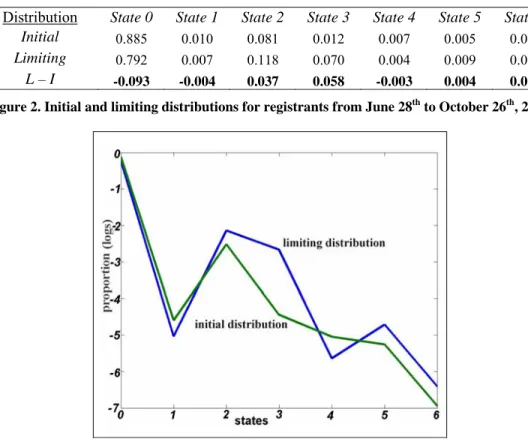
Section 6 begins the more detailed data analysis and discussion of the results obtained with our Markov model, focusing on project-joining and project-founding by the active population of the cohort of developers under examination. It presents a comparison of their initially observed distribution among the activity states and the corresponding limiting distribution to which the Markov chain describing the system converges. Section 7 explores the effect of heterogeneities within sub-groups of the projects’ founders, showing how the propensity to launch new projects tends to be conditioned by the individual’s prior actions as a founder. Section 8 moves the analysis from the examination of Markov chains defined for current activity states to the investigation of expected “career histories” showing the number of cumulated projects founded and joined by each developer over the observed period. The conclusion of the paper in section 9 summarizes the findings in terms of the light they shed on the emergent properties of the FLOSS mode of
innovation as represented by the activity on the SF.net platform, and comments in particular on their broad
implications for the question of the sustainability of the FLOSS system – rather than the issues of sustainability of particular projects. It briefly considers ways in which future research could transcend the limitations of this exploratory implementation of the Markovian approach to analyzing the population dynamics of ecologies of FLOSS developers and their projects.
2. Research questions, empirical setting and methodology
In order to articulate a suitable systems-level approach to assessing the “sustainability” of the FLOSS mode of innovation, the preceding introductory discussion drew upon the seminal ideas presented by March (1991) and other related contributions to the organizational science literature. The present study internalizes those contributions by adopting the following research strategies. First, the focus of analysis is placed on identifying and characterizing the performance of each of two different phases of the innovative process – exploration and exploitation, and on the balance achieved in the coupling between those two sub-processes. Secondly, the framework of analysis for both sub-processes serves to explicitly connect the micro- and macro-structures of the system. Thirdly, the conceptualization of “exploration” at the system level is associated empirically with the mobilization of resources around novel enterprises, whereas the observable micro-level activity of resources at the disposal of already existing enterprises is associated to the phase of “exploitation”. Lastly, the resulting competition for resources between the two processes should be explicitly taken into account.
2.1 Operationalizing exploration, exploitation and the sustainability of innovation
How are we to operationally define the concepts of exploration and exploitation in the context of FLOSS development, so that an empirical study can proceed in accord with the foregoing conceptual approach? The systems perspective and the importance of explicitly connecting the micro- and macro-structures of the system suggest that we should begin by focusing on the activities of the constituent agents or actors (the developers) and move upwards to the level of their common enterprises (the projects), from which perspective the developers appear as mobile resources for which the different projects must compete if they are to survive and grow. Applying the analogy of the industrial district, when developers join existing teams they can be thought of as resources the community devotes to the “exploitation” phase, moving forward the knowledge basis of the community along an already established trajectory. On the other hand, and again referring to the district analogy, when new ventures appear in the form of newly created FLOSS projects, these represent the allocation of developers’ resources to exploration “at the boundaries” of the knowledge basis already mastered by the ensemble of projects established in the virtual locale.
It is worth pointing out that the difference between FLOSS projects and firms reinforces this set of correspondences. Firms organize the relationship among a group of individuals and develop different products over time, but, by contrast, FLOSS projects self-organize around the implementation of one or another particular product idea that will be elaborated, extended and maintained by a fluid group of developers over the course of its life cycle. Within the framework as set out by March (1991), the activities of exploitation and exploration within an industry are seen as being carried on by each of the firms that constitute the industry, whereas, in almost all cases in the open source software world, developers willing to create an innovative product will launch a new project, and seek to mobilize a team of developers that will work to realize their idea.
The first implication to which this leads is that system-level, or community-level exploitation
activities can be regarded as those associated with the mobilization and application of resources in existing projects, because an established project usually is tied to the development of a specific existing software
product. When moving to consider community-level exploration activities, however, the argument cannot
proceed so directly, because as has been noted previously, newFLOSSprojects on SF.net are not necessarily
technologically new. Some projects closely resemble existing ones at the point at which they acquire a
distinct organizational identity. This occurs, for example, when new projects originate from the “forking” of existing projects, and the "spin-offs" start with basically the same code bases. It may be tempting to think of the exploration phase of software innovation as associated simply with the search for technical novelties in computer program architectures and the particular ways in which the latter are implemented in the code. Given such a view, the ubiquitous reuse of code, as well as of the phenomenon of “forking” in reaction to rejection of a proposed alteration in a project’s design, likely lead one to conclude that the FLOSS
development mode is very limited in its innovative capabilities.6 But, it would be a mistake to limit the view
new projects’ exploratory significance to their possible broadening of the technological design space, and hence dismiss a “forked” project as uninteresting because a substantial proportion of the new entity’s code-base contains the code of the initial project.
The potential for economically important software novelty may reside not in the technical
modifications of the code per se, but in the latter having enabled the project to explore and possibly fill a
new and growing market niche.7 Innovation is not co-extensive with the introduction of technical novelties,
and the reapplication of existing product designs and production methods in new market contexts was recognized by Schumpeter as entrepreneurial acts of innovation. Furthermore, even when new FLOSS projects initially resemble existing ones closely in both technology design and product concept, they tend to involve a substantially different group of people, with different skill sets and different conceptualizations of their product’s future evolution. As Rosenkopf and Nerkar (2001) show, if organizations innovate through boundary-spanning, their exploration has a stronger impact on the evolution of the technology when the spanned boundary does not cross different technological domains but overcomes organizational boundaries. Knowledge coming from actors "outside the firm" is a source of diversity that can be exploited to escape the trap of “local search” and induce wider exploration even when the underlying technology is similar. The
6 Klincewicz (2005) has concluded, on just such grounds, that the technological innovativeness of FLOSS projects is very low: “Decision making processes in many OSS projects are highly formalized, which additionally discourages new concepts. It is easier to fork the code, than convince project decision makers to implement certain ideas. An example could be Samba TNG (The Next Generation), forked from Samba (file sharing and printer server for Linux environment, able to communicate with Windows computers). When innovative architectural suggestions were opposed by Samba project leaders, their proponent had no other choice than to launch an independent project in 1999 (Weber 2004: 169). After 6 years of development, Samba TNG remains a niche project, not included in known Linux distributions nor supported by commercial vendors.” (Ibid.:p.19).
7 Recalling the example from the preceding footnote, in which Samba TNG, the “forked” version of the Samba project arose from the misalignment of the developers’ visions of the projects, the difference between the two projects, indeed the very meaning of a fork, originated in the disparate architectural concepts that people wished to implement within Samba, and which implied different trajectories of exploration in the functional/product space. In this regard, whether the new (forked) project proved successful or ended up as a comparative failure, as a dormant occupant of a narrow product niche is irrelevant when referring to the capability of new projects to represent community-level exploration. Exploration is an inherently risky business.
9 The role of diversity in enhancing the payoffs from search activities has been treated also from the perspective of cognitive psychology, where the value of exposure to different problem- framing and solution skills is emphasized (e.g., recently by Page, 2007). An earlier, search-theoretic approach to R&D economics focused on the implications of the
same logic applies generally to new ventures whether they take the form of new firms or new communities assembled around FLOSS projects. In all these cases people with diverse experiences, cognitive frameworks
and sets of potential solutions gather together and share their knowledge to form new combinations.9 The
very fact of a project being organizationallynew, connecting some previously non-interacting agents, tends
to creates greater room for exploration even when the recombinant novelties emerge along an already
established trajectory. Therefore, new projects, most plausibly are among the primary sites where new ideas actually will be implemented and elaborated. In short, the second proposition at which we have arrived holds that if the system’s principal locus of “exploration” is to be found anywhere, then new project formation activity would be the obvious and best place to look for it.
The preceding considerations suggest that our analysis of the innovation capabilities of the FLOSS system should be directed to answering the following research questions:
1) On exploitation: Does the FLOSS system exhibit the tendency to increase the proportion of
developers laboring in existing projects?
2) On exploration: Does the FLOSS system exhibit the tendency to increase the proportion of
developers launching new projects?
3) On sustainability: What do the answers to the foregoing questions permit one to say about the
sustainability of the FLOSS innovation mode that is displayed in the SourceForge ecology?
2.2 Empirical setting: the SourceForge environment
To observe an actual ecology of FLOSS projects the present study draws upon data pertaining to the
individuals and projects that were observed on SourceForge.net (SF.net, at http://sourceforge.net) during the
period from September 2000 to December 2002. SF.net is an on-line platform managed by SourceForge Inc.,
where FLOSS developers can meet and coherently organize their activities on different projects. SF.net is
just one of the possible platforms developers can use to coordinate their work, being FreshMeat and
Savannah notable sites that also host community mode open source software projects. Indeed, SF.net does
not host the very largest and emblematic projects engaged in what Dalle and David (2005) label “C-mode”
(for community-mode) production of FLOSS, many of which, like the Linux kernel or Apache, maintain
their own sites. Nevertheless, as of 10th January 2003, the date of the last observations used in this study10, 73
development teams on SF.net – including well-known projects like Freenet, BZFlag, Python, and JBoss11 –
had membership counts in the range from 30 to 102. These share many of the challenges of coordination,
contributor recruitment and governance encountered by the largest C-mode entities, and, in that regard (as
well as in the comparative salience of their products) are readily distinguished from the mass of FLOSS
projects that were led and staffed by one or two individuals.12 Moreover,
SF.net is far and away the most
densely populated in numbers of project groups and members: at May 9th, 2007, it hosts 147,905 projects and
has 1,579,588 registered uses, against the 42,815 and 2,757 projects and the 383,282 and 50,267 registered
users of FreshMeat and Savannah, respectively.
positive relationship between the second moment of a variate’s distribution and the first moment of the corresponding extreme value distribution; this suggested external search as a means of increasing the variance of the underlying distribution of opportunities from which selections could be made for development research (see, e.g., David 1974). 10 The whole set of available data span the period from the beginning of November 1999 to January the 10th, 2003. Our analysis focuses on the period from September 2000 to December 2002 because the specific variable we need are defined just in that interval.
11 Notice that some projects host some features outside SF.net. For example, Python (at http://www.python.org/) and JBoss (at http://www.jboss.org/).
12 The latter class of FLOSS projects are labeled
I-mode (“independent”) by Dalle and David (2005), who point out that
the disclosure of source code and terms of licensing, rather than their organization structures and development methods, differentiate these projects from their counterparts among the proprietary software companies. FLOSS projects at that end of the size range can be created ex post, simply by a decision to distribute pre-existing conventional
Following the foundation of SF.net late in 1999, SourceForge Inc., collected and organized a data
archive containing a chronological record of the activities of developers and projects hosted on the platform. On SF.net individuals can launch their own FLOSS projects, posting the relative code and benefiting from
the tools the platform offers to manage the cooperative development of software (forums, mailing lists, code repositories, and so on). Other registered members can then join these founders and create ecology of teams working on FLOSS projects. Or they can simply remain “lurkers” and follow the activity of the hosted
projects, only seldom sending some kind of contribution to the teams. As it is clear, SF.net constitutes an
important microcosm of the FLOSS universe, in which a great variety of organizations are found to co-exist, some closely resembling one another, and others being very different in size, organizations structure, and purpose. Thus, it represents a perfect setting to undertake the system-level analysis described in the previous sections.
The portion of thedataset on which we rely contains observations on the activities undertaken during
the period between the beginning of September 2000 and December 2002 by a cohort of 222,835 individuals
that registered on SF.net during the 14 months from September 1, 2000 through October 26, 2001. We
computed the mean probability that each one of these developers moved from a passive “lurking” state to more active states. Two main “active” states are considered, each one proxying one of the two processes we are interested in: exploration and exploitation. In particular, we detect if the developer has joined any project team (so that she contributes to the exploitation process undertaken by the community) or has founded new projects (exploring “at the boundaries” of the knowledge basis already mastered by the community) in a certain period of time. Since the probability of movements between a lurking state, a “member” state, or a “founder” state can be conceived as a ‘transition probability’, the properties of these transitions can be studied applying the statistical apparatus developed for the analysis of Markov processes. In what follows the estimation of transition probability matrices and the properties of Markov chains will be employed both descriptively and as a means of exposing the persisting micro-level patterns of joining and project-founding, and their relationship to the macro-level innovation capabilities of the FLOSS collaboration environment represented on SourceForge.
2.3 Role differentiation among developers: the background of related FLOSS community studies
The aim of the present study is to describe the innovation-generating potential of the FLOSS mode of development as these are reflected in the coupled processes of project-founding and project-joining. To our knowledge, this is the first attempt to infer system-level capabilities from the investigation of these two processes in the “open source” context. Moreover, our study helps to shed some more light on the phenomenon of FLOSS project founding, a process that appears comparatively neglected in the empirical literature. Save for a few exceptions (e.g., Giuri et al. 2006b, and Rullani 2006b), investigations of the organization and conduct of community-based peer production have not focused on projects foundation and instead focused exclusively upon already established projects, which then makes it natural to concentrate attention upon the processes through which FLOSS developers having variegated motivations and skills become attracted to one or another such “community,” and come to take up the variety of tasks defined within those organizational entities. Few such studies have moved beyond snapshot views of the activities within projects, whereas the present analysis employs a statistical methodology that is explicitly dynamic in identifying distinct roles played by developers over the course of many months. .
Furthermore, rather than imposing preconceptions about the sequence of role-changing steps that the typical FLOSS developer follows in the progressive occupancy of different project roles, the approach adopted here provides a framework that uses the available micro-level data on the population of developers on SF.net to characterize patterns in the expected rates and directions of their movement among specified
“development activity states” over successive 6-month time periods. This contrasts with the more usual, project-centered empirical approach that presupposes a set of differentiated roles between which individuals migrate step-wise – moving from peripheral and infrequent actions to regular attachment to a project and thence towards forms of contribution and administrative responsibility successively more and more exacting in their experience and skill-requirements, and therefore closer to the supposed “core” of the team working on the project in question. The most widely known schema for this structure is the so-called “onion model” (Crowston and Howison, 2005), which represents agents in the stylized FLOSS production community as being positioned in successive layers radiating outward form a “core” of initiators, release managers, maintainers, “core developers”, co-developers, active users, specialized bug-patchers, and lurkers at the edges of the project who follow the threads in the email forum discussions, watch the evolution of the codes
in particular sub-projects, and eventually begin to engage with the community on a more regular basis or simply remain passive. Much of the research devoted to measuring the relative numbers of the members occupying these differentiated roles has taken the form of careful and quite detailed case studies of specific projects (e.g. Mockus et al., 2000), while the early empirical efforts to implement the “onion model” were confined to static, cross-section analyses (e.g., Crowston and Howison 2005) that precluded observation of developers’ moving backwards and forwards between non-adjacent layers of the “onion”, or concurrently occupying the same role in more than one project, or taking quite different roles in each of several projects.
A line of investigation that is more immediately related to the present study has been concerned explicitly with the sequential dynamics of FLOSS “project joining.” Pioneering research on this subject was carried out by von Krogh, Spaeth and Lakhani (2003) in a case study of Freenet, a project developing a
peer-to-peer system (which as was noted above is among the biggest projects hosted on SF.net in the period of
analysis). By examining the chronological record of individuals’ appearances in email subscriber lists and forum records of bug reports and patch submissions, as well as of the tasks performed as members of the project, the authors identify an implicit “joining script” defined by the type, frequency and intensity of individual’s engagement; they then measure the distribution of durations that were required for contributors to make the passage from the periphery to the core of the project’s code development activities. Jensen and Scacchi (2005) also have studied processes of “recruitment and role migration,” focusing on the transitions from the role of end-user toward involvement in code development in a number of projects that were selected as separate case studies. In contrast to the notion that there is “a” joining script, they find a variety of paths, some of which do not conform to the conventional conceptualization of step-by-step progressions from periphery toward the project’s core.
In a still more recent case study focusing on GNOME,13 Herraiz
et al. (2006) also ask whether the
conventional dynamic interpretation of the onion model is a good representation of the joining process, and seek answers by estimating the distribution of transit times between developers’ first instances of performing characteristic tasks in the onion’s successive layers. Although it is typical for individuals in the GNOME
community to have contacted the project by email before beginning to commit code14, conventional
suppositions regarding the next step in the sequence are violated by most of the GNOME developers’ behaviors: for example, they often commit to the project’s CVS before sending their first bug report. In general, this study finds striking evidence of the existence of significant heterogeneity in the developers’ population with regard to the degree of directness and speed with which individuals move into core development work, and tries to put forward hypotheses on the possible variable that could accounting for the
diversity.15 A different aspect of the internal micro-dynamics is studied by Christley and Madey (2007). The
authors define roles on the basis of the activities undertaken by developers registered to SF.net, and examine
temporal changes in the distribution of the occupants of positions associated with those tasks. They find that aside from very broadly defined categories such as “Software Developer” and “Handyperson”, the relative frequencies of specific task-positions exhibits high rates of decay, and conclude that FLOSS projects typically are too small to sustain permanent task-specialization. Rather than dealing with the problems posed by trying to find “stable” organizational task-associated roles that could be identified across a wide array of projects, the approach pursued here does not attempt to utilize the detailed information available in the
SF.net archive about group members. Instead it focuses on analysis of a dataset that permits tracking the
roles occupied by individuals in regard to project participation, project joining and project launching in successive time-intervals.
13 GNOME is a large, well known project developing components of a FLOSS desktop environment, which enjoys sponsorship from several companies through its foundation http://foundation.gnome.org.
14 Every time a developer changes the code basis of a project, CVS commits are produced. Thus, their number gives an idea of developers’ rate of activity in the production of code and of their role into the project.
15 The striking results reported by Herraiz
et al (2006) is that almost two thirds of the entire small cadre of developers
that was identified from the CVS as having moved within the shortest time-interval from joining the project into core development work with “commit” privileges were discovered to have been professional programmers sent to help the project by its sponsoring companies. On this issue the reader can see Dahlander and Wallin (2006).
3. The Data
3.1 Gathering data from SourceForge: the SFnetDataset
The statistical analysis is this paper is based upon an edited dataset (referred to here as the
SFnetDataset) covering the SourceForge cohort of 222,835 individuals who registered on SF.net during the
14 months from September 1, 2000 through October 26, 2001. There are other datasets relating to SF.net.
For example, the FlossMole project16 gathers together and gives coherency to different data sources
(obtained primarily from such platforms as SF.net or Freshmeat) describing FLOSS projects and developers’
activities. Another recent initiative, undertaken by a group of researchers of the Notre Dame University, has
released a series of monthly dumps of the SF.net data archives under a special license (see
http://www.nd.edu/~oss/Data/data.html).
Several previous studies have drawn data from the SF.net site and its repositories to answer a
variety of questions concerning the phenomena of open source software producers and production. The following list is not presented as inclusive, but suggests the richness and multi-dimensional nature of this information source. Krishnamurthy (2002), in a pioneering ecological study, examined a sample of project groups from the platform, using several indicators to select 100 “mature” projects to study their membership size and the activity levels reflected in their email forum discussions and commits to their respective CVS
repositories. More recently, Madey et al. (2004) have mapped the network of developers’ collaborations as
members of project groups, Fershtman and Gandal (2004) sought to identify the determinants of variations in projects’ average output of code per contributor-member, Lerner and Tirole (2005) examined the determinants of the choice of a specific open source license, while Lerner, Pathak and Tirole (2006) have drawn upon SourceForge and project web sites to create a dataset of large projects with which to study the
contribution to FLOSS made by “developers” whose email address is a “.com” domain. Comino et al. (2005)
have statistically identified factors determining SF.net projects’ attained stages of development. Still more
recently, Giuri et al. (2006a) have exploited information from the SFnetDataset (the same archival data as is
used here) in order to study the diversity of skills, experience and the division of labor among the members of SF.Net projects extant during 2000-2002; Robles and Gonzalez-Barahona (2006) have utilized time stamp
and other information collected on first registration to discover the geographical distribution of the more than
1,180,000 individuals who were listed as registered on SF.net in November 2005.
3.2 Accuracy of the data, dataset cleaning methods, and reliability in the present context
As is the case with many valuable deposits, there are non-negligible “refining” costs entailed in
exploiting the material extracted from SF.net. Some errors have been found in the procedures followed by
SF.net maintainers in building summary statistics and storing the data (see Hunt and Johnson, 2002).
Moreover, even when the collected numbers are corrected, instances of developers’ improper use of the
facilities provided by SF.net somewhat degrade the accuracy of the resulting statistics (see Howison et al.,
2005). To prepare the SFnetDataset on which this study is based, the original material from the archive was
first “cleaned” by application of a variety of ad hoc procedures, and a systematic algorithm for inferring
founders’ identities from partial information has been implemented. Where automated procedures were not able to correct suspect data entries or identify a project founder, each problematic item was corrected by hand, comparing the available information with other sources of data (other records in the database, the
SF.net website). In general, some assumptions about specific features of the operation of the SF.net data
system were unavoidable, while some features of the data prevent the correction of some specific errors.17
For example, when work on the dataset was first undertaken there was no way to unify different user_id's
that actually belonged to the same individual. Fortunately, a subsequent estimate of the impact of this and of other problems has shown that the resulting residual errors constitute a small fraction of the large number of developers involved in most of the processes that are examined by the present study. Moreover, even when this percentage I is not insignificant, most of these imperfections are basically random with respect to the history of each individual, and thus their net effect in biasing the estimates should be negligible – although
16 FLOSSmole (formerly OSSmole, conveniently accessed at http://ossmole.sourceforge.net/) is a project developing tools for gathering data (metrics) about the development of free/libre/open source projects, archiving data donations from other research groups, and also publishing the resulting analyses about FLOSS projects. See Howison et al., 2005.
17 A further discussion on the data can be found in Giuri
et al. (2006a), that project being the original context in which
they contribute to the noise in the data. A series of ad hoc controls on specific sub-samples and the close
analysis of the aggregate results confirm that any remaining suspicious data can have at most a minor impact on the results.18
A number of previous studies have pointed to a different class of “perils and pitfalls” of working
with SF.net. Most cautions that have been issued along these lines relate not to errors in the data itself, but to
mistakes in analysis arising from casual acceptance of the information without an adequate understanding of the way in which it had been generated, or collected. Howison and Crowston (2004) and Rainer and Gale
(2005) both warn against accepting observations based on SF.net as representative of the FLOSS community
at large, in particular noting the high number of one-person and/or inactive projects hosted by the platform and the absence of many of the largest projects, which have their own web-sites. As has been noted
previously, however, this study treats SF.net and the behaviors of the individual registrants not as
representatives or exemplars of the universe of distributed collective production communities, but on their own terms, as reflecting the experience of a quantitatively important (but nonetheless particular) collaborative development environment. There is another “pitfall” to be borne in mind, which results from
the platform’s “open-ness”: projects that have been largely developed externally to the SF.net environment,
even those whose code is hosted elsewhere, may be posted on SF.net in order to give them greater visibility
(Comino et al., 2005; Howison and Crowston, 2004). Where such is the case, a project that actually was
important and very much alive (elsewhere), nonetheless, might appear on SF.net to be both small and
dormant. This however means that the project’s relationship with the platform must be very weak, and the role of the project in the whole ecology is likely to be marginal. Our data detect precisely these
characteristics. Thus, since we focus on the “window” that SF.net offers to look at FLOSS development, this
problem is to a certain extent irrelevant in our analysis.19
4. Markov chain analysis
Given the nature of the SFnetDataset, we need a statistical framework that is able to capture
parsimoniously the main features of the micro-level processes that are of interest, namely, resources mobilization and new projects foundation. The application of Markov chain analysis (see e.g., Amemiya 1985, Hamilton 1994) is quite suitable for this purpose. In economics and managerial studies this is not a new approach, it has been applied widely in studying a variety of dynamical systems – including those
governing industrial populations (e.g., Ezcurra et al., 2006), income distribution (e.g., McCall, 1971;
Shorrocks, 1976), growth and regional inequality (e.g., Quah, 1993; Fingleton, 1997; Kremer et al., 2001),
finance and accounting (e.g., Cyert et al., 1962; Konings and Roodhooft, 1997), and innovation (e.g., Cefis,
2003). In applying this framework for our present purposes, the appropriate first step is the delineation of a manageably compact “state space” describing an exhaustive set of activity-states into which individuals
observed in the SF.net environment during any interval of time can be classified.
4.1 Defining the “activities” state space
Individuals registering on SF.net participate in the activities of this “community” in several basic
roles: they may “lurk” without interacting with others or with existing projects in any of the several ways that the infrastructure of the platform would record. Alternatively, they may send patches, bug reports or request specific features to one or more of the established project; enter one or more projects and be listed as
18 In some cases, we also “simulated” what would have happened if some of the most important estimates were different (e.g. we smoothed the skewed distributions of some rows) and find that the results are robust. As a final note on the limitation of the present analysis notice that we do not control for environmental changes that could have modified the conditions in which the individual histories of the users developed. When such changes were identifiable, their impact on the analysis was evaluated and always found negligible. For example, we found there were changes in the criteria that the SF.net staff applied in approving projects. Although that could affect the estimated likelihood of founding a
new project over time, we have analyzed the data in such a way as to minimize the influence of such a changes: the limiting distribution in section 7 is estimated using only the cohorts for which that change did not occur, and the subsequent analysis (section 8) of the different behavior of the two subset of developers C1 and C2 is undertaken for all
cohorts, but compares populations that are equally affected by this phenomenon because they were formed by approximately the same proportion of individuals in each cohort. Additional ad hoc robustness checks, such as the
study of the cycle of new projects foundation, similarly show that that the result are not sensitive to those changes. 19 Note also that the assessment of this latter problem by Comino
et al., 2005 concludes, similarly, that in the context of SF.net as a whole the absence of data on projects that have their own websites elsewhere is of limited importance.
“group members;” and initiate new projects. A scale of activities is implicit in this, ranging from inactive to increasingly “active” behaviors, and resources mobilization can be conceived broadly as a transition from the lowest to the highest levels of developers’ involvements into the community activity. As a practical matter, however, it is useful to recognize only three discrete levels in the “mobilization” of resource inputs: (i) contribution of bug reports, patches, and feature requests while remaining external to the projects, (ii) participation as internal members of projects, and (iii) the “founding” of new projects.
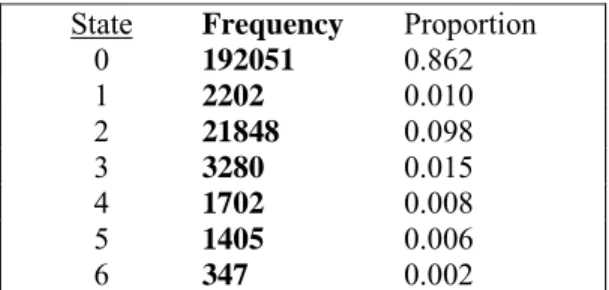
Consequently, we distinguish and capture all of these activity/roles by assigning every registrant to one and only one among the following set of “activity-states” in each of every 30-day period of her or his
experience in SF.net:
0=non member and non founder20, inactive21; 1=non member and non founder, active;
2=member22 of 1 project and non founder of any project (both active and inactive);
3=member of more than 1 projects and non founder of any project (both active and inactive); 4=founder of 1 project and member of 1 project (both active and inactive);
5=founder of 1 project and member of more than 1 projects (both active and inactive);
6=founder of more than 1 project and member of more than 1 projects (both active and inactive).
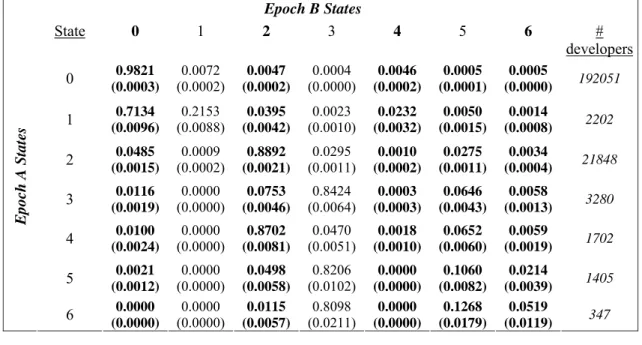
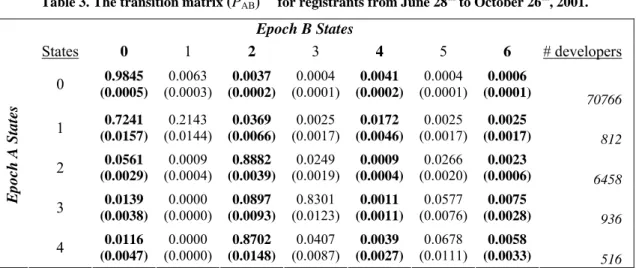
With the states s=1, 2, …, 6 belonging to space s thus defined, observations on the frequency of the
movements of individuals from state i in “epoch” Tt to state j in the next temporally adjacent “epoch”, Tt+1 ,
can be used to calculate average state dependent transition probabilities, and the results may then be organized to form a transition probability matrix. Treating these estimated mean probabilities as constant, the
system is a homogeneous Markov chain with transition matrix P(t) = P.
4.2 Conditions for ergodicity of Markov chains, and their present relevance
A Markov chain is called ergodic if the distribution of the system among its states at step r, p(r),
converges to a limiting (or equilibrium) distribution, p, which is independent of the initial distribution p(0).23
By analysis of the transition matrix P it is possible to establish whether a Markov chain satisfies the
conditions for ergodicity, which is to say that the iterated transition process eventually will cause the system
to shake free of any arbitrary initial distribution p(0). When that is the case, it is possible to calculate the
limiting (ergodic) distribution of developers among activity states.
In presenting this approach, it is important to emphasize that the limiting (ergodic) states we will
exhibit are not interpreted here as long-run forecasts, because the length of the period covered by the SF.net
archive that is under examination here is quite short, and far too brief to allow meaningful predictions for this evolving environment. On the contrary, the Markov chain apparatus is here used as a way to expose the persisting dynamic forces of the system, abstracting from the effects of transient influences that may have affected the initial distribution of the individuals. As Quah suggests with respect to his Markovian analysis of countries’ growth paths: “The steady-state distributions should not be read as forecasts of what will
20
The only “foundations” we take into account are those who generated projects whose founders are still part of at the end of the month in which they were launched. A part from this minimum requirement, inasmuch as the foregoing comparisons aggregate all founders and make no attempt to distinguish the successful from the unsuccessful projects that they have launched, there is no warrant here for concluding that there are no individual characteristics or qualities of founders that matter, or that would differentiate the successful leaders of new projects from the rest of the developers’ population.
21 The developer is considered active if she did post at least one item classified as “patch”, “bug report” or “feature request” to the tracker system of SF.net of at least one project during the analyzed period. Otherwise, she or he is
considered inactive. Notice that SF.net allows developers to post also other typologies of “artifacts”, for example
“support requests”. We excluded this category because it did not represent the same level of contribution as bugs, patches and feature requests do. Moreover, following Christley and Madey (2005), also the small percentage of artifacts (around 3% of the overall number of artifacts) created ad hoc by some project administrators were excluded because
their level of contribution could not be easily identified.
22 As done for the foundation activity, an individual is here considered to be a member of a project if she or he enters that project in a certain period and is still part of it at the end of that period.
23 If the Markov chain is ergodic, the probability of remaining in each state goes to a constant (which is the inverse of the mean recurrence time) at the limit, and the resulting limiting distribution is found as the solution of p = pP.