MIMO transmission
Yasser Fadlallah, Abdeldjalil Aissa El Bey, Karine Amis Cavalec, Dominique
Pastor
To cite this version:
Yasser Fadlallah, Abdeldjalil Aissa El Bey, Karine Amis Cavalec, Dominique Pastor.
Low-complexity detector for very large and massive MIMO transmission. SPAWC 2015 : 16th IEEE
International Workshop on Signal Processing Advances in Wireless Communications, Jun 2015,
Stockholm, Sweden. pp.251 - 255, 2015,
<
10.1109/SPAWC.2015.7227038
>
.
<
hal-01203097
>
HAL Id: hal-01203097
https://hal.archives-ouvertes.fr/hal-01203097
Submitted on 22 Sep 2015
HAL
is a multi-disciplinary open access
archive for the deposit and dissemination of
sci-entific research documents, whether they are
pub-lished or not.
The documents may come from
teaching and research institutions in France or
abroad, or from public or private research centers.
L’archive ouverte pluridisciplinaire
HAL
, est
destin´
ee au d´
epˆ
ot et `
a la diffusion de documents
scientifiques de niveau recherche, publi´
es ou non,
´
emanant des ´
etablissements d’enseignement et de
recherche fran¸
cais ou ´
etrangers, des laboratoires
publics ou priv´
es.
Low-complexity Detector for Very Large and
Massive MIMO Transmission
Yasser FadlallahStudent Member, IEEE Abdeldjalil Aïssa-El-BeySenior Member, IEEE, Karine
AmisMember, IEEE, and Dominique PastorMember, IEEE
Institut Télécom; Télécom Bretagne; UMR CNRS 6285 Lab-STICC Technopôle Brest Iroise CS 83818 29238 Brest, France
Université européenne de Bretagne Email: [email protected]
Abstract—Maximum-Likelihood (ML) joint detection has been proposed as an optimal strategy that detects simultaneously the transmitted signals. In very large multiple-input-multiple output (MIMO) systems, the ML detector becomes intractable due the computational cost that increases exponentially with the antenna dimensions. In this paper, we propose a relaxed ML detector based on an iterative decoding strategy that reduces the computational cost. We exploit the fact that the transmit constellation is discrete, and remodel the channel as a MIMO channel with sparse input belonging to the binary set {0,1}. The sparsity property allows us to relax the ML problem as a quadratic minimization under linear andℓ1-norm constraint. We
then prove the equivalence of the relaxed problem to a convex optimization problem solvable in polynomial time. Simulation results illustrate the efficiency of the low-complexity proposed detector compared to other existing ones in very large and massive MIMO context.
I. INTRODUCTION
In wireless communications, multiple-input-multiple output (MIMO) transmission is a technology that significantly in-creases the achievable data rate without any extra transmission power [1]. Multi-user massive MIMO network is a scenario that has been recently proposed, where many mobile terminals are served by a Base Station (BS) equipped with a very high antenna number [2]. In such a scenario, the detection in the uplink remains a challenge, since the BS is required to detect signals transmitted from all users while trying to exploit full received diversity. The optimal detection criterion that fulfills the diversity requirement is the Maximum-Likelihood (ML) joint detection which has been proposed to detect jointly the transmitted signals [3]. ML detector is able to minimize the probability of error in the medium and high signal-to-noise ratio (SNR) region. However, such a criterion is not applicable to the addressed multi-user massive MIMO scenario due to its computational complexity that increases exponentially with the number of signals to be detected. Alternative solutions have been proposed aiming at reducing the complexity while preserving optimal performance. Among these solutions the sphere decoder (SD) based on a well-defined spherical search [4]. However, SD exhibits also a variable computational complexity that highly depends on the SNR region, the signal dimensions, and the sphere radius initialization. The computational complexity order has been upper-bounded by O(MγN), where γ ∈ (0,1] depends on
both SNR value and sphere radius initialization,Nis the signal dimension, andMis the constellation size [5]. Other proposed linear solutions such as minimum mean square error (MMSE) and zero-forcing (ZF) present rather low complexity at the expense of a high performance-loss.
In order to suit high dimensions problems, this paper aims to find out a relaxed sub-optimal detection criterion that significantly reduces the complexity order. The key idea is to exploit the finite transmit constellation size, and to relax the ML problem constraints such that iterative algorithms can be applied. The iterative strategy of decoding aims to maintain a low computational cost even when the signal and/or constellation size increase. Firstly, the MIMO channel model with inputs belonging to a discrete transmit constellation is shown equivalent to a new model with sparse inputs belonging to the binary set {0,1}. Then, the ML detection problem is formulated as a minimization problem of a quadratic cost function under linear and constantℓ0-norm constraints.
How-ever, such a problem is Non Polynomial (NP-hard) because of the constantℓ0-norm constraint. Referring to the literature
of sparse problems, and in order to reduce the computational cost, theℓ0-norm can be relaxed by theℓ1-norm even though
the equivalence is not always true. This relaxation pushes the problem to have a solution at the intersection of a lozenge of unit diameter and an explicit plan. On the the other hand, theℓ1-norm equality constraint can be readily proven as
non-convex constraint. In order to overcome this non-non-convexity, we prove that, thanks to the presented linear constraints in the new detection problem, the constantℓ1-norm amounts to
ensuring that all components of the variable vector are positive. As a result, the relaxed detection problem is a minimization of a quadratic function under linear equality and positive variables constraint. Such problems can be resolved using first order iterative algorithms (i.e. gradient descent) or even more accurate algorithms such as primal-dual interior point (PDIP) methods [6]. A main advantage over other low complexity detectors such as the MMSE Successive Interference Cancel-lation (MMSE-SIC) is that, the proposed detector does not require any modification when applied to underdetermined1 MIMO systems, which is not the case for the MMSE-SIC [7].
1When the number of receive antennas is smaller than the number of
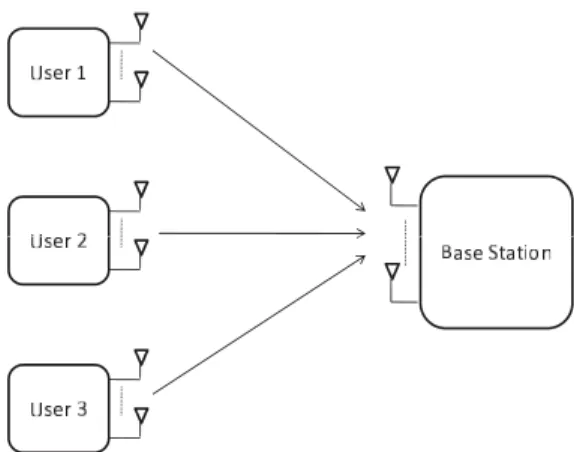
Fig. 1: 3-user MIMO multiple access channel
The rest of the paper is organized as follows. The system model is described in Section II. The new MIMO sparse model is introduced in Section III. Section IV proposes a relaxed ML problem that minimizes a quadratic objective function under linear equality and positive variables constraints. In Section V, the simulation results enable the evaluation of our contribution. Finally, Section VI concludes the paper.
Notations: The superscripts (.)T and (.)H stand for the
transpose and transpose conjugate matrices, respectively. The normℓpis represented by||.||p, and the Kronecker product by ⊗.IN is theN×N identity matrix and1N is theN-length
vector with components equal to one. II. SYSTEM MODEL
We consider a scenario where K User Equipment (UE) equipped with Mk antennas each, are communicating with
a BS equipped with N antennas, and N ≫ Mj ∀j ∈ {1,· · ·, K}. We assume a perfect channel state information (CSI) knowledge between the BS and all UEs at the BS. The received signal is defined as follows
y = K X k=1 Hkxk+z= ¯Hx+z, (1) whereH¯ = [H1,· · ·,HK]Hk,x=xT1,· · ·,xTK T ,Hk∈
CN×Mk is the random channel matrix between the kth UE
and the BS, xk is the Mk×1 data vector from thekth UE
with symbols selected from a finite alphabet constellation, and
z is theN×1circularly symmetric additive Gaussian noise vector with zero mean and covariance matrix equals toσ2IN.
The components ofxkbelong to a finite alphabet constellation
defined as A= {a1,· · ·, aL} whereLis the cardinal of the
set A. For example, the Binary Phase Shift Keying (BPSK)
constellation is the set A={−1,+1}of cardinalL= 2. III. SPARSE DECOMPOSITION
The goal of this paper is to propose an efficient detector, characterized by a polynomial complexity order with respect to the antenna dimensions, that jointly detects all transmitted signals at once. We assume a priori knowledge of the transmit constellation. We exploit the fact that the original symbols
belong to a finite and discrete constellation, and we decompose each symbol on the basis of the vector space in which the finite alphabet vector can be cast i.e.a= [a1,· · ·, aL]where L is the finite alphabet cardinal. That is, the joint symbol vector stacking all UEs transmitted data withMentries (M =
PK
j=0Mj), can be modeled as an equivalent sparse data vector
withM×Lentries. Thejthsymbolx
jofxcan be formulated
as
xj = a sTj,
wheresj = [δa1(xj), δa2(xj)), · · ·, δaL(xj)], (2)
whereδai(xj)is the discrete delta measure which is equal to
1whenai=xjand0otherwise. Applying this decomposition
over all symbols, the vectorxcan be expressed in function of a sparse vectorsas
x = Bas,
wheres = [s1, · · ·, sM]T, andBa =IM⊗a. (3)
Bais a block diagonal matrix of sizeM×M L. Substituting
(3) into (1) yields the received signal as follows
y=HB¯ as+z. (4)
The sparsity degree2of scan be calculated asL(M−1).
In order to better clarify the above decomposition, we give the following example. Let us consider a BPSK constellation with a basis vector a = [−1,1]. Let us define x a vec-tor with elements belonging to the BPSK constellation, and
x = [1,−1]T. Applying the decomposition in (2) and (3),
each element of x can be cast on the constellation basis a
such thatxcan be rewritten as
1 −1 = −1 1 0 0 0 0 −1 1 . 0 1 1 0 (5)
The sparsity degree ofs= [s1;s2]is2.
The transmitted symbols in the new model are the binary components of the vector s. In the upcoming section, we propose a convex approximation of the ML detector based on the euclidean distance minimization to detect the new variable vectorsiteratively using low-complexity algorithms [6].
IV. RELAXEDML DETECTOR
A. Relaxed Minimization Problem
The ML criterion seeks the solution with the closest point to the received signal in the received constellation, that is, the symbol vector that satisfies a minimum euclidean distance between y and H x¯ . The detection problem formulation is given by
(P0) : arg min x∈AM ||
y−Hx¯ ||2. (6)
Such a problem suffers from a high computational cost due to the indispensable exhaustive search over the set AM. Using
the symbol vector decomposition as in the previous section, we propose the following
Lemma 1: The minimization problem(P0)is equivalent to
the following problem
(P1) : arg min s∈RM L ||
y−HB¯ as||2
subject to B1s=1M, ||s||0=M. (7)
where the ℓ0-norm is the weight ofsand the block diagonal
M×M LmatrixB1 is given by
B1 = IM⊗1TL. (8)
Proof:Let us denotexa vector withM elements belong-ing to a finite alphabet set. Referrbelong-ing to Section II,xcan be decomposed as x=Bas, wheresconsists ofM sub-vectors
with only one non-zero element equal to one. In other words, the sum over each sub-vector is equal to one i.e.B1s=1M,
and the total number of non-zero elements in sis equal toM
i.e.||s||0=M. Let us now assume the following hypotheses: B1s=1M and||s||0 =M. The first condition B1s=1M,
i.e. PLp=1s(j−1)L+p = 1 for all j ∈ {1,· · ·, M}, implies
that at least one non-zero element exists in any sub-vector
j ∈ {1,· · ·, M}, with a minimum total non-zero elements number M. The second condition ||s||0 = M imposes the
total non-zero elements number to be equal toM, thus along with the first condition, each sub-vector can contain only one element different from zero and equal to one. Thereby, the projection of the vectorsonto the dictionary matrixBayields
a vectorx=Basin the finite alphabet constellationAM.
Solving a quadratic minimization problem under ℓ0-norm
constraint is in general complex and may require exhaustive search strategy, which can be intractable in practice for large signal dimensions. Therefore, by mimicking literature on sparse reconstruction [8], we propose to replace theℓ0-norm
by the ℓ1-norm. The reason for this approximation is that the
ℓ1-norm represents the best convex approximation of the the
ℓ0-norm [9]. Thus, we address the much simpler problemP2,
(P2) : arg min s∈RM L ||
y−HB¯ as||2
subject to B1s=1M, ||s||1=M. (9)
On the other hand, let Sbe the set defined by the constraint
||s||1=M, by referring to the definition of a convex set,
∀s1,s2∈S, λs1+ (1−λ)s2∈S, (10)
we find out that the constraint ksk1=M does not defined a
convex set. But it defines a convex set when it is combined with the constraint B1s=1M. In order to prove our claim,
we propose the following lemma
Lemma 2: Let us define a real vectors of lengthM Las given in Section III, and satisfying B1s=1M. Theℓ1-norm
is equal toM if and only if all elements ofsare positive.
Proof: Let B1 = IM⊗1TL. The non-zeros elements of
the kth row of B
1 are all equal to one and are those whose
indices range from (k−1)L+ 1 to kL. Thus B1s = 1M
implies
L X
p=1
s(k−1)L+p= 1, ∀k∈ {1,· · ·, M} (11)
By successive additions with respect tok, we obtain
M L X i=1 si= M X k=1 L X p=1 s(k−1)L+p=M. (12)
Let us first assume that all components ofsare positive. Then
si=|si|and using (12), we deduce that PM L
i=1|si|=M, i.e.
ksk1=M.
Let us now assume that ksk1 = M. According to (12), we
can thus write
M L X
i=1
(|si| −si) = 0. (13)
Let N(s)6= ∅ denote the set of indices corresponding to all nonzero negative elements of s. Then PM Li=1(|si| − si) =
2P
i∈N(s)|si|. It follows from (13) that si = 0 for every i∈N(s) which is in contradiction with N(s)6=∅. We thus deduce that N(s) = ∅ and all components of sare positive. The set defined by the constraints B1s=1M and s≥0 is
obviously convex. Thence, the decoding problem becomes
[Quad-min] : arg min
s∈RM L k
y−H Bask2
subject to B1s=1M, ands≥0. (14)
This new optimization model is a quadratic programming model with linear equality constraints and non-negative vari-ables. Such a problem can be solved using first order opti-mization algorithm such as the gradient descent, or even more accurate algorithms such as the PDIP. This latter is largely discussed in the literature (for more details the reader can refer to Section V in [10]), where the authors have proposed a reduced PDIP algorithm in which modified Newton steps are used. It is characterized by a polynomial time compared to the NP-hard solver. The required arithmetic operations is of orderO(M3), whereM is the variable vector length defined in Section II, whereas the NP-hard requires a number of operations that increases exponentially with M i.e.O(LM).
Remark 2:It is worth noting that the equivalence between theℓ0-norm andℓ1-norm in (P1)hold only for the noiseless
case as shown in [11], and not in our case. That is why performance loss are obtained as will be shown hereafter.
B. Complexity order evaluation
The computational complexity of the proposed problem is evaluated in Big−O notation, also called Landau’s sym-bol, which is a well-understood symbolism widely used in complexity theory to describe the asymptotic behavior of functions [12], [13]. Basically, it tells how fast a function grows or declines. Table I summarizes the complexity order of the proposed detector, the simple MMSE, the MMSE-SIC proposed in [14], and the ML optimal detector. The ML based detector is NP-hard, thus it is the least computational cost effi-cient. The simple MMSE-based detector consists of a complex inversion ofN×N matrix, and some matrix multiplications and additions. It is known to have a complexity of order
O(N3)as described in [15]. Regarding the MMSE-SIC, it has a computational complexity ofO(N3)+O(M N2)+O(M2N),
0 2 4 6 8 10 12 14 16 18 20 22 24 26 28 30 10−6 10−5 10−4 10−3 10−2 10−1 100 SNR [dB] Bi t Erro r R a te
60x60 Massive MIMO uplink scenario
Quad−min, 4−QAM MMSE−SIC, 4−QAM Quad−min, 16−QAM MMSE−SIC, 16−QAM
Fig. 2: BER performance comparison of the proposed detector versus the MMSE-SIC detector in large MIMO systems, when
N =M = 60.
which is equivalent to O(M3) for determined systems, i.e.
M = N. The [Quad-min] detector has the same order of complexity as the MMSE-SIC for determined MIMO systems. However, in overdetermined MIMO configuration and for
N ≫M, the complexity order of the[Quad-min] becomes much lower than the MMSE-SIC. This is because the latter has a complexity that mainly depends onN i.e.O(N3), whereas the [Quad-min] complexity order, total and per iteration, depends only on M [10].
V. SIMULATION RESULTS
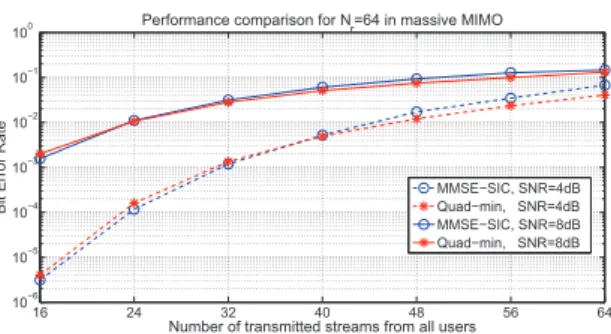
The performance of the proposed detector is compared to the MMSE-SIC in terms of Bit Error Rate (BER) in very large and massive MIMO systems. We consider a scenario where multiple UEs transmit a total streams M via their antennas, and a BS equipped with Nr receive antennas. The
channel coefficients are i.i.d. circularly symmetric complex Gaussian distributed with zero mean and unit variance. The symbols are selected from 4-Quadrature Amplitude Modu-lation (QAM) and 16-QAM. For the implementation of the Quad-min detector, we use the cvx toolbox, which is a Matlab-based modeling system for convex optimization [16], [17]. We also use the Gurobi optimizer as a solver for our convex problem [18]. This solver is based on the PDIP methods for linear and quadratic programming. The solving algorithm can be implemented using the method proposed in [10].
A. Comparison with other low-complexity detector
Fig. 2 presents the configuration of a large MIMO deter-mined system where the total streams and the number of receive antennas are equal to60. We compare the BER perfor-mance for both modulations4-QAM and16-QAM. When the total number of total is equal to the number of receive antennas i.e. very large dimensions with M = N = 60, we observe that the Quad-min outperforms the MMSE-SIC over the whole SNR region, and better exploits the receive diversity through the joint detection. Assuming 4-QAM modulation constella-tion, the gain is about1.7dB at BER10−2, and increases with
the SNR growth to achieve almost2dB at BER 3.10−5. This
gain becomes more important for16-QAM constellation, it is about3dB at BER10−2, and3.7dB at BER10−2. The reason
for the BER gain growth with the constellation size is that,
16 24 32 40 48 56 64 10−6 10−5 10−4 10−3 10−2 10−1
100 Performance comparison for Nr=64 in massive MIMO
Number of transmitted streams from all users
Bi t Erro r R a te MMSE−SIC, SNR=4dB Quad−min, SNR=4dB MMSE−SIC, SNR=8dB Quad−min, SNR=8dB
Fig. 3: BER performance comparison of the proposed detector versus the MMSE-SIC detector in massive MIMO.
0 2 4 6 8 10 12 14 16 18 20 10−5 10−4 10−3 10−2 10−1 100 SNR[dB] Bi t Erro r R a te
4−QAM, massive MIMO uplink scenario
SD, 16x14 SD, 24x21 Quad−min, 16x14 Quad−min, 24x21 Quad−min, 32x28 Quad−min, 64x56
Fig. 4: BER performance comparison of the proposed detector with the sphere decoder in underdetermined systems.
the accuracy of theℓ0-norm relaxation by theℓ1-norm highly
depends on the system dimensions and the sparsity threshold of the signal vector [11].
Next, we setNr= 64and we consider4-QAM modulation.
In Fig. 3 we evaluate the BER performance with respect to the number of total streams. Both detectors yields similar performance for SNR 4dB. At 8dB the proposed detector yields better performance when the number of total streams approaches Nr. Hence, for massive MIMO i.e. Nr ≫ M,
both low-complexity detectors performs similarly whereas for very large MIMO systems i.e. Nr and M of the same
order, the Quad-min becomes more powerful. Furthermore, this latter represents stable performance for underdetermined systems whereas the MMSE-SIC must be modified because the required matrix inversion becomes unstable.
B. Comparison with optimal detector in underdetermined sys-tems
For underdetermined systems, Fig. 4 compares the BER performance of the proposed detection scheme to the sphere decoder (SD), described in [19]. We assume a4-QAM constel-lation mapping known at both, the transmitter and the receiver. It can be observed that beyond8dB, the SD outperforms the proposed scheme, e.g. at BER 10−2, a gain of about 2dB
and of 2.5dB is obtained when the dimensions are 16×14
and24×21, respectively. However, for the SD we cannot go beyond24×21dimensions due to a huge computational cost, whereas with the Quad-min it is possible to detect in a system with N > 90in less than one second for both constellation sizes as shown in Fig. 5.
iteration number computational cost per iteration Total MMSE 1 O(N3) O(N3) MMSE-SIC 1 O(N3) +O(M N2) +O(M2N) O(N3) +O(M N2) +O(M2N) Quad-min O(√M) O(M2.5) O(M3) SD 1 O(√LγM) O(√LγM) ML 1 O(√LM) O(√LM)
TABLE I: Computational cost analysis
15 30 45 60 75 90
10−2 100 102
Number of receive antennas
T ime R u n (se c) Massive MIMO, SNR=15dB Quad−min, 16−QAM Quad−min, 4−QAM SD, 16−QAM SD, 4−QAM
Fig. 5: Time-run comparison between the proposed detector and the sphere decoder.
Remark 3: It is important to mention that the relaxed constraints imposes the subvector components to be in the interval [0,1], with their sum equal to one. Thus interpreting the solution subvector components as reliability values relative to the associated alphabet symbols, a preliminary analysis, which is still in progress, has shown that these output can be used to provide soft input to a channel decoder.
VI. CONCLUSION
A new detection scheme has been proposed in the frame-work of massive and very large MIMO uplink scenario. It ex-ploits the discrete constellation of the transmitted signals, and transforms the MIMO inputs model into a sparse model with inputs belonging to the binary set{0,1}. The optimal detection problem of the transformed model has been reformulated and relaxed based on well-known existing results in the sparse literature. In terms of performance and reliability, the proposed detector has been compared to the low-complexity MMSE-SIC detector, which offers a particularly interesting trade-off between complexity and performance. For high dimensions, it has shown a BER performance gain that increases with the signal dimension and depends on the input constellation, while keeping a same computational complexity order. However, a high performance dependency on both signal dimensions and sparsity threshold has been observed. The next steps are to seek new constraints that compensate the gap with the optimal detector, and to associate the proposed detector with a channel decoding scheme that should help in minimizing the error probability and should yield a more reliable transmission.
REFERENCES
[1] E. Telatar, “Capacity of multi-antenna gaussian channels,” European Transactions on Telecommunications, vol. 10, pp. 585–595, 1999.
[2] F. Rusek, D. Person, B. Lau, E. Larson, T. Marzetta, O. Edfors, and F. Tuvesson, “Scaling up MIMO: Opportunities and Challenges with very Large Arrays,”IEEE Signal Processing Magazine, vol. 30, no. 1, pp. 40–60, Jan. 2012.
[3] X. Zhu and R. D. Murc, “Performance analysis of maximum likelihood detection in a mimo antenna system,”IEEE Transactions on Communi-cations, vol. 50, no. 2, pp. 187–191, Feb 2002.
[4] B. Hassibi and H. Vikalo, “On the sphere decoding algorithm i. expected complexity,”IEEE Transactions on Signal Processing, vol. 53, no. 8, pp. 2806–2818, Aug 2005.
[5] J. Jalden and B. Ottersten, “On the Complexity of Sphere Decoding in Digital Communications,”IEEE Transactions on Signal Processing, vol. 53, no. 4, pp. 1474–1484, April 2005.
[6] S. Boyd and L. Vandenberghe, Convex Optimization. Cambridge University Press, New York, 2004.
[7] L. Bai, C. Chen, and J. Choi, “Prevoting cancellation-based detection for underdetermined mimo systems,”EURASIP J. Wirel. Commun. Netw., vol. 2010, pp. 96:1–96:11, Apr. 2010.
[8] D. Donoho, “For most large underdetermined systems of linear equa-tions, the minimal L1 norm solution is also the sparsest solution,”Comm. on Pure and Applied Mathematics, vol. 59, no. 6, pp. 797–829, June 2006.
[9] MIT Lecture, “Sparsity Based Regularization,” http://www.mit.edu/ 9.520/spring10/scribe-notes/, 2010.
[10] D. Goldfarb and S. Liu, “An o (n 3 l) primal interior point algorithm for convex quadratic programming,”Mathematical Programming, vol. 49, no. 1-3, pp. 325–340, 1990.
[11] A. Aissa-El-Bey, D. Pastor, S. M. Aziz-Sbai, and Y. Fadlallah, “Recovery of Finite Alphabet Solutions of Underdetermined Linear System,”IEEE Transactions on Information Theory, to appear.
[12] MIT Lecture, “Big O Notation,” http://web.mit.edu/16.070/www/lecture/, 2003.
[13] E. Landau,Handbuch der Lehre von der Verteilung der Primzahlen. AMS Chelsea Publishing, 1909.
[14] B. Hassibi, “An efficient square-root algorithm for blast,” in Proceed-ings IEEE International Conference on Acoustics, Speech, and Signal Processing, vol. 2. IEEE, 2000, pp. II737–II740.
[15] D. Wubben, R. Bohnke, V. Kuhn, and K.-D. Kammeyer, “Mmse extension of v-blast based on sorted qr decomposition,” inVehicular technology conference, 2003. VTC 2003-Fall. 2003 IEEE 58th, vol. 1. IEEE, 2003, pp. 508–512.
[16] M. Grant and S. Boyd, “CVX: Matlab software for disciplined convex programming, version 2.0 beta,” http://cvxr.com/cvx, Sep. 2012. [17] M. Grant and S. Boyd, “Graph implementations for nonsmooth convex
programs,” inRecent Advances in Learning and Control, ser. Lecture Notes in Control and Information Sciences. Springer-Verlag Limited, 2008, pp. 95–110.
[18] I. Gurobi Optimizatoion, “Gurobi optimizer reference manual,” 2012. [Online]. Available: http://www.gurobi.com
[19] T. Cui and C. Tellambura, “An Efficient Generalized Sphere Decoder for Rank-Deficient MIMO Systems,”IEEE Communications Letters, vol. 9, no. 5, May 2005.