Full Terms & Conditions of access and use can be found at
ISSN: 0162-1459 (Print) 1537-274X (Online) Journal homepage: http://www.tandfonline.com/loi/uasa20
Bayesian Nonparametric Ordination for the
Analysis of Microbial Communities
Boyu Ren, Sergio Bacallado, Stefano Favaro, Susan Holmes & Lorenzo Trippa
To cite this article: Boyu Ren, Sergio Bacallado, Stefano Favaro, Susan Holmes & Lorenzo Trippa (2017): Bayesian Nonparametric Ordination for the Analysis of Microbial Communities, Journal of the American Statistical Association
To link to this article: http://dx.doi.org/10.1080/01621459.2017.1288631
View supplementary material
Accepted author version posted online: 28 Feb 2017.
Submit your article to this journal
Article views: 65
View related articles
Bayesian Nonparametric Ordination for the Analysis
of Microbial Communities
Boyu Ren
∗Department of Biostatistics, Harvard University
Sergio Bacallado
Department of Pure Mathematics and Mathematical
Statistics, University of Cambridge
Stefano Favaro
Departimento di Scienze Economico-Sociali e
Matematico-Statistiche, Universit`a di Torino
Susan Holmes
Department of Statistics, Stanford University
Lorenzo Trippa
∗Department of Biostatistics, Harvard University
Abstract
Human microbiome studies use sequencing technologies to measure the abundance of bac-terial species or Operational Taxonomic Units (OTUs) in samples of biological mabac-terial. Typ-ically the data are organized in contingency tables with OTU counts across heterogeneous biological samples. In the microbial ecology community, ordination methods are frequently used to investigate latent factors or clusters that capture and describe variations of OTU counts across biological samples. It remains important to evaluate how uncertainty in estimates of each biological sample’s microbial distribution propagates to ordination analyses, including visualization of clusters and projections of biological samples on low dimensional spaces. We propose a Bayesian analysis for dependent distributions to endow frequently used ordinations with estimates of uncertainty. A Bayesian nonparametric prior for dependent normalized ran-dom measures is constructed, which is marginally equivalent to the normalized generalized Gamma process, a well-known prior for nonparametric analyses. In our prior, the dependence
∗Boyu Ren is PhD student, Department of Biostatistics, Harvard University, Boston, MA 02115
(E-mail: [email protected]). Sergio Bacallado is University academic staff, Department of Pure Math-ematics and Mathematical Statistics, University of Cambridge, Cambridgeshire CB2 1TN, UK (E-mail: [email protected]). Stefano Favaro is Associate Professor, University of Torino and Collegio Carlo, C.so Unione Sovietica 218/bis, Torino 10134, Italy (E-mail: [email protected]). Susan Holmes is Professor, De-partment of Statistics, Stanford University, Sequoia Hall, Stanford, CA 94305 (E-mail: [email protected]). Lorenzo Trippa is Assistant Professor, Department of Biostatistics, Harvard University, Boston, MA 02115 (E-mail: [email protected]). Funding was provided by the National Science Foundation, European Research Council, Claudia Adams Barr Program in Innovative Basic Cancer Research and the National Institutes of Health.
and similarity between microbial distributions is represented by latent factors that concentrate in a low dimensional space. We use a shrinkage prior to tune the dimensionality of the latent factors. The resulting posterior samples of model parameters can be used to evaluate uncer-tainty in analyses routinely applied in microbiome studies. Specifically, by combining them with multivariate data analysis techniques we can visualize credible regions in ecological or-dination plots. The characteristics of the proposed model are illustrated through a simulation study and applications in two microbiome datasets.
Keywords: Dependent Dirichlet processes; Bayesian factor analysis; Uncertainty of ordination;
1
Introduction
Next generation sequencing (NGS) has transformed the study of microbial ecology. Through the availability of cheap efficient amplification and sequencing, marker genes such as 16S rRNA are used to provide inventories of bacteria in many different environments. For instance soil and waste water microbiota have been inventoried (DeSantis et al., 2006) as well as the human body
(Dethlefsen et al.,2007). NGS also enables researchers to describe the metagenome by computing
counts of DNA reads and matching them to the genes present in various environments.
Over the last ten years, numerous studies have shown the effects of environmental and clin-ical factors on the bacterial communities of the human microbiome. These studies enhance our understanding of how the microbiome is involved in obesity (Turnbaugh et al., 2009), Crohn’s disease (Quince et al.,2013), or diabetes (Kostic et al.,2015). Studies are currently underway to improve our understanding of the effects of antibiotics (Dethlefsen and Relman,2011), pregnancy
(DiGiulio et al.,2015), and other perturbations to the human microbiome.
Common microbial ecology pipelines either start by grouping the 16S rRNA sequences into known Operational Taxonomic Units (OTUs) or taxa as done inCaporaso et al.(2010), or denois-ing and groupdenois-ing the reads into more refined strains sometimes referred to as oligotypes, phylo-types, or ribosomal variants (RSV) (Rosen et al., 2012; Eren et al., 2014; Callahan et al., 2016). We will call all types of groupings OTUs to maintain consistency. In all cases the data are analyzed in the form of contingency tables of read counts per sample for the different OTUs , as exemplified in Table 1. Associated to these contingency tables are clinical and environmental covariates such as time, treatment, and patients’ BMI, information collected on the same biological samples or environments. These are sometimes misnamed “metadata”; this contiguous information is usually fundamental in the analyses. The data are often assembled in multi-type structures, for instance
phyloseq (McMurdie and Holmes, 2013) uses lists (S4 classes) to capture all the different as-pects of the data at once.
Currently bioinformaticians and statisticians analyze the preprocessed microbiome data using linear ordination methods such as Correspondence Analysis (CA), Canonical or Constrained Cor-respondence Analysis (CCA) , and Multidimensional Scaling (MDS) (Caporaso et al.,2010;
Oksa-nen et al.,2015;McMurdie and Holmes,2013). Distance-based ordination methods use measures
of between-sample or Beta diversity, such as the Unifrac distance (Lozupone and Knight, 2005). These analyses can reveal clustering of biological samples or taxa, or meaningful ecological or clinical gradients in the community structure of the bacteria. Clustering, when it occurs indicates a latent variable which is discrete, whereas gradients correspond to latent continuous variables. Following these exploratory stages, confirmatory analyses can include differential abundance test-ing (McMurdie and Holmes, 2014), two-sample tests for Beta diversity scores (Anderson et al.,
2006), ANOVA permutation tests in CCA (Oksanen et al., 2015), or tests based on generalized linear models that include adjustment for multiple confounders (Paulson et al.,2013).
The interaction between these tasks can be problematic. In particular, the uncertainty in the estimation of OTUs’ prevalence is often not propagated to subsequent steps (Peiffer et al., 2013). Moreover, unequal sequencing depths generate variations of the number of OTUs with zero counts across biological samples. Finally, the hypotheses tested in the inferential step are often formulated
after significant exploration of the data and are sensitive to earlier choices in data preprocessing. These issues motivate a Bayesian approach that enables us to integrate the steps of the analytical pipeline. Holmes et al. (2012); La Rosa et al. (2012); Ding and Schloss(2014) have suggested the use of a simple Dirichlet-Multinomial model for these data; however, in those analyses the multinomial probabilities for each biological sample are independent in the prior and posterior, which fails to capture underlying relationships between biological samples. The simple Dirichlet-Multinomial model is also not able to account for strong positive correlations (high co-occurrences
(Faust et al., 2012)) or negative correlations (checker board effect (Koenig et al., 2011)) that can
exist between different species (Gorvitovskaia et al.,2016).
We propose a Bayesian procedure, which jointly models the read counts from different OTUs and sample-specific latent multinomial distributions, allowing for correlations between OTUs. The prior assigned to these multinomial probabilities is highly flexible, such that the analysis learns the dependence structure from the data, rather than constraining it a priori. The method can deal with uncertainty coherently, provides model-based visualizations of the data, and is extensible to describe the effects of observed clinical and environmental covariates.
Bayesian analysis with Dirichlet priors is a convenient starting point for microbiome data, since the OTU distributions are inherently discrete. Moreover, Bayesian nonparametric priors for dis-crete distributions, suitable for an unbounded number of OTUs, have been the topic of intense research in recent years. General classes of priors such as normalized random measures have been developed, and their properties in relation to classical estimators of species diversity are well-understood (Ferguson, 1973;Lijoi and Pr¨unster, 2010). The problem of modeling dependent dis-tributions has also been extensively studied since the proposal of the Dependent Dirichlet Process
(MacEachern,2000) byM¨uller et al.(2004),Rodr´ıguez et al.(2009), andGriffin et al.(2013)).
In this paper, we try to capture the variation in the composition of microbial communities as a result of a group of unobserved samples’ characteristics. With this goal we introduce a model which expresses the dependence between OTUs abundances in different environments through vec-tors embedded in a low dimensional space. Our model has aspects in common with nonparametric priors for dependent distributions, including a generalized Dirichlet type marginal prior on each distribution, but is also similar in spirit to the multivariate methods currently employed in the mi-crobial ecology community. Namely, it allows us to visualize the relationship between biological samples through low dimensional projections.
The paper is organized as follows. Section 2 describes a prior for dependent microbial distri-butions, first constructing the marginal prior of a single discrete distribution through manipulation of a Gaussian process and then extending this to multiple correlated distributions. The extension is achieved through a set of continuous latent factors, one for each biological sample, whose prior has been frequently used in Bayesian factor analyses. Section 3 derives an MCMC sampling algorithm for posterior inference and a fast algorithm to estimate biological samples’ similarity. Section 4 discusses a method for visualizing the uncertainty in ordinations through conjoint analysis. Sec-tion 5 contains analyses of simulated data, which serve to demonstrate desirable properties of the method, followed by applications to real microbiome data in Section 6. Section 7 discusses poten-tial improvement and concludes. The code for implementing the analyses discussed in this article is included in the Supplementary Materials.
2
Probability Model
In Table1, we illustrate an example of a typical OTU table with 10 biological samples, where half are healthy subjects, and half are Inflammatory Bowel disease (IBD) patients. This contingency table is a subset of the data in Morgan et al.(2012) and records the observed frequencies of five most abundant genus level OTUs in all biological samples based on 16S rRNA sequencing results. Let Zi be the ith observed OTU (e.g. Z1is Bacteroides) and ni,j be the observed frequency of OTU Zi in biological sample j. As an example, n11 = 1822 is the observed frequency of Bacteroides in
the biological sample Ctrl1. We will denote an OTU table as (ni,j)i≤I,j≤J, where I is the number of
observed OTUs and J the number of biological samples.
For the biological sample j, we will assume the vector (n1,j, . . . ,nI,j) follows a multinomial
distribution, noting that our analysis extends easily to the case in which the total countPIi=1ni j is a
Poisson random variable.The unobserved multinomial probabilities of OTUs present in biological sample j determine the distribution of the frequencies ni,j. These probabilities form a discrete
probability measure, which we call a microbial distribution, on the spaceZof all OTUs. We denote this discrete measure as Pj and Pj({Z
i}) gives the probability of sampling Zi from
biological sample j. If we consider all J biological samples, we expect there will be variation in the respective Pj’s. This variation usually can be explained by specific characteristics of the biological sample. For instance, in Table1, we can see the empirical multinomial probability of Enterococcus is higher in healthy controls than in IBD patients on average. This variation has been discovered in prior publication (Morgan et al., 2012) and is attributed to the IBD status. Microbiome studies aim to elucidate the characteristics that explain these types of variations.
Our method focuses on modeling the distributions Pj’s and the variations among them. For
biological samples labelled inJ = {1, . . . ,J}, we assume they have the same infinite set of OTUs
Z1,Z2, . . .∈ Z.We let the number of OTUs present in a biological sample be infinity to make our
model nonparametric in consideration of the fact that there might be an unknown number of OTUs that are not observed in the experiment. We specify the probability mass assigned to a group of OTUs A⊂ Zas Pj(A) = Mj(A)/Mj(Z), Mj(A) = ∞ X i=1 I(Zi ∈A)σihXi,Yji+2, (1)
whereσi ∈ (0,1), Xi,Yj ∈ Rm,I(∙) is the indicator function, and x+ = x×I(x > 0). In addition,
h∙,∙iis the standard inner product inRm.
In this model specification,σiis related to the average abundance of OTU i across all biological
samples. Whenσiis large, the average probability mass assigned to OTU Ziwill also be large. We
refer to Xiand Yj as OTU vector and biological sample vectors respectively. The variation of the Pj’s is determined by the vectors Yj, which can be treated as latent characteristics of the biological samples that associate with microbial composition; for example, an unobserved feature of the subject’s diet, such as vegetarianism, could affect the abundance of certain OTUs. We assume there are m such characteristics, and the lth component in Yj is the measurement of the lth latent
characteristic in biological sample j. The vector Xi denotes the effects of each of the m latent
characteristics on the abundance of the OTU Zi. Therefore Xi has m entries.
In subsection 2.1 we consider a single microbial distribution Pj with fixed parameter Yj and
define a prior on σ = (σ1, σ2, . . .) and (Xi)i≥1 which makes Pj a Dirichlet process (Ferguson,
1973). The degree of similarity between the discrete distributions {Pj; j ∈ J} is summarized by the Gram matrix (φ( j, j0)=hYj,Yj0i; j, j0 ∈ J). Subsection2.2discusses the interpretation of this
matrix. Subsection2.3proposes a prior for the parameters{Yj, j∈ J}which has been previously
used in Bayesian factor analysis, and which has the effect of shrinking the dimensionality of the Gram matrix (φ( j, j0)) and is used to infer the number of latent characteristics m. The parameters
{Yj, j∈ J}or (φ( j, j0)) can be used to visualize and understand variations of microbial distributions
across biological samples.
2.1
Construction of a Dirichlet Process
The prior onσ=(σ1, σ2, . . .) is the distribution of ordered points (σi > σi+1) in a Poisson process
on (0,1) with intensity
ν(σ)= ασ−1(1−σ)−1/2, (2)
whereα > 0 is a concentration parameter. Denote the index of component of Yj and Xi as l. Fix
j, and let Yj =(Y
l,j,l≤m) be a fixed vector inRmsuch thathYj,Yji= 1. We let Xi =(Xl,i,l≤m)
be a random vector for i = 1,2, . . .and Xl,i be independent and N(0,1) a priori for l= 1,2, . . . ,m
and i=1,2, . . .Finally, let G be a nonatomic probability measure on the measurable space (Z,F), whereF is the sigma-algebra onZ, and Z1,Z2, . . .is a sequence of independent random variables
with distribution G. We claim that the probability distribution Pj defined in Equation (1) is a Dirichlet Process with base measure G.
We note that the point processσdefines an infinite sequence of positive numbers, the products
hXi,Yji, i = 1,2, . . ., are independent Gaussian N(0,1) variables, and that the intensityνsatisfies
the inequality R01σdν < ∞. These facts directly imply that with probability 1, 0 < Mj(A) <
∞ when G(A) > 0. It also follows that for any sequence of disjoint sets A1,A2, . . . ∈ F the
corresponding random variables Mj(A
i)’s are independent. In different words, Mj is a completely
random measure (Kingman, 1967). The marginal L´evy intensity can be factorized as μM(ds) ×
G(dz),where μM(ds)∝ Z 1 0 ν(σ) 1 σ !1/2 s−1/2exp − s 2σ dσds ∝ exp(−ss/2)ds, for s∈(0,∞).
The above expression shows that Mj is a Gamma process. We recall that the L´evy intensity of
a Gamma process is proportional to the map s 7→ exp(−c× s)× s−1, where c is a positive scale
parameter. InFerguson(1973) it is shown that a Dirichlet process can be defined by normalizing a Gamma process. It directly follows that Pj is a Dirichlet Process with base measure G.
Remark. Our construction can be extended to a wider class of normalized random measures
(James, 2002;Regazzini et al., 2003) by changing the intensity νthat defines the Poisson process
σ. If we set
ν(σ)=ασ−1−β(1−σ)−1/2+β,
β ∈ [0,1), in our definition of Mj , then the L´evy intensity of the random measure in (1) becomes proportional to
s−1−βexp(−s/2).
In this case the L´evy intensity indicates that Mjis a generalized Gamma process (Brix,1999). We
recall that by normalizing this class one obtains normalized generalized Gamma processes (Lijoi
et al., 2007), which include the Dirichlet process and the normalized Inverse Gaussian process
(Lijoi et al.,2005) as special cases.
A few comments capture the relation between our definition of Pj(A) in (1) and alternative
definitions of the Dirichlet Process. If we normalize h independent Gamma(α/h,1/2) variables, we obtain a vector with Dirichlet(α/h, . . . , α/h) distribution. To interpret our construction we can note
that, whenα/h < 1/2, each of the Gamma(α/h,1/2) components can be obtained by multiplying a Beta(α/h,1/2 − α/h) variable and an independent Gamma(1/2,1/2). The distribution of the
hXi,Yji+2 variables in (1) is in fact a mixture with a Gamma(1/2,1/2) component and a point
mass at zero. Finally if we let h increase to ∞, the law of the ordered Beta(α/h,1/2 − α/h)
converges weakly to the law of ordered points of a Poisson point process on (0,1) with intensityν
(see Supplementary Document S1).
2.2
Dependent Dirichlet Processes
We use the representation for Dirichlet processes from Equation (1) to define a family of dependent Dirichlet processes labelled by a general index setJ. The dependency structure of this family is related to (φ( j, j0) = hYj,Yj0i)
j,j0∈J. Geometricallyφ( j, j0) is the cosine of the angle between Yj
and Yj0. The dependent Dirichlet processes is defined by setting
Pj(A) = P iI(Zi ∈A)×σihXi,Yji+2 P iσihXi,Yji+2 , ∀j∈ J, (3)
for every A ∈ F. Here the sequence (Z1,Z2, . . .) and the array (X1,X2, . . .), as in Section 2.1,
contain independent and identically distributed random variables, whileσis our Poisson process on the unit interval defined in (2). We will use the notation Qi,j = hXi,Yji. This construction has
an interpretable dependency structure between the Pj’s that we state in the next proposition.
Proposition 1. There exists a real function η : [0,1] → [0,1] such that the correlation between
Pj(A) and Pj0(A) is equal to η(φ( j, j0)) for every A that satisfies G(A) > 0. In different words,
the correlation between Pj(A) and Pj0(A) does not depend on the specific measurable set A, it is a
function of the angle defined by Yjand Yj0.
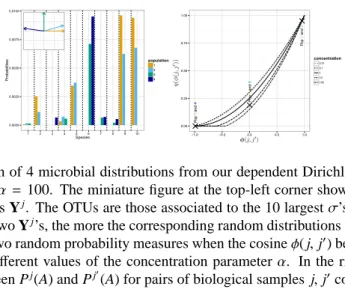
The proof is in the Supplementary Document S2. The first panel of Figure1shows a simulation of Pj’s. In this figure J = {1,2,3,4}. Whenφ( j, j0), the cosine of the angle between two vectors
Yj and Yj0, corresponding to distinct biological samples j and j0, decreases to −1 the random measures tend to concentrate on two disjoint sets. The second panel shows the functionηthat maps the φ( j, j0)’s into the correlations corr(Pj(A),Pj0(A)) = η(φ( j, j0)). As expected the correlation
increases withφ( j, j0).
We want to point out that the construction in (3) extends easily to the setting where we are given any positive semi-definite kernelφ:J × J →(−1,1) capturing the similarity between biological samples labelled byJ. Mercer’s theorem (Mercer,1909) guarantees the kernel is represented by the inner product in anL2space, whose elements are infinite-dimensional analogues of the vectors
Yj. The analysis presented in this section is unchanged in this general setting.
The next proposition provides mild conditions that guarantee a large support for the dependent Dirichlet processes that we defined.
Proposition 2. Consider a collection of probability measures (Fj, j = 1, . . . ,J) onZ and a
pos-itive definite kernelφ. Assume that J = {1, . . . ,J}and the support of G coincides with Z. The
prior distribution in (3) assigns strictly positive probability to the neighborhood{(F10, . . . ,FJ0) :
|R fidF0j −
R
fidFj|< ,i= 1, . . . ,L, j= 1, . . . ,J}, where >0 and fi, i = 1, . . . ,L, are bounded continuous functions.
In what follows we will replace the constrainthYj,Yji =1 with the requirementhYj,Yji <∞. The two constraints are equivalent for our purpose, because we normalize Mj(∙) = PiI(Zi ∈ ∙)×
σihXi,Yji+2, andhYj,Yjican be viewed as a scale parameter.
2.3
Prior on biological sample parameters
This subsection deals with the task of estimating the parameters Yj, j∈ J ={1, . . . ,J}, that capture most of the variability observed when comparing J biological samples with different OTU counts. We define a joint prior on these factors which makes them concentrate on a low dimensional space; equivalently, the prior tends to shrinks the nuclear norm of the Gram matrix (φ( j1, j2))j1,j2∈J. The
problem of estimating low dimensional factor loadings or a low-rank covariance matrix is common in Bayesian factor analysis, and the prior defined below has been used in this area of research.
The parameters Yj can be interpreted as key characteristics of the biological samples that af-fect the relative abundance of OTUs. As in factor analysis, it is difficult to interpret these pa-rameters unambiguously (Press and Shigemasu, 1989;Rowe,2002); however, the angles between their directions have a clear interpretation. As observed in Figure 1, if the kernel φ( j1, j2) ≈
p
φ( j1, j1)φ( j2, j2), the two microbial distributions Pj1 and Pj2 will be very similar. Ifφ( j1, j2)≈ 0,
then there will be little correlation between OTUs’ abundances in the two samples. Ifφ( j1, j2) ≈
−pφ( j1, j1)φ( j2, j2), then the two microbial distributions are concentrated on disjoint sets. This
interpretation suggests Principal component analysis (PCA) of the Gram matrix (φ( j1, j2))j1,j2∈Jas
a useful exploratory data analysis technique.
It is common in factor analysis to restrict the dimensionality of factor loadings. In our model, this is accomplished by assuming Yj to be in Rm and adding an error term in the definition of Qi,j, the OTU-specific latent weights,
where the i,j are independent standard normal variables. Recall that each sample-specific
ran-dom distribution Pj is obtained by normalizing the random variablesσi(Q+i,j)2. If we denote the
covariance matrix of (Qi,1, . . . ,Qi,J) asΣ, this factor model specification indicates Σ = Y|Y+I
conditioning on Y, where I is the identity matrix and Y=(Y1, . . . ,YJ). As a result, the correlation
matrix S induced byΣonly depends on Y.
In most applications the dimensionality m is unknown. Several approaches to estimate m have been proposed (Lopes and West, 2004; Lee and Song, 2002; Lucas et al., 2006;Carvalho et al.,
2008;Ando, 2009). However, most of them involve either calculation of Bayes Factors or com-plex MCMC algorithms. Instead we use a normal shrinkage prior proposed byBhattacharya and
Dunson (2011). This prior includes an infinite sequence of factors (m = ∞), but the variability
captured by this sequence of latent factors rapidly decreases to zero. A key advantage of the model is that it does not require the user to choose the number of factors. The prior is designed to replace direct selection of m with the shrinkage toward zero of the unnecessary latent factors. In addition, this prior is nearly conjugate, which simplifies computations. The prior is defined as follows,
γl ∼ Gamma(al,1), γ0l,j ∼Gamma(v/2,v/2), Yl,j|γ∼ N 0,(γ0l,j)− 1Y k≤l γ−1 k , l≥1, j∈ J, (5)
where the random variables γ = (γl, γ0l,j; l, j ≥ 1) are independent and, conditionally on these
variables, the Yl,j’s are independent.
When al > 1, the shrinkage strength a priori increases with the index l, and therefore the
variability captured by each latent factor tends to decrease with l. We refer to Bhattacharya and
Dunson(2011) for a detailed analysis of the prior in (5). In practice, the assumption of infinitely
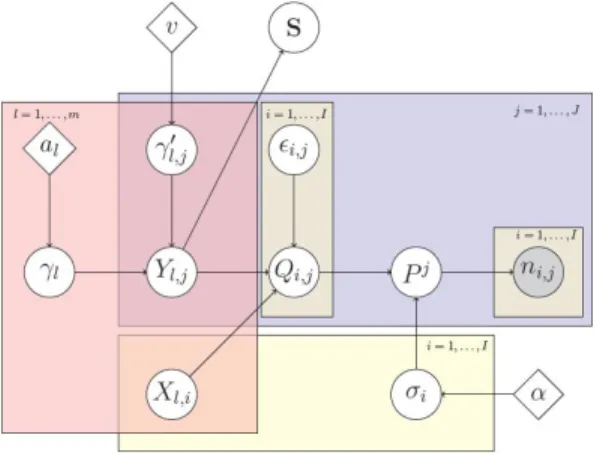
many factors is replaced for data analysis and posterior computations by a finite and sufficiently large number m of factors. The choice of m is based on computational considerations. It is desirable that posterior variability of the last components (l∼ m) of the factor model in (4) is negligible. This prior model is conditionally conjugate when paired with the dependent Dirichlet processes prior in subsection2.2, a relevant and convenient characteristic for posterior simulations. We summarize the full model with a plate diagram, shown in Figure2.
3
Posterior Analysis
Given an exchangeable sequence W1, . . . ,Wn from Pj = Mj × Mj(Z)−1 as defined in subsection 2.1, we can rewrite the likelihood function using variable augmentation as inJames et al.(2009),
n Y i=1 Pj({Wi})= Z ∞ 0 exp[−Mj(Z) T ]×Tn−1 Γ(n) I Y i=1 Mj({Wi∗})nidT. (6)
Here W1∗, . . . ,WI∗ is the list of distinct values in (W1, . . .Wn) and n1, . . . ,nI are the occurrences in
(W1, . . .Wn), so that PiI=1ni = n. We use expression (6) to specify an algorithm that allows us to
We proceed, similarly to Muliere and Tardella (1998) and Ishwaran and James (2001), using truncated versions of the processes in subsection 2.2. We replace σ = {σi,i ≥ 1} with a finite
number I of independent Beta(I,1/2− I) points in (0,1). Supplementary Document S1 shows
that when I diverges, andI =α/I, this finite dimensional version converges weakly to the process
in (2). Each pointσi is paired with a multivariate normal Qi =(Qi,1, . . . ,Qi,J) with mean zero and
covarianceΣ. The distribution of Mi,j = σi(Q+i,j)2is a mixture of a point mass at zero and a Gamma
distribution. In this section Q andσare finite dimensional, and the normalized vectors Pj, which
assign random probabilities to I OTUs in J biological samples, are proportional to (M1,j, . . . ,MI,j), j=1, . . . ,J. Note that Pjconditional onI(Q
1,j >0), . . . ,I(QI,j >0) follows a Dirichlet distribution
with parameters proportional toI(Q1,j > 0), . . . ,I(QI,j >0).
The algorithm is based on iterative sampling from the full conditional distributions. We first provide a description assuming thatΣis known. We then extend the description to allow sampling under the shrinkage prior in Section2.3and to inferΣ.
With I OTUs and J biological samples, the typical dataset is n = (n1, . . . ,nJ), where nj =
(n1,j, . . . ,nI,j) and ni,j is the absolute frequency of the ith OTU in the jth biological sample. We
use the notation nj = PI
i=1ni,j, ni = PJj=1ni,j, σ = (σ1, . . . , σI), Y = (Yj, j = 1, . . . ,J) and
Q= (Qi,j,1≤i ≤ I,1≤ j≤ J). By using the representation in (6) we introduce the latent random
variables T=(T1, . . . ,TJ) and rewrite the posterior distribution of (σ,Q) :
p(σ,Q|n)∝ J Y j=1 I Y i=1 σiQ+i,2j ni,j × J Y j=1 I X i=1 σiQ+i,2j −nj ×π(σ,Q) (7) ∝ Z π(σ,Q) J Y j=1 I Y i=1 σiQ+i,2j ni,j Tnj−1 j exp −TjPiσiQ+i,2j Γ(nj) dT, (8) whereπis the prior. In order to obtain approximate (σ,Q) sampling we specify a Gibbs sampler
for (σ,Q,T) with target distribution
p(σ,Q,T|n)∝π(σ,Q) J Y j=1 I Y i=1 σiQ+i,2j ni,j Tnjj−1exp−TjPiσiQ+i,2j Γ(nj) . (9)
The sampler iterates the following steps:
[Step 1] Sample Tjindependently, one for each biological sample j= 1, . . . ,J,
Tj|Q,σ,n∼Gamma(nj,
X
i
σiQ+i,2j).
[Step 2] Sample Qi independently, one for each OTU i = 1, . . . ,I. The conditional density of
Qi = (Qi,1. . .Qi,J) given σ,T,n is log-concave, and the random vectors Qi, i = 1, . . . ,I, given
We simulate, for j= 1, . . . ,J, from p(Qi,j|Qi,−j,σ,T,n)∝ Q +2ni,j i,j ×exp −TjσiQ+i,2j ×exp − (Qi,j−μi,j)2 2s2j , (10)
where Qi,−j = (Qi,1, . . . ,Qi,j−1,Qi,j+1, . . . ,Qi,J), μi,j = E[Qi,j|Qi,−j], s2j = var[Qi,j|Qi,−j], with the
proviso 00 = 1. Since Q
i is a multivariate normal, both μi,j and sj have simple closed form
expressions.
When ni,j =0 the density in (10) reduces to a mixture of truncated normals:
(1−p1)N(Qi,j; μi,j Δi,j , s 2 j Δi,j )I(Qi,j >0)+ p1N(Qi,j;μi,j,s2j)I(Qi,j ≤0), p1 = Φ(0;μi,j,s2j)N(0; μi,j Δi,j, s2j Δi,j) Φ(0;μi,j,s2j)N(0; μi,j Δi,j, s2 j Δi,j)+N(0;μi,j,s 2 j) 1−Φ(0;μi,j Δi,j, s2 j Δi,j) , and Δi,j = 1+ 2σiTjs2j. Here N(∙;μ,s
2) and Φ(∙;μ,s2) are the density and cumulative density
functions of a normal variable with meanμand variance s2.
When ni,j > 0 the density p[Qi,j|Qi,−j,σ,T,n] remains log-concave, and the support becomes
(0,+∞). We update Qi,j using a Metropolis-Hastings step with proposal identical to the Laplace
approximation N(bμi,j,bs2i,j) of the density in (10),
bμi,j = μi,j/s2j+ q μ2 i,j/s 4 j+8ni,j(2σiTj+1/s 2 j) 2(2σiTj+1/s2j) , bs2i,j = 2nbμ2i,j i,j +2Tjσi+ 1 s2j −1 . (11)
Herebμi,j maximizes the density (10), andbs2i,j is obtained from the second derivative of the
log-density atbμi,j. We found the approximation accurate. In Supplementary Document S4 we provide
bounds of the total variation distance between the target (10) and the approximation (11). When
ni,j increases, the bound of the total variation decreases to zero. See also Figure S1 in the
Supple-mentary Document.
[Step 3] Sampleσiindependently, one for each OTU i=1, . . . ,I, from the density p(σi|Q,T,n)∝
π(σi)σniiexp(−σiPJj=1TjQ+i,2j).Theσi’s are a priori independent Beta(α/I,1/2−α/I) variables. We
use piecewise constant bounds forσ →exp(−σiPJj=1TjQ+i,2j),σ ∈[0,1] and an accept/reject step
to sample from p(σi|Q,T,n).
We now consider inference onΣusing the prior on Y in subsection2.3. The goal is to generate approximate samples of Y from the posterior. We exploit the identity of the conditional distribu-tions of Y given (σ,T,Q,n) and Q. In order to sample Y from the posterior we can therefore
directly apply the MCMC transitions in Bhattacharya and Dunson (2011), with Q replacing the observable variables in their work.
3.1
Self-consistent estimates of biological samples’ similarity
We discuss an EM-type algorithm to estimate the correlation matrix S of the vectors (Qi,1, . . . ,Qi,J), i= 1, . . . ,I. Under our construction in subsection2.3, we interpret S as the normalized version of Gram matrix (φ( j, j0))j,j0∈J between biological samples. In this subsection we describe an
alterna-tive estimating procedure, distinct from the Gibbs sampler, which does not require tuning of the prior probability model. The algorithm can be used for MCMC initialization and for exploratory data analyses. It assumes that the observed OTU abundances are representative of the microbial distributions, i.e. Pj =(n
1,j/nj, . . . ,nI,j/nj). Under this assumption, for each biological sample j,
σiQ+i,2j ×I(ni,j > 0)∝ ni,j, i=1, . . . ,I,
and Qi,j ≤ 0 when ni,j =0. (12)
Forσi, i = 1, . . . ,I, we use a moment estimatebσi = (1/J)Pj
ni0,j/Pi,i0ni,j
. The procedure uses these estimates and at iteration t+1 generates the following results:
[Expectation] Impute repeatedly Q, ` = 1, . . . ,D times, consistently with the constraints (12) and using a N(0,Σt) joint distribution. Here Σt is the estimate of Σ, the covariance matrix of
(Qi,1, . . . ,Qi,J), after the t-th iteration. For each replicate` =1, . . . ,D, we fix Q`i,jfor all (i, j) pairs
with strictly positive ni,jcounts at
p
ni,j/bσiand sample jointly, conditional on these values, negative Q`i,jvalues for the remaining (i, j) pairs with ni,j =0. We use these Q`i,jvalues to approximateL(Σ),
the full data log-likelihood, our target function as in any other EM algorithm.
[Maximization] Set Σt+1 equal to the empirical covariance matrix of the (Q`i,1, . . . ,Q`i,J) vectors,
thus maximizing theL(Σ) approximation.
We iterate until convergence ofΣt. Then, after the last iteration, the inferred covariance matrix
of (Qi,1, . . . ,Qi,J) directly identifies an estimate of S. We evaluated the algorithm using in-silico
datasets from the simulation study in Section5. Overall it generates estimates that are slightly less accurate compared to posterior estimation based on MCMC simulations. We use the datasets con-sidered in Figure3(a), with number of factors fixed at three and nj at 100,000, for a representative example. In this case the average RV-coefficient between the true S and the estimated matrix is 0.93 for the EM-type algorithm and 0.95 for posterior simulations. In our work the described pro-cedure reduced the computing time to approximately 10% compared to the Gibbs sampler. More details on this procedure are provided in the Supplementary Document S5.
4
Visualizing uncertainty in ordination plots
Ordination methods such as Multidimensional Scaling of ecological distances or Canonical Cor-respondence Analysis are central in microbiome research. Given posterior samples of the model parameters, we use a procedure to plot credible regions in visualizations such as Fig 3(f). The methods that we consider here are all related to PCA and use the normalized Gram matrix S be-tween biological samples. We recall that in our model S is the correlation matrix of (Qi,1, . . . ,Qi,J).
Based on a single posterior instance of S, we can visualize biological samples in a lower dimen-sional space through PCA, with each biological sample projected once. Naively, one could think
that simply overlaying projections of the principal component loadings generated from different posterior samples of S on the same graph would show the variability of the projections. However, these super-impositions could be spurious if we carry out PCA for each S sample separately. One possible problem is principal component (PC) switching, when two PCs have similar eigenvalues. Another problem is the ambiguity of signs in PCA, which would lead to random signs of the load-ings that result in symmetric groups of projections of the same biological sample at different sides of the axes. More generally PCA projections from different posterior samples of S are difficult to compare, as the different lower dimensional spaces are not aligned.
We alternatively identify a consensus lower dimensional space for all posterior samples of S
(Escoufier,1973;Lavit et al.,1994;Abdi et al.,2005). We list the three main steps used to visualize
the variability of S.
1. Identify a normalized Gram matrix S0 that best summarizes K posterior samples of
normal-ized Gram matrix S1, . . . ,SK. One simple criterion is to minimize L2 loss element-wise.
This leads to S0 = (PiSi)/K. Alternatively, we can define S0 as the normalized Gram
matrix that maximizes similarity with S1, . . . ,SK. One possible similarity metric between
two symmetric square matrices A and B is the RV-coefficient (Robert and Escoufier,1976), RV(A,B) = Tr(AB)/√Tr(AA)Tr(BB). We refer to Holmes(2008) for a discussion on RV-coefficients.
2. Identify the lower dimensional consensus space V based on S0. Assume we want dim(V) =
2; the basis of V will be the orthonormal eigenvectors v1 and v2 of S0corresponding to the
largest eigenvaluesλ1andλ2. The configuration of all biological samples in V is visualized
by projecting rows of S0 onto V: (ψ01,ψ02)= S0(v1λ1−1/2,v2λ−21/2).As in a standard PCA, this
configuration best approximates the normalized Gram matrix in the L2 sense: (ψ01,ψ02) =
argminhψ1,ψ2i=0kS0−(ψ1,ψ2)(ψ1,ψ2)0k2.
3. Project the rows of posterior sample Sk onto V by (ψk1,ψk2)=Sk(v1λ1−1/2,v2λ−21/2).Overlaying
all the ψk displays uncertainty of S in the same linear subspace. Posterior variability of
the biological samples’ projections is visualized in V by plotting each row of the matrices (ψk
1,ψ
k
2), k = 1, . . . ,K, in the same figure. A contour plot is produced for each biological
sample (see for example Fig3(f)) to facilitate visualization of the posterior variability of its position in the consensus space V.
5
Simulation Study
In this section, we evaluate the procedure described in Section3and explore whether the shrinkage prior allows us to infer the number of factors and the normalized Gram matrix between biological samples S. We also consider the estimates E(Pj|n) obtained with our joint model, one for each
biological sample j, and compare their precision with the empirical estimator. Throughout the section, we assumed the number of factors is m=10 when running the posterior simulations.
We first defined a scenario with distributions Pj generated from the prior (1), with I = 68
j=1, . . . ,m0/2, the vector Yj =(Yl,j,1≤l≤m0) has elements l= m0/2+1, . . . ,m0equal to zero,
while symmetrically, for j= J/2+1, . . . ,J, the vectors Yjhave the elements l=1, . . . ,m0/2 equal
to zero. The underlying normalized Gram matrix S is therefore block-diagonal. After generating the distributions Pj, we sampled with fixed total counts (nj) per biological sample nj=1,000. We
produced 50 replicates with m0 =3, 6, and 9. In our simulations the non-zero components Yl,j’s are
independent standard normal.
We use PCA-type summaries for the posterior samples of Y generated from p(Y|n).
Compu-tations are based on the J × J normalized Gram matrix S. At each MCMC iteration we generate
approximate samples Y from the posterior, compute S by normalizing the Gram matrix Y0Y, and
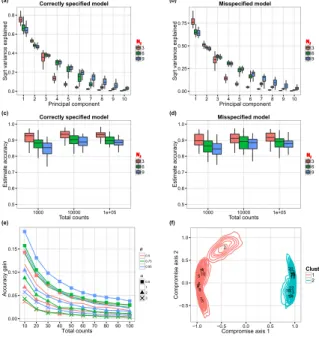
operate standard spectral decomposition on S. This allows us to estimate the ranked eigenvalues, i.e. the principal components’ variance of our Q latent vectors (after normalization), by averaging over the MCMC iterations. Figure 3(a) shows the variability captured by the first 10 principal components, with the box-plots illustrating posterior means’ variability across our 50 replicates. The proportion of variability associated to each principal component decreases rapidly after the
true number of factors m0 = 3,6,9. This suggests that the shrinkage model (Bhattacharya and
Dunson,2011) tends to produce posterior distributions for our Y latent variables that concentrates
around a linear subspace.
Figure3(c) illustrates the accuracy of the estimated normalized Gram matrixbS with njequal to 1,000, 10,000, and 100,000. We estimated the unknown J×J normalized Gram matrix S with the
posterior mean of the normalized Gram matrix, which we approximate by averaging over MCMC iterations. We summarized the accuracy using the RV coefficient betweenbS and S, seeRobert and
Escoufier(1976) for a discussion on this metric. The box-plots illustrate variability of estimates’
accuracy across 50 simulation replicates. As expected, when the total counts per sample increases from 10,000 to 100,000, we only observe limited gain in accuracy. Indeed the overall number of observed OTUs with positive counts per biological sample remains comparable, with expected values equal to 30 and 33 when the total counts per biological sample are fixed at 10,000 and 100,000 respectively. We also note that when m0increases, the accuracy decreases.
We investigate interpretability of our model by using distributions Pj generated from a
prob-ability model that slightly differs from the prior. More precisely, the ith random weight in Pj, conditionally on Y and X, is defined proportional to a monotone function ofhXi,Yji+. We
consid-ered for example
Pj(A) = P iσihXi,Yji+aIZi(A) P iσihXi,Yji+a , a>0. (13)
When the monotone function is quadratic the probability model becomes identical to our prior. In Figure3(b) and Figure3(d) we used model (13) with a= 1 to generate datasets. We repeated the same simulation study summarized in the previous paragraphs.
We evaluated the effectiveness of borrowing information across biological samples for estimat-ing the vectors Pj. The accuracy metric that we used is the total variation distance. We compared
the Bayesian estimator E(Pj|n) and the empirical estimator ˜Pj which assigns mass ni,j/njto the ith
OTUs. The advantage of pooling information varies with the similarity between biological sam-ples. To reflect this, we generated Pj with non-zero components of Y sampled from a zero mean
multivariate normal with cov(Yl,j,Yl,j0) equal toθ. We considered the case when P is generated
ei-ther from our prior or model (13) with a=0.5,1,3. In addition, we consideredθ=0.5,0.75,0.95,
I = 68,J =22, and m0 = 3, while njvaries from 10 to 100.
The results are summarized in Figure3(e) which shows the average difference in total variation, contrasting the Bayesian and empirical estimators. The results, both when the model is correctly specified, and when mis-specified, quantify the advantages in using a joint Bayesian model.
We complete this section with one illustration of the method in Section4. We simulate a dataset with two clusters by generating Yl,j for l= 1, . . . ,m0from N(−3,1) when j= 1, . . . ,J/2 and from
N(3,1) when j = J/2+ 1, . . . ,J. All Yl,j are different from zero. We expected a low nj to be
sufficient for detecting the clusters. We sampled Pj from the prior and set J = 22, I =68, m
0 = 3,
and nj =100. The PC plot and the biological sample specific credible regions are shown in Figure
3(f). In the PC plot the two clusters are illustrated with different colors. In this simulation exercise the posterior credible regions leave little ambiguity both on the presence of clusters and also on samples-specific cluster membership. To compare this with the Principal Coordinates Analysis (PCoA) method used in microbiome studies, we plot the ordination results using PCoA based on the Bray-Curtis dissimilarity matrix derived from the empirical microbial distributions (See Figure S3). We can see that the PCoA point estimate is similar to the centroids identified by the proposed Bayesian ordination method.
6
Application to microbiome datasets
In this section, we apply our Bayesian analysis to two microbiome datasets. We show that our method gives results that are consistent with previous studies, and we show our novel visualization of uncertainty in ordination plots. We start with the Global Patterns data (Caporaso et al., 2011) where human-derived and environmental biological samples are included. We then considered data on the vaginal microbiome (Ravel et al.,2011).
6.1
Global Patterns dataset
The Global Patterns dataset includes 26 biological samples derived from both human and environ-mental specimens. There are a total of 19,216 OTUs, and the average total counts per biological sample is larger than 100,000. We collapsed all taxa OTUs to the genus level—a standard opera-tion in microbiome studies—and yielded 996 distinct genera. We treated these genera as OTUs’ and fit our model to this collapsed dataset. We ran one MCMC chain for 50,000 iterations and recorded posterior samples every 10 iterations.
We first performed a cluster analysis of biological samples based on their microbial compo-sitions. For each posterior sample of the model parameters, we computed Pj for j = 1, . . . ,J
and calculated the Bray-Curtis dissimilarity matrix between biological samples. We then clustered the biological samples using this dissimilarity matrix with Partitioning Among Medoids (PAM)
(Tibshirani et al., 2002). By averaging over the MCMC iterations for the clustering results from
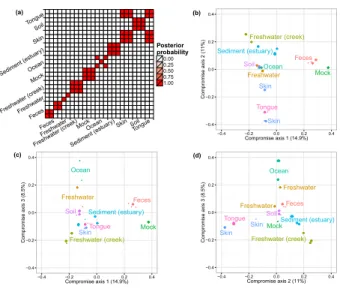
each dissimilarity matrix, we obtained the posterior probability of two biological samples being clustered together. Figure 4(a) illustrates the clustering probabilities. We can see that biological
samples belonging to a specific specimen type are tightly clustered together while different spec-imens tend to define separate clusters. This is consistent with the conclusion in Caporaso et al.
(2011), where the authors suggest, that within specimen microbiome variations are limited when compared to variations across specimen types. We also observed that biological samples from the skin are clustered with those from the tongue. This is to some extent an expected result, be-cause both specimens are derived from humans, and bebe-cause the skin microbiome has often OTUs frequencies comparable to other body sites (Grice and Segre,2011).
We then visualized the biological samples using ordination plots and applying the method de-scribed in Section4. We fixed the dimension of the consensus space V at three. We plotted all bio-logical samples’ projections onto V along with contours to visualize their posterior variability. The results are shown in Figure4(b-d). We observe a clear separation between human-derived (tongue, skin, and feces) biological samples and biological samples from free environments. This separation is mostly identified by the first two compromise axes. The third axis defines a saline/non-saline samples separation. Biological samples derived from saline environment (e.g. Ocean) are well separated when projected on this axis from those derived from non-saline environment (e.g. Creek freshwater). We observed small 95% credible regions for all biological samples projections. This low level of uncertainty captured by the small credible regions in Figure4(b-d) is mainly explained by the large total counts nj for all biological samples. Finally, to compare the ordination results
to those given by standard methods used in microbiome studies, we generated ordination results using PCoA. Figure S4 shows that the relative positions of different types of biological samples in PCoA plots and in the Bayesian ordination plots are similar.
6.2
The Vaginal Microbiome
We also consider a dataset previously presented in Ravel et al. (2011) which contains a larger number of biological samples (900) and a simpler bacterial community structure. These biological samples are derived from 54 healthy women. Multiple biological samples are taken from each indi-vidual, ranging from one to 32 biological samples per individual. Each woman has been classified, before our microbiome sequencing data were generated, into vaginal community state subtypes (CST). This dataset contains only species level taxonomic information, and we filtered OTUs by occurrence. We only retain species with more than five reads in at least 10% of biological samples. This filtering resulted in 31 distinct OTUs. We ran one MCMC chain with 50,000 iterations.
We performed the same analyses as in the previous subsection. The results are shown in Figure
5. Clustering probabilities indicate strong within CST similarity (panel a). There is one exception, CST IV-A samples, in some cases, presenting low levels of similarities when compared to each other and tend to cluster with CST I, CST III, and CST IV-B samples. This is because CST IV-A is characterized as a highly heterogeneous subtype (Ravel et al.,2011). The ordination plots are consistent with the discoveries inRavel et al.(2011). A tetrahedron shape is recovered, and CST I, II, III, IV-B occupy the four vertices. CST II is well separated from other CSTs by the third axis. This pattern is similar to the one observed in the plots generated using PCoA (Figure S5). We also observed a sub-clustering in CST II which has not been detected and discussed inRavel
Note that there are two biological samples with large credible regions, indicating high uncer-tainty of the corresponding positions. This unceruncer-tainty propagates on their cluster membership. Both biological samples have small total counts compared to the others. The lack of precision when using biological samples with small sequencing depth leads to high uncertainty in ordination and classification. It is therefore important to account for uncertainty in the validation of sub-groups biological differences—in our case CST subtypes—based on microbiome profiling. Our example suggests also the importance of uncertainty summaries when microbiome profiles are used to classify samples. Uncertainty summaries allow us to retain all samples, including those with low counts, without the risk of overinterpreting the estimated locations and projections. This also argues for the retention of raw counts in microbiome studies (McMurdie and Holmes,2014). By using raw counts, we can evaluate the uncertainty of our estimates and exploit the informa-tion and statistical power carried by the full dataset; whereas if we downsample the data we lose information and increase uncertainty on the projections.
It is ubiquitous to have biological samples with relevant differences in their total counts, and in some cases the number of OTUs and the total number of reads can be comparable. In this cases, the empirical estimates of microbial distributions are not reliable, and an assessment of the uncertainty is necessary for downstream analyses. The two biological samples with low total counts in the vaginal microbiome dataset are examples. For biological samples with a scarce amount of data our model provides measures of uncertainty and allows uncertainty visualizations with ordination plots.
7
Conclusion
We propose a joint model for multinomial sampling of OTUs in multiple biological samples. We apply a prior from Bayesian factor analysis to estimate the similarity between biological samples, which is summarized by a Gram matrix. Simulation studies give evidence that this parameter is recovered by the Bayes estimate, and in particular, the inherent dimensionality of the latent factors is effectively learned from the data. The simulation also demonstrated that the analysis yields more accurate estimates of the microbial distributions by borrowing information across biological samples.
In addition, we provide a robust method to visualize the uncertainty in ecological ordinations, furnishing each point in the plot with a credible region. Two published microbiome datasets were analyzed, and the results are consistent with previous findings. The second analysis demonstrates that the level of uncertainty can vary across biological samples due to differences in sampling depth, which underlines the importance of modeling multinomial sampling variations coherently. We believe our analysis will mitigate artifacts arising from rarefaction, thresholding of rare species, and other preprocessing steps.
There are several directions for development which are not explored here. We highlight the possibility of incorporating prior knowledge about the biological samples, such as the subject or group identifier in a clinical study. To achieve this, we can augment the latent factors Yjby a vector of covariates (b1w1j, . . . ,bpwjp), whose coefficients b could be given a normal prior, for example.
effects. A less straightforward extension involves moving away from the assumption of a priori exchangeability between OTUs to include prior information about phylogenetic or functional rela-tionships between them. In our present analysis, these relarela-tionships are not taken into account in the definition of the prior for microbial distributions.
8
Acknowledgements
B. Ren is supported by National Science Foundation under Grant No. DMS-1042785. S. Favaro is supported by the European Research Council (ERC) through StG N-BNP 306406. L. Trippa has been supported by the Claudia Adams Barr Program in Innovative Basic Cancer Research. S. Holmes was supported by the NIH grant R01AI112401. We thank Persi Diaconis, Kris Sankaran and Lan Huong Nguyen for helpful suggestions and improvements.
References
Abdi, H., O’Toole, A. J., Valentin, D., and Edelman, B. (2005). Distatis: The analysis of mul-tiple distance matrices. In Computer Vision and Pattern Recognition-Workshops, 2005. CVPR
Workshops. IEEE Computer Society Conference on, pages 42–42. IEEE.
Anderson, M. J., Ellingsen, K. E., and McArdle, B. H. (2006). Multivariate dispersion as a measure of beta diversity. Ecology Letters, 9(6):683–693.
Ando, T. (2009). Bayesian factor analysis with fat-tailed factors and its exact marginal likelihood.
Journal of Multivariate Analysis, 100(8):1717–1726.
Bhattacharya, A. and Dunson, D. B. (2011). Sparse Bayesian infinite factor models. Biometrika, 98(2):291.
Brix, A. (1999). Generalized gamma measures and shot-noise cox processes. Advances in Applied
Probability, pages 929–953.
Callahan, B. J., McMurdie, P. J., Rosen, M. J., Han, A. W., Johnson, A. J. A., and Holmes, S. P. (2016). Dada2: High-resolution sample inference from illumina amplicon data. Nature methods, 13(7):581–583.
Caporaso, J. G., Kuczynski, J., Stombaugh, J., Bittinger, K., Bushman, F. D., Costello, E. K., Fierer, N., Pena, A. G., Goodrich, J. K., Gordon, J. I., and Knight, R. (2010). Qiime allows analysis of high-throughput community sequencing data. Nature methods, 7(5):335–336. Caporaso, J. G., Lauber, C. L., Walters, W. A., Berg-Lyons, D., Lozupone, C. A., Turnbaugh, P. J.,
Fierer, N., and Knight, R. (2011). Global patterns of 16s rRNA diversity at a depth of millions of sequences per sample. Proceedings of the National Academy of Sciences, 108(Supplement 1):4516–4522.
Carvalho, C. M., Chang, J., Lucas, J. E., Nevins, J. R., Wang, Q., and West, M. (2008). High-dimensional sparse factor modeling: applications in gene expression genomics. Journal of the
American Statistical Association, 103(484).
DeSantis, T. Z., Hugenholtz, P., Larsen, N., Rojas, M., Brodie, E. L., Keller, K., Huber, T., Dalevi, D., Hu, P., and Andersen, G. L. (2006). Greengenes, a chimera-checked 16s rRNA gene database and workbench compatible with arb. Applied and environmental microbiology, 72(7):5069– 5072.
Dethlefsen, L., McFall-Ngai, M., and Relman, D. A. (2007). An ecological and evolutionary perspective on human–microbe mutualism and disease. Nature, 449(7164):811–818.
Dethlefsen, L. and Relman, D. A. (2011). Incomplete recovery and individualized responses of the human distal gut microbiota to repeated antibiotic perturbation. Proceedings of the National
DiGiulio, D., Callahan, B. J., McMurdie, P. J., Costello, E. K., Lyell, D. J., Robaczewska, A., Sun, C. L., Goltsman, D. S. A., Wong, R. J., Shaw, G., Stevenson, D. K., Holmes, S., and R., R. D. A. (2015). Temporal and spatial variation of the human microbiota during pregnancy. to appear. Ding, T. and Schloss, P. D. (2014). Dynamics and associations of microbial community types
across the human body. Nature, 509(7500):357.
Eren, A. M., Borisy, G. G., Huse, S. M., and Welch, J. L. M. (2014). Oligotyping analysis of the human oral microbiome. Proceedings of the National Academy of Sciences, 111(28):E2875– E2884.
Escoufier, Y. (1973). Le traitement des variables vectorielles. Biometrics, pages 751–760.
Faust, K., Sathirapongsasuti, J. F., Izard, J., Segata, N., Gevers, D., Raes, J., and Huttenhower, C. (2012). Microbial co-occurrence relationships in the human microbiome. PLoS Comput Biol, 8(7):e1002606.
Ferguson, T. S. (1973). A Bayesian analysis of some nonparametric problems. The annals of
statistics, pages 209–230.
Gorvitovskaia, A., Holmes, S. P., and Huse, S. M. (2016). Interpreting prevotella and bacteroides as biomarkers of diet and lifestyle. Microbiome, 4(1):1.
Grice, E. A. and Segre, J. A. (2011). The skin microbiome. Nature Reviews Microbiology, 9(4):244–253.
Griffin, J. E., Kolossiatis, M., and Steel, M. F. J. (2013). Comparing distributions by using depen-dent normalized random-measure mixtures. Journal of the Royal Statistical Society: Series B
(Statistical Methodology), 75(3):499–529.
Holmes, I., Harris, K., and Quince, C. (2012). Dirichlet multinomial mixtures: generative models for microbial metagenomics. PloS one, 7(2):e30126.
Holmes, S. (2008). Multivariate data analysis: the french way. In Probability and statistics: Essays
in honor of David A. Freedman, pages 219–233. Institute of Mathematical Statistics.
Ishwaran, H. and James, L. F. (2001). Gibbs sampling methods for stick-breaking priors. Journal
of the American Statistical Association, 96(453):161–173.
James, L. F. (2002). Poisson process partition calculus with applications to exchangeable models and bayesian nonparametrics. arXiv preprint math/0205093.
James, L. F., Lijoi, A., and Pr¨unster, I. (2009). Posterior analysis for normalized random measures with independent increments. Scandinavian Journal of Statistics, 36(1):76–97.
Koenig, J. E., Spor, A., Scalfone, N., Fricker, A. D., Stombaugh, J., Knight, R., Angenent, L. T., and Ley, R. E. (2011). Succession of microbial consortia in the developing infant gut micro-biome. Proceedings of the National Academy of Sciences, 108(Supplement 1):4578–4585. Kostic, A. D., Gevers, D., Siljander, H., Vatanen, T., Hy¨otyl¨ainen, T., H¨am¨al¨ainen, A., Peet, A.,
Tillmann, V., P¨oh¨o, P., and Mattila, I. (2015). The dynamics of the human infant gut microbiome in development and in progression toward type 1 diabetes. Cell hostµbe, 17(2):260–273.
La Rosa, P. S., Brooks, J. P., Deych, E., Boone, E. L., Edwards, D. J., Wang, Q., Sodergren, E., Weinstock, G., and Shannon, W. D. (2012). Hypothesis testing and power calculations for taxonomic-based human microbiome data. PloS one, 7(12):e52078.
Lavit, C., Escoufier, Y., Sabatier, R., and Traissac, P. (1994). The ACT (statis method).
Computa-tional Statistics&Data Analysis, 18(1):97–119.
Lee, S. and Song, X. (2002). Bayesian selection on the number of factors in a factor analysis model. Behaviormetrika, 29(1):23–39.
Lijoi, A., Mena, R. H., and Pr¨unster, I. (2005). Hierarchical mixture modeling with normalized inverse-gaussian priors. Journal of the American Statistical Association, 100(472):1278–1291. Lijoi, A., Mena, R. H., and Pr¨unster, I. (2007). Controlling the reinforcement in Bayesian
non-parametric mixture models. Journal of the Royal Statistical Society: Series B (Statistical Methodology), 69(4):715–740.
Lijoi, A. and Pr¨unster, I. (2010). Models beyond the dirichlet process. In Hjort, N. L., Holmes, C., M¨uller, P., and Walker, S. G., editors, Bayesian nonparametrics, chapter 3, pages 80–136. Cambridge University Press.
Lopes, H. F. and West, M. (2004). Bayesian model assessment in factor analysis. Statistica Sinica, 14(1):41–68.
Lozupone, C. and Knight, R. (2005). Unifrac: a new phylogenetic method for comparing microbial communities. Applied and environmental microbiology, 71(12):8228–8235.
Lucas, J., Carvalho, C., Wang, Q., Bild, A., Nevins, J. R., and West, M. (2006). Sparse sta-tistical modelling in gene expression genomics. Bayesian Inference for Gene Expression and
Proteomics, 1.
MacEachern, S. N. (2000). Dependent dirichlet processes. Unpublished manuscript, Department
of Statistics, The Ohio State University.
McMurdie, P. J. and Holmes, S. (2013). phyloseq: an r package for reproducible interactive analysis and graphics of microbiome census data. PLOS one, 8(4):e61217.
McMurdie, P. J. and Holmes, S. (2014). Waste not, want not: why rarefying microbiome data is inadmissible. PLoS Comput Biol, 10(4):e1003531.