A Sociolinguistic Study of Code Choice among Saudis on Twitter
bySaeed Ali Al Alaslaa
A dissertation submitted in partial fulfillment of the requirements for the degree of
Doctor of Philosophy (Near Eastern Studies) in The University of Michigan
2018
Doctoral Committee:
Professor Mohammad T. Alhawary, Chair
Associate Professor Abdulkafi Albirini, Utah State University Professor Marlyse N. Baptista
Saeed A. Al Alaslaa [email protected] ORCID iD: 0000-0002-0527-2334 © Saeed A. Al Alaslaa 2018
ii
ACKNOWLEDGMENT
First and foremost, all praise is to the Almighty God for His grace and blessings throughout my entire life.
Second, I would like to express my sincere gratitude and deep appreciation to my dissertation committee members for their constructive feedback and the time they dedicated to reading and offering suggestions on the writing of my dissertation.
In addition, I want to convey my endless thanks to my advisor, Professor Mohammad Alhawary, who has expanded my knowledge of Arabic linguistics on both levels, theoretical and applied. The Arabic theoretical linguistics classes that I have taken with him were immensely beneficial, including Arabic syntax, semantics, phonology, morphology, historical linguistics, and dialectology. From the applied linguistics perspective, I really benefited from the courses he taught me, such as Arabic second language acquisition, Arabic teaching methodology, as well as the independent classes through which my research topic and interests have evolved and thrived. I am indebted to him for his outstanding direction, guidance, support, patience, and generosity with his time and advice. I hold in the highest esteem everything he has done for me. Without him, this journey could not have been accomplished successfully. May Allah reward him well.
I also wish to recognize Professor Robin Queen, who taught my sociolinguistics class in Fall 2013 in addition to my variation and social cognition class. She is a great professor and person. She is always supportive, encouraging, respectful and respectable, and inspiring.
Unfortunately, as she was on sick leave this academic year (2017–2018), she could not continue serving as a dissertation committee member.
Moreover, I am grateful to Professor Marlyse Baptista, who taught my language contact class and willingly joined my dissertation committee without hesitation despite her hectic schedule. It means so much to me that she is such a great professor.
iii
I am also deeply thankful to Dr. Abdulkafi Albirini for his guidance and support throughout this process. I greatly benefited from his work on bidialectal codeswitching. He is also very knowledgeable and responsive to reading my emails and papers.
My most profound appreciation goes out to Professor Raji Rammuny, a well-known name in Arabic and applied linguistics, for his help, encouragement, and support. He read my whole dissertation with much care and patience, all the while carefully editing and correcting my work. I am extraordinarily grateful to him for his very helpful feedback, dedication, and
sincerity.
Additionally, I am indebted to my friends, who were available when I needed them. Particularly, I am immensely appreciative of Ali Almidhwah, Abdulaziz Alqasem, and Mohammed Alshehri for their kind support, advice, and encouragement. I also thank my classmates Katie Arraj and Caroline Robinson for proofreading some chapters of my dissertation.
Next, I am obliged to my sponsor, King Abdulaziz University, for having offered me a lecturer position in the Faculty of Arts and Humanities, and then offering me a scholarship to pursue my higher education in the USA. Subsequently, I must thank my colleagues for their support and kind cooperation since the first day I prepared to study abroad until the last day of this journey.
I would also like to sincerely recognize my family for their thoughts, supplications, and prayers, particularly my mother for her sincere prayers and her endless love. I will never forget my father, who had passed away a couple of months before I began this journey. Certainly, he would have been proud of me if he were still alive “May Allah forgive his sins and grant him Jannah”.
My deepest appreciation goes out to my great wife Thamra and my children Ali, Shadin, Firas, and Danah for all their patience, sacrifice, care, support, and encouragement throughout my graduate work as well as understanding the difficulties that graduate students encounter during their studies. Thank you for constantly reassuring me that I could accomplish my goals and being with me through thick and thin.
iv
TABLE OF CONTENTS
ACKNOWLEDGMENT ... ii
LIST OF FIGURES ... viii
LIST OF TABLES ... ix
LIST OF IMAGES ... xi
ABSTRACT ... xv
CHAPTER 1
Introduction ... 1
1.1 Overview ...11.2 Objectives of the Dissertation ...4
1.3 Research Questions ... 10
1.4 Organization of the Dissertation... 10
CHAPTER 2
Literature Review... 11
v
2.1 Overview ... 11
2.2 Studies on Arabic Diglossia ... 11
2.2.1 Language and prestige... 18
2.2.2 Mother tongue, native language, or second language... 20
2.3 Studies on Code-Switching ... 22
2.4 CS Studies in the Arabic Context ... 32
2.4.1 Studies of code-switching on social media and Twitter ... 41
2.4.2 Language use and social variables: gender and education factors ... 48
2.5 Conclusion ... 56
CHAPTER 3
Research Methodology ... 58
3.1 Overview ... 58
3.2 Framework ... 59
3.3 Participants and Data Collection ... 62
3.4 Data Coding and Analysis... 70
CHAPTER 4
Findings ... 74
4.1 Overview ... 74
vi
4.2.1 To introduce formulaic expressions ... 79
4.2.2 To emphasize a point ... 81
4.2.3 To quote ... 83
4.2.4 To shift from the comic to the serious ... 86
4.2.5 To take a pedantic stance ... 89
4.3 Motivations for Codeswitching to the Saudi Dialect ... 91
4.3.1 Specific intended meaning ... 94
4.3.2 For joking and sarcasm ... 96
4.3.3 To quote ...100
4.3.4 To explain and exemplify ...103
4.3.5 To introduce sayings about daily life ...105
4.3.6 To scold, insult, and personally attack ...108
4.3.7 For common usage ...111
4.3.8 An overlapping of the functions of SA with the SD ...119
4.4 The Role of Gender and Education in Codeswitching Patterns ... 121
4.4.1 Men with high education ...128
4.4.2 Women with high education ...130
4.4.3 Men with college education ...132
4.4.4 Women with college education ...134
4.4.5 Men with less than college education ...136
4.4.6 Women with less than college education ...138
vii
4.5.1 The religious topic ...142
4.5.2 The social topic ...145
4.5.3 The educational topic ...149
4.5.4 The sport topic ...152
4.5.5 The political topic ...155
4.6 Conclusion ... 159
CHAPTER 5
Discussion and Conclusion ... 164
5.1 Overview ... 164
5.2 Social Motivations for CS: ... 164
5.3 The Role of Gender and Education in Codeswitching Patterns ... 176
5.4 The Role of Topics on the Patterns of Codeswitching ... 183
5.5 Conclusion ... 188
5.5.1 Implications ...192
5.5.2 Limitations ...194
5.5.3 Further research ...195
viii
2
LIST OF FIGURES
Figure 1.1 Dialects Map in Saudi Arabia. ... 2
Figure 1.2 The Literacy Rate in Saudi Arabia among its Population Aged 15 and Older. ... 9
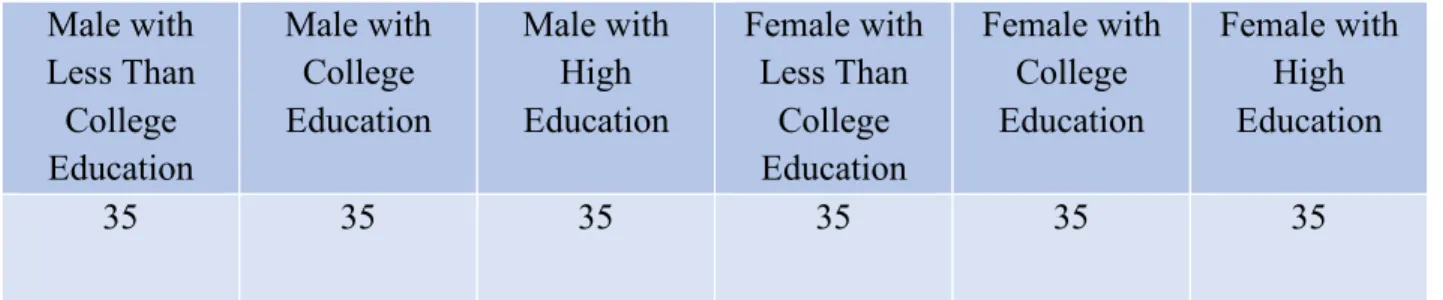
Figure 4.1 The Numbers of the Collected Tweets for Each Group. ...125
Figure 4.2 The Numbers of Tweets Based on Gender. ...126
Figure 4.3 The Numbers of Tweets Based on the Level of Education. ...127
Figure 4.4 The Collected Tweets of Men with High Education. ...128
Figure 4.5 The Collected Tweets of Women with High Education. ...130
Figure 4.6 The Collected Tweets of Men with College Education. ...132
Figure 4.7 The Collected Tweets of Women with College Education. ...134
Figure 4.8 The Collected Tweets of Men with Less than College Education. ...136
ix
LIST OF TABLES
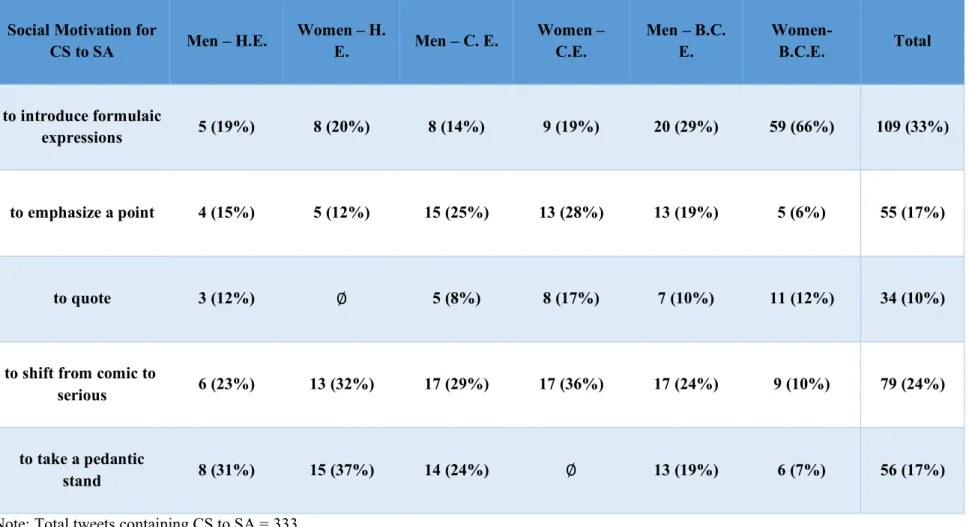
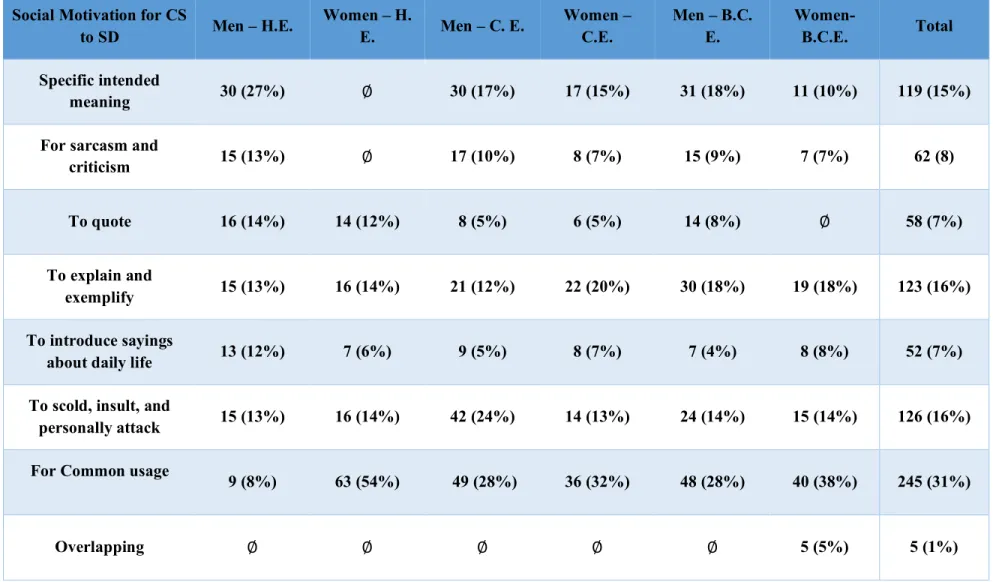
Table 3.1 The Most Frequent and Common Social Motivations for CS. ... 60 Table 3.2 Categorization of the Participants. ... 65 Table 4.1 The Social Motivations with Their Frequencies for CS to SA in Each Group. .... 78 Table 4.2 The Social Motivations with Their Frequencies for CS to the SD in Each Group.93 Table 4.3 The Numbers and Percentages of Tweets for Each Group. ...124 Table 4.4 The Numbers and Percentages of Tweets Based on Gender. ...125 Table 4.5 The Numbers and Percentages of Tweets Based on the Level of Education. ...127 Table 4.6 Numbers of Tweets for Each Twitter Account among Men with High Education.
...129 Table 4.7 Numbers of Tweets for Each Twitter Account among Women with High
Education. ...131 Table 4.8 Numbers of Tweets for Each Twitter Account among Men with College
Education. ...133 Table 4.9 Numbers of Tweets for Each Twitter Account among Women with College
Education. ...135 Table 4.10 Numbers of Tweets for Each Twitter Account among Men with Less than
College Education. ...137 Table 4.11 Numbers of Tweets for Each Twitter Account among Women with Less than
x
xi
3
LIST OF IMAGES
Tweet 1.1 ... 6 Tweet 1.2 ... 7 Tweet 4.1 ... 79 Tweet 4.2 ... 80 Tweet 4.3 ... 80 Tweet 4.4 ... 81 Tweet 4.5 ... 82 Tweet 4.6 ... 82 Tweet 4.7 ... 83 Tweet 4.8 ... 84 Tweet 4.9 ... 84 Tweet 4.10 ... 85 Tweet 4.11 ... 86 Tweet 4.12 ... 87 Tweet 4.13 ... 87 Tweet 4.14 ... 88 Tweet 4.15 ... 89 Tweet 4.16 ... 90 Tweet 4.17 ... 91xii Tweet 4.18 ... 94 Tweet 4.19 ... 94 Tweet 4.20 ... 95 Tweet 4.21 ... 97 Tweet 4.22 ... 97 Tweet 4.23 ... 98 Tweet 4.24 ... 99 Tweet 4.25 ...101 Tweet 4.26 ...102 Tweet 4.27 ...102 Tweet 4.28 ...103 Tweet 4.29 ...104 Tweet 4.30 ...105 Tweet 4.31 ...105 Tweet 4.32 ...106 Tweet 4.33 ...107 Tweet 4.34 ...108 Tweet 4.35 ...109 Tweet 4.36 ...110 Tweet 4.37 ...111 Tweet 4.38 ...112 Tweet 4.39 ...113 Tweet 4.40 ...114
xiii Tweet 4.41 ...115 Tweet 4.42 ...115 Tweet 4.43 ...116 Tweet 4.44 ...117 Tweet 4.45 ...117 Tweet 4.46 ...118 Tweet 4.47 ...119 Tweet 4.48 ...120 Tweet 4.49 ...120 Tweet 4.50 ...143 Tweet 4.51 ...144 Tweet 4.52 ...144 Tweet 4.53 ...146 Tweet 4.54 ...146 Tweet 4.55 ...147 Tweet 4.56 ...148 Tweet 4.57 ...150 Tweet 4.58 ...151 Tweet 4.59 ...152 Tweet 4.60 ...153 Tweet 4.61 ...154 Tweet 4.62 ...154 Tweet 4.63 ...156
xiv Tweet 4.64 ...157 Tweet 4.65 ...157 Tweet 4.66 ...159 Tweet 5.1 ...171 Tweet 5.2 ...171 Tweet 5.3 ...171
xv
4
ABSTRACT
The present study is an attempt to explore a new dimension of language use: how Arabic is utilized in the social media, Twitter in particular. It attempts to examine codeswitching (CS) in its written form between standard Arabic (SA) and Saudi dialect (SD). It aims to answer three research questions, namely:
1. What are the functions of using CS on Saudi Twitter? Are these functions different from the functions of CS in face-to-face interactions?
2. Do patterns of CS use differ by gender and education? 3. Do patterns of CS use differ by topic?
The current study adopts the sociolinguistic approach and provides a qualitative descriptive and quantitative analysis of 7350 tweets which were collected between December 2016 and July 2017, from 210 Saudi Twitter accounts diversified in terms of gender and education. The goal was to compare the motivations for CS in the written form with those motivations that have been identified in face-to-face interactions and to explore whether CS patterns would differ by gender and education. An additional 500 tweets were collected to investigate whether or not CS patterns would change by topic.
The findings revealed that the Saudi Twitter community utilized SA more than the SD. The study revealed that CS to SA is correlated with prestige, importance, sophistication,
xvi
and seriousness. It revealed that the Saudi Twitter community switched to SA for the following social motivations:
1. to introduce formulaic expressions 2. to emphasize a point
3. to quote
4. to shift from comic to serious tone 5. to take a pedantic stand.
In contrast, the SD or the Low variety is associated with sarcasm, informality, low-prestige, and everyday topics. It revealed that the Saudi Twitter community switched to the SD for the following social motivations:
1. for a specific intended meaning 2. for sarcasm and criticism 3. for quotations
4. for exemplifying and simplification 5. for introducing daily-life sayings
6. for scolding and personal attack or insult 7. for common usage.
Regarding the role of topic in CS patterns, the present study provided evidence against Ferguson’s prediction (1959) in which he associated code choice with the topic and situation. It revealed that CS occurred in different contexts that varied in their formality and
xvii
informality. Therefore, the study provided evidence that CS occurs to perform intended functions.
As for gender, the present study found that men utilized SA more than women, and this confirms previous findings of Ibrahim (1986), and Abd-El-Jawad (1987), Badawi (1973), and Haeri (1996a), Schmidt (1974), and Walters (1996) that women with the same level of education as men use SA less than men.
Regarding education, the present study found that the Saudi Twitter users with high and college education used SA more than their counterparts with less than college education. However, the current study should have considered age in addition to gender and education, because education by itself might be “a proxy variable” that could act on behalf of other less obvious independent variables (Al-Wer 2009). The findings of the present study suggest studying each community independently as each community differs in terms of its social variables, language attitudes, perceptions, and language policies. Finally, the study
emphasizes the importance of teaching SA to Arabic learners, placing less focus on dialects to learners due to the stability of SA, and designing as well as developing curriculums accordingly.
1
1
CHAPTER 1
Introduction
1.1 Overview
The Arabic language landscape has not significantly changed in the past 15 centuries, from the pre-Islamic period through the present day, particularly in terms of the existence of various dialects and variations spoken in different geographical areas of the Arabian Peninsula along with a dominant dialect (often referred to as the “High code (henceforth “H”). Furthermore, according to early Arabic sources the dominant dialect was Classical Arabic as we came to know it today and as was standardized by early Arab grammarians and the dialects then were not as divergent as modern day dialects1. Prochazka (1988) divided modern Saudi Arabian dialects into the Southern Ḥijāz and the Tihāma as well as the Najdī and Eastern Arabian dialects (p. 3). On the other hand, Al-Darsooni (1434 H/2013, pp. 16-17) and Aldosaree (2016, p. 16) divided the dialects that are spoken in Saudi Arabia into five main dialects in Saudi Arabia: Northern, Eastern (“Gulf”), Western (“Ḥijāzī”), Najdī, and Southern (“Janūbī”) as Figure 1.1 shows.
1 For discussions to do with variations between dialects then, see Sībawayh (d. 796), Ibn Faris (d. 1004), and Ramaḍān ʻAbd al-Tawwāb (1999).
2 Figure 1.1 Dialects Map in Saudi Arabia.
The Saudi dialectal map was retrieved from: http://journal.wrocah.ac.uk/article/a-perceptual-dialect-map-of-western-saudi-arabia/
Aldosaree (2016) stated that the central Najdī dialect is perceived as the prestigious dialect among all Saudi dialects because it is the variety that the royal family speaks. Al-Essa (2009, p. 206), reported a contradictory view, claiming that the Najdī dialect is classified as “Bedouin” dialect (as opposed to sedentary). In reality, there are some studies that attempted to describe the dialects in Saudi Arabia based on specific regions such as Ingham (1994), Al-Essa (2009), and Al-Rojaie (2013) who focused on the Najdī dialect. Al-Azraqi (1998, 2010), Asiri (2009), Nakshabandi (1988), and al-Shahrani (1988) focused on some dialects in the southwest of Saudi Arabia. Al-Mozainy (1981) studied the vowel alternation in the Bedouin Ḥijāz dialect; Il-Hazmy (1975) studied the dialect of Ḥarb in the west of Saudi Arabia; Al-Jehani (1985) studied the dialect of Mecca; and al-Shehri (1993) studied the impact of urbanization on the linguistic
3
behavior of urbanized rural immigrants in Ḥijāz. Al-Shammiry (2007) studied syntactic aspects of the Turaif in the north side of Saudi Arabia. Prochazka (1988) studied the phonology and the morphology of many dialects in Saudi Arabia, but not all of them.
There are many phonological differences in these various dialects; for example, in the Ḥijāzi dialect, speakers articulate the sounds /ð/ as /d/ or /z/, and /θ/ as /t/ or /s/ (Aldosaree, 2016). Speakers of the Najdī dialect replace /k/ with /ts/, and /g/ with /dz/ (Al-Essa, 2009; and Al-Rojaie, 2013). Al-Azraqi (1998) and Al-Darsooni (1434 H/2013) stated that the classical features such as kaskasah (the changing of the feminine pronominal suffix -ik to -is in pausal form) and kaʃkaʃah (the changing of the feminine pronominal suffix -ik to -iʃ in pausal form) are articulated in the Najdī dialect, and in some parts of the south-west of Saudi Arabia. Al-Darsooni (1434 H/2013) reported that in some parts of southwest of Saudi Arabia, some tribes articulate /dʒ/ as /j/, e.g., jamal “camel”; they also omit the glottal stop. These local dialectal variations, among others, were not found in my data. However, some of the collected tweets used a register in the middle between the local low dialects and SA. It apparently evolved as a result of the dialectal contact between various Saudi local dialects in schools, universities, and working environments across the different regions and provinces, and through TV shows, in addition to other factors. Consequently, I considered this variety as supradialect, and it is equated with the Saudi dialect (henceforth SD) throughout the present study although it needs more descriptive studies. In other words, I categorized the varieties in Saudi Arabia in the present study into three levels:
1. Standard Arabic (SA) including both Classic Arabic (henceforth CA) and Modern Standard Arabic (henceforth MSA).
4 3. The local dialects or the plain dialects.
The present study focused on code-switching (henceforth CS) between the first two varieties: SA and the SD.
1.2 Objectives of the Dissertation
According to Statista website, the market research company that offers online access to statistics and market intelligence, the number of Twitter users in Saudi Arabia reached 4.57 million in 2015 (Digital Market Outlook, 2016). Similarly, Business Insider, a financial and business news website, conducted data analysis to determine what percentage of different countries’ online populations actually use Twitter. Surprisingly, their investigation revealed that 41% of the Saudi online population uses Twitter, which is a higher percentage than any other country (Smith, 2013). In Saudi Arabia, Twitter is more popular than Facebook and Google+, due to its “micro-blogging” format with text-based posts limited to 140 characters, although it recently increased to 280. This feature makes the platform faster and more attractive to use. Another main reason Twitter is a popular communication outlet for Saudi Arabians is that it allows them to express and share their ideas, thoughts, and opinions freely. Moreover, it provides an ideal environment for discussions among people from all Saudi regions. The growth of Twitter use in Saudi Arabia may be a result of the platform’s accommodation of code-switching, which allows for the use of different varieties of Arabic. This feature is particularly relevant to a community rich in dialects and language variations discussed in the previous section.
Electronically-mediated communication (EMC), as facilitated by Twitter, provides a new means of formal and informal communication for Saudis with different dialectal backgrounds as it has features similar to speech, writing, or a mix of both. In this way, Twitter’s unique
5
example, EMC encourages people to use the Low (L) variety in written texts. In particular, Saudi Twitter users routinely write in both Standard Arabic and colloquial Arabic. Gordon (2011) states that “vernacular Arabic has simply been absent from the literary sphere, but it is becoming increasingly ‘written’ through this ubiquitous medium of communication among younger
generations of Arabic speakers” (p. 5). This study examined code choice and the motivations behind the code-switching that occurs in Saudi tweets by collecting data from Twitter. Twitter is not the only social media service, but it is significant that it has become the most popular subject of research and studies in the academic field in comparison to other social media such as
Facebook, Google+, and Flickr. Twitter has gained in popularity due to the following features: 1. Message size: As messages are short, Twitter is comparable to SMS, whereas
Facebook posts, emails, and blog posts vary in terms of length, which might result in unbalanced, incomparable corpora.
2. Sample size: There is greater potential to collect large amounts of data because millions of tweets are published on Twitter on a daily basis.
3. Twitter provides metadata such as usernames, the date the user account was created, language, and many other aspects.
4. Availability is one of the most significant features, as most of Twitter’s data and tweets are available to the public, even to those who do not have Twitter accounts. 5. Accessibility: Data can be accessed easily and collected via Application
Programming Interfaces (APIs), and can then be exported to various file formats, such as SVC, Excel, and so on.
The influence of Twitter on Arabic is a phenomenon worth investigating from a linguistic perspective, as it represents an interesting topic of study that can be examined from different
6
angles including how Twitter impacts the use of dialects and colloquialism in Saudi Arabia and conversely how it influences use of SA or High (H) variety. For example, based on some personal observations, users tend to use a formal register of words and sentences in their tweets even in informal situations where the L variety should be used according to Ferguson (1959). Consider the following tweet where the user used the H variety:
Tweet 1.1
“The wound that was caused when Al-Ahli [A Saudi soccer team] beat Al-Etihad [Another Saudi soccer team] 3-0 is still bleeding, and the announcement of such an important match between Al-Ahli and Barcelona reopens and worsens this bleeding wound.”
This tweet shows use of formal Arabic in a soccer commentary context, in which informal Arabic should have been used as Ferguson (1959) claimed. There is, for some reasons, an absence of local dialects and colloquialism, despite the Saudi society being rich in dialects. In contrast, users sometimes tend to use their local dialects only to serve certain purposes, such as sarcasm, humor, and expressions of anger or happiness, or on some occasion to pass on a coded message as in the following tweet:
7 Tweet 1.2
“Look, I warned you about solving your dilemma, and the necessity to reform your system, before the people who above you [the king] begins his investigation, and scatter the first and the last, then all of you will undergo an ordeal.”
According to Ferguson (1959), a formal register should be used for the tweet due to the serious nature of the content, although the user utilized his local dialect to convey his message, which is basically a warning to the president of a Saudi university in his hometown because both of them, the user and the president, are originally from the same area. Both of them speak Janoubi
(Southern) dialect, which is considered in Saudi Arabia one of the most difficult and
non-understandable dialects. Therefore, the user’s choice to use his own dialect as opposed to a more formal register indicates that the tweet has more of an impact on those who read it, particularly the president of the university.
The sheer abundance of different varieties of Arabic motivated this study on code choice on Twitter. That is, the Arabic linguistic situation is complex because several different varieties coexist: 1) Classical Arabic (CA), the language of the Qur’an, 2) Modern Standard Arabic (MSA), the written language of literature, journalism, and education, 3) the spoken colloquial varieties, and 4) Educated Spoken Arabic (ESA), which occupies a level between the standard and colloquial varieties. Therefore, research on how speakers of Arabic deal with these linguistic complexities is relevant, particularly in such a public space as Twitter. Certainly, tracing and investigating how such codes and varieties are utilized on Twitter should unveil a range of intriguing findings.
8
Code-switching is a creative communicative act employed for different pragmatic and sociolinguistic purposes, such as a mechanism for identity negotiation, situational marking, social-group membership, upward mobility, social solidarity, face management, discursive salience, and linguistic economy (Blom and Gumperz 1972; Gumperz 1982; Bentahila 1983; Appel & Muysken 1987; MyersScotton 1993b; Bhatt and Bolonyai (2011); Albirini 2010, 2011). By investigating code choice in the Saudi speech community on Twitter, the present study contributes to the study of diglossia and bidialectal CS within the context of social media.
To my knowledge, little has been investigated on this topic. The vast majority of studies in the Arabic context focused on the syntactic aspects of CS (e.g., Bassiouney, 2006; Belazi, Rubin, and Toribio, 1994; Boussofara-Omar, 1999; Eid, 1988, 1992) as well as CS in
multilingual speech communities (e.g., Bentahila, 1983; Bentahila & Davies, 1983; Belazi, 1991; Safi, 1992; Al-Mansour, 1998; and Al-Enazi, 2002; among others). Only a few studies have examined CS between SA and dialectal Arabic (DA) (e.g., Eid, 1982, 1988; Boussofara-Omar, 1999; Saeed, 1997; Bassiouney, 2006; and Albirini, 2010, 2011). There is also a small number of studies on CS in social media in the Arabic context, such as Eldin (2014), Alfaifi (2013), Kosoff (2014), Albirini (2016). Therefore, this study seeks to bridge the gap by contextualizing the study of CS between varieties within the framework of the wider discussion of CS and via the written form on Twitter.
Crucial variables that the current study examined including the roles of gender and education level on CS via Twitter. Due to the lack of agreement regarding the issue of language use and gender, as will be seen in the literature review in chapter 3 of the current study, the question of how gender and education levels affect Saudis’ code choice on Twitter naturally arises. This study investigated differences of gender and education level in terms of code choice
9
on Twitter in Saudi Arabia, where the overall literacy rate is almost 100%, as illustrated in Figure 1.2.
Figure 1.2 The Literacy Rate in Saudi Arabia among its Population Aged 15 and Older.
Lastly, the current study attempts to examine whether the functions of CS, as identified by research pioneers who investigated the social motivations of CS (e.g., Gumperz, 1982), are applicable to a bidialectal speech community but is usually a monoculture community.
Moreover, Appel and Muysken (1987) pointed out that the functions of CS vary from one community of speakers to another. Therefore, this study contributes to the literature on CS by filling the gaps regarding the social motivations of CS in written language on Twitter and comparing them to the motivations that have been identified for other contexts in the literature.
10 1.3 Research Questions
The present study aimed to examine the motivations behind CS at the written level because they might be different due to the channel of language production. Furthermore, because Twitter is, by its nature, a written communication channel, the Twitter user writes his/her tweets
consciously. It is therefore predicted that language use and code choice is a rational and conscious process, making CS a way of achieving a communicative (conscious) function. In addition, with respect to gender and education differences, the study aimed to explore the role of gender and education in code choice. Lastly, the present study aimed to investigate the role of topic in code choice. Accordingly, this study aimed to answer the following research questions:
1. What are the functions of using CS on Saudi Twitter? Are these functions different from the functions of CS in face-to-face interactions?
2. Do patterns of the use of CS differ by gender and education? 3. Do patterns of the use of CS differ by topic?
1.4 Organization of the Dissertation
This dissertation includes five chapters. Chapter 1 is an introduction, significance of the study, basic assumptions, and research questions. Chapter 2 focuses on the terms relevant to code-switching and reviews the code-code-switching literature from a sociolinguistic perspective, in addition to considering the variables of gender and education level. Chapter 3 details the methodology that was followed in conducting the current study, including how the data was collected, description of the participants, and data analysis and coding. Chapter 4 reports the main findings of the study. Finally, chapter 5 discusses the findings of the study from a sociolinguistic perspective and offers a conclusion as well as suggestions for future research.
11
2
CHAPTER 2
Literature Review
2.1 Overview
This chapter focuses on the literature related to code-switching. It offers a brief overview of the historical aspects of Standard Arabic versus Colloquial Arabic, commencing with a definition of the term diglossia and an explanation of how Arabic is considered among the diglossic languages. The chapter next provides an overview of different models that contradict Ferguson’s (1959) model, such as Badawi’s (1973), in which Badawi proposed the existence of different levels of Arabic. In this way, the continuum of Arabic dialects is illustrated as a form of code-switching. Finally, the chapter reviews the relevant literature related to the roles that gender and education play in language variation.
2.2 Studies on Arabic Diglossia
According to Zughoul (1980), the term diglossia was first used by the German
linguist Karl Krumbacher (1902) and subsequently by the French linguist William Marçais (1930). Ferguson (1959) is considered the first linguist to popularize the term Diglossia to distinguish between H and L varieties in Arabic. It is important to note that Ferguson’s definition specifically requires that the High and Low varieties should belong to the same language (in this case, H and L Aabic). Arabic is described by Ferguson (1959) as a diglossic language as it has two distinct codes which show clear functional separation: one
12
code is employed in one set of circumstances, which is a high variety (H), and the other in an entirely different set, which is a low variety (L) variety. He sets specific functions for each variety which implies that these two varieties are not used together in the same context. In his seminal article, Ferguson (1959) discussion of diglossia with regard to the relationship between Standard Arabic and colloquial varieties of Arabic was both wide and
comprehensive. Taking diglossia to mean the use of two or more varieties of the same language under different conditions, Ferguson explained the phenomenon of diglossia by reference to four prototypical situations in Arabic, Modern Greek, Swiss German and Haitian Creole. He defined it as follows:
Diglossia is a relatively stable language situation in which, in addition to the primary dialects of the language (which may include a standard or regional standards), there is a very divergent, highly codified (often grammatically more complex) superposed variety, the vehicle of a large and respected body of written literature, either of an earlier period or in another speech
community, which is learned largely by formal education and is used for most written and formal spoken purposes but is not used by any sector of the community for ordinary conversation. (p. 245)
With respect to features, the specialization of function is significant, as H is appropriate only in some situations while L is appropriate in others. For instance, H is considered the medium of formal education, the language of all Arab constitutions, and the symbol of Arab cultural and national unity. It is used in the following situations: sermons in church or mosque, the
13
Qur’an, Old and New Testaments of Christian Arabs, lectures, literature including pre-Islamic era, formal education, newspapers, news broadcasts, news bulletins, street signs, official formal occasions, and so on. In contrast, L is used for daily life conversation with family and friends, in informal situations at home, work, and social gatherings. It is also used in radio and TV entertainment programs, advertisements and in recent decades in folk literature, especially in poetry, novels and drama.
Ferguson (1959) noted that H is considered prestigious, conveying the strong feeling that H is considered the “real” language while L is stigmatized or even reported “not to exist.” In this sense, the attitude toward H is more positive than toward L. As an example, Ferguson observed that native speakers of Arabic who describe someone as not knowing Arabic would normally mean that that person does not know H (even if they are fluent in L). Ferguson (1959) also noted that if a non-native asks an educated Arab to teach them how to speak Arabic, they will typically be taught H. In other words, it is commonly believed that H is more beautiful, more logical, and better able to express significant thoughts and ideas.
Another point raised by Ferguson (1959) related to how both H and L are acquired. He pointed out that adults use L in speaking to children, and children use L in speaking to one another. As a result, L is acquired first while H is acquired through formal education rather than natively. H is also characterized by a strong tradition of grammatical study that allows variations only within certain limits, as well as an inflectional system of nouns and verbs that is much reduced or absent in L. Additionally, H includes grammatical categories that are not found in L.
14
“original weaknesses” and said that if he were to write the original article again, he would treat these differently. One important original weakness is what he called “linguistic
distance” that is, the failure to clarify the distance between H and L, or how far apart H and L must be to constitute diglossia. He emphasized the need to develop scales of distance in language structure, language use, and language attitudes. Nonetheless, Ferguson himself in his original article (1959, p. 240) mentioned that diglossia is not stable and tend to develop into a more stable language situation. Diglossia resists such development for several centuries at least and in some cases as evidence shows can last well over a thousand years. According to Ferguson, the communicative tensions that coexist with diglossia might be resolved through the use of intermediate and uncodified forms of the language, which he called ʔl-luɣah ʔl-wustˤaː ‘Middle Arabic’. This intended intermediate form is a kind of spoken Arabic and is utilized in semi-informal or cross dialectal situations. It has comprised intensively classical vocabulary but without or with few inflectional endings. It also includes some certain classical syntactic features but are integrated with colloquial base in
morphology and syntax as well as an ample admixture of L vocabulary.
Elaborating on what Ferguson (1991) called “linguistic distance,” scholars such as Blanc (1960), Badawi (1973), Meiseles (1980), and Boussofara- Omar (2006) proposed an intermediate level to describe more accurately the distance between H and L in Arabic. They observed that native speakers of Arabic in their spoken language tend to alternate between H and L, resulting in levels that are neither fully H nor L. It noteworthy that native speakers of Arabic are intuitively able to realize what forms belong to H, and what forms belong to L as Parkinson (1996) posited that “speakers themselves are very aware of the 'source' of their linguistic material, and can tell you if a particular lexical item, grammatical pattern, or even
15
vowel marker, is dialectal or fusˤħaː” (p. 91). This intermediate level is known as a continuum of varieties. Albirini (2015) distinguishes between two approaches adopted by those proposing intermediate varieties between H and L. The first of these approaches identifies distinct varieties between H and L, as exemplified by Badawi (1973), and
Meiseles (1980). Badawi proposed a continuum of varieties, with varying degrees of overlap and borrowing from H and L. He identified and explained five levels of contemporary Arabic: (1) fusˤħaː t-turaːθ “inherited Classical Arabic”; (2) fusˤħaː l-ʕasˤr “modern Classical Arabic”; (3) ʕaːmmiyyat ʔal-muθaqqafiːn “colloquial of the educated,” (4) ʕaːmmiyyat mutanawwiriːn “colloquial of the literate”; and (5) ʕaːmmiyyat
ʔal-ʔummiyyiːn “colloquial of the illiterate.” Prior to Badawi (1973), Blanc (1960) proposed five levels, standard classical, modified classical, semi-literary, koineized colloquial, and plain colloquial. On the other hand, Meiseles (1980) identified four distinct varieties of
contemporary Arabic: literary or standard Arabic, oral literary Arabic, educated spoken Arabic, and plain vernacular. In contrast, some researchers such as Meiseles (1980), and Ryding (1991) emphasized an intermediate variety known as Educated Spoken Arabic (ESA) or Formal Spoken Arabic (FSA) or Middle Arabic (MA). Meiseles (1980) defined ESA as follows:
It is the current informal language used among educated Arabs, fulfilling in general their daily language needs. It is also the main means of Arabic interdialectal communication, one of its most important trends being its intercomprehensibility among speakers of different vernaculars, arising
16
mainly from the speaker’s incentive to share a common language with his interlocutor or interlocutors. (p. 126)
Ryding stated that ESA has become the language of choice for most spoken Arabic training at the Foreign Service Institute (FSI) because it represents a real segment of the continuum of spoken Arabic variants. She defined ESA as “a supra-regional prestige form of spoken Arabic practical as a means of communication throughout the Arabic-speaking world” (p. 212). Furthermore, Ryding (1991, p. 216) listed a number of distinctions that characterize ESA, or what she called the “middle language,”as compared to literary Arabic:
1. Omission of inflection (i.e., final short vowels in all parts of speech); 2. Consequent metathesis of vowels on pronoun suffixes;
3. Reduction of inflectional endings in dual and masculine plural sounds to the oblique or non-nominative form;
4. Elimination of the separate feminine plural categories in verbs and pronouns and reduction to one non-gender-specific plural;
5. Elimination of the dual category in verbs and pronouns (both second and third person) and merging of this category with the plural;
6. Omission of final “nuun” in inflectional suffixes for second person feminine singular and second and third person plural in the imperfect;
7. Generalization of the defective suffixable stem to geminate verbs in the past tense;
17
9. Creation of a category of verbs with embedded indirect object.
According to Mahmoud (1986, pp. 245-246), there are some factors have consolidated and contributed to the emergence of ESA, which Badawi (1973) called it ʕaːmmiyyat ʔal-muθaqqafiːn, such as the massive spread of education, beside the widespread use of
technology, which has given birth to a new elite with distinctive communicative needs. This elite is a social class who completed their college education, however, they did not use standard Arabic for one of two reasons; either because of lack of competence and they did not master it or they think that it is not modernized enough to satisfy their way of speaking, particularly when discussing technological topics. Another crucial factor led to the
emergence of ESA is its intensive use by political leaders such as Gamal Abdel-Nasser. Political leaders like the elite utilize H when attempting to convey serious issues and new concepts such as emancipation, progress, and economic freedom. In contrast, they switch to L variety in order to convey their message in a reliable, authentic, and sometimes emotional way. The influence of media is also a significant factor which led to the emergence of ESA particularly television and radio since they used to be the only way to disseminate news and information in the Arab world as well as they have become the main means of
communication between political leaders and their nations. Consequently, ESA had spread among nations of the Arab world. Lastly, an important factor that has contributed to the emergence of ESA is the inter-Arab worker migration in addition to the bilateral and
multilateral meetings. As a result of such dialectal contact, ESA has satisfied communicative needs and has been used as an effective as well as versatile way of communication among Arabs from different countries and region.
18 2.2.1 Language and prestige
Ibrahim (1986) stated that the question of a distinction between prestige and standard varieties of Arabic has not yet even arisen because Arabic sociolinguistics are commonly discussed in exactly the same terms as typically non-diglossic European languages such as English or French. He claimed that the problems of interpreting Arabic sociolinguistic data and findings arise from the identification of H as both standard and prestigious at the same time. Western researchers assume that the standardized variety of a language is the most overtly prestigious, but Arabic sociolinguists need to maintain a clear distinction between standard and the prestigious variety. Ibrahim (1986) argued against assuming that the standard H variety of Arabic is the only highly valued or prestigious variety, as there is evidence from various sources and from different Arab communities that spoken Arabic (L) has its own local prestigious varieties, determined by geographical, political, and social factors within each community. As examples of local prestigious varieties of spoken Arabic (L), Cairene in Egypt is the prestige variety of Egyptian Arabic for non-Cairenes, and Damascene dialect is usually considered the prestige dialect in Syria. Ibrahim noted that all the available data show that, in speaking Arabic, Arab women employ locally prestigious features of L more than men, and more Arab women than men would opt to use prestigious L varieties. Similarly, Haeri (2000) found that women use standard forms significantly less frequently than men, instead favoring non-classical, urban forms (e.g., Amman, Cairo). Abd-El-Jawad (1987) agreed with Ibrahim (1986) that most studies of Arabic
sociolinguistics seem to equate the terms prestige and standard, and therefore tend to view SA as the only prestige variety across all settings. Abd-El-Jawad categorized spoken Arabic into at least three levels of prestige: (1) the national standard variety (MSA) with pan-Arab
19
prestige; (2) regional standard spoken varieties with local prestige (that is, competing with SA); and (3) vernacular varieties with less prestige than (1) and (2). He also noted that the influence of SA’s prestige could be overridden by the social function of prestigious nonstandard local features. Abd-El-Jawad (1987) concluded by suggesting that:
...speakers often abandon their vernacular forms in favor of other local prestigious features in order to (a) share or “koinesize” with those of other
dominant groups, an act of integration and a desire for upward social mobility, (b) avoid ridicule and the stigma of being stereotypes, (c) associate with the dominant social groups, (d) feel socially secure. (p. 366)
Albirini (2016, p. 38) stated that the socioeconomic and educational gap between urban settlers and Bedouins in most Arab countries means that the Bedouin dialect is considered less prestigious than the urban dialect. Nevertheless, Bedouin varieties are described having ʔasˤaːlah “pure origin,” and some urban speakers adopt features from the Bedouin dialect. For instance, Al-Wer (2007) found that some urban men in Jordan
sometimes adopt features of the Jordanian Bedouin dialect to affirm their connection to Bedouin heritage and traditions. Ultimately, the prestigious variety is governed by complex historical, socioeconomic, pragmatic, and demographic factors, as well as by attitudes toward these varieties or their speakers (see also Albirini 2016, p. 39).
20
2.2.2 Mother tongue, native language, or second language
Ferguson (1959) drew a distinction between H and L in terms of how they are acquired. He asserted that H is learned through formal education, while the L variety is acquired at home. Although Ferguson did not attempt to identify which of the two varieties is considered the mother tongue, others construed this status is attributable to L, as it is acquired informally at home, while H is learned through formal education. For example, Schiffman (1997) stated that
In diglossia, no one speaks the H variety as a mother tongue, only the L variety. In the standard with dialects situation, some speakers speak H as a mother tongue, while others speak L varieties as a mother tongue and acquire H as a second system. (p. 207)
However, Fishman (1967) and Gumperz (1993) expanded and broadened the concept of diglossia to subsume bilingual or multilingual societies. Nonetheless, Hudson (1980) objected to such expanding of the concept of diglossia as “a regrettable development, as it would seem to make every society diglossic, including even English-speaking England” (p. 55).
In attempting to link Ferguson’s (1959) and Fishman’s (1967) work on diglossia, Hudson (1991) stated that
Both studies portray diglossic repertoires as repertoires in which one variety, or range of varieties, is acquired in the natural manner of a vernacular mother tongue, whereas a second variety, or range of varieties, is acquired later in the process of
21
socialization, under the influence of formal educational processes outside the environment of home and family. (p. 8)
However, some researchers refute this point of view, arguing that H is considered the mother tongue simply because most Arab children are exposed to both varieties (H and L) from birth. They are exposed to H through television, radio, religious speeches and sermons on Fridays, children’s books, adults’ prayers, and Qur’anic recitations, and some children may attend religious schools in early life. Sabir and Safi (2008) cited evidence of diglossic code-switching between H or Modern Standard Arabic (MSA) and L or Hejazi dialect (HjD) in the speech of a 5:6-year-old Ḥijāzī child. The child had no formal schooling at that time and had not therefore learned H formally. Examining the child’s oral output over a period of nine months, the researchers found significant elements of SA in the child’s daily
conversational output, indicating that the acquisition of SA does not necessarily depend on formal education.
Albirini (2016) conducted a pilot study to explore Arab children’s comprehension of five videos in SA, extracted from five cartoon shows: Sinbad, Sasuki, ḥikāyāt alʿālamiyya, Sinān, and ʾabṭāl almalāʿib. The sample of eight children varied in age between 5 and 5:6 and came from different cities in Jordan (Amman, Irbid, and Al-Ramtha). None of the participants had had any formal education in SA. After watching each video clip, each child was asked three comprehension questions—one testing their general understanding
concerning the theme of the video, and two about specific details. The researcher found that all of the eight participants were able to recognize the general idea or theme of the videos either completely or in part (92.5% accuracy of comprehension). Most of the children
22
(83.1%) were also able to identify specific details requiring profound understanding of SA, demonstrating that these Arab children had receptive skills in SA. Similarly, illiterate Arabs who had not attended formal education have been found to understand SA in news reports, religious speeches and sermons, and other sources of SA, again supporting the idea that H is acquired natively.
2.3 Studies on Code-Switching
Ferguson’s (1959) article about diglossia had a significant impact on early researchers of CS such as Blom and Gumperz (1972) because diglossia is similar, if not identical, to what Bloom and Gumperz (1972) refer to as situational CS (Belazi 1991, Albirini 2010).
Although diglossia is a historical turning point, it can be subsumed under the umbrella of CS because switching might occur between different varieties of the same language as well as between two distinct languages. Accordingly, the current study agrees with Mejdell (2006, as cited in Bassiouney 2009, p. 31) who suggested that code-switching should be
comprehended and studied in a broad context to comprise both varieties of one language and different languages. Further, CS can be studied in the written form similarly to how spoken language is studied. Thus, the term code-switching can be applied to switching between two distinct languages or switching between varieties of the same language.
As for the approaches to study CS, Appel and Muysken (1987) identified three approaches to code-switching: the psycholinguistic approach, the linguistic or grammatical constraints that restrict code choice within sentences, and the sociolinguistic approach to code-switching, which is the one mainly guiding the present study (pp. 121–122). The sociolinguistic approach attempts to provide an explanation for why speakers alternate
23
between different languages and codes. Among the researchers who followed the sociolinguistic approach to identify the motivations behind the factors that impact code-switching were Blom and Gumperz (1972), Gumperz (1982), Bentahila (1983), Appel and Muysken (1987), Myers-Scotton (1993b), and Bhatt and Bolonyai (2011).
Gumperz (1982) defined code-switching as “the juxtaposition within the same speech exchange of passages of speech belonging to two different grammatical systems or subsystems” (p. 59). Ten years earlier, Blom and Gumperz (1972) examined CS between standard and non-standard dialects in a Norwegian town and distinguished between two types of switching: situational and metaphorical. They explained that situational code-switching occurs when the conversational situation changes, for instance, when there is a change in participants, topic, or setting. In contrast, metaphorical code-switching is used as a conversational strategy to support conversational acts, such as showing solidarity with a group, offering an apology, or making a request, refusal, or complaint.
Another categorization of types of CS based on the linguistic approach is proposed by Muysken (2000, 2013 p. 714) who categorized the different types of CS into three main types: “(1) INSERTION: use of the L1, i.e., the grammatical and lexical properties of the first language, as the matrix or base language; (2) CONGRUENT LEXICALIZATION: production of structures and words which share properties of L1 and L2; (3)
ALTERNATION: use of universal combinatory principles, procedures by which fragments from different languages can be combined independently of the grammars involved.
(4) BACKFLAGGING: use as much as possible of the L2, i.e. the grammatical and lexical properties of the second language, as the matrix or base language.”
24
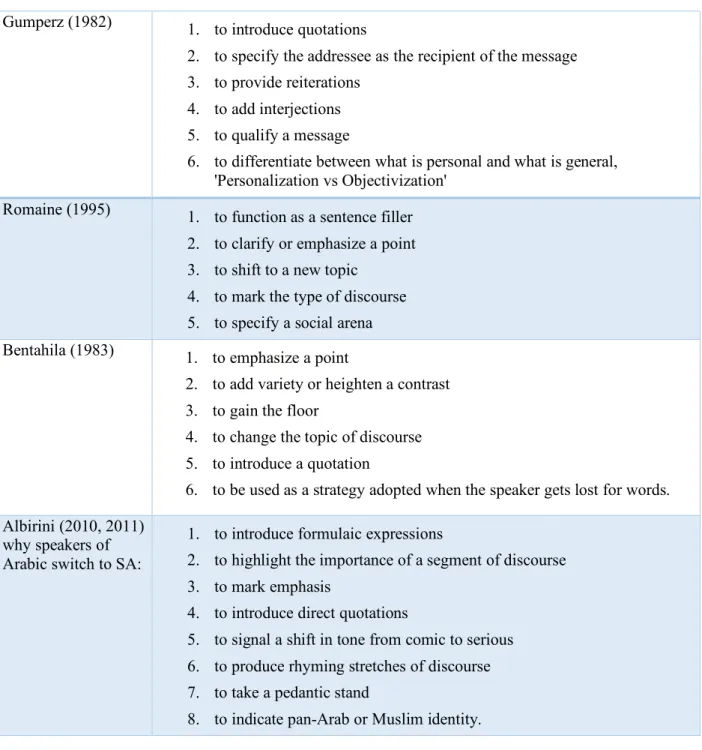
Focusing on the social motivations for CS, Gumperz (1982) identified six functions for code-switching that clarify why people usually switch codes: (1) to introduce quotations; (2) to specify the addressee as the recipient of the message; (3) to provide reiterations; (4) to add interjections; (5) to qualify a message; and (6) to differentiate between what is personal and what is general. Notably, Gumperz (1982) distinguished between in-group and out-group audience, and proposed what he called ‘we code’ and ‘they code’ as he wrote:
The tendency is for the ethnically specific, minority language to be regarded as the 'we code' and become associated with in-group and informal activities, and for the majority language to serve as the 'they code' associated with the more formal, stiffer and less personal out-group relations. (p. 66)
In addition to Gumperz identifying six functions for why individuals tend to code switch, Grosjean (1982, p. 152) distinguished ten reasons for CS, namely (1) to fill a linguistic need for lexical item , set phrase, discourse marker, or sentence filler; (2) to continue the last language used (triggering); (3) to quote someone; (4) to specify addressee; (5) to qualify message: amplify or emphasize ("topper" in argument); (6) to specify speaker involvement (personalize message); (7) to mark and emphasize group identity (solidarity); (8) to convey confidentiality, anger, annoyance; (9) to exclude someone from conversation; and (10) to change role of speaker: raise status, add authority, show expertise. Yet another researcher, Romaine (1995, pp. 161-162), identified functions for code-switching with some overlap with Grosjean (1982). Romaine identified the following functions: (1) to function as a
25
sentence filler; (2) to clarify or emphasize a point; (3) to shift to a new topic; (4) to mark the type of discourse; and (5) to specify a social arena.
Myers-Scotton (1993, p. 47) states that prior to Blom and Gumperz (1972), CS was perceived as a lack of linguistic competence or, in other words, it is caused by imperfect bilingualism because the person who switches between codes cannot maintain a
conversation in a determined code in different situations. Moreover, Weinreich (1953, p. 73) stated that speakers consider their environment as well as the occasion of the speech when deciding whether to switch between codes. He gave an example of a university lecture as a situation in which the audience expects the lecturer to utilize a formal code when the lecturer discusses non-personal topics. In contrast, if the lecturer himself/herself talks to a student about personal matters outside of the lecture hall, the lecturer might utilize informal code. Thus, switching between codes, according to Weinreich, depends on two factors: the topic being discussed and the participants.
Auer (1988, 1995, 1998) advocated a sequential approach to CS based on conversation analysis. He argued that CS is best analysed and explained as a
contextualisation cue. He stated, “[A]ny theory of conversational [code-switching] is bound to fail if it does not take into account that the meaning [of code-switching] depends in an essential way on its ‘sequential environment’” (Auer, 1995, p. 116). Auer’s sequential approach emphasised analysing data by considering the preceding and subsequent
utterances. Auer (1995, pp. 125-126) identified four patterns for sequential code-switching: (1) discourse-related code-switching, which is used to mark a shift in topic, a change in participant constellation, or a change in activity type; (2) participant-related code-switching, which reveals the speaker’s preferences for one code instead of another. For example, when
26
a speaker might avoid using a specific code in which he/she lacks confidence, and therefore uses the code in which he/she has greater competence; (3) discourse related and semi-participant discourse-related code-switching, in which bilingual speakers keep code choices open by switching between the two codes within a turn; as a result, it becomes difficult to decide which code is the base language; and (4) transfer, in which “a word or another structure in language B is inserted into a language A frame” (Auer, 1995, p. 126).
Appel and Muysken (1987) proposed a functional model of CS to answer the question why speakers switch between codes and identified six functions of CS: (1) the referential function, (2) the directive and integrative function, (3) the expressive function, (4) the phatic function, (5) the metalinguistic function, and (6) the poetic function (pp. 118– 120). The referential function of CS occurs due to lack of facility or lack of knowledge of one of the two languages on a certain topic or subject. Appel and Muysken added that this type of CS is the only type that bilingual people use consciously. Codeswitching can also serve a directive function, in which the CS can be utilized to include or exclude specific interlocutors by using the speakers’ preferred code to include a speaker or the less preferred code to exclude a certain conversational participant. The directive and integrative function resembles what Gumperz (1982) called “addressee specification,” as well as the
convergence and divergence of the speech accommodation theory introduced by Giles, Taylor and Bourhis (1973) as cited in Appel and Muysken (1987). The expressive function, in which CS may be meaningless or carry no specific meaning, mainly serves to express the multilingual or bilingual status of the speaker. As for the phatic function, CS is used to alter the tone of conversation, and is similar to what Gumperz called metaphorical CS. The metalinguistic function occurs when the speaker aims to either directly or indirectly
27
comment on the languages involved. As an example of this function, Appel and Muysken (1987) described a speaker who switches between different codes to impress the audience with his/her linguistic skills (p. 120). Lastly, the poetic function involves using puns, telling jokes, and producing poetry in various languages. Furthermore, Appel and Muysken (1987) pointed out that the functions of CS vary from one community of speakers to another. For example, “Puerto Ricans in New York may code switch for very different reasons than the Flemish in Brussels” (p. 120). They also emphasized the importance of focusing on why people switch in the same manner sociolinguists focus on who does the switching.
In spite of the work that has been done by Gumperz and others on the social
motivations for CS by identifying lists of social motivations for CS, Gumperz among others have not established a solid or coherent theoretical framework to explain CS as a linguistic phenomenon as an alternative to Gumperz’s descriptive approach (Myers-Scotton 1993, p. 63). Consequently, several attempts have been made to establish a solid theoretical
framework to explain CS, such as the accommodation theory proposed by Giles, Taylor & Bourhis (1973), Giles, Coupland and Coupland (1991), the conversational model by Auer (1988, 1995, 1998), the markedness theory by Myers-Scotton (1993), and the optimality-theoretic approach suggested by Bhatt and Bolonyai (2011).
For her part, Myers-Scotton (1993), after studying Eastern African multilingual communities, introduced the markedness model (MM) in an attempt to explain the social motivations behind CS. She observed that multilingual communities of speakers feature norms that lead the speaker to select one particular linguistic code over another. Myers-Scotton framed her MM based on the idea that people employ CS to negotiate the rights and obligations (RO) between interlocutors in social interactions. Thus, code choice in MM is
28
ruled and governed by the rights and obligations that are set up by the norms of the
communities of speakers. Because every conversational setting differs in terms of its rights and obligations, the speakers ought to conform their behavior appropriately to achieve maximum benefit.
Myers-Scotton proposed three maxims, or types, of code-switching: the unmarked choice maxim, the marked choice maxim, and the exploratory choice maxim. Unmarked choices occur when the speakers follow the social norms. These language choices are expected and customary. The marked choice, on the other hand, deviates from the
determined social norms. According to the MM, the speaker can purposely utilize a marked code rather than an unmarked code in order to negotiate a new set of rights and obligations. Moreover, the unmarked choice is used to “make your code choice the unmarked index of the unmarked [rights and obligations] RO set in talk exchanges when you wish to establish or affirm that RO set” (1993, p. 114). The unmarked choice maxim features two types of unmarked CS: sequential CS and CS itself as an unmarked choice. Sequential CS resembles the situational CS of Blom and Gumperz (1972) and occurs when the situation, topic, or participants change. Sequential CS occurs as a result of a change in conversational situation that dictates CS. The marked CS choice occurs when it is used to “make a marked code choice which is not the unmarked index of the unmarked RO set in the interaction when you wish to establish a new RO set as unmarked for the current exchange” (Myers-Scotton, 1993, p. 131). As a marked choice, CS can be utilized to increase or decrease the social distance between interlocutors, and, as mentioned, can be compared to what Gumperz (1982) referred to as metaphorical CS. Finally, an exploratory CS choice occurs “when an unmarked choice is not clear, [speakers] use CS to make alternate exploratory choices as
29
candidates for an unmarked choice and thereby as an index of an RO set which you favor” (Myers-Scotton, 1993, p. 142). Exploratory CS occurs when, for example, the interlocutors cannot clearly identify the unmarked choice.
In later research, the markedness model was recast into a more explicit rational choice model (Myers-Scotton & Bolonyai, 2001). The authors pointed out that the rational choice model provides a better explanation for why a speaker prefers one linguistic variety over another. In the rational choice model, the theory proposed that choices in conversations depend on the estimation and assessment of what choice provides the speaker with the greatest benefit. “That is, choices reflect a goal to enhance interpersonal relations and/or material or psychological rewards, and to minimize costs” (Myers-Scotton & Bolonyai, 2001, p. 6). The rational choice model includes three filters through which the choices pass. In the words of the authors:
Choices in a rationally based model of linguistic variation pass through several filters. They begin with the external constraints on speakers: their linguistic repertoires, which in turn are constrained by large-scale societal factors and the discourse structure of their communities. They are also filtered to internal constraints, the innately available architectures (a markedness evaluator, somatic markers) that bias choices based on experience. Finally, choices pass through a third filter in which a social mechanism, rationality, is the centerpiece. To act rationally means that speakers take account of their own beliefs, values, and goals, and that they assess these in regard to internal consistency and available evidence. (p. 22)
30
Prior to the work of Myers-Scotton and Bolonyai (2001), Giles, Taylor, and Bourhis (1973) developed a model of code choice that they named the interpersonal speech
accommodation theory. The aim behind this sociolinguistic theory was to explain that situational factors alone cannot adequately illustrate code choice. Thus, they formulated their model to focus on one taxonomic level: the aspects of interpersonal relations that have to be considered. The essence of the model was derived from social psychological research on similarity-attraction. Their model proposed that interlocutors can reduce dissimilarities between them by inducing other conversation participants to evaluate them more favorably. In other words, speakers will spontaneously or subconsciously adjust to and conform with each other to gain social approval. Such behavior is called accommodation, and it has two opposite dimensions. The first dimension, convergence, involves a speaker using the code that the other conversation participant best knows or prefers to indicate social inclusion. Divergence, the second dimension, involves the speaker attempting to use the hearer’s disfavored language or code to indicate social exclusion by maximizing differences in languages usage. In support of this theory, Myers-Scotton (1988) claimed that “In many multilingual societies, switching to a language not known by all participants is a common means of exclusion, often conscious” (p. 174).
Bhatt and Bolonyai (2011) introduced the optimality-theoretic model, in which they developed a theoretical framework that incorporates principles of optimality theory (OT). Bhatt and Bolonyai benefited from previous theoretical approaches that had attempted to explain the functions of CS, such as the social-functional models (Gumperz, 1982; Heller, 1992; Myers-Scotton, 1993) and the conversational models of CS (Auer, 1998). Bhatt and
31
Bolonyai (2011) provide a model in which the functions of CS have been reduced to five meta-constraints, rather than consisting of countless functions of CS. Their model was generated as a result of an analysis of the sociolinguistic functions of code-switching (CS) in 120 studies that they reviewed. Bhatt and Bolonyai (2011) abstracted more than 130
functions of CS from 120 studies into five main principles:
1- The Principle of Interpretive Faithfulness (FAITH), in which “actors code-switch to the language that more faithfully and economically captures the intended conceptual, semantic-pragmatic, often socio-culturally or ideologically grounded, meaning” (Bhatt and Bolonyai 2011, p. 526)
2- The Principle of Symbolic Domination (POWER), in which social actors shift to another code to maximize social distance, and to highlight himself/herself in a position of power, status, authority, and social distance (Bhatt and Bolonyai 2011, p. 528)
3- The Principle of Social Concurrence (SOLIDARITY), in which social actors switch to another code to minimize social distance, and to create the feeling of affiliation, intimacy, and to create solidarity with others (Bhatt and Bolonyai 2011, p. 530)
4- The Principle of Face Management (FACE), in which social actors switch to the code that allows them to maintain “face,” or a specific public image when interacting with others. Social actors in the principle of FACE management also “switch to a language that is best positioned to manage their interpersonal relations consistent with their own or others need (e.g. appreciation, tact,
32
deference, respect, positive or negative politeness)” (Bhatt and Bolonyai 2011, pp. 531-532)
5- The Principle of Perspective Taking (PERSPECTIVE), in which “Actors switch to a language that is best positioned to signal what is assumed to be currently salient point of view and socio-cognitive orientation in discourse” (Bhatt and Bolonyai 2011, pp. 531-533).
2.4 CS Studies in the Arabic Context
Having looked at some of the work that has been done on CS, this literature review focuses specifically on the work that has been done on social motivations for CS in the Arabic context. When it comes to discussing CS in the Arabic context, Bentahila is considered a pioneer in the field. In his study, Bentahila (1983) investigated the motivation behind the use of code-switching among Arabic-French bilinguals who use Moroccan dialect, claiming that code-switching is a common feature of the speech of those Moroccans who are fluent in both French and Arabic. His data comprised seven-and-a-half hours of conversations that were recorded without the knowledge of the participants. All the participants were balanced bilinguals aged between 17 and 40. The conversations took place in a relaxed home setting, involved between two and four participants meeting on a friendly basis, and covered a wide range of topics from idle chat about food, the weather, and everyday events to more serious discussions of work, politics, and education. He found that switching can allow bilinguals to use the vocabulary that they find most readily available or most appropriate to a particular topic, thereby making possible greater fluency than if they had to search for suitable terms