One Parser to Rule Them All
Ali Afroozeh
Anastasia Izmaylova
Centrum Wiskunde & Informatica, Amsterdam, The Netherlands {ali.afroozeh, anastasia.izmaylova}@cwi.nl
Abstract
Despite the long history of research in parsing, constructing parsers for real programming languages remains a difficult and painful task. In the last decades, different parser gen-erators emerged to allow the construction of parsers from a BNF-like specification. However, still today, many parsers are handwritten, or are only partly generated, and include various hacks to deal with different peculiarities in program-ming languages. The main problem is that current declara-tive syntax definition techniques are based on pure context-free grammars, while many constructs found in program-ming languages require context information.
In this paper we propose a parsing framework that em-braces context information in its core. Our framework is based on data-dependent grammars, which extend context-free grammars with arbitrary computation, variable binding and constraints. We present an implementation of our frame-work on top of the Generalized LL (GLL) parsing algorithm, and show how common idioms in syntax of programming languages such as (1) lexical disambiguation filters, (2) op-erator precedence, (3) indentation-sensitive rules, and (4) conditional preprocessor directives can be mapped to data-dependent grammars. We demonstrate the initial experience with our framework, by parsing more than 20 000 Java, C#, Haskell, and OCaml source files.
Categories and Subject Descriptors D.3.1 [Programming Languages]: Formal Definitions and Theory—Syntax; D.3.4 [Programming Languages]: Processors—Parsing
Keywords Parsing, data-dependent grammars, GLL, dis-ambiguation, operator precedence, offside rule, preprocessor directives, scannerless parsing, context-aware scanning
Copyright ©ACM, 2015. This is the author’s version of the work. It is posted here by permission of ACM for your personal use. Not for redistribution. The definitive version was published inOnward!’15, October 25–30, 2015, Pittsburgh, PA, USA. http://dx.doi.org/10.1145/2814228.2814242.
1. Introduction
Parsing is a well-researched topic in computer science, and it is common to hear from fellow researchers in the field of programming languages that parsing is a solved prob-lem. This statement mostly originates from the success of Yacc [18] and its underlying theory that has been developed in the 70s. Since Knuth’s seminal paper on LR parsing [25], and DeRemer’s work on practical LR parsing (LALR) [6], there is a linear parsing technique that covers most syntactic constructs in programming languages. Yacc, and its various ports to other languages, enabled the generation of efficient parsers from a BNF specification. Still, research papers and tools on parsing in the last four decades show an ongoing effort to develop new parsing techniques.
A central goal in research in parsing has been to en-able language engineers (i.e., language designers and tool builders) todeclarativelybuild a parser for a real program-ming language from an (E)BNF-like specification. Never-theless, still today, many parsers are hand-written or are only partially generated and include many hacks to deal with peculiarities in programming languages. The reason is that grammars of programming languages in their sim-ple and readable form are often not deterministic and also often ambiguous. Moreover, many constructs found in pro-gramming languages are not context-free, e.g., indentation rules in Haskell. Parser generators based on pure context-free grammars cannot natively deal with such constructs, and require ad-hoc extensions or hacks in the lexer. There-fore, additional means are necessary outside of the power of context-free grammars to address these issues.
General parsing algorithms [7, 33, 35] support all context-free grammars, therefore the language engineer is not lim-ited by a specific deterministic class, and there are known declarative disambiguation constructs to address the prob-lem of ambiguity in general parsing [12, 36, 38]. However, implementing disambiguation constructs is notoriously hard and requires thorough knowledge of the underlying parsing technology. This means that it is costly to declaratively build a parser for a given programming language in the wild if the required disambiguation constructs are not already sup-ported. Perhaps surprisingly, examples of such languages are not only the legacy languages, but also modern languages such as Haskell, Python, OCaml and C#.
In this paper we propose a parsing framework that is able to deal with many challenges in parsing existing and new programming languages. We embrace the need for context information at runtime, and base our framework on data-dependent grammars [16]. Data-data-dependent grammars are an extension of context-free grammars that allow arbitrary com-putation, variable binding and constraints. These features al-low us to simulate hand-written parsers and to implement disambiguation constructs.
To demonstrate the concept of data-dependent grammars we use the IMAP protocol [29]. In network protocol mes-sages it is common to send the length of data before the ac-tual data. In IMAP, these messages are called literals, and are described by the following (simplified) context-free rule: L8 ::= '⇠{' Number '}' Octets
HereOctetsrecognizes a list of octet (any 8-bit) values. An example of L8 is ~{6}aaaaaa. As can be seen, there is no data dependency in this context-free grammar, but the IMAP specification says that the number ofOctetsis determined by the value parsed byNumber. Using data-dependent grammars, we can specify such a data-dependency as:
L8 ::= '⇠{' nm:Number {n=toInt(nm.yield)} '}' Octets(n) Octets(n) ::= [n > 0] Octets(n - 1) Octet
| [n == 0] ✏
In the data-dependent version, nm provides access to the value parsed byNumber. We retrieve the substring of the input parsed byNumbervianm.yieldwhich is converted to integer using toInt. This integer value is bound to variable n, and is passed toOctets.Octetstakes an argument that specifies the number of iterations. Conditions [n > 0] and [n == 0] specify which alternative is selected at each iteration.
It is possible to parse IMAP using a general parser, and then remove the derivations that violate data dependencies post parse. However, such an approach would be slow. With-out enforcing the dependency on the length ofOctetsduring parsing, given the nondeterministic nature of general pars-ing, all possible lengths ofOctetswill be tried.
There are many common grammar and disambiguation idioms that can be desugared into data-dependent grammars. Examples of these idioms are operator precedence, longest match, and the offside rule. Expecting the language engi-neer to write low-level data-dependent grammars for such cases would be wasteful. Instead, we describe a number of such idioms, provide high-level notation for them and their desugaring to data-dependent grammars. For example, using our high-level notation the indentation rules in Haskell can be expressed as follows:
Decls ::= align (offside Decl)*
| ignore('{' Decl (';' Decl)* '}')
This definition clearly and concisely specifies that either all declarations in the list are aligned, and eachDeclis offsided with regard to its first token (first alternative), or indentation is ignored inside curly braces (second alternative).
Our vision is a parsing framework that provides the right level of abstraction for both the language engineer, who de-signs new languages, and the tool builder, who needs a pars-ing technology as part of her toolset. From the language en-gineer’s perspective, our parsing framework provides an out of the box set of high-level constructs for most common id-ioms in syntax of programming languages. The language en-gineer can also always express her needs directly using data-dependent grammars. From the tool builder’s perspective, our framework provides open, extensible means to define higher-level syntactic notation, without requiring knowledge of the internal workings of a parsing technology.
The contributions of this paper are:
•We provide a unified perspective on many important chal-lenges in parsing real programming languages.
•We present several high-level syntactical constructs, and their mappings to data-dependent grammars.
•We provide an implementation of data-dependent gram-mars on top of Generalized LL (GLL) parsing [33] that runs over ATN grammars [40]. The implementation is part of the Iguana parsing framework1[2].
•We demonstrate the initial results of our parsing frame-work, by parsing 20363 real source files of Java, C#, Haskell (91% success rate), and excerpts from OCaml. The rest of this paper is organized as follows. In Section 2 we describe the landscape of parsing programming languages. In Section 3 we present data-dependent grammars, our high-level syntactic notation, and the mapping to data-dependent grammars. Section 4 discusses the extension of GLL parsing with data-dependency. In Section 5 we demonstrate the ini-tial results of our parsing framework using grammars of real programming languages. We discuss related work in Sec-tion 6. A conclusion and discussion of future work is given in Section 7.
2. The Landscape of Parsing Programming
Languages
In this section we discuss well-known features of program-ming languages that make them hard to parse. These features motivate our design decisions.
2.1 General Parsing for Programming Languages
Grammars of programming languages in their natural form are not deterministic, and are often ambiguous. A well-known example is theif-then-elseconstruct found in many programming languages. This construct, when written in its natural form, is ambiguous (the dangling-else ambigu-ity), and therefore cannot be deterministic. Some nonde-terministic (and ambiguous) syntactic constructs, such as if-then-else, can be rewritten to be deterministic and un-1https://github.com/iguana-parser
ambiguous. However, such grammar rewriting in general is not trivial, the resulting grammar is hard to read, maintain and evolve, and the resulting parse trees are different from the original ones the grammar writer had in mind.
Instead of rewriting a grammar, it is common to use an ambiguous grammar, and rely on some implicit behavior of a parsing technology for disambiguation. For example, the dangling-else ambiguity is often resolved using a longest match scheme provided by the underlying parsing technol-ogy. Relying on implicit behavior of a parsing technology to achieve determinism can make it quite difficult to reason about the accepted language. Seemingly correct sentences may be rejected by the parser because at a nondetermin-istic point, a wrong path was chosen. For example, Yacc is an LALR parser generator, but can accept any context-free grammar by automatically resolvingallshift/reduce and reduce/reduce conflicts. Using Yacc, the language engineer should manually check the resolved conflicts in case of un-expected behavior.
A common theme in research in parsing has been to in-crease the recognition power of deterministic parsing tech-niques such as LL(k) or LR(k). One of the widely used gen-eral parsing techniques for programming languages is the Generalized LR (GLR) algorithm [35]. GLR parsers support all context-free grammars and can produce a parse forest containing all derivation trees in form of a Shared Packed Parse Forest (SPPF) in cubic time and space [34]. Note that the cubic bound is for the worst-case, highly ambiguous grammars. As GLR is a generalization of LR, a GLR parser runs linearly on LR parts of the grammar, and as the gram-mars of real programming languages are in most parts near deterministic, one can expect near-linear performance using GLR for parsing programming languages. GLR parsing has successfully been used in source code analysis and develop-ing domain-specific languages [12, 22].
General parsing enables the language engineer to use the most natural version of a grammar, but leaves open the prob-lem of ambiguity. In declarative syntax definition [12, 23], it is common to use declarative disambiguation constructs, e.g., for operator precedence or the longest match. As a gen-eral parser is able to return all ambiguities in form of a parse forest, it is possible to apply the disambiguation rules post-parse, removing the undesired derivations from the parse for-est. However, such post-parse disambiguation is not practical in cases where the grammar is highly ambiguous. For exam-ple, parsing expression grammars without applying operator precedence during parsing is only limited to small inputs. Therefore, it is required to resolve ambiguity while parsing to achieve near-linear performance.
Implementing disambiguation mechanisms that are ex-ecuted during parsing is difficult. This is because the im-plementation of such disambiguation mechanisms requires knowledge of the internal workings of a parsing technology. Therefore, the choice of the general parsing technology
be-comes very important when considering parsing program-ming languages. For example, GLR parsers operate on LR automata, and have a rather complicated execution model, as a parsing state corresponds to multiple grammar positions.
The Generalized LL (GLL) parsing algorithm [33] is a new generalization of recursive-descent parsing that sup-ports all context-free grammars, including left recursive ones. GLL parsers produce a parse forest in cubic time and space in the worst case, and are linear on LL parts of the grammar. GLL parsers are attractive because they have the close relationship with the grammar that recursive-descent parsers have. From the end user’s perspective, GLL parsers can produce better error messages, and can be debugged in a programming language IDE.
To deal with left recursive rules and to keep the cu-bic bound, a GLL parser uses a GSS to handle multiple call stacks. While the execution model of a GLL parser is close to recursive-descent parsing, the underlying ma-chinery is much more complicated, and still an in-depth knowledge of GLL is required to implement disambiguation constructs. In this paper, we propose a parser-independent framework for parsing programming languages based on data-dependent grammars. We use GLL parsing as the basis for our data-dependent parsing framework, as it allows an intuitive way to implement components of data-dependent grammars, such as environment threading, and enables an implementation that is very close to the stack-evaluation based semantics of data-dependent grammars [16].
2.2 On the Interaction between Lexer and Parser
Conventional parsing techniques use a separate lexing phase before parsing to transform a stream of characters to a stream of tokens. In particular, whitespace and comments are dis-carded by the lexer to reduce the number of lookahead in the parsing phase, and enable deterministic parsing.
The main problem with a separate lexing phase is that without having access to the parsing context, i.e., the appli-cable grammar rules, the lexer cannot unambiguously deter-mine the type of some tokens. An example is>>that can ei-ther be parsed as a right shift operator, or two closing angle brackets of a generic type, e.g.,List<List<String>>in Java. Some handwritten parsers deal with this issue by rewriting the token stream. For example, when thejavacparser reads a >>token and is in a parsing state that expects only one>, e.g., when matching the closing angle bracket of a generic type, it only consumes the first>and puts the second one back to prevent a parse error when matching the next angle bracket. To resolve the problems of a separate lexing phase, we need to expose the parsing context to the lexer. To achieve this, the separate lexing phase is abandoned, and the lex-ing phase is effectively integrated into the parslex-ing phase. We call this modelsingle-phaseparsing. There are two options to achievesingle-phase parsing. The first option is called scannerless parsing [32, 38] where lexical definitions are treated as context-free rules. In scannerless parsing,
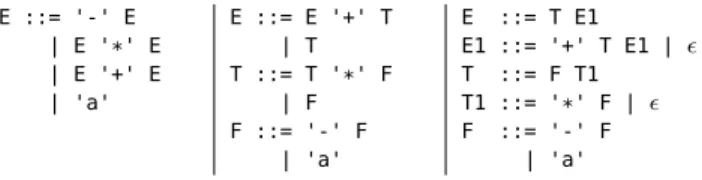
gram-E ::= '-' gram-E | E '*' E | E '+' E | 'a' E ::= E '+' T | T T ::= T '*' F | F F ::= '-' F | 'a' E ::= T E1 E1 ::= '+' T E1 | ✏ T ::= F T1 T1 ::= '*' F | ✏ F ::= '-' F | 'a'
Figure 1. Three grammars that accept the same language:
the natural, ambiguous grammar (left), the grammar with precedence encoding (middle), and the grammar after left-recursion removal (right).
mars are defined to the level of characters. The second op-tion iscontext-awarescanning [37], where the parser calls the lexer on demand. At each parsing state, the lexer is called with the expected set of terminals at that state.
In almost all modern programming languages longest match (maximal munch) is applied, and keywords are ex-cluded from being recognized as identifiers. These disam-biguation rules are conventionally embedded in the lexer. In single-phase parsing—scannerless or context-aware— longest match and keyword exclusion have to be applied during parsing, by using lexical disambiguation filters such as follow restrictions [32, 36]. These disambiguation filters have parser-specific implementations [2, 38]. In Section 3 we show how these filters can be mapped to data-dependent grammars. Also note that although a context-aware scanner employs longest match, for example by implementing the Kleene star (*) as a greedy operator, in some cases we still need to use explicit disambiguation filters, see Section 3.2.
2.3 Operator Precedence
Expressions are an integral part of virtually every program-ming language. In reference manuals of programprogram-ming lan-guages it is common to specify the semantics of expressions using the priority and associativity of operators. However, the implementation of expression grammars can consider-ably deviate from such precedence specification.
It is possible to encode operator precedence by rewriting the grammar: a new nonterminal is created for each prece-dence level. The rewriting is not trivial for real programming languages, and the resulting grammar becomes large. This rewriting is particularly problematic in parsing techniques that do not support left recursion. The left-recursion removal transformation disfigures the grammar and adds extra com-plexity in transforming the trees to the intended ones. Fig-ure 1 shows three versions of the same expression grammar. In the 70s, Ahoet al. [4] presented a technique in which a parser is constructed from an ambiguous expression gram-mar accompanied with a set of precedence rules. This work can be seen as the starting point for declarative disambigua-tion using operator precedence rules. Ahoet al.’s approach is implemented by modifying LALR parse tables to re-solve shift/reduce conflicts based on the operator prece-dence. However, the semantics of operator precedence in this approach is bound to the internal workings of LR
pars-f x = case x of 0 -> 1 _ -> do let y = 2 y + z where z = 3 g x = case x of 0 -> 1 _ -> x + 2 + 4 g x = case x of 0 -> 1 _ -> x + 2 + 4
Figure 2. Examples of indentation rules in Haskell.
ing. There have been other solutions to build parsers from declarative operator precedence which we discuss in Sec-tion 6. In SecSec-tion 3.4 we provide a mapping from operator precedence rules to data-dependent grammars.
2.4 Offside Rule
In most programming languages, indentation of code blocks does not play a role in the syntactic structure. Rather, ex-plicit delimiters, such asbeginandendor{and}are used to specify blocks of statements. Landin introduced theoffside rule [26], which serves as a basis for indentation-sensitive languages. The offside rule says that all the tokens of an ex-pression should be indented to the right of the first token. Haskell and Python are two examples of popular program-ming languages that use a variation of the offside rule.
Figure 2 shows two examples of the offside rule in Haskell. The keywordsdo,let,of, andwheresignal the start of a block where the starting tokens of the statements should be aligned, and each statement should be offsided with re-gard to its first token. In Figure 2 (left),casehas two alterna-tives which are aligned, and the second alternative that spans several lines is offsided with regard to its first token, i.e.,_. Figure 2 (right) shows two examples that look the same, but the indentation of the last part,+ 4, is different. In the top declaration+ 4belongs to the last alternative, but in the bot-tom declaration,+ 4belongs to the expression on the right hand side of=.
Indentation sensitivity in programming languages can-not be expressed by pure context-free grammars, and has often been implemented by hacks in the lexer. For exam-ple, in Haskell and Python, indentation is dealt with in the lexing phase, and the context-free part is written as if no indentation-sensitivity exists. Both GHC and CPython, the popular implementations of Haskell and Python, use LALR parser generators. In Python, the lexer maintains a stack and emits INDENTandDEDENTtokens when indentation changes. In Haskell, the lexer translates indentation information into curly braces and semicolons based on the rules specified by theLfunction [28].
In Section 3.5 we show how data-dependent grammars can be used for single-phase parsing of indentation-sensitive programming languages in a declarative way. As data-dependent grammars are rather low-level for such solutions, we introduce three high-level constructs:align,offside, and ignorewhich are desugared to data-dependent grammars.
void test() { #if Debug System.Console.WriteLine("Debug") } #else } #endif #if X /* #else /* */ class Q { } #endif
Figure 3. Problematic cases of using C# directives [30].
2.5 Conditional Directives
Many programming languages allow compilerpragmasthat specify how the compiler (or the interpreter) processes parts of the input. The C family of programming languages, i.e., C, C++ and C#, allow preprocessor directives such as #if and#define. GHC also allows various compiler pragmas [28, §12.3]. For example, it is possible to enable C preprocessor directives in Haskell using{-# LANGUAGE CPP #-}.
Preprocessor directives pose considerable difficulty in parsing programming languages. The main reason is that they are not part of the grammar of a language, but can ap-pear anywhere in the source code. In this regard, preproces-sor directives are similar to whitespace and comment. How-ever, conditional directives may affect the syntactic structure of a program, and cannot be simply ignored as a special kind of whitespace. This is especially important if we consider single-phase parsing where no lexing/preprocessing is avail-able. We need a mechanism to allow the parser to switch between the preprocessor mode and main grammar, and to evaluate conditional directives to select the right branch.
Figure 3 (left) shows a C# example where ignoring the conditional directive will lead to a parse error, as the closing bracket of the test method is in the conditional directive, and one of the branches should be included in the input. The example in Figure 3 (right) shows another aspect of directives in C#. IfXis true,"/* #else /* */ class Q {}"will be considered as part of the source code. IfXis false, only the else-part will be considered: "/* */ class Q {}". Note that whenXis false, the if-part does not have to be syntactically correct, in this case an unclosed multi-line comment.
Among the family of C languages we selected C#, as parsing C# is more manageable. The problematic part of parsing C with directives is textual macros. Without a pre-processor to expand macros before parsing, we need to deal with macros at runtime. Parsing C without a preprocessor is future work. In C#,#definedoes not define a macro, rather it only sets a boolean variable. It should also be noted that C# supports multi-line strings, where directives should not be processed. Figure 4 shows a C# example that uses condi-tional directives in a multi-line string. In single-phase pars-ing, however, multi-line strings are not a problem, as we ef-fectively parse each terminal in the context where it appears.
static void Main() {
System.Console.WriteLine(@"hello, #if Debug world #else Nebraska #endif "); }
Figure 4. C# multi-line string containing directives [30].
2.6 Miscellaneous Features
There are many other peculiarities in programming lan-guages and data formats that cannot be expressed by context-free grammars. There has been considerable effort to build declarative parsers for data formats, e.g. PADS [9], and one of the main motivations for data-dependent grammars [16] is indeed to enable parsing data formats.
Examples of languages that require data-dependent pars-ing are data protocols, such as IMAP and HTTP, and tag-based languages such as XML. In programming languages, data-dependent grammars can be used to implement some language-specific disambiguation mechanisms. For exam-ple, to maintain a table of type definitions in C to allow re-solving the infamous typedef ambiguity, e.g., inx * ywhich can be either interpreted as a variable of pointer typexor as a multiplication, depending on the type ofx. We give an ex-ample of parsing XML and resolving the typedef ambiguity in C in Section 3.7.
3. Parsing Programming Languages with
Data-dependent Grammars
In this section we describe data-dependent grammars [16], discuss our single-phase parsing strategy, and demonstrate how various high-level, declarative syntax definition con-structs can be desugared into data-dependent grammars.
3.1 Data-dependent Grammars
Data-dependent grammars are defined as an extension of context-free grammars(CFGs), where a CFG is, as usual, a tuple(N, T, P, S)where
•Nis a finite set of nonterminals;
•Tis a finite set of terminals;
•Pis a finite set of rules. A rule (production) is written as A::=↵, whereA(head) is a nonterminal, and↵(body) is a string in(N[T)⇤;
•S2N is the start symbol of the grammar.
We useA, B, C to range over nonterminals, and a, b, c to range over terminals. We use↵, , for a possibly empty sequence of terminals and nonterminals, and ✏ represents the empty sequence. It is common to group rules with the same head and write them asA::=↵1|↵2|. . .|↵n. In this representation, each↵iis an alternative ofA.
Data-dependent grammarsintroduce parametrized non-terminals, arbitrary computation via an expression language, constraints, and variable binding. Here, we assume that the expression languageeis a simple functional programming language with immutable values and no side-effects. In a data-dependent grammar a rule is of the fromA(p) ::= ↵, wherepis a formal parameter ofA. Here, for simplicity of presentation and without loss of generality, we assume that a nonterminal can have at most one parameter. The body of a rule,↵, can now contain the following additional symbols:
•x=l:A(e)is a labeled call toAwith argumente, label l, and variablexbound to the value returned byA(e);
•l:ais a labeled terminalawith labell;
•[e]is a constraint;
•{x=e}is a variable binding;
•{e}is a return expression (only as the last symbol in↵);
•e?↵: is a conditional selection.
The symbols above are presented in their general forms. For example, labels, variables to hold return values, and return expressions are optional.
Our data-dependent grammars are very similar to the ones introduced in [16] with four additions. First, terminals and nonterminals can be labeled, and labels refer to properties associated with the result of parsing a terminal or nonter-minal. These properties are the start input index (or left ex-tent), the end input index (or right exex-tent), and the parsed substring. Properties can be accessed using dot-notation, e.g., for labeled nonterminalb:B,b.lgives the left extent, b.rthe right extent, andb.yieldthe substring.
Second, nonterminals can return arbitrary values (return expressions) which can be bound to variables. In several cases, we found this feature very practical as we could ex-press data dependency without changing the shape of the original specification grammar. Specifically, cases where a global table needs to be maintained along a parse (C# con-ditional directives discussed in Section 3.6 and C typedef declarations in Section 3.7), or where semantic information needs to be propagated upwards from a complicated syntac-tic structure (Declaratorof the C grammar in Section 3.7). In some cases a data-dependent grammar that uses return val-ues can be rewritten to one without return valval-ues. However, in general, whether return values enlarge the class of lan-guages expressible with the original data-dependent gram-mars is an open question for future work.
Third, we support regular expression operators (EBNF constructs):⇤,+, and?, by desugaring them to data depen-dent rules as follows:A⇤::=A+|✏;A+ ::=A+A|A; and A? ::= A|✏. In the data-dependent setting, this translation must also account for variable binding. For example, if sym-bol([e]A)⇤appears in a rule, andxis a free variable ine, captured from the scope of the rule, our translation lifts this variable, introducing a parameterxto the new nonterminal.
In addition, EBNF constructs introduce new scopes: vari-ables declared inside an EBNF construct, e.g.,(l:A[e])⇤, are not visible outside, e.g., in the rule that uses it.
Finally, we also introduce a conditional selection sym-bole?↵: , which selects ↵ifeis evaluated to true, oth-erwise , i.e., introduces deterministic choice. Similar to EBNF constructs, we implement conditional selection by desugaring it into a data-dependent grammar. For example, A::=↵e?X :Y is translated toA::=↵C(e) , where C(b) ::= [b]X |[!b]Y. We illustrate use of the conditional selection when discussing C# directives in Section 3.6.
3.2 Single-phase Parsing Strategy
We implement our data-dependent grammars on top of the generalized LL (GLL) parsing algorithm [33]. As general parsers can deal with any context-free grammar, lexical defi-nitions can be specified to the level of characters. For exam-ple, comment in the C# specification [30] is defined as: Comment ::= SingleLineComment | DelimitedComment SingleLineComment ::= "//" InputCharacter* InputCharacter ::= ![\r \n]
DelimitedComment ::= "/*" DelimitedCommentSect* [*]+ "/" DelimitedCommentSect ::= "/" [*]* NotSlashOrAsterisk NotSlashOrAsterisk = ![/ *]
Such character-level grammars, however, lead to very large parse forests. These parse forests reflect the full struc-ture of lexical definitions, which are not needed in most cases. We provide the option to use an on-demand context-aware scanner, where terminals are defined using regular ex-pression. For example,Commentin C# can be compiled to a regular expression. In cases where the structure is needed, or it is not possible to use a regular expression, e.g., recursive definitions of nested comments, the user can use character-level grammars.
Our support for context-aware scanning borrows many ideas from the original work by Van Wyk and Schwerd-feger [37], but because of the top-down nature of GLL pars-ing, there are some differences. The original context-aware scanning approach [37] is based on LR parsing, and as each LR state corresponds to multiple grammar rules, there may be several terminals that are valid at a state. The set of valid terminals in a parsing state is calledvalid lookaheadset [37]. In GLL parsing, in contrast, the parser is at a single grammar position at each time, i.e., either before a nonterminal or be-fore a terminal in a single grammar rule. Therebe-fore, in GLL parsing, the valid lookahead set of a terminal grammar posi-tion contains only one element, which allows us to directly call the matcher of the regular expression of that terminal.
We use our simple context-aware scanning model for better performance, see Section 5.1. The implementation of the context-aware scanner in [37] is more sophisticated. The scanner is composed of all terminal definitions, as a composite DFA. This enables a longest match scheme across terminals in the same context, for example in programming languages where one terminal is a prefix of another, e.g.,
A ::= ↵ B !>> c A ::= ↵ c !<< B A ::= ↵ B \ s A ::= ↵ b:B [input.at(b.r) != c] A ::= ↵ b:B [input.at(b.l-1) != c] A ::= ↵ b:B [input.sub(b.l,b.r)!= s]
Figure 5. Mapping of lexical disambiguation filters.
'fun' and'function'in OCaml. To enforce longest match across terminals we use follow/precede restrictions, in this case a follow restriction on'fun'or a precede restriction on identifiers. Moreover, keyword reservation in [37] is done by giving priority to keywords at matching states of the composite DFA. In our model, keyword exclusion should be explicitly applied in the grammar rules using an exclude disambiguation filter. We explain follow/precede restrictions and keyword reservation in Section 3.3.
In single-phase parsing layout (whitespace and com-ments) are treated the same way as other lexical definitions. Because layout is almost always needed in parsing program-ming languages, we support automatic layout insertion into the rules. There are two approaches to deal with layout in-sertion: a layout nonterminal can be inserted exactly before or after each terminal node [20, 37]. Another way is to in-sert layout between the symbols in a rule, like in SDF [12]. We use SDF-style layout insertion: if X ::= x1x2. . . xn is a rule, and Lis a nonterminal defining layout, after the layout insertion, the rule becomesX::=x1L x2L . . . L xn. A benefit of SDF-style layout insertion is that no symbol definition accidentally ends or starts with layout, provided that the layout is defined greedily (see Section 3.3). This is helpful when defining the offside rule (see Section 3.5).
3.3 Lexical Disambiguation Filters
Common lexical disambiguation filters [36], such as fol-low restrictions, precede restrictions and keyword exclu-sion, can be mapped to data-dependent grammars without further extensions to the parser generator or parsing algo-rithm. These disambiguation filters are common in scanner-less parsing [32] and have been implemented for various generalized parsers [2, 38].
A follow restriction (!>>) specifies which characters can-not immediately appear after a symbol in a rule. This re-striction is used to locally define longest match (as op-posed to a global longest match in the lexer). For ex-ample, to enforce longest match on identifiers we write Id ::= [A-Za-z]+ !>> [A-Za-z]. A precede restriction (!<<) is similar to a follow restriction, but specifies the characters that cannot immediately precede a symbol in a rule. Precede restrictions can be used to implement longest match on key-words. For example,[A-Za-z] !<< Iddisallows an identifier to start immediately after a character. This disallows, for example, to recognizeintx as the keyword'int' followed by the identifierx. Finally, exclusion (\) is usually used to implement keyword reservation. For example,Id \'int' ex-cludes the keywordintfrom beging recognized asId.
Figure 5 shows the mapping from character-level disam-biguation filters to data-dependent grammars. The mapping is straightforward: each restriction is translated into a con-dition that operates on the input. A note should be made regarding the condition implementing precede restrictions. This condition only depends on the left extent,b.l, that per-mits its application before parsingB. We consider this opti-mization in the implementation of our parsing framework, permitting application of such conditions before parsing la-beled nonterminals or terminals.
The restrictions of Figure 5 are just examples and can be extended in many ways. For example, instead of defining the restriction using a single character, we can use regular expressions or character classes. One can also define similar restrictions for related disambiguation purposes. For exam-ple, consider the cast expression in C#:
cast-exp ::= '(' type ')' unary-exp
An expression such as(x)-yis ambiguous, and can be in-terpreted as either a type cast of-yto the typex, or a sub-traction ofyfrom(x). In the C# language specification, it is stated that this ambiguity is resolved during parsing based on the character that comes after the closing parentheses: if the character following the closing parentheses is ~,'!','(', an identifier, a literal or keywords, the expression should be interpreted as a cast. We can implement this rule as follows: cast-exp ::= '(' type ')' >>> [⇠!(A-Za-z0-9] unary-exp The>>> notation specifies that the next character after the closing parentheses should be an element of the specified character class. The implementation of>>>is similar to that of>>with an additional aspect: it adds the condition on the automatically inserted layout nonterminal after')'instead.
These examples show how more syntactic sugar can be added to the existing framework for various common lexi-cal disambiguation tasks in programming languages without changes to the underlying parsing technology.
3.4 Operator Precedence and Associativity
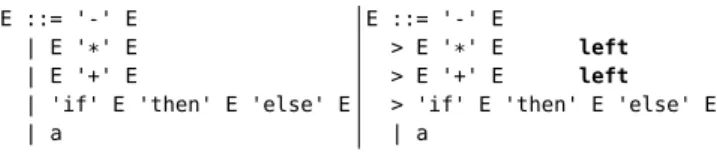
Expression grammars in their natural form are often ambigu-ous. Consider the expression grammar in Figure 6 (left). For this grammar, the input stringa+a*ais ambiguous with two derivation trees that correspond to the following groupings: (a+(a*a))and((a+a)*a). Given that* normally has higher precedence than+, the first derivation tree is desirable. We use>,left, andrightto define priority and left- and right-associativity, respectively [3]. Figure 6 (right) shows the dis-ambiguated version of this grammar by specifying > and
left, where- has the highest precedence, and* and+ are left-associative.
Ambiguity in expression grammars is caused by deriva-tions from the left- or right-recursive ends in a rule, i.e., E::=↵EandE::=E . We use>,left, andrightto spec-ify which derivations from the left- and right-recursive ends are not valid with respect to operator precedence. For ex-ample,E ::= '-' E > E '*' Especifies thatEin the'-'-rule
E ::= '-' E | E '*' E | E '+' E
| 'if' E 'then' E 'else' E | a
E ::= '-' E
> E '*' E left
> E '+' E left
> 'if' E 'then' E 'else' E | a
Figure 6. An ambiguous expression grammar (left), and the
same grammar disambiguated with>andleft(right). (parent) should not derive the'*'-rule (child). The > con-struct only restricts the right-recursive end of a parent rule when the child rule is left-recursive, and vice versa. For ex-ample, in Figure 6 (right) the rightE in the'+'-rule is not restricted because the'if'- rule is not left-recursive. This is to avoid parse error on inputs that are not ambiguous, e.g., a + if a then a else a. Note that'if' E 'then' E 'else'in the'if'-rule acts as a unary operator. In addition, the> oper-ator is transitive for all the alternatives of an expression non-terminal. Finally,leftandrightonly affect binary recursive rules and only at the left- and right-recursive ends.
Although>is defined as a relationship between a parent rule and a child rule, its application may need to be arbitrary deep in a derivation tree. For example, consider the input string a * if a then a else a + a for the grammar in Fig-ure 6 (right). This sentence is ambiguous with two derivation trees that correspond to the following groupings:
(a * (if a then a else a)) + a a * (if a then a else (a + a))
The first grouping is not valid as'if' binds stronger than '+', but we defined'+'to have higher priority than'if'. This example shows that restricting derivations only at one level cannot disambiguate such cases. A correct implementation of>thus also restricts the derivation of the'if'-rule from the right-recursive end of the'*'-rule if the'*'-rule is derived from the left-recursive end of the'+'-rule.
We now show how to implement an operator precedence disambiguation scheme using data-dependent grammars. We first demonstrate the basic translation scheme using binary operators only, and then discuss the translation of the exam-ple in Figure 6. Figure 7 (left) shows a simexam-ple examexam-ple of an expression grammar that defines two left-associative binary operators* and+, where*is of higher precedence than +. Figure 7 (right) shows the result of the translation into the data-dependent counterpart. The basic idea behind the trans-lation is to assign a number, aprecedence level, to each left-and/ or right recursive rule of nonterminalE, to parameterize Ewith a precedence level, and based on the precedence level passed toE, to exclude alternatives that will lead to deriva-tion trees that violate the operator precedence.
In Figure 7 (right) each left- and right-recursive rule in the grammar gets a precedence level (shown in comments), which is the reverse of the alternative number in the defi-nition ofE. The precedence counter starts from 1 and incre-ments for each encountered>in the definition. The number0 is reserved for the unrestricted use ofE, illustrated using the
E ::= E '*' E left
> E '+' E left
| '(' E ')' | a
E(p) ::= [2 >= p] E(2) * E(3) //2 | [1 >= p] E(0) + E(2) //1 | '(' E(0) ')'
| a
Figure 7. An expression grammar with>andleft(left), and
its translation to data-dependent grammars (right). E(l,r) ::= [4 >= l] '-' E(l,4) //4
| [3 >= r, 3 >= l] E(3,3) '*' E(l,4) //3 | [2 >= r, 2 >= l] E(2,2) '+' E(l,3) //2 | [1 >= l] 'if' E(0,0) 'then' E(0,0) 'else' E(0,0) //1 | a
Figure 8. Operator precedence with data-dependent
gram-mars (binary and unary operators).
round bracket rule. NonterminalEgets parameterpto pass the precedence level, and for each left- and right-recursive rule, a predicate is added at the beginning of the rule to ex-clude rules by comparing the precedence level of the rule with the precedence level passed to the parentE. Finally, for each use ofEin a rule, an argument is passed.
In the'*'-rule, its precedence level (2) is passed to the left E, and its precedence level plus one (3) is passed to the right E. This allows to exclude the rules of lower precedence from the leftE, and to exclude the rules of lower precedence and the'*'-rule itself from the rightE. Excluding the'*'-rule it-self allows only the left-associative derivations, e.g.,(a*a)*a, as specified byleft. In the'+'-rule, its precedence level plus one (2) is passed to the rightE, excluding the'+'-rule. The value0is passed to the leftE, permitting any rule. Note that passing0instead of1to the left Eof the'+'-rule achieves the same effect but enables better sharing of calls toE, as the sharing of calls (using GSS) is done based on the name of the nonterminal and the list of arguments. In the round bracket rule,0is passed toEas the use ofEis neither left-nor right-recursive, hence, the precedence does not apply.
Now we discuss the translation of the example shown in Figure 6 that contains both binary and unary operators. For this we need to distinguish between the rules that should be excluded from the left and from the rightE. This is achieved as follows. First,Egets two parameters,landr(Figure 8), to distinguish between the precedence level passed from left and right, respectively. Second, a separate condition on l is added to a rule when the rule can be excluded from the right E (i.e., rules for binary operators and unary postfix operators). A separate condition on r is added to a rule when the rule can be excluded from the left E (i.e., rules for binary operators and unary prefix operators). Third,l -andr-arguments are determined for the left and right E’s as follows. Anl-argument to the left Eand r-argument to the right E are determined as in the example of Figure 7. For example,E(3,_) '*' E(_,4), where3 is the precedence level of the'*'-rule, and4is the precedence level plus one. Note that r=4 does not exclude the unary operators of E. Now, anl-argument to the rightE’s is propagated from the
Decls ::= align (offside Decl)*
| ignore('{' Decl (';' Decl)* '}') Decl ::= FunLHS RHS
RHS ::= '=' Exp 'where' Decls
Figure 9. Simplified version of Haskell’sDecls.
parentE. This effectively excludes a unary prefix rule from the rightE’s when the parentEis the leftEof a rule of higher precedence than the unary operator. Finally, given that there are no unary postfix operators, anr-argument to the leftE’s is not propagated from the parentEand can be the same as the respectivel-argument.
We have also extended this approach for grammars that allow rules of the same precedence and/or associativity groups. For example, binary + and - operators have the same precedence, but are left-associative with respect to each other.
Our translation of operator precedence to data-dependent grammars resembles the precedence climbing technique [5, 31]. In contrast to precedence climbing that requires a non-left recursive grammar, our approach works in presence of both left- and right-recursive rules.
3.5 Indentation-sensitive Constructs
In this section we show how the offside rule can be translated into data-dependent grammars. We use Haskell as the run-ning example, but our approach is also applicable for other programming languages that implement the offside rule.
In Haskell, one can write awhereclause consisting of a block of declarations, where the structure of the block is de-fined by using either explicit delimiters or indentation (col-umn number). For example, the structure of the following blocks, one written with explicit delimiters, such as curly braces and semicolons (left), and the other written using in-dentation (right), is the same:
{ x = 1 * 2 + 3; y = x + 4 } x = 1 * 2 + 3 y = x + 4
Figure 9 shows a simplified excerpt of the Haskell grammar, defined using our parsing framework. The first alternative explicitly enforces indentation constraints on a declaration block. First, it requires that all declarations of a block are aligned (align) with respect to each other, i.e., each decla-ration starts with the same indentation. Second, it requires that the offside rule applies to each declaration, i.e., all non-whitespace tokens of a declaration are strictly indented to the right of its first non-whitespace token. In contrast, the second alternative ofDeclsenforces the use of curly braces and semicolons, and explicitly ignores (ignore) indentation constraints even when imposed by an outer scope.
In our meta-notation, align only affects regular defini-tions (EBNF constructs) such as lists and sequences,offside affects nonterminals, and ignore applies to a sequence of symbols. The translation of these high-level constructs into data-dependent grammars is illustrated in Figures 10 and 11.
Decls ::= a0:Star1(a0.l)
| ignore('{' Decl Star2 '}') Decl ::= FunLHS RHS
RHS ::= '=' Exp 'where' Decls Star1(v) ::= Plus1(v) | ✏
Plus1(v) ::= offside a1:Decl [col(a1.l) == col(v)] | Plus1(v) offside a1:Decl [col(a1.l) == col(v)] Star2 ::= Plus2 | ✏
Plus2 ::= Plus2 Seq2 | Seq2 Seq2 ::= ';' Decl
Figure 10. Desugaring ofalign.
Decls(i,fst) ::= a0:Star1(a0.l,i,fst) | '{' Decl(-1,0) Star2 '}' Decl(i,fst) ::= FunLHS(i,fst) RHS(i,0)
RHS(i,fst) ::= o0:'=' [f(i,fst,o0.l)] Exp(i,0) o1:'where' [f(i,0,o1.l)] Decls(i,0) Star1(v,i,fst) ::= Plus1(v,i,fst) | ✏
Plus1(v,i,fst)
::= Plus1(v,i,fst) a1:Decl(a1.l,1)
[col(a1.l) == col(v), f(i,0,a1.l)] | a1:Decl(a1.l,1) [col(a1.l) == col(v), f(i,fst,a1.l)] Star2 ::= Plus2 | ✏
Plus2 ::= Plus2 Seq2 | Seq2 Seq2 ::= ';' Decl(-1,0)
f(i,fst,l) = i == -1 || fst == 1 || col(l) > col(i);
Figure 11. Desugaring ofoffsideandignore.
The basic idea of translatingalignis to use the start index of a declaration list, and constrain the start index of each declaration in the list by an equality check on indentation at the respective indices. Figure 10 shows the result after first desugaringalignand then translating EBNF constructs (Section 3.1). Desugaringalignalone results in:
Decls ::= a0:(offside a1:Decl [col(a1.l) == col(a0.l)])* Labelsa0anda1are introduced to refer to the start index of a declaration list, a0.l, and to the start index of each declaration in the list,a1.l, respectively, and the constraint checks whether the respective column numbers (given tabs of 8 characters) are equal. As in case of precede restric-tions in Section 3.3, this constraint only depends on the start indices and can be applied before parsing Decl. The EBNF translation introduces nonterminals for each EBNF construct, whereStar1andPlus1also get parametervas the use ofa0has to be lifted during the translation.
Figure 11 shows the result of desugaring offside and ignore from Figure 10. The basic idea is to pass down
Decl’s start index and constrain the indentation of any non-whitespace terminal that can appear under theDecl-node, ex-cept for the leftmost one, to be greater than the indentation of Decl’s start index. Two parameters,iandfst, are introduced toDecland to all nonterminals reachable from it. The first parameter is used to passDecl’s start index, calculated at the
offsideapplication site (a1.l), to any nonterminal reachable fromDecl, and to constrain terminals reachable fromDecl.
The second parameter,fst, which is either0or1, is used to identify and skip the leftmost terminal that should not be constrained. The value1is passed at the application site of
offsideand propagated down to the first nonterminal of each reachable rule if the rule starts with a nonterminal. The value 0is passed to any other nonterminal of a reachable rule when the first symbol of the rule is not nullable. Our translation also accounts for nullable nonterminals (not shown here), and in such cases the value of fst also depends on a dy-namic check whether the left and right extents of the node corresponding to a nullable nonterminal are equal.
Finally, each terminal reachable from Decl gets a label (labels starting with o), to refer to its start index, and a constraint, encoded as a call to boolean functionf. Note that in the definition off, conditioni == -1corresponds to the case whenDeclappears in the context where the offside rule does not apply or is ignored, and conditionfst == 1to the case of the leftmost terminal.
The offside, align and ignore constructs are examples of reasonably complex desugarings to data-dependent gram-mars. Their existence and their aptness to describe the syn-tax of Haskell is a witness of the power of data-dependent grammars and the parsing architecture we propose.
3.6 Conditional Directives
In this section we present our solution for parsing condi-tional directives in C#. As discussed in Section 2.5, most directives can be regarded as comment, but conditional di-rectives have to be evaluated during parsing, as they may affect the syntactic structure of a program.
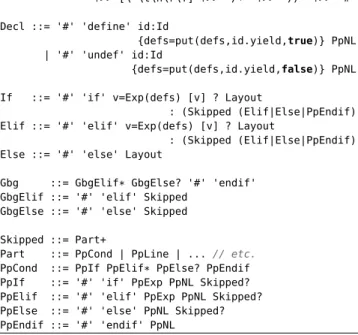
Conditional directives can appear anywhere in a program. Therefore, it is natural to define them as part of the layout nonterminal. Figure 12 shows relevant parts of the layout definition (Layout)2we used to parse C# (follow restrictions enforce longest match). In addition to whitespace charac-ters (Whitespace) and comments (starting with'/*'or'//'), the layout consists of declaration directives (Decl) and con-ditional directives (If).
According to the C# language specification, the scope of symbols introduced by declaration directives#defineand #undefis the file they appear in. Therefore, we need to main-tain a global symbol tabledefsto declare (seeDecl) and ac-cess (seeIfandElif) symbol definitions while parsing. In C# one can define/undefine a symbol, but a value cannot be assigned to a symbol. Thus, the symbol table needs to asso-ciate a boolean value with a symbol.
To enable global definitions, our parsing framework sup-portsglobal variablesthat can be declared using theglobal keyword. e.g.,defsin Figure 12. In our parsing framework, a global variable is implemented by using parameters and return values to thread a value through a parse. In this case, 2For readability reasons, we omit uses ofWhitespace?(optional
whites-pace) before and after terminal'#', and uses ofWhitespaceafter termi-nals'define','undef','if','elif'.
globaldefs = {}
Layout ::= (Whitespace | Comment | Decl | If | Gbg)* !>> [\ \t\n\r\f] !>> '/*' !>> '//' !>> '#' Decl ::= '#' 'define' id:Id
{defs=put(defs,id.yield,true)} PpNL | '#' 'undef' id:Id
{defs=put(defs,id.yield,false)} PpNL If ::= '#' 'if' v=Exp(defs) [v] ? Layout
: (Skipped (Elif|Else|PpEndif)) Elif ::= '#' 'elif' v=Exp(defs) [v] ? Layout
: (Skipped (Elif|Else|PpEndif)) Else ::= '#' 'else' Layout
Gbg ::= GbgElif* GbgElse? '#' 'endif' GbgElif ::= '#' 'elif' Skipped
GbgElse ::= '#' 'else' Skipped Skipped ::= Part+
Part ::= PpCond | PpLine | ...// etc. PpCond ::= PpIf PpElif* PpElse? PpEndif PpIf ::= '#' 'if' PpExp PpNL Skipped? PpElif ::= '#' 'elif' PpExp PpNL Skipped? PpElse ::= '#' 'else' PpNL Skipped? PpEndif ::= '#' 'endif' PpNL
Figure 12. The grammar of conditional directives in C#.
each nonterminal that directly or indirectly accesses a global variable should get an extra parameter, and each nonterminal that can directly or indirectly update a global variable should return the new value of the variable if the variable is used after an occurrence of the nonterminal in a rule. Note that, assuming immutable values, such implementation of global variables properly accounts for the nondeterministic nature of generalized parsing. This way updates to a variable made along one parse do not interfere with updates made along an alternative parse.
The basic idea of single-phase parsing of C# in presence of conditional directives is as follows. Recall that in our pars-ing strategy (Section 3.2) layout is inserted between symbols in a grammar rule. Conditional directives are evaluated as part of the layout nonterminal, and based on the result of the evaluation, the next lines of source code are either treated as the actual source code (true case), or as a sequence of valid C# tokens (false case), also consuming directives that should not be evaluated. To achieve this, the grammar of Figure 12 uses two different definitions for#if,#elifand#else. The bottom definition (PpIf,PpElifandPpElse), which is found in the C# specification, simply defines directives as part of valid C# tokens (Skipped), while the top definition (If,Elif andElse) uses data dependency. Note that conditional direc-tives can be nested. This is expressed by usingLayoutinIf, ElifandElse, andSkippedinPpIf,PpElifandPpElse.
Whenever an#if-directive and its expression are parsed as part ofIf, the expression is evaluated using the symbol table (defs). Exp (not shown in Figure 12) defines a sim-ple boolean expression. To enable evaluation of expressions
Element ::= STag Content ETag STag ::= '<' Name Attribute* '>' ETag ::= '</' Name '>'
Element ::= s=STag Content ETag(s)
STag ::= '<' n:Name Attribute* '>' { n.yield } ETag(s) ::= '</' n:Name [n.yield == s] '>'
Figure 13. Context-free grammar of XML elements (top)
and the data-dependent version (bottom).
while parsing, Exp uses data dependency and extends the PpExp rules, found in the C# specification, with return val-ues and boolean computation. If the expression evaluates to true (note the use of conditional selection), the parser first continues consuming layout, including the nested directives, and then, after no layout can be consumed, the parser returns to the next symbol in the alternative.
If the expression evaluates to false, the parser consumes part of the input as a list of valid C# tokens (Skipped) until it finds the corresponding#elif-,#else- or#endif-part. Note thatSkippedalso consumes nested#if-directives (PpCond), if any, but in this case, conditions are not evaluated. The defi-nition ofSkippedalso allows to consume invalid C# structure (only valid token-wise) when the condition is false, see Fig-ure 3 (right). Finally, when all#if,#elifand#elsedirectives are present, there will be dangling#elif,#else, and#endif parts remaining if one of the conditions evaluates to true. These dangling parts should be also consumed by the lay-out. TheGbg(garbage) nonterminal, defined as part of layout, does exactly this.
3.7 Miscellaneous Features
In this section we discuss the use of data-dependent gram-mars for parsing XML and resolving the infamoustypedef ambiguity in C. XML has a relatively straightforward syn-tax. Figure 13 (top) shows the context-free definition of Elementin XML, whereContentallows a list of nested ele-ments. The problem with this definition is that it can recog-nize inputs with unbalanced start and end tags, for example: <note>
<to>Bob</from> <from>Alice</to> </note>
Using data-dependent grammars, the solution to match start and end tags is very intuitive. Figure 13 (bottom) shows a data-dependent grammar for XML elements. As can be seen, inside a starting tag,STag, the result of parsingNameis bound ton, and the respective substring,n.yield, is returned from the rule. The returned value is assigned to s in the Elementrule, and is passed to the end tag,ETag. Finally, in the ETag, the name of the end tag is checked against the name of the starting tag. If the name of the starting tag is not equal to the name of the end tag, i.e.,n.yield == sdoes not hold, the parsing pass dies.
globaldefs = [{}]
Declaration ::= x=Specifiers Declarators(x) Specifiers ::= x=Specifier y=Specifiers {x || y}
| x=Specifier {x} Specifier ::= "typedef" {true} | ...
Declarators(x) ::= s=Declarator {h=put(head(defs),s,x); defs=list(h,tail(defs))} ("," Declarators(x))*
Declarator ::= id:Identifier {id.yield}
| x=Declarator "(" ParameterTypeList ")" {x} | ...
Expr ::= Expr "-" Expr
| "(" n:TypeName [isType(defs,n.yield)] ")" Expr | "(" Expr ")"
| ...
| Identifier [!isType(defs,n.yield)]
Figure 14. Resolving typedef ambiguity in C.
Now, we consider the problem of typedef ambiguity in C. For example, expression(T)+1 can have two meanings, depending on the meaning ofTin the context: a cast to typeT with+1being a subexpression, or addition with two operands (T)and1. IfTis a type, declared usingtypedef, the first parse is valid, otherwise the second one.
To resolve the typedef ambiguity, type names should be distinguished from other identifiers, such as variables and function names, during parsing. In addition, the scoping rules of C should be taken into account. For example, con-sider the following C program:
typedef int T; main() {
int T = 0, n = (T)+1; }
In this example,Tis first declared as a type alias tointand then redeclared as a variable of typeintin the inner scope introduced by themainfunction.
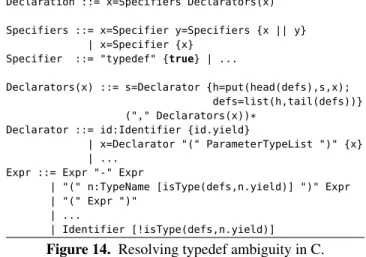
Figure 14 shows a simplified excerpt of our data-dependent C grammar. The excerpt shows the declaration and expres-sion parts of the C grammar. As can be seen, a C decla-ration consists of a list of specifiers followed by a list of declarators. Each declarator declares one identifier. Key-wordtypedefcan appear in the list of specifiers, for exam-ple, along with the declared type. A declarator can be either a simple identifier or a more complicated syntactic structure, e.g., array and function declarators, nesting the identifier. It is important to note that an identifier should enter the cur-rent scope when its declarator is complete. The expression part of Figure 14 shows the cast expression rule (the sec-ond rule from top), and the primary expression rule (the last one). Note that to resolve the typedef ambiguity, illustrated in our running example, an identifier should be accepted as an expression if it is not declared as a type name.
To distinguish between type names and other identifiers, we record names, encountered as part of declarators, and as-sociate a boolean value with each name:truefor type names
and false otherwise. To maintain this information during parsing, we introduce global variabledefs, holding a list of maps to properly account for scoping. At the beginning of parsing,defsis a list containing a single, empty map. At the beginning of a new scope, i.e., when"{"is encountered, an empty map is prepended to the current list resulting in a new list which is assigned todefs(not shown in the figure). At the end of the current scope, i.e., when"}"is encountered, the head of the current list is dropped by taking the tail of the list and assigning it todefs.
To communicate the presence oftypedefin a list of spec-ifiers, we extend each rule ofSpecifierto return a boolean value:"typedef"-rule returnstrue, and the other rules return false.Specifiers computes disjunction of the values asso-ciated with the specifiers in the resulting list. This informa-tion is passed via variablextoDeclarators. We also extend the rules ofDeclaratorto return the declared name,id.yield. After a declarator is parsed, the declared name can be stored indefs: pair(s,x)is added to the map taken from the head of the current list, and a new list, with the resulting map as its head, is created and assigned todefs.
Finally, isType function is used to check whether the current identifier is a type name in the current scope or not: isTypeiterates over elements indefs, starting from the first element, to look up the given name. If the name is not found in the current map,isTypecontinues the search with the next element, representing the outer scope. If the name is found, isTypereturns the boolean value associated with the name. If none of the maps contains the name,isTypereturnsfalse.
In our running example, after parsing the second decla-ration ofT, appeared in the scope of themainfunction, pair ("T",false)will be added to the map in the head of defs, effectively shadowing the previous typedef declaration ofT, and causing the condition in the cast expression rule to fail.
4. Implementation
In this section we present our extension of the GLL parsing algorithm [33] to support data-dependent grammars. GLL parsing is a generalization of recursive-descent parsing that supports all context-free grammars, and produces a bina-rized Shared Packed Parse Forest (SPPF) in cubic time and space. GLL uses a Graph-Structured Stack (GSS) [35] to handle multiple function calls in recursive-descent parsing. The problem of left recursion is solved by allowing cycles in GSS. As GLL parsers are recursive-descent like, the han-dling of parameters and environment is intuitive, and the im-plementation remains very close to the stack-based seman-tics, which eases the reasoning about the runtime behavior of the parser. More information on GLL parsing over ATN, GSS, and SPPF is provided in Appendix A.
We use a variation of GLL parsing that uses a more effi-cient GSS [2]. GLL parsing can be seen as a grammar traver-sal process that is guided by the input. At each point during parsing, a GLL parser is at a grammar slot (grammar
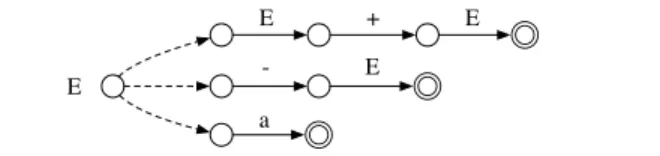
posi-E E E -a + E
Figure 15. ATN Grammar forE::=E+E| E|a.
tion before or after a symbol in a rule) and executes the code corresponding to this slot. Because of the nondeterministic nature of general parsing, a GLL parser needs to record all possible paths and process them later, and at the same time eliminate duplicate jobs. The unit of work in GLL parsing is adescriptor which captures a parsing state. Descriptors allow a serialized, discrete view of tasks performed during parsing. GLL parsing has a main loop, in a trampolined style, that executes the descriptors one at a time until no more de-scriptors left.
The standard way of implementing a GLL parser is to generate code for each grammar slot [33]. Such implemen-tation relies ondynamic gotos to allow arbitrary jumps to the main loop or other grammar slots. In our GLL imple-mentation, a grammar is modeled as a connected graph of grammar slots. This model of context-free grammars re-sembles Woods’Recursive Augmented Transition Networks (ATN) [40] grammars. As such, our implementation of GLL over ATN grammars (Appendix A) provides an interpreter version of GLL parsing.
4.1 ATN Grammars
ATN grammars are an automaton formalism developed in the 70s to parse natural languages, and are similar to nonde-terministic finite automata.
An ATN grammar is a tuple(Q, F,!)where
•Qis a finite set of states representing grammar slots;
•F ⇢Qis a finite set of states representingfinalgrammar slots; and
•!is a transition relation of the form A
!(nonterminal), t
!(terminal), or ✏
!(epsilon).
For example, the ATN grammar forE ::=E+E| E|a is shown in Figure 15. In an ATN, there is a one-to-many relation, S ⇢ String⇥Q, from a nonterminal name to a set of start states, each representing the initial state of an alternative.
Constructing an ATN grammar from a CFG is straight-forward. For each nonterminal in the grammar, and for each alternative of the nonterminal, a pair consisting of the non-terminal’s name and a state representing the start state of the alternative is added toS. Finally, for each symbol in the al-ternative, a next state is created, and a transition, labeled with the symbol, from the previous state to this state is added. The last state of the alternative is marked as a final grammar slot.
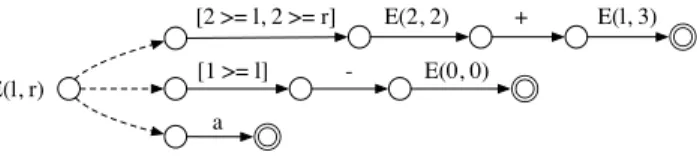
E(2, 2) E(l, 3) E(0, 0) -a + E(l, r) [2 >= l, 2 >= r] [1 >= l]
Figure 16. Data-dependent ATN grammar forE ::= E+
E > E|aafter desugaring operator precedence.
4.2 Data-dependent ATN Grammars
To support data-dependent grammars, we extend ATN gram-mars with the following forms of transitions:
• x=l:A(e)!(parameterized, labeled nonterminals) and l:t!
(labeled terminals)
• x=e
!(variable binding), [e]!(constraint) and e
!(return expression).
Two additional mappings are maintained:L, X:Q!String that map a state, representing a grammar slot after a labeled nonterminal, to the nonterminal’s label (l) and to the nonter-minal’s variable (x), respectively. Here, as in Section 3.1, for simplicity of presentation and without loss of generality, we assume that nonterminals can have at most one parameter. We also only consider cases of labeled terminals and non-terminals, and when a return expression is present. Finally, we assume that expression languageeis a simple functional programming language with immutable values and no side-effects, that labels and variables are scoped to the rules they are introduced in, and that labels and variables introduced by desugaring have unique names in their scopes.
An example of a data-dependent ATN is shown in Fig-ure 16. This ATN grammar is the disambiguated version of the grammar shown in Figure 15 after desugaring operator precedence.
4.3 Data Dependency in GLL Parsing
In the following,p,q,srepresent ATN states inQ,iis an input index,u,u0 represent GSS nodes, andw,n,y repre-sent SPPF nodes. To support data-dependent grammars, we introduce an environment, E, into GLL parsing. Here, we assume that E is an immutable map of variable names to values. In the data-dependent setting, a descriptor, the unit of work in GLL parsing, is of the form(p, i, E, u, w). Now, a descriptor contains an environmentEthat has to be stored and later used whenever the parser selects the descriptor to continue from this point. GSS is also extended to store ad-ditional data. A GSS node and a GSS edge are now of the forms(A, i, v)and(u, p, w, E, u0), respectively. That is, in addition to the current input indexi, a GSS node stores an argumentv, passed to a nonterminalA, to fully identify the call. A GSS edge additionally stores an environmentE, to capture the state of the parser before a call to a nonterminal is made.
Finally, a GLL parser constructs a binarized SPPF (Ap-pendix A.1), creating terminal nodes (nodeT), and nonter-minal and intermediate nodes (nodeP). In GLL parsing in-termediate nodes are essential. In particular, they allow the parser to carry a single node at each time by grouping the symbols of a rule in a left-associative manner. Nonterminal and intermediate nodes can be ambiguous. To properly han-dle ambiguities under nonterminal and intermediate nodes, we include environment and return values into the SPPF con-struction. Specifically, arguments to nonterminals and return values are part of nonterminal nodes, and environment is part of intermediate nodes.
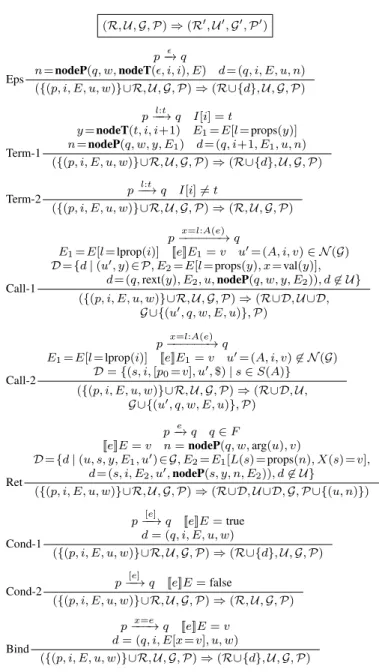
Figure 17 presents the semantics of GLL parsing over ATN, defining it as a transition relation on configuration (R,U,G,P) where the elements are four main structures maintained by a GLL parser:
•Ris a set of pending descriptors to be processed •U is a set of descriptors created during parsing. This set
is maintained to eliminate duplicate descriptors
•Gis a GSS, represented by a set of GSS edges
•P is a set of parsing results (SPPF nodes created for nonterminals) associated with GSS nodes, i.e., a set of elements of the form(u, w)
During parsing, a descriptor is selected and removed from R, represented as{(p, i, E, u, w)}[R, and given the rules, a deterministic choice is made based on the next transition in the ATN. The simplest rules are Eps, Cond-1, Cond-2 and Bind. Eps creates the✏-node (via call tonodeT) and an intermediate node (via call tonodeP), and adds a descriptor for the next grammar slot. Cond-1 and Cond-2 depend on the evaluation of expressionein a constraint. If the expression evaluates to true, a new descriptor is added to continue with the next symbol in the rule (Cond-1), otherwise no descriptor is added (Cond-2). Bind evaluates the expression in an assignment and creates a new environment containing the respective binding. This environment is used to create the new descriptor added toR.
Term-1 and Term-2 deal with labeled terminals. If ter-minalt matches (Term-1) the input string (represented by an arrayI) starting from input position i, a terminal node is created (assumingtis of length1). Then, the properties, i.e., the left and right extents, and the respective substring, are computed from the resulting node (props(y)). Finally, a new environment, containing binding[l=props(y)], is cre-ated and used to construct an intermediate node and a new descriptor. If the terminal does not match (Term-2), no de-scriptor is added.
Call-1 and Call-2 deal with labeled calls to nonterminals. First, argumenteis evaluated, whereE1 allows the use of the left extent ine(lprop constructs properties with only left extent). If a GSS node, representing this call, already exists (Call-1), the parsing results associated with this GSS node are reused, and a possibly empty set of new descriptors (D)
![Figure 3. Problematic cases of using C# directives [30].](https://thumb-us.123doks.com/thumbv2/123dok_us/1991513.2795891/5.918.79.439.105.224/figure-problematic-cases-using-c-directives.webp)