REFERENCE PROTOCOL NAKTUINBOUW
Real-time RT-PCR (RT TaqMan PCR) for pospiviroids
(CEVd, CLVd, MPVd, PCFVd, PSTVd, TASVd, TCDVd and
TPMVd) on seeds of tomato (Solanum lycopersicum)
Protocol number: SPN-V043e Version: 1.1
Date: 01-08-2014 Validation: Under validation
This protocol is a translation of the Dutch protocol SPN-V043. In case of discrepancies between the English and Dutch text, the Dutch text prevails. This protocol is made available without any warranty. Naktuinbouw cannot guarantee that the results obtained by laboratories that follow this protocol are accurate and representative. Many factors (e.g. personnel skills, lab conditions, quality of reagents, sampling methods etc.) can influence the results. Consequently, Naktuinbouw will not accept any liability with respect to the use of this protocol.
Naktuinbouw 2/9 SPN-V043e v1.1
1. Objective
To detect the absence or presence of potentially relevant pospiviroidae (CEVd, CLVd, MPVd, PCFVd, PSTVd, TASVd, TCDVd and TPMVd) in tomato seeds by isolation of RNA followed by TaqMan RT PCR.
2. Principle
RNA from seed extract of tomato is isolated and purified with a kit using KingFisher. The possible presence of viroid RNA is demonstrated by means of RT TaqMan PCR using selective sets of primers and labeled TaqMan probes. Each subsample is spiked with DLVd as an internal amplification control (IAC) to monitor the performance of RNA extraction and RT Taqman PCR.
3. Abbreviations
cDNA Complementary DNA CEVd Citrus exocortis viroid CLVd Columnea latent viroid
Ct-value “Cycle threshold” value (number of PCR cycli till reaching the threshold) DLVd Dahlia latent viroid (spike viroid)
GH+ buffer Guanidine–hydrochloride extraction buffer IAC Internal amplification control
KF King Fisher MPVd Mexican papita viroid
NC seed Negative control tomato seeds (process control)
PC seed Positive control PSTVd contaminated tomato seed lot (process control) PCFVd Pepper chat fruit viroid
PSTVd Potato spindle tuber viroid RT Taqman Reverse transcriptase Taqman TASVd Tomato apical stunt viroid TCDVd Tomato chlorotic dwarf viroid TPMVd Tomato planta macho viroid
4. Materials
Biorad CFX 96 PCR apparatus
Hard Shell PCR plates (Biorad, Catalog no. HSP9645) Interscience BagMixer 100
Grinding bags 100 ml (Interscience BagPage) Thermoshaker
Taqman RNA-to-Ct 1 step kit (Applied Biosystems, product no. 4392938/4392656) KingFisher Flex 96 (ThermoFisher Scientific)
KingFisher 96 tip comb for DW magnets, (ThermoFisher Scientific, Cat. No. 97002534) KingFisher 96 KF plate, 200µL (ThermoFisher Scientific, Cat. No. 97002540)
KingFisher deepwell 96 plate, (ThermoFisher Scientific, Cat. No. 95040450) Sbeadex maxi plant kit, 960 samples (LCG genomics, Cat. No. 41620) GH+ buffer (see appendix)
RNase-free water DLVd stock
Naktuinbouw 3/9 SPN-V043e v1.1
5. Method
5.1 Safety and warnings
Disinfection of seeds with hypochlorite and / or trisodium phosphate strongly decreases the sensitivity of this assay.
Viroids can be present in very high concentrations in plant tissue and cross-contamination is a possibility. Accuracy of operations is important to reduce the chance of cross-contamination. Wear gloves and use pipets with filter tips at all times.
5.2 Execution
5.2.1 Preparation of tomato seed samples
1. Weigh from each sample (3.000 or 20.000 seeds) 3 subsamples of 1000 or 50 subsamples of 400 seeds and transfer each subsample to a grinding bag (Interscience BagPage 100ml). 2. Calculate the required amount of GH+ extraction buffer based on the total number of
subsamples. Dilute the DLVd spike 10x. Add 10 μl diluted DLV spike for each 100 ml GH+ extraction buffer as internal amplification control (IAC).
3. Add to each bag with 1,000 or 400 seeds respectively 20 or 12 ml GH+ extraction buffer including the DLVd IAC.
4. Soak the seeds for 30-60 minutes at room temperature.
5. Extract the subsamples for 90 seconds using the Interscience BagMixer (position 4). 6. Preheat thermoshaker (setting: 65 °C, 850 rpm).
7. Transfer 1.5 ml of seed extract per subsample gently into 1.5 ml tube.
8. Include a PSTVd-contaminated subsample (PC tomato seed with a Ct of about 30) and a negative control (NC tomato seed with a Ct > 37) per sample series.
NB. Handle the PC seed as the last subsample in order to minimize the chance of cross-contamination. 5.2.2 RNA isolation
1. Use the "Sbeadex Plant Maxi Kit" for RNA isolation,
2. Incubate the subsamples in thermoshaker for 15 minutes at 65 °C and 850 rpm. 3. Centrifuge the tubes for 10 minutes at 16,000 g.
4. Code and fill in the plates as indicated in Table 1. Table 1. Coding and composition of KF plates
Code Type of plate Name Composition
A KF deep well 96 Binding 500 µl binding buffer PN (green)
50 µl Sbeadex particle suspension
( hi ) B KF deep well 96
l Wash 1 400 µl Wash buffer PN1 (red) C KF deep well 96
l Wash 2 400 µl Wash buffer PN2 (yellow) D KF deep well 96
l Wash 3 400 µl Pure RNase free water (pH ≤7,0) E KF 96 plate Elution 100 µl Elution buffer PN (black)
5. Transfer 200 µl of the supernatant (avoid pellet!) from the subsamples, the NC seed and PC seed into the binding plate.
6. Store the remainder of the extract and the extract controls at -20 °C until the test is completed. 7. Put all the plates in the correct position in the KF unit.
8. Select and start the KF1 program on the KingFisher Flex 96 (Table 2). 9. Store the elution plate on ice for 1 minute and then cover with foil sticker. 10. Continue directly with PCR or store purified RNA at -20 °C.
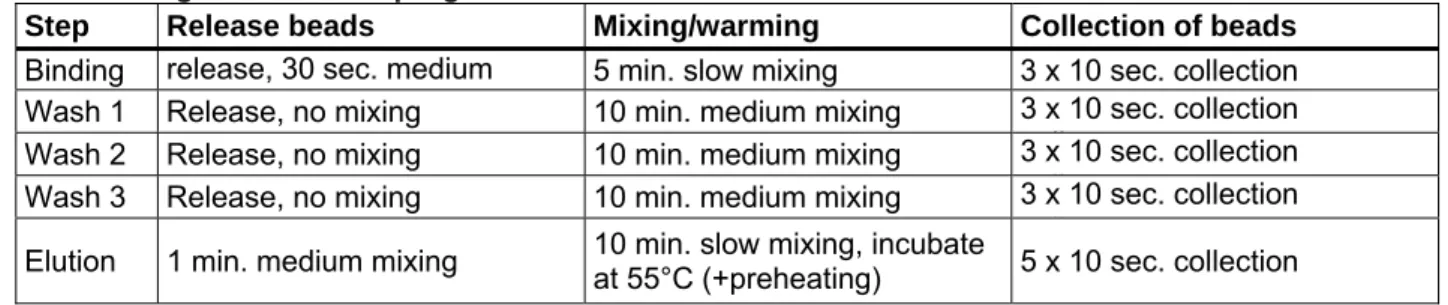
Table 2. Kingfisher Flex 96 program KF1
Step Release beads Mixing/warming Collection of beads Binding release, 30 sec. medium 5 min. slow mixing 3 x 10 sec. collection Wash 1 Release, no mixing 10 min. medium mixing 3 x 10 sec. collection
ll
Wash 2 Release, no mixing 10 min. medium mixing 3 x 10 sec. collection ll
Wash 3 Release, no mixing 10 min. medium mixing 3 x 10 sec. collection ll
Naktuinbouw 4/9 SPN-V043e v1.1 5.2.3 Taqman RT-PCR
1. Prepare Taqman RT-PCR mix (Table 4a, 4b, 4c and 4d).
NB. Work on ice as much as possible and prevent prolonged exposure of probes to light. Wear clean lab coat and gloves to minimize the risk of cross-contamination.
2. Calculate the required amount of reaction mix based on the number of subsamples and controls + 2.
3. Transfer 19 µl PCR mix into a strip of white PCR tubes or PCR plates with white bottom / green border.
4. Pipette 6 µl of the purified RNA sample in 19 µl mix. 5. Cover the strip / plate after adding the RNA.
6. In each run, include a no-template control and positive RNA controls (Table 3) giving a Ct value of approximately 30.
7. Run the Taqman RT PCRs according to the following program (Table 5).
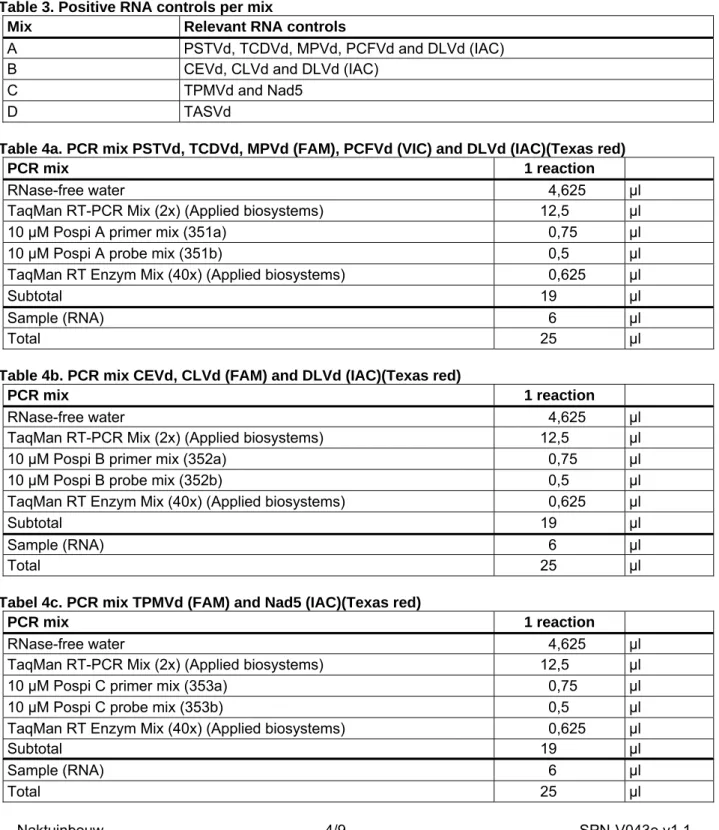
Table 3. Positive RNA controls per mix
Mix Relevant RNA controls
A PSTVd, TCDVd, MPVd, PCFVd and DLVd (IAC) B CEVd, CLVd and DLVd (IAC)
C TPMVd and Nad5
D TASVd
Table 4a. PCR mix PSTVd, TCDVd, MPVd (FAM), PCFVd (VIC) and DLVd (IAC)(Texas red)
PCR mix 1 reaction
RNase-free water 4,625 μl
TaqMan RT-PCR Mix (2x) (Applied biosystems) 12,5 μl 10 µM Pospi A primer mix (351a) 0,75 μl
10 µM Pospi A probe mix (351b) 0,5 μl
TaqMan RT Enzym Mix (40x) (Applied biosystems) 0,625 μl
Subtotal 19 μl
Sample (RNA) 6 μl
Total 25 μl
Table 4b. PCR mix CEVd, CLVd (FAM) and DLVd (IAC)(Texas red)
PCR mix 1 reaction
RNase-free water 4,625 μl
TaqMan RT-PCR Mix (2x) (Applied biosystems) 12,5 μl 10 µM Pospi B primer mix (352a) 0,75 μl
10 µM Pospi B probe mix (352b) 0,5 μl
TaqMan RT Enzym Mix (40x) (Applied biosystems) 0,625 μl
Subtotal 19 μl
Sample (RNA) 6 μl
Total 25 μl
Tabel 4c. PCR mix TPMVd (FAM) and Nad5 (IAC)(Texas red)
PCR mix 1 reaction
RNase-free water 4,625 μl
TaqMan RT-PCR Mix (2x) (Applied biosystems) 12,5 μl 10 µM Pospi C primer mix (353a) 0,75 μl
10 µM Pospi C probe mix (353b) 0,5 μl
TaqMan RT Enzym Mix (40x) (Applied biosystems) 0,625 μl
Subtotal 19 μl
Sample (RNA) 6 μl
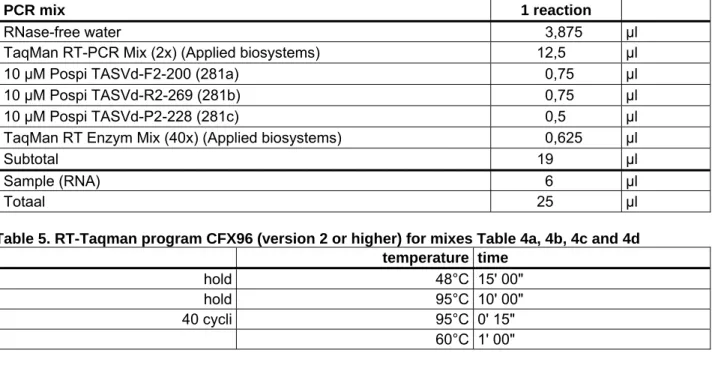
Naktuinbouw 5/9 SPN-V043e v1.1 Table 4d. PCR mix TASVd (FAM)
PCR mix 1 reaction
RNase-free water 3,875 μl
TaqMan RT-PCR Mix (2x) (Applied biosystems) 12,5 μl 10 µM Pospi TASVd-F2-200 (281a) 0,75 μl 10 µM Pospi TASVd-R2-269 (281b) 0,75 μl
10 µM Pospi TASVd-P2-228 (281c) 0,5 μl
TaqMan RT Enzym Mix (40x) (Applied biosystems) 0,625 μl
Subtotal 19 μl
Sample (RNA) 6 μl
Totaal 25 μl
Table 5. RT-Taqman program CFX96 (version 2 or higher) for mixes Table 4a, 4b, 4c and 4d temperature time
hold 48°C 15' 00"
hold 95°C 10' 00"
40 cycli 95°C 0' 15"
60°C 1' 00"
6.
Evaluation and interpretation
6.1 Evaluation test result
TurnonFAM, VICandTRsignalfor all 96wells.
Usesinglethresholdsetting(RFU 200).
Turn onoption"fluorescent driftcorrection".
Checkshapeofcurve(S-shape) forpositive samples.Compare, if necessary, with PCseed. Please notethattheTPMVdTaqmanRToccasionally gives atypicalplanarcurves(no S-shaped curve) that should be considered as noise. In case of doubt always check with responsible person.
Monitor theperformanceofPCstomaintainthe reliability ofthe testlistand note theRFUvalue usedper dataset.
Seedecision matrix(Table6a, b, c, andd) forinterpretation of theresultsof samples.Based on thesignalsindifferent channels, an indication of the identity ofa viroid can beobtained.
6.2 Validity of test result
Results may only be issued if the positive controls give a clear signal (Ct seed PC and PC RNA between 28 and 32).
Results may only be issued if Ct in the negative control samples > 35.
The Ct DLVd must be < 32. The Ct values for the Nad5 IAC are relatively less important. Nad5 degradation is much faster than viroid and the quantity of Nad5 is variable per seed lot. For a subsample Nad5 Ct > 32 can be acceptable provided that the IAC DLVd is < 32 and the TPMVd PC is clearly positive.
Contact the responsible person when the results differ from the expectations.
Contact the responsible person when a seed sample is suspect.Naktuinbouw 6/9 SPN-V043e v1.1 6.3 Decision matrix (subsample level)
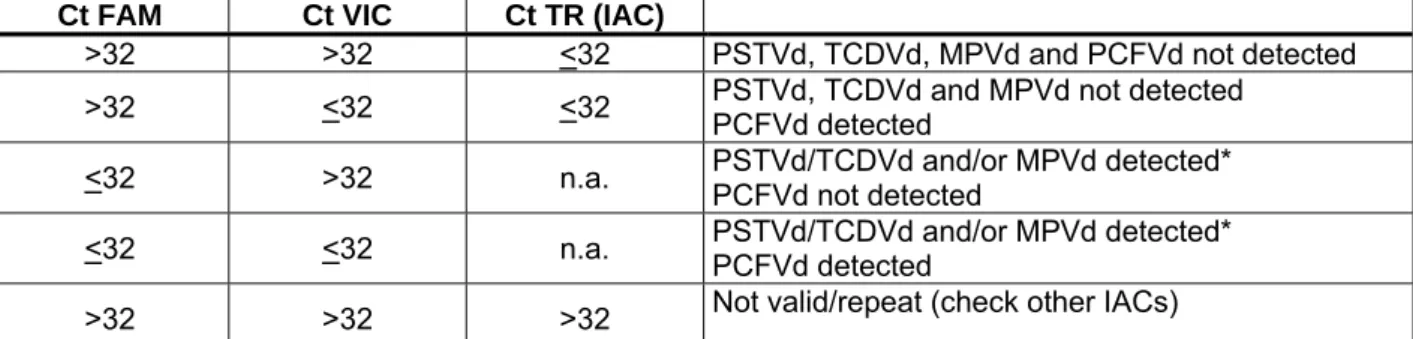
Table 6a. Decision matrix PCR mix 4A: PSTVd, TCDVd, MPVd (FAM), PCFVd (VIC) and DLVd (IAC)(TR) Ct FAM Ct VIC Ct TR (IAC)
>32 >32 <32 PSTVd, TCDVd, MPVd and PCFVd not detected >32 <32 <32 PSTVd, TCDVd and MPVd not detected PCFVd detected
<32 >32 n.a. PSTVd/TCDVd and/or MPVd detected* PCFVd not detected <32 <32 n.a. PSTVd/TCDVd and/or MPVd detected* PCFVd detected >32 >32 >32 Not valid/repeat (check other IACs) *if desired, perform sequence analysis to identify the specific pospiviroid
Tabel 6b. Decision matrix for PCR mix 4B: CEVd, CLVd (FAM) and DLVd (IAC)(TR)
Tabel 6c. Decision matrix for PCR mix 4C: TPMVd (FAM) and Nad5 (TR)
Tabel 6d. Decision matrix for PCR mix 4D: TASVd (FAM) Ct FAM
>32 TASVd not detected <32 TASVd detected
7. Literature
and
instructions
Literature:
Boonham, N., L.. González-Pérez, ,M.S. Mendez, E. Lilia Peralta, A. Blockley, K. Walsh, I. Barker & R.A. Mumford (2004) Development of a real-time RT-PCR assay for the detection of Potato spindle tuber viroid. Journal of Virological Methods 116:139-146.
Botermans, M., van de Vossenberg, B. T. L. H., Verhoeven, J. Th. J.,Roenhorst, J. W., Hooftman, M., Dekter, R. & Meekes, E. T. M. (2013) Development and validation of a real-time RT-PCR assay for generic detection of pospiviroids. J. Virol. Methods 187, 43–50.
Koenraadt, H., Jodlowska, A., van Vliet, A. & Verhoeven, K. (2009)Detection of TCDVd and PSTVd in seeds of tomato. Phytopathology 99, S66.
Menzel, W., Jelkmann, W., and Maiss, E. (2002) Detection of four apple viruses by multiplex RT-PCR assays with coamplification of plant mRNA as internal control. J. Virol. Methods 99: 81-92.
Monger, W., Tomlinson, J., Boonham, N., Marn, M.V., Plesko, I.M., Molinero-Demilly,V., Tassus, X., Meekes, E., Toonen, M., Papayiannis, L., Perez-Egusquiza, Z., Mehle, N., Jansen, C., Nielsen, S.L., (2010) Development and inter-laboratory evaluation of real-time PCR assays for the detection of pospiviroids. J. Virol. Methods 169, 207–210. Ct FAM Ct TR (IAC)
>32 <32 CEVd and CLVd not detected <32 n.a. CEVd and/or CLVd detected >32 >32 Not valid/repeat (check other IACs)
Ct FAM Ct TR (IAC)
>32 <32 TPMVd not detected <32 n.a. TPMVd detected >32 >32
Check DLVd IACs (mix A and mix B) since IAC DLVd is more relevant. Check with responsible person.
Naktuinbouw 7/9 SPN-V043e v1.1 Mumford, R.A., A.L. Skelton, N. Boonham, K.I. Posthuma, M.J. Kirby, & A.N. Adams (2001) The Improved Detection of
Strawberry Crinkle Virus Using Real-Time RT-PCR (TaqMan®). Acta Horticulturae 656: 81-86.
Manuals:
TaqMan® RNA-to-CT™ 1-Step Kit Protocol RNeasy plant mini kit (Qiagen)
8.
History and revisions
20-12-2013 Version 1.0 - Protocol based on ISO17025 accredited PSTVd / TCDVd seed assay (SPN-V003, version 3.1) for tomato.
Overnight soaking of seeds was reduced to 30-60 minutes to limit break down of viroid.
Introduction of DLVd spike as an internal amplification control (IAC) in multiplex RT Taqman to replace endogenous Nad5 target since amount of Nad5 RNA is highly variable (14-40) in the seed matrix.
Use of GH+ extraction buffer instead of PN1 extraction buffer (LGC) since degradation in GH+ RNA extraction buffer is much less than in PN1 extraction buffer leading to a higher PSTVd sensitivity.
Specification of method to purify RNA for nVWA. RNeasy purified RNA in general give better sequences in comparison with Sbeadex purified RNA although high Ct values samples are still problematic due to low sensitivity of sequencing method.
Use of several new multiplex RT Taqmans to detect additional Pospiviroidae as CEVd, CLVD, PCFVd, TASVd and TPMVd.
03-02-2014 Version 1.1 - Correction numbering primer sets in appendices. 201d instead 201c, at 349 / mc instead of 249 at / c and 350a, 350b instead 250a, 250b.
Naktuinbouw 8/9 SPN-V043e v1.1
9. Appendices
GH+ extraction buffer (6M) Adjust to 1 liter water
guanidine-hydrochloride (harmful) 573 g
NaAC-buffer (4M) 50 ml
EDTA (di-natrium) 9.3 g
PVP-10 25 g
NaAc buffer (4M) Adjust to 1 liter with water
NaAC (CH3COONa) 328 g g
Check/adjust pH to 5.2
DLVd spike
Take a leaf from a DLVd infected Dahlia plant and make an leaf extract. Dilute the extract experimentally to a Ct value of 25. Store aliquots at -80 °C.
After thawing store aliquot at -20 ˚C for up to one week. Primer No. Naktuinbouw primer collection Sequence Lit. ref. PSTV-231F1 201a GCCCCCTTTGCGCTGT 1 PSTV-296R 201b AAGCGGTTCTCGGGAGCTT 1 PSTV-251T-probe 201d 6FAM-CAGTTGTTTCCACCGGGTAGTAGCCGA-BHQ1 1
DaVd1-FT 320a GCTCCGCTCCTTGTAGCTTT 2
DaVd1-RT 320b AGGAGGTGGAGACCTCTTGG 2
DaVd1-P 320c Texas red-CTGACTCGAGGACGCGACCG-BHQ2 2
TPMVd-F1 350a AAAAAAGAATTGCGGCCAAA 3
TPMVd-R 350b GCGACTCCTTCGCCAGTTC 3
pUCCR2 307i 6FAM-CCGGGGAAACCTGGA-NFQ-MGB 4
CLVd-F 279a GGTTCACACCTGACCCTGCAG 5
CLVd-F2 279b AAACTCGTGGTTCCTGTGGTT 5
CLVd-R 279c CGCTCGGTCTGAGTTGCC 5
CLVd-P 279d 6FAM-AGCGGTCTCAGGAGCCCCGG-BHQ1 5
CEVd-F2-304 280a CTCCACATCCGRTCGTCGCTGA 6
CEVd-R2-399 280b TGGGGTTGAAGCTTCAGTTGT 6 CEVd-P2-337 280c 6FAM-CCCTCGCCCGGAGCTTCTCTCTG-BHQ1 6 TASVd-F2-200 281a CKGGTTTCCWTCCTCTCGC 7 TASVd-R2-269 281b CGGGTAGTCTCCAGAGAGAAG 7 TASVd-P2-228 281c 6FAM-TCTTCGGCCCTCGCCCGR-BHQ 7 PCFVd-F 349a TCTTCTAAGGGTGCCTGTGG 8 PCFVd-R 349b GCTTGCTTCCCCTTTCTTTT 8 PCFVd-Probe 349c VIC-CTCCCCCGAAGCCCGCTTAG-BHQ1 8
nad5 F 151a GATGCTTCTTGGGGCTTCTTGTT 9
nad5 R 151b CTCCAGTCACCAACATTGGCATAA 9
nad5-Probe 151d Texas red-AGGATCCGCATAGCCCTCGATTTATGTG-BHQ2 9
Naktuinbouw 9/9 SPN-V043e v1.1 Composition primer and probe mixes A, B and C (10 µM each)
351a Pospi primermix A 201a, 201b, 349a, 349b, 320a, 320b 351b Pospi primermix A 201d, 349c, 320c
352a Pospi primermix B 280a, 280b, 279a, 279b, 279c, 320a, 320b 352b Pospi primermix B 280c, 279d, 320c
353a Pospi primermix C 350a, 350b, 151a, 151b 353b Pospi primermix C 307i, 151d