3D Human Pose Estimation from a Single Image via Distance Matrix Regression
Francesc Moreno-Noguer
Institut de Rob`otica i Inform`atica Industrial (CSIC-UPC), 08028, Barcelona, Spain
Abstract
This paper addresses the problem of 3D human pose esti-mation from a single image. We follow a standard two-step pipeline by first detecting the 2D position of the N body joints, and then using these observations to infer 3D pose. For the first step, we use a recent CNN-based detector. For the second step, most existing approaches perform2N
-to-3Nregression of the Cartesian joint coordinates. We show that more precise pose estimates can be obtained by repre-senting both the 2D and 3D human poses usingN×N dis-tance matrices, and formulating the problem as a2D-to-3D distance matrix regression. For learning such a regressor we leverage on simple Neural Network architectures, which by construction, enforce positivity and symmetry of the pre-dicted matrices. The approach has also the advantage to naturally handle missing observations and allowing to hy-pothesize the position of non-observed joints. Quantita-tive results on Humaneva and Human3.6M datasets demon-strate consistent performance gains over state-of-the-art. Qualitative evaluation on the images in-the-wild of the LSP dataset, using the regressor learned on Human3.6M, re-veals very promising generalization results.
1. Introduction
Estimating 3D human pose from a single RGB image is known to be a severely ill-posed problem, because many different body configurations can have virtually the same projection. A typical solution consists in using discrimi-native strategies to directly learn mappings from image ev-idence (e.g. HOG, SIFT) to 3D poses [1,9, 32,36, 44]. This has been recently extended to end-to-end mappings us-ing CNNs [23,46]. In order to be effective, though, these approaches require large amounts of training images anno-tated with the ground truth 3D pose. While obtaining this kind of data is straightforward for 2D poses, even for im-ages ‘in the wild’ (e.g. FLIC [35] or LSP [18] datasets), it requires using sophisticated Motion Capture (MoCap) sys-tems for the 3D case. Additionally, the datasets acquired this way (e.g. Humaneva [37], Human3.6M [17]) are mostly indoors and their images are not representative of the type
of image appearances outside the laboratory.
It seems therefore natural to split the problem in two stages: Initially use robust image-driven 2D joint detectors, and then infer the 3D pose from these image observations using priors learned from MoCap data. This pipeline has already been used in a number of works [10,31,39,40,50,
52] and is the strategy we consider in this paper. In partic-ular, we first estimate 2D joints using a recent CNN detec-tor [51]. For the second stage, most previous methods per-form the 2D-to-3D inference in Cartesian space, between
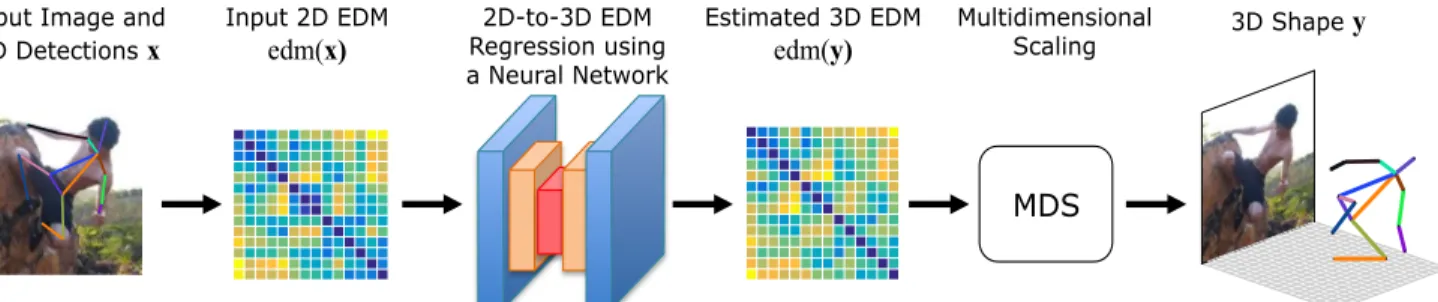
2N- and3N- vector representations of theN body joints. In contrast, we propose representing 2D and 3D poses us-ingN×N matrices of Euclidean distances between every pair of joints, and formulate the 3D pose estimation prob-lem as one of 2D-to-3D distance matrix regression1. Fig.1, illustrates our pipeline.
Despite being extremely simple to compute, Euclidean Distance Matrices (EDMs) have several interesting advan-tages over vector representations that are particularly suited for our problem. Concretely, EDMs: 1) naturally encode structural information of the pose. Inference on vector rep-resentations needs to explicitly formulate such constraints; 2) are invariant to in-plane image rotations and translations, and normalization operations bring invariance to scaling; 3) capture pairwise correlations and dependencies between all body joints.
In order to learn a regression function that maps 2D-to-3D EDMs we consider Fully Connected (FConn) and Fully Convolutional (FConv) Network architectures. Since the di-mension of our data is small (N×Nsquare matrices, with N = 14joints in our model), input-to-output mapping can be achieved through shallow architectures, with only 2 hid-den layers for the FConn and 4 convolutional layers for the FConv. And most importantly, since the distance matrices used to train the networks are built from solely point con-figurations, we can easily synthesize artifacts and train the network under 2D detector noise and body part occlusion.
We achieve state-of-the-art results on standard bench-marks including Humaneva-I and Human3.6M datasets, and we show our approach to be robust to large 2D detector
er-1Once the 3D distance matrix is predicted, the position of the 3D body joints can be estimated using Multidimensional Scaling (MDS).
!! !!
MDS
Input Image and 2D Detections x Input 2D EDM edm(x) 2D-to-3D EDM Regression using a Neural Network Estimated 3D EDM edm(y) Multidimensional Scaling 3D Shape y
Figure 1.Overview. We formulate the 3D human pose estimation problem as a regression between two Euclidean Distance Matrices (EDMs), encoding pairwise distances of 2D and 3D body joints, respectively. The regression is carried out by a Neural Network, and the 3D joint estimates are obtained from the predicted 3D EDM via Multidimensional Scaling.
rors, while (for the case of the FConv) also allowing to hy-pothesize reasonably well occluded body limbs. Addition-ally, experiments in the Leeds Sports Pose dataset, using a network learned on Human3.6M, demonstrate good gener-alization capability on images ‘in the wild’.
2. Related Work
Approaches to estimate 3D human pose from single im-ages can be roughly split into three main categories: meth-ods that rely on generative models to constrain the space of possible poses, discriminative approaches that directly predict 3D pose from image evidence, and methods lying in-between the two previous categories.
The most straightforward generative model consists in representing human pose as linear combinations of modes learned from training data [5]. More sophisticated models allowing to represent larger deformations include spectral embedding [43], Gaussian Mixtures on Euclidean or Rie-mannian manifolds [15, 41] and Gaussian processes [22,
48, 54]. However, exploring the solution space defined by these generative models requires iterative strategies and good enough initializations, making these methods more appropriate for tracking purposes.
Early discriminative approaches [1, 9, 32, 36, 44] fo-cused on directly predicting 3D pose from image descrip-tors such as SIFT of HOG filters, and more recently, from rich features encoding body part information [16] and from the entire image in Deep architectures [23, 46]. Since the mapping between feature and pose space is complex to learn, the success of this family of techniques depends on the existence of large amounts of training images an-notated with ground truth 3D poses. Humaneva [37] and Human3.6M [17] are two popular MoCap datasets used for this purpose. However, these datasets are acquired in labo-ratory conditions, preventing the methods that uniquely use their data to generalize well to unconstrained and realistic images. [33] addressed this limitation by augmenting the training data for a CNN with automatically synthesized im-ages made of realistic textures.
In between the two previous categories, there are a series of methods that first use discriminative formulations to es-timate the 2D joint position, and then infer 3D pose using e.g. regression forests, Expectation Maximization or evolu-tionary algorithms [10,26,31,39,40,50,52]. The two steps can be iteratively refined [39,50,52] or formulated independently [10,26, 31,40]. By doing this, it is then possible to exploit the full power of current CNN-based 2D detectors like DeepCut [28] or the Convolutional Pose Machines (CPMs) [51], which have been trained with large scale datasets of images ‘in-the-wild’.
Regarding the 3D body pose parameterization, most ap-proaches use a skeleton with a number N of joints rang-ing between 14 and 20, and represented by 3N vectors in a Cartesian space. Very recently, [10] used a gener-ative volumetric model of the full body. In order to en-force joint dependency during the 2D-to-3D inference, [17] and [46] considered latent joint representations, obtained through Kernel Dependency Estimation and autoencoders. In this paper, we propose usingN×NEuclidean Distance Matrices for capturing such joint dependencies.
EDMs have already been used in similar domains,e.g. in modal analysis to estimate shape basis [2], to represent protein structures [20], for sensor network localization [7] and for the resolution of kinematic constraints [29]. It is worth to point that for 3D shape recognition tasks, Geodesic Distance Matrices (GDMs) are preferred to EDMs, as they are invariant to isometric deformations [42]. Yet, for the same reason, GDMs are not suitable for our problem, be-cause multiple shape deformations yield the same GDM. In contrast, the shape that produces a specific EDM is unique (up to translation, rotation and reflection), and it can be es-timated via Multidimensional Scaling [7,11].
Finally, representing 2D and 3D joint positions by dis-tance matrices, makes it possible to perform inference with simple Neural Networks. In contrast to recent CNN based methods for 3D human pose estimation [23,46] we do not need to explicitly modify our networks to model the under-lying joint dependencies. This is directly encoded by the distance matrices.
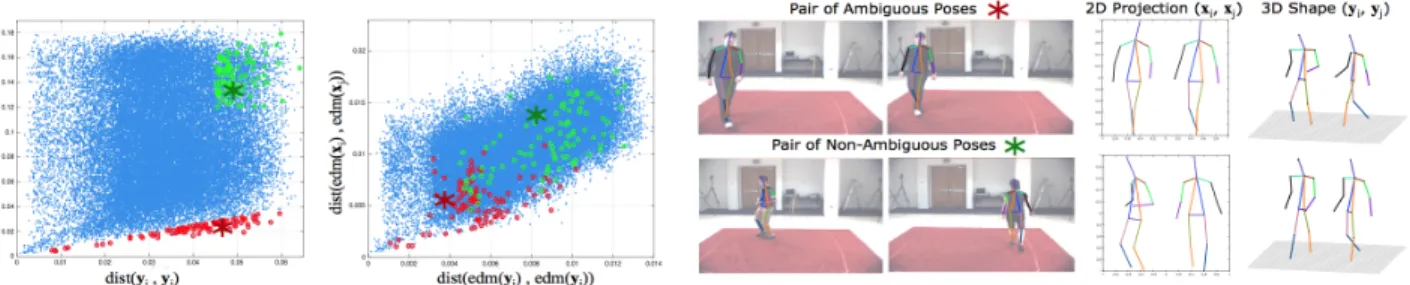
Figure 2.EDMs vs Cartesian representations. Left:Distribution of relative 3D and 2D distances between random pairs of poses, rep-resented as Cartesian vectors (first plot) and EDM matrices (second plot). Cartesian representations show a more decorrelated pattern (Pearson correlation coefficient of0.09against0.60for the EDM), and in particular suffer from larger ambiguities,i.e. poses with similar 2D projections and dissimilar 3D shape. Red circles indicate the most ambiguous such poses, and green circles the most desirable con-figurations (large 2D and 3D differences). Note that red circles are more uniformly distributed along the vertical axis when using EDM representations, favoring larger differences and better discriminability.Right:Pairs of dissimilar 3D poses with similar (top) and dissimilar (bottom) projections. They correspond to the dark red and dark green ‘asterisks’ in the left-most plots.
3. Method
Fig. 1 illustrates the main building blocks of our ap-proach to estimate 3D human pose from a single RGB im-age. Given that image, we first detect body joints using a state-of-the-art detector. Then, 2D joints are normal-ized and represented by a EDM, which is fed into a Neu-ral Network to regress a EDM for the 3D body coordi-nates. Finally, the position of the 3D joints is estimated via a ‘reflexion-aware’ Multidimensional Scaling approach [7]. We next describe in detail each of these steps.
3.1. Problem Formulation
We represent the 3D pose as a skeleton withN=14joints and parameterized by a 3N vector y = [p>
1, . . . ,p>N]>, wherepi is the 3D location of thei-th joint. Similarly, 2D poses are represented by 2N vectorsx = [u>1, . . . ,u>N]>, whereui are pixel coordinates. Given a full-body person image, our goal is to estimate the 3D pose vector y. For this purpose, we follow a regression based discriminative approach. The most general formulation of this problem would involve using a set of training images to learn a func-tion that maps input images, or its features, to 3D poses. However, as discussed above, such a procedure would re-quire a vast amount of data to obtain good generalization.
Alternatively, we will first compute the 2D joint position using the Convolutional Pose Machine detector [51]. We denote byx˜the output of the CPM, which is a noisy version of the ground truth 2D posex.
We can then formally write our problem as that of learn-ing a mapplearn-ing functionf :R2N →
R3N from potentially corrupted 2D joint observationsx˜to 3D posesy, given an annotated and clean training dataset{xi,yi}Di=1.
3.2. Representing Human Pose with EDMs
In oder to gain depth-scale invariance we first normalize the vertical coordinates of the projected 2D posesxito be
within the range[−1,1]. 3D joint positionsyiare expressed in meters with no further pre-processing. We then represent both 2D and 3D poses by means of Euclidean Distance Ma-trices. For the 3D poseywe define edm(y)to be theN×N matrix where its(m, n)entry is computed as:
edm(y)m,n=kpm−pnk2. (1)
Similarly, edm(x)is theN×Nmatrix built from the pair-wise distances between normalized 2D joint coordinates. In case that some of the joints areoccluded, we set to zero their corresponding rows and columns in edm(x).
Despite being simple to define, EDMs have several
advantages over Cartesian representations: EDMs are
coordinate-free, invariant to rotation, translation and reflec-tion. Previous regression-based approaches [33, 39, 52] need to compensate for this invariance by pre-aligning the training 3D posesyi w.r.t. a global coordinate frame, usu-ally defined by specific body joints. Additionusu-ally, EDMs do not only encode the underlying structure of plain 3D vec-tor representations, but they also capture richer information about pairwise correlations between all body joints. A di-rect consequence of both these advantages, is that EDM-based representations allow reducing the inherent ambigui-ties of the 2D-to-3D human pose estimation problem.
To empirically support this claim we randomly picked pairs of samples from the Humaneva-I dataset and plot-ted the distribution of relative distances between their 3D and 2D poses, using either Cartesian or EDM representations (see Fig. 2). For the Cartesian case (left-most plot), an entry to the graph corresponds to
[dist(yi,yj),dist(xi,xj)], where dist(·) is a normalized distance and i, j are two random indices. Similarly, for the EDMs (second plot), an entry to the graph corresponds to[dist(edm(yi),edm(yj)),dist(edm(xi),edm(xj))]. Ob-serve that 3D and 2D pairwise differences are much more correlated in this case. The interpretation of this pattern is
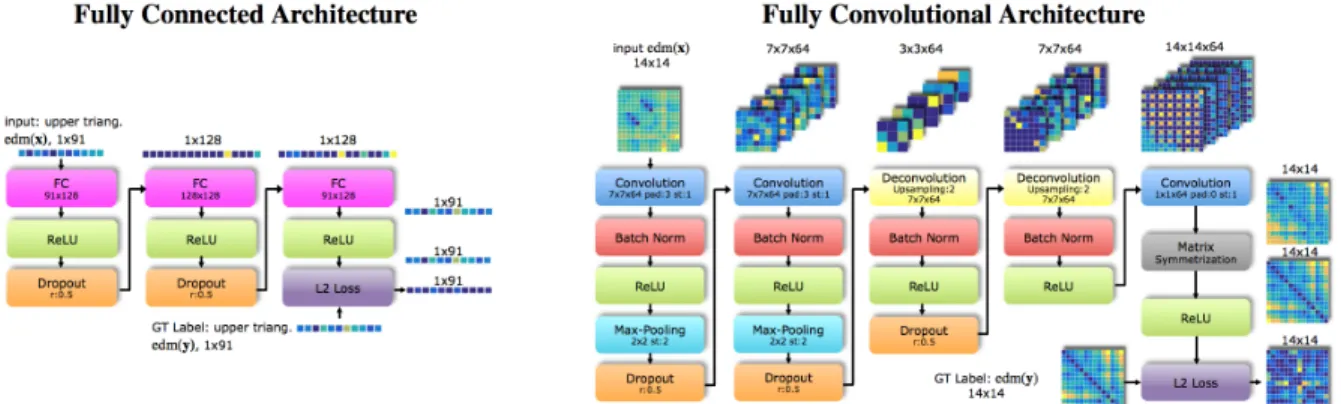
Figure 3.Neural Network Architectures used to perform 2D-to-3D regression of symmetric Euclidean Distance Matrices.
that distance matrices yield larger 3D pose differences for most dissimilar 2D poses. The red circles in the graphs, correspond to the most ambiguous shapes,i.e., pairs of dis-similar poses{yi,yj}with very similar image projections {ui,uj}. Note that when using EDMs, these critical sam-ples depict larger differences along the vertical axis,i.e., on the 2D representation. This kind of behavior makes it easier the subsequent task of learning the 2D-to-3D mapping.
3.3. 2D-to-3D Distance Matrix Regression
The problem formulated in Sec.3.1can now be rewrit-ten in terms of finding the mappingf : RN×N →RN×N, from potentially corrupted distance matrices edm(˜x)to ma-trices edm(y)encoding the 3D pose, given a training set {edm(xi),edm(yi)}Di=1. The expressiveness and low
di-mensionality of the input and output data (14×14matrices) will make it possible to learn this mapping with relatively tiny Neural Network architectures, which we next describe.
Fully Connected Network. Since distance matrices are symmetric, we first consider a simple FConn architecture with 40K free parameters that regresses theN(N−1)/2 = 91elements above the diagonal of edm(y). As shown in Fig.3-left, the network consists of three Fully Connected (FC) layers with 128-128-91 neurons. Each FC layer is fol-lowed by a rectified linear unit (ReLU). To reduce overfit-ting, we use dropout after the first two layers, with a dropout ratio of 0.5 (50% of probability to set a neuron’s output value to zero).
The91-dimensional vector at the output is used to build the14×14output EDM, which by construction, is guar-anteed to be symmetric. Additionally, the last ReLU layer enforces positiveness of all elements of the matrix, another necessary (but not sufficient) condition for an EDM.
Fully Convolutional Network. Motivated by the recent success of Fully Convolutional Networks in tasks like se-mantic segmentation [24], flow estimation [13] and change dectection [4], we also consider the architecture shown in Fig.3-right to regress entire14×14distance matrices.
FConv Networks were originally conceived to map im-ages or bi-dimensional arrays with some sort of spatial con-tinuity. The EDMs however, do not convey this continuity and, in addition, they are defined up to a random permu-tation of the skeleton joints. In any event, for the case of human motion, the distance matrices turn to be highly struc-tured, particularly when handling occluded joints, which re-sults in patterns of zero columns and rows within the input EDM. In the experimental section we will show that FConv networks are also very effective for this kind of situations.
Following previous works [4,24], we explored an archi-tecture with a contractive and an expansive part. The con-tractive part consists of two convolutional blocks, with7×7
kernels and64features, each. Convolutional layers are fol-lowed by a Batch Normalization (BN) layer with learned parameters, relieving from the task of having to compute such statistics from data during test. BN output is for-warded to a non-linear ReLU; a 2×2 max-pooling layer with stride 2 that performs the actual contraction; and fi-nally, to a dropout layer with0.5ratio.
The expansive part also has two main blocks which start with a deconvolution layer, that internally performs a ×2
upsampling and, again, a convolution with 7×7 kernels and64features. The deconvolution is followed by a ReLU and a dropout layer with ratio0.5. For the second block, dropout is replaced by a convolutional layer that contracts the64,14×14features into a single14×14channel.
Note that there are no guarantees that the output of the expansive part will be a symmetric and positive matrix, as expected for a EDM. Therefore, before computing the ac-tual loss we designed a layer called ‘Matrix Symmetriza-tion’ (MS) which enforces symmetry. If we denote byZ the output of the expansive part, MS will simply compute
(Z+Z>)/2, which is symmetric. A final ReLU layer, guar-antees that all values will be also positive.
This Fully Convolutional Network has 606K parameters.
Training. In the experimental section we will report re-sults on multiple training setups. In all of them, the two networks were trained from scratch, and randomly
initial-Walking (Action 1, Camera 1) Jogging (Action 2, Camera 1) Boxing (Action 5, Camera 1)
Method S1 S2 S3 Average S1 S2 S3 Average S1 S2 S3 Average
Taylor CVPR’10 [45] 48.80 47.40 49.80 48,70 75,35 - - - -Bo IJCV’10 [8] 45.40 28.30 62.30 45.33 - - - - 42.50 64.00 69.30 58.60 Sigal IJCV’12 [38] 66.00 69.00 - - - -Ramakrishna ECCV’12 [31](*) 161.80 182.00 188.60 177.47 - - - - 151.00 170.00 158.00 159.67 Simo-Serra CVPR’12 [40] 99.60 108.30 127.40 111.77 - - - -Simo-Serra CVPR’13 [39] 65.10 48.60 73.50 62.40 74.20 46.60 32.20 51.00 - - - -Radwan ICCV’13 [30] 75.10 99.80 93.80 89.57 79.20 89.80 99.40 89.47 - - - -Wang CVPR’14 [50] 71.90 75.70 85.30 77.63 62.60 77.70 54.40 64.90 - - - -Belagiannis CVPR’14 [6] 68.30 - - - 62.70 - - -Kostrikov BMVC’14 [21] 44.00 30.90 41.70 38,87 57.20 35.00 33.30 41.83 - - - -Elhayek CVPR’15 [12] 66.50 - - - 60.00 - - -Akhter CVPR’15 [3](*) 186.10 197.80 209.40 197.77 - - - - 165.50 196.50 208.40 190.13 Tekin CVPR’16 [47] 37.50 25.10 49.20 37.27 - - - - 50.50 61.70 57.50 56.57 Yasin CVPR’16 [52] 35.80 32.40 41.60 36.60 46.60 41.40 35.40 41.13 - - - -Zhou PAMI’16 [55](*) 100.00 98.90 123.10 107.33 - - - - 112.50 118.60 110.00 113.70 Bogo ECCV’16 [10] 73.30 59.00 99.40 77.23 - - - - 82.10 79.20 87.20 82.83
Our Approach, Fully Connected Network
Train 2D: GT, Test: CPM 35.70 36.80 41.34 37.95 41.25 27.96 34.34 34.52 47.26 50.52 67.64 55.14 Train 2D: CPM, Test: CPM 20.16 14.00 28.76 20.97 38.12 17.95 21.42 25.83 44.05 48.52 57.00 49.86 Train 2D: GT+CPM, Test: CPM 19.72 13.52 26.46 19.90 34.64 17.85 20.05 24.18 45.67 47.52 57.63 50.27
Our Approach, Fully Convolutional Network
Train 2D: GT, Test: CPM 28.35 27.75 38.93 31.68 47.75 27.82 30.21 35.26 42.40 49.15 59.17 50.24 Train 2D: CPM, Test: CPM 19.82 12.64 26.19 19.55 43.83 21.79 22.10 29.24 45.55 47.64 46.52 46.57
Train 2D: GT+CPM, Test: CPM 19.68 13.02 24.89 19.20 39.69 20.04 21.04 26.92 46.63 47.56 46.45 46.88
Table 1.Results on the Humaneva-I dataset. Average error (in mm) between the ground truth and the predicted joint positions. ‘-’ indicates that the results for that specific ‘action’ and ‘subject’ are not reported. The results of all approaches are obtained from the original papers, except for (*), which were obtained from [10].
ized using the strategy proposed in [14]. We use a stan-dard L2 loss function in the two cases. Optimization is car-ried out using Adam [19], with a batch size of7EDMs for
Humaneva-I and200EDMs for Human3.6M. FConn
gener-ally requires about 500 epochs to converge and FConv about 1500 epochs. We use default Adam parameters, except for the step size α, which is initialized to0.001 and reduced to0.0001after 250 (FConn) and 750 (FConv) epochs. The model definition and training is run under MatconvNet [49].
3.4. From Distance Matrices to 3D Pose
Retrieving the 3D joint positionsy = [p>1, . . . ,p>N]>
from a potentially noisy distance matrix edm(y)estimated by the neural network, can be formulated as the following error minimization problem:
arg min p1,...,pN X m,n |kpm−pnk22−edm(y) 2 m,n|. (2)
We solve this minimization using [7], a MDS algorithm which poses a semidefinite programming relaxation of the non-convex Eq.2, refined by a gradient descent method.
Yet, note that the shape y we retrieve from edm(y) is up to a reflection transformation, i.e., y and its reflected versiony∗yield the same distance matrix. In order to dis-ambiguate this situation, we keep eitheryor y∗ based on their degree of anthropomorphism, measured as the num-ber of joints with angles within the limits defined by the physically-motivated prior provided by [3].
4. Experiments
We extensively evaluate the proposed approach on two publicly available datasets, namely Humaneva-I [37] and Human3.6M [17]. Besides quantitative comparisons w.r.t. state-of-the-art we also assess the robustness of our ap-proach to noisy 2D observations and joint occlusion. We further provide qualitative results on the LSP dataset [18]
Unless specifically said, we assume the 2D joint posi-tions in our approach are obtained with the CPM detec-tor [51], fed with a bounding box of the full-body person image. As common practice in literature [39,52], the re-construction error we report refers to the average 3D Eu-clidean joint error (in mm), computed after rigidly aligning the estimated pose with the ground truth (if available).
4.1. Evaluation on Humaneva-I
For the experiments with Humaneva-I we train our EDM regressors on the training sequences for the Subjects 1, 2 and 3, and evaluate on the ‘validation’ sequences. This is the same evaluation protocol used by the baselines we com-pare against [3,6,8,10,12,21,30,31,38,39,40,45,47,
50,52,55,56]. We report the performance on the ‘Walk-ing’, ‘Jogging’ and ‘Boxing’ sequences. Regarding our own approach we consider several configurations depending on the type of regressor: Fully Connected or Fully Convolu-tional Network; and depending on the type of 2D source used for training: Ground Truth (GT), CPM or GT+CPM.
Sample 3D Reconstructions Right Arm, Leg, True Tracks Right Arm, Leg, Hypoth. Tracks Left Arm, Leg, True Tracks Left Arm, Leg, Hypoth. Tracks Sample 3D Reconstructions Right Arm, Leg - True Tracks Right Arm, Leg - Hypothesised Tracks Left Arm, Leg - True Tracks Left Arm, Leg - Hypothesised Tracks
Figure 4. Hypothesysing Occluded Body Parts. Ground truth and hypothesized body parts obtained using the Fully Convolutional distance matrix regressor (Subject 3, action ‘Jogging’ from Humaneva-I). The network is trained with pairs of occluded joints and is able to predict one occluded limb (2 neighboring joints) at a time. Note how the generated tracks highly resemble the ground truth ones.
Walking (Action 1, Camera 1) Jogging (Action 2, Camera 1) Boxing (Action 5, Camera 1) NN Arch. Occl. Type Error S1 S2 S3 Average S1 S2 S3 Average S1 S2 S3 Average
FConn 2 Rand. Joints Avg. Error 53.30 59.49 51.99 54.93 49.93 27.91 37.07 38.30 49.63 60.74 64.53 58.30 Error Occl. Joints 53.95 60.24 53.65 55.95 54.06 30.61 43.25 42.64 56.32 68.74 72.04 65.70 FConn Right Arm Avg. Error 55.55 59.16 49.31 54.67 54.45 31.30 36.73 40.83 49.48 69.59 68.26 62.44 Error Occl. Joints 59.38 55.02 45.32 53.24 72.48 37.25 41.33 50.35 100.57 127.29 134.75 120.87 FConn Left Leg Avg. Error 53.51 55.87 60.04 56.47 49.83 30.90 41.16 40.63 46.68 64.85 62.04 57.86 Error Occl. Joints 83.15 86.73 88.25 86.04 85.58 61.38 82.04 76.33 38.43 72.66 55.12 55.40 FConv 2 Rand. Joints Avg. Error 31.56 28.00 38.49 32.68 46.63 26.61 34.34 35.86 50.00 54.19 56.12 53.44 Error Occl. Joints 32.96 30.22 45.79 36.32 48.04 29.57 40.32 39.31 58.60 60.59 66.34 61.84 FConv Right Arm Avg. Error 37.96 27.70 35.27 33.64 51.00 28.11 31.81 36.97 58.09 59.74 62.78 60.20 Error Occl. Joints 48.06 27.57 29.72 35.12 69.59 32.78 34.79 45.72 111.61 101.49 132.76 115.29 FConv Left Leg Avg. Error 34.42 38.64 41.69 38.25 39.72 29.22 33.62 34.19 50.68 53.85 50.14 51.56 Error Occl. Joints 61.03 64.79 71.48 65.77 59.3 59.24 67.11 61.88 44.59 61.23 46.48 50.77
Table 2.Results on the Humaneva-I under Occlusions. Average overall joint error and average error of the occluded and hypothesized joints (in mm) using the proposed Fully Connected and Fully Convolutional regressors. We train the two architectures with 2D GT+CPM and with random pairs of occluded joints. Test is carried out using the CPM detections with specific occlusion configurations.
The 2D source used for evaluation is always CPM.
Table1 summarizes the results, and shows that all con-figurations of our approach significantly outperform state-of-the-art. The improvement is particularly relevant when modeling the potential deviations of the CPM by directly using its 2D detections to train the regressors. Interestingly, note that the results obtained by FConn and FConv are very similar, being the former a much simpler architecture. How-ever, as we will next show, FConv achieves remarkably bet-ter performance when dealing with occlusions.
Robustness to Occlusions.The 3D pose we estimate obvi-ously depends on the quality of the 2D CPM detections. De-spite the CPM observations we have used do already contain certain errors, we have explicitly evaluated the robustness of our approach under artificial noise and occlusion artifacts. We next assess the impact of occlusions. We leave the study of the 2D noise for the following section.
We consider two-joint occlusions, synthetically pro-duced by removing two nodes of the projected skele-ton. In order to make our networks robust to such oc-clusions and also able to hypothesize the 3D position of the non-observed joints, we re-train them using pairs {edm(xocc
i ),edm(yi)}Di=1, where edm(xocci )is the same as edm(xi), but with two random rows and columns set to zero. At test, we consider the cases with random joint oc-clusions or with structured ococ-clusions, in which we com-pletely remove the observation of one body limb (full leg or
full arm).
Table2 reports the reconstruction error for FConn and FConv. Overall results show a clear and consistent advan-tage of the FConv network, yielding error values which are even comparable to state-of-the-art approaches when ob-serving all joints (see Table1). Furthermore, note that the error of the hypothesized joints is also within very reason-able bounds, exploiting only for the right arm position in the ‘boxing’ activity (error>100 mm). This is in the line of previous works which have shown that the combination of convolutional and deconvolutional layers is very effective for image reconstruction and segmentation tasks [27,53]. A specific example of joint hallucination is shown in Fig.4.
4.2. Evaluation on Human3.6M
The Human3.6M dataset consists of 3.6 Million 3D poses of 11 subjects performing 15 different actions under 4 viewpoints. We found in the literature 3 different evalua-tion protocols. For Protocol #1, 5 subjects (S1, S5, S6, S7 and S8) are used for training and 2 (S9 and S11) for test-ing. Training and testing is done independently per each action and using all camera views. Testing is carried out in all images. This protocol is used in [17,23,34,46,47,56]. Protocol #2 only differs from Protocol #1 in that only the frontal view is considered for test. It has been recently used in [10], which also evaluates [3,31,55]. Finally, in Protocol #3, training data comprises all actions and viewpoints. Six
Method Direct. Discuss Eat Greet Phone Pose Purch. Sit SitD Smoke Photo Wait Walk WalkD WalkT Avg Protocol #1 Ionescu PAMI’14 [17] 132.71 183.55 133.37 164.39 162.12 205.94 150.61 171.31 151.57 243.03 162.14 170.69 177.13 96.60 127.88 162,20 Li ICCV’15 [23] - 136.88 96.94 124.74 - 168.08 - - - 132.17 69.97 - -Tekin BMVC’16 [46] - 129.06 91.43 121.68 - - - 162.17 - 65.75 130.53 - -Tekin CVPR’16 [47] 102.41 147.72 88.83 125.28 118.02 112.38 129.17 138.89 224.90 118.42 182.73 138.75 55.07 126.29 65.76 124.97 Zhou CVPR’16 [56] 87.36 109.31 87.05 103.16 116.18 143.32 106.88 99.78 124.52 199.23 107.42 118.09 114.23 79.39 97.70 112.91 Sanzari ECCV’16 [34] 48.82 56.31 95.98 84.78 96.47 66.30 107.41 116.89 129.63 97.84 105.58 65.94 92.58 130.46 102.21 93.15
Ours, FConv, Test 2D: CPM 67.48 79.01 76.48 83.12 97.43 74.58 71.96 102.40 116.68 87.70 100.37 94.57 75.21 82.72 74.92 85.64
Protocol #2
Ramakrishna ECCV’12 [31](*) 137.40 149.30 141.60 154.30 157.70 141.80 158.10 168.60 175.60 160.40 158.90 161.70 174.80 150.00 150.20 156.03
Akhter CVPR’15 [3](*) 1199.20 177.60 161.80 197.80 176.20 195.40 167.30 160.70 173.70 177.80 186.50 181.90 198.60 176.20 192.70 181.56
Zhou PAMI’16 [55](*) 99.70 95.80 87.90 116.80 108.30 93.50 95.30 109.10 137.50 106.00 107.30 102.20 110.40 106.50 115.20 106.10
Bogo ECCV’16 [10] 62.00 60.20 67.80 76.50 92.10 73.00 75.30 100.30 137.30 83.40 77.00 77.30 86.80 79.70 81.70 82.03
Ours. FConv, Test 2D: CPM 64.11 76.58 70.59 80.81 93.01 74.01 65.45 87.93 109.49 83.81 96.31 93.08 73.51 81.57 72.59 81.52
Protocol #3
Yasin CVPR’16 [52] 88.40 72.50 108.50 110.20 97.10 81.60 107.20 119.00 170.80 108.20 142.50 86.90 92.10 165.70 102.00 110.18
Rogez NIPS’16 [33] - - - 88.10
Ours, FConv, Test 2D: CPM 66.05 61.69 84.51 73.73 65.23 67.17 60.85 67.29 103.48 74.75 92.55 69.59 71.47 78.04 73.23 73.98
Table 3.Results on the Human3.6M dataset.Average joint error (in mm) considering the 3 evaluation prototocols described in the text. The results of all approaches are obtained from the original papers, except for (*), which are from [10].
Occ. Type Error Direct. Discuss Eat Greet Phone Pose Purch. Sit SitD Smoke Photo Wait Walk WalkD WalkT Avg
2 Rnd.Joints Avg. Error 88.53 97.83 139.99 99.57 106.13 102.78 92.97 113.35 126.62 111.73 122.74 109.85 95.1 96.76 97.97 106.79
Err.Occl. Joints 94.77 104.37 155.66 110.48 119.62 103.83 91.04 141.31 135.35 137.76 146.68 131.41 116.16 96.11 99.73 118.95
Left Arm Avg. Error 197.86 101.88 123.91 109.72 93.00 106.15 100.55 113.19 129.50 111.15 135.72 118.07 99.21 100.73 100.94 109.44
Err.Occl. Joints 177.44 177.68 152.06 220.28 145.93 180.42 143.24 192.42 154.62 184.24 253.88 213.6 176.11 160.44 188.38 181.38
Right Leg Avg. Error 79.94 82.23 132.64 92.05 100.77 97.32 76.37 126.95 125.51 106.66 109.82 95.92 94.88 89.82 91.60 100.17
Err.Occl. Joints 81.23 92.57 177.80 103.69 148.45 120.74 92.63 200.56 183.03 146.10 145.29 107.36 133.11 105.9 120.12 130.57
Table 4.Results on Human3.6M under Occlusions.Average overall joint error and average error of the hypothesized occluded joints (in mm). The network is trained and evaluated according to the ‘Protocol #3’ described in the text.
2D Input Direct. Discuss Eat Greet Phone Pose Purch. Sit SitD Smoke Photo Wait Walk WalkD WalkT Avg
GT 53.51 50.52 65.76 62.47 56.9 60.63 50.83 55.95 79.62 63.68 80.83 61.80 59.42 68.53 62.11 62.17
GT+N(0,5) 57.05 56.05 70.33 65.46 60.39 64.49 59.06 58.62 82.80 67.85 83.97 70.13 66.76 75.04 68.62 67.11
GT+N(0,10) 76.46 70.74 77.18 77.25 73.42 81.94 64.65 71.05 97.08 76.91 93.45 77.12 85.14 80.96 83.47 79.12
GT+N(0,15) 90.72 91.99 96.54 94.99 87.43 101.81 89.39 84.46 107.26 93.31 106.01 95.96 100.38 96.59 104.41 96.08
GT+N(0,20) 109.84 110.21 117.13 115.16 107.08 116.92 107.14 101.82 131.43 114.76 115.07 112.54 125.50 118.93 129.73 115.55
Table 5.Results on the Human3.6M dataset under 2D Noise.Average 3D joint error for increasing levels of 2D noise. The network is trained with 2D Ground Truth (GT) data and evaluated with GT+N(0.σ). whereσis the standard deviation (in pixels) of the noise.
subjects (S1, S5, S6, S7, S8 and S9) are used for training and every64thframe of the frontal view of S11 is used for testing. This is the protocol considered in [33,52].
We will evaluate our approach on the three protocols. In contrast to HumanEva experiments, CPM detections will not be used for training (very time consuming), and we will train with the ground truth 2D positions. CPM detections are used during test, though. For Protocol #3 we choose the training set by randomly picking 400K samples among all poses and camera views, a similar number as in [52]. For the rest of experiments we will only consider the FConv regres-sor, which showed overall better performance than FConn in the Humaneva dataset. The results are summarized in Table3. For Protocols #1 and #3 our approach improves state-of-the-art by a considerable margin, and for Protocol #2 is very similar to [10], a recent approach that relies on a high-quality volumetric prior of the body shape.
Robustness to Occlusions. We perform the same occlu-sion analysis as we did for Humaneva-I and re-train the net-work under randomly occluded joints and test for random and structured occlusions. The results (under Protocol #3) are reported in Table4. Again, note that the average body error remains within reasonable bounds. There are,
how-ever, some specific actions (e.g. ‘Sit’, ‘Photo’) for which the occluded leg or arm are not very well hypothesized. We believe this is because in these actions, the limbs are in con-figurations with only a few samples on the training set. In-deed, state of the art methods also report poor performance on these actions, even when observing all joints.
Robustness to 2D Noise.We further analyze the robustness of our approach (trained on clean data) to 2D noise. For this purpose, instead of using CPM detections for test, we used the 2D ground truth test poses with increasing amounts of Gaussian noise. The results of this analysis are given in Table5. Note that the 3D error gradually increases with the 2D noise, but does not seem to break the system. Noise levels of up to 20 pixels std are still reasonably supported. As a reference, the mean 2D error of the CPM detections considered in Tables4and3is of10.91pixels. Note also that there is still room for improvement, as more precise 2D detections can considerably boost the 3D pose accuracy.
4.3. Evaluation on Leeds Sports Pose Dataset
We finally explore the generalization capabilities of our approach on the LSP dataset. For each input image, we locate the 2D joints using the CPM detector, perform the
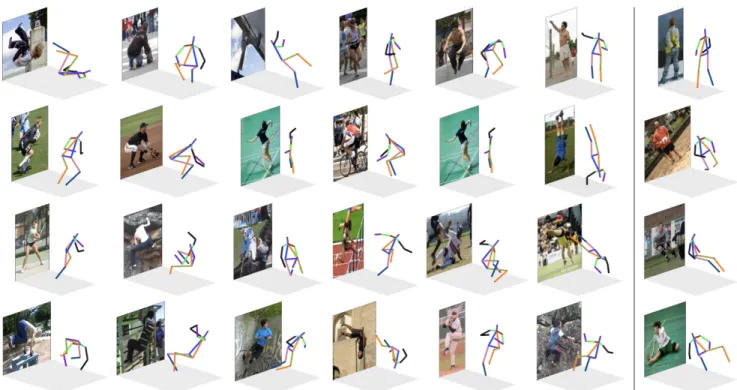
Figure 5.Results on the LSP dataset.The first six columns show correctly estimated poses. The right-most column shows failure cases.
Error Type Feet Knees Hips Hands Elbows Should. Head Neck Avg
CPM 5.66 4.22 4.27 7.25 5.24 3.17 3.55 2.65 4.77 Reproj. 2D CPM 12.68 8.71 10.32 9.50 8.05 5.79 7.61 5.24 8.83 Reproj. 2D GT 9.75 7.33 7.47 6.05 6.14 4.52 6.24 4.09 6.67 Table 6.Reprojection Error (in pixels) on the LSP dataset.
2D-to-3D EDM regression using the Fully Convolutional network learned on Human3.6M (Protocol #3) and com-pute the 3D pose through MDS. Additionally, once the 3D pose is estimated, we retrieve the rigid rotation and trans-lation that aligns it with the input image using a PnP al-gorithm [25]. Since the internal parameters of the camera are unknown, we sweep the focal length configuration space and keep the solution that minimizes the reprojection error. The lack of 3D annotation makes it not possible to per-form a quantitative evaluation of the 3D shapes accuracy. Instead, in Table6, we report three types of 2D reprojection errors per body part, averaged over the 2000 images of the dataset: 1) Error of the CPM detections; 2) Error of the re-projected shapes when estimated using CPM 2D detections; and 3) Error of the reprojected shapes when estimated using 2D GT annotations. While these results do not guarantee good accuracy of the estimated shapes, they are indicative that the method is working properly. A visual inspection of the 3D estimated poses, reveals very promising results, even for poses which do not appear on the Human3.6M dataset used for training (see Fig.5). There still remain failure cases (shown on the right-most column), due toe.g. detector mis-detections, extremal body poses or camera viewpoints that largely differ from those of Human3.6M.
5. Conclusion
In this paper we have formulated the 3D human pose es-timation problem as a regression between matrices encod-ing 2D and 3D joint distances. We have shown that such matrices help to reduce the inherent ambiguity of the prob-lem by naturally incorporating structural information of the human body and capturing joints correlations. The distance matrix regression is carried out by simple Neural Network architectures, that bring robustness to noise and occlusions of the 2D detected joints. In the latter case, a Fully Con-volutional network has allowed to hypothesize unobserved body parts. Quantitative evaluation on standard benchmarks shows remarkable improvement compared to state of the art. Additionally, qualitative results on images ‘in the wild’ show the approach to generalize well to untrained data. Since distance matrices just depend on joint positions, new training data from novel viewpoints and shape configura-tions can be readily synthesized. In the future, we plan to explore online training strategies exploiting this.
6. Acknowledgments
This work is partly funded by the Spanish MINECO project RobInstruct TIN2014-58178-R and by the ERA-Net Chistera project I-DRESS PCIN-2015-147. The author thanks Nvidia for the hardware donation under the GPU grant program, and Germ´an Ros for fruitful discussions that initiated this work.
References
[1] A. Agarwal and B. Triggs. 3D Human Pose from Silhouettes by Relevance Vector Regression. InConference on Com-puter Vision and Pattern Recognition.1,2
[2] A. Agudo, J. M. M. Montiel, B. Calvo, and F. Moreno-Noguer. Mode-Shape Interpretation: Re-Thinking Modal Space for Recovering Deformable Shapes. InWinter Con-ference on Applications of Computer Vision, 2016.2
[3] I. Akhter and M. Black. Pose-conditioned Joint Angle Lim-its for 3D Human Pose Reconstruction. InConference on Computer Vision and Pattern Recognition, 2015.5,6,7
[4] P. F. Alcantarilla, S. Stent, G. Ros, R. Arroyo, and R. Gher-ardi. Street-View Change Detection with Deconvolutional Networks. InRobotics: Science and Systems Conference, 2016.4
[5] A. O. Balan, L. Sigal, M. J. Black, J. E. Davis, and H. W. Haussecker. Detailed Human Shape and Pose from Images. InConference on Computer Vision and Pattern Recognition, 2007.2
[6] V. Belagiannis, S. Amin, M. Andriluka, B. S. N. Navab, and S. Ilic. 3D Pictorial Structures for Multiple Human Pose Estimation. InConference on Computer Vision and Pattern Recognition, 2014.5
[7] P. Biswas, T. Liang, K. Toh, T. Wang, and Y. Ye. Semidefi-nite Programming Approaches for Sensor Network Localiza-tion With Noisy Distance Measurements.IEEE Transactions on Automation Science and Engineering, 3:360–371, 2006.
2,3,5
[8] L. Bo and C. Sminchisescu. Twin Gaussian Processes for Structured Prediction.International Journal of Computer Vi-sion, 87:28–52, 2010.5
[9] L. Bo, C. Sminchisescu, A. Kanaujia, and D. Metaxas. Fast Algorithms for Large Scale Conditional 3D Prediction. In
Conference on Computer Vision and Pattern Recognition, 2008.1,2
[10] F. Bogo, A. Kanazawa, C. Lassner, P. Gehler, J. Romero, and M. J. Black. Keep it SMPL: Automatic Estimation of 3D Human Pose and Shape from a Single Image. InEuropean Conference on Computer Vision, 2016.1,2,5,6,7
[11] I. Borg and P. Groenen. Modern Multidimensional Scaling: Theory and Applications. Springer, 2005.2
[12] A. Elhayek, E. Aguiar, A. Jain, J. Tompson, L. Pishchulin, M. Andriluka, C. Bregler, B. Schiele, and C. Theobalt. Ef-ficient Convnet-Based Marker-Less Motion Capture in Gen-eral Scenes with a Low Number of Cameras. InConference on Computer Vision and Pattern Recognition, 2015.5
[13] P. Fischer, A. Dosovitskiy, E. Ilg, C. H. P. Hausser, V. Golkov, P. v.d. Smagt, D. Cremers, and T. Brox. FlowNet: Learning Optical Flow with Convolutional Networks. In In-ternational Conference on Computer Vision, 2015.4
[14] K. He, X. Zhang, S. Ren, and J. Sun. Delving Deep into Rec-tifiers: Surpassing Human-Level Performance on ImageNet Classification. InInternational Conference on Computer Vi-sion, 2015.5
[15] N. R. Howe, M. E. Leventon, and W. T. Freeman. Bayesian Reconstruction of 3D Human Motion from Single-Camera Video. InNeural Information Processing Systems, 1999.2
[16] C. Ionescu, J. Carreira, and C. Sminchisescu. Iterated Second-Order Label Sensitive Pooling for 3D Human Pose. InConference on Computer Vision and Pattern Recognition, 2014.2
[17] C. Ionescu, D. Papava, V. Olaru, and C. Sminchisescu. Human3.6M: Large Scale Datasets and Predictive Methods for 3D Human Sensing in Natural Environments. IEEE Transactions on Pattern Analysis and Machine Intelligence, 36(7):1325–1339, 2014.1,2,5,6,7
[18] S. Johnson and M. Everingham. Clustered Pose and Non-linear Appearance Models for Human Pose Estimation. In
British Machine Vision Conference, 2010.1,5
[19] P. Kingma and J. Ba. Adam: A Method for Stochastic Op-timization. InInternational Conference in Learning Repre-sentations, 2015.5
[20] A. Kloczkowski, R. L. Jernigan, Z. Wu, G. Song, L. Yang, A. Kolinski, and P. Pokarowski. Distance Matrix-based Ap-proach to Protein Structure Prediction.Journal of Structural and Functional Genomics, 10(1):67–81, 2009.2
[21] I. Kostrikov and J. Gall. Depth Sweep Regression Forests for Estimating 3D Human Pose from Images. InBritish Machine Vision Conference, 2014.5
[22] N. D. Lawrence and A. J. Moore. Hierarchical Gaussian Pro-cess Latent Variable Models. InInternational Conference in Machine Learning, 2007.2
[23] S. Li, W. Zhang, and A. Chan. Maximum-Margin Structured Learning with Deep Networks for 3D Human Pose Estima-tion. InInternational Conference on Computer Vision, 2015.
1,2,6,7
[24] J. Long, E. Shelhamer, and T. Darrell. Fully convolutional networks for semantic segmentation. InConference on Com-puter Vision and Pattern Recognition, 2015.4
[25] C.-P. Lu, G. D. Hager, and E. Mjolsness. Fast and Glob-ally Convergent Pose Estimation from Video Images. IEEE Transactions on Pattern Analysis and Machine Intelligence, 22(5):610–622, 2000.8
[26] G. Mori and J. Malik. Recovering 3D Human Body Configu-rations Using Shape Contexts.IEEE Transactions on Pattern Analysis and Machine Intelligence, 28:1052–1062, 2006.2
[27] H. Noh, S. Hong, and B. Han. Learning deconvolution net-work for semantic segmentation. InInternational Confer-ence on Computer Vision, 2015.6
[28] L. Pishchulin, E. Insafutdinov, S. Tang, B. Andres, M. An-driluka, P. Gehler, and B. Schiele. Deepcut: Joint subset par-tition and labeling for multi person pose estimation. In Con-ference on Computer Vision and Pattern Recognition, 2016.
2
[29] J. Porta, L. Ros, F. Thomas, and C. Torras. A Branch-and-Prune Solver for Distance Constraints. IEEE Transactions on Robotics, 21:176–187, 2005.2
[30] I. Radwan, A. Dhall, and R. Goecke. Monocular Image 3D Human Pose Estimation Under Self-Occlusion. In Interna-tional Conference on Computer Vision, 2013.5
[31] V. Ramakrishna, T. Kanade, and Y. A. Sheikh. Reconstruct-ing 3D Human Pose from 2D Image Landmarks. In Euro-pean Conference on Computer Vision, 2012.1,2,5,6,7
[32] G. Rogez, J. Rihan, S. Ramalingam, C. Orrite, and P. Torr. Randomized Trees for Human Pose Detection. In Confer-ence on Computer Vision and Pattern Recognition, 2008. 1,
2
[33] G. Rogez and C. Schmid. MoCap-guided Data Augmenta-tion for 3D Pose EstimaAugmenta-tion in the Wild. InNeural Informa-tion Processing Systems, 2016.2,3,7
[34] M. Sanzari, V. Ntouskos, and F. Pirri. Bayesian image based 3d pose estimation. InEuropean Conference on Computer Vision, 2016.6,7
[35] B. Sapp and B. Taska. Modec: Multimodal Decomposable Models for Human Pose Estimation. InConference on Com-puter Vision and Pattern Recognition, 2013.1
[36] G. Shakhnarovich, P. Viola, and T. Darrellr. Fast pose esti-mation with parameter-sensitive hashing. InConference on Computer Vision and Pattern Recognition, 2003.1,2
[37] L. Sigal, A. O. Balan, and M. J. Black. HumanEva: Syn-chronized Video and Motion Capture Dataset and Baseline Algorithm for Evaluation of Articulated Human Motion. In-ternational Journal of Computer Vision, 87(1-2), 2010.1,2,
5
[38] L. Sigal, M. Isard, H. W. Haussecker, and M. J. Black. Loose-limbed People: Estimating 3D Human Pose and Mo-tion Using Non-parametric Belief PropagaMo-tion.International Journal of Computer Vision, 98(1):15–48, 2012.5
[39] E. Simo-Serra, A. Quattoni, C. Torras, and F. Moreno-Noguer. A Joint Model for 2D and 3D Pose Estimation from a Single Image. InConference on Computer Vision and Pat-tern Recognition, 2013.1,2,3,5
[40] E. Simo-Serra, A. Ramisa, G. Aleny`a, C. Torras, and F. Moreno-Noguer. Single Image 3D Human Pose Estima-tion from Noisy ObservaEstima-tions. InConference on Computer Vision and Pattern Recognition, 2012.1,2,5
[41] E. Simo-Serra, C. Torras, and F. Moreno-Noguer. 3D Hu-man Pose Tracking Priors using Geodesic Mixture Models.
International Journal of Computer Vision, pages 1–21, 2016.
2
[42] D. Smeets, J. Hermans, D. Vandermeulen, and P. Suetens. Isometric Deformation Invariant 3D Shape Recognition. Pat-tern Recognition, 45(7):2817–2831, 2012.2
[43] C. Sminchisescu and A. Jepson. Generative Modeling for Continuous Non-Linearly Embedded Visual Inference. In
International Conference in Machine Learning, 2004.2
[44] C. Sminchisescu, A. Kanaujia, Z. Li, and D. N. Metaxas. Generative Modeling for Continuous Non-Linearly
Embed-ded Visual Inference. InConference on Computer Vision and Pattern Recognition, 2005.1,2
[45] G. Taylor, L. Sigal, D. Fleet, and G.E.Hinton. Dynamical Bi-nary Latent Variable Models for 3D Human Pose Tracking. InConference on Computer Vision and Pattern Recognition, 2010.5
[46] B. Tekin, I. Katircioglu, M. Salzmann, V. Lepetit, and P. Fua. Structured Prediction of 3D Human Pose with Deep Neural Networks. InBritish Machine Vision Conference, 2016. 1,
2,6,7
[47] B. Tekin, X. Sun, X. Wang, V. Lepetit, and P. Fua. Predicting People’s 3D Poses from Short Sequences. InConference on Computer Vision and Pattern Recognition, 2016.5,6,7
[48] R. Urtasun, D. J. Fleet, and P. Fua. 3D People Tracking with Gaussian Process Dynamical Models. InConference on Computer Vision and Pattern Recognition, 2006.2
[49] A. Vedaldi and K. Lenc. Matconvnet: Convolutional neural networks for matlab. InInternational Conference on Multi-media, 2015.5
[50] C. Wang, Y. Wang, Z. Lin, A. L. Yuille, and W. Gao. Robust estimation of 3d human poses from a single image. In Con-ference on Computer Vision and Pattern Recognition, 2014.
1,2,5
[51] S.-E. Wei, V. Ramakrishna, T. Kanade, and Y. Sheikh. Con-volutional pose machines. InConference on Computer Vi-sion and Pattern Recognition, 2016.1,2,3,5
[52] H. Yasin, U. Iqbal, B. Kruger, A. Weber, and J. Gall. A Dual-Source Approach for 3D Pose Estimation from a Sin-gle Image. InConference on Computer Vision and Pattern Recognition, 2016.1,2,3,5,7
[53] M. D. Zeiler, G. W. Taylor, and R. Fergus. Adaptive decon-volutional networks for mid and high level feature learning. InInternational Conference on Computer Vision, 2011.6
[54] X. Zhao, Y. Fu, and Y. Liu. Human Motion Tracking by Temporal-Spatial Local Gaussian Process Experts. IEEE Transactions on Image Processing, 20(4):1141–1151, 2011.
2
[55] X. Zhou, M. Zhu, S. Leonardos, and K. Daniilidis. Sparse Representation for 3D Shape Estimation: A Convex Relax-ation Approach.IEEE Transactions on Pattern Analysis and Machine Intelligence, 2016.5,6,7
[56] X. Zhou, M. Zhu, S. Leonardos, K. Derpanis, and K. Dani-ilidis. Sparseness Meets Deepness: 3D Human Pose Esti-mation from Monocular Video. InConference on Computer Vision and Pattern Recognition, 2016.5,6,7