CATEGORY 9: BUILDING COLLABORATIVE RELATIONSHIPS
I
NTRODUCTIONBuilding Collaborative Relationships commonly requires the time and effort of multiple divisions or units at LLCC. These external relationships (9P1, 9P2, 9P4, 9P5) are valued and considered vital to the institution’s existence. Yet admittedly the College has not made a concerted effort to identify, prioritize, and evaluate its key collaborative relationship. In retrospect, processes that seem to have a natural home at the College (e.g., educational institutions from which LLCC student matriculate, organizations that supply materials and services to LLCC students, and external agencies related to accreditation) are more systematic than those that fall
under multiple units or divisions (9P3, 9P7) of the College.
LLCC recognizes that it does not have a formal process to effectively document, measure, and evaluate new or existing collaborative relationships. Such a system would allow the College to prioritize its efforts and investments with external partners, a process that may prove valuable in a time of rapidly dwindling state funding. The College request feedback on how to design an aligned and integrated process in this area.
Furthermore, LLCC is interested in learning of best-practices for benchmarking institutional performance in this area.
Reader’s Note for Process Questions: The College’s responses to the Criteria for Accreditation are denoted by a notation that references a specific core component subcategory. For example, [crit.1A3] alerts the reader that the preceding text is included in the Systems Portfolio in response to Criteria One, Core Component 1A, Subcategory 3.
CATEGORY 9: BUILDING COLLABORATIVE RELATIONSHIPS
Building Collaborative Relationships examines our relationships – current and potential – to analyze how they contribute to the institution accomplishing its mission.
PROCESSES
9P1. How do you create, prioritize, and build
relationships with educational institutions and other organizations from which you receive your students? The College creates collaborative relationships with high schools, employers, and non-profits throughout District 526. These partnerships create awareness and facilitate the transition of students to the institution, making LLCC the “community’s college.”
District 526 includes 37 public high schools, a career center, and two state residential institutions – the Illinois School for the Visually Impaired and the Illinois School for the Deaf. Relationships with the District high schools are built through the recruitment process, dual credit and dual enrollment programming, and curriculum
articulation efforts.
Recruiters, under the direction of Public Relations and Marketing, and staff at the Educational Service Areas (ESAs) provide high school counselors and potential students timely information on academic programs and the enrollment process. To build and maintain these secondary school relationships, recruiters visit each high school at least twice in both the fall and spring
semesters. JumpStart – LLCC’s dual credit program – exemplifies the type of collaborative partnerships built with the District secondary schools. With oversight provided by the Dean of District Learning Resources, JumpStart exists to maximize opportunities for students to earn college credit while still in high school. This involves a well-defined process of evaluation of teaching credentials, articulation of curriculum, and performance evaluation to ensure courses maintain the rigor necessary for college credit.
The process for creating these dual credit partnerships varies. Some have evolved from ongoing relationships created initially through the College’s recruitment and marketing process. Others emerged from articulation agreements created under Tech Prep (now known as the Partnership for College and Career Success). At times, District high schools have approached LLCC about creating such partnerships. Regardless of how the partnerships were initiated, the process involved many one-on-one conversations between LLCC’s Dean of
District Learning Resources and superintendents, counselors, and teachers at the respective high school. In five years, dual credit programming grew from 510 students involving 20 instructors at 16 schools to 853 students involving 46 instructors at 21 high schools. These high school relationships are maintained through regular on-site visits. During these visits, the College staff member (e.g., Dean of District Learning Resources, an Academic Dean, a Faculty Coordinator, the Special Programs Coordinator, recruiters) solicits feedback from high school administrators, counselors, teachers,
students, and their parents primarily through ongoing informal conversations. Such outreach has led to changes in how the dual credit program is administered, variations in the dual credit delivery, and the creation of a dual enrollment program.
Staff at the Educational Service Areas (ESAs) have led development of the College’s dual-credit variations. Three such programs are HEAT (Higher Education Academic Transfer), PACT (Professional Accelerated Career Training), and First Semester. First Semester targets high school seniors who have completed all graduation requirements by December, providing a program that leads to 12 college credits delivered at one of the local high schools. This cooperative venture provides high school seniors a structured option for an early start in college during the spring semester, facilitating their transition to college.
Other collaborative partnerships have emerged from the College staff building and maintaining relationships with federal and state agencies, local non-profit organizations, and various community initiatives. For example,
collaboration between the Sangamon County Community Foundation and the Greater Springfield Chamber of Commerce resulted in the Central Illinois Nursing Initiative at LLCC. This collaboration was associated with the Quantum Growth Partnership, a five-year economic development initiative that identified the medical industry as an emerging opportunity for
economic growth. By aligning local nursing education opportunities, this program expanded the capacity for nursing education, curriculum articulation, and diversity in the region.
The Capital City Training Center (CCTC) builds collaborative relationships primarily through
partnerships with various businesses and state offices. The business or state agency benefits by having a one stop training solutions provider. The staff at the CCTC does all the research, locates the instructor and training location, secures the class materials, and provides the support necessary to successfully complete the
training. Many of these collaborations are longstanding relationships (e.g., Central Management Services, the Illinois Department of Employment Security), evidence of the College’s ability to build and maintain strong partnerships with local business and the state government.
9P2. How do you create, prioritize, and build
relationships with the educational organizations and employers that depend on the supply of your students and graduates that meet those organizations’
requirements?
Collaborations with four-year universities are created and built upon ongoing conversations about student transition and curriculum needs. These relationships involve on-site visits from recruiters representing four-year institutions, participation in the Illinois Articulation Initiative (IAI), and the formation of two-plus-two articulation agreements with upper-division institutions. Student Transfer Day is an annual event in which representatives from both public and private four-year institutions are invited to campus to talk with LLCC students who will be transferring. This program is organized by the Advising and Counseling office, and changes to the program are based on annual survey feedback from participating schools. In addition to Student Transfer Day, recruiters and admissions specialists from four-year institutions work with a designated LLCC academic advisor to schedule individual visits to campus.
LLCC has been a participating member of the Illinois Articulation Initiative (IAI), a statewide transfer agreement, since 1993. Membership means general education courses transfer “as a package” when LLCC students earn a transferrable associate’s degree prior to entry at the senior institution. Participation in IAI facilitates student transfer because general education requirements at the receiving upper-division institution are considered complete. Knowing the value of the IAI to the College’s students, members of LLCC’s faculty and staff serve on discipline-specific IAI panels.
In addition to participation in the IAI, LLCC students benefit from two-plus-two agreements negotiated with four-year institutions to facilitate transfer in specific majors. Two-plus-two agreements are initiated by either the senior institution or LLCC’s faculty/administration. One dozen two-plus-two agreements exist currently, allowing LLCC students to complete baccalaureate programs in accounting, nursing, early childhood education and numerous other fields.
LLCC also partners with educational and governmental institutions, working cooperatively to confer certain degrees or certificates. Partners involved in these cooperative agreements include the Association of Illinois Electrical Cooperatives (Electrical Distribution Lineman), the Illinois Department of Healthcare and Community Services, and the Sangamon County Detention Facility.
In programs at LLCC that prepare students for direct entry into the workforce, faculty and staff create relationships with local business and industry as well as non-profits to ensure graduates have the appropriate skills and knowledge to succeed. At times, these
collaborations involve multiple for-profit and non-profit organizations. For example, the Truck Driver Training program works with staff associated with the Secretary of State’s office, the Illinois Association of Publicly Funded Truck Driver Training Programs, the Workforce Investment Act, the Department of Rehabilitation Service, and area businesses. Such relationships have resulted in a 100% placement rate of graduates with approximately 70% still retained at their initial job one year later.
Gathering regular input from local business and industry is vital to successful placement of graduates. Working from this understanding, the Career and Technical Education (CTE) and Health Professions programs maintain advisory committees with employers who hire LLCC graduates. These committees meet at least once each year, providing an avenue for those in education, business, and industry to discuss trends, curriculum, student placements, and the preparedness of graduates. Regular conversations such as these lead to changes that benefit all parties involved. For example, the
Occupational Therapy Assistant (OTA) program recently increased an earlier focus on service-learning based on feedback from its OTA advisory board.
9P3. How do you create, prioritize, and build relationships with the organizations that provide services to your students?
Many of these collaborative relationships emerge from a common interest in serving students or citizens living within District 526. For example, the Division of Rehabilitation Services (DRS) under the Department of Human Services has a common interest in serving students with disabilities. Consequently, DRS provides comprehensive evaluations of students to determine eligibility for benefits under the Vocational
Rehabilitation Act. The College’s Special Needs Professional refers LLCC students to DRS for this service. Eligible students are then jointly counseled by the Special Needs Professional at LLCC and a
rehabilitation counselor at DRS regarding available benefits and services.
Transporting students to the Springfield campus and each of the Educational Service Areas is also a concern at the College. The Director of Student Life has actively worked with the Springfield Mass Transit District (SMTD) regarding the availability of evening bus service to campus. Students dependent upon public transportation were not able to take night classes because the final pickup time at campus occurred before the end of night classes at 9 PM. Through the Director’s collaborative work with staff at the SMTD and the University of Illinois at Springfield, late evening bus routes were added on a provisional basis. Based on ridership by students at both institutions, these routes have been maintained and are now considered profitable by SMTD. Now, a similar conversation is addressing the sustainability of public transportation in the rural areas of Sangamon County. The Executive Director for Taylorville/Litchfield is a member of this Transit Partnership Group (TPG), providing a voice regarding the transportation needs of LLCC students outside the city of Springfield.
Another partnership to benefit students pertains to insurance. LLCC students not covered under a parent’s or guardian’s policy are provided the opportunity to purchase insurance under a group plan made possible through a bid accepted from the Illinois Community College Systems Purchasing Consortium. Other College partnerships with sister higher education institutions enable enhanced services to LLCC students. For example, LLCC students completing courses primarily at the Jacksonville ESA are afforded MacMurray College services that include the learning center,
cafeteria or food service, dormitories, and participation in intramural sports.
9P4. How do you create, prioritize, and build relationships with the organizations that supply materials and services to your organization? How relationships are created, prioritized, and built is dependent upon the type of service, supply, or material needed. Items or services purchased from vendors may include, but are not limited to:
furniture, office supplies, printing,
banking services, auditing services,
insurance for college employees and buildings, food service, and
technology services/equipment.
With most purchasing, vendor selection is subject to the rules governed by the ICCB (Illinois Community College Board) as stated in the Illinois Compiled Statutes (110 ILCS 805/3-27.1). These are outlined in LLCC Board Policy and Procedure (Board Policy 6.4, Purchasing/Contracts). Consequently, the College must conduct a sealed bid process for items that are $25,000 and over. As long as the vendor adheres to the
specifications outlined in the bid, the lowest responsible bidder is awarded the contract. For items costing $10,000 to $24,999, at least three quotes are sought. At other times, the College may choose to participate in consortium purchasing. With consortium
purchasing, items, commodities, services, etc., have already been bid. As a result, members are afforded the opportunity to take advantage of group pricing or previously negotiated plans. As LLCC builds vendor relationship through either process, the College is always mindful of previous purchasing experience, the quality of product/service provided, service provided after the purchase, and the vendor’s willingness to back the product/service provided.
9P5. How do you create, prioritize, and build relationships with the education associations,
external agencies, consortia partners, and the general community with whom you interact?
The College itself as well as its faculty and staff create voluntary affiliations with a variety of educational associations. For example, the College is associated with
The League for Innovation in the Community College. The President and members of the Board of Trustees are actively involved with both the Illinois Community College Trustees Association (ICCTA) and the Association of Community College Trustees (ACCT). Individual faculty are associated with discipline-specific professional associations.
The College is affiliated with the Higher Learning Commission (HLC). Specific programs are accredited through their respective external governing agencies, such as the Nursing program with the National League for Nursing Accrediting Commission; the Airfame and Powerplant Mechanics program with the Federal Aviation Administration; and the Occupational Therapy Assistant program with the Accreditation Council for Occupational Therapy Education and the American Occupational Therapy Association. Nine degree programs at LLCC currently hold their respective association’s accreditation.
The College maintains collaborative relationships with various national, state, and local agencies as well as local Chambers of Commerce. Service-learning is an active part of LLCC’s Biology, Criminal Justice, Honors, and Occupational Therapy Assistant programs. Service-learning engages LLCC students with more than 20 community agencies in a variety of projects and programs. Community partners include the Central Illinois Food Bank (Criminal Justice Program) and Special Olympics (Occupational Therapy Assistant Program). The value of these partnerships is assessed by the students and faculty, using a variety of reflective tools.
The College participates in assorted consortia, most emerging from LLCC’s affiliation with the Illinois Community College Board. For example, LLCC is a participating member of the Illinois Shared Enrollment and Graduation (ISEG) consortium facilitated by Southern Illinois University at Carbondale’s Office of Institutional Research. Because of that involvement, the College is able to track LLCC students to graduation with a bachelor’s degree from one of the participating public universities in Illinois. LLCC also participates in consortium agreements with 24 other community colleges in the state of Illinois to share academic programs. Through these agreements, District 526 residents can apply to and complete an academic program not offered at LLCC yet still pay the in-district tuition rate of that particular community college.
LLCC also partners with groups within the community. Some of these partnerships are short in duration and narrow in scope. For example, students in the
Construction program partnered with a local park district to build log cabins and restrooms. Other community partnerships maintain a longer life and have a broader impact. The HIRE Education program in Workforce Development is more exemplary of this type of community partnership. The HIRE Education program involves 10 different construction-related unions partnering with LLCC to design a pre-apprenticeship program. The success of this program has been recognized by the Illinois Department of Public
Transportation (IDOT). As a result, staff with LLCC and IDOT collaborated for over a year to develop a program specifically for IDOT, a program that emphasizes skills used by unions/contractors who are commonly awarded IDOT contracts. This new partnership led to a
reorganization of IDOT training, removing it from social service agencies and awarding the training program to eight community colleges in Illinois. Each of these community colleges now delivers a version of the curriculum and procedures developed by LLCC for the original HIRE Education pre-apprenticeship
program. The success of the first program has assisted in maintaining relationships with local unions, increased the College’s ability to apply for additional funding through other state and federal earmark grants, and increased the number of disadvantaged students served by LLCC.
9P6. How do you ensure that your partnership relationships are meeting the varying needs of those involved?
This varies by partnership but generally is initiated with two-way conversations regarding how each party can benefit. For example, our dual credit program, or JumpStart, is still a relatively new offering involving many high school partners. District high school
administrators and faculty as well as the parents of high school students are requesting more of these offerings. However, the College must balance the demanded access with the need for quality across these programs (i.e., dual credit offerings are of the same standard as an on-campus offering). This means the voice of each party is represented and heard during the initial planning period and throughout the life of the partnership. Once a partnership is established, evaluation assumes a more formal method than conversation, such as the use of surveys and focus groups.
9P7. How do you create and build relationships between and among departments and units within your organization? How do you assure integration and communication across these relationships? Relationships between and among departments are commonly forged around workplace-related topics, concerns, or needs. For example, the Adult Education staff became concerned about the basic academic skills of dislocated workers. Given the number of local jobs in allied health, a pre-CNA bridge was designed to assist dislocated workers in meeting the academic pre-requisites for nursing. Using a Workforce Investment Act (WIA) grant, a curriculum was developed collectively by the Health Professions, Adult Basic Education, and Instructional Technology and Distance Education staff. From the first pilot bridge program to the current one, the College established best practices based on what works and what does not, changing the curriculum accordingly with each successive delivery. Other means exist to enhance internal relationships. The Leadership Planning Roundtable facilitates a cross-divisional approach to the College’s annual planning and budgeting process. Ad hoc tasks forces are created when an improvement project would benefit from a diverse, college-wide membership. The College’s AQIP action project teams have had a similar effect on relationship building as teams work to improve processes at the College.
Communication between and among departments or units at the College occurs through a variety of formal structures. Internal communications are conducted via the LincLetter, campus-wide email, and publications such as The Lamp (LLCC’s student newspaper) and the Student News (a publication issued by the Vice President of Student Services office). Employee groups are
represented on committees that have a voice in institutional issues. Some of these groups include the Faculty Senate, the Classified Personnel Advisory Committee (CPAC), and the Academic Deans. The College’s new Shared Governance structure was implemented to facilitate communication across divisions and the institution as a whole.
RESULTS
9R1. What measures of building collaborative relationships, external and internal, do you collect and analyze regularly?
This measurement is a complex task because of (a) the number of partnerships in which LLCC is engaged and
(b) the varying purpose of each partnership. Intended outcomes for the majority of these collaborative relationships are aligned with the mission and goals of the College. Hence, it is the overall goal of the College that is measured rather than the relationship directly. For example, Goal 3 is Economic Responsiveness and states that LLCC will provide leadership in meeting the
economic needs of the community. In the dashboard, one indicator of meeting this goal is successful employment in the workforce within six months of completing training. Therefore, partnerships associated with HIRE Education are measured based on the number of completers successfully employed. Designing a standardized method to measure the effectiveness of such collaborations at a less aggregate level is challenging yet represents an opportunity for improvement at LLCC.
LLCC does make significant efforts to conduct regular analysis of certain collaborative relationships although each is, in reality, an indirect measure. These measures include:
the number of students enrolled in dual credit; the College’s market penetration rate of graduating
high school seniors; and
the Career and Technical Education Follow-Up Survey.
9R2. What are your performance results in building your key collaborative relationships, external and internal?
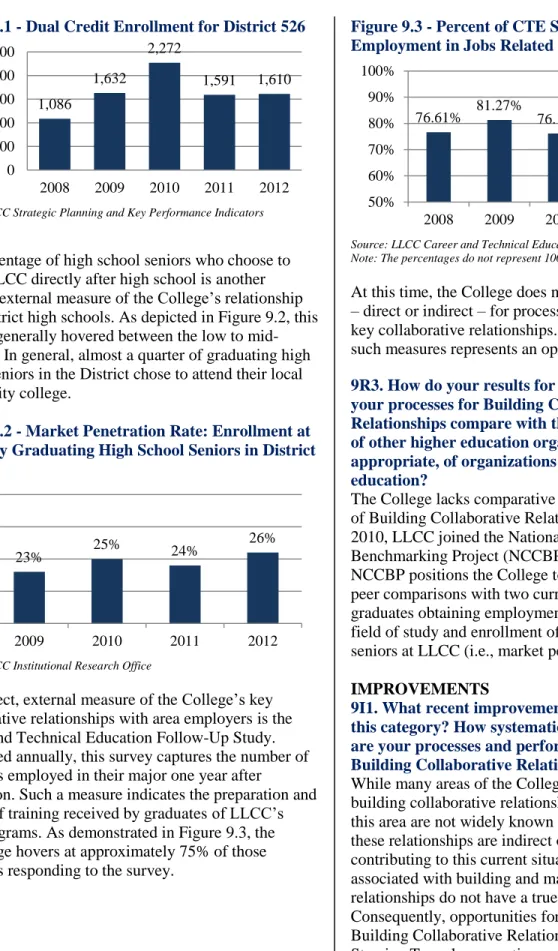
LLCC considers District high schools and employers among its key collaborative relationships. One indirect, external measure associated with the District high schools is LLCC’s dual credit partnerships. These enrollments represent students served by LLCC offerings. Figure 9.1 depicts LLCC’s duplicated headcount in dual credit for the past five years.
Figure 9.1 - Dual Credit Enrollment for District 526
Source: LLCC Strategic Planning and Key Performance Indicators Dashboard
The percentage of high school seniors who choose to attend LLCC directly after high school is another indirect, external measure of the College’s relationship with District high schools. As depicted in Figure 9.2, this rate has generally hovered between the low to mid-twenties. In general, almost a quarter of graduating high school seniors in the District chose to attend their local community college.
Figure 9.2 - Market Penetration Rate: Enrollment at LLCC by Graduating High School Seniors in District 526
Source: LLCC Institutional Research Office
An indirect, external measure of the College’s key collaborative relationships with area employers is the Career and Technical Education Follow-Up Study. Conducted annually, this survey captures the number of graduates employed in their major one year after
graduation. Such a measure indicates the preparation and quality of training received by graduates of LLCC’s CTE programs. As demonstrated in Figure 9.3, the percentage hovers at approximately 75% of those graduates responding to the survey.
Figure 9.3 - Percent of CTE Students Obtaining Employment in Jobs Related to Field of Study
Source: LLCC Career and Technical Education Follow-Up Study, Table 7 Note: The percentages do not represent 100% of CTE graduates
At this time, the College does not have internal measures – direct or indirect – for processes related to building its key collaborative relationships. Beginning to identify such measures represents an opportunity for the College. 9R3. How do your results for the performance of your processes for Building Collaborative
Relationships compare with the performance results of other higher education organization and, if appropriate, of organizations outside of higher education?
The College lacks comparative measurements in the area of Building Collaborative Relationships at this time. In 2010, LLCC joined the National Community College Benchmarking Project (NCCBP). Participation in NCCBP positions the College to begin making national peer comparisons with two current measures: CTE graduates obtaining employment in jobs related to their field of study and enrollment of graduating high school seniors at LLCC (i.e., market penetration rate).
IMPROVEMENTS
9I1. What recent improvements have you made in this category? How systematic and comprehensive are your processes and performance results for Building Collaborative Relationships?
While many areas of the College are actively involved in building collaborative relationships, processes used in this area are not widely known and measures to evaluate these relationships are indirect or absent. A factor contributing to this current situation is that processes associated with building and maintaining collaborative relationships do not have a true process owner.
Consequently, opportunities for improvement exist in Building Collaborative Relationships. The AQIP Steering Team has an action project proposal that involves indexing the College’s partnerships. This AQIP 1,086 1,632 2,272 1,591 1,610 0 500 1,000 1,500 2,000 2,500 2008 2009 2010 2011 2012 Hea d co u n t 23% 25% 24% 26% 15% 20% 25% 30% 35% 2009 2010 2011 2012 76.61% 81.27% 76.12% 74.20% 76.58% 50% 60% 70% 80% 90% 100% 2008 2009 2010 2011 2012
Steering Team views this action project proposal as a huge undertaking but one that would position the College to (a) catalog its collaborative relationships and (b) assess the associated level of commitment and benefit to the College for each. This action project was not prioritized as one of the top two for the College to launch in 2013. It therefore remains in the queue for future consideration.
9I2. How do your culture and infrastructure help you select specific processes to improve and to set targets for improved performance results in Building Collaborative Relationships?
LLCC is highly responsive to the needs of stakeholders in the community, and forming partnerships is a common route for meeting those stakeholder needs. Forming such collaborative partnerships moves the College toward achieving two of its strategic goals – Economic Responsiveness and Community Engagement. The existence of LLCC’s Strategic Planning and Key Indicators Dashboard and performance indicator scorecards positions the College to measure progress towards achieving its goals. The development of new measures and further refinement of existing measures will strengthen the College’s ability to establish targets related to Building Collaborative Relationships.