University of Massachusetts Amherst
ScholarWorks@UMass Amherst
Open Access Dissertations2-2011
Automated Negotiation for Complex Multi-Agent
Resource Allocation
Bo An
University of Massachusetts Amherst
Follow this and additional works at:https://scholarworks.umass.edu/open_access_dissertations Part of theComputer Sciences Commons
Recommended Citation
An, Bo, "Automated Negotiation for Complex Multi-Agent Resource Allocation" (2011).Open Access Dissertations. 329.
AUTOMATED NEGOTIATION FOR COMPLEX
MULTI-AGENT RESOURCE ALLOCATION
A Dissertation Presented by
BO AN
Submitted to the Graduate School of the
University of Massachusetts Amherst in partial fulfillment of the requirements for the degree of
DOCTOR OF PHILOSOPHY February 2011
c
Copyright by Bo An 2011
AUTOMATED NEGOTIATION FOR COMPLEX
MULTI-AGENT RESOURCE ALLOCATION
A Dissertation Presented by
BO AN
Approved as to style and content by:
Victor Lesser, Chair
Jim Kurose, Member
Shlomo Zilberstein, Member
Michael Zink, Member
Andrew Barto, Department Chair Department of Computer Science
ACKNOWLEDGMENTS
I take this opportunity to express my gratitude to all the people who have provided me with their help and without those help this work would not been possible. First and foremost, I want to thank my advisor Victor Lesser for his constant support and encouragement in all aspects of my research, career and even personal issues. Victor has been not only a great advisor but also a cordial friend and a person mentor. He is always enthusiastic in sharing his experience and knowledge with me. He has taught me how to do deep research, to find new research directions by discovering variations and generalizations, to deliver presentations, and to be confident. He gave me a lot of freedom in pursuing my broad interests and tried very hard to put me in close contact with the multiagent systems community. I am grateful for the opportunity to work with and to learn from such an extraordinary teacher.
I also especially want to thank the other members of my committee, Jim Kurose, Shlomo Zilberstein, and Michael Zink, for their helpful and insightful comments. Spe-cial thanks go to Jim Kurose for advising my synthesis project and Michael Zink for guiding my research on the cloud computing resource allocation problem in Chapter 6. I gratefully thank the NSF CASA project (contract No. EEC-0313747) for provid-ing me with fundprovid-ing over the last four years. Workprovid-ing for the NSF CASA project has taught me much about how to do research which has great practical impact and I am grateful for all the interactions that I have had with the great people there, includ-ing Sherief Abdallah, Michael Krainin, Eric Lyons, Dave Pepyne, Brenda Phillips, David Westbrook, and Michael Zink. I am also very grateful for the University of Massachusetts Amherst Graduate School Fellowship that partially supported me this
I want to thank other co-authors who provided me valuable suggestions and guid-ance including Nicola Gatti for the work on bargaining theory, Kwang Mong Sim for the work on multi-resource negotiation, and David Irwin for the work on cloud com-puting resource allocation. I also want to thank Fred Douglis and Fan Ye for advising my intern research work at IBM research. I am indebted to many other researchers in multiagent systems and electronic commerce with whom I have had valuable dis-cussions. I would like to particularly thank Edith Elkind, David Parkes, Tuomas Sandholm, Katia Sycara, Milind Tambe, Thanos Vasilakos, and Xiaoqin Zhang for their support toward my research work.
The Multi-Agent Systems Lab has been a family. I have benefited greatly from many technical discussions with Dan Corkill, Alan Carlin, Yoonheui Kim, He Luo, Hala Mostafa, Mark Sims, Huzaifa Zafar, Chongjie Zhang, and many others. I also would like to thank Michele Roberts for helping with a variety of paperworks.
Before coming to UMASS, I had the good fortune to work with many excellent advisors. I would like to thank Daijie Cheng, Shuangqing Li, Chunyan Miao, Zhiqi Shen, Kwang Mong Sim, and Lianggui Tang for all their support and advice to build my career.
Finally, I want to thank my family for their unconditional love from the beginning. I want to thank my wife Jinghua for her love and support, especially for giving up everything in China before coming to the states. Thank you. I thank my daughter Amber. Your birth gives me much joy. This thesis is dedicated to them.
ABSTRACT
AUTOMATED NEGOTIATION FOR COMPLEX
MULTI-AGENT RESOURCE ALLOCATION
FEBRUARY 2011 BO AN
B.Sc., CHONGQING UNIVERSITY M.Sc., CHONGQING UNIVERSITY
M.Sc., UNIVERSITY OF MASSACHUSETTS AMHERST Ph.D., UNIVERSITY OF MASSACHUSETTS AMHERST
Directed by: Professor Victor Lesser
The problem of constructing and analyzing systems of intelligent, autonomous agents is becoming more and more important. These agents may include people, physical robots, virtual humans, software programs acting on behalf of human be-ings, or sensors. In a large class of multi-agent scenarios, agents may have different capabilities, preferences, objectives, and constraints. Therefore, efficient allocation of resources among multiple agents is often difficult to achieve. Automated negotiation (bargaining) is the most widely used approach for multi-agent resource allocation and it has received increasing attention in the recent years. However, information uncer-tainty, existence of multiple contracting partners and competitors, agents’ incentive to maximize individual utilities, and market dynamics make it difficult to calculate agents’ rational equilibrium negotiation strategies and develop successful negotiation
agents behaving well in practice. To this end, this thesis is concerned with analyzing agents’ rational behavior and developing negotiation strategies for a range of complex negotiation contexts.
First, we consider the problem of finding agents’ rational strategies in bargaining with incomplete information. We focus on the principal alternating-offers finite hori-zon bargaining protocol with one-sided uncertainty regarding agents’ reserve prices. We provide an algorithm based on the combination of game theoretic analysis and search techniques which finds agents’ equilibrium in pure strategies when they exist. Our approach is sound, complete and, in principle, can be applied to other uncertainty settings. Simulation results show that there is at least one pure strategy sequential
equilibrium in 99.7% of various scenarios. In addition, agents with equilibrium
strate-gies achieved higher utilities than agents with heuristic stratestrate-gies.
Next, we extend the alternating-offers protocol to handle concurrent negotiations in which each agent has multiple trading opportunities and faces market competition. We provide an algorithm based on backward induction to compute the subgame perfect equilibrium of concurrent negotiation. We observe that agents’ bargaining power are affected by the proposing ordering and market competition and for a large subset of the space of the parameters, agents’ equilibrium strategies depend on the values of a small number of parameters. We also extend our algorithm to find a pure strategy sequential equilibrium in concurrent negotiations where there is one-sided uncertainty regarding the reserve price of one agent.
Third, we present the design and implementation of agents that concurrently negotiate with other entities for acquiring multiple resources. Negotiation agents are designed to adjust 1) the number of tentative agreements and 2) the amount of concession they are willing to make in response to changing market conditions and negotiation situations. In our approach, agents utilize a time-dependent negotiation strategy in which the reserve price of each resource is dynamically determined by 1)
the likelihood that negotiation will not be successfully completed, 2) the expected agreement price of the resource, and 3) the expected number of final agreements. The negotiation deadline of each resource is determined by its relative scarcity. Since agents are permitted to decommit from agreements, a buyer may make more than one tentative agreement for each resource and the maximum number of tentative agreements is constrained by the market situation. Experimental results show that our negotiation strategy achieved significantly higher utilities than simpler strategies. Finally, we consider the problem of allocating networked resources in dynamic environment, such as cloud computing platforms, where providers strategically price resources to maximize their utility. While numerous auction-based approaches have been proposed in the literature, our work explores an alternative approach where providers and consumers negotiate resource leasing contracts. We propose a dis-tributed negotiation mechanism where agents negotiate over both a contract price and a decommitment penalty, which allows agents to decommit from contracts at a cost. We compare our approach experimentally, using representative scenarios and workloads, to both combinatorial auctions and the fixed-price model, and show that the negotiation model achieves a higher social welfare.
TABLE OF CONTENTS
Page ACKNOWLEDGMENTS. . . .iv ABSTRACT. . . .vi LIST OF TABLES. . . x LIST OF FIGURES. . . .xi CHAPTER 1. INTRODUCTION . . . 1 1.1 Introduction . . . 1 1.2 Motivating Examples . . . 31.2.1 Collaborating, Autonomous Stream Processing Systems (CLASP) . . . 3
1.2.2 Global Environment for Network Innovations (GENI) . . . 5
1.3 Automated Negotiation for Complex Resource Allocation Problems . . . 10
1.3.1 Negotiation with Uncertainty . . . 11
1.3.2 One-to-Many and Many-to-Many Negotiation . . . 13
1.3.3 Multi-Resource Negotiation . . . 15
1.3.4 Negotiation with Decommitment for Dynamic Resource Allocation in Cloud Computing . . . 18
1.4 Main Contributions . . . 21
1.5 Thesis Organization . . . 22
2. LITERATURE REVIEW ON AUTOMATED NEGOTIATION. . . 24
2.1.1 Bargaining Mechanism Design . . . 25
2.1.2 Alternating-offers protocol and its extensions . . . 27
2.2 Equilibrium strategies in Strategic Bargaining Game . . . 29
2.3 Designing Negotiation Agents . . . 34
2.4 Auction Mechanism . . . 40
2.5 Summary . . . 42
3. NEGOTIATION WITH UNCERTAIN RESERVE PRICES . . . 43
3.1 Background . . . 43
3.2 Bargaining with Complete Information . . . 45
3.3 One-sided Uncertainty about Reserve Prices . . . 49
3.3.1 Introducing Uncertainty . . . 50
3.3.2 Existing Solutions in Literature . . . 51
3.4 The Algorithm for Finding All Sequential Equilibria . . . 55
3.4.1 High Level Idea of the Approach . . . 55
3.4.2 Computation Reduction . . . 59
3.4.3 The Algorithm . . . 62
3.4.4 Off the Equilibrium Path Optimal Strategies . . . 62
3.5 The Buyer’s Equilibrium Offer . . . 65
3.5.1 Pooling Choice Rule . . . 66
3.5.2 Separating Choice Rule . . . 68
3.6 The Seller’s Equilibrium Offer . . . 71
3.7 Equilibrium Existence . . . 74
3.8 The Value of Equilibrium Strategies . . . 83
3.8.1 Heuristic Based Strategies . . . 84
3.8.2 Different Strategy Combination . . . 85
3.8.3 Performance Measures and Results . . . 86
3.8.4 The Value of Choosing Equilibrium strategies . . . 88
3.8.5 Comparison of Social Welfare . . . 90
3.9 Applications of the Approach . . . 92
3.9.1 Bilateral Negotiation with Uncertain Discount Factor . . . 92
3.9.2 Bilateral Multi-issue Negotiation with Uncertain Weights . . . 95
4. EXTENDING ALTERNATING-OFFERS BARGAINING IN
ONE-TO-MANY AND MANY-TO-MANY SETTINGS. . . 102
4.1 One-to-Many Alternating-Offers Negotiation . . . 102
4.1.1 Negotiation Mechanism . . . 102
4.1.2 Agents’ Equilibrium Strategies . . . 104
4.1.3 Equilibrium Outcome Computation and Uncertain Information . . . 111
4.2 Many-to-Many Alternating-Offers Negotiation . . . 113
4.2.1 Negotiation Mechanism . . . 113
4.2.2 Agents’ Equilibrium Strategies . . . 114
4.2.3 Considerations on Settings with Uncertain Information . . . 120
4.3 Uncertainty about Reserve Prices . . . 121
4.3.1 Introducing Uncertainty . . . 121
4.3.2 Off the Equilibrium Path Optimal Strategies . . . 123
4.3.3 Our Approach . . . 125
4.3.4 The Buyer’s Equilibrium Offer . . . 125
4.3.4.1 Pooling Choice Rule . . . 126
4.3.4.2 Separating Choice Rule . . . 127
4.3.5 The Seller’s Equilibrium Offer . . . 129
4.4 Summary . . . 132
5. STRATEGIC AGENTS FOR MULTI-RESOURCE NEGOTIATION. . . 134
5.1 Background . . . 134
5.2 Negotiation mechanism . . . 138
5.2.1 Assumptions . . . 138
5.2.2 The Negotiation Problem . . . 140
5.2.3 The Negotiation Protocol . . . 142
5.2.4 The Negotiation Strategy . . . 143
5.3 Heuristics based Strategies . . . 145
5.3.1 An overview of negotiation strategies . . . 145
5.3.2 Different deadlines for different resources . . . 148
5.3.3 Generating proposals . . . 151
5.4 Empirical evaluation and analysis . . . 161 5.4.1 The methodology . . . 161 5.4.1.1 Agent design . . . 161 5.4.1.2 Experimental settings . . . 163 5.4.1.3 Performance measure . . . 165 5.4.1.4 Results . . . 167 5.4.2 Observations . . . 168 5.4.2.1 Observation 1 . . . 168 5.4.2.2 Observation 2 . . . 170 5.4.2.3 Observation 3 . . . 173 5.4.2.4 Observation 4 . . . 180 5.4.2.5 Observation 5 . . . 181 5.4.2.6 Sensitivity analysis . . . 182 5.4.3 Analysis of properties . . . 183 5.5 Summary . . . 186
6. NEGOTIATION WITH DECOMMITMENT FOR DYNAMIC RESOURCE ALLOCATION IN CLOUD COMPUTING. . . 188
6.1 Negotiation Over Decommitment Penalty . . . 189
6.1.1 Leveled-commitment contracting . . . 191
6.1.1.1 Contracting game . . . 192
6.1.1.2 Decommiting game . . . 193
6.1.2 Optimal contracts . . . 193
6.1.3 Efficiency of Negotiating Over Penalty in Two-player Game . . . 195
6.2 Resource Allocation in GENI . . . 198
6.3 The Negotiation Model . . . 200
6.3.1 The Resource Allocation Problem . . . 200
6.3.2 Negotiation Protocol . . . 202
6.4 Buyers’ Negotiation Strategy . . . 205
6.5 Sellers’ Negotiation Strategy . . . 211
6.6 Empirical evaluation . . . 213
6.6.2 Experimental Settings and Measures . . . 215
6.6.3 Results . . . 217
6.6.3.1 Performance of the negotiation mechanism . . . 217
6.6.3.2 Evaluating agents’ negotiation strategies . . . 222
6.6.3.3 Sensitivity analysis . . . 223
6.7 Summary . . . 225
7. CONCLUSIONS AND FUTURE RESEARCH. . . 226
7.1 Contributions . . . 226
7.2 Future Research . . . 228
LIST OF TABLES
Table Page
3.1 Simulation parameters . . . 80
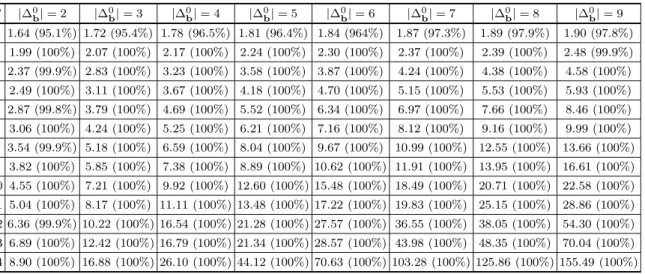
3.2 Average number of sequential equilibria and percentage of games with sequential equilibria . . . 81
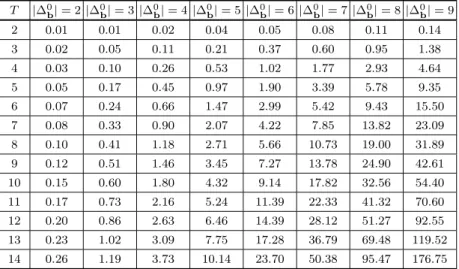
3.3 Average computation time (in seconds) . . . 83
5.1 Symbols used in this chapter . . . 146
5.2 Experimental settings . . . 163
5.3 Performance Measure . . . 165
5.4 Experimental results for 106 runs (performance measures are defined in Table ??) . . . 166
6.1 Symbols used in this chapter . . . 202
LIST OF FIGURES
Figure Page
1.1 Execution of a distributed job consisting 3 subjobs [27]. Owner Site 3
executes one subjob, and dispatches two subjobs to Site 1 and 2
for execution. Site 4 monitors Sites 1 and 2. . . 5
1.2 Resource sharing with one consumer and one provider [1] . . . 6
1.3 Resource sharing with multiple consumers and multiple providers . . . 8
3.1 Backward induction construction with RPb = 100, RPs= 0, ι(0) =s, δb = 0.75, δs= 0.8,Tb= 10, Ts= 11; at each time point t the optimal offer x∗(t) is marked; the dashed lines are isoutility curves. . . 48
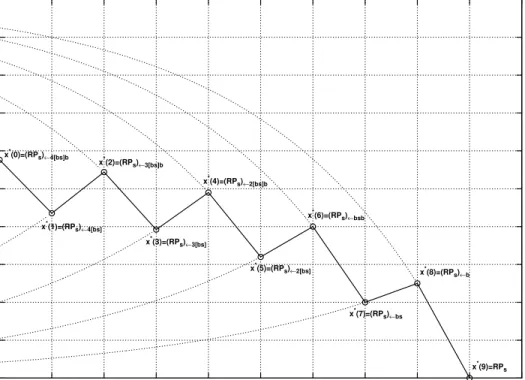
3.2 Failure of the approach in [51, 52] withT = 5, ι(0) =s, RPs= 10, RP1 = 90, RP2 = 70, ω0b1 = 0.8, ω 0 b2 = 0.2,δs = 0.7, and δb = 0.8; agents’ offers in complete information settings were also showed. . . 53
3.3 A high level illustration of our approach (ι(t) =s and |∆0|>1) . . . 56
3.4 The buyer’s different rates of concession . . . 84
3.5 Buyer’s average utility while using different strategies . . . 86
3.6 Buyer’s average utility and the negotiation deadline . . . 87
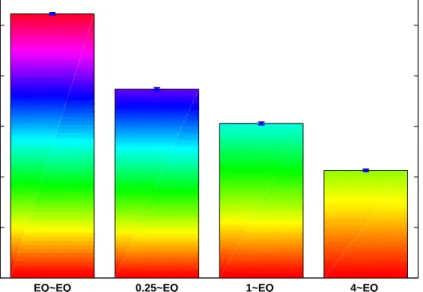
3.7 Buyer’s average utility and agents’ discount factors . . . 88
3.8 Seller’s average utility while using different strategies . . . 89
3.9 Seller’s average utility and agents’ discount factors . . . 90
3.10 Social welfare for different strategy combinations . . . 91
3.12 Social welfare and the negotiation deadline . . . 93
3.13 Failure of the approach in [52, 51] with T = 5, ι(0) =s, RP1s = RP2s = 0, RP1b = RP2b = 90, δs = 0.5, δb = 0.8, ws=h0.9,0.1i,{wb1 =h0.4,0.6i, wb2 =h0.9,0.1i},ωb1 = 0.9, and ωb2 = 0.1; agents’ offers in complete information settings were also showed. . . 97
4.1 Backward induction construction with RPb = 1, RPs1 = 0, RPs2 = 0.2,δb = 0.8, δs1 = 0.7,δs2 = 0.8,Tb = 10,Ts1 = 11, Ts2 = 7; at each time point t the optimal offer x ∗ a(t) that ι(t) can make is marked; the dashed lines are sellers’ optimal offer if there is only one seller. . . 109
4.2 Backward induction construction. At each time t the optimal offer x∗ B(t) or x∗S(t) is marked. . . 119
5.1 Buyer a’s multi-resource negotiation problem . . . 140
5.2 Prediction accuracy ofHBAs . . . 171
5.3 Deadline and expected utility . . . 174
5.4 Deadline and success rate . . . 175
5.5 Number of resources and expected utility . . . 176
5.6 Number of resources and success rate . . . 177
5.7 Supply/demand ratio and expected utility . . . 178
5.8 Supply/demand ratio and success rate . . . 179
6.1 Efficiency comparison in two-player game (1) . . . 197
6.2 Efficiency comparison in two-player game (2) . . . 198
6.3 Finite state machine for the negotiation protocol. . . 203
6.4 Social welfare and resource competition . . . 216
6.5 Success rate and resource competition . . . 217
6.7 Success rate and number of resource to acquire . . . 219
6.8 Social welfare and the flexibility of starting a task . . . 220
6.9 Success rate and the flexibility of starting a task . . . 221
6.10 Social welfare and negotiation time . . . 222
CHAPTER 1
INTRODUCTION
1.1
Introduction
The problem of resource allocation is ubiquitous in many diverse research fields such as economics, operations research, and computer science, and is relevant to a wide range of applications, e.g., electronic commerce, supply chain, sensor networks, web/grid service composition, workflow, and enterprise integration. In systems involv-ing multiple autonomous agents, it is often necessary to decide how scarce resources should be allocated. The allocation of resources within a system of autonomous agents is a challenging and exciting area of research at the interface of computer sci-ence and economics. There are (at least) two different lines of work, depending on how decisions about allocations are made. In centralized approaches like combina-torial auctions [26, 42], agents simply report their preferences and wait for the final allocation to be made by the auctioneer or some other central entity. However, it is often impractical to adopt a centralized approach for resource allocation problems due to various constraints, e.g., computational overhead, communication constraints, privacy, and real-time requirements. In distributed approaches, allocations evolve in an asynchronous way, by means of local negotiations among agents.
Negotiation has been treated as a key approach for resource allocation problems and has been applied to e-commerce, manufacturing planning, sensor networks, cloud computing, and distributed vehicle routing [10, 75, 119]. Automated negotiation is an important research area bridging together economics, game theory, and artificial intelligence. It has received prominent attention in recent years [70] and its
impor-tance is widely acknowledged since intelligent agents that negotiate with each other on behalf of human users are expected to lead to more efficient negotiations [120].
A very common class of negotiation is bargaining.1 It refers to a situation in which
individual agents have the possibility of concluding a mutually beneficial agreement which could not be imposed without all individuals’ approval. In intelligent agent systems like electronic markets, agents negotiate with each other through some form of negotiation protocol and negotiation capabilities for software agents are a central concern. Specifically, agents need to employ certain strategies to make negotiation decisions on behalf of the parties they represent with the aim of maximizing benefit for their users. One open question about automated negotiation is determining which strategy to employ, which is a complex decision making task because of the inherent uncertainty and dynamics of the situation.
In this thesis, we will be concerned with agents’ negotiation strategies in dynamic and complex negotiation environments in which 1) agents have conflicting objectives and preferences; 2) agents need to acquire a set of resources; 3) agents have incom-plete information about others; and 4) agents have multiple trading partners and trading competitors. The complex negotiation problem has not been studied deeply in the field. Our approaches will include both theoretic analysis and heuristic imple-mentation. From a theoretical perspective, we analyze agents’ rational strategies in bargaining games that more closely mirror the issues in complex negotiation than have previously been studied. Game theoretic analysis provides insights and theoretical foundations for developing negotiation agents. For more realistic complex dynamic bargaining games involving multiple agents, it is impractical to compute agents’ ra-tional strategies and we design heuristics based negotiation strategies by considering
1
Unless a specific distinction is drawn, we use the terms negotiation and bargaining interchange-ably.
agents’ constraints, contracting opportunities and market competition.2 As part of
this work, we will also focus on the use of decommitment penalties to handle the uncertainty present in dynamic and complex bargaining environments.
1.2
Motivating Examples
The focus of this thesis is developing new techniques for complex agent-mediated negotiation problems in which agents have different goals, preferences, constraints, and knowledge about others. To motivate the research from a practical perspective, this section describes two examples of application domains where the approaches developed in this thesis are needed.
1.2.1 Collaborating, Autonomous Stream Processing Systems (CLASP)
Collaborating, Autonomous Stream Processing Systems (CLASP) [27] is a mid-dleware for cooperating data stream processing sites, which has been designed and prototyped in the context of System S project [69] within IBM Research to enable sophisticated stream processing. There are multiple sites running the System S soft-ware, each with their own administration and goals. Each site may only have limited processing capabilities, so cooperation among these sites can frequently be of mutual benefit and such cooperation enables such sites to increase the scale, breadth, depth, and reliability of analysis beyond that available within a single site [5].
In System S, a job is an execution unit that accomplishes certain work through stream analysis. A job takes the form of a processing graph, consisting of resources, i.e., data sources and processing elements (PEs), which are interconnected in a cer-tain manner. These resources might be located at multiple different sites. Due to the potentially large numbers of data sources and PEs needed in complex jobs, and the
2Informally, a rational agent is an agent which has clear preferences, models uncertainty via
existence of functionally equivalent processing graphs, it is infeasible for human users to manually construct and identify the best alternative graph. System S has a plan-ning component that can construct processing graphs automatically from high-level descriptions of desired results [108].
Figure 1.1 illustrates an example of a distributed job execution [27]. Site 3 is responsible for executing a job, which can be decomposed to three subjobs, each of
which contains a normal job (for data processing) and multiple tunneling PE jobs
(for data transportation). The Remote Execution Coordinator (REC) of owner site 3 executes the third subjob and dispatches two other subjobs to Sites 1 and 2 for execution. Site 4 monitors the execution status of Sites 1 and 2. The REC at the owner site maintains a subjob table about which subjobs are running at which other site. The table is used for recovery of subjobs on failed sites. The REC executing a subjob first parses its Job Description Language (JDL) to identify one normal job, and multiple tunneling PE jobs. One thread is launched to handle each of them. The thread customizes the JDL, such as assigning a host for each PE. Then it deploys the job through its local Job Management. For a source PE job, the REC needs to contact the local Tunneling Manager responsible for assigning the network address and port on which the source PE will be listening for incoming connections. It deploys the source PE job and reports the assigned network location to the REC at the owner site. For a sink PE job, the REC needs to query the REC of the owner site for the network location of the corresponding source PE. Then it configures and deploys the sink PE job.
Many resources needed in plans are accessed exclusively. In order for a site to reserve a limited resource from another site, it must establish an agreement with the other site, specifying the price of sharing the resource. Consider that a site receives a job. After planning [108], the site finds that using only its local resources, it cannot satisfy all resource requirements of the plan. Then, the site negotiates with
Figure 1.1. Execution of a distributed job consisting 3 subjobs [27]. Owner Site 3 executes one subjob, and dispatches two subjobs to Site 1 and 2 for execution. Site 4 monitors Sites 1 and 2.
other sites to acquire resources needed using its negotiation management component [5]. For each resource, there can be multiple providers and the site negotiates with different resource providers to construct agreements for these resources. The plan can
be executed if and only if all resource requirements are satisfied. Therefore, while
making a proposal to a trading partner for one resource, the site needs to consider the dynamically changing negotiation environments (e.g., the number of sites requiring the same resource) and the negotiation situation of other negotiations for the same resource and for other resources. It also has to consider the total price it will need to pay for all the resources needed to complete the job. Chapter 5 presents the design of negotiation strategies for a multi-resource allocation problem abstracted from this example.
1.2.2 Global Environment for Network Innovations (GENI)
Cloud computing platforms enable consumers to programmatically rent multiple types of Internet-accessible computing resources. In many cases, these platforms use recent advances in virtualization to make the resources appear to the consumer as raw
Figure 1.2. Resource sharing with one consumer and one provider [1]
hardware components, such as machines, storage block devices, sensors, or network links. For example, Amazon currently operates both the Elastic Compute Cloud (EC2) and the Elastic Block Store (EBS), where consumers programmatically rent virtual machines and block devices, respectively. As another example, the Global Environment for Network Innovations (GENI) project [2] is a recent NSF initiative that uses a similar paradigm but incorporates a wider range of hardware components, including not only machines and block devices, but also sensors, mobile devices, and the network links connecting them, from a wider range of providers, including universities and industry research labs.
GENI aims to provide a flexible and programmable shared experimental infras-tructure for the investigation of future internet protocols and software. As explained in the GENI System Overview [1], one core concept for the suite of GENI infrastruc-ture is Resource Sharing. That is, multiple researchers can simultaneously share the infrastructure and each experiment runs within its own, isolated slice created
end-to-end across the experiment’s GENI resources. Furthermore, GENI experiments will be an interconnected set of reserved resources on platforms in diverse locations. Re-searchers will remotely discover, reserve, configure, program, debug, operate, manage, and teardown distributed systems established across parts of the GENI suite.
To illustrate the GENI’s basic concepts regarding resource sharing, we show an example with a researcher who wishes to use GENI to perform an experiment [1]. A GENI Clearinghouse can be treated as a resource provider which can provide a wide range of resources. Most GENI resource components are not treated as isolated units. Instead they are parts of aggregates, which are collections of resources managed as a coherent whole. GENI contain many different kinds of aggregates. For example, the Clearinghouse in Figure 1.2 controls three aggregates: a computing cluster, a backbone network, and a metropolitan wireless network.
One core concept of GENI is virtualization in the sense that multiple researchers can simultaneously share the infrastructure. If the clearinghouse agrees to provide
resources for the researcher, it will create aslice for the researcher. A slice is an empty
container into which experiments can be instantiated and to which researchers and resources may be bound. The slice in Figure 1.2 extends across three aggregates: a computer cluster, a backbone network, and a metro wireless network. The resources within this slice are linked together to form a coherent virtual network in which an ex-periment can run. By virtualization, this slice will be isolated from other researchers’ slices so that experiments running within the slice will behave consistently no matter what other researchers are doing within their own GENI slices. Once the slice is cre-ated, the researcher can download code into her slice, debugs, collects measurements, and iterates.
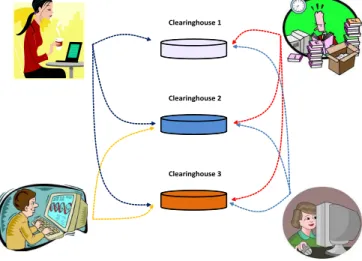
Generally there are multiple consumers acquiring resources and multiple clear-inghouses which can provide resources (see Figure 1.3). Each clearinghouse may be operated by a private company, other US government agency, or indeed a separate
Figure 1.3. Resource sharing with multiple consumers and multiple providers
nation. For a consumer’s resource requirement, there could be multiple clearinghouses which can satisfy the consumer’s resource requirement separately. In this situation, the consumer has the opportunity to choose the clearinghouse with the lowest cost. It is also possible that a consumer’s resource requirement cannot be satisfied by any single clearinghouse. In this situation, the consumer needs to acquire resources from multiple clearinghouses which may need to coordinate with each other to sat-isfy the consumer’s resource requirements. After the consumer makes agreements with clearinghouses regarding resource sharing, a slice will be created over multiple clearinghouses.
Each consumer achieves some utility once its resource requirement is satisfied. A clearinghouse suffers a cost while providing resources. Given the existence of many resource consumers, the resources provided in the market is “limited”. Therefore, the problem of allocating resources is an important issue. Since resource consumers and providers are always trying to maximize their own utilities, it is necessary to introduce some market mechanism to regulate the behaviors of resource consumers and providers: clearinghouses charge consumers and in turn consumers pay
clear-inghouses. Automated negotiation can be used for agents to make agreements on resource sharing. Chapter 6 discusses a distributed negotiation mechanism for the dynamic resource allocation problem in GENI.
The negotiation problem in the above two examples has the following features:
• Each agent has a negotiation deadline. A resource consumer’s negotiation
dead-line is the time by which its job has to be executed. The presence of deaddead-line indicates that an agent may need to make larger concessions when its deadline is approaching.
• All agents (including all resource consumers and resource providers) are
self-ish. That is, during negotiation, each agent chooses its negotiation strategy maximizing its (expected) utility. While agents are not cooperative, an agent
often has no optimal strategy and we use the notion of anequilibrium strategy
to define rational behavior of players, which jointly decide the outcome of the bargaining game. A strategy equilibrium is a profile of players’ strategies so that no player could benefit by unilaterally deviating from its strategy in the profile, given that other players follow their strategies in the profile.
• Each agent has incomplete information about others. In a stream processing
system, a site has incomplete information about other sites’ cost of providing resources. Similarly, a resource provider does not know the exact reserve price of a site (the highest price the site is willing to pay) which desires its resource. Furthermore, resource supply and requirement in a stream processing system change dynamically.
• There could be multiple resource providers for a resource. To acquire a resource,
a resource consumer can negotiate concurrently with all resource providers and make an agreement with the lowest price provider.
• A resource consumer also faces market competition from other resource con-sumers, which indicates that a negotiation agent needs to take the market sit-uation into account to decide what is a necessary price to pay.
• An agent may need to acquire a set of resources and it gains nothing if it fails to
get all the resources. Therefore, while making a proposal to a trading partner for one resource, the site needs to consider the dynamically changing negotiation environments (e.g., the number of sites requiring the same resource) and the negotiation situation of other negotiations for the same resource and for other resources, i.e., it is limited in what it can pay for the needed resources.
• In part of this work, we treat decommitment as a feature of negotiation
prob-lems. Since agents can choose to decommit from agreements, an agent may need to make more than one agreement for each resource. However, the buyer needs to pay much more by making more agreements. Thus, it is important to decide how many agreements to make. In some situations, it is also important to negotiate over both price and decommitment penalty.
The two examples demonstrate many of the issues that will the focus of the the-sis: negotiation where there is uncertainty about agents’ types, negotiation involving multiple buyers and sellers, and negotiation where the buyer needs to acquire multiple resources.
1.3
Automated Negotiation for Complex Resource
Alloca-tion Problems
In designing automated negotiation agents for complex resource allocation prob-lems we consider in this thesis, and in many others besides, there are a number of open problems and common issues that need to be dealt with. In addition, it is possible to identify a range of concepts and approaches that form a solid foundation for tackling
complex resource allocation problems. This thesis addresses important issues regard-ing automated negotiation for complex resource allocation problems. Specifically, this thesis investigates the following three questions:
• What are agents’ equilibrium strategies in bilateral negotiation with uncertain
reserve prices?
• How to compute agents’ equilibrium strategies in concurrent one-to-many and
many-to-many negotiation?
• When an agent needs to acquire multiple resources in a marketplace and it is
allowed to decommit from an existing contract, how to make proposing decisions and decommiting decisions to achieve a high utility?
• How to develop an efficient negotiation model for resource allocation problems
in dynamic markets such as cloud computing?
1.3.1 Negotiation with Uncertainty
The problem of finding agents’ rational strategies in bargaining with incomplete information is well known to be challenging and there is no generally applicable algo-rithm [61]. We focus on finding agents’ rational strategies in incomplete information bilateral bargaining. We consider the most common bargaining protocol, i.e., the Rubinstein’s alternating-offers [111], which has been widely used in the bargaining theory literature, e.g., [61, 112, 117]. We analyze the situation with one-sided un-certain reserve prices and where agents have deadlines. This problem is customarily modeled as a Bayesian extensive-form game with infinite number of strategies as the price is a continuous value. The appropriate solution concept for such a class of game issequential equilibrium [79], specifying a pair: asystem of beliefsthat prescribes how
agents’ beliefs must be updated during the game and strategies that prescribe how
the belief system and strategies: strategies must be sequentially rational given the
belief system and belief system must be consistent with respect to strategies.
The first area of focus is on the development of a novel algorithm to find a pure strategy sequential equilibrium in bilateral bargaining with multi-type uncertainty (Chapter 3). Our algorithm combines together game theoretic analysis with state space search techniques and it is sound and complete. Our approach is based on the following two observations: 1) with pure strategies, the buyer’s possible choice rules regarding whether different buyer types behave in the same way or in different ways at a decision making point are finite, and 2) with pure strategies, the seller’s possible beliefs regarding whether different buyer types will accept or reject its offer are finite. We employ a backward approach to find sequential equilibria in the context of a forward search process: to compute agents’ equilibrium strategy at a continuation game with certain belief, we search forward to find agents’ equilibria strategies in its continuation game with different beliefs and consider agents’ all possible choice rules as well as belief update rules. At the same time, we derive theoretically the agents’ optimal strategies by applying a Bayesian extension of backward induction and check equilibrium existence conditions.
In addition to developing the algorithm for computing all the sequential equilibria, we also empirically evaluate the performance of equilibrium strategies against some representative heuristic based strategies in the literature (e.g., [12, 48, 78, 124, 127]). Empirical results show that agents with equilibrium strategies achieved higher utilities than agents with heuristic based strategies. Furthermore, when both agents adopt the equilibrium strategies, they achieved the highest social welfare than that in all other strategy combinations.
1.3.2 One-to-Many and Many-to-Many Negotiation
In the bargaining theory literature, most work focuses on bilateral bargaining. A variety of negotiation aspects like information and outside options have been studied. One-to-many and many-to-many negotiations are also very important and widely exist in many application domains. For one-to-many negotiation, an auction is widely used and, for many-to-many negotiation, market mechanisms like matching or two-sided auction seem more intuitively appropriate. Even if an agent interacts with many agents, a common assumption in the literature is that an agent can pursue only one negotiation at a time. The result is that an agent may terminate a current negotiation in disagreement, in spite of possible gains from trade in order to pursue a more attractive outside alternative. Therefore, the presumption that an agent can pursue only one negotiation at a time appears to be restrictive. While there has been much experimental work (e.g., [97, 125]) on one-to-many and many-to-many negotiations in which an agent concurrently negotiates with multiple agents in discrete time, there is no game theoretic analysis of agents’ strategic interactions in concurrent one-to-many and many-to-many negotiations.
The difference between negotiation and market mechanisms (e.g., auctions) is blurred with the arrival of the Internet and electronic commerce [72]. Negotiation has been treated as a key component of commerce and has been applied to e-commerce, manufacturing planning, and distributed vehicle routing. While an auction is the most widely implemented and discussed market mechanism, only recently the complex, multidimensional, and combinatorial auctions have gained the interest of researchers and foremost practitioners. Negotiations have been somewhat neglected as a possible market mechanism. The proliferation and acceptance of web and Internet technologies made the replacement of some negotiated transactions with auctions not only possible but also efficient. However, negotiation-based mechanisms still remain the preferred choice when the good and service attributes are ill-defined and there are
criteria other than price (e.g., reputation, trust, relation and future contracts) [64]. In addition, no third party like an auctioneer is needed in bargaining. Strategic agents may prefer bargaining as they can exploit other agents by using learning, collusion, and other bargaining techniques. In this work, we compared the efficiency of our model with some other mechanisms like auctions.
The second focus of this work is on analyzing agents’ strategic behavior in one-to-many and one-to-many-to-one-to-many negotiations in which agents are negotiating with multiple trading partners and, at the same time, are facing competition from trading competi-tors (Chapter 4). The subgame perfect equilibrium for complete information setting is presented and equilibrium properties, such us uniqueness, are discussed. We analyze the reduction of computation in one-to-many settings and many-to-many settings. We also consider uncertainty about the reserve price of an agent while the reserve prices of other agents are common knowledge. We extend our approach for bilateral bargaining to search for sequential equilibrium when each agent is negotiating with multiple agents.
A central research topic in bargaining theory is understanding bargaining power, which is related to the relative abilities of agents in a situation to exert influence over each other. In bilateral bargaining, each agent’s bargaining power is affected by its reserve price, patience attitude, deadline, etc. When many buyers and sellers are involved in negotiation, it is important to investigate how the market competition will affect agents’ equilibrium bargaining strategies. With a large number of buyers and sellers, a single agent is unlikely to have much influence on the market equilibrium. Our analysis shows that both bargaining order and market competition affect agents’ bargaining power. We show how an agent’s bargaining power increases with the number of trading partners (agents of a different type) and decreases with the number of trading competitors.
1.3.3 Multi-Resource Negotiation
In electronic commerce markets where selfish agents behave individually, agents often have to acquire multiple resources in order to accomplish a high level task with each resource acquisition requiring negotiations with multiple resource providers. For example, in the CLASP [27], a site may need a set of resources to execute a job. Therefore, agents may need to engage in multiple negotiations. If the multiple nego-tiations are not all successful, consumers gain nothing. Such scenarios widely exist in practical applications. For example, a complex task may need several robots to work together and the absence of any of these robots results in the failure of the task. This is a simple form of multi-linked negotiation where the resources are independent but are interrelated. Resources are independent in the sense that there is no dependence between different resources, i.e., using one resource doesn’t constrain how the other resources are used. However, from the perspective of the overall negotiation, resources are dependent as an agent’s utility from the overall negotiation depends on obtaining overall agreements on all the resources. The negotiation problem we consider has the following three features:
1. When acquiring multiple resources, a consumer agent only knows the reserve price available for the entire set of resources, i.e., the highest price the agent can pay for all the resources, rather than the reserve price of each separate resource. In practice, given a plan and its resource requirements, an agent can easily decide the reserve price for all the resources in that plan based on the overall worth of the task. However, it is difficult (even impossible) for a resource consumer to understand how to set the reserve price for each separate resource. In fact, we show experimentally that it is undesirable to set a fixed reserve price for an individual resource prior to beginning negotiations.
or new negotiation events. If these events make some existing contracts less profitable or infeasible for an agent, that agent can decommit from those con-tracts [121].
3. Negotiation agents are assumed to have incomplete information about other agents, for example, a buyer agent knows the distribution of the reserve price of a seller agent and the number of trading competitors. However, an agent’s negotiation status (the set of proposals it has received) and negotiation strategy are its private information. For strategic reasons, a negotiation agent won’t disclose such information during negotiation. During negotiation, negotiation agents can quit negotiation at any time, even without notifying their trading partners. When a buyer acquires multiple resources, it concurrently negotiates with sellers to reach agreements for all the resources.
Because resource providers and consumers may have different goals, preferences, interests, and policies, the problem of negotiating an optimal allocation of resources within a group of agents has been found to be intractable both in computation [45] and communication [47]. The multi-resource negotiation is even more complex due to decommitment. The resource negotiation problem is different from multi-attribute negotiation in which negotiations are bilateral [49, 80, 82]. Sim and Shi [130] proposed a coordination strategy for multi-resource negotiation where an agent can negotiate with multiple agents as in this work. Each buyer in [130] knows the reserve price of each resource in advance and the buyer just needs to decide the concession strategy for each one-to-many negotiation for one resource. In contrast, each buyer in this work is assumed to only know the value of its high level task, i.e., the reserve price of all resources required for the high level task. Furthermore, a buyer in [130] only makes one tentative agreement but in this work, a buyer may make more than one tentative agreement. Nguyen and Jennings [97, 98] provide and
number of tentative agreements is determined prior to negotiation. In our work, the maximum number of tentative agreements is determined by market situation and will change dynamically during negotiation. In addition, our work studies a multi-resource negotiation problem, rather than single multi-resource negotiation as in [97, 98]. Furthermore, Nguyen and Jennings [97, 98] make very restrictive assumptions about agents’ available information.
An agent’s bargaining position in each round is determined by many factors such as market competition, negotiation deadlines, current agreement set, trading partners’ proposals, and market dynamics. During each round of negotiation, an agent has to make decisions on how to proceed with each negotiation thread and there are many possible choices for each decision based on a variety of factors. Thus, it is difficult to construct an integrated framework in which all these factors are optimized concurrently. Rather than explicitly model those inter-dependent factors and then determining each agent’s best decisions by an intractable combined optimization, the third area of focus (Chapter 5) tries to connect those inter-dependent factors indirectly and develops a set of heuristics to approximate agents’ decision making during negotiation. The distinguishing feature of negotiation agents is that they are designed with the flexibility to adjust 1) the number of tentative agreements for each resource and 2) the amount of concession by reacting to i) changing market conditions, and ii) the current negotiation status of all concurrently negotiating threads. In our approach, agents utilize a time-dependent negotiation strategy in which the reserve price of each resource is dynamically determined by 1) the likelihood that negotiation
will not be successful (conflict probability), 2) the expected agreement price of the
resource, and 3) the expected number of final agreements given the set of tentative
agreements made so far. The negotiation deadline of each resource is determined by its scarcity. A buyer agent can make more than one tentative agreement for each resource and the maximum number of tentative agreements is constrained by
the market situation in order to avoid the agent’s making agreements more than necessary.
To evaluate the performance of negotiation agents, a simulation testbed consisting of a virtual e-Marketplace, a society of trading agents and a controller was imple-mented. Given that there is no existing negotiation agents dealing with our multi-resource negotiation problem, for comparison reason, we implemented three other types of buyers based on existing techniques for single resource negotiation and ne-gotiation with decommitment. In the experiments, agents were subjected to different market densities, market types, deadlines, number of resources to acquire or sell, and supply/demand ratio of each resource. We use a number of performance measures including expected utility, success rate. Extensive stochastic simulations were car-ried out for all the combinations of market density, market type and other agents’ characterizations. Experimental results show that the designed negotiation strategy achieved much better performance than other strategies.
1.3.4 Negotiation with Decommitment for Dynamic Resource Allocation
in Cloud Computing
Cloud computing platforms enable consumers to programmatically rent multiple types of Internet-accessible computing resources. In many cases, these platforms use recent advances in virtualization to make the resources appear to the consumer as raw hardware components, such as machines, storage block devices, sensors, or network links. There are many reasons why market-oriented mechanisms are attractive for reg-ulating resource supply and demand for these platforms. Amazon’s goal is to make a profit by renting their resources to consumers for more than it costs to purchase and operate them. While GENI is initially operated as a non-profit platform, it allocates resources from multiple providers that dynamically donate and withdraw them, which makes centralized allocation difficult as the number of providers scales. Additionally,
market-oriented allocation mechanisms are attractive since they encourage providers to contribute resources to GENI in exchange for (real or virtual) currency that in-creases their access. Recent work has explored a variety of both system [55, 68] and market [19, 83] structures for resource allocation in market-oriented cloud computing platforms.
In this work, we focus on a general resource allocation problem that matches the characteristics of cloud computing platforms and their consumers. Namely, multiple self-interested agents supply or consume multiple types of resources, where 1) con-sumers dynamically enter and leave the market, 2) concon-sumers have some bounded flexibility over when they require resources, and 3) a single provider cannot satisfy consumers’ resource requirements. The first two characteristics are evident in current cloud platforms that are available to the general public, which use them to execute tasks that may or may not have hard deadlines. The motivation for 3) is natural for an infrastructure like GENI that allocates networked resources from multiple providers, and is also becoming more prevalent for profit-making enterprises like Amazon as competitors, such as RackSpace Cloud, become more prominent.
Given these characteristics, we consider the design of a market structure that
allo-cates resources to their mostefficient use. A straightforward approach would have all
consumers submit both their resource requirements and bids to a single super agent that runs an auction, such as the well-known VCG auction [42], to allocate resources. Since VCG is not necessarily strategy-proof in dynamic settings, this approach does not necessarily result in the most efficient usage [101]. While efficient online mecha-nisms have been proposed for dynamic environments, they only work in constrained settings and often rely on strong assumptions about agents’ knowledge [101]. Fur-ther, finding an auctioneer that selfish agents will trust and comply with is difficult. Alternatively, each consumer could run the VCG auction separately, but a provider may not truthfully report its information due to the existence of other auctions.
In this work, we present a negotiation mechanism in which agents make contracts for resource leases, which bind a set of resources from a provider to a consumer for a fixed time interval. To accommodate the highly dynamic nature of cloud computing platforms, we introduce a negotiation mechanism where an agent is able to decommit from a contract by paying a penalty to the other contract party. Thus, an agent may find it advantageous to decommit from existing contracts. Rather than setting decommitment penalties exogenously, we consider the role of negotiation in deciding decommitment penalties, where agents concurrently negotiate over both the contract price and the amount of decommitment penalty. We propose negotiating simultane-ously over contract prices and decommitment penalties since it is difficult for system
designers to decide the optimal contract prices and decommitment penalties that
maximize the social welfare in dynamic environments involving multiple agents. We show that allowing decommitment improves the efficiency of the resource allocation mechanism.
Negotiation with uncertainty is both the most challenging problem in the ne-gotiation literature [61], and is key to successful application of nene-gotiation to real problems such as cloud computing. The literature provides a limited number of closed form results with narrow uncertainty settings using bilateral bargaining that considers only one type of uncertainty, such as a negotiation deadline [61] or reserve price [6]. In contrast, we consider negotiation between multiple agents in dynamic en-vironments where there are multiple types of uncertainty that increases the difficulty of computing agents’ rational equilibrium strategies. As a result, we bound agents’
rationality and design negotiation strategies for them following the negotiation
deci-sion functions paradigm [11, 48]. Our negotiation problem is complex due to market
dynamics, uncertainty, multiple contracting opportunities, resource competition, and decommitment. As a result, constructing an integrated framework for each agent that optimizes these factors concurrently is difficult. Rather than explicitly model
these inter-dependent factors and determine each agent’s best decisions through an in-tractable combined optimization, we connect these inter-dependent factors indirectly and develop a set of heuristics to approximate agents’ decision-making during nego-tiation. The distinguishing characteristic of our negotiation agents is their flexibility to adjust their decisions, such as making offers, by reacting to changing negotiation status, while also considering the time constraints, resource competition, and resource cost.
We evaluate our negotiation mechanism on a simulation testbed against two well-known mechanisms—combinatorial auctions and Amazon’s fixed-price model. Exper-imental results show that our negotiation mechanism achieves a higher social welfare than either mechanism in a wide range of scenarios. Further, we show that setting penalties through negotiation achieves a higher social welfare than exogenous mech-anisms for setting penalties.
1.4
Main Contributions
The work described in this thesis makes a number of important contributions to the state of the art in the area of agent mediated negotiation by looking at more complex bargaining problems from both theoretical and heuristic perspectives. The contributions of this work can be summarized as follows:
• We present a novel algorithm to find a pure strategy sequential equilibrium in
bilateral bargaining with multi-type uncertainty [6]. Our algorithm goes beyond existing algorithms dealing with complete information settings. Our approach is not specific to an application and it can be applied to other uncertainty settings, e.g., bilateral bargaining with uncertain discount factors, multi-issue negotiation with uncertain weight functions [51], and sequential auction (potentially over multiple goods).
• We extend the alternating-offers protocol to handle multiple trading opportu-nities and market competition [7]. We provide an algorithm based on backward induction to compute the subgame perfect equilibrium of concurrent one-to-many negotiation and one-to-many-to-one-to-many negotiation. There is no existing work on analyzing agents’ equilibrium strategies in concurrent negotiation in markets.
• We present the design, implementation, and experimental evaluation of
nego-tiation agents that negotiate for multiple resources where agents don’t know the reserve price of each resource and are allowed to decommit from existing agreements [11, 12]. Existing work only considers single resource negotiation and often make unrealistic assumptions about agents’ knowledge.
• We propose a distributed negotiation mechanism for the problem of allocating
networked resources in dynamic environment, such as cloud computing plat-forms. In our approach, providers and consumers automatically negotiate source leasing contracts as well as decommitment penalties. Experimental re-sults show the advantage of the negotiation model over different combinatorial auction mechanisms and Amazon’s fixed price model. This is the first work that shows the importance of negotiation over decommitment penalties.
1.5
Thesis Organization
The rest of this thesis is structured in the following manner: In Chapter 2, we discuss related research on automated negotiation, including both theoretic work and empirical work. Subsequently, in Chapter 3, we present an algorithm for finding agents’ equilibrium in pure strategies in bargaining with one-side uncertainty about agents’ reserve prices. Next, in Chapter 4, we analyze agents’ equilibrium strate-gies in one-to-many and many-to-many negotiations. After that, in Chapter 5 and Chapter 6, we consider more practical multi-agent resource allocation problems. In
Chapter 5, we present the design and implementation of agents that concurrently ne-gotiate with other entities for acquiring multiple resources as the negotiation problem in Section 1.2.1. In Chapter 6, we discuss the distributed negotiation mechanism for the problem of allocating networked resources in cloud computing platforms such as the GENI platform in Section 1.2.2. We finally summarize the contributions in this thesis and outline future directions In Chapter 7.
CHAPTER 2
LITERATURE REVIEW ON AUTOMATED
NEGOTIATION
Automated negotiation is an important research area bridging together economics, game theory, and artificial intelligence. Bargaining (or negotiation) refers to a situa-tion in which individual agents have the possibility of concluding a mutually beneficial agreement which could not be imposed without all individuals’ approval. A bargain-ing theory is an exploration of the relation between the outcome of bargainbargain-ing and the characteristics of the situation. Cooperative bargaining theory (axiomatic ap-proach) initiated by Nash [95] is concerned with the outcome of bargaining given the list of properties (e.g., stability, fairness) the outcomes are required to satisfy. In the non-cooperative bargaining theory (strategic approach), the outcome is an equilibrium of an explicit model of the bargaining process. The strategic bargaining has received more attention following Rubinstein’s path-breaking work [111]. In this chapter we provide an extensive literature review on the research of non-cooperative
negotiation in the fields of economics and artificial intelligence.1 The research in the
economics community mainly focuses on computing agents’ equilibrium strategies and the research in the AI part contributes to the development of software agents which negotiate on behalf of their users in realistic environments in which it is often impossible to compute agents’ equilibrium strategies. We also discuss some market mechanisms for resource allocation problems.
2.1
Negotiation as a Mechanism
Automated negotiation research can be considered to deal with three broad top-ics: negotiation protocols, negotiation objects and strategies. According to [70], a negotiation protocol is a set of rules that govern the interaction which cover the per-missible types of participants (e.g., the negotiators and any relevant third parties), the negotiation states (e.g., accepting bids, negotiation closed), the events that cause negotiation states to change (e.g., no more bidders, bid accepted) and the valid actions of the participants in particular states (e.g., which messages can be sent by whom, to whom, at what stage). This section discusses a variety of negotiation protocols and we start with the formal bargaining mechanism design in the mechanism design literature.
2.1.1 Bargaining Mechanism Design
Bargaining mechanism design generally focuses on bilateral monopoly, in which a
buyer and a seller are bargaining over the price of an object (e.g., a good). Myerson-Satterthwaite theorem [94] is one of the most remarkable negative results in eco-nomics. Informally, Myerson-Satterthwaite theorem says that there is no efficient way for two parties to trade a good when they each have secret and probabilistically varying valuations for it, without the risk of forcing one party to trade at a loss.
My-erson and Satterthwaite analyze bargaining as astatic direct revelation game in which
each player reports its type to a third party, and the third party chooses whether the object is transferred, and how much the buyer must pay. Chatterjee and Samuel-son [36] analyze a strategic game in which both players make offers simultaneously, and the trade occurs at a price between the two offers if the seller’s offer is less than the buyer’s offer. This game is closely related to the direct revelation game since it is static. Moreover, it can be shown that for a particular class of examples, the
simultaneous-offers game implements the direct revelation game in which the outcome
functions are chosen to maximize the players’ ex ante utility.
It is unrealistic to use a bargaining mechanism that forces agents to walk away from known positive gains from a potential trade since such mechanisms violate a broad interpretation of sequential rationality [40]. Cramton [40] examined the bargaining problem as a sequential direct revelation game, focusing on both the role of incomplete information and sequential aspects of bargaining. The difference between the static direct revelation game in [94] and the sequential direct revelation game in [40] is that in the sequential game, the outcome functions not only determine the probability and terms of trade, but also dictate when trade is to take place. In the static game trade may occur only at time zero whereas in the sequential game trade may occur at different times depending on the players’ reports of their private information. Analyzing sequential bargaining mechanisms enable one to infer what the players’ learning process is over time and to study what bargaining outcomes are possible when the bargainers are unable to make binding agreements.
Efficient bargaining mechanisms strongly depend on the bargaining settings char-acterized by agents’ preferences and knowledge. Athey and Segal [16] consider the problem of allocating a good between two players in each period of an infinite-horizon game. The players’ valuations in each period are private information, and the valua-tions change over time following a first-order Markov process. They analyze condivalua-tions under which there exists an efficient, Bayesian incentive-compatible, individually ra-tional, budget-balanced mechanism, when the mechanism designer has commitment
power.2
2
A mechanism is Bayesian incentive-compatible if telling truth is a Bayesian-Nash equilibrium of the game induced by the mechanism. A mechanism is individually rational if an agent can always achieve as much expected utility from participation as without participation. A mechanism is budget-balanced if there are no net transfers out of the system or into the system.
Mechanism design is a powerful theory for studying incentive problems in bar-gaining. We are able to characterize the set of attainable outcomes and determine optimal or efficient trading mechanisms. However, mechanism design has a number of weaknesses [18]. First, the mechanisms may depend on the traders’ beliefs and utility functions, which are assumed to be common knowledge. In addition, it is difficult to find a “satisfactory” bargaining mechanisms [94]. In practice, bargainers use simple negotiation protocols (e.g., the most widely used alternating-offers protocol [111]) that do not depend on agents’ beliefs or utility functions. Given a negotiation protocol, the focus is then on analyzing agents’ equilibrium strategies in the strategic bargaining game. An important distinction between direct revelation games and strategic games is that the direct revelation game does not explicitly model the process of bargaining. The sequence of offers and replies that eventually leads to an outcome is not studied in the direct revelation game as it is in strategic games.
2.1.2 Alternating-offers protocol and its extensions
The most widely used bargaining protocol in strategic bargaining games is the alternating-offers protocol, which was was pioneered by Stahl [132] and Rubinstein [111] in a setting with complete information. The alternating-offers game represents a very general bargaining rule: at any time, a bargainer may make a new offer or accept the most recent offer of its opponent. The alternating-offers protocol captures the most important features of bargaining: bargaining consists of a sequence of offers and decisions to accept or reject these offers. The alternating-offers protocol has been widely used in the bargaining theory literature, e.g., [61, 112, 117], just to name a few.
The original alternating-offers protocol is designed for the simple discrete time
bilateral single-issue negotiation and the allowed actions include offer and accept.
more complex negotiation situations, e.g., deadline, one-to-many negotiation, and decommitment. In realistic applications, agents often face deadlines and the action
quit allows an agent to quit a negotiation before its deadline approaches. In addition
to bilateral negotiation, one-to-many and many-to-many negotiations are also very important and widely exist in many application domains like e-commerce as well as in human society [5, 97, 98]. In automated negotiation systems for self-interested agents, contracts have traditionally been binding and do not allow agents to efficiently deal with future events in the environment. Sandholm and Lesser [121] proposed leveled-commitment contracts which allow an agent to be freed from an existing contract at the cost of simply paying a penalty to the other contract party. A self-interested agent will be reluctant to decommit because the other contract party might decommit, in which case the former agent gets freed from the contract, does not incur a penalty, and collects a penalty from the other party. Despite such strategic decommiting, leveled-commitment increases the expected payoffs of all contract parties and can enable deals that are impossible under full commitment [121]. Negotiation with decommitment has been applied in a variety of applications [5, 97, 98].
The contract net protocol (CNP) [131] is a simple negotiation protocol for dis-tributed problem-solving based on the notion of call for bids on markets. The original CNP protocol is for cooperative problem solving and it has a number of limitations. For example, in the original CNP model, a contractor can only respond to bids se-quentially. However, in a multi-agent system, several managers may concurrently call for bids and it is important to give each contractor the opportunity to concurrently negotiate with multiple managers and optimize its utility. In addition, there is no counter-proposing in the CNP model. The original CNP protocol has been extended in different applications. In the work on TRACONET [115, 118], a formal model based on marginal cost calculation was proposed for bounded rational self-interested agents to make announcing, bidding and awarding decisions. In early CNP
imple-mentations, tasks were negotiated one at a time, which is insufficient. Sandholm [113] analyzed task reallocation where individually rational agents contract tasks among themselves based on marginal costs and propose different contract types to facilitate
negotiation. Aknine et al. [4] proposed an extended version of CNP to support
con-current negotiation processed for the task contractor service provider. Later, Dang and Huhns [43] extended the model to allow counter-proposing.
We consider both bilateral negotiation and concurrent negotiation. We use the most widely used alternating-offers protocol to study bilateral bargaining. To acco-madate one-to-many negotiation, we extend the alternating-offers protocol by
intro-ducing another action confirm to avoid agents’ non-reasonable behaviors as in the
ADEPT (Advanced Decision Environment for Process Tasks) multi-agent
architec-ture [71]. If one seller s accepts an offer from a buyer b, buyer b needs to confirm
the acceptance to reach an agreement. Notice that, in absence of the actionconfirm,
if buyer b makes offers to multiple sellers and all these accept, buyer b must buy
multiple items. In presence of the actionconfirm, buyerbis in the position to choose
only one contract.
2.2
Equilibrium strategies in Strategic Bargaining Game
Strategic bargaining theory uses the notion of an equilibrium strategy to define rational behavior of bargaining agents, which jointly decide the outcome of a bar-gaining game. A strategy equilibrium is a profile of players’ strategies so that no player could benefit by unilaterally deviating from its strategy in the profile, given that other players follow their strategies in the profile.
A game is with complete information if the preference information of a player is known to all other players, otherwise it is a game with incomplete information. When both agents have complete information about each other, the appropriate solution concepts are Nash equilibria for one-shot bargaining games and subgame
![Figure 1.1. Execution of a distributed job consisting 3 subjobs [27]. Owner Site 3 executes one subjob, and dispatches two subjobs to Site 1 and 2 for execution](https://thumb-us.123doks.com/thumbv2/123dok_us/9052305.2803241/23.918.166.784.44.272/figure-execution-distributed-consisting-subjobs-executes-dispatches-execution.webp)
![Figure 1.2. Resource sharing with one consumer and one provider [1]](https://thumb-us.123doks.com/thumbv2/123dok_us/9052305.2803241/24.918.298.664.61.363/figure-resource-sharing-consumer-provider.webp)
![Figure 3.2. Failure of the approach in [51, 52] with T = 5, ι(0) = s, RP s = 10, RP 1 = 90, RP 2 = 70, ω b0 1 = 0.8, ω 0 b 2 = 0.2, δ s = 0.7, and δ b = 0.8; agents’ offers in complete information settings were also showed.](https://thumb-us.123doks.com/thumbv2/123dok_us/9052305.2803241/71.918.230.763.49.424/figure-failure-approach-agents-offers-complete-information-settings.webp)