RNAcentral: a hub of information for non-coding RNA
sequences
The RNAcentral Consortium
1–38,*1European Molecular Biology Laboratory, European Bioinformatics Institute, Wellcome Genome Campus, Hinxton, Cambridge CB10 1SD, UK,2Department of Computational Biology, Institute of Molecular Biology and Biotechnology, Adam Mickiewicz University, Poznan, Poland,3Center for non-coding RNA in Technology and Health, Department of Veterinary and Animal Sciences, University of Copenhagen, Frederiksberg, Denmark,4Institute for Cellular and Molecular Biology, and the Center for Computational Biology and Bioinformatics, The University of Texas at Austin, Austin, TX 78712, USA,5dictyBase, Northwestern University, 420 E. Superior St., Chicago, IL 60611, USA, 6Department of Molecular and Cellular Biology, Harvard University, Biological Laboratories, 16 Divinity Avenue, Cambridge, MA 02140, USA,7Department of Physiology, Development and Neuroscience, University of Cambridge, Downing Street, Cambridge CB2 3DY, UK,8Institute of Cardiovascular Science, University College London, London, UK,9Department of Biomolecular Engineering, University of California, Santa Cruz, CA, USA,10DIANA-Lab,
Department of Electrical & Computer Engineering, University of Thessaly, 382 21 Volos, Greece,11Hellenic Pasteur Institute, 127 Vasilissis Sofias Avenue, 11521 Athens, Greece,12Ghent University and Cancer Research Institute Ghent, 9000 Ghent, Belgium,13St Vincent’s Clinical School, UNSW Sydney, Sydney, Australia,14BIG Data Center, Beijing Institute of Genomics, Chinese Academy of Sciences, Beijing 100101, China,15Faculty of Biology, Medicine and Health, The University of Manchester, Manchester, UK,16International Institute of Molecular and Cell Biology in Warsaw, Warsaw, Poland,17Jackson Laboratory, 600 Main St., Bar Harbor, ME 04609, USA,18Key Laboratory of RNA Biology, Institute of Biophysics, Chinese Academy of Sciences, Beijing 100101, China,19Institute of Computing Technology, Chinese Academy of Sciences, Beijing 100080, China,20Cambridge Systems Biology and Department of Biochemistry, University of Cambridge, Sanger Building, 80 Tennis Court Road, Cambridge, Cambridgeshire CB2 1GA, UK,21Department of Plant, Soil and Microbial Sciences, Michigan State University, East Lansing, MI 48824, USA,22College of Pharmacy and Health Sciences, St John’s University, Queens, NY 11439, USA,23Ontario Institute for Cancer Research, Toronto, ON M5G 0A3, Canada,24National Center for Biotechnology Information, U.S. National Library of Medicine, Bethesda, MD 20894, USA,25Department of Biomedical Engineering, Medical College of Wisconsin and Marquette University, Milwaukee, WI 53226, USA,26Department of Genetics, Stanford University, Palo Alto, CA 94304 USA,27Microbial Genomics and Bioinformatics Research Group, Max Planck Institute for Marine Microbiology, D-28359 Bremen,28Jacobs University Bremen, School of Engineering and Science, D-28759 Bremen, 29Frontier Science Research Center, University of Miyazaki, Miyazaki, Japan,30Phoenix Bioinformatics, Fremont, CA 94538, USA,31Systems Biology Department, Sandia National Laboratories, Livermore, CA 94551, USA,
32Bioinformatics Group, Department of Computer Science, and Interdisciplinary Centre for Bioinformatics, Leipzig University, H ¨artelstr. 1618, 04107 Leipzig, Germany,33Competence Center for Scalable Data Services and Solutions Dresden/Leipzig, German Centre for Integrative Biodiversity Research (iDiv), and Leipzig Research Center for Civilization Diseases, Universit ¨at Leipzig, Ritterstrasse 9–13, 04109 Leipzig, Germany,34Max Planck Institute for Mathematics in the Sciences, Insel Strasse 22, 04103 Leipzig, Germany,35Fraunhofer Institute for Cell Therapy and Immunology, Perlickstrasse 1, 04103 Leipzig, Germany,36Department of Theoretical Chemistry, University of Vienna, Wahringerstrasse 17, 1090 Vienna, Austria,37Center for RNA in Technology and Health, University of Copenhagen, Grønneg ˚ardsvej 3, Frederiksberg C, Denmark and38Santa Fe Institute, 1399 Hyde Park Road, Santa Fe, NM 87501, USA
Received September 14, 2018; Revised October 11, 2018; Editorial Decision October 16, 2018; Accepted October 16, 2018
ABSTRACT
RNAcentral is a comprehensive database of non-coding RNA (ncRNA) sequences, collating
informa-tion on ncRNA sequences of all types from a broad range of organisms. We have recently added a new genome mapping pipeline that identifies genomic
lo-*To whom correspondence should be addressed. Tel: +44 1223 492550; Fax: +44 1223 494468; Email: [email protected]
C
The Author(s) 2018. Published by Oxford University Press on behalf of Nucleic Acids Research.
This is an Open Access article distributed under the terms of the Creative Commons Attribution License (http://creativecommons.org/licenses/by/4.0/), which permits unrestricted reuse, distribution, and reproduction in any medium, provided the original work is properly cited.
are facilitated by an improved RNAcentral web in-terface, which features an updated genome browser, a new sequence feature viewer, and improved text search functionality. RNAcentral is freely available at
https://rnacentral.org.
INTRODUCTION
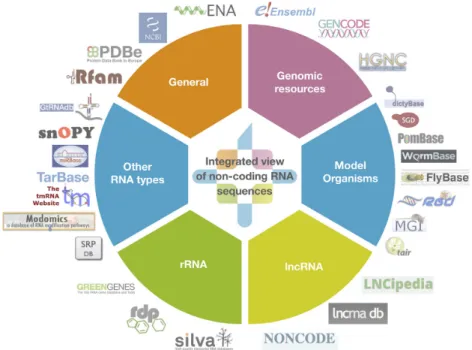
RNAcentral is a comprehensive database of ncRNA se-quences from a broad range of species (1). Launched in 2014 (2), RNAcentral provides unified access to the data from 28 different RNA resources, known as Expert Databases (Fig-ure1).
The primary objective of the RNAcentral database is to provide a comprehensive set of high quality ncRNA sequences to the widest possible audience. Unique RNA
sequences are assigned ‘URS’ identifiers, which become the primary entities around which all information is stored, in-tegrated from multiple different sources, and presented. Rel-evant data (e.g. accessions, genomic locations, functional annotations) for each ncRNA are then displayed within in-dividual sequence pages on the website. The RNAcentral website has four main functionalities:
1. Text search: allows users to search and compare ncRNA sequences from different databases.
2. Sequence search (powered by nhmmer (3)): users may search any nucleotide sequence for similarity to known ncRNA sequences from contributing databases.
3. Genome browser: allows users to view ncRNA annota-tions in a genomic region of interest.
4. Bulk data download: all data are accessible via the FTP archive and for programmatic data access via an API (https://rnacentral.org/downloads).
In this paper we discuss the recent improvements and changes that have expanded RNAcentral’s abilities to serve scientists with various backgrounds and data needs. Since the last RNAcentral publication (1), the database has pro-vided 5 releases (versions 6–10) and now imports ncRNA data from 28 databases (seven additional databases since 2017). In addition to increasing the number of sequences, we have added several new data types, including: (1) ge-nomic locations for sequences in selected model organisms,
central provided genomic locations for sequences only if the expert databases submitted the coordinates. However, many databases do not capture genomic coordinates on the latest genome assemblies, or indeed at all. Due to this limitation in release 9 23.6% of human ncRNA sequences had no an-notated genomic location.
To overcome this limitation, we have developed a com-prehensive approach to map RNAcentral sequences to their genome locations. We downloaded 296 genomes from En-sembl (6) and all Ensembl Genomes (7) divisions except Bacteria (due to scale). For each species, all RNAcentral se-quences that did not already have a genome mapping were mapped to the corresponding genome using blat (8). Ex-act matches, defined as alignments with an edit distance of zero, were stored. For sequences that did not have an exact match (∼14% of all ncRNAs across all genomes), hits with at least 95% sequence identity were retained. To minimise the chance of spurious hits, we limit the length of insertions for sequences shorter than 100 nucleotides. We evaluated this pipeline by mapping all ncRNA sequences from En-sembl and found it successfully recovered the correct loca-tion for>99% indicating it is accurate.
After applying this mapping pipeline, the number of se-quences with reported genome mappings has increased by a factor of 10 across all species, now providing sequence lo-cations for>95% from the sequences of many important model organisms (Table1). The mapping will be updated with each RNAcentral release using the latest genome ver-sions from Ensembl, ensuring that these mappings are al-ways up-to-date.
Users can explore genomic mapping in the context of Ensembl genes and transcripts either on sequence report pages or by navigating to any genome location using the RNAcentral genome browser (https://rnacentral.org/ genome-browser). Additionally, GFF3 and BED files can be downloaded from the RNAcentral FTP archive.
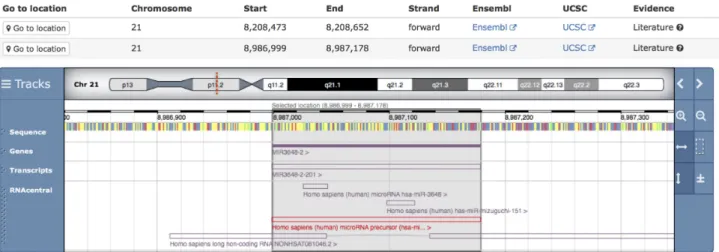
Genome mapping of ncRNAs within RNAcentral can identify inconsistencies between data sources and thereby facilitate improvements in ncRNA annotations across ex-pert databases. For example, 10 out of 11 novel D. melanogastersnoRNAs described in a recent paper (9) and submitted to the INSDC (10) do not overlap with existing annotated ncRNAs (Figure2), making these features can-didates for review by databases such as FlyBase (11), snoPY (12) and Rfam (13). RNAcentral is developing a pipeline for
Figure 1.A diagram showing the 28 Expert Databases imported into RNAcentral as of September 2018, organised according to their contents. The full list of databases is available athttps://rnacentral.org/expert-databases.
Table 1. The increase in the number of sequences with genome coordinates across key species Species Genome assembly Sequence count Percent mapped Improvement
Percent of sequences with more than one mapping
Caenorhabditis elegans WBcel235 27 137 99.7% 4.9% 2.4%
Dictyostelium discoideum dicty 2.7 167 99.4% 9.6% 25.3%
Homo sapiens GRCh38.p12 204 847 99.1% 23.6% 7.2%
Rattus norvegicus Rnor 6.0 131 013 97.7% 70.6% 15.0%
Mus musculus GRCm38.p6 182 379 96.4% 47.1% 9.4%
Schizosaccharomyces pombe ASM294v2 2196 96.4% 15.8% 12.2%
Drosophila melanogaster BDGP6 6630 96.1% 34.4% 22.0%
systematic identification of such annotation anomalies and alerting the relevant databases.
QUALITY CONTROLS USING RFAM
RNAcentral aims to provide a comprehensive and high-quality set of ncRNA sequences. In order to accomplish this, we have developed a pipeline to implement quality checks based on Rfam classification of RNA families (13). All RNAcentral sequences were searched against all Rfam families using the Infernal software (14). Although Rfam does not include piRNAs, full-length lncRNAs, and several other ncRNA types (13), the majority of RNAcentral se-quences (80%) are matched by one or more Rfam families, demonstrating that classification by Rfam provides broad quality control coverage. The remaining 20% of sequences in RNAcentral that do not match an Rfam family are pri-marily (60%) from RNA types that Rfam does not model (piRNA, mature miRNAs, lncRNAs) or from a generic bio-types such as other or miscellaneous RNA.
This analysis produces a series of warnings which are dis-played in search results and on sequence pages. Currently, RNAcentral provides three types of warnings. (i) Poten-tial contamination: triggered when a eukaryotic sequence matches an Rfam family that is only found in bacteria,
which could indicate either bacterial contamination or tax-onomic misclassification. (ii) Incomplete sequences: trig-gered when an RNAcentral sequence matches only a small part (<50%) of an Rfam model. (iii) Potential misannota-tions: triggered when either an rRNA or tRNA sequence does not match the corresponding Rfam families.
The distribution of warnings by type is shown in Table2. The majority (60%) of sequences do not have any warnings. Of those with warnings, most (34% of all sequences) are in-complete sequences. The majority of inin-complete sequences are partial rRNAs (5 070 967 or 99%) followed by tRNAs (<1%) and other RNA types (<1%).
The warnings provided by this quality control are search-able on the browse page, using the ‘QC warning found’ fil-ter on the lower left. For details on searching please refer to the RNAcentral search help at:https://rnacentral.org/help/ text-search. Additionally, RNAcentral provides a flat file of all Rfam annotations in the FTP archive (ftp://ftp.ebi.ac.uk/ pub/databases/RNAcentral/current release/rfam/). The file can be used by expert databases to add Rfam links or val-idate existing RNA annotations by checking if they match the expected Rfam families. It is important to interpret the results of this automatic quality control analysis with cau-tion. For example, eukaryotic sequences found in organelles
Figure 2.Novel snoRNA Me18S-G1506 (URS0000A59F5E 7227) found in the ENA database that was mapped with 100% sequence identity to the
Drosophila melanogastergenome using the new genome mapping pipeline.
Table 2. The number of sequences with and without Rfam warnings Warning type Number of sequences
No problems detected 9 055 240 (60%) Incomplete sequence 5 074 317 (34%) Potential misannotation 778 974 (5%) Potential contamination 162 562 (1%)
are expected to match bacterial Rfam models, so the warn-ings are only a guide to potential issues.
NEW DATA AND FUNCTIONAL ANNOTATIONS
In this section we highlight the new data RNAcentral has imported since last publication. This data not only includes more ncRNA sequences, but also new types of informa-tion such as tRNA secondary structures and high-quality miRNA/mRNA interactions.
New expert databases
Since our last publication, RNAcentral has imported ncRNA data from seven new databases, including three Model Organism Databases (MODs):FlyBase(11), Mouse Genome Informatics (MGI) (15), and the Rat Genome Database (RGD) (16). The MODs contribute high-quality, manually reviewed ncRNAs for the species they represent, thereby adding significant value to RNAcentral.
Additionally, we have imported ncRNA data from En-sembl(6),GENCODE(17),HGNC(HUGO Gene Nomen-clature Committee) (18), and TarBase(19). Ensembl pro-vides automated RNA gene annotations for over 62 verte-brate genomes predicted based on Ensembl ncRNA and lin-cRNA pipeline (20), while GENCODE provides high qual-ity manual annotations for large lncRNAs found in human and mouse genomes.
tRNA secondary structures imported from GtRNAdb
Following a major upgrade of the tRNAscan-SE software, Genomic tRNA Database (GtRNAdb) (21) now provides a
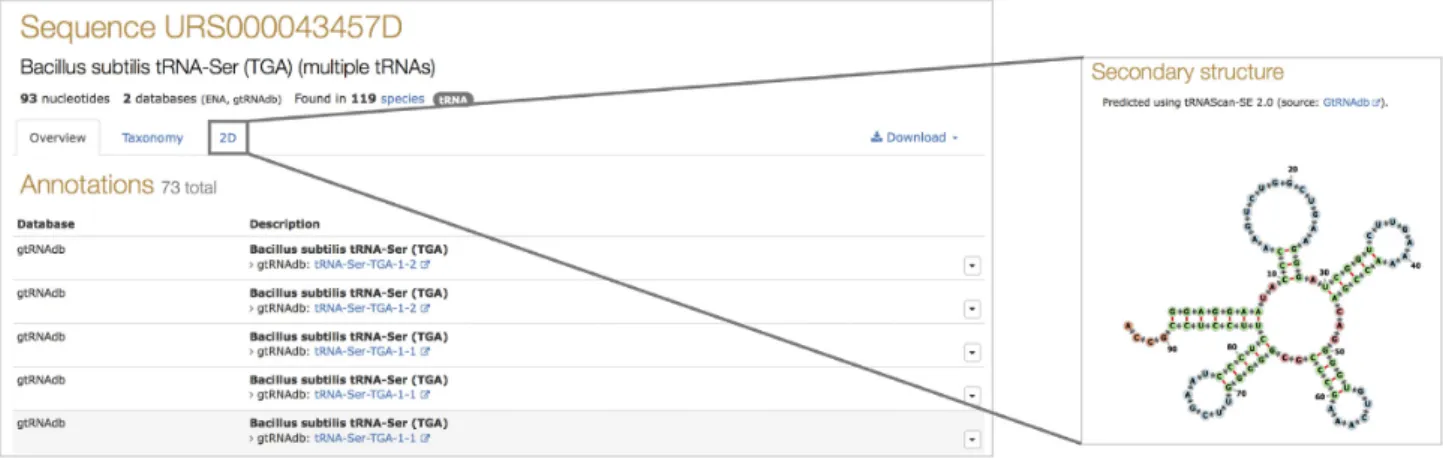
much broader range of tRNA sequences, including tRNAs with possible introns. RNAcentral has imported bacterial, archaeal, fungal, as well as human, rat and mouse sequences from GtRNAdb increasing the coverage from 382 species to 4239. RNAcentral also displays RNA secondary structures provided by GtRNAdb using Forna (22) (Figure3). This is the first secondary structure dataset integrated into RNA-central.
miRNA target interactions from TarBase
RNAcentral also imported its first intermolecular interac-tions data from TarBase v8 (19). TarBase provides hun-dreds of thousands of experimentally supported microRNA (miRNA) targets derived from>30 experimental method-ologies applied to ∼600 cell type/tissues. The integrated dataset incorporates 1507 distinct miRNAs from human and mouse, annotating 559 000 miRNA:gene pairs, corre-sponding to 33 858 protein coding targets. The interactions are displayed on sequence report pages (Figure4) and can be queried using the text search.
OTHER IMPROVEMENTS
In addition to new data, RNAcentral has also improved sev-eral aspects of the website based upon extensive user feed-back. Here, we discuss improvements to the search inter-face, sequence descriptions, a new sequence feature viewer, as well as a JSON-based submission pipeline.
More informative search results
The text search interface has been substantially improved based on user feedback. First, the search now features a textautocompletefunctionality. Secondly, the search sup-ports more filtering options. These include: length, which helps identify only complete sequences; and the new qual-ity checks, which allow users to limit search results to only those sequences without warnings. Finally, it is also now possible tosort search results by lengthin ascending or de-scending order (Figure5A).
Figure 3. Example secondary structure of tRNA-Ser-TGA-1-2 fromBacillus subtilis(URS000043457D 1423) visualized using Forna. The nucleotides in the Forna diagram are colored by secondary structure element, with helixes in green, hairpin loops in blue and red otherwise.
Figure 4. New section of the sequence report pages showing target proteins for miRNA hsa-miR-612 (URS0000759916 9606). The table provides links to Ensembl genes and TarBase summary pages and shows experimental methods.
Figure 5. (A) New text search interface options for filtering sequences by length (bottom) or changing the order of the results (top). (B) Structured snippets in text search results. The string matching the query (‘mir-100’) is highlighted in light-gray. The logos of expert databases annotating the sequence are displayed and additional information about the databases can be viewed on mouse hover. (C) A search result showing a sequence with a quality check failure. Here the red warning symbol indicates the sequence has an error, along with the type of issue detected, incomplete sequence here.
Search results now provide structured snippets (Fig-ure 5B, C). These snippets are a concise summary of the matched sequence showing the gene symbols, sequence length, and a list of databases providing annotation for the entry, as well as any quality check issues. The snippet also explains why the entry is shown by highlighting the matched text (Figure5B).
Improved sequence descriptions
RNAcentral provides descriptions for all sequences, which are displayed in search results as a summary and on se-quences pages. Informative descriptions help to quickly identify sequences of interest among other search results (Figure5B). RNAcentral has created a rule-based system
to take into account expert database annotations to select an informative description for each sequence.
In some cases, RNAcentral generates new descriptions to better represent the data from specific databases. For exam-ple, sequence URS000075A3E2 9606 is a miRNA encoded at four genome locations, which corresponds to four differ-ent descriptions from miRBase. Picking a single description for the unique sequence would not accurately summarize the different locations, so the following description is gen-erated: ‘Homo sapiens (human) microRNA hsa-mir-6859 precursor (hsa-mir-6859 1 to 4)’. As this description shows the full range of precursors that are part of this sequence and is more informative than any one description. The gen-eration of descriptions is done automatically on an ongoing basis.
quence. More than 10 millions of these annotations are available through QuickGO (22) (https://www.ebi.ac.uk/ QuickGO/annotations?assignedBy=RNAcentral), as well as in the Gene Ontology Annotation (GOA) Database (https://www.ebi.ac.uk/GOA). RNAcentral is the largest source of GO annotations for ncRNA sequences. Addition-ally, RNAcentral identifiers (URS) are used as the basis for GO annotations in GOA and QuickGO. These identifiers were chosen because they provide a stable, precise, and com-prehensive method for referring to ncRNA sequences (24).
New JSON-based submission process
In order to streamline the submission of data to RNA-central, we defined a new exchange format and validation software. The new system results in a clear and unambigu-ous protocol for the preparation, validation and submission of ncRNA data and metadata by the expert databases to RNAcentral, and has made the submission process faster, more reliable and flexible.
The current version is based on a corresponding ef-fort by the Alliance of Genome Resources (https://github. com/alliance-genome/agr schemas), and has been devel-oped with extensive feedback from FlyBase (11), miRBase (25), LNCipedia (26), GtRNAdb (21) and TarBase (19). The schema and a JSON schema validator are available at
https://github.com/RNAcentral/rnacentral-data-schema.
USE OF RNACENTRAL DATA
Here we describe how being part of the RNAcentral Con-sortium has helped two expert databases to improve their resources. We also present examples of RNAcentral usage by the research community.
HGNC CANONICAL HUMAN NCRNA GENE SET
The HGNC (18) is the only international resource that has the authority to approve gene symbols and names for hu-man genes. HGNC began approving symbols for huhu-man small non-coding RNA genes in the 1980s, starting with mi-tochondrial tRNA genes. Since the identification of many new classes of RNA the naming of ncRNA genes has be-come one of HGNC’s core activities. HGNC collaborates with several RNAcentral expert databases to name specific classes of small ncRNAs, such as miRBase for miRNAs and GtRNAdb for tRNAs. HGNC also names long non-coding
RNAcentral has helped HGNC by performingquality control checks on its data. This enable HGNC to check the mappings between their gene symbols and Ensembl gene annotations and lncRNAdb, and also augment their links to RefSeq transcript sequences. Following a list sent to HGNC from RNAcentral and a resulting discussion with RefSeq gene annotators, HGNC withdrew the gene sym-bol HPVC1 (gene name: human papillomavirus (type 18) E5 central sequence-like 1) because there was a lack of evi-dence for transcription at this locus. RefSeq also withdrew their gene entry for HPVC1.
Functional annotation of miRNAs
Functional annotation of gene products using the Gene On-tology has proven vital for interpretation of scientific stud-ies, especially for large-scale studies where functions and roles of many gene products need to be analysed (27). How-ever, this type of high-quality functional annotation has been lacking for many classes of ncRNAs. There is an abun-dance of published information about the targets and the functional roles of individual miRNAs in the literature, but that information is not curated or systematically available in any database. Researchers therefore commonly infer func-tional roles of miRNAs by mining lists of predicted targets (28–30). However, this has been shown to lead to biased and unreliable interpretations of miRNA function (29,30).
The Functional Gene Annotation Team at University College London (UCL) started curating experimentally ver-ified GO terms for mature miRNAs in 2014. However, any slight change in a miRNA sequence can mean that it targets different mRNAs for silencing, and potentially different bi-ological processes and pathways. Therefore, to ensure GO annotations are associated with the correct mature miRNA sequence, stable species-specific database identifiers were re-quired (24). The provision of RNAcentral identifiers has al-lowed the UCL curators to identify miRNA sequences re-ported in specific publications unambiguously. Since it is common practice for authors to display an alignment of the mRNA with the targeting miRNA sequence in reverse ori-entation (3to 5), RNAcentral implemented a ‘reverse se-quence and search again’ option into the sese-quence similar-ity search tool to assist finding the correct miRNA identi-fier. Occasionally, authors will only show a partial miRNA sequence in a publication. In these cases, a text search in RNAcentral for the miRNA name will return all ncRNA matches, allowing the biocurator to manually cross-check
Figure 6.New section of the sequence report showing Rfam annotations. In this example, an ENA sequenceURS00005B7DD8 9606, originally annotated as miscellaneous RNA (misc RNA), matches a conserved domain of the MALAT1 Rfam family (RF01871) and MEN beta RNA (RF01684). The locations of the Rfam matches are shown in the feature viewer.
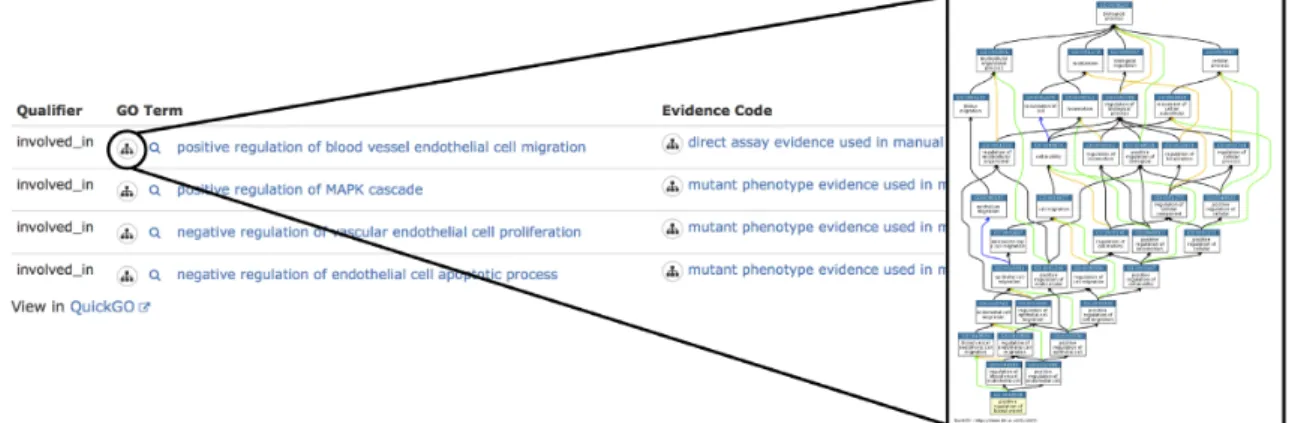
Figure 7. RNAcentral visualization of GO annotations for miRNA hsa-mir-126 (URS0000759B6D 9606) that is involved in heart development.
with the published sequence to determine the correct se-quence for GO term assignment.
As discussed above, ncRNA annotations in QuickGO are based upon RNAcentral identifiers, which makes dis-tributing UCL GO annotations simple. UCL annotations are provided to several high-profile knowledgebases such as Ensembl, NCBI Gene, miRBase, as well as the GO Con-sortium. Additionally, the experimentally validated interac-tions between the mature miRNA and its targets are pro-vided as a PSICQUIC web service (http://www.ebi.ac.uk/ Tools/webservices/psicquic/view/main.xhtml), named ‘EBI-GOA-miRNA, enabling this data to be used in interaction networks (28).
The UCL team has created over 5,000 GO annotations for over 570 miRNAs from human, mouse and rat. These GO annotations are now displayed in the RNAcentral en-tries for the mature miRNAs (Figure 7), with links out to the QuickGO browser (23) for the full annotation records. The consistent use of RNAcentral identifiers for functional annotation has also facilitated the import and display of miRNA functional data in the miRBase database (25).
Use of RNAcentral by the wider research community
We monitor RNAcentral usage by analyzing paper citations and engaging with the users online and at conferences. One of the main uses of RNAcentral is as a source of refer-ence data. In several studies RNAcentral sequrefer-ences from
an organism or RNA type of interest are downloaded and then the novel ncRNAs are compared against the RNAcen-tral sequences to classify them or to determine if the ncR-NAs have been observed before. For example, RNAcentral data were used to study miRNA expression in breast can-cer (31), to annotate the sea anemone genome with ncR-NAs and study miRNA-mediated modulation of the host transcriptome in cnidarian-dinoflagellate symbiosis (32), and to understand the physiological regulation of repro-duction in goats (33). Additionally, Ensembl regularly im-ports identifiers and descriptions from RNAcentral. Cur-rently, in Ensembl, there are 579,783 RNAcentral related entries for over 112 species. RNAcentral data are also used in the private sector where the sequences have been used to build a reference database for metagenomics analysis us-ing the MG7 pipeline by a company called Era7 Bioin-formatics (https://era7bioinformatics.com/en/page.cfm?id= 464). More use cases can be found on a dedicated web page (https://rnacentral.org/use-cases).
Future plans
We are currently working on several improvements such as computing and displaying standardized secondary struc-tures using TRAVeLer (34), a faster release procedure, and more extensive quality controls. We expect RNAcentral to continue growing in utility and reach as more features are added and more databases join the consortium. For
exam-man (RNAcentral), Maciej Szyexam-manski, Wojciech M. Kar-lowski (5SRNADB), Jan Gorodkin, Stefan E. Seemann (CRS), Jamie J. Cannone, Robin R. Gutell (CRW), Pe-tra Fey, Siddhartha Basu (dictyBase), Simon Kay, Guy Cochrane (ENA), Kostantinos Billis (Ensembl), David Em-mert, Steven J. Marygold (FlyBase), Rachael P. Hunt-ley, Ruth C. Lovering (Functional Gene Annotation at UCL), Adam Frankish (GENCODE), Patricia P Chan, Todd M Lowe (GtRNAdb), Elspeth Bruford, Ruth Seal (HGNC), Jo Vandesompele, Pieter-Jan Volders (LNCi-pedia), Maria Paraskevopoulou (LncBase), Lina Ma, Zhang Zhang (LncRNAWiki), Sam Griffiths-Jones (miR-Base), Janusz M. Bujnicki, Pietro Boccaletto (Modomics), Judith A. Blake, Carol J. Bult (Mouse Genome Infor-matics), Runsheng Chen, Yi Zhao (NONCODE), Valerie Wood, Kim Rutherford (PomBase), Elena Rivas (R-scape), James Cole (RDP), Stanley J.F. Laulederkind, Mary Shi-moyama (RGD), Marc E. Gillespie, Marija Orlic-Milacic (Reactome), Ioanna Kalvari, Eric Nawrocki (Rfam), Stacia R. Engel, J. Michael Cherry (SGD), SILVA Team (SILVA), Tanya Z. Berardini (TAIR), Artemis Hatzigeorgiou, Dimi-tra Karagkouni (TarBase), Kevin Howe, Paul Davis (Worm-Base), Marcel Dinger (lncRNAdb), Shunmin He (piR-Base), Maki Yoshihama, Naoya Kenmochi (snOPY), Peter F. Stadler (tRNAdb), Kelly P. Williams (tmRNA Website).
FUNDING
Biotechnology and Biological Sciences Research Coun-cil (BBSRC) [BB/N019199/1]. Funding for open access charge: Research Councils UK (RCUK).
Conflict of interest statement.Janusz M. Bujnicki is an Ex-ecutive Editor ofNucleic Acids Research.
REFERENCES
1. The RNAcentral Consortium (2017) RNAcentral: a comprehensive database of non-coding RNA sequences.Nucleic Acids Res.,45, D128–D134.
2. The RNAcentral Consortium (2015) RNAcentral: an international database of ncRNA sequences.Nucleic Acids Res.,43, D123–D129. 3. Wheeler,T.J. and Eddy,S.R. (2013) nhmmer: DNA homology search
with profile HMMs.Bioinformatics,29, 2487–2489.
4. Hui,J.H.L., Marco,A., Hunt,S., Melling,J., Griffiths-Jones,S. and Ronshaugen,M. (2013) Structure, evolution and function of the bi-directionally transcribed iab-4/iab-8 microRNA locus in arthropods.Nucleic Acids Res.,41, 3352–3361.
5. Rinn,J.L., Kertesz,M., Wang,J.K., Squazzo,S.L., Xu,X., Brugmann,S.A., Goodnough,L.H., Helms,J.A., Farnham,P.J.,
international nucleotide sequence database collaboration.Nucleic Acids Res.,44, D48–D50.
11. Gramates,L.S., Marygold,S.J., Santos,G. dos, Urbano,J.-M., Antonazzo,G., Matthews,B.B., Rey,A.J., Tabone,C.J., Crosby,M.A., Emmert,D.B.et al.(2016) FlyBase at 25: looking to the future.
Nucleic Acids Res.,45, D663–D671.
12. Yoshihama,M., Nakao,A. and Kenmochi,N. (2013) snOPY: a small nucleolar RNA orthological gene database.BMC Res. Notes,6, 426. 13. Kalvari,I., Argasinska,J., Quinones-Olvera,N., Nawrocki,E.P.,
Rivas,E., Eddy,S.R., Bateman,A., Finn,R.D. and Petrov,A.I. (2018) Rfam 13.0: shifting to a genome-centric resource for non-coding RNA families.Nucleic Acids Res.,46, D335–D342.
14. Nawrocki,E.P. and Eddy,S.R. (2013) Infernal 1.1: 100-fold faster RNA homology searches.Bioinformatics,29, 2933–2935. 15. Smith,C.L., Blake,J.A., Kadin,J.A., Richardson,J.E., Bult,C.J. and
Mouse Genome Database Group (2018) Mouse Genome Database (MGD)-2018: knowledgebase for the laboratory mouse.Nucleic Acids Res.,46, D836–D842.
16. Shimoyama,M., De Pons,J., Hayman,G.T., Laulederkind,S.J.F., Liu,W., Nigam,R., Petri,V., Smith,J.R., Tutaj,M., Wang,S.-J.et al.
(2015) The Rat Genome Database 2015: genomic, phenotypic and environmental variations and disease.Nucleic Acids Res.,43, D743–D750.
17. Mudge,J.M. and Harrow,J. (2015) Creating reference gene annotation for the mouse C57BL6/J genome assembly.Mamm. Genome,26, 366–378.
18. Yates,B., Braschi,B., Gray,K.A., Seal,R.L., Tweedie,S. and Bruford,E.A. (2017) Genenames.org: the HGNC and VGNC resources in 2017.Nucleic Acids Res.,45, D619–D625. 19. Karagkouni,D., Paraskevopoulou,M.D., Chatzopoulos,S.,
Vlachos,I.S., Tastsoglou,S., Kanellos,I., Papadimitriou,D., Kavakiotis,I., Maniou,S., Skoufos,G.et al.(2018) DIANA-TarBase v8: a decade-long collection of experimentally supported
miRNA–gene interactions.Nucleic Acids Res.,46, D239–D245. 20. Aken,B.L., Ayling,S., Barrell,D., Clarke,L., Curwen,V., Fairley,S.,
Fernandez Banet,J., Billis,K., Garc´ıa Gir ´on,C., Hourlier,T.et al.
(2016) The Ensembl gene annotation system.Database (Oxford),
2016, baw093.
21. Chan,P.P. and Lowe,T.M. (2016) GtRNAdb 2.0: an expanded database of transfer RNA genes identified in complete and draft genomes.Nucleic Acids Res.,44, D184–D189.
22. Kerpedjiev,P., Hammer,S. and Hofacker,I.L. (2015) Forna (force-directed RNA): simple and effective online RNA secondary structure diagrams.Bioinformatics,31, 3377–3379.
23. Binns,D., Dimmer,E., Huntley,R., Barrell,D., O’Donovan,C. and Apweiler,R. (2009) QuickGO: a web-based tool for Gene Ontology searching.Bioinformatics,25, 3045–3046.
24. Huntley,R.P., Sitnikov,D., Orlic-Milacic,M., Balakrishnan,R., D’Eustachio,P., Gillespie,M.E., Howe,D., Kalea,A.Z.,
Maegdefessel,L., Osumi-Sutherland,D.et al.(2016) Guidelines for the functional annotation of microRNAs using the Gene Ontology.
RNA,22, 667–676.
25. Kozomara,A. and Griffiths-Jones,S. (2014) miRBase: annotating high confidence microRNAs using deep sequencing data.Nucleic Acids Res.,42, D68–D73.
26. Volders,P.-J., Verheggen,K., Menschaert,G., Vandepoele,K., Martens,L., Vandesompele,J. and Mestdagh,P. (2015) An update on
LNCipedia: a database for annotated human lncRNA sequences.
Nucleic Acids Res.,43, D174–D180.
27. Ashburner,M., Ball,C.A., Blake,J.A., Botstein,D., Butler,H., Cherry,J.M., Davis,A.P., Dolinski,K., Dwight,S.S., Eppig,J.T.et al.
(2000) Gene ontology: tool for the unification of biology. The Gene Ontology Consortium.Nat. Genet.,25, 25–29.
28. Huntley,R.P., Kramarz,B., Sawford,T., Umrao,Z., Kalea,A., Acquaah,V., Martin,M.J., Mayr,M. and Lovering,R.C. (2018) Expanding the horizons of microRNA bioinformatics.RNA,24, 1005–1017.
29. Bleazard,T., Lamb,J.A. and Griffiths-Jones,S. (2015) Bias in microRNA functional enrichment analysis.Bioinformatics,31, 1592–1598.
30. Godard,P. and van Eyll,J. (2015) Pathway analysis from lists of microRNAs: common pitfalls and alternative strategy.Nucleic Acids Res.,43, 3490–3497.
31. Buschmann,D., Gonz´alez,R., Kirchner,B., Mazzone,C., Pfaffl,M.W., Schelling,G., Steinlein,O. and Reithmair,M. (2018) Glucocorticoid receptor overexpression slightly shifts microRNA expression patterns in triple-negative breast cancer.Int. J. Oncol.,52, 1765–1776. 32. Baumgarten,S., Cziesielski,M.J., Thomas,L., Michell,C.T.,
Esherick,L.Y., Pringle,J.R., Aranda,M. and Voolstra,C.R. (2018) Evidence for miRNA-mediated modulation of the host transcriptome in cnidarian-dinoflagellate symbiosis.Mol. Ecol.,27, 403–418. 33. Capra,E., Lazzari,B., Frattini,S., Chessa,S., Coizet,B., Talenti,A.,
Castiglioni,B., Marsan,P.A., Crepaldi,P., Pagnacco,G.et al.(2018) Distribution of ncRNAs expression across
hypothalamic-pituitary-gonadal axis in Capra hircus.BMC Genomics,19, 417.
34. Elias,R. and Hoksza,D. (2017) TRAVeLer: a tool for template-based RNA secondary structure visualization.BMC Bioinformatics,18, 487.