Energex’s ICT expenditure
2015-20
Australian Energy Regulator
9 July 2015
Contents
1 Executive Summary ... 4
1.1 Individual project evaluation ... 4
1.2 Efficiency Assessment ... 6
2 Project evaluation ... 8
2.1 Enterprise Asset Management ... 8
2.2 Network Information Enablement ... 10
2.3 Advanced Distribution Management ... 12
2.4 Distributed Workforce Automation ... 14
2.5 Administrative ERP ... 15
2.6 Market Systems Modernisation ... 17
2.7 Business Analytics Renewal ... 19
2.8 Information Security Enhancement ... 20
2.9 Integration Platform Renewal ... 21
2.10 Desktop Productivity – Thin client ... 23
3 Efficiency Assessment ... 25
3.1 Current operating arrangements ... 25
List of Tables
Table 1 - Energex - Proposed SPARQ capital investment program ($2014-15m) ... 5
Table 2 - Assessment of project justification against NEM criteria ($2014-15m) ... 5
Table 3: Nous conclusion – Enterprise Asset Management – forecast capex ... 10
Table 4: Nous conclusion – Network Information Enablement – forecast capex ... 12
Table 5: Nous conclusion – Advanced Distribution Management – forecast capex ... 14
Table 6: Nous conclusion – Distributed Workforce Automation – forecast capex ... 15
Table 7: Nous conclusion – Administrative ERP – forecast capex ... 17
Table 8: Nous conclusion – Market System Modernisation – forecast capex ... 18
Table 9: Nous conclusion – Business Analytics Renewal – forecast capex ... 20
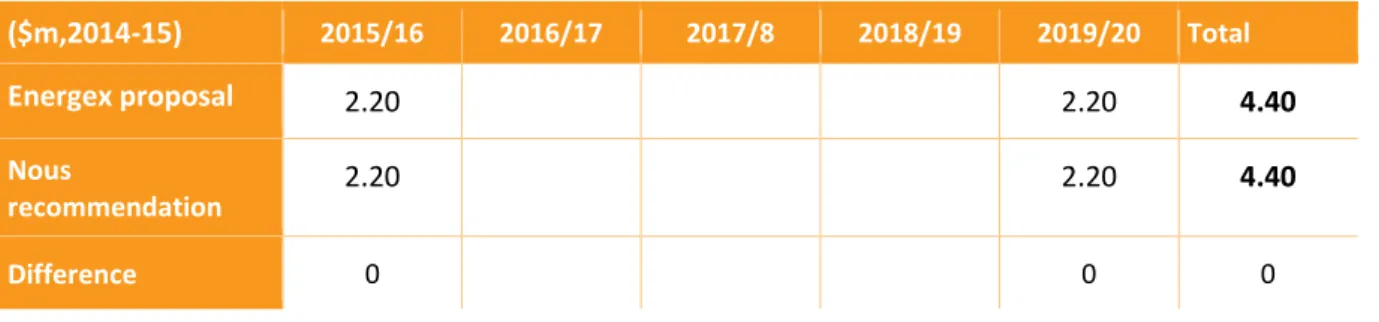
Table 10: Nous conclusion – Information Security Enhancement – forecast capex ... 21
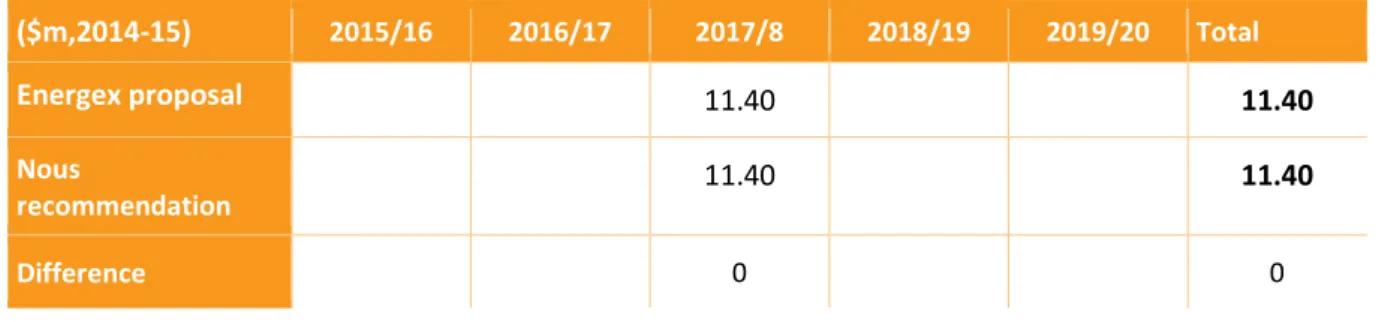
Table 11: Nous conclusion – Integration Platform Renewal – forecast capex ... 23
1
Executive Summary
Energex’s Regulatory Proposal for the period 2015-2020 outlines a range of outcomes it plans to achieve. To deliver on these, Energex has proposed an ICT program of work that involves capital investment within SPARQ of $240.37 million (2014/15 prices). These are to be supported by Asset Service Fees of $242.84 million, which also includes return on capitalised assets from previous periods. There are also proposed Operational Support costs of $230.32 million, Telecommunications Pass-through of $37.16 million and Non-Capital Project Costs of $26.32 million, providing a total of $536.4 million of ICT operational expenditure.
This report provides a systematic evaluation of the ICT program of work proposed by Energex from two perspectives:
A bottom-up evaluation of the justification for individual ICT projects against the requirements of the NEM.
An assessment of the degree to which efficiencies are being achieved in the current delivery arrangements through SPARQ
Both of these perspectives have linkages to a similar evaluation of the Regulatory Proposal from Ergon. In several areas, efficiencies are being sought in the joint SPARQ ownership arrangement through selection of industry applications that can meet the requirements of both organisations. As much as possible, the assessment of project justification in the bottom-up evaluation is undertaken in this report on the basis of information provided by Energex alone. However, in some areas, we were able to increase our understanding of areas of joint use of applications by considering the combined cases presented. The evaluation of jointly derived efficiency necessarily takes an integrated view.
1.1
Individual project evaluation
The proposed capital investment profile within SPARQ to deliver Energex’s program is shown in Table 1. Our assessment has confirmed that core applications need to be replaced or updated within the five year period to support current and expected network operating functions. These include:
Core asset management capability Geographic information system Administrative ERP
Parts of the market systems Security related applications
Some of the proposed programs have components that move beyond core resilience and expected service requirements to drive for further efficiencies in operation. Where these are supported by clear analysis that delivers a positive return that will reduce costs to customers over time, we accept these as efficient and in support of market objectives. Other components and individual projects that cannot be justified either for essential service delivery or demonstrable benefits have been excluded from our proposed revised view of justified expenditure.
Table 1 - Energex - Proposed SPARQ capital investment program ($2014-15m)
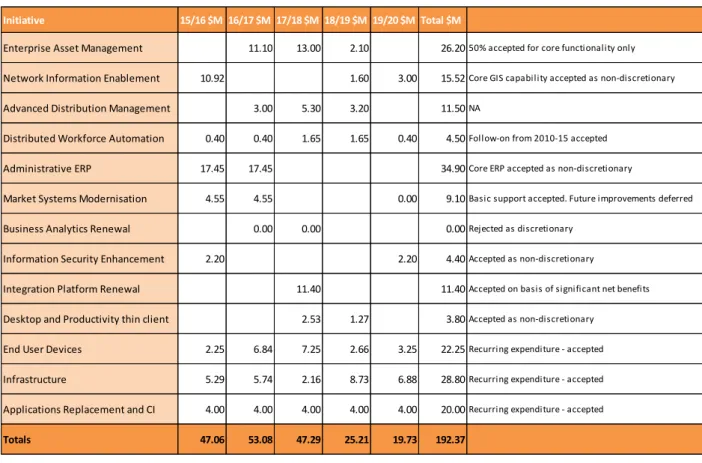
Table 2 provides a summary of our conclusions on individual project justification within the Energex capital program:
Table 2 - Assessment of project justification against NEM criteria ($2014-15m)
ICT Architecture Segment Initiative 15/16 $M 16/17 $M 17/18 $M 18/19 $M 19/20 $M Total $M
1 Network Asset Management Enterprise Asset Management 11.10 26.10 15.20 52.40 1 Network Asset Management Network Information Enablement 10.92 1.60 3.00 15.52 2 Network Operations Advanced Distribution Management 3.00 5.30 3.20 11.50 2 Network Operations Distributed Workforce Automation 0.40 0.40 1.65 1.65 0.40 4.50
3 Corporate Services Administrative ERP 17.45 17.45 34.90
4 Customer Services Market Systems Modernisation 4.55 4.55 10.90 20.00
5 Enterprise Services Business Analytics Renewal 5.45 5.45 10.90
5 Enterprise Services Information Security Enhancement 2.20 2.20 4.40
5 Enterprise Services Integration Platform Renewal 11.40 11.40
6 ICT Infrastructure Desktop and Productivity thin client 2.53 1.27 3.80
6 ICT Infrastructure End User Devices 2.25 6.84 7.25 2.66 3.25 22.25
6 ICT Infrastructure Infrastructure 5.29 5.74 2.16 8.73 6.88 28.80
ALL Applications Replacement and CI 4.00 4.00 4.00 4.00 4.00 20.00
Totals 47.06 58.53 65.84 38.31 30.63 240.37
Initiative 15/16 $M 16/17 $M 17/18 $M 18/19 $M 19/20 $M Total $M
Enterprise Asset Management 11.10 13.00 2.10 26.20
Network Information Enablement 10.92 1.60 3.00 15.52Core GIS capability accepted as non-discretionary
Advanced Distribution Management 3.00 5.30 3.20 11.50
Distributed Workforce Automation 0.40 0.40 1.65 1.65 0.40 4.50
Administrative ERP 17.45 17.45 34.90
Market Systems Modernisation 4.55 4.55 0.00 9.10
Business Analytics Renewal 0.00 0.00 0.00
Information Security Enhancement 2.20 2.20 4.40
Integration Platform Renewal 11.40 11.40
Desktop and Productivity thin client 2.53 1.27 3.80
End User Devices 2.25 6.84 7.25 2.66 3.25 22.25
Infrastructure 5.29 5.74 2.16 8.73 6.88 28.80
Applications Replacement and CI 4.00 4.00 4.00 4.00 4.00 20.00
Totals 47.06 53.08 47.29 25.21 19.73 192.37
ErgonComment
Accepted as non-discretionary
Accepted on basis of significant net benefits Accepted as non-discretionary
Recurring expenditure - accepted Recurring expenditure - accepted Recurring expenditure - accepted 50% accepted for core functionality only
NA
Follow-on from 2010-15 accepted Core ERP accepted as non-discretionary
Basic support accepted. Future improvements deferred Rejected as discretionary
1.2
Efficiency Assessment
ICT services for Energex are provided by SPARQ Solutions (SPARQ), a jointly owned subsidiary between Ergon Energy and Energex to create economies of scale and overall cost reduction for the provision of ICT capability.
Energex uses operating expenditure (including Asset Services fees) to recover SPARQ capital investment in ICT assets. However, Energex directly procures client devices used by employees and contractors. Non-system ICT capital expenditure incurred directly by Energex relates only to end user devices such as desktop computers, laptops, tablets, handheld devices, smartphones and printers.
SPARQ's operating and capital expenditure for ICT services is charged to Energex as ICT service fees. Total ICT expenditure incurred by SPARQ associated with ICT services to Energex is treated as indirect operating expenditure and allocated to services consistent with Energex’s approved CAM.
A review of both Ergon Energy and Energex’s ICT spending proposals for the 2010-15 period shows that there will be a significant increase in application of common solutions across the two organisations. Most areas have matching strategies and investment profiles, with notable exceptions being Network Information Enablement programs, including GIS investments, and Advanced Distribution Management. However, the business cases for the two organisations show that most of the projects are planned to be internally delivered within SPARQ with little use of outsourced services. (Deloitte has previously noted less than 4% from external sources). This is at odds with current trends in ICT service delivery where the focus is moving strongly towards accessing externally provided services, whether at the platform, application or total service level. This is especially the case with applications that are universal across a range of industries, such as ERP and desktop services.
This is supported by results of a recent benchmarking study by Computer Economics. Its “IT Spending and Staffing Benchmarks Study” provides key metrics in financial and strategic management of IT and identifies current trends in organization IT spending and staffing. The survey involves executives in public and private sector from over 200 U.S. and Canadian IT organisations and helps identify long-term trends and benchmarks.
Major findings of the 2015 study confirm that while ICT spending is on a cyclical upswing, the increase is in operational spending, including cloud services, with capital and IT headcount remaining flat or decreasing. Overall the cost of services is declining on a per-user basis.
We recognise that the operator of an essential regulated network will take a conservative view on the transition to outsourced or cloud-based services, but we can expect that the momentum towards this type of delivery will continue to increase over the next five years, including areas of comparable security and reliability requirements. The level of investment in security infrastructure and integration capability in the SPARQ-based plans of Ergon Energy and Energex points to an increasing capability to move in that direction.
In that light, we are surprised by the extent to which the planned operating arrangement within SPARQ appears to remain primarily in-house and self-contained. The arrangement does not have any market-testing component by Energex or Ergon Energy outside the arrangement, nor by SPARQ in its delivery of services.
We note that The Independent Review Panel on Network Cost (the Panel) included in its recommendations:
Alternative service delivery models for Information and Communication Technology services currently delivered by SPARQ solutions should be tested as follows:
o Issue market tenders for the delivery of the relevant operational Information Communication and Technology services.
Our view is slightly different from those put forward by the Panel. We agree with the need to have market-testing but we also see a case to continue to drive for efficiency by combining the services for Ergon and Energex. The highly parallel nature of the two submissions shows that there will be an increasing level of use of common applications over the next five year period. This appears to have moved on since the Panel found that there had been very limited delivery of joint projects.
The Panel recommendation is also not well geared to take advantage of the move to cloud-based services in line with the trends described above. The distinction between capital and operating components appears to support the status quo.
In Nous’ view, an alternative approach that could achieve the overall objective of efficiency would be to have SPARQ progressively move towards a role as a broker of available market services, rather than be primarily a self-contained developer and operator, at least for applications that are genuinely common. Ergon Energy and Energex could still individually test the market for applications and services that are not in common and perhaps selectively test for those that are. But the prime objective should be to capture both economies of scale and market-based efficiencies. This will also allow a more explicit examination of the value added by the SPARQ relationship.
We don’t see it reasonable to make adjustments to actual capital and operating allowances for this dynamic at this stage. However, if the position is clearly stated and an intention to benchmark the next round of pricing reset against publicly available Software as a Service (SaaS) and similar services, which will be substantial in five years, it would be reasonable in our view to make global adjustments in the next cycle.
2
Project evaluation
2.1
Enterprise Asset Management
Key findings:
This project combines the replacement of a core enterprise asset management (EAM) capability with the upgrade of a number of asset management functions, particularly asset inspections and works management.
The replacement of core capability is prudent due to the existing Ellipse 5 system reaching end-of-life. The upgrade of individual asset management functions are only broadly scoped at this stage and some
may or may not be part of the new core EAM.
The costs in the business case appear to span both replacement and upgrade and the NPV calculations do not provide a convincing case for the additional activities.
Recommendation:
To accept 50% of the costs proposed by Energex in order to support the replacement of core EAM capability, weighted towards the first two years of the proposed program.
To the extent that individual services are justified through savings, Energex will be able to self-fund further development.
2.1.1
Project summary
The proposed project consists of a suite of activities to deliver a range of asset management capabilities for Energex’s future operations. These include:
Replace a core enterprise asset management capability, currently held within the Ellipse 5 suite, with an EAM component of a new EAM/ERP solution.
Replace an Asset Inspections solution
Replace Works Management capability
Potential future extensions to support other functions such as workforce mobility.
The preferred solution by Energex combines the Asset Inspections and Works Management capability in an overall program that spans the period 2016 to 2019.
2.1.2
Need
The core driver for action is the expiration of support by Ventyx of the Ellipse 5 suite in June 2015. The operating platform is Windows Server 2003, with Microsoft withdrawing extended support for that platform from June 2015 as well. This requirement also drives the need to replace the ERP component of the suite, which is the subject of a separate business case.
The need to replace various asset management capabilities, many of which sit outside the Ellipse 5 suite, is broadly supported in the business case by operating efficiencies than will accrue in areas such as Asset Inspections and Works Management. The preferred option in the business case incorporates an
2.1.3
Options
Energex identified the following three options:
Option 1: Do Nothing, which evaluated the additional labour cost and risk of working with an unsupported system indefinitely.
Option 2: Deferral, which is similar to Option 1, but assumes the proposed changes will be deferred until the 2020-25 regulatory period.
Option 3: Upgrade of Ellipse 5 with a contemporary EAM solution, including Works Management and Asset inspection replacements.
A fourth option – Upgrade of core Ellipse 5 functionality and deferring consideration of Works
Management and Asset Inspection - is not mentioned or analysed. This is unfortunate because that case in comparison with Option 3 would have provided better insight into the justification for the Works Management and Asset Inspection components.
The NPV analysis in the business case appears to favour Option 3, but in Nous’ opinion, the comparison is flawed. Options 1 and 2 have significant labour costs to support the current arrangements through the full period from 2015. Option 3 does not appear to have any of these support costs, even though
replacement of the core system is not commenced until 2016 and achieved until 2018. If the risks of Do Nothing are real, they will also need to be managed for at least two to three years until replacement is achieved.
2.1.4
Scope
Nous has reviewed the information provided and considers that the proposal to upgrade its core asset management application reflects good industry practice. However we remain unconvinced that funding the additional stages of replacing Works Management and Asset Inspections are warranted at this time. In the case of Asset Inspections, it is stated that the replacement may be part of the new EAM or could be developed as a satellite solution e.g. as part of the Field Force Automation project.
2.1.5
Cost
Nous is not able to determine from the provided information which components of the overall cost relate to the core replacement and which to later stages, except by considering the overall program timing. Our judgement is an allowance of 50% of the proposed capital program would support the core EAM replacement, weighted towards the first two years of the program.
2.1.6
Timing
The proposed timing of the core project over the years 2016 to 2018 is justified by the end-of-life of Ellipse 5 support.
2.1.7
Opex/capex trade-off
The replacement of core capability will maintain current asset management capabilities and no new opex savings can be expected. However business cases for further development of new capabilities will be able to evaluate the efficiency savings that will accrue in each case.
2.1.8
Conclusion
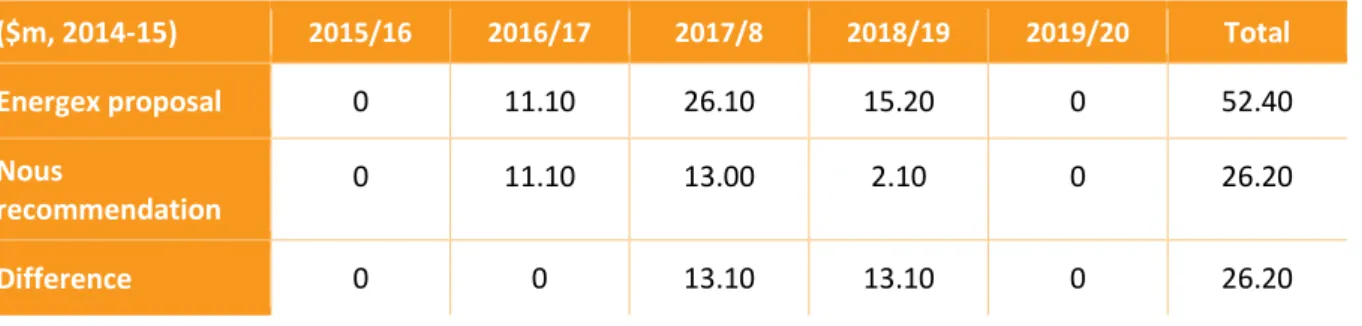
Based on our above review, Nous considers that the 50% of the proposed expenditure should be allowed, weighted towards the earlier years of the program, as shown in Table 3:
Table 3: Nous conclusion – Enterprise Asset Management – forecast capex
($m, 2014-15) 2015/16 2016/17 2017/8 2018/19 2019/20 Total Energex proposal 0 11.10 26.10 15.20 0 52.40 Nous recommendation 0 11.10 13.00 2.10 0 26.20 Difference 0 0 13.10 13.10 0 26.20
2.2
Network Information Enablement
Key findings:
The core component of this project is the replacement of Energex’s Geographic Information System (GIS) home grown solution with a commercial system capable of supporting future requirements. Other upgrades are noted in the ICT Strategy related to replacement of SIFT and NETPLAN and a
further project for Distribution Monitoring Analytics (DMA), appears to be part of the overall program. The capital funding request appears to align with the range of costs estimated for the GIS program
alone in the supplied Business Case. We have therefore based this evaluation on the GIS component. Nous considers the investment in a GIS system to support future network planning, delivery and
operation is a prudent action to support network expansion and supply reliability.
Recommendation:
To support the proposed costs by Energex for replacement of the GIS solution.
2.2.1
Project summary
The core component of this project is the replacement of Energex’s Geographic Information System (GIS) home grown solution with a commercial system capable of supporting future requirements. There are other upgrades noted in the ICT Strategy, related to replacement of SIFT and NETPLAN, and a further project for Distribution Monitoring Analytics (DMA), appears to be part of the overall program. No reconciliation has been provided of the costs of the overall program with the business case
requirements of the individual components. However, the capital funding request appears to align with the range of costs estimated for the GIS program alone in the supplied Business Case. We understand that the SIFT and NETPLAN projects are relatively small, but the DMA project has capital requirements of approximately $6m. We assume that Energex has chosen to develop this program separately on the basis of the positive NPV generated by its delivery. We have therefore based this evaluation on the GIS project alone.
2.2.2
Need
The current version of GIS used by Energex is a home grown solution based on Oracle, with interfaces to 130 applications and solutions. It has become unwieldy, costly to support and will not cater for the future requirements of network planning.
GIS referenced data is increasingly being used as a core functionality that supports distribution planning and maintenance. The advent of smart meters and distributed generation is significantly expanding the data modelling requirement to include low-voltage systems and these requirements will exceed the capabilities of the current solution.
In Nous’ opinion, it will be prudent for Energex to replace its home-grown system with a commercially system with the capability to support its future needs.
2.2.3
Options
There are two levels of option evaluation for this project. The first relates to whether Energex should align with the GIS solution used by Ergon Energy and the second concerns the potential impacts of do-nothing and deferral actions. Energex has examined the case for alignment with the Smallworld system used by Ergon in detail. An evaluation panel compared the option of Smallworld with the leading international solution provided by ESRI as part of a $1.4M pre-project evaluation stage. The
investigation, which was overseen by a probity advisor, concluded that both solutions would be fit-for-purpose, but the ESRI solution would be the most cost-effective for Energex. This was endorsed by the Steering Committee, EMT, the Joint Working Steering Committee and the Network Technical Committee, subject to Government consultation, now complete. The project then entered the stage of evaluation of costs/ timing of the ESRI-based solution.
In its Business Case, Energex identified the following three options:
Do Nothing – Considered as a base case, but not evaluated in financial detail as it was considered infeasible as a prudent option.
Deferring implementation to the 2018-20 period
Implementing the new solution in 2015 – 17 (preferred option)
A fourth option was considered, but it was a nominal variation of the preferred option.
Nous views the analysis that shows the preferred option has the lowest risk and best overall NPV as sound.
2.2.4
Scope
The scope of this assessment is limited to the core GIS replacement. This is the minimum viable component of the program.
2.2.5
Cost
We have accepted the costs in the proposed SPARQ capital profile on face value. The amounts are within the range of low to high assessments in the business case, based in Requests for Offer from prospective suppliers.
2.2.6
Timing
The proposed timing of expenditure early in the period, with minor updates later, provides the lowest risk and best NPV
2.2.7
Opex/capex trade-off
The comparison of the preferred case with the other options includes an evaluation of the operational savings that will accrue with the new system.
2.2.8
Conclusion
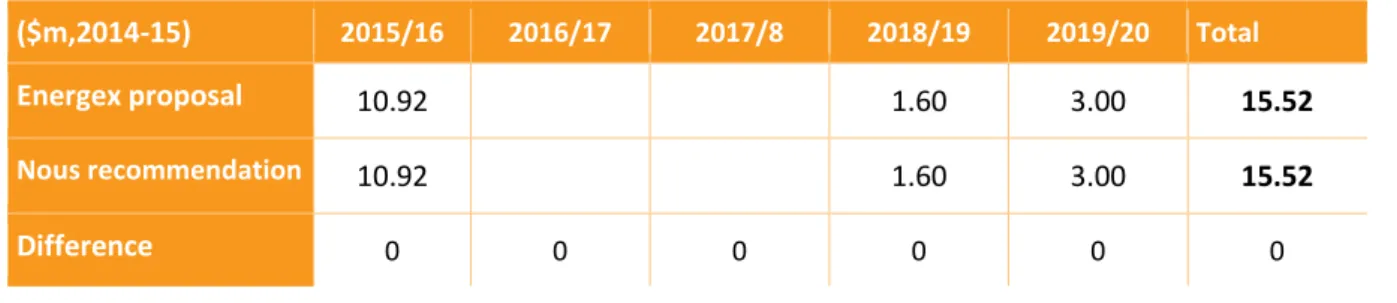
Based on our above review, Nous considers that the proposed expenditure is prudent to develop critical future distribution planning and management capability. This is summarised in Table 4.
Table 4: Nous conclusion – Network Information Enablement – forecast capex
($m,2014-15) 2015/16 2016/17 2017/8 2018/19 2019/20 Total
Energex proposal 10.92 1.60 3.00 15.52
Nous recommendation 10.92 1.60 3.00 15.52
Difference 0 0 0 0 0 0
2.3
Advanced Distribution Management
Key findings:
This program of work upgrades core Distribution Management System (DMS) capability as well as particular functions such as a Switching Request Register (SRR).
The business case chooses a preferred option of a complete program, costing $20M over the period, even though the NPV is better for a reduced program involving DMS and SRR upgrade only.
However, the capital profile in Energex’s proposal, totalling $11.5M, appears to match the costs for the basic DMS and SRR upgrade alone, indicating that a decision was made to propose the basic program only.
On this basis, we consider the costs justified to maintain operational management capability and safety in switching operations. It also aligns with the best NPV case in the Business Case.
Recommendation:
To support the proposed costs by Energex.
2.3.1
Project summary
This is a program of work to upgrade core Distribution Management System (DMS) capability as well as upgrades to particular functions. Prospective upgrades and additions in the Business Case are:
Switching administration Model Management HV/LV
Preliminary work on a fault detection, isolation and restoration capability
Energex has heavily invested in basic DMS capability in the current period and is operating V5.2.0 of the system, which is being replaced by the vendor with v6.0. V5.2.0 will lose vendor support in 2017/18.
2.3.2
Need
The basic case for the core upgrade to version 6 of DMS software and the Switching Request Register is presented on the basis of significant risk accruing in network operation and safety management, if the cores systems are not supported versions. On top of this, the case is built for operational improvements and efficiency that will result as higher order options are introduced.
2.3.3
Options
The options considered are: Do nothing
Deferral of the program to the following period Full program suite upgrade
DMS and SRR upgrade only with other components deferred.
The business case chooses a preferred option of a complete program, costing $20M over the period, even though the NPV is better for a reduced program involving DMS and SRR upgrade only.
However, the capital profile in Energex’s proposal, totalling $11.5M, appears to match the costs for the basic DMS and SRR upgrade alone, indicating that a decision was made to propose the basic program only in the final proposal. (The costs for these two components is $10.5M in the business case, with escalation to 14/15 prices likely to explain the difference).
2.3.4
Scope
Nous is satisfied that limiting the scope to the DMS and SRR upgrades is the correct decision on the basis of less certain benefits for higher order functions.
2.3.5
Cost
The costs appear realistic for functionality of this type.
2.3.6
Timing
The proposed timing is consistent with replacement of core DMS capability before support for the current version is lost.
2.3.7
Opex/capex trade-off
2.3.8
Conclusion
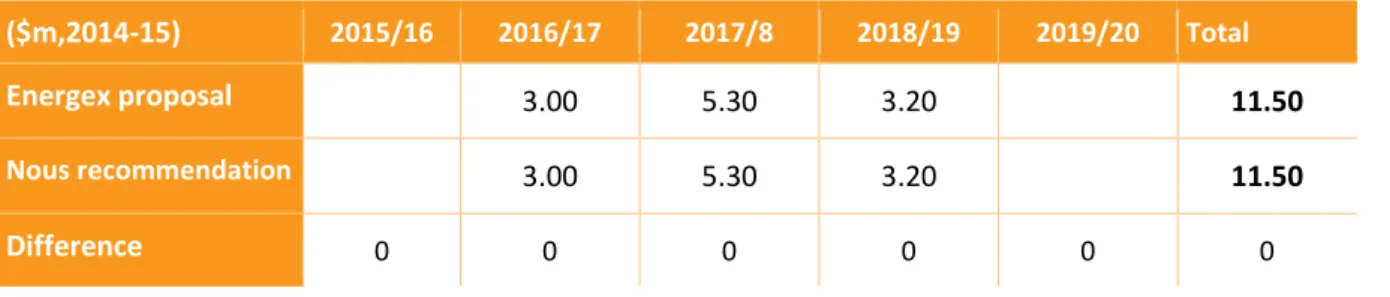
Based on our above review, Nous considers that the proposed expenditure is prudent to maintain the quality and safety of distribution operations. This is summarised in Table 5.
Table 5: Nous conclusion – Advanced Distribution Management – forecast capex
($m,2014-15) 2015/16 2016/17 2017/8 2018/19 2019/20 Total
Energex proposal 3.00 5.30 3.20 11.50
Nous recommendation 3.00 5.30 3.20 11.50
Difference 0 0 0 0 0 0
2.4
Distributed Workforce Automation
Key findings:
Energex uses Field Force Automation (FFA), based on the Ventyx Service Suite, first rolled out in 2007. Ergon has adopted the solution, with substantial completion of the transfer on the 2010-15 period. The two companies will now pursue upgrades and product renewals to maintain currency.
Nous considers this minor program to be justified.
Recommendation:
To support the proposed costs by Energex.
2.4.1
Project summary
Energex uses the Field Force Automation (FFA) solution based on the Ventyx Service Suite, first rolled out in 2007. During the 2010-15 regulatory period, Ergon adopted the solution and two companies will now pursue upgrades and product renewals to maintain currency. This will have a sustainment component and an extension to incorporate additional work types, where they can be economically justified.
2.4.2
Need
The business case justifies the recurrent expenditure in terms of maintaining current services with acceptable levels of quality and efficiency. Individual extensions to areas such as improved options for mobile devices will be justified over time where net benefits are positive.
2.4.3
Options
Individual options have not been examined in detail, given the low cost and prima facie justification for the core program of maintaining currency.
2.4.4
Scope
The scope of this project is defined above in Section 2.4.1
2.4.5
Cost
The proposed costs are accepted at face value.
2.4.6
Timing
The proposed timing is logical for recurrent expenditure and some expansions.
2.4.7
Opex/capex trade-off
Not analysed in detail.
2.4.8
Conclusion
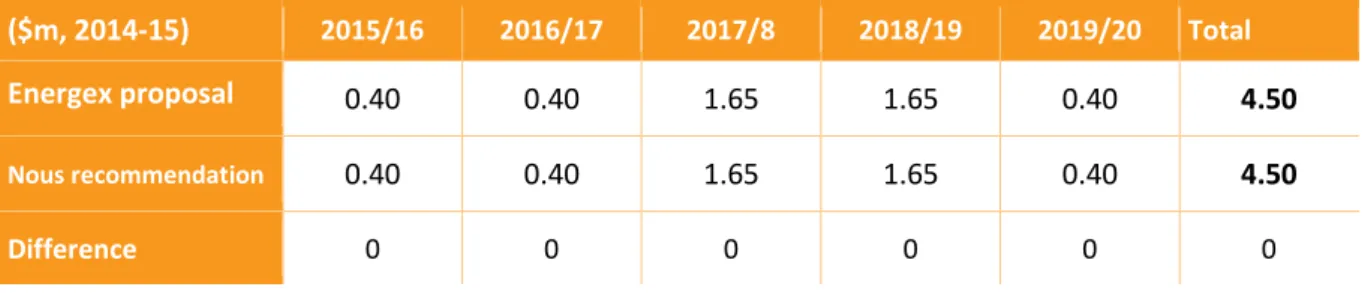
Based on our above review, Nous considers that the proposed recurrent costs are prudent and minor expansion costs efficient in the delivery of NEM outcomes. This is summarised in Table 6.
Table 6: Nous conclusion – Distributed Workforce Automation – forecast capex
($m, 2014-15) 2015/16 2016/17 2017/8 2018/19 2019/20 Total Energex proposal 0.40 0.40 1.65 1.65 0.40 4.50 Nous recommendation 0.40 0.40 1.65 1.65 0.40 4.50 Difference 0 0 0 0 0 0
2.5
Administrative ERP
Key findings: Replacement of core administrative ERP capability is prudent due to the existing Ellipse 5 system reaching end-of-life.
Recommendation:
To support the proposed costs by Energex.
2.5.1
Project summary
2.5.2
Need
The core driver for action is the expiration of support by Ventyx of the Ellipse 5 suite in June 2015. The operating platform is Windows Server 2003, with Microsoft withdrawing extended support for that platform from June 2015 as well. This requirement also drives the need to replace the EAM component of the suite, which is the subject of a separate business case, as described in Section 2.2.
2.5.3
Options
Energex identified the following three options:
Option 1: Do Nothing – evaluating the ICT capex and opex uplift that would be necessary to keep working with an unsupported Ellipse 5 suite.
Option 2: Deferral – similar to Option 1, but with deferral of replacement to the following regulatory period.
Option 3: Replacement – with a contemporary Administrative ERP system
Nous is satisfied that these options over the realistic range of alternatives to be considered.
2.5.4
Scope
The scope of this project under the preferred option is replacement of the core ERP suite over the first two years of the 2015-20 period. Nous has reviewed the information provided and considers that the proposal to upgrade the application reflects good industry practice.
2.5.5
Cost
The costs defined for the preferred option are for foundation ERP capability that will in turn support subsequent programs, such as the EAM program covered in Section 2.2. Nous is satisfied that the proposed costs for foundation capability are justified.
2.5.6
Timing
Timing in the first two years of the period is appropriate, given the impending obsolescence of the current system and the fact that this project provides foundation capability for other projects.
2.5.7
Opex/capex trade-off
The business case calculations demonstrate a net benefit as a result of the proposed replacement, at least in comparison with the deferral option, mainly due to the removal of opex and capex required to maintain operation without replacement. The Do Nothing case in theory has a slightly better NPV than both cases, but Nous is satisfied that it can be discounted as a realistic strategy. The organisation cannot deliver core administrative capability with indefinite use of an unsupported ERP system.
2.5.8
Conclusion
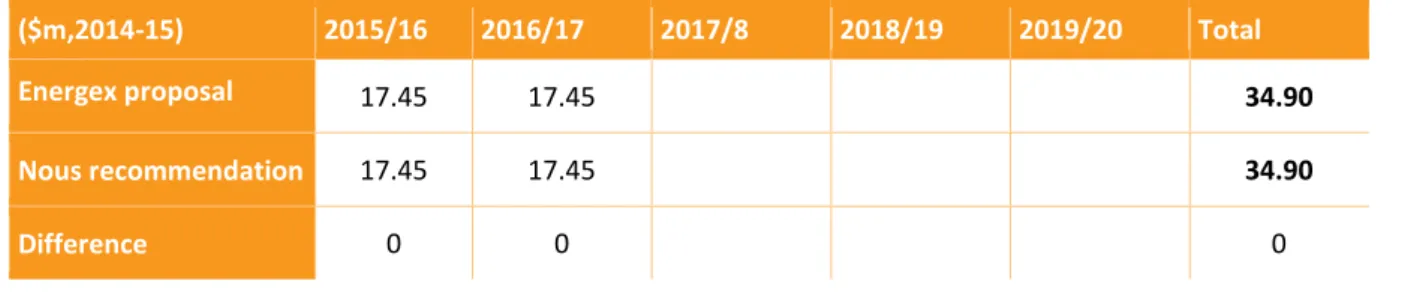
Based on our review, Nous considers the proposed expenditure is prudent to support core
administrative capability and enable subsequent delivery of projects to support network operation, such as EAM. This is summarised in Table 7.
Table 7: Nous conclusion – Administrative ERP – forecast capex
($m,2014-15) 2015/16 2016/17 2017/8 2018/19 2019/20 Total
Energex proposal 17.45 17.45 34.90
Nous recommendation 17.45 17.45 34.90
Difference 0 0 0
2.6
Market Systems Modernisation
Key findings:
Energex’s market systems, Nemlink and TohT, require upgrading early in the 2015-20 period to maintain reliability of data management and market gateway operations.
An upgrade of Peace is planned for late in the regulatory period and the case for this will draw on efficiencies to be achieved by the upgrade of the Customer Information System
Recommendation:
To support the costs proposed by Energex for securing TohT and Nemlink in the first two years of the regulatory period.
In the absence of a detailed business case, to defer the proposed costs of upgrading Peace by one year to the following regulatory period, to allow a proper assessment to be made.
2.6.1
Project summary
Energex’s market systems are planned for upgrading early in the period. They are: Nemlink – facilitates B2B and CATS interaction with the NEM
Toht – provides Local Network Service Provider (LNSP) meter data management capability. Peace – customer information and network billing functionality
The first two are planned to be upgraded early in the 2015-20 period and an upgrade of Peace is planned for the last year.
2.6.2
Need
We do not have a detailed business case for these system changes. However, Energex has provided a Business Proposal and a summary of the plans in the ICT Strategic Plan. Based on this information, Nous is satisfied that lack of action on Nemlink and Toht would introduce unacceptable risk in data
management and market operation.
The case for an upgrade of Peace late in the period is less clear. The main benefits appear to be related to efficiencies that will be derived down the track when there are evolving market changes, including Demand Side Participation. As the proposed expenditure is in the last year of the period, we propose deferral of that part of the expenditure by one year to the following regulatory period to allow proper
2.6.3
Options
Without a detailed business case to examine the assessment has been made on the basis of a risk of ‘Do Nothing’ discussion in the Business Proposal.
2.6.4
Scope
Nous has reviewed the available information and is satisfied that it is prudent to upgrade the Toht and Nemlink systems. However the upgrade of Peace requires further examination.
2.6.5
Cost
Nous is satisfied that the costs in the first two years are justified, but not the final year.
2.6.6
Timing
Action in the first two years is justified to reduce risk of failure of market systems
2.6.7
Opex/capex trade-off
The case for Toht and Nemlink do not rely on operational efficiencies. We expect that this will be a focus of a future business case for Peace.
2.6.8
Conclusion
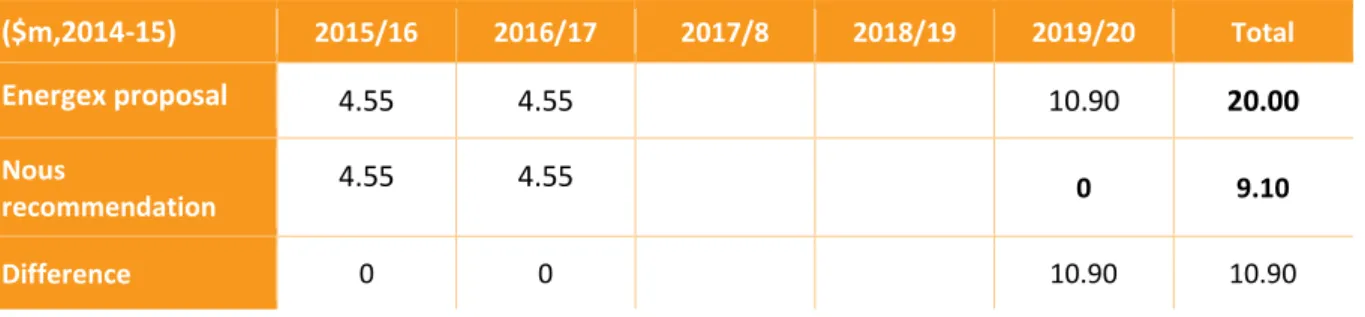
Based on our above review, Nous considers that the proposed expenditure in the first two years is justified, but the amount proposed for the final year should be deferred to the next regulatory period. This is summarised in Table 8.
Table 8: Nous conclusion – Market System Modernisation – forecast capex
($m,2014-15) 2015/16 2016/17 2017/8 2018/19 2019/20 Total
Energex proposal 4.55 4.55 10.90 20.00
Nous
recommendation 4.55 4.55 0 9.10
2.7
Business Analytics Renewal
Key findings:
Some components of the business analytics platform will become unsupported in the 2015-20 period and others may, although the suppliers has not made a firm announcement.
We have not had access to a detailed business case and have made our assessment on the basis of the Energex Business Proposal and the Ergon ICT Technology Plan for the common components.
There is no clear justification for the upgrade of existing capability and no assessment of services or functionality lost or at risk if this is not achieved.
On this basis, we consider the project to be discretionary.
Recommendation:
To remove the allowance for Business Analytics Renewal from the proposed Energex capital expenditure profile.
2.7.1
Project summary
The proposed project consists of further updates to a Business Analytics platform, which has been established in the 2010-15 regulatory period, without explicit funding approved by AER. Components of the infrastructure will become technically and asset obsolete in the 2015-20 period.
2.7.2
Need
On face value, there may be a case to upgrade components of the analytics platform as they reach points of obsolescence. However no detail is available to determine what services or functions would be affected and to what extent, if the upgrades are not delivered with the proposed timing. Given that the base platform has been developed without explicit funding, we consider the project to be discretionary.
2.7.3
Options
No options have been examined in detail.
2.7.4
Scope
The scope of this project is upgrade of components that may include SAP Business Analytics, Sharepoint 2010, Oracle SOA Suite and SAP Business Objects Data Services and a number of satellite applications. Nous has reviewed the information provided and considers that the proposal to upgrade these is not proven at this point. We also note that the upgrade of the Oracle SOA suite is part of the Integration Platform Renewal, separately reviewed in Section 2.9.
2.7.5
Cost
2.7.6
Timing
Timing not been examined in detail as the project is considered discretionary.
2.7.7
Opex/capex trade-off
There is no information available to demonstrate a tradeoff.
2.7.8
Conclusion
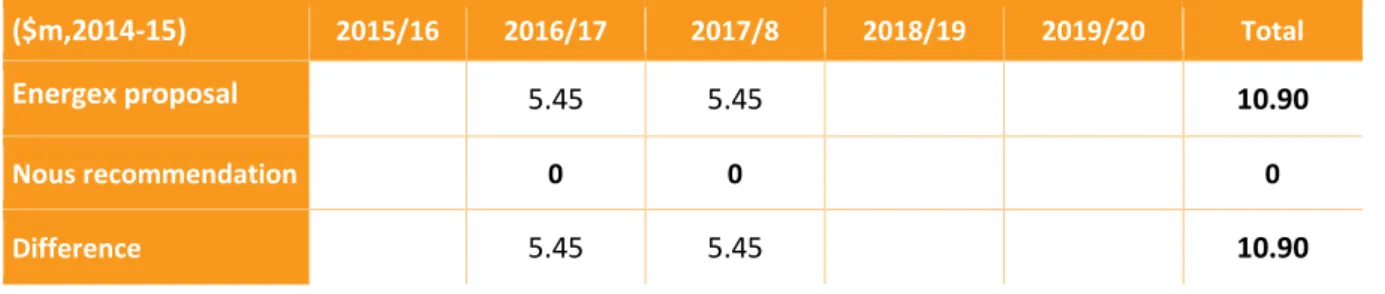
Based on our above review, Nous considers that the proposed expenditure is discretionary and has removed it from the revised capital expenditure profile. This is summarised in Table 9.
Table 9: Nous conclusion – Business Analytics Renewal – forecast capex
($m,2014-15) 2015/16 2016/17 2017/8 2018/19 2019/20 Total
Energex proposal 5.45 5.45 10.90
Nous recommendation 0 0 0
Difference 5.45 5.45 10.90
2.8
Information Security Enhancement
Key findings:
With the increasing level of data being transferred and the use of mobile devices, we consider that maintaining adequate levels of security is non-discretionary.
Recommendation:
To support the proposed expenditure by Energex to enhance information security.
2.8.1
Project summary
This project consists of enhancements to Energex’s security infrastructure.
2.8.2
Need
A prudent operator will continue to enhance its security infrastructure as information use and mobility increases.
2.8.3
Options
2.8.4
Scope
Not explicitly defined.
2.8.5
Cost
The proposed costs of $4.4M over the period are reasonable.
2.8.6
Timing
Proposed upgrades spaced four years apart are realistic.
2.8.7
Opex/capex trade-off
Not applicable.
2.8.8
Conclusion
Based on our above review, Nous considers that the proposed costs for upgrade of the security infrastructure are non-discretionary. This is summarised in Table 10.
Table 10: Nous conclusion – Information Security Enhancement – forecast capex
($m,2014-15) 2015/16 2016/17 2017/8 2018/19 2019/20 Total
Energex proposal 2.20 2.20 4.40
Nous
recommendation 2.20 2.20 4.40
Difference 0 0 0
2.9
Integration Platform Renewal
Key findings:
The Integration Platform is a key component of the ICT architecture and its application reduces the complexity and cost of interface and operation of many of the systems in Energex’s overall suite. The platform is due for renewal in the middle of the 2015-20 period and the business proposal
information provided by Energex demonstrates substantial net benefits from its continued operation.
Recommendation:
To support the costs proposed by Ergon for Integration Platform Renewal.
Creation of Cloud-Cloud integration capability
An increase in mobile application integration capability
An upgrade of processes to support data management and governance to a required level of maturity.
Together these will maintain and enhance the ability for applications to operate without the need for direct interfaces to be developed and maintained, reducing costs and complexity.
2.9.2
Need
An integration platform is a core component of a prudent operator’s ICT architecture, providing flexibility and supporting cost reduction in individual application delivery. The Business Proposal demonstrates substantial net benefits from its continued and expanded application. Energex has estimated 20% improvement in related application areas.
2.9.3
Options
The Business Proposal is based on the benefits of making the investment, compared with a do-nothing assumption.
2.9.4
Scope
Nous has reviewed the information provided and considers that the proposal to upgrade the integration platform reflects good industry practice.
2.9.5
Cost
In Nous view, the proposed costs are realistic
2.9.6
Timing
The proposed timing is towards the end of the required period defined in the Business Proposal.
2.9.7
Opex/capex trade-off
The Business Proposal identifies significant opex benefits that it states have been factored into the other project areas, on the assumption that the integration platform is maintained and renewed. Nous is not able to directly track the application of this assumption, but the fact that the platform already exists makes this the most likely outcome.
2.9.8
Conclusion
Based on our above review, Nous considers that the proposed costs for the Integration Platform Renewal are both in line with good industry practice and efficient, leading to substantial reduction in development and operating costs across a wide range of applications. This is summarised in Table 11.
Table 11: Nous conclusion – Integration Platform Renewal – forecast capex ($m,2014-15) 2015/16 2016/17 2017/8 2018/19 2019/20 Total Energex proposal 11.40 11.40 Nous recommendation 11.40 11.40 Difference 0 0
2.10
Desktop Productivity – Thin client
Key findings:
This project involves the upgrade of desktop operating platform and productivity applications from Microsoft Windows 7 and Office 2010, respectively, to versions that will be supported through the 2015 – 20 period.
Upgrading to supported versions will be essential to maintain efficiency and ensure security of the desktop infrastructure.
Recommendation:
To accept the costs proposed by Ergon
2.10.1
Project summary
This project consists of the upgrade of desktop operating platform and productivity applications from Microsoft Windows 7 and Office 2010, respectively, to versions that will be supported through the 2015 – 20 period. The current versions will be unsupported by 2019-20.
2.10.2
Need
In Nous view, the replacement is in line with good industry practice to maintain productivity and ensure security of the desktop infrastructure.
2.10.3
Options
Options have not been examined in detail, except to note the productivity loss and security risks that would accrue if the action is not taken.
2.10.4
Scope
Nous has reviewed the information provided and considers that the proposal to upgrade the above applications reflects good industry practice.
2.10.6
Timing
The proposed timing is consistent with loss of support in 2019/20 for the existing solutions.
2.10.7
Opex/capex trade-off
Not explicitly examined.
2.10.8
Conclusion
Based on our above review, Nous considers that the proposed costs by Energex are prudent. This is summarised in Table 12.
Table 12: Nous conclusion – Desktop and Productivity –Thin Client – forecast capex
($m,2014-15) 2015/16 2016/17 2017/8 2018/19 2019/20 Total
Energex proposal 2.53 1.27 3.80
Nous
recommendation 2.53 1.27 3.80
3
Efficiency Assessment
3.1
Current operating arrangements
ICT services for Energex are provided by SPARQ Solutions (SPARQ), a jointly owned subsidiary between Ergon Energy and Energex to create economies of scale and overall cost reduction for the provision of ICT capability.
Energex uses operating expenditure (including Asset Services fees) to recover SPARQ capital investment in ICT assets. However Energex directly procures client devices used by employees and contractors. Non-system ICT capital expenditure incurred directly by Energex relates only to end user devices such as desktop computers, laptops, tablets, handheld devices, smartphones and printers.
SPARQ's operating and capital expenditure for ICT services is charged to Energex as ICT service fees. Total ICT expenditure incurred by SPARQ associated with ICT services to Energex is treated as indirect operating expenditure and allocated to services consistent with Energex ‘s approved CAM.
The review of both Ergon Energy and Energex’s ICT spending proposals for the 2015-20 period shows that there will be a significant increase in application of common solutions across the two organisations. Most areas have matching strategies and investment profiles, with the notable exceptions being
Network Information Enablement programs, including GIS investments, and Advanced Distribution Management.
However, the business cases for the two organisations show that most of the projects are planned to be internally delivered within SPARQ with little use of outsourced services. (Deloitte has previously noted less than 4% from external sources). This is at odds with current trends in ICT services delivery in which the focus is moving strongly towards accessing externally provided services, whether at the platform, application or total service level. This is especially the case with applications that are universal across a range of industries, such as ERP and desktop services.
3.2
Current trends in ICT service delivery
The “Computer Economics IT Spending and Staffing Benchmarks Study” provides key metrics in financial and strategic management of IT and identifies current trends in organization IT spending and staffing. The survey involves executives in public and private sector from over 200 U.S. and Canadian IT organisations and helps identify long-term trends and benchmarks.
Major Findings of the 2015 study, recently released, are:
1. IT spending remains in a cyclical upswing. Over 65% of IT organizations are increasing IT operational budgets this year:
a. Larger organizations are doing better than smaller ones
b. service companies have stronger IT operational spending growth than manufacturing companies.
2. While IT operational budgets are rising at the fastest pace since the Great Recession, IT capital spending remains flat and IT headcount is increasing only at the margins.
4. The effects of transition to the cloud are emerging. Operational spending is accelerating while capital spending decreases.
5. The cost of IT is declining on a per-user basis and as a percentage of revenue. But IT executives are divided over whether budgets are adequate to meet organisational needs.
6. Investment in cloud applications and infrastructure is rising.
a. 56% of IT organizations are increasing spending on cloud applications compared with 10% growing spending on data centre infrastructure.
b. Transition to cloud has a long way to go - IT organisations continue to use data centres and employees to support critical business applications.
Our experience in Australia mirrors these findings. A recent article in Australia’s CIO magazine1 identifies five areas of IT that are on the rise and makes the following observations:
1. IT as a Service broker - You don’t build and run systems anymore, you deliver and service. A CIO’s value is in understanding what the business is about and mapping their knowledge and experience to the capability.
2. Software-as-a-service (SaaS) - this market will be worth $142 billion globally by 2020. Take advantage of this instead of maintaining legacy systems. Move to SaaS infrastructure and enable IT teams to focus on high value tasks.
3. Identity-as-a-service (IdaaS) - allows companies to encrypt all data right down to end point devices. Change in this space will be exponential as security is embedded into applications and capability rather than being around it like a wall. Identities are no longer the domain of a single organisation – the perimeter disappears for organisations with large distribution of customers, employees and partners. To validate identities, IdaaS will reduce reliance on internal
infrastructure for ‘who is who in the zoo’.
4. ArcOps – making an end-to-end role/capability responsible from architecture through to completion (rather than fragmented between developers and operational staff) to drive a lot more value. Developers will start to consider operations when creating their apps.
5. The ‘sharing’ economy - currently driven by innovators like Uber, Airbnb and Airtasker. We recognise that the operator of an essential regulated network will take a conservative view on the transition to outsourced or cloud-based services, but we can expect that the momentum towards this type of delivery will continue to increase over the next five years, including areas of comparable security and reliability requirements. The levels of investment in security infrastructure and integration capability in the SPARQ-based plans of Ergon and Energex point to an increasing capability to move in that
direction.
In that light, we are surprised by the extent to which the planned operating arrangement within SPARQ appears to be planned to remain primarily an in-house self-contained operation. The arrangement does not have any market-testing component either by Ergon (and Energex) outside the arrangement, or by SPARQ in its delivery of services.
We note that The Independent Review Panel on Network Cost (the Panel) included in its recommendations:
Alternative service delivery models for Information and Communication Technology services currently delivered by SPARQ solutions should be tested as follows:
1
o Issue market tenders for the delivery of capital projects
o Issue market tenders for the delivery of the relevant operational Information Communication and Technology services.
Our view is lightly different from those put forward by the Panel. We agree with the need to have market-testing but we also see a case to continue to drive for efficiency by combining the services for Ergon and Energex. The highly parallel nature of the two submissions shows that there will be an increasing level of use of common applications over the next five year period. This appears to have moved on since the Panel found that there had been very limited delivery of joint projects. The Panel recommendation is also not well geared to take advantage of the move to cloud-based services in line with the trends described above. The distinction between capital and operating components appears to support the status quo.
In Nous view, an alternative approach that could achieve the overall objective of efficiency would be to have SPARQ progressively moves towards a role as a broker of available market services, rather than be primarily a self-contained developer and operator, at least for applications that are genuinely common. Ergon Energy and Energex could still individually test the market for applications and services that are not in common and perhaps selectively for those that are. But the prime objective should be to capture both economies of scale and market-based efficiencies. This will also allow a more explicit examination of the value added by the SPARQ relationship.
We don’t see it reasonable to make adjustments to actual capital and operating allowances for this dynamic at this stage. However, if the position is clearly stated and an intention to benchmark the next round of pricing reset against publicly available SaaS and similar services (which will be substantial in five years), it would be reasonable in our view to make global adjustments in the next cycle.