Louisiana Tech Digital Commons
Doctoral Dissertations
Graduate School
Summer 2017
Understanding the effects of regulatory focus on
proactive behavior
Brian P. Waterwall
Louisiana Tech UniversityFollow this and additional works at:
https://digitalcommons.latech.edu/dissertations
Part of the
Business Administration, Management, and Operations Commons
,
Human
Resources Management Commons
, and the
Industrial and Organizational Psychology Commons
This Dissertation is brought to you for free and open access by the Graduate School at Louisiana Tech Digital Commons. It has been accepted for inclusion in Doctoral Dissertations by an authorized administrator of Louisiana Tech Digital Commons. For more information, please contact
Recommended Citation
Waterwall, Brian P., "" (2017).Dissertation. 52.
FOCUS ON PROACTIVE BEHAVIOR
by
Brian P. W aterw all, B.A., M.B.A.
A D issertation Presented in Partial Fulfillm ent o f the Requirem ents for the Degree
D octor o f Business A dm inistration
CO LLEG E OF BU SIN ESS LO U ISIA N A TECH U N IV ERSITY
All rights reserved
IN FO R M A TIO N TO A L L U SER S
T he quality o f this reproduction is d ep e nd e nt upon the quality o f the copy subm itted.
In the unlikely e ve n t th a t the a u th o r did not send a com plete m anuscript and there are m issing pages, these w ill be noted. Also, if m aterial had to be rem oved,
a note w ill indicate the deletion.
P roQ uest 10753659
ProQuest
Que
P ublished by P roQ uest LLC (2018). C o p yrig ht o f the D issertation is held by the Author.
All rights reserved.
T his w o rk is protected a ga in st unauthorized copying under Title 17, United S tates Code. M icroform Edition © P roQ uest LLC.
P roQ uest LLC
789 E ast E ise nh o w er Parkw ay P.O. Box 1346
THE GRADUATE SCHOOL
May 23, 2017
Date
W e hereby recommend that the dissertation prepared under our supervision
. Brian Waterwall
by____________________________________________________________________________________________
entitled________________________________________________________________________________________
"Understanding the Effects of Regulatory Focus on Proactive Behavior"
be accepted in partial fulfillment o f the requirem ents for the Degree o f
Doctor of Business Administration
_ ___ . ,SiiAervtsor o f Dissertation Research
■'y Head o f Department
Management
Department
Recom mendation concurred in:
z>
Advisory Committee'A p p r o v e d :
Director o f Graduate Studies Dean o f the Graduate School
£C
j
1 J
GS Form 13a
O ver the past decade, m otivation research has focused on w hat m otivates em ployees to engage in behaviors that fall outside o f ones’ job/task requirem ents and bring about meaningful change in the organization’s environm ent, proactive behaviors (Batem an & Crant, 1993; Crant, 2000). Recently, regulatory focus theory has received considerable research attention because o f its potential to explain additional variance in behavior beyond other m otivational constructs. Regulatory focus theory suggests that during goal striving, people will display behaviors associated w ith their current m otivational state. D raw ing from prior research exam ining m otivation and behavior, I propose and test a m odel that exam ines the effects o f em ployee w ork regulatory focus on proactive behavior. The hypothesized m odel focuses on individual and contextual factors w hich influence w ork regulatory focus. Further, given empirical findings o f prior
research on regulatory fit (e.g., Righetti, Finkenauer, & Rusbult, 2011; Spiegel, Grant- Pillow, & Higgins, 2004), I exam ine the m oderating effect o f two forms o f fit
(interpersonal and intrapersonal) on the relationship betw een w ork regulatory focus and proactive behavior.
Findings indicate regulatory focus theory is useful in predicting w orkplace behavior. Positive relationships w ere found betw een subordinate w ork prom otion focus and proactive person-environm ent fit behavior and proactive strategic behavior w hile controlling for proactive personality. Findings suggest that regulatory focus theory
behavior beyond that o f core proactive m otivation constructs (e.g., proactive personality). Further, this study explored the m oderating roles o f supervisor proactive
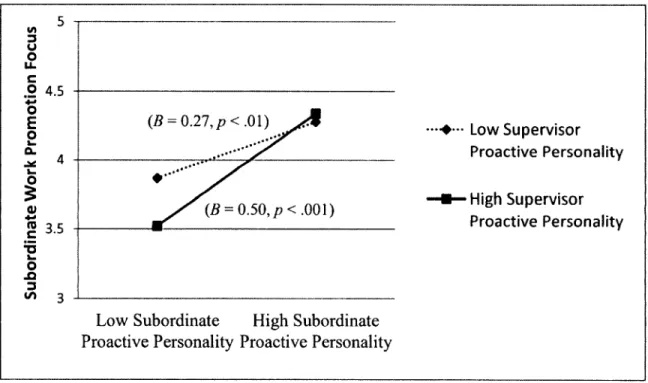
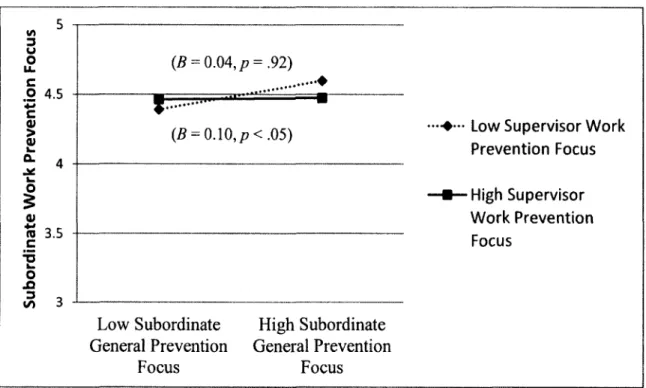
personality and supervisor work regulatory focus on the relationship betw een regulatory focus and work behavior. Supervisor proactive personality was found to m oderate the relationship betw een subordinate proactive personality and subordinate w ork prom otion focus. This suggests that proactive personality shapes em ployee cognitive m otivational states. No support w as found to suggest that supervisor work regulatory focus has a m oderating effect on subordinate w ork regulatory focus.
In support o f interpersonal regulatory fit theory, results indicate that interpersonal prom otion fit predicts both types o f proactive w ork behavior. This finding supports the idea that regulatory fit, in this case interpersonal prom otion fit, leads subordinates to experience positive affective states such as “feeling right” (Cesario, Grant, & Higgins, 2004) and should result in elevated levels o f proactive behavior.
The author grants to the Prescott M em orial Library o f Louisiana Tech U niversity the right to reproduce, by appropriate m ethods, upon request, any or all portions o f this D issertation. It is understood that “proper request” consists o f the agreem ent, on the part o f the requesting party, that said reproduction is for his personal use and that subsequent reproduction will not occur w ithout w ritten approval o f the author o f this D issertation. Further, any portions o f the D issertation used in books, papers, and other w orks m ust be appropriately referenced to this Dissertation.
Finally, the author o f this D issertation reserves the right to publish freely, in the literature, at any tim e, any or all portions o f this D issertation.
A uthor
Date < -
3- V/ 7
G S Form 14
A B STR A C T ...iii
LIST OF T A B L E S ... ix
LIST OF F IG U R E S ... xi
A CK N O W LED G EM EN TS... xii
CH A PTER 1 IN TR O D U C T IO N ... 1
The N eed for Future R esearc h ... 7
Purpose o f the Study and Research Q uestions...9
C o n trib u tio n s... 10
C H A PTER 2 LITERATURE REV IEW AND H Y P O T H E S E S ...13
Literature Review o f R egulatory Focus T h e o ry ... 13
O verview o f Regulatory F o c u s...13
Prom otion and Prevention F o cu s... 16
G eneral and Situational Regulatory F o c u s ...18
R egulatory F i t ...25
Potential Research A re a s ...27
Proactive B ehavior...35
Predicting W ork R egulatory F ocus...44
Personal A ttributes W hich Relate to W ork R egulatory F o c u s ...46
G eneral R egulatory Focus... 46
Proactive Personality... 47
Situational Influences o f W ork R egulatory F ocus...49
Supervisor Proactive P erson ality... 49
Supervisor W ork R egulatory F o c u s ...54
Predicting Proactive B ehavior U sing W ork Regulatory F o c u s ...57
R egulatory Fit and W ork R egulatory F o c u s...63
Intrapersonal Fit and Proactive B e h a v io r...64
Interpersonal Fit and Proactive B e h a v io r...66
CH A PTER 3 M E T H O D S ... 71
D ata C o llectio n ... 71
M easures... 72
R egulatory F o c u s ... 72
W ork Regulatory F o cu s...72
Proactive P erso n ality ... 73
Proactive B ehavior... 73
G eneralized C om pliance...74
R egulatory F i t ... 75
Control V ariables... 75
O rganization Innovation C lim ate...75
A g e ... 76
H ypothesis T e s tin g ... 76
CH APTER 4 R E S U L T S ... 78
Sam ple... 78
D em ographics... 78
D escriptive Statistics, C orrelations, and R eliabilities...79
Hypothesis Tests and R e s u lts ... 84
CH A PTER 5 D ISC U SSIO N ... 105
Research F indings...105
Theoretical Im plications and Future R e se a rc h ... 109
L im ita tio n s ... 115
Conclusion ... 120
A PPEN D IX A STUDY M E A S U R E S ... 121
A PPEN D IX B SUM M A RY OF H Y PO TH ESES...131
A PPEN D IX C A D D ITIO N A L T A B L E S ... 134
A PPEN D IX D HUM AN U SE A PPRO V A L L E T T E R ... 136
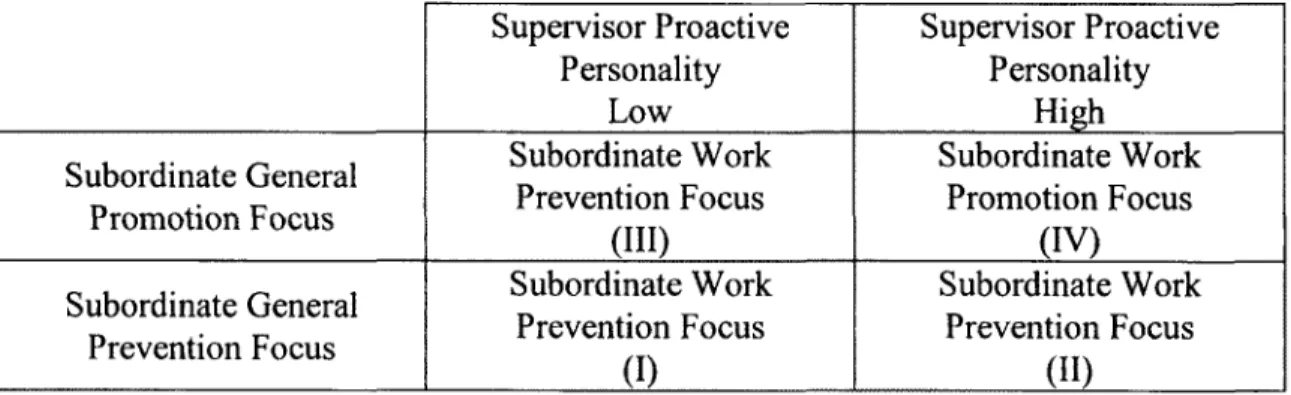
Table 2.1: Subordinate General Prom otion Focus, Supervisor Proactive Personality and Subordinate W ork Prom otion Focus for Supervisors High in
Prom otion Focus...60 Table 2.2: Subordinate General Prevention Focus, Supervisor Proactive Personality
and Subordinate W ork Prevention Focus for Supervisors H igh in
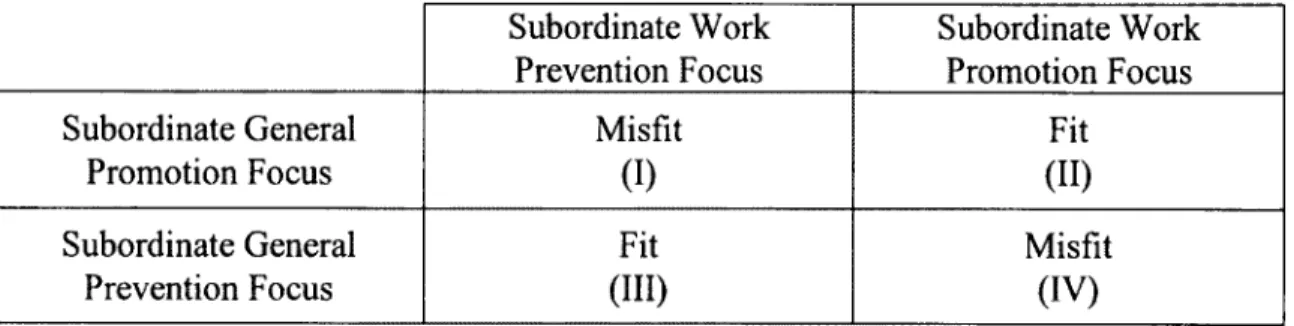
Prevention Focus... 60 Table 2.3: Intrapersonal Regulatory F it... 65 Table 4.1: M eans, Standard D eviations, and C orrelations...80 Table 4.2: Results o f H ierarchical R egression A nalyses Predicting Subordinate
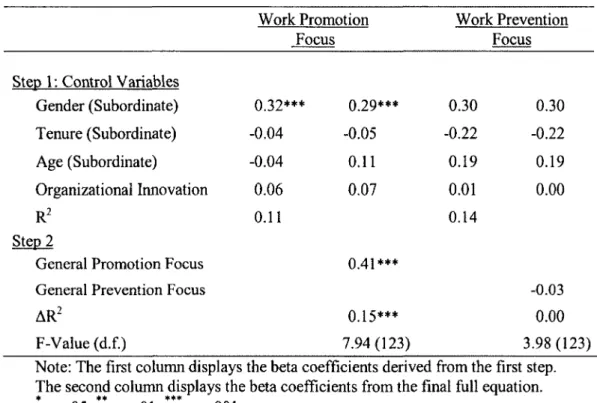
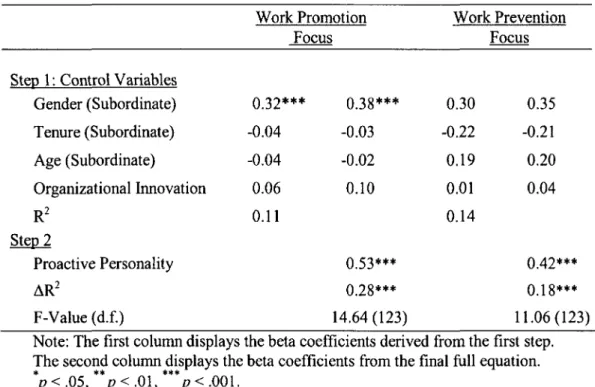
W ork Prom otion Focus and Subordinate W ork Prevention Focus... 85 Table 4.3: Results o f H ierarchical R egression A nalyses Predicting Subordinate
W ork Prom otion Focus and Subordinate W ork Prevention Focus... 86 Table 4.4: Results o f H ierarchical Regression A nalyses Predicting General
Prom otion Focus and G eneral Prevention Focus... 86 Table 4.5: Results o f the Interaction betw een Supervisor and Subordinate Proactive
Personality on Subordinate W ork R egulatory Focus... 87 Table 4.6: Results o f the Interaction betw een Supervisor W ork and Subordinate
G eneral Regulatory Focus on Subordinate W ork R egulatory F o cus...89 Table 4.7: Results o f H ierarchical Regression A nalyses Predicting Proactive
B ehavior... 91 Table 4.8: Results o f Hierarchical R egression A nalyses Predicting G eneralized
C om pliance... 93 Table 4.9: Results o f the Interaction betw een Subordinate W ork Prom otion Focus
and Subordinate General Prom otion Focus on Proactive W ork B ehavior... 94
Table 4.10: Results o f the Interaction betw een Subordinate W ork Prom otion Focus
and Subordinate G eneral Prom otion Focus on Strategic Scanning... 95 Table 4.11: Results o f the Interaction betw een Subordinate W ork Prom otion
Focus and Subordinate General Prom otion Focus on Proactive PE-Fit
B ehavior...96 Table 4.12: Results o f the Interaction betw een Subordinate W ork Prevention
Focus and Subordinate G eneral Prevention Focus on G eneralized
Com pliance... 97 T able 4.13: Results o f the Interaction betw een Supervisor and Subordinate W ork
Prom otion Focus on Proactive W ork B ehavior... 99 Table 4.14: Results o f the Interaction betw een Supervisor and Subordinate W ork
Prom otion Focus on Proactive Strategic B ehavior... 102 Table 4.15: Results o f the Interaction betw een Supervisor and Subordinate W ork
Prom otion Focus on Proactive PE-Fit Behavior...103 Table 4.16: Results o f the Interaction betw een Supervisor and Subordinate W ork
Figure 1.1: H ypothesized M odel...10 Figure 4.1: Interaction betw een Supervisor and Subordinate Proactive Personality on
Subordinate W ork Prom otion Focus... 88 Figure 4.2: Interaction betw een Supervisor W ork Prevention Focus and Subordinate
General Prevention Focus on Subordinate W ork Prevention Focus...90 Figure 4.3: Interaction betw een Subordinate W ork Prom otion Focus and Supervisor
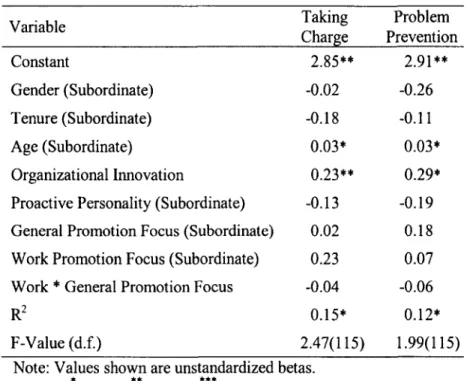
W ork Prom otion Focus on Taking C harge... 100 Figure 4.4: Interaction betw een Subordinate W ork Prom otion Focus and Supervisor
Several people have been essential in m y success in m y doctoral education and in com pleting m y dissertation. First, to m y com m ittee m embers: Dr. Bryan Fuller, Dr. M arcia D ickerson, and Dr. Kirk Ring, I w ish to express m y sincere gratitude for their advice and support throughout this process. Each o f you provided m e w ith the w isdom and determ ination to excel under the extrem e pressures and stress arising during m y time at Louisiana Tech University.
I w ould also like to thank m y fam ily for their sacrifice, support, and
understanding. Special thanks go to m y m om and dad, w ithout your love and support I w ould not be here today. Robert, w ithout your encouragem ent and investm ent I would not have em barked on this journey, thank you for pushing me. To m y daughter Katie, you are one o f the biggest sources o f m otivation w hich helped m e stay persistent and fight hard to com plete m y degree. A final thank you is owed to Jaim e, her sacrifices allowed m e to pursue this goal.
INTRODUCTION
“Let them do it. D o n ’t talk about it. Do it. ”
— M ichael Frese
A highly qualified w orkforce is a necessary com ponent o f organizational success. H owever, sim ply having qualified em ployees does not guarantee an organization will be successful; success requires action (i.e., output from em ployees). Research into what m otivates em ployees receives considerable attention in the m anagem ent literature. O ver the past decade, m otivation research has focused on w hat drives em ployees to engage in behaviors aim ed at bringing about m eaningful change in the organization’s environm ent such as proactive behaviors (Batem an & Crant, 1993; Crant, 2000). Several definitions o f proactive behavior appear in the literature including, “taking initiative in im proving current circum stances; it involves challenging the status quo rather than passively adapting to present condition” (Crant, 2000, p. 436), “self-initiated and future-oriented action that aims to change and im prove the situation or o n e s e lf’ (Parker, W illiam s, & Turner, 2006, p. 636), and “anticipatory action that em ployees take to im pact them selves and/or their environm ents” (G rant & Ashford, 2008, p. 4). Each conceptualization o f proactive behavior focuses on taking an active approach in ones work role in order to positively change the work environment.
A variety o f proactive behaviors have been identified in the last tw enty years o f research including: voice behavior (Van D yne & LePine, 1998), taking charge (M orrison & Phelps, 1999), problem prevention (Frese & Fay, 2001), issue selling (D utton & Ashford, 1993), proactive role perform ance (Fuller, M arler, & H ester, 2006), and job change negotiations (Ashford & Black, 1996). Empirical evidence suggests that proactive behavior has a positive im pact on desired outcom es such as increased efficiency and greater job satisfaction (Fuller & M arler, 2009; Grant, Parker, & Collins, 2009; Li, Liang, & Crant, 2010; M arler, 2008; Parker & Collins, 2010; T om au & Frese, 2013). The evidence present in the literature illustrates the im portance o f proactive behavior in organizations and considerable effort has focused on identifying and explaining the antecedents and m echanism s w hich lead to proactive behavior.
O ne o f the m ost influential predictors o f proactive behavior is proactive
personality, “one who is relatively unconstrained by situational forces, and w ho effects environm ental change” (Batem an & Crant, 1993 p. 105). Results from tw o proactive personality m eta-analyses suggest that proactive personality has a strong positive relationship with m any different forms o f proactive behavior (Fuller & M arler, 2009; T om au & Frese, 2013). Further, proactive personality plays an im portant role in proactive idea im plem entation and problem solving (Parker et ah, 2006) and has been related to jo b perform ance (Thom pson, 2005), as well as feedback seeking, m entoring, and career planning (Seibert, Kraimer, & Crant, 2001). D espite the grow th o f studies linking proactive personality w ith proactive behavior, m ore research is needed in order to better understand the m otivational m echanism s that link proactive personality and
behavior research incorporate regulatory focus as a m otivational m echanism in m odels o f proactive behavior (Glaser, Stam, & Takeuchi, 2016; M orrison, 2002). M orrison (2002) suggested that feedback seeking, a form o f proactive person-environm ent fit behavior (see Parker & Collins, 2010), m ay be the result o f one adopting a prom otion focus as the seeker m ay be searching for opportunities to achieve positive outcomes. R egulatory focus theory m ay be able to explain increm ental variance in proactive behavior beyond that explained b y antecedents com m only found in w orkplace behavior research (e.g., proactive personality). Results from Lanaj, Chang, and Johnson’s (2012) m eta-analysis indicate that regulatory focus, relative to eight other predictors (conscientiousness, extraversion, openness to experience, agreeableness, positive and negative affect, jo b satisfaction, and affective organizational com m itm ent), accounted for 17% additional variance explained in organizational citizenship behavior, 27% in counter productive w ork behavior, and 25% in innovative perform ance.
R egulatory focus theory (Higgins, 1997, 1998) provides insight into the processes and the underlining m otivational m echanism s w hich individuals use to regulate their behavior. R egulatory focus theory (RFT), rooted in self-discrepancy theory (SDT), illustrates how individuals focus on reducing discom forts caused by discrepancies
betw een their actual self and their ought or ideal self. A ccording to the hedonic principle, people are m otivated to approach pleasure and avoid pain. However, the hedonic
principle is too sim plistic in that it doesn’t address how or why people approach pleasure and avoid pain ju st that they do. In order to explain w hy and how people approach pleasure and avoid pain, SDT suggests that individuals use self-guides, internalized standards a person feels he or she should possess, as reference points w hen regulating
their behavior (Higgins, 1987, 1998). H iggins (1987) suggests there are three
conceptualizations o f the self w hich act as self-guides: actual, ought, and ideal (Higgins, 1987). The actual-self represents the attributes that one believes they actually possess, the ideal-self reflects the attributes one w ould ideally possess, and the ou gh t-self is the representation o f the attributes one believes they should possess (H iggins, 1987). RFT suggests that individuals will adopt either a prom otion or a prevention focus depending on w hich com bination o f selves is salient.
A ccording to RFT, the w ay in w hich people m anage progress tow ards a goal is dependent upon their regulatory focus. A prom otion focus is adopted w hen there is a discrepancy betw een the actual and ideal selves (Higgins, 1997). Individuals w ith a prom otion focus anticipate pleasure and use an approach orientation to achieve a desired end state. Individuals high in prom otion focus frame outcom es as hits (gains) and non hits (non-gains) and they desire to approach hits and avoid errors o f om ission (Higgins,
1997, 1998). Prom otion focus individuals engage in behaviors w hich increase the
likelihood o f success as pain and pleasure com e from the presences or absence o f positive outcomes. A lternatively, a prevention focus occurs when there is a discrepancy betw een the actual and ought selves (Higgins, 1997). Individuals high in prevention focus frame outcom es as losses and non -losses and are m otivated to approach non-loss and avoid errors o f com m ission (Higgins, 1997, 1998). Prevention focus individuals engage in behaviors w hich decrease the likelihood o f failure as pain is experienced w hen losses are present.
Findings from RFT research suggest that regulatory dispositions are m alleable; they can vary as a result o f the interaction betw een personal traits and contextual factors
(Higgins, 1997, 1998; Johnson, Smith, W allace, Hill, & Baron, 2015; Lanaj et al., 2012; M oss, Ritossa, & Ngu, 2006; Liberman, Idson, Cam acho, & Higgins, 1999; W allace, Little, Hill, & Ridge, 2010; Zacher & de Lange, 2011). Because regulatory orientations are m alleable, RFT distinguishes betw een tw o types o f regulatory orientation: general regulatory focus and situational regulatory focus. G eneral regulatory focus (GRF), o n e’s preferred regulatory state, is influenced by life experience and tends to be stable in adulthood (H iggins & Silberman, 1998). Personality traits are strong indicators o f GRF and research has identified m any traits w hich affect regulatory focus including:
extraversion, openness to experience, and agreeableness (G orman, M eriac, O verstreet, Apodaca, M cIntyre, Park, & Godby, 2012), anxiety (W allace, Johnson, & Frazier, 2009), risk propensity (Idson, Liberm an, & H iggins, 2000), self-esteem (M cG regor, Gailliot, Vasquez, & Nash, 2007), and self-efficacy (Lanaj et al. 2012) to nam e a few. A lthough individual factors such as regulatory focus affect goal setting processes and goal directed behavior, they rarely do so in isolation o f contextual factors.
Situational regulatory focus, som etim es referred to as w ork regulatory focus (W RF) in organizational research (Lanaj et al., 2012; N eubert, Kacm ar, Carlson, Chonko, & Roberts, 2008, W allace et al., 2009), assum es that em ployees adapt to stim uli in order to becom e m ore com patible w ith the work environm ent (Cam acho, H iggins, & Luger, 2003; Higgins, 2000). In the w orkplace, regulatory focus can be altered by contextual m echanism s such as rew ard structures (Freitas, Liberman, & H iggins, 2002), leadership (Benjam in & Flynn, 2006) and selection (Brockner, Higgins, & Low, 2004). For
exam ple, leaders can encourage their subordinates to adopt a prevention focus by em phasizing accountability (Peng, D unn, & Conlon, 2015) or by em phasizing
com pliance (Gino & M argolis, 2011). A lternatively, leaders can em phasize visions o f future success or a desirable outcom e to achieve in order to elicit a prom otion focus (Stam , Van K nippenberg, & W isse, 2010).
W ork regulatory focus has been linked to several different behaviors. Em ployees w ith an active prom otion focus are reported b y their supervisors as displaying m ore organizational citizenship behavior (OCB) than their prevention focused counterparts (W allace et al., 2009). Research suggests that a prom otion focus is positively related to helping behavior and a prevention focus is positively related to deviant behavior (Neubert et al., 2008). A nother study found that one’s regulatory focus m ediates the relationship betw een core self-evaluations and jo b satisfaction (Ferris, Johnson, Rosen, D jurdjevic, & Chang, 2013). Further, prom otion oriented em ployees w orking on collective tasks
continue to put forth effort even after the collective goal had been achieved (Aziz, 2008). That is, em ployees w ith an active prom otion focus will not reduce their w ork efforts w hen a goal is reached. Rather, they will continue to work hard in an effort to m axim ize collective outcomes. Since W RF is shaped as environm ental factors interact w ith o n e’s GRF, research suggests that regulatory fit theory can further our understanding o f the relationship betw een different regulatory foci and subsequent outcomes.
A ccording to regulatory fit theory m otivation tow ards goal pursuit is strengthened as a result o f an individual’s engaging in goal pursuit behaviors that align w ith their general regulatory focus (Higgins, 2000). There are two categories o f regulatory fit: intrapersonal regulatory fit and interpersonal regulatory fit. Intrapersonal fit refers to experienced fit betw een an individual’s general and situational regulatory foci (Righetti, Finkenauer, & Rusbult, 2011). Interpersonal fit occurs w hen an individual perceives “an
interaction partner to approach goal pursuit activities w ith a regulatory orientation that m atches the individual’s own regulatory orientation” (Righetti et al., 2011, p. 721). Both forms o f fit result in increased m otivation tow ards goal pursuit. Because regulatory focus is m alleable, m anagers m ay attem pt to influence subordinate regulatory focus in order to adjust subordinate perform ance (Johnson & W allace, 2011). W ith that in mind,
researchers and practitioners will benefit from research exam ining how supervisors influence subordinate regulatory focus to elicit desirable w orkplace behaviors such as proactive behavior.
The N eed for Future Research
D espite a recent surge in RFT research, there is little research using RFT to predict proactive behavior. A lthough empirical evidence suggests there is a link betw een regulatory focus and extra role behaviors (G orm an et al., 2012; Lanaj et al., 2012) m ost o f the research findings com e from studies looking at organizational citizenship
behaviors (e.g., Strobel, Tum asjan, Sporrle, & W elpe, 2013), leaving change focused behaviors, typically classified as proactive behaviors, unexam ined. O rganizational citizenship behaviors (O CB) are not the sam e as proactive behaviors. O CB refers to “individual behavior that is discretionary, not directly or explicitly recognized by the formal rew ard system, and that in the aggregate prom otes the effective functioning o f the organization” (Organ, 1988, p. 4). On the other hand, proactive behaviors are future oriented behaviors aim ed at bringing about positive change to the work environm ent (Batem an & Crant, 1993; Crant, 2000; T om au & Frese, 2013). One o f the key differences betw een the two types o f behavior is that proactive behavior is initiated in order to bring about change and change related behavior is inherently risky (Fuller et al., 2006; Parker
et al., 2006). Since regulatory focus is future oriented (Higgins, 1997) and different regulatory foci are associated with varying levels o f risk seeking and risk aversion
(Liberm an et al., 1999), using regulatory focus as a future oriented m otivational construct in a m odel o f proactive behavior m ay provide new insights into the proactivity process.
Researchers have also stated that future research needs to acknow ledge the fact that m ultiple m otivation processes drive proactive behavior (Parker, Bindl, & Strauss, 2010). Indeed, few studies o f proactive behavior include m ultiple m otivational
m echanism s. D oing so is necessary in order to better understand how each m echanism uniquely contributes to proactive behavior (see Fuller, M arler, & Hester, 2012). Further, little research exists that includes m ultiple m otivational m echanism s to predict proactive behavior. As stated by N guyen (2013), “as theories o f proactive personality evolve, it is necessary to investigate m ore potential m ediators for a better understanding o f the
process by w hich proactive personality ultim ately results in m eaningful outcom es” (p. 6). This dissertation attem pts to address this gap by including both a m otivational
m echanism that receives little attention in proactive behavior research (regulatory focus) and a core m otivational state that has been integral in understanding proactive goal setting and proactive goal striving (proactive personality).
Finally, although the idea o f regulatory fit is im portant to regulatory focus
research, there appear to be no studies w hich exam ine the sim ultaneous effect o f different forms o f regulatory fit (intrapersonal and interpersonal) on work outcomes. This is unfortunate as both conceptual and experim ental studies indicate that regulatory fit has a m oderate relationship w ith individual behavior as well as behavior w ithin exchange relationships (Righetti et al., 2011; Sassenberg, Jonas, Shah, & Brazy, 2007). Further,
w hile research suggests general and situational regulatory foci are distinct constructs (N eubert et al., 2008; W allace et al., 2009), studies w hich foci on regulatory fit rarely include m easures o f both general and situational regulatory foci. Since regulatory fit is concerned with the degree o f alignm ent betw een general and situational regulatory focus, research exam ining the interplay betw een both regulatory foci and different form s o f fit is needed.
Purpose o f the Study and Research Questions
The prim ary purpose o f this research is to investigate the effect o f work regulatory focus (W RF) on the frequency at w hich subordinates engage in proactive behavior and determ ine w hether or not regulatory focus can accurately predict w hich type o f proactive behaviors w ill be displayed. A secondary purpose o f this dissertation is to exam ine the path through w hich individual and contextual antecedents o f W RF relate to the tw o different types o f regulatory fit and how the degree o f regulatory fit m oderates the relationship betw een W RF and proactive behaviors. Figure 1.1 presents the
hypothesized m odel to be exam ined in this dissertation. The hypothesized m odel represents a potentially new paradigm o f proactive behavior in the w orkplace. M any proactive behavior studies tend to consider only one proactive behavior at a tim e (G rant & A shford, 2008). Studies w hich include m ultiple related proactive behaviors will assist in identifying the “key” drivers o f particular proactive behavior (Parker & Collins, 2010). This dissertation will explore the follow ing questions:
1. Does w ork regulatory focus predict different types o f proactive behavior? I f so, do work prevention and w ork prom otion foci uniquely predict different proactive behaviors?
S u p e rv is o r W o rk R e g u la to ry F o c u s -Q T J u <ursl JD .t; o += Cl Q. LL JQ Q . Q . JQ Q. Q. CO o_ LL. CC Cl <D O 4> _N '55 o -4- * o & X u S3 OX)
2. To what degree does supervisor work regulatory focus m oderate subordinate w ork regulatory focus?
3. Does proactive personality relate to work regulatory focus? If so, does supervisor proactive personality m oderate this relationship?
4. To w hat degree do different forms o f regulatory fit (intrapersonal and
interpersonal) m oderate the relationship betw een subordinate w ork regulatory focus and proactive behaviors?
Contributions
This dissertation prom ises several theoretical and practical contributions to the m anagem ent literature. First, this is one o f the first studies to use regulatory focus as a m otivational state to predict m ultiple forms o f proactive behavior. In doing so, the present research illustrates the extent to w hich RFT provides increm ental understanding o f the m otivational processes that underlie proactive behavior beyond that o f core proactive m otivation constructs (e.g., proactive personality).
Second, illustrating how the work environm ent shapes subordinate W RF is im portant for several reasons. First, illustrating the effect o f supervisor proactive personality on subordinate proactive behavior suggests that different com binations o f supervisor traits have unique effects on subordinate W RF and subsequent subordinate behavior. N ext, although results indicate that supervisor W RF is not related to
subordinate W RF, finding that supervisor proactive personality is significantly related to work prom otion focus. A pproxim ately 95% o f subordinates in the sam ple w ere found to have a general prom otion focus. Yet, only 32% o f the subordinates w ere found to be higher in work prom otion focus than work prevention focus. This suggests that
subordinates are adopting a situational regulatory focus that is not aligned w ith their general regulatory focus. Taken together, the findings support the claim that the work environm ent plays a crucial role in determ ining em ployees WRF.
Last, the findings from the regulatory fit analyses suggest that interpersonal regulatory fit has a greater im pact on subordinate behavior than intrapersonal regulatory fit. This indicates that som e supervisor/subordinate dyads are better positioned to
positively im pact the work environm ent than others. W hen taken together, findings from this study suggest that organizations w ishing to increase the presence o f proactive behavior in the w orkplace should take care to m atch subordinates w ith supervisors based on proactive personality and regulatory foci.
LITERATURE REVIEW AND HYPOTHESES
This chapter review s literature on regulatory focus, proactive behavior and proactive personality. Theoretical and em pirical studies in each area are discussed. The regulatory focus literature review includes a discussion o f the studies used to introduce, develop, and validate regulatory focus theory. This section includes a review o f the studies that investigate the personal and contextual variables w hich are thought to be related to regulatory focus as well studies exam ining regulatory fit. The proactivity literature review includes a discussion o f proactive behavior w ith an em phasis given to proactive personality and how it relates to proactive behavior. The final section integrates regulatory focus and proactive behavior and identifies the areas in the literature that this study aims to explore.
Literature Review o f R egulatory Focus Theory O verview o f R egulatory Focus
H iggins (1997) introduced RFT in hopes o f encouraging scholars to m ove beyond using the hedonic principle as the sole lens through w hich they exam ine m otivation. The basic assum ption o f the hedonic principle is that people are m otived to approach pleasure and avoid pain. H owever, the approach-avoidance concept is too sim plistic to provide an
understanding o f the w ay individuals behave (Higgins, 1997). The hedonic principle indicates w hat an individual’s desired end state m ay be, but it does not describe the means b y w hich a person attempts to achieve this state. The hedonic principle provides a rational for w hy people put forth effort to achieve a goal, but it does not describe the actual m ethods people use to achieve goals. Goals can be attained using a variety o f strategic means; b y integrating approach-avoidance m otivation and self-regulation (see Bandura, 1977; B andura & Cervone, 1983; Carver & Scheier, 1990), H iggins (1997), suggests that regulatory focus theory can provide insight into the m eans by w hich individuals take action to pursue their goals.
H iggins (1997) relied heavily on self-discrepancy theory (SDT) w hen developing regulatory focus theory (RFT). A ccording to SDT, people are m otivated to align their self-concept and self-guide (Higgins, 1987). A person’s self-concept represents the attributes the person feels he or she actually possesses. The self-concept, often referred to as the actual-self, refers to how the person believes he o r she is actually represented (H iggins, 1998). Self-guides represent internalized standards a person feels he or she should possess. A ccording to H iggins (1987, 1998), self-guides are represented by two distinct selves: the ideal-self and the ought-self. The ideal-self represents the attributes that a person would like to possess; they are a person’s hopes and aspirations (Higgins,
1987). Follow ing the ideal self-guide results in a regulatory state aim ed at
accom plishm ent and uncovering opportunities to advance (Freitas & H iggins, 2002). On the other hand, the ought-self represents the attributes that a person believes he or she should possess. Oughts are characterized as a person’s sense o f duty, obligation, and responsibility (Higgins, 1987). Follow ing an ought self-guide results in a regulatory state
aim ed at avoiding obstructions to responsibility and obligations. An assum ption o f SDT is that individuals are m otivated to achieve a state w here the self-concept and self-guide aligns (Higgins, 1987). Individuals experience negative em otions (e.g., discom fort, dejection, fear, sadness) w hen a discrepancy exists betw een their self-concept and their self-guide. N egative em otions result from the absence o f positive outcom es or from the presence o f negative outcom es w hile successful attainm ent o f desired end states is associated w ith cheerfulness (Baas, De Dreu & N ijstad, 2008). SDT suggests that individuals are m otivated to reduce or elim inate the negative em otions caused by a discrepancy betw een their actual and desired self (Higgins, 1987).
Regulatory focus theory (RFT) is concerned w ith the process b y w hich
individuals self-regulate their behavior in order to align their self-concept and self-guide (G orm an et al., 2012; Higgins, 1997, 1998; Lanaj et al., 2012). M eaning, regulatory focus is a m echanism that m otivates changes in goal attainm ent strategies in response to
feedback about one’s current state (Higgins, 2000). RFT attempts to account for individual differences in how people view goals and provide an explanation as to w hy people adopt certain strategic m eans to achieve their goals (B rockner et al., 2004; G amache, M cNam ara, M annor, & Johnson, 2015). Pleasure and pain serve as reference points for individuals w hen determ ining desired (positive reference point) and undesired (negative reference point) end-states (Higgins, Roney, Crowe, & Hymes, 1994). People regulate pleasure and pain by using different self-regulatory system s (H iggins, 1996). D iscrepancy reducing systems, also referred to as approach systems, involve attem pts to move o n e’s actual-self closer to a positive reference point (Carver & Scheier, 1990). In order to reduce discrepancies, individuals using an approach system will “approach self
states w hich m atch desired end-states or avoid states that m ism atch the desired end-state” (H iggins et al., 1994, p. 276). On the other hand, self-regulatory systems w hich use negative reference points are referred to as discrepancy am plifying or avoidance systems because they involve attem pts to m ove one’s actual self aw ay from an undesired end- state (Carver & Scheier, 1990). U nder the discrepancy am plifying system, individuals can approach self-states w hich m ism atch the undesired end-state or avoid states that m atch the undesired end-state (H iggins et al., 1994).
Prom otion and Prevention Focus
By integrating approach-avoidance m otivation and self-regulation, RFT provides insight into the m eans by w hich individuals pursue their goals. RFT suggests that people self-regulate their behavior differently w hen serving different needs (H iggins, 1997). RFT describes two system s b y w hich individuals regulate behavior during goal pursuit: a prom otion focus w hich focuses on nurturance needs and a prevention focus w hich focuses on security needs. A person’s regulatory orientation affects how they view their goals and indicates a preference for adopting one strategic m eans over another (Scholer & H iggins, 2008). RFT is useful to behavioral research as prom otion and prevention foci have unique effects on behavior (G am ache et al., 2015).
A prom otion focus is characterized by a concern with advancem ent, grow th, and accom plishm ent and involves striving for goals follow ing an ideal self-guide (W allace, Butts, Johnson, Stevens, & Smith, 2016). Ideals are goals w hich represent hopes and aspirations (Higgins, 1987). Individuals adopting a prom otion focus desire to approach pleasure and avoid the absence o f pleasure, and will use eagerness-related m eans during goal pursuit. H iggins (1997, 1998) suggests that w hen individuals adopt a prom otion
orientation, positive outcom es are fram ed as gains or hits and negative outcom es are framed as non-gains or non-hits. The desire is to approach hits (gains) and avoid errors o f om ission (non-gains). A ttaining goals using a prom otion focus results in positive
em otions such as cheerfulness or enjoyment. Failure to obtain goals leads to experienced negative em otion such as disappointm ent, sadness, and frustration (Baas, et al., 2008; Crow e & H iggins, 1997). Self-regulation occurs in response to the presence or absence o f positive outcomes. Losses are not salient to individuals striving for goals under a
prom otion focus; they’re only concerned w ith achieving hits and avoiding errors o f om ission (Higgins, 2000). U nder a prom otion focus, goals are view ed as m axim al goals and success is m ore intense than non-success (Halam ish, Liberman, H iggins, & Idson, 2008; Idson et al., 2000). In the w orkplace, high prom otion focus em ployees are m otived to engage in agentic w ork behavior including exceeding expectations, exploring
alternatives and experim enting, and taking risks (W allace et al., 2016). Therefore, a prom otion focus is associated w ith behaviors w hich increase the likelihood o f success (e.g., proactive behaviors).
Prevention focus is characterized by a concern w ith safety, security, and fulfillm ent o f duty or responsibility. Individuals adopting a prevention focus strive for goals using the ought-self guide w hich represent goals that m ust be m et (Higgins, 1987; Idson et al., 2000). Individuals w ith a prevention focus anticipate pain and adopt a discrepancy am plifying system to avoid undesired end states. A ccordingly, prevention focused individuals will use vigilance-related m eans during goal pursuit. H iggins (1997,
1998) suggests that w hen individuals adopt a prevention focus, outcom es are fram ed as losses and non-losses. Prevention oriented individuals approach non-losses and avoid
losses or errors o f com mission. Self-regulation occurs in response to the presence or absence o f negative outcom es (Higgins, 2000). M aintaining the status quo is salient and brings pleasure w hereas pain is experienced w hen losses occur. W hen a prevention focus is activated, goals are view ed as m inim al goals and failure to attain a m inim al goal is m ore intense than a success (Halam ish et al., 2008; Idson et al., 2000). W hen individuals achieve goals w ith a prevention focus they experience quiescence (calm and serene) w hereas failure to achieve a goal results in agitation and frustration (Baas, et al., 2008; Crow e & Higgins, 1997). In the w orkplace, prevention focus em ployees are less likely than prom otion focus em ployees to take risks or seek opportunities to develop new routines (W allace et al., 2016). Therefore, prevention focus is associated w ith behaviors w hich decrease the likelihood o f failure (e.g., com pliance and task perform ance).
G eneral and Situational Regulatory Focus
Prom otion and prevention focus strategies are not opposite ends o f a continuum. As suggested by H iggins et al. (1994), “all people possess both systems, but different socialization experiences could m ake one system predom inant in self-regulation” (p. 277). A person’s regulatory orientation is shaped by personal traits and contextual factors, and can vary from one situation to the next (G orm an et al., 2012; H iggins, 1997,
1998; Idson et al., 2000; Johnson et al., 2015; Lanaj et al., 2012; M oss et al., 2006; Liberm an et al., 1999; N eubert et al., 2008; W allace et al., 2010; Zacher & de Lange, 2011). Therefore, a person’s regulatory focus can be referred in term s o f a general regulatory disposition and a situational regulatory disposition.
G eneral regulatory focus (GRF, som etim es referred to as chronic regulatory focus) is an individual disposition w hich is shaped by life experience and tends to be
stable in adulthood (H iggins & Silberman, 1998). Personality traits are strong indicators o f GRF and as such, research has given considerable attention to exam ining the effects o f different traits on GRF. For example, the big five personality factors are related to
regulatory focus but each o f the five factors differs in the degree to w hich it shapes o n e’s regulatory orientation. Results from two recent m eta-analyses suggest that extraversion, openness, and agreeableness are positively related to prom otion focus and negatively related to prevention focus (Gorm an et al., 2012; Lanaj et al., 2012). Results also suggest that neuroticism is the strongest predictor o f prevention focus and conscientiousness has positive effects on both prom otion and prevention foci (G orm an et al., 2012; Lanaj et al., 2012). O ther individual factors w hich relate to GRF include: anxiety (W allace et al., 2009), risk propensity (Idson et al., 2000), self-esteem (M cG regor et al., 2007), and self- efficacy (Lanaj et al., 2012) to nam e a few.
On the other hand, situational regulatory focus refers to a regulatory state that occurs as a result o f environm ental factors interacting with an individual’s GRF. Liberm an et al. (1999) provide initial evidence to illustrate the m alleability o f GRF. Liberm an et al. (1999) conducted several experim ents w hich sought to determ ine w hether o r not a prom otion or a prevention focus m aybe evoked based on how a task is framed. In the experim ents participants had to com plete a task in w hich they had to describe an object to another person in such a w ay that the other person w ould b e able to correctly identify the object from am ongst m any other objects. The task and the rew ards were m anipulated so as to reflect a prom otion or a prevention focus. Participants in the prom otion focus treatm ent were told they w ould start with 0 points and be rewarded points for each figure they described well. Participants in the prevention focus treatm ent
were told they w ould start w ith 6 points but w ould be penalized 2 points for each figure they did not describe well. D uring the experim ent, all participants w ere interrupted w hile describing the third object and w ere advised that they could resum e their current task or m ove to another task. For participants in the prom otion focus treatment, either task (continuing to describe the current object or m oving to the next object) is suitable for m axim izing rewards. H owever, for participants in the prevention focus treatm ent, m oving on to a new task m eans incurring a penalty for not com pleting the current task. Therefore, both tasks are necessary for goal accom plishm ent and individuals m ust finish their
current task before m oving on to the next one. Results from this study provide evidence that the characteristics o f a task can be altered in order to m anipulate a p erson’s
regulatory orientation; a finding that supports the existence o f situational regulatory focus.
Situational regulatory focus, som etim es referred to as work regulatory focus (W RF) in organizational research (Lanaj et al., 2012; N eubert et al., 2008, W allace et al., 2009), assum es that em ployees adapt to stim uli in order to becom e m ore com patible w ith the work environm ent (Cam acho et al., 2003; Higgins, 2000). A subordinate’s regulatory orientation responds to situational influences w hich alter their behaviors at work
(Johnson & W allace, 2011). For exam ple, em ployees can receive cues from the work environm ent as to w hich behaviors are rew arded and w hich behaviors are punished. Em pirical evidence indicates that W RF is m ore strongly related to work attitudes and behaviors than general regulatory focus (Lanaj et al., 2012). W hen taken together, the finding that W RF is a strong predictor o f work attitudes and behavior and that GRF is m alleable has im portant im plications for m otivation in the workplace. In a w ork context,
regulatory focus can be m anipulated through m echanism s such as rew ard structures, leadership, values and norm s, and interpersonal interactions (Benjam in & Flynn, 2006; Brockner et al., 2004; Freitas et al., 2002; G am ache et al., 2015). For exam ple, Brockner and H iggins (2001) suggest that leader regulatory focus and leader behavior can be interpreted by subordinates as an indicator as to w hat type o f behavior(s) supervisors expect in the workplace. Because regulatory focus is malleable, supervisors can play an active role shaping their subordinate’s regulatory orientation by role m odeling desired behaviors, altering the w ork environm ent, or b y fram ing tasks/objectives to m atch a desired regulatory orientation.
In one o f the first studies exam ining leadership regulatory focus, W u, M cM ullen, Neubert, and Yi (2008), found evidence w hich indicates that leadership plays an
im portant role in shaping follower situational regulatory focus. W u et al. (2008) suggest that leader regulatory focus shapes follower regulatory focus through a fram ing effect. M eaning leaders attem pt to alter the w ay followers view a situation w hich, and if successful, affects subsequent behavior. A ccording to Brockner and H iggins (2001), supervisors can foster a prom otion focus from subordinates by em phasizing ideals and accom plishm ents (ideal-self). On the other hand, supervisors can attem pt to foster a prevention focus from their subordinates b y em phasizing obligations and duty (ought- self). Further, research suggests that even subtle differences in how a situation is framed can alter subordinate behavior (Gino & M argolis, 2011).
Results from N eubert et al. (2008) indicate that regulatory focus m ediates the relationship betw een both initiating structure and servant leadership and behavioral outcom es such as deviant, helping, and creative behavior. In a sim ilar vein, Cheng,
Chang, Kuo, and Cheung (2014) found evidence to suggest that regulatory focus
m oderates the relationship betw een ethical leadership and em ployee engagem ent; w hich is positively related to voice behavior. W hether em ployees are affect by their supervisor’s attem pts to increase m otivation depends on both the em ployee’s and the supervisor’s dispositions.
A ccording to social learning theory, behaviors are learned by observation (Bandura, 1977). Individuals will strive to em ulate behaviors o f their role models, leaders, and coworkers. In the w orkplace, supervisors can serve as a positive or a
negative role model. Individuals view positive role m odels as representing a desired-self and view negative role m odels as representing an undesired-self (Lockw ood, 2002). Positive role m odels focus on the pursuit o f success by encouraging the use o f strategies that prom ote desired outcom es (Higgins et al., 1994). N egative role m odels focus on avoiding failure by encouraging strategies that avoid undesired outcomes. Supervisors m ay induce a prom otion or prevention focus by fram ing outcom es (e.g., rew ards) in term s o f losses to avoid or benefits to gain (Crow e & H iggins, 1997). A dditionally, supervisors m ay em phasize jo b obligations and m inim al perform ance standards to elicit a prevention focus from subordinates (K ark & V an Dijk, 2007) o r com m unicate appealing visions to elicit a prom otion focus (N eubert et al., 2008; Stam et al., 2010). Results from Lockwood, Jordan, and K unda (2002) suggest that positive role m odels increased
m otivation o f prom otion focus individuals and negative role m odels increased m otivation for prevention focus individuals. Further, prom otion focused individuals prefer positive role m odels w hen considering additive behaviors (Lockwood, Sadler, Frym an, & Tuck, 2004). This phenom enon is thought to occur as a result o f prom otion focus individuals
seeking out inform ation that relates to the pursuit o f success w hile prevention focus individuals are m ore sensitive to inform ation that to relates to the avoidance o f failure (Lockw ood et al., 2002). This finding suggests that w hether or not a supervisor has an im pact on em ployee m otivation depends, in part, on the strength o f the em ployee’s prom otion or prevention focus.
M oss et al. (2006) suggested that leaders could influence w hether their followers w ould experience eagerness or vigilance in the w orkplace. Since transform ational leaders em phasize uplifting em otions and encourage em ployees to fulfill their aspirations,
transform ational leadership should be associated w ith eagerness strategies and result in em ployees using a prom otion orientation (M oss et al., 2006). Corrective-avoidance leadership is focused on errors and shortfalls. This type o f leadership em phasizes using vigilance and result in em ployees using a prevention orientation (M oss et al., 2006). Their findings suggest that w hile corrective-avoidant leadership does not lead subordinates to adopt a prevention focus, corrective-avoidant leadership does curb prom otion oriented behavior.
Findings from a recent study b y W allace et al. (2016) further highlight the effect o f leadership and the w ork environm ent on the relationship betw een em ployee regulatory orientations and w orkplace behavior. The purpose o f their study was integrating self- determ ination theory and RFT to explain how individual and contextual factors interact to shape em ployee m otivation and innovation. They hypothesize that em ployee thriving is positively related to innovation. W hen thriving at w ork, em ployees: have m ore energy and m otivation for exploring new processes, are in a position to recognize and im plem ent im provem ent opportunities, and experience positive m oods and em otions w hich foster
cognitive thinking and problem solving (W allace et al., 2016). They also suggest that em ployees high in prom otion focus are m ore likely than prevention focus em ployees to experience thriving. However, ju st because an em ployee adopts a prom otion focus does not m ean they will thrive or innovate. Rather, “the opportunity to pursue such behaviors depends on the w orkplace context” (W allace et al., 2016, p. 988). Supervisors can increase the opportunity for em ployees to thrive b y creating high involvem ent climates. Supervisors can develop high involvem ent clim ates b y providing em ployees with: opportunities to participate in decision m aking, opportunities for training and
developm ent, and autonomy. In high involvem ent climates, prom otion focus em ployees experience strong m otivation as a result o f thriving and are m ore likely to innovate than prevention focus em ployees (W allace et al., 2016).
Taken together, the research presented above suggests that the elem ents w ithin one’s environm ent, especially leadership, im pact the regulatory orientation one uses to pursue goals. Consider the following scenarios, both adapted from Johnson et al. (2015). In the first scenario, a supervisor frames a task as being prom otion oriented by
dem anding an increase in profits. The em ployee responds by low ering the im portance placed on due diligence (decreased vigilance) w hen selecting new projects in order to take on m any projects w ith the hopes o f obtaining m any successes (increased eagerness). H owever, the supervisor can also frame the task as being oriented tow ard a prevention focus. This is accom plished by em phasizing reduced financial losses over larger profits. The em ployee responds by increasing due diligence (increased vigilance) w hen
approving new projects. This results in a few projects being started overall, but each project has a high likelihood o f success; subsequently reducing the potential to incur
financial losses. In both scenarios, the em ployee adopts a regulatory orientation that aligns w ith the requirem ents o f the task. It’s im portant to note that the opportunity to pursue behaviors aligned w ith one’s regulatory orientation is dependent on the context o f the environm ent (W allace et al., 2016). M otivational dispositions m a y b e o f little
consequence if the environm ent is not supportive. Regulatory Fit
W hile there are m any factors w hich determ ine a person’s initial level o f m otivation to pursue a goal (e.g., self-efficacy, personality), regulatory fit determ ines w hether existing m otivation is strengthened or w eakened during the goal pursuit process (Spiegel, G rant-Pillow , & Higgins, 2004). RFT is concerned w ith goals and discrepancies betw een ought- and ideal-selves and suggests that the strategies individuals use to attain their goals affect personal outcomes. The theory o f regulatory fit is concerned w ith the alignm ent betw een an individual’s general regulatory orientation and the strategies they use to approach or avoid certain outcom es (Higgins, 2000). The “value from fit
hypothesis” states that w hen current and preferred goal pursuit m eans m atch, regulatory fit occurs (Higgins, 2000). M otivational strength is enhanced w hen the m eans people use to pursue a goal sustains their current regulatory orientation, thereby, leading to a greater sense o f com m itm ent to the goal (Higgins, Idson, Freitas, Spiegel, M olden, 2003). Some suggest this occurs because using a strategic m eans that fits o n e’s general regulatory orientation increases the perceived instrum entality o f the means during goal attainm ent (Spiegel et al., 2004).
There are two types o f regulatory fit: intrapersonal and interpersonal.
m eans and their current goal pursuit means. This type o f fit is concerned w ith the
m otivational benefits that occur w ithin the individual (Righetti et al., 2011). On the other hand, interpersonal fit considers the consequences o f an interaction partner’s regulatory focus on the target individual. Interpersonal fit occurs when an individual perceives “an interaction partner to approach goal pursuit activities w ith a regulatory orientation that matches the individual’s own regulatory orientation” (Righetti et al., 2011, p. 721).
W u et al. (2008) found that regulatory fit betw een supervisor and subordinate has a positive relationship subordinate perform ance. Results from Lee and A aker’s (2004) study suggest that w hen supervisors fram e m essages to fit the receiver’s regulatory orientation, receivers rate the m essages as being m ore persuasive than m essages not aligned w ith the receiver’s regulatory orientation. Sim ilar results w ere found in later study exam ining regulatory focus and ethical behavior. Evidence from Gino and M argolis (2011) suggest that how organizations present a code o f ethics can im pact w hether
em ployees behave ethically or unethically depending on em ployee regulatory focus. W hen organizations frame ethics around prom oting positive outcom es, em ployees w ith a prom otion focus are m ore likely than em ployees w ith a prevention focus to be risk seeking and behave unethically. W hen organizations frame ethics around preventing negative outcom es, m otivation to behave ethically is stronger for em ployees w ith a prevention focus than in organizations that frame ethics around prom oting positive outcom es (Gino & M argolis, 2011).
Existing research on regulatory fit suggests that fit in the w orkplace has positive effects on em ployee m otivation. Regulatory fit has been linked to increases in both task enjoym ent and task success (Freitas & Higgins, 2002). Further, high regulatory fit should
increase the likelihood o f repeating a task in the future. Fit also reduces subordinate turnover intentions (H am stra, V an Yperen, W isse, & Sassenberg, 2011). W ith regard to perform ance based outcom es o f regulatory fit, under a prom otion focus, regulatory fit is positively related to OCB (G orm an et al., 2012; Lanaj et al., 2012; N eubert et al., 2008; Shin, Kim, Choi, Kim, & Oh, 2017) w hile regulatory fit is positively related to counter productive work behaviors under a prevention focus (Lanaj et al., 2012). Ham stra, Sassenberg, V an Yperen, and W isse (2014) found that regulatory fit betw een leaders and subordinates results in subordinates feeling m ore valued by their leaders. At the team level, regulatory fit can affect perceptions o f team value. Team s w ith higher pow er relative to other groups are viewed as m ore valued by individuals w ith a prom otion focus and low er pow er team s are valued by prevention focus individuals (Sassenberg et al., 2007). It is suggested that high pow er team s provide prom otion focused individuals with m ore opportunity to achieve w hile prevention focused individuals likely value low er pow er teams because o f their focus on security and safety. Findings from regulatory fit research could prove useful when exam ining dyads in the workplace. Y et, research has only ju st begun to look beyond intrapersonal fit and consider the effect o f interpersonal fit on em ployee behavior.
Potential Research Areas
Available evidence m akes a com pelling case for regulatory focus’ im portance in organizational settings. R egulatory focus is believed to be m ore m alleable than
dispositional traits (e.g., proactive personality) but m ore stable than transient states (G am ache et al., 2015) m eaning supervisors can increase em ployee m otivation by encouraging em ployees to adopt different goal strategies congruent w ith the em ployee’s
GRF. A lthough there has been a surge in regulatory focus research in the past decade there are some areas w hich still lack adequate study. A potential area w hich has seen lim ited attention is the relationship betw een regulatory focus and change related OCB or proactive behavior. For exam ple, D ew ett and Denisi (2007) proposed that there is a positive relationship betw een prom otion focus and change related citizenship behaviors. W allace et al. (2009) provide evidence in support o f this proposition. In their study, W allace, Johnson, and Frazier (2009) uncovered a positive relationship betw een prom otion focus and OCBs and a negative relationship betw een prevention focus and OCBs.
A recent study exam ining the effect o f personality on OCBs found that future focus has an indirect effect on OCBs through regulatory focus (Strobel et al., 2013). Future orientation or future focus is an individual difference variable that indicates the extent to w hich an individual thinks about future events and states (Shipp, Edwards, & Lam bert, 2009; Zim bardo & Boyd, 1999). In the workplace, future focus has been conceptualized in term s o f future w ork selves, a representation o f one’s future se lf in term s o f hopes and aspirations, and is thought to be a strong link betw een o n e’s self- concept and behavior (Strauss, Griffin, & Parker, 2012). Since RFT suggests that individuals envision a future state, one w hich they hope to achieve or to avoid (Higgins,
1997), the future focus perspective should be related to both regulatory foci. Results from Strobel et al. (2013) indicate that prom otion focus m ediates the relationship betw een future focus and two OCBs (altruism and civic virtue) w hile prevention focus m ediates the relationship betw een future focus and courtesy. The finding that different regulatory
foci are related to different OCBs provides some support for m ore research exam ining the effect o f different regulatory foci on a variety o f w orkplace behaviors.
Lin and Johnson (2015) found evidence that prom otion focus is positively related to prom otive voice behavior w hile prevention focus is positively related to prohibitive voice behavior. The results w ere found in two separate studies. Further, prom otion focus has been shown to m oderate the relationship betw een self-sacrificial leadership and follow er prosocial behavior (D e Crem er, M ayer, Dijke, Schouten, & Bardes, 2009). Results from two separate m eta-analyses provide evidence w hich support the positive relationship betw een prom otion focus and OCBs (G orm an et al., 2012; Lanaj et al., 2012). H owever, neither study found support for a relationship betw een prevention focus and OCBs (G orm an et al., 2012; Lanaj et al., 2012).
In sum, em pirical evidence suggests there are positive relationships betw een prom otion focus and change related OCBs and prevention focus and m aintenance related OCBs. A lthough research has exam ined the pathw ays through w hich regulatory focus effects OCBs, the num ber o f studies currently available is limited. Further, few regulatory focus studies exam ine behaviors w hich are m ore change oriented such as change related OCB or proactive behavior. Including proactive behavior in studies o f regulatory focus m ay provide im portant im plications beyond those uncovered in research which only exam ines OCBs as proactive behavior is distinct from m any
conceptualizations o f OCBs.
OCB research recognizes several types o f citizenship behavior. O rgan (1988) identified five OCBs: altruism (actions that help another person w ith work), courtesy (gestures that help som eone else prevent a problem ), sportsm anship (w illingness o f
em ployees to tolerate less than ideal circum stances w ithout com plaining), civic virtue (taking an active interest in the life o f the organization), and conscientiousness (accepting and adhering to rules, regulations, and procedures). W illiam s and A nderson (1991) suggest that OCB can b e categorized as being directed tow ards an individual (OCB-I) or towards the organization (OCB-O). O CB-I includes behaviors that directly benefit specific individuals and indirectly benefit the organization (e.g., altruism). OCB-O includes behaviors that are beneficial to the organization such as follow ing rules and giving notice w hen unable to work. Both O rgan’s (1988) and W illiam s and A nderson’s (1991) conceptualizations o f OCB suggest that OCBs sustain the status quo and/or foster supportive w orking relationships rather than serving as an im petus for change. OCB in this sense w ould not be considered risky behavior by employees.
D ew ett and D enisi (2007) incorporate change related behavior into the OCB concept and suggest conceptualizing OCB as m aintenance related or change related. M aintenance behaviors are intended to sustain the status quo and include behaviors such as altruism , cheerleading, helping, sportsm anship, and volunteering. M aintenance behaviors are m ore aligned with the traditional conceptualization o f OCBs. On the other hand, change oriented citizenship behaviors (OCB-CH) focus on efforts to identify and im plem ent change in the w orkplace (Chiaburu, Oh, Berry, Li, & Gardner, 2011; Dew ett & Denisi, 2007; Shin et al., 2017). Change related OCBs include taking charge, voice behavior, and personal initiative. Change related OCBs are m ore sim ilar to proactive behaviors than traditional or m aintenance OCBs. For exam ple, D ew ett and D enisi’s (2007) conceptualization o f m aintenance related OCB overlaps w ith Parker and C ollins’ (2010) recent conceptualization o f proactive work behavior, “taking control of, and
bringing about change w ithin the internal organizational environm ent” (p. 637). W hile there is som e overlap betw een various conceptualizations o f OCBs and proactive behavior there is a distinct difference betw een the two; specifically w ith regards to behaviors directed at benefiting the self.
Recently, Spitzm uller and V an D yne (2013) advocated a m ore nuanced perspective on OCB or helping behavior. They do so, in part, by delineating seven dim ensions w hich differentiate two popular conceptualizations o f helping behavior: reactive helping behavior and proactive helping behavior. A ccording to social exchange theory, individuals engage in reactive helping behaviors in response to the needs o f others around them or in order to reciprocate positive treatm ent (Spitzm uller & V an Dyne, 2013). A ccording to functional m otives theory, individuals engage in proactive helping behavior in order to satisfy personal needs (Spitzm uller & V an Dyne, 2013). By engaging in OCB, one m ight receive personal benefits (e.g., experiencing positive em otions w hen helping others), but O CBs are usually not categorized based on benefits received b y the focal actor. Spitzm uller and V an D yne’s (2013) conceptualization o f reactive helping behavior and proactive helping behavior provide a better explanation than other conceptualizations o f OCB as to the possible m otives w hich lead one to engage in helping behavior.
A lthough existing research has exam pled the relationship betw een regulatory focus and OCBs, researcher have paid little attention to the relationship betw een regulatory focus and proactive behavior. W hile there is some overlap in behaviors that are classified as OCB or proactive behavior. The tw o constructs are distinct. O rgan’s (1988) conceptualization o f OCB included behaviors like altruism and sportsm anship;
behaviors that are not necessarily future focused or enacted to bring about m eaningful change. Proactive behavior differs from conceptualizations o f OCB because proactive behavior can “occur either w ithin or beyond the boundaries o f em ployees’ roles” (G rant & Ashford, 2008, p. 9) w hile OCBs are often conceptualized as occurring outside o f prescribed work roles (Van D yne & LePine, 1998; W illiam s & Anderson, 1991). Grant and A shford (2008) suggest that proactive behaviors follow a process w hich involves anticipating, planning, and taking action directed tow ard future im provem ent. Behaviors that result from this sequence can be considered proactive behavior regardless o f w hether they are in-role or extra-role. G rant and A shford (2008) distinguish betw een proactive role behavior (anticipatory behavior arising in the course o f achieving prescribed goals using prescribed processes) and proactive extra-role behavior (anticipatory behavior arising beyond specified processes or goals). Exam ples o f proactive role behavior include seeking out perform ance feedback and going out o f one’s w ay to build relationships w ith coworkers. Exam ples o f proactive extra-role behavior include netw orking or seeking feedback from outside o f o n e’s department.
G iven the evidence supporting the effect o f regulatory focus on different forms o f OCBs in addition to evidence o f the conceptual distinction betw een O CBs and proactive behavior, it is surprising that researchers have given little effort to exam ining the
relationship between regulatory focus and O BC-CH relationship or the relationship betw een regulatory focus and proactive behavior. W hile som e research exists which exam ines the relationship between regulatory focus and change related behavior (see Simo, Sallan, Fernandez, & Enache, 2016; Strobel, Tum asjan, Sporrle, & W elpe, 2017; W allace et al., 2013), m ost studies focus on the relationship betw een regulatory focus and