MAKING A DIFFERENCE?
UNDERSTANDING THE
WORKING LIVES OF LEARNING
DISABILITY NURSES: 30 YEARS
OF LEARNING DISABILITY
NURSING IN ENGLAND
Nicky Genders
October
2016
A Thesis Submitted in Partial Fulfilment of the Requirements
of the Award of Doctor of Philosophy De Montfort University
Abstract
The study aimed to explore the lived experience of the careers of learning disability nurses in England. The methodology was informed by Hermeneutic Phenomenology, and the study design utilised narrative interviewing techniques based on an adapted model of the Biographic Narrative Interpretive Method (Wengraf 2001) in order to explore the career choices, experiences and beliefs, and values about learning disability nursing. Twenty in-depth qualitative interviews with learning disability nurses, who had been in practice in the 30-year period between 1979 and 2009, were undertaken in 2010 across nine counties in England. The data was interpreted using a narrative analysis approach. Key findings indicated that nurses, working in a diverse range of settings with varying degrees of experience, are motivated by working with people with learning disabilities and narrate their experiences of building relationships with people articulating the meaning of this for them as nurses. The initial reasons for choosing learning disability nursing as a career formed a key theme within the findings, with complex influences on their career choice. Additionally, all participants in this study created a narrative of change, focusing on the ways in which change in policy, practice and in societal views have impacted upon their working lives and their identity. The individual narratives have also been interpreted to form a collective narrative of learning disability nursing to specifically explore the identity of learning disability nurses and nursing in a changing context of health and social care provision.
Acknowledgements
Undertaking a piece of work of this length and depth takes time and is not achieved without support of others in this venture. I would like to acknowledge and thank a number of people here.
Firstly, my supervisors Professor Brian Brown and Dr Tina Harris have provided consistent support for a number of years, offering guidance, wisdom and reassurance through many changes. My PhD studies began with two early supervisors, Professor Denis Anthony and Dr Sue Dyson, who started me off on this journey. The Faculty of Health at Life Sciences at De Montfort University Leicester had also financially supported my studies initially and for this I also thank them. Colleagues at De Montfort University (DMU) offered support and, even after moving to South Wales and leaving my employment at DMU, many have continued to support and ‘cheerlead’ from afar. When I began this journey a colleague at DMU, Dr Kip Jones, was instrumental in my thinking about method and has continued to support me throughout the past eight years.
This long journey also contained some career changes, including promotion within DMU to a move in 2014 from my hometown of Leicester and a 26-year career at DMU to a new life, personally and professionally, at the University of South Wales (USW), based in the beautiful South Wales valleys. As Head of School of Care Sciences, I have been supported in the continuation of my PhD by both colleagues in the school and Faculty of Life Sciences and Education. In addition to the support from my workplaces I have also had the most amazing support from Professor Duncan Mitchell, who has given his time so generously to support me with the specialist learning disability content of this project.
I have learnt in the past two years that, wherever I live, I have the support of many wonderful friends and family. My Mum and Dad are unfailing in their belief in me and in their practical and emotional support. I also met (my now) husband, Andy, during this PhD journey and he has been the rock, grounding and supporting me whenever I have been shaky in my resolve.
I also started this journey as a single parent to two wonderful older teenagers who were in the process of managing huge changes in their lives. Levi, my son, joined the armed services and Amy, my daughter, started her undergraduate degree. Our lives are entwined and run parallel. Levi spent almost a year in a conflict zone, returned to the UK and, after leaving the armed services, went to live in Australia for a year. He is now home in the UK. Amy completed her degree and moved to south Wales to undertake her post-graduate studies before registering for her own full-time PhD. Through all of their life changes and mine, we have always been there to support each other and I would like to say a huge thank you to them for being such fantastic young people (now adults).
I have too many friends to thank individually but all have been on this journey with me. Some of these friends maintain contact through virtual environments of social media, but they are equally as valuable as those I see regularly. Joanne, Heather and Sarah have been the type of friends latterly who send those almost daily messages, spurring me on and keeping me motivated.
My PhD studies have been an important aspect of my life for the past eight years but they are kept in perspective by life events and those people I have around me, grounding me and ensuring I remember who I am.
TABLE OF CONTENTS
CHAPTER 1 INTRODUCTION AND AIMS OF THE STUDY 8
1.1INTRODUCTION 8
1.2MODEL OF SERVICE DELIVERY FOR PEOPLE WITH LEARNING DISABILITIES 9
1.3THE IMPACT OF CHANGING SERVICE MODELS ON THE LEARNING DISABILITY NURSE’SROLE 14
1.4AIMS OF THE STUDY 19
1.5THESIS STRUCTURE 20
CHAPTER 2 LITERATURE REVIEW 21
2.1 MAPPING THE PROCESS 21
2.2 CARE FOR PEOPLE WITH LEARNING DISABILITIES: A HISTORICAL CONTEXT 24
2.2.1POST JAY REPORT AND THE ERA OF COMMUNITY CARE 35
2.3 THE EDUCATION AND TRAINING OF NURSES 39
2.3.1 CHOOSING NURSING AS A CAREER 40
2.5BEING A LEARNING DISABILITY NURSE: THE WORKING LIVES OF LEARNING DISABILITY NURSES 46
2.5.1ROLE DIVERSITY 46
2.5.2 RELATIONSHIPS AS PART OF THE NURSE’S ROLE 47
2.6 IDENTITY AND ROLE THEORY 50
2.6.1 SOCIAL IDENTITY THEORY 51
2.6.2 SIMILARITY AND DIFFERENCE: THE ROLE OF THE ‘OTHER’ 54
2.6.3 RELATIONAL IDENTITY 55
2.6.4 IDENTITY AND THE CHANGING ROLE OF THE LEARNING DISABILITY NURSE 56
2.6.6 PROFESSIONAL IDENTITY AND PROFESSIONAL SOCIALISATION 58
2.7 CONCLUSION 60
CHAPTER 3 METHODOLOGY 62
3.1 INTRODUCTION 62
3.1.1 CHOOSING THE RIGHT APPROACH 62
3.2 NARRATIVE INQUIRY 63
3.2.1 PHILOSOPHICAL UNDERPINNINGS OF NARRATIVE INQUIRY 66
3.2.2NARRATIVE WITHIN SOCIAL AND CULTURAL BOUNDARIES 67
3.2.3NARRATIVE CAPTURING TIME 68
3.2.4NARRATIVE AND IDENTITY 68
3.3DEVELOPING THE CONCEPT OF UNSTRUCTURED INTERVIEWS: THE CASE OF BNIM 69
3.4THE RESEARCH PROCESS 71
3.4.1POPULATION TARGET 72
3.4.2ENGAGING THE SAMPLE 72
3.4.3ETHICAL ISSUES 74
3.4.4ANONYMITY AND PRIVACY 74
3.5THE RESEARCHER POSITION IN THE RESEARCH: SHARED UNDERSTANDINGS 75
3.5.1COMMUNICATION WITH PARTICIPANTS THROUGH THE LIFE OF THE PROJECT 77 3.6DATA COLLECTION AND THE RESEARCH DESIGN 77
3.6.1METHODS OF DATA COLLECTION: THE PILOT INTERVIEWS 78 3.6.2DATA COLLECTION:CONDUCT OF INTERVIEWS 79
3.7PRESENTATION OF FINDINGS 80
3.7.1THE PARTICIPANTS 80
3.8DATA ANALYSIS 82
3.8.1TRUSTWORTHINESS, CREDIBILITY AND AUTHENTICITY IN THE RESEARCH PROCESS 84
3.9CONCLUSION 85
CHAPTER 4 FINDINGS – PARTICIPANT CAMEOS 86
4.1 INTRODUCTION 86 4.2CAMEOS OF PARTICIPANTS 88 TINA 88 MARY 90 ROBERT 92 LORNA 93 KAREN 95 PAULA 96 MATTHEW 97 ANNETTE 98 DAVID 100 JANE 101 MARTIN 102 QUINN 103 DEAN 105 RYAN 106 JULIE 107 NARISA 109 DEBBIE 110 ANGELA 111 JENNY 112 WENDY 113
CHAPTER 5 BECOMING A LEARNING DISABILITY NURSE 116
5.1INTRODUCTION 116
5.2FACTORS INFLUENCING CHOOSING ‘TO BECOME’ A NURSE 117 5.2.1INFLUENCES:FAMILY AND SIGNIFICANT OTHERS 118
5.2.2CIRCUMSTANCE, HAPPENSTANCE AND LIFE CHANGES 123
5.2.3PERCEPTIONS OF NURSING 127
5.2.4PREVIOUS EXPERIENCES OF PEOPLE WITH A LEARNING DISABILITY 128
5.3PROFESSIONAL SOCIALISATION – LEARNING THE CRAFT 132
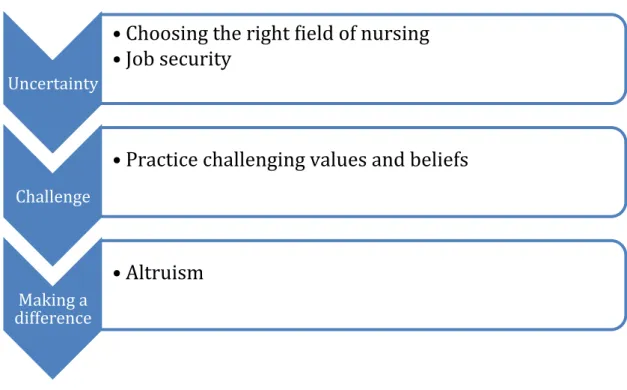
5.3.1UNCERTAINTY 133
5.3.2TESTING TIMES 137
5.3.3MAKING A DIFFERENCE 140
5.4CONCLUSION 142
CHAPTER 6 ON BEING A LEARNING DISABILITY NURSE 144
6.1INTRODUCTION 144
6.2CARVING A CAREER 144
6.3ROLE DIVERSITY 148
6.5RELATIONSHIPS’ AS PART OF IDENTITY 152
6.6CHALLENGE TO CHANGE 156
6.7CHALLENGED IDENTITIES:‘PROPER NURSES’? 161
6.8CHALLENGED IDENTITIES: VISION OF THE FUTURE 165
6.9CONCLUSION 168
CHAPTER 7 DISCUSSION 169
7.1 INTRODUCTION 169
7.2. MAKING CAREER CHOICES 170
7.2.1CHOOSING NURSING: ASPECTS OF ‘SELF’ 171
7.2.2CHOOSING NURSING: EDUCATIONAL ATTAINMENT 173
7.2.3CHOOSING LEARNING DISABILITY NURSING IN THE CONTEXT OF CHANGING SERVICE PROVISION174 7.2.4BECOMING A LEARNING DISABILITY NURSE:ASPECTS OF RESILIENCE 174
7.2.5.AN EVOLVING NURSING IDENTITY 175
7.3THE WORKING LIVES OF LEARNING DISABILITY NURSES 177
7.3.1CHANGING SERVICE PROVISION 177
7.3.2CHANGING ROLES 179
7.3.3THE CHALLENGE TO CHANGE PRACTICE 180
7.3.4CHANGING RELATIONSHIPS 182
7.4PROFESSIONAL IDENTITY:WHO ARE WE? 182 7.4.1THE LEARNING DISABILITY NURSE AS THE ‘OTHER’ 183
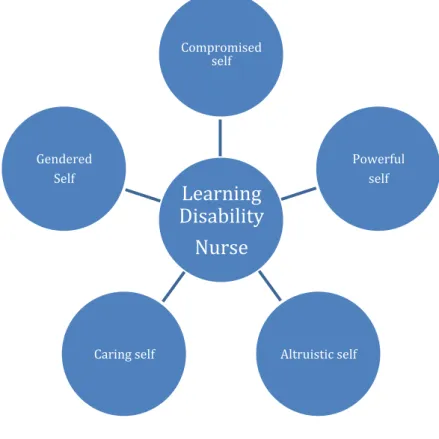
7.4.2THE SELF IN LEARNING DISABILITY NURSING. 183
7.4.3CHALLENGED IDENTITIES 187
7.4.4COLLECTIVE IDENTITY AND THE LEARNING DISABILITY NURSE 189
7.4.5CHALLENGED IDENTITIES:'NOT A PROPER NURSE' REVISITED 192
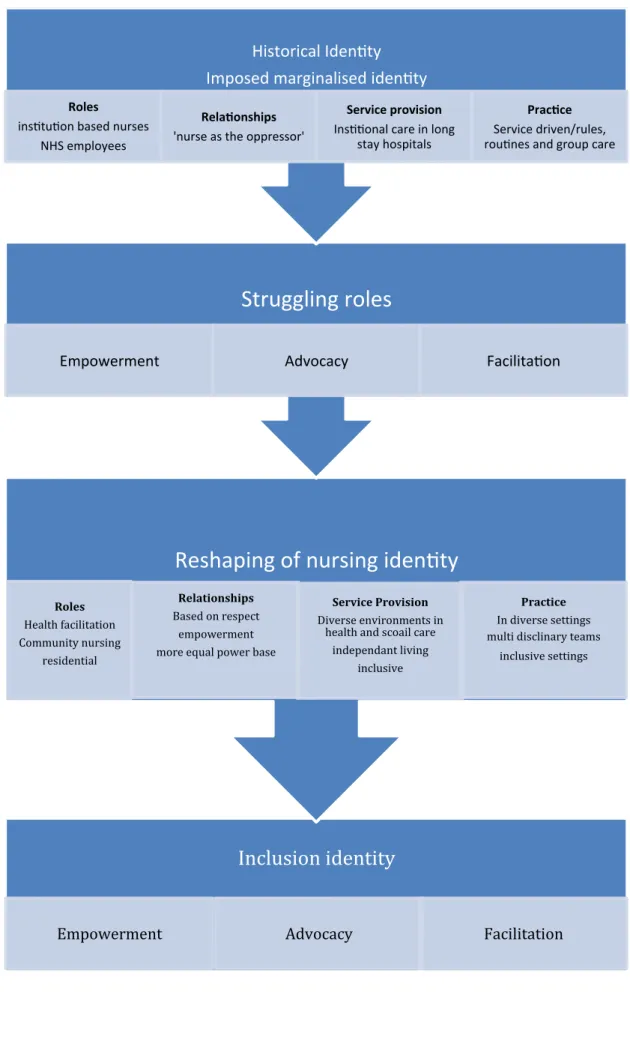
7.5 CONCLUDING DISCUSSION: TOWARDS A NEW MODEL OF LEARNING DISABILITY NURSING
IDENTITY 193
CHAPTER 8 THE PLACE OF THIS STUDY IN LEARNING DISABILITY NURSING:
REFLECTIONS, LIMITATIONS AND MOVING FORWARD. 198
8.1STUDY LIMITATIONS 198
8.2IMPLICATIONS FOR EDUCATION AND PRACTICE AND RESEARCH 198
8.2.1EDUCATION:COMMISSIONING 198 8.2.2EDUCATION: RECRUITMENT 199 8.2.3EDUCATION:CURRICULA 200 8.2.4IMPLICATIONS:PRACTICE 202 8.2.5FURTHER RESEARCH 203 8.3TOCONCLUDE… 203 REFERENCES 205 APPENDICES
APPENDIX 1 SEARCH TERMS
APPENDIX 2ONLINE INVITATION TO PARTICIPATE
APPENDIX 4 PARTICIPANT INFORMATION SHEET APPENDIX 5 CONSENT FORM
APPENDIX 6 ETHICS APPROVAL
APPENDIX 7 LIST OF CONFERENCE PRESENTATIONS
LIST OF TABLES AND FIGURES
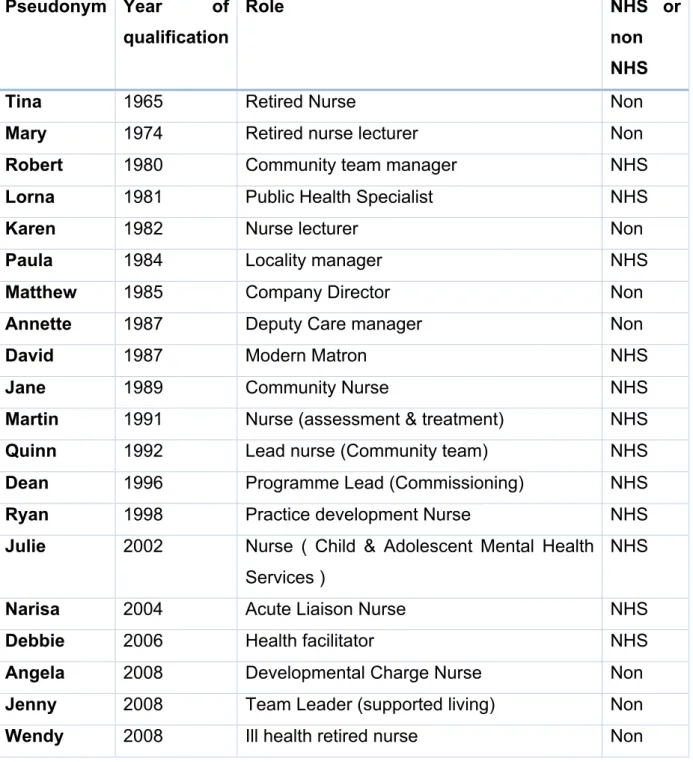
TABLE 1 PARTICIPANT DATA 87
FIGURE 1 BECOMING A LEARNING DISABILITY NURSE 116
FIGURE 2 INFLUENCING FACTORS 118
FIGURE 3 THEMES: PROFESSIONAL SOCIALISATION 132
FIGURE 4 ASPECTS OF SELF 187
Chapter 1 Introduction and Aims of the Study
1.1 Introduction
There has been a revolution in the ways in which people with learning disabilities are both cared for and supported, and this necessarily has led to nothing short of a revolution to the practice of learning disability nursing.
(Gates 2011, p5)
There have been a number of influential factors that led to the undertaking of this study, including my professional background as a learning disability nurse who trained more than 30 years ago in a care context that was very different to today. The quotation from Gates (2011) above resonated with my experiences of learning disability nursing over a 30-year period, observing a seismic shift in not only the locations of care and support for people with learning disabilities but also the philosophical underpinnings of this care. At the beginning of this study in 2009 it had been 30 years since the recommendations of the Jay Report (1979) had suggested a move towards an altogether different model of care for people with learning disabilities and the demise of the learning disability nurse to be replaced by a worker based in social care, Learning disability nurses had been a key provider of care in an NHS-based system for those people who required support. My observation over the 30 years was that this role had changed, roles had been challenged, reconfirmed and redefined and the professional identity of learning disability nurses had been impacted on by these changes. A driver for undertaking this study was a curiosity in how these changes had shaped the professional identity of the learning disability nurse. My own journey was an important influence as I was aware this was also shaped by these changes in policy and services for people with learning disabilities over the past three decades. Being aware of my own position as a nurse would enable me to ‘pay attention’ to this within the research process (Holloway & Freshwater, 2007).
This thesis is underpinned by the view that learning disability is largely socially constructed and this will be discussed later in the thesis. Social and health policy
have defined and redefined learning disability nursing since its inception and in the past 30 years this has dramatically changed the meaning of nursing in this field of practice. But what impact does this have on the individuals who work as nurses within these services, on society, and the views around learning disability nurses? Understanding the history of learning disability nursing over the past 30 years enables us to see how society has constructed the meaning of learning disability, of community care and of learning disability nurses.
1.2 Models of service delivery for people with learning disabilities
With the social construction of learning disability in mind, it is important to consider the ways in which society has ‘cared for’ people with learning disabilities, as this in turn has impacted on those who chose to work with people with this group.
The history of learning disability goes back as far as we have been able to write about the human condition. In pre industrial times it is suggested that people with learning disabilities were often part of communities where literacy and numeracy were not a necessity or priority. As such ‘services’ for people with learning disabilities in any formalised structure did not exist. During the Victorian era the rise of the institution brought with it a range of views and beliefs about people with learning disabilities. Not only did the institution provide society with an opportunity to remove ‘undesirable individuals’ from society, but also the opportunity for segregation of the sexes and the stifling of human rights for people with learning disabilities.
The notion of community care and maintaining people within their own homes rather than providing residential care has been spelt out since the early 1950s, even though socio-demographic changes suggest changing family structures will lead to declining numbers of potential care givers (Allsop, 1995). One of the attractions of community care for the Government may have been that it appeared a cheaper model, but this was also supported by a societal view that community care was a more appropriate on ‘humanitarian and moral’ grounds (Royal Commission, 1957).
But, whilst public support for community care for the elderly grew in the 1950s, the numbers of people in ‘sub normality’ hospitals continued to rise. Perhaps due to
ongoing eugenic views of many leading policymakers, not only did the institution provide society with an opportunity to remove ‘undesirable individuals’ from society but also the opportunity for segregation of the sexes and the stifling of human rights for people with learning disabilities. Eugenic concerns in the early post-war years supported the continuation of segregation for people with learning disabilities.
The development of community care for people with learning disabilities led to a number of related policy statements, including the Report of the Royal Commission (1957). This report recommended a parallel system of residential care, set up by local authorities, utilising small residential units of 20-30 places for people with learning disabilities. Politically this was supported in a speech by Enoch Powell, then Minister for Health, in 1961 advocating the ‘run down of mental hospitals’. Although this could be seen as an economic move for the Government, the Minister’s view was supported by sociological research into the conditions within institutions which described them as dehumanising environments with routines and structures that diminished the quality of life for those who lived there (Goffman, 1961). The conditions in institutions were picked up by a number of Inquiry’s further discussed in chapter 2 of this thesis.
Whilst proposals for the development of residential units in the community were being suggested, a number of writers were proposing structures to divide those deserving of community care from those who were not. Dutton (1963) had proposed the division of people with learning disabilities into three distinct groups based on ability, with only the ‘top stream’ being suitable for a move to the ‘community’. Galloway and Garrett (1964) also advocated the grouping of individuals based on ability, suggesting three groups, those who required nursing care who would stay in the hospital system, those who needed control within a secure environment, and those who required ‘social training’ for whom community living was advocated. Despite the debate over who should live within the community and how this should be decided, much of the care during the 1970s remained hospital based, following a medical model.
However, public inquiries into abuse within institutions during the 1960s and 1970s (Howe report, 1969; Spencer et al, 1978) fuelled concerns about the appropriateness
of institutional provision. Ham (1992) suggested that the Ely Hospital Inquiry led to major policy change within learning disability and contributed to the 1971 White Paper Better Services for the Mentally Handicapped (DHSS, 1971). It has been suggested that this was the first time changes in official policy were underpinned by clearly defined principles, reflecting current thinking about people with learning disabilities (Mitchell, 2000).
An element of the thinking underpinning the White Paper recommendations was rights based, supported by the 1971 United Nations Convention on the Rights of Mentally Retarded persons (United Nations General Assembly 1971 in Wolfensberger et al, 1972). Many argued that the White Paper, without the force of legislation behind it, would not put pressure on the providers of services (Race, 1995). Following the White Paper, Local Authority provision increased, but only a small number of hospital beds were reduced. This may have been due to Local Authorities increasing Day Services, not residential provision, as this could provide for larger numbers and was cheaper. The review also re-emphasised the need for joint planning of services between local Authorities and Health. This brought with it its own complications, and, in many areas, this is still not resolved some three decades later.
The Committee of Inquiry into Mental Handicap Nursing and Care was set up in 1975 under the Chairmanship of Mrs Peggy Jay with the task of examining the staffing of mental handicap residential care settings in the NHS and Local Authorities (Jay, 1979). The report findings have been described as radical (Rose, 1993), calling for the acceleration of community care, for an increase in staffing numbers and for management organisation to be streamlined. The Jay Committee report (Jay, 1979) carried a recommendation for the banning of any new construction or expansion of hospitals of 500 beds or more and a suggestion to increase Local Authority residential accommodation. Limited funding was available for this, however, and, where local authorities had a choice, many opted for the building of adult training centres which could provide for larger numbers than the small residential accommodation.
The Committee also recognised that the problems of institutionalisation were not confined to large isolated hospitals but could also manifest in small residential accommodation. ‘A purpose-built unit in the edge of town is not in our view 'in the community'.' (Jay, 1979, p.36). It is suggested that the Jay Committee is one of the few documents that has reflected a shift in philosophical approaches to the care of people with learning disabilities (Wolfensberger, 1983; Race, 2002; Mitchell, 2003). In the same year that the Jay committee reported Mittler produced his key text ‘People not patients’ (1979) linking rights for people with mental handicaps to the provision of appropriate resources, advocating the use of specialist resources within communities and ‘better training for all staff who come into contact with disabled people’ (p10).
With this background, the development of community care policies for people with learning disabilities occurred in conjunction with changes in philosophies of care for this group. The move towards deinstitutionalisation had already begun and government policies of community care were seen to be supporting these moves. Notions of rights of individuals, empowerment and choice were all seen to be in line with current policy. Community care policies were also underpinned by the development of philosophies of normalisation (Nirje, 1973). As the concept developed, its definition began to include the enhancement of socially valued roles for people with learning disabilities (Hattersley, 1991). Wolfensberger, in 1983, used the concept of 'socially valued roles' to formulate a change to the concept of normalisation which he named 'social role valorisation' (SRV). He argued that achieving socially valued roles in society would enhance the image and therefore acceptance by the non-disabled society of people with learning disabilities. The main means of achieving socially valued role would be the 'fitting in' of people with learning disabilities into the dominant value system within society.
A number of issues arise from this adoption of the principles of Social Role Valorisation (SRV). This perspective and that of normalisation appear to advocate values based on western culture, reflecting capitalism, materialism, competitiveness, individualism, and success of achievement within a nuclear family (Ni Ong, 1993). These values may require challenging and the views of people with learning disabilities should be sought to be certain that these are values that this group wants
to aspire to. The danger in not doing this is that normalisation and SRV may come to represent a lifestyle valued by its exponents but not people with learning disabilities (Bayley, 1991). A fundamental issue relating to normalisation and SRV is that the route to acceptance in society for de-valued groups is seen through some kind of normality (Ryan and Thomas, 1980; Corbett, 1991), a concept that is ambiguous and constructed by dominant groups in society.
In relation to policy formation, the concepts of power and normality are important. Foucault (1977) links these together in suggesting that normalising tendencies (an example of normalising tendency is the idea that paid work is a prime moral value) are powerful and ever present in society, whatever policies are in use at that time. Many services for people with learning disabilities have used the principles of normalisation and SRV without challenging the values they reflect. Institutions can exist in the community and, sadly, life in group homes and day centres may also mean being at risk from victimisation and abuse at worse (Philpot and Ward, 1995), or, for many, community care can mean loneliness and isolation as social networks are often limited (Flynn, 1989). Many people with learning disabilities who live independently or semi-independently live in poverty, with no opportunities for employment. It is arguable that the values of materialism and financial independence held highly in our society are unachievable due to social circumstance rather than the individual's learning disability.
Services, which have challenged the dominant community model, such as L' Arche, and Rudolf Steiner-inspired facilities, have contested whether roles valued by a particular society are appropriate for people with learning disabilities (Bayley, 1991). These 'alternative communities' have philosophies that acknowledge the unique contribution of people with learning disabilities to society, reflecting the stance that normalisation principles may disregard the right of people with learning disabilities to be different. Dalley (1992) has made the contrasts between normalisation and current social welfare ideologies - the notion of securing full rights for devalued citizens within the philosophy of normalisation is linked to collectivism, but there is a dichotomy, as the supporting of the status quo favouring family of quasi-family models of care and advocating competence and self-reliance are individualistic. It is
argued by Dalley that this is intrinsically damaging for people with learning disabilities:
Historically, therefore, people with learning disabilities have been at the mercy of society’s view of them, the policies that are implemented, and models of service delivery adhered to, often with little opportunity to make choices for themselves. It is clear though that, since the inception of the NHS, even with the development of policies of community care that, as Race states, ‘power over the learning disability agenda has remained in the hands of the Department of Health. (Race, 2002, p.35-6).
The models of care dominated by the NHS brought with them a group of workers based on the NHS model: nurses, doctors and nursing assistants who have been key in maintaining the medical model, even though the roles of these workers within the system have been consistently challenged. Understanding where learning disability nurses have come from historically, and the service models in which they work, is an important part of this study.
1.3 The impact of changing service models on the learning
disability nurse’s role.
My journey into learning disability nursing started at an early age when I worked voluntarily with children who had complex disabilities and were staying in the respite care environment, where I volunteered. My passion for working with people with learning disabilities continued as I undertook nurse ‘training’ in a large long-stay hospital and faced challenges on a daily basis to the way I felt care should be delivered. Over the years I worked with many nurses who, like me, were constrained by an environment of routine and order, one which often disempowered both the nurses and those that lived in that environment. However, I was also supported in this environment, feeling part of a ‘community’ and feeling privileged to share the day-to-day lives of people with learning disabilities. I began my nurse training in the early 1980s at a time when there had been a major challenge to the role of the learning disability nurse from the Briggs report (1972) and the Jay Report (1979). The Briggs report had suggested a new professional grouping and Jay had suggested replacing nurses with workers who held a social care-based qualification. Each decade post Jay brought with it a challenge to the role of the learning disability nurse. A letter from the Chief Nursing Officer (CNO) in 1985 reinforced the
commitment to maintaining the role and status of the learning disability nurse (Mitchell, 2000). The 1990s also brought with it a change in the emphasis in role of the learning disability nurse, the Cullen report (1991) suggested a greater emphasis for learning disability nurses on the health rather than social care needs of those with learning disabilities - a move towards health - and this has been further supported by a number of reports as the focus on the role of the nurse has re-emerged in health. This focus has been reinforced by a number of reports that have acknowledged the health needs of people with learning disabilities who have moved from institutions and into community-based living.
With this background, learning disability nurses have been debating their role within the nursing profession since (Mitchell, 2003). Some 30 years later, in 2001, the Government produced its White Paper Valuing People First (DH, 2001) where there is little mention of specific services, but the notion of inclusion and the use of generic services is clear and part of the guiding principles of this White Paper.
Although still a discrete branch of nursing, the debate around the future of the learning disability nurse still rumbles on. A wide range of service provider agencies, and inclusion being the key principle for people with learning disabilities in society, has left some doubt over the future role of the learning disability nurse. The impact of this debate is not only upon service provision but also on the future education of learning disability nurses. Mitchell’s (1998; 2000; 2002a; 2003) work has examined the link between social policy, service provision and education. This study is located within this context and develops further the work of Mitchell to examine current Government policy (Post Jay Report) to include key policy documents and reports – Continuing the Commitment (DH, 1996) Signposts for Success (DH, 1998); Valuing People (DH, 2001); The Health & Social care Act (DH, 2003); Choosing Health (DH, 2004); Our Health, Our Care, Our Say (DH, 2006), and the potential impact on service provision and the future of learning disability nursing and education. The narratives of learning disability nurses within the study will contribute to an understanding of the impact of said policies upon the lives and careers of learning disability nurses in England in the past 30 years.
A gradual philosophical shift following the work of O’Brien (1981), Wolfensberger (1983) and Nerje (1972; 1985) was also being observed (at least in the confines of the classroom). These theorists were advocating different lifestyles for people with learning disabilities based on human rights, living lives that were as close to ‘normal’ as possible (normalisation) and setting out ‘accomplishments’, such as choice, community presence, relationships, competence and respect. However, the institutions where people lived continued to constrain by their very nature. Soon after qualifying as a registered nurse I worked in a small-scale community-based residential unit with children who had complex and life-limiting disorders, managed by the same hospital in which I had undertaken my training. My observations at this time where that many nurses were struggling with the move from the large long-stay hospital to small community-based services and the level of change that this brought with it. Nursing within small quasi-family structured environments, after being part of large multi-bedded wards in large long-stay hospitals, brought its challenges for staff and for people with learning disabilities themselves.
Learning disability nursing at this time was also being questioned in terms of its place in this new care philosophy (Barr & Sines, 1996 ), care was being provided in Local Authority settings and in many areas the development of community nursing teams to support people in their own homes was in its infancy. This period of uncertainty prior to the 1990 NHS and Community Care Act (DH) felt like an unsettled time for learning disability nursing. I had an opportunity to work in what was then a college of nursing, managed by the health authority, as a clinical nurse teacher delivering nurse education. Retaining my links with nurses working in large long-stay hospitals as I supported students undertaking placements in these areas, I was also aware that many had begun to work outside of the NHS supporting people with learning disabilities.
For a decade or more the move towards the closure of long-stay hospitals moved rapidly and, whilst some provision was still being provided by the NHS, this was of a specialist nature and small numbers comparatively. In my role in education, preparing learning disability student nurses, I saw a decline in applications and in interest in the field of nursing as worries over whether there would be a job as a nurse at the end of the course became pronounced.
Since 2008 there had been a steady decline noted in the numbers of learning disability nurses, arguably as NHS campus bed numbers have declined, so have the numbers of nurses. However, one might expect to see an increase in the numbers of community nurses as the numbers of people with learning disabilities living outside of NHS provided hospitals increased. Emerson and Glover (2012), however, highlight the numbers of these nurses have dropped - ‘Numbers of community nurses change little from 2008 to 2009, rise by three per cent to 2010 and then fall by 16 per cent to 2011’ (Emerson et al, p.195). Whilst they suggest that 'this trend is less easy to explain’, this could be due to the number of learning disability nurses who work in diverse settings in the community but who do not hold the specific title of ‘community nurse’. Locating learning disability nurses at this time was becoming increasingly difficult as a range of titles for roles existed and many roles sat outside of NHS provision in school, prisons, residential settings, acute hospital trusts and the independent sector. However, Emerson and Glover reported that, whilst it is acknowledged that there is a large shortfall between the numbers of nurses registered and those accounted for in workforce statistics - some 12,433 - these cannot be reasonably accounted for by employment in the independent sector. Emerson and Glover draw on Gates’ statistics from the 2011 report, suggesting that 'at least 2,500 were working in independent sector facilities of some type' (Gates, 2011). Gates (2011) reports:
It is known that the numbers of learning disability nurses employed in the NHS has continued to fall year on year from 12,504 in 1995 to 6,600 in 2009 [something in the order of a reduction of 53%] or ~1,000 a year, with a reducing participation rate that has fallen by 3.9%, and a growing vacancy factor from 2008 [1.3%], 2009 [1.7%] and 2010 [2.0%]. (National Health Service, 2010, p.8)
A small proportion of this large shortfall in learning disability nurses could be accounted for by workforce statistics. Emerson and Glover (2012) offer a number of suggestions for the decline in learning disability nurses in their work, however, there is no current solution to the difficulties of accounting for learning disability nurse numbers across a diverse range of potential employment settings.
The range of settings in which learning disability nurses work provides challenges in undertaking research with this group. It is acknowledged by many that there is some difficulty in identifying the numbers of learning disability nurses in employment - there are figures around student places held by HEIs and commissioners, and figures held by the Nursing & Midwifery Council (NMC) of those that are entered onto the Register, but, beyond this, the data is at best patchy both in its accurate collection and in its ability to reflect those nurses who work outside of the NHS.
Recent studies have focused on the declining numbers of learning disability nurses and their places of employment. Gates, in 2010, was commissioned to Chair a task and finish group examining a number of questions raised via the professional advisory board to the English Department of Health around learning disability nursing, including examining the diminishing numbers of learning disability nurses, exploring the service modules in which they practice, and 'identifying the national supply and demand for learning disability nurses, including the number of student places commissioned' (Gates, 2011, p.4). The report, published in 2011, concluding: The task and finish group conclude that learning disability nursing has moved from a narrowly defined role, within long-term care, to a much broader role within the National Health Service and beyond. It is a health profession supported and endorsed by many as unique in its breadth of employment base, located as it is among the various sectors. Learning disability nursing roles span community support specialists, liaison roles between services and agencies, and roles in secure or forensic health settings, and these roles offer support across the age continuum. (Gates, 2011, p.3)
More recently, the Chief Nursing Officers (CNO) of the four countries of the UK reviewed learning disability nursing, with their report echoing Gates’ work in suggesting that: 'learning disability nurses work in many different settings, including community teams, some inpatient services, criminal justice and education contexts and, to an increasing extent, independent/voluntary sector settings’ (UK Chief Nursing Officers, 2012 p.2).
Changes in the nature of the role of the learning disability nurse towards a more diverse range of activities and the places in which learning disability nurses practice suggested to me that these nurses, more than in any other field of nursing, had extended and expanded their location of professional practice, adopted new ways of
working, and embedded themselves within a wider range of professional and non-professional groupings. Understanding how learning disability nurses perceive their careers and their identity at a time of change or ‘revolution’, as Gates suggests, became, for me, a desirable focus of study.
There have been few studies which focus on working lives of learning disability nurses in a historical context, and, uniquely, this study uses a narrative approach to understanding why they chose learning disability nursing, and their experiences of being a learning disability nurse. The present study adds to the literature around career choices in nursing and around the professional identity of learning disability nurses at a time of change.
1.4 Aims of the study
The overall aim of this study was to gain an in-depth understanding of the lived experience of the careers of learning disability nurses in England over the past 30 years. In order to achieve this, further sub aims were developed to explore the reasons for choosing learning disability nursing as a career and gain an enhanced understanding of the working lives of learning disability nurses. Underpinned by hermeneutic phenomenological principles, a narrative approach has been taken to explore the participants’ experiences. An adapted approach to Biographical Narrative Interpretive Method (Wengraf, 2001) was used to frame the interview processes and enable an ‘open’ approach to generating narrative. The study gained research ethics approval from De Montfort University Ethics Committee and a request for learning disability nurses to take part in the study was posted on a variety of online ‘networking’ sites in order to capture those nurses working outside of the NHS. Twenty learning disability nurses across nine counties of England were interviewed in two-stage interviews that ranged between 90 minutes and two hours long, with a thirty-minute break, as part of the BNIM interviewing process. The participants were offered further follow-up interviews, typed transcripts were shared for checking and pseudonyms were chosen. The transcripts of these interviews created both a rich individual narrative and also a collective narrative of learning disability nursing which were analysed using narrative analysis.
1.5 Thesis structure
The thesis is organised around the following structure:
Chapter 2 examines the literature around learning disability nursing, career choices, identity and the working lives of nurses, in order to contextualise the study and its aims. The literature relevant to this study is from a diverse range of health and social care literature and incorporates a historical view of learning disability nursing in order to locate the issues. Chapter 3 offers a detailed exploration of this study’s methodological approaches, outlining the philosophical underpinnings and practical application of the narrative inquiry. Chapter 4 is the first of three chapters detailing the findings of the study. It contains the ‘cameos’ of the 20 participants engaged in the study. As part of the analytical process, these ‘cases’ were generated in order to analyse the themes within each narrative prior to examining themes across participants. Taken with field notes gathered at the time of the interviews, these form the ‘case’ on which analysis is based. Chapters 5 and 6 provide an analysis of the themes arising from the participant narratives, including career choice, working lives and identity. The participant ‘voice’ is an inherent part of these chapters as their words become quotations and these are analysed in relation to the themes arising from the interviews. Chapter 7 draws together these themes into a critical discussion and highlights the study’s unique contribution to knowledge in the field. As a unique study in the UK utilising a biographical narrative approach in order to explore the motivations towards learning disability nursing and the working lives of learning disability nurses over a 30-year period, the study adds to the extant evidence base informing education, practice and research. The final chapter provides a reflection on the research process, discusses the study’s limitations and explores implications of the study’s findings for education, practice and research.
Chapter 2: Literature Review
2.1 Mapping the process
In order to understand and locate literature pertinent to this study in a systematic way, a literature review was undertaken utilising a framework that enables a rigorous review of the literature to avoid bias (Aveyard, 2010; Hart, 2003). This framework included a clear identification of the research question; focused search strategy and appraisal, and synthesis of the material to ensure rigour and validity in the literature review process. In common with many qualitative studies, my research question was framed within an aim for the study; to explore the lived experience of the careers of learning disability nurses in England over the past 30 years, the motivations for becoming a learning disability nurse, and their professional identity. Three key areas became the focus of my literature review; firstly, the history of learning disability nursing, its location and practices; secondly, what motivates people to become nurses and, more specifically, learning disability nurses, and, thirdly, identity and nursing, providing parameters for my search strategy. I was aware that there had been two key literature reviews undertaken by Northway et al in 2007 and, a year later, Griffiths and others 2008 undertook a large-scale review which suggested that:
The extent of learning disability nursing research is limited in quantity and it is difficult to draw comparisons across research studies. Much of the available evidence is drawn from small-scale evaluations; which may provide useful guidance and inspiration for service development but do not, in themselves, constitute a sufficient body of research evidence to support learning disability nursing practice. (Griffiths et al, 2008, p.490)
Whilst acknowledging the limitations suggested by Griffiths et al (2008), the purpose of the literature review was to understand the literature that already existed relevant to the research area and the potential for this study to build on this literature base, and make an original contribution to knowledge through the exploration of the working lives of learning disability nurses.
Searching the research base around learning disability nursing is complicated by the use of a wide range of terms across the international literature including, in the UK alone, learning disability, learning difficulty and intellectual impairment. These terms
may sometimes be used interchangeably but they may also describe very different groups of people internationally. In the US Mental Retardation is a common term used and, until recently, in the UK this has been mental handicap. Additionally, education-focused literature may also use the term learning difficulty or learning difference to describe a completely different group of people, those who have conditions such as dyslexia and ADHD who do not have a learning disability. As described in chapter 1, the definition of learning disability underpinning this study was constantly referred back to in the literature search process to ensure relevance. The literature search incorporated a broad database search, beginning with CINAHL PLUS, BNI and ASSIA, but also cross-checking these searches with a ProQuest search including six databases; ASSIA, Periodical Archive Online, ProQuest Dissertation & Theses UK & Ireland, Pro Quest Psychology Journals, PsycArticles and PsycInfo. Appendix 1 outlines the search results, including search terms and ‘hits’.
The number of ‘hits’ in some databases reflected the breadth of the use of the keyword learning disability, and also its relevance in an international context with the term in some countries referring to a wider more diverse group, including those with dyslexia, dyspraxia and other conditions impacting on learning. This was countered with the filtering through keyword searches to reduce the numbers of irrelevant hits. The broad search terms of learning disability/mental handicap/intellectual disability or mental retardation and nurses/nursing produced a breadth of literature, so titles were scanned for relevance and to place the literature into categories for further scrutiny. Further searches used the following search terms: Career choices and learning disability nursing/nurses professional identity and learning disability nurses/nursing (see appendix 1).
Whilst initially focusing on the published literature, ‘grey literature’; unpublished material including unpublished theses and conference proceedings, were also included in the search parameters to ensure maximum access to what is a limited research base. Specific inclusion criteria of date and of publications written in English also ensured that the literature was as specific as possible to my research area. Whilst the study was based in England, the examination of the literature included other countries to contextualise learning disability nursing globally.
Examination of the chosen literature enabled further searches using what is described as the snowballing effect, finding literature cited in the original sources (Averyard, 2010). References were all collated into an electronic research bibliography using a reference management system ‘Refworks’ ® www.refworks.com
enabling me to create themes from the search, annotate studies and organise the material.
My initial interest was to examine the period of 30 years from the early 1980s; however, in order to understand the changes during that period and to set the scene for the research the initial literature review was set for those database searches which allowed it to 1960. Earlier articles were also reviewed if found in studies through a method of hand searching and deemed relevant. Additionally, as the study focuses on the working lives of nurses, the breadth of the literature search needed to include elements of working lives rather than just a chronological history of the development of learning disability nursing.
The search yielded similar results to those published reviews of the literature by Northway et al (2007) and Griffiths et al (2008). There was a wide range of literature which, for the purposes of this study, was sorted into that which focused on the specific history of the learning disability nurse from a first-person perspective (Gates & Moore, 2002; Jukes, 2011); the history of learning disability services; and the place of the nurse within these services.
Surprisingly, there were few research studies focusing specifically on the working lives of learning disability nurses in the UK in a historical context, notably Gates and Moore, (2002) focused on the working life of one learning disability nurse, Annie and Jukes (2011) offers a semi-autobiographical account of his career over a 30-year period, beyond this the literature focuses within wider studies on the nurses’ role and function in the context of a 30-year period. Additionally, much of the published literature does not constitute published research, as much of the literature in this area was found to be commentary from learning disability leads in the field rather than the results of specific research studies. This, however, remains important to my study as it often describes learning disability nursing from the perspective of leaders in the field and those who have contributed to the extant literature base.
Whilst commentators in the field reflected upon the roles of the learning disability nurse, the literature review enabled a historical overview and timeline. It was expected that more of the published work would have a focus specifically on the working life of the learning disability nurse from their perspective. It is this particular gap in the literature where my study will contribute to the existing body of knowledge and make a unique contribution in using the voices of 20 learning disability nurses through a biographical narrative approach.
The literature focused around career choice in learning disability nursing is fairly limited, whilst the there is a broader research base around nursing more generally. Additionally, the search for ‘professional identity’ and ‘learning disability nurses/nursing’ produced few results, whilst the search term nursing produced thousands of hits and required further keyword filters (appendix1).
The literature search results were minimal from the learning disability nurses’ narrative perspective, however, the history of learning disability nursing, the role and function of the learning disability nurse, and the development of services have been debated in the literature and a large proportion of this is written by learning disability nurses themselves. In addition, the shaping of the services in which learning disability nurses work has been documented alongside policy change and the influence of these changes upon working practices in learning disability nursing. In the next section of this chapter the literature will be critically reviewed in the context of my research aims, to take a look at the history of learning disability nursing in order to examine the working lives of learning disability nurses over the past 30 years, their career choices and their identity.
2.2 Care for people with learning disabilities: a historical context
Formalised health and social care services are relatively new in historical terms, however, people with learning disabilities are not a new group within society and have existed in documented records for thousands of years. A number of commentators have explored the history of learning disability as both a condition and social construct, examining the historical response of society to those who over the years have had many different labels, reflecting the prevailing societal attitudes of
the time. These secondary sources of historical information will provide a context for the development of care for people with learning disabilities and the place of the learning disability nurse within that. Understanding the place of people with a learning disability in our society is an important precursor for understanding how the profession of learning disability nursing came to exist, the places and institutions in which this nursing took place, and the changes that have taken place in the past 30 years. Emerson (2005) suggests that the way in which people with learning disabilities in society are treated is based on three main underpinnings: 'Public and professional preconceptions of the nature of learning disability, notions of common decency and pre-existing mechanisms for the delivery of welfare support' (p.109). This is reflected in the changing nature of care provision and welfare for people with a learning disability in England, and the literature which illustrates these changes.
In Critiques of Segregation and Eugenics, Richardson (2005), examines pre-industrial society and its approach to people with learning disabilities, asserting that written accounts of difference based on disability are ‘largely absent […] since in pre-industrial societies only the wealthy and ruling classes were likely to be educated and literate’ (in Grant et al, 2005, p.67). He goes on to suggest that, where history does focus on those with a physical or mental disability, this is at the extremes of either ‘exclusion’ or ‘veneration’. The example of those labelled village idiot is relevant here, where in pre-industrial societies those we now recognise as having learning disabilities were often an accepted part of a community, the label ‘village idiot’ was one which acknowledged the person’s place within the community (albeit within their own grouping of deviants) in addition to their social and later legal label of ‘idiot’ (Richardson, 2005).
Industrialisation changed the place of people with disabilities in society as capitalist ideology impacted upon social stratification. Difference was the key to capitalism’s need to ‘remove, control and discipline those who would not or could not conform to new working practices by demanding greater secular controls’ (Richardson, 2005, p.71). As such, this period of industrialisation and its focus on contribution to society through capitalist enterprise heralded growth in institutional settings for the ‘sick poor’, many of whom we might now describe as having learning disabilities. McClimens (2005) describes the 1601 Poor Law Act as an 'early example of social
policy' (p.29) as the recognition of those who may need additional support following difficulties in the local economy and the classification of those into the ‘deserving poor’ were embedded in the premise of this Act. Whilst at this time people with learning disabilities were not identified as a specific group in this early classification, McClimens suggests ‘the origins of targeted care were beginning to emerge in the provision of poor relief' (p.29). Understanding the early history of classification is an important aspect of my study as it locates the person with a learning disability in society and sets the scene for the nurses who were eventually involved in their care
This focus on classifying and then ‘caring for’ the sick poor continued; Richardson in his account, states that: 'Between 1720 and 1825, 150 hospitals were built in England to cater for the sick poor' (2005, p.71). This growth continued with the development of ‘idiot asylums’ with upward of 500 beds supported by legislation in the Idiots Act of 1886, placing the emphasis on local authorities to provide these services. As early as these asylums were built there were concerns raised about the treatment and regimes within them. By 1845 the Insanity Act had ensured a Medical Superintendent was in place in all asylums, heralding the medicalisation of what had previously been seen as a social issue. Growth in the field of psychiatry had also placed emphasis on mental disorders as medical conditions, and therefore potentially ‘treatable’. As a result of this, many people with learning disabilities were housed in these institutions alongside those with psychiatric disorders (Ryan & Thomas, 1980). Following the 1845 Insanity Act concerns were raised around overcrowding in institutions, resulting in the Lunacy Amendment Act (1862) enabling movements between Workhouse and Asylum to deal with the issue.
In 1886 the Idiots Act provided a distinction between what were known as lunatics, idiots and imbeciles, categorising those we now label as having mental health problems as ‘lunatic’ and those categorised as Idiots and Imbeciles (those we now label as having learning disabilities) and examined the educational needs of those who were defined as idiots and imbeciles (McClimens, 2005; Barber, 2012). Alongside the medicalisation of such conditions, educational theorists were at this time also suggesting that ‘training’ could enhance the potential of those with learning disabilities. These distinctions are important within the historical narrative presented here as they impact on services for those categorised in particular ways. Those with
what we now define as mental health problems were categorised differently to those who have a learning disability, leading the way for a separation of services for those with these conditions.
McClimens (2005) in his historical account From Vagabonds to Victorian Values: The social construction of disability identity, suggests that concerns over the conditions within the institutions led to the Royal Commission on the Care and Control of the Feeble Minded 1904-08 (The Radnor Report), the findings of which ‘paved the way for the Mental Deficiency Act of 1913’ (Barber, 2012, p.191). With a clear focus on the genetic inheritance of disability, The Radnor report led to the incarceration of thousands of people with learning disabilities (‘mental defectives’ at the time) in ‘colonies’ set up specifically for this purpose (Ryan & Thomas, 1987). The language used in society at the time in reference to these colonies was also important. People were ‘detained’ for life (Ryan and Thomas, 1987, Barber, 2012), suggesting a punishment approach to having a learning disability and eugenic concerns about the future of society.
The literature describing the history of care for people with learning disabilities post-industrialisation is bleak. Eugenicist discourse constituted a powerful force, encouraging the incarceration of thousands of people with learning disabilities in the UK and supported legally through the introduction of the 1913 Mental Deficiency Act. These medicalisation ideologies and legal frameworks also began a labelling and categorisation process for people with learning disabilities who, within the 1913 Act, would be determined ‘feeble minded’, ‘idiots’, ‘imbeciles’ and ‘moral defectives’. These categories were also used to determine who would receive education, as the feeble minded in particular were thought to be a group that might benefit from such provision. A number of scholars describe the Act as one stemming from the eugenic aim to remove and segregate from society those seen as ‘different’ and therefore undesirable (Richardson, 2005; Ryan and Thomas, 1980; Barber, 2012). Theories of eugenics in the late 1800’s and early 1900’s were largely built from theories of genetics and inheritance, based on plant reproduction and the transference of characteristics between generations.
Subscribing to this belief system fuelled a view that ‘feeblemindedness was a genetically inherited disease that would eventually reduce the nation’s intelligence’
(Richardson, 2005, p.73). This was further strengthened by the growth in views that disability equated to social deviance and the questioning from an economic perspective the value of disabled people in society.
As a result of this, people seen to be feeble minded were often removed directly from communities and incarcerated with or without their or their families’ consent. The Eugenics movement played a powerful role in the development of institutional care for people with learning disabilities between World War I and II and in the years immediately following as those contributing to policy at the time advised Governments on the care of people with learning disabilities. Emerson (2005), in his chapter ‘models of service delivery’, quotes Tredgold, a leading psychiatrist advising a variety of commissions, in 1909 who stated:
I have come to the conclusion that, in the case of the majority of the feebleminded, there is one measure, and one measure only...which is practically possible, namely the establishment of suitable farm and industrial colonies.... society would thus be saved a portion, at least, of the cost, of their maintenance, and more important, it would be secure from their depredation and danger of their propagation. (Tredgold 1909 in Emerson, 2005, p.113) These views were supported by Government at the time and the subsequent 1913 Mental Deficiency Act made clear delineation between the care of those with learning disabilities and those with mental health problems (Emerson, 2005). Influenced largely by eugenic views of the time, people with learning disabilities were seen to require incarceration and segregation rather than the treatment required by those with mental health problems. This period in history is very relevant to the history of learning disability nursing as it reflected care models, including large institutions which later became hospitals staffed by learning disability nurses. By 1919 the Nurses Registration Act had been approved and the General Nurses Council (GNC) had a separate part of the register for mental deficiency nurses. Prior to the inception of the National Health Service, the training of those working with people with learning disability (then known as mental deficiency) had been based in the large institutions, colonies or private institutions caring for those with learning disabilities and mental health problems. Initially, training had been alongside that of psychiatric medical superintendents with accreditation through the Medico Psychological Association and reflected the ‘care’ received by people with learning
disabilities at the time. They were cared for alongside people with mental health problems and social deprivation often resulted in them being institutionalised. However, after the 1913 Mental Deficiency Act the incarceration and segregation of people with learning disabilities was deemed ‘different’ to those with mental health problems and, as such, required its own workforce (Mitchell, 2000). Mitchell also suggests in his historical study of learning disability nursing that 'mental deficiency nursing became part of the nursing profession because of a series of coincidences of timing and group interest. The GNC (General Nursing Council) was unable to dislodge it because of interests involved in its continuation' (Mitchell, 2000, p.201). He argues that the place of nursing and therefore learning disability, or mental deficiency nursing at the time, was influenced by the need of the medical profession to control the work in institutions: ‘Mental deficiency specialists had a vested interest in the establishment of a discrete group of nurses over whom they could exercise control’ (Mitchell, 2000, p.88) Whilst this landmark shift in the separation out of conditions relating to learning disability and those related to mental health disorders impacted on care, the work of the Eugenics movement continued between the two World Wars and Tredgold was influencing the education of medical professionals and nurses across the UK. His first edition of Mental Deficiency was published in 1908 and continued to be used for the next 50 years, with this damning quote still appearing in the eighth edition in 1952:
The 80,000 or more idiots and imbeciles in the country… are not only incapable of being employed to any economic advantage, but their care and support, whether in their own homes or in institutions, absorbs a large amount of time, energy and money of the normal population which could be utilised to better purpose. Moreover, many of these defectives are utterly helpless, repulsive in appearance, and revolting in manners. Their existence is a perpetual source of sorrow and unhappiness to their parents, and those who live at home have a most disturbing influence on other children and family life… In my opinion it would be an economical and humane procedure were their existence to be painlessly terminated. (Tredgold 1952 in Emerson, 2005, p.113)
Whilst many may be shocked today at views such as Tredgold’s, philosophies underpinned by beliefs such as this were reflected in the care provision for many people with learning disabilities in large long-stay institutions but also in their exclusion from society. Following the enactment of the National Health Service
(NHS) Act in 1948 in Britain, and the establishment of health services which were free to all at the point of delivery, the institutions in which people with learning disabilities lived became part of the NHS and, by the early 1950s, the General Nursing Council (GNC) had taken over the training of those nurses working within these institutions. However, records examined by Mitchell show that as early as 1926 the status of these workers as nurses was being questioned, as it was clear they did not ‘care for the sick’ (Mitchell, 2002). However, this might be expected as the history of care of people with learning disabilities up to the early 1920s was underpinned by philosophies of segregation, exclusion and custodial provision.
This challenge to the status and value of the learning disability nurse continued, and in 1979 the Jay Committee put forward two key policies supporting the move away from nurses supporting people with learning disabilities. Prior to the Jay Report, the Briggs Report in 1972 had suggested a new professional grouping, while Jay had recommended replacing nurses with workers who held a social care-based qualification. The Committee of Inquiry into Mental Handicap Nursing and Care was set up in 1975 under the Chairmanship of Mrs. Peggy Jay with the task of examining the staffing of mental handicap residential care settings in the NHS and Local Authorities. The report findings have been described as radical (Rose, 1993), calling for the acceleration of community care, for an increase in staffing numbers, and for management organisation to be streamlined. The Jay Committee report (DHSS, 1979) carried a recommendation for the banning of any new construction or expansion of hospitals for people with learning disabilities of 500 beds or more and a suggestion to increase Local Authority residential accommodation. However, only limited funding was available and, where local authorities had a choice, many opted for the building of adult training centres that could provide for larger numbers, rather than the small residential accommodation. The implications of this include a continuing focus on a medical model of care in a largely hospital-based provision.
The Jay Committee Report in 1979 not only redefined the structure of learning disability services in England, Scotland and Wales, but also the role of the learning disability nurse; suggesting that learning disability nurses should, over time, be removed from conventional nursing, to allow for the emergence of a new professional group. This fundamental shift in thinking provided a key challenge for