Value Creation in E-Procurement
“Education is the most powerful weapon which you can use
to change the world”
Abstract
This thesis analyses the value creation in an e-procurement process and uses as case study a large shipping company who has the procurement group as a global procurement unit, negotiating agreement in connection with the various Business Units and pooling up the e-procurement process through the organization.
The sources of value creation in e-business used as a theoretical framework based in theories of entrepreneurship and strategic management is applied in a practical context through out the thesis in form of practical examples linking the theory to the practice.
Preface
After six years of education I can feel I already reached a level where I can start applying my knowledge gained in those years in a practical perspective with more maturity and confidence. The first steps of my career started in Brazil when I decided to take a Bachelor in International Trade together with the opportunity to work in the same area at Embraer. The first four years of my education was combined with practical knowledge, executing tasks of high responsibility that allowed me to have an expanded knowledge.
My interest for procurement started in 2003 while working at the Strategic Purchasing Department at Kodak, the fascinating world of e-business and contract negotiations kept my attention and I had the confirmation of which line I would like to follow.
The opportunity of taking a master degree at Århus School of Business was a big step to reach the level I always dreamed of. My interest for procurement was confirmed once more while taking an E-Commerce Legislation elective and my theoretical knowledge was combined with practice once again when I was accepted to work at the Procurement Department at A.P Møller – Mærsk December 2006, which helped me maturing both as professional and as person and made me feel realized to have got my dream job while still studying and having the opportunity to improve my learning process.
I would like to first of all thank my mother who taught me to be determined and to fight for my dreams with dignity and wisdom. Who taught me not to give up when everything seems to be so difficult and cloudy and that sometimes we lose and sometimes we win but the most important thing is to learn with our mistakes and become a better person. I would also like to thank to my brother and family who supported me with their love and also made me hold on in difficult times. Thanks to my friends with whom I shared many laughter and some tears, which showed me that life can be much better when we are not alone and to my dear Jacob Severinsen for all the support and advice given in this important task. Thanks to my colleagues at Mærsk for providing me important contribution and some practical examples, in special to Camille Klejin for reading this thesis and aggregating constructive comments into it, and to my managers Brian Nygaard and Jens Aage Nielsen for their comprehension and the time given to me so I could finish this thesis. Thanks to my director Henrik Larsen for the opportunity of writing the E-Sourcing Handbook, this showed me their trust in my knowledge and work. Finally but not least, thanks to my supervisor Kent Nielsen for helping me keeping my focus in such broad subject.
Table of contents
ABSTRACT I PREFACE II TABLE OF CONTENTS 1 LIST OF ABBREVIATIONS 3 GLOSSARY OF TERMS 4 1 INTRODUCTION 51.1 INTRODUCTION TO THE SUBJECT 5
1.2 PROBLEM STATEMENT 6
1.3 DELIMITATIONS 7
1.4 STRUCTURE OF THE THESIS 7
2 THEORY OF VALUE CREATION IN E-BUSINESS 9
2.1 DEFINITIONS 9
2.2 INTRODUCTION TO THE THEORY 10
2.2.1 Value chain framework 12
2.2.2 Creative destruction 12
2.2.3 Resource-based view of the firm 13
2.2.4 Strategic networks 14
2.2.5 Transaction cost economics 15
2.3 VALUE CREATION DRIVERS 16
2.3.1 Efficiency 17 2.3.2 Complementarities 18 2.3.3 Lock-in 19 2.3.4 Novelty 22 2.4 THEORY REMARKS 23 3 E-PROCUREMENT 26 3.1 INTRODUCTION 26 3.2 DEFINITION 27
3.3 UNDERSTANDING THE E-PROCUREMENT PROCESS 27
3.4 BENEFITS 28
3.5 BARRIERS AND RISKS OF E-PROCUREMENT 30
3.5.1 Legal issues 31 3.5.2 Resistance to change 32 3.5.3 IT issues 32 3.5.4 Security of transactions 33 3.7 E-SOURCING 35 3.7.1 Definition 36 3.7.2 Process 36
3.8 E-RF(X) (ELECTRONIC REQUEST FOR INFORMATION/QUOTATION/PROPOSAL) 37
3.8.1 Definition 38 3.8.2 E-RFI 39 3.8.3 E-RFQ 39 3.8.4 Benefits of an e-RFQ 40 3.8.5 Applicability of an e-RFQ 41 3.9 E-CATALOGUES 41 3.10 E-AUCTION 43 3.10.1 Definition 43 3.10.2 Types of e-auctions 43 3.10.3 Benefits 44 3.10.4 Supplier feedback 45
3.10.5 Award decision 46 3.11 ONLINE CONTRACTS 47 3.11.1 Offer 48 3.11.2 Acceptance 48 3.11.3 On-line Acceptance 49 3.12 CHAPTER DISCUSSION 51 4 LEGAL FACTORS 52 4.1 E-CONTRACT FORMATION 52 4.2 DATA PROTECTION 53 4.3 EU DIRECTIVES 53 4.4 CHAPTER DISCUSSION 55
5 STUDY CASE – MÆRSK MODEL 56
5.1 ABOUT A.P. MØLLER – MÆRSK (APMM) 56
5.2 ABOUT MÆRSK PROCUREMENT (MPRO) 57
5.3 IDENTIFIED NEEDS FOR ADAPTING E-PROCUREMENT 60
5.4 MÆRSK PROCUREMENT SIX SOURCING STEPS 62
Step 1 – Establish Scope, Team and Goals 62
Step 2 - Collect and Analyse Internal Data 63
Step 3 – Collect and Analyse Supply Market Data 64
Step 4 – Develop Strategy 65
Step 5 – Execute Strategy 65
Step 6 – Implementation and Category Management 66
5.5 THE MÆRSK PROCUREMENT PROCESS 67
5.6 E-SOURCING IMPLEMENTATION 68
Establish Scope, Team & Goals 69
Collect & Analyse Internal Data 70
Collect & Analyse Supply Market Data 71
Execute Strategy 72
5.7 CHAPTER DISCUSSION 75
6 DISCUSSION AND CONCLUSION 77
6.1 RECOMMENDATIONS 81
List of Abbreviations
APMM – A.P. Møller Mærsk Group
CM – Content Management
DE – Document Exchange
DPCP – Decentralized Procurement through a Common Platform
EDI – Electronic Document Interchange
EPS – Electronic Procurement System
E-RFI – Electronic Request for Information
E-RFP – Electronic Request for Proposal
E-RFQ – Electronic Request for Quotation
E-RF(x) – Electronic Request for (Information, Quotation, Proposal)
FA – Frame Agreements
ICT – Information and Communications Technology
MPRO – Mærsk Procurement
PDW – Procurement Data Warehouse
PO – Purchase Order
SSG – Strategic Sourcing Group
Glossary of Terms
Baseline – An agreed starting point against which project impact will be measured. The baseline is generally the previous year spend on a good or service. This amount can be adjusted for several factors such as market development, volume changes, etc.
Benchmarking – An analytical tool used to measure and compare business operations, functions or processes against best-in-class performers.
Compliance – The degree of usage of an agreement. Compare non-compliance – sometimes termed maverick buying.
Procurement Data Warehouse – it is a spend data consolidator and tool for monitoring compliance on new agreements.
Procurement Virtual Community – It is the MPRO’s knowledge portal. It contains information and tools on procurement activities such as strategic sourcing, category management, frame agreements and procurement training & education.
Saving – The saving is the financial impact of the sourcing project and is calculated by comparing the new price to the defined baseline.
TCO model – Total Cost of Ownership, a model summarizing all costs associated with purchasing, owning and maintaining a particular product or service during a defined period of time.
1 Introduction
1.1 Introduction to the subject
E-procurement tools have been used by several organizations to purchase direct and indirect materials for processes such as operations, sales, administration and maintenance, travel related items (flight tickets and hotel reservations), cleaning solvents, and transportation services, among others. This procedure allows the organizations to have a decentralized purchasing decision, in which only the accredited suppliers can be seen in their purchasing systems, through for example e-catalogues.
One of the tools used within the e-procurement process is the e-RFQ (Electronic Request for Quotation), where the quotation is requested online in a platform set by the customer (buyer) in which the form for the quotation is uploaded and the supplier can only update the information requested. Another tool used in e-procurement is e-auction, where the number of suppliers can be maximized while the workload is minimized1 and through which negotiations can be completed in a short time with great saving potentials. A study conducted by Cambridge Consultants, a manufacturer with 300 employees offering technical product design and development services to commerce and industry, identified that through e-procurement the cost of a paper-based order of £60 was reduced to £10 per order, generating a total saving of £57,000 per year.2
In this paper, I will make an analysis of the value creation in an electronic procurement process, what changes when you move from traditional procurement to electronic procurement and what benefits it brings to the companies involved. The analysis will be based on how things are done in practice at a large Danish shipping company, A.P. Møller – Mærsk Group, which has the Procurement Group placed as a global Business
1 As e-auction is based in an electronic platform, it allows buyers to reach as many suppliers as it is needed
with a minimized workload, once the suppliers can be selected in the preparatory phase and with the click of a button, the invitation to participate in the event is sent out automatically by the system.
2 The Cambridge Consultants case can be found at Chaffey, Dave. “E-business and E-commerce
Unit established in 2001. The analysis will be sustained by the theory of “Value Creation in E-Business” framework, which basically states that value can be created by the ways in which transactions are enabled. The theory suggests a model of the sources of value creation in e-business, which depends on four interdependent dimensions: efficiency, complementarities, lock-in and novelty. This business model describes the design of transaction content and structure so as to create value through the exploitation of business opportunities. The theory proposes that a company’s business model is an important “locus” of innovation and crucial source of value creation for the company itself, its suppliers, partners and customers.
Before identifying which values are added in an e-procurement process, it is necessary to understand the definitions of procurement and its phases, also to know how they occur, what their objectives and processes.
I will start by describing the study used as theory, the e-procurement process and definitions and will build a case study of how e-procurement is done in a practical context. This thesis will be finalized with a discussion and conclusion chapters.
1.2 Problem statement
E-procurement simplifies the sourcing and purchasing process in an organization. However there is still some change resistance towards its implementation and therefore the importance of identifying whether e-procurement creates value to a procurement process, how and what are the benefits of changing from traditional procurement process to electronic procurement.
This thesis intends to answer the main question:
An answer the following sub-question will also be provided:
What changes in the procurement process when it goes online? Is it only a web-based system or does it require a new process?
The answers will be based on a theoretical framework and its applicability in a practical context.
1.3 Delimitations
This thesis will only be based on value creation in the procurement process of private companies. Due to lack of information of how private companies conduct their e-procurement process, the analysis will mainly be based at A.P. Møller – Mærsk Group, where I work since December 2006 at the Mærsk Procurement Group.
This cooperation allowed me to apply the theoretical knowledge gained during my education in a practical and analytical perspective, which contributed to the analysis and technical interpretation of the current situation within the procurement environment and to the application of practical examples.
It is required that the reader possess a practical and technical understanding of
procurement to fully understand the topics. If I had to explain each step of procurement in full detail, it would result in a enormous paperwork, exceeding the limit and purpose of this thesis. However I tried to be simple in the explanations and write in a didactic format.
1.4 Structure of the thesis
The thesis starts in Chapter 2 with an overview of the value creation framework. It introduces the four drivers or sources of value creation in e-business and shows some examples of each one of them. Chapter 3 contains a broad description of e-procurement; it ends up with a discussion of value creation, linking to the theoretical framework from chapter 2. This chapter also intends to answer the sub-question presented at section 1.2. In chapter 4 the legal factors are illustrated and are linked to the sources of value creation. Chapter 5 discusses the creation of a study case based in a large private company and identifies the sources of value creation applied to the study case and built on the
theoretical framework. Finally, chapter 6 answers the main question presented in section 1.2 and finalises this thesis with an overall discussion and conclusion.
2 Theory of Value Creation in e-Business
This chapter describes the study made by Raphael Amit and Christoph Zott in 2001 used as theory in this thesis. It explains how value can be created and identified based on two theories: entrepreneurship and strategic management.
During this chapter some terms will constantly be used, therefore they need to be explained for a better understanding of the reader.
2.1 Definitions
Source of value creation and value driver refer to any factor that enhances the total value created by an e-business, as per Amit and Zott (2001). This value is the sum of all values that can be appropriated by the participants in e-business transactions.
Virtual markets refer to settings in which business transactions are conducted via open network based on the fixed and wireless Internet infrastructure. In an electronic environment new ways of creating value are opened up by the new forms of connecting buyers and sellers in existing markets (‘re-intermediation’), and by innovative market mechanisms (reverse auctions) and economic exchanges.
Value refers to the total value created in e-business transactions regardless of whether it is the firm, the customer, or any other participant in the transaction who appropriates that value.
Business model is the description of the content, structure, and governance of transactions designed so as to create value through the exploitation of business opportunities.
Transaction content refers to the goods or information that is being exchanged, and to the resources and capabilities that are required to enable the exchange.
Transaction structure refers to the parties that participate in the exchange and the ways in which these parties are linked. The choice of transaction structure influences the flexibility, adaptability, and scalability of the actual transactions.
Transaction governance refers to the ways in which flows of information, resources, and goods are controlled by the relevant parties.
Novel refers to something of a new kind, different from anything seen or known before.
E-business refers to any business conducted using electronic media, making some or all of its revenue via Internet technology.
E-commerce refers to the act of buying and/or selling goods or services over the Internet.
2.2 Introduction to the theory
E-business has the great potential of generating new wealth, mostly through entrepreneurial start-ups and corporate ventures. It is also transforming the rules of competition for established businesses in unprecedented ways. Therefore e-business has attracted the attention of scholars in the fields of entrepreneurship and strategic management since the “advent of e-business presents a strong case for the confluence of the entrepreneurship and strategy research streams”.3. Yet, there is currently a lack of academic research on e-business. The literature to date has neither articulated the central issues related to this new phenomenon, nor has developed a theory that captures the unique features of virtual markets.
3Amit and Zott (2001)
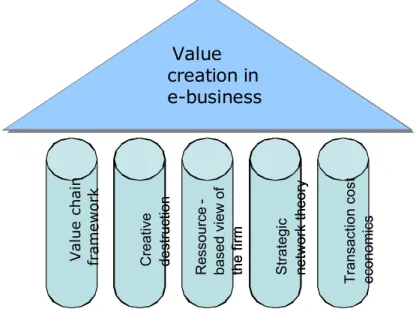
This chapter touches upon the potential of value creation present in virtual markets, and explores the sources of value creation in entrepreneurship and strategic management literatures. It is sustained by five theoretical variables, which is shown in Figure 1 below.
Value creation in e-business V al u e ch ai n fr am ew or k Creative dest ru ct io n R es so ur ce -based view of th e fir m S tr at eg ic ne tw or k th eo ry T ra ns ac tio n co st ec on om ic s Value creation in e-business V al u e ch ai n fr am ew or k Creative dest ru ct io n R es so ur ce -based view of th e fir m S tr at eg ic ne tw or k th eo ry T ra ns ac tio n co st ec on om ic s
Figure 1. Value creation theoretical sustainability
Amit and Zott (2001) identify four interrelated value drivers of e-business: novelty, lock-in, complementarities, and efficiency. It is observed that value creation in e-business goes beyond the value that can be realized through the configuration of the value chain, the formation of strategic networks among firms, or the exploitation of firm-specific core competencies. A business model is proposed as a unifying unit of analysis that captures the value creation arising from multiple sources. It states that no single entrepreneurship or strategic management theory can fully explain the value creation potential of e-business; however each of the theories offers an important insight into one aspect of value creation in e-business, therefore the unification of the important aspects of each one of them.
Before explaining about the four dimensions identified, a brief theoretical perspective in value chain analysis, creative destruction, the resource-based view of the firm, strategic network theory and transactional cost economics need to be mentioned for a complete understanding of how the four value drivers have been identified.
2.2.1 Value chain framework
Amit and Zott (2001) stated that value chain framework analyses value creation at the firm level. Value chain analysis identifies the activities of the firm and then studies the economic implications of those activities. It includes four steps:
1. Defining the strategic business unit; 2. Identifying critical activities;
3. Defining products, and
4. Determining the value of an activity.
Value chain framework explores the primary activities, which have a direct impact on value creation, and support activities, which affect value only through their impact on the performance of the primary activities.4 Value can be created by differentiation along every step of the value chain, through activities resulting in products and services that lower buyers’ costs or raise buyers’ performance.
Value creation opportunities in virtual markets may result from new combinations of information, physical products and services, innovative configurations of transactions, and reconfiguration and integration of resources, capabilities, roles and relationships among suppliers, partners and customers.
2.2.2 Creative destruction
As per Amit and Zott (2001), Schumpeter (1934) pioneered the theory of economic development and new value creation through the process of technological change and innovation. He identified several sources of innovation including the introduction of new goods or new production methods, the creation of new markets, the discovery of new supply sources, and the reorganization of industries.
4Primary activities involve creation of physical products and include inbound logistics, operations, outbound
Creative destruction emphasizes the importance of technology and considers novel combinations of resources as the foundations of new products and production methods, leading to the transformation of markets and industries, and consequently to economic development.
Virtual markets broaden the notion of innovation since they influence firm and industry boundaries, involve new exchange mechanisms and unique transaction methods (rather than merely new products, or production processes), and bring new forms of collaborations among firms.
2.2.3 Resource-based view of the firm
The resource-based view of the firm, which builds on creative destruction’s perspective on value creation, views the firm as a bundle of resources and capabilities. It states that uniquely combining a set of complementary and specialized resources and capabilities may lead to value creation.
A firm’s resources and capabilities are valuable if they reduce the firm’s costs or increase its revenues compared to what would have been the case if the firm did not possess those resources. Examples of such value-creation processes are product development, strategic decision-making, alliance formation, knowledge creation, and capabilities transfer.
When procurement goes online, it reaches markets that would not be reached otherwise; companies interact in a smoother and faster way and speed up the cycle time to execute tasks and run projects.
Practical example
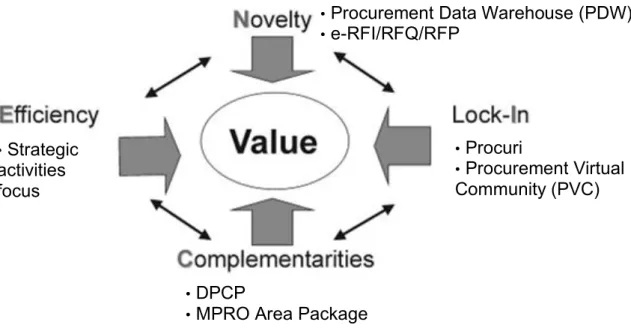
A trucking e-sourcing conducted in South Africa in May 2007 improved the analysis time of supplier’s bids from one week to half day and enhanced the decision making process. By possessing the e-procurement resources, Mærsk Procurement was able to focus on strategic activities and decide which suppliers could be invited for next negotiations round within a work day, this was possible through the analytical tools provided by Procuri making it simple, faster and easier to analyse.
The virtual markets clearly opens up new sources of value creation since relational capabilities and new complementarities among a firm’s resources and capabilities can be exploited (between online and offline capabilities). The prospect of value preservation or sustainability is an important incentive for value creation.
2.2.4 Strategic networks
Strategic networks are stable inter-organizational ties which are strategically important to involved firms. They may take the form of strategic alliances, joint ventures, long-term buyer-suppliers partnerships, among others.
Traditionally, networks theorists with a background in sociology or organizational theory have focused on the implications of network structure for value creation. The size of the network and the heterogeneity of its ties have been speculated to have a positive effect on the availability of valuable information to the participants within that network.
The network perspective is clearly relevant for understanding wealth creation in e-business because of the importance of networks of firms, suppliers, customers, and other partners in the virtual market space. Virtual markets with their world wide reach, connectivity, and low cost information processing power, open entirely new possibilities for value creation through the structuring of transactions in novel ways.
An example could be given by the interaction suppliers and buyers have during an e-procurement process. By a common platform suppliers can clarify eventually doubts they might have regarding the process and the answer is immediately posted back to all participant suppliers, creating a forum with important information for the overall result of the process.
2.2.5 Transaction cost economics
Amit and Zott (2001) suggest that “a transaction occurs when a good or service is transferred across a technologically separable interface. One stage of processing or assembly activity terminates, and another begins”.
Transaction costs include the costs of planning, adapting, executing, and monitoring task completion. Transaction cost economics identifies transaction efficiency as a major source of value, as enhanced efficiency reduces costs. It suggests that value creation can derive from the minimization of uncertainty, complexity, information asymmetry, and small-numbers bargaining conditions. Moreover, reputation, trust, and transactional experience can lower the cost of peculiar exchanges between firms.
One of the main effects of transacting over the Internet, or in any highly networked environment, is the reduction in transaction costs it brings. Transaction costs include the time spent by managers and employees searching for customers and suppliers, communicating with counterparts in other companies regarding transaction details, the costs of travel, physical space for meetings, and processing paper documents, as well as the costs of production and inventory management.
Practical example The same example from previous topic could be given in this case as well. By this common e-procurement platform, buyers can monitor the development of each supplier in any phase of the process. As each transaction the suppliers execute is recorded in the system, the time spent by buyers in monitoring suppliers is reduced and can easily be check through a report the system generates. The electronic platform is an error-free tool, allowing a clear process and thus building trust between suppliers and buyers and between the stakeholders in a sourcing project.
Practical example
Another example of transaction cost reduction is the Mærsk Conferencing Services implemented by Mærsk Procurement and Group IT in June 2007, the spend with travel costs and accommodation for four people is $1400 and can be reduced in 96% by utilising the web/audio-conference services.
The transaction costs theory also focuses on cost minimisations by single parties and neglects the interdependence between exchange parties and the opportunities for joint value maximisation that this presents.
2.3 Value creation drivers
Each theoretical framework discussed above makes valuable suggestions about possible sources of value creation. The multitude of value drivers suggested raises the question of precisely which sources of value are particularly important in e-business, and whether unique value drivers can be identified in a context of e-business.
Figure 2 describes the four sources of value creation in e-business that emerged from the study by Raphael Amit and Christoph Zott (2001). Their theory assumes the total value created as the sum of the values appropriated by each party involved in a transaction and suggests that the presence of these value drivers, which are anchored in the received entrepreneurship and strategic management theory, enhances the value-creation potential of e-business.
2.3.1 Efficiency
Amit and Zott (2001) point to transaction efficiency as one of the primary value drivers for e-business.
This finding, which is consistent with transaction costs theory, suggests that transaction efficiency increases when the costs per transaction decrease. Therefore, the greater the transaction efficiency gains that are enabled by a particular e-business, the lower the costs and hence the more valuable it will be. One is by reducing information asymmetries between buyers and sellers through the supply of up-to-date and comprehensive information. The speed and facility with which information can be transmitted via the Internet makes this approach convenient and easy.
Improved information can also reduce customers’ search and bargaining costs, as well as opportunistic behavior. The opportunistic behavior could be for example, the maverick buy, in which someone with purchaser rights in the company buys items way above the contracted price and from a non-accredited supplier. The use of e-catalogues enhances compliance with existing frame agreements and diminishes situations as maverick buy. By leveraging the cheap interconnectivity of virtual markets, e-businesses further enhance transaction efficiency by enabling faster and more informed decision making. They also provide greater selection at lower costs by reducing distribution costs, streamlining inventory management, simplifying transactions, which reduce the likelihood of mistakes, allowing individual customers to benefit from scale economies through demand aggregation and bulk purchasing, streamlining the supply chain, and speeding up transaction processing and order fulfillment, benefiting both vendors and customers. Vendors in this case, benefit from participating in an error-free process and higher volume through a global frame agreement, meaning that for example, the purchase of computers and laptops in the entire organization would be purchased from IBM.
Practical example Taking it to e-procurement, an example could be the e-procurement platform, as mentioned earlier; it allows information flow between buyers and suppliers in almost no time.
According to Amit and Zott (2001) using an online auction instead of an offline format for trading cars between businesses halves transaction costs. Marketing and sales costs, transaction-processing costs, and communication costs can also be reduced in an efficient e-business, and the firm’s value-creating potential can be enhanced through scalability, for example by increasing the number of transactions that flow through the e-business platform.
2.3.2 Complementarities
Complementarities are present whenever having a vast number of goods together provides more value than the total value of having each of the goods separately.
In the strategy literature, Amit and Zott (2001) have discussed the importance of providing complementary outputs to customers. They state that “a player is your complementor if customers value your product more when they have the other player’s product than when they have your product alone”. Resource-based view theory also highlights the role of complementarities among strategic assets as a source of value creation; and network theory highlights the importance of complementarities among the participants in the network.
Complementarities can be expected to increase value by enabling revenue increases. The data analysis suggests that e-businesses leverage this potential for value creation by offering a number of complementary products and services to their customers. These complementary goods may be vertical complementarities such as after sales services or horizontal complementarities such as one-stop shopping. They are often directly related to a core transaction enabled by the firm.
E-businesses may also create value by capitalising on complementarities among activities such as supply-chain integration, and complementarities among technologies such as linking the analytical technology of one business with the Internet communication technology of another, as shown in the example above, thereby unleashing hidden value.
2.3.3 Lock-in
The value-creating potential of an e-business is enhanced by the extent to which customers are motivated to engage in repeated transactions, increasing transaction volume, and by the extent to which strategic partners have incentives to maintain and improve their associations, increasing both the willingness to pay of customers and lower opportunity costs for firms. These value-creating attributes of an e-business can be achieved through lock-in.
Lock-in prevents the migration of customers and strategic partners to competitors, creating value in a number of ways. Lock-in is manifested as switching costs, which are anchored by the transaction cost framework, and as network externalities, which has its roots in network theory.
It should also be noted that, as resource-based value theory suggests, a firm’s strategic assets, such as its brand name, and buyer-seller trust, both contribute to lock-in. The study reveals several ways in which customer retention can be enhanced.
An example of those complementarities would be an e-procurement solution web site, Procuri, which grants its customers analytical tools to better and easily analyse the outcomes of and sourcing. These services enhance the value of the core products, e-procurement platform, and make it convenient for users to comply with the platform by having available tools such as Scorecard analysis and report and automatic supplier ranking.
First, loyalty programs rewarding repeat customers with special bonuses can be established. Second, firms can develop dominant design proprietary standards for business processes, products, and services, such as the Amazon’s patented shopping cart. Third, firms can establish trustful relationships with customers, for example, by offering them transaction safety and reliability guaranteed by independent and highly credible third parties.
To the extent that customers develop trust in an e-business company through such measures, they are more likely to remain loyal to the site rather than switch to a competitor. The data suggest that e-businesses enhance lock-in by enabling customers to customize products, services, or information to their individual needs in a variety of ways. This mechanism exhibits the interesting property that the more the customer interacts with the system, the more accurate the matching results become. Customers then have high incentives to use the system, creating a positive feedback loop5. More important for the
discussion of e-business, however, is the idea that increasing returns and positive feedback may derive from network effects.
Virtual markets also enable e-business firms to create virtual communities that bond participants to a particular e-business. Such communities enable frequent interactions on a wide range of topics and thereby create loyalty and enhance transaction frequency.
Given the enormous reach of virtual markets, e-business firms often connect numerous parties that participate in commercial transactions. They can be considered as network generators. Networks may exhibit externalities in that the production or consumption activities of one party connected to the network have an effect on the production or utility functions of other participants in the network. This effect is not transmitted through the price mechanism. In the context of e-business, network externalities are present when the value created for customers increases with the size of the customer base. In an auction setting, the complementary components of the network would be the buyers and sellers where the total value created is a direct function of the network size.
5 Amit and Zott, 2001
Efficiency and complementarities as sources of value creation can also be helpful in encouraging lock-in. The efficiency features and complementary product and service offerings of an e-business may serve to attract and retain customers and partners. The higher the relative benefits offered to these parties, the higher their incentives to stick with or join the network established by the e-business. The increasing return properties inherent to network effects then magnify the relative benefits offered, triggering positive feedback dynamics. Conversely, when an e-business creates lock-in, this can also have positive effects on its efficiency and on the degree to which it provides for complementarities. For example, many auction sites enable buyers to rate sellers. This feature increases buyers’ trust in the fairness of transactions and therefore improves stickiness. Moreover, a strong potential for lock-in provides an incentive for high-profile partners to contribute complementary products and services because of the promise of high-volume business.
There are important relationships between lock-in, efficiency, and complementarities as sources of value creation. The potential value of an e-business depends on the combined effects of all these value drivers.
Practical example To summarize this driver with an example related to this thesis, consider Procuri, which as mentioned before is an e-procurement solution provider, Procuri allows its customers to suggest changes into the system to fit into its customer’s realities and shape the platform according to customer’s requirements and needs. Some of the suggestions are so relevant for the effectiveness of the platform that they are implemented in a general basis, and for particular modifications, only a single platform is modified. What happens with Procuri is that the overall function and tools are shared among its customers. However each customer has its ‘own’ Procuri platform, with special requirement to fit that specific company. For example, at Mærsk, when a supplier is invited to an e-sourcing project, he receives an invitation with access to the Procuri platform, though it shows the Mærsk logo in it, showing that this is the Mærsk e-procurement platform, developed and maintained by Procuri. The same happens with Kodak, IBM, among others. This interaction between Procuri and its customers creates a huge network, with discussion forums and improvement suggestions; the overall outcome is the continuous improvement of the platform, making it even more effective and error-free.
2.3.4 Novelty
The value creation potential of innovations has been articulated by Amit and Zott (2001). While the introduction of new products or services, new methods of production, distribution, or marketing, or the tapping of new markets have been the traditional sources of value creation through innovations, the study reveals that e-businesses also innovate in the ways they do business, meaning by the way transactions are structured.
The unique characteristics of virtual markets such as the removal of geographical and physical constraints, possible reversal of information flows from customers to vendors; and other novel information bundling and channelling techniques, makes the possibilities for innovation seem endless. For example, e-business firms can identify and incorporate valuable new complementary products and services into their bundle of offerings in novel ways.
Practical example For example, Mærsk Procurement introduced the purchase of flight tickets and hotel reservations through Buyer’s Compass, anyone in APMM that needs to book tickets and hotel rooms can easily make it through an e-catalogue integrated with Buyer’s Compass. This e-catalogue shows prices negotiated by Mærsk Procurement and only accredited suppliers are listed. They create value by connecting previously unconnected parties, eliminating inefficiencies in the buying and selling processes through adopting innovative transaction methods, capturing latent consumer needs, such as flight ticket purchasing from the convenience of your office without arguments about the price or agreement with a travel agency, and by creating entirely new markets such as auction for more than 100 hotel chains.
2.4 Theory remarks
Novelty and lock-in are linked in two important ways. First, e-business innovators have an advantage in attracting and retaining customers, especially in conjunction with a strong brand. Second, being first to market is an essential prerequisite to being successful in markets that are characterized by increasing returns. First movers are in a good position to initiate the positive feedback dynamics that derive from network externalities, and to achieve a critical mass of suppliers and/or customers before others do. Novelty is also linked with complementarities. The main innovation of some e-businesses resides in their complementary elements, such as the resources and capabilities they combine.
Finally, there is also an important relationship between novelty and efficiency. Certain efficiency features of e-businesses may be due to novel assets that can be created and exploited in the context of virtual markets.
The theory mentions that value creation strikes at the heart of the strategic management and entrepreneurship fields, as it is an essential prerequisite for value appropriation. However, the theoretical lenses that are commonly used in the fields of strategic management and entrepreneurship for viewing and explaining wealth creation emphasize distinct sources of value, which each of the identified sources of value creation commands equal attention.
Amit and Zott (2001) suggest that no single theoretical framework discussed above should be given priority over the others when examining the value creation potential of e-businesses and that the interdependence of the sources of value and to the locus of value creation in e-business is very important.
As seen at section 2.3, the presence of each value driver can enhance the effectiveness of any other driver. This gives even more weight to an improved integration of the various theories of value creation in order to yield a more complete picture of the functioning of e-businesses and capture the various sources of value creation.
In the value chain framework, it is the firm’s activities; in creative destruction theory of economic development, it is the firm; in resource-based view theory, it is the resources and capabilities that constitute the firm; in strategic network theory, it is the network of firms; and in transaction cost economics, it is the transaction that is both the unit of analysis and the presumed locus of value creation. The use of any of these theoretical frameworks alone would result in some crucial aspects of value creation in e-business either being ignored or not being given due importance.
Based on theory’s analysis of the sources of value creation in e-business, it is proposed a business model as a unit of analysis. The business-model construct proposed is believed to be useful because it “explains and predicts an empirical phenomenon, which is the value creation in e-business, which is not fully explained or predicted by conceptual frameworks already in existence”6. The business model construct builds on ideas based
on the main theoretical frameworks of strategic management and entrepreneurship research. First, it is consistent with creative destruction idea that innovation is an act of ‘creative destruction.’ In the context of the business model, innovation refers not only to products, production processes, distribution channels, and markets, but also to exchange mechanisms and transaction architectures. Innovative business models such as the ones adopted by Priceline.com, with its patented ‘name your own price’ exchange mechanism, have the potential to break existing industry structures and thereby setting a serious threat to incumbents. Second, the notion of the business model draws on arguments that are central to the value chain framework.
A business model does not follow the flow of a product from creation to sale, but describes the steps that are performed in order to complete transactions. It is worth emphasizing that customers can play a critical role in value creation, for an example, as lead users. They may work with the firm to better assess their needs, acting as beta sites before the product is released to a larger customer base. In fact, by electronically supplying information in real time, customers can even ‘co-create value’, as vendors can better tailor their offerings to the customer.
6Amit and Zott (2001)
Note that each business model is centred, being its main reference point. This is why the theory can refer to a particular business model as ‘firm x’s business model’. However, the business model as a unit of analysis has a wider scope than does the firm, since it encompasses the capabilities of multiple firms in multiple industries.
The theory proposes that its definition of a business model is applicable to firms doing business in virtual markets as well as to those on more conventional businesses. With the theoretical foundations of the business model construct anchored in the value chain framework, creative destruction, the resource-based view of the firm, strategic network theory and the transaction perspective, a definition of the value that is created through a business model can be given. In doing so, total value created can be expressed as “the sum of the values appropriated by each party”7, which can be extended by stating that the
total value created through a business model equals the sum of the values appropriated by all the participants in a business model, over all transactions that the business model enables.
In summary, the theory suggests that value is created by the way in which transactions are enabled. In e-businesses in particular, enabling such transactions requires a network of capabilities drawn from multiple stakeholders including customers, suppliers, and complementors. The examples given during this chapter illustrate some of the value creation drivers identified during this thesis.
The following chapters will give an in depth analysis of how the value creation is applied in a practical context and some of the examples mentioned will be explained with more detail.
7Amit and Zott (2001)
3 E-Procurement
In this chapter I will define and describe the procurement process, its benefits and risks and what are the phases involved. It is in here that I will answer the sub-question:
3.1 Introduction
Procurement refers to all activities involved with obtaining items from a supplier, which includes purchasing and inbound logistics such as transportation, goods-in and warehousing before the item is used. It has not traditionally been a significant topic for management study in comparison with other areas such as marketing, operations and strategy. The concept of e-business has, however, highlighted its importance as a strategic issue since introducing electronic procurement can achieve significant savings and other benefits which directly impact upon the customer.
E-procurement is not a new process and there have been several attempts to automate the process of procurement for the buyer using electronic procurement systems (EPS), workflow systems and links with suppliers through EDI. These attempts can be referred to as the first-generation of e-procurement, they included online entry, authorisation and placing of orders using a combination of data entry forms, scanned documents and e-mails based workflow.
As per Dave Chaffey (2002), the perceived importance of e-procurement was highlighted by a Tranmit plc (1999) report8 which showed that around 90 per cent of companies said
they planned to implement an electronic procurement system within the next five years, with the majority of them identifying cost savings as their primary goal.
8 E-business and E-commerce Management – Second Edition. Chaffey, Dave. Pg. 288
What changes in the procurement process when it goes online? Is it only a web-based system or does it require a new process?
3.2 Definition
E-procurement is the term used to describe the use of electronic methods, typically over the Internet to conduct transactions in a Business to Business environment. The process of e-procurement covers every stage of purchasing, from the identification of a requirement, through the bidding process, to the payment and potentially the contract and supplier management. 9
3.3 Understanding the e-procurement process
It is fundamental to understand that electronic procurement is not a strategy itself but the use of electronic means to carry out the procurement process.
Through the e-procurement process, companies have the possibility to aggregate spending corporate-wide and take advantage of the purchasing agreements. Procurement activities can be grouped and defined in three different ways: indirect procurement, direct procurement and sourcing.
Indirect procurement involves selecting, buying and managing supplies for running the day to day of the company. Direct procurement may sometimes be called supply chain management and involves buying goods and organising activities to manufacture finished products, or products related to the core business of the company. Sourcing is the process of determining long-term demand requirements in goods or services, finding sources to fulfil those requirements, selecting suppliers to provide the requirements, negotiating the purchase agreements and managing the suppliers' subsequent performance, can apply to both indirect and direct procurement. It involves a four phase model: information, negotiation, settlement, and after sales.10
9 EIC (Euro Info Centre) – Curran, Elaine. Bernert, Andrea. Wiegand, Anke. Electronic Procurement in the
public sector – Factsheet on latest developments in e-procurement in the EU and its Member States.
Before e-procurement started, organizational procurement process had remained similar for many years. The paper-based purchasing process involved the end-user of an item selecting the item by conducting a search and then filling in a paper requisition form that was sent to a buyer in the purchasing department, which originally caused delays in the process due to manager’s authorisation waiting time. After the authorisation, the buyer filled in an order form that was dispatched to the supplier. After the delivery of the item purchased, the item and the delivery note were reconciled with the order form and an invoice to be submitted to accounts payable department. Usually this whole process had a cycle time of five and a half days. By applying e-procurement this process can be optimised and the cycle time reduced to one and a half day. The process is changed in the buyer involvement, which is not required and by using the web as a searching tool makes it easier to find products than by using traditional catalogues. Though it is important to emphasise that this cycle time is for new item instead of a repeat buy for which searching would not be required. The overall result is large savings in time and expenses.
3.4 Benefits
Through e-procurement, the buyer achieves the target set out during the sourcing project which leads to lower transaction and processing costs and increases efficiency, for example greater speed in procuring services and goods and reduced spending due to increased choice and competition.
The private sector is often highlighted as the forerunner when it comes to adoption of new technologies and new methods of work. However, in the procurement field, including e-procurement, the public sector is probably well ahead of the private sector, such as auctioning transportation services, medical supplies and equipments for hospitals, among others.11
There are several ways that the private sector can benefit from the public sector’s e-procurement experiences as the needs of the public authorities are not much different
from the needs of private enterprises and in many cases the results of this work and standards could be used for Business to Business (B2B) e-procurement, through practices such as benchmarking.
Business-to-Business e-commerce has transformed the buying habits of the private sector, with companies of all sizes adjusting their strategic thinking to quicken turnaround times, and reduce costs, increase transparency and objective, keep inventory just-in-time, track orders, replenish consumables, anticipate the next requirement, upgrade systems and plan maintenance.
When e-procurement is combined with process reengineering it can greatly reduce transactional costs. In the traditional procurement process, there is a large freight of documents such as requisition, purchase order and invoice which gets prepared and transported within an organization and across organizations, administrative effort put into preparing these documents can be greatly reduced via e-procurement. There is a high cost involved in printing these documents and in transporting them both within and across an organization; the average of transaction cost in large organization is estimated in US$250.00 per transaction.
Practical example The transaction cost of $250.00 is due to manual handling and transportation of the invoices within the organization, due to issuing of a check or payment in connection to this invoice, for example. Though what makes this number appear large as it does is the unconformity of invoices, either because it shows wrong prices, quantities or there is no PO in connection with it. Through a purchasing system, the unconformities are minimised once this system is connected to the frame agreements (e-catalogue), showing the quantity agreed and the correct price. Once systems are matched and conform, the items are shipped and once delivery is conformed the integrated financial system issues the payment. This procedure is known as ‘Reverse Billing’ or ‘Buyer’s Invoice’, the actual supplier invoice is irrelevant for the payment and completion of this process as it was automated 100% automated and the quantity is diminished from the open PO the buyer has in its purchasing system.
When e-procurement is done, efficiency is obtained not just via reduced printing and transportation costs, but also via reduced process cycle time. E-procurement also tends to change the role of buyers in the purchasing department. By removing administrative tasks such as placing orders and reconciling deliveries and invoices with purchase orders, buyers can spend more time on value-adding activities. Such activities might include spending more time with key suppliers to improve product delivery and costs or analysis and control of purchasing behaviour, which can be named as contract management.
Another benefit of e-procurement is to obtain high quality data on purchasing activities, such as what has been bought, when, from which supplier and how much. Equipped with this data, companies are well positioned to negotiate better frame agreements with suppliers, to consolidate spend and reduce sub optimization.
E-procurement also enhances transparency and accountability in the purchasing process, making it a secure and transparent process by limiting maverick buying12, which is a great advantage for both procuring and procured companies.
3.5 Barriers and Risks of e-procurement
Though e-procurement has a lot of benefits to the organizations involved, in both parties (buyer and supplier), there are some issues to be acknowledged and taken care of.
12 Maverick buying is when items are order unnecessarily or with high prices.
Practical example A practical example of how companies can benefit from managing high quality data is the Procurement Data Warehouse of Mærsk Procurement, where information regarding all current suppliers, spend figures and frame agreements are available company wide and is a great advantage to start a sourcing project knowing that the information necessary to identify spend and possible savings are available and are accurate.
As per Edie et al (2007), identified some of the greatest risks related to products and services procured through e-procurement in the construction field; they are in order of importance: supplier relationships, technology and legal control, cost/benefit concern, organizational skills and culture. The legal, technical and organisational barriers that may result from procurement online are one of the greatest challenges for policy makers.13
Despite the proven benefits of using electronic means in procurement, Edie et al (2007) showed that only 48% of respondents indicated that they were able to conduct e-commerce effectively. This might be an indication that those barriers are really impacting the good results and benefits for the implementation of e-procurement.
The barriers identified in the European study have been found in any type of procurement, having some of them slightly modified from segment to segment. However, it is fundamental to the development of strategies for improvement to have those barriers and risks identified. They are shortly explained in the following sections.
3.5.1 Legal issues
Edie et al (2007) also stated that Information and Communications Technology (ICT)14 is improving communication in the construction sector. On the negative side it also showed that only 26% of respondents agreed that ICT was acceptable as admissible written proof during construction. Only 17% thought that it was acceptable as a written notice. This questions the legal validity of electronic information exchange and must be considered as a barrier to the implementation of an e-procurement system.
Legal difficulties are one of the main barriers to e-procurement, such as lack of specific legal regulation, different national approaches and validity, enforceability and evidentiary problems. The legal boundaries of e-procurement are mentioned in a chapter later on.
13 Barriers to e-procurement - ITcon Vol. 12 (2007), Edie et al.
3.5.2 Resistance to change
Resistance to change, lack of a widely accepted solution and lack of leadership, which are cultural issues, are highlighted as barriers by Edie et al (2007) in the USA. These produce a slowdown in adoption of e-procurement and result in a failure to reach many of the perceived benefits. Therefore a cultural change needs to take place prior to adoption of an e-procurement system. However, with the pressures on companies, other competing initiatives have taken priority in many occasions. According to Edie et al (2007), there was a study conducted in Singapore which showed that this was the largest barrier in that country with 60% of the respondents under the impression that other initiatives were of more importance than e-procurement. This point towards the need for cultural change, which brought by top management support can successfully implement e-procurement.
3.5.3 IT issues
As per Edie et al (2007) some companies have a problem in acquiring the right platform to carry out e-procurement. The reason might be due to high costs involved in installing the proper IT system to have all the benefits of e-procurement process.
Practical example An example would be the introduction of e-sourcing at the Fuel market in the US. With the important task of implementing e-procurement in a fuel project within the US, Mærsk Procurement faces resistance to change from its own stakeholders, meaning that the BU in the US is not confident with the outcomes an e-sourcing provides. Mærsk Procurement created a test e-sourcing to show its BU, a trucking company, the benefits and time enhanced by running an e-sourcing. The test is scheduled to go live by the end of August 2007 with all the stakeholders of this specific project involved and playing both suppliers’ and buyers’ sides to understand the overall benefit for both parties. Despite this resistance to change from the BU, Mærsk Procurement is confident the BU will understand and accept the e-sourcing in another successful project.
Although most of Northern Ireland contractors stated that they have the necessary equipment to carry out e-procurement and that the cost of IT is not a problem and the problem lie in know-how of the system.
Lack of IT system to conduct e-procurement can be easily solved by investing in this area either by joint investment or financing and training key users to gain expertise. The capital invested would easily be returned by the benefits e-procurement provides to the company, which benefits have been previously covered.
The lack of e-procurement knowledge can occur when the company has an older generation of employees that are change resistant regarding IT related issues, relying on traditional forms and means of procurement, which can be solved by training employees and by creating a knowledge sharing centre to spread the IT concept of e-procurement through the organization or key personnel.
3.5.4 Security of transactions
Security is a major concern when working on the internet. Edie et al (2007) state “The World Wide Web leaks such as a sieve. Data transmitted on it can be garbled, can reassemble wrongly at the other end, or can display only partially because of incompatible software”.
Many of the banks although acknowledging these problems, have set systems into place to mitigate them. An example is the Bank for International Settlements (BIS) who state that their security “should include establishing appropriate authorisation privileges and authentication measures, logical and physical access controls, adequate infrastructure security to maintain appropriate boundaries and restrictions on both internal and external user activities and data integrity of transactions, records and information”. It should not be different than the security structure for e-procurement platforms.
3.6 Phases
This section uses a model for procurement process extracted from the case study company, A.P. Møller – Mæersk Group; where the four phase model by Edie et al (2007) has been broaden to six phase model.
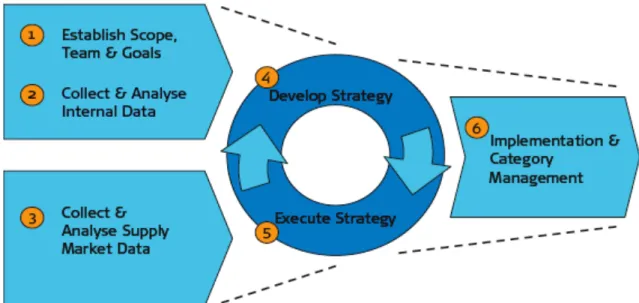
Figure 3 below shows the dynamism of a procurement process. It is worth noting that the steps don’t follow a chronological order, meaning that they can be done even when a previous step is not finished yet.
Steps 1 to 3 analyse internal and external data. It is imperative that the company knows who they are, where they stand for and how they spend. What the market demands are, what the options and alternatives are before approaching this market with a strategy, these steps are often carried out simultaneously.
Steps 4 and 5 plan and execute the strategy towards the market. The steps are cyclic, indicating that the strategy often needs to be reviewed after it has been executed.
Step 6 is the continuous improvement and management of the results achieved during the previous steps. After the conclusion of this step, the project is hand over to the organization that manages this contract (in case it is done by a global procurement group working closely to the Business Unit).
Figure 3. Six Steps of e-procurement
It is important to notice that this model includes Category Management under step 6; this is applicable to Procurement Project Organization that hands over to the Business Unit. In other organization models it is recommended to change this to Contract and Supplier Management.
3.7 E-Sourcing
E-sourcing is a new area, and there are naturally many concerns from both suppliers and stakeholders. Some concerns origins in myths and misunderstandings about the applicability of e-sourcing, such as ‘e-sourcing is all about lowering prices’, ‘e-sourcing is unfair to suppliers’, ‘e-sourcing makes it difficult to win new business’, ’e-sourcing eliminates buyer-supplier relationships’, among others.
Even though concerns and resistance in the initial phase of an e-sourcing is natural and expected, experience from e-sourcing projects conducted at Mærsk Procurement show that suppliers actually understand the value of the process – during and after completion.
Some of the comments received from suppliers afterwards are:15
• It is time saving – negotiations take hours, not days or weeks (e-auction); • It provides added transparency to the negotiation process;
• It gives a good indication of the market situation;
• When factoring is added to an e-auction focus is shifted to non-pricing
criteria and Total Cost of Ownership;
• It is an easy-to-use standard interface;
• With log-in codes it provides the ability to participate from anywhere in the
world.
3.7.1 Definition
E-sourcing is one of the procurement activities which can be defined by “the process of determining long-term demand requirements in goods or services, finding sources to fulfil those requirements through a faster and more efficient way, selecting suppliers to provide the requirements, negotiating the purchase agreements through a web-based platform and managing the suppliers' subsequent performance”16.
3.7.2 Process
E-sourcing is not only a web-based platform which supports some of the steps in the sourcing process. The value of having an e-platform is added through a more
15 Suppliers’ feedback received during and after e-sourcing projects at Mærsk Procurement.
16 Handbook for Strategic Sourcing – Mærsk Procurement
Applying this to the theoretical framework from chapter 1, the novelty of running a new process combined with the trust gained through a more transparent process in lock-in
and the efficiency by reducing negotiations time is a practical example of value creation and the interaction of each driver.
standardized, globally accessible and structured process, which can be facilitated by some tools for spend analysis, aggregate demand, define requirements, discover suppliers, negotiate (through RFQ and/or reverse auctions), and evaluate suppliers. It enhances the transparency and fairness of the sourcing process as the suppliers involved have access to the same information at the same time.
The main objectives for adopting the e-sourcing is to save time through information transfer, improve productivity with template re-use (available at the online platform as the user simply inputs the information necessary for the current project), the transparency issue is fully enabled through monitoring and reporting tools, unified measurements of key performance indicators are ensured and followed up on sourcing goals in equal terms, the savings can be increased by strong functionality with scenario building possibilities and through e-auction with direct competition.
E-sourcing is the single greatest opportunity to impact the Total Cost of Ownership, quality, and performance of a supply chain. Enterprises of all sizes and industries are rushing to develop e-sourcing competence and secure the optimal mix of suppliers to ensure supply, mitigate risks, reduce costs, and capitalize on emerging markets.
3.8 E-RF(x) (Electronic Request for Information/Quotation/Proposal)
A RF(x) process allows the decision making process to be determined by a variety of attributes, involving not only price, but quality, lead time, contract terms, supplier reputation, incumbent switching costs, among others. Consequently, e-marketplaces are currently being developed to partially automate the RF(x) process by creating an e-RF(x) platform, an example would be Procuri.com which provides online platforms and tools to automate the sourcing process and add value through the novelty driver.