Pilot Scholars
Engineering Faculty Publications and Presentations
Shiley School of Engineering
2015
Best Practices for Advising At-Risk First-Year
Engineering Students
Caitlin Cairncross
University of Portland, [email protected]
Tammy VanDeGrift
University of Portland, [email protected]
Sharon A. Jones
University of Portland, [email protected]
Lindsay Chelton
Follow this and additional works at:
http://pilotscholars.up.edu/egr_facpubs
Part of the
Engineering Commons
This Conference Paper is brought to you for free and open access by the Shiley School of Engineering at Pilot Scholars. It has been accepted for inclusion in Engineering Faculty Publications and Presentations by an authorized administrator of Pilot Scholars. For more information, please contact
Citation: Pilot Scholars Version (Modified MLA Style)
Cairncross, Caitlin; VanDeGrift, Tammy; Jones, Sharon A.; and Chelton, Lindsay, "Best Practices for Advising At-Risk First-Year Engineering Students" (2015).Engineering Faculty Publications and Presentations. 36.
Best Practices for Advising At-Risk First-Year
Engineering Students
Caitlin Cairncross, Dr. Tammy VanDeGrift, Dr. Sharon Jones, Lindsay Chelton
University of Portland, [email protected], [email protected], [email protected], [email protected]
Abstract – This paper reports on challenges identified
and best practices developed through advising at-risk first-year engineering students, synthesizing both existing literature as well as the experiences of advisors and faculty members in the School of Engineering. Based on conversations with and feedback from first-year students, it has become clear that at-risk students face unique challenges that can affect their persistence in engineering. These challenges include: the high school to college transition, the difficulty of high-achievers experiencing failure for the first time, the competitive culture of engineering, learning how to take ownership of the college experience, and pressure in high-stakes courses. With these challenges in mind, the School of Engineering has adopted a number of best practices that are targeted specifically at supporting at-risk first-year students. These best practices include: group advising, holistic advising, growth mindset strategies, flow charts, student socials, and student assessment.
Index Terms – advising, at-risk first-year engineering students, retention, best practices
INTRODUCTION
This paper highlights six best practices for advising at-risk first-year engineering students. These best practices have been developed and identified in response to some of the common challenges that at-risk engineering students face; therefore, this paper will also consider these common challenges, and how they affect the success and persistence of engineering students. The intent of this paper is not to generalize about the experience of at-risk students, but to shed light on some the challenges that these students encounter, which can in turn help inform the implementation of effective advising practices. Many of the challenges identified were based on feedback from students who met with an academic success counselor throughout their first year.
National data shows that approximately 60% of students leave engineering during their first-year [1]. The School of Engineering at the University of Portland has focused on advising as a tool to increase the persistence of first-year students, particularly those who are at-risk (defined here as students who either were not calculus-ready when they started, or who fell behind in their degree progress after their first semester). As a whole, the advising structure and
best practices utilized in the School of Engineering are designed to provide holistic support for engineering students, and ultimately to improve the retention rates of those who are considered at-risk of leaving engineering.
Institutional Background
The University of Portland is a private, four-year, teaching-focused institution serving approximately 3700 undergraduate students; of those 3700, approximately 700 are engineering students. The School of Engineering at University of Portland offers three engineering degrees and one computer science degree.
The University of Portland does not have a pre-engineering program, so students enter the School of Engineering as freshmen. During the first year, all students take a common set of courses. In the fall semester, students take math, science, two core curriculum courses, and an introduction to engineering course. Students officially declare their major at the end of fall semester of their freshman year. In the spring, students take math, one or two science courses, a computing course, and one or two core curriculum courses. In the School of Engineering, the average 1st-3rd semester
retention rate is 78.5%, and the average four-year graduation rate is 47.2%. These rates are noticeably lower than those of the University’s peers; nationally, private universities have an average 1st - 3rd retention rate of 85%
and a four-year graduation rate of 51% [2].
The average retention rate for at-risk students is significantly below average. The 1st – 3rd semester retention rate for students who start in pre-calculus (making them one course behind in math) is 53.8%, and the four-year graduation rate is 25.0% (compared to 80.7% and 51.9%, respectively, for students who start in Calculus I or higher). In addition, students who start their second year behind in credits have a 17% lower 3rd – 5th semester retention rate than those who start their second year on track.
In the 2014-2015 academic year, of the 240 students who started in the fall, 52 first-year engineering students were identified as at-risk. 35 of those students started in Pre-Calculus II, 11 did not pass one or more courses in the fall semester but were still in good standing, and 6 were on
academic probation (including one who took a leave of absence) in the spring semester.
In response to the low retention rates of at-risk students, the School of Engineering has focused on its advising practices as a way to support these students. Ultimately, the hope is that thorough its advising structure and targeted advising practices, the school can prevent the attrition of students who have the drive and desire to be in the engineering field, but are derailed by various challenges that may arise during their first year and beyond.
Advising Structure
Advising in the School of Engineering is multi-tiered, to ensure that students are supported in their academic, personal, and professional lives. The advising structure is as follows:
• Academic Program Counselor - Advises all engineering students on degree planning, co-curricular planning, and registration. In the fall, conducts group advising for freshmen to review registration processes. In the spring, holds mandatory 1:1 meetings with all freshmen to discuss specifics around students’ degree progress and four-year plan.
• Faculty Advisors – Advise students on registration, academic progress, and career and educational goals. Meet 1:1 with students in both the fall and spring semester. In the fall semester, the faculty advisor is the student’s Intro to Engineering instructor. Once assigned advisees in the spring (after freshmen have officially declared majors), the faculty advisor maintains the same cohort of advisees throughout the four years. • Associate Dean – Works with students who are on
academic probation to discuss factors that lead to their probationary status, strategies for academic success, and fit within the chosen major.
• Academic Success Counselor – Assists at-risk students with tools for academic success, including time management, study strategies, campus resources, and degree planning. This position is currently funded through a grant.
• Professional Development Advisor - Works with all engineering students regarding their career interests, and helps connect students with internships, jobs, and other professional opportunities.
Altogether, the variety of advising support helps ensure that at-risk students are caught not only after they are of academic concern, but also before they suffer any major academic setbacks. It is important to note that outside of the School of Engineering, students have access to a host of other student support resources, including an academic
resource center, a learning resource center advisor, and departmental tutoring.
CHALLENGES TO AT-RISK ENGINEERING STUDENTS At-risk first-year engineering students at the University of Portland face a number of unique challenges. There are five challenges in particular that seem to affect most at-risk students: 1) the high school to college transition; 2) high achievers experiencing failure for the first time; 3) the competitive culture of engineering; 4) pressure in high-stakes courses; and 5) students learning how to take ownership of their college experience. The identification of these challenges stems both from informal and formal feedback provided by students, as well as observations about at-risk students provided by advisors. Although some of the challenges listed above apply to all engineering students, it appears that they have different effects on at-risk students, particularly with regards to their desire to persist in engineering.
Many of these challenges align with national trends. A recent qualitative study cited high school preparation, unwelcoming engineering culture, and poor academic performance as factors that influence students’ decision to leave engineering [3]. Importantly, the study also listed advising (specifically poor advising) as a factor in attrition, justifying the need for effective and up-to-date advising practices. A second study confirmed these three factors, and highlighted the fact that students of color tend to feel the effects of poor academic preparation more so than white students [4]. The challenges and best practices explored in this paper will be analyzed in the context of existing literature on retention of at-risk engineering students.
Challenge 1: High School to College Transition
The high school to college transition is a difficult one for most engineering students, if not most college students. A major issue for at-risk freshmen is their academic preparation, and the adjustment to college-level coursework. Indeed, research has found that while many students enter the STEM field due to positive experiences with math and science courses in high school, many of them leave due to negative experiences with STEM courses in college or a lack of preparation for the rigors of college-level coursework [3, 5]. Not only are students unaccustomed to the high expectations and quick pace of college classes, some of them never took calculus or physics in high school, two key courses in the engineering degree. Therefore, while other students are making their way through calculus and physics for the second time, many of our at-risk students are seeing this material for the first time, which proves to be a big hurdle for them.
In addition, many at-risk students in the School of Engineering report that their high schools were not very competitive, and that they could be successful with minimal
effort. Therefore, when these students start college, and are taking five to six rigorous courses simultaneously, they do not have the study skills in place to achieve success in all courses. Much of the challenge of the high school to college transition, then, goes beyond difficult course content – it is also about learning how to manage time and study effectively, skills that many of these students have never developed.
The high school to college transition is not just an academic transition, but a social transition as well. Leaving family and adjusting to a completely new place can cause significant stress for students. For students who are not from the continental United States, the transition can be even more difficult. Approximately 25% of this year’s at-risk freshmen were from Hawaii, the Pacific Islands, or from outside of the United States. For these students, some of whom did not grow up speaking English as a first language, the high school to college transition is a major challenge – they are far away from home, in a completely new culture and educational system. As a result, many of them feel isolated and homesick during their first year. These circumstances make it very difficult for them to concentrate fully on their demanding coursework, often resulting in challenges that have more to do with their emotional wellbeing than their academic ability.
Challenge 2: High Achievers Experiencing Failure
Many students in the University of Portland School of Engineering were high performing students in high school. They entered college feeling confident in their ability and preparation, and did not anticipate the quick pace and academic rigor of college-level coursework. When they hit their first roadblock - whether it is failing a test, an incomplete homework, or a general lack of confusion in a course – they panic. Because these students are not used to experiencing failure, they are not sure how to react to it; many of them start to question their own intelligence and their future in engineering. Because academic self-confidence has been shown to have strong correlations with retention, students’ ability to rebound from academic challenges is critical [6].
Self-doubt has different effects on different people – some students are able to regroup by changing their study tactics and outlook on success. Other students experience a decline in effort or academic achievement (or both), transforming the once-small roadblock into a major hurdle. Another side-effect of the fear of failure is a general reluctance to asking for help. Many students report being hesitant to visit a tutor or to attend a faculty member’s office hours because they are worried about appearing incompetent. As a result, these students do not get the support and assistance that they need to actually be successful in their courses, and the concern about failure becomes a self-fulfilling prophecy.
Challenge 3: Competitive Culture of Engineering
Studies show that the educational climate of engineering, which includes peer-to-peer interaction and students’ sense of community, is an important factor in retention, particularly for women and underrepresented students [6]. Students who leave engineering often list frustration with the climate of engineering as a factor, particularly with regards to integration into the engineering community [3]. Indeed, all twenty of the at-risk freshmen who worked with the Academic Success Counselor mentioned competitiveness as being an issue for them, both inside and outside of the classroom (note that the School of Engineering does not have pre-engineering, so all first-year students are already admitted to the School; this differs from schools where students are competing for a set number of slots in a particular major).
This perceived competitiveness has a multitude of consequences – for some students, it results in a hesitancy to ask questions in class or talk to their peers about concepts they do not understand, for fear of admitting ineptitude; for others, it results in a resistance to leave engineering, for fear of looking like a “failure” (even when students express interest in another field). More generally, this competitive culture results in students doubting their own ability to be successful in engineering – they start to compare themselves to their peers, and wonder why they are the only ones struggling. While this is very rarely the reality of the situation, the perceived divide is enough to cause a significant loss of confidence.
Although engineering is certainly a competitive field in of itself, the impact of the competitive culture at University of Portland may be unique, due to the small size of the school. Unlike larger institutions, where students may be on any number of pathways in their degree, students in the School of Engineering are cohorted from day one, and are all put on a four-year track. Therefore, any students who start behind or fall behind in their degrees feel somewhat isolated, due to the fact that they are not on the same degree plan as their peers. In addition, because the cohorts are so small (about 200 students per cohort), students may be afraid to discuss their academic challenges, because they assume that they are the “only ones” who are facing such challenges. Similar to the fear of failure, this causes a reluctance to seek help, particularly from their classmates, which is detrimental in a degree that demands peer support and collaboration.
Challenge 4: Pressure in High-Stakes Courses
Another challenge for students at a small university is the fact that many of their courses are only offered once during the academic year, so any mishaps in one of these high-stakes courses can cause entire four-year plan to be delayed. Failure to pass certain courses (a C- is required in many of the foundational courses, including calculus and physics)
can potentially set students back by an entire year, which is a discouraging and expensive situation to be in. Consequently, students start to feel added pressure in these courses, which can actually hinder their performance. Although there are ways to make up for lost ground over the summer (without it affecting the ability to graduate in four years), many students are either unaware of these opportunities or are unsure of how to pay for extra courses. As a result, students may make decisions about their future in engineering without having full knowledge of the implications of retaking a course. Ironically, spreading out coursework over the summer is actually beneficial for some students, since they have more time to concentrate on difficult courses and can build up their confidence before moving into their second year. The goal, then, is to help students view retaking classes as a benefit, not necessarily a sign of weakness.
Challenge 5: Students Taking Ownership of the College Experience
Prior to college, many students are accustomed to being cared for and protected by their family, and are not used to autonomy or accountability. This experience may be even more acute for the millennial generation, which is considered by many as the generation that “was not allowed to skin their knees” and was “given awards and applause for everything they did” [7]. The implication is that when these students get to college, they may struggle with embracing challenges and assuming responsibility for their actions. Because the University of Portland has a largely traditional student population, many freshmen enter with a seemingly millennial mentality.
One of the transitions that students (ideally) go through during their first year is learning how to be self-sufficient, and take ownership of their own college experience. For some students this means making necessary adjustments in their study strategies, and accepting that A’s don’t come as easily in college as they did in high school. For other students it means understanding their degree requirements, and knowing what electives they can take or what classes are only offered once a year. While it is easy to place blame on others for mistakes or challenges, it is important for students to take responsibility for their own successes and failures.
BEST PRACTICES IN ADVISING
Advising, like pedagogy, is a constantly changing field. A key aspect of good advising is assessment – evaluating students’ needs, and reflecting on whether or not the advising practices utilized are meeting those needs. In the School of Engineering, advising is viewed as a feedback loop: advisors learn about students through 1:1 conversations, assessments, and other advising tools, then implement new best practices as a result of what they learn.
FIGURE 1 Feedback loop for advising
There are six best practices that advisors in the School of Engineering have identified as being effective for at-risk students. All six practices were developed by taking into account the five challenges already explored in this paper. Although neither list is exhaustive, they are meant to provide a general outline of the challenges that at-risk first-year students face, and the advising practices that can help support those students.
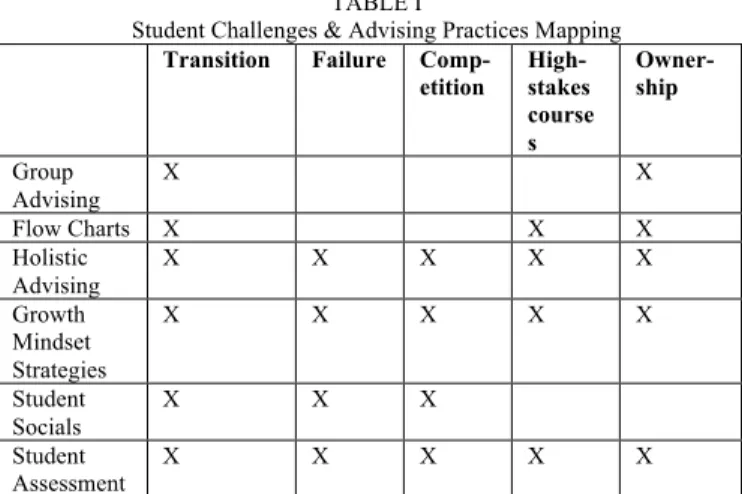
Table 1 shows which challenge each advising practice is intended to support.
TABLE I
Student Challenges & Advising Practices Mapping Transition Failure
Comp-etition High-stakes course s Owner-ship Group Advising X X Flow Charts X X X Holistic Advising X X X X X Growth Mindset Strategies X X X X X Student Socials X X X Student Assessment X X X X X
Best Practice 1: Group Advising During First Semester
The School of Engineering first rolled out a group advising model in the Fall of 2014, due to record enrollment of first-time freshmen. In order to advise this high number of students efficiently, the academic program counselor gave a presentation in every Introduction to Engineering course (which all freshmen take) to discuss her role, the engineering degree as a whole, and important academic policies and opportunities. Before the group advising session, students were required to complete an advising “scavenger hunt,” to help familiarize them with their degrees and the various resources available to them. Group advising has numerous benefits. Most obviously, it is a means to reduce the advising load of academic counselors, while also giving students the opportunity to network and
What is learned about students
learn from one another [8]. Group advising has two additional advantages: 1) the conversation typically covers a wider territory than in a 1:1 appointment (for example, a student may ask about study abroad options, which other students in the class may not have thought to ask about), and 2) students must assume more responsibility with regards to understanding their degree requirements and learning about important advising policies and procedures, since the advising session is not tailored to individual students. In this way, group advising helps students in the transition to college and in learning to assume responsibility for their own academic experience.
It is important to note that students also meet 1:1 with their faculty advisors two to three weeks after the group advising session. With this approach, the faculty advisor could focus the appointment time on individual concerns about college, coursework, and educational and professional goals, since general advising information had already been covered.
Best Practice 2: Flow Charts
As part of the effort to promote student autonomy and accountability, the School of Engineering developed degree plan flow charts (Appendix A). Unlike a standard degree checklist, the flow charts help students visualize their degree requirements, show the connections between different courses, and indicate courses that are only offered once a year. A search of national engineering programs shows that most institutions use degree plans that are in list format, which are useful for keeping track of progress towards the degree, but don’t demonstrate pre-requisite courses or other relationships between courses.
The flow charts seem to resonate with engineering students, who tend to gravitate towards systemic, cause-and-effect thinking. In addition, they help at-risk students understand the consequences of getting off track. The flow charts help students anticipate high-stakes courses, understand the immediate consequences of any missteps in their academic progress, and evaluate how to make up for lost time. The goal of the flow charts, then, is to help students become more independent in constructing and adjusting their degree plan, and to provide a road map that can help students rebound from failure.
Best Practice 3: Holistic Advising
Student success goes far beyond understanding degree requirements – students’ social, financial, emotional, and developmental wellbeing is also important. Existing literature supports this assertion: one study found that academic-related skills, self-confidence, and goals had strong correlations with student retention [6], while another study found that students’ sense of belonging in engineering (or lack thereof) had more of an impact on attrition than did difficulty of the curriculum [4].
Given the importance of these factors on student success and retention, it is necessary for advisors to not only focus on curricular information, but to also explore students’ overall wellbeing. Holistic helps advisors support students by asking about their transition to college, their background, their social activities, their involvement on campus, their study strategies, their interest in the field of engineering, their academic and professional goals, and their overall happiness in their chosen field.
The benefits of holistic advising are well documented; in fact, the National Academic Advising Association ranks holistic advising as one of its core values [9]. Taking into account the common challenges highlighted in this paper, holistic advising can help advisors uncover the specific issues that may be affecting at-risk students. This type of advising can be particularly useful when working with students on academic probation, as it can help advisors determine factors that led to the probationary status (for example, an illness, a change in living situations, a breakup, or homesickness).
Overall, holistic advising can provide the guidance and support that students need to troubleshoot the challenges that may arise during their first year, which in turn can help increase student persistence in engineering. In addition, since advising is a continuous feedback loop, holistic advising can help educators understand the factors that influence student success and happiness, which in turn can help guide the development of improved advising practices.
Best Practice 4: Growth Mindset Strategies
Many students come into college with what Carol Dweck calls a fixed mindset, meaning they believe that intelligence is unchangeable, and that success is predicated on ability rather than effort [10]. Consequently, when students with a fixed mindset encounter challenges, they interpret these challenges as signs of their own weakness rather than opportunities for growth. The trouble with a fixed mindset is that it can hinder students’ ability to overcome failure – if failure is ultimately tied to innate ability, there is no use in putting in extra effort to try and learn from the experience. Because engineering curricula are notoriously rigorous, students are almost guaranteed to experience failure at one point or another. It is important, then, to be sure that they approach failure with a growth mindset, meaning they use the experience to maximize their own development and learning. Dweck’s research shows that mindsets themselves are not fixed, and that there are specific steps that educators can take to foster the development of a growth mindset. The following tactics can be utilized to help students change the way they approach challenges, and can influence the development of a growth mindset:
• When students experience a setback (for example, a failed exam) ask them to evaluate their own preparation and review what they could do differently the next time. Have students focus only on factors that are within their own control, rather than external factors like teaching style or difficulty of the exam
• Emphasize the importance of failure and risk-taking for overall development and success in the engineering field
• Praise students for their effort or persistence rather than intelligence or ability
• Teach students about fixed and growth mindset, and ask them to reflect on how it relates to their own academic success
By nurturing students’ growth mindset, advisors can ensure that they are prepared to persist through obstacles and accomplish their goals.
Best Practice 5: Student Socials
Tinto’s model of retention argues that students need to be fulfilled both academically and socially to persist in college [11]. Other studies have shown that peer-to-peer support has a strong influence on student persistence [12,13]. With this research in mind, the School of Engineering implemented student socials to help build a sense of community amongst at-risk students. The socials are not academic in nature – students gather to play games, get to know one another, and discuss life as engineering students.
Peer support is invaluable to student retention, particularly in the first year as students are adjusting to college. Students at the socials discuss topics from the latest calculus exam, to helpful academic resources, to extracurricular activities taking place on campus. Most importantly, the socials help at-risk students feel less isolated by providing a venue for them to connect to others who are experiencing similar setbacks in their degrees.
Best Practice 6: Student Assessment
In the School of Engineering, two forms of student assessment are used: student self-assessments, and student assessments of advising services. Both tools are offered specifically to at-risk first-year engineering students, and are utilized to gather information and drive improvements in advising practices.
The student self-assessments contain both qualitative and quantitative questions regarding various aspects of students’ academic and personal lives, including questions about the transition to college, satisfaction with the field of engineering, and goals for the future (Appendix B). These self-assessments are designed to prompt students’ reflection on their own progress, as well as give advisors the
opportunity to assess students’ wellbeing and areas for development.
Although not all students completed the assessment, notable data that came from the 2014-2015 freshman cohort was:
• 4 out of 5 students said they had to study differently than they did in high school, and 3 out of 5 said that the transition to college was more difficult than they expected
• 5 out of 5 students said they felt more stressed than they did in high school
• 4 out of 5 said they had a sense of community on campus
Because students may be more comfortable disclosing sensitive information on paper rather than in person, the self-assessments can give advisors more direction in issues that are affecting students. For example, in response to a question regarding balance of academic and social lives, one student wrote “what social life?” Since the student had not previously mentioned a lack of social engagement on campus, this information gave the advisor more insight into the student’s experience in college. Generally, advisors can use self-assessments to gauge a student’s progress and identify any potential areas of concern.
Student assessments of advising services are offered in two formats: online surveys and focus groups. Both assessments are created specifically for first-year at-risk students, and contain questions specific to that population. Online surveys are meant to be relatively broad in scope, and generate a high response rate. Results are then processed to assess which advising practices are effective, and which advising practices could be altered to better support the students. Focus groups are conducted to gain a more qualitative understanding of the needs of at-risk first-year students. In the focus groups, students are asked about various factors affecting their success, such as the transition from high school to college, and the effectiveness of the available advising services in supporting their needs. Feedback gathered from the focus group is used to generate ideas for future changes in the advising of at-risk, first-year students. Both the self-assessment and advising assessment are intended to continue the feedback loop outlined above – the more information that is gathered from and about students, the more the advising services can be tailored specifically to the perceived needs of those students. As a result, the advising practices in the School of Engineering are constantly evolving, which is instrumental in producing effective advising. Going forward, the advising staff will continue to assess and evaluate its advising practices and programs, in order to ensure effective support for at-risk students.
ACKNOWLEDGMENT
This material is based upon work supported by the National Science Foundation under award number DUE - 1317238 and is supported in part by funds given to the National Science Foundation by the Intel Foundation and the GE Foundation. Any opinions, findings, and conclusions or recommendations expressed in this material are those of the author(s) and do not necessarily reflect the views of the National Science Foundation.
REFERENCES
[1] Marcus, J. (2012). High dropout rates prompt engineering schools to
change approach.
[2] American Society for Engineering Education. (2015, January 2). Databytes. Prism. http://www.asee-prism.org/databytes-jan-2/ [3] Meyer, M. and Marx, S. (2014). Engineering dropouts: A qualitative
examination of why undergraduates leave engineering. Journal of
Engineering Education, 103(4), 525-548.
[4] Marra, R., Rodgers, K., Shen, D., and Bogue, B. (2012). Leaving engineering: A multi-year single institution study. Journal of
Engineering Education, 101(1), 6-27.
[5] Seymour, E., & Hewitt, N. M.(1997). Talking about leaving: Why
undergraduates leave the sciences. Boulder, CO: Westview.
[6] ACT. (2004). The role of academic and non-academic factors in improving college retention.
https://www.act.org/research/policymakers/pdf/college_retention.pdf [7] Lewin, T. (2012). Digital natives and their customs. The New York
Times.
http://www.nytimes.com/2012/11/04/education/edlife/arthur-levine-discusses-the-new-generation-of-college-students.html?_r=0 [8] Ryan, B. (2010). Integrating group advising into a comprehensive
advising program. Academic Advising Today, 33(1).
http://www.nacada.ksu.edu/Resources/Academic-Advising-Today/View-Articles/2010-March-331.aspx
[9] NACADA, (2005). statement of core values of academic advising
https://www.nacada.ksu.edu/Resources/Clearinghouse/View-Articles/Core-values-declaration.aspx
[10] Dweck, C. (2006). Mindset. New York: Ballantine Books. [11] Tinto, V. (1987). Leaving College. Chicago: University of Chicago
Press.
[12] Litzler, E. and Young, J. (2012). Understanding the risk of attrition in undergraduate engineering: Results from the project to assess climate in engineering. Journal of Engineering Education, 101(2), 319-345.
http://onlinelibrary.wiley.com/doi/10.1002/j.2168-9830.2012.tb00052.x/epdf
[13] Hutchison, M., Follman, D., Sumpter, M., and Bodner, G. (2006). Factors influencing the self-efficacy beliefs of first-year engineering students. Journal of Engineering Education, 95, 39-47.
[14] Lent, R., Singley, D., Sheu, H. B., Schmidt, J., and Schmidt, L. (2007). Relation of social-cognitive factors to academic satisfaction in engineering students. Journal of Career Assessment, 15(1), 87-97. [15] Perry, W.G. (1968). Forms of intellectual and ethical development in the college years: A scheme. New York: Holt, Rinehart, & Winston. [16] Schreiner, L. and Anderson, E. (2005). Strengths-based advising: A
new lens for higher education. NACADA Journal, 25(2), 20-29. [17] Seligman, M. (2011). Flourish. New York: Free Press.
AUTHOR INFORMATION
Caitlin Cairncross STEP Counselor, University of Portland, [email protected]
Dr. Tammy VanDeGrift Associate Professor of Computer Science, University of Portland, [email protected]
Dr. Sharon Jones Dean, University of Portland,
Lindsay Chelton Program Counselor, University of Portland, [email protected]
Appendix A Sample Flow Chart Freshman
Fall Spring
Sophomore Junior Senior
Fall Spring Fall Spring Fall Spring
EGR 110 (2 cr) Intro to Engineering PHY 204 & 274 (4 cr) General Physics I & Lab MTH 201 (4 cr) Calculus I C-‐ or higher required for
MTH 202 & EGR 211
PHL 150* (3 cr)
Intro to Philosophy
THE 105 (3 cr)
Intro to Theology
PHY 205 & 275 (4 cr) General Physics II & Lab EGR 111 (2 cr) Engineering Computing w/ Applications MTH 202 (4 cr) Calculus II CHM 277 (1 cr)
Gen Chem I Lab
CHM 207 (3 cr)
Gen Chem I & CHM 007 Workshop
ENG 112* (3 cr)
Intro to Literature
MTH 321 (3 cr)
Ordinary Differential
Equation
EGR 3616 (3 cr) Analysis of EGR
Data EGR 211 (3 cr) Statics PHL 220 (3 cr) Ethics EGR 221 (3 cr) Materials Science OR EE 261 (3 cr) Circuits EE 271 (1 cr) Circuits Lab EGR 212 (3 cr) Dynamics MTH 301 (4 cr) Vector Calculus EGR 322 (3 cr) Strength of Materials EGR 270 (1 cr) & 070 Materials Lab & Lecture ME 222 (2 cr) Engineering Graphics ME 301 (2 cr) ME Analysis EGR 311 (3 cr) Fluids I ME 351 (2 cr) Mechanical Systems Lab ME 331 (3 cr) Thermodynamics ME 304 (3 cr) Finite Element Analysis Professional Elective5 # (3 cr) _____________ EGR 300 (1 cr)
Intro to Capstone Project
ME 374 & 074 (1 cr) Fluids Lab &
Lecture ME 312 (2 cr) Fluids II ME 336 (3 cr) Heat Transfer ME 332 (2 cr) Applied Thermodynamics ME 328 (4 cr) Machine Design THE 2051 (3 cr) The Bible, Past and
Present Professional Elective5 # (3 cr) _____________ ME or EGR 483 (2 cr) Capstone Project I ME or EGR 484 (3 cr) Capstone Project II ME 376 & 076 (1 cr) Thermo Lab & Lecture Math/Science Elective4 # (3 cr) _____________ Social Science Elective3 (3 cr) _____________ FA 207 (3 cr)
Intro to Fine Arts
Professional Elective5 # (3 cr) _____________ History Elective (3 cr) HST ________ EGR 351 (3 cr) Engineering Economics Social Science Elective3 (3 cr) _____________ Theology Elective2 (3 cr) [Upper Division] THE _________
Appendix B
Freshman Self-Assessment Survey
On a scale of 1-5, with one being the lowest and 5 being the highest, please rate the following statements:
I feel committed to my major
1 2 3 4 5
I am open to exploring other majors
1 2 3 4 5
I have a specific career path that I am interested in
1 2 3 4 5
I am interested in exploring different career paths
1 2 3 4 5
I feel like I am expected to know exactly what I want to do
1 2 3 4 5
I feel external pressure to pursue a specific career path
1 2 3 4 5
I spend time reflecting on my goals
1 2 3 4 5
My classes are interesting
1 2 3 4 5
I have to study differently than I did in high school
1 2 3 4 5
I have the study skills I need to be successful
1 2 3 4 5
Academic expectations are higher than they were in high school
1 2 3 4 5
I feel more stressed than I did in high school
1 2 3 4 5
I know how to balance my academic responsibilities with my personal life
1 2 3 4 5
My academic performance in college has been different than it was in high school
1 2 3 4 5
I feel engaged in class
1 2 3 4 5
I have a strong desire to get good grades
1 2 3 4 5
I have an understanding of the resources available to me on campus
I participate in activities and events outside of my academic responsibilities
1 2 3 4 5
I have utilized one or more university resources
1 2 3 4 5
I feel a sense of community on campus
1 2 3 4 5
I have someone I could talk to if I had a question or concern
1 2 3 4 5
The transition to college has been more difficult than I anticipated
1 2 3 4 5
I feel like my professors are accessible to me
1 2 3 4 5
I have sought help from my professor outside of class
1 2 3 4 5
What has been the most challenging part of your college experience so far?
What has been the most exciting part of your college experience so far?
Goals I have for this year (can be academic or personal):
Specific steps that will help me achieve my goals: