Human beings can perceive that objects are three-dimensional (3D) as a result of simultaneous lens accommo-dation and convergence on objects, which is possible because humans can see a single so that parallax occurs with the right and left eye. Virtual images are perceived via the same mechanism, but the influence of binocular vision on human visual function is insufficiently understood. In this study, we developed a method to simultaneously measure accommodation and convergence in order to provide further support for our previous research findings. We also measured accommodation and convergence in natural vision to confirm that these measurements are correct. As a result, we found that both accommodation and convergence were consistent with the distance from the subject to the object. Therefore, it can be said that the present measurement method is an effective technique for the measurement of visual function, and that even during stereoscopic vision correct values can be obtained.
Key words:Natural Vision, Simultaneous Measurement, Eye Movement, Accommodation and Convergence
1. Introduction
Recently, 3-dimensional images have been spreading rapidly, with many opportunities for the general population to come in contact with them, such as in 3D films and 3D televisions. Manufacturers of electric appliances, aiming at market expansion, are strengthening their line of products with digital devices related 3D.
Stereoscopic vision can deliver information in three dimensions, whereas conventional television has been a medium to deliver information in two dimensions. This kind of structural change may be a reason for developments that enable delivery of greater volumes of information.
Despite this increase in 3D products and the many stud-ies that have been done on binocular vision, the influence of binocular vision on human visual function remains insuffi-ciently understood (Donders, 1864; Fincham, 1937; Krish-manet al., 1977; Ukaiet al., 1983; Wannet al., 1995). In considering the safety of viewing virtual 3-dimensional ob-jects, investigations of the influence of stereoscopic vision on the human body are important.
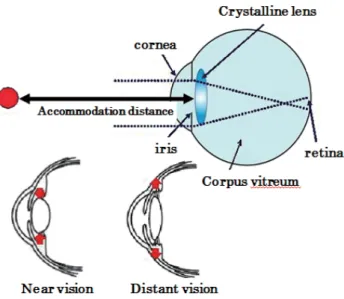
Though various symptoms like eye fatigue and solid in-toxication are seen often when humans continue to view 3-dimensional images, solid intoxication, if not eye fatigue, is a symptom not seen in the conditions in which we usu-ally live, so-called natural vision. One of the reasons often given for this is that the lens accommodation (Fig. 1) and convergence (Fig. 2) are inconsistent.
Accommodation is a reaction that changes refractive Copyright cSociety for Science on Form, Japan.
power by changing the curvature of the lens with the ac-tion of the musculus ciliaris of the eye and the elasticity of the lens, so that an image of the external world is focused on the retina.
Convergence is a movement where both eyes rotate in-ternally, functioning to concentrate the eyes on one point to the front.
There is a relationship between accommodation and con-vergence, and they are also one factor, that enables humans to see one object with both eyes.
When an image is captured differently with right and left eyes (parallax is caused), convergence is caused.
This originates in the structure of the human face, and is something that creatures such as fish and herbivores cannot do because their eyes look outward to the side to take in a wide view. The reason is that convergence is very an impor-tant factor in the ability to obtain information in the depth direction; that is, the sense of distance and stereoscopic per-ception. Therefore, convergence is seen in the creatures like carnivores that need to measure the distance to prey, which is unnecessary in animals like herbivores that need to obtain a wide view. When convergence occurs, focus on an ob-ject is achieved simultaneously by accommodation. Binoc-ular vision using such mechanisms is the main method of presenting 3-dimensional images, and many improvements have been made (Choet al., 1996; Sierraet al., 2006).
The main approach in current 3D technology is based on this binocular vision, and so the face structure of humans may be considered a very important factor.
In explaining the inconsistencies above, it is said that
Fig. 1. Principle of lens accommodation.
commodation is always fixed on the screen where the image is displayed, while convergence intersects at the position of the stereo images. As a result, eye fatigue, solid intox-ication, and other symptoms occur. However, we obtained results that indicate the inconsistency between accommoda-tion and convergence does not occur (Miyaoet al., 1996). Even so, it is still often explained that inconsistency is a cause of eye symptoms. One reason is that we could not si-multaneously measure accommodation and convergence in our previous study, and the proof for the results was insuf-ficient.
To resolve this inconsistency, it was thought that measur-ing simultaneously accommodation and convergence was needed. We therefore developed a method to simultane-ously measure accommodation and convergence. Compar-ison with measurements of natural vision is essential in in-vestigating stereoscopic vision. For such comparisons, it is first necessary to make sure that the measurements of nat-ural vision are accurate. We therefore focused on whether we could accurately measure natural vision, and we report the results of those measurements.
2. Method
Informed consent was obtained from the subjects before the experiments, and the study was approved by the Ethical Review Board of the Nagoya University Graduate School of Information Science.
The experiment was done with six healthy young males (age: 20∼37). Subjects were given a full explanation of the experiment in advance, and consent was obtained. Subjects used their naked- eyes or wore soft contact lenses (one person with is uncorrected vision, 5 who wore soft contact lenses), and their refraction was corrected to within±0.25 diopter. (“Diopter” is the refractive index of lens. It is an index of accommodation power. It is the inverse of meters, for example, 0 stands for infinity, 0.5 stands for 2 m, 1 stands for 1 m, 1.5 stands for 0.67 m, 2 stands for 0.5 m, and 2.5 stands for 0.4 m).
Fig. 2. Principle of convergence by binocular parallax.
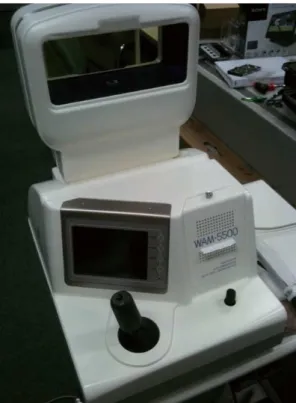
The devices used in this experiment were an Auto Ref/Keratometer WAM-5500 (Grand Seiko Co. Ltd., Hi-roshima, Japan), and an eye mark recorder EMR-9 (NAC Image Technology Inc., Tokyo, Japan).
The WAM-5500 provides an open binocular field of view while a subject is looking at a distant fixation target, and has two measurement modes, static mode and dynamic mode. We used the dynamic mode in this experiment. The ac-curacy of the WAM-5500 in measuring refraction in the dynamic mode of operation was evaluated using the
man-ufacture’s supplied model eye (of power −4.50 D). The
WAM-5500 set to Hi-Speed (continuous recording) mode was connected to a PC running the WCS-1 software via an RS-232 cable and allows refractive data collection at a tem-poral resolution of 5 Hz. We do not need any special op-eration during dynamic data collection, except depressing the WAM-5500 joystick button once to start and again to stop recording at the beginning and end of the desired time frame, respectively. The software records dynamic results, including time (in seconds) of each reading for pupil size and MSE (mean spherical equivalent) refraction in the form of an Excel Comma Separated Values (CSV) file. (Queir´os
et al., 2008; Sheppard and Davies, 2010).
On the other hand, the EMR-9 was to measure the eye movement using papillary/corneal reflex method. The hor-izontal measurement range was 40 degrees, the vertical range was 20 degrees, and the measurement rate was 60 Hz. This consisted of two video cameras fixed to the left and right sides of the face, plus another camera (field-shooting unit) fixed to the top of the forehead. Infrared light sources were positioned in front of each lower eyelid. The side cameras recorded infrared light reflected from the cornea of each eye while the camera on top of the forehead recorded pictures shown on the screen. After a camera controller su-perimposed these three recordings with a 0.01 s electronic timer, the combined recording was recorded on a SD card. Movement of more than 1 degree with a duration greater than 0.1 s was scored as an eye movement. A gaze point was defined by a gaze time exceeding 0.1 s. This technique enabled us to determine eye fixation points. The wave-length of the infrared light was 850 nm. After data were
Fig. 3. Auto Ref/Keratometer WAM-5500 (Grand Seiko Co. Ltd., Hi-roshima, Japan).
Fig. 4. EMR-9 (NAC Image Technology Inc., Tokyo, Japan).
preserved on an SD card, they are read into a personal com-puter (Sakaki, 2009; Egamiet al., 2009).
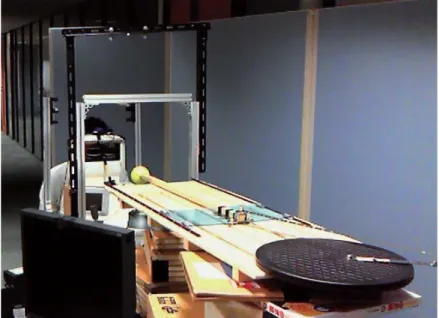
These two devices were combined as in Fig. 3, and we si-multaneously measured focus distances of accommodation and convergence when subjects were gazing at objects (Fig. 4).
The following experimental procedure was used. Sub-jects’ accommodation and convergence were measured
when they were gazing with binocular vision at an object (tennis ball, diameter 7 cm) presented in front of them. The object moved in a range of 0.5 m to 1 m, with a cycle of 10 seconds. Measurements were made four times every 40 seconds. The illuminance of the experimental environment was about 103 (lx), and the brightness of the object in this environment was 46.9 (cd/m2).
3. Results
In this study, we simultaneously measured subjects’ ac-commodation and convergence while they were gazing at an object with binocular vision. The results of these mea-surements were comparable in all subjects. The results of this experiment for two representative subjects are shown in Figs. 5 and 6.
In Figs. 5 and 6, “accommodation” stands for focal length of lens accommodation, and “convergence” stands for con-vergence focal length. From these figures, it is found that the accommodation and convergence of both subject A and B are in agreement and have changed. Moreover, the change in the diopter value occurred with a cycle of about ten seconds. Maximum diopter values of accommodation and convergence of A and B were both about 2 D, which is equal to 0.5 m. This was consistent with the distance from the subject to the object.
On the other hand, their minimum values were accom-modation distance of 1 D, equal to 1 m, and convergence distance of 0.7 D, equal to 1.43 m. Convergence was con-sistent with the distance to the object, but accommodation was focused a little beyond the object (about 0.3 D).
4. Discussion
In this experiment, we used the WAM-5500 and the EMR-9.
As an experiment using the WAM-5500, the result that there was a research that examined the performance, and it
was possible to measure it by the accuracy of−0.01 D±
0.38 D by examining the result of a measurement of the WAM-5500 from the agreement with subjective findings
within the range from −6.38 to +4.88 D was obtained
(Sheppard and Davies, 2010). There was also a research that investigated eyestrain and transient myopia using the
WAM-5500 (Tosha et al., 2009; Borsting et al., 2010).
Fig. 6. Photograph of experimental setup.
Fig. 7. Example of measurements: Subject A.
The eye mark recorder was academically used from various viewpoints like this.
As it was the above-mentioned, a lot of researches that investigated the performance and the characteristic of these instruments and the experiments using these are conducted. In this experiment, we measured the accommodation dis-tance and the convergence disdis-tance during the object seen. For convergence distance, we calculated it based on coordi-nate data of both eyes from pupil distance.
Convergence is peculiar to animals that have binocular vision, and humans have a face structure that makes
conver-gence possible. Essinget al.(2006) measured convergence
using an SMI EyeLink eye tracker. Neither Egami nor Sasaki measured convergence, though they used an EMR series. In this experiment, using EMR-9, we calculated con-vergence distance from line of sight coordinate data rather than directly measuring the focal length of convergence. From the results, we can say that we were able to measure convergence accurately even with EMR-9.
Our results showed that subjects’ accommodation and convergence changed to a position between a near and far position from the subjects while they were gazing at the object. Moreover, these changes occurred at a constant cycle, tuned to the movement of the object. Therefore, subjects viewed the object with binocular vision, and we could measure the results. The accommodation weakened about 0.3 D when there was an object in the furthest position and the point of 1 m. This indicates that the lens may not be accommodated strictly at about 0.4 D, nearly in agreement
with our previous findings (Miyao et al., 1993). While
convergence was almost consistent with the distance from the subject to the object, accommodation was often located a little beyond the object. This is thought to originate the fact that the index is seen even if focus is not accurate because of the depth of field (Wattet al., 2005).
These measurements were done in healthy young males. In this case, it can be said that accommodation and conver-gence were consistent with distance to the object when the subjects were gazing at the object. Further investigation is needed to see whether the same results will be obtained in different conditions, such as when the subjects are woman, not emmetropic, or older.
In conclusion, it was possible to simultaneously measure
Borsting, E., Tosha, C., Chase, C. and Ridder, W. H. (2010)Measuring Near-Induced Transient Myopia in College Students with Visual Dis-comfort, American Academy of Optometry, Vol. 87, No. 10.
Cho, A., Iwasaki, T. and Noro, K. (1996) A study on visual characteristics binocular 3-D images,Ergonomics,39(11), 1285–1293.
Donders, F. C. (1864)On the Anomalies of Accommodation and Refraction of the Eye, New Sydenham Soc., London. Reprinted by Milfort House, Boston (1972).
Egami, C., Morita, K., Ohya, T., Ishii, Y., Yamashita, Y. and Matsuishi, T. (2009) Developmental characteristics of visual cognitive function during childhood according to exploratory eye movements,Brain & Development,31, 750–757.
Essing, K., Pomplun, M. and Ritter, H. (2006) A neural network for 3D gaze recording with binocular eye trackers,The International Journal of Parallel, Emergent and Distributed Systems,21(2), 79–95. Fincham, E. F. (1937) The mechanism of accommodation,Br. J.
Ophthal-mol.,21, Monograph Supp. 8.
Krishman, V. V., Shirachi, D. and Stark, L. (1977) Dynamic measures of vergence accommodation,Am. J. Optom. Physiol. Opt.,54, 470–473. Miyao, M.et al.(1996) Visual accommodation and subject performance
during a stereographic object task using liquid crystal shutters, Er-gonomics,39(11), 1294–1309.
Miyao, M., Otake, Y., Ishihara, S., Kashiwamata, M., Kondo, T., Sakak-ibara, H. and Yamada, S. (1993) An experimental study on the objective measurement of accommodative amplitude under binocular and natural viewing conditions,Tohoku J. Exp. Med.,170, 93–102.
Nakashima, Y., Morita, K., Ishii, Y., Shouji, Y. and Uchimura, N. (2010) Characteristics of exploratory eye movements in elderly people: possi-bility of early diagnosis of dementia,Psychogeriatrics,10, 124–130. Queir´os, A., Gonz´alez-M´eijome, J. and Jorge, J. (2008) Influence of
fog-ging lenses and cycloplegia on open-field automatic refraction,Ophthal. Physiol. Opt.,28, 387–392.
Sakaki, T. (2009) Estimation of intention of user arm motion for the proac-tive motion of upper extramity supporting robot,2009 IEEE 11th In-ternational Conference on Rehabilitation Robotics, Kyoto InIn-ternational Conference Center, Japan, June 23–26.
Sheppard, A. L. and Davies, L. N. (2010) Clinical evaluation of the Grand Seiko Auto Ref/Keratometer WAM-5500,Ophthal. Physiol. Opt.,30, 143–151.
Sierra, R.et al.(2006) Improving 3D imagerywith variable convergence and focus accommodation for the remote assessment of fruit quality, SICE-ICASE International Joint Conference 2006, pp. 3553–3558. Tosha, C., Borsting, E., Ridder, W. H. and Chase, C. (2009)
Accommoda-tion response and visual discomfort,Ophthal. Physiol. Opt.,29, 625– 633.
Ukai, K., Tanemoto, Y. and Ishikawa, S. (1983) Direct recording of ac-commodative response versus acac-commodative stimulus, inAdvances in Diagnostic Visual Optic(eds. G. M. Breinin and I. M. Siegel), pp. 61– 68, Springer-Verlag, Berlin.
Wann, J. P., Rushton, S. and Mon-Williams, M. (1995) Natural problems for stereoscopic depth perception in virtual environments,Vision Res., 35(19), 2731–2736.
Watt, S. J., Akeley, K., Ernst, M. O. and Banks, M. S. (2005) Focus cues affect perceived depth,Journal of Vision,5, 834–862.