Research into the operation of the Warranty Link Rule
including contaminated land
BD2729 – final report
Research into the operation of the Warranty Link
Rule including contaminated land
BD2729 – final report
CIRIA in association with Waterman Environmental, Stevens & Bolton LLP and TPS Consultancy
January 2012
This research, commissioned by the previous government, is being published in the interests of transparency. The views and analysis expressed in this report are those of the authors and are not intended to reflect the current or future views or policies of the current government. The Department for Communities and Local Government is publishing this report alongside the 2012 consultation on changes to the Building Regulations as some of the findings in it are discussed in that consultation and used in the impact assessments that accompany it.
© Queen’s Printer and Controller of Her Majesty’s Stationery Office, 2012 Copyright in the typographical arrangement rests with the Crown.
You may re-use this information (not including logos) free of charge in any format or medium, under the terms of the Open Government Licence. To view this licence, visit
http://www.nationalarchives.gov.uk/doc/open-government-licence/ or write to the Information Policy Team, The National Archives, Kew, London TW9 4DU, or e-mail:
This document/publication is also available on our website at www.communities.gov.uk
Any enquiries regarding this document/publication should be sent to us at: Department for Communities and Local Government
Eland House Bressenden Place London SW1E 5DU Telephone: 030 3444 0000 January 2012 ISBN: 978-1-4098- 3193-8
Contents
Executive summary 3
Background 5
Part 1: Warranty Link Rule 6
Part 2: The contaminated land criterion 9
Part 3: Review of other criteria in Annex E to the 31 March 2005
circular letter 19
Part 4: General conclusions 19
Tables of the data
Table 1: Questionnaire and other consultation details 7 Table 2: Warranties containing non-conforming exclusions 12
Executive summary
The Warranty Link Rule was introduced in 2005 to open up the new homes market and allow all Approved Inspectors scope to develop their business across all sectors of building control. The Warranty Link Rule requires that, before an Approved Inspector can take responsibility for building control in respect of new build homes for private sale or renting, they have to ensure that a Designated Warranty Scheme is in place.
This report describes the findings of a research project to review the Warranty Link Rule commissioned by DCLG and carried out by CIRIA in association with Waterman Environmental, Stevens & Bolton LLP and TPS Consultancy (between 2008 and 2009). The overall objectives are to review:
• the policy rationale for the Warranty Link Rule itself; to confirm whether it is necessary and to define its purpose and objectives; and
• the reasonableness of the contaminated land remediation cover criterion and the rationale for its formulation, whether it should be retained and recommendations for a more specific and tightly defined criterion Rationale for the Warranty Link Rule
The research shows that the objective of the Warranty Link Rule to provide homeowners with a no fault redress mechanism in case of Building
Regulations and contaminated land issues has been largely achieved. However the rationale behind the introduction of the Warranty Link Rule is unfounded:
• the original fear that there would be more complaints and that it would be more difficult financially for homeowners to rectify defects where an Approved Inspector carried out the building control function is unfounded; and
• the Warranty Link Rule has not encouraged Approved Inspectors to carry out building control on new homes, in fact, there is evidence of the
opposite outcome in some situations Suggestions for changes
The Warranty Link Rule therefore appears to be an unnecessary burden in the overall aim of opening up the domestic sector to Approved Inspectors. The grounds for its implementation are flawed and it is recommended that it should be removed.
However, there is universal support for the continued availability of the type of warranty that the Warranty Link Rule requires. In fact there is support for availability of such a warranty regardless of the nature of the building control provider.
It is recognised that the Government cannot require all new homes to have a warranty under the powers in the Building Act. However, the Government may wish to consider how the provision of protection to the level offered by a
designated warranty could be encouraged within the industry not only for work carried out by Approved Inspectors but also work carried out by local
authorities to protect all new homeowners. The contaminated land criterion
Despite the emphasis in Government policy supporting the building of houses on brownfield sites, there is no evidence of an increased number of warranty claims relating to contamination. Indeed, the number of claims that would be covered as a result of contaminated land remediation cover criterion remains very low, although this may well increase in the future. This is because many local authorities have not yet carried out their inspections under Part 2A of the Environmental Protection Act 1990 which could trigger such claims.
The criterion itself is limiting in that it only relates to work carried out by an Approved Inspector with regards to the Building Approval process as covered by Approved Document C, rather than the broader range of contamination issues covered under Part 2A which forms the basis for the service of remediation notices. It is therefore recommended that:
• the Warranty Link Rule should be removed and replaced by a warranty that covers all liabilities that may arise from a statutory notice to remediate contamination at new homes in order to protect new homeowners.
Protection is also needed regardless of whether the building control is carried out by an Approved Inspector or local authority
We recognise that this is not possible under the current system due to DCLG not having the requisite power to require warranty providers to provide such protection under the Building Regulations, as this is a consumer protection issue.
• if a warranty is to be provided on a voluntary basis this should be carefully monitored by a relevant body
We recognise that including all liabilities arising from a statutory notice in the warranty involves cost implications to house builders and homeowners. In the economic climate when this report was prepared (i.e. 2009), this is likely to create a further burden to the weak housing market in the UK.
Other criteria in Annex E to the 31 March 2005 Circular letter
The review showed that there is a general support to all of these other criteria. (Two of the warranty providers stated that their products already had all of these criteria in place before the Warranty Link Rule was promulgated.) No changes to these criteria are proposed.
Background
The Building Regulations 2000, made under powers contained in the Building Act 1984, set out broad standards and requirements that individual aspects of building design and construction must achieve. The responsibility for checking that the Building Regulations have been complied with falls to building control bodies - either local authorities or private sector Approved Inspectors.
Approved Inspectors do not have the financial strength of local authorities as permanent, statutory bodies, so one of the safeguards provided for in the Building Act is that an Approved Inspector must have professional indemnity insurance. This insurance indirectly protects clients and others who may be adversely affected by any negligence on the part of the Approved Inspector by ensuring that, subject to the limits on cover, the Approved Inspector has the financial resources to comply with any award of damages or out-of-court settlement.
Until 2005 only local authorities and the National House-Building Council’s (NHBC’s) Approved Inspectors were allowed to undertake the building control function for new homes intended for private sale or renting. This was due to continued concern that Approved Inspectors might be unable or unwilling to meet claims to remedy new home defects which were not covered by their professional indemnity insurance (i.e. which were not due to their own negligence). NHBC was excluded from the prohibition because its Approved Inspectors only undertook building control work on new homes for private sale or renting where its own new home warranty was in place for each dwelling. To open up the new homes market and allow all Approved Inspectors scope to develop their businesses across all sectors of building control, the Office of the Deputy Prime Minster (now Communities and Local Government (DCLG)) introduced the Warranty Link Rule in 2005. The Warranty Link Rule requires that, before an Approved Inspector can take responsibility for building control in respect of new homes for private sale or renting, the Approved Inspector has to ensure that there is a Designated Warranty Scheme, i.e. a scheme approved by DCLG, in place for each home that is to be built. Designated warranties add extra items to ‘standard’ warranties to cover defects that should have been picked up by the Approved Inspector in the course of providing the building control service, in addition to defects that are due simply to poor building work. The Designated Warranty Schemes also
provide for cover in respect of contaminated land remediation. DCLG has set criteria for the warranties and approves them as Designated Warranty
Schemes by reference to those criteria.
It came to DCLG’s attention that some of the current Designated Warranty Schemes do not appear to meet the criterion for contaminated land
remediation cover because they attempt to exclude cover in ways that do not appear to be allowed under the criterion.
In order to address this issue, DCLG commissioned CIRIA (in association with Waterman Environmental, Stevens & Bolton LLP and TPS Consultancy) to carry out an independent review of the Warranty Link Rule and contaminated land criterion in the Designated Warranty Scheme between 2008 and 2009.
The overall objectives are to review:
• the policy rationale for the Warranty Link Rule itself; to confirm whether it is necessary and to define its purpose and objectives; and
• the reasonableness of the contaminated land remediation cover criterion and the rationale for its formulation, whether it should be retained and recommendations for a more specific and tightly defined criterion
Part 1: Warranty Link Rule
1.1 The policy rationale for the Warranty Link Rule
The main objective of this part of the research was to investigate the policy rationale for the Warranty Link Rule itself; to confirm whether it is necessary and to define its purpose and objectives.
The investigation and evaluation included the following specific objectives:
• determine the comparative number of complaints relating to the building control functions provided by local authorities and Approved Inspectors in relation to building types, new homes and existing homes expressed as a percentage of the overall volume of work
• determine the comparative difficulty taking into account financial and corporate arrangements for a homeowner to have defects rectified when a local authority or an Approved Inspector undertook the building control function
• determine whether there is evidence that the vast majority of work that Approved Inspectors undertake is either large scale commercial or new build housing; and
• review whether the current arrangement for designating warranties is the most appropriate arrangement and whether it is ‘fit for purpose’. If not, what are the potential alternatives?
1.2 Consultation and information collection
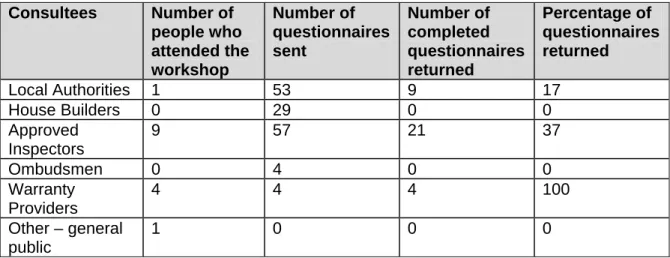
Over 150 key stakeholders were consulted in this project via a questionnaire survey which was initiated in January 2009 and a consultation workshop in March 2009. The percentages of replies from Approved Inspectors and warranty providers were good. There was a low response from the house builders and ombudsmen but this was probably due to the consultation process taking place at the beginning of the downturn of the UK property market (see Table 1).
The persons who were consulted included:
• local authority building control
• Approved Inspectors
• house builders
• warranty providers; and
• the general public
Table 1: Questionnaire and other consultation details
Consultees Number of people who attended the workshop Number of questionnaires sent Number of completed questionnaires returned Percentage of questionnaires returned Local Authorities 1 53 9 17 House Builders 0 29 0 0 Approved Inspectors 9 57 21 37 Ombudsmen 0 4 0 0 Warranty Providers 4 4 4 100 Other – general public 1 0 0 0 1.3 Results
Is the Warranty Link Rule fit for purpose?
The consultation process shows that the Warranty Link Rule is not fit for purpose, not on the grounds that it is flawed in operation but on the basis that the concerns which gave light to its implementation are without basis and further, that it therefore introduces unnecessary burdens into what was aimed to be a positive pathway into a previously unavailable market sector.
The research has found the following in regard to the original objectives: Encouraging Approved Inspectors to carry out building control on new homes
There appears to be no link between the Warranty Link Rule and an Approved Inspector’s decision to work in this sector. The Warranty Link Rule was
introduced as a condition of Approved Inspectors entering this marketplace but it appears to have played no part in encouraging them to do so. Rather, the opposite appears to be true in that it seems to be regarded by most Approved Inspectors as an impediment to their operations.
Particular reference is made to the additional administration and logistics associated with the Warranty Link Rule such as registering with warranty providers and fees associated with the Warranty Link Rule as well as the potential delay in a project if the Warranty Link Rule is not considered in time.
Creating and developing conditions for fair competition between Approved Inspectors and local authorities across all areas of building control
The opening up of the sector has achieved a great deal in creating
competition in this marketplace, but the Warranty Link Rule is seen as an impediment to the fairness of this competition.
In some cases, the Warranty Link Rule has discouraged Approved Inspectors from entering the private dwelling market because of the additional
administration and logistics as well as the associated costs. Some small developers have found the Warranty Link Rule to be cost prohibitive. As a result, they stated that they had no alternative but to use local authorities for building control.
There have been occasions that Approved Inspectors were not awarded work concerning apartments and mixed used developments because the clients were landlords who did not see the value of the Warranty Link Rule when their projects were for long-term investment.
Safeguarding homeowners against the potential of more defects when Approved Inspectors are used than when local authority Building Control carries out the work
There is no clear evidence that there are more complaints if Approved
Inspectors carry out the building control work. The study shows that since the Warranty Link Rule was introduced in 2005, Approved Inspectors have not received significantly more complaints than local authorities.
Although more complaints may appear in the next few years because the warranty cover lasts for ten years, other research such as that carried out on behalf of DCLG in 2008 seems to reinforce the parity of complaints to project ratios.
Also the assumption that the procedures in managing complaints and financial compensation are fundamentally different between Approved Inspectors and local authorities is flawed because they are equally accessible.
Controlling the quality of the cover
In regard to the current arrangement for designating warranties, some of the warranty providers have reduced their cover without notifying DCLG. This ability to reduce cover raised the issue as to whether the warranty providers and any other involved parties such as reinsurers are concerned about the financial implications of the warranties. Also if this reduction in cover is
allowed to continue unchecked, it is likely that the other warranty providers will follow suit, which will affect the protection provided by the Warranty Link Rule to homeowners.
Although the process for designating a warranty is sound there appears to be a weakness in the system over its ongoing controls.
Providing no-fault redress
Providing homeowners with a no fault redress mechanism in the case of Building Regulation and contaminated land issues seems to have been achieved. However, it is not possible for the Designated Warranty Schemes to provide homeowners with full protection from Statutory Notices because the local authorities and Approved Inspectors cannot act beyond their powers under building control legislation and guidance. The scope of these powers is less than the scope of contamination for which Statutory Notices may be served on homeowners and other persons.
1.4 Suggestions for changes
The Warranty Link Rule appears to be an unnecessary burden in the overall aim of opening up the domestic sector to Approved Inspectors. The grounds for its implementation are flawed and it should be removed.
The impact of removing the Warranty Link Rule
Whilst we suggest that the Warranty Link Rule should be removed, it should be noted that there is universal support for the availability of the type of warranty that it requires (albeit in only in that part of the marketplace where Approved Inspectors are involved).
The Government may wish to consider how the provision of protection to the level offered by a designated warranty could be encouraged within the industry not only for work carried out by Approved Inspectors but also work carried out by Local authorities in order to protect all new homeowners.
Part 2: The contaminated land criterion
Part 2 of this project was to address specific issues relating to compliance of the Warranty Link Rule contaminated land criterion, as defined by DCLG in relation to the costs of complying with a statutory notice requiring remediation of contamination in land under or around the home, if that contamination was already present at the time of the sale of the home by the developer
The contaminated land criterion for the Warranty Link Rule is contained in paragraphs 12 and 14(h) of Annex E to the ODPM Divisional Circular Letter, dated 31 October 2005, as set out below.
Paragraph 12 provides that:
“The three designated warranty schemes [NHBC, Zurich and Premier] include cover in relation to contaminated land. In outline, this cover indemnifies the owner for the costs arising from compliance with a statutory notice requiring remediation of contamination in the land under or around the home, if that contamination was already present at the time of the sale of the home by the developer. Any financial limits for new warranty schemes would need to be set with this requirement in mind. In any case, such limits are unlikely to be less than the following. The lessor [sic] of the value of the home, or £250,000, to at least £20 million (all index linked to suitable indices) per site”.
It should be noted that DCLG has authority under the Building Regulations and Approved Document C only regarding liability under Part 2A of the
Environmental Protection Act 1990 (Part 2A) in respect of significant harm, or a significant possibility of such harm, to people, buildings, building materials and building services. This scope is much narrower than the scope of liability for which a Statutory Notice may be served under Part 2A. That is, as noted in section 1.9 below, an enforcing authority may serve a Statutory Notice, not only in respect of contaminants that are causing significant harm or a
significant possibility of significant harm to people at a site to which building controls apply, buildings, building materials and building services but also in respect of such harm to any other persons, designated ecological systems, various types of property and controlled waters.
In order to assist in addressing the issues presented above, the project team was instructed to answer the following question:
“Determine the number of and costs of problems related to
contaminated land (as defined for the purpose of service of Statutory Notices) for new homes in England and Wales since 2000”.
The following objectives were set:
• Determine the number of claims made in respect of problems for which liability is excluded in the Zurich 10 and NHBC Buildmark schemes contrary to the Designated Warranty Scheme criteria.
• Assess the risk (current and future) of contaminated land problems arising that could lead to the issue of a statutory notice to homeowners.
• Assess the technical and financial risks to homeowners resulting from contaminated land problems having regard to the exclusions under the Zurich and NHBC schemes.
• Assess the technical and cost implications for owner-occupiers and local authorities if the NHBC and Zurich exclusions are retained.
• Assess the cost implications for insurers and warranty providers if the warranties do not have exclusions and present a reasoned case for or against the exclusions.
• Define options for resolving the current problem of contaminated land exclusions in the warranty schemes and provide recommendations supported by a risk analysis.
• Assess whether policies should include cover for ionizing radiation.
• Assess whether Designated Warranty Schemes should be expanded to include cover to reinstate a home to a habitable condition.
• Assess how appropriate it is to have the contaminated land cover criterion in regard to the principle behind the Warranty Link Rule, i.e. to protect the policyholder against defects due to poor workmanship.
• Assess the contaminated land cover criterion for compatibility with the principle behind Warranty Link Rule, i.e. protection of the policyholder against defects due to poor workmanship and/or material.
• Propose a revised contaminated land criterion for approved Designated Warranty Schemes if necessary. This should be clear on which risks must be covered and which may be excluded.
• Analyse the implications for the Warranty Link Rule of the regulations transposing the Environmental Liability Directive and of any other reasonably foreseeable changes to English law.
2.1 Consultation and information collection
Consultations have been made with key stakeholders to obtain background statistics and other relevant information. Consultees responding to enquiries were within the following groups:
• warranty providers
• local authorities; and
• house builders
Only two of the four warranty providers provided completed questionnaires. This limited response, however, gives a statistically useful response and is supported by the other information gathered through the consultation process and workshop.
As part of the study, four warranty schemes were compared for compliance with the criterion. The schemes are:
• NHBC Buildmark
• Zurich Standard 10
• Premier Guarantee for New Homes
• BLPSECURE Housing Warranty Insurance Policy
Note: Zurich has now withdrawn from this market and will provide no new cover from the end of September 2009 but will honour existing cover. 2.2 Conclusions for the contaminated land criterion
Responses to consultations have been limited and information on the current operation and effectiveness of Designated Warranty Schemes in providing safeguards to homeowners in respect of contaminated land problems is consequently also limited.
It should be noted throughout the conclusions that the numbers of houses built on potentially contaminated brownfield sites has increased markedly since the Government put forward a target of 60 per cent of new housing to be built on brownfield sites by 2040. This is however balanced by an improved understanding of contamination investigation and remediation both within the house building industry and regulators, especially over the last ten years. We note that the owner or occupier of a site (a Class B person) is liable under Part 2A only for remediating the site that he or she owns or occupies. In addition, an owner or occupier is not liable for remediating contaminants that he or she did not cause or knowingly permit to be in groundwater, surface water or coastal waters. A homeowner is not, therefore, liable for remediating contaminants that have migrated from his or her land to other land or to ground, surface or coastal waters. These exclusions from liability do not,
however, apply to a person who caused or knowingly permitted a substance to be in, on or under land such that the land is contaminated land under Part 2A (a Class A person). If a homeowner becomes aware that the land on which their home is built is contaminated land and does not remediate the contamination after a reasonable opportunity to do so, the homeowner, depending, in part, on whether he or she has or can obtain funding to
remediate the contamination, is likely to have become a “knowing permitter” and to have become liable for remediating not only his or her own land but any other land to which the contaminants have migrated. If the warranty is in place, homeowners would have financial resources to remediate (depending on the scope of the Statutory Notice; see below) and consequently they could be considered Class A persons.
We also note that the Warranty Link Rule does not require a warranty for a new home to cover the remediation of contaminants that the homeowner subsequently introduces onto the site of the home. The exclusions from the warranties for contamination after the sale of the home by the builder,
however, go beyond the exclusion of such liability, in some instances, to also exclude contaminants that leak from an undiscovered buried container on the site.
Still further, whilst the limits of indemnity in the warranties comply with the Warranty Link Rule, they may not be adequate to cover remediation costs in a particular case, due to being linked to the value of the home rather than the cost of remedial works.
Conclusions have been drawn in respect of each of the contaminated land objectives.
Objective (i)
Determine the number of claims made in respect of problems for which liability is excluded in the Zurich 10 and NHBC Buildmark schemes contrary to the Designated Warranty Scheme contaminated land criterion.
Table 2: Warranties containing non-conforming exclusions
Exclusion NHBC Zurich Premi
er
BLP Secure Any claim for anything that was not considered to be
harmful at the time the “notice to build” was deposited with the Local authority but is later
considered to be harmful.
x
Any claim in respect of contaminants or
contamination at the Site not identified prior to the “notice to build” being deposited with the local authority.
x
Any contaminant present in any building (being any above or below-ground man-made structure
including but not limited to foundations and services connected to any building), but not excluding
Remediation Work within any buildings caused directly by Contamination;
Exclusion NHBC Zurich Premi er
BLP Secure Liability for polluted water that migrated onto the site
before the sale of the site to the first owner, but which was not discovered until after that time.
x
Contamination that could not have resulted in the issue of a Statutory Notice under legislation and/or
Government guidance in force at the dateof
Completion. Any claim that arises out of a change in legislation or definition of contamination or harmful material that occurs after the date the “notice to build” was deposited with the local authority
x x
Section 4 provides cover for “Site preparation and resistance to moisture” and not “Site preparation and resistance to contaminants and moisture”
x x
Any claim in connection with ionising radiation. x x
Liability for a Statutory Notice that is served on a homeowner for liabilities under the Water Resources Act 1991
x
All the existing warranties except Premier contain additional exclusions which do not conform to the contaminated land criterion in the Warranty Link Rule. Policy excesses may be contrary to the contaminated land criterion in the Warranty Link Rule, which apparently requires the full cost of compliance with a statutory notice to be covered.
A number of exclusions have been identified within warranties from three warranty providers (i.e. NHBC, Zurich and BLP not Premier). Two warranty providers stated that there have been no claims involving contaminated land that have been rejected. However, from descriptions of actual claims
provided by one warranty provider, it is apparent that a number of claims could have been excluded if they had not been resolved through other means such as by the builder.
The warranties back up the builder’s insurance for some but not all claims during the first two years after the sale of a dwelling to the homeowner. Claims covered by the builder’s insurance must be based on negligence, however, whereas the warranties are designed to cover no-fault claims. In addition, the circumstances in which the warranties provide cover is not always clear.
Objective (ii)
Assess the risk (current and future) of contaminated land problems arising that could lead to the issue of a Statutory Notice to homeowners. Approved Document C does not define the term “contaminated land
problems”. Paragraph 0.12 of that document defines the word “contaminant”, however, to mean “[a]ny substance which is or may become harmful to
persons or buildings, including substances which are corrosive, explosive, flammable, radioactive or toxic”. Approved Document C defines the word “substance” according to its definition in Part 2A of the Environmental Protection Act 1990 (Part 2A), i.e. “… any natural or artificial substance,
whether in solid or liquid form or in the form of gas or vapour”. Paragraph 2.7 of Approved Document C further provides that “When land affected by
contaminants is developed, receptors (i.e. buildings, building materials and building services, as well as people) are introduced onto the site and so it is necessary to break the pollutant linkages”.
The above definition of “contaminant” differs substantially from the definition of the same word in respect of which DCLG checks Designated Warranty Schemes for compliance with the Warranty Link Rule under paragraph 14(h) of ODPM Divisional Circular letter, dated 31 October 2005. The criterion in paragraph 14(h) is whether the Designated Warranty Scheme includes “cover for the costs of complying with a statutory notice requiring remediation of contamination in land under or around the home”
However, the definition of “contaminant” under Part 2A is broader than that under Approved Document C. There is thus a disparity between the duty of an Approved Inspector in respect of contaminated land problems and the contaminated land problems for which a statutory notice may be served on a homeowner. That is, a statutory notice may be served on a homeowner to require the remediation of contamination for receptors that are totally unrelated to any inspections carried out by an Approved Inspector (or local authority building control). More importantly, the Approved Inspector or local authority does not have authority to carry out inspections in relation to
contamination beyond the requirements of the Building Regulations. The contaminated land criteria therefore has to be limited to those aspects that the building control body are able to check within the scope of Building
Regulations.
Local authority inspections of their areas under Part 2A are largely incomplete and there is the potential for new determinations to concern housing sites that already exist. There was only one report from local authorities of a
determination on a housing site built since 2000. There were eight examples of houses built since 2000 which had the potential to result in a determination reported by house builders and warranty providers. At least one example involved migration off site which would not need to have been covered to satisfy the Warranty Link Rule contaminated land criterion, but this was resolved by the builder.
We note that Zurich informed us that if a site is known to be contaminated and the developer does not wish to take additional cover, Zurich declines to
provide any warranty cover where the Warranty Link Rule applies.
A single claim was reported out of 1,900,000 policies issued. The claim was not accepted. In addition one warranty provider has reported up to a further six claims that were dealt with by the builder and 16 that they considered not valid.
Contaminated land problems may be discovered due to their effects being physically apparent and, if not, as a result of an inspection. The progress of local authority inspections under Part 2A is variable. An average of 36 per cent local authority areas has emerged from consultations although due to the difficulty in defining the level of detail of the inspections, this figure is
somewhat tenuous. As indicated above, the Environment Agency’s report on contaminated land suggests that less than 10 per cent of local authority areas have been inspected. It is clear that the process is far from complete, leaving the possibility of many new cases being discovered in the future. There is also the potential for protection systems to degrade over time, for undiscovered buried contaminants to become mobilised and abnormal events, such as severe atmospheric conditions, to trigger previously unexpected
contamination problems.
Houses built since 2000 should have been constructed under tighter controls than in previous years when contamination issues were given less
consideration. Houses constructed in 2009 are subject to several levels of guidance including planning conditions in accordance with PPS 23, as well as the warranty providers’ own technical audit procedures. These procedures are in addition to building control (and planning control) supervision. Some local authority consultees on contamination expressed concerns about the level of supervision, insufficient information being provided and the lack of adequate validation/verification after remediation.
The number of contaminated land problems reported during the consultations was very small. None were reported by local authorities for houses built since 2000, albeit 35 individual homes were still under consideration. Two cases were reported by the three house builders that responded, both of which were remediated by the builders. Up to a further six cases of contaminated land were reported by one warranty provider to have been remediated by the builder.
From the responses received from local authorities, house builders and warranty providers it appears that the risk of contaminated land problems that could lead to the service of a statutory notice to householders is small, but reasonably foreseeable. Planning guidance and current protocols for site investigation, risk assessment, remediation and verification, in addition to building control inspections, have reduced the potential for residual problems to arise since 2000. Future housing projects should present less risk. All risk cannot, however, be eliminated.
The statutory guidance to Part 2A contains hardship criteria which reduce the likelihood that statutory notices would be served on homeowners. Very little information about the interpretation of these criteria by local authorities has been obtained from consultations, although their intention is clearly to protect homeowners from draconian liabilities, which they would not have the
resources to meet without suffering significant hardship. However the existence of a warranty may count against hardship criteria being triggered since the financial burden could be transferred to the warranty provider.
Objectives (iii) and (iv)
Assess the technical and financial risks to homeowners resulting from contaminated land problems having regard to the exclusions under the existing warranty schemes; Assess the technical and cost implications for owner-occupiers and local authorities if the existing warranty
exclusions are retained.
There are technical and financial risks to homeowners resulting from the contaminated land exclusions, but these are mitigated by:
• contaminated land protocols for investigation, remediation and verification and supervision under planning guidance as well as the much more limited investigation under building control
• house builder responsibilities and insurance to rectify defects – but only if negligence is alleged; and
• hardship criteria in the statutory guidance to Part 2A – but only if the enforcing authority applies the criteria
Technical and financial risks to Local authorities are also mitigated by the first two items, but are increased by the hardship criteria. This is because Defra Circular 01/2006 provides that if the homeowner did not and could not reasonably have been expected to know at the time of the purchase of the dwelling, that it was adversely affected by a pollutant, the local authority should consider reducing or waiving the cost of remediating it. The extent of the reduction or waiver should be determined on the basis of reasonableness taking into account the person’s income, capital and outgoings, potentially leaving the local authority to pick up the remediation costs
If a warranty is in place, homeowners would have resources to remediate, then they could be considered Class A persons under Part 2A due to having the financial ability to remediate contamination if other factors also applied so they became a “knowing permitter”.
Objective (v)
Assess the cost implications for insurers and warranty providers if the warranties do not have exclusions and present a reasoned case for or against the exclusions.
Overall evidence suggests that the exclusions are undesirable and that they should be capable of removal subject, of course, to the willingness of warranty providers to remove them.
From the consultation responses it is apparent that circumstances have occurred, albeit few in number, in which a warranty has not provided full protection. Further cases are inevitable with the current range of identified exemptions. The lack of restriction on the warranty providers with regards to their ability to change the terms under which they operate also means that the scope of exclusions could change with time unless controlled.
30 out of 42 (80 per cent) of Local authorities known to have made Part 2A determinations on housing sites have indicated whether the housing was built before 2000. Of these only a single site was completed in 2000 or later. Nevertheless from responses from other consultees, it is apparent that circumstances that have the potential to result in statutory intervention are being addressed before the intervention becomes necessary.
Migration of contamination from the property onto other land appears to be excluded in one form or other by all the existing warranty providers. As noted, however, such exclusions do not breach the Warranty Link Rule contaminated criterion.
Objective (vi)
Define options for resolving the current problem of contaminated land exclusions in the warranty schemes and provide recommendations supported by a risk analysis.
We consider that DCLG should discuss the removal of non-conforming exclusions with warranty providers due to some providers being willing to provide cover that is excluded by other providers. Even if the non-conforming warranty providers agreed to remove the relevant exclusions, a slight gap would remain in the first two years.
The risk associated with the first two years cover being excluded appears low, but due to uncertainties in the wording of policies is not zero.
The probability that changes in legislation might result in new determinations depends on scientific and technical developments as well as future
government policy and future legislation. We note that, as a general Rule, environmental insurance policies that are similar to the Warranty Link Rule by providing cover for up to 10 years for risks arising from contamination that is undetected or reported to insurers at the time of inception, do not exclude changes in legislation. We therefore recommend that warranty providers are to justify the exclusion with a view to removing it.
Objective (vii)
Assess whether policies should include cover for ionizing radiation. Part 2A has been expanded to include land that is contaminated by
radioactive substances in respect of human health effects since August 2006. Questionnaires were sent to four warranty providers, asking them if the
warranty scheme excludes cover for ionizing radiation that has led to the issue of a statutory notice under Part 2A of the Environmental Protection Act 1990, Two of the warranty providers responded of which, one provided cover for ionizing radiation whilst the other indicated that their warranty excludes such cover.
There is no obvious justification for excluding ionizing radiation other than that it could be considered to be part of the exclusion for nuclear materials that is general to all insurance policies. We consider that, due to radioactivity being specifically included in Part 2A, homeowners should have the same level of protection for a determination on those grounds as for chemical
contamination. Objective (viii)
Assess whether Designated Warranty Schemes should be expanded to include cover to reinstate a home to a habitable condition.
Designated Warranty Schemes should not be expanded to include cover to reinstate a home to a habitable condition as defined, because the focus of such reinstatement is to ensure a healthy and safe environment for tenants of the housing. In contrast, the Warranty Link Rule mostly applies to private dwellings. In addition, many factors considered in determining whether a house is in a habitable condition do not involve the building itself or contaminated land.
Objectives (ix) and (x)
Assess how appropriate it is to have the contaminated land cover criterion in regard to the principle behind the Warranty Link Rule, i.e. to protect the policyholder against defects due to poor workmanship; Assess the contaminated land cover criterion for compatibility with the principle behind Warranty Link Rule, i.e. protection of the policyholder against defects due to poor workmanship and/or material.
The current warranties were originally prepared to provide homeowners with cover to protect the value of their investments at reasonable cost. They are not specifically designed to cover defects in building control procedures for which warranty providers apply additional safeguards through their own technical audit procedures. Further, the application of the contaminated land criterion is necessarily limited to a building control body’s powers; a building control body cannot inspect a site for all the reasons for which a statutory notice may be served under Part 2A.
Objective (xi)
Propose a revised contaminated land criterion for approved Designated Warranty Schemes if necessary. This should be clear on which risks must be covered and which may be excluded
We consider that it is not necessary to propose a revised contaminated land criterion for approved Designated Warranty Schemes because doing so would not serve the purpose of protecting homeowners in view of the mismatch between the definition of ‘contaminated land’ in Approved Document C and the definition in Part 2A (as well as the larger scope of contaminated land under PPS 23). As a result of this mismatch, a local authority or the
Environment Agency may require a homeowner to remediate contamination under Part 2A that is outside the scope of Approved Document C and, thus, outwith the power of building control bodies to regulate. Any revised criterion would thus contain large gaps that would necessarily leave homeowners
exposed to the potential that a remediation notice could be served on them for contamination that is not covered by Approved Document C. The warranty would need to alert homeowners to these gaps, which could lead to
homeowners becoming alarmed at their potential exposure. We understand that one insurer provides cover for Part 2A liabilities for homeowners. The provision of such cover, however, is obviously at the discretion of the insurer so homeowners would not necessarily be able to fill the above gaps. Further, if the insurer agrees to provide the cover, the policy would cover not only the gaps but would overlap with cover for remediating contaminated land that is provided by the warranty.
Objective (xii)
Analyse the implications for the Warranty Link Rule of the regulations transposing the Environmental Liability Directive and of any other reasonably foreseeable changes to English law.
It is unlikely that the Environmental Damage (Prevention and Remediation) Regulations 2009, which transposed the Environmental Liability Directive into English law will apply directly to situations involving the Warranty Link Rule, but they could trigger the required remediation of contamination under Part 2A and the Water Resources Act 1991.
Part 3: Review of other criteria in Annex E to the 31
March 2005 circular letter
As well as the contaminated land matters, Designated Warranties are required to deal with other issues and contain particular clauses. These additional matters are detailed in Annex E of the DCLG circular letter of 31 March 2005. These ‘other criteria’ were reviewed as part of the research project via the questionnaire survey and the consultation workshop which took place in March 2009. The result of this review suggested no changes are needed to other criteria.
The review showed that there is a general support to all of these other criteria. Two of the warranty providers stated that their products already had all of these criteria in place before the Warranty Link Rule was promulgated. Historical evidence pre-Warranty Link Rule suggests that many issues are dealt with by the builder during the post completion period (two years).
Part 4: General conclusions
Although the research carried out in this study has not revealed a large number of claims, this does not necessarily mean that there have been no problems. Complaints may not yet have been referred to the warranty
providers. In addition, because the Warranty Link Rule has only been in place since 2005 and the Rule provides for 10 years of cover, more complaints could occur in the future.
The above conclusion is also very similar for contaminated land. The research shows a small number of contaminated land-related claims but only
approximately 33 per cent of local authorities have inspected their land for contamination in the past few years.
It should be noted throughout the conclusions that the numbers of houses built on potentially contaminated brownfield sites has increased markedly since the Government put forward a target of 60 per cent of new housing to be built on brownfield sites by 2040. This is however balanced by an improved understanding of contamination investigation and remediation both within the house building industry and regulators, especially over the last 10 years. Our research has also shown that the original fear that there would be more complaints where an Approved Inspector has carried out the building control function against Approved Inspectors than local authorities appears to be unfounded.
Our research has further shown that the warranty for remediating
contaminated land in the Designated Warranty Schemes is incomplete in that it provides protection only for remediating contamination described in
Approved Document C. That is, the warranty provides protection to homeowners for remediating contamination that poses a risk to buildings, building materials and building services. It does not provide protection to homeowners for remediating contamination that poses a risk to designated ecological systems and property in the form of crops, domestic produce and animals. Further, it does not provide protection from liability arising from contaminants that migrate from, or to, the site of the new home. The homeowner could, however, be served with a statutory notice to remediate the above contamination. There are additional exclusions in the warranties currently available which further reduces the protection afforded to
homeowners.
The situation has thus arisen in which homeowners are likely to consider that the contaminated land section of a Designated Warranty Scheme provides them with protection against liability for remediating contamination at or from their home when in actual fact such protection is strictly limited. This situation is obviously unsatisfactory.
We recommend that:
• the Warranty Link Rule should be removed and replaced by a warranty that covers all liabilities that may arise from a statutory notice to remediate contamination at new homes in order to protect new homeowners.
Protection is also needed for developments regardless of whether the building control is carried out by an Approved Inspector or local authority We recognise that this is not possible under the current system due to DCLG not having the requisite power to require warranty providers to provide such protection under the Building Regulations, as this is a consumer protection issue.
• if a warranty is to be provided on a voluntary basis this should be carefully monitored by a relevant body
We recognise that including all liabilities arising from a statutory notice in the warranty involves cost implications to house builders and homeowners. In the economic climate when this report was produced (i.e. 2009), this is likely to create a further burden to the weak housing market in the UK.
The research also reviewed othercriteria in Annex E to the 31 March 2005 Circular letter.
The review showed that there is a general support to all of these criteria. (Two of the warranty providers stated that their products already had all of these criteria in place before the Warranty Link Rule was promulgated.) No changes to these criteria are proposed.
Department for Communities and Local Government © Crown Copyright, January 2012