Education Doctoral Dissertations in Leadership School of Education
2017
Success for All: A Case Study of a Comprehensive
Reform Model’s Effect on an Urban Elementary
School
Lynette K. Scott
University of St. Thomas, Minnesota, [email protected]
Follow this and additional works at:https://ir.stthomas.edu/caps_ed_lead_docdiss Part of theEducation Commons
This Dissertation is brought to you for free and open access by the School of Education at UST Research Online. It has been accepted for inclusion in Education Doctoral Dissertations in Leadership by an authorized administrator of UST Research Online. For more information, please contact [email protected].
Recommended Citation
Scott, Lynette K., "Success for All: A Case Study of a Comprehensive Reform Model’s Effect on an Urban Elementary School" (2017).
Education Doctoral Dissertations in Leadership. 86. https://ir.stthomas.edu/caps_ed_lead_docdiss/86
Success for All:
A Case Study of a Comprehensive Reform Model’s Effect on an Urban Elementary School
A DISSERTATION
SUBMITTED TO THE FACULTY OF THE SCHOOL OF EDUCATION OF THE UNIVERSITY OF ST. THOMAS
SAINT PAUL, MINNESOTA
By
Lynette K. Scott
IN PARTIAL FULFILLMENT OF THE REQUIREMENTS FOR THE DEGREE OF
DOCTOR OF EDUCATION
DEDICATION
This dissertation is dedicated to the memory of my parents, Herman and Carrie Bannister, who taught me the value of faith, that all things are possible.
ACKNOWLEDGEMENTS
I would like to acknowledge the love, support and opportunities my parents, Herman and Carrie Bannister, gave me throughout my life. They always told me how proud they were of me; I only wish they were here to accept my dedication of this work to them. To my brother Greg, and his family, Laura, Joshua, and Chantelle, and my mother-in-law Jeannine Scott, thank you for your encouragement and support. I wish to thank my friends Rhonda, Rachel, Marletta, and Lois who never gave up hope. To Peggy Sullivan, Mae Schunk, Capetra Parker, and Dr. DeLariah Jones: thanks for assistance with writing, editing, and resources, and for your constant words of encouragement. Thanks also to all the teachers, teacher
assistants, parents and students who previously attended Roosevelt Elementary: without you this study could not have been possible. To my current administrator, Dr. Delores Henderson: thank you, thank you, and thank you for your constant support, push and encouragement to “get it done.” To Dr. Trudi Taylor, we have come full circle, thank you, thank you. To my committee members, Dr. Sharon Radd and Dr. Jeanne Mortinson: thank you for not giving up on me and for helping me realize my dream. To Dr. Bob Brown, my chair: we have come a long way and it could not have been done without your persistence and perseverance. Finally and especially to my loving husband John: thank you for your constant encouragement, patience, patience, patience and never ending love.
TABLE OF CONTENTS
Page
APPROVAL PAGE………..ii
DEDICATION……….………..iii
ACKNOWLEDGEMENTS………..iv
TABLE OF CONTENTS………...v
TABLE OF FIGURES………...…...vii
ABSTRACT……….viii
PREFACE………ix
CHAPTER ONE: INTRODUCTION……….. 1
Background……….1
Statement of the Problem……….……….…6
Significance of the Problem ……….6
Overview of Chapters……...……….…..7
Definition of Terms…………...………8
Summary……….………...……….9
CHAPTER TWO: REVIEW OF THE LITERATURE.……….………...11
Historical Perspective of Education Reform in America………...11
School Reform in the 19th Century………..………....12
School Reform in the 20th Century……….………...15
School Reform in the 21st Century……….………..…17
Effective Schools Research……….………...17
Related Research….………...…….21
Interpretations of the Experts……….……23
Specific of Success for All………..…..24
Analytical Literature………...………29 Economic Lens………...………...29 Political Lens………...………..….31 Taxonomic Lens………..………..……...32 Critical Lens……….…..………...35 Summary………..……….……….40
CHAPTER THREE: METHODOLOGY……….……....41
Participant Selection……….44
Data Collection………..45
Data Analysis………..46
Interview Questions………...47
Follow-up Interview Questions……….……..48
Researcher Bias……….48
Limitations of the Study……….……..49
Setting: The Implementation Process……….………49
Description of Interviewees………..57
Summary………...…64
CHAPTER FOUR: DATA ANALYSIS……….………...65
Trust………....66 Standardization of Learning………..71 Creativity/Flexibility……….75 Success/Pride……….77 Follow-up Interviews………80 Accountability………...….81 Resistance……….81 Abandonment……….82 Summary………...…83
CHAPTER FIVE: FINDINGS, IMPLICATIONS AND RECOMMENDATIONS…………..84
Findings……….84
Implications………...……….89
General Recommendations………92
Recommendations for St. Paul Public Schools………...95
Summary and Closing Thoughts.………..………...………..95
REFERENCES……….97
APPENDICES ...105
Appendix A: Letter of Invitation to Participation………...106
Appendix B: Consent Form………...107
Appendix C: Interview Questions………...109
Appendix D: Follow-up Interview Questions………...110
Appendix E: Reading Results of MCA………111
TABLE OF FIGURES
Figure 2.1: Format of Success for All ... 27 Figure 2.2: Success for All Instructional Components ... 28 Figure 5.1: Classic Adoption Curve………...………94
ABSTRACT
Over the past several decades, many reform models have been employed in school settings that attempt to improve student academic achievement. The results of the program implementation are often reported in a strictly quantitative manner, as higher or lower standardized test scores. This research project focused on one such reform model’s implementation, but studied the results in a broader, more qualitative context, examining the impact of the program on the larger school community - administrators, teachers, parents, and students, as well as on quantitatively measureable student outcomes, test scores.
The case study approach, a widely accepted qualitative research
methodology, was selected as the most effective means of analyzing the effects of the program for various stakeholders. The program researched was the Success for All reading program implemented at an urban public school, Roosevelt Elementary, in St. Paul, Minnesota. Data analyzed included audio-taped interviews;
observations of subjects; school district information; Minnesota Comprehensive Assessment (MCA) and Success for All Foundation records. All participation in the study was voluntary.
Findings were developed relating to themes of trust, standardization of learning, creativity/flexibility, success/pride, accountability, resistance, and abandonment. Implications for educational leadership and both general and targeted recommendations were identified.
PREFACE
The journey for this study has been arduous and challenging. The course work with the cohort had been new and exciting, resulting in healthy, thought- provoking, lively discussions. Each course had a purpose that allowed me to reflect on my learning and look at issues through a critical lens. After nearly completing the coursework, I felt fully prepared for the next step, the “dissertation.” My topic was chosen, the research methodology was determined, and my committee members were assembled.
But “life happened” in ways I could not have predicted. There was a seesaw effect that appeared every August for roughly five years: shortly before I was to return for a new academic school year, I would have a minor or major health issue. During this time, I had good intensions and proceeded with intent. I carefully organized my committee and thoughtfully navigated the last coursework to be completed. After taking a doctoral elective course with Dr. Sue Huber, I knew she would be an excellent choice as my chair. I could work with her to complete my dissertation and I valued her professionalism. At that time, Dr. Huber was the Dean of the College of Education, Leadership and Counseling. Shortly after beginning my work with her, however, she was appointed Interim Executive Vice President and Chief Academic Officer at St. Thomas and was no longer able to serve as Committee Chair.
I reassessed the situation and choose Dr. Bruce Kramer as my Chair. We had a good student/professor relationship and a mutual respect for each other. He was preparing to take a sabbatical and I was preparing the groundwork for my study.
Upon his return from sabbatical, however, the University of St. Thomas had other plans for Dr. Kramer. He was appointed Interim Dean of the College of Education, Leadership and Counseling and would not be able to continue as my Chair due to the responsibilities of his new position.
Disappointed and devastated, I was determined to achieve my goal. I
reached out to Dr. Robert Brown who was retired but still deeply involved with the University. He had served as my advisor during the completion of the Collaborative Urban Educator Program (CUE) and master’s degree program. He graciously
accepted the role and we began to work.
Both Dr. Brown and I have had our challenges during this time, but persevering through the obstacles in the way, we intend to be victorious in our efforts.
CHAPTER ONE: INTRODUCTION
Background
My passion for advocating for students and for educational opportunity came from my personal educational experience. As an elementary school student, my peers teased me for going to the “dummy class,” “ not-so-smart class” or the “special needs class.” I could read, but I had problems with comprehension. The derogatory terms made me feel unintelligent and inferior. The name-calling lowered my self- esteem and my confidence that I could become a good reader. Reading was difficult and I lacked the strategies to be successful at the task.
During my formative years of reading, I was instructed with Dick and Jane primers. The primers lacked characters who were persons of color. (Dick and Jane later added an African American family.) Instruction in reading consisted of phonics taught out of context, spelling and pronouncing sight words. I could read the words, but I had continuing difficulty understanding what I was reading. If I couldn’t
understand, how was I going to learn? I put up a mental barrier regarding reading. If the content was interesting, I had no problem. However, I had to read more difficult or technical material multiple times to comprehend the content. Clarification came for me once I could discuss the topic. Over time, I learned to compensate for what I call this “self induced” disability.
As I began my work life, I had no interest in a career in education and almost had a fear of teaching. I was raised with the view that teachers knew everything. As a student in school at the elementary, secondary, and post-secondary level, I looked at teachers as the knowledgeable persons who had all the answers and could provide guidance.
After several years of employment changes, my educator friends encouraged me to explore the career option of teaching. The childhood memories returned: how was I going to teach if it required the arduous task of technical reading and understanding difficult text? Particularly, how would I be able to teach reading? I feared the unknown in relation to teaching.
I reconsidered teaching, however, when my desire to excel in the business environment grew ever more challenging in the difficult economy. Teaching came at a time in my life when any other option looked desirable compared to starting over at the bottom of another organization. I applied to the University of St. Thomas Collaborative Urban Educator (CUE) program, a teacher licensure program for individuals who held a bachelor degree in an area other than education and who had extensive experience working with children. After acceptance into the program, I managed the rigorous course work, mastered lesson planning, and learned about teaching specific subjects such as math, science, and reading. The real test came when I was with the mentor teacher and the students. I gained courage and knowledge from my mentor and the confidence to teach and become a licensed educator.
Teaching proved an exciting and rewarding career change. I joined the staff at Roosevelt Elementary School in an urban school district in Minnesota.
Through collaborating with master teachers, acquiring classroom management skills, and developing positive relationships with students, I became an effective classroom teacher. My biggest challenge was the instruction of reading and helping struggling readers with comprehension. I developed a passion for teaching reading to the at- risk child, who struggled as I had, but I sometimes found I had insufficient concrete strategies to meet all the needs.
As an educator, my passion for children to read was fueled by my own experience. My philosophy is that every student has the potential for success,
including students who struggle with reading. My mentor suggested various reading strategies to meet the needs of the students. While my students read adequately and performed well on standardized test, there was always the need for improvement.
Roosevelt’s student population had become more diverse, with an increase of enrollment of students of color, second language learners and students who came to school with few academic skills. Minnesota at that time was also implementing new and more rigorous assessments and standards. Roosevelt’s principal realized its student population needed more than just a new basal reader. The principal desired a program that focused on reading that would be applicable to all students, including the increasing number of English Language Learners (ELL). The program needed the capabilities to integrate the Minnesota State Standards into the curriculum, and as well needed to be research based and data driven to increase student standardized test scores.
In the fall of 1997, the principal of Roosevelt Elementary began scrutinizing comprehensive reform models that had an emphasis on reading. The principal’s research and the collaboration with staff and parents resulted in the implementation of the Success for AllTM (Success for All) reading program at Roosevelt and at four other district elementary schools at the start of the 1998 academic school year. Staff at all five urban schools attended extensive training during opening week and throughout the first year of implementation. Each school agreed to a commitment of three years to implement the Success for All comprehensive reform model. After that three-year period, continuation of the Success for All model was at the discretion of each school. The Success for All program materials “guaranteed” measurable success within the three-year commitment.
Roosevelt’s administration, teaching staff and parent community recognized that improvement was needed with reading instruction and test scores based on school evaluations and previous assessment scores. As Success for All
implementation progressed, Roosevelt established parental groups, a uniform policy, and red flag meetings to discuss academic and social concerns of students. Students were assigned a personal mentor to follow-up with academic needs, attendance, behavior, and homework support. Stakeholders in the school
community were developing a strong vested interest in the success of Success for All, of Roosevelt Elementary and of its students.
The staff began teaching according to the Success for All program, utilizing prescribed strategies for instruction. The newer teachers, as I was, tended to have an easier time adjusting their teaching styles. Some of the more experienced teachers
tended to begin by using a combination of techniques they were familiar with along side the Success for All model, and a few teachers had difficulty changing teaching styles at all.
The most rewarding experience was to observe the development of the skills of struggling readers - watching them use strategies learned, begin more fluent reading, and increase comprehension of what they were reading. The smile on their faces and the sparkle in their eyes when they could read was the ultimate reward.
Roosevelt students reached the goal of the mission statement; “All students will be able to read at or above grade level by the end of third grade” (Roosevelt Elementary, 2004/2005). The school gained recognition from Success for All for their success with the Success for All Foundation particularly recognizing the
outstanding parent involvement initiative. The urban school district commended the Roosevelt community for increased test scores.
I experienced the students’ success first hand and observed how the reform model worked at Roosevelt. In this same time frame, the school district adopted other reform initiatives including America’s Choice and Scholastic Read 180. Comparing Roosevelt’s success with that of other schools that put into practice Success for All or other reform models, my experience led me to wonder why Roosevelt’s experience had been so highly successful. Each urban school followed the same guidelines for implementation and the same assurance.
Although Success for All was first implemented in 1987-88, the developer, Dr. Robert Slavin and his wife, Dr. Nancy Madden, had mainly completed studies of the Success for All program. Other researchers provided valuable information; however,
the question of how the program affected educators, administrators and parents had not been fully addressed. This led me to adopt the research question for my study regarding the experiences of Roosevelt and the Success for All program.
Statement of the Problem
Since few studies had examined the impact of the Success For All model on individuals within a reform setting, the following primary question was adopted to guide my study: how did Roosevelt’s implementation of Success for All affect its
stakeholders (teachers, administrator, students, and parents)? Supporting questions to identify certain aspects of the program and clarify participant experiences included: (1) how did leadership affect implementation?, (2) how did the quality of instruction and features of the particular program affect implementation?, (3) how did the staff, individually or collectively, contribute to Roosevelt’s success?, (4) how has this model made Roosevelt a more effective school? The research design allowed me to remain open to other questions or topics relating to participants’ experiences.
Significance of the Problem
The purpose of this qualitative case study of Roosevelt Elementary is to analyze the implementation of the Success for All comprehensive school reform model, particularly related to leadership and the program’s impact on quality of instruction and student reading improvement. The No Child Left Behind Act (2001) and subsequent legislation has educators seeking ways for their schools to become more effective in meeting a broad range of student needs while increasing
standardized test scores. It was hoped that a qualitative study of Roosevelt might enhance educators’ ability to evaluate the comprehensive nature of the programs and better understand their impact on instruction and leadership of a school. An aim of the study was to share the experiences of one school as it implemented a
comprehensive reform model, anticipating that educators planning a similar
adoption might benefit from both the positive and difficult elements of the Roosevelt implementation process.
Overview of the Chapters
Following the introduction to the study, Chapter One includes sections that provide background on my educational journey, a statement of the problem,
including the research questions informing my study, the significance of the issues, and definition of terms. Chapter Two provides a review of the literature from the perspective of historical educational school reform, effective schools research, related research, interpretation of experts, specific information on Success for All, and the analytical literature. The methodology of a qualitative single case study is presented in Chapter Three, including a rationale for the methodology, participant selection, data collection and analysis information, interview questions, limitations of the study, and descriptions of the setting and interviewees. Chapter Four
examines the impact of the reform process on the relationships among children, teachers, administrators and district administration and outlines the assumptions of administrators for teachers in reform.
Chapter Five provides a summary of key findings, implications of those findings, general recommendations for administrators and policy makers in implementing future reforms, and specific recommendations for St. Paul Public Schools. The final section includes a summary and personal closing statement.
Definition of Terms
The following terms and definitions have been adopted for this study:
America’s Choice: a school design school and instructional system to help low
performing schools raise their performance.
Area Learning Center (ALC): after school programming focused on academics
Comprehensive School Reform (CSR): a broad concept referring to improving
entire schools and raising student achievement using scientifically based research and effective practices
Direct Instruction (DI): a general term for the explicit teaching of a skill-set
usinglectures or demonstrations of the material to students. Developed by Siegfried Engelmann and Wesley C. Becker.
Diffusion of Innovations Theory: theory developed by Everett M. Rogers (1962)
related to how an idea or product gains momentum and diffuses (or spreads) through a specific population or social system.
Mondo: a research-based comprehensive literacy program which provides
a complete, classroom package of student materials and teacher resources for Kindergarten through Grade 5.
Reader’s and Writer’s Workshop: a widely used method of teaching reading and writing using the workshop model. Designed to meet both whole group’s needs as well as differentiating for the needs of small groups and individuals.
Scholastic Read 180: a blended instructional model that includes
whole-groupinstruction and three small-group rotations: adaptive software, differentiated instruction, and independent reading.
Success for All: a standards-based school wide Comprehensive School
Reform curricula for early childhood through middle school, developed by Dr. Robert Slavin. Includes the nonprofit organization Success for All Foundation (Success for All, 1996).
Title I Program: provides financial assistance to local educational agencies and
public schools with high concentrations of low income families, to ensure children meet state academic standards.
Summary
Personal experiences in my early educational background led to this study. The first portion of Chapter One described those experiences, told the story of my becoming an educator, and discussed why I developed a passion for helping students, particularly students at risk, become effective readers. “Success for All” described the intention of my teaching.
Chapter One then outlined the purpose of the study, stated the problem, discussed the significance of the problem, and presented an overview of the chapters
and definitions of terms used in the study. The next chapter presents the review of literature relevant to this study.
CHAPTER TWO: REVIEW OF THE LITERATURE
The purpose of the literature review is to build a framework for the proposed research within the context of related literature. According to Marshall and Rossman (1999), “the literature review has four broad functions which include: (a) underlying assumptions behind the general questions, (b) demonstrates the researcher is
knowledgeable of related research that supports the study, (c) demonstrates ability to identify gaps in previous research, and (d) further definition of the research question” (p. 43). For the purpose of this study, the literature review focused on historical perspectives of American educational reform, commentary and
assumptions on effective schools research, interpretations of the experts, the Success for All program as a Comprehensive School Reform (CSR) model, and the analytical literature.
Historical Perspective of Education Reform in America
The definition of the word or term reform is the improvement of something by removing faults or problems, to make it better (Merriam-Webster, 2017). Societal influences and issues affecting American education and reform in education has a long history. Tyack and Cuban concluded, “Dialogue and debate about the goals of public education are a potent means of defining the present and shaping the future.” It is “one way that Americans make sense of their lives” (Tyack, 1995, p. 42). William
Reese wrote, “There were three aspects to change during key eras of reform: (a) the sources of education change, (b) many-sided demands of reformers, and (c) influences of various reformers on social practices” (Reese, 2000, p. 8).
School Reform in the 19th Century
The 19th century witnessed the establishment of universal tax-supported public schools in the United States. Reese (2000) and Reddick (2004) noted that Catherine Beecher and Horace Mann were prominent reformers during that era who helped champion the cause of universal education. During the 1820’s, Emma Willard and Catherine Beecher were educational theorists and reformers. According to Reddick (2004), education moved from male dominant to female dominated instruction and reforms improved education of women when women still did not have political rights (p. 76). Reddick (2004) stated, “Willard and Beecher might be considered the mothers of “conservative modernization” [in that their arguments helped structure the myth of] ’traditional‘ families and schools” (p. 76). Reddick further stated that Willard and Beecher articulated a 19th-century version of what Michael Apple (2004) called, “educating the ‘right’ way” (p. 76). Reformer Beecher felt that educating children was important in the development of middle class society including class, race, ethnicity, and religion. Some reformers were influenced to promote a common set of skills and moral values. Reese (2000) stated, “Horace Mann, the most famous education leader of the century, at different times claimed that school attendance would lessen crime, increase moral behavior, cut absenteeism in factories, lead to more productive lives, save the republic, assimilate the foreign
born and end poverty”(p. 20). Spring (2005) stated that the “Common school reformers believed education assured the dominance of the Anglo-American or white culture, minimized tension among social classes, eradicated crime and poverty, maintain the political system and develop a patriotic citizen” (p. 73). Spring
identified Horace Mann and Henry Barnard as key figures of the common school period. Spring (2005) stated “The term ‘common school’ came to have a specific meaning: a school that was attended in common by all children and in which a common political and social ideology was taught” (p. 74). Despite the differences, which existed among the various school reformers in the common school movement, the outcome from this period of reform is the American school system. The ideology of the common school movement established the framework of public schooling. Differences between the northern and southern schools regarding racial segregation issues forged differing reform movements in those regions (Spring, 2005).
According to Reese (2000),
Mann, a defender for equality of educational opportunity, believed that all children should have access to schools that offer a high quality of instruction with common standards which included: (a) common textbooks, (b) common requirements for high school graduation or college entrance, (c) common test for promotion or college admission, (d) common core curriculum, (e)
common teacher training (p. 20).
America needed a more literate society to meet the needs of the industrial revolution work force after the Civil War. A new era in education emerged by the 1890s, as the new education. Reese (2000) stated, “The new education drew on the
writings of Johann Pestalozzi and Friedrich Froebel, taking its most obvious institutional form in the kindergarten. The new education, said its various
proponents, promised to treat each child as an individual, to offer a more natural means of educating the young, and to provide instruction in fundamental
concepts, not simply through textbooks, but first through familiar objects” (p. 25). The kindergarten program taught moral habits, cleanliness, politeness, obedience, and promptness, skills which some claimed were no longer provided at home as they had once been, and skills which were required for school success. Spring (2005) stated, “William T. Harris, a social conservative and a U. S.
Commissioner of Education, claimed that kindergartens were necessary because traditional socializing agencies such as family, church and community had
collapsed” (pp. 209-210). Spring (2005) further stated, “A major goal of the early kindergarten movement was to teach children habits that would reform the home” (p. 210). The social role of the kindergarten movement gave birth to a major reform calling for increased parent education.
Another historical event took place in 1896, the U. S. Supreme Court declared segregated schools were constitutional in Plessey v. Ferguson and separate but equal also projected restrictions on voting rights of minorities.
In summary, reforms of the 19th century established free public education with taxes as education’s base for funding. The role of women in education
changed dramatically. Common standards were established and teaching came to be identified more as a science. The need for ongoing educational reform was established, heeding the demands of articulate, vocal, astute reformers and their
political influence on social practices. The ideology of the common school movement had an impact on reform and established the basic framework for the American school. Both reformers Horace Mann and Henry Barnard believed, according to Spring’s book The American School, that equality reduced tension among the social classes, and that the common school was the key to social control and stability. These reformers believed the common school would foster a good society by building up economic conditions, imparting equal opportunities, reducing crime, and preserving political and social order (Spring, 2005, p.76).
School Reform in the 20th Century
Reformers of the 19th century laid the groundwork for educational reform in the next era. Even visionary reformers could not fully contemplate the impact urbanization, industrialization, and immigration would have on American society (Reddick, 2004). These social forces transformed the future of America and the world. Huge changes were occurring, for example soon after World War I, more than half the population was living in urban areas. Large numbers of African Americans began migrating into northern cities. Race and economic issues became increasingly intertwined with educational complexities. Some reformers wanted to remake schools in the image of the corporate industry, calling for a more
standardized, consolidated and centralized school system run by highly paid individuals (Reese, 2000).
By the end of World War, America was a leading world power, the richest nation on earth, with powerful economic opportunities for some, but not all citizens.
The denial of African American opportunities led to the civil rights movement and to enormous changes for education (Reddick, 2004).
The major federal report, A Nation at Risk (1983), exposed the many flaws in America’s schools, particularly from an economic perspective, and brought about demands for greater emphasis on academic excellence. Gardener et al. (1983) stated: “Our society and its educational institutions seem to have lost sight of the basic purposes of schooling, and of the high expectations and disciplined effort needed to attain them. This report, the result of 18 months of study, seeks to generate reform of our educational system in fundamental ways and to renew the Nation's commitment to schools and colleges of high quality throughout the length and breadth of our land” (para 3). President George H. Bush and state governors, led by Governor
Clinton, found a common ground with Republicans to establish a set of national goals for public schools known as the Goals 2000: Educate America Act. The framework sought to establish world-class academic standards, measure student progress, and provide support to meet standards. The reform agenda set objectives for the nation’s public schools by the turn of the century.
Urbanization, industrialization, and immigration polarized the 20th century. American society continued to deal with Civil Rights and educational issues. Reddick (2004) stated, “… contradictions need not lead to failure, instead, they are necessary historical conditions in which educational reform is accomplished” (p. 87). Even though philanthropists, educators, and members of the community are frustrated and
dissatisfied with public education, they typically have hoped for an educational transformation and not the elimination of the public school system (2004).
School Reform in the 21st Century
According to Allyson Klein of Education Week, “When most people think about the No Child Left Behind Act (NCLB), they think of two things: former President George W. Bush, and standardized testing. But the politics, policy, and history of the laws are far more complicated than that” (2015, para 6.). The No Child Left Behind Act, signed into law January 2002, was an update to the Elementary and Secondary Education Act of 1965. The law came about from the concern that the American education system was not competitive, leading to schools being
responsible for the success or progress of students. States and schools were
required to focus on certain groups, such as English-language learners, students in
special education, and poor and minority children with low achievement. Non
-compliance by state and schools resulted in loss of Federal funding, such as Title I.
The Every Student Succeeds Act (ESSA) signed into law December 10, 2015, by President Obama followed the NCLB Act. The ESSA returned authority to state and local government with less mandates from the federal government.
Effective Schools Research
Comprehensive school reform resulted from the need to improve schools so that they could better serve the needs of a rapidly changing nation. Whole-school reform initiatives developed to package management and instructional practices, particularly to help schools with high concentrations of academically disadvantaged students raise academic achievement. Comprehensive reform programs intended to be based on scientifically researched and effective instructional practices. The
following eleven components defined what a comprehensive school reform was, according to the Department of Education:
The U.S. Department of Education (2002) defines CSR on the basis of 11 components that, when coherently implemented, represent a
“comprehensive” and “scientifically based” approach to school reform. Specifically, a CSR program
Employs proven methods for student learning, teaching, and school management that are founded on scientifically based research and effective practices and have been replicated successfully in schools;
Integrates instruction, assessment, classroom management, professional development, parental involvement, and school management;
Provides high-quality and continuous teacher and staff professional development and training;
Includes measurable goals for student academic achievement and establishes benchmarks for meeting those goals;
Is supported by teachers, principals, administrators, and other staff through-out the school;
Provides support for teachers, principals, administrators, and other school staff by creating shared leadership and a broad base of responsibility for reform efforts;
Provides for the meaningful involvement of parents and the local community in planning, implementing, and evaluating school improvement activities;
Uses high-quality external technical support and assistance from an entity that has experience and expertise in school wide reform and improvement, which may include an institution of higher education;
Includes a plan for the annual evaluation of the
implementation of the school reforms and the student results achieved;
Identifies the available federal, state, local, and private financial and other resources that schools can use to coordinate services that support and sustain the school reform effort; and
Meets one of the following requirements: Either the program has been found, through scientifically based research, to significantly improve the academic achievement of
participating students; or strong evidence has shown that the program will significantly improve the academic
achievement of participating children (para, 7).
An article in the American Educational Research Journal (AER) (Phillips, 1997) stated:
Many researchers and reformers currently claim that schools effectiveness hinges on communal organizations. They contend that shared values and activities, positive adult social relations, positive teacher-student relations, and democratic governance enhance students’ school engagement and their academic achievement.” The article further stated, “…that schools are effective when they offer demanding curricula and employ teachers whose educational expectations for their students are high (p. 633).
For the whole school reform or any comprehensive reform model to be successful there needs to be collaboration on a set of elements or standards the model will employ (Phillips, 1997, p. 633).
The study of Bibb County schools conducted by Vonceil NeSmith summed up effective schools as having: (a) strong instructional leadership, (b) positive school climate, (c) goal directed instruction, and (d) parent involvement and support (NeSmith, 1998).
The above elements are based on research of best practices. If students are involved in this type of model, there are likely to be high levels of achievement. Whole school reform models have the same expectations. This study revealed that effectiveness, as measured by student acievement, depend on these elements (NeSmith, 1998).
A study at the University of Arkansas stated that schools effective in helping low-achieveing students to meet challenging academic standards tend to include the following attributes (Summers, et al, 2004). They “(a) utilize standards to drive curriculum, instruction, and assessment, (b) schedule extended instructional time in math and reading, (c) spent proportionally more money on professional
development than other schools, (d) utilized systemic assessments to monitor student progress, (e) encouraged parents to become involved with student’s school work and (f) held adults (not students) responsible for students outcome through accountability standards” (p. 3). Selected from among all the school reform models, this study focused on four models that highlighted rigorous evidence of success in improving student achievement. The models were (a) Success for All, (b) Comer’s School Development Project, (c) Direct Instruction, and (d) High Schools that Work (Summer, et al, 2004).
Related Research
A review of related research of comprehensive school reform (CSR) programs such as Success for All showed an increase in program options over time. The
Coleman Report (1966), a study mandated by the U.S. Congress in the Civil Rights Act of 1964, showed that variations in school quality showed little association with levelsof educational attainment, when students of comparable social backgrounds were compared across schools. Student's educational attainment was not only
related to his or her own family background, but also to the backgrounds of the other students in the school (para 2). The No Child Left Behind (NCLB) Act hastened the popularityof alternatives to conventional public schooling, and school vouchers, charter schools, for-profit schools and CSR program-related schools have made for a complex and politically–charged educational reform landscape.
NeSmith (1998) studied the efficacy of effective schools in the Bibb County school system as measured by student achievement. The NeSmith study was a quantitative comparative study of schools using a CSR model and those that were not using the model. The hypothesis was tested using t-tests and the results showed no statistically significant difference between the schools. There were significant increases in achievement as students progressed through the grades.
Berends (2000) studied and wrote a paper on the Comprehensive School Reform Program entitled New American Schools (NAS) and its implementation process. Berends analyzed survey data from teachers and administrators in various sites to determine the effectiveness of the implementation process on educators and student experiences. The findings revealed that for further implementation there
needed to be adequate communication and resources for teacher support of the program (Berends, 2000). The analysis further discussed policy
implications (Berends, 2000).
Robert Bifulco (2001) studied three comprehensive school reform models: the School Development Program, the More Effective Schools Program, and the Success for All program. The purpose for the Bifulco study was to determine the impact of the adoption of a CSR model on student academic performance. The study compared schools in New York City and the results found that the School
Development Program and the More Effective Schools Model had small positive impacts on student performance in both math and reading. For the students at the schools with the Success for All model, no positive impacts were found (Bifulco, 2001).
Jessica Wolff (2002) wrote a policy report for the Campaign for Fiscal Equity summarizing the research evidence presented on programs that offer expanded platforms for learning. The Success for All, Reading Recovery, Intensive School-Day Program, and Project Read were some of the programs researched. It was established that for students to receive an adequate education, they needed more time on task. The evidence presented demonstrated that students who participated in these programs benefited from the models (Wolff, 2002).
Interpretations of the Experts
Robert Slavin (2000) developed Success for All with colleague Nancy
Madden (2000). Slavin, Madden, and other researchers involved with Success for All along with others not involved with Success for All have done extensive research of the Success for All program. A Phi Delta Kappa article authored by Slavin and Madden (2000) stated:
All of this research has compared Success for All to matched control schools on standardized measures of reading, both individually administered
measures. Not every study has found positive outcomes, but the great majority have - especially when program implementation has been adequate. The studies have been published in some of the most rigorous journals in education. Reviews of research on comprehensive reform design by American Institutes of Research and by Thomas Fordham Foundation have identified Success for All as one of two elementary programs (the other is Direct Instruction) with strong replicated evidence of effectiveness for student achievement (pp. 38-39).
Venezeky (1994) studied one of the first Baltimore schools to use the system, and found that at the end of fifth grade, Success for All students scored below grade level on the Comprehensive Test of Basic Skills (CTBS). Walberg and Greenberg (1999) argued that independent evaluations concluded that the program was not effective.
One well-established critic of the Success for All program was Professor Pogrow, University of Arizona, who specialized in school reform and administrative
and instructional uses of technology and is the developer of the Higher Order Thinking Skills (HOTS) program and Supermath. Pogrow (2000) disputed the effectiveness of comprehensive school improvement models and instead focused on improvement in one or two key areas. He was skeptical about the necessity to design an effective one-size-fits-all school-wide model. He expressed skepticism of attempting to solve multiple problems facing schools through one comprehensive program. In an article in Phi Delta Kappa, Pogrow (2002) questioned the
effectiveness of the reform models New America Schools and Success for All. Datnow and Castellano (2001) used qualitative data from six Success for All schools to examine how principal leadership shapes and are shaped by a reform model.
Specifics of Success for All
Success for All is a research based, data driven comprehensive school reform program, which formally started in 1987. It evolved from research developed at Johns Hopkins University in the mid 1907s, spearheaded by Robert Slavin and Nancy Madden. Because of the rapid growth of Success for All, the developers broke away from John’s Hopkins and emerged as the Success for All Foundation. Success for All is in 48 states, and serves about 1,500 schools and over one million children.
The goal of the Success for All Foundation is to transform schools by using researched-based programs. Its founder, Robert Slavin, stated,
Success for All was named as an example in the 1997 legislation that first established comprehensive school reform. More recently, the latest guidance
places a stronger emphasis on adoption of programs ’based on scientifically- based research, which are defined as programs that have been extensively evaluated in rigorous experimental-control comparisons, have been published in scientific journals, and have been studied by many investigators.’ Research on Success for All meets this definition better than any other comprehensive reform model. Furthermore, we now offer Success for All-Reading First and Early Reading First, specifically tailored to meet the needs of the No Child Left Behind Act Retrieved from (http://www.successforall.org).
Success for All is a CSR restructuring program for elementary schools. It is based on the following principles:
Emphasis on prevention, early and intensive intervention, and tutoring for students with academic difficulties.
Incorporation of state-of-the-art curriculum and instructional methods.
Emphasis on the integration of phonics and meaning-focused instruction, cooperative learning, and curriculum-based assessments.
Writing/Language arts instruction emphasizing writer’s workshops.
Pre-school/kindergarten instruction with story telling and language development.
Adaptions for Spanish and English as a second language.
A family support program engaging parents, community members, and integrated services.
Extensive professional development throughout the elementary grades. (Retrieved from http://www.successforall.org).
For a school to have success with the program, implementation must be followed as prescribed. The Success for All program consist of nine
components which are as follows: (a) the reading and writing program, (b) eight weeks assessments, (c) tutors, (d) kinder-corner (kindergarten), (e) cooperative learning, (f) family support team, (g) facilitator, (h) staff
support team, and (i) professional development. (Retrieved from http://www.successforall.org).
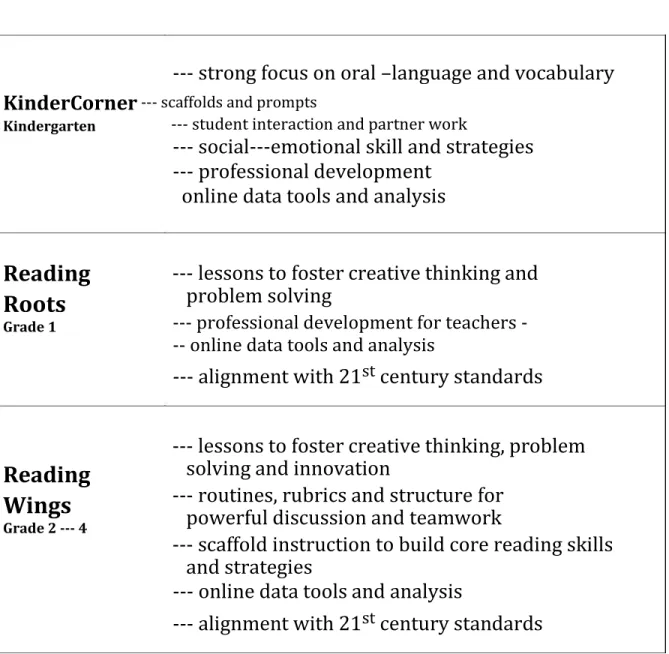
Figure 2.1 illustrates the components utilized at Roosevelt Elementary for student achievement. Through the Success for All program, there was 90 minutes of instruction in reading daily, 20 minutes of reading nightly for homework, focus on attendance, tutoring, and parent involvement. Figure 2.2 shows the instructional component at grade levels of KinderKorner for Kindergarten, Reading Roots for grade one, and Reading Wings for second, third and fourth grades. There is a Spanish component, which is used for English Language Learners called Lee Comingo, used with grade one Spanish speakers. (See Figure 2.1 and Figure 2.2.)
Figure 2.1 Format of Success For All
Student
Achievement
Success
For
All
90 Minute Instruction Block 20 Minute Tutoring Reading Nightly Parent Attendance InvolvementSuccess For All Model 90 Minute Instruction Block
Parent Involvement
20 Minute Reading Nightly
Attendance Tutoring
Figure 2.1 Format of the Success For All model
Figure 2.2 Success For All Instructional Components
Success for All Reform Model Components
- strong focus on oral –language and vocabulary
KinderCorner
- scaffolds and promptsKindergarten - student interaction and partner work
- social-emotional skill and strategies
- professional development
online data tools and analysis
Reading
Roots
Grade 1Reading
Wings
Grade 2 - 4- lessons to foster creative thinking and
problem solving
professional development for teachers - online data tools and analysis
- alignment with 21
stcentury standards
- lessons to foster creative thinking, problem
solving and innovation
- routines, rubrics and structure for
powerful discussion and teamwork
- scaffold instruction to build core reading skills
and strategies
- online data tools and analysis
- alignment with 21
stcentury standards
Figure 2.2 Success for All instructional component at each grade level.Analytical Literature
Analytic theory provides a theoretical lens to view a study’s findings and to identify emerging patterns and themes (Maxwell, 2005). I adopted several theoretical frameworks to analyze the challenges experienced in implementing a comprehensive reform system in an urban school. The issues were examined through economic, political, taxonomic, and critical lens.
Students bring personal issues into the classroom, making it challenging for the teacher to reach them. Challenges of student behavior and issues within their home life affect their performance in the educational setting. Some teachers feel they spend increasingly more time on discipline and other issues and increasingly less time on academics in the classroom as the society around them becomes more complex. School systems continue to look for ways to keep the workforce intact and educate children at the same time. There are numerous programs that address the issues school systems face. Reform models like Success for All are designed to consider a student’s academic success within the realities of today’s society.
Economic Lens
Karl Marx’s ideology might react to the Success for All program in two ways. Marx might observe that Success for All supports the whole system by serving all, because it is inclusive and does not exclude anyone. The program intends to equally support the interest of all participants without prejudice (i.e. without regard for
nationality, race, ethnicity, gender, etc.). However, in reality all students are not successful. Some of the students will not be helped in this program. Marx might argue with the slogan Success for All, since the name implies everyone will be successful. Dialectical materialism is a way of understanding reality, thought, emotions, or the material world (Eagleton, 1999). Dialectics is a method of thinking in which concepts are flexible and mobile (Berlin, 1995). The philosophy of Marxism might reflect that dualistic approach in regards to the Success for All program.
According to Muller (1995), “Adam Smith suggested that universal public education is at the expense of the government. He felt everyone, even the poor, could acquire the necessary skills of reading, writing, and math” (p.150). Smith did not say that school should be mandatory, but did insist it had to be accessible and useful to individuals (Muller, 1995). Smith thought that an education would benefit individuals and the state. If one were better educated, then there was less of a chance of that individual responding to “the delusions of enthusiasm and
superstition” (Muller, 1995, p. 151) or being persuaded by con artists. Smith thought an educated population would make for greater social cohesion through shared respectability. Smith would likely have appreciated the components of the Success for All programs, because of the focus on reading, writing, and math behaviors, and on shaping the whole person. Smith, however, might not agree with the
implementation of Success for All if it were not accessible to all. If Success for All were mandated by school districts or states, then it might be considered more accessible to all.
Both Karl Marx (1995) and Adam Smith (1995) advocated equality for all, however, each for different reasons. Marx might have viewed Success for All from a dialectic materialistic perspective, while Smith might have considered the program from an economic viewpoint.
Political Lens
Edelman (1988) suggested that the central connotation of leadership is innovation: leaders point the way so that others can emulate their initiatives. Mary Rosario, the principal at Roosevelt, had a mandate to implement a reform model at her school. As a leader, she was innovative in accomplishing this task. As a leader, she had to take risks and plan so that Success for All would have the best possible chance to produce results to meet her expectations. Edelman would characterize her as a strong leader. Edelman (1988) stated “Strong leaders typically win reputation through policies that bring risk, suffering, or death to large numbers of people” (p. 38). Edelman (1988) continued,
“ . . . some people are born leaders; leaders possess certain traits
(resourcefulness, originality, courage, foresight, mediating talents, self- sacrifice in the public interest) in greater degree than others; that individuals become leaders is itself evidence that they surpass others in the necessary qualities or that they represent the public will, divine will, merit, the average citizen, or whatever other symbol is accepted as legitimate at a particular time and place. To list these commonplace assumptions about leadership is to raise questions about their validity; but in everyday discourse they are likely
to be intoned rather than examined because leadership provides vital psychological gratifications” (p. 39).
Mary Rosario, exhibiting her leadership style, displayed those traits in having the foresight for Roosevelt to adopt a reform model before the district took control and made the decision for them.
Taxonomic Lens
Implementing the Success for All program at Roosevelt required core stakeholders to accept and practice new rituals and routines while abandoning others that they had performed perhaps for many years. Additionally, they had to adjust to the practices of the Success for All monitors as new supervisors,
supervisors who balanced both mentoring and monitoring functions.
Officials from Success for All would come at least three times a year to
monitor implementation of the program. During these visits, stress levels were high and tempers occasionally flared among the teachers. Teachers were observed and sometimes felt challenged. Success for All teaching plans are very detailed, to the point of timing one’s teaching to the minute. Student behaviors, the inability to comprehend the lesson, and demographics of the classroom were seen as sometimes not being taken into consideration. Points were deducted from
evaluations for non- displayed Success for All program literature (posters) or for signals not used by the student and teacher in the classrooms. Evaluation of the total program based on Success for All observer visits to certain rooms for a few minutes were not always seen as representative.
The teacher facilitator did surprise visits. While not threatening or intrusive, the process could be flustering if someone were a nervous person or had something to hide. The facilitator did observations as a way of getting those teachers not doing the program to be on board with the other teachers and for accountability. The facilitator maintained the integrity of the program to the specification of Success for All.
Lincoln (1989) suggested,
… that ritual performance can contribute powerfully to the maintenance of society-a crucial insight of functionalist and structural-functionalist theoreticians remains an accepted truism, and others who write from a Marxist position have advanced powerful arguments in support of the view that rituals is both intrinsically and categorically conservative in nature (p. 53).
At Roosevelt there was evidence of dominance and resistance going on. There were teachers doing the program to the best of their ability and to the specifications of Success for All. Other teachers gave the appearance of doing the program but in reality resisted doing the program whenever an opportunity made itself available. Lincoln (1989) in his discussion of the Swazi Newala stated:
Thus, domination may be defined as the attempt (never entirely successful) of a given group (A) to absorb other groups (B, C, etc.) within a higher level of social integration (I) in which the members of A occupy a position of
imposition of an unwanted and exploitative fusion on groups that are converted into subordinate segments of the new social aggregate. Conversely, resistance is the (sustained, but never fully successful) refusal of given group (such as B) to accept absorption into a higher level of integration, the polico-economic realities and dominant ideology of which are imposed by an initially alien group (A) that seeks to establish itself as the ruling stratum of the new aggregate. Resistance-which may take material, political, cultural, ritual or countless other forms-is thus continued visionary pressure against an unwanted and exploitative fusion imposed from outside
(p. 73).
As previously mentioned, Success for All had a 3-year commitment and strict rules or guidelines to follow. The dominant culture was the Success for All program in the school. Said (1993) stated “the term imperialism means the practice, the theory, and the attitudes of a dominating metropolitan center ruling a distant territory.” (p. 9). At Roosevelt, the Success for All model was in place and the remainder of the curriculum had to adjust to its schedule. With Success for All having these strict guidelines and commitment it was able to maintain its program and presence as a reform model. It might be considered an empire. Said (1993) stated, “Imperialism is simply the process or policy of establishing or maintaining an empire” (p. 9).
Looking through both the political and taxonomic lens the problem centers on leadership and the anomaly. Anomalies are a fact of reality. Anomalies will continue to be a threat to the dominant culture. An anomaly is not necessarily a bad thing.
The presence of an anomaly is a taxonomic structure that exposes faults, inadequacies and inconsistencies of a structure.
Critical Lens
Kevin Kumashiro explained right, left and public education.
One way to understand the various reforms in education is to contrast the efforts of those who want to maintain the status quo, particularly its
hierarchies and privileges, with the efforts of those who want to change the status quo by raising awareness of and challenging the racism, sexism, and other forms of oppression that permeate schools and society. The former is led by the political Right in the United States; the latter, by the Left
(Kumashiro, 2008, p. 5).
To identify the groups by issue is difficult. Conservatives or Republicans identify with the Right, and liberals and progressives with the Left. What defines or differentiates the Right and Left (and which can differ at any time) are their
underlying goals: The Left aims to change the status quo and Right aims to maintain it (Kumashiro, 2008,p. 5-6).
Diane Ravitch and Michael Apple are well-respected contemporary
reformers of education who advocate for excellent public educational opportunities for all children. According to Ravitch (2013):
All children deserve a curriculum that includes the arts, history, civics geography, the sciences, foreign languages, mathematics, and literature. Children of the poor need good schools and adequate resources as much as –
perhaps even more than–children of the affluent, especially since they are far less likely to have their education supplemented by private art or music lessons after school or in the summer, as afforded the children in well –to-do families (p. 298).
Ravitch (2013), as a school reform historian, noted that, “What is happening now is an astonishing development. It is not meant to reform public education but is a deliberate effort to replace public education with a privately managed, free-market system of schooling”(p.298).
Apple (2008) stated:
… conservative modernization. This is a powerful, yet odd, combination of forces that is in play in education, a combination that many educators, community activists, critical researchers, and others believe poses
substantial threats to the vitality of our nation, our schools, our teachers, and our children. As I noted, we are told to free our schools by placing them into the competitive market, restore our traditional common culture and stress discipline and character, return God to our classrooms as a guide to all our conduct inside and outside the school, and tighten central control through more rigorous and tough-minded standards and tests (p.4).
According to Kumashiro (2012), “Neoliberalism values competitive markets and attempts to redistributes resources or accountability, often manifesting in politics that reduce governmental regulation of trade, increase the privatization of public services, and support the growth of business” (p. 38). Kumashiro further stated, “Neoliberalism …promotes an understanding of equality and freedom that
presumes a level playing field, and that expects some to win and many others to lose“ (p. 39).
Ravitch (2013) commented, “The majority of Americans received a public education in our public schools. Americans want neighborhood schools, not
schools that pick and choose their students, and despite promises made by charter corporations and political allies, the public is awakening to the threat posed by privatization” (p. 319).
Kumashiro (2012) stated,
…the concept of privatization is that of personal responsibility, which is the reliance on oneself rather than on others, and consequently the rejection of political or social-welfare structures that could hamper one’s own sense of independence and development, instead, a system of unfair distribution of resources and undeserved rewards (p. 38).
Neoliberal ideology framed the reform of public education in countries around the world. According to Kumashiro, “In the United States, neoliberal ideology did not characterize educational reform until the end of the 20th century” (p. 41). Federal funding was directed to equity programs and formula grants targeted low income families, English-languages proficiency and disability concerns. Federal funds have moved to market solutions and competitive grants. Kumashiro (2008) stated,
“…such initiatives continues to grow, despite compelling research revealing their ineffectiveness in improving school performance and teacher quality. Nonetheless, within this logic, competition is what will make schools and teachers better” (p. 42).
According to Apple (2006) “For Neoliberals, one rationality is more powerful than any other-economic rationality. Efficiency and an ethic of cost-benefit analysis are the dominant norms. All people are to act in ways that maximize their own personal benefits” (p. 31).
Ravitch (2013) stated,
The corporate reform movement has capitalized on the American public’s infatuation with consumerism. The advance of privatization depends on high- stakes testing. The federally mandated regime of annual testing generates the data to grade not only students and teachers but also schools. Given unrealistic goals, a school can easily fail. When a school is labeled a failingschool under NCLB or priority or focus school according to the metrics of theObama
administration’s program, it must double down on test preparation to attempt to recover its reputation, but the odds of success are small especially after the most ambitious parents and students flee the school” (p. 319). Ravitch (2013)
continued, “public education is an essential part of the
democratic fabric of the American Society” (p.320).
Ravitch’s defense of public education is particularly timely given the current politically charged debates on how to best educate our nation’s children. Betsy DeVos, recently selected as U. S. Secretary of Education, represents a side of the debate that does not appear to share Ravitch’s deep commitment to public education. John Rosales, in a NEA Today article wrote that DeVos comes to the position, “With no experience as an educator or elected official, and despite a decades-long record of
undermining public schools by promoting taxpayer-funded vouchers for private and religious schools” (January 11, 2017).
Sara Meade, opinion contributor for US News, cautioned that the stakes for children are too high for the nation to allow partisanship to dictate education policy. She stated:
The challenges that face our schools and our country today are complicated ones. It's possible to simultaneously believe both that our schools lack sufficient funding and that existing resources could be used more effectively; that schools alone cannot counteract the devastating impact of poverty on human development and that our existing school system compounds the problem by consistently giving the poorest students lower quality learning experiences; that test scores alone fail to measure a large part of what matters in education and that they predict children's later chances of life success. If our public dialogue on education issues can't encompass multiple causes for complex problems, or accommodate diverse perspectives on values trade-offs, we're unlikely to reach effective policy responses to the complex challenges we face (January 26, 2017).
Summary
In Chapter two, I discussed the historical perspective of educational reform from the 19th, 20th and 21st century. Also included were effective schools research, related research, interpretations by experts and specifics of the Success for All program. The analytical literature was reviewed through economic, political,
taxonomic, and critical lens. In the next chapter, the methodology for this qualitative case study will be described.
CHAPTER THREE: METHODOLOGY
This chapter includes description of the study’s research design, rationale, participant selection, data collection and analysis, and interview and follow-up interview questions. I included discussions of researcher bias, limitations of the study, and descriptions of the setting and of the study’s participants to complete the chapter.
The research methodology for this study is qualitative. Marshall, et al. (1999) noted, “Qualitative research is a broad approach to the study of social phenomena; its various genres are naturalistic and interpretive, drawing on multiple methods of inquiry” (p. 2). Qualitative research takes place in a natural setting using multiple methods involving interactions with humans and the data is developing and interpretive (p. 3).
One method of qualitative research is a case study, defined by Merriam (1988) as follows: “A qualitative case study is an intensive, holistic description and analysis of a single instance, phenomenon, or social unit” (p. 21). Case studies seek to answer “how” or “why” questions with a focus on real-life or contemporary settings (Yin, 2007). Merriam (1998) described a case study’s overall intent as “one that presents a detailed account of the phenomenon” (p. 38). I sought to learn about Success for All based on the experiences of the participants, learning from teachers, administration facilitators, parents, and a Success for All official.