ScienceDirect
Available online at www.sciencedirect.com
Procedia Manufacturing 38 (2019) 478–487
2351-9789 © 2019 The Authors. Published by Elsevier B.V.
This is an open access article under the CC BY-NC-ND license (http://creativecommons.org/licenses/by-nc-nd/4.0/)
Peer-review under responsibility of the scientific committee of the Flexible Automation and Intelligent Manufacturing 2019 (FAIM 2019) 10.1016/j.promfg.2020.01.061
10.1016/j.promfg.2020.01.061 2351-9789
© 2019 The Authors. Published by Elsevier B.V.
This is an open access article under the CC BY-NC-ND license (http://creativecommons.org/licenses/by-nc-nd/4.0/)
Peer-review under responsibility of the scientific committee of the Flexible Automation and Intelligent Manufacturing 2019 (FAIM 2019) Available online at www.sciencedirect.com
ScienceDirect
Procedia Manufacturing 00 (2019) 000–000
www.elsevier.com/locate/procedia
2351-9789 © 2019 The Authors. Published by Elsevier B.V.
Peer-review under responsibility of the scientific committee of the 28th Flexible Automation and Intelligent Manufacturing 2019
29th International Conference on Flexible Automation and Intelligent Manufacturing
(FAIM2019), June 24-28, 2019, Limerick, Ireland.
Using Serious Games to Inform Mass Customization Production
Methods from the Fuzzy Front-End of New Product Development
a
Mic
hael O’Sullivan,
bDr. Con Sheahan*
a,b School of Engineering, University of Limerick, IrelandAbstract
Mass customization means to offer products or services which meet the demands of each individual customer, but which still can be produced and delivered with mass production efficiency. The buzz surrounding technologies like 3D printing and artificial intelligence has many start-ups hoping to capitalise on this dream of creating personalised products at an affordable price, and well-established companies scrambling to innovate and maintain their market share. However, the majority of them are failing as they struggle to understand one key question – where does customization make sense? Customization and personalisation only make sense where the value of the perceived benefit outweighs the cost to implement it. In other words, will people pay for it? Looking at the Kano Model makes it clear that it depends on the product. In products where customization is an inherent need, like prosthetics, mass customization technologies can be highly beneficial. However, for products that already sell as a standard, like headphones, offering customization is likely only an added bonus, and so the product development team must figure out if
the customers’ perception of the added value of this feature will outweigh its premium price tag. This can be done through the
use of a ‘serious game,’ whereby potential customers are given a limited budget to collaboratively buy and bid on potential
features of the product, before it is developed. If the group choose to buy customization over other features, then the product development team should implement it into their design. If not, the team should prioritize the features on which the customers have spent their budget. The level of customization purchased can also be translated to an appropriate production method. For example, the most expensive type of customization would likely be free-form design and could be achieved through digital fabrication, while a lower level could be achieved through short batch production. Twenty-eight teams of final year students from design, engineering, construction and technology tested this methodology when bringing a product from concept through to production plan and found that it allowed them to confidently decide what level of customization, if any, would be worth offering for their product, and what would be the best method of producing it. They also found that the discussion and negotiations between players during the game led to invaluable insights, and almost all teams said they would use the methodology in future product development projects, especially those from non-design backgrounds.
* Corresponding author. Tel.: +353 85 1132518 E-mail address: [email protected]
Available online at www.sciencedirect.com
ScienceDirect
Procedia Manufacturing 00 (2019) 000–000
www.elsevier.com/locate/procedia
2351-9789 © 2019 The Authors. Published by Elsevier B.V.
Peer-review under responsibility of the scientific committee of the 28th Flexible Automation and Intelligent Manufacturing 2019
29th International Conference on Flexible Automation and Intelligent Manufacturing
(FAIM2019), June 24-28, 2019, Limerick, Ireland.
Using Serious Games to Inform Mass Customization Production
Methods from the Fuzzy Front-End of New Product Development
a
Mic
hael O’Sullivan,
bDr. Con Sheahan*
a,b School of Engineering, University of Limerick, IrelandAbstract
Mass customization means to offer products or services which meet the demands of each individual customer, but which still can be produced and delivered with mass production efficiency. The buzz surrounding technologies like 3D printing and artificial intelligence has many start-ups hoping to capitalise on this dream of creating personalised products at an affordable price, and well-established companies scrambling to innovate and maintain their market share. However, the majority of them are failing as they struggle to understand one key question – where does customization make sense? Customization and personalisation only make sense where the value of the perceived benefit outweighs the cost to implement it. In other words, will people pay for it? Looking at the Kano Model makes it clear that it depends on the product. In products where customization is an inherent need, like prosthetics, mass customization technologies can be highly beneficial. However, for products that already sell as a standard, like headphones, offering customization is likely only an added bonus, and so the product development team must figure out if
the customers’ perception of the added value of this feature will outweigh its premium price tag. This can be done through the
use of a ‘serious game,’ whereby potential customers are given a limited budget to collaboratively buy and bid on potential
features of the product, before it is developed. If the group choose to buy customization over other features, then the product development team should implement it into their design. If not, the team should prioritize the features on which the customers have spent their budget. The level of customization purchased can also be translated to an appropriate production method. For example, the most expensive type of customization would likely be free-form design and could be achieved through digital fabrication, while a lower level could be achieved through short batch production. Twenty-eight teams of final year students from design, engineering, construction and technology tested this methodology when bringing a product from concept through to production plan and found that it allowed them to confidently decide what level of customization, if any, would be worth offering for their product, and what would be the best method of producing it. They also found that the discussion and negotiations between players during the game led to invaluable insights, and almost all teams said they would use the methodology in future product development projects, especially those from non-design backgrounds.
* Corresponding author. Tel.: +353 85 1132518 E-mail address: [email protected]
2 Author name / Procedia Manufacturing 00 (2019) 000–000 © 2019 The Authors. Published by Elsevier B.V.
Peer-review under responsibility of the scientific committee of the Flexible Automation and Intelligent Manufacturing 2019 Keywords: New Product Development; mass customization; feature prioritization; serious game; Kano Model; Quality Function Deployment 1.Introduction
The world of new product development (NPD) has always been fast-paced and competitive, with companies constantly looking for new ways to gain an advantage on their competition. Recent years have seen many examples of once-huge companies, like Nokia or Blockbuster failing to innovate and being pushed out of the market by new start-ups and others driving change, creating new products and adapting new business models. Due to sites like Netflix and Amazon offering personalized recommendations, as well as smart home devices adapting to each
individual’s unique needs and lifestyles, customers are increasingly expecting products tailored to suit them [1]. This is now becoming true for physical products also, which has re-fuelled the hype for the concept of mass customization. Mass customization means to offer products or services which meet the demands of each individual customer, but which still can be produced and delivered with mass production efficiency [2]. While it is a concept that has been around for decades, it is only now that it appears to be coming to fruition, thanks to this fundamental
shift in customer’s expectations, as well as a push from some of the technologies which could enable it – additive manufacturing and flexible automation [3].
As these technologies rapidly continue to improve and become more accessible, many companies are rushing to figure out how they can be used to augment their current product offerings, or to offer new products and services. Meanwhile, the barriers to setting up a brand and selling a product are constantly being reduced, creating a strong growth in the popularity of start-ups and placing even more pressure on firms to innovate and compete for market share [4]. This rush to create custom products faster than others has led to many companies failing to offer products that excite their customers enough to purchase them. For example, Amazon set up a 3D printing store, offering personalized items like dog tags and credit card holders, before discontinuing it shortly after. Meanwhile, countless start-ups have been forced to shut down because their custom offerings could not compete with the mass produced equivalent. In 2013, Piller & Walcher [5] published a study into 500 mass customization companies, and within 15 months they had seen a 20% death rate [6].
Piller believes that the following are some of the main reasons why customization start-ups fail. The first is that companies do not realize that customization per se provides no customer value. He claims that he often sees customization being offered just for the sake of it, or to have just as any point of differentiation. He also says that
there is too much ‘me-too,’ focusing on aesthetic customization only, rather than customization fit or function, which
might add more value. Ultimately, customization only makes sense where the value of the perceived benefit of customization outweighs the cost to implement it and its corresponding premium price tag. However, it is not
enough to know if people will pay for customization or not, but also what level or ‘depth’ they would be willing to pay for. There appears to be no methodology to aid teams in overcoming this challenge.
Meanwhile, Piller claims that the main reason why mass customization units of large established global firms fail is that there is not enough top management support. It is clear, then, that there is a real need for a methodology that solves these issues. One that allows teams to quickly assess product ideas and their suitability to customization, based on how customers are likely to spend their money, without committing too much time or resources. O’Sullivan
and Sheahan [7] have already created a streamlined methodology to help teams navigate the fuzzy front-end and assess ideas based on how customers are likely to spend their money, and so this research aims to build on their methodology by adapting it for mass customization.
Michael O’Sullivan et al. / Procedia Manufacturing 38 (2019) 478–487 479 Available online at www.sciencedirect.com
ScienceDirect
Procedia Manufacturing 00 (2019) 000–000
www.elsevier.com/locate/procedia
2351-9789 © 2019 The Authors. Published by Elsevier B.V.
Peer-review under responsibility of the scientific committee of the 28th Flexible Automation and Intelligent Manufacturing 2019
29th International Conference on Flexible Automation and Intelligent Manufacturing
(FAIM2019), June 24-28, 2019, Limerick, Ireland.
Using Serious Games to Inform Mass Customization Production
Methods from the Fuzzy Front-End of New Product Development
a
Mic
hael O’Sullivan,
bDr. Con Sheahan*
a,b School of Engineering, University of Limerick, IrelandAbstract
Mass customization means to offer products or services which meet the demands of each individual customer, but which still can be produced and delivered with mass production efficiency. The buzz surrounding technologies like 3D printing and artificial intelligence has many start-ups hoping to capitalise on this dream of creating personalised products at an affordable price, and well-established companies scrambling to innovate and maintain their market share. However, the majority of them are failing as they struggle to understand one key question – where does customization make sense? Customization and personalisation only make sense where the value of the perceived benefit outweighs the cost to implement it. In other words, will people pay for it? Looking at the Kano Model makes it clear that it depends on the product. In products where customization is an inherent need, like prosthetics, mass customization technologies can be highly beneficial. However, for products that already sell as a standard, like headphones, offering customization is likely only an added bonus, and so the product development team must figure out if
the customers’ perception of the added value of this feature will outweigh its premium price tag. This can be done through the
use of a ‘serious game,’ whereby potential customers are given a limited budget to collaboratively buy and bid on potential
features of the product, before it is developed. If the group choose to buy customization over other features, then the product development team should implement it into their design. If not, the team should prioritize the features on which the customers have spent their budget. The level of customization purchased can also be translated to an appropriate production method. For example, the most expensive type of customization would likely be free-form design and could be achieved through digital fabrication, while a lower level could be achieved through short batch production. Twenty-eight teams of final year students from design, engineering, construction and technology tested this methodology when bringing a product from concept through to production plan and found that it allowed them to confidently decide what level of customization, if any, would be worth offering for their product, and what would be the best method of producing it. They also found that the discussion and negotiations between players during the game led to invaluable insights, and almost all teams said they would use the methodology in future product development projects, especially those from non-design backgrounds.
* Corresponding author. Tel.: +353 85 1132518 E-mail address: [email protected]
ScienceDirect
Procedia Manufacturing 00 (2019) 000–000
www.elsevier.com/locate/procedia
2351-9789 © 2019 The Authors. Published by Elsevier B.V.
Peer-review under responsibility of the scientific committee of the 28th Flexible Automation and Intelligent Manufacturing 2019
29th International Conference on Flexible Automation and Intelligent Manufacturing
(FAIM2019), June 24-28, 2019, Limerick, Ireland.
Using Serious Games to Inform Mass Customization Production
Methods from the Fuzzy Front-End of New Product Development
a
Mic
hael O’Sullivan,
bDr. Con Sheahan*
a,b School of Engineering, University of Limerick, IrelandAbstract
Mass customization means to offer products or services which meet the demands of each individual customer, but which still can be produced and delivered with mass production efficiency. The buzz surrounding technologies like 3D printing and artificial intelligence has many start-ups hoping to capitalise on this dream of creating personalised products at an affordable price, and well-established companies scrambling to innovate and maintain their market share. However, the majority of them are failing as they struggle to understand one key question – where does customization make sense? Customization and personalisation only make sense where the value of the perceived benefit outweighs the cost to implement it. In other words, will people pay for it? Looking at the Kano Model makes it clear that it depends on the product. In products where customization is an inherent need, like prosthetics, mass customization technologies can be highly beneficial. However, for products that already sell as a standard, like headphones, offering customization is likely only an added bonus, and so the product development team must figure out if
the customers’ perception of the added value of this feature will outweigh its premium price tag. This can be done through the
use of a ‘serious game,’ whereby potential customers are given a limited budget to collaboratively buy and bid on potential
features of the product, before it is developed. If the group choose to buy customization over other features, then the product development team should implement it into their design. If not, the team should prioritize the features on which the customers have spent their budget. The level of customization purchased can also be translated to an appropriate production method. For example, the most expensive type of customization would likely be free-form design and could be achieved through digital fabrication, while a lower level could be achieved through short batch production. Twenty-eight teams of final year students from design, engineering, construction and technology tested this methodology when bringing a product from concept through to production plan and found that it allowed them to confidently decide what level of customization, if any, would be worth offering for their product, and what would be the best method of producing it. They also found that the discussion and negotiations between players during the game led to invaluable insights, and almost all teams said they would use the methodology in future product development projects, especially those from non-design backgrounds.
* Corresponding author. Tel.: +353 85 1132518 E-mail address: [email protected]
© 2019 The Authors. Published by Elsevier B.V.
Peer-review under responsibility of the scientific committee of the Flexible Automation and Intelligent Manufacturing 2019 Keywords: New Product Development; mass customization; feature prioritization; serious game; Kano Model; Quality Function Deployment 1.Introduction
The world of new product development (NPD) has always been fast-paced and competitive, with companies constantly looking for new ways to gain an advantage on their competition. Recent years have seen many examples of once-huge companies, like Nokia or Blockbuster failing to innovate and being pushed out of the market by new start-ups and others driving change, creating new products and adapting new business models. Due to sites like Netflix and Amazon offering personalized recommendations, as well as smart home devices adapting to each
individual’s unique needs and lifestyles, customers are increasingly expecting products tailored to suit them [1]. This is now becoming true for physical products also, which has re-fuelled the hype for the concept of mass customization. Mass customization means to offer products or services which meet the demands of each individual customer, but which still can be produced and delivered with mass production efficiency [2]. While it is a concept that has been around for decades, it is only now that it appears to be coming to fruition, thanks to this fundamental
shift in customer’s expectations, as well as a push from some of the technologies which could enable it – additive manufacturing and flexible automation [3].
As these technologies rapidly continue to improve and become more accessible, many companies are rushing to figure out how they can be used to augment their current product offerings, or to offer new products and services. Meanwhile, the barriers to setting up a brand and selling a product are constantly being reduced, creating a strong growth in the popularity of start-ups and placing even more pressure on firms to innovate and compete for market share [4]. This rush to create custom products faster than others has led to many companies failing to offer products that excite their customers enough to purchase them. For example, Amazon set up a 3D printing store, offering personalized items like dog tags and credit card holders, before discontinuing it shortly after. Meanwhile, countless start-ups have been forced to shut down because their custom offerings could not compete with the mass produced equivalent. In 2013, Piller & Walcher [5] published a study into 500 mass customization companies, and within 15 months they had seen a 20% death rate [6].
Piller believes that the following are some of the main reasons why customization start-ups fail. The first is that companies do not realize that customization per se provides no customer value. He claims that he often sees customization being offered just for the sake of it, or to have just as any point of differentiation. He also says that
there is too much ‘me-too,’ focusing on aesthetic customization only, rather than customization fit or function, which
might add more value. Ultimately, customization only makes sense where the value of the perceived benefit of customization outweighs the cost to implement it and its corresponding premium price tag. However, it is not
enough to know if people will pay for customization or not, but also what level or ‘depth’ they would be willing to pay for. There appears to be no methodology to aid teams in overcoming this challenge.
Meanwhile, Piller claims that the main reason why mass customization units of large established global firms fail is that there is not enough top management support. It is clear, then, that there is a real need for a methodology that solves these issues. One that allows teams to quickly assess product ideas and their suitability to customization, based on how customers are likely to spend their money, without committing too much time or resources. O’Sullivan
and Sheahan [7] have already created a streamlined methodology to help teams navigate the fuzzy front-end and assess ideas based on how customers are likely to spend their money, and so this research aims to build on their methodology by adapting it for mass customization.
480 Michael O’Sullivan et al. / Procedia Manufacturing 38 (2019) 478–487
Author name / Procedia Manufacturing 00 (2019) 000–000 3 2.Background
Over the past number of decades, there have been many tools developed in academia to aid in the new product development process. In fact, there are so many that it can be difficult for people to know which ones to use and how they work together. As well as this, the language used can be difficult for non-academics to understand, and their level of technicality can be off-putting. For this reason, studies have shown that there is a huge gap between their academic prevalence and their industry adoption. While many industrialists admit that the tools developed in academia would be beneficial to their NPD efforts, they believe that the tools are too complex and carry a learning curve that is too steep to make them worth using [8]. To combat this, O’Sullivan and Sheahan [7] created a streamlined methodology for navigating the fuzzy front-end, adopting tools with strong synergy like Voice of the Customer (VoC), Kano Model, Quality Function Deployment (QFD) and Buy a Feature (BaF). An overview of their methodology is detailed here:
2.1. Voice of the customer
When a product development team has an initial idea for a concept, their first protocol should be to understand the VoC – the needs and wants of the customer. They can use online research, surveys, focus groups, observations and other methods to fully understand the problem area, their competition, target market and the needs and wants of this target market. The VoC should provide a clear list of potential customer requirements. For example, if developing a pair of headphones, some of these requirements might relate to the comfort, battery life, carry case, and so on.
2.2. Brainstorm
While it is important to understand what the customer wants and provide this in the product/service solution, this is not always enough. It is also the job of the NPD team to come up with potential new requirements that the customers might not think of themselves. This could help make the product more appealing to the customers and set itself apart from competitors on the marketplace. For this reason, the NPD team should carry out a brainstorm at this stage, adding to their list of potential requirements from the VoC.
2.3. Kano Model
The team can then categorize all of these requirements into several attributes by asking potential customers how they feel if the feature is present/absent and then reading these results off the Kano Table [9]. ‘Must-be’ requirements simply have to be met. They won’t add satisfaction for the customer, they will simply ensure they are
not dissatisfied. ‘Performance’ requirements essentially mean ‘the more, the better.’ A good example would be the
speed of a car, or the comfort of a pair of headphones. There has to a minimum level of this, but the more this
feature is implemented, the happier the customer will be. ‘Attractive’ requirements are ones that are not expected by
the customer, so will not cause dissatisfaction if absent, but will delight them if present. Requirements that do not affect satisfaction or dissatisfaction are called ‘indifferent,’ and should be avoided as they are essentially money -sinks. Finally, if a requirement is categorized as ‘reversal,’ it means that customers actually want the opposite of
what is being offered.
2.4. House of Quality
Once the team understands which requirements are critical, which ones are ‘performance’ and which ones are just
a bonus, they can use the first house in QFD to decide how they might fulfil these requirements. This is called the House of Quality (HoQ) and it is used to translate customer requirements into the technical features that will satisfy them, and to see how they interact with each other [10].
4 Author name / Procedia Manufacturing 00 (2019) 000–000 2.5. Buy a Feature
Finally, the team can use all of this information to play the serious game ‘Buy a Feature’ with a group of their
potential customers [11]. Each possible feature is assigned a retail price, based on its estimated development time and cost from the HoQ, as well comparing it to similar products on the market. By having completed the Kano
Model, the team can ensure that only ‘performance’ and ‘attractive’ features are presented to the customers, as
‘must-be’ features simply have to be included, and ‘indifferent’ ones do not affect satisfaction. The group are
provided with ‘play’ money but are given a budget that will only allow them to collectively buy between one and
two thirds of all the features. This forces them into an open discussion about the features, as they must negotiate and collaborate to pool their money together and purchase the features that are most important to them. The NPD team
can then decide, based on the amount spent, the players’ discussions during the game and their reactions to the
prices, whether or not the project is worth pursuing, and what features they should prioritize.
Their methodology was tested with almost 30 NPD teams as they carried a concept from the idea stage through to proof-of-concept. Surveys showed that teams who used the methodology had a higher confidence in their product’s
fit-to-market and feature prioritization than those who did not, and that they demonstrated a stronger understanding
of their customers’ requirements and willingness-to-pay. It is believed that the methodology could be improved
further and adapted for mass customization, as described in the next section.
3.Integrating mass customization
This section outlines the changes made to O’Sullivan and Sheahan’s methodology to adapt it for mass
customization.
3.1. Brainstorm ideas that utilize customization
When deciding if it makes sense to offer customization for a given product, the researchers believe that the best place to start is in the brainstorm session following the VoC. By educating the NPD team on mass customization –
the possibilities and the means – they can brainstorm new ideas for incorporating customization into their concepts.
For the headphones example, this might be something like, “I would like to be able to express my individuality
through my headphones.” Teams can be educated through the vast amount of online resources available on the matter [12].
3.2. Sort customization ideas into Kano categories
Once the team have come up with potential ways of incorporating customization, they can use the Kano Model to see which categories these ideas fall into in the eyes of the customer. For products where customization is already inherent, like prosthetics, it is likely to be a must-be requirement, and so the team know it is worth pursuing. For products that already sell without a custom element, like headphones, customization is likely only going to be a
‘performance’ or ‘attractive’ requirement. This means the team must figure out if customers are willing to spend
their money on it, and, if so, to what level it should be customizable.
3.3. Translating customization ideas into technical solutions using HoQ and ‘levels’
Before playing Buy a Feature, the team must first use the HoQ to help them translate these customer requirements into technical requirements, and, based on these, assign prices for the game. Once completed, the team will have a strong idea of how their product could be customized and how it would be produced. Continuing with the example of the headphones, imagine the Kano Model had ranked the ability for one to express their individuality
as a ‘performance’ requirement, meaning the more, the better. Similar to offering the headphones’ comfort in
various levels and prices, the team might consider offering multiple levels of customization. The first level might be low-level personalization, like adding the customer’s name to the headband, which could be achieved through laser
2.Background
Over the past number of decades, there have been many tools developed in academia to aid in the new product development process. In fact, there are so many that it can be difficult for people to know which ones to use and how they work together. As well as this, the language used can be difficult for non-academics to understand, and their level of technicality can be off-putting. For this reason, studies have shown that there is a huge gap between their academic prevalence and their industry adoption. While many industrialists admit that the tools developed in academia would be beneficial to their NPD efforts, they believe that the tools are too complex and carry a learning curve that is too steep to make them worth using [8]. To combat this, O’Sullivan and Sheahan [7] created a streamlined methodology for navigating the fuzzy front-end, adopting tools with strong synergy like Voice of the Customer (VoC), Kano Model, Quality Function Deployment (QFD) and Buy a Feature (BaF). An overview of their methodology is detailed here:
2.1. Voice of the customer
When a product development team has an initial idea for a concept, their first protocol should be to understand the VoC – the needs and wants of the customer. They can use online research, surveys, focus groups, observations and other methods to fully understand the problem area, their competition, target market and the needs and wants of this target market. The VoC should provide a clear list of potential customer requirements. For example, if developing a pair of headphones, some of these requirements might relate to the comfort, battery life, carry case, and so on.
2.2. Brainstorm
While it is important to understand what the customer wants and provide this in the product/service solution, this is not always enough. It is also the job of the NPD team to come up with potential new requirements that the customers might not think of themselves. This could help make the product more appealing to the customers and set itself apart from competitors on the marketplace. For this reason, the NPD team should carry out a brainstorm at this stage, adding to their list of potential requirements from the VoC.
2.3. Kano Model
The team can then categorize all of these requirements into several attributes by asking potential customers how they feel if the feature is present/absent and then reading these results off the Kano Table [9]. ‘Must-be’ requirements simply have to be met. They won’t add satisfaction for the customer, they will simply ensure they are
not dissatisfied. ‘Performance’ requirements essentially mean ‘the more, the better.’ A good example would be the
speed of a car, or the comfort of a pair of headphones. There has to a minimum level of this, but the more this
feature is implemented, the happier the customer will be. ‘Attractive’ requirements are ones that are not expected by
the customer, so will not cause dissatisfaction if absent, but will delight them if present. Requirements that do not affect satisfaction or dissatisfaction are called ‘indifferent,’ and should be avoided as they are essentially money -sinks. Finally, if a requirement is categorized as ‘reversal,’ it means that customers actually want the opposite of
what is being offered.
2.4. House of Quality
Once the team understands which requirements are critical, which ones are ‘performance’ and which ones are just
a bonus, they can use the first house in QFD to decide how they might fulfil these requirements. This is called the House of Quality (HoQ) and it is used to translate customer requirements into the technical features that will satisfy them, and to see how they interact with each other [10].
2.5. Buy a Feature
Finally, the team can use all of this information to play the serious game ‘Buy a Feature’ with a group of their
potential customers [11]. Each possible feature is assigned a retail price, based on its estimated development time and cost from the HoQ, as well comparing it to similar products on the market. By having completed the Kano
Model, the team can ensure that only ‘performance’ and ‘attractive’ features are presented to the customers, as
‘must-be’ features simply have to be included, and ‘indifferent’ ones do not affect satisfaction. The group are
provided with ‘play’ money but are given a budget that will only allow them to collectively buy between one and
two thirds of all the features. This forces them into an open discussion about the features, as they must negotiate and collaborate to pool their money together and purchase the features that are most important to them. The NPD team
can then decide, based on the amount spent, the players’ discussions during the game and their reactions to the
prices, whether or not the project is worth pursuing, and what features they should prioritize.
Their methodology was tested with almost 30 NPD teams as they carried a concept from the idea stage through to proof-of-concept. Surveys showed that teams who used the methodology had a higher confidence in their product’s
fit-to-market and feature prioritization than those who did not, and that they demonstrated a stronger understanding
of their customers’ requirements and willingness-to-pay. It is believed that the methodology could be improved
further and adapted for mass customization, as described in the next section.
3.Integrating mass customization
This section outlines the changes made to O’Sullivan and Sheahan’s methodology to adapt it for mass
customization.
3.1. Brainstorm ideas that utilize customization
When deciding if it makes sense to offer customization for a given product, the researchers believe that the best place to start is in the brainstorm session following the VoC. By educating the NPD team on mass customization –
the possibilities and the means – they can brainstorm new ideas for incorporating customization into their concepts.
For the headphones example, this might be something like, “I would like to be able to express my individuality
through my headphones.” Teams can be educated through the vast amount of online resources available on the matter [12].
3.2. Sort customization ideas into Kano categories
Once the team have come up with potential ways of incorporating customization, they can use the Kano Model to see which categories these ideas fall into in the eyes of the customer. For products where customization is already inherent, like prosthetics, it is likely to be a must-be requirement, and so the team know it is worth pursuing. For products that already sell without a custom element, like headphones, customization is likely only going to be a
‘performance’ or ‘attractive’ requirement. This means the team must figure out if customers are willing to spend
their money on it, and, if so, to what level it should be customizable.
3.3. Translating customization ideas into technical solutions using HoQ and ‘levels’
Before playing Buy a Feature, the team must first use the HoQ to help them translate these customer requirements into technical requirements, and, based on these, assign prices for the game. Once completed, the team will have a strong idea of how their product could be customized and how it would be produced. Continuing with the example of the headphones, imagine the Kano Model had ranked the ability for one to express their individuality
as a ‘performance’ requirement, meaning the more, the better. Similar to offering the headphones’ comfort in
various levels and prices, the team might consider offering multiple levels of customization. The first level might be low-level personalization, like adding the customer’s name to the headband, which could be achieved through laser
482 Michael O’Sullivan et al. / Procedia Manufacturing 38 (2019) 478–487
Author name / Procedia Manufacturing 00 (2019) 000–000 5
engraving or printed graphics and would likely not cost too much. The next level might be moderate customization, such as selecting the colour or size of the various parts, which could likely still be produced by mass production, but with a configure-to-order system. This would cost more. Finally, the highest and most expensive level might allow customers to design their own headbands, which could be produced through 3D printing. By estimating the relative resources required to develop and produce this, the team will know that this feature will be more expensive than the last, and so will carry a higher retail price.
3.4. Buy a Feature
Now, when playing Buy a Feature, certain features will be offered to customers in levels with tiered pricing, and the team can see how they spend their limited budget. The players might decide to purchase maximum level comfort and moderate battery life, and only have enough money left over for the low-level customization, or may even choose to spend this money on a carry case or keep it instead. If customization is important to the players, they will choose to purchase it and sacrifice another feature. Again, the in-game discussions during negotiations will be invaluable here, as players explain their rationale behind purchases, and even offer new ideas for the NPD team. Where the Kano Model categorizes customization as an ‘Attractive’ feature, Buy a Feature might offer it as a single
level purchase. If purchased, it is likely that, during the game, players will have discussed the types of customization they would like to see in the product, and so the game can be played a second time, this time just focusing on these ideas and with a smaller budget.
4.Methodology for testing
The updated methodology was tested with 28 teams of final year NPD students, as they carried a product from concept through to proof-of-concept and production plan. The teams were comprised of students from design, engineering, technology and construction backgrounds and, for the most parts, students worked in teams of 4 with others sharing their background. The students were deemed suitable for testing the methodology as in a few months they will likely be working on product development in companies, and so will be the target audience for the tools discussed in this paper.
The teams had 12 weeks to work on the project and were provided with the proposed methodology in the form of a physical guide, and this included an example of how a pair of headphones would be developed using the methodology. The teams were encouraged to use pre-existing articles and videos online to help them complete the VoC, Kano and HoQ, as well as articles explaining the potential benefits of mass customization and how it could be achieved. They were also provided with instructions on how to carry out Buy a Feature, as well as instructions to read to the players (their potential customers). Finally, they were also provided with play money and a set of
example ‘feature cards’ – cards showing the descriptions and prices for a set of potential features for a pair of headphones. These feature cards would allow the team to play a practice game of Buy a Feature amongst themselves and with their customers, before creating their own feature cards based on their own product concepts.
At the end of the project, teams submitted a report, documenting their process and their results. A survey was
carried out following the project to understand the teams’ confidence in their feature prioritization and their
product’s fit to the market. This would be used to compare results with a previous Buy a Feature study which did not incorporate levels of features or mass customization, to ensure that the changes implemented in this study did not have a negative impact. 12 teams were then randomly selected for semi-structured focus groups, to learn more about their experience with and thoughts on the methodology, and to see how this varied across disciplines and products. Finally, the reports were analyzed to observe how teams used the methodology, to see how it affected their decision-making, particularly in relation to mass customization, and to see again how this varied across disciplines and products.
6 Author name / Procedia Manufacturing 00 (2019) 000–000 5.Results
5.1. Comparison to previous study
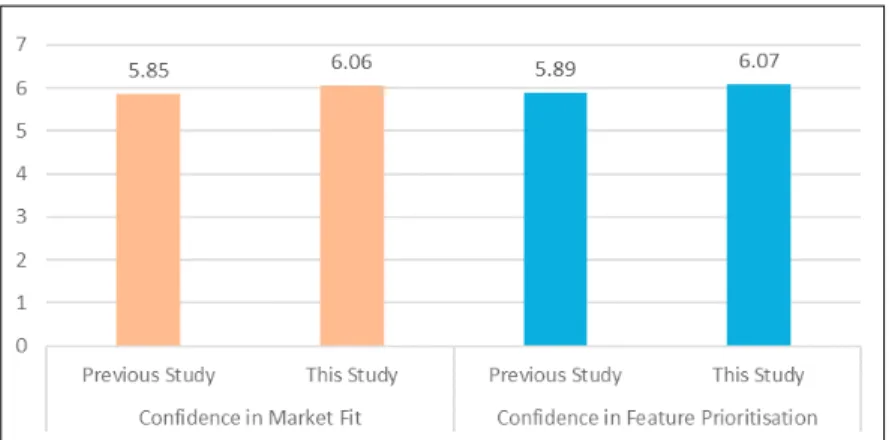
Fig. 1. Comparison to previous Buy a Feature study without levels or mass customization
This data was obtained from a survey following the completion of the project. 78 out of 115 students provided answers to the survey, equating to a response rate of 68%. In both studies, confidence in market-fit and feature prioritization was ranked on a scale of 1-7, 1 being low and 7 being high, and then averaged out across the teams.
5.2. Ideas for exploiting mass customization
Following the VoC and education on mass customization, 17 of the 28 teams considered implementing some type of customization in their final product. As some teams had multiple ideas for offering customization of their product, there were 20 ideas in total.
5.3. Mass customization in Kano
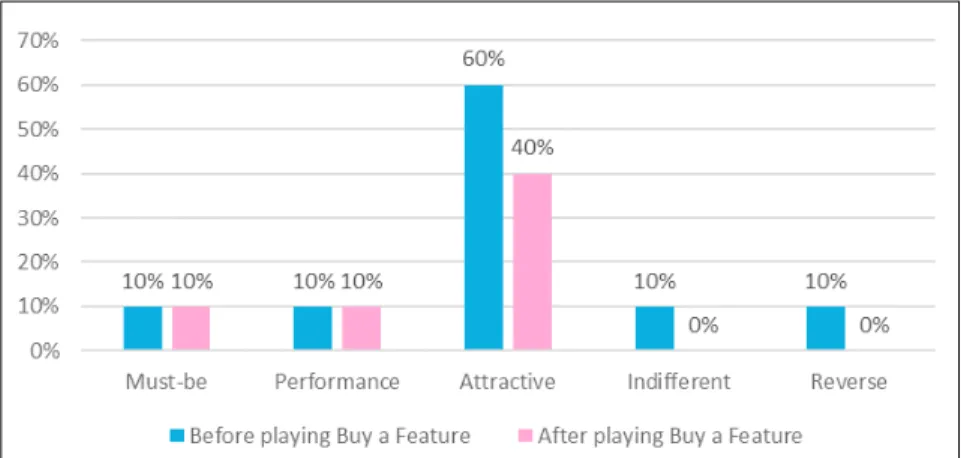
Fig. 2. Mass customization in Kano
Fig. 2 shows how these 20 ideas for customization were categorized according to the Kano Model. This information was obtained by observing the reports from the teams.
engraving or printed graphics and would likely not cost too much. The next level might be moderate customization, such as selecting the colour or size of the various parts, which could likely still be produced by mass production, but with a configure-to-order system. This would cost more. Finally, the highest and most expensive level might allow customers to design their own headbands, which could be produced through 3D printing. By estimating the relative resources required to develop and produce this, the team will know that this feature will be more expensive than the last, and so will carry a higher retail price.
3.4. Buy a Feature
Now, when playing Buy a Feature, certain features will be offered to customers in levels with tiered pricing, and the team can see how they spend their limited budget. The players might decide to purchase maximum level comfort and moderate battery life, and only have enough money left over for the low-level customization, or may even choose to spend this money on a carry case or keep it instead. If customization is important to the players, they will choose to purchase it and sacrifice another feature. Again, the in-game discussions during negotiations will be invaluable here, as players explain their rationale behind purchases, and even offer new ideas for the NPD team. Where the Kano Model categorizes customization as an ‘Attractive’ feature, Buy a Feature might offer it as a single
level purchase. If purchased, it is likely that, during the game, players will have discussed the types of customization they would like to see in the product, and so the game can be played a second time, this time just focusing on these ideas and with a smaller budget.
4.Methodology for testing
The updated methodology was tested with 28 teams of final year NPD students, as they carried a product from concept through to proof-of-concept and production plan. The teams were comprised of students from design, engineering, technology and construction backgrounds and, for the most parts, students worked in teams of 4 with others sharing their background. The students were deemed suitable for testing the methodology as in a few months they will likely be working on product development in companies, and so will be the target audience for the tools discussed in this paper.
The teams had 12 weeks to work on the project and were provided with the proposed methodology in the form of a physical guide, and this included an example of how a pair of headphones would be developed using the methodology. The teams were encouraged to use pre-existing articles and videos online to help them complete the VoC, Kano and HoQ, as well as articles explaining the potential benefits of mass customization and how it could be achieved. They were also provided with instructions on how to carry out Buy a Feature, as well as instructions to read to the players (their potential customers). Finally, they were also provided with play money and a set of
example ‘feature cards’ – cards showing the descriptions and prices for a set of potential features for a pair of headphones. These feature cards would allow the team to play a practice game of Buy a Feature amongst themselves and with their customers, before creating their own feature cards based on their own product concepts.
At the end of the project, teams submitted a report, documenting their process and their results. A survey was
carried out following the project to understand the teams’ confidence in their feature prioritization and their
product’s fit to the market. This would be used to compare results with a previous Buy a Feature study which did not incorporate levels of features or mass customization, to ensure that the changes implemented in this study did not have a negative impact. 12 teams were then randomly selected for semi-structured focus groups, to learn more about their experience with and thoughts on the methodology, and to see how this varied across disciplines and products. Finally, the reports were analyzed to observe how teams used the methodology, to see how it affected their decision-making, particularly in relation to mass customization, and to see again how this varied across disciplines and products.
5.Results
5.1. Comparison to previous study
Fig. 1. Comparison to previous Buy a Feature study without levels or mass customization
This data was obtained from a survey following the completion of the project. 78 out of 115 students provided answers to the survey, equating to a response rate of 68%. In both studies, confidence in market-fit and feature prioritization was ranked on a scale of 1-7, 1 being low and 7 being high, and then averaged out across the teams.
5.2. Ideas for exploiting mass customization
Following the VoC and education on mass customization, 17 of the 28 teams considered implementing some type of customization in their final product. As some teams had multiple ideas for offering customization of their product, there were 20 ideas in total.
5.3. Mass customization in Kano
Fig. 2. Mass customization in Kano
Fig. 2 shows how these 20 ideas for customization were categorized according to the Kano Model. This information was obtained by observing the reports from the teams.
484 Michael O’Sullivan et al. / Procedia Manufacturing 38 (2019) 478–487
Author name / Procedia Manufacturing 00 (2019) 000–000 7 5.4. Customization ideas being pursued following completion of the methodology
Fig. 3. Customization features being pursued following Buy a Feature
Fig. 3 shows the percentage of customization ideas that teams decided to continue developing following completion of the methodology. This information was obtained through focus groups and by studying the reports further to see if customers prioritized customization above other features when playing Buy a Feature.
5.5. Correlating the appropriate production method to the customization offering
100% of the 20 customization ideas had an appropriate production method assigned from their technical requirements in the House of Quality. These were used to aid the teams in estimating development costs and corresponding retail prices for playing Buy a Feature. This information was obtained through focus groups and observations of the reports.
5.6. Teams’ intentions to use the process again in future projects
Finally, teams taking part in the focus groups were asked if they would use this methodology in future projects, outside of an academic setting. 100% of students from engineering, technology and construction backgrounds would use the methodology again, while only 60% of designers said they would.
6.Discussion
6.1. Comparison to previous study
The primary aim of the survey was to calculate each team’s average confidence in their product’s fit to the market,
and their confidence in their feature prioritization. This was done to ensure that integrating mass customization and
the concept of ‘levels’ did not have a negative effect on the methodology already tested by O’Sullivan and Sheahan
[7]. Fig. 1 shows that, not only did the changes not have a negative effect, but there was a slight improvement in
both ratings. This might be due to the integration of ‘levels’ for performance features, as a small number of teams in
the previous study reported confusion when players bought contradicting features, e.g. both ‘wireless’ and ‘wired’
connection were purchased for a custom computer mouse. The addition of levels likely reduced any confusion in a situation like this and resulted in higher values for both ratings.
8 Author name / Procedia Manufacturing 00 (2019) 000–000 6.2. Feedback from teams
The survey also offered individuals the chance to share any opinions they had on Buy a Feature, as well as the overall methodology. Almost all comments were positive, particularly from students with an engineering, technology or construction background. They enjoyed the game and methodology, found them very useful and would use them in future. The only difficulty teams seemed to encounter was if their product was very simple and did not have many features for playing the game, or if the product was cheap and so the ‘play’ money provided was
not of a low enough value, meaning they had to scale up the prices. A good example of this was a team of technology students who designed an adjustable and highly precise powder scooper for high performance athletes with strict diet plans. While the team experienced slight difficulty playing the game due to their low number of features, they claimed that they would definitely use it if working on other product development projects in future,
“especially for bigger products.” And while scaling the price of each of the features made the spending money
arbitrary, the team still found it useful for feature prioritization as players were limited in their purchasing.
Though originally designed for developing physical products, one team developing a nightlife app found the methodology extremely beneficial and used Buy a Feature to help them decide which features of the app would be free and which would be offered in their premium version. Meanwhile, a team developing an app for medication usage found that the game was not applicable as they would not be charging for the app.
6.3. The methodology’s influence on customization ideas
From carrying out focus groups and studying the reports, it is clear that, following the VoC and education on mass customization, the majority of teams considered implementing some form of customization for their product. Some teams brainstormed multiple ideas for implementing some form of it. While a lot of teams only considered the ability for customers to choose their own colours or add their name or logo to the product, others considered the idea of interchangeable parts, or even parametric adjustments. Examples of products which teams believed to have a high potential for customization included items like custom gear knobs or drone bodies. Teams listed multiple customization possibilities for these products, from parametric control of the width and height, to configuration of the shapes and attachments. In total, there were 20 ideas across all the projects on how some element of customization could be implemented and could even be the selling point of the product. This shows how appealing the concept of customization can come across, and how tempting it can be to offer it for a product.
However, of the 20 ideas for customization, teams only elected to follow through with 12 after completing the methodology. Only two ideas were categorized as ‘must-be’ on the Kano Model. One of these was an idea for 3D
printing a customer’s own photographs, and so customization was inherent. Likewise, for the gear knobs, customers
simply had to be able to get the product’s threads matched with the threads of their car’s gear stick, also making this
a ‘must-be.’ Only two ideas were categorized as ‘performance,’ and these related to the level of control the customer had over the customization of a certain feature of the products. In one case, the highest level was purchased over other features during Buy a Feature, and in the other the lowest level was purchased. Two ideas were categorized as
‘reverse’ features on the Kano Model, and so these ideas were not carried through to the HoQ or to Buy a Feature.
Likewise, two ideas were considered to be ‘indifferent’ and so they were dropped at this stage as they would not
affect customer satisfaction. As predicted, the majority of customization ideas were categorized as ‘attractive’ on the
Kano Model. This is likely because people already buy these products without the ability to customize them, so customization would not be a ‘must-be’ or a ‘performance’ feature. Of the 12 ‘attractive’ ideas, only 8 were purchased above other features during Buy a Feature, meaning the rest were not worth pursuing into the product design stage.
Interestingly, despite the idea of levels only being considered useful by the researchers for ‘performance’
features, many of the teams decided to use it for their customization ideas that had been categorized as ‘attractive’
too. In fact, the majority of customization features purchased were actually the lowest level being offered by the team, and usually consisted of either choosing preferred colours or adding a name to the product. One team learned
5.4. Customization ideas being pursued following completion of the methodology
Fig. 3. Customization features being pursued following Buy a Feature
Fig. 3 shows the percentage of customization ideas that teams decided to continue developing following completion of the methodology. This information was obtained through focus groups and by studying the reports further to see if customers prioritized customization above other features when playing Buy a Feature.
5.5. Correlating the appropriate production method to the customization offering
100% of the 20 customization ideas had an appropriate production method assigned from their technical requirements in the House of Quality. These were used to aid the teams in estimating development costs and corresponding retail prices for playing Buy a Feature. This information was obtained through focus groups and observations of the reports.
5.6. Teams’ intentions to use the process again in future projects
Finally, teams taking part in the focus groups were asked if they would use this methodology in future projects, outside of an academic setting. 100% of students from engineering, technology and construction backgrounds would use the methodology again, while only 60% of designers said they would.
6.Discussion
6.1. Comparison to previous study
The primary aim of the survey was to calculate each team’s average confidence in their product’s fit to the market,
and their confidence in their feature prioritization. This was done to ensure that integrating mass customization and
the concept of ‘levels’ did not have a negative effect on the methodology already tested by O’Sullivan and Sheahan
[7]. Fig. 1 shows that, not only did the changes not have a negative effect, but there was a slight improvement in
both ratings. This might be due to the integration of ‘levels’ for performance features, as a small number of teams in
the previous study reported confusion when players bought contradicting features, e.g. both ‘wireless’ and ‘wired’
connection were purchased for a custom computer mouse. The addition of levels likely reduced any confusion in a situation like this and resulted in higher values for both ratings.
6.2. Feedback from teams
The survey also offered individuals the chance to share any opinions they had on Buy a Feature, as well as the overall methodology. Almost all comments were positive, particularly from students with an engineering, technology or construction background. They enjoyed the game and methodology, found them very useful and would use them in future. The only difficulty teams seemed to encounter was if their product was very simple and did not have many features for playing the game, or if the product was cheap and so the ‘play’ money provided was
not of a low enough value, meaning they had to scale up the prices. A good example of this was a team of technology students who designed an adjustable and highly precise powder scooper for high performance athletes with strict diet plans. While the team experienced slight difficulty playing the game due to their low number of features, they claimed that they would definitely use it if working on other product development projects in future,
“especially for bigger products.” And while scaling the price of each of the features made the spending money
arbitrary, the team still found it useful for feature prioritization as players were limited in their purchasing.
Though originally designed for developing physical products, one team developing a nightlife app found the methodology extremely beneficial and used Buy a Feature to help them decide which features of the app would be free and which would be offered in their premium version. Meanwhile, a team developing an app for medication usage found that the game was not applicable as they would not be charging for the app.
6.3. The methodology’s influence on customization ideas
From carrying out focus groups and studying the reports, it is clear that, following the VoC and education on mass customization, the majority of teams considered implementing some form of customization for their product. Some teams brainstormed multiple ideas for implementing some form of it. While a lot of teams only considered the ability for customers to choose their own colours or add their name or logo to the product, others considered the idea of interchangeable parts, or even parametric adjustments. Examples of products which teams believed to have a high potential for customization included items like custom gear knobs or drone bodies. Teams listed multiple customization possibilities for these products, from parametric control of the width and height, to configuration of the shapes and attachments. In total, there were 20 ideas across all the projects on how some element of customization could be implemented and could even be the selling point of the product. This shows how appealing the concept of customization can come across, and how tempting it can be to offer it for a product.
However, of the 20 ideas for customization, teams only elected to follow through with 12 after completing the methodology. Only two ideas were categorized as ‘must-be’ on the Kano Model. One of these was an idea for 3D
printing a customer’s own photographs, and so customization was inherent. Likewise, for the gear knobs, customers
simply had to be able to get the product’s threads matched with the threads of their car’s gear stick, also making this
a ‘must-be.’ Only two ideas were categorized as ‘performance,’ and these related to the level of control the customer had over the customization of a certain feature of the products. In one case, the highest level was purchased over other features during Buy a Feature, and in the other the lowest level was purchased. Two ideas were categorized as
‘reverse’ features on the Kano Model, and so these ideas were not carried through to the HoQ or to Buy a Feature.
Likewise, two ideas were considered to be ‘indifferent’ and so they were dropped at this stage as they would not
affect customer satisfaction. As predicted, the majority of customization ideas were categorized as ‘attractive’ on the
Kano Model. This is likely because people already buy these products without the ability to customize them, so customization would not be a ‘must-be’ or a ‘performance’ feature. Of the 12 ‘attractive’ ideas, only 8 were purchased above other features during Buy a Feature, meaning the rest were not worth pursuing into the product design stage.
Interestingly, despite the idea of levels only being considered useful by the researchers for ‘performance’
features, many of the teams decided to use it for their customization ideas that had been categorized as ‘attractive’
too. In fact, the majority of customization features purchased were actually the lowest level being offered by the team, and usually consisted of either choosing preferred colours or adding a name to the product. One team learned
486 Michael O’Sullivan et al. / Procedia Manufacturing 38 (2019) 478–487
Author name / Procedia Manufacturing 00 (2019) 000–000 9
from customers during the in-game discussion that having their names on the product would be useful, but they would be content if this were simply done with stickers, rather than engraving or printed graphics. In some cases, customers purchased their preferred features and had money left over to spend on customization, but decided to keep the money instead. Teams found this very interesting and useful, as it is easy for people to say that they would like a certain feature, or even all features, but when they have a limited budget, it really forces them to think about what’s
important and how they would act if purchasing the product for real.
6.4. Correlating production methods for customization ideas
Where customization was included in the game, the majority of teams were confident about their pricing of it, as it had been based off the HoQ and by looking at similar products on the market. This was possible thanks to the literature provided on mass customization when originally brainstorming the ideas. When estimating development costs and assigning corresponding retail prices for features, some teams also chose to use the ‘t-shirt sizing’ or ‘relative resource’ method. Here, teams would assign a price to one feature about which they were confident on its cost. This might be considered a ‘medium’ size t-shirt and might cost, say, $5. A feature that would be relatively
more costly to produce might be considered a ‘large’ and might cost $10, while a ‘small’ might cost $2. Overall,
teams showed a strong understanding of how parts would be produced and the costs associated. For example, one team decided they would use injection moulding for producing the product but could use 3D printed inserts to provide a customizable element.
6.5. Experience with the methodology across disciplines
Overall, the teams enjoyed the whole methodology and claim they would use it again in future product development projects, both inside and outside of a university setting. This was true for the engineering, technology and construction students in particular, as they had never completed a product development project before. Meanwhile, design students were slightly less keen on the methodology. These students have completed numerous product development projects and have spent 4 years learning their own design methods, so all of the tools used in this methodology were new to them, with the exception of the VoC. While some design students really appreciated the Kano Model and admitted to understanding the benefits of tools like the HoQ, many of them said they struggled with elements of these tools and would rather use their own design process. However, many of them appreciated the effectiveness of Buy a Feature and said that they would normally just prioritize features based on instinct, but might be inclined to use the game in future projects instead. Interestingly, the non-designers scored higher than the designers when presenting their projects in a peer-review.
7.Conclusion, limitations and future work
Overall, the experiment was a strong success. It highlighted how easy it is for product development teams to believe that offering customization is a good idea and that it might even be the selling point for their product. However, once critical features had been set aside, only 55% of customization features were purchased above other non-critical features by potential customers. Furthermore, in the majority of cases where customization was purchased above other features, it was the lowest level of customization being offered, and was often just purchased because players had money left over. This result reflects the many companies that set out to offer custom products before realizing that the market is not willing to pay the premium price for them. While people might say that they would like customization or other features, their opinion changes when the product is put in front of them and they have a limited amount of money. The methodology proved effective in reducing the risk of developing features that people will not pay for, and prioritizing the ones they will pay for. It also proved useful for helping teams to assign manufacturing plans to execute on their customization offerings, and to do this from a very early stage in the NPD cycle. All teams with an engineering, technology or construction background enjoyed the methodology and would use it again in future NPD efforts, and while many designers said they would rather use the method they are used to, many of them believe they will integrate Buy a Feature into this.
10 Author name / Procedia Manufacturing 00 (2019) 000–000
One limitation to the study would be the fact that teams had a limited time frame of 12 weeks to develop the product. If teams could spend more time on each part they would likely have produced better work, but this could also be representative of the time constraints and rush experienced by NPD teams in industry today. Another limitation would be the fact that teams had to complete the project as part of a course module, and so might have only completed tasks for this sake. Future studies will test an updated version of the methodology with real-world projects and start-ups. The updated version will take all feedback into account and aim to create a methodology that works for all types of product development – physical products, services and digital applications.
References
[1] Franke, N., Keinz, P. and Steger, C.J., 2009. Testing the value of customization: when do customers really prefer products tailored to their preferences?. Journal of marketing, 73(5), pp.103-121.
[2] Da Silveira, G., Borenstein, D. and Fogliatto, F.S., 2001. Mass customization: Literature review and research directions. International journal of production economics, 72(1), pp.1-13.
[3] Fogliatto, F.S., Da Silveira, G.J. and Borenstein, D., 2012. The mass customization decade: An updated review of the literature. International Journal of production economics, 138(1), pp.14-25.
[4] M. Zwilling 2013, A New Era For Entrepreneurs And Startups Has Begun, Forbes, viewed 13 February 2019, https://www.forbes.com/sites/martinzwilling/2013/12/25/a-new-era-for-entrepreneurs-and-startups-has-begun/#345639834bd1>
[5] Walcher, D. and Piller, F.T., 2012. The customization 500: an international benchmark study on mass customization and personalization in consumer e-commerce. ICON Group International.
[6] Piller, F 2013, Why do customization startups fail?, Quora, accessed 21 February 2019, https://www.quora.com/Why-do-customization-startups-fail
[7] O’Sullivan, M.N. and Sheahan, C. (2018) ‘Using Serious Games to Guide Commercial Success from the Fuzzy Front-End’,
European Conference on Innovation and Entrepreneurship. University of Aveiro, 20-21 September, pp.1081-1084.
[8] Thia, C.W., Chai, K.H., Bauly, J. and Xin, Y., 2005. An exploratory study of the use of quality tools and techniques in product development. The TQM Magazine, 17(5), pp.406-424.
[9] Sauerwein, E., Bailom, F., Matzler, K. and Hinterhuber, H.H., 1996, February. The Kano model: How to delight your customers. In International Working Seminar on Production Economics (Vol. 1, No. 4, pp. 313-327).
[10] Akao, Y., King, B. and Mazur, G.H., 1990. Quality function deployment: integrating customer requirements into product design (Vol. 21). Cambridge, MA: Productivity press.
[11] Hohmann, L., 2006. Innovation games: creating breakthrough products through collaborative play. Pearson Education. [12] J. H. Gilmore and B. J. Pine II 1997, The Four Faces of Mass Customization, Harvard Business Review, viewed 13 February
2019, < https://hbr.org/1997/01/the-four-faces-of-mass-customization.
This project has received funding from the European Union’s Horizon 2020 research and innovation programme