808
Role of SMAC Stack on Competitive Advantage and Innovation with
Supply Chain Performance
P. Verma ([email protected])
V. Kumar ([email protected])
R.R.K. Sharma ([email protected]) Indian Institute of Technology, India Abstract
The paper investigates the relationship between SMAC capabilities in productivity, innovation and competitive advantage for supply chain performance. This paper shows how SMAC technologies insight into business issues to increase supply chain performances. So, the main objective is to develop a model to transform the organization into sustainable businesses. More specifically, authors developed a theoretical framework which finds that SMAC (Social media, Mobile, Analytics, and Cloud) capabilities have a positive impact on supply chain performance in terms of productivity, competitive advantage, and innovation. The paper draws from literature and experiential knowledge of other authors with the perspective of SMAC technologies in supply chain management to address the objective of the paper.
809
INTRODUCTION
SMAC is the fifth wave of Information Technology Architecture and a new concept of IT model that blends Social, Mobile, Analytics and Cloud technologies. Social, Mobility, Analytics and Cloud (SMAC) are individual technologies and platforms which have risen during the past few years and have shown immense growth (Gohel & Gondalia, 2014). It is the newest version of ICT (Information & Communication Technology).
According to Jack &Samuel (2006), ICT is one of the most important enablers of effective supply chain management. ICT tools enhance the organizational efficiency and effectiveness (Cohen et al., 2002). Therefore, ICT tools help to execute activities faster, support autonomous decision-making processes, and enable distributive operations (Huang & Nof, 1999). According to a survey by IDC (International Data Corporation), it estimates that the worldwide spending on ICT spending will reach the US$5 trillion mark by 2020 with 80% of this driven by this intersection of SMAC technologies (Nair, 2014). In the ICT implementation in anorganization, there are every process and techniques run independently and to some extent, they transform the organization for achieving their goals but when we brought these technologies together the impact is profound and offers organizations the opportunity to shift from the traditional industrial models to new efficient digital ways of working. SMAC is one of the concepts that integrates all separate platform and technologies in business. According to Faruqui et al. (2015), the use of social, analytics and mobile, cloud technologies is already enabling progressive enterprises to work in highly connected, collaborative and real-time ways. The effect of SMAC is positive in most of the industries and firms viz. educational, e-governance, manufacturing, and onlineservices etc. According to Nair (2014), the SMAC effect and fusing of these technologies can be leveraged to render supply chain to be more adaptive, resilient, and responsive.
Although, information and communication technologies (ICT) are already used independently in supply chain industry and playing a great role in improving their performance, but recently, the supply chain industry was criticized for lagging behind other industries in their use of social media, and mobility etc. (TodaysTrucking, 2010). Consequently, todayin aglobal environment, industries are trying to implement SMAC technologies in an integrated form because the SMAC Stack is becoming an essential technology toolkit for enterprises and represents the next wave for driving higher customer engagement and growth opportunities. Based on these finding, we draw an attention towards
810
the SMAC effect on supply chain industry and how its influence on productivity, competitive advantage, and innovation. SMAC can impact strategies for supply chain planning and execution. From the SMAC stack, social and mobile technologies facilitating improved communication and collaboration; while analytics and cloud changing the enterprise architecture, and brings supply chain transparency, flexibility & visibility respectively.
The main objective is to develop a model to transform supply chain industry into asustainable business. The model will take into consideration the opportunities offered by SMAC technologies for an efficient & effective operation of the supply chain to achieve productivity, innovation, and competitive advantage. So, the main research objectives of the present paper are:
To understand the SMAC stack
To identify the relationship between SMAC technologies and supply chain industry
To outline further research directions
Now, the central research question is that ״How does SMAC stack improve supply chain productivity, competitiveness, and innovation? ״ . In this paper, section 2 gives a brief review of existing literature on SMAC stack and Supply chain management. Section 3 relates research framework and hypotheses development with past literature. Section 4 briefly outlines the discussion and conclusions followed by the limitations of the study.
LITERATURE REVIEW
This section provides an exhaustive review of the relevant literature. First, it provides an insight about SMAC. Next, it addresses the supply chain performance in terms of achieving competitive advantage, innovation, and opportunities. Finally, it identifies the relationship between them.
SMAC (Social, Mobility, Analytics, and Cloud)
The subject of SMAC has been dominating debates across the world over the last 12–24 months (ASSOCHAM*, 2014). The four pillars of SMAC technologies are social media, mobility, analytics and cloud computing (KPMG**, 2013). In other words, Social, Mobility, Analytics, and Cloud, abbreviated SMAC, are separate platforms with technologies that evolved during last few years and have shown enormous enhancement. Moreover, each
811
SMAC stack technology has an inherently unique quality that differentiates it and also complements other technologies (ASSOCHAM, 2014).
This stack is one of the most recent trends for both consumer and enterprise realization within digital media, communications, applications, content, and commerce. Some experts in the field have predicted that by 2020 SMAC will account for $5 trillion of the total spending by customers. SMAC is the fifth wave of IT model in the evolution of IT industry (see in Figure 1). SMAC is not only helping develop new software platforms to address numerous diverse issues from revenue generation to providing efficient customer service but also transforming the way business are done (Faruqui et al., 2015).
ASSOCHAM*Associated Chambers of Commerce and Industry of India;
KPMG**Klynveld Peat Marwick Goerdeler
Figure 1: Evolution of SMAC in IT industry
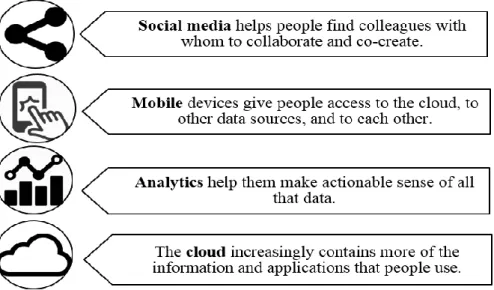
Social Media: Social media strategy has become a must for all businesses. Social media allows people to connect and interact without any delay and interfaces (Babu & Kumar, 2014). In other words, social media refers to software tool used by people to collaborate, communicate, and build community with their friends online. Social media related software tools such as Facebook, YouTube, Twitter, and Foursquare. In addition, social media can refer to technologies that facilitate social interaction and development of virtual “relationships” (O’Leary, 2011). It also enhances the rapid sharing of knowledge, ideas, and information over the social networks that can ultimately conducive to collaboration and information distribution across a business (Capgemini Consulting, 2013).
812
Mobility: Mobility refers to communication beyond limitations of physical, static location or devices. The basic goal of mobile web is to facilitate users to have a closer look to businesses and this gives the opportunities to the businesses to interact with their customers in much more relevant ways (Dewan& Jena, 2014). The growth in smart devices is bringing about an era of ubiquitous connectivity.
Emerging technologies, such as mobile payments, peer-to-peer payments, and mobile apps, are creating a mobile ecosystem. In the technological era, most of the people use mobile devices to complete each and every regular task with the help of mobile apps etc. Adding on this, according to thesurvey, the next five years promise to continue mobiletrends (ASSOCHAM, 2014). Mobility is also helping in fare management, payment solutions, distribution, and logistics.
Analytics: Business Analytics (BA) refers to the skills, applications and practices for continuous iterative investigation of past business performance and trends to gain business insight and drive corporate planning (Faruqui et al., 2015). It also refers to the utilization of raw data, inference rules, and analysis models to provide decision makers to perform necessary steps to improve their day-to-day or milestone activities. In addition, analytics (Big Data) helps gain meaningful insights from the information, facilitating informed decision making (Dinodia Capital Advisors, 2013). This Business analytics works based on historical data for developing new insights of business performance.
813
Cloud Computing: Cloud is a general model for enabling on-demand network and a convenient way to access a pool of computing resources which includes servers, networks, applications, and services. In other words, cloud technologies have enabled all technology resources to be connected through a utility model to run effectively in a cost-optimized manner (Dinodia Capital Advisors, 2013). Moreover, in a cloud computing, there are acollection of remote servers and software networks that allow different kinds of data sources be uploaded for real-time processing to generate computing results without the need to store processed data in the cloud. It can be classified as public, private or hybrid (Aichner& Jacob, 2015; and Qusay, 2011).
Supply Chain and SMAC Stack
The supply chain is the widely researched area between the academicians and practitioners. Supply chain management is an integrative philosophy to manage the total flow of a distribution channel from supplier to the ultimate user. According to Christopher (1998) supply chain as the network of organizations that are involved, through upstream and downstream linkages, in the different processes and activities that produce value in the form of products and services in the hands of the ultimate customer.
In emerging markets, infrastructure is developing steadily, and technologically equipped labor force is getting ready. In order to survive in competition, it is imperative for firms to adapt thetechnology for speeding up their processes, lower wastage, increase efficiency and ensure better predictability. Adding on this, Tripathy et al. (2016) analyzed the structural relations among information technology (IT), logistic effectiveness, operational effectiveness, customer relationship, supplier relationship and SCM competitive advantage in their research. Moreover, the use of information technology (IT) is considered a prerequisite for the effective control of today’s complex supply chains. Information and communication technologies (ICT) are one of the most important enablers of effective supply chain management (Jack &Samuel, 2006). Today's, in the intense competitive environment, supply chain industry must integrate with ICT usage, applications, and deployments toward achieving the organizational goals.
According to Nair (2014), ICT adoption and usage across the supply chains has become a performance enabler and determinant of competitive advantage for manage corporations. There are various system & technologies viz. ERP, SCM software packages and solutions,
814
EDI, bar codes, RFID, inventory & warehouse management systems, and transportation which provides better agility, collaboration, coordination, decision making, and visibility of enterprises. Apart from these technologies, there are other some process & systems must be implemented or integrated with the enterprise i.e. social media, mobility, analytics, and cloud. Now, ICT shifts towards SMAC technologies which are thefifth wave of information technology (IT) in this era organization achieved of explosive growth. In the SMAC stack, all of the technologies are integrated into supply chain industry. SMAC technologies have a greater influence on supply chain performance. SMAC technologies facilitate the fundamental methodology of how business managing technology and fulfills the demands and responsibilities which companies place on their C- level officers (Dewan& Jena, 2014). Each components SMAC i.e. social, mobility, analytics, and cloud are important for thesupply chain. These components act as a pillar of any building which supports the overall functionally of the organization.
IT implementation in supply chain industry for transaction processing, supply chain planning & collaboration, order tracking and delivery coordination (Auramo et al., 2005). SMAC presents exceptional opportunities to business productivity. It alsohaspotential benefits for supply chain management in term of customer engagement, enterprise workflow, collaboration, and decision- making. Emerging ICT tools like software agents, web services, cloud computing, analytics software, and virtual supply chains are being deployed to aid various operations for supply chain planning and execution (Nair, 2014).
815
THEORETICAL FRAMEWORK AND QUESTIONS
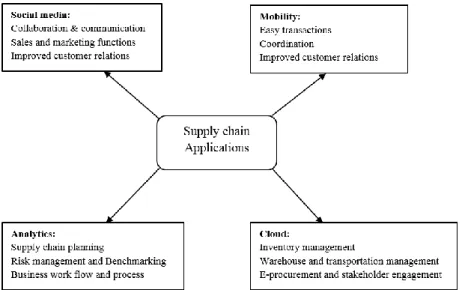
Based on the literature review, a research framework is developed to examine the relationships between SMAC technologies and supply chains. The framework shows in figure 4. The model suggests that not only individual platforms of SMAC is essential for supply chain innovation, productivity, and competitiveness, but also an integrated effort is critical to supply chain in the technological era. Based on the intentions to investigate and analyze the relationships between SMAC technologies and supply chains; this research aims to answer the following questions:
Are there any effects of SMAC stack on thesupply chain?
How SMAC stack improve supply chain productivity, competitiveness, and innovation?
Figure 4: Theoretical Framework
THEORY AND HYPOTHESIS DEVELOPMENT
Based on the theory and relationships from the literature, we develop a set of propositions that reflect relationships between SMAC and supply chains.
SMAC and Supply Chain Innovation
Innovation can greatly impact supply chain performance. Supply chain innovation is important for companies of all sizes. Supply chain innovation is all about the way a company applies its assets, operating resources, and capabilities to develop new ways to satisfy customer needs (Hansen, 2006).
SMAC presents exceptional opportunities to business innovations (Dewan& Jena, 2014). SMAC (Social, Mobile, Analytics and Cloud) is an integration of four technologies that have
816
become the drivers of innovation in businesses at present. With the supporting to this statement, Billington (2016) says that Social, Mobile, Cloud and Analytics (SMAC) technologies are redefining the pace and focus of product innovation, enabling almost real-time insight into market trends and customer preferences. This observation can aid enterprise to enhance and innovate existing product lines, as well as develop new products that are more directly targeted to customer needs. SMAC speeds up the innovation process by enabling connectivity to the user, the product, and market demands.
If we consider the individual effect of SMAC stack on supply chain innovation, then we already discussed in theliterature that social media and mobility leads to improve customer relations & customer preferences, communication, collaboration, and speed up transactions. On the supporting of this statement, Billington (2016) focus in his article that the combination of social media and data analytics can deliver insight into customer requirements and drive product innovation. Moreover, according to Thecka (2014) the power of cloud computing to foster innovations and productivity is now accepted by all stakeholders.
In addition, SMAC speeds up the innovation process by enabling connectivity to the user, the product, and market demands. From the above discussions and the literature, the following proposition is posited:
Proposition 1: SMAC technologies have apositive relationship with innovation and
creativity.
SMAC and Supply Chain Competitive advantage
To ensure a viable future, the entire supply chain ecosystem must transform to deliver competitive advantage, which means manufacturers need to re-tool and re-skill and should look at using an essential toolkit of new technologies, called the SMAC Stack (Manufacture Monthly, 2016). This system is based on the “customer focus” and includes all individual stack (social, mobile, analytics, and cloud) to help supplier and manufacturer for higher customer engagement and growth opportunities.
Nowadays, firms have also started using social media for sales and marketing functions (Thecka, 2014). Hence, data generated by customers which can be used to change processes, materials, and approaches. Social media may be seen as supplementing or replacing more
817
traditional technologies (McAfee, 2006), e.g., mail, email or telephone. Social media may take information from a one-to-one environment and disclose the information to larger numbers of people (O’Leary, 2011). So, the use social media information and data organization fulfills customer’s demand and customer satisfaction which leads to competitiveness in supply chains. In the second aspect of SMAC is mobility, the increasing availability of mobile apps lets manufacturers gather the information they need to make faster and better decisions.
Moreover, in the perspective of Analytics, every year in an organization, generated billions of gigabytes of data. Consequently, the organization has a large amount of historical data, sometimes the organization does not have an idea what to do with such data. But, when the enterprise uses this data in an optimized way, can achieve an unbeatable competitive advantage. From the above discussions and the literature, the following proposition is posited:
Proposition 2: SMAC technologies have positive relationships with competitiveness
SMAC and Supply Chain Productivity
In the technological era, there are many firms or enterprise that enhance or speedup the business process by use of information & communication technology (ICT). For instance, IBM accelerates productivity with SMAC technologies.
Combining SMAC technologies into an integrated approach transforms a supply chain ability to understand and meet its customers’ needs. SMAC technologies help in inventory planning, optimization &management, customer relationships management, risk management, collaboration, demand planning and forecasting, sales and distribution planning, and transportation management in the field of supply chain management. According to
Josefowicz (2013), the SMAC architecture blends social, mobility, big data analytics, and Cloud technologies... emerging to catalyze organizational productivity and business competitiveness.
All four pillars of SMAC bundle are conducive to enhance the supply chain productivity. Like social media interactions have improved the sales and distribution channels as well as inventory & warehouse management; mobility makes process and applications can be used
818
anytime and anywhere. According to McKinsey CIO, survey tablets could replace up to 30% of laptops. Even cloud-based applications also support mobility by enabling users to access critical enterprise resources. This reachability is going to have a great impact in different kind of industries as telecom, retail, and supply chain. Through the mobility, theorganization will be able to minimize the cost and improve their efficiency.
Moreover, cloud computing used in demand forecasting, e-procurement, and inventory management in the field of supply chain. This application makes supply chain flexible, visible and transparent. In addition, Big data and business analytics is also a playing a greater role in supply chain productivity because it helps in building fresh perspectives and new insights into the business performance using data, statistical methods, quantitative analysis, and predictive modeling. Business analytics is estimated to be an industry worth US $50 billion by 2016 (Nair, 2015) Business analytics has potential to impact wide-ranging improvement in SCM both at the strategic and operational levels thereby improving operational efficiency and creating customer value (Nair, 2014).
From the above discussions and the literature, the following three propositions are posited:
Proposition 3: SMAC technologies enhance the supply chain productivity.
CONCLUSIONS
SMAC is emerging as an effective technology for business enterprises for improving their productivity, and innovation as well as competitive advantage over their rivals. The promise of SMAC is that we will be predicting the future (Analytics), the results will be available anywhere (Mobile), everyone will be networked (Social), and at a fraction of the cost (Cloud). Gartner predicts that by 2017, SMACachieves great position among the enterprises (Miles, 2014). Based on such strong prediction and literature review, we are trying to develop an understanding that how SMAC stack is essential for supply chain industry.
REFERENCES
KPMG (2013), “The SMAC Code: Embracing new technologies for future business”, available at
http://kpmg.com/in (accessed 21 August 2016).
Dewan, B., & Jena, S. R. (2014, December). The state-of-the-art of Social, Mobility, Analytics and Cloud Computing an empirical analysis. In High-Performance Computing and Applications (ICHPCA), 2014 International Conference on (pp. 1-6). IEEE.
819
Aichner, T. and Jacob, F. (March 2015). "Measuring the Degree of Corporate Social Media Use". International Journal of Market Research 57 (2): 257–275.
Nair, P. R. (2014). The SMAC effect towards adaptive supply chain management. CSI Comm, 38(2), 31-33. Qusay, H. (2011). "Demystifying Cloud Computing". The Journal of Defense Software Engineering (CrossTalk) 2011 (Jan/Feb): 16–21. Retrieved 15 August 2016.
Auramo, Jaana,;JouniKauremaa and Kari Tanskanen (2005). “Benefits of IT in Supply Chain Management: An explorative study of progressive companies”, International Journal of Physical Distribution and Logistics Management 2005; 35,2; Academic Research Library pg. 82
Huang, C.Y. and Nof, S. (1999), “Enterprise agility: a view from the PRISM lab”, International Journal of Agile Management Systems, Vol. 1.
Cohen, G., Salomon, I. and Nijkamp, P. (2002), “Information-communication technology (ICT) and transport: does knowledge underpin policy?”, Telecommunications Policy, Vol. 26.
Jack R. M. & Samuel J. M. Jr. (2006). Project Management a Managerial Approach, 6th Edition, John Wiley & Sons, Inc.
Faruqui, S., Agarwal, A., Chauhan, V. S., &Iyer, E. K. (2015). Multi-sector Comparison of SMAC Adoption to improve Customer Relations and Engagement, International Journal of Management Research & Business Strategy.
Thecka, S. (2014, May). Transforming fragmented industry into sustainable businesses with SMAC technologies. In IST-Africa Conference Proceedings, 2014 (pp. 1-9). IEEE.
McAfee, A., “Enterprise 2.0: The Dawn of Emergent Collaboration,” MIT Sloan Management Review, Spring 2006, pp. 21-28.
Josefowicz, M. (2013) "Hot topics: For Insurers: Social, Mobile, Analytics, Big Data, Cloud and DigitaF', Novarica Insurance Technology Research Council Report, pp. 1-13.
Miles, T (2014). SMAC in the Middle of Supply Chain Change, supply chain blog. Published October 6th, 2014 Accessed from https://blog.kinaxis.com/2014/10/smac-middle-supply-chain-change/ Accessed at 22 Aug 16.
Billington., R (2015). Manufacturing CIOs: Don't Ignore SMAC for Innovation, Accessed from http://www.industryweek.com/product-development/manufacturing-cios-dont-ignore-smac-innovation Accessed in 15 Sep 2016.
Manufacturer Monthly (2016). How Manufacturers Can Stay Competitive With the SMAC Stack.
http://www.manmonthly.com.au/news/manufacturers-can-stay-competitive-smac-stack/
Gohel, H and Gondalia, V (Oct 2014). Role of SMAC Technologies in E-Governance Agility. CSI Communications, pp. 7-9.
Babu, A.B.KarthickAnand and Kumar, D.Maghesh (Oct 2014). SMAC for Education pp. 10. CSI Communications.
820
Dinodia Capital Advisors (June 2013). SOCIAL, MOBILE, ANALYTICS & CLOUD, The game changers for the Indian IT industry.
20. O’Leary, D.E. (2011). The use of Social media in the Supply Chain: Survey and Extensions, Article in Intelligent Systems in Accounting Finance & Management, DOI: 10.1002/isaf.327.
ASSOCHAM (2014). SMAC — the next growth driver for SMEs in India, Ernst & Young LLP. The Knowledge Chamber of Corporate India
Capgemini Consulting (2013) Accelerate Your Transformation: Social, Mobile, and Analytics in the Cloud. Today’s Trucking, “Supply Chain Lagging in Use of Social Media,” 15/08/2016
http://www.todaystrucking.com/news.cfm?intDocID=23903