Concordia University St. Paul Concordia University St. Paul
DigitalCommons@CSP
DigitalCommons@CSP
CUP Ed.D. Dissertations Concordia University Portland Graduate Research
Spring 3-30-2020
The Use of Digital Applications and Websites in Completing Math
The Use of Digital Applications and Websites in Completing Math
Assignments
Assignments
Ronna WilliamsConcordia University - Portland, [email protected]
Follow this and additional works at: https://digitalcommons.csp.edu/cup_commons_grad_edd Part of the Applied Mathematics Commons, and the Higher Education Commons
Recommended Citation Recommended Citation
Williams, R. (2020). The Use of Digital Applications and Websites in Completing Math Assignments (Thesis, Concordia University, St. Paul). Retrieved from
https://digitalcommons.csp.edu/cup_commons_grad_edd/452
This Dissertation is brought to you for free and open access by the Concordia University Portland Graduate Research at DigitalCommons@CSP. It has been accepted for inclusion in CUP Ed.D. Dissertations by an authorized
Concordia University - Portland Concordia University - Portland
CU Commons
CU Commons
Ed.D. Dissertations Graduate Theses & Dissertations
Spring 3-30-2020
The Use of Digital Applications and Websites in Completing Math
The Use of Digital Applications and Websites in Completing Math
Assignments
Assignments
Ronna WilliamsConcordia University - Portland
Follow this and additional works at: https://commons.cu-portland.edu/edudissertations Part of the Applied Mathematics Commons, and the Higher Education Commons
CU Commons Citation CU Commons Citation
Williams, Ronna, "The Use of Digital Applications and Websites in Completing Math Assignments" (2020). Ed.D. Dissertations. 445.
https://commons.cu-portland.edu/edudissertations/445
This Open Access Dissertation is brought to you for free and open access by the Graduate Theses & Dissertations at CU Commons. It has been accepted for inclusion in Ed.D. Dissertations by an authorized administrator of CU
Concordia University–Portland College of Education Doctorate of Education Program
WE, THE UNDERSIGNED MEMBERS OF THE DISSERTATION COMMITTEE CERTIFY THAT WE HAVE READ AND APPROVE THE DISSERTATION OF
Ronna Williams
CANDIDATE FOR THE DEGREE OF DOCTOR OF EDUCATION
Belle Booker-Zorigian, Ph.D., Faculty Chair Dissertation Committee Angelo Letizia, Ph.D., Content Specialist
The Use of Digital Applications and Websites in Completing Math Assignments
Ronna Williams
Concordia University–Portland College of Education
Dissertation submitted to the Faculty of the College of Education in partial fulfillment of the requirements for the degree of
Doctor of Education in Higher Education
Belle Booker-Zorigian, Ph.D., Faculty Chair Dissertation Committee Angelo Letizia, Ph.D., Content Specialist
Megan Cavalier, Ph.D., Content Reader
Concordia University–Portland
Abstract
There are is a large assortment of digital applications and websites available for students to use in completing their math assignments. The problem is how and why they are using these applications. This study looked at the different applications and websites used by students, including Slader, Wolfram Alpha, Symbolab, Desmos, and Photomath. The study then explored why students used these applications and websites. The idea of plagiarism in mathematics was presented to the students in this study. The review of the literature included the concepts of plagiarism and cheating and illustrated that students have a history of using tools for
accomplishing tasks. Nine students were interviewed by implementing a phenomenological approach. The themes that developed from these interviews included confidence building, learning, and easy access. Students stated that they planned to continue using digital applications and websites to complete their math assignments.
Keywords: math, Slader,Wolfram Alpha, Symbolab, Desmos, Photomath, plagiarism, cheating, confidence building, digital applications
Dedication
I dedicate this paper to my family and my students. These are the people who inspire me to continue teaching and to reach new heights, once thought to be unattainable.
Acknowledgments
I would like to extend my deepest gratitude to my dissertation committee faculty chair Dr. Belle Booker-Zorigan for her invaluable patience and support through this long process. I would also like to acknowledge the assistance I received from Dr. Angelo Letizia and Dr. Megan Cavalier, my committee members. From these two individuals, I learned how to present my data and how to research more effectively.
I also want to thank my friends and my family. My friends have supported me by asking how things were going. Even when it seemed dull, they were willing to listen to my challenges. My children, Eric and Julie, were supportive as I struggled with the frustrations of completing this process. My sister, Randa, has never failed to remind me how proud she was of my accomplishments. Finally, my last thank you goes to my husband, John. I would never have embarked on this journey without him. The list he gave me is now complete.
Table of Contents Abstract ... ii Dedication ... iii Acknowledgements ... iv List of Tables ...x List of Figures ... xi Chapter 1: Introduction ...1
Introduction to the Problem ...1
Background, Context, History, and Conceptual Framework for the Problem ...2
Statement of the Problem ...5
Purpose of the Study ...6
Research Questions ...6
Rationale, Relevance, and Significance of the Study ...6
Definition of Terms...8
Assumptions, Delimitations, and Limitations ...10
Summary of Chapter 1 ...10
Chapter 2: Literature Review ...12
Introduction ...12
The Context ...13
The Significance ...14
The Problem Statement ...14
The Organization ...16
Social Constructivism: Conceptual Framework ...16
Social Cognitive Theory: Theoretical Framework ...20
Applying Both Lenses to Academic Dishonesty ...23
Literature Review...25
Introduction ...25
Seminal Studies ...25
Academic Dishonesty: Who, Why, and How it Happens ...27
Social Groups, Academic Groups, and Other Activities ...30
Neutralizing Behaviors ...31
Plagiarizing in Mathematics ...32
Review of Methods ...34
Methodology Issues ...37
Synthesis of Research Findings ...40
Critique of Previous Research ...44
Chapter 2 Summary ...47
Chapter 3: Methodology ...49
Research Questions ...50
Purpose and Design...51
Methodology ...51
Research Population and Sampling Method ...53
Instrumentation ...55
Interview Questions ...57
Identification of Attributes ...61
Participants ...61
Plagarisim ...61
Reserach ...61
Analysis...62
Data Analysis Procedures ...63
Limitations and Delimitations of the Research Design ...68
Validation ...69
Expected Findings ...70
Expected Findings for Research Question 1 ...71
Expected Findings for Research Question 2 ...71
Ethical Issues of the Study ...72
Chapter 3 Summary ...73
Chapter 4: Data Analysis and Results ...75
Description of the Sample ...75
Population Demographics ...76 Participant Recruitment ...78 Sample Demographics ...78 Eligibility Criteria ...79 Research Method ...79 Participant Interviews ...81 Member Checking ...82 Data Analysis ...82
Descriptions ...82
Summary of the Findings ...83
Analytical Themes ...95
Presentation of Data and Results ...85
Detailed Analysis ...85
Analytical Themes ...95
Emergent Themes ...90
Why students use digital applications and websites ...90
Digital applications and websites used by students ...91
Justification for using digital applications and websites ...92
Definition of plagiarism in mathematics ...94
Chapter 4 Summary ...96
Chapter 5: Discussion and Conclusion ...98
Summary of the Results ...100
Learning the Processing and/or Filling Gaps ...101
The Question of Plagiarism ...101
Other Emerging Themes ...102
Frameworks Used ...102
Discussion of Results ...105
Digital Applications or Websites Used by Students ...105
Why and How Participants Use Digital Applications...107
Unavailability of the Instructor ...108
Continued Usage ...110
Definition of Plagiarism ...111
Discussion of the Study’s Results and the Literature ...113
Limitations of the Study...116
The Implication of the Results for Practice, Policy, and Theory ...118
Implications for Practice ...118
Implications for Policy ...121
Implications for Theory ...122
Recommendation for Further Research ...125
Conclusion ...128
References ...130
Appendix A: Consent Form ...143
Appendix B: Survey ...145
Appendix C: Interview Questions ...146
Appendix D: Portion of Quote Spreadsheet...147
Appendix E: Composite Textural-Structural Description...150
List of Tables
Table 1. Demographics of the Population and Sample ...77
Table 2. Textural Themes ...88
Table 3. Structural Themes ...88
Table 4. Emerging Themes ...99
List of Figures
Figure 1. Vygotsky’s (1978) social constructivism theory ...18 Figure 2. Relationship between conceptual and theoretical frameworks in this study ...23
Chapter 1: Introduction Introduction to the Problem
In Bowers’ (1966) seminal study, 75% of the surveyed students admitted to participating in academic dishonesty, which was defined by Bowers as using the words or ideas of others without giving credit to the source. Bowers (1966) used the phrases academic dishonesty and cheating interchangeably. According to Simkin and McLeod (2010), cheating, their term for academic dishonesty, has become even easier for students due to the popularity and easy access to the Internet where students can find and copy work. While most of the academic dishonesty studies center on writing, Bidgood and Merrill (2017) found plagiarism extends beyond writing into computer programming as well. Bidgood and Merrill (2017) defined plagiarism as a subset of academic dishonesty, where a person uses the ideas or words of others without giving proper credit. For example, Bidgood and Merrill (2017) examined student plagiarism in a computer programming class focused on coding data. Their research discovered that 100 out of 700 students copied their assignments from the Internet, many changing one symbol to try to make their work look different (Bidgood & Merrill, 2017). This example from computer programming illustrates how the concepts of academic dishonesty, specifically plagiarism, can be applied to the field of mathematics.
Students often use digital applications and websites such as Slader, PhotoMath, and Wolfram Alpha to complete their assignments (Linshi, 2016). These applications allow students to input their problems to receive a step-by-step solution. The students might copy the solutions directly from these sites, or the students may use the solutions to learn the process (Linshi, 2016). Either way, the students should always cite the sources to avoid plagiarism. However, according to Jones, Reid, and Bartlett (2008), a shared belief among many students is that all
items found on the Internet are in public domain, and therefore, students believe that the acknowledgment of these kinds of internet programs as sources is not necessary. It is unclear whether students sharing this belief are aware that copying solutions from these digital applications and websites are considered plagiarism. No studies exist that investigate the link between student behavior (i.e., using the application to complete assignments) and student cognition (i.e., perception and intention for using the application). This connection is one of the areas I explored in this research. More specifically, in this research study, I sought to examine (a) how and why students use digital application and websites to complete math assignments, (b) how students perceive plagiarism in math assignments, and (c) how the use of these applications, in mathematics, is a form of plagiarism.
Background, Context, History, and Conceptual Framework for the Problem
In this phenomenological study, I used two related conceptual frameworks to examine why and how students are used digital applications and websites for completing math
assignments. These two conceptual frameworks are social constructivism, which is considered a large paradigm, in which falls the second framework, social cognitive theory (Bandura, 2001). These conceptual frameworks explain how information is learned through social means (McCabe & Trevino, 1993). In social constructivism, one component of this social interaction is called the zone of proximal development (ZPD), whereby a learner accomplishes a task with guidance from someone more knowledgeable (Vygotsky, 1978). Social cognitive theories suggest learning occurs through observation and imitation (Bandura, 2001). Social learning theories emphasized the importance of learning through example (McCabe, Trevino, & Butterfield, 2002). This notion of learning through observation of others is a lens through which to understand plagiarism in completing math assignments. Previous research has shown that watching others cheat or having
known of their cheating encourages other students to choose the same path (Rittinger & Kramer, 2009).
The Internet provides easy access to references and examples which some students use to complete their assignments (Ma, Wan, & Yong, 2008). This manner of completing assignments is plagiarism, using a source without proper citation (Aasheim, Rutner, Li, & Williams, 2012; Bowers, 1966; Ma et al., 2008). As electronic sources become more available, there is an increase in plagiarism using these sources (Ma et al., 2008). Often students believe the
information available through these sources is in the public domain and therefore free to be used by everyone without citation (Jones et al., 2008). These ideas lead to the phenomenon of many students in mathematics courses plagiarizing by copying solutions from digital applications and websites, such as Wolfram Alpha or Mathway, without learning the material (Hindin, 2010; Tantra, 2016). Given the rise in plagiarism in mathematics, it is critical to understand students’ intentions behind their actions, which was one purpose of this investigation.
Various research projects into plagiarism used quantitative, qualitative, and mixed-method approaches. The first studies of plagiarism in higher education began with Bowers (1966) and continued with McCabe and Trevino (1993, 1996, 1997) and McCabe, Trevino, and Butterfield (1999, 2001a, 2001b, 2002, 2003, 2011). Most of these studies involved exploration of using honor codes in controlling academic dishonesty, the act of being dishonest in an
academic setting (McCabe & Trevino, 1993). One emerging idea from these studies is that peers can control the behavior of others by employing honor codes. These honor codes establish clear rules regarding academic dishonesty and encourage students to “police” the behavior of others (McCabe & Trevino, 1993). Often, academic dishonesty is a result of following the example of others, an idea from social constructivism (Fox, 2010; McLeod, 2016; Vygotsky, 1978). Many of
these studies used a quantitative approach seeking to discover the percentage of people
committing academic dishonesty in higher education. Other quantitative studies were designed to arrive at a description of a person who cheats. Some of the researchers sought to understand the connection between the Internet and academic dishonesty. Finally, some of the research studies seek to find a commonality in the definition of plagiarism between students and instructors, while these studies arrived at some ideas individually, there was still no common definition between the two groups (Aasheim et al., 2012; Bryan, Adams, & Monin, 2013; Molnar & Kletke, 2012; Shu, Gino, & Bazerman, 2011; Trushell, Byrne, & Simpson, 2012). In the
research, students defined plagiarism differently depending on the source used, while instructors found plagiarism to have the same definition, that of copying someone else’s work and turning it in as your own, regardless of the source (Aasheim et al., 2012).
A few other studies used a qualitative approach, seeking to understand the reason students plagiarize, to define plagiarism, and to categorize the different types of academic
dishonesty (e.g., Burnett, Smith, & Wessel, 2016; Eraslan, 2011; Ma, Lu, Turner, & Wan, 2007). Gullifer and Tyson (2010) used discussion groups and writing prompts to achieve these goals. In another study, Shu and Gino (2012) set up experiments that allowed individuals the opportunity to choose between honesty and cheating. A few studies were based in a mixed research method, usually with a survey as the quantitative portion, and a discussion group or writing prompt as the qualitative part to examine why students plagiarize (e.g., Boehm, Justice, & Weeks, 2009; Comas-Forgas & Sureda-Negre, 2010; Rittinger & Kramer, 2009). Although each of these studies contributed to the collective understanding of academic dishonesty and plagiarism by college students, most focused on writing assignments. Few existing studies have examined plagiarism in completing math assignments through the use of electronic devices.
Hamadneh and Al-Masaeed (2015) are the exception; they examined using a digital application, PhotoMath, for teaching students math concepts. This research is important because the researchers sought to obtain information on the topic of plagiarism in math courses. This area has received little attention in the past. The authors found that PhotoMath could be used to teach students mathematical concepts, by first establishing a firm foundation and then allowing the students to explore the concepts through the application (Hamadneh & Al-Masaeed, 2015; Webel & Otten, 2015). This research study was unique from Hamadneh and Al-Masaneed’s research in that it explored the use of many digital applications and websites available, including PhotoMath, a common tool used to copy solutions in completing math assignments. In this study, I used a phenomenology method to understand why and how students use digital applications and websites for completing math assignments and how students understand plagiarism in math. In this study, I explored the lived experience of individuals who commit plagiarism in math courses using the social learning theories of social constructivism and social cognitive theory.
Statement of the Problem
The widespread use of the Internet presents students of mathematics courses with digital applications and websites that provide solutions for completing their math assignments. In other subjects, students find cutting and pasting from the Internet an easy task (Walker, 2010). This manner of acquiring information leads to students plagiarizing solutions to math problems on their assignments, rather than learning the material. It is not yet clearly understood how students understand plagiarism in math or whether students recognize the use of these applications as plagiarism in math. This dissertation aided in determining students’ reasons for using digital applications and websites in completing math assignments.
Purpose of the Study
The purpose of this study was to discover why and how students in higher education used digital applications and websites to complete math assignments. I aimed to discover why
students used these digital tools to complete math assignments, using social constructivism and social cognitive theory as conceptual frameworks. The use of electronic devices has grown in the last two decades, with some students using these tools, and the software apps available on them, to copy solutions without learning the material and some students using the tools to learn the material (Ma et al., 2008). Either way, if the student does not properly credit the software, the use of the software is defined as plagiarism, which is using someone else’s work without citing the source (Perry, 2010; Shashikiran, 2014). In this study, my goal was to describe and
understand this phenomenon using social learning theories to understand the increase in academic dishonesty as students follow the examples of others.
Research Questions
The following research questions and sub research questions guided this study: RQ1: How do college students perceive the use of digital applications to complete assignments in math courses?
SRQ1: What reasons do college students provide for justifying the use of the Internet and digital applications in completing math assignments and tests?
RQ2: How do college students perceive plagiarism in math courses? SRQ2: What is the shared essence of plagairism in math courses?
Rationale, Relevance, and Significance of the Study
Most studies of plagiarism address academic dishonesty in writing (Chace, 2012; Gullifer & Tyson, 2010). This study was significant in that it addressed plagiarism in completing math
assignments, an area lacking research. One area of difficulty in plagiarism in writing is the need for a clear definition, between instructors and students, of what constitutes plagiarism (Jones et al., 2008). This study expanded on the body of literature on defining plagiarism in writing by attempting to understand how students define plagiarism in mathematics.
In the current body of literature, only a few references were made to copying solutions in math classes. In one such study, Hamadneh and Al-Masaeed (2015) addressed using outside sources to complete math assignments. They explored using PhotoMath as a teaching resource. When using the PhotoMath application, a student takes a picture of a math problem with a smart device. PhotoMath then provides the step-by-step solution to the question (Hamadneh & Al-Masaeed, 2015; PhotoMath, n.d.). In this research on the negative and positive influences of PhotoMath on the students, the researchers determined that the application was useful to students as an exploration tool following a proper introduction to the concepts (Hamadneh &
Al-Masaeed, 2015).
One goal of this research was to determine why and how students use digital applications and websites to complete math assignments. Another goal was to determine if students saw their use of these applications and websites as plagiarism in mathematics. I used social constructivism and social cognitive theory as sequential frameworks. Both of these theories provided a basis for exploring the social phenomenon of plagiarism in mathematics. Another potential benefit of this study was that it established a shared “essence” of plagiarism as defined by students. This common definition may benefit students, instructors, and administers of schools of higher education. Furthermore, this study has the potential to help create a dialogue between instructors and students about ways to use applications to teach math concepts.
Definition of Terms
The following definitions are used for the purpose of this study:
Accommodation. Adaptation and adjustment to conditions (Accommodation, 2018). Assimilation. The process of fully understanding information to which the person is exposed (Assimilate, 2018).
Classical conditioning. The act of learning a new behavior through a process of association (McLeod, 2016).
Desmos. An online graphing calculator (Desmos, 2019).
Digital applications and websites. For this study, these are applications for smart devices and websites found on the Internet, which provide solutions to problems in math assignments.
Disengage. To release from responsibility or something else engaging as in disengaging by using neutralizing behaviors (Stephens, Young, & Calabrese, 2007).
Essence. Finding the things that make the phenomenon what it is (Vagle, 2016) Interpersonal. Having to do with relations between people (Interpersonal, 2018). Intrapersonal. Action is occurring within the person (Intrapersonal, 2018).
Intersubjectivity. Occurring between two objects, i.e., two people or a person and a digital application (Intersubjective, 2018; Moustakas, 1994).
Math assignments. These assignments include any tasks given to math students, which are taken home, leaving the students with choices on how to complete the assignments.
Mathway. This application isavailable as a digital application and a website. The student enters the problem in a box, clicks on evaluate, and the solution appears (Tantra, 2016). The goal of this application is to provide “on-demand math assistance accessible to all students (Mathway, n.d., para. 2).
Moral disengagement. The relationship between an individual and their unethical decision making, deciding ethical standards do not apply to them (Bandura, Barbaranelli, Caprara, & Pastorelli, 1996; Detert, Trevino, & Sweitzer, 2008).
Operant conditioning. Learning achieved through rewards and punishments (McLeod, 2016).
PhotoMath. A digital application for a smart device providing solutions to math
problems. The student takes a picture of the problem, then the solution appears (PhotoMath, n.d.; Webel & Otten, 2015).
Plagiarism. The act of using someone else’s work to complete an assignment without giving proper credit (Perry, 2010).
Scaffolding. A supporting framework for building knowledge (Scaffolding, 2018). Social cognitive theory. Where a moral agency is exercised and evident through the actions of a person (Bandura, 2001, 2011), this conduct permits students to plagiarize based on the idea that the behavior is socially acceptable because other people are not punished when plagiarizing (Bandura et al., 1996).
Social constructivism. This theory is based on the idea that learning is a process of “constructing meaning” based on what a person experiences (Amineh & Asl, 2015, p. 9). Vygotsky believed the “process of knowing” is determined by other people, where the
community and the culture set the guidelines for the behavior, thus “learning is a social process” (Amineh & Asl, 2015, p. 13). For the present culture, the Internet is a place for students to learn; this learning can lead to plagiarism (del la Llave, Gruner, Kelly, & Tarantino, n.d.).
Symbolab. This application is an equation search and math solver that solves algebra, trigonometry, and calculus problems step by step (Symbolab, 2017).
Wolfram alpha. A digital application, website, and “add-on” application for Google. A student inputs the problem, then the step-by-step solution appears (Hindin, 2010; Wolfram Alpha, n.d.).
Assumptions, Delimitations, and Limitations
Through this research, I sought to discover why and how students use digital applications and websites in completing their math assignments and how students defined plagiarism in mathematics. My assumption in approaching this study was that most student used digital applications and websites to further their knowledge on mathematical concepts. I also assumed that there were individuals who used the digital applications and websites as devices for
cheating. This study had several limitations and delimitations. The delimitation included asking the questions in a way that would aid a student regarding their use of these tools and whether this use qualifies as plagiarism. I used a journal as a delimitator to aid in noting bias and changes to the research.
One limitation of this study was found when approaching a student regarding their use of applications and websites and attempting not to alienate the student by accusing them of
academic dishonesty. Students may not have previously considered using outside sources to complete mathematics assignments as plagiarism since, for too many students, the definition of plagiarism can change depending on the source used (Aasheim et al., 2012).
Summary of Chapter 1
Access to the Internet has become a tool for students (Ma et al., 2008). Sometimes students use the Internet to complete math assignments. The first chapter of this dissertation was an introduction to this issue. I stated the problem and purpose of the study, which was to
assignments. I also presented the research questions, definitions, and assumptions. Chapter 2 is a review of the literature on the topic of plagiarism. In this review, I examine the definition of academic dishonesty, specifically plagiarism, in higher education, along with best practices and methods for curtailing this behavior. In Chapter 3, I will explain the methodology used in this study and various attributes of data and its collection, including a discussion of instrumentation. I will also include a description of the research population, including the research site and research participants. In the final two chapters, I will present data analysis, findings, and conclusions. Specifically, in Chapter 4 I will list the results of the study, including analysis and interpretation, and in Chapter 5 I will present the results and the conclusion of the study.
The goal of this research was to examine how and why students used digital applications in math and to determine if students using digital applications and websites in completing math assignments defined this action like plagiarism. I also sought to learn whether there was
commonality among college students’ justification for the use of these tools. This study has the potential to help open lines of communication between students, instructors, and institutions as to the acceptable use of these items in completing math assignments.
Chapter 2: Literature Review Introduction
Plagiarism, a form of cheating, is defined as copying work from a source and not giving proper credit (Plagiarism.org, 2017). Plagiarism has received much attention in the area of completing written assignments and tests (Plagiarism.org, 2017). According to a survey
conducted by the International Center for Academic Integrity (ICAI) from the fall of 2002 to the spring of 2015, 39% of the 71,300 surveyed undergraduates admitted cheating on tests and 62% admitted cheating on written assignments (ICAI, 2017). Another study completed by this same organization in 2005, found among 50,000 undergraduates at 60 universities that 77% of the participants did not believe copying work from an online source was a serious issue (ICAI, 2017; Ma et al., 2007). The idea of plagiarism extends to the study of mathematics, where various apps and websites allow students to copy solutions (Harkins & Kubik, 2010).
As I explored the literature, I focused my search on academic dishonesty, a type of cheating occurring in education, which includes plagiarism. I found that most of the information available on academic dishonesty involves plagiarism in writing. There was little information on plagiarism in mathematics, except in the area of encouraging the use of digital applications and websites as teaching tools. The data collected in the studies I explored in this review came from public schools and institutions of higher education.
The Context. In this literature review, I explored academic dishonesty, specifically plagiarism, which occurred principally in written assignments. A student can commit plagiarism by completing math assignments through the use of programs and applications found on the Internet and smart devices. These applications provide solutions a student can copy and turn in as their work, without giving credit to the original author (Harkins & Kubik, 2010). This action fits the definition of plagiarism, which is passing someone else’s work off as your own
(Plagiarism.org, 2017).
I used the frameworks of social constructivism and social cognitive theory as the lens for this study. According to social constructivism, the determination of an object’s existence occurs through communication (Comas-Forgas & Sureda-Negre, 2010; Keaton & Bodie, 2011).
Vygotsky (1978), who developed the idea of social constructivism, believed knowledge is not constructed but rather co-constructed by using language, and that social learning usually comes before development. Sometimes a student feels they cannot learn the skills necessary to complete a task, or a student feels they do not have time to finish the assignment. These two instances may cause the student to resort to academic dishonesty to complete the assignment. The use of digital applications and websites is a method of construction by using language as discussed by
Vygotsky (1978).
Social cognitive theory, which was first developed under the name social learning theory, was developed by Bandura (1971). Through this lens, almost all learning is seen as having resulted from direct experience and by observing the behaviors of other people. Learning is also believed to occur by observing the consequences of other people’s choices (Bandura, 1971). Inacademic dishonesty, a student cheats because of the low likelihood of being caught or
receiving little or no punishment if they are caught. These are examples of behavior observable by others (Burrus, Graham, & Walker, 2011).
The signifiance. While there is a large body of information addressing plagiarism in written assignments, there is very little research addressing plagiarism in mathematics. This research contributed to the current body of literature by providing information in this area. Additionally, this study may be beneficial to administrators and instructors of higher education, who are often unaware of the various applications and websites available for students. This lack of knowledge constitutes a gap in understanding the actions and needs of students. This
knowledge allows administrators and instructors to assist students in completing assignments in a way that enhances their learning instead of enabling actions that circumvent learning.
In this study, I targeted not only higher education but also mathematical education in high schools. When a student copies answers without practicing the mathematical skill, they do not learn the skill. When students do not learn, schools often find themselves lowering their standards (Arum & Roksa, 2011). This problem leads to schools producing students with a weak background in mathematics. As I searched the literature, I also included correlations to other similar fields, such as the sciences.
The problem statement. Mathematics is a subject best learned by practice; it is this practice that disappears when a student plagiarizes. Completing assignments by copying involves methods deemed dishonest by some teachers and defined as dishonest by some students (Harkins & Kubik, 2010). As the Internet and digital applications continue to grow, a clear definition of plagiarism in mathematics needs to be defined, and the use of technological applications needs further investigation (Harkins & Kubik, 2010).
Several researchers explored why students choose to practice dishonesty in their
academic work. Some of the reasons included wanting a better grade as well as peer culture and mismanagement of time to complete the assignment (Geddes, 2011; Ma et al., 2007; Scott, 2016). Additional reasons included student perception of no real punishments if caught being dishonest and the excuse of poor teaching practices (Geddes, 2011; Ma et al., 2007; Scott, 2016). The most prevalent reason found by researchers was the neutralizing or minimizing of the action by the students (McCabe et al., 2001).
Anytime someone copies work without acknowledging the creator of the work, it is considered plagiarism (Plagiarism.org, 2017). The idea of plagiarizing is extendable to
completing math assignments through the use of programs and applications such as Symbolab, PhotoMath, Wolfram Alpha, and Slader. These applications provide solutions students use to complete math assignments. In one example, researchers explored the use of the Photo Math application for completing math assignments in Irbid, Jordan (Hamadneh & Al-Masaeed, 2015). Photo Math allowed students to use their smartphones to complete the mathematics questions. Students took a picture of the math problem, and Photo Math displayed the solution to the problem (Hamadneh & Al-Masaeed, 2015). The students did not usually give credit to the application for the answer and instead, turned the assignment in as their work (Harkins & Kubik, 2010). This action fits the definition of plagiarism (Plagiarism.org, 2017).
Two other similar applications are Symbolab and Wolfram Alpha, which are both step-by-step calculators. The student enters a math problem, clicks a button, and the solution to the problem is provided (Symbolab, 2017; Wolfram Alpha, n.d.). Both of these programs are available for free on the Internet or as paid applications. Slader is a "free source of step-by-step solutions to homework problems in popular math and science books” (Edshelf, 2017, para.1).
There is also a version available for digital devices making Slader easy for students to access (Slader, 2017).
The organization. This literature review begins with a discussion of the problem of plagiarism in school; specifically, how plagiarism in mathematics occurs. The following section contains a description of the conceptual and theoretical framework used to collect and study the problem of plagiarism in mathematics. The conceptual framework for this study was social constructivism; the theoretical framework was social cognitive theory. In the next section, I present a discussion of the methods used in researching academic dishonesty, especially plagiarism. The remaining sections of this literature review contain an examination of
methodological issues, a synthesis of research findings, a critique of previous research, and a summary of the literature review.
Conceptual and Theoretical Frameworks
Technology has enabled cheating, especially plagiarism, to become easier for students (Aasheim et al., 2012). In this study, I explored academic dishonesty through the lens of social constructivism and the social cognitive theory.
Social constructivism: Conceptual framework. For this study, I used the conceptual framework of social constructivism in understanding academic dishonesty. According to social constructivism, the determination of an object’s existence is through communication, both intrapersonal and interpersonal (Keaton & Bodie, 2011). This process of defining the object, or its construction, is social and allows a person to understand the object within a social context. Maturana (1978) explained social constructivism by noting that
knowledge implies interactions, and we cannot step out of our domain of interactions, which is closed. We live, therefore, in a domain of subject-dependent knowledge and
subject-dependent reality. . . . We literally create the world in which we live by living it. (pp. 17–18)
This study falls into this domain of subject-dependent knowledge.
One of the assumptions of constructivism is that a student’s previous knowledge contributes to new learning (Keaton & Bodie, 2011; Vygotsky, 1978). This idea applies to plagiarism because one of the reasons students give for plagiarizing is that of learning from previous experience. One example of learning from previous experience is the case of video game players who are encouraged to ‘cheat’ to advance in their games (Kafai & Fields, 2009). The information for video game cheats is usually in the public domain on the Internet. These video game players often grow up with the idea that all information on the Internet is in public domain and may be used however the individual deems necessary (Jones et al., 2008). The idea of cheating may lead people to believe that the information on the Internet is in the public domain and therefore do not see copying or plagiarizing from the Internet as cheating (Jones et al., 2008).
Another assumption of constructivism is the idea of assimilation and accommodation. When a student cannot assimilate the new knowledge, they then make an accommodation for the new knowledge (Vygotsky, 1978; Zhang, 2012). When students cheat because of poor time management, or too much work in the class, the student is making an accommodation for their learning (Gullifer & Tyson, 2010; Vygotsky, 1978). Other examples that lead to cheating due to accommodations include striving for a certain GPA, poor pedagogy, and assignments deemed as unnecessary by the student (Geddes, 2011; Gullifer & Tyson, 2010; Vygotsky, 1978).
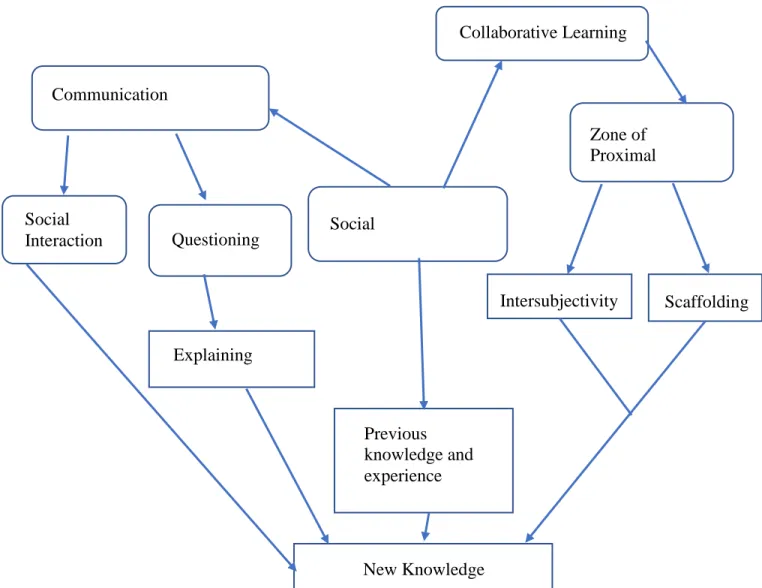
Vygotsky (1978) proposed that knowledge co-constructed using language, calling this idea of social constructivism (University College Dublin [UCD], 2015; Vygotsky, 1978). As
shown in Figure 1, social learning usually occurs before development. Learning takes place in the zone of proximal development (ZPD), where the student acquires new knowledge with the help of a “more knowledgeable other” (UCD, 2015; Vygotsky, 1978). A “more knowledgeable other” could be a human or, in the case of those who engage in plagiarism in completing math assignments, a nonhuman resource (UCD, 2015; Vygotsky, 1978). In Vygotsky’s (1978) theory, the “more knowledgeable person” is an integrated part of the ZPD.
Figure 1. Vygotsky’s (1978) social constructivism theory.
The zone of proximal development (ZPD) contains many features that result in student learning. The first feature is intersubjectivity, where the two people in the ZPD start their journey
Intersubjectivity Scaffolding Previous knowledge and experience New Knowledge Communication Social Interaction Questioning Collaborative Learning Zone of Proximal Social Explaining
together with different knowledge and understanding (UCD, 2015; Vygotsky, 1978). The second feature is scaffolding, where teaching is adjusted to fit the student’s current knowledge and level of performance (UCD, 2015; Vygotsky, 1978). Vygotsky (1978) defined the ZPD as the distance between the developmental level of learning and the potential level of learning, and viewed skills or learning as in the process of maturation. The basis of Vygotsky’s theory was learning through collaboration; it is in the ZPD, where collaboration for learning takes place (Applefield, Huber, & Moallem, 2001; Vygotsky, 1978).
Students bring prior knowledge into learning situations; one belief in social
constructivism was that students must critique and re-evaluate their understanding of prior knowledge in learning new knowledge (UCD, 2015; Vygotsky, 1978). Students may find it easier to resort to academic dishonesty rather than working towards gaining the new knowledge (UCD, 2015). Dishonesty is often a learned behavior, as in the example of players of video games who are encouraged to “cheat” to advance in their games (Kafai & Fields, 2009). These individuals learn cheating behaviors through websites and communication boards, where players exchange information. This experience in “cheating” at games often manifests in educational situations where students do not see a problem with dishonesty as long as they advance towards their educational goals (Kafai & Fields, 2009). In Selwyn’s (2008) research, 98% of the 1222 undergraduate students surveyed reported that they looked up information on the Internet, while 50% claimed to use the Internet as a resource “all the time” (p. 16).
Plagiarism of math assignments is a social phenomenon. Every day, more digital apps and websites become available for completing homework assignments. Students share these objects through communication. This action, according to social constructivism, allows the person to define the object within a social context (Keaton & Bodie, 2011; Vygotsky, 1978).
When a student uses these new objects to complete their assignments, they were leaning on their previous knowledge. This previous knowledge usually consists of another student gaining success in plagiarizing assignments, thereby setting an example to follow. Another reason a student may use digital apps and websites to complete assignments is their lack of foundational knowledge. Within the context of social constructivism, the individual is making
accommodations to achieve a specific goal (Geddes, 2011; Gullifer & Tyson, 2010). These examples show how social constructivism was a suitable theory for this study.
Social cognitive theory: Theoretical framework. In this study, I used social cognitive theory (SCT) as the theoretical framework through which to examine academic dishonesty (Bandura, 1971). Behaviorist theories provided the classical and operant conditioning use in the social cognitive theory (McLeod, 2016). Almost all learning resulted from direct experience and occurred by the observation of other’s behaviors (Bandura, 1971). People also learned by observing the consequences of other people’s choices. These consequences help people develop thoughts or hypotheses as to which behaviors will yield the best results. These hypotheses then become guides for future actions. Another feature of the social cognitive theory is the ability to understand future consequences and convert those ideas into motivators influencing current behavior (Bandura, 1971). Future consequences and ideas become important in the examination of academic dishonesty. Bandura based his social cognitive theory on the behaviorist learning theories of classical conditioning and operant conditioning (Bandura, 1971; McLeod, 2016). According to the social cognitive theory, people learn by observation (Bandura, 1971; McLeod, 2016). In the example of plagiarism, one reason students gave for cheating is the observation of other students cheating (McCabe & Trevino, 1993). People also learned by observing the
consequences of the behavior of others (McLeod, 2016). Cheating students often discover there are few consequences when caught cheating (Gullifer & Tyson, 2010).
Consequences are imposed by schools when a student is caught cheating. The campus where the research occurs has consequences which range from a warning to expulsion At a local university, when student commit academic dishonesty and are caught, the student may find themselves receiving a warning, the student may be required to take a course regarding academic integrity, or perhaps the student is required to write a reflective essay examining the actions which lead to the misconduct. Sanctions against offending students can also include disciplinary probation, suspension, and expulsion
Hudd, Apgar, Bronson, and Lee (2009) revealed that more than 40% of the instructors employed at colleges are part-time. They also showed that part-time instructors are less likely to spend time looking for academic dishonesty (Hudd et al., 2009). Hudd et al. concluded that part-time instructors are likely to be more lenient than full-part-time instructors. The difference in the attitudes between full-time and part-time instructors extends to definitions and interpretation of academic integrity infractions (Hudd et al., 2009). The information regarding the possible penalties and the statistics about the part-time instructors shows why students might find that there are few consequences if caught cheating (Gullifer & Tyson, 2010).
Bandura’s (1971) theory contains four interrelated subprocesses or mediational
processes: attentional, retention, reproduction, and reinforcement, motivational. Through these processes, Bandura explained that a person does not automatically observe a behavior and then immediately imitate it (Bandura, 1971; McLeod, 2016). The attentional process requires a person to recognize the features of the model’s behavior (Bandura, 1971). The retention process
exist (Bandura, 1971). To reproduce the behavior, a person assembles a set of responses that fit the given behavior; this action is a copy of the observed behavior (Bandura, 1971). In the final process, reinforcement and motivation, the levels of observable learning are affected by the reinforcement. If the behavior receives positive reinforcement or motivation, then the behavior is more likely to occur. These four interrelated subprocesses illustrate the learning of new patterns of behaviors before the performance of these behaviors (Bandura, 1971).
The social cognitive theory also includes three controlling processes of stimulus, cognitive, and reinforcement (Bandura, 1971). Some of the forms of stimulus control are emotional learning, persons, places, and events associated with experiences, both painful and pleasant (Bandura, 1971). One prime function of stimulus control is protection against potential threats (Bandura, 1971). Within the process of stimulus control occurred the two conditioning responses of symbolic conditioning and vicarious conditioning (Bandura, 1971). Symbolic conditioning explains strong emotional responses to situations, either positive or negative, based on previous conditioning (Bandura, 1971). Vicarious conditioning explains how vocal, facial, and the posture of another person led to a response, positive or negative, in another person (Bandura, 1971). The controlling process of the stimulus led to the controlling processes of cognitive and reinforcement.
In social cognitive theory, the concept of learning from direct experiences leads to an understanding of future consequences and allows the students to convert these ideas into motivators influencing their choice to cheat (Bandura, 1971). Another example of future consequences and motivators occurred with students running out of time to complete
assignments and recognizing the consequences to their GPA (Geddes, 2011). These examples both illustrate how social cognitive theory applied to the study of academic dishonesty.
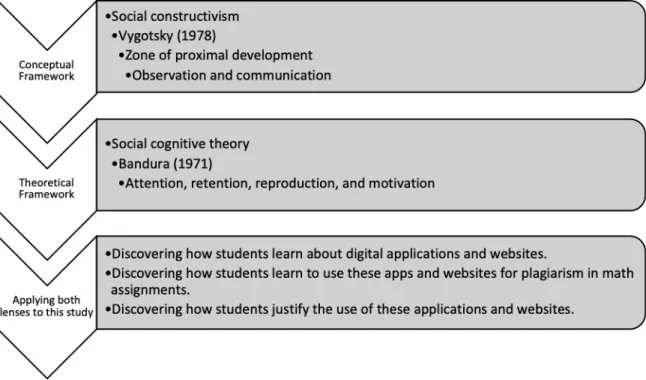
Applying both lenses to academic dishonesty. Social cognitive theory (SCT) falls under the category of social constructivism. In this study, I examined how social constructivism and, more specifically, social cognitive theory determined student’s thoughts and actions when
plagiarizing math assignments. Both of these theories formed their basis through the use of social means. Students often choose to commit academic dishonesty based on the behavior of others. The development of this learned behavior is through social interactions and the modeling of the behaviors. Within social constructivism exists the zone of proximal development (ZPD), where learning takes place through observation and other forms of communication (Applefield et al., 2001; Vygotsky, 1978). This concept is similar to the ideas of social cognitive theory, where people learn through the observation and communication of those who display the cultural patterns (Vygotsky, 1978). Vygotsky (1978), believed there was no doubt children learned speech from adults through observation and communication. This idea aligns with Bandura's (1971) social cognitive theory, where adults are seen as models from whom children learn.
Bandura’s (1971) theory contains four mediational processes of attention, retention, reproduction, and motivation. The attention process addresses the understanding that a person cannot learn without recognizing that there is something to learn (Bandura, 1971). The seminal studies in this research showed how the attention process applies to plagiarism (Bowers, 1966; McCabe & Trevino, 1993). These seminal studies illustrated that honor codes helped to eliminate cheating in the school (McCabe & Trevino, 1993). The honor codes defined cheating and the expectations, which then helped to eliminate academic dishonesty (McCabe & Trevino, 1993). Thus, there was no cheating behavior to observe and the undesirable behavior ended at the school (Bandura, 1971; McCabe & Trevino, 1993).
The retention process requires a person to create a memory of the learning, so the learning is then repeatable in the reproduction process (Bandura, 1971). Bandura (1971) addressed how the student first learned of the various digital applications and websites they chose to use for plagiarizing math assignments. Bandura also explored the reason a student had to use these sites. The observation of the students showed a correlated with the motivational process, where the learner had to have a desire to reproduce the learning (Bandura, 1971). These processes tied to the framework of social constructivism as they all are forms of communication (Keaton & Bodie, 2011; Vygotsky, 1978).
These four processes—attention, retention, reproduction, and motivation—illustrate that new patterns of behaviors are learned before being performed (Bandura, 1971). This concept relates to Vygotsky's (1978) theory that social learning occurred before development. Vygotsky (1978) believed children learned by imitation; this idea fit into the reproduction process of Bandura’s (1971) theory. Past studies showed that when someone admits to plagiarism, they often stated that they were reproducing the successful behavior of another person; this is an
example of Bandura’s (1971) reproduction phase and Vygotsky's (1978) imitation stage (Ma et al., 2008). When a person continues to commit plagiarism, their behavior is aligning with motivation process from SCT, where a person continues the learned behavior (Bandura, 1971).
In this study, I used the overarching framework of social constructivism as well as the more specific concepts in social cognitive theory to understand the phenomena of academic dishonesty, especially plagiarism. These two frameworks helped guide this research, where students learned about applications and plagiarizing through social means, observations of others' behavior, and the success of their behaviors. Specifically, it was my goal in this study to understand the hows and whys of plagiarism in higher education mathematics courses.
Literature Review Introduction
In this literature review, I explore the different facets of academic dishonesty and the ways this action threatened intellectual honesty and integrity. Some of the facets of this review are a description of the seminal studies, types of academic dishonesty, and why people cheat. In particular, in this literature review, I look at information involving plagiarism in mathematics.
Seminal Studies
Bowers (1966) completed the first major study of cheating in universities or colleges. In his research, Bowers sent questionnaires to deans and student body presidents at 1,134 schools of higher education. A more intensive study followed this initial action with the students of 100 colleges and universities receiving more comprehensive questionnaires (Bowers, 1966). Students evaluated themselves on these surveys, and when returned, 75% of those surveyed admitted they engaged in or more incidents of academic dishonesty during their time in higher education (Bowers, 1966).
In 1993 and 1997, McCabe and Trevino conducted two studies similar to Bowers (1966). The first study involved 6,096 students from 31 colleges (McCabe & Trevino, 1993). This study showed that academic dishonesty, or cheating, was determined by observing the behaviors of other people. If peers frowned on cheating, such as in a school with an honor code, then individuals usually would not cheat. Sometimes the pressure from peers was related to the special privileges enjoyed by schools with honor codes, such as the self-proctoring of tests.
The second study by McCabe and Trevino (1997) involved students at nine state universities. These results indicated that males in the first years of study with low GPAs were more likely to participate in academic dishonesty. Also, extracurricular activities influenced academic dishonesty; some of these undertakings included fraternity or sorority membership and intercollegiate athletics, where many of these extra-curricular groups have academic
requirements to retain membership. Another factor in these groups was students watching fellow students cheat and get away with it (McCabe & Trevino, 1997). Students used these observations as one of the reasons to explain their participation in academic dishonesty. Research has
determined the greatest deterrent to academic dishonesty was peer disapproval, especially in the form of honor codes (McCabe & Trevino, 1997).
In the years following Bowers’ initial research, McCabe et al. completed two studies. The first study was comparing at schools with honor codes and those without honor codes (McCabe et al., 2001b). In this study, the students were from 31 schools, 14 with honor codes, and 17 with other policies. Research showed that there was significantly less cheating and a somewhat higher level of reporting dishonesty at schools with an honor code. This research supports the ideas of social cognitive theory, which explained students modeled the behavior for each another
model the non-cheating behavior. Students at schools with honor codes usually report academic dishonesty infraction so that they may maintain the special privileges, such as self-proctoring of tests, allowed by the honor code (McCabe et al., 2001b). The 2003 study involved more than 2000 students at 21 schools and included the faculty at 17 of these schools (McCabe et al., 2003). The research conducted in these studies found honor code schools experienced less cheating (Bowers, 1966; McCabe et al., 2003).
Specifically, these researchers found that academic dishonesty was higher among male students and all students involved in intercollegiate athletics, sororities, or fraternities, where grades determined eligibility for these groups (Bowers, 1966; McCabe, & Trevino, 1997). These seminal studies laid the foundation for studying plagiarism. Some later research supported some of the results found in the seminal studies (i.e., McCabe et al., 2003), while other research showed plagiarism was not specific to gender or members of organizations (i.e., Walker, 2010). In Bowers (1966) and McCabe et al. (2003), identification of the students was through self-identification based on their interpretation of cheating by the researchers. Walker (2010) used Turnitin to code different types of plagiarism and discovered few differences between the categories, i.e., gender, year of enrollment, as identified by earlier studies. Turnitin was used primarily to detect plagiarism in written assignments; it is not used often in math. These differences between the two sets of studies may be due to the self-identification approach. One study showed that females or first-year students are less honest about their dishonesty than are males and upper-level students (Walker, 2010).
Academic dishonesty: Who, why, and how it happens.
Academic dishonesty includes different types of cheating, including plagiarism, collusion, falsification, and replication (Jones et al., 2008). Plagiarism is benefiting from someone else's
work without giving them credit (Perry, 2010). When students collaborate without the permission of the teachers, this is collusion (Jones et al., 2008). Falsification occurs when a student invents or falsely presents information, such as inventing a citation (Jones et al., 2008). Replication is using the same piece of work for more than one assignment (Jones et al., 2008). Some researchers found a variety of factors that influence students to use academic dishonesty. These factors include how and why people cheat, who cheats, and the results of the cheating, including methods to stop cheating.
In various studies, students identified their reasons for choosing to cheat. Some of these reasons are personal, such as poor time management skills and procrastination (Murdock, Beauchamp, & Hinton, 2008). Some of the reasons were external reasons in the form of neutralizing behaviors, where individuals blame other people for their choices (Murdock et al., 2008). In one study, students with higher neutralizing scores were more likely to cheat (Murdock et al., 2008). The final results showed when students blamed teachers for their lack of learning; these students saw cheating as justifiable (Murdock et al., 2008). In performance-based classes, the basis for the student’s grade is the product produced in the class rather than on mastery of the concept (Murdock et al., 2008). Many students find performance-based classes boring with many assignments, which the students deemed as “busy work” (Murdock et al., 2008). These “busy work” assignments are seen as unimportant and sometimes lead to the students completing them by academic dishonesty (Murdock et al., 2008).
A common issue in the literature is the lack of a definition of academic dishonesty, cheating, and plagiarism (Aasheim et al., 2012; Bisping, Patron, & Roskelley, 2008; Gullifer & Tyson, 2010; Jones et al., 2008; Perry, 2010). Students are frustrated by instructors ‘threatening’ the students with dire consequences when plagiarizing, instead of teaching how not commit the
offense (Power, 2009). Gullifer and Tyson (2010) used information from a study by Roig (1997) to show that many students could not identify examples of plagiarism and that this inability leads to anxiety for some students. Some students consider sharing answers during an examination as cheating but do not consider plagiarism as cheating (Owunwanne, Rustagi, & Dada, 2010). In a study by Perry (2010), 27% of first-year students admitted to using material from the Internet to complete assignments but did not believe this was plagiarizing. Even when students understand academic dishonesty, they still perceive a difference in acceptable behaviors depending on the assignment type (Aasheim et al., 2012).
Another issue in plagiarism is the lack of punishment upon the discovery of academic dishonesty (Burrus et al., 2011; Schmelkin, Gilbert, Spencer, Pincus, & Silva, 2008). Many teachers believe a cheater only hurts themselves and chose to ignore the behavior (Chace, 2012). This ignoring of behavior leads some students to see a few consequences for cheating (Ma et al., 2008). Students claim that cheating is easy because of the low likelihood of being caught and if they are caught receiving little punishment (Burrus et al., 2011). The students receive
encouragement in academic dishonesty when they see others receive high grades by cheating and receiving no punishment (Eraslan, 2011).
Social groups, academic groups, and other activities. Some research has indicated membership, in particular, social, academic, or other groups encourage academic dishonesty. Some of these groups are gamers, athletes, and participants in other extracurricular clubs (McCabe et al., 1999). Video game players advance in their games by seeking answers from others or cheating when encountering a difficult part of the game (Kafai & Fields, 2009). Cheating is allowed in gaming and is even encouraged with most cheats found in the public domain (Kafai & Fields, 2009). Video players then extend the idea of the public domain to
everything found on the Internet, believing it is okay to use this information without citing the source (Jones et al., 2008). Cheating is also higher among the groups of students participating in intercollegiate athletics and those who are fraternity and sorority members (Bowers, 1966; Stannard & Bowers, 1970). Perhaps this occurrence of cheating is because these groups require students to maintain their grades for participation (Bowers, 1966; Stannard & Bowers, 1970). Other determining factors that seem to encourage academic dishonesty include membership in social groups, increased television watching, and participation in clubs or groups (Pino & Smith, 2003; Wotring, 2007).
A student’s GPA may also correlate with cheating (Bowers, 1966; Geddes, 2011; McCabe & Trevino, 1997). According to Geddes (2011), students with a high GPA have heavy workloads and high expectations. Research shows these students admit to academic dishonesty to maintain their GPA (Geddes, 2011). Bowers’ (1966) and McCabe and Trevino's (1997) research showed students with low GPA cheat more often. Some results indicated students with higher GPAs engaging in academic dishonesty tend to choose methods that are less common and less obvious (Choong & Brown, 2007). While students with low GPAs often have low
motivation to master the body of information and choose to cheat because it is easier often using methods that are detected easier (Jordan, 2001). Researchers have shown students with high GPAs and students with low GPAs participate in academic dishonesty for different reasons (Pino & Smith, 2003). Students with high GPAs feel pressured to maintain their grades, while students with low GPAs often cheated because of poor time management skills (Gullifer & Tyson, 2010; Pino & Smith, 2003).
Neutralizing behaviors. Neutralizing behaviors are actions based on external forces (Murdock et al., 2008). Students use neutralizing behaviors to explain away the responsibilities
of their choices; in other words, the students are taking little responsibility for choosing to cheat (Murdock et al., 2008). These external forces include the teacher, the teaching style, the structure of the classroom, and the time of the day of the class (Murdock et al., 2008). Students who cheat often consider their behaviors acceptable when they neutralize the behavior (Comas-Forgas & Sureda-Negre, 2010). Shu and Gino’s (2012) findings suggested that memory, or lack of
memory, may contribute to neutralizing behaviors. Murdock et al. (2008) surveyed 256 students who admitted cheating, claiming two reasons for blaming their teachers these were “too much assignment work” and “lack of respect for the teacher.” Some of the issues cited by other students included poor teacher pedagogy; including performance-oriented teaching style where students believe the assignments are “busy work” or irrelevant assignments which the students feel is unimportant to their educational future; failure of the teacher to motivate the student; and the relationship between student and teacher (Chace, 2012; Comas-Forgas & Sureda-Negre, 2010; Geddes, 2011; Ma et al., 2008; Murdock et al., 2008; Pulvers & Diekhoff, 1999). Neutralizing behaviors are common among students who commit academic dishonesty. In this study, I examined how students used neutralizing behaviors as a reason for committing
plagiarism in completing math assignments.
Technology and the Internet have made it easier to access information and have had a profound impact on the academic world, providing increased opportunities for students to cheat and to learn (Aasheim et al., 2012). In a study by Selwyn (2008), 98% of the students responding reported completing assignments using information from the Internet, 50% reported doing this all the time. Research has shown students do not believe cheating with technology carries the same stigma as “regular” cheating (Molnar, Kletke, & Chongwatpol, 2008). Some people believe everything available on the Internet is in the public domain, and thus, it is not cheating to copy or
plagiarize using the Internet (Jones et al., 2008). Some examples of how technology aids in cheating include the buying of assignments and plagiarizing (Aasheim et al., 2012). Some researchers have argued the availability of digital sources is the reason for the growth in academic dishonesty (Simkin & McLeod, 2010). This idea is apparent in plagiarism in math assignments, as more information becomes available through digit applications and websites, the more a student is tempted to plagiarize in completing their math assignments (Ma et al., 2008).
Plagiarizing in mathematics
This study explored plagiarism through the lens of social constructivism, where the determination of an object’s existence is through communication and observation (Keaton & Bodie, 2011). In social constructivism, learning takes place in the ZPD, where a “more knowledgeable other” aids the student in acquiring new knowledge (UCD, 2015; Vygotsky, 1978). Plagiarism occurs most often in writing, but plagiarism occurs in other works such as music, art, diagrams, design, software code, and so on (Jones et al., 2008). For example, when a student did not learn the mathematical concept, the student may then be tempted to resort to a “more knowledge other” who helps him or her to plagiarize. This “more knowledgeable other” may be another person, or it could be a math application (Vygotsky, 1978). Students also learn to plagiarize by observing others participating in academic dishonesty and then applying this
behavior to their studies. Learning by observation is a characteristic of social constructivism (Vygotsky, 1978).
Ma et al. (2008) viewed the Internet as a social constructivist learning environment where students engaged in learning that is relevant to their personal needs and interest. In social constructivism, social interaction, through communication and dialogue, is a critical factor for acquiring knowledge (Vygotsky, 1978). Using the Internet leads students to develop a shared
understanding of what is acceptable behavior (Ma et al., 2008). Researchers found about two-thirds of the student participants were following the examples of other students who cut-and-paste (Ma et al., 2008). Most of the students in interviews talked about copying-and-pasting as if it was an ordinary occurrence (Ma et al., 2008). Ma et al. (2008) illustrated how the use of the Internet is viewable through the lens of social constructivism.
There is little published research on the topic of plagiarism in mathematics. One documented area where plagiarizing is occurring is in coding, which is a concept similar to mathematics (Bidgood & Merrill, 2017). Students are copying code from websites and friends and turning it in as their work (Bidgood & Merrill, 2017). One professor at the University of California, Berkley discovered approximately 100 of his 700 students copied code (Bidgood & Merrill, 2017). In 2015, about 20% of the students in one course at Stanford University were flagged for possible cheating, with many students changing one command in the code (Bidgood & Merrill, 2017). This student action is similar to how plagiarism occurs in English courses (Bidgood & Merrill, 2017). Computer programing, or coding, is comparable to math; in both fields, students share information and acquire answers from websites and other digital sources.
There are websites available for plagiarizing mathematical assignments. These include Wolfram Alpha, Mathway, Symbolab, PhotoMath, and Slader. Wolfram Alpha, Mathway, and Symbolab each require the user to input the information into the applications (Wolfram Alpha, n.d.; Mathway, 2016; Symbolab, 2017). With PhotoMath, the user takes a picture of the question, and the solution is produced (PhotoMath, n.d.). Slader consists of a database of textbooks with solutions provided (Slader, 2017). In research by Ma et al. (2008), students admitted to copy-and-pasting answers for a math assignment. There is little documentation as to how many students use these sites to complete their assignments, but according to a study by