The Mechanical Engineer
of the Future
The development of the five year Mechanical engineering
programme at Chalmers University of Technology
Josefin Bertilsson and Hanna Sundström
2014-12-19
ii
Abstract
This strategy project aims to serve as the foundation for the future strategic development of the Mechanical engineering programme (Master of Engineering) at Chalmers University of Technology (Chalmers). The goal is to be one of the top Mechanical engineering programmes in Europe. The project has been led during 2014 by two students attending programme. The programme consists of a Bachelor cycle and a Master’s cycle. An action research based approach has been used, and the data collection has included both quantitative and qualitative methods. Data collection aimed to gather the different stakeholders’ views of the future of Mechanical engineering education, and to learn from other programmes and universities. The stakeholders have been defined as: Academia (universities in general, and Chalmers in particular), students and alumni from the five year Mechanical engineering programme, industry, and society. The global outlook has focused on universities within Europe and the USA, and has included site visits. Data has been analysed continuously and summarised into five challenges. The challenges for the mechanical engineering programme have been identified as: recruitment, arenas for meetings between industry-university-student, skills of the engineer, internationalisation, and uncertainty. These have been further discussed and evolved into recommendations for the Mechanical engineering programme.
The first recommendation, connected to the challenge ‘uncertainty’ is vital for a holistic long term development of the programme, and it states that The Mechanical engineering programme has to agree on what should characterise a Master of Science in Mechanical engineering, i.e. the combined Bachelor and Master’s cycles, at Chalmers. Without this foundation it will be exceedingly difficult to organise further developments. Other general recommendations for the programme include mapping and defining what is already being done in the programme, developing it and then improving the way that the strengths of the programme are exhibited both internally and externally.
iii
Table of Content
Abstract ... ii
1 Introduction ... 2
1.1 Context - Mechanical engineering at Chalmers ... 2
1.2 Background ... 3
1.3 Aim ... 4
1.4 Limitations and Scope ... 4
2 Method ... 4
2.1 The stakeholders ... 5
2.1.1 Chalmers ... 5
2.1.2 Students, and alumni ... 6
2.1.3 Industry ... 6
2.1.4 Society ... 7
2.2 Global outlook ... 7
2.3 The analysis ... 9
3 Summary of data collection ... 9
3.1 The study ... 9
3.2 Related studies ... 13
4 Challenges ... 15
4.1 Recruitment ... 15
4.2 Arenas for meetings between industry-university-student ... 15
4.3 Skills of the engineer ... 15
4.4 Internationalisation ... 16 4.5 Uncertainty ... 16 4.5.1 Mismatch ... 16 4.5.2 Different needs/interests ... 16 4.5.3 Marketing ... 17 4.5.4 Past-Present-Future ... 17 5 Discussion ... 17 6 Recommendations ... 21 6.1 Overall ... 21
iv
6.3 The Bachelor cycle ... 24
6.4 The Master’s programmes ... 24
6.5 The courses ... 25
6.6 Action plan ... 25
6.6.1 Overall... 25
6.6.2 The five year programme ... 25
6.6.3 The Bachelor cycle ... 25
6.6.4 The Master’s programmes... 26
6.6.5 The teachers ... 26
7 Impact of the project ... 26
2
1 Introduction
This strategy project, the Mechanical engineer of the Future, aims to serve as the foundation for the future strategic development of the Mechanical engineering programme at Chalmers University of Technology (Chalmers). This project has been lead by two students at the Mechanical engineering programme at Chalmers in 2014. The students have experience in both operative and strategic levels, in educational questions at Chalmers in general and at the Mechanical engineering programme in particular.
The report starts with an introduction to the project and the current Mechanical engineering programme, and the aim and scope of the project. This is followed up by the method for the project and a summary of the data collection. The data is then summarised in five key challenges for the programme, these are discussed, and followed by the recommendations. For those interested, an appendix will be released where the data is summarised per stakeholder and university, please see https://chalmersuniversity.box.com/s/il7zosl369yc5d0o9eyl for further information.
1.1
Context - Mechanical engineering at Chalmers
The Master of Science in mechanical engineering programme is a five year programme divided into two cycles. The first cycle consists of three years of full time studies corresponding to 180 ECTS and ends with the degree of Bachelor of Science. The second cycle is a two years (120 ECTS) Master’s programme. After completing both cycles the student is awarded the Swedish degree “Civilingenjör” as well as the degree of Master of Science. This structure is the result of the Bologna process, which included comparable B.Sc and M.Sc degree system (European University Association, u.d.)between 29 countries within Europe. The B.Sc and the M.Sc are academic degrees, while the combined Bachelor and Master’s programme is an engineering degree, i.e. Master of Science in Engineering. Chalmers has structured their courses around programmes which means that it is not possible to just apply for and take one course at the university. The academic year at Chalmers consists of two semesters, autumn and spring, which are divided into two study periods of eight weeks and one exam week, nine weeks in total. The academic year of 2014/2015 is the first year to have a study period of nine weeks, before this it was usually eight weeks, and to have examinations after Christmas for study period two. The courses consist mainly of 7.5 ECTS, and there are usually two courses in parallel per study period. Each year of the Bachelor cycle contains a project course, devised according to the CDIO-methodology that stretches over one semester. The Master’s programmes mostly have courses of 7.5 or 15 ECTS to facilitate the scheduling for the students and to make it easier to choose courses from other programmes.
All students at the Mechanical engineering programme apply to the five year programme in Mechanical engineering, and after finishing the first cycle they have the possibility to choose between more than 15 Master’s programmes within Chalmers. The students also have the possibility to do their Master’s programme at another university in Sweden. The Mechanical Engineering programme is responsible for eight of the Master’s programmes at Chalmers, and
3 the other Master’s programmes belong to other five year engineering programmes. The fact that Mechanical Engineering students can choose Master’s programmes owned by other programmes also means that students from other programmes are allowed to attend the Master’s programmes belonging to the Mechanical engineering programme. There is also a possibility for the students to choose a Master’s programme that will not give them the national Master of Science within Mechanical engineering degree, but only a B.Sc degree and M.Sc degree; however, very few students do this. The students are then able to select any Master’s programme at Chalmers, providing that they have the right prerequisites.
The director of the five year Mechanical engineering programme is responsible for the programme, and works together with the programme team consisting of the director of studies and the student guidance counsellor for the Mechanical Engineering programme. Each Master’s programme has a director that reports to the director of the Mechanical engineering programme. In addition to this, the programme has an advisory board which consists of representatives from faculty, the PhD students, the students, and industry (mostly large companies). The programme is organised in an educational area together with Industrial design, Automation and Mechatronics and the Marine and Naval programmes, with a Dean of education as the leader. Chalmers has a buy/sell organisation for their programmes and departments, which means that the Mechanical engineering programme orders the courses from the different departments. The programme is responsible for the aims, content, sequence, and quality of the courses and the study environment, while the departments are responsible for the teachers. All courses are evaluated by the programme management on a yearly basis together with the teacher/s and the students.
The university has created Areas of Advance, which are clusters for research considered to be of special importance to the university.
1.2 Background
The five year Mechanical engineering programme at Chalmers has received national recognition on several occasions due to its high quality. In 2008 the programme received an award for an excellent educational environment by Swedish Higher Education Authority, UKÄ, which also awarded the programme the grade “very high quality”, the highest distinction possible, in a national assessment in 2013. The programme was the only five year Mechanical engineering programme to receive this distinction. However it was only the five year programme and the Master's degree that were awarded the highest grade, the B.Sc degree was awarded “high quality”. Additionally, the programme received the best engineering education award from the industrial employer’s organisation Teknikföretagen in 2012, which highlighted the collaboration with industry partners and the philosophy of continuous improvement within the program.
In 2009 a workshop was held at Chalmers with the theme “Shaping the Future of Mechanical engineering Education at Chalmers” aiming to find what was required of Chalmers to educate the Mechanical engineers of tomorrow. Some milestones for benchmarking were created, with the future goal to be the best and most recognised Mechanical engineering programme in Europe. Following this conference a visiting committee was appointed, with members from industry and academia from all over the world. The purpose of the committee was for the programme to receive continuous outside assessment on how it was doing in terms of its aim of becoming the best. The
4 committee met up at Chalmers in 2011 for their first visit and the result was a set of ideas on how to improve the programme further. One suggestion was to formulate a strategy to use as a guideline when it came to the continuous improvement. The next meeting for the committee was conducted in December 2013. Many improvements had been made since the previous visit, including the creation of 40 new project rooms for students to work in. The committee was impressed with the development of the programme, but still asked for a strategy. The motivation now being that most “quick fixes” and small problems had been rectified, but that bigger changes, the sort that would raise awareness of the programme in Europe and world-wide, would be more difficult and would benefit from being coordinated by a strategy. By not having a clear strategy the programme would risk sub-optimisation of their work because different improvement projects may work against each other.
1.3 Aim
On the back of the awards and the with the continued encouragement of the visiting committee, this project was started as a means to create a strategy for the further long and short-term development of the program, aiming to improve the reputation in Europe and world-wide as one of the top Mechanical engineering programmes. This would mean updating the vision and goals as well as a plan of action for how the programme can continue to improve, become more visible internationally and benchmark against other universities.
1.4 Limitations and Scope
The time frame given was that the project should be conducted during maximum one year, but that the data collection should neither collide with the project team’s term-time nor the universities’ holiday period. Therefore, the work was concentrated around the summer months, with the start-up in the spring and the finishing touches being done in the autumn.
This study has focused on the five year programme in Mechanical engineering, Master of Science in engineering (M.Sc engineering). The study has not considered the students that only study towards their Master’s degree within a programme associated with the Mechanical engineering programme specifically, but has focused on getting a cohesive five year programme. To define which qualities are needed for a future mechanical engineer, a more general approach of “the engineer of the future” has been used to get input from a wider field.
2 Method
The project was initiated in January of 2014, and was mostly performed during the summer of 2014. The focus was on gathering the different stakeholders’ views of the Mechanical engineering programme, and its future, and to learn from other programmes and universities, how they work and what they think about “the engineer of the future”. An action based research method has been used, where data has been collected and analysed iteratively. To maximise the time available for the project the work has been performed in parallel, with regular discussions between the participants. This has made it possible to adjust the project over time, but also means that the processes have been affected by in which order, and when in time, the stakeholders and
5 universities have been involved. However, the final analysis has taken this into consideration, to make sure it does not affect the conclusion and recommendations.
2.1 The stakeholders
The project started by defining the stakeholders for the Mechanical engineering programme, and how their views and opinions should be collected. The stakeholders are listed in Table 1.
Table 1: The stakeholders to the Mechanical engineering programme Universities in general, and Chalmers in particular
Students and alumni from the five year Mechanical engineering programme
Industry
Society
Data collection was performed using both quantitative and qualitative studies. The quantitative studies were used to get input from a wide range of people, and to include several aspects and views within one category of stakeholders. The qualitative studies were used to get more thorough and detailed answers from the stakeholders, and to get input from specific parts within one stakeholder, e.g. input from the different Master’s programmes. Before the summer surveys, workshops and interviews were carried out with students, alumni, Master’s programme directors and industry representatives.
2.1.1
Chalmers
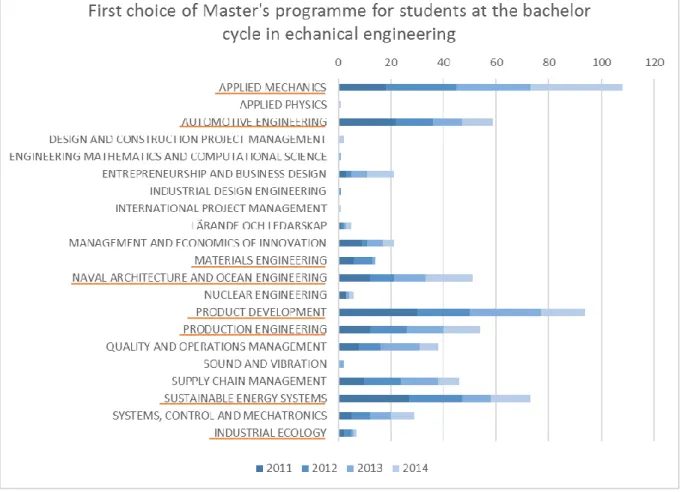
The Master’s programmes involved in this study are those that are most popular among the students, have a strong connection to Mechanical engineering and/or programmes that involve specific elements of importance and non-traditional thinking, see Table 2. Input from these Master’s programmes was gathered through interviews with the director of the Master’s programme, or a person in a similar position. To get a more holistic view some interviews were performed with PhD students from some of the departments involved. The PhD students were recommended by the directors of the Master’s programmes and could also give their views of the Mechanical engineering programme as alumni.
Table 2: Master’s programmes that have been involved in this study
Applied Mechanics, Product Development, Automotive Engineering, Production Engineering,
Industrial Ecology, Quality and Operations Management,
Learning and Leadership1, Supply Chain Management,
Management and Economics of Innovation, Sustainable Energy Systems, and Materials Engineering, Systems, Control and Mechatronics Naval Architecture and Ocean Engineering,
Further information was gathered from meetings with people around the university, not necessarily connected to Mechanical engineering, including people connected to Challenge Lab, MOOCs, programmes using tracks during their Bachelor cycle and programmes using alternatives methods of
1 A master degree taught in Swedish, which is both an M.Sc degree and a teaching degree. The programme is called Lärande och Ledarskap in Swedish
6 admittance. Input from Chalmers centrally has been collected from policy documents for their vision and mission and Chalmers' rules for a Chalmers degree, to be able to connect this project to the overall strategy for Chalmers.
2.1.2
Students, and alumni
To include students from all five years of the Mechanical engineering programme a survey was performed, in class for the Bachelor cycle and online for the Master’s programmes. The aim with a live survey for the Bachelor students was to get as many responses as possible, the drawback being that the students did not have much time to think their answers through. As the Mechanical engineering Master’s students are spread out over more than 15 Master’s programmes it was more convenient to perform an online survey to get diversity among the respondents, this method also gave the students time to think about their answers before submitting them. Responses were gathered from 14 different Master’s programmes. The survey included questions about what the students thought the programme should focus on, what the students think is lacking in the programme today and which qualities they think a future employer will value. Surveys were complemented with workshops with student representatives from the Bachelor cycle and the most common Master’s programmes for the Mechanical engineering students. The goal with these workshops was to get a qualitative view on the questions, and to discuss different opinions and to get more developed answers.
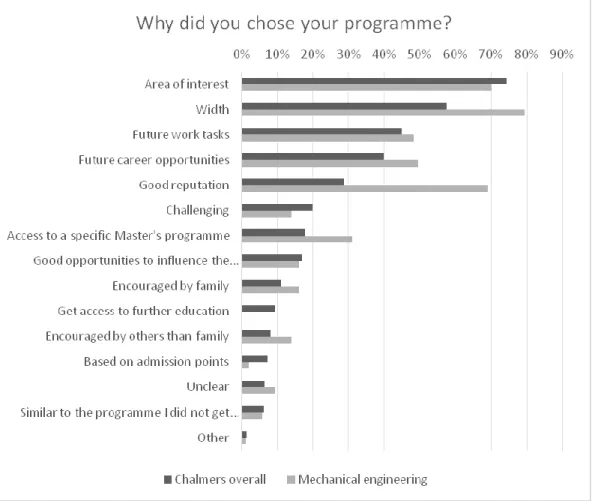
A smaller survey was sent out to alumni for them to give their views on the programme. Secondary data from Chalmers’ own surveys to alumni has also been used, in an effort not to overwhelm alumni with questionnaires. In addition to this, data from a Chalmers survey to the first year students was used to gain insight into why students choose to attend the programme.
2.1.3
Industry
A survey was sent to the industry, and respondents were selected from a catalogue sent out during the Chalmers student union´s career fair, where companies had indicated that they were interested in recruiting Mechanical engineering students. The same survey was handed out during a workshop about simulation in education held in the Mechanical engineering building and co-hosted by the programme. Unfortunately, the total number of responses was low, and angled towards engineering analysts in a way that does not correspond with future careers of Mechanical engineering students; due to the large number of answers from the workshop. This was taken into consideration in the analysis. To get quantitative information from the industry interviews and workshops were conducted with the advisory board of Mechanical engineering, which includes industry representatives. Some additional interviews have also been conducted with industry representatives selected by the project team because of a special connection to engineering in general or Mechanical engineering in particular
7
2.1.4
Society
Society's view of a Mechanical engineering degree has been collected through the national criteria for the degree in B.Sc, M.Sc, and the national five years degree M.Sc Engineering, and the national assessment in 2013.
2.2 Global outlook
The investigation of other universities and their thoughts on the (Mechanical) engineer of the future was performed nationally and internationally. The universities that were included in the study were selected together with the director of the Mechanical engineering programme. This list was continuously updated, aspiring to have diversity among the universities, both geographically and in their views of education with a connection to Mechanical engineering. The main objective was to study universities in Europe as one goal for the programme is to be the leader in Europe. Owing to beneficial circumstances, and interesting concepts at universities within the US, the project could also include site visits to American universities. Some of the universities were already connected to the programme, while others were new connections. To get the most honest and holistic view from the different universities, site visits were performed at the majority of the universities included in this project. The context and the circumstances in which the university operates affect the way the education is performed and the results, which has been an important consideration during the project. Three things that have been identified to affect the outcome are: resources, number of students, and culture.
Contact was established with the universities during the spring and some site visits were performed to get early input to the study. An interview guide was designed, and developed during the project as more knowledge about the subject was gathered. It was adapted slightly to the specific university and interviewee. Most site visits included both a tour around the facility/facilities and one to several interviews. The site visits were performed by one person from the project team, which made it possible to do more visits than if they would have been conducted by the entire project team. One drawback of using this system is that the impressions from the visits can become biased.
Table 3 shows the universities that have given their input to the project, and which role the interviewee/s had.
8
Table 3: List of which universities that have been included in the study
University Interviewee Nation How
Delft University of Technology (Delft)
Director of B.Sc and M.Sc Aerospace Engineering
Netherlands Study visit and interview
Design Factory (DF) at Aalto University (Aalto)
Director of DF and a student of Mechanical engineering
Finland Study visit and interview
ETH Zürich (Zürich) Coordinator of Studies, Department of Mechanical and Process
Engineering
Switzerland Email
Imperial College London (Imperial)
Director of courses, faculty of Engineering, department of Mechanical engineering United Kingdom Study visit and interview Linköping University (Linköping)
Student representative Mechanical engineering
Sweden Email
Massachusetts Institute of Technology (MIT)
Member of the visiting committee and professor of Mechanical engineering
USA Study visit and interview
Olin College of Engineering (Olin)
Professor within Mechanical engineering, and a student
USA Study visit and interview Pennsylvania State University (Penn State) Aerospace Engineering, Mechanical engineering,
Director of the Learning Factory
USA Study visit and interview
Royal Institute of Technology (KTH)
Student representative Mechanical engineering
Sweden Phone interview
RWTH Aachen University (Aachen)
Student representative Mechanical engineering
Germany Skype interview
Stanford University (Stanford)
Leader of Stanford Designing Education Lab (DEL)
USA Study visit and interview
Technical University of Denmark (DTU)
Director of B.Sc Mechanical engineering and director of M.Sc Applied Mechanics
Denmark Study visit and interview
9
2.3 The analysis
Data collected from the stakeholders and the universities has been analysed iteratively through multiple discussions within the project group, and feedback sessions with the director of the Mechanical engineering programme. To complement this study information has also been collected from scientific articles and other articles within the subject of the engineer of the future. The two main reports that have been taken into consideration were written by The American Society of Mechanical Engineering (ASME) and by MIT respectively, investigating the future of (Mechanical) Engineering education.
During the autumn, after the last data had been collected, the analysis was summarised into challenges for the five year Mechanical engineering programme, which were emailed to the visiting committee for feedback. Their feedback was included in the updated challenges, which were transformed into recommendations for the programme. Challenges and recommendations were also discussed with student representatives. The study was then presented to faculty at the faculty conference of the programme. Faculty had the opportunity to give feedback during the session, and afterwards by email. The recommendations were then updated, to include the feedback obtained during the faculty conference and discussions within the project team, and an action plan for the recommendations was developed. The study has also been presented for the educational area that the five year Mechanical engineering programme belongs to, and the advisory board.
3 Summary of data collection
The first part of the summary consists of the stakeholders’ views of the future of the Mechanical engineering programme at Chalmers, and an analysis of the context. The summary ends with a review connected to this study on other projects within the same field. The extended data collection will be released as a separate appendix, please see
https://chalmersuniversity.box.com/s/il7zosl369yc5d0o9eyl.
3.1 The study
Chalmers has an aspiration to achieve “global attraction through excellence in education” .One of the foundations for this is to have innovative and creative learning processes and to work interdisciplinary, another is to develop sustainable technology for man kind. These goals include collaboration with industry, and society, recruiting the most motivated students, movability during education, and development of the individual. (Chalmers University of Technology, 2010)
Chalmers also has some criteria for their degrees involving courses within sustainability, and the relationship between human, technology, and society. These two general Chalmers criteria are areas where the five year programme needs to be strengthened according to the national board for university education, UKÄ. Several of the teachers agreed that the students need to strengthen their ability to handle multiple perspectives, scientific theory, and their understanding of technology’s role in society. The industry said that knowledge within sustainable development will increase in importance.
10 Most students thought that the ability to work in a group and communication skills were important and something they wanted more practice in, but some students thought that there was too much focus on these skills today, and not enough on the technical skills. Some of the directors of Master’s programmes had a similar concern, that the students now have weaker technical skills than before. They also thought that the students need to understand the importance of being able to work independently, even in a group, which the industry agreed upon. Industry demanded good technical understanding, rather than specific software, as theory will be the same but the applications and tools will change. However, the importance of soft skills was emphasized at many of the studied universities. Both the students and the teachers saw the usefulness and the need to work with open problems, and some teachers said that students need know how to handle information efficiently. This includes finding the right information, sorting large amounts of information and knowing when there is enough, or not enough, information.
The discussions at the university visits about what qualities a future engineer should possess have been summarised in Table 4.
Table 4: Skills of a future engineer
Creative innovators that will solve the global challenges of the future
Develop the skill for independent learning for life
Have a broad base but be really good at “something”
Communication and the ability to co-operate.
The ability to think analytically and critically
System thinking and being able to see the whole picture
Interdisciplinary
Ethics and morale
Commitment
The students wanted to have more collaboration with industry, and some of the first year students said that they did not want to wait until the end of the Bachelor cycle to get it, but rather have it right from the start. However, the following years’ students seemed to be more satisfied with the amount of industry interaction. In general, the Master’s programmes focus more on a future career in industry, than in academics. However, some of the Master’s programme directors said they wanted to educate the students for the future, not for current roles in industry. One classification of future roles for Mechanical engineering students that was discussed with a member of the advisory board was: specialist, “systems manager”, innovator, leader and researcher.
It has been identified that it is tougher for the international Master’s students to get a thesis in industry, due to lack of personal connections, cultural differences and a wish from the industry to get Swedish speaking students to do their theses. Industry representatives mentioned that they appreciate when students have experience of real projects, but added it could be other things than work experience such as experience from societies at university or “life experience” in general.
The students, and also the teachers, had different ideas on how to collaborate with the industry. Some students wanted to have the opportunity to do an internship, but they did not like the idea
11 of getting ECTS for it. Internships are common in the Netherlands, Germany, and Switzerland. There are both internships at shop floor level and as an engineer, and they could be from 6 weeks up to 6 months. The Bachelor of Engineering programme (BEng, 180 ECTS) at DTU also had internships. In the United Kingdom the students are required to work for a while after acquiring their degree to get certified as engineers. Some of the universities studied have companies that they collaborate regularly with, and in the US is it common to have a capstone project in the final year, where the students perform a project for a company. It is also quite common that industry representatives act as a jury during the students’ presentations, and give awards. Penn State saw this collaboration with industry as win-win-win for the students, the faculty, and the industry.
The Mechanical engineering Bachelor cycle at Chalmers has in general more mandatory courses than other B.Sc degree programmes within Mechanical engineering. At Aalto, Delft and DTU part of the elective credits should be used towards a minor. It is common that the students take a minor in Engineering economics and management, as their mandatory courses are more closely related to Mechanical engineering, basic science, and engineering skills such as projects skills. To handle the greater amount of elective courses it is common that the students have mentors, who are faculty members, and an individual study plan. The students and the directors of the Master’s programmes at Chalmers are generally satisfied with the Bachelor cycle, and that it touches upon a wide variety of subjects. Some students think Mechanical engineering should be broad, and that this requires a lot of mandatory courses in the Bachelor cycle, while others thought there should be a possibility to focus earlier or to be able to try different subjects. There was a concern among some students that the course quality could decrease if there were more elective courses, and that students would choose the “easy way out”. It was also highlighted that many students chose the five year Mechanical engineering programme because it is broad and that they would have access to many Master’s programmes. Master’s programmes often consist of more than one year of elective courses, including the thesis, which most thought was enough. One of the teachers thought that too many credits of the elective Master’s courses could be Bachelor level courses, which count towards the Master’s degree.
The directors of the Master’s programmes want students from different Bachelor cycles to get diversity among the students, but mentioned that it can be hard to get the right level of the courses when the students start the programmes with different levels of knowledge. Some Master’s programmes have lowered their prerequisites for the Master’s programme, or are thinking about doing so, to make it possible for students from more Bachelor cycles to choose the programme. Industry had a divided view of the amount of elective courses the students should have. Some representatives thought that the students should follow their passion to be motivated, while others said it was hard to compare candidates if they had a lot of different courses, and they did not know what the different courses meant. Industry also had difficulties differentiating between the three degrees: B.Sc, M.Sc and the Master of Science in engineering degree.
Some universities abroad, and the visiting committee, highlighted the importance of having diversity among the faculty members and the students, both in terms of gender and nationality. This creates an international environment which has been credited as something that increases the quality of the education.
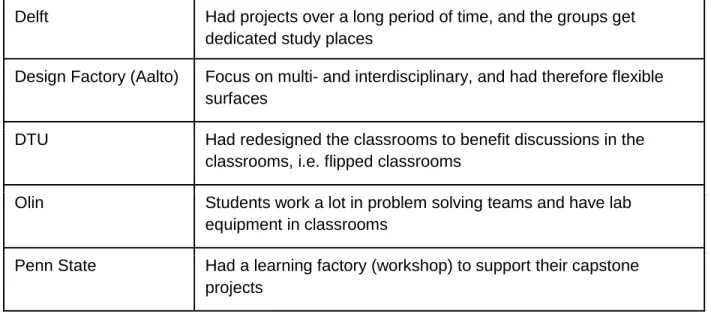
12 The students would like to have better integration between the courses, and to have even more types of examination methods than today, and that those could affect the student’s final grade. Today is it common to have projects, labs, quizzes and hand-ins during the course, but the grade is most often decided by a written exam. Some students also said they lacked time for reflection. Teachers also talked about different types of examination and learning activities. Olin focuses on projects, teaching mathematics and mechanics within those courses, instead of specific mathematics courses. To support these types of courses the classrooms are designed for team work. That the facilities support the learning of the students has been observed in many of the universities, with some examples listed in Table 5.
Table 5: Examples of facilities
Delft Had projects over a long period of time, and the groups get dedicated study places
Design Factory (Aalto) Focus on multi- and interdisciplinary, and had therefore flexible surfaces
DTU Had redesigned the classrooms to benefit discussions in the classrooms, i.e. flipped classrooms
Olin Students work a lot in problem solving teams and have lab equipment in classrooms
Penn State Had a learning factory (workshop) to support their capstone projects
As mentioned in the beginning of this chapter, Chalmers highlights movability, and several of the students take this opportunity, but most often for only half a year. One of the teachers felt that the 3+2 system is not used to the extent that it could be; for instance, only a few students change university within Sweden between their Bachelor and Master’s degree. Most students that have started the Bachelor cycle at Chalmers stay at Chalmers during their Master’s as well. However, some of the Master’s programmes at Chalmers offer the possibility to do a double degree together with international partner universities. In the US it is more common that the student changes university if they choose to study a Master’s. At Olin all students apply to one common entrance and then choose a major after a couple of terms. KTH has introduced a programme in Mechanical engineering where the students can study abroad during their Bachelor in France, Spain or Germany. Another way to encourage mobility and learning from different cultures is to have global project teams, which Penn State has done during their Capstone project.
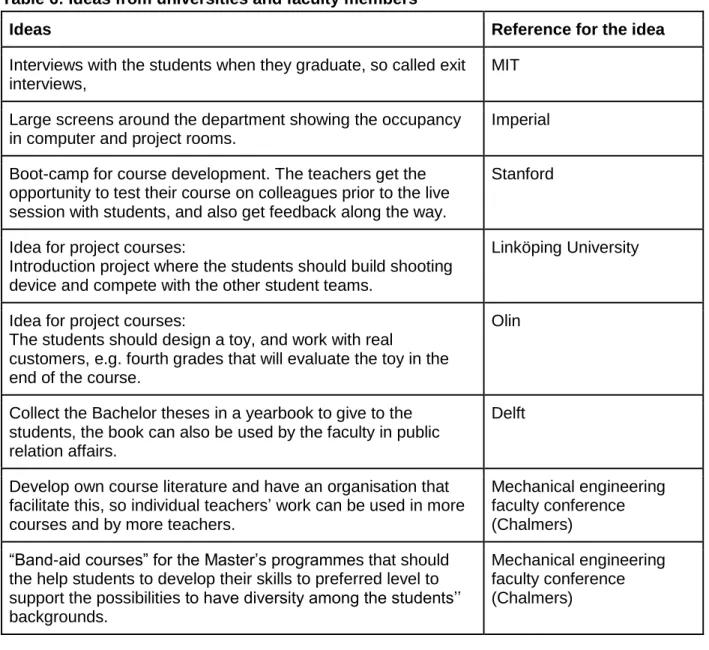
13 Some ideas that have been discussed and things that other universities do are summarised in Table 6.
Table 6: Ideas from universities and faculty members
Ideas Reference for the idea
Interviews with the students when they graduate, so called exit interviews,
MIT
Large screens around the department showing the occupancy in computer and project rooms.
Imperial
Boot-camp for course development. The teachers get the opportunity to test their course on colleagues prior to the live session with students, and also get feedback along the way.
Stanford
Idea for project courses:
Introduction project where the students should build shooting device and compete with the other student teams.
Linköping University
Idea for project courses:
The students should design a toy, and work with real
customers, e.g. fourth grades that will evaluate the toy in the end of the course.
Olin
Collect the Bachelor theses in a yearbook to give to the students, the book can also be used by the faculty in public relation affairs.
Delft
Develop own course literature and have an organisation that facilitate this, so individual teachers’ work can be used in more courses and by more teachers.
Mechanical engineering faculty conference (Chalmers)
“Band-aid courses” for the Master’s programmes that should the help students to develop their skills to preferred level to support the possibilities to have diversity among the students’’ backgrounds.
Mechanical engineering faculty conference (Chalmers)
3.2 Related studies
The two reports studied, one from The American Society of Mechanical engineering (ASME) and the other from MIT, were investigating the future of mechanical engineering education and the future of engineering education. The ASME report, published in 2011, highlights the importance of an increase in curricular flexibility and offering a curriculum that encourages innovation and creativity. Moreover, developing the students’ professional-skills to a higher degree, increasing the amount of project-based learning and creating strategies for attracting a more diverse student body are recommended. A suggestion for the increased flexibility of the curriculum was that a programme identifies a series of core Mechanical Engineering courses and then let students choose a concentration area or minor to make up the rest of their degree. This idea has been
14 adapted in many of the universities studied in this project, for example Stanford, MIT, Delft and Aalto.
The professional skills identified in the ASME report were as follows; complex system-level perspective, inter-disciplinary teamwork, leadership, entrepreneurship, innovation, and project management. It was suggested that these skills could easily be implemented in design-build-test courses, preferably with multi-disciplinary teams, and would at the same time also increase the practical experience given to students. The Mechanical engineering programme at Chalmers has included ethics and communication (written, verbal and visual) in their current definition of professional skills, and these are taught primarily in the term-long design-build-test projects conducted each year. There is also a requirement from Chalmers that the students study the equivalent of 7.5 ECTS of sustainability and human-technology-society.
Another way of giving students a more practical experience is to make sure that professors have experience from industry and not only academic experience. This is suggested by the report to give the professors more credibility if they can show real world practical applications of what they are teaching. However, the recruitment of faculty is handled centrally by Chalmers, and therefore this is not anything that can be decided upon by the Mechanical engineering programme.
During the course of the project, MIT released a report on the improvement of their Engineering education. The MIT task force identified 16 recommendations. These recommendations concern bringing more innovation and flexibility into the curriculum through the use of new and different learning models and a re-examination of the current core requirements and through better collaborations across the university. There is also a suggestion for these innovations to be made accessible for a wider audience than previously, so that more people can be a part of MIT, both in residence and across the globe.
The report discusses the importance of using new methods of teaching and examination to make sure that students’ skills are developed in the most efficient way, this includes the new model of game-based learning and project based learning. MIT benefits from extensive online resources, something that the task force feels should be further developed and better integrated in the curriculum in the form of blended learning. One recommendation concerns appointing a group of different stakeholders to create new learning spaces across campus, this would enhance the educational experience for students and also enable creative discussion and innovation within the education.
The general view of the MIT report is that there is much that is great with MIT but that the fear of losing something that is good should not hinder experimentation with new models and new ways of teaching a broader audience. This could be true for the Mechanical engineering programme at Chalmers as well, as it is possible that there is a fear of losing the things that have made the programme successful by changing the way the curriculum looks.
15
4 Challenges
From the analysis, the challenges were summarised into five areas seen below. The challenge that should be given priority is the “uncertainty”, without a firm and clear identity it will be difficult to develop the programme strategically.
4.1 Recruitment
The current system for accepting students into the programme is based on some form of scoring; either grade scores or test scores. The grades taken into account are either the high school grades (gymnasiebetyg) or grades from the foundation year at Chalmers. The test scores come from the national entrance exam to university studies, which tests basic Swedish, English and mathematical skills. There is a national regulation that one third of the places in the programme should be given to the applicants with the highest national entrance exam score, one third to applicants with the highest high school grades and the rest is for the university to decide. Chalmers has decided to divide the remaining third between the three scores, test, high school grades and grades from the foundation year. During the course of this project it has been questioned whether this system fulfils the general Chalmers goal of only accepting the most motivated students. Is it certain that grades and test scores indicate who will become the best engineer or the most motivated student?
4.2 Arenas for meetings between industry-university-student
The programme offers diverse career paths but it is difficult to get input from all the different possible paths, both in curriculum development but also in student interaction. Students have indicated that they would like even more connection and collaboration with industry. They also want it in slightly different forms than what is available today. Moreover, this challenge connects to how the students learn about what is going on around the different departments at Chalmers and in the Areas of Advance. Exciting opportunities for students to work on research projects and help out around departments would be made easier if there was a simple way of connecting to departments. Therefore, one of the challenges identified is to find arenas for new ways of interacting between these three stakeholders.
4.3 Skills of the engineer
When asked, students rated working in a team as one of the most important skills for getting a job, but when employers were asked the same question they rated being able to work independently as important, as the ability to work independently is also important within a team. How can the programme teach both at the same time, and how can they introduce research methodologies, ethics and communication as efficiently as possible? When interviewed, both students and faculty have mentioned a lacking ability to write scientific reports. The overall level of communication has improved over the last couple of years, but more can still be done.
16
4.4 Internationalisation
Internationalisation was put forward in Chalmers’ list of goals for 2020, yet most exchanges take place during the Master’s programme, and even then it can be tricky to match up courses. Few projects run together with students from other schools. Indications from industry and Master’s programme directors say that it is more difficult for international students to get industry-led Master thesis projects, many end up doing their thesis within a department as that is where they get accepted. This does not really match up with Chalmers’ international profile.
4.5 Uncertainty
The biggest challenge the programme is facing is uncertainty. There is a general uncertainty when it comes to the image and role of Mechanical engineers. Prospective students do not know what future careers they will have if they enrol in the program. Master’s programme directors do not always trust that the students from the Bachelor cycle have the skills/knowledge that the course objectives of prior courses say that they should, even if they have passed courses with good grades. Human Resources departments (HR) and recruiters find it difficult to keep track of what different courses entail and what skills the applicants have when they supply a list of courses. One HR-representative from a recruitment business mentioned in a survey that: “We have limited our recruiting of Mechanical engineering students because we don’t know what all the electives mean”. There is also an uncertainty among employers where there are examples of diagnostic tests for future employees, which could be interpreted as that they do not trust the students’ grades.
4.5.1
Mismatch
There is a system of recommended or prerequisite courses, where students need to have passed or at least been registered to certain courses to gain entry to certain Master’s programmes. These requirements have gradually decreased to allow programmes to accept students of more diverse backgrounds and in doing so get more applicants. This change means that even if an “optimal” Bachelor cycle is designed, the bar would need to be raised in the Master’s programmes, and then the bar might be too high for students from other programmes.
It is also evident from interviews with directors of Master’s programmes that there is a mismatch between what students choose to study and what society needs. A Master’s programme with several tracks might encourage students to choose the track where there is a strong need for engineers, but in many cases the students choose the other tracks. This leads to the question of which the main stakeholder of the programme is, the students or the society where they will work.
4.5.2
Different needs/interests
Because of the broad nature of the programme, and the fact that it is possible for students to choose 15+ Master’s programmes there are discrepancies in what subjects are considered “core subjects” or “basic knowledge”. Some Master’s programmes require more theory whereas others require more applied knowledge, they also require different levels of certain subjects, and in some cases certain subjects might even be considered superfluous. Because the Bachelor cycle is large (150 students per year) there are also different needs and preferences among the students, such as different preferred learning styles, some require participative exercises whereas others just want to study and write their exams. How to handle these different needs and interest is the
17 challenge, should they be balanced or should there be different tracks for different needs and preferences? This challenge is also connected to what skills are required by industry, is it reasonable for students to learn to study for an exam or does there need to be continuous examination for the students to really digest the material?
4.5.3
Marketing
The programme offers an almost endless supply of possible career paths, which makes it difficult to market. What do the students actually become and how is that marketed in the most efficient way? This uncertainty is tricky to work with because opportunities for the specific marketing of the programme are limited today, as there is a general plan for marketing of the entire university. However, there are certain freedoms given to programmes, so it is still an important challenge to work with.
4.5.4
Past-Present-Future
What is the programme educating for, the present situation or the future? Is it important to teach students about the past so that they can better understand the future? Interviews with older students have indicated that too much focus might be put on the future so that students, sometimes, aren’t well enough equipped for the current working situation. Other students do not understand what they should learn about the history within the field.
5 Discussion
The visiting committee, when consulted regarding the challenges, agreed with what had been identified. There were some specific suggestions regarding how the challenges should be approached, for example that it was important not to make too drastic a change too quickly to swing in the direction of either stakeholder. It was also suggested by one member of the committee that some uncertainty is good, as too much detail and micro-managing can stifle creativity and flexibility, and also that there is an inherent risk of mismatch with the 3+2 Bologna process.
One big issue with identifying recommendations and challenges has been how to use the views of the identified stakeholders. Students have a right to have some say in their education, they are also the only ones that experience the whole programme and not individual courses like the teachers, and the university needs to educate the researchers of tomorrow. Likewise, industry, both local and global, needs engineers with certain skills, and society needs engineers to solve the problems of tomorrow. Included in the stakeholder ‘Society’ is also the local community, meaning how Chalmers should contribute to the improvement of the local area and attract the engineers of the future by encouraging youths to study science and technology.
There has been a continuous discussion as to how to weight these four stakeholders in how much say they should have, especially when their views are conflicting. It becomes quite problematic when some stakeholders are at opposite ends of a spectrum in certain questions, but also poses a challenge when the stakeholders all agree, as in the case with what subjects to include in the curriculum. There are many ideas on what other courses to include, or what the stakeholders
18 would like more of, but few or none of what should be removed. It would be beneficial if there was a unified plan detailing how to handle stakeholders in matters like these, as that would speed up the process. During the study it has been difficult to get in contact with all different stakeholders, particularly to get response from a diverse group of companies and alumni. This introduces ideas about establishing networks with industry and alumni; today the contact is primarily on a personal level between teachers and employees of companies, and students/teachers/Master’s programme directors and alumni.
During the course of the project it has come to light that the students in the programme belong to a rather homogeneous group. Most are male (usually between 20-25 % of the students are female) and start university straight after high school or after one gap year. However, as the age-groups used in the data are quite wide, there is still some spread, but the general feeling is that the students are quite close in age. It would perhaps be beneficial to try to make the classes more heterogeneous, as society today is more diverse. New ways of recruiting and admitting students could perhaps solve this. The Swedish university admittance system is rather standardised and doesn’t offer much room when it comes to selecting candidates, something that differs from other universities, internationally.
The broad nature of the programme is something that has been debated. What does broad really mean, and do we want to be “broad”? As it stands the programme has chosen to make most of the Bachelor cycle mandatory to give all students a base of mechanics, mathematics, product development and material science, but also courses in economics, management and mechatronics/automated control. This means that students that already have a specialisation in mind can feel forced to take courses that they know they do not need, sacrificing a depth in the area they want to specialise in. On the other hand, this hopefully ensures that the students can view problems from different perspectives, even if they might not necessarily have a future career in the subject.
As there is not yet a clear picture of what the Mechanical engineer of the future will look like, it is difficult to decide on how to solve these issues. One suggestion that has been discussed is to let students choose future roles, such as “researcher”, “manager”, “innovator”, and “technical expert” and have different course-bundles for the different roles, in addition to a common Mechanical engineering core, during the Bachelor cycle. Other solutions studied have been to have more elective courses, either organised as a minor (the elective courses should then be within the same field) or just a free choice of courses. One drawback with this increase in flexibility is that students might become more mono-disciplinary or bi-disciplinary, and many involved in this study have emphasised the importance of multi- and interdisciplinary engineers. The 3+2 programme structure gives the students the wide spectrum of subjects during the Bachelor cycle and the depth during the Master’s programme, and most of the Master’s programme directors seem happy with the Bachelor cycle in Mechanical engineering in general. The Master’s programme directors want students from different Bachelor cycles, as they want diversity among the students’ knowledge and background. Another reason is that they want more applicants to their programme as more students mean more resources. However, this desire results in different knowledge levels among the students accepted and it could be hard to find the right level of the courses. As the Bachelor cycle is only responsible for some of the available Master’s programmes is it common
19 that these Master’s programmes are prioritised in the programme development and the alignment of courses.
This raises the question of how the five year programme should be organised to educate the best Mechanical engineers, which becomes even more complicated as the five year programme consists of two academic degrees (B.Sc and M.Sc) together making one engineering degree. To get the best engineers the whole five year programme should be considered, however as some of the available Master’s programmes are outside the control of the programme this becomes difficult. One solution could be to optimise the education towards the Master’s programmes that the five year programme is responsible for, but this would mean that the five year programme favours some of the available Master’s programmes and that students from other Bachelor cycles might not be able to attend them or find that the level of the courses doesn’t fit them. Another solution is to focus on the best Mechanical engineering Bachelor cycle, but this could lead to the students being overqualified for the Master’s programmes. Also, the Bachelor cycle should be an academic degree, but it might be more beneficial for the students’ future careers in the engineering industry if the focus is on applied engineering skills instead.
That students have a difficult time seeing the end goal and the big picture of their education has been mentioned in both students’ workshops and the surveys. Students expressed that they do not know what courses to choose and what they lead to but also that they do not know what is required of them if they choose a certain career path. All programmes at Chalmers have a guidance counsellor that they can go to discuss these issues, but because there are so many students and the guidance counsellor is very popular, there might not be enough time to reach all students. Other universities have solved this by having mentors and tutors, both older students and faculty, so that the students know that there are people around that can help them find their way through the uncertainties. A faculty member or a student will also have a different experience than a guidance counsellor which rarely has an engineering background. What system is best is difficult to predict, but there is clearly a need from the students for more guidance.
One observation during the process of the project is that there is sometimes a territorial nature to how professors view their subjects and their place in the curriculum. Professors tend to feel that their subject is the core of Mechanical engineering and because there is no unified image of the Mechanical engineer of the future it is possible that courses that should be part of a specialisation is now a core requirement. When the Aerospace Engineering education at Delft went through a major reorganisation it was openly stated that the professors should not have too big of a role in the decision-making of what subjects to involve or not, as they saw that the professors were biased towards their own subject and that they also had limited time available. From the beginning the Mechanical engineering programme incorporated the Industrial Engineering and Management, Naval and Ocean engineering, Industrial Design and the Automation and Mechatronics programmes but these have gradually been separated and turned into their own programmes. However, the Mechanical engineering programme still contains courses from these programmes, even if, perhaps, it should have been removed from the curriculum upon its separation. The question is who should make these decisions, and which stakeholders to involve and in what amount.
20 One point of discussion after the site visits has been the subject of being committed to the local industry or not to favour any industry no matter its location. The Mechanical engineering programme benefits greatly from a close connection with the companies and industries active in the Gothenburg region, but one interview highlighted a problem where the industry representative mentioned that their company could only guarantee that they would be active in the region for an additional 20-25 years after which they might be forced to move elsewhere. If that happens the programme is in a precarious situation because it has favoured an employer that has moved away.
The site visits at the universities have shown different ways of marketing, both online and on site. One thing that differs from Chalmers is that most other universities have more information about their individual degrees; Chalmers has only one rather standardised page per programme with just one student interview. For instance, DTU has a video clip and Linköping University have student blogs. Aalto and Olin showed ongoing and previous student projects in the corridors such as prototypes and A3-posters which showed what students were doing.
As mentioned previously it is important to remember that there is a significant difference in the budgets of the universities visited and the possibilities given to Mechanical engineering at Chalmers. There is a value in studying the universities as long as the context is kept in mind when analysing the data. Solutions used by other universities can to different extents be applied at the programme, and all good things from the universities don’t require vast amounts of resources. Sources not strictly related to Mechanical engineering but more to engineering in general or closely related disciplines have been used, but again, these sources hold validity in the sense that their advice can be modified and then applied in the Mechanical engineering programme.
During the Mechanical engineering faculty conference faculty members were given the chance to come up with suggestions and give feedback on which improvements were to be given the highest priority. One popular suggestion brought up was to expand the current workshop or create a completely new makerspace or “fab-lab”. The workshop in the basement of the Mechanical engineering building is becoming crowded and there is a demand for more flexible working areas like many of the universities studied have had Other popular suggestions included producing course books from material developed by teachers and creating a “flipped-lab” series, where students can watch safety and lab instructions with quizzes before they arrive for their course labs. Resources should also be given to develop the competences of the teachers.
21
6 Recommendations
The recommendations have been created to address the identified challenges and critical things that have been brought up in discussions. The project aimed to update the visions and goal for the programme but it is vital that the first recommendation be taken care of prior to this for there to be any point in updating the vision and curriculum.
6.1 Overall
During the project many different views of what qualities the Mechanical engineer of the future should have. The challenges are based on what has been found to be the most important issues for the Mechanical engineering programme at Chalmers to handle, but they can be handled in different ways. The main concern for the programme is within the subject of uncertainty. The stakeholders have suggestions on several aspects and subjects the curriculum should include more of, but few or none that should be reduced. The studied universities have different approaches and focus, and one idea could be to take the best from each, but it might be hard to combine and would scatter the education even more which should be avoided. Different solutions have been investigated, e.g. tracks or a minor during the Bachelor cycle, however most stakeholders agree that the width, and the amount of mandatory courses, of the Bachelor cycle is one its strengths. Another point is the number of Master’s programmes a Mechanical engineering student should be able to choose between, and what the connection between the B.Sc and M.Sc should be like. Today, the connection between the Bachelor years and Master’s programmes differ depending on if the Master’s programme is owned by the five year Mechanical engineering programme or not. This sums up the first recommendation, and they should handle the challenge uncertainty.
1. Agree on what should characterise a Master of Science in Mechanical engineering, i.e. the combined Bachelor cycle and Master’s programme, at Chalmers.
To be able to agree upon this, the programme needs to decide how they should handle and prioritise their stakeholders and the 3+2 system. When these things have been decided upon it is possible to make changes to the curriculum and update the vision.
6.2 The five year programme
Communication, scientific theory and professional skills, collaboration with the industry and faculty, and collaboration with universities abroad are all areas that the stakeholders and the studied universities have emphasised the importance of. The aim is to start defining what these areas entail prior to the mapping and development of them, because it is important that everyone has the same definition and view to be able to work holistically.
The visiting committee, and several of the stakeholders, have emphasised the importance of the programme team, and to make sure that the knowledge this team has is retained within programme. The site visits at the universities, and the university web pages, all showed examples
of what their students are doing and showed both ongoing and finished student projects. Displaying what is going on creates excitement and a sense of pride that would perhaps increase the popularity of the programme even more, as well as a serve as a means of communication
22 between different parts of the programme by letting people know what is/was going on and who did it. Other recommendations in this section include the creation of mentorship opportunities, improved contact with alumni and an extension and improvement of the workshop
2. Define, map and develop the use of different ways to teach communication
Today the project courses in the Bachelor cycle have a clear projection within the subject of communication, and many courses involve some communication, but mainly written assignments, and the students want more feedback. However, the students need more practice in communication not just written, but also oral and visual. Creating an overview over which types of communication skills are practiced and where will be helpful for both students and teachers, this would also facilitate the involvement of the communication support department.
3. Define, map and develop skills of the engineer
One common holistic approach to what scientific theory and common engineering skills are, is currently missing, which has been made clear during discussions with teachers. The programme needs to define what these are, when they are introduced and or practiced in the curriculum today and how they should be taught in the future. These skills should be useful for the future roles of the Mechanical engineering students, including their roles as researchers as well as in industry. Examples of these include project managing experience, communication and ethics. These skills can then be used in the marketing of the programme, as something that sets the Mechanical engineers of Chalmers apart from other Mechanical engineers.
4. Define, map and develop the collaboration with the industry and the faculty
The students made it clear that they wanted more collaboration with industry, and not just as guest lectures. Today, the collaboration with industry is mostly up to the individual teachers. In some of the visited universities one person was responsible for the contact, and that the collaboration for bigger projects went through this person. Currently, some departments are more visible than others during the B.Sc cycle and students and PhD students said they missed the opportunity to learn about current research within the departments. In this area there is a lot of development potential and an opportunity to involve the Areas of Advance. There is a system in place for letting people from industry attend Chalmers for one or a few courses to further their knowledge of a subject. This should be further expanded, as it creates diversity in the classroom and valuable insights for the students.
5. Define, map and develop the collaboration with universities internationally
The programme should decide if they want to focus on major collaboration with few universities or minor collaboration with more universities, and in which regions and areas these collaborations should take place. Today, some of the Master’s programmes collaborate through projects, or the opportunity for the student to get a double degree from Chalmers and another international university. The reason to map the existing collaboration is to get an overview of what already exists and to make it easier to promote,
23 and develop these collaborations. Collaborations that are identified as advantageous should be further strengthened to include collaborations not only between faculties but between students as well. It is suggested that the programme build upon the contacts of faculty to include collaborations in courses, for instance in project courses where there can be partner teams at other universities.
6. Create succession plans for key persons within the programme
Today, the programme is very dependent on its programme team, and there needs to be a plan developed to retain their knowledge, and a succession plan so that the whole programme team doesn’t change at once.
7. Investigate the possibility for mentorship and increased student guidance
Due to the uncertainties and the possibility of more curriculum flexibility there should be an investigation into how the students can be guided through their education in the best manner. Suggestions for how to solve this include designated faculty mentors, and/or older students acting as advisors like many of the universities studied have had.
8. Develop the contact with alumni
Today, some individual Master’s programme directors are in contact with or have contact information to prior students, and it would be beneficial if this was more on a general level to facilitate future collaboration. Good suggestions for how to keep contact and to get feedback on the education include exit interviews like those conducted at MIT.
9. Improve the prototype lab (workshop)
The existing workshop has reached its capacity limit in terms of space and it is hard to meet an increased demand on project courses and workshop practice for the students. The faculty wants a “super lab” which should be large, flexible and have a good learning environment; there is also a wish among some of the teachers to get better skills themselves in the workshop.
10. Show off our strengths
The five year Mechanical engineering programme is excellent in many areas, but does not show it off to the extent it could. The programme should highlight current projects and the facilities both online and within the M-building. Ideas for this include publishing a series of course literature based on material created by teachers for their own courses and marketing it as “Mechanical Engineering’s own literature” as suggested during the faculty conference, and also by gathering abstracts or short summaries of the theses written by Bachelor/Master’s students and publishing them as books that are available to the class and other interested parties. A solution to highlight the facilities would be to use the screens adopted by Imperial to broadcast the availability in the different facilities, including labs, computer rooms, the workshops and project spaces.