Marshall stability performance of waste zinc slag in hma
BekirAktaş1, Selim Bozdemir2
1Department of Civil Engineering, Erciyes University, Turkey 2
Kayseri 6th Regional Directorate of the General Directorate of Highways, Turkey
ABSTRACT
This paper presents the effects of the utilization of waste zinc slag as filler on the properties of Hot Mix Asphalt (HMA). Mechanical characteristics of all mixtures were evaluated by Marshall Stability tests. The specimens tested in this study were fabricated using 50%, 75%, and 100% mixing ratio based on the conventional mineral filler ratio to analyze the possibility of
using waste zinc slag in respect to stability performance. The first results gained through this study can contribute to the encouragement of waste zinc re-use in the asphalt concrete. The results indicate that stability of Marshall samples using with waste zinc slag within the limits in accordance with technical specifications of general directorate of Turkish highways.
INTRODUCTION
Environmental conservation and preservation have taken on great importance in recent years because of the fact that population and large amount of waste materials increases continuously. Decision-makers are paying more attention to concerns related to the environmental effect of the materials. In addition, more raw materials are needed day by day. Many authorities are going to seek to privilege and enforce by law the reuse of waste materials in environmentally and economically sustainable way [1].
In general, some materials such as glass, aluminum, paper etc. have been recycling commonly. In developed countries asphalt, concrete, aggregate, roofing shingle, PVC etc. materials have been recycling and reusing in some applications. Similarly, the reuses of hazardous materials have been under study for many years through technological work and research on the environmental impact of such practices [2].
The recycling of industrial waste in civil engineering applications has remarkable potential over a very long time. Owing to needs of so much raw materials, highway engineering is a leader field among the construction sectors [3,4,5]. Among the road pavement layers, surface course has primary importance because of their structure and exposure of direct loading and climate effect.
Hot mix asphalt (HMA) or asphalt concrete is a combination of aggregate and asphalt cement commonly used in construction projects such as road surfaces, parking lots, and airports
Waste materials have been using in HMA effectively over years. Şengöz and Topal [8]
investigated using of waste roofing shingle as % 1, % 2, % 3, % 4 and % 5 ratios in HMA. Authors indicated that shingle added Marshall samples have better stability and rutting performance in comparison with control samples. Hınıslıoğlu and Ağar [9] studied effect of
HDPE bitumen modified with different mixing, temperatures and HDPE content. The results from the study showed that 4% of HDPE content, a mixing temperature 165 oC and 30 min mixing period is optimum for Marshall stability, flow and Marshall Quotient (MQ) values. Ahmedzade and Sengoz [10] studied evaluated of steel slag coarse aggregate in hot mix asphalt concrete. They concluded that steel slag used as a coarse aggregate improved the mechanical properties of asphalt mixtures. Moreover, volume resistivity values demonstrated that the electrical conductivity of steel slag mixtures were better than that of limestone mixtures.
The primary objective of this research was to determine the effects of waste zinc as mineral filler on engineering properties of HMA. Marshall Stability and flow tests were conducted on the Marshall samples made with conventional mineral filler and waste zinc and the results derived from laboratory tests were evaluated.
MATERIAL AND METHOD Aggregate
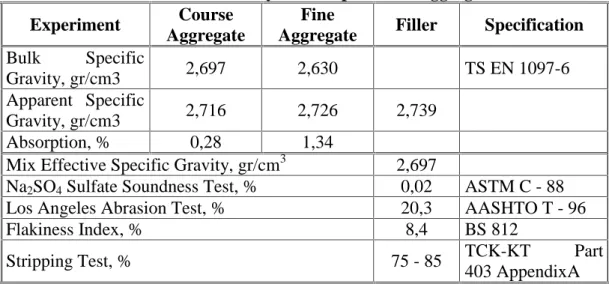
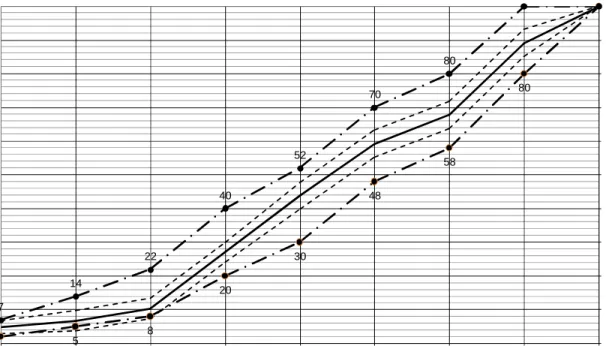
In the experimental studies four different aggregate gradations were used: 19-25 mm, 12.5-19 mm, 5-12.5 mm and 0-5 mm. The aggregates were supplied by a limestone quarry in Kayseri. After determined physical properties of these materials, mix gradation was prepared in accordance with TCK binder course specification [11]. Physical properties of these materials, mix gradation and specification limits are seen in Table 1, and Figure 1 respectively.
Table 1 The Physical Properties of Aggregates Experiment Course
Aggregate
Fine
Aggregate Filler Specification
Bulk Specific
Gravity, gr/cm3 2,697 2,630 TS EN 1097-6 Apparent Specific
Gravity, gr/cm3 2,716 2,726 2,739 Absorption, % 0,28 1,34
Mix Effective Specific Gravity, gr/cm3 2,697
Na2SO4Sulfate Soundness Test, % 0,02 ASTM C - 88
Los Angeles Abrasion Test, % 20,3 AASHTO T - 96
Flakiness Index, % 8,4 BS 812
Stripping Test, % 75 - 85 TCK-KTŞ Part
80 58 48 30 20 8 5 2 100 100 80 70 52 40 22 14 7 0,0 10,0 20,0 30,0 40,0 50,0 60,0 70,0 80,0 90,0 100,0 25,0 19,0 12,5 9,5 4,75 2,0 0,425 0,180 0,075 P er ce n t P a ss in g , % Sieve Size, mm
Figure 1. Mix Gradation and Specification Limits for Binder Course
Bitumen
Bitumen in 50/70 penetration grade supplied from Tupraş Kirikkale Refinery was used in
preparing Marshall samples. Properties of bitumen are presented in Table 2. Table 2. The Physical Properties of B50/70 Bitumen Bitumen Specific Gravity, gr/cm3 1,027 TS 1087 Bitumen Penetration, dmm 57 TS EN 1426
Waste Zinc
Waste zinc slagwas taken from ÇİNKOM company in TURKEY. The original gradation of
the waste zinc generally ranging from 0-5 mm. This material was milled to obtain filler size before added to mix. Chemical compositions of zinc slag mostly are consisting of CaO, SiO2,
RESULTS AND DISCUSSIONS Marshall Mix Design
In order to determine optimum Bitumen Content (AC), Marshall stability and flow tests were carried out on compacted specimens at various bitumen based on ASTM D1559. AC was determined using with values of maximum bulk specific gravity, maximum stability, 5% air voids in the total asphalt and 68% voids in the aggregate filled with asphalt (VFA). Asphalt samples were prepared on the basis of 0.5% increment of bitumen content. The specimens were preheated to a prescribed temperature which is 60 oC placed in the special test head and the load was applied at a constant stain (2 in/min). While the stability test is in progress, the dial gauge was used to measure the vertical deformation of the specimens; the deformation read at the load failure point is expressed in units of 0,25mm and is called the Marshall Flow value of the specimen. Figure 2 shows the Marshall sample fabrication and stability test process. The tests were repeated for the each bitumen content and optimum AC value was determined. After that maximum bulk specific gravity, corrected Marshall Stability, Marshall flow, air voids in the total mix and VMA curves versus AC were plotted. To determine the optimum AC for the asphalt design, average value of the following AC obtained from the graphs were considered [11]:
a) AC content corresponding to maximum stability.
b) AC content corresponding to maximum bulk specific gravity.
c) AC content corresponding to the median of designed limits of percent air voids in the total asphalt.
The stability value, flow value and VFA at the optimum bitumen were determined from the curves and it was ensured that each of these values correspond with the Marshall design specification values. Following this, the optimum asphalt contents versus specifications Marshall flow and % VMA were checked.
In order to determine optimum bitumen content, created charts of the Marshall design are shown in Figure 3. According to these results optimum bitumen content was found as 4.4%.
2,200 2,240 2,280 2,320 2,360 2,400 2,440 2,480 3,00 3,50 4,00 4,50 5,00 5,50 6,00
Bulk Specific Gravity, Gmb
700 750 800 850 900 950 1000 1050 1100 1150 1200 3,00 3,50 4,00 4,50 5,00 5,50 6,00 Stability,kg 40,0 45,0 50,0 55,0 60,0 65,0 70,0 75,0 80,0 85,0 90,0 3,00 3,50 4,00 4,50 5,00 5,50 6,00 VFA,% 2,00 3,00 4,00 5,00 6,00 7,00 8,00 9,00 3,00 3,50 4,00 4,50 5,00 5,50 6,00 Void,% 2,50 3,00 3,50 4,00 4,50 5,00 Flow,mm 14,00 14,50 15,00 15,50 16,00 V.M.A,%
Marshall Stability and Flow Results for Waste Zinc Added Samples
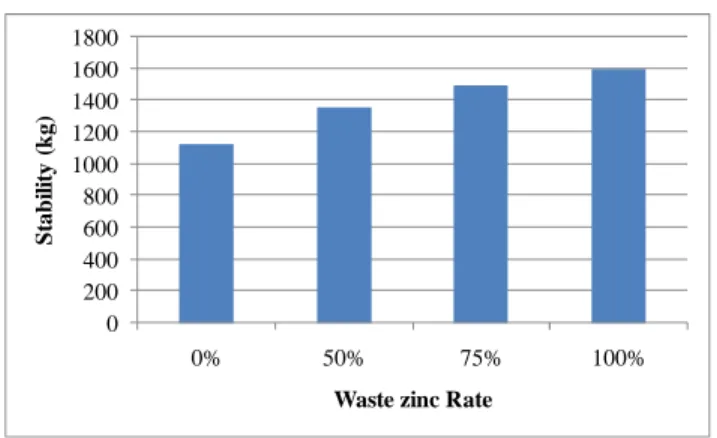
After determined optimum bitumen content with conventional aggregates, waste zinc added to this mix as filler 50%, 75% and 100% based on the conventional mineralfiller ratio. Figure 4 shows the Marshall Stability values of the waste zinc added samples for optimum bitumen content. According to the Technical Specifications of General Directorate of Highways, the stability value must be minimum 750 kg for binder course. The graph shows that the Marshall Stability values of all specimens are higher than specification lower limit. In addition, Marshall stability values are increasing with adding waste zinc slag.
0 200 400 600 800 1000 1200 1400 1600 1800 0% 50% 75% 100% S tab il it y (k g )
Waste zinc Rate
Figure 4 Marshall stability test results
According to Technical Specifications of General Directorate of Highways, the flow value limit must be maximum 4 mm and minimum 2 mm for binder course. The maximum flow value, indicated in ASTM specifications, controls the plasticity and maximum AC content of the asphalts. The minimum flow value controls the brittleness and strength of the asphalts. As illustrated in Figure 5, all the specimens are within the specification limits.
0,00 0,50 1,00 1,50 2,00 2,50 3,00 3,50 0% 50% 75% 100% F low (m m )
Waste zinc Rate
Figure 5: Marshall flow values of the samples
the results derived from tests showed that Marshall stability values of all specimens are higher than specification lower limit. In addition, Marshall stability values are increasing slightly with adding waste zinc slag. Also, the flow value limit must be maximum 4 mm and minimum 2 mm for binder course according to specifications in Turkey. The flow values of the specimens within the limit flow values.
The study of evaluation waste zinc in asphalt concrete has been continued comprehensively by the authors of this paper. In this study different amount of waste zinc added to asphalt concrete samples whose asphalt content determined previously. The first results gained through this study can contribute to the encouragement of waste zinc re-use in the asphalt concrete. To determine exact amount of bitumen for this waste material, different mix design should be prepared with various mineral aggregates. The aim of this study is to show that there is a possibility for waste zinc in asphalt concrete. In addition, to determine environmental impact of waste zinc after added asphalt concrete further tests are required.
ACKNOWLEGEMENT
This study was supported by the Scientific Research Projects Coordination Department of Erciyes University (Project Number: FBY-13-4498). Authors of this study express their gratitude to ERÜ/BAP for sponsoring the project.
REFERENCES
[1]. Aubert JE, Husson B, Sarramone N. (2006). Utilization of municipal solid waste incineration (MSWI) fly ash in blended cement Part 1. Processing and
characterization of MSWIfly ash. J. Hazard Materials; B136:624–31.
[2]. Cyr M, Aubert JE, Husson B, Clastres P. (2004). Recycling waste in cement based materials: a studying methodology. In: Conference on the use of recycled materials in building and structures –RILEM 2004, vol. 1. November 9–11, Barcelona, Spain; p. 306–315.
[3]. Ahmed, I. (1993). Use of Waste Materials in Highway Construction. Purdue University Department of Civil Engineering, PhD. Thesis, 114s, Indiana.
[4]. Huang Y., Bird R. N., Heidrich O. (2007). A Review Of The Use of Recycled Solid Waste Materials in Asphalt Pavements. Resources Conservation and Recycling: Volume 52, Issue 1, Pages 58-73.
[5]. Perez I., Pasandin A.R., Medina L. (2011). Hot mix asphalt using C&D waste as coarse aggregates, Materials and Design.
[6]. Brawn E.R., Kandhal P. S., Roberts F. L., Kim Y. R., Lee D. Y., Thomas W. K. (2009). Hot Mix Asphalt Materials, Mixture Design, and Construction. Third Edition. NAPA Research and Education foundation. Lanham, Maryland.
[8]. Sengoz B., Topal A. (2005). Use Of Asphalt Roofing Shingle Waste in HMA, Construction and Building Materials, Volume 19, Issue 5, Pages 337-346.
[9]. Hinisliglu S, Agar E. (2004). Use of waste high density polyethylene as bitumen modifier in asphalt concrete mix. J. Material Letters; 58:267–71.
[10]. Ahmedzade P. and Sengoz B. (2009). Evaluation of steel slag coarse aggregate in hot mix asphalt concreteJournal of Hazardous Materials 165; 300–305.