Strat. Mgmt. J.,30: 1113–1132 (2009) Published online EarlyView in Wiley InterScience (www.interscience.wiley.com) DOI: 10.1002/smj.777 Received 18 September 2007;Final revision received 15 March 2009
HOW DO NETWORKS AND LEARNING DRIVE M&AS?
AN INSTITUTIONAL COMPARISON BETWEEN CHINA
AND THE UNITED STATES
ZHIANG (JOHN) LIN,1MIKE W. PENG,1* HAIBIN YANG,2and SUNNY LI SUN1
1School of Management, University of Texas at Dallas, Richardson, Texas, U.S.A. 2Department of Management, City University of Hong Kong, Kowloon, Hong Kong
What drives mergers and acquisitions (M&As) in different institutional environments? This article builds on the resource dependence perspective and argues that networks, learning, and institu-tions represent three building blocks that can enhance our understanding of the drivers behind M&As. Specifically, we consider firms as learning actors embedded in network relations and influenced by institutional development, and compare and contrast firms’ acquisition activities across the United States and China. Our findings show that there are indeed important learning and network factors that lead to M&As. More interestingly, the impact of such learning and net-work factors varies sharply across countries with different market-based institutions.Copyright
2009 John Wiley & Sons, Ltd.
INTRODUCTION
What drives mergers and acquisitions (M&As)? This crucial question has attracted numerous stud-ies, predominantly with financial explanations and in the context of developed economies (see Cartwright and Schoenberg, 2006 for a review). One of the leading behavioral perspectives — known as the resource dependence perspective— posits that firms, embedded in relationships and influenced by the external environment, can use M&As to enhance their control of the resources needed for survival and prosperity (Oliver, 1990; Pfeffer and Salancik, 1978). While there is hardly any debate among scholars on the importance of M&As, the actual drivers behind M&As are not Keywords: mergers and acquisitions; industry alliance network; network and learning factors; institutional settings
*Correspondence to: Mike W. Peng, University of Texas at Dallas, School of Management, 800 W. Campbell Rd., SM 43, Richardson, TX 75080, U.S.A. E-mail: [email protected] Note: The first three authors contributed equally.
completely known, and how these mechanisms dif-fer due to institutional disparity is even less under-stood. In this article, we build on the resource dependence logic by arguing that (1) networks, (2) learning, and (3) institutions are the three underlying building blocks to help us understand the drivers behind M&As. We do so with a spe-cial focus on the United States and China, two important institutional settings with distinctive lev-els of development for market functions (Boisot and Child, 1996; Peng, 2003; Robins and Lin, 2000).
Three important motivations fuel this article. First, from a resource dependence perspective, we argue that the industry alliance network repre-sents a pool of resources that firms can leverage to engage in M&As through asset, information, and status flows (Gnyawali and Madhavan, 2001; Lin, Yang, and Arya, 2009). While such social embeddedness has long been argued to be crucial (Granovetter, 1985; Uzzi, 1996), previous work, with a few exceptions (Haunschild and Beckman, 1998; McEvily and Marcus, 2005; Yang, Lin, and
Peng, 2007), has not paid sufficient attention to the role of social context and network embeddedness leading to M&As.
Second, from a resource dependence perspective it is important to consider the learning aspect that drives M&As, as firms often rely on past experi-ences for future actions (Barkema and Vermeulen, 1998; Luo and Peng, 1999; March, 1991). To cope with environmental uncertainty, firms often resort to alliances as part of their adaptive learn-ing processes (Baum, Li, and Usher, 2000; Porrini, 2004). In particular, the ways firms learn from their previous alliance relationships through explo-ration and exploitation may affect their decisions toward future acquisitions (Cooke, 2006; March,
1991; Yanget al., 2007). While some studies have
incorporated the element of learning in understand-ing the drivers of acquisition activities, they have typically focused on the role of acquisition expe-rience (Haleblian, Kim, and Rajagopalan, 2006;
Hayward, 2002) instead of alliance experience,
which may have different effects. In this article, we focus on the impact of previous alliance experience on firms’ subsequent M&As.
Finally, extending the resource dependence proposition that a firm’s control of resources is affected by the external environment (Pfeffer and Salancik, 1978), we argue that the network and learning drivers of M&As may be subject to the disparities of the institutional environment. Both formal laws and regulations and informal norms and values —collectively known as an institu-tional framework—have been suggested to influ-ence firms’ M&A choices (North, 1990; Peng and Heath, 1996). However, prior research on M&As tends to understate the importance of the insti-tutional environment (Dikova and Witteloostuijn, 2007; Peng, Wang, and Jiang, 2008). Comparing and contrasting the network and learning drivers of M&As between different levels of market-based institutions help highlight the importance of institutions typically missed in previous M&A
research (Meyer et al., 2009; Meyer and Peng,
2005; Wright et al., 2005). While Western M&A
research (especially that in the United States) has a long tradition of rich theories and quantitative methods, research on M&As in relatively underde-veloped economies such as China has traditionally been limited to case studies and descriptive statis-tics (Cooke, 2006; Peng, 2006; Peng, Luo, and Sun, 1999). Such disparities have called for more comparative studies (Lu, Tsang, and Peng, 2008;
Tsui, 2007), a gap that this article endeavors to fill.
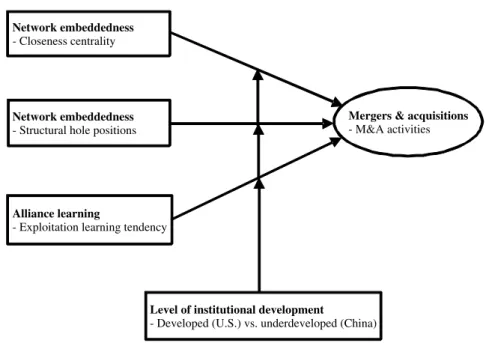
Overall, this article departs from previous work in two significant ways. First, we develop the argu-ment that the drivers of M&As can be revealed by a focus on networks and alliance learning. Using industry alliance networks allows us to bet-ter examine the relational context within which firms’ acquisition activities are embedded. Second, we contend that institutional environments shape how networks and learning affect M&As. Specifi-cally, we conduct a first comparative study on the network and learning factors that drive M&As in the United States and China, thus highlighting the interactive roles played by networks, learning, and institutions behind M&As. Our overall theoretical framework is illustrated in Figure 1.
NETWORKS, LEARNING, AND INSTITUTIONS
As an important means for firms to expand and control resources, M&As have been predomi-nantly studied by Western researchers in developed economies (Cartwright and Schoenberg, 2006; Hitt, Harrison, and Ireland, 2001). Most have app-roached the issue of ‘What drives M&As?’ from various (but primarily financial or economic) explanations, assuming that acquisitions are the results of firms’ stand-alone calculations of cost or options in response to inefficient market transac-tions (Folta and Miller, 2002; Williamson, 1985). While insightful, these lines of research tend to assume firms to be atomistic players striving for short-term financial goals.
Such a view may have overlooked the fact that firms are increasingly adopting network forms of organizing and are subject to the influences of noneconomic factors (Powell, 1990; Provan, Fish, and Sydow, 2007). A number of studies have shown that a firm’s acquisition choices may actu-ally be driven by its prior acquisition experiences
(Haleblian et al., 2006; Hayward, 2002), dyadic
relationships (Wang and Zajac, 2007), network ties (McEvily and Marcus, 2005), and institutional con-texts (Dunning and Lundan, 2008; Park and Luo,
2001; Penget al., 2008). Such studies have pointed
out some useful drivers for M&As that we extend in this study. Specifically, drawing on the resource dependence perspective, we view firms as learning actors that are influenced by their external network
Alliance learning
- Exploitation learning tendency Network embeddedness - Structural hole positions Network embeddedness - Closeness centrality
Level of institutional development
- Developed (U.S.) vs. underdeveloped (China)
Mergers & acquisitions - M&A activities
Figure 1. Theoretical framework
and institutional environments and can use M&As to control needed resources for their survival and
prosperity (Hitt et al., 2001; Oliver, 1990;
Pfef-fer and Salancik, 1978). Further, we argue that the impacts of networks and learning are subject to the influences of different institutional conditions, which may differ in their ability to facilitate mar-ket functions such as M&As. In short, we advo-cate (1) networks, (2) learning, and (3) institutions to be the three building blocks that can further enhance our understanding of the drivers behind M&As.
Networks
Firms, like other players in society, are embed-ded in networks of social and economic relations (Granovetter, 1985; Uzzi, 1996). M&As are sub-ject to these network opportunities as well as their constraints. Although researchers have increas-ingly noted the importance of networks in gen-eral (Powell, 1990), insufficient attention has been paid to the role of social context and organiza-tional embeddedness in the decisions leading to M&As (Gulati and Gargiulo, 1999). One stream of research has examined acquisitions as a parallel governance choice to alliances due to dyadic inter-firm calculations (Wang and Zajac, 2007). Another stream of research, which our study falls into, goes beyond this dyadic approach and treats acquisitions
as a complex outcome subject to firms’
embed-dedness in the overall network (Beckman and
Haunschild, 2002; Yang et al., 2007). Of the few
studies that adopt a network perspective, the focus has often been on the role of board interlocks rather than that of alliance networks (Haunschild, 1993), which we believe may provide a more natural and stronger driver to firms’ M&As.
This network perspective is important to M&A research as prior studies, especially those based on financial or economic perspectives, tend to regard
acquisitions as stand-alone decisions.1As a result,
the role of network embeddedness in firms’ acqui-sitions has been underexplored (Powell, 1990). Network embeddedness may also be important to emerging economy settings, where there has been an emergence of ‘network capitalism’ that thrives on interfirm relationships (Dunning and Lundan,
2008; Meyeret al., 2009; Peng and Heath, 1996).
From a resource dependence perspective, net-works are not only channels of resources but also mechanisms to search and monitor firms’ strate-gies and actions (Gnyawali and Madhavan, 2001).
Specifically, a firm’scentrality refers to the extent
to which it occupies a central position with ties to other network members, describing the firm’s 1Some studies have also examined whether a particular alliance may evolve into an M&A, which is different from our focus on a firm’s overall acquisition activities (total number of acquisitions) due to its past alliance experience and network positions.
ability to access information and resources (Free-man, 1979; Wasserman and Faust, 1994). A firm’s
structural hole positions, on the other hand, refer to its brokerage locations between two otherwise disconnected firms in the network, representing the broker firms’ ability to monitor and manipu-late the flow of information and resources (Burt, 1992). These two constructs —(1) centrality and (2) structural hole positions —have also been con-sidered to capture important aspects of network embeddedness (Gulati and Gargiulo, 1999) and will be explored further in this study.
Learning
The resource dependence perspective also regards firms as learning actors that can accumulate past experiences for future actions (March, 1991; Pfef-fer and Salancik, 1978). Such a view is consistent with the network embeddedness perspective and important to our understanding of M&A drivers. For this study, we assume that firms are boundedly rational players that can rely on prior experiences as a means to acquire knowledge and to respond
to the institutional environment (Hitt et al., 2001;
Tsang, 2002). Experience thus becomes a primary source of learning (Barkema and Vermeulen, 1998; Luo and Peng, 1999).
Of the studies that suggest the importance of learning in a firm’s acquisition behaviors, most have focused on the role of the firm’s prior
acqui-sition experience (Haleblianet al., 2006; Hayward,
2002; Hitt et al., 2001). We intend to go beyond
such a direct and relatively simplistic assumption that ‘if firm A has done B more frequently in the past, then A will have a higher tendency to do B again in the future.’ Specifically, we contend
that learning may be multidimensional in nature
and that the ways firms learn from their previ-ous alliance relations may affect their decisions toward future acquisitions —known as a spillover effect (Cooke, 2006; Zollo and Reuer, 2001). We further extend the spillover argument by differen-tiating the nature of learning in alliances between exploration and exploitation (Levinthal and March, 1993; Lin, Yang, and Demirkan, 2007; March, 1991). Exploitation enables firms to engage in refinement, implementation, efficiency, production and selection, while exploration attaches impor-tance to adaptive mechanisms that call for exper-imentation, variation, search, and innovation (March, 1991). In this study, we contend that
exploratory learning and exploitative learning in alliances may differentially affect firms’ tendencies in subsequent acquisitions.
Institutional environments
As strategic choices, acquisitions are not only driven by firms’ industry relations and past expe-riences, but are a reflection of the institutional constraints faced by firms (Rodriguez, Uhlen-bruck, and Eden, 2005; Wan and Hoskisson, 2003). According to Scott, ‘it is difficult if not impossi-ble to discern the effects of institutions on social structures and behaviors if all our cases are embed-ded in the same or very similar ones’ (Scott, 1995: 146). Various scholars have also echoed the view on how the institutional environment can affect a firm’s behavior (Gold, Guthrie, and Wank, 2002; Peng and Heath, 1996; Robins and Lin, 2000; Zhou and Li, 2007).
Traditional research tends to be criticized for largely ignoring the institutional underpinning that provides context for the competition among firms (Dikova and Witteloostuijn, 2007) or for
focus-ing largely on developed economies (Peng et al.,
2008). Given the importance of the institutional environment and the increasing interest in emerg-ing economies, it becomes important to com-pare distinctive institutional settings and the extent to which they influence market functions (Gold
et al., 2002; Robins and Lin, 2000). Emerging economies, where profound institutional transfor-mation is taking place, provide an excellent con-trast to developed economies (Wan, 2005). For
example, Hitt et al. (2004) show that institutional
differences affect firms’ alliance partner selection in China and Russia. Yet, rigorous comparative studies have been rare.
In addition, given the complexity and unique-ness of each institutional environment, it may be too risky to simply generalize Western theories to emerging economies —or vice versa—without a systematic understanding of the conditions that may drive M&As in these settings (Li and Peng, 2008; Robins and Lin, 2000; Tsui, 2007). Com-parative studies have been suggested as a useful approach to test or generalize Western findings and develop theories for emerging economies (Earley, 1989; Tsui, 2007), but have rarely been attempted (Luet al., 2008).
Our study endeavors to provide a first attempt to systematically compare the differential insti-tutional impact on M&As, extending the line of research to consider not only structural and behav-ioral perspectives, but also institutional differ-ences. In addition, we rely on explanations from the formal aspect2 of the institutional
environ-ment (e.g., business laws, market mechanisms, and property rights protection) as it is suggested to have a more direct impact on market func-tions such as alliances and M&As, which often rely on legally binding contracts (Dikova and Witteloostuijn, 2007). We focus on the United States and China—two important and distinc-tive institutional settings. Specifically, compared with the United States, China’s formal institutional framework is relatively underdeveloped in sup-port of complex market-based transactions such as M&As (Peng, 2003, 2006; Peng and Heath, 1996). This is often manifested in strong government intervention, insufficient legal protection, regional controls with fragmented bureaucracy, and weak market monitoring mechanisms (Boisot and Child, 1996; Keister, 1998, 2009; Kovacic, 1998; Li, Poppo, and Zhou, 2008; Yiu, Lau, and Bruton, 2007).
HYPOTHESES
To examine the drivers behind M&As, we fol-low the resource dependence logic and argue that, while firms’ embeddedness and learning in the alliance network will affect their subsequent acqui-sitions, such impact can change due to different levels of institutional development. Prior research has also suggested that the effects of network and learning constructs are likely to vary with differ-ent institutional settings (Mizruchi, Stearns, and Marquis, 2006). For example, Burt, Hogarth, and Michaud (2000) compare the difference in social capital between French and American managers and find that French managers associate negative emotions with structural hole positions. Xiao and Tsui (2007) demonstrate that structural holes play different roles in China.
2While not a focus for this research, we acknowledge the impor-tance of the informal influences of the institutional environment (such asguanxi) as studied by Earley (1989), Park and Luo (2001), and Peng and Luo (2000).
Firm centrality
Of the various measures of centrality (Freeman, 1979), we argue that closeness centrality is the most appropriate here, as it captures both direct and indirect relationships and is regarded as an important aspect of the embeddedness concept (Baldwin, Bedell, and Johnson, 1997; Gulati and Gargiulo, 1999). A high closeness centrality enables a firm’s independent access to all other network members in the shortest number of steps. From the resource dependence perspective, firms
centered in interorganizational networks are
exposed to more sources of information and have a higher level of control over relevant resources (Pfeffer and Salancik, 1978).
Whether or not a firm’s centrality in the industry alliance network stimulates its subsequent acqui-sitions, however, would depend on the institu-tional environment (Peng, 2003). Compared with an alliance, an acquisition requires higher com-mitment and entails more risks, while allowing
better resource control by the firm (Hitt et al.,
2001). In a more developed institutional setting, the established business environment provides suf-ficient legal protection for market behaviors. Con-sequently, a central position in an industry alliance
network may reduce firms’ incentives to pursue
subsequent acquisitions. Further, the reliability of market monitoring mechanisms (e.g., government agencies, financial institutions, and legal represen-tatives) helps ensure the benefit from such alliance relations for central firms (Haunschild and Beck-man, 1998). Potential opportunistic behavior by peripheral firms in the network is more likely to be reduced for a central firm, which minimizes cooperation costs and facilitates relatively smooth collaborations between the central firm and other potential partners when there is a resource need (Gnyawali and Madhavan, 2001). As a result, in a developed institutional setting, a centrally located firm may find it more efficient to leverage its strategic position to control resources while less necessary to pursue acquisitions, which may entail much higher risks and uncertainty.
Conversely, in an underdeveloped institutional setting where the business environment is frag-ile and legal protection is insufficient, a central position in an industry alliance network may not ensure the reliability of interfirm relationships for the central firm (Li and Atuahene-Gima, 2002). Consequently, there is potentially a high threat of
opportunism by alliance partners that significantly increases the cooperation cost, in particular to a firm that has to simultaneously manage multiple relations as a result of its central position in the network (Gulati and Singh, 1998; Kovacic, 1998; Zhang and Li, 2008). Centrally located firms in an alliance network may have less confidence about the outcome of their alliance relationships in an underdeveloped institutional setting. According to a market failure logic that assumes acquisitions to be the result of costly or difficult market exchanges (Williamson, 1985), central firms in underdevel-oped environments may be more inclined to take advantage of their central position in network relations to acquire others for better control of resources. In summary:
Hypothesis 1: The level of institutional devel-opment will negatively moderate the relation-ship between a firm’s centrality in the indus-try alliance network and its subsequent number of acquisitions. Specifically, a high centrality will lead to fewer acquisitions in a developed institutional setting but more acquisitions in an underdeveloped institutional setting.
Structural hole positions
Firms occupying structural hole positions can derive benefits from a network in two aspects. Information benefits come from timing, access, and referrals, while control benefits originate from the ‘tertius gaudens’ (literally, ‘the third who bene-fits’) (Burt, 1992). Compared with closeness cen-trality, which reflects the extent of access to other network members, structural holes emphasize the strategic controls of such accesses and are more
dynamic and transitory in nature (Burt, 2002).3
Whether a firm’s structural hole positions may encourage or constrain its subsequent acquisitions may depend on how effectively the institutional environment fosters the role of structural holes
(Peng et al., 2008). In a developed institutional
setting where established business laws encour-age and reward market competition, the leveraging of information and control for strategic advan-tages through structural hole positions becomes desirable. Structural hole positions confer efficient 3In an extreme case, if all firms in a network are directly linked to one another, they would attain the highest information access benefit but the lowest strategic control benefit (Brass, 1984).
access to the private information of other dis-connected firms to broker firms, increasing the chance of finding undervalued targets. Further, the information and control benefits of structural hole positions are subject to quick decay (Soda, Usai, and Zaheer, 2004). As a result, brokerage firms may have more urgency and incentive to leverage their strategic positions, allowing them to pursue acquisitions at a lower cost and with a lower risk. In an underdeveloped institutional setting, mar-ket functions may be hampered by fief-like struc-tures and insufficient legal protection (Boisot and Child, 1996). Thus, the leveraging of structural hole positions for potential acquisitions may bring severe negative consequences and turn into dis-advantages. Specifically, an underdeveloped insti-tutional setting is often associated with a strong preference for nonmarket mechanisms and old-fashioned direct or personal contacts (Peng and Heath, 1996). A broker firm that strives for mar-ket manipulations and short-term gains is generally perceived as untrustworthy in such an
environ-ment (Hitt et al., 2004). Xiao and Tsui (2007),
for example, find a negative effect of structural
hole positions on employees’ career achievements in China. Firms occupying brokerage positions often encounter substantial distrust and hostility by others and may not be able to serve as effec-tive bridges between otherwise disconnected firms (Kovacic, 1998). The private information needed for profitable acquisitions becomes difficult to come by and even more short-lived. Broker firms’ intentions for acquisition in an underdeveloped institutional setting would be interpreted as hos-tile and they may face substantial resistance from targets. As a result, while a firm in an underdevel-oped institutional setting may enjoy some tempo-rary benefits from its transitory brokerage position between disconnected alliance partners, it may face much higher risks, bigger costs, and longer-term consequences if it intends to manipulate its
bro-kerage position for acquisitions (Goldet al., 2002;
Wrightet al., 2005). Consequently, a firm’s
struc-tural hole positions may actually inhibit a firm’s
tendency for pursuing subsequent acquisitions in an underdeveloped institutional setting. Therefore:
Hypothesis 2: The level of institutional devel-opment will positively moderate the relationship between a firm’s structural hole positions in the industry alliance network and its subsequent number of acquisitions. Specifically, structural
hole positions will lead to more acquisitions in a developed institutional setting but fewer acquisitions in an underdeveloped institutional setting.
Learning through alliance experience
The M&A literature has argued for the role of learning and regarded prior experience as a pri-mary source of learning (Barkema and Vermeulen, 1998; Luo and Peng, 1999). While most have focused directly on how prior acquisition experi-ences may affect firms’ future acquisition
behav-iors (e.g., Haleblian et al., 2006; Hayward, 2002),
we explore a less obvious and more complex type of learning—namely, experience from prior alliance formations —while also controlling for prior acquisition experience.
Specifically, we follow March (1991) and assume that firms are adaptive players with bounded rationality and limited resources. As a result, firms are constantly challenged by the need to simultaneously exploit existing resources and explore future opportunities. Although the two are important elements for firms to succeed over the long term (Birkinshaw and Gibson, 2004), resource constraints often force firms to emphasize one direction over the other at any particular time. In other words, along the continuum of exploration-exploitation, some firms may be more positioned toward exploitation and others toward exploration in their pursuit of knowledge and resources (Gupta, Smith, and Shalley, 2006; March, 1991).
Firms’ exploration and exploitation learning ten-dencies can also be reflected through their prior alliance formation (Koza and Lewin, 1998; Lavie and Rosenkopf, 2006; Rothaermel, 2001). Exploit-ation alliances, which are more focused on short-term economic benefits as the returns of exploita-tion in a developed environment, in general, are more positive, proximate, and predictable than exploration alliances (March, 1991).
Alliances and acquisitions are fundamentally firms’ different levels of response to market func-tions, with the latter offering better resource con-trols (Williamson, 1985). Consequently, whether a firm may transfer its exploitation learning expe-rience from prior alliance relations into future acquisitions can depend on how the institutional environment supports the utilization of alliance
exploitations (Meyer et al., 2009; Peng, 2003).
Specifically, in a developed institutional setting,
laws and practices protect and reward efficient alliance relations. As a result, a firm may face less opportunistic behaviors by its partners and have more confidence in the short-term economic gains (Gulati and Singh, 1998). Firms with an exploitation tendency (manifested through more prior exploitation than exploration alliances) may have more strategic incentives for economic effi-ciency. In other words, they may find it more beneficial to utilize alliance relationships instead of seeking more acquisitions, which also tend to bear higher market uncertainty and financial risks (Folta and Miller, 2002).
In contrast, in an underdeveloped institutional setting, legal protection is fragile, market moni-toring mechanisms not well established, and expe-riences in interfirm governance lacking (Keister, 2009; Kovacic, 1998; Peng and Heath, 1996). Consequently, alliance relationships may be more prone to the threat of opportunism (Das and Teng, 2000; Dyer, 1997). This is further amplified given the intended short-term orientation of exploitation alliances, in which long-term relationship build-ing, by design, becomes a secondary goal. These conditions greatly increase the risks of exploita-tion alliances and the costs of managing them. As a result, firms may become less comfortable in the continuation of such relationships (Keister, 1998). Such market inefficiencies or failures (Williamson, 1985), therefore, tend to force firms with pre-dominantly exploitation alliances to go beyond these alliances’ short-term gains and turn their exploitation tendency into more complete controls of resources and markets, resulting in more future acquisitions (Tong, Reuer, and Peng, 2008). Thus:
Hypothesis 3: The level of institutional devel-opment will negatively moderate the relation-ship between a firm’s exploitation (as opposed to exploration) learning tendency in the industry alliance network and its subsequent number of acquisitions. Specifically, exploitation tendency will lead to fewer acquisitions in a developed institutional setting but more acquisitions in an underdeveloped institutional setting.
METHODOLOGY Data sources
To ensure valid comparisons between the United States and China, we collect data from the same
industry over the period of 2001–2005 (inclusive). For the U.S. sample, we focus on the electronics industry (Standard Industrial Classification code 36) as it has witnessed many alliance and M&A activities since the late 1980s (Park and Russo, 1996). Alliance and M&A data are collected from the SDC Platinum database and verified using Lexis-Nexis and the Dow Jones News Retrieval Service. Financial data are retrieved from Com-pustat. Information on board directors is retrieved from the Standard & Poor’s register of corpora-tions, directors, and executives. Additional data are obtained from the Economic Census of the U.S. Census Bureau and Moody’s Financial Online.
Following Rowley, Behrens, and Krackhardt (2000), we construct the industry alliance net-work by two criteria: membership in the elec-tronics industry and at least one strategic alliance with another member of this industry. A total of 346 firms are identified. Among them, we iden-tify 57 focal firms that have relatively complete financial information from Compustat, involving a total of 81 M&As and 256 alliances during the five-year period. A focal firm’s network embed-dedness, therefore, is based on its position in the
overall industry alliance network (manifested as
yearly matrices of 346×346). Since SDC does
not show the termination date for each alliance, we use a five-year moving window to capture the cumulative nature of a firm’s alliance portfolio, as Kogut (1988) argues that the life span of alliances is usually no more than five years. Similarly, we use a five-year moving window to capture a firm’s network embeddedness (e.g., a five-year moving window of the industry alliance network for 2001 is based on the cumulative alliances announced from 1997 to 2001). Consequently, we further col-lect alliance data from 1997 to 2000, involving an additional 184 alliances.
For the China sample, we also focus on the electronics industry, identified by the Industry Classification Guide of Listed Companies issued by the China Securities Regulatory Commission (CSRC) in April 2001. This is an industry where alliance and M&A activities began to flourish
in the late 1990s (Peng et al., 1999). Alliance,
M&A, and other firm-level data are collected from WIND Data Services, a leading provider in China for financial databases. The study period of 2001–2005 is chosen also because a clear industry classification was available in 2001 and the WIND
database provides comprehensive data coverage on firms’ financial information from 2001.
Similar to the approach used in the U.S. sample, we construct an industry alliance network of 92 Chinese firms, identifying 52 of them as focal firms with relatively complete information from WIND and involving 126 alliances and 74 M&As during the period of 2001 to 2005. We collect further alliance data from 1997 to 2000 (involving an additional 69 alliances) and construct five-year moving windows to capture the cumulative nature of a firm’s alliance portfolio as well as a firm’s network embeddedness in the industry alliance network.
Measures
We have strived to rely on similar measures for both institutional environments in our study. We have created the same dependent and independent variables and matched the control variables across the two samples.
Dependent variable
M&A Activities. Our focus is to examine the overall M&A activities of a focal firm as a result of its alliance network embeddedness and explo-ration/exploitation learning under different institu-tional environments. Therefore, we use the number of M&As initiated by a focal firm in each year to capture its M&A activities, targeting both prior alliance partners and non-alliance partners in each electronics industry alliance network.
Independent variables
Closeness centrality. To calculate closeness cen-trality, we construct the symmetric (nondirec-tional) matrix for each year as noted earlier (Wasserman and Faust, 1994) using Ucinet 6 (Bor-gatti, Everett, and Freeman, 2002). We then use the command of ‘closeness centrality’ in Ucinet 6 to calculate the index for each firm in the network:
Cc(pk)= n−1 n i=1 d(pi, pk) (1)
where Cc(pk) is the closeness centrality for firm
and k, and n is the total number of firms in the network.
Structural hole positions. We use Burt’s (1992) measure of constraint that captures the extent to which a firm’s network is directly or indi-rectly concentrated via a single contact. If a firm’s alliance partners all have one another as part-ners, this firm is highly constrained and has few
structural holes. Following Soda et al. (2004), we
multiply the value of constraint by −1 in order
to capture structural holes (the ‘opposite’ of con-straint). Again, a five-year moving window is used to construct the yearly industry alliance network.
Exploitation learning tendency (exploitation alli-ance ratio). Following Koza and Lewin (1998) and Rothaermel (2001), we analyze the nature of alliances based on March’s (1991) paradigm of exploration and exploitation. The SDC database provides descriptions for each alliance, such as whether a particular alliance is formed for purposes like research and development (R&D) or marketing. In addition, the database also provides deal description text on the background of each alliance. We content-analyze both the alliance description and the background information to assess firms’ learning tendencies in the alliance. Specifically, alliances that focus on the discov-ery and development of new technology (such as R&D and technology alliances) are coded as
exploration alliances, and alliances that deal with marketing and resource utilization (such as licens-ing, marketlicens-ing, and supply alliances) are treated as
exploitation alliances. For example, Texas Instru-ments and Lucent formed a strategic alliance in 2001 to retail and supply a wide range of semi-conductors and optical components to Lucent in the United States. SDC has described this alliance as being for retail and supply purposes and we code it as an exploitation alliance. In some special cases where an alliance is created for both exploration and exploitation, we code it as 0.5 exploration and 0.5 exploitation (Lavie and Rosenkopf, 2006).
For the China sample, alliance descriptions are available in WIND and at firms’ Web sites. For example, Shanghai Belling and Shanghai Hua-hong formed a joint venture in 1999. According to WIND and Belling’s annual report, the alliance is primarily for supply chain management, market-ing, and customer services. These are considered indicators of an exploitation alliance. Two Ph.D.
students have coded all the alliances indepen-dently and have achieved a 95 percent intercoder reliability.
To capture a firm’s overall tendency for either exploration or exploration while recognizing the simultaneous existence of exploratory and exploita-tive alliances in a firm’s portfolio, we have created the following index using the five-year moving window.
Exploitation learning tendency (exploitation alliance ratio)
=
# of exploitation alliances formed by a
firm in the five years leading to yeart
total # of alliances formed by that firm
in the five years leading to yeart
(2)
This is a continuous measure of firms’ learning manifested through its alliance compositions. A value closer to one means that the focal firm has a larger composition of exploitation alliances or a stronger learning tendency toward exploitation. A value closer to zero means that the focal firm has a larger composition of exploration alliances or a stronger learning tendency toward exploration.
Institutional development. We use a dummy vari-able to represent the degree of institutional devel-opment, where the United States is treated as a developed institutional setting (institutional
devel-opment=1) and China as an underdeveloped
insti-tutional setting (instiinsti-tutional development=0).
Control variables
We have controlled for the same set of variables for both the U.S. and China samples.
Cash flow. M&As are constrained by firms’ finan-cial capabilities. Although firms can undertake M&As through an exchange of stock or a combi-nation of cash and stock, cash has been a popular financing medium for acquisitions and has contin-ued to dominate the other two methods over the
past decade (Hittet al., 2001). A lack of free cash
flow may constrain firms’ capability to acquire other firms, and we control for this by tracking their operating cash flow in the cash flow sheet at the end of each year.
Firm performance. Past firm performance is likely to affect the number of acquisitions (Haunschild, 1993). On the one hand, increasingly good performance may create managerial hubris (Roll, 1986). Managers with hubris may overesti-mate their abilities to make risky acquisitions. On the other hand, poor performance may also stimu-late risky investment (Bromiley, 1991). Firms with performance below industry norms may aspire to meeting industry norms; risk taking may increase as firms move further and further below industry average performance. Past performance is mea-sured by the averaged return on assets during the previous two years.
Slack resources. Organization slack may assist managers pursuing acquisitions by allowing greater financial discretion (Tan and Peng, 2003). Fol-lowing Cheng and Kesner (1997), we
opera-tionalize slack resources as available slack
(cur-rent assets/cur(cur-rent liabilities) andrecoverable slack
(general and administrative expenses/sales).
Information strength. This refers to the degree of information exchange through various alliances. We capture the information strength by resorting to a similar scheme adopted by Contractor and Lor-ange (1988) and Nohria and Garcia-Pont (1991). In this scheme, the degree of information exchange created by different types of linkages is rated from 4 (strong) to 1 (weak): technical or R&D alliances are rated as 4, marketing or manufactur-ing alliances as 3, licensmanufactur-ing or supply alliances as 2, and other alliances as 1. A firm-level measure of information strength from alliances is the aggre-gated ordinal scale for each alliance divided by the firm’s total number of alliances in a given year.
Outside director ratio. Agency theory proposes that corporations with a high proportion of outside directors may be less likely to undertake diversi-fying acquisitions, because outside directors serve to monitor and control the top managers’ oppor-tunism (Jensen, 1986). However, in China, ear-lier research by Peng (2004) has questioned this role. We therefore control the proportion of outside directors on a firm’s board.
Other control variables include firm size
(num-ber of employees of the firm in a log form),
firm age, firm’s number of alliances (number of
alliances formed by the firm in a given year),firm’s
number of prior M&As (number of general
acqui-sitions by the firm before the selected year), debt
on total assets, industry’s number of M&As (in a
given year), andyear dummies.
Model estimation
Since the dependent variable is a count variable (the number of M&As by the focal firm), it ranges from zero to a certain positive number, which is nonnegative and makes it inappropriate to use standard multiple regression. Although Poisson regression seems a good choice as it is explicitly designed for count dependent variables, it assumes that the mean and variance of the counts are equal. For most social-science data, the variance is likely to exceed the mean and result in the prob-lem of overdispersion, which tends to bias down-ward the estimated standard errors (Haunschild and Beckman, 1998; Kogut and Zander, 1992). The negative binomial model, used in many stud-ies (Haunschild and Beckman, 1998), overcomes the overdispersion problem and also accounts for omitted variable bias and is, thus, adopted here.
Our data have multiple observations for a firm over several years, which may raise the concern of potential interdependence. To address this, we use a negative binomial model with Huber/White robust standard errors. Robust standard errors, combined with the clustering option, have relaxed the assumption of interdependence within the clus-ter. We also suggest that firms’ network positions and learning alliances should have a lag effect on their strategic behavior. We therefore lag all the independent variables and control variables by one year in the regression analyses. We conduct our analysis using the negative binomial regression in Stata V.9.
RESULTS
Tables 1 and 2 present our descriptive statistics. Year dummies are used but not reported in order to save space. Table 3 displays the model results for both the U.S. and China samples. To assess the potential threat of colinearity, we estimate the variance inflation factors (VIFs) and find that no variable has a VIF greater than 2.13, which is well below the recommended ceiling of 10 (Kleinbaum, Kupper, and Muller, 1988). Following Aiken and
T able 1 . D escriptive statistics and correlation for the U .S. sam p le V ar ia b le M ea n S .D . 123 4567 89 1 0 1 1 1 2 1 3 1 4 1 5 1. M& A activities 0 .31 0 .79 2 F irm age 24.84 22 .05 − 0.0 3 3. Firm size 11.11 21 .75 0 .11 0 .34 4. Debt on total asset 0 .23 0 .29 − 0 .04 0.18 0.16 5. Information strength 0 .71 1 .62 0 .14 0 .07 0 .20 − 0.04 6. Cash flow 5 .15 1 3 .15 0.07 0.18 0.54 − 0.04 0 .18 7. A v ailable slack 3.78 3 .34 0.05 − 0.21 − 0.40 − 0.15 − 0.0 8 − 0.1 2 8. Recoverable slack 0.86 3 .45 0.01 − 0.15 − 0.28 0.01 0 .02 − 0 .06 0.06 9. Firm performance − 0.12 0 .34 0.06 0.31 0.20 − 0.01 0 .06 0.10 − 0.05 − 0.35 10. Outside d irector ratio 0.30 0 .34 0.20 0.23 0.31 0.09 0 .14 0.37 − 0.13 − 0.14 0 .11 11. Firm alliance num ber 0 .24 0 .54 0 .14 0 .06 0 .18 − 0.05 0 .51 0.17 − 0.08 0.00 0 .05 0.12 12. Firm’s prior M &A number 2 .03 3 .96 0 .31 0 .15 0 .35 − 0.09 0 .15 0.49 − 0.07 − 0.07 0 .03 0.39 0.14 13. Number of intraindustry M &As 98.50 26 .54 0 .08 − 0.11 0.03 − 0.03 − 0.0 8 − 0 .05 0.10 − 0.04 0 .14 − 0.0 4 − 0.09 − 0.09 14. Closeness centrality 2.96 0 .16 0.05 0.10 0.34 0.08 0 .25 0.12 0.07 0.05 0 .07 0.23 0.13 0.10 0.06 15. Structural hole positions − 0.48 0 .45 − 0.0 1 − 0.08 0.11 0.06 − 0 .26 0.06 0.04 − 0.02 0 .07 0.06 − 0.27 − 0.04 0.24 0.27 16. Exploitation learning tendency 0 .68 0 .36 − 0.0 6 − 0.07 − 0.22 − 0.04 − 0.1 9 − 0 .11 0.17 − 0.14 − 0.0 2 − 0.1 9 − 0.06 − 0.15 0.03 0.02 − 0.03 Note: N ra nges fr o m 219 to 399. Cor re lations above | 0 . 11 | ar e significant at the 0.05 level.
T able 2 . D escriptive statistics and correlation for the C hina sam p le V ar ia b le M ea n S .D . 1 2345 6789 1 0 1 1 1 2 1 3 1 4 1 5 1. M& A activities 1 .02 1 .60 2 F irm age 8.24 4.87 − 0.07 3 D ebt o n total asset 0 .48 19.60 0.06 0 .10 4. Information strength 1 .88 1 .77 0 .10 − 0 .05 0.04 5. Cash flow 7 .56 10.72 0.24 − 0 .04 0.13 0.01 6. A v ailable slack 0.02 0.01 − 0.04 − 0.1 5 − 0 .85 0.13 − 0.11 7. Recoverable slack 0.18 0.14 − 0.08 0 .18 − 0.0 2 − 0.06 − 0.13 − 0.08 8 F irm p erformance 0.01 0.07 − 0.04 − 0.2 3 − 0 .28 0.01 0.02 0.22 − 0.4 9 9. Firm alliance num ber 0 .98 1 .28 0 .17 − 0 .16 0.07 0.61 0.02 0.02 − 0 .10 0.01 10. Outside d irector ratio 0.24 0.12 0.18 0 .03 0.08 − 0.03 0.10 − 0.12 − 0 .20 0.02 − 0.01 11. Firm size 6.46 11.18 0.25 − 0 .09 0.13 0.15 0.48 − 0.17 − 0 .08 0.04 0.38 − 0.02 12. Firm’s prior M &A number 0 .84 1 .44 0 .19 0 .06 0 .03 − 0.02 0.16 0.02 − 0.0 7 − 0.0 5 − 0.00 0.12 0.14 13. Number of intraindustry M &As 43.65 31.98 − 0.07 − 0 .19 0.16 0.03 0.04 − 0.07 − 0.0 4 − 0 .20 0.20 0.32 0.16 0 .19 14. Closeness centrality 2.58 3. 59 0.22 0 .03 0.04 0.19 0.06 0.01 − 0 .24 0.11 0.18 − 0.13 − 0.10 0 .02 − 0.3 3 15. Structural hole positions − 0.39 0.43 − 0.23 − 0 .12 0.02 − 0.01 0.07 − 0.03 − 0.2 5 − 0 .03 0.03 − 0.09 0.09 − 0 .11 0.27 0.16 16. Exploitation learning tendency 0 .41 0 .38 0 .18 0 .10 0 .23 0 .16 0 .03 − 0.19 − 0 .16 0.05 0.26 0.23 0. 18 0 .09 0.19 0.03 0.06 Note: N ra nges fr o m 121 to 125. Cor re lations above | 0 . 15 | ar e significant at the 0.05 level.
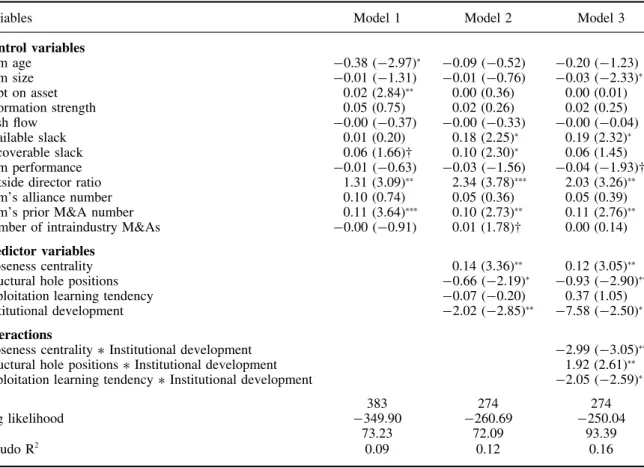
Table 3. Negative binomial regressions on M&A activities
Variables Model 1 Model 2 Model 3
Control variables Firm age −0.38 (−2.97)∗ −0.09 (−0.52) −0.20 (−1.23) Firm size −0.01 (−1.31) −0.01 (−0.76) −0.03 (−2.33)∗ Debt on asset 0.02 (2.84)∗∗ 0.00 (0.36) 0.00 (0.01) Information strength 0.05 (0.75) 0.02 (0.26) 0.02 (0.25) Cash flow −0.00 (−0.37) −0.00 (−0.33) −0.00 (−0.04) Available slack 0.01 (0.20) 0.18 (2.25)∗ 0.19 (2.32)∗ Recoverable slack 0.06 (1.66)† 0.10 (2.30)∗ 0.06 (1.45) Firm performance −0.01 (−0.63) −0.03 (−1.56) −0.04 (−1.93)†
Outside director ratio 1.31 (3.09)∗∗ 2.34 (3.78)∗∗∗ 2.03 (3.26)∗∗
Firm’s alliance number 0.10 (0.74) 0.05 (0.36) 0.05 (0.39)
Firm’s prior M&A number 0.11 (3.64)∗∗∗ 0.10 (2.73)∗∗ 0.11 (2.76)∗∗
Number of intraindustry M&As −0.00 (−0.91) 0.01 (1.78)† 0.00 (0.14)
Predictor variables
Closeness centrality 0.14 (3.36)∗∗ 0.12 (3.05)∗∗
Structural hole positions −0.66 (−2.19)∗ −0.93 (−2.90)∗∗
Exploitation learning tendency −0.07 (−0.20) 0.37 (1.05)
Institutional development −2.02 (−2.85)∗∗ −7.58 (−2.50)∗
Interactions
Closeness centrality∗Institutional development −2.99 (−3.05)∗∗
Structural hole positions∗Institutional development 1.92 (2.61)∗∗
Exploitation learning tendency∗Institutional development −2.05 (−2.59)∗
N 383 274 274
Log likelihood −349.90 −260.69 −250.04
χ2 73.23 72.09 93.39
Pseudo R2
0.09 0.12 0.16
Note: Year dummy variables were included, but not reported here. Unstandardized coefficients are reported with z-values in parentheses †p <0.1;∗p <0.05;∗∗p <0.01;∗∗∗p <0.001
West (1991), we have mean-centered the predictor variables before generating interaction terms.
Hypothesis 1 argues that the level of institutional development will negatively moderate the rela-tionship between a firm’s centrality in the indus-try alliance network and its subsequent number of acquisitions. The coefficient for the interac-tion between closeness centrality and instituinterac-tional development in Model 3 is negatively significant at
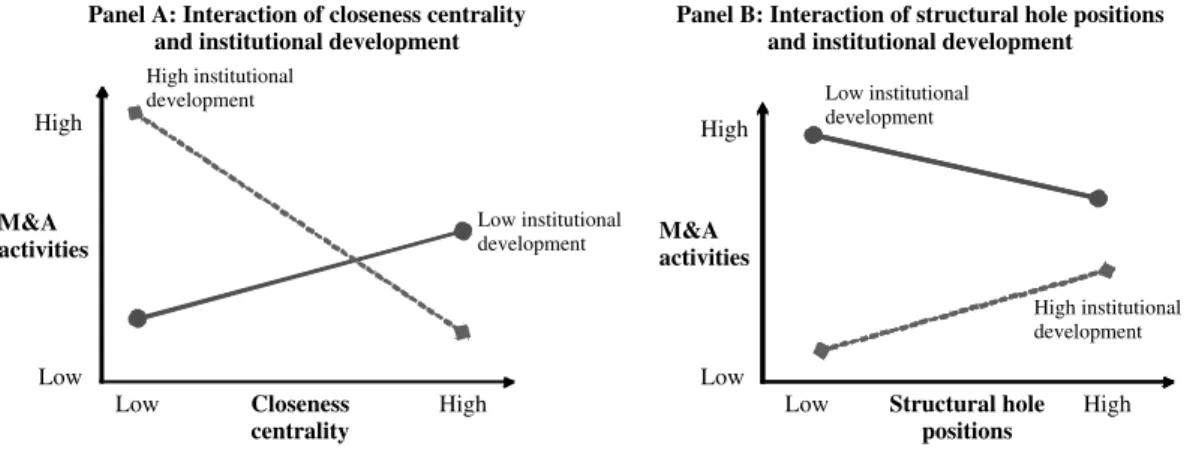
p <0.01, supporting Hypothesis 1. To gain addi-tional insights, we have further drawn the inter-action plot in Panel A, Figure 2, which shows a consistent pattern with our prediction.
Hypothesis 2 suggests that the level of insti-tutional development will positively moderate the relationship between a firm’s structural hole posi-tions in the industry alliance network and its sub-sequent number of acquisitions. The coefficient for the interaction between structural hole posi-tions and institutional development in Model 3
is positively significant at p <0.01, supporting
Hypothesis 2. The interaction graph in Panel B, Figure 2 lends further support to our prediction.
Hypothesis 3 examines the negative moderating effect of institutional development on the relation-ship between a firm’s exploitation learning ten-dency and its subsequent number of acquisitions. The coefficient for the interaction between ex-ploitation learning tendency and institutional development in Model 3 is negatively significant at
p <0.05 in support of Hypothesis 3. The interac-tion graph in Panel C, Figure 2 reports consistent findings for our regression analysis.
Overall, all three hypotheses have been sup-ported. The findings suggest that a joint consider-ation of both network embeddedness and learning helps to understand the drivers behind firms’ M&As, and that such drivers differ systemati-cally between the United States and China due to their distinctive levels of market-based institutional development.
Panel A: Interaction of closeness centrality and institutional development
Closeness centrality Low institutional development M&A activities High Low Low High High institutional development M&A activities High Low Structural hole positions Low High Low institutional development High institutional development Panel B: Interaction of structural hole positions
and institutional development
M&A activities High Low Exploitation learning tendency Low High Low institutional development High institutional development Panel C: Interaction of exploitation learning tendency
and institutional development
Figure 2. Interaction plots
Post hoc robustness checks
In the previous analysis, our dependent variable is theoverall M&As initiated by a focal firm in each year, including the targets of both prior alliance partners and non-alliance partners in the industry alliance network. In addition, the above regres-sions are based on a combined dataset, including both China and U.S. data. To gain deeper insights into M&A behavior, we conduct separate analysis in each institutional setting, and also compare the pattern of overall M&As with that of non-partner M&As, which refer to the acquisitions of those firms in the electronics industry alliance network that do not have direct prior alliance relationships with the focal firm. According to our theoreti-cal framework, we may also be able to predict that a focal firm’s network positions and learning tendency can have a bearing on the acquisitions of indirect partners in the industry network, but with decreasing power due to an increased distance between the focal firm and its targets.
Such an exercise has two useful contributions. First, our study extends the dyadic approach in prior research (Wang and Zajac, 2007) and adopts a
network approach, which contends that the sphere of network influence extends to both direct and indirect partners (or targets) in the industry net-work through access, timing, and referrals (Burt, 1992). Second, although we argue that the same hypothesized relationships will still hold for the acquisitions of indirect partners, the magnitude of these hypothesized relationships may be less when firms are loosely connected through intermediates (Burt, 2007).
To test this argument, we conduct a subsample analysis for the overall M&As versus non-partner M&As in two institutional settings respectively (Table 4). For the U.S. subsample, the significance levels are reduced for all the predictors in terms of
z-values. In the China subsample, the weakening
effect becomes more prominent. The predictor of closeness centrality becomes nonsignificant, and the significance level of structural hole positions is also reduced. This interesting contrast suggests that compared with the United States, the institutional environment in China may further dampen the efficiency of the M&A process for indirect and thus distant partners.
Ta b le 4 . Post hoc analysis on the comparison o f overall M&As vs . non-partner M &As in two institutional settings Va ri ab le s D V = Overall M &As D V = Non-partner M &As U.S. Model C hina Model U .S. Model C hina Model Contr o l variables Firm age − 0.34 ( − 2.19) ∗ − 0.32 ( − 1.27) − 0.20 ( − 0.81) − 0.14 ( − 0.57) − 0.34 ( − 2.14) ∗ − 0.31 ( − 1.16) − 0.43 ( − 1.27) − 0.35 ( − 1.02) Firm size 0.00 (0.05) − 0.02 ( − 1.44) − 0.01 ( − 0.03) 0.15 (0.88) 0.00 (0.08) − 0.02 ( − 1.39) 0.24 (1.10) 0.32 (1.36) Debt on asset 0 .19 (0.42) 1.57 (2.97) ∗∗ 0.00 (0.48) 0.00 (0.42) − 0.34 ( − 0.65) 0 .97 (1.46) 0.01 (0.57) 0.01 (0.46) Information strength 0.16 (0.72) 0.48 (1.30) − 0.01 ( − 0.05) 0.02 (0.16) 0.13 (0.57) 0.55 (1.30) 0.15 (1.01) 0.17 (1.15) Cash flow − 0.04 ( − 2.27) ∗ − 0.02 ( − 1.38) 0.01 (0.49) − 0.00 ( − 0.17) − 0.04 ( − 2.35) ∗ − 0.03 ( − 1.38) − 0.01 ( − 0.52) − 0.02 ( − 0.69) A v ailable slack 0.09 (1.75)† 0 .22 (2.91) ∗∗ 7.08 (0.43) 17.77 (1.11) 0.12 (1.99) ∗ 0.25 (2.80) ∗∗ 26.31 (1.35) 31.52 (1.56) Recoverable slack 0.08 (2.68) ∗∗ 0.03 (0.82) − 0.09 ( − 0.08) − 0.27 ( − 0.22) − 0.01 ( − 0.11) − 0.07 ( − 0.46) 2.05 (1.56) 1.08 (0.74) Firm performance 0.05 (0.21) − 0.28 ( − 1.08) − 0.04 ( − 1.41) − 0.05 ( − 1.78)† 0 .10 (0.37) − 0.19 ( − 0.62) − 0.03 ( − 0.80) − 0.04 ( − 1.07) Outside d irector ratio 1.41 (3.16) ∗∗ 1.59 (2.40) ∗ 3.32 (2.45) ∗ 3.11 (2.20) ∗ 1.59 (3.32) ∗∗ 1.99 (2.55) ∗ 3.88 (2.14) ∗ 2.99 (1.58) Firm ’s alliance number − 0.15 ( − 0.24) − 1.61 ( − 1.22) 0.18 (1.07) 0.01 (0.08) − 0.08 ( − 0.12) − 1.81 ( − 1.21) − 0.14 ( − 0.55) − 0.21 ( − 0.76) Firm’s prior M &A number 0.16 (4.89) ∗∗∗ 0.15 (3.46) ∗∗ 0.10 (1.11) 0.03 (0.29) 0.16 (4.56) ∗∗∗ 0.15 (2.91) ∗∗ 0.23 (2.04) ∗ 0.17 (1.48) Number of intraindustry M& As 0.01 (2.39) ∗ 0.00 (0.02) − 0.01 ( − 2.09) ∗ 0.00 (0.27) 0.01 (2.36) ∗ − 0.00 ( − 0.12) − 0.02 ( − 2.60) ∗∗ − 0.01 ( − 1.30) Pr edictor variables Closeness centrality − 2.88 ( − 2.33) ∗ 0.14 (2.94) ∗∗ − 3.34 ( − 2.24) ∗ 0.05 (0.70) Structural hole positions 1.26 (2.15) ∗ − 0.99 ( − 2.49) ∗ 1.24 (1.82)† − 1.02 ( − 1.92)†
Exploitation learning tendency
− 1.71 ( − 2.80) ∗∗ 0.25 (0.63) − 1.50 ( − 2.00) ∗ − 0.20 ( − 0.36) N 262 153 121 121 262 153 121 121 Log likelihood − 173.24 − 84.49 − 162.21 − 155.69 − 165.02 − 79.68 − 86.99 − 84.95 χ 2 56.16 60.18 16.96 29.99 54.11 49.90 21.00 25.07 Pseudo R 2 0.14 0.26 0.05 0.09 0.14 0.24 0.11 0.13 Note: Y ear dum m y var iables w er e included, but not re por ted h er e. Unsta ndar d ized coef ficients ar e re por ted w ith z-values in par entheses † p< 0 . 1; ∗p< 0 . 05; ∗∗ p< 0 . 01; ∗∗∗ p< 0 . 001
DISCUSSION
Overall, this study has shown how a focus on networks, learning, and institutional factors may significantly advance our understanding of the drivers behind M&As. These drivers have rarely been jointly examined. Some previous studies have focused on the construct of tie embedded-ness (Gao, Xu, and Yang, 2008; McEvily and Marcus, 2005; Peng and Luo, 2000) or the role
of acquisition experience (Haleblian et al., 2006;
Hayward, 2002), and others have focused on
the context of emerging economies (Hitt et al.,
2004; Meyer et al., 2009; Peng et al., 2008). Our
study extends these lines of research not only by examining key aspects of network embedded-ness constructed from real industry alliance net-works, but also by considering learning as mul-tidimensional in nature and reflected through a firm’s prior alliance relations. Most importantly, we contrast the market-based institutional influ-ences from two distinctive environments, while linking them through the common thread of the resource dependence perspective.
Contributions
At least four contributions emerge. First, this arti-cle offers a unique perspective to understand firms’ M&A activities by focusing on important relational and behavioral drivers, which have been largely underemphasized in the literature (Cartwright and Schoenberg, 2006). M&As do not occur in isola-tion from their social context. Although an atom-istic or dyadic approach of M&A research has its contributions, a network approach helps us capture a broader picture of this critical strategic behavior. Our study shows that firms’ structural character-istics such as closeness centrality and structural hole positions in their industry alliance network may have different implications for their subse-quent acquisitions.
In addition, considering the previous alliance behavior of a potential acquirer is a sensible exten-sion that has been suggested in the literature, but with relatively scant empirical research. In this study we build on the work of March (1991) and Koza and Lewin (1998) and link learning with a firm’s prior alliance behaviors. Specifi-cally, we differentiate two types of learning (explo-ration vs. exploitation) in alliances and find that firms’ acquisition decisions are not only affected
by their network attributes, but also informed by their learning tendencies in alliances.
Second, this study has responded to the calls
issued by Meyer et al. (2009), Peng (2003), and
Peng et al. (2008) for more rigorous research on the role of institutional environments. In particu-lar, we have moved beyond mere descriptions of their differences by exploring how they may mod-erate the roles of network embeddedness and firms’ learning in relation to M&As. The institutional aspects of M&As have often been assumed, but seldom tested and contrasted between a developed economy and an emerging economy. This study contributes to both the acquisition literature and the comparative management literature by system-atically exploring the role of institutional devel-opment across U.S. and Chinese settings. We have not only shown the existence of differences in their macro institutional environments, but also demon-strated how such differences may affect M&As. It has long been argued that firm growth strate-gies such as M&As differ significantly between the United States and China (Peng and Heath, 1996), but how specifically do they differ? To our knowledge, systematic and comparative investiga-tion drawing from the same underlying theoret-ical framework while comparing and contrasting a developed economy and an emerging economy has rarely been attempted. Our efforts, thus, paint the broad contours of an institution-based view
of M&As (Penget al., 2008). In some sense, our
study has also shed light on the debate regarding the applicability of Western theories in emerging economy settings, as we have not only revealed the differences but more importantly the potential for bridges (Li and Peng, 2008; Tsui, 2007).
Third, this study has taken one step forward in expanding the influence of social network research by using real, firm-level strategic alliance and learning data to shed light on how social net-works and learning affect acquisitions. This rep-resents significant progress above and beyond the limited number of previous studies on the link between social networks and acquisitions, which have almost exclusively focused on interlocking directorates (Haunschild and Beckman, 1998).
Fourth, this study has useful implications for related areas of research. For example, our theo-retical framework and methodology can be readily applied to research on strategic network dynam-ics by treating firms as adaptive learning
2007; Lin et al., 2008; Osborn and Hagedoorn, 1997). Further, our perspective can help advance knowledge transfer research given that knowledge transfer is fundamentally the result of intra- and interfirm interactions of firms’ past experiences, while subject to the influence of the environment
(Arya and Lin, 2007; Lu et al., 2008; van Wijk,
Jansen, and Lyles, 2008).
The contributions from this study also have important implications for practitioners. Our study advises firms to better understand the impact of their institutional environment, and to know when and how to leverage their network positions and prior experiences for strategic advantages. Under-standing these systematic differences will be cru-cial not only for U.S. firms acquiring Chinese targets (Cooke, 2006; Peng, 2006; Tong and Li, 2008), but also for Chinese firms eyeing U.S. targets (Yamakawa, Peng, and Deeds, 2008; Yiu
et al., 2007).
Limitations and future research directions The limitations of this study offer opportunities for future improvement. First, for accuracy and simplicity we have only studied one industry in both the United States and China. Caution should be exercised in generalizing our findings to other industries. Second, while we have striven to obtain comparable measures across U.S. and Chinese set-tings, there are also disparities due to discrep-ancies between accounting systems, which may affect some control variables such as cash flow. We believe that our overall findings focusing on alliances and acquisitions should not be biased due to this accounting difference. Third, although the index for exploitation learning tendency has recog-nized the simultaneous existence of exploratory and exploitative alliances, it has been compiled into a single dimension measure for simplify-ing purposes. Future studies may examine both exploration and exploitation as two independent constructs.
CONCLUSION
This study, as a first comparative attempt of its kind, departs from previous work on M&As by examining both the roles of firms’ alliance net-work embeddedness and their alliance learning,
and contrasting their effects across two institu-tional settings. In conclusion, our findings suggest that relational, behavioral, and institutional fac-tors are not only important, but also promising for future research on M&As in the United States, China, and potentially around the world.
ACKNOWLEDGEMENTS
We thank Associate Editor Steve Tallman and the two reviewers for excellent guidance. We also appreciate the editing help from Amanda Besch. This research was supported in part by the National Science Foundation (CAREER SES 0552089) and the Research Grants Council of the Hong Kong Special Administrative Region, China (CityU 1414/06H). An earlier version of the paper was presented at the Strategic Management Society Special Conference on China Strategies, Shanghai, 28–30 May 2007. The views expressed are those of the authors and not those of the sponsors.
REFERENCES
Aiken LS, West SG. 1991.Multiple Regression: Testing
and Interpreting Interactions. Sage Publications: Newbury Park, CA.
Arya B, Lin Z. 2007. Understanding collaboration
outcomes from an extended resource-based view perspective: the roles of organizational characteristics,
partner attributes, and network structures. Journal of
Management 33(5): 697 – 723.
Baldwin TT, Bedell MD, Johnson JL. 1997. The social fabric of a team-based MBA program: network effects
on student satisfaction and performance. Academy of
Management Journal 40(6): 1369 – 1397.
Barkema HG, Vermeulen F. 1998. International expan-sion through start-up or acquisition: a learning
per-spective. Academy of Management Journal 41(1):
7 – 26.
Baum JAC, Li SX, Usher JM. 2000. Making the next move: how experiential and vicarious learning shape
the locations of chains’ acquisitions. Administration
Science Quarterly 45(4): 766 – 801.
Beckman CM, Haunschild PR. 2002. Network learning: the effects of partners’ heterogeneity of experience
on corporate acquisitions. Administrative Science
Quarterly47(1): 92 – 124.
Birkinshaw J, Gibson C. 2004. Building ambidexterity
into an organization.MIT Sloan Management Review
45(4): 47 – 55.
Boisot M, Child J. 1996. From fiefs to clans and network capitalism: explaining China’s emerging
economic order. Administrative Science Quarterly
Borgatti SP, Evereff MG, Freeman LC. 2002. Ucinet 6 for Windows: Software for Social Network Analysis. Analytic Technologies: Harvard, MA.
Brass DJ. 1984. Being in the right place: a structural analysis of individual influence in an organization. Administrative Science Quarterly 29: 518 – 539. Bromiley P. 1991. Testing a causal model of corporate
risk taking and performance.Academy of Management
Journal 34(1): 37 – 59.
Burt RS. 1992. Structural Holes. Harvard University
Press: Cambridge, MA.
Burt RS. 2002. Bridge decay. Social Networks 24:
333 – 363.
Burt RS. 2007. Secondhand brokerage: evidence on the importance of local structure for managers, bankers,
and analysts.Academy of Management Journal50(1):
119 – 148.
Burt RS, Hogarth RM, Michaud C. 2000. The social
cap-ital of French and American managers.Organization
Science 11(2): 123 – 147.
Cartwright S, Schoenberg R. 2006. Thirty years of mergers and acquisitions research: recent advances and
future opportunities. British Journal of Management
17: S1 – S5.
Cheng JLC, Kesner IF. 1997. Organizational slack and response to environmental shifts: the impact of
resource allocation patterns. Journal of Management
23(1): 1 – 18.
Contractor F, Lorange P. 1988. Why should firms cooperate? The strategy and economics basis for
cooperative ventures. In Cooperative Strategies in
International Business, Contractor F, Lorange P (eds). Lexington Books: Lexington, MA; 3 – 30.
Cooke FL. 2006. Acquisitions of Chinese state-owned enterprises by multinational corporations: driving
forces, barriers and implications for HRM. British
Journal of Management 17: S105 – S121.
Das TK, Teng BS. 2000. Instabilities of strategic
alliances: an internal tensions perspective.
Organi-zation Science 11(1): 77 – 101.
Dikova D, Witteloostuijn AV. 2007. Foreign direct
investment mode choice: entry and establishment
modes in transition economies. Journal of
Inter-national Business Studies38(6): 1013 – 1033. Dunning J, Lundan SM. 2008. Institutions and the OLI
paradigm of the multinational enterprise.Asia Pacific
Journal of Management 25(4): 573 – 593.
Dyer JH. 1997. Effective interfirm collaboration: how firms minimize transaction costs and maximize
transaction value. Strategic Management Journal
18(7): 535 – 556.
Earley PC. 1989. Social loafing and collectivism: a comparison of the United States and the People’s
Republic of China. Administrative Science Quarterly
34(4): 565 – 581.
Folta TB, Miller KD. 2002. Real options in equity
partnerships. Strategic Management Journal 23(1):
77 – 88.
Freeman LC. 1979. Centrality in social networks:
con-ceptual clarification.Social Networks1(3): 215 – 239.
Gao S, Xu K, Yang J. 2008. Managerial ties, absorptive
capacity, and innovation. Asia Pacific Journal of
Management 25(3): 395 – 412.
Gnyawali DR, Madhavan R. 2001. Cooperative networks and competitive dynamics: a structural embeddedness
perspective. Academy of Management Review 26(3):
431 – 445.
Gold T, Guthrie D, Wank D. 2002.Social Connections in
China: Institutions, Culture, and the Changing Nature of Guanxi. Cambridge University Press: New York. Granovetter M. 1985. Economic action and social
structure: the problem of embeddedness. American
Journal of Sociology91(3): 481 – 510.
Gulati R, Gargiulo M. 1999. Where do
interorganiza-tional networks come from? American Journal of
Sociology104(5): 1439 – 1493.
Gulati R, Singh H. 1998. The architecture of cooperation:
managing coordination costs and appropriation
concerns in strategic alliances.Administrative Science
Quarterly43(4): 781 – 814.
Gupta AK, Smith KG, Shalley CE. 2006. The interplay
between exploration and exploitation. Academy of
Management Journal 49(4): 693 – 706.
Haleblian JJ, Kim JYJ, Rajagopalan N. 2006. The influ-ence of acquisition experiinflu-ence and performance on acquisition behavior: evidence from the U.S.
com-mercial banking industry. Academy of Management
Journal 49(2): 357 – 370.
Haunschild PR. 1993. Interorganizational imitation: the impact of interlocks on corporate acquisition activity. Administrative Science Quarterly 38(4): 564 – 592. Haunschild PR, Beckman CM. 1998. When do interlocks
matter? Alternate sources of information and interlock
influence. Administrative Science Quarterly 43(4):
815 – 844.
Hayward MLA. 2002. When do firms learn from their acquisition experience? Evidence from 1990 – 1995. Strategic Management Journal 23(1): 21 – 39. Hitt MA, Ahlstrom D, Dacin MT, Levitas E,
Svobod-ina L. 2004. The institutional effects on strategic alliance partner selection in transition economies:
China vs. Russia. Organization Science 15(2):
173 – 185.
Hitt MA, Harrison JS, Ireland RD. 2001. Mergers
and Acquisitions: A Guide to Creating Value for Stakeholders. Oxford University Press: New York. Jensen MC. 1986. Agency costs of free cash flow,
corporate finance, and takeovers.American Economic
Review 76(2): 323 – 329.
Keister LA. 1998. Engineering growth: business group structure and firm performance in China’s transition
economy. American Journal of Sociology 104(2):
404 – 440.
Keister LA. 2009. Organizational research on market
transition: a sociological approach. Asia Pacific
Journal of Management 26: (in press). DOI:
10.1007/s10490-008-9113-4.
Kleinbaum DG, Kupper LL, Muller KE. 1988. Applied
Regression Analysis and Other Multivariable Methods. PWS Publishing: Boston, MA.
Kogut B. 1988. A study of the life cycle of joint