by Jenny Root November, 2012 Director of Thesis: Dr. Kathi Wilhite
Major Department: Special Education, Foundations, and Research
The purpose of this study was to investigate the effects of tactile self monitoring of attention on off task behavior by students with Intellectual Disabilities and Autism in the self contained setting during independent tasks. Adolescents with Intellectual Disabilities and Autism
demonstrate significant deficits in self management as demonstrated by off task behavior. The participants of the study were three public middle school students ages 12-13 with Intellectual Disabilities and Autism who receive all academic instruction in a special education classroom. The participants all displayed significant amounts of off-task behavior during baseline, including getting out of their seats, talking with or interrupting others, looking around the classroom at items not related to the task, not working on assigned tasks, engaging in bodily movements unrelated to or interfering with the assigned task or using materials for purposes other than completing the assigned task. A tactile self monitoring intervention was implemented using a multiple baseline design across three tasks. The independent tasks included reading, math, and vocational activities. The tactile self monitoring of attention was successful in decreasing the amount of time spent off task during independent work activities.
Tactile Self Monitoring Of Attention to Decrease Off-Task Behavior of Adolescents with Intellectual Disabilities and Autism
A Thesis
Presented to the Faculty of the Department of Special Education, Foundations, and Research East Carolina University
In Partial Fulfillment of the Requirements for the Degree Masters of Arts in Education Special Education
by
Jenny Root November, 2012
Tactile Self Monitoring to Decrease Off-Task Behavior of Adolescents with Intellectual Disabilities and Autism
Jenny Root APPROVED BY: DIRECTOR OF THESIS: ________________________________________________________ Kathi Wilhite, Ed D COMMITTEE MEMBER:________________________________________________________ Sandra Warren, PhD COMMITTEE MEMBER:________________________________________________________ Louis Warren, Ed D COMMITTEE MEMBER:________________________________________________________ Guili Zhang, PhD CHAIR OF THE DEPARTMENT OF SPECIAL EDUCATION, FOUNDATIONS, AND
RESEARCH
______________________________________________________________________________ Alana Zambone, PhD DEAN OF THE GRADUATE SCHOOL
______________________________________________________________________________ Paul Gemperline, PhD
Abstract………...i Title Page………....iii Copyright Page………...…iv Signature Page……….v List of Tables……….vii List of Figures………...viii Chapter I: Introduction……….1
Chapter II: Review of the Literature ………...…………4
Chapter III: Methods………..…………11
Chapter IV: Results………..…………..16
Chapter V: Discussion……….…………..20
References………..………24
Tables………27
Figures………..…………..33
Appendix A: IRB Approval Letter……….…………...39
Appendix B: IRB Informed Consent Letter………..………….40
Appendix C: IRB Informed Assent Script……….………42
List of Tables
Table 1: Literature Review Table……….27
Table 2: Elizabeth’s Percentage of Off Task Behavior………30
Table 3: Bobby’s Percentage of Off Task Behavior……….31
Figure 1: Student Self Graphing Form………..33
Figure 2: Observer Data Recording Form………34
Figure 3: Treatment Fidelity Checklist……….35
Figure 4: Elizabeth’s Graphs of Off Task Behavior ……….36
Figure 5: Bobby’s Graphs of Off Task Behavior………..37
The current accepted description of persons with Intellectual Disabilities is that they have limitations in mental functioning and adaptive skills. Simeonson, Granlund, and Bjorck-Akesson (2006) stated that adaptive behavior is not a separate component of an Intellectual Disability, but an expression of underlying cognitive ability due to the fact that correlation between measures of intelligence and adaptive behavior is generally high (2006, p. 253). A person who has an
Intellectual Disability has an IQ that is two or more standard deviations away from the mean as well as adaptive deficits that originate prior to the age of 18 (CEC, 2011). Autism Spectrum Disorders are related to neurological dysfunctions of an unknown origin (Bailey, Phillips, & Rutter, 1996). Autism Spectrum Disorders are characterized by deficits in communication, social skills, and repetitive or stereotypic behaviors, rituals, or interests. According to the CDC, 46% of individuals with Autism Spectrum Disorders also have an Intellectual Disability (CDC, 2009).
With the passing of the Education of the Handicapped Act of 1970 and subsequent amendments of the Individuals with Disabilities Education Act, students with Intellectual
Disabilities and Autism have the chance to be served in resource or general education classrooms versus self contained settings. IDEA intends for students with disabilities to be educated in the least restrictive environment to the maximum extent appropriate (Wehmeyer et al., 2002). Case law has shaped the conceptualization of appropriate, and determined that the impact of a
student’s behavior on their education and that of their classroom peers must be taken into
account when considering the least restrictive environment (Hartmann v. Loudoun County Bd of Ed, 1997; Devries v. Fairfax County Sch. Bd. 1989). Regular education classes typically have a higher teacher to student ratio which means students do not receive individual monitoring and prompting as frequently (NC School Report Card, 2011). Students who are able to monitor their
2 behavior and display few off-task behaviors are going to be able to participate in the general curriculum in a less restrictive environment. Roberts (2002) stated that off-task behavior is one of the most common reasons for referral to school administrators, and these behaviors may be used by students to fulfill multiple functions.
Students with Intellectual Disabilities (ID) have difficulties deciding what aspect of the environment should be attended to and what action should be taken under a certain condition (Westling & Fox, 2009). Research has also shown that students with Autism process and
categorize aspects of the environment in a different manner than their typically developing peers (O’Brien & Daggett, 2006). A defining characteristic of Autism is deficits in social skills (APA, 1994). Similarly, students with ID often display social skills deficits which may result in them arguing, pestering, showing off to peers and adults, or displaying other off-task behaviors for attention or praise (Hardman, Drew, & Egan, 1999). Students with ID may also have difficulty understanding both the function and the consequence of their behaviors. Carr and colleagues (1999) found that challenging behaviors, including time spent off-task, are barriers to
participation in the general education classroom.
Self management is considered to be a vital academic and vocational skill. However, not all students are able to self-regulate their academic productivity, attention to task, and off-task behavior. For many students with ID, it is the inability to manage their impulses and stay on task, in addition to their level of cognitive functioning, which inhibits them from reaching their academic potential. The altered cognition of persons with Autism results in difficulties with attention and information processing. Overselectivity of attention is a characteristic of persons with Autism which also makes staying on task difficult (Quill, 2000). The focus population for
3 this study is students with ID and Autism due to their characteristic inability to sustain attention to task and marked achievement differences from same aged peers (Hughes & Boyle, 1991).
For these students, self-management needs to be explicitly taught. Self-monitoring has been proven to be an effective start to self-management (Argan et. al, 2005; Hughes & Boyle, 1991). Self-monitoring generally consists of two processes: self-assessment and self-recording. When self-assessing, students are taught to ask themselves whether or not they are doing the targeted behavior. Common targeted behaviors in self-monitoring research include on-task behavior, academic accuracy, and academic productivity (Holifield et al., 2010; Harris et al., 2005; Amato Zech et al., 2006).
The methods of self-monitoring have been varied, but students consistently have had to receive a prompt in order to self-monitor. The traditional prompt has been an auditory cue delivered to the entire class or via headphones to individual students. Auditory cues have been criticized by Maag, Rutherford, and Digangi (1992) and Amato-Zech, Hoff, and Dopeke (2006) as being intrusive, stigmatizing, and difficult to implement. Alternatives to the auditory cue are physical prompting by a teacher (Maag, Rutherford, and Digangi 1992), verbal prompting by a teacher (Holifield et al. 2010) or the use of a tactile cue (Amato-Zech et al., 2006). See table 1 for more research regarding self monitoring of students with ID.
The social importance of self management has been examined by many researchers (Lannie & Martens 2008; Maag, Rutherfod & Digangi, 1992; Harris et al. 2005). By comparing the treatment effects on students with disabilities to those on students without disabilities, researchers have found that self-monitoring can result in comparable performance to grade-level peers for students with disabilities for on-task behavior (Maag et al. 1992).
task behavior for adolescent students with Intellectual Disabilities and Autism in the self contained setting during independent academic activities. Self-monitoring has been proven to lead to increased time on-task which will result in less off-task behaviors. My study will answer the research question: Will tactile self monitoring of attention decrease off task behaviors of adolescent students with Intellectual Disabilities and Autism during independent academic tasks?
Chapter Two Literature Review On-task Behavior
Amato-Zech, Hoff, & Doepke (2006) used the MotivAider as a tactile self-monitoring cue in lieu of the more noticeable and intrusive prompts such as chimes or verbal cues which involve tones that were common practice in previous research. The authors argued that the MotivAider would be much easier to use in the classroom because it did not require the teacher to interrupt the lesson and as a portable cue it had potential for use outside of the classroom. In an ABAB reversal design, they used the MotivAider to monitor attention on a 15second partial interval recording system. The participants had dual diagnosis of speech/language impairment and specific learning disabilities or severe emotional disturbances and received services in a self-contained elementary classroom. When the fifth grade students felt the pulsing vibration, they checked “yes” or “no” after being trained to “observe and record” in previous sessions (p. 215). The study began with one minute cues, however researchers felt that it was too frequent and therefore hindered the students from their work. Upon reflection, the interval changed to three minutes. Results showed a 30% jump for on task behavior to above 90%. A return to baseline showed the treatment control with a steady return to baseline and immediate on-task increase
5 with the second intervention. Treatment acceptability ratings by classroom personnel were high meaning it was rated as beneficial to the student and easy to implement.
On-Task Behavior and Academic Accuracy
Harris, Friedlander, Saddle, Frizzelle, & Graham (2005) conducted a counterbalanced multiple baseline across participants study to examine differential effect that self monitoring of attention and self monitoring of performance may have on on-task behavior in the general education classroom. Participants were third- to fifth-grade students who had a medical diagnosis of ADHD for which they were on medication and received spelling instruction in the general education classroom. The observations and monitoring did not begin until five minutes into the spelling activity to give the students time to transition. Students were trained to self-monitor their attention by asking “Was I on task?” when they heard a tone via earphones at random intervals, with an average of 45 seconds during a regularly scheduled spelling time daily. Students self-recorded by marking in a “yes’ or “no” column, and graphing the number of times they chose yes at the end of the session. Students were taught to self monitor progress by counting the number of times spelling words had been practiced since the last tone and graph at the end of the period. Graphing was in included in both conditions to control for any
motivational feedback. Harris et al. (2005) found that both self-monitoring of attention and self- monitoring of progress had positive effects on on-task behavior, with little difference between the two conditions. Researchers gave no “official” measure of accuracy of self-recording of attention or performance because they relied on previous research findings that a high degree of accuracy is not needed for a positive effect.
DiGangi, Maag, and Rutherford (1991) also studied the effects of self-monitoring and self-graphing on on-task behavior and academic accuracy on students with learning disabilities
6 (LD) in the general education classroom. The two elementary students had IQ scores between 85 and 115 and were at least two years below grade level in more than one academic area. Self- monitoring was employed during independent math work in the general education classroom. Using a single-subject multiple-treatment design, on-task behavior was measured using time sampling at intervals of ten seconds for a total of sixty observations per session. Baseline on-task behavior was collected over a five day period before the treatment began. In the self-monitoring phase, students asked themselves “Was I paying attention” when they heard the auditory cue through headphones. They marked a tally under “yes” or “no” and resumed their independent work at the sound of a second tone. In the next phase, procedures in the self-monitoring were continued while students plotted the number of tallies from the “yes” column. In a third phase, students were instructed to self-reinforce by telling themselves “I did a really good job” (p. 223). Finally, they were taught to self-evaluate by judging whether or not they did a “really good job” by having eight to ten tally marks or “I did ok” if there were four to seven marks (p. 223). The self-monitoring and self-graphing phases were faded, at which point students were instructed to continue self-reinforcement and self-evaluation. Researchers proposed this phase as maintenance rather than the absence of an intervention. Results of this study showed that self-monitoring paired with self-graphing increased on-task behavior but had minimal impact on academic accuracy. Self-reinforcement and self-evaluation had no positive effect on on-task behavior or academic accuracy. During the fading phase, the treatment gains were maintained.
The effectiveness of self-monitoring on on-task behavior and academic accuracy are not limited to students with disabilities in the general education classroom. Rooney, Polloway, and Hallahan (1985) based their study of self-monitoring with students who had low IQs and LD on
7 the question: If on-task behavior is increased, does academic achievement also increase? (p. 384) To answer the question, ten students in a self contained elementary classroom with diagnosis of learning disabilities and a mean IQ of 76 were taught to self-monitor their on-task behavior and academic achievement. Using a ten second interval time sampling procedure, observers noted whether or not participants were on-task. An ABACACA design was used the entire fifteen minute session for a total of 60 observation sessions. The two alternating treatments were self- monitoring of attention and self-monitoring of math accuracy, which were each randomly conducted twice each week. At the sound of a tape recorded tone, students used a self-recording sheet and asked themselves if they were paying attention, and recorded an answer in the
appropriate “yes” or “no” columns.
In the self-monitoring of math accuracy phase, student worksheets had a visual signal every few math problems that would signal them to stop and check to see if their answer to that problem was correct. The student marked in the appropriate “yes’ or “no” columns. In the combination treatment phase, self-monitoring of attention and self-monitoring of accuracy were employed simultaneously. When the participant heard the tone, they asked themselves if they were paying attention and self recorded in the appropriate column. The visual cue remained on the worksheet but students did not self-record accuracy in the combination treatment. Results of the study indicated that the combination of self-monitoring attention and self-monitoring
accuracy correlated with an improvement in the amount of on-task behavior for all participants. When looking at academic achievement, a significant relationship was found between number of problems completed and time on task. Rooney, Polloway, and Hallahan suggested that the design of a self monitoring program must meet the needs of the individual students based on their disabilities. They found that lower functioning students need more training before
8 treatment begins, and that multiple strategies may increase the effectiveness of self-monitoring for these students.
Such scaffolded self-monitoring was employed by Holifield, Goodman, Hazelkorn, & Heflin (2010) when they studied the effectiveness of a self-monitoring procedure on increasing attending to task and academic accuracy in a self-contained classroom with two male elementary students with mild-moderate autism and IQs of 39 and 60 and scores of 45 and 46 on the
Childhood Autism Rating Scale (CARS). Students were given self-monitoring sheets before independent seatwork in each content area. Initially they were prompted to start assignment, to self-monitor and record, and return to task through verbal and gesture prompts. Both participants quickly picked up on the procedures and were able to self-monitor independently when cued after six days. This study supported previous research that academic accuracy and on task behavior increase during self monitoring. Both participants had low levels of attending to task prior to treatment which stabilized to higher levels following treatment. This study supported the theory that self-monitoring was equally effective for those with emotional behavioral disorders, Autism, low IQs, and learning disabilities.
On-Task Behavior and Productivity
Maag, Rutherford, & Digangi (1992) also used a prompt which was less invasive and noticeable than the standard auditory cue. The 2nd, 4th, and 6th grade participants were taught to ask “Am I working on the assignment?” when touched on the shoulder by an assistant teacher. All students in the class were used to the assistant teacher circulating around the room, which made the physical prompt naturalistic. The students were taught to self-record, either by circling smiling/frowning faces or making tallies under “on-task” or “off-task” column depending on their grade level (p. 159). After each session, students added up tally marks and received verbal
9 reinforcement contingent upon an increase over the previous session’s performance. In the second phase, students and teachers worked together to set goals, which when met were reinforced with verbal praise. The addition of goal setting to contingent reinforcement also showed improvement in on-task behavior. Goal setting resulted in the largest gains across all subjects as far as academic productivity. This study did not measure academic accuracy, instead relying on previous research which found self-monitoring on-task behavior had greater effects on productivity than accuracy.
Self-monitoring on-task behavior and productivity has proven effective for students with ID. Hughes and Boyle (1991) studied the effects of self-monitoring on on-task behavior and task productivity with lower functioning elementary students in a multiple baseline across behaviors design. Their participants were three elementary students with IQs ranging from 39 to 42. In a self-contained classroom in southeast Pennsylvania, students were taught to self-monitor during prevocational sessions. Tasks involved assembling, packaging, and sorting and were completed independently. Students were considered on-task when they were actively involved in the prevocational task, and task completion was measured by determining how many products were correctly created in the 45 minute time period. Researchers used a 20 second momentary time-sampling procedure to observe each student 15 times per task for a total of 45 times per session for each student. Following training sessions, students began the first phase of self-monitoring which involved a token economy. In this phase students were instructed to ask themselves “Was I on-task” and record their answer when they heard the auditory cue. The token economy was discontinued once data trends stabilized. Researchers accounted for social validity by getting norms for rate completion from typically developing same age peers. Results of this study indicated that self-monitoring was effective in increasing on-task behavior for the participants.
10 The implications of this study are limited, however, because there were no maintenance or generalization phases.
On-Task Behavior, Productivity, and Accuracy
The effects on children’s math work during a self-monitoring program for on-task behavior, productivity and accuracy were studied by Lannie and Martens (2008). Their study was a replication of Maag et al. (1993) but conditions were sequenced in accordance with the Instructional Hierarchy. Four students in a fifth grade general education class were studied during morning math instruction with momentary time sampling of 15 second intervals. Prior to training or treatment, a reinforcement assessment survey was given to teachers. From the survey pictures of approved items were presented to students to create a pool of preferred rewards. Training sessions where students were instructed on the procedures for each condition occurred until all students were 100% proficient. In the self-monitoring on-task behavior phase,
participants were asked to do as many math problems as possible in five minutes while an audio cue was delivered via headphones to self monitor at random intervals with an average of 45 seconds. Students self-recorded by putting a mark in the appropriate column. Students had an opportunity to earn a chosen reward at the end of every session. Students also graphed their data at the end of each session. In the self-monitoring accuracy phase, the student marked the
problem they had just completed after hearing the audio cue. Students compared their answers to the answer sheet, counted number correct, and recorded it on the check list. Students resumed on an audio cue. The reward was earned based on the number of correct math problems completed. In the self-monitoring of productivity phase, the student marked the problem they just completed after an audio cue, counted the number completed and recorded the number on the checklist. Participants resumed on an audio cue. They had the opportunity to earn a choice reward in this
phase as well. On-task behavior was high during baseline for all students and remained high throughout, which made it difficult to determine treatment control. Accuracy results for all students did not show self-monitoring to be effective for increasing accuracy. Although the inclusion of rewards enhanced stimulus control, the multiple tangible rewards is not always feasible, especially in upper grades and larger classrooms.
The purpose of this study is to investigate the effects of tactile self monitoring on off task behavior for adolescent students with Intellectual Disabilities and Autism in the self contained setting during independent academic activities. Self-monitoring has been proven to lead to increased time on-task which will result in less off-task behaviors.
Chapter Three Method Participants and Setting
This study took place in a self contained classroom in a rural public middle school in south eastern North Carolina. The school serves around 780 students, with more than 60% of the population receiving free and reduced lunch and 13% of the school population having been identified as students with disabilities eligible for an Individualized Education Plan. The classroom serves students in grades six, seven, and eight. The students in the classroom are eligible for special education services in the IDEA eligibility categories of Intellectual
Disabilities, Autism, Speech Language Impairments, and Visual Impairments. The classroom has one lead teacher and two full time assistants.
Three students participated in the study. Students were eligible for participation based on their identified disabilities, present levels of off-task behavior, and desire to improve in the area of independence. Elizabeth is a twelve year old female in the seventh grade with a mild
12 contained setting as well as speech language therapy one time per week. She requires frequent redirection to task and quickly gets off topic in conversations by perseverating on topics or questions which are of interest to her. She has a strong desire to do grade level work and enjoys praise and recognition of success.
Bobby is a thirteen year old male in the sixth grade that has Noonan’s syndrome, which has caused a moderate Intellectual Disability. He also has Autism and receives extensive speech language therapy, occupational therapy, and physical therapy throughout the school day. Bobby displays frequent off task behaviors during independent and group work, including fixating on properties of academic materials, looking around the room, talking off topic, and getting out of his seat. Bobby is eager to please adults and wants to be seen as a teenager who takes on responsibility.
Isaiah is a twelve year old male in the sixth grade that has DiGeorge syndrome which has resulted in a mild Intellectual Disability. Isaiah also has Autism and receives speech language therapy two times each week. During independent work he frequently looks to adults for clarification and approval. He engages in attention seeking and task avoidant behaviors throughout the school day which include dropping items on the floor, frequently asking to get water or sharpen a pencil, and raising his hand to ask questions he already knows the answer to. Isaiah works very neatly and does a good job of following directions and learning routines.
The three independent tasks the participants completed daily were similar in format across sessions. The reading tasks involved completing phonics worksheets or independently reading short passages at their independent reading level and answering literal comprehension questions. The math tasks involved reviewing functional skills that had previously been
13 included filling out personal data sheets, typing on the computer, and working on fine motor skills through cut, color, and paste worksheets or handwriting tasks.
Confidentiality
The names used in the study are pseudonyms. No data relating to the study contains any personally identifiable information. Informed consent was obtained from the parents of all participants with an example of the form displayed in Appendixes B and C. All permanent products relating to the data obtained in this study were kept secure by the author and study staff and will be disposed of following the completion of the study and publication. The principal of the school where the study took place also gave consent, as seen in Figure D.
Experimental Design
A single subject multiple baseline design was used. This was the most appropriate design because the skill learned (self management) was not able to be unlearned. The dependent
variable (decrease in off-task behavior) is socially valid in all academic settings, therefore taking away the intervention in a regression or withdrawal design would not be ethical. The three tasks included reading, math, and vocational tasks.
Dependent Variable
The dependent variable in this study was off-task behavior. Off-task behavior was operationally defined as (a) not in seat (b) talking with others, (c) interrupting others, (d) not working on assigned task (e) engaging in bodily movements unrelated to or interfering with assigned task (f) looking around the classroom at non-task related items and/or (g) using task materials for purposes other than completing the task.
14 The independent variable in this study is tactile self monitoring. Participants clipped a vibrating timer to their waist band or put it into their pockets during the intervention phases of this study with the timer set to two minute intervals. When participants felt it vibrate, they recorded on an index card whether they were on task or off task using tally marks. Following each session which used the intervention, participants self graphed their percentage of off task behavior, which was calculated and given to them by a classroom staff member. Following the graphing, participants and teachers briefly discussed their progress.
Instrument and Materials
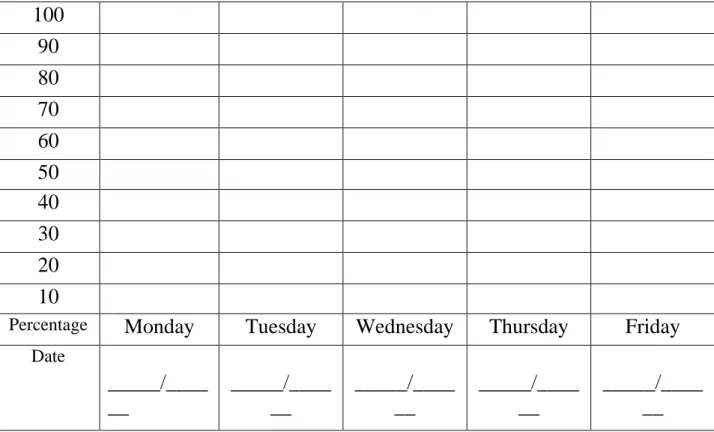
A vibrating timer was used as the tactile cue to self monitor. The timer was made by the King Arthur flour company and had the ability to give audible cues or vibrating cues. The timer had a large display and only three buttons on the face, one to start/stop the timer, one to add minutes, and one to add hours. All three participants were able to easily operate the timer after given time to practice. The participants self recorded using an index card which was taped to their desk. The card was divided in half and had “ON” printed on the top of the left side and “OFF” on the top of the right side with a line dividing the two sides. Participants used whatever writing utensil they had at their work space to make tally marks in the appropriate column. Following each work session where the tactile timer was used, the participants self graphed the percentage of off task and on task behaviors on their own graphing sheets which were kept in their student managed data folders, as seen in Figure 1. Three iPod Touches were used to video record each participant during the three daily independent work tasks.
Data Collection and Analysis
Data was taken via permanent product (video recordings) using momentary time
15 displayed off task behavior at the fifteen second interval, the behavior was recorded as off task. If the participant did not display off task behavior at the fifteen second interval, the behavior was recorded as on task. Researchers and inter rater observers used a recording sheet (as seen in Figure 2) to indicate whether the participant was on task or off task at each interval. Data was graphed using Microsoft Excel 2007. Data was collected during 8 to 10 minute work sessions three times each day, with each task being performed at the same time every day. The author served as the primary data collector and the schools’ behavior specialist collected interobserver agreement data.
Interobserver agreement data was collected for a total of 33% of all of the sessions. Interobserver agreement was calculated by dividing the total interval agreements by the total intervals observed (Kazdin, 1982). The mean percentage of overall agreements was 94% (range 90-100).
Treatment integrity was assessed through a fidelity check list which contained eleven items as seen in Figure 3. The author collected measures of treatment integrity for 40% of the sessions. Adherence to all steps of the fidelity check list occurred 94% of the time.
Procedures
Prior to implementation, a training period occurred for classroom staff, study staff, and participants. Classroom staff was trained on implementation procedures and use of the iPod Touches for video recording. The school’s behavior specialist, who was familiar with the students, special education research techniques, and observing behaviors, was trained on data recording and operational definitions of off-task behavior. Participants were trained on the following procedures: how to differentiate between on task and off task behavior using video models and scenarios before self assessment, how to use the index card, and how to program the
social stories, and individual conversations.
Baseline behavior data was taken until stabilization was met of off-task behavior, as observed via permanent product and reliability checks during all three settings (independent math task, independent reading task, and independent vocational skill task). The baseline behavior data was taken for two weeks, or a period of ten school days. Following baseline, each participant entered into phase one of the intervention, during which the intervention was
implemented in one setting. Each participant followed a different randomized sequence of independent tasks, while baseline probes continued in the remaining baseline conditions for each participant.
Once a participant met criteria for three consecutive sessions, the intervention began in a second setting while baseline probes continued in the remaining baseline condition for each participant. The criterion for all participants was off task behavior for 20% or less of the session. Once a participant met criteria on three consecutive sessions in the second setting, the
intervention began in the final setting. Following each session in which the intervention was used participants self-graphed the percent of off task events (percentage provided by teacher analysis of student recording sheet) and had a discussion with staff about their off-task behavior.
Chapter Four Results
Figures 4, 5, and 6 display the percentages of off-task behavior for the three participants. Similar results were obtained for each of the participants, although the rate at which each
participant was able to meet criteria differed. During baseline all participants displayed off task behaviors for more than 50% of the intervals, with a range of 50.1% to 65.1%. During the first phase of the intervention, each participant was able to decrease their off-task behavior to less
17 than 20% through tactile self monitoring. All three participants were also able to meet criteria in the second phase of the study, during which the tactile self monitoring intervention was
implemented in two of the three settings. Two of the participants were able to meet criteria in the second phase of the study and move onto the third phase which involved implementing the intervention in all three settings.
Table 2 displays the percentages of Elizabeth’s off task behavior in each of the tasks and phases of the study. Elizabeth’s mean percentage of off task behavior during baseline was 65.1% for the reading task, 50.1% for the math task, and 60.8% for the vocational task. During phase one of the intervention, Elizabeth used tactile self monitoring in the reading task. It took 12 sessions to reach criteria, with an average of 27.72% of off-task behavior. During this phase off task behavior in the continued baseline phases of math and vocational tasks stayed about the same with math being 54.43% and vocational task being 58.36%. In phase two of the study Elizabeth used tactile self monitoring in the math task. She was able to reach criteria in 11 sessions for an average of 28.21% of off-task behavior, while off-task behavior in the reading phase continued to meet criteria with an average of just 15.3%. In the continued baseline setting of the vocational task Elizabeth’s off task behavior stayed above criteria at 45.1%. In phase three when the intervention was implemented during all three tasks, Elizabeth’s off task behavior maintained at criteria in the reading and math tasks at 14.3% and 16.3%. She did not reach criteria during the time allotted for the study but did reduce her off task behavior in the vocational task to 23.3%.
Table 3 displays Bobby’s percentages of off task behaviors across tasks and phases of the study. Bobby’s mean percentage of off task behavior during baseline was 64.3% for the reading task, 59.8% for the math task, and 53% for the vocational task. During phase one of the
18 intervention, Bobby used tactile self monitoring in the vocational task. It took 17 sessions to reach criteria, with an average of 31.5% of off-task behavior. During this phase his off task behavior in the continued baseline phases of reading and math tasks stayed about the same with reading being 53.41% and math task being 58.4%. In phase two of the study Bobby used tactile self monitoring in the reading task. He was not able to reach criteria in the time allotted for the study. His off task behavior did decrease to an average of 33% of the intervals in the reading task while he maintained criteria in the vocational task with an average of off task behavior in 18.5% of the intervals. His off task behavior remained high in the continued baseline math task with an average of 54.11%.
Table 4 displays Isaiah’s percentage of off task behavior across tasks and phases. Isaiah’s mean percentage of off task behavior during baseline was 51.6% for the reading task, 52.4% for the math task, and 56.2% for the vocational task. During phase one of the
intervention, Isaiah used tactile self monitoring in the math task. It took 9 sessions to reach criteria, with an average of 26.3% of off-task behavior. During this phase his off task behavior in the continued baseline phases of reading and vocational tasks remained consistent with reading being off task for 52% of the intervals and vocational task being off task for 52.1% of the intervals. In phase two of the study Isaiah used tactile self monitoring in the vocational task. He was able to reach criteria more quickly in this phase in just 8 sessions for an average of
23.7% of intervals displaying off-task behavior, while off-task behavior in the math phase continued to meet criteria with an average of just 16.6% of the intervals. In the continued baseline setting of the reading task Isaiah’s off task behavior stayed above criteria at 45.1%. In phase three when the intervention was implemented during all three tasks, Isaiah’s off task behavior maintained at criteria in the math and vocational tasks at 14.75% and 14.75% of the
19 intervals. Isaiah did meet criteria in the third phase of the study after 8 sessions with an average of 21.5% of the intervals displaying off task behavior.
The purpose of this study is to investigate the effects of tactile self monitoring on off task behavior for adolescent students with Intellectual Disabilities (ID) and Autism in the self
contained setting during independent academic activities. Results of the study indicate that self monitoring of attention is effective in decreasing off task behavior of adolescents with ID and Autism. These findings were consistent with the literature (Argan et. al 2005, Hughes & Boyle 1991). By using a tactile cue, the treatment fidelity and acceptability were high, as it was a method that was unobtrusive to the classroom teacher and not stigmatizing to the participant (Amato-Zech et al., 2006).
All of the participants were able to significantly decrease their off task behavior with the aid of tactile self monitoring. Throughout the baseline phases of the study, participants’ off task behavior remained high. When the intervention was introduced, each participant’s response was a decreased amount of intervals displaying off task behavior. Experimental control was
displayed by the maintenance of high off task behavior during continued baseline phases and the maintenance of low off task behavior during continued intervention phases.
All three participants did not decrease their off task behavior at the same rate. Isaiah responded the quickest to the intervention, but he had the lowest average percentage of off task behavior during the initial baseline. Elizabeth’s off task behavior during the initial baseline was the median for the group and her rate of acquisition of criteria was also the median for the group. Bobby had the highest rate of off task behavior during the initial baseline and took the longest to meet criteria in phase one. Due to the short duration of the study, he did not reach criteria in phase two and was unable to enter into phase three and implement the intervention in all three settings.
21 This study adds to the current body of literature regarding self monitoring in several ways. The social implications of self monitoring are at the forefront of this study, with the goal of any behavior intervention being to align the student’s behavior to the norm of the classroom and grade level. The ability to observe one’s behavior and determine whether or not it is desirable is a life skill that will increase the opportunities for students. Typically developing adolescents are able to complete tasks with which they are familiar with a high degree of
independence. The ability to work independently and self monitor behavior is one of the leading factors determining the restrictiveness of a student’s educational program (Carr et al., 1999). Students with ID and Autism who are able to display low levels of off task behavior will have increased educational, vocational, and recreational opportunities.
Past studies involving self monitoring have primarily focused on using auditory or teacher directed prompts to self monitor, whereas this study will build upon the work of Amato-Zech et al. (2006) by using a tactile student managed prompt. The use of a tactile prompt to self monitor has high acceptability for several reasons. The tactile prompt in this study was self managed, meaning that it did not require adult assistance and truly allowed the student to work independently. Both the teachers and the students involved in this study reported that they found the intervention easy to implement. This study supports the current belief in the field that self monitoring can decrease off-task behavior of adolescent students with ID and Autism.
This study has several limitations which should be kept in mind. The first is the limited time frame under which it was conducted. There were a total of thirty six instructional days during which the study took place. Ten of those days were used for the initial baseline.
Although all three participants showed great progress in reducing off task behavior, formal data was not collected to give evidence as to whether or not Bobby would have met criteria in the
22 third phase. The lack of a maintenance or generalization phase also presents limitations to this study.
A second limitation could be attributed to the self graphing of on and off task behavior. Graphing progress is built into the classroom routine and incorporated in several other areas throughout the participant’s school day. Other studies have shown that self graphing combined with self monitoring increased on task behavior in students with Intellectual Disabilities (DiGangi, Maag, & Rutherford, 1991). The self-graphing was used throughout all three intervention phases and is an area that could be studied as a second independent variable in future research.
The discussion of off task behavior that followed self graphing may also have had an impact on the decrease in off task behavior and is a third limitation of the study. The
reinforcement of decreasing off-task behavior resulting from the debriefing conversations may contribute to the treatment effects. The training sessions, self graphing, and discussion with classroom staff may have contributed to the slight decreases in off task behaviors in settings that continued baseline into the first and second phase of the study. Classroom teachers kept the conversations regarding student progress consistent and non-punitive in the event students had high off task behavior to minimize fluctuation based on quality of discussion.
The results of this study have great implications for the profession. Teachers of students with ID and Autism must teach their students self management skills. One component of self management is self monitoring. By teaching students to observe their own behavior and
determine whether or not it is appropriate or inappropriate, or in the case of this study on task or off task, teachers are increasing the educational, vocational, and recreational opportunities for their students. This intervention has been shown to decrease off task behavior in a way that is
23 non stigmatizing for the student, involves the lowest possible amount of teacher assistance, and can be generalized into multiple settings.
Further research is warranted in the area of tactile self monitoring. A replication of this study with an extended time frame would further support the efficacy of the intervention. Including maintenance and generalization phases would give professionals more information on the utility and abilities of this intervention to change the behavior of students with ID and Autism. The intervention in this study should also be used with students in resource or general education settings to observe whether or not the treatment acceptability and treatment effects are replicated in a less restrictive environment. Many of the studies conducted using self monitoring have analyzed the effects that it can have on academic accuracy and productivity. The current study only focused on the decrease in off task behavior and did not measure whether or not this increased on task behavior, increased academic productivity, or increased academic accuracy. These measures would significantly increase the effectiveness and power of the intervention.
American Psychiatric Assocation. (1994). Diagnostic and statistical manual of mental disorders (4th ed.). Washington, DC: Author.
Agran, M., Sinclair, T., Alper, S., Cavin, M., Wehmeyer, M., & Hughes, C. (2005). Using self-monitoring to increase following-direction skills of students with moderate to severe disabilities in general education. Education and Training in Developmental Disabilities, 40(1), 3-13.
Amato-Zech, N. A., Hoff, K. E., & Doepke, K. J. (2006). Increasing on-task behavior in the classroom: extension of self-monitoring strategies. Psychology in the Schools, 43(2), 211-221.
Bailey, A., Phillips, W., & Rutter, M. (1996). Autism: Towards an integration fo clinical, genetic, neuropsychological, and neurobiological perspectives. Journal of Child Psychology and Pyschiatry, 37, 89-126.
Carr, E.G., Horner, R.H., Turnbull, A.P., Marquis, J.G., McLaughlin D.M., McAtee, M.L, Smith, C.E., Ryan, K.A., Ruef M.B., & Doolabh, A. (2000). Positive behavior support for people with developmental disabilities: A research synthesis. Washington, DC: American Association on Mental Retardation.
Centers for Disease Control. (2009). CDC press briefing on Autism surveilence study. Retrieved from http://www.cdc.gov/media/transcripts/2009/t091218.htm
Crawley, S., Lynch, P., & Vannest, K. (2006). The use of self-monitoring to reduce off-task behavior and cross-correlation examination of weekends and absences as an antecedent to off-task behavior. Child & Family Behavior Therapy, 28(2), 29-48
25 DiGangi, S. A., Maag, J. W., & Rutherford, R. B. (1991). Self-graphing of on-task behavior:
enhancing the reactive effects of self-monitoring on on-task behavior and academic performance. Learning Disability Quarterly, 14(3), 221-30.
Education of the Handicapped Act of 1970, Pub.L. No. 91-230, § 601-622, 84, Stat. 175
Harris, K. R., Friedlander, B., Saddler, B., Frizzelle, R., & Graham, S. (2005). Self-monitoring of attention versus self-monitoring of academic performance: effects among students with ADHD in the general education classroom. Journal of Special Education, 39(3), 145-156.
Hardman, M., Drew, C., & Egan, M. (1999). Human exceptionality: Society, school,
and family (6th ed.). Boston: Allyn & Bacon.
Hartmann v. Loudoun County Bd of Ed., 118 F.3d. 996 (4th Cir. 1997), cert. denied, 118 S. Ct. 688 (1998).
Holifield, C., Goodman, J., Hazelkorn, M., & Heflin, L. (2010). Using self-monitoring to increase attending to task and academic accuracy in children with autism. Focus on Autism and Other Developmental Disabilities, 25(4), 230-238. doi:
10.1177/1088357610380137.
Hughes, C. A., & Boyle, J. R. (1991). Effects of self-monitoring for on-task behavior and task productivity on elementary students with moderate mental retardation. Education and Treatment of Children, 14(2), 96-111.
Kazdin, A.E. (1982). Single case research design: Methods for clinical and applied settings. New York: Oxford University Press.
Lannie, A. L., & Martens, B. K. (2008). Targeting performance dimensions in sequence according to the instructional hierarchy: Effects on children's math work within a
self-26 monitoring program. Journal of Behavioral Education, 17(4), 356-375. doi:
10.1007/s10864-008-9073-2.
Maag, J. W., Rutherford R. B., & DiGangi S.A. (1992). Effects of self-monitoring and contingent reinforcement on on-task behavior and academic productivity of learning-disabled students: A social validation study. Psychology in the Schools, 29(2), 157-72. doi: 10.1002/1520-6807(199204)29:2<157::AID-PITS2310290211>3.0.CO;2-F O’Brien, M. & Dagget, J.A. (2006). Beyond the Autism Diagnosis: A Professional’s Guide to
Helping Families. Baltimore, MD: Paul H. Brookes
Quill, K.A. (2000). Do-Watch-Listen-Say: Social and Communication Intervention for Children with Autism. Baltimore: Paul H. Brookes Publishing
Roberts, M. (2002). Off-task behavior in the classroom. Retrieved 10 June, 2012. http://www.naspcenter.org/teachers/gc-offtask.html
Rooney, K., Polloway, E. A., & Hallahan, D. P. (1985). The use of self-monitoring procedures with low IQ learning disabled students. Journal of Learning Disabilities, 18(7), 384-89. Simeonsson, R. J., Bjorck-Akesson, E. & Granlund, M. (2006). The concept and classification of
mental retardation. In H.N. Switzky & S. Greenspan. What is mental retardation? American Association on Mental Retardation. Pgs 245-266.
Wehmeyer, M., Sands, D., Knowlton, H.E., Kozelski, E. (2002) Teaching students with mental retardation: Providing access to the general curriculum. Baltimore: Paul H. Brooks. Westling, D. L., & Fox, L. (2009) Teaching students with severe disabilities. (4th ed.) Upper
27 Table 1 Literature Review Table
Citation Design Participants Setting Dependent Variable Independent
Variable Results Agran et al. (2005) Multiple baseline across subjects 6 male students (1 African American, 5 Caucasian) ages 13-15, FSIQ 30-72, all with mild ID4, 3 as AU1 secondary disability
Junior high in mid western United States during tasks in social studies, consumer sciences, art, or industrial technology Following directions Self monitoring of performance Increase of performance following directions which was maintained over 2 month period Amato-Zech et al. (2006)
ABAB reversal design 3 5th graders with LD2 and speech/language, 1 with SED7 , 2 males and 1 female, Self contained multi age classroom during reading and writing instruction
On task behavior Self monitoring
using MotivAider
1st on task behavior at 90%, decrease in on task behavior for return to baseline, 2nd intervention on task behavior to 90% DiGangi et al. (1991) Multiple baseline across participants
Two 10 yr old females with LD2 Regular classroom in elementary school in Phoenix, AZ On task behavior and academic performance
Self monitoring, self graphing, self reinforcement Improvement with addition of graphing to self-monitoring Harris et al. (2005) Counterbalance Multiple Baseline 6 3rd – 5th students w/
ADHD8 who were all on
medication, 5 boys 3 girls, General education classroom in Title I school in mid Atlantic Academic Performance, On task behavior Self monitoring of attention, self monitoring of performance Self monitoring of progress increased on task from 50% to 92%, self monitoring
28
elementary school of attention
increased on task to 96% Holifield et al. (2010) Multiple baseline across participants
2 male elem. Students w/ AU1
Elementary self contained classroom during language arts and math instruction Attending to task and academic accuracy Self monitoring of attention Self monitoring increased accuracy up 62% and attending to task up 123% Hughes & Boyle (1991) Multiple baseline across tasks
3 students with moderate ID4, 2 10 yr old males, 1 9 year old female
Self contained class in south east Pennsylvania elementary school during prevocational activities On task behavior and rate of tasks completion
Self monitoring of on-task behavior (with tokens, without tokens) SM of on-task behavior increased task productivity Lannie, & Martens (2008) Multiple baseline design across participants
4 black students age 10-12 2 male 2 female Regular education classroom in Mid Atlantic urban elementary school Time on task, accuracy, productivity Self monitoring of on-task behavior, accuracy, and productivity On-task behavior was high in baseline and remained high, not effective for increasing accuracy
29
1. Au = Autism
2. LD = Learning Disability
3. MR = Mental Retardation
4. ID = Intellectual Disability
5. SMA = Self Monitoring Attention
6. SMP = Self Monitoring Progress
7. SED = Severe Emotional Disability
8. ADHD = Attention Deficit Hyperactivity Disorder
Maag et al. (1992)
Multiple Treatment 6 students w/ LD2, 2
female 4 male, ages 7, 9, 11 Regular Education classroom in suburban school in Phoenix, AZ On-task behavior and academic productivity
Self observation, self observation and self
recording, self observation, self
recording and contingent reinforcement (with
and without goal setting)
contingent reinforcement improved self-monitoring for on-task behavior, combined with goal setting had largest gains
Rooney et al. (1985)
ABCABCA 4 male elementary
students with LD2, mean IQ 76 Self-contained elementary classroom On task behavior and academic achievement Self monitoring Attention and Self
Monitoring Accuracy Combination of SM-Attention and SM – Accuracy improved on-task behavior
30 Table 2
Elizabeth’s Off Task Behavior
Setting Baseline Phase 1 Phase 2 Phase 3
Reading 65.1% 27.72% 12 sessions to reach criteria 15.3% 14.3% Math 50.1% 54.43% 28.21% 11 sessions to reach criteria 16.3% Vocational 60.8% 58.36% 45.1% 23.3% didn’t reach criteria
31 Table 3
Bobby’s Off Task Behavior
Setting Baseline Phase 1 Phase 2 Phase 3
Reading 64.3% 53.41% 33 % Did not reach
Math 59.8% 58.4% 54.11 % Did not reach
Vocational 53% 31.5 %
17 sessions to reach criteria
32 Table 4
Isaiah’s Off Task Behavior
Setting Baseline Phase 1 Phase 2 Phase 3
Reading 51.6% 52% 54% 21.5% 8 sessions to reach criteria Math 52.4% 26.3% 9 sessions to reach criteria 16.6% 14.75% Vocational 56.2% 52.1 % 23.7% 9 sessions to reach criteria 15.75%
33
_____________________’s Progress Graph
100
90
80
70
60
50
40
30
20
10
Percentage
Monday
Tuesday
Wednesday
Thursday
Friday
Date
_____/____
__
_____/____
__
_____/____
__
_____/____
__
_____/____
__
34 Observer’s Name: ______________________________
Role:____________________________ KEY + on task - off task
Directions: Note if the student was on (+) or off (-) task at each fifteen second interval for the entire length of the session.
Off task behavior: (a) not in seat (b) talking with others, (c) interrupting others, (d) not working on assigned task and (e) engaging in bodily movements unrelated to or
interfering with assigned task (f) using task materials for purposes other than completing task
Student: Date: Time:_______-_______ Phase: 1 2 3 Task:_____________________
Total OFF (-)________________ Total Opportunities: __________________ Percentage OFF task: _________________
Student: Date: Time:_______-_______ Phase: 1 2 3 Task:_____________________
Total OFF (-)________________ Total Opportunities: __________________ Percentage OFF task: _________________
Student: Date: Time:_______-_______ Phase: 1 2 3 Task:_____________________
Total OFF (-)________________ Total Opportunities: __________________ Percentage OFF task: _________________
35 Treatment Fidelity Rating Chart
Teacher:______________________ Student:____________________ Observer:___________________ Date: ___________ Time:__________ Setting:_________________ Intervention Phase: 1 2 3
Components Yes (3) Sometimes
Somewhat (2)
No (1) 1. Recording device has clear view of
student and surrounding 3 foot area 2. Recording device turned on prior to beginning of session
3. Student has all necessary materials: vibrating timer, writing utensil, self monitoring card
4. Timer is set to 3 minute intervals 5. Student self records every time timer goes off
6. Student returns to work within thirty seconds
7. Session lasts at least ten minutes 8. Teachers do not provide additional prompts to stay on task
9. At the end of the session student counts total number of “On” and “off” tally marks
10. Teacher calculated % off task 11. Student self graphed on and off task behavior
Total:
Treatment Fidelity Percent
36 Figure 4 Graphs of Elizabeth’s intervention results
0 20 40 60 80 1 2 3 4 5 6 7 8 9 10 11 12 13 14 15 16 17 18 19 20 21 22 23 24 25 26 27 28 29 30 31 32 33 34 35 36 P er ce nta g e o f inte rv a ls O ff T a sk Sessions
Percentage of Off-Task Behavior in Reading Task
Baseline Phase 1 Phase 2 Phase 3 0 10 20 30 40 50 60 70 1 2 3 4 5 6 7 8 9 10 11 12 13 14 15 16 17 18 19 20 21 22 23 24 25 26 27 28 29 30 31 32 33 34 35 36 P er ce nta g e o f inte rv a ls O ff T a sk Sessions
Percentage of Off-Task Behavior in Math task
Baseline Phase 1 Phase 2 Phase 3 0 10 20 30 40 50 60 70 80 1 2 3 4 5 6 7 8 9 10 11 12 13 14 15 16 17 18 19 20 21 22 23 24 25 26 27 28 29 30 31 32 33 34 35 36 P er ce nta g e o f inte rv a ls O ff T a sk Sessions
Percentage of Off-Task Behavior in Vocational Task
37 Figure 5 Graphs of Bobby’s Intervention Results
0 10 20 30 40 50 60 70 80 1 2 3 4 5 6 7 8 9 10 11 12 13 14 15 16 17 18 19 20 21 22 23 24 25 26 27 28 29 30 31 32 33 34 35 36 P er ce nta g e o fT tim e O ff T a sk Sessions
Percentage of Off-Task Behavior in Reading Task
Baseline Phase 1 Phase 2 0 10 20 30 40 50 60 70 80 1 2 3 4 5 6 7 8 9 10 11 12 13 14 15 16 17 18 19 20 21 22 23 24 25 26 27 28 29 30 31 32 33 34 35 36 P er ce nta g e o f T im e O ff T a sk Sessions
Percentage of Off Task Behavior in Math Task
Baseline Phase 1 Phase 2
0 10 20 30 40 50 60 70 1 2 3 4 5 6 7 8 9 10 11 12 13 14 15 16 17 18 19 20 21 22 23 24 25 26 27 28 29 30 31 32 33 34 35 36 P er ce nta g e o f T im e O ff T a sk Sessions
Percentage of Off Task Behavior in Vocational Task
Baseline Phase 1
38 Figure 6 Graphs of Isaiah’s Intervention Results
0 10 20 30 40 50 60 70 1 2 3 4 5 6 7 8 9 10 11 12 13 14 15 16 17 18 19 20 21 22 23 24 25 26 27 28 29 30 31 32 33 34 35 36 P er ce nta g e o f T im e O ff T a sk Sessions
Percentage of Off Task Behavior in Reading Task
Baseline Phase 1 Phase 2 Phase 3
0 10 20 30 40 50 60 70 1 2 3 4 5 6 7 8 9 10 11 12 13 14 15 16 17 18 19 20 21 22 23 24 25 26 27 28 29 30 31 32 33 34 35 36 P er ce nta g e o f T im e O ff T a sk Sessions
Percentage of Off Task Behavior in Math Task
Baseline Phase 1 Phase 2 Phase 3
0 10 20 30 40 50 60 70 1 2 3 4 5 6 7 8 9 10 11 12 13 14 15 16 17 18 19 20 21 22 23 24 25 26 27 28 29 30 31 32 33 34 35 36 P er ce nt a g e o f Tim e O ff Ta sk Sessions
Percentage of Off Task Behavior in Vocational Task
39
Appendix A: IRB Approval Letter
EAST CAROLINA UNIVERSITY
University & Medical Center Institutional Review Board Office
4N-70 Brody Medical Sciences Building· Mail Stop 682 600 Moye Boulevard · Greenville, NC 27834
Office 252-744-2914 · Fax 252-744-2284 · www.ecu.edu/irb
Notification of Initial Approval: Expedited From: Social/Behavioral IRB
To: Jenny Root CC:
Kathi Wilhite Date: 9/12/2012 Re:
UMCIRB 12-001219
Effects of Tactile Self Monitoring on Attention of Adolescent Students with Intellectual Disabilities and Autism
I am pleased to inform you that your Expedited Application was approved. Approval of the study and any consent form(s) is for the period of 9/12/2012 to 9/11/2013. The research study is
eligible for review under expedited category #6, 7. The Chairperson (or designee) deemed this study no more than minimal risk.
Changes to this approved research may not be initiated without UMCIRB review except when necessary to eliminate an apparent immediate hazard to the participant. All unanticipated problems involving risks to participants and others must be promptly reported to the UMCIRB. The investigator must submit a continuing review/closure application to the UMCIRB prior to the date of study expiration. The Investigator must adhere to all reporting requirements for this study.
The approval includes the following items:
Name Description
Data collection sheet | History Data Collection Sheet Parental Consent for Using Research Data.doc | History Consent Forms
Student Assent Script | History Consent Forms
Study Protocol | History Study Protocol or Grant Application
The Chairperson (or designee) does not have a potential for conflict of interest on this study.
IRB00000705 East Carolina U IRB #1 (Biomedical) IORG0000418
40
Appendix B: Informed Consent Letter
Dear Parent/Guardian,
I’m presently working on my Masters of Special Education at East Carolina University. As part of my degree requirements, I am planning an educational research project to take place at Leland Middle that will help me to learn more about the effects of tactile self monitoring on decreasing off task behavior in adolescents with Intellectual Disabilities and Autism. Tactile self
monitoring will involve your child using a vibrating timer that serves as a prompt for them to ask themselves if they are on task. The fundamental goal of this research study is to decrease off task behavior during independent work tasks.
As part of this research project, your child will participate in independent work tasks over four to six weeks that will allow me to determine the effects of tactile self monitoring. As this study is for educational research purposes only, the results of each activity will not affect your child’s grade.
I am requesting permission from you to use your child’s data (i.e. incidences of off task
behavior) in my research study. In order to collect data, I will be video recording your students while they complete independent tasks. These videos will only be viewed by study staff, will be kept in a secure location, and will not contain any identifying information. They will be
destroyed once the data has been fully evaluated. Please understand that your permission is entirely voluntary.
If you have any questions or concerns, please feel free to contact me at school at 910-371-3030 or by emailing me at [email protected] . If you have any questions about the rights of your child as a research participant, you may contact The University and Medical Center Institutional Review Board at 252-744-2914.
Thank you for your interest in my educational research study. Jenny Root
Researcher/Investigator
As the parent or guardian of ______________________________________________, (write your child’s name)
I grant my permission for Mrs. Root to use my child’s data in her educational research project regarding self monitoring. I voluntarily consent to Mrs. Root using any of the data gathered about my student in her study. I fully understand that the data will not affect my child’s grade, will be kept completely confidential, and will be used only for the purposes of her research study.
41 I do NOT grant my permission for Mrs. Root to use my child’s data in her educational
research project regarding self monitoring.
Signature of
Parent/Guardian:________________________________________Date:____________
“By initialing in the following places, the parent/guardian and investigator indicate their opinion that the patient is too young or otherwise not able to give consent/assent.”
42
Appendix C: Informed Assent Letter
Title of Study: Effects of Tactile Self Monitoring on Attention of Adolescent Students with Intellecutal Disabilities and Autism
Person in charge of study: Jenny Root Where they work: Leland Middle
Other people who work on the study: Angelique Meyer Study contact phone number: 9193685807
Study contact E-mail Address: [email protected]
People at ECUstudy ways to make people’s lives better. These studies are called research. This research is trying to find out how to help you stay on task.
Your parent(s) needs to give permission for you to be in this research.
You may stop being in the study at any time. If you decide to stop, no one will be angry or upset with you.
Why are you doing this research study?
The reason for doing this research is to see how we can help keep you on task.
Why am I being asked to be in this research study?
We are asking you to take part in this research because we know that you need to work on staying on task when doing your independent work.
How many people will take part in this study?
If you decide to be in this research, you will be one of about 3 people taking part in it.
What will happen during this study?
-During independent work time you will use a timer to help remind you to ask yourself if you are on task.
-You will make tally marks on your worksheet to record your answer. -You will graph your off task behavior with your teacher’s help -You and your teacher will talk about how well you did.
43 -We will only do this for a few weeks.
-You will be videotaped every day so that your teacher can see how well you are doing Check the line that best matches your choice:
_____ OK to record me during the study _____ Not OK to record me during the study
This study will take place at Leland Middle and will last 6-8 weeks.
Who will be told the things we learn about you in this study?
During the study, Mrs. Root, Mrs. Angelique and Mrs. Root’s professors will know how you are doing. After the study Mrs. Root will use your information but not your name to write papers about how well you are doing. Other teachers might read this, but they will not know it was you because they won’t know your name.
What are the good things that might happen?
Sometimes good things happen to people who take part in research. These are called “benefits.” The benefits to you of being in this study may be working for longer amounts of time by yourself and having more opportunities. There is little chance you will not benefit from being in this research. We will tell you more about these things below.
What are the bad things that might happen?
Sometimes things we may not like happen to people in research studies. These things may even make them feel bad. These are called “risks.” These are the risks of this study: you may not like seeing that you were off task, you may not do as well as you want to. You may or may not have these things happen to you. Things may also happen that the researchers do not know about right now. You should report any problems to your parents and to the researcher
Will you get any money or gifts for being in this research study?
You will not receive any money or gifts for being in this research study.
Who should you ask if you have any questions?
If you have questions about the research, you should ask the people listed on the first page of this form. If you have other questions about your rights while you are in this research study you may call the Institutional Review Board at 252-744-2914.