Worcester Polytechnic Institute
Digital WPI
Interactive Qualifying Projects (All Years) Interactive Qualifying Projects
May 2016
assistment
Loc NguyenWorcester Polytechnic Institute Nguyen Gia Le
Worcester Polytechnic Institute
Follow this and additional works at:https://digitalcommons.wpi.edu/iqp-all
This Unrestricted is brought to you for free and open access by the Interactive Qualifying Projects at Digital WPI. It has been accepted for inclusion in Interactive Qualifying Projects (All Years) by an authorized administrator of Digital WPI. For more information, please [email protected]. Repository Citation
The ASSISTments Project: Comparing Different Tutoring
Strategies
An Interactive Qualifying Project Report
Submitted to the Faculty of
WORCESTER POLYTECHNIC INSTITUTE
In partial fulfillment of the requirements for the
Degree of Bachelor of Science
By
Nguyen Le
Loc Nguyen
Date: May 5th, 2016
1. ABSTRACT
This Interactive Qualifying Project was design to find out which method of tutoring in Mechanical Physics would help the students master the materials better. The project contains sets of Physics problems covering free fall, simple motion and projectile motion. Each problem was designed with one of three ways in tutoring: hints with steps from WPI students, video hints or solutions from Holy Name High School students. The study was performed by using
ASSISTments to assign problems to students with random type of hint. Data from the
experiments was analyzed in order to find of which method of hints yields better results in term of students’ learnings.
2. ACKNOWLEDGEMENT
Our Interactive Qualifying Project would have never been possible had it not been for so many fantastic and helpful individuals from WPI community as well as the Holy Name high School. First, we want to express our special thank to Professor Neil Heffernan for being a great leader of the ASSISTments program. Also, special thanks to Mrs. Cristina Heffernan and Mr. Eric Vanlnwegen for all the excellent and necessary guidance and feedback from the beginning to the final step of the long term project and also warm and cheerful project advisors. We would also want to show our great appreciation to Mrs. Maureen Connolly, (3 other students) from Holy Name high School. Their professional cooperation has been a joy to work with. We also thank to the ASSISTments development team for helping maintain the system properly. Last but not least, we would like to thank the teachers and students who spend their valuable time
completing the problem sets with their best efforts. Again, our IQP team has always grateful for all the contributions of the aforementioned individuals.
3. TABLE of CONTENT
Contents
1. ABSTRACT ... 1 2. ACKNOWLEDGEMENT ... 2 3. TABLE of CONTENT ... 3 4. INTRODUCTION ... 44.1 THE ASSISTMENTS SYSTEM ... 4
4.2 HOLY NAME HIGH SCHOOL VISIT ... 4
5. CONTENT ... 5
5.1 Variablized Templates Design ... 5
5.1.1 A-term progress ... 5
5.1.2 B-term progress ... 7
5.2 Study Problem Set Structure Design ... 9
6. EXPERIMENTS ...12
6.1 Website for Study ...14
6.1.1 Website for Teacher ...14
6.1.2 Website for Student ...15
6.2 Study ...15
6.2.1 Study 1: Business as usual (control) vs Best Worked Example (treatment) ...16
6.2.2 Study 2:Business as usual (control) vs Mixed Worked Examples (treatment) ...25
6.2.3 Study 3:Business as usual (control) vs Mixed Student Work and Video (treatment) ..36
6.2.4 Study 4:Business as Usual (Control) vs Student Video (Treatment) ...39
7. RESULT ...42
8. CONCLUSION ...43
References ...44
Appendix ...44
Appendix A - Skillbuilder Grouping ...44
4. INTRODUCTION
The ASSISTments system is a skill building and researching tool developed by
Worcester Polytechnic Institute in collaboration with Carnegie Mellon University. Teachers to analyze how well the students master the materials or to plan their instructions to help students overcome the difficulties they are having with the materials can use ASSISTments. Students can also use it as a skill-building tool by providing intelligent tutoring assistances.
The first step of this project is to create sets of variablized problem templates, which include necessary skills for Projectile Motion Physics such as free fall, simple motion and two-dimensional motion. Team members listed all the topics related to solving the projectile motion problems and divided them into sub-topics, which covers all the skills needed to complete the problem. Under instructions from our project advisor, 27 complete variablized sets of problem were created for the skills listed.
After having finished building and creating contents, we also conduct a study to
determine which method of tutoring has a positive effect on students in term of understanding a particular skill. Each student is randomly assigned problem either with the hint from our team members, the written hint from Holy Name High School’s students, or the video hint from Holy Name High School’s students. We then assign all the participated students a post-test problem to test their understanding of the skill.
4.1 THE ASSISTMENTS SYSTEM
ASSISTments began as an idea of an intelligent tutoring system from Neil Heffernan and Ken Koedinger. During the years, thousands of students from Maine and Massachusetts have used ASSISTments. Not only assists students to understand the skill, ASSISTments also grants teachers an easy but effective methods of assessing their students’ performances. Different topics and contents were built on ASSISTments system, which helps students master hundreds of different skills on various areas. Recently, ASSISTments also lets teachers assign problems in a google classroom format, which gives students an even quicker way to access their homework.
4.2 HOLY NAME HIGH SCHOOL VISIT
We are given opportunity to visit Holy Name high school to collect data for our study, and also test and observe how the our content being used by actual students. In terms of data
approach the problem. Our second type of crowdsourcing is to work in team with 3-4 students who demonstrated strong interest in the subject. Specifically, we assign those students with certain problems that needs visual explanation and ask them to make videos explaining their approach in the problem. In other words, the explanation videos are, to some extent, similar to those by Khan Academy's, but they are allowed to be as creative as the students want them to be.
Also, this testing and observing period at Holy Name also help us in identifying several defects in our ASSISTments contents. For example, we are able to go back to the problem and fix some wrong answers and technical mistakes in our content thanks to the explanation of the students. Also with the invaluable help of Eric, who had a lot of interaction and experiences working with middle and high school students, we are able to improve our wording and terminology to make our contents easier to approach for the target students.
5. CONTENT
Our project starts by familiarizing ourselves with the existing types of problems in the system and learning how to create variablized templates via the introductory site created by Eric. Then under Cristina's instruction, we are able to explore and investigate the existing problems in edit mode in order to gain a more thorough understanding of the expectation for a certified ASSISTments problem. Simultaneous to the familiarizing process, our team also brainstorms and decided to build contents for introductory materials for Physics, specifically 2 Dimensional Projectile Motion and all the previous knowledge leading to that type of problem. Finally, we utilize our experiences in the first two weeks of to create a variety of different templates to test our understanding and then modify those templates to meet the requirement of ASSISTments of a certified template.
5.1 Variablized Templates Design
The ASSISTments system already has hundreds of problems organized in ASSISTments Certified problem sets folder, which makes it easier for the user to find the specific skills they are looking for. Users can take advantage of pre-built variablized problems to create their own templates by clicking the button copy. Users also have an option of building their templates from scratch to serve the purpose of the problem sets.
5.1.1 A-term progress
The first task in our IQP is to brainstorm about a specific academic content targeting High School and First Year College Student and build as many templates as possible. After the first week, our team decides to create skillbuilder to help student tackle the projectile motion
the students and all the problem are algebra and common trigonometry. Before tackling some real problems in projectile motion, students will also have a chance to review on the basic content about horizontal motion and vertical motion that are related to the path of a projection. All the problems are set with “algebraic and numeric" answer. Mechanistically, it requires the students to work out the solution and enter the answer numerically with a tolerance of +/- 0.01. Also, we do not build content for conceptual materials for this topic since we assume that the students will better understanding of the concepts by practicing more problems.
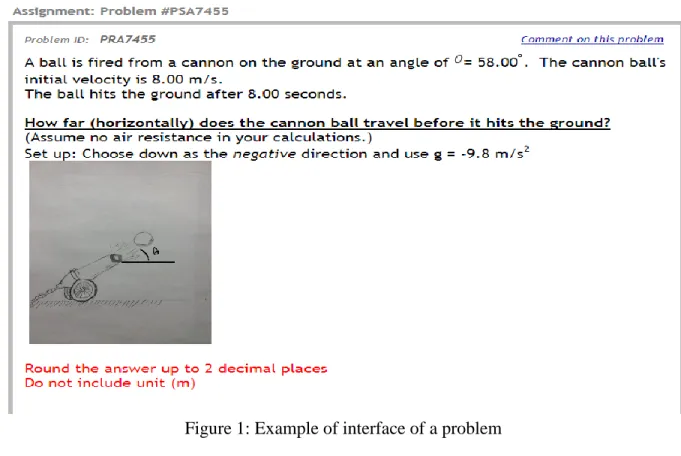
Figure 1: Example of interface of a problem
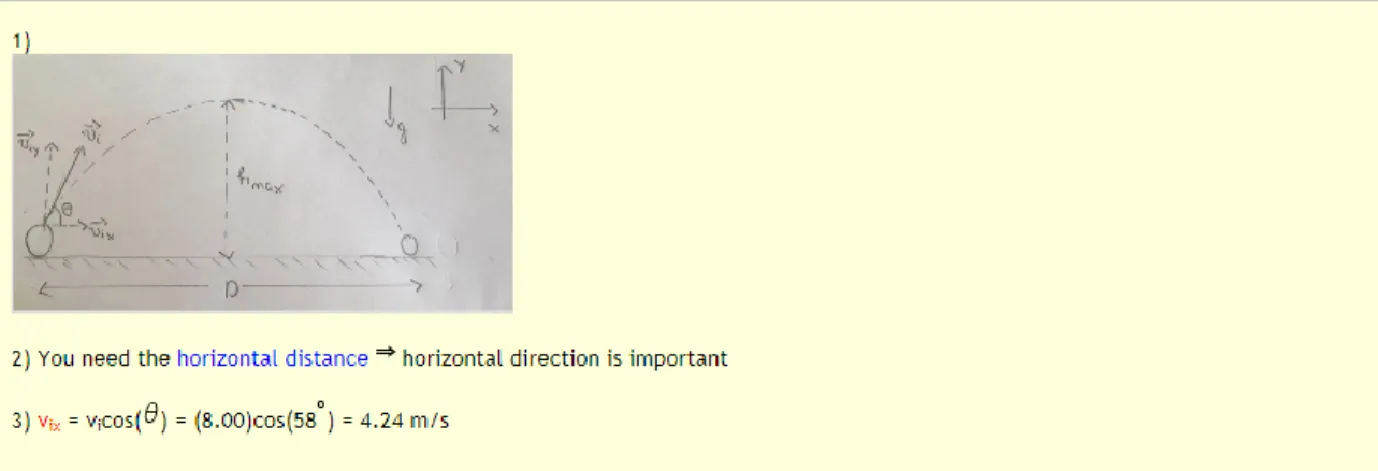
Our team’s explanation or hint of the problem usually consists of 3 or 4 parts. Hint 1 is usually the directional guideline to help students identify the concepts, equations or tricks in the problem.
Figure 3: Example of Hint 2 and 3
The last explanation is just some algebraic manipulation of the equation and numeric substitution of the equation, and show the students how to input the correct answer. However, this last step is significantly important because if the students cannot enter the correct answer, they cannot proceed to the next question.
Figure 4: Example of final hint
5.1.2 B-term progress
After our variablized templates get approved from both Cristina and Eric, our next step is to instantiate multiple of instances from those templates. The purpose of instantiation is to “lock-in" specific numbers, which ultimately simplifies reports for teachers and allows specific problem to problem comparison for researchers. Typically, a template is instantiated for 50 times, meaning 50 instances with different numbers (variables) but exactly the same content. Simultaneous to the instantiation process, we also have to think of the targeting skills that we want to build for the students in order to group the templates together. Specific details of the grouping process can be found in Appendix A - Skillbuilder Grouping.
Finally, after all the instances are created and templates are grouped into certain skills, we start to build the “show your work" problem sets, which set the stages for crowdsourcing process in C-term. Out of 50 instances from each templates, we randomly pick one instance from each
templates, and modified those instances by adding a second main problem in the body of the instance. The second main problem will be stated as follow:
Figure 5. Guidance for creating your own work.
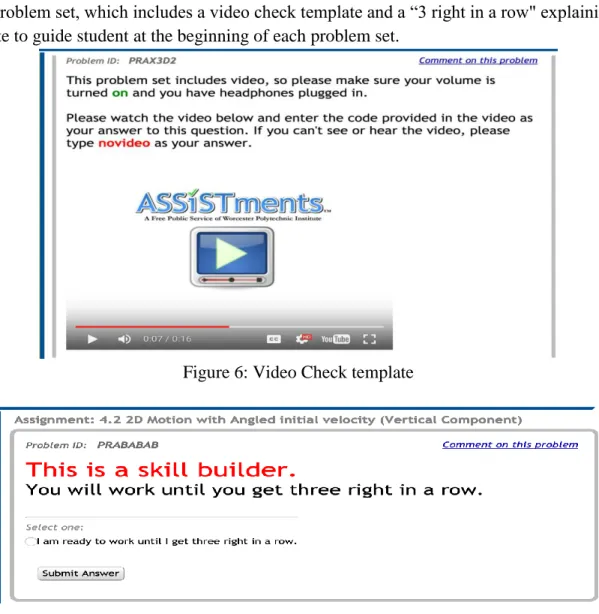
The content of the “show your work" problem set will be similar to the content of each skillbuilder. In addition to collecting student work, we also begin some first steps designing our study problem set, which includes a video check template and a “3 right in a row" explaining template to guide student at the beginning of each problem set.
Figure 7. Skill Builder Check
More details for the study problem sets structures are provided in the section below.
5.2 Study Problem Set Structure Design
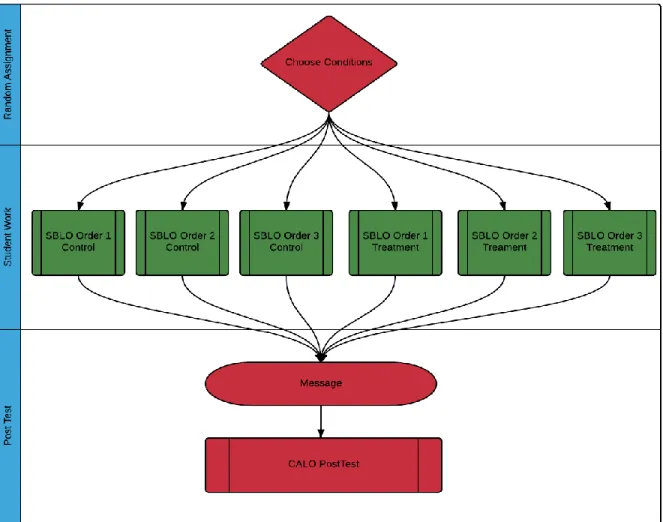
We use “Choose Condition” as our problem set type. More details of the problem set structure is illustrated in the Figure below using Lucidchart:
Figure 9 :Structure of “Choose Condition” problem set in Assistment
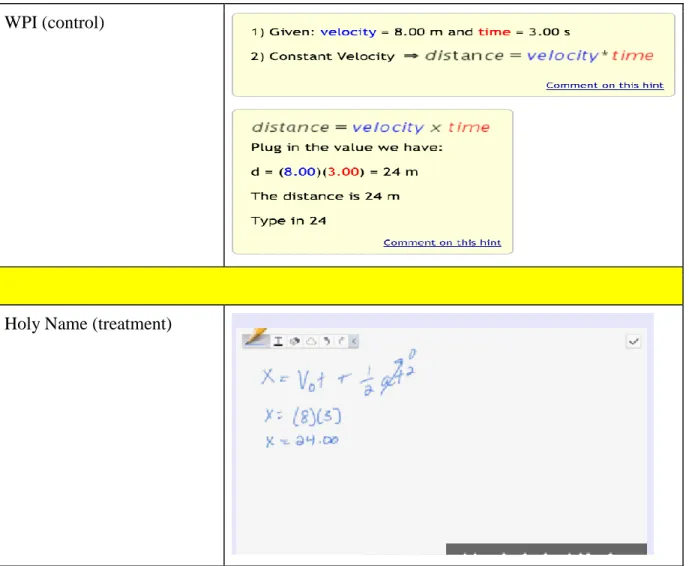
The study problem set is mainly just one assignment with multiple version. First, Control versions stands for problem sets that have original hints created by the WPI ASSISTments Team, whereas the Treatment version is problem set have worked example or video hints provided by Holy Name Students:
Figure :1 problem in both conditions
WPI (control)
Holy Name (treatment)
Table 1: Example of a control hint and a treatment hint
Second, although each treatment and control part consists of approximately 50 problems, only the first 4 problems in each condition are used for the purpose of this study. For the control conditions, with the exception of question 4 being exactly the same in every control, the order of the first 3 questions are randomized among each control conditions to prevent cheating among the students. We follow the same rule for the treatment conditions, but we do not have to repeat the randomization process because the order of each treatment parts have to correspond to the order of the control parts. Example of the the order in each control and treatment part is illustrated in the table below:
Control 1 Control 2 Control 3 Treatment 1 Treatment 2 Treatment 3
a b a a b a
c a b c a b
d d d d d d
Table 2: Order of the first 4 problems in each conditions
As mentioned above, there will be an extra question (number 4) to test the learning ability of student, and this extra post-test question will be exactly the same in any treatment and control.
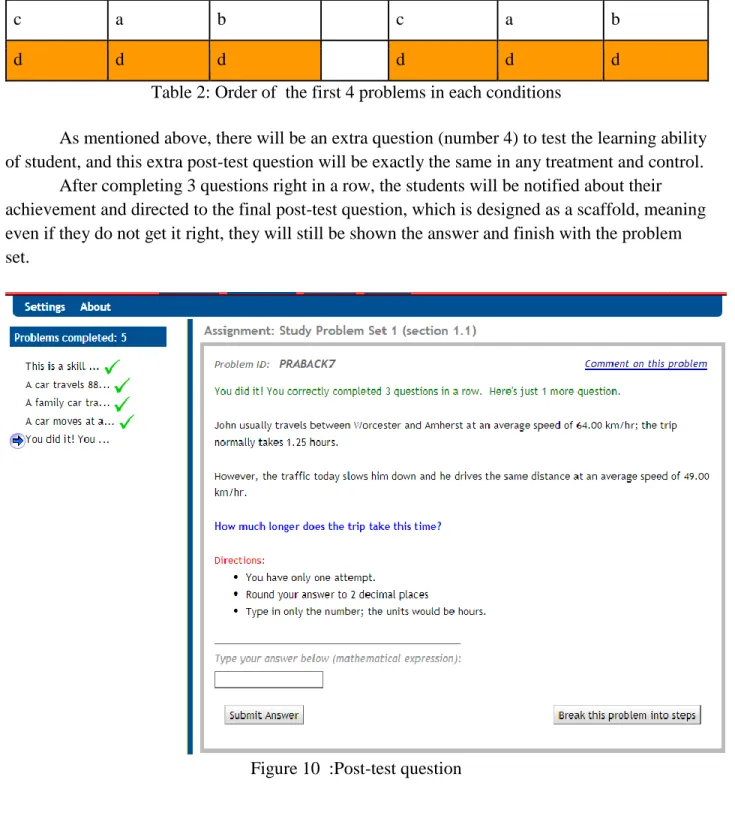
After completing 3 questions right in a row, the students will be notified about their achievement and directed to the final post-test question, which is designed as a scaffold, meaning even if they do not get it right, they will still be shown the answer and finish with the problem set.
Figure 10 :Post-test question
Figure 11: Advertising Document
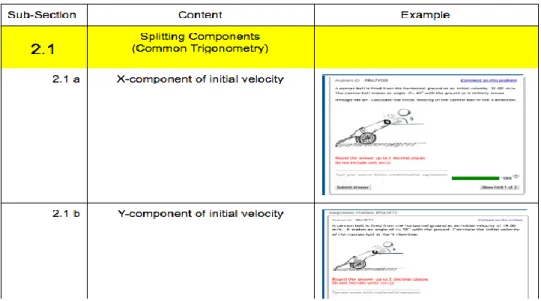
We also provide the content with picture of the problems, so that the teachers can see if the content is helpful for their course:
Figure 12: Table of Content example
6.1 Website for Study
In order to make it easy for the students and teachers to access to content, we build a google site at the address: https://sites.google.com/site/physicshelpdirect/. The website contains all the physics topics with pictures of the problems. We build one website for the teacher and one website for the students. Each has the tutorial on how to use the website to assign or access the problems.
6.1.1 Website for Teacher
The website for the teacher is where teachers can get the share link to assign the problem sets to the students. We first go to builder in ASSISTments, click on the problem sets that we have already built to see the details.
We then copy the teacher’s share link and put on the website.
6.1.2 Website for Student
We make a copy of the original website in order to create the website for students. Students can use the website to access to the problem sets assigned. Similar to the procedure above, we also put the share link for students into the topics’ names.
6.2 Study
The ultimate purpose for our research is to determine the most effective way to help student learn physics via systems similar to Assistments. Specifically, we want to compare the
Student Work and Videos generated by high school students. Depending upon the student work collecting from crowdsourcing method, we come up with four studies:
+ WPI Original Hints vs one best Work Examples + WPI Original Hints vs mixed Worked Examples
+ WPI Original Hints vs combination of Worked Examples and Videos + WPI Original Hints vs Videos only
As we have previously explained in our problem set structure design, the control parts in each study problem set will only have WPI original hints, whereas the treatment parts will either have only worked examples or videos, or a combination of both of those data. Details of each study is illustrated below.
6.2.1 Study 1: Business as usual (control) vs Best Worked Example
(treatment)
For this study, we are comparing original hints created by WPI students and all the worked examples by one exceptional student to see which method is better in helping the student to learn the material and also how well they do on the 4th item and the post test. The major content this study is one dimensional kinematics with 3 study problem sets corresponding to 3 important skills: 1.1: 1D Motion in Horizontal, 1.2: 1D Motion in Vertical: Free Fall, and 1.3: 1D Motion in Vertical: Launching Up.
Section 1.1 1D Motion in Horizontal 1.1 a) Find Distance (PRA8GNR)
WPI Hint (PRA94MF)
Student Work (PRA86CZ)
1.1 b) Find Constant Velocity (PRA8F8R)
WPI (PRA94MF)
Student Work (PRA86CZ)
WPI (PRA94MH)
Student Work (PRA86C3)
Section 1.2: 1D Motion in Vertical: Free Fall 1.2 a) Find Height (PRA8NUN)
WPI (PRA94MJ)
Student Work (
WPI (PRA948D)
Student Work (PRA948F)
1.2 c) Find Final Velocity (PRA8NWA)
WPI (PRA948E)
Student Work (PRA948G)
Section 1.3: 1D Motion in Vertical: Launching Up 1.3 a) Find (maximum) Height (PRA8NXX)
Hint ID Description
WPI (PRA95BV)
Student Work (PRA95BW)
1.3 b) Find time (PRA8N3K)
WPI (PRA95BX)
Student Work (PRA95BY)
1.3 c) Find initial velocity (PRA8N48)
WPI (PRA95BZ)
Student Work (PRA95B2)
6.2.2 Study 2:Business as usual (control) vs Mixed Worked Examples
(treatment)
For this study, we are comparing original hints created by WPI students and combination of student work to determine which method is better in helping the student to learn the material and how also how well they do on the 4th item and post-test . The major content this study is vectors and two dimensional motion without angled initial velocity with 4 study problem sets corresponding to 4 important skills: splitting vector components, combining vector components, horizontal component of non-angle projectile motion, and vertical component of non-angle projectile motion.
Section 2.1 Splitting Components
Hint ID Description
PRA95CY - WPI
PRA95CZ - Student Work
Hint ID Description
PRA95C4 - WPI
PRA95C5 - Student Work
Section 2.2 Combining Components 2.2 a) Angle (PRA9799)
Hint ID Description
PRA9799 - WPI
Hint ID Description
PRA94MR - WPI
PRA86CJ - Student Work
Section 3.1: 2D Motion without angled Initial Velocity: Horizontal Component 3.1 a) Find Distance (PRA94MS)
Hint ID Description
PRA94MS - WPI
PRA8535 - Student Work
Hint ID Description
PRA94MU - WPI
- Student Work
Hint ID Description
PRA94MV - WPI
- Student Work
Section 3.2: 2D Motion without angled Initial Velocity: Vertical Component 3.2 a) Find Height (PRA95DN)
Hint ID Description
PRA95DN - WPI
PRA95DP - Student Work
Hint ID Description
PRA95DQ - WPI
Hint ID Description
PRA95DS - WPI
6.2.3 Study 3:Business as usual (control) vs Mixed Student Work and
Video (treatment)
For this study, we are comparing original hints created by our team vs combination of student works and videos to see which method is better in helping the student to learn the
material and also how well they do on the 4th item and the post test. The major content this study is one two dimensional projectile motion with 1 study problem sets corresponding to 1 important skills: 4.1: 2D Motion with angled initial velocity (Horizontal Component).
Section 4.1 2D Motion with Angled initial velocity: Horizontal Component 4.1 a) Find Distance (PRA94M6)
Hint ID Description
PRA9DU2 - Student Work
4.1 b) Find Initial Velocity (PRA8S7R)
Hint ID Description
PRA9DU3 - Student Video
https://www.youtube.com/watch?list=PLtM3pQ7A_sfQTr LK6FnCC6qwy0lm6WWnp&v=hL97Kb134c0
4.1 c) Find time (PRA8S7Z)
Hint ID Description
PRA9DU4 - Student Video
https://www.youtube.com/watch?list=PLtM3pQ7A_sfQTr LK6FnCC6qwy0lm6WWnp&v=_-lH_tfSvfo
6.2.4 Study 4:Business as Usual (Control) vs Student Video (Treatment)
For this study, we are comparing original hints created by our team vs only student generated videos to determine which method is better in helping the student to learn the material and also how well they do on the 4th item and the post test. The major content this study is also one two dimensional projectile motion with 1 study problem sets corresponding to 1 important skills: 4.2: 2D Motion with angled initial velocity (Vertical Component).Section 4.2 2D Motion with Angled initial velocity: Vertical Component. 4.2 a) Find (maximum) height (PRA8S72)
PRA8S72 - WPI
PRA94R5 - Student Video
https://www.youtube.com/watch?list=PLtM3pQ7A_sfQTr LK6FnCC6qwy0lm6WWnp&v=_AlARAC6Xy8
PRA8S74 - WPI
PRA95G3 - Student Work
https://www.youtube.com/watch?list=PLtM3pQ7A_sfQTr LK6FnCC6qwy0lm6WWnp&v=J2B2IA7PvKg
Hint ID Description
PRA8S77 - WPI
PRA95G5 - Student Work
https://www.youtube.com/watch?list=PLtM3pQ7A_sfQTr LK6FnCC6qwy0lm6WWnp&v=NCVm3rudiEI
7. RESULT
However, since we were not provided with enough crowdsourcing data from Maureen and Holy Name students by the end of B-term, our progress to create study problem set was procrastinated until the middle of C-term when sufficient videos and student works were sent to us. We work extra hours in C-term to finish our study problem set, and hand out the complete study problem set by the beginning of D-term. Unfortunately, D-term is not an ideal time to ask students and teachers to help us to complete our study since most of the physics courses at WPI is more about electricity, thermodynamics, oscillation and waves, etc… instead of Mechanics. As a result, not many professors are interested in handing out this old material for the students, especially during finals week. Cristina and Eric have tried to contact some high school teachers, and hopefully we can get some data in the near future to analyze and compare the all of the proposed tutoring strategies.
As a result, due to the small sample size, we do not have enough data and results to compare which tutoring strategies are more preferable by students to master the skills. Further study with more participants should be conducted in the future to have a significant and strong conclusion of the most effective tutoring strategy.
8. CONCLUSION
This project provides a new content of projectile motion in physics folder in ASSISTments certified. Since the project only focuses on Projectile Motion, students are required to have basic knowledge in Mechanical Physics such as how to calculate distance, time and velocity before actually study the problem sets. The problem sets will help the students to use the knowledge they have already known in order to find variables in projectile topic. Because the content is divided into steps to solve the projectile motion problem, student can master the skills in 1D Motion, Vectors, 2D Motion with Initial Horizontal Velocity and 2D Motion with Angled Initial Velocity. The problem sets are easy to access, so the students can keep coming back to practice with different variables each time.
We also have some issues for our study, since there were no suitable populations to experiment the study. We cannot find a Physics class in WPI to introduce the study since only Electronic and Magnetism Physics was being taught during D-term. Due to the limitation of sample size, we don’t have enough data to prove our hypothesis, or to find which one of the method is more helpful than another. However, the research can be expanded in the future. Since Projectile Motion is an important topic in Mechanic Physics, high school students who are studying Physics, reviewing for AP exams or WPI students who are taking PH1110 can use the problem set to improve their skills. When a large enough sample size is available, we believe that we can conclude which one of the three tutoring strategies mentioned yields a better result in term of student’s learning.
References
[1] Physics for Students: https://sites.google.com/site/physicshelpforstudents/
[2] Physics for Teachers: https://sites.google.com/site/teacherassistment/
[3] ASSISTments: http://www.assistments.org/staticpages/AboutUs.htm
[4] ASSISTments Teacher Wiki: http://teacherwiki.assistment.org/
[5] ASSISTments TestBed Resource Guide: http://www.assistmentstestbed.org/home
Appendix
Appendix A - Skillbuilder Grouping
SECTION 1: ONE DIMENSIONAL MOTIONSub Section Content Example
1.1 Horizontal Motion (Constant Velocity)
D = vt
Problem Set
1.1 b Constant velocity (v)
1.1 c Time (t)
1.2 Vertical Motion: Free Fall
h = (½)gt2 v = gt 1.2 a Height (h)
1.2 b Time (t)
1.2 c Velocity after certain amount of time (v) 1.3 Vertical Motion: Launching Upward h = 12gt2 + vit vf = vi + gt vf2 = vi2 + 2gh
1.3 a Height (h)
1.3 b Time (t)
1.3 c Initial velocity (vi)
2.1 Splitting Components (Common Trigonometry) 2.1 a X-component of initial velocity
2.1 b Y-component of initial velocity
2.2 Combining Components
(Pythagoras and Inverse trigonometry) 2.2 a Angle of projectile
2.2 b Initial Velocity
SECTION 3: TWO DIMENSIONAL MOTION WITH HORIZONTAL INITIAL VELOCITY
Sub-Section Content Example
3.1 Horizontal Motion D = vit
3.1 b Time (t)
3.1 c Initial Horizontal Velocity (vi)
3.2 Vertical Motion
h = 12gt2 v = gt
3.2 a Height (h)
3.2 b Time (t)
3.2 c Velocity before hitting the ground (v)
Sub-Section Content Example 4.1 Horizontal Motion D = [visin(θ)]*t 4.1 a Distance (D) 4.1 b Time (t) 4.1 c Initial Velocity (vi)
h = (½)gt2 + [visin(θ)]*t
vf = visin(θ) + gt
vf2 = [visin(θ)]2 + 2gh
4.2 a (max) Height (h)
4.2 b Time to reach (max) height (t)
4.2 c Initial Velocity (vi)
Problem Set "Appendix"id:[PSAZ2JY] Select All
1) Problem #PRA7KJX "PRA7KJX - Convert (km/..."
Convert %v{sprintf("%.2f",c)} (km/hr) to (m/s) Round your answer to 2 decimal places
Do not include units.
Algebraic Expression: %v{answer_rounded} %v{answer_rounded} + 0.01 %v{answer_rounded} - 0.01 Hints: • 1)1 km = 1000 m 1hr = 3600 s (60s = 1min; 60min = 1hr)
2)Use the "railroad tracks" (string of fractions) method to convert. •
%v{sprintf("%.2f",c)} %v{answer_rounded}
Type in %v{answer_rounded}
2) Problem #PRA7KJ4 "PRA7KJ4 - Convert (m/s) t..."
Convert %v{sprintf("%.2f",d)} (m/s) to (km/hr) Round your answer to 2 decimal places
Do not include units.
Algebraic Expression:
%v{answer_rounded}
Hints:
• 1)1 km = 1000 m
1 hr = 3600 s (60s = 1min; 60min = 1hr)
2)Use the "railroad tracks" (string of fractions) method to convert. •
%v{sprintf("%.2f",d)} %v{answer_rounded}
Type in %v{answer_rounded}
Page 1 of 48 Assistment - Printing Content
3) Problem #PRA7KJ2 "PRA7KJ2 - Convert (mile..."
Convert %v{sprintf("%.2f", x)} (miles/hr) to (ft/s) Round your answer to 2 decimal places
Do not include units.
Algebraic Expression: %v{answer_rounded} %v{answer_rounded} + 0.01 %v{answer_rounded} - 0.01 Hints: • 1)1 mile = 5280 ft 1 hr = 3600 s (60s = 1min; 60min = 1hr)
2)Use the "railroad tracks" (string of fractions) method to convert. •
%v{sprintf("%.2f", x)} %v{answer_rounded}
Type in %v{answer_rounded}
4) Problem #PRA7KJ8 "PRA7KJ8 - Convert (ft/s) to (mile/hr)"
Convert %v{sprintf("%.2f", x)} (ft/s) to (mile/h) Round your answer to 2 decimal places
Do not include units.
Algebraic Expression: %v{answer_rounded} %v{answer_rounded} + 0.01 %v{answer_rounded} - 0.01 Hints: • 1)1 mile = 5280 ft 1 hr = 3600 s (60s = 1min; 60min = 1hr)
2)Use the "railroad tracks" (string of fractions) method to convert. •
%v{sprintf("%.2f", x)} %v{answer_rounded}
Page 2 of 48 Assistment - Printing Content
5) Problem #PRA7ZQB "PRA7ZQB - Calculate travel distance given velocity and time"
A car moves at a constant velocity %v{sprintf("%.2f",velocity)} m/s for %v{sprintf("%.2f",time)} seconds. Calculate the travel distance of the car
Round the answer up to 2 decimal places Do not include unit (m)
Algebraic Expression:
%v{distance_rounded} %v{distance_rounded} + 0.01 %v{distance_rounded} - 0.01
Hints:
• 1) Given: velocity = %v{sprintf("%.2f",velocity)} m and time = %v{sprintf("%.2f",time)} s 2) Constant Velocity
•
Plug in the value we have:
d = (%v{sprintf("%.2f",velocity)})(%v{sprintf("%.2f",time)}) = %v{distance_rounded} m The distance is %v{distance_rounded} m
Type in %v{distance_rounded}
6) Problem #PRA7YMD "PRA7YMD - Calculate velocity given travel distance and time"
A family car travels %v{sprintf("%.2f",distance)} m in %v{sprintf("%.2f",time)} seconds at constant velocity. Calculate the velocity of the car.
Round the answer up to 2 decimal places Do not include unit (m/s)
Algebraic Expression:
%v{velocity_rounded} %v{velocity_rounded}+0.01 %v{velocity_rounded}-0.01
Page 3 of 48 Assistment - Printing Content
Hints:
• 1) Given: distance = %v{sprintf("%.2f",distance)} m and time = %v{sprintf("%.2f",time)} s 2) Constant Velocity
•
Plug in the values, we have:
v =%v{sprintf("%.2f",distance)} %v{sprintf("%.2f",time)}
= %v{velocity_rounded} m/s
The velocity is %v{velocity_rounded} m/s Type in %v{velocity_rounded}
7) Problem #PRA7YKU "PRA7YKU - Calculate travel time given distance and velocity"
A car travels %v{sprintf("%.2f",distance)} m at a constant velocity %v{sprintf("%.2f",velocity)} m/s. Calculate the time that the car travels.
Round the answer up to 2 decimal places Do not include unit (s)
Algebraic Expression: %v{time_rounded} %v{time_rounded} + 0.01 %v{time_rounded} - 0.01 Hints: • 1) Given: distance = %v{sprintf("%.2f",distance)} m velocity = %v{sprintf("%.2f",velocity)} m/s 2) Constant velocity Page 4 of 48 Assistment - Printing Content
t =
%v{sprintf("%.2f",distance)} %v{sprintf("%.2f",velocity)}
= %v{time_rounded} s
Type in %v{time_rounded}
8) Problem #PRA7ZVW "PRA7ZVW - Free Fall: Calculate Height given time"
A ball is dropped into a river from a bridge. The ball hits the water surface after %v{sprintf("%.2f",time)} s.
Find the positive height of the bridge above the river.
(Ignore any air resistance in your calculations.)
Set up: Choose the down as the positive direction and use g = 9.8 m/s2
Round the answer up to 2 decimal places Do not include unit (m)
Algebraic Expression:
%v{height_rounded} %v{height_rounded} + 0.01 %v{height_rounded} - 0.01
Hints:
• 1) Sketch your own motion diagram
2) Label your drawing. Include the initial velocity of the ball.
3) What equation should you use? You are given time and initial velocity, you need height.
Page 5 of 48 Assistment - Printing Content
• 1)
2) The motion is free fall vy = 0 3) The necessary equation is:
•
Plug in the value, we have:
(%v{sprintf("%.2f",time)})2 = %v{height_rounded} m The height of the bridge is %v{height_rounded} m
Type in %v{height_rounded}
9) Problem #PRA8G2G "PRA8G2G - Calculate time given height"
A ball is dropped from a bridge into the river below.
The bridge is %v{sprintf("%.2f",height)} m above the water surface.
Find the time the ball reaches the water surface.
Set up: Choose down as the positive direction and use g = 9.8 m/s2
Page 6 of 48 Assistment - Printing Content
Round the answer up to 2 decimal places Do not include unit (s)
Algebraic Expression:
%v{rounded_t} %v{rounded_t} + 0.01 %v{rounded_t} - 0.01
Hints:
• 1) Sketch your own motion diagram 2) Does the ball have any initial velocity?
3) What equation should you use? You are given height and initial velocity (by default from the situation), you need time
• 1)
2) The motion is free fall vyi = 0 3) The necessary equation is:
Page 7 of 48 Assistment - Printing Content
•
Plug in the value, we have:
t =
(
2*%v{sprintf("%.2f",height)}9.8
)
1/2= %v{rounded_t} s
Type in %v{rounded_t}
10) Problem #PRA8G2H "PRA8G2H - Calculate velocity given time"
A ball is dropped (with no initial velocity) and falls straight down for %v{sprintf("%.2f", time)}s.
What is the ball's velocity %v{sprintf("%.2f", time)}s after being dropped?
(Assume no air resistance in your calculations.)
Set up: Choose down as the positive direction and use g = 9.8 m/s2
Round the answer up to 2 decimal places Do not include unit (m/s)
Algebraic Expression: %v{rounded_final} %v{rounded_final} + 0.01 %v{rounded_final} - 0.01 Hints: • Page 8 of 48 Assistment - Printing Content
3) What equation should you use? You are given time and g; you need to find velocity (v) at %v{sprintf ("%.2f",time)}.
• 1)
2) When an object is dropped, Vyi = 0 3) The necessary equation is:
•
When we plug in the values, we have:
v= (9.8)(%v{sprintf("%.2f",time)}) = %v{rounded_final} m/s Type in %v{rounded_final}
11) Problem #PRA73M6 "PRA73M6 - Calculate height given time and initial velocity"
A ball is thrown straight up with an initial velocity of %v{sprintf("%.2f",velocity)} m/s.
How high (compared to the starting point) is the ball %v{sprintf("%.2f",time)} s after being released?
(Ignore any air resistance in your calculations.)
Set up: Choose the up as the positive direction and use g= -9.8 m/s2
Page 9 of 48 Assistment - Printing Content
Round the answer up to 2 decimal places Do not include unit (m)
Algebraic Expression: %v{rounded_height} %v{rounded_height} + 0.01 %v{rounded_height} - 0.01 Hints: •
1) Sketch your own motion diagram
2) What equation should you use? You are given time, initial velocity, and g. You need height. • 1)
Page 10 of 48 Assistment - Printing Content
•
Plug in the value, we have:
h = (-9.8)(%v{sprintf("%.2f",time)})2 + (%v{sprintf("%.2f",velocity)})(%v{sprintf("%.2f",time)}) = %v{sprintf("%.2f", rounded_height)} m
Type in %v{sprintf("%.2f", rounded_height)}
12) Problem #PRA7NH3 "PRA7NH3 - Maximum Height"
A ball is thrown straight up with an initial velocity of %v{sprintf("%.2f",velocity)} m/s.
What is the maximum height (compared to the starting point) that the ball %v{sprintf("%.2f",time)} s reaches?
(Ignore any air resistance in your calculations.)
Set up: Choose the up as the positive direction and use g= -9.8 m/s2
Round the answer up to 2 decimal places Do not include unit (m)
Algebraic Expression:
%v{distance_rounded} %v{distance_rounded} - 0.01 %v{distance_rounded} + 0.01
Hints:
• 1) Sketch your own motion diagram.
2) Label your drawing. Include information like the velocity at maximum height?
2) What equation should you use? You have initial velocity (vi), velocity at maximum height and g
(9.8 m/s2); you need height.
Page 11 of 48 Assistment - Printing Content
• 1)
2)At maximum height vf= 0
3)The necessary equation is the time-independent equation: • Since vf = 0
Plug in the values, we have:
=
-( %v{sprintf("%.2f",velocity)} )2
2(-9.8) =%v{sprintf("%.2f",distance_rounded)} m Type in %v{sprintf("%.2f",distance_rounded)}
13) Problem #PRA8HPX "PRA8HPX - Calculate the time to reach maximum height given initial velocity"
A ball is thrown straight up with an initial velocity of %v{sprintf("%.2f",velocity)} m/s. Calculate the time for the ball to reach maximum height.
Set up: Choose the up as the positive direction and use g= -9.8 m/s2
Page 12 of 48 Assistment - Printing Content
Round the answer up to 2 decimal places. Do not include unit (s) in your answer. Algebraic Expression:
%v{time_rounded} %v{time_rounded} + 0.01 %v{time_rounded} -0.01
Hints:
• 1) Sketch your own motion diagram
2) What equation should you use? You are given initial velocity, and g. You need time.
3) Also, what is the velocity at maximum height?
Page 13 of 48 Assistment - Printing Content
• 1)
2) To find new velocity after certain amount of time, we need the equation:
3) At maximum height, v=0. The equation becomes:
•
Plug in the values, we have:
t =
-(%v{sprintf("%.2f",velocity)}) (-9.8)
= %v{time_rounded} s
Type in %v{time_rounded}
14) Problem #PRA73ND "PRA73ND - Calculate initial velocity given time to reach maximum height"
A ball is thrown straight up.
The ball reaches the maximum height %v{sprintf("%.2f",time)} s after being released.
What was the initial velocity?
(Ignore any air resistance in your calculations.)
Set Up: Choose the up as the positive direction and use g= -9.8 m/s2
Page 14 of 48 Assistment - Printing Content
Round the answer up to 2 decimal places Do not include unit (m/s)
Algebraic Expression: %v{rounded_velocity} %v{rounded_velocity} + 0.01 %v{rounded_velocity} - 0.01 Hints: •
1) Sketch your own motion diagram
2) What equation should you use? You are given time, and g. You need initial velocity
3) Also, what is the velocity of the ball at maximum height?
Page 15 of 48 Assistment - Printing Content
• 1)
2) The necessary equation is:
3) At maximum height v = 0. The equation becomes:
•
Plug in the value, we have:
vi = - (-9.8)(%v{sprintf("%.2f", time)}) = %v{rounded_velocity} m/s Type in %v{rounded_velocity}
15) Problem #PRA7VGD "PRA7VGD - Finding x component of initial velocity"
%v{article[pointer]} %v{object[pointer]} is fired from the horizontal ground at an initial velocity %v{sprintf ("%.2f",velocity)} m/s, with an angle = %v{angle} from the ground.
Calculate the initial velocity of the %v{object[pointer]} in the X-direction.
Round the answer up to 2 decimal places Do not include unit (m/s)
Algebraic Expression: %v{x_velocity_rounded} %v{x_velocity_rounded} +0.01
Page 16 of 48 Assistment - Printing Content
• Check your calculator's mode. This is what the answer would be if the angle were in radians. The angle given is in degrees.
%v{wrong_ans} + 0.01
• Check your calculator's mode. This is what the answer would be if the angle were in radians. The angle given is in degrees.
%v{wrong_ans} - 0.01
• Check your calculator's mode. This is what the answer would be if the angle were in radians. The angle given is in degrees.
Hints:
• 1) Sketch your own motion diagram
2) Label the x and y components of initial velocity 3)Use common trigonometry to find the vix
• 1) + 2)
3) vix = vicos( )
• vix = (%v{sprintf("%.2f",velocity)})cos(%v{angle} ) = %v{x_velocity_rounded} m/s
The velocity in the X-direction is: %v{x_velocity_rounded} m/s Type in %v{x_velocity_rounded}
16) Problem #PRA7KT3 "PRA7KT3 - Finding Y Component of initial velocity"
%v{article[pointer]} %v{object[pointer]} is %v{action[pointer]} from the horizontal ground at an initial velocity of %v{sprintf("%.2f",velocity)} m/s and at an angle of = %v{angle}° from the ground. Calculate the initial velocity of the %v{object[pointer]} in the Y-direction.
Page 17 of 48 Assistment - Printing Content
Round the answer up to 2 decimal places Do not include units (m/s)
Algebraic Expression: %v{y_velocity_rounded} %v{y_velocity_rounded} + 0.01 %v{y_velocity_rounded} - 0.01 %v{wrong_ans}
• Check your calculator's mode. This is what the answer would be if the angle were in radians. The angle given is in degrees.
%v{wrong_ans} + 0.01
• Check your calculator's mode. This is what the answer would be if the angle were in radians. The angle given is in degrees.
%v{wrong_ans} - 0.01
• Check your calculator's mode. This is what the answer would be if the angle were in radians. The angle given is in degrees.
Hints:
• 1) Sketch your own motion diagram
2)Label the x and y components of initial velocity 3) Use trigonometry to find viy
Page 18 of 48 Assistment - Printing Content
• 1) + 2)
2) viy = visin( )
• viy = (%v{sprintf("%.2f",velocity)})sin(%v{angle} ) = %v{y_velocity_rounded} m/s
The velocity in the Y-direction is: %v{y_velocity_rounded} m/s Type in %v{y_velocity_rounded}
17) Problem #PRA7RRE "PRA7RRE - Calculate the ang..." A soccer player kicks the ball along the ground (perfectly horizontal).
The ball's velocity in the x-direction (downfield) is %v{sprintf("%.2f",x)} m/s; the ball's velocity in the y-direction (across field) is %v{sprintf("%.2f",y)} m/s.
The x (→) and y (↑) velocities are the components of the initial velocity vo. Calculate the angle of the ball's velocity in degrees.
Round the answer up to 2 decimal places Do not include unit (degrees)
Algebraic Expression:
Page 19 of 48 Assistment - Printing Content
%v{angle_rounded} %v{angle_rounded} + 0.01 %v{angle_rounded} - 0.01 %v{duplicate_check}
• You would be correct if the units were in radians. Check your calculator's mode.
%v{duplicate_check} +0.01
• You would be correct if the units were in radians. Check your calculator's mode.
%v{duplicate_check} -0.01
• You would be correct if the units were in radians. Check your calculator's mode.
Hints: •
1) Sketch your own motion diagram
2)Label the x-velocity (vx) and y-velocity (vy)
3) Use trigonometry to find the angle • 1) +2)
3) Using common trigonometry:
Page 20 of 48 Assistment - Printing Content
%v{sprintf("%.2f",x)} = %v{angle_rounded}
The answer is %v{angle_rounded} Type in %v{angle_rounded}
18) Problem #PRA755S "PRA755S - Calculate the initial velocity given the x and y velocity" A soccer player kicks the ball along the ground (perfectly horizontal).
The ball's velocity in the x-direction (downfield) is %v{sprintf("%.2f",x)} m/s; the ball's velocity in the y-direction (across field) is %v{sprintf("%.2f",y)} m/s.
The x (→) and y (↑) velocities are the components of the initial velocity Vo. Calculate the magnitude of the initial velocity Voin m/s.
Round the answer up to 2 decimal places Do not include unit (m/s)
Algebraic Expression: %v{velocity_rounded} %v{velocity_rounded} + 0.01 %v{velocity_rounded} -0.01 Hints:
• 1) Sketch your own motion diagram
2)Label the x-velocity (vx) and y-velocity (vy) 3) Use Pythagorean theorem Vo
• 1) +2)
3) Applying Pythagorean theorem to the sketch above, we have: vo2 = vx2 + vy2
Page 21 of 48 Assistment - Printing Content
which becomes: vo = (vx2 + vy2)1/2
(Remember: Raising something to the 1/2 power is the same as taking the square root.) • vo = (vx2 + vy2)1/2
When you plug in the values, you get:
vo = (%v{sprintf("%.2f",x)}2 + %v{sprintf("%.2f",y)}2)1/2 = %v{sprintf("%.2f",velocity_rounded)} m/s
Type in %v{sprintf("%.2f",velocity_rounded)}
19) Problem #PRA7P5T "PRA7P5T - Calculate the horizontal distance given initial velocity and time to hit the ground"
A pool ball leaves from the edge of a high table with an initial velocity of %v{sprintf("%.2f",velocity)} m/s (in the horizontal direction only).
It hits the ground after %v{sprintf("%.2f",time)} s.
How far from the table does the ball hit the ground? (Ignore any air resistance in your calculations.)
Set up: Pick down as the positive y; use g = +9.8m/s2.
Round your answer up to 2 decimal places Do not include unit (m)
Algebraic Expression: %v{range_rounded} %v{range_rounded}-0.01 %v{range_rounded}+0.001 Hints:
• 1) Sketch your own motion diagram.
2) Label the important direction on your diagram.
3) What equation should you use? You have time, initial velocity (vi); you need horizontal distance.
Page 22 of 48 Assistment - Printing Content
• 1)
2) The important direction is the horizontal direction
3) The horizontal motion is only constant velocity motion, so the necessary equation is: •
Plugging in the values, we have
D = %v{sprintf("%.2f",velocity)}m/s x %v{sprintf("%.2f",time)} s = %v{range_rounded} m
Type in %v{range_rounded}
20) Problem #PRA7SEY "PRA7SEY - Calculate the Range of the projectile given initial velocity and height of the surafce"
A small ball rolls off the edge of a %v{sprintf("%.2f",height)} m high tabletop.
The ball is initially moving horizontally with velocity vi = %v{sprintf("%.2f",velocity)} m/s. How far from the table does the ball hit the ground?
(Ignore any air resistance in your calculations.) Set up: Pick down as the positive y; use g = +9.8m/s2.
Round the answer up to 2 decimal places. Do NOT include the unit (m) in the answer. Algebraic Expression: %v{range_rounded} %v{range_rounded} + 0.01 %v{range_rounded} -0.01 Hints: Page 23 of 48 Assistment - Printing Content
• 1) Sketch your own motion diagram.
2) Label the important direction on your diagram.
3) Since the ball is moving horizontally off of the table, vyi = 0.
4) Find the travel time first by using height (vertical distance) equation.
5) After that, you have time and x initial velocity (vxi = vi), you need horizontal distance, what equation
should you use? • 1)
2) The horizontal direction is the important direction in finding the horizontal distance 3) y = yi + vyi t + ½gt2
Substitute:
• y = 0 (the ground) • yi = h (the tabletop height) • vyi = 0
4) This gives the free fall equation: h = ½gt2
=
(
2 (%v{sprintf("%.2f",height)})
9.8
)
1/2
= %v{rounded_time} s
5) The ball travels with constant velocity (vi) in the horizontal motion. The travel distance is simply:
• = (%v{sprintf("%.2f",velocity)})(%v{rounded_time}) = %v{range_rounded} m
Page 24 of 48 Assistment - Printing Content
21) Problem #PRA75RN "PRA75RN - Calculate the time given the horizontal distance and initial velocity" A ball is knocked off the edge of a high table with an initial velocity of %v{sprintf("%.2f",velocity)} m/s (perfectly horizontally).
The ball lands on the floor %v{sprintf("%.2f",distance)} m from the edge of the table. How long did it take the ball to fall to the floor?
Round your answer up to 2 decimal places Do not include unit (s)
Algebraic Expression: %v{time_rounded} %v{time_rounded} + 0.01 %v{time_rounded} - 0.01 Hints:
• 1) Sketch your own motion diagram.
2) Label the important direction on your diagram.
3) What equation should you use? You have initial velocity, horizontal distance; you need time. • 1)
2) The important direction is the horizontal direction
3) The horizontal motion is motion with constant velocity, so the necessary equation is:
Page 25 of 48 Assistment - Printing Content
•
Plug in the value, we have:
t =
%v{sprintf("%.2f",distance)}
%v{sprintf("%.2f",velocity)}
= %v{time_rounded} s
Type in %v{time_rounded}
22) Problem #PRA756D "PRA756D - Calculate initial velocity given time and horizontal distance" A ball leaves the edge of a high table with an unknown initial velocity. (But it was known that the ball was moving perfectly horizontally.)
The ball hits the ground %v{sprintf("%.2f",distance)}m away from the edge of the table %v{sprintf("%.2f",time)}s after it left.
What was the ball's initial velocity?
Round your answer up to 2 decimal places. Do not include unit (m/s).
Algebraic Expression: %v{velocity_rounded} %v{velocity_rounded} - 0.01 %v{velocity_rounded} + 0.01 Hints:
• 1) Sketch your own motion diagram.
2) Label the important direction on your diagram.
3) What equation should you use? You have time and horizontal distance; you need initial velocity. • 1)
Page 26 of 48 Assistment - Printing Content
2) The important direction is the horizontal direction
3) The horizontal motion is motion with constant velocity, so the necessary equation is:
•
When we plug in the values, we have:
Vi=
%v{sprintf("%.2f",distance)} %v{sprintf("%.2f",time)}
=%v{sprintf("%.2f", velocity_rounded)} m/s
Type in %v{sprintf("%.2f", velocity_rounded)}
23) Problem #PRA7PVP "PRA7PVP - Calculate the Height given time and initial velocity"
A %v{subjects[pointer]} book slides off the horizontal surface of a %v{surfaces[pointer1]} with an initial horizontal speed of %v{sprintf("%.2f",speed)} m/s.
It strikes the floor after %v{sprintf("%.2f",time)} s.
Ignore air resistance, find the height of the tabletop above the floor. Set up: Choose down as the positive direction and use g = 9.8 m/s2
Round the answer up to 2 decimal places Do not include unit (m)
Algebraic Expression: %v{height_rounded}
Page 27 of 48 Assistment - Printing Content
%v{height_rounded} +0.01 %v{height_rounded} - 0.01 %v{wanswer_rounded}
• You will be correct if the question ask about the horizontal distance. Choose the direction again. Hints:
• 1) Sketch your own motion diagram.
2) Label the important direction on your diagram.
3) What equation should you use? You have time, y initial velocity (vy), and g (9.8 m/s2); you need
height. • 1)
2) The important direction is the y-direction.
3) Vertical motion is free fall vy=0. The necessary equation is:
•
Plug in the given value, we have:
(%v{sprintf("%.2f",time)} s) 2= %v{height_rounded} m Type in %v{height_rounded}
24) Problem #PRA7R9D "PRA7R9D - Find time to hit the ground given the initial height"
A dart is thrown horizontally toward point A, the bull's eye on a on the dart board. However, it hits point B on the rim, vertically below A.
Page 28 of 48 Assistment - Printing Content
Round the answer up to 2 decimal places Do not include unit (s)
Algebraic Expression: %v{rounded_time} %v{rounded_time} + 0.01 %v{rounded_time} - 0.01 Hints:
• 1)Sketch your own motion diagram
2) Label the important direction on your diagram.
3) What equation should you use? You have height, initial velocity (vy), and g (9.8 m/s2); you need time
• 1)
2) Height is given, so vertical direction is important
3) Vertical motion is free fall vy=0. The necessary equation is:
•
Plug in the value, we have:
t=(
2 (%v{sprintf("%.2f",height)}) )
1/2= %v{rounded_time} s
Page 29 of 48 Assistment - Printing Content
9.8
Type in %v{rounded_time}
25) Problem #PRA78CS "PRA78CS - Calculate the y final velocity given time"
A %v{subjects[pointer]} book %v{verbs[pointer1]} a %v{surfaces[pointer1]} and hits the %v{lands[pointer1]} below.
The book has an initial horizontal velocity of %v{sprintf("%.2f",speed)}m/s; it hits the %v{lands[pointer1]} after %v {sprintf("%.2f",time)}s.
Calculate the velocity in the vertical direction of the book just as it hits the %v{lands[pointer1]}. Set up hint: Choose the down as the positive direction. Use g = 9.8 m/s2
Round the answer up to 2 decimal places Do not include unit (m/s)
Algebraic Expression: %v{y_velocity_rounded} %v{y_velocity_rounded} + 0.01 %v{y_velocity_rounded} - 0.01 %v{sprintf("%.2f",speed)}
• You would be correct if you were asked about horizontal velocity. The question ask for vertical velocity!!!
Hints:
• 1) Sketch your own motion diagram.
2) Choose the important direction on your diagram.
3) What equation should you use? You have time, and g (9.8 m/s2); you need y velocity (vy) after a
certain amount of time.
Page 30 of 48 Assistment - Printing Content
• 1)
2) The important direction is the y-direction.
3) The important equation is:
4) Also, since the vertical motion is free fall vyi = 0. The equation becomes:
•
Plug in the given value, we have:
(%v{sprintf("%.2f",time)})= %v{y_velocity_rounded} m/s Type in %v{y_velocity_rounded} m/s
26) Problem #PRA7455 "PRA7455 - Calculate the horizontal distance of the projectile given initial velocity, angle and time"
A ball is fired from a cannon on the ground at an angle of = %v{sprintf("%.2f",angle)} . The cannon ball's initial velocity is %v{sprintf("%.2f",velocity)} m/s.
The ball hits the ground after %v{sprintf("%.2f",time)} seconds.
How far (horizontally) does the cannon ball travel before it hits the ground?
(Assume no air resistance in your calculations.)
Set up: Choose down as the negative direction and use g = -9.8 m/s2
Page 31 of 48 Assistment - Printing Content
Round the answer up to 2 decimal places Do not include unit (m)
Algebraic Expression:
%v{distance_rounded} %v{distance_rounded} + 0.01 %v{distance_rounded} - 0.01 wdistance
• Please use the x-component of velocity
Hints:
• 1) Sketch your own motion diagram.
2) Label your drawing. You need to find horizontal distance, which direction is more important (vertical or horizontal)?
3) Calculate the x-component of initial velocity.
4) What equation should you use? You have x-component of initial velocity, and time; find the
horizontal distance. • 1)
Page 32 of 48 Assistment - Printing Content
3) vix = vicos( ) = (%v{sprintf("%.2f",velocity)})cos(%v{angle} ) = %v{x_velocity_rounded} m/s
4) From here, the problem is similar to finding horizontal distance travelled by the ball with constant velocity. Use the exact equation
• The necessary equation is:
D = vixt
• D = vixt
Plug in the values, we have:
D = (%v{x_velocity_rounded}) (%v{sprintf("%.2f",time)}) = %v{distance_rounded} m
Type in %v{distance_rounded}
27) Problem #PRA78CZ "PRA78CZ - Calculate initial velocity given horizontal distance and angle of fire"
A ball is fired from a cannon at an angle = %v{sprintf("%.2f",angle)} .
The cannon ball hits the ground %v{sprintf("%.2f",distance)}m from the cannon %v{sprintf("%.2f",time)} s after it leaves.
Find the magnitude of the ball's combined initial velocity.
(Assume no air resistance in your calculations.)
Set up: Choose down as the negative direction and use g = -9.8 m/s2
Round the answer up to 2 decimal places Do not include unit (m/s)
Algebraic Expression:
%v{velocity_rounded} %v{velocity_rounded} + 0.01 %v{velocity_rounded} - 0.01 %v{x_velocity_rounded}
• This is the x-component of velocity. Find the combined velocity.
Page 33 of 48 Assistment - Printing Content
%v{x_velocity_rounded} +0.01
• This is the x-component of velocity. Find the combined velocity.
%v{x_velocity_rounded} -0.01
• This is the x-component of velocity. Find the combined velocity.
Page 34 of 48 Assistment - Printing Content
Hints:
• 1) Sketch your own motion diagram.
2) Label your drawing. You are given horizontal distance, which direction should we focus on (vertical or horizontal)?
3) Calculate the x-component of initial velocity from horizontal distance and travel time (motion with constant velocity)
4) After that, you have x-component of initial velocity and angle, you need initial velocity. Simply use common trignometry
• 1)
2) You are given horizontal distance horizontal direction is important 3)
Plug in the value, we have:
vix =
%v{sprintf("%.2f",distance)} %v{sprintf("%.2f",time)}
= %v{x_velocity_rounded} m/s
4) From here, the problem is similar to finding hypotenuse (vi) in right triangle given one side (vix) and
an angle ( )
Page 35 of 48 Assistment - Printing Content
•
The necessary equation is:
vix = vicos( )
• vix = vicos( )
Plug in the values, we have:
vi =
%v{x_velocity_rounded}
cos(%v{sprintf("%.2f",angle)})
= %v{velocity_rounded} m/s
Type in %v{velocity_rounded}
28) Problem #PRA78CT "PRA78CT - Calculate time given angle, initial velocity and horizontal distance"
A cannon ball is fired at an angle of = %v{sprintf("%.2f",angle)} with an initial velocity of %v{sprintf ("%.2f",velocity)}m/s.
The cannon ball hits the (level) ground %v{sprintf("%.2f",distance)}m away from the cannon.
How long does it take the cannon ball to hit the ground?
(Assume no air resistance in your calculations.)
Set up: Choose down as the negative direction and use g = -9.8 m/s2
Page 36 of 48 Assistment - Printing Content
Round the answer up to 2 decimal places Do not include unit (s)
Algebraic Expression:
%v{time_rounded} %v{time_rounded} + 0.01 %v{time_rounded} - 0.01 %v{wtime}
• Please use the x-component of velocity
%v{wtime} +0.01
• Please use the x-component of velocity
Page 37 of 48 Assistment - Printing Content
%v{wtime} - 0.01
• Please use the x-component of velocity
Hints:
• 1) Sketch your own motion diagram.
2) Label your drawing. You are given horizontal distance, which direction should we focus on (vertical or horizontal)?
3) Calculate the x-component of initial velocity.
4) What equation should you use? You have x-component of initial velocity, and horizontal distance, you need time.
Page 38 of 48 Assistment - Printing Content
• 1)
2) You are given horizontal distance horizontal direction is important
3) vix = vicos( ) = (%v{sprintf("%.2f",velocity)})cos(%v{angle} ) = %v{x_velocity_rounded} m/s
4) From here, the problem is similar to finding time travelled by the ball with constant velocity. Use the exact equation.
• The necessary equation is:
D = vixt
• D = vixt
When you plug in the values, you get:
t =
%v{sprintf("%.2f",distance)}
%v{x_velocity_rounded}
= %v{time_rounded} s
Type in %v{time_rounded}
29) Problem #PRA74HV "PRA74HV - Maximum height in context of projectile"
A ball is fired at an angle of = %v{sprintf("%.2f",angle)} from a cannon on the ground. The cannon ball's initial velocity is %v{sprintf("%.2f",velocity)} m/s.
Find the maximum height the cannon ball reaches.
(Ignore air resistance in your calculations.)
Set up: Choose up as the positive direction and use g = -9.8 m/s2.
Page 39 of 48 Assistment - Printing Content
Round the answer up to 2 decimal places Do not include unit (m)
Algebraic Expression:
%v{max_height_rounded} %v{max_height_rounded}+0.01 %v{max_height_rounded} - 0.01 %v{wheight}
• It looks like you have correctly used the equation of motion. BUT you used the total Vi, not just the Viy.
%v{wheight} + 0.01
• It looks like you have correctly used the equation of motion. BUT you used the total Vi, not just the Viy.
%v{wheight} - 0.01
• It looks like you have correctly used the equation of motion. BUT you used the total Vi, not just the Viy.
Hints:
• 1) Sketch your own motion diagram.
2) Label your drawing. You need to find height, which direction is more important (vertical or horizontal)?
3) Calculate the y-component of initial velocity.
Page 40 of 48 Assistment - Printing Content
• 1)
2) You need height vertical direction is important
3) viy = visin( ) = (%v{sprintf("%.2f",velocity)})sin(%v{angle} ) = %v{y_velocity_rounded} m/s
4) From here, the problem is similar to finding maximumheight of a ball being thrown vertically upward. Use the exact equation
• The equation is the time-independent equation:
Also, at maximumheight, Vf = 0 •
Plug in the values, we have:
=
-( %v{sprintf("%.2f",y_velocity)} )2
2(-9.8) =%v{sprintf("%.2f",max_height_rounded)} m
Type in %v{sprintf("%.2f",max_height_rounded)}
30) Problem #PRA8CDS "PRA8CDS - Time to reach maximum height given initial velocity and angle"
A cannon ball is fired at an angle = %v{sprintf("%.2f",angle)} with an initial velocity of %v{sprintf ("%.2f",velocity)} m/s.
How long does it take the ball to reach its maximum height? (Assume no air resistance in your calculations.)
Set up: Choose up as the positive and use g = -9.8 m/s2.
Page 41 of 48 Assistment - Printing Content
Round the answer up to 2 decimal places Do not include unit (s)
Algebraic Expression: %v{time_rounded} %v{time_rounded}+0.01 %v{time_rounded} - 0.01 %v{wtime}
• It looks like you solved the equation of motion correctly!
But, you need to use the y-component, not the combined velocity!
%v{wtime} + 0.01
• It looks like you solved the equation of motion correctly!
But, you need to use the y-component, not the combined velocity!
Page 42 of 48 Assistment - Printing Content
%v{wtime} - 0.01
• It looks like you solved the equation of motion correctly!
But, you need to use the y-component, not the combined velocity!
Hints:
• 1) Sketch your own motion diagram.
2) Label your drawing. You need to find time to reach maximum height, which direction is more important (vertical or horizontal)?
3) Calculate the y-component of initial velocity.
4) What equation should you use? You have y-component of initial velocity, and g (-9.8 m/s2); you need
time to reach maximum height.
Page 43 of 48 Assistment - Printing Content
• 1)
2) You need time to reach maximum height vertical direction is important
3) viy = visin( ) = (%v{sprintf("%.2f",velocity)})sin(%v{angle} ) = %v{y_velocity_rounded} m/s
4) From here, the problem is similar to finding time to reach maximum height of a ball being thrown vertically upward.
• The equation is: v = viy+ gt
Important concept: At maximum height, the velocity of the ball in y-direction is 0. • We have:
v = viy + gt Since v = 0,
Plug in the values, we have: t=
- %v{sprintf("%.2f",y_velocity)}
-9.8 =%v{sprintf("%.2f",time_rounded)} s
Type in %v{sprintf("%.2f",time_rounded)} s
31) Problem #PRA8CHM "PRA8CHM - Find initial velocity to reach maximum height given time"
A cannon ball is fired at an angle = %v{sprintf("%.2f",angle)} .
The cannon ball reaches its maximum height after %v{sprintf("%.2f",time)} s. Find the initial combined velocity of the ball.
(Assume no air resistance in your calculations.) Set up: Choose up as the positive and use g = -9.8 m/s2.
Page 44 of 48 Assistment - Printing Content
Round the answer up to 2 decimal places Do not include unit (m/s)
Algebraic Expression: %v{velocity_rounded} %v{velocity_rounded} + 0.01 %v{velocity_rounded} - 0.01 %v{y_velocity_rounded}
• You have correctly solved for the y-component of initial velocity.
To find the combined initial velocity, you have to use the angle and combine the vectors.
%v{y_velocity_rounded} + 0.01
• You have correctly solved for the y-component of initial velocity.
To find the combined initial velocity, you have to use the angle and combine the vectors.
Page 45 of 48 Assistment - Printing Content