• No results found

Introductory Programming: A Systematic Literature Review

N/A
N/A
Protected

Academic year: 2021

Share "Introductory Programming: A Systematic Literature Review"

Copied!
52
0
0

Loading.... (view fulltext now)

Full text

(1)

Andrew Luxton-Reilly

University of Auckland

New Zealand

[email protected]

Simon

University of Newcastle

Australia

[email protected]

Ibrahim Albluwi

Princeton University

United States of America

[email protected]

Brett A. Becker

University College Dublin

Ireland

[email protected]

Michail Giannakos

Norwegian University of Science and

Technology

Norway

[email protected]

Amruth N. Kumar

Ramapo College of New Jersey

United States of America

[email protected]

Linda Ott

Michigan Technological University

United States of America

[email protected]

James Paterson

Glasgow Caledonian University

United Kingdom

[email protected]

Michael James Scott

Falmouth University

United Kingdom

[email protected]

Judy Sheard

Monash University

Australia

[email protected]

Claudia Szabo

University of Adelaide

Australia

[email protected]

ABSTRACT

As computing becomes a mainstream discipline embedded in the

school curriculum and acts as an enabler for an increasing range of

academic disciplines in higher education, the literature on

introduc-tory programming is growing. Although there have been several

reviews that focus on specific aspects of introductory programming,

there has been no broad overview of the literature exploring recent

trends across the breadth of introductory programming.

This paper is the report of an ITiCSE working group that

con-ducted a systematic review in order to gain an overview of the

introductory programming literature. Partitioning the literature

into papers addressing the student, teaching, the curriculum, and

assessment, we explore trends, highlight advances in knowledge

over the past 15 years, and indicate possible directions for future

research.

CCS CONCEPTS

Social and professional topics

Computing education;

KEYWORDS

ITiCSE working group; CS1; introductory programming; novice

programming; systematic literature review; systematic review;

lit-erature review; review; SLR; overview

Permission to make digital or hard copies of part or all of this work for personal or classroom use is granted without fee provided that copies are not made or distributed for profit or commercial advantage and that copies bear this notice and the full citation on the first page. Copyrights for third-party components of this work must be honored. For all other uses, contact the owner/author(s).

ITiCSE’18, July 2–4, 2018, Larnaca, Cyprus © 2018 Copyright held by the owner/author(s). ACM ISBN 978-x-xxxx-xxxx-x/YY/MM. https://doi.org/10.1145/nnnnnnn.nnnnnnn

ACM Reference Format:

Andrew Luxton-Reilly, Simon, Ibrahim Albluwi, Brett A. Becker, Michail Gi-annakos, Amruth N. Kumar, Linda Ott, James Paterson, Michael James Scott, Judy Sheard, and Claudia Szabo. 2018. Introductory Programming: A Sys-tematic Literature Review. InProceedings of 23rd Annual ACM Conference on Innovation and Technology in Computer Science Education (ITiCSE’18).ACM,

New York, NY, USA,52pages.https://doi.org/10.1145/nnnnnnn.nnnnnnn
1

INTRODUCTION

Teaching students to program is a complex process. A 2003 review

by Robins et al. [

554

] provided a comprehensive overview of novice

programming research prior to that year. The first paragraph of the

review sets the general tone:

Learning to program is hard [. . . ] Novice programmers

suffer from a wide range of difficulties and deficits.

Pro-gramming courses are generally regarded as difficult,

and often have the highest dropout rates. [

554

, p137]

However, more recent studies have suggested that the situation is

not as dire as previously suggested. Studies indicate that dropout

rates among computing students are not alarmingly high [

64

,

692

],

and it has been suggested that the difficulties faced by novices may

be a consequence of unrealistic expectations rather than

intrin-sic subject complexity [

393

]. Better outcomes are likely to arise

from focusing less on student deficits and more on actions that

the computing community can take to improve teaching practice.

In this paper we investigate the literature related to introductory

programming and summarise the main findings and challenges for

the computing community.

(2)

Although there have been several reviews of published work

involving novice programmers since 2003, those reviews have

gen-erally focused on highly specific aspects, such as student

miscon-ceptions [

530

], teaching approaches [

679

], program

comprehen-sion [

578

], potentially seminal papers [

502

], research methods

ap-plied [

598

], automated feedback for exercises [

321

],

competency-enhancing games [

675

], student anxiety [

478

], and program

visual-isation [

631

].

A review conducted contemporaneously with our own, by

Medeiros et al. [

436

], is somewhat broader in scope than those

mentioned above, but not as broad as our own. It investigates the

skills and background that best prepare a student for

program-ming, the difficulties encountered by novice programmers, and the

challenges faced by their instructors.

2

SCOPE

We review papers published between 2003 and 2017 inclusive.

Pub-lications outside this range are not included in the formal analysis,

but may be included in discussion where appropriate.

In selecting papers for review, we make a clear distinction

be-tween those involving introductory programming — the focus of

our review — and those about other aspects of introductory

com-puting. For example, the literature of computing includes many

papers on aspects of computational thinking. This review addresses

such papers only where they where they have a clear focus on

introductory programming.

We have limited our scope to units of teaching corresponding to

introductory programming courses, thus ruling out shorter and less

formal units such as boot camps and other outreach activities. As

it became apparent that we needed to reduce the scope still further,

we also excluded work on introductory programming courses at

school level (also known as K–12) and work explicitly concerning

introductory computing courses for non-computing students (also

known as non-majors). Some papers in these areas are still included

in our discussion, but only if they contribute to our principal focus

on introductory programming courses for students in computing

degrees.

As recommended by an ITiCSE working group on worldwide

terminology in computing education [

609

], this report tends in

general to avoid the term ‘computer science’, preferring instead the

less restrictive term ‘computing’.

3

METHOD

The working group conducted a systematic literature review by

adapting the guidelines proposed by Kitchenham [

335

]. In this

review, we followed a highly structured process that involved:

(1) Specifying research questions

(2) Conducting searches of databases

(3) Selecting studies

(4) Filtering the studies by evaluating their pertinence

(5) Extracting data

(6) Synthesising the results

(7) Writing the review report

3.1

Research Questions

This review aims to explore the literature of introductory

program-ming by identifying publications that are of interest to the

com-puting community, the contributions of these publications, and the

evidence for any research findings that they report. The specific

research questions are:

RQ1

What aspects of introductory programming have been

the focus of the literature?

RQ2

What developments have been reported in introductory

programming education between 2003 and 2017?

RQ3

What evidence has been reported when addressing

dif-ferent aspects of introductory programming?

3.2

Conducting Searches

Selecting search terms for a broad and inclusive review of

intro-ductory literature proved challenging. Terms that are too general

result in an unwieldy set of papers, while terms that are too specific

are likely to miss relevant papers. After some trial and error with

a range of databases, we selected a combined search phrase that

seemed to capture the area of interest:

"introductory programming" OR "introduction to

pro-gramming" OR "novice propro-gramming" OR "novice

programmers" OR "CS1" OR "CS 1" OR "learn

gramming" OR "learning to program" OR "teach

pro-gramming"

To check whether this search phrase was appropriate, we applied

it to a trial set of papers and compared the outcome with our own

thoughts as to which papers from that set would fall within the

scope of our review. We chose the papers from the proceedings of

ICER 2017 and ITiCSE 2017, 94 papers in all. Ten members of the

working group individually decided whether each paper was

rele-vant to the review. The members then formed five pairs, discussed

any differences, and resolved them.

The inter-rater reliability of this process was measured with the

Fleiss-Davies kappa [

148

], which measures the agreement when

a fixed set of raters classify a number of items into a fixed set of

categories. In principle we were classifying the papers into just two

categories, yes and no, but some members were unable to make this

decision for some papers, introducing a third category of undecided.

The Fleiss-Davies kappa for individual classification was 61%. It has

been observed [

607

] that classification in pairs is more reliable than

individual classification, and this was borne out with our paired

classification, which resulted in a Fleiss-Davies kappa of 73% — and

the disappearance of the undecided category.

When measuring inter-rater reliability, an agreement of less than

40% is generally considered to be poor, between 40% and 75% is

considered fair to good, and more than 75% is rated excellent [

45

].

By this criterion, our individual agreement was good and our paired

agreement was substantially better. This process resulted in the

selection of 29 papers, those that a majority of pairs agreed were

pertinent to our review.

We then automatically applied the search terms to the same set of

94 papers, resulting in a selection of 32 papers: 25 of the 29 that we

had selected and seven false positives, papers that were indicated

by the search terms but not selected by us. This proportion of false

positives was not a major concern, because every selected paper was

(3)

going to be examined by at least one member of the team and could

be eliminated at that point. There were also four false negatives,

papers that we deemed relevant but that were not identified by

the search terms. False negatives are of greater concern because

they represent relevant papers that will not be identified by the

search; but, unable to find a better combination of search terms, we

accepted that some 14% of pertinent papers would not be identified

by our search.

The search terms were then applied to the title, abstract, and

keyword fields of the ACM Full Text Collection, IEEE Explore,

ScienceDirect, SpringerLink and Scopus databases. The search was

conducted on 27 May 2018, and identified the following numbers

of papers:

ACM Full text collection: 2199

IEEE Explore: 710

ScienceDirect (Elsevier): 469

SpringerLink (most relevant 1000): 1000

Scopus (most relevant 2000): 2000; 678 after removal of

du-plicates

Total: 5056

3.3

Selecting Studies

The next stage of a systematic review is to select the papers that will

form the basis for the review. The search results were divided among

the authors, who examined each title and abstract, and the

corre-sponding full paper if required, to determine its relevance to the

review. We eliminated papers that were irrelevant, papers that were

less than four pages long (such as posters), and papers that were

clearly identified as work in progress. The biggest reductions were

seen in the more general ScienceDirect and SpringerLink databases,

where, for example, ‘CS1’ can refer to conditioned stimulus 1 in a

behavioural studies paper, cesium 1 in a paper on molecular

struc-tures, and connecting segment 1 in a paper on pathology. This

process reduced the pool of papers by more than half, as shown

below.

ACM Full text collection: 1126 (51%)

IEEE Explore: 448 (63%)

ScienceDirect (Elsevier): 62 (13%)

SpringerLink (most relevant 1000): 204 (20%)

Scopus: 349 (51%)

Total: 2189 (43%)

3.4

Filtering and Data Analysis

Following the selection of papers, the team collectively devised a

set of topics that might cover the papers we had been seeing. This

began with a brainstormed list of topics, which was then refined

and rationalised. The topics were then gathered into four high-level

groups: the student, teaching, curriculum, and assessment. The

first three of these groups have together been called the ‘didactic

triangle’ of teaching [

70

,

314

]. While it is not one of these three core

elements, assessment is a clear link among them, being set by the

teacher and used to assess the student’s grasp of the curriculum.

The 2189 papers were divided among the authors, each of whom

classified approximately 200 papers using the abstract and, where

necessary, the full text of the paper. During this phase some 500

further papers were excluded upon perusal of their full text and

some 25 papers because the research team was unable to access

them. The remaining 1666 papers were classified into at least one

and often several of the categories. This classifying, or tagging,

constituted the first phase of the analysis: the data extracted from

each paper were the groups and subgroups into which the paper

appeared to fit.

Small groups then focused on particular topics to undertake the

remaining steps of the systematic process: evaluating the pertinence

of the papers, extracting the relevant data, synthesising the results,

and writing the report. The data extracted at this stage were brief

summaries of the points of interest of each paper as pertaining

to the topics under consideration. As the groups examined each

candidate paper in more depth, a few papers were reclassified by

consensus, and other papers were eliminated from the review. At the

completion of this phase, some of the initial topics were removed

because we had found few or no papers on them (for example,

competencies in the curriculum group), and one or two new topics

had emerged from examination of the papers (for example, course

orientation in the teaching group).

In a systematic literature review conducted according to

Kitchen-ham’s guidelines [

335

], candidate papers would at this point have

been filtered according to quality. This process was followed in

a limited manner: as indicated in the two foregoing paragraphs,

some papers were eliminated upon initial perusal and others upon

closer examination. However, our focus was more on the

perti-nence of papers to our subject area than on their inherent quality,

so at this stage we could be said to have deviated somewhat from

Kitchenham’s guidelines.

A further deviation from Kitchenham’s guidelines arises from the

number of papers identified by our search. It would be impractical

to list every paper that has addressed every topic, and even more

impractical to discuss any papers in depth. Therefore our intent is

to give a thorough view of the topics that have been discussed in the

literature, referring to a sample of the papers that have covered each

topic. Except where the context suggests otherwise, every reference

in the following sections should be understood as preceded by an

implicit ‘for example’.

4

OVERVIEW OF INTRODUCTORY

PROGRAMMING RESEARCH

Table

1

shows the number of papers in each group and the

sub-groups into which some or all of these papers were classified. The

majority of papers fall into the teaching category, most of them

describing either teaching tools or the various forms of delivery

that have been explored in the classroom. A substantial number of

papers focus on the students themselves. We see fewer papers that

discuss course content or the competencies that students acquire

through the study of programming. The smallest of the broad topic

areas is assessment, which is interesting since assessment is such a

critical component of courses and typically drives both teaching

and learning.

Given the comprehensive nature of this review, it is inevitable

that some papers will be discussed in more than one section. For

example, a paper exploring how students use a Facebook group

to supplement their interactions in the university’s learning

man-agement system [

408

] is discussed under both student behaviour

(4)

Table 1: Initial classification of 1666 papers, some classified

into two or more groups or subgroups

Group

Papers Optional subgroups

The student

489

student learning, underrepresented

groups, student attitudes, student

be-haviour, student engagement, student

ability, the student experience, code

reading, tracing, writing, and

debug-ging

Teaching

905

teaching tools, pedagogical ap-

proaches, theories of learning,

infrastructure

Curriculum

258

competencies, programming lan-

guages, paradigms

Assessment

192

assessment tools, approaches to as-

sessment, feedback on assessment,

academic integrity

(section

5.1.3

) and teaching infrastructure (section

6.5

). While

fur-ther rationalisation might have been possible, we consider that

readers are best served by a structure that considers broad

cate-gories and then surveys the papers relevant to each, even if that

entails some duplication.

Figure

1

shows the number of papers that we identified in the

data set, arranged by year. It is clear that the number of publications

about introductory programming courses is increasing over time.

To check whether introductory programming is a growing focus

in the ACM SIGCSE conferences, we counted the papers in our data

set that were published each year in ICER (which began in 2005),

ITiCSE, or the SIGCSE Technical Symposium, and compared this

with the total number of papers published each year in those three

conferences. Figure

2

shows that publication numbers in the three

main ACM SIGCSE conferences remain fairly stable between 2005

and 2017. Publications from these venues focusing on introductory

programming, although somewhat variable, also remain relatively

stable across the same period. We conclude that the main growth

in publications is occurring outside SIGCSE venues, which might

indicate that programming education is of growing interest to the

broader research community. Alternatively, it might indicate that

authors are seeking more venues because there is no growth in the

numbers of papers accepted by the SIGCSE venues.

5

THE STUDENT

This section explores publications that focus primarily on the

stu-dent. This includes work on learning disciplinary content

knowl-edge, student perceptions and experiences of introductory

program-ming, and identifiable subgroups of students studying programming.

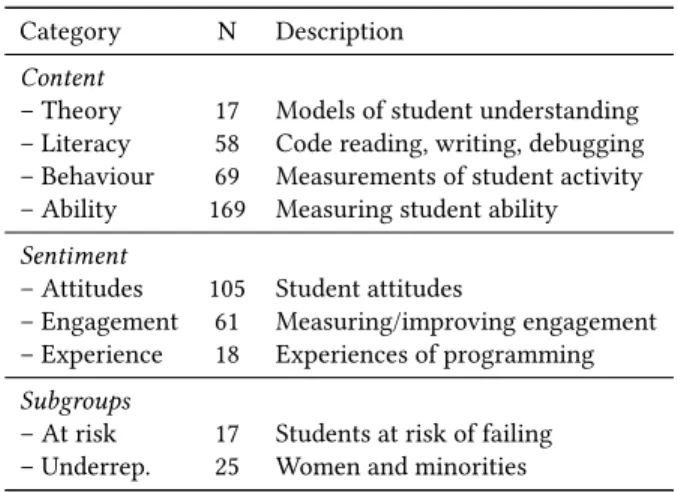
Table

2

gives an overview of the categories and corresponding

num-bers of papers. The sum of the numnum-bers in the table does not match

the number in Table

1

because some papers were classified into

more than one category.

2003

2004

2005

2006

2007

2008

2009

2010

2011

2012

2013

2014

2015

2016

2017

0

50

100

150

200

Paper count

Figure 1: Introductory programming publications identified

by our search

2003

2004

2005

2006

2007

2008

2009

2010

2011

2012

2013

2014

2015

2016

2017

0

50

100

150

200

250

Paper count

SIGCSE conference papers in our study

All SIGCSE conference papers

Figure 2: Introductory programming publications identified

by our search and published in ICER, ITiCSE or SIGCSE,

compared with total publications in ICER, ITiCSE and

SIGCSE

Table 2: Classification of papers focused on students

Category

N

Description

Content

– Theory

17

Models of student understanding

– Literacy

58

Code reading, writing, debugging

– Behaviour

69

Measurements of student activity

– Ability

169 Measuring student ability

Sentiment

– Attitudes

105 Student attitudes

– Engagement

61

Measuring/improving engagement

– Experience

18

Experiences of programming

Subgroups

– At risk

17

Students at risk of failing

– Underrep.

25

Women and minorities

(5)

5.1

Content

The categories in this section relate to measuring what students

learn and how they learn it. We begin by considering work that

applies a cognitive lens to student understanding. We then move

to publications on what we term code literacy (i.e., reading,

writ-ing, and debugging of code), before moving to measurable student

behaviour. The section concludes by considering broad ways that

student ability is addressed in research. Figure

3

illustrates the

growth of papers focusing on the interaction between students and

the content taught in introductory programming courses.

2003

2004

2005

2006

2007

2008

2009

2010

2011

2012

2013

2014

2015

2016

2017

Year

0

5

10

15

20

25

Paper count

Figure 3: Number of publications focusing on interaction

be-tween students and the content — theory, literacy, behaviour

and ability — by year

5.1.1

Theory.

Several papers grounded in various theoretical perspectives

study the thinking processes of novice programmers. The

num-ber of papers focusing on the theoretical perspectives is relatively

small (no more than 3 papers in any given year), with no discernible

trend over the period of our study.

From a constructivist point of view, learners construct their own

mental models of the phenomena they interact with [

59

]. Several

pa-pers have investigated novice programmers’ viable and non-viable

mental models of concepts such as variables [

628

], parameter

pass-ing [

401

], value and reference assignment [

399

], and how objects

are stored in memory [

627

]. Students were found to hold

misconcep-tions and non-viable mental models of these fundamental concepts

even after completing their introductory programming courses. To

address this issue, Sorva [

627

,

628

] recommends the use of

visual-isation tools with techniques from variation theory, while Ma et

al. [

398

,

400

] recommend the use of visualisation tools with

tech-niques from cognitive conflict theory. Interestingly, both Madison

and Gifford [

401

] and Ma et al. [

399

] report that students holding

non-viable mental models sometimes still manage to do well on

related programming tasks, suggesting that assessment techniques

beyond conventional code-writing tasks might be needed to reveal

certain misconceptions.

Vagianou [

674

] suggests a conceptual framework and a

graph-ical representation that can be used to help students construct a

viable mental model of program-memory interaction. Vagianou

ar-gues that program-memory interaction exhibits the characteristics

of a

threshold concept

, being troublesome, transformative, and

po-tentially irreversible. Sorva [

629

] distinguishes between threshold

concepts and

fundamental ideas

, proposing that threshold concepts

act as ‘portals’ that transform the students’ understanding, while

fundamental ideas “run threadlike across a discipline and beyond”.

Sorva, who has conducted a comprehensive review of research

on mental models, misconceptions, and threshold concepts [

630

],

suggests that abstraction and state might be fundamental ideas

while program dynamics, information hiding, and object

interac-tion might be threshold concepts.

Lister [

381

] and Teague et al. [

655

658

] apply a neo-Piagetian

perspective to explore how students reason about code. They

dis-cuss the different cognitive developmental stages of novice

pro-grammers and use these stages to explain and predict the ability or

otherwise of students to perform tasks in code reading and writing.

The most important pedagogical implication of this work is that

in-structional practice should first identify the neo-Piagetian level that

students are at and then explicitly train them to reason at higher

levels. They contrast this with conventional practices, where they

argue that teaching often happens at a cognitive level that is higher

than that of many students [

381

,

656

658

].

Due to the qualitative nature of research done both on mental

models and on neo-Piagetian cognitive stages, more work is needed

to quantitatively study what has been observed. For example, it is

still not clear how widespread the observed mental models are or

which neo-Piagetian cognitive stages are more prevalent among

novice programmers in different courses or at different times in the

same course. The small numbers of participants in these qualitative

studies suggest the need for more studies that replicate, validate,

and expand them.

5.1.2

Code ‘Literacy’.

Literacy, a term traditionally applied to the reading and writing

of natural language, is concerned with making sense of the world

and communicating effectively. In modern usage this has

broad-ened to refer to knowledge and competency in a specific area, for

example, ‘computer literacy’. Here, however, we apply the term in

the traditional sense to coding, using it to mean how students make

sense of code and how they communicate solutions to problems by

writing executable programs. We distinguish between reading and

writing, and consider research that seeks insights into the students’

processes in each.

Code reading and tracing.

The process of reading programs is

essential both in learning to program and in the practice of

pro-gramming by experts. We found 28 papers reporting on issues

related to students’ code reading. These included papers where the

reading process involved tracing the way a computer would

exe-cute the program, which adds a significant dimension to ‘making

sense’ that is not present in the largely linear process of reading

natural-language text.

A number of papers study the reading process in order to gain

insight into students’ program comprehension, for example by

re-lating reading behaviour to well-known program comprehension

models [

13

] or the education-focused block model [

702

]. There has

been recent interest in the application of eye-tracking techniques

to novice programmers, for example to study changes in reading

(6)

process as students progress through a course and to identify

clus-ters of students with similar learning paths [

499

,

721

]. Although

useful work has been done, the process of reading code, and the

way this process changes as a novice programmer gains expertise,

are not well understood.

There have been major studies of student code-reading and

trac-ing skills, for example by Lister et al. [

382

], which have raised

concerns about weaknesses in many students’ abilities. The

re-lationship between code reading and other skills, notably code

writing, has also been widely studied [

383

,

388

,

562

,

611

],

lead-ing to the conclusion that code-readlead-ing skills are prerequisite for

problem-solving activities including code writing. Given this, there

is a strong incentive to help students to develop reading skills, and

a number of papers focus on the effects on writing skills of specific

activities that are designed to provide practice in reading [

142

,

644

].

Tools have been developed to support students in code reading

by helping them to identify ‘beacons’ in code [

369

] and to help

teachers to target support by visualising students’ code-tracing

pro-cesses [

126

]. Given the evidence that has been found for the value

of code-reading skills in novice programmers, there is an ongoing

need to explore further ways of encouraging the development of

these skills.

Code writing and debugging.

Papers in this category focus on

students’ ability to write programs, how they approach the creation

of programs, and ways of supporting the process. Creating

pro-grams involves writing code and debugging that code in order to

reach a working solution. We found 48 papers focusing on aspects

of writing and debugging code.

The McCracken report from an ITiCSE working group in

2001 [

426

], which raised concerns about students’ skills at the end

of the introductory programming course, has been influential in

the study of student code-writing skills during the years covered by

this review. Utting et al. revisited the topic in a subsequent ITiCSE

working group [

673

], and discovered a closer match between

teach-ers’ expectations and student skills than the original study. They

noted as a possible reason that teachers’ expectations have lowered,

possibly as a consequence of previous research. A number of papers

focus not just on students’ performance on writing tasks, but also on

what this reveals about the difficulty and suitability of those tasks,

for example the canonical ‘rainfall problem’ [

357

,

586

,

606

,

703

].

The types of task that we give to students, and the way we present

and scaffold these tasks, are important to students’ performance

and to their learning through undertaking the tasks, and insights

in this area will continue to be of value.

Other papers focus on supporting students in writing tasks,

mostly concerned with the way students deal with the errors they

encounter as they write code rather than the process of planning or

designing their programs. Zehetmeier et al. [

729

] describe teaching

interventions designed to help with common errors. Compilation

is an important part of the process of code writing and there has

been a significant body of work related to compiler error messages,

including studying the comprehensibility of standard compiler

mes-sages [

667

] and providing enhanced messages to help novices [

56

].

A number of approaches and tools have been proposed to

encour-age students to take a systematic approach to debugging,

includ-ing a serious game [

442

], error messages that are pedagogically

designed [

411

] or based on social recommendations from other

stu-dents’ activities [

251

], and programming environments that allow

students to interactively ask questions about program output [

339

].

An ITiCSE working group [

615

] developed a repository of videos to

help students with debugging. Bennedsen and Schulte [

66

] studied

the impact of using the BlueJ debugger to visualise code execution,

but there are actually very few papers that study how students use

the debuggers built into most IDEs. These environments provide

rich tools to provide insight into the execution of code, and there

are open questions around their accessibility and usefulness in the

early stages of learning to program.

Summary.

Research in this area has advanced understanding of

the ways in which students read and write code and the expectations

that are realistic for teachers to hold for their ability to do so. A

key finding is the importance of code-reading skills to underpin

other aspects code literacy. Linguists hypothesise that we acquire

writing style by reading, and there is evidence that this applies to

programming as well as to natural language. Guidance has also

been derived for designing appropriate code reading and writing

tasks and supporting the students in these processes. For example,

emerging techniques such as eye tracking promise new insights

into the process of code reading and may also guide teachers in

presenting code examples in a ‘readable’ form to enhance learning.

5.1.3

Student Behaviour.

Students generate a great deal of data as they go about their

activities, for example in the way they interact with coding

envi-ronments, learning tools, and the classroom. There is increasing

interest in gathering and analysing this data in order to learn about

the ways in which students behave. This section reports on the

69 papers we identified that report data and findings on student

behaviour. More than half of these (36 papers) were published in

the last three years (2015-2017) of the fifteen-year period covered in

this review (see Figure

4

). This may reflect an increasing awareness

of the value of data and the emergence and wide use of machine

learning and data mining, although by no means all of the papers

use these techniques.

2003

2004

2005

2006

2007

2008

2009

2010

2011

2012

2013

2014

2015

2016

2017

Year

0

2

4

6

8

10

12

14

Paper count

Figure 4: Papers classified as being about student behaviour

have increased rapidly over the past few years

(7)

Many of these papers can be considered to describe learning

analytics. Hui and Farvolden [

280

] recently proposed a framework

to classify ways in which learning analytics can be used to shape

a course, considering how data can address the instructors’ needs

to understand student knowledge, errors, engagement, and

expec-tations, and how personalisation of feedback based on data can

address students’ needs to plan and monitor their progress. Many

aspects of their framework are reflected in the themes discovered

in the current review. An understanding of student behaviour is of

value to educators in at least the following ways:

Predicting success in examinations and other assessments

Identifying student difficulties and interventions designed

to mitigate them

Designing tools that respond to specific behaviours in a way

that is helpful to the students

Encouraging students to alter their behaviour to improve

their likelihood of success

Detecting undesirable behaviour such as cheating

A previous ITiCSE working group [

294

] has reviewed the

litera-ture on educational data mining and learning analytics in

program-ming (not restricted to introductory programprogram-ming), describing the

state of the art in collecting and sharing programming data and

discussing future directions. The report from that working group

complements this work by providing in-depth coverage of this

specific topic.

Coding behaviour data.

Students in introductory programming

courses spend a lot of time creating code, but what are they actually

doing when they code? Some papers describe the use of data to

provide insights into how students go about and experience the

process of coding, reporting analyses of observations of the students

as they code or of the products of the coding.

The largest number of papers report analysis of compilation

behaviour. Brown et al. [

93

] describe a repository of compilation

data that is populated by users worldwide of the BlueJ IDE. This

follows earlier work by the BlueJ team on recording compilation

behaviour [

299

], and allows other researchers to use the tool to

gather data for their own research, exemplified by Rodrigo and

Baker [

555

]. Other researchers have embedded the capability to

record similar data in the tools that their students use to write

code [

69

,

205

,

460

]. In order to extract insights from compilation

data, Jadud [

299

] defined an error quotient (EQ) metric, which was

further explored by Petersen et al. [

507

], while Becker [

57

] has

proposed an alternative metric. Compilation data has been used

to provide feedback to students in the form of enhanced error

messages, although the results have been mixed in terms of the

value of these messages to students [

58

,

509

]. Compilation can

provide insights into aspects of behaviour other than the errors

the student has to deal with; for example, Rodrigo and Baker [

555

]

used compilation data to study frustration.

Compilation is an important aspect of the coding process, but

other aspects have been studied, including keystrokes and timing

within a session [

367

] and evolution of code over an extended

period [

514

].

In addition to the process, the code artefacts created by students

have been studied. The correctness of code, typically measured by

whether it passes automated tests on submission, has been used to

identify common student difficulties [

137

] and competencies [

69

],

and to predict course outcomes and target at-risk students [

6

,

37

].

Code quality has been analysed to allow instructors to target

im-provements in the guidance given to students. Measurements of

code quality have included traditional [

508

] and novel [

112

]

soft-ware metrics and a continuous inspection tool [

41

]. While coding

quality is a notion that comes from software engineering,

Bum-bacher et al. [

99

] propose a set of metrics, which they refer to as

‘coding style’, that can be used to monitor progress in learning

and to predict help-seeking. Hovemeyer et al. [

273

] and Pero [

503

]

have used code structures, in the form of abstract syntax trees

de-rived from students’ code, to draw conclusions about student skill

levels. Loksa and Ko [

387

] combine student code with think-aloud

protocols to investigate self-regulation of learning in programming.

Other behaviour data.

While coding tools play an important part

in studying programming, students interact with a range of other

more generic learning resources such as learning management

sys-tems (LMS). Although such resources are widely used and studied

across disciplines, there is a growing body of work specifically

focused on their use in introductory programming.

Some researchers have applied techniques for machine

learn-ing [

323

,

370

] and data mining [

36

] to study interaction by

intro-ductory programming students with an LMS in order to identify

behaviour patterns and investigate whether these can predict

aca-demic success. Other papers focus on introductory programming

students’ use of specific types of resource provided within a

learn-ing environment, such as video lectures [

149

,

428

] and interactive

reading and homework materials [

183

] designed to enable a flipped

classroom approach. The latter paper identifies some key

implemen-tation factors that encourage engagement with interactive materials.

There has also been research on the use of social media, beyond

the LMS, for online learning [

408

].

Although there is an emphasis in the literature on online

be-haviours, Hsu and Plunkett [

274

] study the correlation between

class attendance and academic grades, while Chinn et al. [

125

]

in-vestigate several study habits, including online and other activities.

Summary.

The value of data in providing insights and

predic-tive power is becoming increasingly recognised in many aspects of

human activity, and techniques and tools for data science are

be-coming increasingly accessible. Computing education is beginning

to make use of these, but we have as yet only scratched the surface

of what can be done. In particular, it seems that there is significant

potential to learn about student learning through analysis of coding

behaviour. There has been progress in mechanisms for gathering

data, but there is a great deal of scope for exploring the correlation

between behaviour and learning outcomes [

637

], and perhaps for

understanding the differences in behaviour between novice and

expert programmers.

5.1.4

Student Ability.

Students’ ability in introductory programming courses can be

thought of as what they can achieve in terms of learning,

under-standing, and applying programming. In this category we

identi-fied 169 entries, most of which infer students’ ability from

mea-surements related to their performance and success in

program-ming [

21

,

48

,

709

,

734

]. The use of the word ‘ability’ in this context

(8)

should not be taken to infer that this is a fixed quantity. In particular,

it does not contradict the notion of ‘growth mindset’, which

recog-nises that students’ ability can change as their studies progress.

Students’ ability has been measured by various means such as

code assessment [

318

], self-reporting [

223

], knowledge acquisition

tests [

106

], exams [

101

,

357

], and various learning analytics [

323

].

Some studies combine different types of measurement [

264

,

318

].

Although students’ grades and traditional assessment are still the

dominant measurement of their ability, there are moves towards

more sophisticated measurements coming from high-frequency

data collections.

A number of papers focus on the capacity of student-generated

data to provide accurate estimations of students’ ability. In recent

years we have seen papers using student-generated data such as

source code and log files to compare variables that can predict

students’ performance [

694

]. In addition, we have seen large-scale

student-generated data that can be analysed to guide (or

ques-tion) teachers’ decisions and judgement about students’ ability [

92

].

Despite the difficulties in adopting and using student-generated

data (e.g., from large-scale projects and sophisticated

pedagogi-cal practices) to infer students’ ability, student-generated data is a

growing area of research in introductory programming [

92

,

323

]

that promises more accurate and reliable measurements of

stu-dents’ ability, for example by tracking learning progression during

programming.

Many papers propose specific pedagogical practices such as

community-of-inquiry learning, pair programming, and team-based

learning [

101

,

425

], suggesting that these practices can potentially

improve students’ ability to learn programming. Such papers

gener-ally report on the introduction of a practice to cope with a specific

difficulty or misconception in programming, and often conclude

with a possibly rigorous empirical evaluation and a discussion of

lessons learned.

Some recent publications focus on the relationship between

stu-dents’ programming ability and other abilities such as problem

solving [

377

] and engagement [

313

,

323

], traits such as

conscien-tiousness [

570

] and neuroticism [

569

], and attitudes such as

self-efficacy [

313

].

In summary, publications on the ability of introductory

program-ming students typically address one or more of these questions:

How can students’ ability, that is, their success or

perfor-mance in programming, be measured more accurately and

reliably?

How can the various types of student-generated data inform

students/teachers about ability and predict future success?

What is the relationship between students’ programming

ability and their other abilities and personality traits,

atti-tudes, and engagement?

What pedagogical practices have the capacity to enhance

students’ ability?

5.2

Sentiment

In this section we report on research that investigates the student

perspective of learning to program — the attitudes of students,

the extent of their engagement, and the experience of learning

to program. Figure

5

illustrates the growth of papers focusing on

student sentiment.

2003

2004

2005

2006

2007

2008

2009

2010

2011

2012

2013

2014

2015

2016

2017

Year

0

2

4

6

8

10

12

14

16

18

20

Paper count

Figure 5: Number of publications per year focusing on

stu-dent attitudes, engagement, or experience

5.2.1

Student Attitudes.

For the purpose of classifying papers, ‘attitudes’ has a broad

definition. Eagly and Chaiken [

180

] define attitude as “a

psycho-logical tendency that is expressed by evaluating a particular entity

with some degree of favour or disfavour”. We take that to include

self-perceptions, where the ‘entities’ are the students themselves

or certain of their characteristics, such as current level of

program-ming skill. We also take it to include perceptions of particular

aspects of introductory programming, whether more abstract, such

as programming as a discipline, or more concrete, such as a tool.

Given the challenges that educators face in the introductory

programming course, particularly with respect to retention [

325

,

372

], ways of supporting students to develop positive attitudes have

received considerable attention in the literature (105 papers). This is

perhaps underscored by McKinney and Denton’s 2004 paper [

431

],

which reports a concerning decline in affective factors during the

first programming course, a challenge that persists more than ten

years after its publication [

587

].

Although a considerable number of attitudinal influences have

been linked with measures of course success, no construct has

re-ceived more attention than self-efficacy and self-perception. This

body of work includes key papers by Kinnunen and Simon which

examine self-efficacy through a theoretic lens [

327

] and which

identify sometimes counter-intuitive processes through which

stu-dents’ self-efficacy can change [

328

]. Though the importance of the

construct is consistent with other areas [

350

], recent work throws

into question whether conventional designs for learning activities

that are intended to lead to enacted mastery experiences are

ap-propriate and readily transferable to the domain of introductory

programming. Further complicating this challenge is the notion that

practices could disproportionately affect different groups. Some

pa-pers on this topic are covered in sections

5.3.1

and

5.3.2

. However, it

is worth noting that recent work continues to highlight differences

in self-efficacy between genders [

378

,

531

].

Within this domain is a considerable body of work on the

per-ceived difficulty of programming courses [

355

] and its relation to

(9)

persistence in computing degrees [

189

]. Only the most engaged

students are good at predicting their performance in a course [

159

],

so when students tend to pick tasks that they perceive to be

eas-ier [

665

], it is not clear whether the difficulties they perceive are

in the task or in themselves as individuals. The literature seems

to acknowledge that when addressing such perceptions, the first

impression is important [

338

], as is the consideration of perceived

difficulty in the design of pedagogic approaches [

223

].

Several studies have explored ways to enrich student attitudes,

often with the intention of improving some aspect of course ‘health’

or the student experience. These interventions include collaborative

scaffolding [

194

], problem-based learning [

208

], peer tutoring [

220

],

pedagogical code review [

282

], facilitated e-learning [

365

], and peer

instruction [

731

].

A related area where successful interventions are also reported

focuses on Dweck’s notion of ‘mindset’, the level of belief that

one can grow and develop. Murphy and Thomas [

464

] warn

edu-cators of the dangers of students developing a ‘fixed’ mindset in

the introductory programming context. Further literature has since

explored the design of mindset interventions [

245

,

584

,

616

]. Cutts

et al. [

143

] report some success by teaching students about the

concept of mindset and using messages embedded in coursework

feedback to reinforce a ‘growth’ mindset.

There remains a need for further work comparing the effect sizes

of interventions in order to guide educators towards the most

ef-fective practices. Student self-beliefs therefore remain a fertile field

of research with continuing challenges. Calls for greater

method-ological rigour [

190

] might pave the way for such comparisons.

For example, a number of measurement instruments have been

developed and formally validated for use in the introductory

pro-gramming context [

171

,

583

] and their use might facilitate new

developments in this field.

Another core area of attitudinal research considers attitudes

towards particular tools, techniques, platforms, and pedagogical

approaches. Much of this research is combined into studies

explor-ing the tools themselves, and is covered in section

6.4

. Examples

of such attitudinal research include impressions of pair

program-ming [

242

,

425

,

427

], attitudes towards the use of tools such as

Scratch [

418

], satisfaction with self-assessment [

474

], impressions

of prior experience [

651

], and the use of consistent instructors [

424

].

This area has considerable breadth and leverages a rich set of

methodologies. Although validity is a spectrum rather than an

abso-lute [

472

], there are several ways that methodological rigour could

be improved in future work. Many of the recommendations

pub-lished in the 2008 methodological review by Randolph et al. [

537

]

are yet to be widely adopted, and there is scope to address similar

concerns surrounding measurement [

190

]. Furthermore, papers in

this area during the review period tend to focus on WEIRD

popula-tions (western, educated, industrialised, rich, and democratic) [

258

],

exposing a lack of cross-cultural studies and undermining the

gener-alisability of the research to an international audience. There is also

a shortage of research replicating experiments that use validated

measurement instruments; such research would offer reassurance

of the consistency with which particular attitudes are observed in

different contexts.

5.2.2

Student Engagement.

Student engagement in introductory programming has received

considerable attention over the period of this review, encompassing

papers focused on time on task, encouragement of self-regulated

learning, and the issues surrounding disengagement. It is no

sur-prise that a major factor in students’ success is their self-motivation

and ability to engage with the learning opportunities available to

them [

552

]. However, students disengage and subsequently drop

out for many reasons, and these are quite multifaceted [

325

]. On the

other hand, there are students who complete their studies

success-fully after adapting to the difficulties by devising new techniques

and increasing their efforts [

505

].

While much research on student engagement in computing

takes a broader approach, the introductory programming context

has been the focus of a number of studies. Such investigations

often overlap with attitudes as antecedents to motivation (see

sec-tion

5.2.1

), tools and teaching approaches as interventions to

im-prove motivation (see sections

6.4

and

6.3

), and behaviour, in the

sense of students doing things that improve their level of

achieve-ment and their probability of persisting with their study (see section

5.1.3

). However, given the specific interest of the research

commu-nity in engagement, it is worth highlighting key contributions to

student engagement in a separate section here.

Many of the papers published during the period report on

empiri-cal studies focusing on the internal characteristics of students [

111

]

and their role in self-regulated learning [

378

]. Some of these studies

highlight particular constructs deserving of further attention, for

ex-ample, achievement goals [

734

] and perceived instrumentality [

504

],

as well as how these may differ between different sub-populations

in some introductory classes [

600

]. Researchers also examine a

range of motivational sub-factors, for example finding a weak

cor-relation between performance in introductory programming and

social motivation, the desire to please somebody [

576

].

There are many explorations of the effectiveness of

interven-tions on student engagement. Examples include full course

re-designs [

134

,

406

,

476

]; implementing a holistic and better

in-tegrated curriculum [

134

]; teaching activity design, such as the

use of in-class response systems [

119

]; strategies to enrich

stu-dent behaviour, such as online journaling [

604

] and reading

in-terventions [

183

]; changes to infrastructure, allowing for smaller

classes [

87

] and closer monitoring of individuals [

32

]; the

appli-cation of e-learning [

80

,

365

,

652

]; flipped classrooms [

363

]; peer

communication tools such as anonymous chat rooms [

666

],

dis-cussion forums [

590

], and Facebook [

488

]; collaboration, including

pair programming [

115

], team-based learning [

192

], and

strate-gies such as think-pair-share [

346

]; interactive learning

experi-ences [

337

,

415

,

669

]; the use of robots [

397

,

435

]; and physical

computing approaches [

417

,

565

].

Other papers report attempts to improve student engagement

through changes in the assessment process, introducing assessment

practices and cycles such as feedback-revision-resubmission [

262

];

contexts that are meaningful to students [

292

]; contexts that

cor-respond to the real world [

344

]; the use of tools and equipment,

such as 3D printers [

316

] and robot olympics [

582

], that can grab

attention while facilitating creativity; emphasising the utility of

computing through simulated research [

493

]; tapping into social

(10)

computing paradigms earlier in introductory programming [

592

];

and game development [

130

].

Of course, games also feature prominently in the literature on

engagement for their motivational qualities [

122

,

568

]. The use of

games and game-like tools in introductory programming is not

unique to the most recent literature. However, it is worth noting

an increase in papers on the topic of ‘gamification’ (or ‘gameful

design’ as some authors prefer [

162

]) across the period. Such

pa-pers describe how particular ideas and techniques can be leveraged

in the introductory programming context. Though ‘gamification’

was coined as a term in 2002, it has received considerably more

attention in educational spheres since 2010 when Lee Sheldon

pub-lished

The Multiplayer Classroom

[

599

] and Jesse Schell endorsed

the approach at the 2010 DICE (Design, Innovate, Communicate,

Entertain) Summit. This has manifested in the introductory

pro-gramming literature through schemes such as

Game2Learn

[

49

]

and

JustPressPlay

[

155

], as well as the gamified practical activities

in

TRAcademic

[

249

]. Yet few papers refer explicitly to underlying

motivational theory and design frameworks [

38

,

127

], and further

research may be necessary to determine their applicability to

im-proving the design of interventions that engage students to do more

programming.

Approaches that promote engagement tend to emphasise active

learning over passive learning, eliminate barriers to practice, play

to students’ intrinsic motivations, explicitly introduce extrinsic

motivations, and strive to resolve ‘hygiene’ problems. Also, some

holistic interventions that approach course design as a system of

interrelated factors tend to report at least some success. However,

the question of how best to facilitate engagement for most students

remains an open one. There are several high-quality papers that

describe successful interventions and leverage motivational

the-ories to explain their efficacy. Examples include three-motivator

theory [

476

], self-determination theory [

336

], control-value

the-ory [

583

]. Although such theories are discussed elsewhere in the

literature, there is little work that addresses them within the scope

of our focus on introductory programming. Therefore, future work

focusing on introductory programming should strive to leverage

these theories in explaining their interventions. It is also somewhat

surprising that learning analytics have not played a more

promi-nent role in this section of the introductory programming literature.

The use of such tools to measure engagement would help to

iden-tify particular ‘hygiene’ factors or problematic topics that tend to

disengage students. Such data could be collected through classroom

response systems, virtual learning environments, version control

systems, integrated development environments, and more.

5.2.3

The Student Experience.

When considering the student experience in introductory

pro-gramming courses, we constrained this to mean those aspects of

study that are beyond the scope of tools and approaches related

to learning. Thus, papers in this category focus on the experience

itself, covering practices and systems for support, social integration,

affect, and pastoral issues surrounding the transition into higher

education. Many of these issues overlap with retention risk

(sec-tion

5.3.1

) but have been reported in this category because they

focus on experiences or because they describe social or pastoral

support structures rather than focusing on individual

characteris-tics.

With only 18 papers identified by the search, as a topic in and

of itself the experience of learning programming does not seem to

have received focused attention in the period of this review. A small

number of articles explore the influences of learning programming

in a foreign language [

147

], though most focus on interventions

to support learners who experience anxiety and frustration in the

face of difficulty. These include peer-assisted study schemes [

163

],

mentoring systems [

175

], and programmes to support students from

underrepresented groups [

471

]. Most such studies apply an

action-research approach incorporating analysis of data collected through

survey and interview. However, a clear nomological network has

yet to emerge across such intervention studies, suggesting that

further work is needed to identify and converge upon key factors

associated with the study of the student experience.

Even if not as an explicit goal, work towards such a model does

exist. For example, Barker et al. [

46

] found that factors such as peer

interaction predicted intention to continue studying computing, and

Schoeffel et al. [

576

] found correlations between social motivation

and performance. Other researchers such as Haatainen et al. [

234

]

considered social barriers such as whether students felt comfortable

requesting help. Indeed, many such social integration challenges

have been identified in the literature. However, rather than a sole

focus on predictors of achievement or retention, the identification

of a holistic set of factors would support work into interventions.

An aspect of the student experience which has received much

attention is affect, in the sense of emotions. Notable qualitative

studies [

279

,

326

,

376

] analyse the emotional experiences and ‘tolls’

that programming students tend to encounter as they complete

introductory programming tasks. There are interventions to

ex-plore how the modality of learning programming can influence the

emotions experienced by students [

417

]. Nolan and Bergin [

478

]

systematically reviewed many such papers in 2016, focusing on

programming anxiety. They concluded that although much work

promotes an awareness of student anxieties, there is a need for

greater focus and granularity by leveraging tools that can

mea-sure a student’s anxiety during particular programming tasks. A

number of tools have been proposed and developed to aid this

research [

84

,

235

].

Our search found only a small amount of work on the student

experience in the explicit context of introductory programming.

We are aware that more general work has been carried out on this

topic, and we feel that such work could have considerable impact

on concerns specific to introductory programming, so the area

re-mains a fertile field for further research. In addition to receiving

more attention, there is also the need to identify key facets and

drivers of the student experience. The methods of

phenomenogra-phy and grounded theory are well suited to the identification of

new factors [

329

]. Researchers should also consider identifying and

drawing together appropriate theories, models, and frameworks

from other fields to elicit potential factors [

409

]. The development of

new tools to measure experiential effects would also support work

into the identification of particular tasks that heavily influence the

student experience, and would help to determine the effectiveness

of particular interventions.

Figure

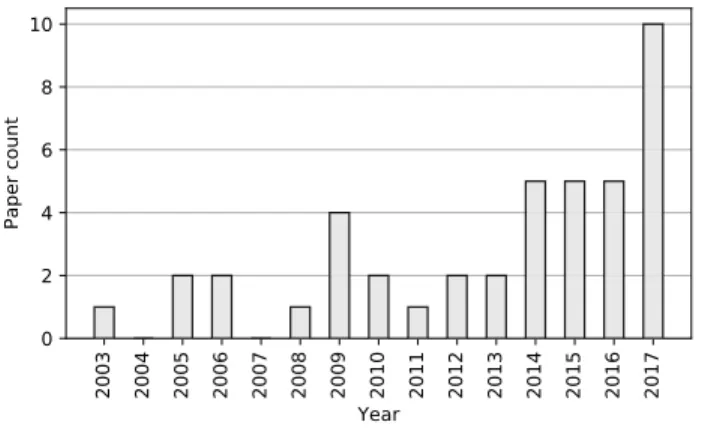
Figure 1: Introductory programming publications identified by our search 2003 2004 2005 2006 2007 2008 2009 2010 2011 2012 2013 2014 2015 2016 2017050100150200250Paper count
Figure 3: Number of publications focusing on interaction be- be-tween students and the content — theory, literacy, behaviour and ability — by year
Figure 4: Papers classified as being about student behaviour have increased rapidly over the past few years
Figure 5: Number of publications per year focusing on stu- stu-dent attitudes, engagement, or experience
+7

References

Related documents

(Most members do not reach the other two stages – the Coverage Gap Stage or the Catastrophic Coverage Stage. To get information about your costs in these stages, look at Chapter

Since the nominal money stock, which is controlled by monetary policy, pins down the domestic price level in this case, the nominal exchange rate would need to adjust – given

TEMPORÁLNA ARTERITÍDA A OBA Obrovskobunková arteritída je systémová granulomatózna vaskulitída neznámej etio- lógie, ktorá typicky postihuje vetvy karotickej artérie

A student group called Community Medical Outreach (CMO) from Florida State University in Tallahassee, Florida, has developed a unique framework to allow

The major issues in housing policy for low-income households are whether (1) housing assistance should be an entitlement, (2) the poorest households of each size should be

Ward argues in Neoliberalism and the Global Restructuring of Knowledge and Education , unchecked and unrestrained college professors are considered “too dangerous” to

In summary, these results indicate that increasing nutrient density in the diet of a laying hen will increase egg production, egg weight, egg mass, feed efficiency, body

REIT property sector going back to 2007 demonstrates the annual variability of returns by property sector of real estate trends who has access to information in both the listed