Quoc-Sang Phan
Queen Mary University of London [email protected]
Abstract
We show how Symbolic Execution can be understood as a variant of the DPLL(T) algorithm, which is the dominant technique for the Satisfiability Modulo Theories (SMT) problem. In other words, Symbolic Executors are SMT solvers. This view enables us to use an SMT solver, with the ability of generating all models with respect to a set of Boolean atoms, to explore all symbolic paths of a program. This results in a more lightweight approach for Symbolic Execution.
1998 ACM Subject Classification D.2.4 Software/Program Verification
Keywords and phrases Symbolic Execution, Satisfiability Modulo Theories
Digital Object Identifier 10.4230/OASIcs.ICCSW.2014.58
1
Introduction
Symbolic Execution (SE) [11] is now popular. It is increasingly used not only in academic settings but also in industry, such as in Microsoft, NASA, IBM and Fujitsu [4]. In the success of SE, the efficiency of SMT solvers [9] is a key factor. In fact, while SE was introduced more than three decades ago, it had not been made practical until research in SMT made significant advances [5].
State-of-the-art SMT solvers, e.g. [8, 2], implement the DPLL(T) algorithm [15] which is an integration of two components as follows. The first component is a propositional satisfiability (SAT) solver, based on the Davis-Putnam-Logemann-Loveland (DPLL) algorithm [7], to search on theBoolean skeleton of the formula. The second component is a decision procedure, called theT-solver, to check the consistency w.r.t. the theory T of conjunctions of literals, each literal is an atomic formula or the negation of an atomic formula. The path conditions generated by a Symbolic Executor, e.g. Symbolic PathFinder (SPF) [14], are also conjunctions of literals. Therefore, when an SMT solver checks such a path condition, only theT-solver works on it, and the SAT component is not used.
On the other hand, aclassicalSymbolic Executor [11] can be divided into two components. The first component, dubbed asBoolean Executor hereafter, executes the instructions, and updates the path condition. The second component is aT-solver (since the SAT solver is not used) to validate the consistency of the path condition. This paper shows that a Boolean Executor does the same work as the DPLL algorithm. Thus, SE is a variant of DPLL(T). This view is important since it connects two communities and can give an insight for future research.
Based on this new insight, we propose a lightweight approach for SE which uses the DPLL component of an SMT solver to explore symbolic paths instead of a Boolean Executor. Our approach relies on an SMT solver with the ability of generating all models w.r.t. a set of Boolean atoms.
2
Background
Before showing the correspondence between a Symbolic Executor and an SMT solver, we recall some background on Symbolic Execution and the SMT problem.
2.1
Symbolic Execution
Symbolic Execution [11] (SE) is a programming analysis technique which executes programs on unspecified inputs, by using symbolic values instead of concrete data. For each executed program path, SE builds a path conditionpcwhich represents the condition on the inputs for the execution to follow that path.
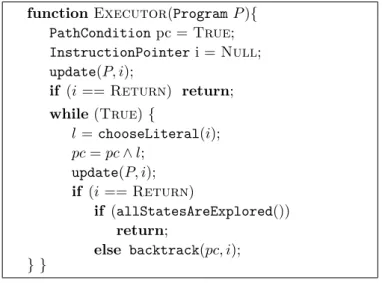
functionExecutor(ProgramP){ PathConditionpc =True; InstructionPointer i =Null; update(P, i); if (i==Return) return; while (True) { l =chooseLiteral(i); pc=pc∧l; update(P, i); if (i ==Return) if (allStatesAreExplored()) return;
else backtrack(pc, i); } }
Figure 1A simplified Boolean Executor.
For anif statement with conditionc, there are three possible cases: (i)pc`c: SE chooses thethenpath; (ii)pc` ¬c: SE chooses theelsepath; (iii) (pc0c)∧(pc0¬c): SE executes both paths: in thethenpath, it updates the path conditionpc1=pc∧c, in theelsepath it updates the path conditionpc2=pc∧ ¬c. The satisfiability of the path condition is checked by SMT solvers, for example the symbolic executor KLEE [3] uses the SMT solver STP [10], while SPF provides a parameter to select one of the SMT solvers: CVC3, Yices, Z3. In this way, only feasible program paths are explored. Test generation is performed by solving the path conditions.
2.2
SMT and DPLL(
T
)
Satisfiability Modulo Theories (SMT) is the problem of checking the satisfiability of logical formulas over one or more first-order theoriesT.
Our setting is standard first-order logic. Boolean variables are called Boolean atoms or simply atoms, and atomic formulas are called theory atoms or T-atoms. A truth assignment µfor a formula ϕis a truth value assignment to the T-atoms ofϕ. We define a bijective functionBA(Boolean abstraction) which maps Boolean atoms into themselves andT-atoms into fresh Boolean atoms. TheBoolean refinement functionBRis then defined as the inverse ofBA, which meansBR=BA−1.
At a high level, an SMT solver is the integration of two components: a SAT solver and T-solvers. SMT solving can be viewed as the iteration of the two following steps. First, the
SAT solver searches on the Boolean abstraction of the formula,ϕP =BA(ϕ), and returns a (partial) truth assignmentµP. TheT-solvers then check the Boolean refinement of the
candidate,BR(µP), whether it is consistent with the theoriesT.
functionDPLL(BooleanFormulaϕ){ µ=True; status=propagate(ϕ, µ); if (status ==Sat) returnSat;
else if (status==UnSat) returnUnSat; while(True) {
l =chooseLiteral(ϕ); µ=µ∧l;
status=propagate(ϕ, µ); if (status==Sat) returnSat; else if (status==UnSat)
if (allStatesAreExplored()) returnUnSat;
else backtrack(ϕ, µ); } }
Figure 2DPLL algorithm.
The dominant approach for SAT solvers is the DPLL family of algorithms [7]. The simplest form of DPLL is depicted in Figure 2, its input is a propositional formula ϕin Conjunctive Normal Form (CNF), which meansϕtakes the form:
ϕ=^(l1∨l2· · · ∨lk)
A (finite) disjunction of literals (l1∨l2· · · ∨lk) is called a clause, and a literalli is an atom
or its negation. A clause that contains only one literal is called aunit clause. At a high level, DPLL is a stack-based depth-first search procedure which iteratively performs the two following steps: first choose a literalli from the remaining clause, and add it to the current
truth assignment; then apply Boolean Constraint Propagation (BCP), backtracking if there is a conflict. These two steps are repeated until a model is found or all states are explored without finding a model.
The procedure BCP for a literalli removes all the clauses containingli, and removes¬li
from the remaining clauses. If the removal results an empty clause, the search encounters a conflict.
3
Illustration of DPLL(
T
)
A complete formal description of first-order theories and the DPLL(T) algorithm can be found in, e.g., [15]. Here we briefly introduce necessary preliminaries via a running example as follows.
ϕ:= (¬(x0>5)∨T1)∧((x0>5)∨T2)∧(¬(x0>5)∨(x1=x0+ 1))∧ (¬(x1<3)∨T3)∧(¬(x1<3)∨(x2=x1−1))∧
be abstracted into a Boolean skeleton by replacing all theT-atoms with new Boolean atoms, which is often calledBoolean abstraction. For the example above, we define new Boolean variablesG1, G2, A1, A2, A3for the Boolean abstraction ofT-atoms, and the abstraction can be expressed as:
BA:=G1= (x0>5)∧G2= (x1<3)∧
A1= (x1=x0+ 1)∧A2= (x2=x1−1)∧A3= (y1=x1+ 1)
(2)
As the result, we obtain a formulaϕP (P stands for propositional) as the Boolean skeleton
ofϕ. Obviously,ϕis logically equivalent toϕP∧ BA.
ϕP := (¬G1∨T1)∧(G1∨T2)∧(¬G1∨A1)∧ (¬G2∨T3)∧(¬G2∨A2)∧
(G2∨T4)∧(G2∨A3)
(3)
The DPLL(T) algorithm is the integration of the DPLL algorithm with aT-solver. The DPLL algorithm searches onϕP, returning a conjunction of Boolean literalµP. Replacing
all the new Boolean atoms,Gi andAi, inµP with their correspondingT-atoms, we obtain
the conjunctionµinT. TheT-solver then checks whetherµis consistent with the theoryT. Below is the illustration of DPLL(T) onϕ(for the limit of space, only decision literals are shown inµP):
0. µP =True ϕP
1. µP =G1 ϕP = (¬G2∨T3)∧(¬G2∨A2)∧(G2∨T4)∧(G2∨A3) 2. µP =G1∧G2 ϕP =True ;T-solver(µ) =Inconsistent
3. µP =G1 ϕP = (¬G2∨T3)∧(¬G2∨A2)∧(G2∨T4)∧(G2∨A3) 4. µP =G1∧ ¬G2 ϕP =True ;T-solver(µ) =Consistent
The DPLL algorithm tries to build a model using three main operations: decide,propagate, and backtrack [9]. The operation decide heuristically chooses a literal l (which is an unassigned Boolean atom or its negation) for branching. The operationpropagate then removes all the clauses containingl, and deletes all occurrences of¬l in the formula; this procedure is also called Boolean Constraint Propagation (BCP). If after deleting a literal from a clause, the clause only has only one literal left (unit clause), BCP assigns this literal toTrue. If deleting a literal from a clause results in an empty clause, this is called a conflict. In this case, the DPLL procedure mustbacktrackand try a different branch value.
At step 1, G1 is decided to be the branching literal, and the T-solver validates that (x0 >5) is consistent. BCP removes the clause (G1∨T2), and deletes all occurrences of ¬G1. This results in two unit clauses T1andA1, so they are assigned toTrue, which means µP =G1∧T1∧A1. Similarly, at step 2 G2 is chosen, i.e. µP =G1∧T1∧A1∧G2. The T-solver checks the conjunction: µ = (x0 > 5)∧T1∧(x1 < 3)∧(x1 =x0+ 1). This is obviously inconsistent, thus DPLL(T) backtracks and tries¬G2, which leads to a consistent model.
Note that DPLL(T) refers to various procedures integrating DPLL and aT-solver. There are procedures with an integration schema different from what we have described here. The interested reader is pointed to [15] for further references.
4
Symbolic Execution as DPLL(
T
)
Intuitively, a program can be encoded into a (first-order) formula whose models correspond to program traces. Symbolic Executors explore all program traces w.r.t. the set of program conditions, therefore they can be viewed as SMT solvers that return all (partial) models w.r.t. a set of Boolean atoms.
In this paper we only consider bounded programs, since this is the class of programs that SE can analyse. This means every loop can be unwound into a sequenceifstatements. In order to encode a program into a formula, all program variables are renamed in the manner of Static Single Assignment form [6]: each variable is assigned exactly once, and it is renamed into a new variable when being reassigned. In this way, assignments such asx=x+ 1 will not be encoded into an unsatisfiable atomic formula. Under these settings, a programP can be modelled by aSymbolic Transition System(STS) as follows:
P ≡(S, I, G, A, T)
Sis the set of program states,I⊆S is the set of initial states; each state in the STS models the computer memory at a program point. Gis the set of guards andAis the set of actions; guards and actions are first-order formulas. An action models the effect of an instruction on the computer memory. Actions that do not update the computer memory (e.g. conditional jumps) are Boolean atoms, the others areT-atoms. T ⊆S×G×A×S is the transition function,tij =hsi, gij, aij, sji ∈T models a transition from state si to state sj by taking
actionaij under the guardgij. After a transitiontij :si →sj, the statesj is exactly as the
statesi apart from the variable updated by the actionaij.
One way to encode a transitiontij into a first-order formula is to present it in the form:
tij ≡gij→aij, or equallytij ≡ ¬gij∨aij. This encoding expresses that satisfying the guard
gij implies that the actionaij is performed. In this way, a program trace is defined as a
sequence of transitions:
t01∧t12∧ · · · ∧t(k−1)k = (¬g01∨a01)∧(¬g12∨a12)· · · ∧(¬g(k−1)k∨a(k−1)k)
The semantics of the program is then defined as the set of all possible traces, or equally the set of all possible transitions, which can be represented as the following formula:
ϕ= ^ tij∈T tij = ^ tij∈T (¬gij∨aij) (4)
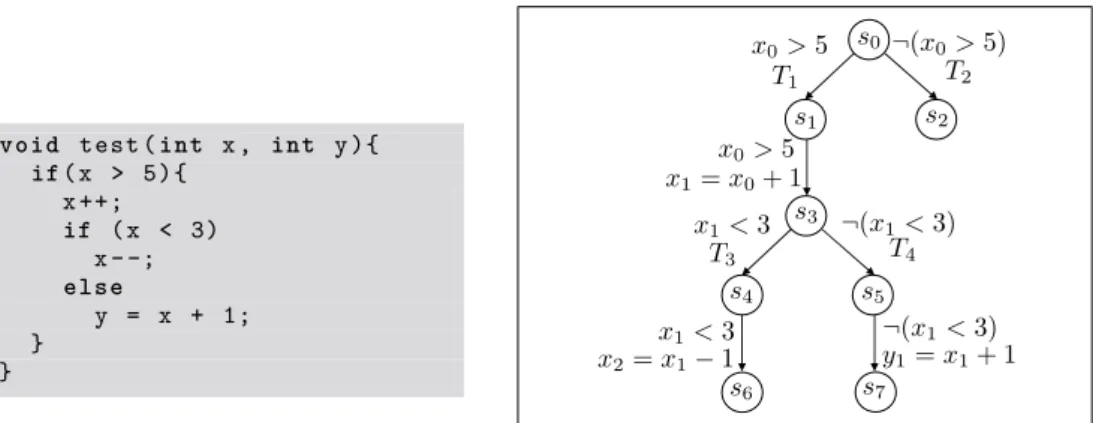
Fig. 3 depicts a simple example program and its associated STS. Encoding this STS following (4) results in the formula (1) that we have illustrated with DPLL(T) in the previous section. We now illustrate this example with SE.
At a high level, a Symbolic Executor can be considered as the integration of two com-ponents: a Boolean Executor (BE) to execute the instructions and aT-solver to check the feasibility of path conditions. For example, SPF has a parametersymbolic.dpto customize which decision procedure to use. If we set this parameter with the optionno_solverthen SPF solely works on the BE.
A BE can be described as trying to buildall path conditions using three main operations: decide,updateandbacktrack. The operationdecidechooses a literall, a condition (or its
v o i d t e s t (int x , int y ){ if( x > 5){ x ++; if ( x < 3) x - -; e l s e y = x + 1; } } s0 s1 s2 s3 s4 s5 s6 s7 x0>5 T1 ¬(x0>5) T2 x0>5 x1=x0+ 1 x1<3 T3 ¬(x1<3) T4 x1<3 ¬(x1<3) y1=x1+ 1 x2=x1−1
Figure 3 A simple program and its associated STS. The first if statement is modelled by two transitionshs0,(x0>5), T1, s1iandhs0,¬(x0>5), T2, s2i; the assignmentx++is modelled by hs1,(x0 >5), x1=x0+ 1, s3i; similarly for the rest of the program.
it backtracks to explore other paths. A Symbolic Executor, which is the integration of a BE and aT-solver, backtracks if the path condition is not satisfied.
Both DPLL and BE rely on Depth-First Search, they are similar in the way theydecide andbacktrack1. After choosing a literal, e.g. (x0 >5), BE executes the block it guards, i.e. T1 andx1=x0+ 1. This is exactly the same as in DPLL: after choosing gij, for all
the clauses (¬gij∨aij), BCP deletes¬gij, assigningaij toTrue. Therefore, the operation
updatedoes the same work as BCP, we can view a BE as implementing the DPLL algorithm, and SE as DPLL(T).
5
A lightweight approach for Symbolic Execution using All-SMT
While both Symbolic Executors and SMT solvers implement DPLL(T), the main difference between them is the models they return. Symbolic Executors explore all path conditions, each path condition is identified by the values of the Boolean abstractions of its condition constraints. For instance, although there are many values ofx0 satisfying the path (x0< 5)∧ ¬(x1 <3), it is identified byG1 =True andG2 =False. On the other hand, SMT solvers in general stop searching when a model is found. However, the solver MathSAT provides a functionality, called All-SMT [2], that given a formula and a set of Boolean atoms, it returnsall models of the formula w.r.t. this set. Hence, by asking MathSAT to find all models w.r.t. the set of guards, we can explore all symbolic paths of the program.We illustrate the approach with our running example in Fig. 3. The formulaϕin (1) is expressed in SMT-LIB v2 format [1] as follows (for the limit of space variable declarations are omitted):
1 (assert(= (> x05)G1)) 8 (assert(or(notG1)A1)) 2 (assert(= (< x13)G2)) 9 (assert(or(notG2)T3)) 3 (assert(= (=x1(+x0 1))A1)) 10 (assert(or(notG2)A2)) 4 (assert(= (=x2(−x1 1))A2)) 11 (assert(orG2 T4)) 5 (assert(= (=y1(+x1 1))A2)) 12 (assert(orG2 A3)) 6 (assert(or(notG1)T1)) 13 (check-allsat(G1 G2)) 7 (assert(orG1 T2))
1 We consider DPLL in its simplest form, without non-chronological backtracking.
Recall thatϕ=BA ∧ϕP as defined in (2) and (3). Assertions from 1 to 5 are forBA, and each assertion from 6 to 12 represents a clause ofϕP. The final command,check-allsat,
asks the solver to return all models w.r.t. the set (G1, G2). Note thatcheck-allsatis not included in standard SMT-LIB, and it is not supported by other solvers, e.g. Z3 [8].
Executing MathSAT on the example above, we obtain three models w.r.t. the set (G1, G2) as follows: (True,False), (False,True) and (False,False), which correspond to two feasible symbolic paths: (x0>5)∧ ¬(x1<3) and¬(x0>5). As we did not model integer overflow rules, the path (G1, G2) as (True,True), i.e. (x0>5)∧(x1<3), is not feasible (this path is feasible when the overflow in the assignmentx1=x0+ 1 changes a big integer into a small one). The path¬(x0>5) is listed twice, since in this case the value ofG2, i.e. (x1<3), is irrelevant, but the solver still considered it in two casesTrue andFalse.
6
Discussions and Future Work
In this paper, we show the correspondence between a Symbolic Executor and an SMT solver implementing the DPLL(T) framework [15]. Therefore, the claims in this paper do not apply for the bit vector theory, since its solvers do not implement the DPLL(T) framework. Bit vector formulas are solved by flattening into propositional formulas, then the resulting formulas are checked by a SAT solver [10].
A common problem for both SE and SMT is that there is a considerable amount of redundancy in the queries to theT-solver. Because the BE and its counterpart in SMT, the SAT component, build the conjunctions of literals in an incremental manner. To address this problem, previous work in SE and SMT used different approaches. In SE, the BE often uses the T-solver as a black box, thus most research on constraint redundancy problem has focused on caching techniques. For example, KLEE [3] has a counterexample cache that maps of sets of constraints to counterexamples, Green [16] can store the constraints offline, reusing them in different runs of the Symbolic Executor. In SMT solver, there is a tight synergy between the SAT component and theT-solver, and both are incremental and backtrackable. Therefore, theT-solver do not start from scratch if the constraint is similar to the previous query.
An immediate direction for investigation is whether the caching techniques in KLEE and Green can improve the efficiency of SMT solvers. Conversely, it would be interesting to investigate if techniques developed for SMT can be exploited for SE, for example to develop a concurrent Symbolic Executor based on previous work in concurrent SMT solver [17].
7
Conclusion
We show the correspondence between Symbolic Execution and Satisfiability Modulo Theories. This correspondence is important, as it enables us to migrate techniques developed in one community to the other. Moreover, it can give an insight for future research. In our previous work, we proposed a DPLL-based algorithm to tackle the quantitative information flow problem, and implemented it using SPF [13, 12].
Based on the correspondence above, we propose a lightweight approach for SE, using the DPLL component of an SMT solver to explore symbolic paths. The main limitation of our
References
1 Clark Barrett, Aaron Stump, and Cesare Tinelli. The smt-lib standard: Version 2.0. In SMT Workshop, 2010.
2 Roberto Bruttomesso, Alessandro Cimatti, Anders Franzén, Alberto Griggio, and Roberto Sebastiani. The mathsat 4 smt solver. InProceedings of the 20th international conference on Computer Aided Verification, CAV ’08, pages 299–303, Berlin, Heidelberg, 2008. Springer-Verlag.
3 Cristian Cadar, Daniel Dunbar, and Dawson Engler. Klee: unassisted and automatic generation of high-coverage tests for complex systems programs. OSDI’08, pages 209–224.
4 Cristian Cadar, Patrice Godefroid, Sarfraz Khurshid, Corina S. Păsăreanu, Koushik Sen, Nikolai Tillmann, and Willem Visser. Symbolic execution for software testing in practice: Preliminary assessment. InProceedings of the 33rd International Conference on Software Engineering, ICSE ’11, pages 1066–1071, New York, NY, USA, 2011. ACM.
5 Cristian Cadar and Koushik Sen. Symbolic execution for software testing: Three decades later. Commun. ACM, 56(2):82–90, February 2013.
6 R. Cytron, J. Ferrante, B. K. Rosen, M. N. Wegman, and F. K. Zadeck. An efficient method of computing static single assignment form. InProceedings of the 16th ACM SIGPLAN-SIGACT symposium on Principles of programming languages, POPL ’89, pages 25–35, New York, NY, USA, 1989. ACM.
7 Martin Davis, George Logemann, and Donald Loveland. A machine program for theorem-proving. Commun. ACM, 5(7):394–397, July 1962.
8 Leonardo De Moura and Nikolaj Bjørner. Z3: an efficient smt solver. InProceedings of the 14th international conference on Tools and algorithms for the construction and analysis of systems, TACAS’08, pages 337–340, Berlin, Heidelberg, 2008. Springer-Verlag.
9 Leonardo De Moura and Nikolaj Bjørner. Satisfiability modulo theories: introduction and applications. Commun. ACM, 54(9):69–77, September 2011.
10 Vijay Ganesh and David L. Dill. A decision procedure for bit-vectors and arrays. In Proceedings of the 19th international conference on Computer aided verification, CAV’07, pages 519–531, Berlin, Heidelberg, 2007. Springer-Verlag.
11 James C. King. Symbolic execution and program testing. Commun. ACM, 19(7):385–394, July 1976.
12 Quoc-Sang Phan and Pasquale Malacaria. Abstract model counting: A novel approach for quantification of information leaks. In Proceedings of the 9th ACM Symposium on Information, Computer and Communications Security, ASIA CCS ’14, pages 283–292, New York, NY, USA, 2014. ACM.
13 Quoc-Sang Phan, Pasquale Malacaria, Oksana Tkachuk, and Corina S. Păsăreanu. Sym-bolic quantitative information flow. SIGSOFT Softw. Eng. Notes, 37(6):1–5, November 2012.
14 Corina S. Păsăreanu and Neha Rungta. Symbolic pathfinder: symbolic execution of java bytecode. InProceedings of the IEEE/ACM international conference on Automated software engineering, ASE ’10, pages 179–180, New York, NY, USA, 2010. ACM.
15 Roberto Sebastiani. Lazy Satisfiability Modulo Theories.Journal on Satisfiability, Boolean Modeling and Computation, 3:141–224, 2007.
16 Willem Visser, Jaco Geldenhuys, and Matthew B. Dwyer. Green: reducing, reusing and recycling constraints in program analysis. In Proceedings of the ACM SIGSOFT 20th International Symposium on the Foundations of Software Engineering, FSE ’12, pages 58:1– 58:11, New York, NY, USA, 2012. ACM.
17 Christoph M. Wintersteiger, Youssef Hamadi, and Leonardo Mendonça de Moura. A con-current portfolio approach to smt solving. InCAV, pages 715–720, 2009.