REVIEWED
Integrated Performance Management System
of
Nketoana Municipality:
~
April 2007
TABLE OF CONTENTS
1.0 INTRODUCTION: ... 4
2.0 THE MUNICIPAL OBJECTIVES: ... 5
3.0 THE IPMS OBJECTIVES ... 7
4.0 THE IPMS FRAMEWORK AND ITS COMPONENTS: ... 8
4.1 THE MANAGEMENT AND ADMINISTRATION OF THE PMS: ... 8
4.1.1 The Municipal Manager, Mayor and Council: ... 8
4.1.2 The Municipal Communities and Other Stakeholders: ... 9
4.1.3 The Departmental Heads and Section heads: ... 10
4.1.4 Other Sectors: ... 10
4.1.5 The National and Provincial Departments: ... 10
4.2 THEIPMSCOMPONENTS: ... 11
5.0 THE PMS FOR OVERALL IDP IMPLEMENTATION: ... 12
5.1 THEKEYPERFORMANCEINDICATORSFORTHEPMS ... 12
5.1.1 Access to Basic Services: ... 12
5.1.2 Poverty reduction; ... 14
5.1.3 No of Jobs created by LED and capital development: ... 14
5.1.4 Employment Equity Plan Targets: ... 15
5.1.5 Work Skills Development Plan: ... 15
5.1.6 Financial Viability: ... 15
5.1.7 Other KPIs: ... 16
5.2 KEYPERFORMANCEAREAS[KPAS] ... 17
5.2.1 The Determination and Confirmation of KPAs: ... 17
5.2.2 The Strategy to address late funding: ... 18
5.2.3 Strategy to address Rural Areas: ... 19
5.2.4 Overall KPA assessment: ... 20
5.2.5 Overall KPA execution and management: ... 20
5.3 THEMONITORINGSYSTEM: ... 21
5.3.1 Individual Project Monitoring Framework: ... 22
Purpose ... 25
5.3.4 Overall Responsibility for Monitoring: ... 26
5.4 EVALUATIONOFTHEMEASUREDRESULTS: ... 26
5.4.1 Cumulative Impact Assessments: ... 27
5.4.2 Overall Responsibility for Evaluation: ... 28
5.5 PLANNINGANDREVIEW: ... 28
5.5.1 Responsibility for the IDP Review Process: ... 29
5.6 REPORTINGONPMS: ... 30
5.6.1 Report Presentation to the Council, the Public Community and Higher Offices. 31 6.0 THE PERFORMANCE MANAGEMENT SYSTEM FOR STAFF MANAGEMENT ... 35
6.1. INTRODUCTION ... 35
6.2.1 Primary Objective ... 35
6.2.2 Secondary Objective ... 36
6.3 THE CONCEPTUAL FRAMEWORK OF THE PERFORMANCE MANAGEMENT SYSTEM FOR PERSONNEL MANAGEMENT IN NKETOANA MUNICIPALITY. ... 36
6.3.1 Cascading Responsibilities ... 36
6.3.2 The Individual Focus ... 37
6.4 THE ELEMENTS OF PERFORMANCE MANAGEMENT ... 39
6.4.1 Identify Performance Expectations for Municipal Staff: ... 41
6.4.2 Mutual Discussions and Agreements on Performance Expectations .. 42
6.4.3 Reviewing Progress ... 44
6.4.4 Performance Appraisal Discussions ... 45
6.5. PLANNING FOR IMPROVEMENTS ... 48
6.6. COACHING AND FEEDBACK ... 49
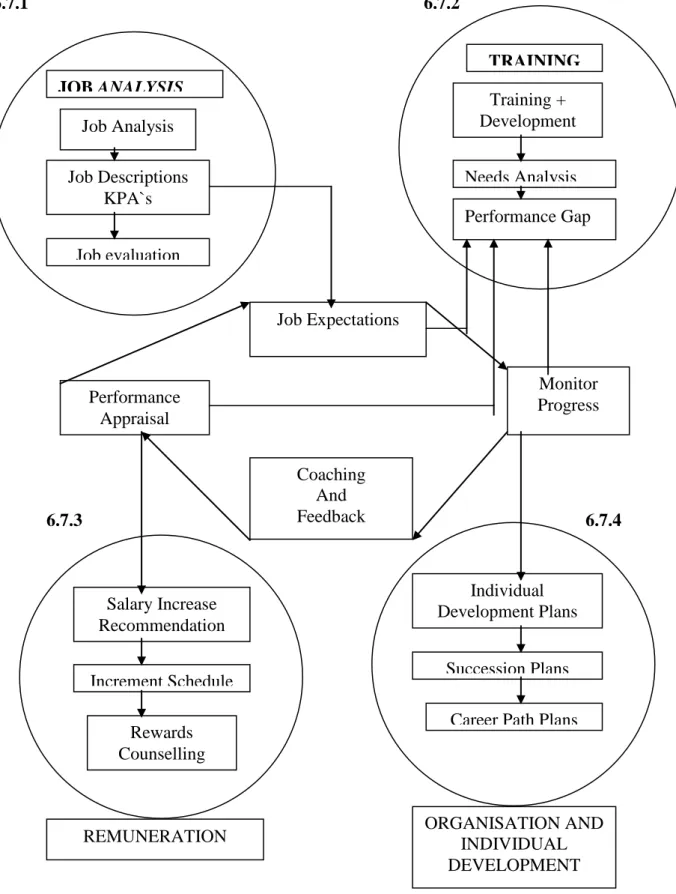
6.7. SYSTEMS INTEGRATION WITH THE PERFORMANCE MANAGEMENT CYCLE IN THE MUNICIPALITY: ... 50
6.7.1 Job Analysis: ... 50
6.7.2 Training... 50
6.7.3 Remuneration ... 51
6.7.4 Organisation and Individual Development ... 51
6.8: KEEPING INDIVIDUAL PERFORMANCE TOOLS AND FILES ... 53
6.9 CONCLUSION ... 53
7.0 CONCLUSION AND RECOMMENDATIONS: ... 55
7.1 STAKEHOLDER PEOPLE PARTICIPATION: ... 55
7.2 AWARENESS GENERATION ABOUT THE IPMSSYSTEM: ... 56
7.3 FINANCIAL DISCIPLINE: ... 56
7.4 PROJECT FUNDING: ... 56
7.5 INTEGRATION OF MUNICIPAL DEVELOPMENT OBJECTIVES WITH PMS AND INDIVIDUAL PERSONNEL OBJECTIVES: ... 57
7.6 INVESTMENT IN EQUIPMENT AND STAFF TRAINING: ... 57
7.7 EQUITABLE ACCESS TO DEVELOPMENT IN RURAL AREAS: ... 58
7.8 MULTI DISCIPLINARY APPROACHES AND TECHNICAL CONTENT: ... 58
7.9 OVERALL SUSTAINABILITY OF THE IPMS: ... 58
1.0 INTRODUCTION:
As part of the broader objective to establish a developmental state, the government introduced performance management systems in the public sector, which includes local government. Because local government is the sphere of government closest to the people at grass root level, it plays a very important role in transformation and improved service delivery.
In local government, Performance Management System is broadly legislated for by the Municipal Systems Act 32 of 2000. It can be defined in generic terms as a strategic approach to management, which equips Councillors, the Administration under guidance of the Municipal Manager, and other stakeholders at different levels, with a specified set of tools and techniques. The defined set of tools and techniques are to regularly measure and review the performance in terms of indicators and targets for efficiency, effectiveness and impact.
This ensures that the municipality is managed in such a manner that all its components and individual employees are held accountable thereby ensuring improved service delivery and value for money to the local community and residents.
Certain conditions and specific measures should be put in place in order to prepare various municipalities to implement standard PMS in a manner that leads to efficient and effective service delivery by the municipality. The Situational Analysis outlines the state of preparedness by Nketoana in terms of implementing a PMS and the relevant measures and conditions that should be put in place.
This document is aimed at putting in place a PMS relevant for the situation and circumstances of Nketoana Municipality. The PMS is designed to ensure that Nketoana Municipality will be able to monitor the implementation of its IDP in a manner so continuous as to improve their operations, performance, and accountability. This also implies that the PMS culture will have to be cascaded down to staff management level. This would then lead to a systematic integration of staff management and the management of the Municipal/Organisational development
objectives into one system; hence the term Integrated Performance Management System (IPMS).
2.0
THE MUNICIPAL OBJECTIVES:
The Vision:
The IDP states the Municipal Vision as:
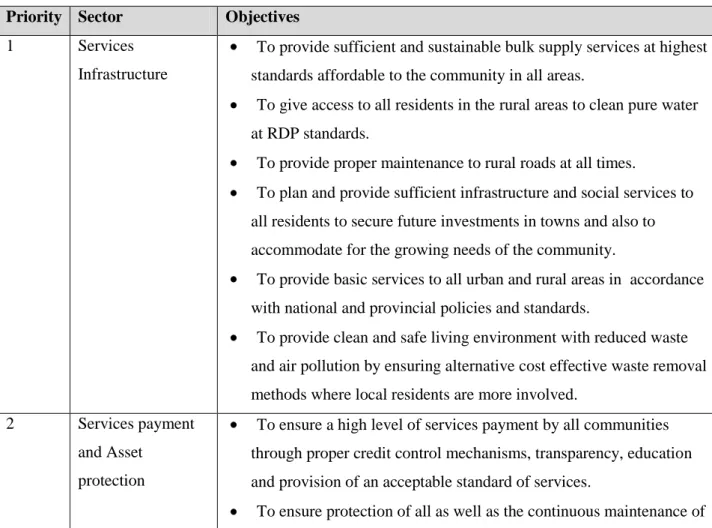
The specific developmental objectives of the Municipality are outlined in Chapter 4 of the IDP. They are summarised on a priority and thematic basis by the table below:
Table 1: Specific Municipal Objectives for Nketoana
Priority Sector Objectives
1 Services
Infrastructure
To provide sufficient and sustainable bulk supply services at highest standards affordable to the community in all areas.
To give access to all residents in the rural areas to clean pure water at RDP standards.
To provide proper maintenance to rural roads at all times.
To plan and provide sufficient infrastructure and social services to all residents to secure future investments in towns and also to accommodate for the growing needs of the community.
To provide basic services to all urban and rural areas in accordance with national and provincial policies and standards.
To provide clean and safe living environment with reduced waste and air pollution by ensuring alternative cost effective waste removal methods where local residents are more involved.
2 Services payment
and Asset protection
To ensure a high level of services payment by all communities through proper credit control mechanisms, transparency, education and provision of an acceptable standard of services.
To ensure protection of all as well as the continuous maintenance of
“To develop an integrated crime free society which is economically sustainable to attract investment that will lead to a better life for all.”
existing and future infrastructure equipment and facilities.
3 Land and Housing To ensure coordinated and formal land development takes place and that illegal occupation of land is discouraged.
To have cemeteries that adequately cater for the deceased in a dignified manner.
To provide access to security of tenure and quality housing for all.
4 Primary Health
Care
To improve the functioning and accessibility to primary health care facilities and emergency services by all members of the community and to ensure adequate maintenance of such facilities.
To ensure a clean and healthy environment that is safe to the incumbent residents of all areas.
To ensure a preventative community care system that will curb the occurrence and spreading of serious diseases.
5 Education To have adequate and sufficient educational facilities supported by effective infrastructure with improved educational conditions and a high level of education in rural and urban areas.
To ensure a higher level of literacy amongst all community members.
6 Job creation and Economic growth
To ensure continuous skills development for residents as well as the optimal utilisation of available skills to stimulate economic growth and job creation.
To ensure a larger income from the agricultural and manufacturing sectors through value added processing of agro-based products.
To have a LED strategy through which local business development and spending is promoted and investment opportunities are created. 7 Social Services and
Welfare
To promote and support the provision of a high level of social, recreational and welfare facilities and support structures which will address the needs of the community.
To promote the increased understanding, consultation and interaction between different communities to ensure greater social unity.
8 Safety and Security To have sufficient fire fighting equipment for effective prevention and fighting of fires.
Source: Municipal IDP (2006) – Nketoana Municipality.
In order to meet these objectives, the Municipality has identified a number of projects. In addition the Situational Analysis also identified a significant number of projects (raised during IDP needs analysis within the different communities in our
municipality) that should be put in place to enhance the capacity of Nketoana Municipality to manage and implement their own IPMS (See Item 4 of the PMS Situational Analysis).
3.0
THE IPMS OBJECTIVES
The aim of this IPMS is:
To put in place a high performance framework that will integrate Nketoana Municipality’s developmental objectives and staff management systems into one, that is geared and focussed to implement the developmental objectives of the municipality as outlined in its IDP, whilst taking into account staff welfare and interests on a performance based system.
The IPMS framework that should be put in place should address the following:
Highlight the administration of the IPMS and the role of other interested parties. Describe and outline in detail the two components of the IPMS that need to be integrated. Their elements must be clearly defined. These two components are:
The PMS for Overall IDP implementation and its elements
The PMS for Individual Staff Management and its elements.
Make a preliminary evaluation of the relevance of the designed IPMS framework for the situation and circumstances of Nketoana Municipality and the prospects for its implementability and sustainability of use in the Municipality.
The ultimate goal is to transform Nketoana Municipality into a high achieving institution /organisation that is able to meet all its service delivery functions and mandates including developmental goals in an efficient and effective manner.
4.0
THE IPMS FRAMEWORK AND ITS COMPONENTS:
4.1 THE MANAGEMENT AND ADMINISTRATION OF THE PMS:
4.1.1 The Municipal Manager, Mayor and Council:
The overall management of the Municipal PMS is going to be the sole responsibility of the Municipal Manager. He shall in turn delegate several aspects and functions of its components to the Senior Management Staff in his office. The Municipal Manager shall in turn report quarterly on the PMS to the Mayor and Council.
The Municipal Manager shall also see to it that all his departments have embraced the culture of PMS approach to service delivery and rewarding system. This requirement is also a pre-requisite of the Municipal Systems Act. This poses a second challenge.
The challenge is being to ensure that the PMS does not only cover aspects of IDP implementation but also aspects of personnel management and appraisal. This ensures that the PMS objectives are cascaded down to the lowest level, thus determining organisational culture and behaviour. Thus, it links daily performance with long range and strategic goals of Nketoana Municipality.
Consequently the framework shall cover two components:
The PMS for overall IDP implementation by the Municipality; The PMS for individual management and performance appraisal.
The two components are going to be linked to formulate one system that shall be referred to as the Integrated Performance Management System. The linkage shall be through ensuring that the individual appraisal is based on attaining the KPA’s, indicators, and targets, as outlined in the IDP document. By doing so, all staff
functions and operations shall be focussed and geared towards meeting the developmental goals and objectives as outlined in the IDP plan and Table 1 above. This completes the Municipal Systems Act’s requirement that municipalities should adopt PMS as a culture of doing work.
The Mayor and his Council will ensure that the Municipal Manager and all his staff adopt the PMS approach to service delivery. They will also ensure that the developmental goals (KPAs), and the Municipal KPIs are sufficiently met. They shall as well assist in ensuring that the necessary resources are leveraged to attain the outlined targets. They shall set the localised KPIs, of course being guided by the national framework from the Minister and help justify why they adopt the stated levels of KPIs, for onward reporting to the Provincial and National offices, and also to their respective constituencies who are the community in which the projects are to be implemented. The Mayor, Council, and Municipal Manager are to ensure that a culture of stakeholder participation is adopted in the PMS process, which is one of the key requirements of the Municipal Systems Act. They shall recommend the appropriate methods and measures to ensure that this happens. They will determine the reporting deadlines as well and ensure that these dates are strongly adhered to.
4.1.2 The Municipal Communities and Other Stakeholders:
These ensure that their socio-economic constraints, aspirations, and local objectives are adequately taken into account during the planning process. They identify and preliminarily prioritise, the relevant Projects and KPAs. They can make qualitative representations/suggestions for the KPIs and targets. Because Council know the resources at its disposal, Council shall therefore do the final prioritisation and confirmation. They will translate the qualitative targets from the community into quantitative indicators. The communities are expected to intensively participate in the monitoring and evaluation process. Their input, views and aspirations need to be adequately made in the planning and review process of the IDP implementation at the end of each appraisal.
4.1.3 The Departmental Heads and Section heads:
The various Municipal departments, sections and heads shall embrace a PMS culture of doing things in their routine activities. Their departmental objectives and goals should be geared towards attaining the municipal goals and projects as outlined in the Municipal IDP. HODs should ensure that their staff is managed, monitored, appraised, coached, and fed back, in a manner that attains IDP targets (KPAs) and KPIs.
The Municipal Manager shall assess each HOD on their effectiveness of implementing this management culture. In order to ensure that departments and sections adopt a PMS approach, a framework for individual PMS has been developed for staff management as well. Each HOD and head of section should ensure that they adopt the PMS appraisal system for all their staff. This appraisal should be linked to the rewarding system of Council and Municipality.
4.1.4 Other Sectors:
Other sectoral departments involved in implementing the development projects planned in the IDP should ensure that they produce the relevant progress reports to the Head of Department for that section in the Municipality. They should also embrace a PMS approach, in project implementation, monitoring, evaluation and reporting. Local level Project Steering Committees (PSC) should be set up for each project as a way of effectively coercing stakeholder participation. Their progress report should be endorsed by the PSC.
4.1.5 The National and Provincial Departments:
Play a facilitator’s role in ensuring that the Municipal office is given the appropriate resource support, technical assistance, training and capacity building, equipment, and financial resources for joint venture projects. Ensure that their inputs are timeously given, so that there is no delayed release of funds that will in turn impede on service delivery in a manner outlined in the Situational Analysis.
The Municipal Manager and HOD’s should ensure constant consultation with these higher offices to facilitate this.
The Provincial and National Offices should give guidelines on how certain programmes should be implemented for example, guidelines on the KPIs, and IDP planning and implementation.
They should assess and identify technical gaps on the various Municipal delivery aspects and make the appropriate interventions whenever needed. These assessments should include quality assessments.
They should set standards for and approve the desired documentation. They should put in place mechanisms to ensure that development projects and programmes proceed in the manner planned for.
4.2 THEIPMSCOMPONENTS:
As stated earlier, two components of the IMPS shall be outlined in detail. The PMS for Overall IDP implementation by the Municipality The PMS for Individual Staff Management.
These systems have to be systematically linked to create a work culture in the Municipality that will make Nketoana realise its intended goals and objectives as earlier outlined. It will not be possible for one component of the IPMS to function efficiently and effectively without the other. Thus the two components are a system that should be carefully designed to feed into each other in a mutually beneficial relationship.
5.0
THE PMS FOR OVERALL IDP IMPLEMENTATION:
This PMS component is aimed at driving the Municipality as an organisation to meet its vision, goals, and objectives as highlighted on Table 1. This PMS has various elements that have to be adequately designed and defined.
5.1 THEKEYPERFORMANCEINDICATORSFORTHEPMS
The Specific Municipal Developmental Objectives are stated in the IDP and also shown on Table 1. The following core Key Performance Indicators (KPIs) for the Municipality are summary highlights of the performance status expected after successful implementation of the IDP projects, programmes, strategies, and objectives. These Municipal KPIs are themselves informed and guided by the national KPIs set by the Minister.
5.1.1 Access to Basic Services:
5.1.1.1 Water:
The KPI for the Municipality is to achieve a 100% service delivery to safe clean water supply for primary household purposes at RDP standards by the year 2007 up from the current 95%. This was Achieved during April 2007 when the new development in Leratswana was provided with community taps in the streets not further than 200metre from a household.
To facilitate this, three 24-hr water treatment works are under way. In addition there are various water supply upgrade plans in all areas that are currently not sufficiently serviced for example in Arlington, Lindley, Mamafubedu, Petsana, and Leratswana. The following projects will be completed by June 2007:
Upgrading of Reitz Bulk Water Supply R 12 500 000
Reservoir Lindley R 3 800 000
The following project will be completed by March 2008:
5.1.1.2 Sanitation:
The KPIs objective is to increase the provision of sanitary service facilities for all households in both rural and urban areas. Plans are in place to increase water borne sanitation. Main hindrance was due to low pressure, which was not enough to push solid waste. Currently there are two supply service systems, the bucket systems for black townships and the water borne systems mainly for former white areas.
The following projects will be completed by June 2007:
Sewer Network at Ntha R 12 500 000
Water Borne Toilets 150 R 1 470 000 The following projects will be completed by March 2008:
500 VIP Toilets Mamafubedu R 3 750 000 800 Water borne Toilets Petsana Phase 3 R 6 900 000 300 VIP Toilets Mamafubedu Phase 2 R 2 700 000 1261 VIP Toilets Phase 2 R 9 400 000
5.1.1.3 The Indigent policy and access to basic services
The indigent policy is ensuring that every person has access to 6 KL of clean and safe water. However in the rural areas, access is restricted because of poor infrastructure resources development.
To increase the percentage of beneficiaries of water services, about 4000 households are planned to receive a further subsidy of R89/month for water and sanitation and refuse removal services for those with an income limit of R1100/month up from a limit of R800/month. This blanket cover is meant to include pensioners.
There are solid plans to increase access to water and sanitation by farm workers in rural areas. This is made possible by availing R1.5 million as grants to farmers to ensure that the farm workers enjoy equitable access to water resources and sanitary services. This money shall be applied for and procedures are put in place to monitor its use.
5.1.1.4 Electricity:
There are plans to give access to all by making provision of 50 KW free to all residents. However there is a dual supply service of energy by ESKOM and the Municipality. Whereas the Municipality will not be a problem, the areas serviced by ESKOM will need negotiations for equitable access of the resource by all. There is a need to put in place meters to enable implementation of the free for all policy. The Municipal electricity is already cheaper and there is need to streamline prices between the two supply authorities.
5.1.2 Poverty reduction;
There are plans to increase the number serviced by free basic services from the current limit of 800 to those earning R1100/ month.
All (100%) pensioners are to be registered and to receive subsidies for basic services.
Community based Public Works Programs are to be linked to the indigent list of households.
The IDP has identified various strategies across all sectors to reduce poverty
5.1.3 No of Jobs created by LED and capital development:
The prospects for employment generation and reduction of employment are well covered in the Municipal IDP.
There are plans for the following:
To reduce employment by intensifying labour opportunities.
To increase employment opportunities by giving access of land resources to women and the landless.
With regard to the above 35 ha of former Municipal land has been allocated to about 20 women to do market gardening with a view to register them as a cooperative or SMME.
Other comprehensive strategies are detailed in the IDP as shown on the PMS schedule.
The challenge lies in the rural areas where there is no database. An Integrated Sustainable Rural Development Strategy (ISRDS) should be put in place to tackle this challenge effectively since the measures outlined in the IDP are inadequate.
5.1.4 Employment Equity Plan Targets:
The intention is to increase allocation of senior posts to those people who were previously disadvantaged before 1994. Although there is a need to put in place a formal document highlighting the plan and procedure, the Municipality has implemented this dramatically by filling all HOD posts within a year. They have consequently outperformed the national targets. (see the PMS Situational Analysis).
However a comprehensive document needs to be put in place.
5.1.5 Work Skills Development Plan:
The intention is to increase the percentage of people benefiting from the implementation of the Work Skills Plan.
There must be a significant proportion of the budget spent on the work skills plan each year. R 221 550 have been allocated to training whilst R 50 000 is allocated to private training assistance to officials.
The challenge is to ensure that this plan is implemented given the previous low records in training by the Municipality (see the Situational Analysis).
5.1.6 Financial Viability:
The annual budget allocation to salaries should be within national guidelines. These national guidelines recommend that up to 35% of the budget should be for salaries. The Municipality has 35.2, which is within reasonable range of the recommended. This ensures the municipality operations are kept within viable
estimates and thus will not affect implementation/funding of development projects.
However the need to contain salaries can negatively affect delivery since some current posts in the new organogram had to be frozen for the current year.
There has been some significant tariff increases in various aspects and sections of service delivery implying that there is going to be viable cost recovery mechanisms to cover the costs of services provided for by the Municipality to its community. All other tariffs are to be increased by 6 %.This ensures that Municipal operations are recovered and thus contributing to financial viability. There has been 8% salary increase on the budget and this is not yet performance based. The award of these salary increases should have been performance based. However, the 8% is to ensure that the council remains viable and within the maximum limit of 35%. There is also scope for external funds to help fund most projects (90%) in the Municipality (see Situational Analysis). This ensures that the revenue base and viability of the Municipality remain sustained and viable. It also sets free Municipal funds for other development projects.
There are solid mechanisms in operation to ensure credit control and cost effective cost recovery from defaulting ratepayers. This rate has been increased from below 58% to 85%. The plan is to ensure that this percentage cost recovery should continue to rise. This will maintain institutional financial viability that will culminate in high service delivery by the Municipality.
5.1.7 Other KPIs:
5.1.7.1 Putting in Place the Integrated Information Systems:
The intention is to increase information technology coverage and undertake the following:
Link all offices with one network;
Link all offices with one financial information system;
Install an electronic filing system to replace the current manual system; The Municipality is part of a Master Systems Plan, a pilot project designed to link information systems from district to provincial and national offices.
5.1.7.2 Integrated Organogram
This is meant to streamline staff posts, operations and functions. It also includes filling vacant posts and newly identified posts. It is aimed at sharpening Municipal functions and expedites service delivery by the Municipality.
Top posts are to be filled under guidance from the Employment Equity Act, where those previously disadvantaged are earmarked and prioritised for these positions.
All HOD posts were filled by January 2007
5.1.7.3 Job evaluation
Four municipalities at different grades have been merged as a result of the recent demarcation exercise. Different people with same posts are currently at different salary scales. There are plans to address this disparity in salaries. This exercise shall be guided at National level where the Department is getting assistance from strategic partners like IMATU and SALGA in conducting a comprehensive job evaluation.
The guidelines shall be used and adapted in the Municipality to attain parity in salary scales for similar job specifications.
These Municipal targets are expected to be completed once there is accord among all the stakeholders.
5.2 KEYPERFORMANCEAREAS[KPA’S]
5.2.1 The Determination and Confirmation of KPAs:
In order to meet the above developmental aspirations and thus meet the KPIs, the Municipality identified projects that should be developed over a five-year period. Over and above this, the situational analysis also identified some supplementary projects that will increase the Municipality’s state of preparedness in running its own PMS.
All the projects are categorised into the following priority groups (see the IDP document):
Infrastructure Services;
Service Payment and Asset Protection; Land and Housing;
Education;
Primary Health Care; Education;
Job Creation and Economic growth; Social Services and Welfare;
Safety and Security
Although the number of projects appears ambitious, the Municipal Council and Authorities are optimistic that this number is a reality and achievable given the scenarios detailed in the Situational Analysis. This is possible given that about 90 % of the projects are externally supported by national government programmes of which about 60% is from MIG.
However the Situational Analysis has identified the late release of funds especially for externally supported projects as a major threat. This problem is a reality especially given the fact that 90% of the projects are externally supported. This threat hinders the Municipality from accomplishing most of the KPIs as identified by IDP.
The municipality has consequently put in place solid strategies and plans to address this.
This activity based strategy shall become part of the PMS framework aimed at addressing the threat that can jeopardise delivery by the Municipality given that 90% of its projects are externally supported by funds that are released very late.
The strategy entails the following:
Linking all the projects to their large number of service providers registered on the database. The service providers and projects are going to be separated into disciplines. The service providers are allocated to projects belonging to their disciplines. They produce business plans on risk well in time, which will be commented upon, and approved by the Municipality.
When the funds are received, the service providers are immediately appointed and requested to implement.
This, it is expected, shall cut short the bureaucratic procedures, a process of which is expected to lead to rapid service delivery.
The strategy shall eliminate, if not significantly reduce the major threat of late payment.
5.2.3 Strategy to address Rural Areas:
The Situational Analysis outlined the problem that poor infrastructural development in the rural areas has contributed to lack of delivery of basic services in rural areas.
The strategy has been to budget for provision of some form of service- water- provision- to the rural community.
Another strategy has been to increase access to land by the poor and vulnerable especially women and encourage them to partake into intensified land uses like market gardening/vegetable production. Twenty household women have already been earmarked to benefit from this.
The IDP also intends to get a Data Base for rural areas.
These strategies are however not complete in themselves, but they significantly contribute towards attaining reasonable KPIs in the rural areas. What is needed is a more elaborate ISRDS.
5.2.4 Overall KPA assessment:
Given the scenarios outlined in the IDP, it is confirmed that the Municipality has proper strategies in place to remove or alleviate the major threats identified by the Situational Analysis (see SWOT analysis) thereby allowing them to attain the planned KPIs.
As such the 105 projects are a reality and achievable. These projects are presented in a tabulated LOGFRAME approach that shows:
What activities/milestones are going to be undertaken; Output Indicators:
Expected project outputs (specific indicators); Input Indicators:
Financial Costs
Time scheduling (Time indicators);
The role players (responsible person/s).
These results are presented on Appendix Two.
5.2.5 Overall KPA execution and management:
The person responsible for overall KPA execution of the IDP shall be the Municipal Manager.
Planning, identification and overall coordination of all aspects related to the KPAs shall be delegated by the Municipal Manager to the IDP manager who shall be under the HOD Corporate Services.
It has been outlined that the projects have been categorised into various thematic sections (see Item 5.2.1). Each HOD to which the mandate to implement each project falls, shall be responsible for implementing those projects under their areas of mandate.
They shall also be assessed and appraised personally and departmentally upon the attainment of the deliverable KPI elements as outlined in Appendix 2.
The HODs should ensure that implementation of those projects falling under their areas of discipline are given top priority in their daily activities.
Departmental resource allocation in terms of material, finances, manpower and time should consequently be allocated to reflect that projects identified in the IDP are given top priority.
Individual junior staff appraisal systems (See Item 6.0) shall also be based mainly on attainment of these IDP targets as outlined on Appendix Two.
5.3 THEMONITORINGSYSTEM:
Monitoring and Evaluation are important because IDP planning and implementation involve a huge resource investment and commitment in terms of time, money, human and material resources. If not properly monitored, it would signify a huge loss and a frustration to both, the intended beneficiary communities, and implementing authorities, that include national government. As such there should be mechanisms for continuous monitoring of the IDP implementation process, to ensure that development is within the planned course.
Monitoring involves continuous measurement of indicators with regard to the outputs of the planning process. It also provides adequate information to management with respect to keeping the IDP implementation on track, whilst achieving the intended results in terms of time and financial indicators.
The process also includes systematic data collection about the IDP project implementation, and using such information to enable management to judge whether implementation is on course and beneficiaries are satisfied.
In summary, monitoring and evaluation are critical to: Ensure the implementation of IDPs;
Measure the impact of development; Ensure the efficient use of resources.
The Logframe presentation (Appendix two) itemises the overall/summary parametric attributes for monitoring purposes given that municipalities have a dynamic number of projects.
These are presented as specific output indicators for individual projects and input indicators in terms of time and money.
These objective indicators are so strategically planned to the extent that realising them would result in the attainment of overall KPIs as discussed in earlier on Item 5.1
5.3.1 Individual Project Monitoring Framework:
Whilst Appendix two shows the resultant indicators of the IDP implementation, there should be a systematic method of how to manage, monitor, and control the process on a project basis in a continuous manner, leading to the attainment of the specified individual project indicators.
It is the responsibility of each HOD to ensure that each project being implemented by his/her department has its specific log frame presentation highlighting detailed aspects that lead to attaining results shown on Appendix Two and ultimately the KPIs after full implementation.
They shall have the following minimal information.
Goal
Project Objective Project Purpose
Project indicators (Objective Verifiable Indicators -OVI)
The means of verification/ measurement of the objective indicators (MOVI)
Frequency of verification Responsible persons.
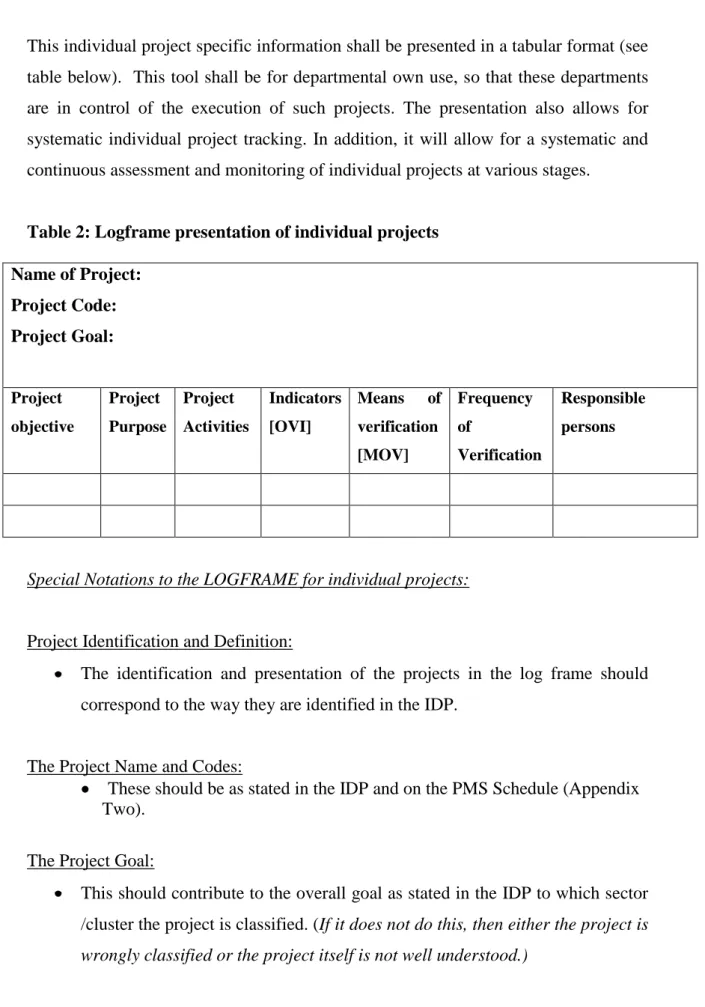
This individual project specific information shall be presented in a tabular format (see table below). This tool shall be for departmental own use, so that these departments are in control of the execution of such projects. The presentation also allows for systematic individual project tracking. In addition, it will allow for a systematic and continuous assessment and monitoring of individual projects at various stages.
Table 2: Logframe presentation of individual projects
Name of Project: Project Code: Project Goal: Project objective Project Purpose Project Activities Indicators [OVI] Means of verification [MOV] Frequency of Verification Responsible persons
Special Notations to the LOGFRAME for individual projects:
Project Identification and Definition:
The identification and presentation of the projects in the log frame should correspond to the way they are identified in the IDP.
The Project Name and Codes:
These should be as stated in the IDP and on the PMS Schedule (Appendix Two).
The Project Goal:
This should contribute to the overall goal as stated in the IDP to which sector /cluster the project is classified. (If it does not do this, then either the project is wrongly classified or the project itself is not well understood.)
This should lead towards attaining the goal. The objective should be based on the SMART concept [i.e. Specific, Measurable, Appropriate, Realistic and
Time bound.]
Project Purpose:
This should be action oriented and meant to attain the defined project objective.
Activity/milestones:
These are distinct core activities that should be carried out in the process of meeting the project purpose.
Indicators:
These are specific indicators/outputs or products, indicating that a particular activity has taken place successfully. They have quantitative, qualitative and temporal attributes.
Means of Verification:
For one to be able to identify specific indicators of success in various inputs, there has to be a scientific method of measuring or verifying the extent to which the activity was successfully conducted.
The method and tools for efficient, effective, and accurate measurements/recording. These tools and methods differ with projects and places.
Individual HODs should ensure that internal capacities exist to enable this within their own departments.
Frequency of Verification:
For effective monitoring and control of project progress, there has to be frequent project tracking and monitoring.
There are supposed to be minimum measurement/recording sessions that should be done. This frequency of verification or measurements should be
reasonable enough to allow the project manager to quickly and effectively intervene before the project goes off course.
The frequency of measurement depends on the nature of project and availability of resources. This can be conducted weekly or monthly, quarterly, half yearly or yearly depending on the nature of these projects.
Given that it is central to effective monitoring and project control, the HODs and Project Managers should ensure that adequate resources are set aside for this frequent verification.
5.3.2 Other Relevant Project Tracking/Monitoring Tools for use in PMS [For More than One Project]:
Although the Logframe presentation above tends to give project information in a fairly contextualised form, this is by no means adequate. Some more basic information is required for project monitoring and analysis.
The table 3 below highlights the tools and information for monitoring more than one project. The tools are meant to enable a systematic analysis of project parameters for more than one project. They can be used for a cluster of projects in each department or project category for example.
Table 3: Project Monitoring tools for a group of projects (more than one project)
Monitoring Tool Purpose Appendix
Project Input Indicators
Project funding
and expenditure
Tracking financial information and trends Appendix 3.1
Project Time frame
Tracking time-related information about projects
Appendix 3.2
Input Indicators
Monitoring Quantitative (% or ratios) assessments Appendix 3.4 Qualitative
Monitoring
Qualitative (descriptive) assessments
-(project specific statements on progress)
Appendix 3.5
Qualitative (stakeholder feedback) assessments (stakeholder perception about project impact)
Appendix 3.6
5.3.4 Overall Responsibility for Monitoring:
The Municipal Manager should delegate responsibility to the HOD Auditing. Internal Auditing should be conducted regularly by the Auditing Department. It is further proposed :
That frequent audits be conducted initially so as to set the process rolling and in order to gain initial control of the IDP implementation process. This can be done on a monthly basis, ensuring that progress on IDP implementation is reported and fed back in the Monthly Municipal Reports.
The report shall also have adequate input from the IDP Manager for a comprehensive feedback to the Municipality for a balanced view of the reasons for progress and failure. This will give the Council an informed base from which to make decisions.
It is also proposed that serious considerations be given to the reasons and circumstances contributing to failure or success.
5.4 EVALUATIONOFTHEMEASUREDRESULTS:
This process uses the results from the measured parameters used in monitoring to assess, whether and to what extent, the development goals of Nketoana (KPIs) are being achieved through the implementation of the Municipal IDP.
The evaluation process also provides the benchmark information or basis for reviewing the IDP and its KPIs i.e. re-planning.
It also assesses whether the appropriate developmental policies and strategies were used; whether they are still relevant; or whether they need adjustment. Evaluation should also be continuously done, although specific time periods should be allowed to provide for ample accumulation of information so as to be able to determine trends.
This could be done monthly or quarterly depending on projects, but it is imperative by way of the Municipal Systems Act, to ensure that at the end of the year, an externally conducted full scale Evaluation exercise is held.
This evaluation shall be against the pre-determined KPIs or medium to long- term goals based on the IDP objectives as outlined on Table 1 and specific KPIs detailed in Appendix Two.
5.4.1 Cumulative Impact Assessments:
The results of monitoring and evaluation over the whole year can be mapped into a cumulative Impact Assessment.
This is done by consolidating all the individual results from the previous monitoring and evaluation activities conducted during the year for all project types under implementation. The actual delivery of the projects, and the degree to which they succeed or fail to meet the defined planning targets, shall indicate the extent to which planned KPIs have been met.
The degree to which developmental goals and projects reinforce or undermine each other is also assessed together with the need to review them.
The following aspects should be addressed as well by the evaluation process:
Performance with respect to developmental objectives as stated in the IDP and KPIs;
Assess adequacy of the Municipal Capacity and delivery process, mechanisms, strategies and policies.
Assess capacity by the service provider.
5.4.2 Overall Responsibility for Evaluation:
This activity shall be the responsibility of the HOD Auditing section. The HOD shall be responsible for both periodic audits and end of year audits. The same shall be responsible for hiring an external auditor for monitoring and evaluation whom they shall supervise. The HOD shall develop the detailed TOR with input from the IDP Manager and the IDP Committee.
5.5 PLANNINGANDREVIEW:
The results and recommendations from monitoring and evaluation are used to provide adjustments and corrective actions that are fed back into the IDP planning process. This will re-inform IDP project planning, design, and implementation.
Consequently the IDP priorities, KPIs, goals, and strategies will be re-informed and revised together with the Municipal Policy and Development approaches. This is meant to improve overall Municipal Performance of the development thrusts and initiatives with regards to attaining the preset KPIs as highlighted under Item 5.1.
The following activities are to be undertaken:
Adjustment of project output with respect to customer satisfaction Revising developmental plans
The implications of the review process, systematically noted on a project basis with respect the reviewed/revised item and impact on time and cost for example [See the project review form Appendix 3.7].
In summary the review process should include the following recommendations in order to improve performance where relevant:
Adjustment of KPIs and IDP Targets;
Change of approach and delivery practices by the Municipality and or Service Provider;
Capacity building (Municipal or service provider);
Management and or technology reform (Municipal or service provider); Alternative delivery mechanisms that may even include changing of service providers;
Noting implications of these changes to the planning process (see Appendix 3.7).
5.5.1 Responsibility for the IDP Review Process:
This activity shall be the responsibility of the HOD Corporate Services. This will be conducted/ coordinated by the IDP manager. The following should be noted:
The review process should take into consideration the current circumstances and recommendations from the monitoring and evaluation session by the internal and external audits.
Council should be involved in the revision of the KPIs and targets and should do so taking into cognisance their circumstances and recommendations from the monitoring and evaluation exercise.
The targets should be consulted with other implementing departments and agencies as well. The IDP manager, under the coordination of the HOD
The IDP manager shall produce the plan together with the IDP committee.
5.6 REPORTINGONPMS:
The Municipal Manager shall delegate this function to the HOD Corporate services and the IDP manager. They shall give the report to the Municipal Manager, who shall in turn report to the Mayor and Council. This comprehensive report should include results from Monitoring and Evaluation. The following aspects should be noted:
Reporting on the monitoring and evaluation shall be done by the HOD Auditing and shall be presented to Council through the Office of the Municipal Manager.
Reporting on IDP progress is proposed to be a monthly agenda item for council. All issues and concerns should be thoroughly deliberated upon. This is essential realising that the IDP represents the core developmental aspirations of Council.
Each implementing department shall produce periodic progress reports on their section as shall be determined by Council. Monthly reports are proposed in addition to quarterly, half yearly and end of year reports.
These reports shall be prepared in conjunction with the local level project steering committees. The councillor chairing the development committee in which the project falls shall endorse his/her signature for the report to be considered authentic. If not such a report should be referred back to the reporting HOD. This measure is meant to ensure that councillor participation is solicited.
The overall comprehensive report on the PMS shall however be produced by the HOD Corporate service and the IDP Manager and shall incorporate the detailed comments of the audits (internal and external).
The minimum items for reporting shall be:
Performance in the same reporting period by the development partners e.g. service providers and other implementing agencies private, NGOs, other sector departments etc.
Measures taken to improve performance during the year Backlogs and plans to address them
Delivery priorities for the following year including backlogs
Establish the measures to be taken to improve performance given the constraints scenario in the previous year.
Assess implications of these measures in terms of time, money, material and financial resources.
Audited financial statements:
Establish whether expenses match with performance with respect to targets and indicators;
Aspects on financing and discipline;
Expenses on the project versus quality of products by the project;
Incorporate comments from both external and internal auditors..
5.6.1 Report Presentation to the Council, the Public Community and Higher Offices.
The Municipal Manager shall present the Comprehensive report to Council for feedback and adoption.
If adopted, it becomes an official Municipal Report and deemed ready for public input, feedback, and consultation.
After consultation, the report shall be sent to the Province who shall use it for further purposes e.g. production of provincial reports.
The public consultation process shall follow the normal procedure currently in use by Council for other projects for example, during IDP planning process, people budget formulation process etc.
For the general public, it is proposed that simplified summaries on successes and failures and corrective measures should be produced.
The summary should use simple user-friendly terms and local languages for effective information dissemination.
These summary reports should be published in local bulletins or newspapers with an open invitation for those interested, to visit various Municipal offices for the detailed reports.
The Corporate Services Department and the IDP Manager to ensure that this report is produced and given adequate publicity.
Councillors and Project Steering Committees are also expected to assist in ensuring that the contents of each public report are adequately communicated to the general public community in their respective constituencies.
The Municipal Manager, the Municipal Council, and the Mayor together with the HOD Finance should ensure that adequate finances are set aside for the generation of public awareness and education on the contents of the report. Any input and comments from the public community should be sufficiently captured either in the report or in the review or re-planning process.
5.7 THE PLACE OF PEOPLE PARTICIPATION IN PMS:
It is a Municipal Systems Act requirement that people be involved in the development and planning processes of their respective municipalities. It is encouraged here therefore, that people should make an input in the planning and development, monitoring and evaluation processes of Nketoana Municipality. They should make this input through their local stakeholder organisation structures like project steering committees and local ward committees. The Council should also conduct stakeholder mobilisation and awareness generation sessions on the planning and development process, and the successes and failures in the development planning process. Public forums should be held as well as focus group sessions with community leaders. This will ensure that the general public is informed about the IDP implementation process. Councillors and Steering Committees should help with information dissemination in their respective communities.
Feedback can also be obtained from the Local Labour Forums (LLF’s). The LLF’s should ensure that adequate input is made from strategic partners like the parastatals, NGOs, private organisations, and other government departments. Feedback on PMS appraisal should also be fed to labour unions for their input, assistance and advice.
All participating agencies like implementing organisations and departments should be encouraged to embrace stakeholder participation processes during project implementation.
It is proposed that people be actively involved in the following phases:
Activity Proposed nature of participatory engagement PMS
KPI and KPA identification and setting.
People make statements of intent. Planning experts will translate them into quantities.
Monitoring and Evaluation
Assist in giving and recording information on progress Project Steering Committees to actively participate.
process.
Commenting on level of service delivery.
Highlighting on achievements and under achievements.
Review Give suggestions/recommendations on corrective actions Give input on targets, KPI revision, and KPA re-prioritisation. Give input to and approve the revised IDPs.
Reporting Confirm that the report is reflective of their actual situation on the ground.
Assist in information dissemination.
The purpose for engaging people participation is to achieve the following:
Stakeholder awareness of the development planning process;
Feedback to the community on the planning and development process; Make them feel they are part of the development process;
Generate a sense of ownership in the development process;
The development process is clear and more transparent as to the people as more people become well informed about the process through participation. This generates public trust in the development agents. Increase stakeholder participation in community based maintenance
and other development projects;
People participation in cost recovery for services rendered e.g. in rates and tariff payments;
6.0
THE PERFORMANCE MANAGEMENT SYSTEM FOR
STAFF MANAGEMENT
6.1. INTRODUCTION
The first section of this report highlighted that the Nketoana PMS would be incomplete if the PMS culture is not transferred down to the management of individual employees. This integration will ensure that all Municipal resources and activities, from Councillors to employees shall be geared and focussed to meet the Municipal Performance goals as outlined in the IDP. This integration will enable the Municipality to meet its intended goals.
The aim of this part of the document is to provide senior management, with the necessary tools required to successfully manage the performance of their
subordinates. It is by no means exhaustive, nor is it intended to provide all of the answers to performance problems. It aims to clarify adequately, what the
performance management system requires from managers and subordinates in Nketoana Municipality, in order that they realise their Performance goals as
highlighted in their KPI description. Secondly it explains in straightforward, practical steps “how to” implement the performance management system in Nketoana
Municipality. It is also an acknowledged fact that some tools have already been put in place for senior Management (See Appendix 5.) by SALGA. These tools need to be adapted to suit the situation of Nketoana as summarised by the IDP and the PMS Situational Analysis.
6.2. PERFORMANCE MANAGEMENT -OBJECTIVES
6.2.1 Primary Objective
To help the manager and subordinate in Nketoana Municipality: To gain commitment to agreed job expectations,
To provide a framework which enables the employee to become more independent and self-sufficient in the workplace.
6.2.2 Secondary Objective
This part of the Performance Management System aims:
To provide managers with the necessary tools, knowledge and
guidelines on how to effectively manage and improve individual work performance and job satisfaction through scheduled performance discussions which strengthen the relationship between employee and subordinate and leads to specific plans for improvement.
6.3 THE CONCEPTUAL FRAMEWORK OF THE PERFORMANCE MANAGEMENT
SYSTEM FOR PERSONNEL MANAGEMENT IN NKETOANA MUNICIPALITY.
6.3.1 Cascading Responsibilities
Performance management should be a results-oriented way of managing which links individual performance objectives with the long range and strategic goals and plans of the Municipality as outlined in the IDP.
Attempts to establish individual performance objectives should not be accomplished in isolation. Before setting individual performance objectives, the manager should ensure that there is a link between the overall objectives of the Municipality and those of the individual.
This integration of objectives should be a primary concern for top management in the Municipality. Long-range Municipal goals should be translated into organisational performance objectives. This has already been achieved in the IDP and the first part of the Municipal PMS. These
organisational performance objectives should be translated into departmental objectives.
This process is cascaded through the various levels of the organisational hierarchy of Nketoana Municipality (see fig. 1). The ultimate aim is for the individual objectives of each employee to be linked and integrated through each successive level of the corporation. This forms the main object of the second PMS part of Nketoana.
6.3.2 The Individual Focus
Performance Management should also focus on the individual employee. This helps managers to gain a clear understanding and agreement on what must be achieved by each employee for them to contribute meaningfully to higher-level objectives of the Municipality.
One of the advantages of the performance management system is that it is integrated with broader organisation objectives. In order to be able to point out the meaningful role of each job/post in the Municipality, managers should be able to point out to their subordinates, the upward linkages between the employee’s individual job and the broader objectives of the section or department of the Municipality.
This will enable employees to better appreciate the contribution, which their performance makes to the overall objectives and mission of the corporation.
Fig. 1 illustrates the cascading of objectives and upward flow of performance management information.
Fig. 2 also illustrates how the cascaded objective scenario is going to be fed into a detailed Performance Management Cycle for individual employee management.
Organisational Municipal Long Range Goals Council
[Vision and Mission]
The IDP and its Strategic Top Management Plans
[Organisational
Performance Objectives] Senior Management
Departmental Middle Management
Objectives
Sectional Supervisors
Objectives
Individual Specialists
Objectives
Fig 2: Linking Municipal Objectives with the Individual Performance Management Cycle for Staff.
Individual Objectives build upwards from Bottom to Top Broader are cascaded from Top to
FLOW CHART
NKETOANA MUNICIPALITY MISSION; POLICIES; IDP & STRATEGIC PLAN
OBJECTIVES
DEPARTMENT MANAGER OBJECTIVES
AVAILABLE MANAGERS PRELIMINARY SUBORDINATES
REQUIRED EXPECTATIONS FOR INITIAL
RESOURCES SUBORDINATES EXPECTATIONS
OF REQUIREMENTS
AGREEMENT MUTUALLY
AGREED EXPECTATIONS
FINAL REVIEW AND PERIODIC PROGRESS
APPRAISAL OF REVIEW BY
PERFORMANCE MANAGER
CORRECTIVE MEASURE COACHING AND FEEDBACK
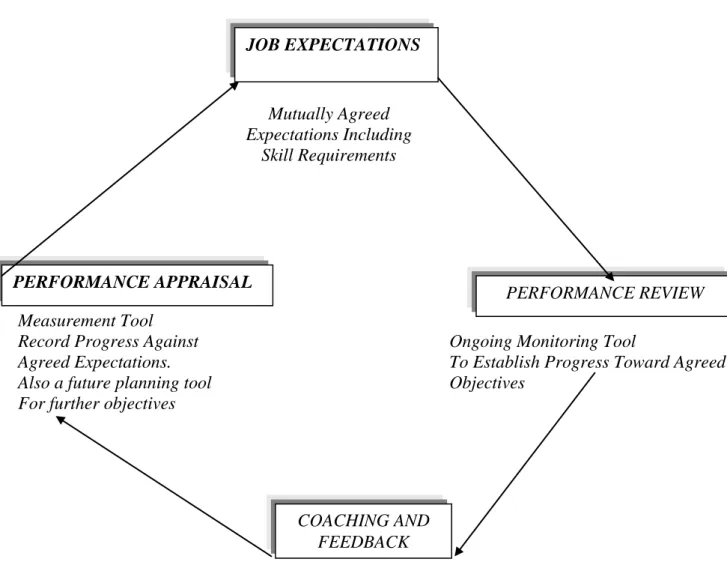
The elements of the Performance Management are highlighted in the PM Cycle outlined in fig. 2 above and fig. 3 below.
The manager is required to achieve certain results from his section or department. To achieve this the following tasks should be done:
Assign duties and responsibilities and create specific jobs designed to achieve results.
The jobs should be structured in such a way as to ensure that his/her objectives for the work unit are met.
Structurally then, the manager needs to have organised the work in his/her unit to reach the stated objectives (see fig 2). This is accomplished based on the assumption that the elements within each job are performed 100% competently with specific resource constraints such as time, money etc.
Theoretically the job description describes the activities required to perform the job. This is only the starting point of performance management. The following list should be noted.
A job description should be activity based.
It should describe what actually takes place based upon a specific action. (For effective performance management, it is not enough to merely list activities or tasks.)
The objective to be reached must be stated in results language together with the specific standard which must be achieved.
It is important to describe precisely what must be achieved and to specify the standard required as well as how the result will be achieved and the time (see box below).
Example 1: Types all documents (This example describes an activity).
Example 2: Types all document with 95% accuracy at 80 w.p.m. (This example adds the specific standards required).
Example 3: Type all documents using a Personal Computer with 95% accuracy at 80 w.p.m. each day.
(This example describes what must be achieved, how it should be achieved and specifies the standard to be reached and the target in terms of time.)
This simple example serves to illustrate that performance management requires an in depth understanding of precisely what is required to be achieved, the desired output and the target time.
Thus it is SMART based:
Specific in terms of clarity of what needs to be done
Measurable results
Action based
Realistic in terms of being achievable
Time bound.
6.4.1 Identify Performance Expectations for Municipal Staff:
The process where the top Municipal management define all the necessary factors that contribute to the achievement of specific individual objectives is called setting job expectations. The following factors should be considered:
Establishing precisely what should be achieved and when; Establishing how such objectives will be achieved;
Establishing specific standards to measure achievement;
Establishing the specific monitoring points to ensure that progress is being made;
Establishing the specific skill inputs necessary for the successful; achievement of objectives.
Job expectations are the sum of all requirements needed to achieve a specific objective. Job expectations help management to define inputs and enable management to measure outputs.
The first task for the manager, when establishing performance management in his work unit, is to define precisely what his expectations are for each job.
This requires careful job analysis and demands that the manager carefully examines each aspect of the job to decide on the following:
What is the specific result that I expect to get from this activity? Only when the manager can define the result he/she expects from the job can it be considered a meaningful part of the job.
Then he/she needs to specify the standard to be achieved i.e. what criteria should the expectation meet which demonstrate that the activity has been successfully done.
Finally, what is required, what inputs or resources are needed to ensure that a successful output or result are obtained
What Skills, Knowledge, Abilities or logistic support resources are needed?
6.4.2 Mutual Discussions and Agreements on Performance Expectations
One other compulsory requirement is that the set job expectations should be agreed between the management and junior staff of the Municipality (see fig 3 below). The following steps and points should be noted:
Whilst the manager, may have a clear idea of exactly what he/she requires from the subordinate, he/she should not merely present the job expectations and tell the subordinate to get on with the job.
The manager should do his/her homework and compile his/her preliminary job expectations. (see fig 2)
Just as important the subordinate needs to establish his/her own job expectation. (See fig 2)
Whilst the manager may feel that he/she understands precisely what is required from the job, the incumbent knows best what he/she can deliver. He may also be aware of some specific constraints or obstacles to job performance.
The conclusion here is that, Performance Management is and must be, a two-way discussion. The expectation of both manager and subordinate should be mutually agreed. The reason for this is commitment. The sub-ordinate must also feel ownership of the agreed job expectation, after all they belong to him and the manager.
Certain criteria are important to bear in mind from the manager and subordinates’ perspective when establishing mutually agreed job expectations. These expectations must be reasonable.
The following four criteria are common to reasonable performance expectations.
Measurable/Observable:
Are the results measurable to allow future appraisal?
Controllable
Does the employee have direct control over all aspects of the work to be done?
If not, it would not be fair to set an expectation in this area.
The results of most employees’ work often depend on results achieved by another position. In these situations the manager shall focus on the job elements that the employee can control.
Realistic