i
Controller Tuning Using System Identification
by
Norhanisah binti Zubir 14418
Dissertation submitted in partial fulfillment of the requirements for the
Bachelor of Engineering (Hons) (Chemical Engineering)
SEPTEMBER 2014
Universiti Teknologi PETRONAS Bandar Seri Iskandar
31750 Tronoh Perak Darul Ridzuan
ii
CERTIFICATION OF APPROVAL
Controller Tuning Using System Identification
by
Norhanisah binti Zubir 14418
A project dissertation submitted to the Chemical Engineering Programme Universiti Teknologi PETRONAS in partial fulfillment of the requirement for the
BACHELOR OF ENGINEERING (Hons) (CHEMICAL)
Approved by,
_________________________ (Dr. Lemma Dendena Tufa)
UNIVERSITI TEKNOLOGI PETRONAS TRONOH, PERAK
iii
CERTIFICATION OF ORIGINALITY
This is to certify that I am responsible for the work submitted in this project, that the original work is my own except as specified in the references and acknowledgements, and that the original work contained herein have not been undertaken or done by unspecified sources or persons.
___________________________ NORHANISAH BINTI ZUBIR
iv
ABSTRACT
In the industries today, less attention has been put on the development of a unified tuning approach for Proportional-Integral-Derivative (PID) controller of Single Input Single Output (SISO) system and Multiple Input Multiple Output (MIMO) system. The current tuning methods are limited and specific to particular systems. This paper focuses on the development of a unified controller tuning method based on Internal Model Control (IMC) method and system identification using software Matlab Simulink. The controller tuning performance of the proposed method tested on SISO and MIMO systems are being compared with the performance shown by the existing tuning methods; Ziegler-Nichols (ZN) and Simple Internal Model Control (SIMC). The evaluation of performance measurement is done based on Integral Absolute Error (IAE), Integral Square Error (ISE), Integral Time-weighted Absolute Error (ITAE) and Total Input Variation (TV). It is observed that the proposed unified tuning method is effective for tuning on SISO and MIMO systems and gives better performance than ZN and SIMC in terms of IAE, ISE, ITAE and TV in both set point tracking and disturbance rejection.
v
ACKNOWLEDGEMENTS
My utmost appreciation extends to all parties that involve in assisting me completing this project, especially my supervisor, parents as well as my friends. First and foremost, I would like to express my gratitude towards my supervisor, Dr. Lemma Dendena Tufa for his dedication and support, persistently guiding and teaching me in order to complete my project. The encouragement and expertise shared are really appreciated as I have gained a lot of knowledge from him. Under his supervision, I have improved myself from time to time. Next, my sincere appreciation goes to my parents and friends for their endless moral support. They always encourage me not to give up and complete the project successfully. I appreciate all parties that stay by my side throughout completing this project.
vi CONTENTS
CERTIFICATION OF APPROVAL ... ii
CERTIFICATION OF ORIGINALITY ... iii
ABSTRACT ... iv
ACKNOWLEDGEMENTS ... v
Abbreviations and Nomenclatures ... x
1.0 INTRODUCTION ... 1
1.1 BACKGROUND OF STUDY ... 1
1.2 PROBLEM STATEMENT ... 4
1.3 OBJECTIVES ... 4
1.4 SCOPE OF STUDY ... 4
1.5 RELEVANCY AND FEASIBILITY OF PROJECT ... 5
2.0 LITERATURE REVIEW ... 6
3.0 METHODOLOGY / PROJECT WORK ... 11
4.0 RESULTS AND DISCUSSION ... 19
4.1 The Controller Parameters of Each System ... 19
4.2 The Control Performance of the Proposed Unified Tuning Method, Ziegler-Nichols (ZN) and Simple Internal Model Control (SIMC) Method on Various Systems. ... 20
4.2.1 The Control Performance of First Order Single-Input Single-Output (SISO) System by Proposed Method, Ziegler-Nichols and SIMC Method. ... 21
4.2.2 The Control Performance of Second Order Single-Input Single-Output (SISO) System by Proposed Method, Ziegler-Nichols and SIMC Method. ... 24
4.2.3 The Control Performance of Complex System reduced to first order SISO System by Proposed Method, Ziegler-Nichols and SIMC Method. ... 27
vii
4.2.4 The Control Performance of Complex System reduced to second order SISO
System by Proposed Method, Ziegler-Nichols and SIMC Method. ... 30
4.2.5 The Control Performance of MIMO System by Proposed Method, Ziegler-Nichols and SIMC Method... 33
5.0 CONCLUSION AND RECOMMENDATION ... 39
6.0 REFERENCES ... 40
7.0 APPENDIX ... 44
7.1 The PID Parameters of Each System ... 44
7.2 The Performance Shown by Various Systems on the Proposed Unified Tuning Method, Ziegler-Nichols and SIMC Method. ... 46
viii LIST OF FIGURE
Figure 1: Controller identification test ... 3
Figure 2: Methodology of the project ... 11
Figure 3: Model set up to obtain controller parameters for each system ... 12
Figure 4: The subsystem a) Gm- and b) Gm ... 12
Figure 5: Model set up for unified tuning method ... 15
Figure 6: Model set up for MIMO system ... 16
Figure 7: Subsystem of the MIMO model set up. ... 17
Figure 8: Control performance of first order SISO System using different tuning methods ... 21
Figure 9: Control performance of second order SISO System using different tuning methods ... 24
Figure 10: Control performance of Complex System Reduced to first order SISO System using different tuning methods ... 27
Figure 11: Control performance of Complex System Reduced to second order SISO System using different tuning methods ... 30
Figure 12: Control performance of first transfer function of MIMO System using different methods ... 34
Figure 13: Control performance of second transfer function of MIMO System using different methods ... 36
ix LIST OF TABLES
Table 1: PID Parameters obtained using Matlab ... 19 Table 2: Control performance of first order SISO System using different tuning methods ... 22 Table 3: Control performance of second order SISO System using different tuning methods ... 25
Table 4: Control performance of Complex System reduced to First Order SISO System using different tuning methods ... 28
Table 5: Control performance of Complex System reduced to Second Order SISO System using different tuning methods ... 31 Table 6: The new transfer functions and parameters for MIMO ... 33 Table 7: Control performance of first transfer function of MIMO System using different tuning methods ... 35
Table 8: Control performance of second transfer function of MIMO System using different tuning methods ... 37
x
Abbreviations and Nomenclatures
IAE Integral Absolute IMC Internal Model Control ISE Integral Square Error
ITAE Integral of Time-weighted and Absolute Error MIMO Multiple-Input Multiple-Output
PID Proportional Integral Derivative SISO Single-Input Single-Output SIMC Simple Internal Model Control TV Total Input Variation
1 CHAPTER 1 INTRODUCTION
1.1BACKGROUND OF STUDY
Controller tuning is a procedure in which controller parameters are determined to yield the desired output. In other words, it is a process where a control engineer selects the controller parameters’ values for a Proportional-Integral-Derivative (PID) controller so that the response can behave as desired. The most well-known controller is PID controller which has become the top preferred controller in process industries for decades. It is widely accepted due to the capability to control a variety of processes, the well-understood control action, ease of execution and robustness shown in the performance. Besides, it is reported that PID controller still maintain its dominancy as the number one feedback controller as it is widely utilized by operators and the cost-effective PID modules are easily accessible [1-4] .
Controller tuning is a vital aspect in a specific control system as it is the backbone for a certain plant that runs and manages the processes within the plant. Thus, properly tuned system offers various benefits in increasing the effectiveness of a certain plant, maximizing the manufacturing rate as well as diminishing the variability of a process [5] . On the other hand, slow tuning will lead to sluggish response; otherwise the system will turn unstable and produce overshoot if harsh tuning is applied. Hence, it is crucial to select proper and correct tuning method with the best algorithm. There is a variety of tuning techniques available yet the most popular are Ziegler-Nichols (Z-N) and internal model control (IMC). According to [6], Z-N method utilized ultimate gain and ultimate oscillation period in order to obtain gain value . IMC technique takes into consideration the unpredictability of a system and enables the balance between robustness and performance [6] . The IMC strategy resembles to the conventional feedback control system if the controller in the conventional system, and the controller in IMC, satisfy by (1).
2
Eq. (1)
Eq. (2) Where
System identification employs statistical method in constructing mathematical model of a dynamic system based on experimental data. There are two different kinds of models which are parametric and non-parametric models. The first type involves a structure of model and parameters will be determined from that structure. On the other hand, the latter style requires data to identify the transfer function of model [7] . The selection of model for identification requires in-depth understanding in order to get the parameters of the model. A good model will reconstruct the computed data as close as possible [8] . Another PID controller identification technique is proposed in which the technique was generated based on internal model control (IMC) structure and it is believed to be advantageous in time delay dominant systems [9] . Another approach was suggested for controller design by combining direct synthesis method and system identification [10] . Both approaches avoid the needs to estimate time delay for designing the controller. In addition, the latter technique does not require estimating the plant model.
The approach of the aforementioned proposed method is generated by eliminating the filter from the conventional and internal model control equations. Thus the inverse controller equation becomes as presented by (3) [9] .
Eq. (3)
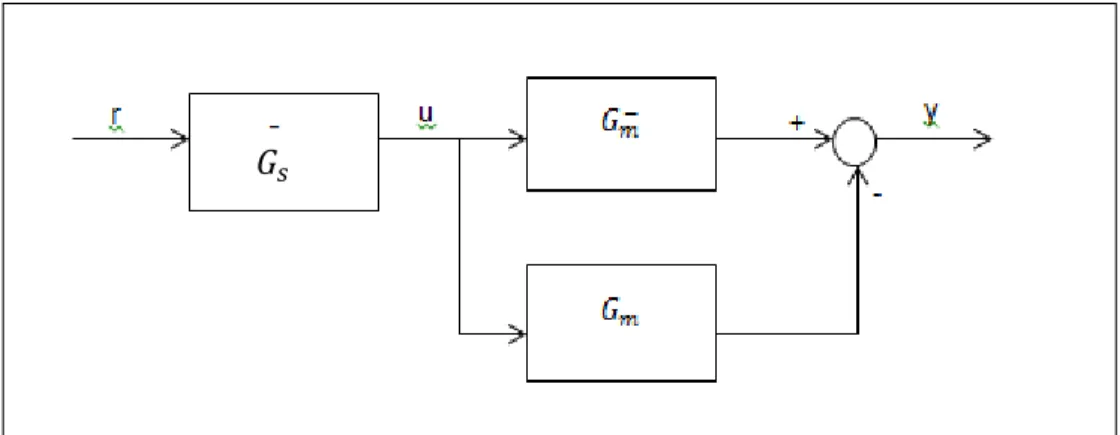
The time delay of exists in the numerator and estimation of time delay is not required. The optimal parameters of controller can be acquired by inverse identification method, utilizing the plant model from simulation data. Figure 1 shows the simulation that can be applied for controller identification test.
3
Figure 1: Controller identification test
According to Figure 1, transfer function is the smoothening function. A simple first order filter with a unit gain can be a smoothening function and is necessary to avoid too aggressive response. In order to approximate the optimal model parameters, a continuous time identification approach in which y(t) as an input and u(t) as an output (inverse identification) is applied. Simulation will be done using (3) in order to acquire the identification data [9, 10] .
Overall, there are various tuning approaches available, but the current tuning methods are limited and specific to particular systems. Therefore, this paper attempted to develop a unified tuning method for SISO and MIMO systems based on IMC method and system identification. An inverse identification approach is selected to be used to identify the controller. The control performance of the proposed method is compared with the performance shown by Ziegler-Nichols and Simple Internal Model Control in terms of Integral Absolute Error (IAE), Integral Square Error (ISE), Integral Time-weighted Absolute Error (ITAE) and Total Input Variation (TV).
4 1.2 PROBLEM STATEMENT
There are numerous controller tuning methods available which offer different level of performance and recommended for different types of systems. However, the current tuning methods are limited and specific to particular systems. There is no unified tuning method for SISO and MIMO systems available in the field today.
1.3OBJECTIVES
The objectives of the research paper are:
1. To develop a unified tuning approach based on Internal Model Control (IMC) method and system identification.
2. To test the effectiveness of the proposed technique on
a. First Order Single Input Single Output (SISO) system b. Second Order Single Input Single Output (SISO) system c. Complex system reduced to First Order SISO system d. Complex system reduced to Second Order SISO system e. Multiple Input Multiple Output (MIMO) system
3. To compare the performance of the proposed method on aforementioned systems with Ziegler-Nichols (ZN) method and Simple Internal Model Control (SIMC).
1.4SCOPE OF STUDY
The scopes of study for this paper are:
1) To write Matlab codes for a unified tuning method based on IMC-method and system identification using software Matlab Simulink.
2) To test the effectiveness of the proposed model on SISO system, complex system reduced to SISO system and MIMO system.
5
3) To compare the performance of the proposed method with Ziegler-Nichols method and Simple Internal Model Control (SIMC). The performance measurements selected to be compared are:
a) Integral Absolute Error (IAE) b) Integral Square Error (ISE)
c) Integral Time-weighted Absolute Error (ITAE) d) Total Input Variation (TV)
1.5 RELEVANCY AND FEASIBILITY OF PROJECT
This project is relevant to be executed as there is no development of a unified tuning method for SISO and MIMO systems available for the time being. Furthermore, the execution of this project requires application of knowledge in control which is one of the important aspects in chemical engineering and the industry.
This project is feasible as the time allocated of 2 semesters for this project is sufficient for a complete and thorough study on the literatures available on this topic. Besides that, the time frame is ample for the development of a unified PID tuning method for SISO and MIMO systems, thus determine the performance of the proposed model.
6 CHAPTER 2 LITERATURE REVIEW
The interest in designing and tuning of PID controllers has increased among the scholars. They have suggested many PID controller settings that covered a variety of process models and diverse performance criteria. A cluster of academicians has suggested a new technique that does not require any estimation of the plant model in tuning closed-loop responses PID controllers for single input single output (SISO) systems. This approach was generated by implementing the impulse response as an alternative ofstep response in which it is handled as a statistical distribution. The mean as well as the variance of the distribution are computed and utilized in acquiring the tuning parameters of PID controller [2] . Another approach was done by approximating the feedback form of an internal model control (IMC) controller. Both approaches used the first three terms of the Maclaurin series expansion of the preferred closed-loop transfer function. In fact, it is found that the PID controllers designed by the first technique perform equally well with those of the latter and much better than the other approaches [11] .
For SISO PID controller tuning, there is an approach generated based on the Magnitude Optimum criterion. The approach proposed entailing SISO with the conjugate complex poles. The establishment of this technique takes into consideration the two elemental restrictions, which are the bad process model and process’s output access, instead of the conditions. In Magnitude Optimum criterion lie “the preservation of the shape of the step and frequency response” of the system [12] . Besides, there is an approach for unstable process by innovating the old PID system where a set-point weighted PID controller tuning method is demonstrated to correct the error feedback systems by using the data of original error PID control system [13] . Direct synthesis method is recommended for unstable systems by synthesizing an uncomplicated closed-loop transfer function and estimations of process time delay. The modus operandi is
7
developed to create the filter for set-point of a two-degree of freedom model and utilized the first-order Taylor series estimation of process time delay [14] .
PID controller with first order noise filter is proposed to be tuned according to a process’s frequency-domain dynamics characterization. A unified tuning technique is suggested for stable, integrating and unstable processes, which incorporated the dead-time and oscillatory dynamics. The specification of the required sensitivity to the high frequency quantification noise as well as the required highest sensitivity is feasible within this approach. This is actualized by finding a solution for two nonlinear algebraic equations for the needed figure of damping ratio [15] . Another unified tuning approach proposed for the same types of processes by [16] which utilized filtered Smith predictor of PID estimation. The closed-loop robustness for stable and integrating systems is evaluated by the sensitivity peak while IAE is used for assessing the performance.
Iterative SISO tuning methods used in industry nowadays are not only tedious yet they also do not attain optimum control accomplishment. Hence, a multi input multi output (MIMO) model-based approach was recommended wherein it successfully tune multiple PID loops. This modus operandi needs the determination of a complete dynamic replica of multivariable system and uses restricted nonlinear optimization techniques in getting the parameters. In addition, to verify the loop to stably prevail and well damped even for nonlinear operation, it needs huge gain and dead time robustness margin [17] . Besides, there is a strategy for integral plus time delay systems in attaining particular gain and phase margin methodical expressions for PID controller. The obtained PID formula is used in unifying the previous guides with diverse gain and phase margin designations. This approach is advantageous as it leaves remarkable benefit to refer to in tuning PID controllers and choosing the right gain and phase margin for a particular system [18] .
Fuzzy PID controller has been suggested to be auto tuned using internal model control (IMC) technique. It is reported that the structure comprised of degraded linear PID
8
controller as well as nonlinear compensation component, wherein the latter part is treated as disturbance of the process. After obtaining the controller’s parameters, the stability of the system is assessed by Lyapunov stability theory. It is concluded that the suggested procedure is powerful than conventional PID in terms of performance in transient and steady phase [19] . Besides, a group of researchers had come out with a new tuning approach for process uncertainties where it is generated from two degree of freedom IMC (2DOF-IMC) to solve problems arise from normal IMC in which it produced slow responses for distraction refusal. The procedure involved the identification of model unpredictability, the selection of set-point parameter by maximum peak (Mp) as well as the distraction rejection parameter by gain margin (GM) aspect. This Mp-GM technique successfully acquired controller parameters under unpredictable condition [20] .
Other innovative tuning method was proposed to make the best use of the closed-loop performance with respect to particular robustness constraints. A practice of Newton’s rule was utilized in determining the tuning rule parameter and time-delay robustness aspects. The utilization based on highest amplitude of an arbitrarily diverse time-delay makes this rule attractive in various applications. In fact, this rule performed better than the other tuning rules for first-order lag integrator plus delay process [21] . Other than that, an approach where the Smith predictor (SP) merged with PID controller was introduced by [22] for integrator plus dead-time systems and the method is called modified SPPID. Through this technique a person is capable in switching from SP way to PID style by including the tuning parameter in the rule, hence removing the offset. It is found out that when the value of tuning parameter is between 0 and 1, the system will turn to be modified SPPID. Plus, this approach is able to permit dead time, dynamics and process gain.
Researchers also have worked on a strategy to diminish the load disturbance integral error on any linear system. This PID controller auto-tuning algorithm is done in accordance with relay feedback experiments. The procedure is done by setting the integral gain at maximum, in line with the required phase margin as well as desired gain
9
margin limitations at their least. The established method executed well with the actual mensuration noise and disruptions [23] . Others came out with the idea of auto-tuning based on particle swarm optimization (PSO). This approach demonstrated the utilization way of PSO in identifying the parameters of PID controller for a slider-crank mechanism model. Hence, researchers can get the PID parameters for both conditions; the normal state as well as fully-loaded state. Therefore, the suggested technique will tune its parameters automatically within these extents. It is concluded that this approach is more powerful in terms of competency and stability [24] .
In contrast, other academician proposed a tuning method based on a genetic algorithm [25] . Genetic algorithm can be described as an innate selection and genetics-based optimization technique. There is a work using genetic algorithm in determining the parameters of PID controller for industrial polymerization batch reactor and it is appraised based on integral of absolute value of the error (IAE) [26] . Besides that, it is displayed that genetic algorithm implemented system is capable in preventing premature convergence and promote bigger convergence rate for optimization of PID controller parameters [27] . In addition, there is an approach in implementing the evolutionary multi-objective optimization in controller tuning utilizing the Pareto optimality concept [28] . The adjustment of the parameters for multivariable PID using genetic algorithm is demonstrated in figuring out the hitch revolving around multi-objective control model. The idea of Pareto optimality is applied in this approach to enable the easy determination of achievable performance limits. Hence, the designations of controller can be easily satisfied and successfully affirmed for SISO and MIMO systems [29] .
Heuristic tuning methods are powerful for PID controller auto-tuning as they can increasingly upgrade the responses using previous exposures. In conjunction with that, a heuristic optimization approach was suggested based on a fractional order reference model wherein Bode’s ideal control loop is used as the reference in the master–slave optimization method. This approach utilized the Stochastic Multi-Parameters Divergence Optimization (SMDO) method in which it repositions the optimization
10
parameter vector to a new vector according to a stated objective function [30] . A chaotic differential evolution (DE) was put forward by a group of intellectuals for PID multivariable controllers based on Zaslavskii map. Premature convergence to local optima is hindered for enhancement of DE performance. Wood and Berry distillation column used has indicated good responses by this presented method [31] .
Other proposed heuristic technique is by ceaselessly alters the proportional, integral and derivative gains via easily analyzable heuristic rules. This approach used a single nonlinear gain adaptive parameter α defined on the instantaneous process states [32] . Another innovatory method was suggested for higher order a aperiodic process which is based on the determination of n-th order lag (PTn) model as well as application of damping optimum aspects. The PTn model’s parameters were determined via simple auto-tuning algorithm based on process model step response time integral. This method successfully found to boost vigorous closed-loop character with a relatively huge process model variation [33] .
New approach was generated to give good control performance than the existing first order plus time delay (FOPTD) and second order pus time delay (SOPTD) models-based. The model reduction method was suggested for fractional order plus time delay (fOPTD) model. This approach was based on resolving single quantity optimization problem and has successfully incorporated many processes with over damped or under-damped dynamics, non-minimum phase dynamics and fractional order dynamics. Furthermore, researchers also developed an explicit PID tuning rule for fOPTD using optimal tuning parameters minimizing the Integral of the Time weighted Absolute Error (ITAE) [34] .
From the literature review analyzed, it is found out that researchers tend to study on different types of tuning methods which are limited and specific to particular systems. However, it has been discovered that there is no research done on developing a unified tuning method based on system identification that can be used to tune SISO and MIMO systems. Therefore, this project will be carried out to achieve the purpose.
11 CHAPTER 3
METHODOLOGY / PROJECT WORK
Matlab is the main software used in this project. Figure 2 shows the methodology that is implemented in this paper in order to achieve all of the objectives:
Figure 2: Methodology of the project
Objective 1 - To develop a unified tuning approach based on Internal Model Control (IMC) method and system identification.
To accomplish the first objective, a unified tuning method based on IMC-approach and system identification will be written and codded using software Matlab Simulink. The Matlab codes used in the project are attached in the Appendix section.
Develop Matlab codes for the proposed method
Develop Simulink models for unified tuning method Test the effectiveness of the proposed tuning method on
SISO and MIMO Systems
Compare the control performance with ZN and SIMC Validate result by calculating IAE, ISE, ITAE, TV
12
Objective 2 - To test the effectiveness of the proposed method on SISO and MIMO systems
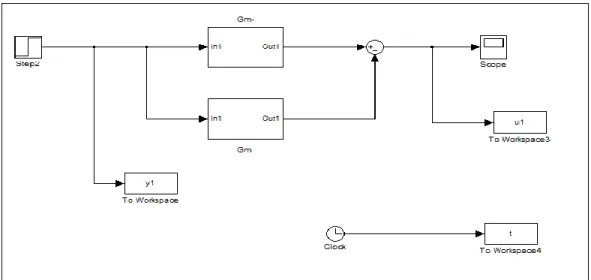
To accomplish this objective, controller parameters of each system need to be obtained before being tuned using the proposed unified tuning method to test its effectiveness and control performance. Figure 3 shows the model set up using software Matlab Simulink in order to identify the controller parameters of each system.
Figure 3: Model set up to obtain controller parameters for each system
The transfer functions of each system are inserted in the subsystem and as shown in Figure 4.
13
The representation of transfer functions of each system used in this project are:
a) First Order Single Input Single Output (SISO) system.
Eq. (4)
b) Second Order Single Input Single Output (SISO) system
Eq. (5)
c) Complex system reduced to first order SISO system.
Eq. (6)
d) Complex system reduced to second order SISO system.
Eq. (7)
e) Multiple Input Multiple Output (MIMO) system.
The model that is going to be used for this system is Wood and Berry Distillation Column (1973) [35] .
[
] [
] [
]
Eq. (8)14
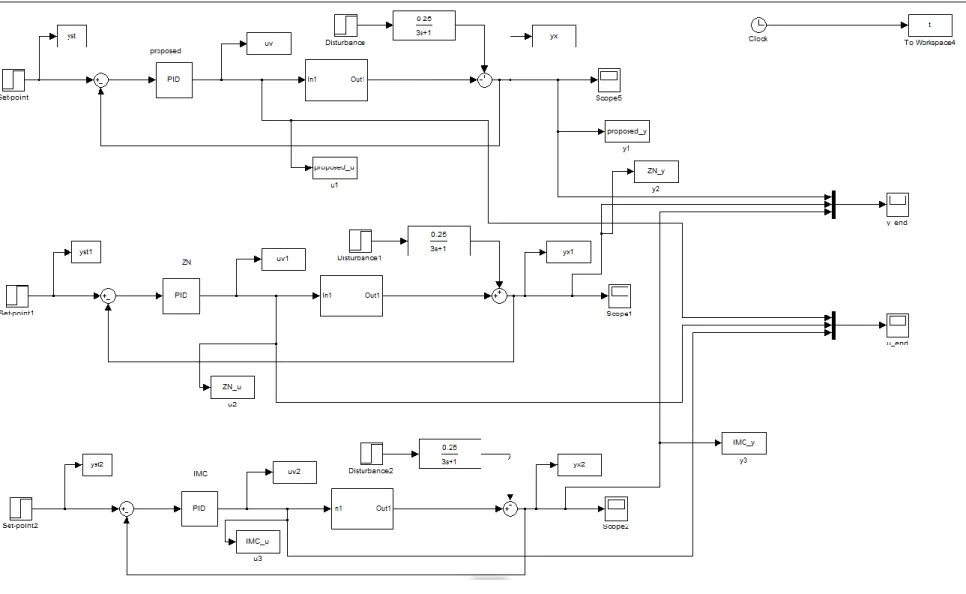
After obtaining the controller parameters of each system, the effectiveness of the proposed unified tuning method is tested and evaluated. Figure 5 shows the model set up for the unified tuning approach. The performance measurement of the proposed method is evaluated in terms of Integral Absolute Error (IAE), Integral Square Error (ISE), Integral Time-weighted Absolute Error (ITAE) and Total Input Variation (TV). For multiple-input multiple-output (MIMO) system, the model set up to conduct the step test is shown on Figure 6.
15
16
17
18
Objective 3 – To compare the performance of the proposed tuning method with existing popular tuning methods
The control performance of the proposed method is compared to Ziegler-Nichols (ZN) method and Simple Internal Model Control (SIMC) method on set point tracking and disturbance rejection. The performance measurements selected to be compared with ZN and SIMC are:
i) Integral Absolute Error (IAE) ii) Integral Square Error (ISE)
iii) Integral Time-weighted Absolute Error (ITAE) v) Total Input Variation (TV)
19 CHAPTER 4
RESULTS AND DISCUSSION
RESULTS
4.1 The Controller Parameters of Each System
The controller parameters of each system are obtained after the transfer functions of each system are inserted in the model set up as shown in Figure 3 from Chapter 3 and by using Matlab code [PI PID]= fpid(y1,u1,t,td,tau1,tau2,speed).
Tabulation in Table 1 shows the results obtained for various systems.
Table 1: Controller Parameters for each system
Systems Controller parameters Transfer functions First order SISO system 0.7133 0.7907 0.2010 Second order SISO system 0.9008 10.7501 2.0194 Complex system reduced to first order SISO system 0.4486 12.6682 3.3962 Complex system reduced to second order SISO system 0.4976 13.4813 4.4820
20 MIMO system 0.2305 5.9041 2.4469 -0.0839 5.5915 0.8602
4.2 The Control Performance of the Proposed Unified Tuning Method, Ziegler-Nichols (ZN) and Simple Internal Model Control (SIMC) Method on Various Systems.
The effectiveness of the proposed unified tuning method is tested on various systems. The PID parameters obtained in Table 3 are used in the model set up for unified tuning method as shown in Figure 5 accordingly to the respective system. The control performance of ZN and SIMC are also been tested and shown in this section. The comparisons of control performance between different tuning methods for all systems are presented qualitatively and quantitatively in this section.
21
4.2.1 The Control Performance of First Order Single-Input Single-Output (SISO) System by Proposed Method, Ziegler-Nichols and SIMC Method.
The control performance of first order SISO system using three different tuning methods has been obtained for set point tracking and disturbance rejection. The tuning methods tested are the proposed unified tuning method based on IMC-approach and system identification, Ziegler-Nichols (ZN) and Simple Internal Model Control (SIMC). The first order SISO system is represented by (4), in which it has been tested with the aforementioned tuning methods.
Eq. (4)
The results have been analyzed qualitatively as well as quantitatively, comparing the performance shown by proposed method with ZN and SIMC. The resulting control performance for first order SISO system is demonstrated graphically on figure 8.
22
Based on figure 8, for set point tracking it can be clearly observed that the control response shown by the proposed unified tuning method is smooth and able to reach the desired output in short time without obvious overshoot or sustain error. However, sluggish responses are shown by Ziegler-Nichols (ZN) and Simple Internal Model Control (SIMC) to reach the desired output compared to the proposed method. For disturbance rejection, there are obvious overshoots recorded by ZN and SIMC while the proposed method shows smooth response, indicating good response. Thus, it can be said that the proposed method provides much better control performance compared to ZN and SIMC PID controllers.
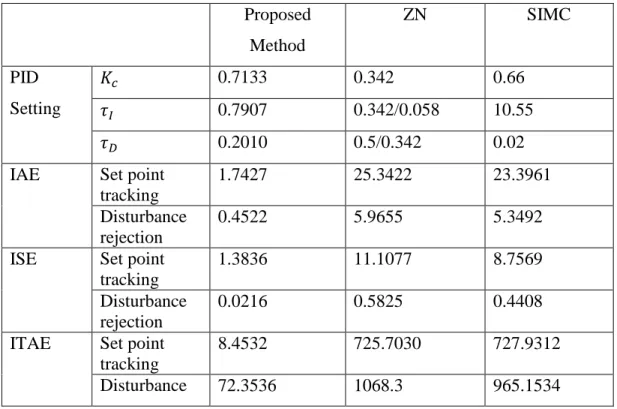
These results can be validated quantitatively as tabulated in Table 2. The resulting performance measurement for set point tracking and disturbance rejection for different tuning methods are measured with regard to Integral Absolute Error (IAE), Integral Square Error (ISE), Integral Time-weighted Absolute Error (ITAE) and input variation (TV).
Table 2: Control performance of first order SISO System using different tuning methods
Proposed Method ZN SIMC PID Setting 0.7133 0.342 0.66 0.7907 0.342/0.058 10.55 0.2010 0.5/0.342 0.02 IAE Set point
tracking
1.7427 25.3422 23.3961 Disturbance
rejection
0.4522 5.9655 5.3492
ISE Set point tracking
1.3836 11.1077 8.7569 Disturbance
rejection
0.0216 0.5825 0.4408
ITAE Set point tracking
8.4532 725.7030 727.9312 Disturbance 72.3536 1068.3 965.1534
23 rejection TV Set point tracking 1.8756 2.0077 1.9299 Disturbance rejection 1.9395 1.8898 1.8198
Based on table 2, it is clearly demonstrated that the control performance shown by the proposed unified tuning method on first order SISO system is excellent. The values of IAE, ISE, ITAE and TV recorded by the proposed method are the lowest compared to ZN and SIMC for both set point tracking and disturbance rejection. These results indicate that there are no overshoot, no sustain error and smooth response observed on the proposed method compared to the existing methods. Thus, the proposed method provides much better performance compared to ZN and SIMC with regard to IAE, ISE, ITAE and TV on SISO system.
24
4.2.2 The Control Performance of Second Order Single-Input Single-Output (SISO) System by Proposed Method, Ziegler-Nichols and SIMC Method.
The control performance of second order SISO system using three different tuning methods has been obtained for set point tracking and disturbance rejection. The tuning methods tested are the proposed unified tuning method, Ziegler-Nichols (ZN) and Simple Internal Model Control (SIMC). The second order SISO system is represented by (5), in which it has been tested with the aforementioned tuning methods.
Eq. (5)
The results have been analyzed qualitatively as well as quantitatively, comparing the performance shown by proposed method with ZN and SIMC. The resulting control performance for second order SISO system is demonstrated graphically on figure 9.
25
Based on figure 9, for set point tracking it can be observed that the proposed unified tuning method able to reach the desired output in shorter time compared to the response shown by ZN and SIMC. In addition, ZN shows an overshoot while SIMC gives sluggish response. For disturbance rejection, the overshoots recorded by ZN and SIMC are higher than the proposed method, indicating bad responses. Even though the proposed method shows an overshoot, but it is small and less than 0.25%. Thus, it is acceptable and offers better performance than ZN and SIMC.
These responses can be validated quantitatively as tabulated in Table 3. The resulting control performance for set point tracking and disturbance rejection for different tuning methods are measured with regard to Integral Absolute Error (IAE), Integral Square Error (ISE), Integral Time-weighted Absolute Error (ITAE) and input variation (TV).
Table 3: Control performance of second order SISO System using different tuning methods
Proposed Method Z-N SIMC PID Setting 0.9008 0.342 0.66 10.7501 0.342/0.058 10.55 2.0194 0.5/0.342 0.02 IAE Set point
tracking
12.0358 19.1694 16.0058 Disturbance
rejection
2.9634 4.6543 3.9310
ISE Set point tracking
9.3565 13.6154 10.8975 Disturbance
rejection
0.3887 0.7021 0.5622
ITAE Set point tracking 84.8273 253.0032 197.8989 Disturbance rejection 479.6987 772.4778 649.6724 TV Set point tracking 3387.9 455320 1.2056 Disturbance rejection 6771.6 910640 1.2817
26
Based on table 3, it is clearly demonstrated that the control response shown by the proposed unified tuning method on second order SISO system is excellent. The values of performance measurement IAE, ISE, ITAE and TV recorded by the proposed method are the lowest compared to ZN and SIMC for both set point tracking and disturbance rejection. The ISE of the proposed method for disturbance rejection is far smaller than ZN and SIMC, explaining the acceptable overshoot by the proposed method observed in Figure 3, which is less than 0.25%. These results indicate that the proposed method provides much better performance with regard to IAE, ISE, ITAE and TV on SISO system.
27
4.2.3 The Control Performance of Complex System reduced to first order SISO System by Proposed Method, Ziegler-Nichols and SIMC Method.
The control performance of complex system reduced to first order SISO system has been tested using three different tuning methods for set point tracking and disturbance rejection. The reason of conducting this system on the proposed method is to assess the versatility of the proposed method on all types of systems. The tuning methods tested on the system are the proposed unified tuning method, ZN and SIMC. The complex system which has been reduced to first order SISO system is represented by (6).
Eq. (6)
The results have been analyzed qualitatively and quantitatively, evaluating the performance shown by the proposed method with ZN and SIMC. The resulting control performance for the system is demonstrated graphically on figure 10.
Figure 10: Control performance of Complex System Reduced to first order SISO System using different tuning methods
28
Based on figure 10, it can be observed that the proposed method gives smooth response for set point tracking while ZN and SIMC produce big overshoots and oscillatory responses. Tuning using the proposed method is able to reach the desired output in short time while ZN and SIMC show oscillatory responses indicating bad PID controllers. For disturbance rejection, the proposed method gives much better control performance compared to ZN and SIMC that show oscillatory responses. Thus, the proposed method provides much better controller tuning compared to ZN and SIMC.
These responses can be validated quantitatively as tabulated in Table 4. The resulting performance measurements for set point tracking and disturbance rejection for different tuning methods are measured with regard to IAE, ISE, ITAE and TV.
Table 4: Control performance of Complex System reduced to First Order SISO System using different tuning methods
Proposed Method Z-N SIMC PID Setting 0.4486 0.342 0.66 12.6682 0.342/0.058 10.55 3.3962 0.5/0.342 0.02 IAE Set point
tracking
28.3925 47.8919 48.7512 Disturbance
rejection
7.0653 10.3856 11.9914 ISE Set point
tracking
23.8968 29.9919 29.5417 Disturbance
rejection
1.2619 1.7206 2.0862
ITAE Set point tracking 440.3410 1963.2 2138.7 Disturbance rejection 1202.1 1900.0 2250.4 TV Set point tracking 1.1016 2.8777 4.2057 Disturbance rejection 1.2965 1.5802 2.1513
29
By referring to table 4, the control performance recorded by the proposed unified tuning method is the best compared to ZN and SIMC. The lowest values of IAE, ISE, ITAE and TV are recorded by the proposed method compared to ZN and SIMC for set point tracking and disturbance rejection. These results indicate that there are no overshoot, no sustain error and smooth response recorded by the proposed method compared to the existing tuning methods. In addition, these results validate the versatility of the proposed method to tune complex system which has been reduced to first order SISO system, thus the proposed unified tuning method provides much better controller tuning performance with regard to IAE, ISE, ITAE and TV on complex system compared to other tuning methods.
30
4.2.4 The Control Performance of Complex System reduced to second order SISO System by Proposed Method, Ziegler-Nichols and SIMC Method.
The control performance of complex system reduced to second order SISO system has been tested using three different tuning methods for set point tracking and disturbance rejection. The reason of conducting this system on the proposed method is to assess the versatility of the proposed method on all types of systems. The tuning methods tested on the system are the proposed unified tuning method, ZN and SIMC. The complex system which has been reduced to second order SISO system is represented by (7).
Eq. (7)
The results have been analyzed qualitatively and quantitatively, evaluating the performance shown by the proposed method with ZN and SIMC. The resulting control performance for the system is demonstrated graphically on figure 11.
Figure 11: Control performance of Complex System Reduced to second order SISO System using different tuning methods
31
Based on figure 11, it can be observed that the proposed method gives smoother response for set point tracking and disturbance rejection compared to ZN and SIMC. The existing tuning methods provide large overshoots and oscillatory responses. In addition, tuning using the proposed method is able to reach the desired output in short time while ZN and SIMC show oscillatory responses. This clearly indicates that ZN and SIMC provide bad response to the system.
The control performance for this system is likely the same with the response shown by system represented by (6). Hence, it can be deduced that the proposed method gives much better performance compared to ZN and SIMC. These responses can be interpreted quantitatively as tabulated in Table 5. The resulting performance measurements for set point tracking and disturbance rejection for different tuning methods are measured with regard to IAE, ISE, ITAE and TV.
Table 5: Control performance of Complex System reduced to Second Order SISO System using different tuning methods
Proposed Method Z-N SIMC
PID Setting
0.4976 0.342 0.66
13.4813 0.342/0.058 10.55
4.4820 0.5/0.342 0.02
IAE Set point tracking
27.4544 48.4244 49.1438 Disturbance
rejection
6.7370 10.4874 11.8785
ISE Set point tracking
23.0603 29.9704 29.4699 Disturbance
rejection
1.1557 1.7572 2.0114
ITAE Set point tracking 420.7104 2030.2 2185.3 Disturbance rejection 1145.5 1921.4 2243.3 TV Set point tracking 1.2529 2.9149 4.2159 Disturbance rejection 1.3115 1.5838 2.1418
32
Based on to table 5, the control performance showed by the proposed unified tuning method is far better than ZN and SIMC. The values recorded for IAE, ISE, ITAE and TV by proposed method are the smallest compared to ZN and SIMC for set point tracking and disturbance rejection. These results indicate that there are no overshoot, no sustain error and smooth response observed on the proposed method. Thus, the proposed unified tuning method provides much better performance on complex system compared to the existing tuning methods.
33
4.2.5 The Control Performance of MIMO System by Proposed Method, Ziegler-Nichols and SIMC Method.
Wood and Berry distillation column represented by (8) has been used as the model for multiple input multiple output (MIMO) system. The control performance of MIMO system using three different tuning methods has been obtained for set point tracking and disturbance rejection.
[
] [
] [
]
Eq. (8)Step test is conducted to lead the acquisition of new controller parameters that will yield stable response for MIMO system. The new transfer functions as well as the respective controller parameters are tabulated in Table 6.
Table 6: The new transfer functions and parameters for MIMO
New transfer function New parameters
0.2305 5.9041 2.4469 -0.0839 5.5915 0.8602
The resulting control performance of the first transfer function of MIMO system is demonstrated graphically on figure 12.
34
Figure 12: Control performance of first transfer function of MIMO System using different methods
Based on figure 12, it can be seen that the response shown by the proposed unified tuning method is the most stable compared to the response shown by ZN and SIMC. The oscillatory response over time portrayed by SIMC indicates there is sustain error while thesharp overshoot recorded at the beginning of set point tracking signifies bad tuning approach provided by SIMC. These responses can be interpreted quantitatively as tabulated in Table 7.
35
Table 7: Control performance of first transfer function of MIMO System using different tuning methods
Proposed Method Z-N SIMC
PID Setting
0.2305 0.342 0.66
5.9041 0.342/0.058 10.55
2.4469 0.5/0.342 0.02
IAE Set point tracking
5.8493 4.5311 5.8560
Disturbance rejection
0.9881 0.6793 1.5546
ISE Set point tracking
3.4674 2.6989 2.4579
Disturbance rejection
0.0696 0.0449 0.0631
ITAE Set point tracking 36.5169 25.0661 129.1298 Disturbance rejection 156.0017 107.6915 280.6736 TV Set point tracking
2.7315e+07 1.4930e+07 5.1272e+07 Disturbance
rejection
5.4630e+07 2.9860e+07 1.0254e+08
By referring to table 7, the values of IAE recorded by the proposed method are slightly higher than ZN but much lower than SIMC. Same goes to the values of ITAE recorded by the proposed unified approach are slightly greater than ZN but lesser than SIMC. However, there is no sustained error observed on the proposed unified tuning method over time as can be seen on figure 12.
Even though the ISE recorded by the proposed method is the highest among other tuning methods, however the overshoot is less than 0.25%, thus it is within the acceptable range. On the other hand, the values of TV shown by SIMC are the highest compared to the proposed method and ZN, indicating a sharp overshoot provided by SIMC observed on Figure 12. Generally, it can be said that the proposed unified tuning method still provides good tuning performance on MIMO system, supported by the graphical result on figure 12.
36
For the second transfer function of MIMO system, the resulting control performance is shown in Figure 13.
Figure 13: Control performance of second transfer function of MIMO System using different methods
Based on the figure, it can be observed that the proposed unified tuning method shows smooth response for both set point tracking and disturbance rejection. The response can be interpreted quantitatively as tabulated in Table 8.
37
Table 8: Control performance of second transfer function of MIMO System using different tuning methods
Proposed Method Z-N SIMC
PID Setting
-0.0839 0.342 0.66
5.5915 0.342/0.058 10.55
0.8602 0.5/0.342 0.02
IAE Set point tracking
6.9890 3.0570e+19 7.8269e+22 Disturbance
rejection
1.6871 1.9318e+32 1.1639e+38 ISE Set point
tracking
5.5014 1.5046e+38 1.2644e+45 Disturbance
rejection
0.2053 5.8863e+63 2.5488e+75 ITAE Set point
tracking 28.6400 4.4926e+21 1.1561e+25 Disturbance rejection 265.8410 4.7709e+34 2.8810e+40 TV Set point tracking 0.1831 5.6956e+18 2.2674e+22 Disturbance rejection 0.1186 3.9582e+31 3.3946e+37
Based on table 8, the values of IAE, ISE, ITAE and TV recorded by the proposed method are much lower than ZN and SIMC for set point tracking and disturbance rejection. These results indicate a good response provided by the proposed method supported by the quantitative results. Hence, the proposed unified tuning method provides much better performance with regard to IAE, ISE, ITAE and TV on MIMO system.
Overall, it is observed from the qualitative and quantitative results obtained and demonstrated in this section that the proposed unified tuning method provides excellent controller tuning for both SISO and MIMO systems. This result demonstrated that using one unified tuning approach proposed based on IMC method and system identification
38
can tune both SISO as well as MIMO systems. Furthermore, the unified tuning approach provides much better control performance with regard to IAE, ISE, ITAE and TV compared to the existing tuning methods such as ZN and SIMC. Hence, the proposed unified tuning method is proven can be applied to first and second order SISO system, complex system reduced to first and second order as well as MIMO system. The results obtained have successfully met all of the objectives of the project and has been clearly presented in this section with thorough analysis.
39 CHAPTER 5
CONCLUSION AND RECOMMENDATION
Controller tuning plays a very important role in the industries today. It is crucial to study a unified tuning approach that can tune various systems. In this project, a unified approach for tuning PID controller based on IMC-method and system identification is proposed. The effectiveness of the proposed method on various types of SISO & MIMO continuous systems has been tested. Furthermore, the performance of the proposed method has been compared with Ziegler-Nichols (ZN) and Simple Internal Model Control (SIMC).
From the qualitative and quantitative results obtained, it is shown that the proposed method shows better performance than the existing tuning methods on various types of SISO and MIMO systems. The control performance evaluation is thoroughly done with regard to performance measurement IAE, ISE, ITAE and TV which show the best result compared to ZN and SIMC. It is shown by simulation study that the resulting controller tuning is more effective than the corresponding ZN and SIMC PID controllers. Hence, the objectives of the project have been successfully met.
It is recommended that the learning of Matlab Simulink software is to be included in the course of studies for undergraduate students for the upcoming semester. Thus, this can assist the students to understand better the function of Matlab and know how to fully utilize the software in order to do their work. Hence, the progress of work can be done effectively and efficiently.
40 REFERENCES
1. Merlin, T.E., Process Control: Designing Processes and Control Systems for
Dynamic Performance. 1995: McGraw-Hill.
2. M. Ramasamy, S.S., PID controller tuning for desired closed-loop responses for
SISO systems using impulse response. Computers and Chemical Engineering
2008. 32(8): p. 1773–1788.
3. Mohd Rahairi Rani, H.S., Zuwairie Ibrahim, Hairi Zamzuri, Multi-objective Optimization for PID Controller Tuning using the Global Ranking Genetic
Algorithm. International Journal of Innovative Computing, Information and
Control, 2012. 8(Number 1 (A)): p. 269-284.
4. M. G. Lin, S.L., and G. P. Rangaiah, A Comparative Study of Recent/Popular PID Tuning Rules for Stable, First-Order Plus Dead Time, Single Input Single
Output Processes. Ind. Eng. Chem. Res., 2008. 47: p. 344-368.
5. Buckbee, G. Best Practices for Controller Tuning. 2009 [cited 2014 June 24th];
Available from: https://www.google.com.my/url?sa=t&rct=j&q=&esrc=s&source=web&cd=2& cad=rja&uact=8&ved=0CCEQFjAB&url=https%3A%2F%2Fwww.isa.org%2F WorkArea%2FDownloadAsset.aspx%3Fid%3D123350&ei=5VyuU-KHIpC4uASy5YD4Bw&usg=AFQjCNGVZAlDBMenDItlGxsQaATp2FPvxQ &sig2=yZFppiQ-sfrnPB8L7YoBzA.
6. Mohammad Shahrokhi, A.Z. Comparison of PID Controller Tuning Methods. [cited 2014 June 24th]; Available from:
http://www.ie.itcr.ac.cr/einteriano/control/clase/Zomorrodi_Shahrokhi_PID_Tun ning_Comparison.pdf.
7. Nagarajaiah, S. System Identification. 2009, July 7 [cited 2014 June 25th];
Available from:
http://sstl.cee.illinois.edu/apss/files/9a_SN_UIUC_Short_Course_1.pdf.
8. Ljung, L., System Identification - Theory For the User. 2nd ed. 1999, New Jersey: PTR Prentice Hall.
9. Lemma Dendena Tufa, M.R., Robust and Effective PID Controller Identification
41
10. Lemma Dendena Tufa, M.R., Direct Synthesis Controller Identification. Advanced Materials Research, 2013. 622-623: p. 1498-1502.
11. Yongho Lee, S.P., Moonyong Lee, Coleman Brosilow, PID Controller Tuning
for Desired Closed-Loop Responses for SI/SO Systems. AIChE Journal 1998.
44(1): p. 106-115.
12. Konstantinos G. Papadopoulos, N.I.M., Optimal automatic tuning of active
damping PID regulators. Journal of Process Control, 2013. 23: p. 905– 915.
13. Chan-Cheng Chen, H.-P.H., Horng-Jang Liaw, Set-Point Weighted PID
Controller Tuning for Time-Delayed Unstable Processes. Industrial &
Engineering Chemical Research, 2008. 47(18): p. 6983–6990.
14. Wonhui Cho, J.L., Thomas F. Edgar, Simple Analytic
Proportional-Integral-Derivative (PID) Controller Tuning Rules for Unstable Processes. Industrial &
Engineering Chemical Research, 2014. 53: p. 5048−5054.
15. Miroslav R. Matausek, T.B.S., PID controller frequency-domain tuning for
stable, integrating and unstable processes, including dead-time. Journal of
Process Control, 2011. 21: p. 17–27.
16. Julio E. Normey-Rico, J.L.G.n., Unified PID Tuning Approach for Stable,
Integrative, and Unstable Dead-Time Processes. Industrial & Engineering
Chemical Research, 2013. 52: p. 16811−16819.
17. Rainer Dittmar, S.G., Harpreet Singh, Mark Darby, Robust optimization-based multi-loop PID controller tuning: A new tool and its industrial application. Control Engineering Practice 2012. 20(4): p. 355–370.
18. Wuhua Hu, G.X., Xiumin Li, An analytical method for PID controller tuning with specified gain and phase margins for integral plus time delay processes. ISA Transactions 2011. 50(2): p. 268–276.
19. Xiao-Gang Duan, H.-X.L., Hua Deng, Effective Tuning Method for Fuzzy PID
with Internal Model Control. Industrial & Engineering Chemical Research,
2008. 47(21): p. 8317–8323.
20. Juwari Purwo Sutikno, B.A.A., Chin Sim Yee, Rosbi Mamat, A New Tuning Method for Two-Degree-of-Freedom Internal Model Control under Parametric
42
Uncertainty. Chinese Journal of Chemical Engineering, 2013. 21(9): p.
1030-1037.
21. L. Eriksson, T.O., K. Mikkola, PID controller tuning rules for integrating
processes with varying time-delays. Journal of the Franklin Institute, 2009.
346(5): p. 470–487.
22. Rames C. Panda, S.-B.H., Cheng-Ching Yu, An Integrated Modified Smith Predictor with PID Controller for Integrator Plus Deadtime Processes. Industrial & Engineering Chemical Research, 2006. 45(4): p. 1397-1407.
23. Julio Ariel Romero, R.S., Pedro Balaguer, PI and PID auto-tuning procedure
based on simplified single parameter optimization. Journal of Process Control,
2011. 21: p. 840–851.
24. Chih-Cheng Kao, C.-W.C., Rong-Fong Fung, The self-tuning PID control in a slider–crank mechanism system by applying particle swarm optimization
approach. Mechatronics, 2006. 16: p. 513–522.
25. Shen, J.-C., New tuning method for PID controller. ISA Transactions 2002.
41(4): p. 473–484.
26. Ayla Altınten, F.K., Sebahat Erdogan, Hale Hapoglu, Mustafa Alpbaz, Self-tuning PID control of jacketed batch polystyrene reactor using genetic
algorithm. Chemical Engineering Journal, 2008. 138(1-3): p. 490–497.
27. Zhang Jinhua, Z.J., Du Haifeng, Wang Sun’an, Self-organizing genetic
algorithm based tuning of PID controllers. Information Sciences, 2009. 179(7):
p. 1007–1018.
28. Gilberto Reynoso-Meza, X.B., Javier Sanchis, Miguel Martínez, Controller tuning using evolutionary multi-objective optimisation: Current trends and
applications. Control Engineering Practice, 2014. 28: p. 58–73.
29. Alberto Herreros, E.B., Jose R. Peran, Design of PID-type controllers using
multiobjective genetic algorithms. ISA Transactions, 2002. 41(4): p. 457–472.
30. Baris Baykant Alagoz, A.A., Celaleddin Yeroglu, Auto-tuning of PID controller according to fractional-order reference model approximation for DC rotor
43
31. Leandro dos Santos Coelho, M.W.P., A tuning strategy for multivariable PI and PID controllers using differential evolution combined with chaotic Zaslavskii map. Expert Systems with Applications, 2011. 38(11): p. 13694–13701.
32. Chanchal Dey, R.K.M., An improved auto-tuning scheme for PID controllers. ISA Transactions, 2009. 48(4): p. 396-409.
33. Danijel Pavković, S.P., Davor Zorc, PID controller auto-tuning based on
process step response and damping optimum criterion. ISA Transactions 2014.
53(1): p. 85-96.
34. Cheon Yu Jin, K.H.R., Su Whan Sung, Jietae Lee, In-Beum Lee, PID auto-tuning using new model reduction method and explicit PID auto-tuning rule for a
fractional order plus time delay model. Journal of Process Control 2014. 24(1):
p. 113-128.
35. Dale E. Seborg, T.F.E., Duncan A, Mellichamp, Process Dynamics and Control. 2nd ed. 2004, United States of America: John Wiley & Sons. 713.
44
APPENDIX
7.1 The PID Parameters of Each System
function [PI PID]= fpid(y1,u1,t,td,tau1,tau2,speed) %clear t y ys z su M1 M2 M N N1 N2 us ut yt;
yt=y1; ut=u1;
%n=checkt(u1);
% Finding the integrals yt0=yt; ys=yt; n=length(ys); M1=[]; m1=3; for j=1:m1 for i=2:n A=trapz(t(1:i),ys(1:i)); ys0(i)=A; end; ys=ys0'; M1=[M1 ys]; end; us=ut; M2=[ut]; m2=4; for j=1:m2 for i=2:n A=trapz(t(1:i),us(1:i)); us0(i)=A; end; us=us0'; M2=[M2 us]; end; %M2(:,1)=[]; clc; N1=-1*M1(:,1); N2=M2(:,1:3);
% weight of derivative time if speed==1 a=0.36; elseif speed==2 a=0.37; else a=0.41; end Wtd1=a*((td/(tau1+td))+(td/(tau2+td))); x=(td+tau1)/(tau1+tau2); Wtd2=(0.35+x)/x;
45 %Wtd2=1; N1(:,1)=Wtd1*N1(:,1); N2(:,1)=Wtd2*N2(:,1); N=[N1 N2]; k=size(N,2); R=eye(k,k); %yt=10000*yt;%%%%%%%%%%%%%%%%%%%%%%%%%%%%%%%%%%%IMPORTANT%%%%%%%%%%%%% %%%%%%%%%% lamda=0; D2=inv(N'*N+lamda*R)*N'*yt; N2=[ D2(2) D2(3) D2(4) ]/D2(1); D2=[1 D2(1) 0 ]/D2(1); % Dv2 = (lsqlin(N,yt,[],[], [],[]))'; % N2=[ Dv2(2) Dv2(3) Dv2(4) ]/Dv2(1); % D2=[1 Dv2(1) 0 ]/Dv2(1); yt=yt0;%%%%%%%%%%%%%%%%%%%%%%%%%%%%%%%%%%%IMPORTANT%%%%%%%%%%%%%%%%%%% %%%% V=[M2(:,1:2)]; k1=size(V,2); R1=eye(k1,k1); % Dva = (lsqlin(Va,yt, [],[]))'; lamda=1; Dva=inv(V'*V+lamda*R1)*V'*yt; N1=[Dva(1) Dva(2)]/Dva(2); D1=[1 0 ]/Dva(2); PI=[N1(1)/D1(1) N1(1)/N1(2)]; PID= [N2(2) N2(2)/N2(3) N2(1)/N2(2)];
46
7.2 The Performance Shown by Various Systems on the Proposed Unified Tuning Method, Ziegler-Nichols and SIMC Method.
function [ IAE ISE ITAE TV]=ISE_f(y,yst,uv,t,t0,tn) %yst-step response
%y actual response
%t- simulation time from clock %t0 starting of integral
% tn- end of integral
%function [IAE ISE ITAE TV]=ISE_f(y,yst,uv,t,t0,tn) n=length(t); diff=t(7)-t(6); for i=1:n if (t(i)>=t0) k0=i; break; end end for j=1:n if (t(j)>=tn) kn=j; break; end end tx=t(k0:kn); e=y-yst; E=abs(e); IAE=trapz(tx,E(k0:kn)); E2=e.^2; ISE=trapz(tx,E2(k0:kn)); TE=tx.*E(k0:kn); ITAE=trapz(tx,TE); TV=sum(abs(filter([1 -1],[1],uv(k0:kn)))); OS=100*(max(y(k0:kn))-1); if OS<0 OS=0; end; %ISP=trapz(tx,abs(yst(k0:kn))); %IYT=trapz(tx,abs(y(k0:kn)));