Group Inequality
Samuel Bowlesy Glenn C. Louryz Rajiv Sethix
February 10, 2009
Abstract
This paper explores conditions under which inequality across social groups can emerge from initially group-egalitarian distributions and persist across generations despite equality of eco-nomic opportunity. These conditions arise from interactions among three factors: the extent of segregation in social networks, the strength of interpersonal spillovers in human capital accumu-lation, and the responsiveness of relative wages to the skill composition in production. Social segregation is critical in generating these results: group inequality cannot emerge or persist un-der conditions of equal opportunity unless segregation su¢ ciently great. We also show that if an initially disadvantaged group is su¢ ciently small, integration above a threshold level can induce both groups to invest more in human capital, while the opposite holds if the disadvantaged group is large.
Keywords: segregation, networks, group inequality, human capital JEL Classi…cation Codes: D31, Z13, J71
This material is based upon work supported by the National Science Foundation under Grant No. SES-0133483, the Russell Sage Foundation, the Behavioral Sciences Program at the Santa Fe Institute, and the Institute for Advanced Study. We thank Young Chul Kim, Dan O’Flaherty, Arthur Robson, John Roemer, and Rohini Somanathan for their comments.
ySanta Fe Institute and University of Siena ([email protected]). zDepartment of Economics, Brown University ([email protected]).
xDepartment of Economics, Barnard College, Columbia University and the Institute for Advanced Study ([email protected]).
1
Introduction
Technologically modern societies are characterized by a broad range of occupations, some of which require years of costly investment in the development of expertise, while others need only minimal levels of training. Since investments in human capital must be adequately compensated in mar-ket equilibrium, the persistence of substantial earnings disparities is a necessary consequence of a modern production structure. What technology doesnot imply, however, is that members of par-ticular social groups (identi…ed, for instance, by race or religion) must be concentrated at di¤erent points in the income distribution. The fact that such concentration is widespread, persistent, and arises in societies with widely varying histories and commitments to equal opportunity calls for an explanation.
In some cases, contemporary inequality between social groups can be traced directly to a history of systematic oppression. In the United States during slavery and the Jim Crow period, and in South Africa under Apartheid, group membership based on a system of racial classi…cation was a critical determinant of economic opportunity. In the Indian subcontinent formal caste-based hierarchies have been in place for centuries. However, not all instances of contemporary group inequality can be traced to historical oppression. Many immigrants of European descent arrived in the United States with little human or material wealth, but distinct ethnic groups have experienced strikingly di¤erent economic trajectories in subsequent generations. Similarly, hierarchical economic orders such as the caste system and the early agrarian civilizations emerged from societies with little if any political hierarchy or economic inequality. This suggests that economic inequality across social groups might arise endogenously under certain conditions, without pre-existing discrimination or group di¤erences in ability or wealth.
There is a substantial theoretical literature in economics dealing with the intergenerational dynamics of income distributions, but relatively little that deals explicitly with inequality between social groups.1 The distinction is important because high levels of inequality among persons is theoretically consistent with little or no inequality between groups. Put di¤erently, while much of the literature on inequality deals with measures of dispersion in the income distribution, group inequality deals with the correlation between economic status and social identity. Understanding the dynamics of group inequality therefore requires a model in which individuals di¤er along at least two dimensions, economic and social. We develop such a model here, and use it to identify conditions under which group inequality can emerge from initially group-egalitarian states, and
1Two notable exceptions are Loury (1977) and Lundberg and Startz (1998). We discuss these and the broader
persist once it has emerged.
The structure of the model is as follows. All individuals belong to one of two social groups, parents invest in the human capital of their children, and generations are overlapping. There are two occupational categories, one of which requires a higher level of costly human capital investment than the other. Investment costs depend both on an individual’s ability and on the level of human capital in one’s social network. There are no credit constraints and investments are perfectly observable. Wages in each period are determined under competitive conditions by the overall distribution of human capital in the economy, and investment decisions are based on anticipated wages. There is equal opportunity in the labor market, so wages depend only on one’s investment and not on one’s group identity, and ability is identically distributed across groups. Nevertheless, if the initial state is one of inequality, members of di¤erent groups will invest at di¤erent rates when there is some degree of segregation in social networks and peer e¤ects exist.
The central question of interest pertains to the limiting properties of equilibrium paths. We show that under certain conditions, there exists no stable steady state with equality across groups. In this case, small initial group di¤erences will be ampli…ed over time, resulting in a correlation between earnings and identity even if no such correlation exists to begin with. These conditions depend on interactions involving three factors: the extent of segregation in social networks, the strength of interpersonal spillovers in human capital accumulation, and the level of complementarity between high and low skill labor in the process of production. In particular, social segregation plays a critical role: group inequality cannot emerge or persist under conditions of equal opportunity unless segregation is su¢ ciently great. Furthermore, the relationship between group equality and social segregation is characterized by a discontinuity: there exists a critical level of segregation such that convergence to group equality occurs if and only if segregation lies below this threshold. If segregation lies above the threshold, convergence over time to group equality is impossible from almost any initial state. Hence a small increase in social integration, if it takes the economy across the threshold, may have large e¤ects on long run group inequality, while a large increase in integration that does not cross the threshold may have no persistent e¤ect.
We also examine a special case of the model with a given human capital wage premium and multiple symmetric steady states (each of which entails group equality). Again we …nd that group inequality can be sustained if and only if segregation is su¢ ciently high, so integration can be equalizing if it proceeds beyond a threshold. However, since there are multiple steady states with group equality, this raises the question of which one is selected when equalization occurs. Here we …nd that the population share of the initially disadvantaged group plays a critical role. If this
share is su¢ ciently small, integration can result not only in the equalization of income distributions across groups, but also in an increase in the levels of human capital in both groups. Under these conditions integration might be expected to have widespread popular support. On the other hand, if the population share of the initially disadvantaged group is su¢ ciently large, integration can give rise to a decline in human capital in both groups and, if this result is anticipated, may face widespread popular resistance.
Our main point is that even in the complete absence of market discrimination and credit con-straints, group inequality can emerge and persist inde…nitely as long as signi…cant social segre-gation endures. Furthermore, declining segresegre-gation can have discontinuous e¤ects on long run group inequality, with welfare e¤ects that depend on demographic structure of the population. These …ndings are relevant to the debate over the appropriate policy response to a history of overt discrimination. Procedural or rule-oriented approaches emphasize the vigorous enforcement of anti-discrimination statutes and the establishment of equal opportunity. Substantive or results-oriented approaches advocate group-redistributive remedies such as a¢ rmative action or reparations. Our results suggest that there are conditions under which group inequality will persist inde…nitely even in the presence of equal economic opportunity. In fact, when no stable steady state with group equality exists, even redistributive policies will be ine¤ective as long as they are temporary. In this case the only path to equality in income distributions across groups is an increase in social integration.
The relationship between segregation and the dynamics of group inequality has been explored previously by Loury (1977) and Lundberg and Startz (1998). Loury introduced the …rst dynamic model of group inequality with a view to exploring conditions under which equal opportunity in contractual relations would lead to the eventual convergence of income distributions across groups. His model contains many of the ingredients that we consider here, including peer e¤ects, segregation, and the endogenous determination of wages, and he establishes that convergence to groupequality
occurs under weak conditions if there is no segregation by race. Such convergence need not occur when communities are segregated. Loury does not, however, provide su¢ cient conditions for the persistence or emergence of group inequality, a signi…cant gap that we attempt here to …ll.
Lundberg and Startz (1998) explore a model in which community human capital a¤ects both current output and the returns to investment in the human capital of the next generation. They model social groups as essentially distinct economies, except for the possibility that the human capital of the majority group has a spillover e¤ect on the production of human capital in the minority group. The size of this spillover e¤ect is interpreted as the level of segregation. Their
model gives rise to equality across groups in the steady state growth rate of income and human capital, although convergence to the steady state may be very slow when segregation is high. Moreover, unless segregation is complete (in which case the two groups function as truly separate economies) there is eventual equalization not just in growth rates but also in income levels. In contrast, we identify conditions under which group equality cannot be sustained no matter how narrow the initial inequality between groups may be. Attempts at equalization in this case will either be futile, or will lead to a reversal of roles and an inversion of the initial hierarchy. In fact, our model shows not only how group inequality can persist, but also how it could emerge from initially group-egalitarian structures.
Our work is also connected to the broader literature on the intergenerational dynamics of income distributions, especially the work on socioeconomic strati…cation and inequality by Benabou (1993, 1996a, 1996b) and Durlauf (1996).2 As in our model, local complementarities (which may be
…scal or interpersonal) play a critical role in sustaining inequality across generations, since the rich separate themselves from the poor through the process of neighborhood sorting. However, since individuals vary along just a single dimension, the issue of a correlation between economic success and social identity cannot be fully explored in this framework. For instance, members of di¤erent social groups could, in principle, be well represented in both rich and poor communities. Despite this di¤erence, many of the mechanisms that sustain group inequality in our model are also operational in this work, and our …ndings about the possible futility of redistributive policies echoes conclusions reached by Benabou (1996b).
One channel through which group inequality can be sustained across generations is through discrimination, either motivated by hostility as in Becker (1957), or by incomplete information about individual productivity as in the theory of statistical discrimination (Arrow, 1973, Phelps, 1972).3 Since we assume that human capital investments are perfectly observable, there is no scope for statistical discrimination in our model. This is not to deny the importance of stereotypes in economic life, but to maintain focus of the role of peer-e¤ects, segregation, and production complementarities. We also abstract from credit constraints, assuming instead that parents can always …nance human capital investments in their children if the future bene…ts from doing so outweigh the current costs, regardless of parental income levels. Again, we do so not to deny the empirical importance of credit constraints, but rather to identify mechanisms that can allow group
2See also Becker and Tomes (1979), Loury (1981), Banerjee and Newman 1993, Galor and Zeira 1993, and
Mookherjee and Ray (2003).
3
There is a vast literaure dealing with these mechanisms; see, for instance, Coate and Loury (1993), Antonovics (2002), Moro and Norman (2004) and Chaudhuri and Sethi (2008).
inequality to emerge and persist even when such constraints are not binding.
2
The Model
Consider a society that exists over an in…nite sequence of generations and at any date t= 0;1; :::
consists of a continuum of workers of unit measure. The workers live for two periods acquiring human capital in the …rst period of life and working for wages in the second. The generations overlap, so that each young worker (i.e. the child) is attached to an older worker (the parent). For convenience, we assume that each worker has only one child. There are two occupations, of which one requires skills while the other may be performed by unskilled workers. Total output in periodt
is given by the production functionf(ht; lt);wherehtis the proportion of workers assigned to
high-skill jobs, andlt= 1 ht:Only workers who have invested in human capital can be assigned to high
skill jobs, soht st;wherestis the proportion of the population that is quali…ed to perform skilled
jobs at date t: The production function satis…es constant returns to scale, diminishing marginal returns to each factor, and the conditions lims!0f1 = lims!1f2 = 1: Given these assumptions
the marginal product of high (low) skill workers is strictly decreasing (increasing) in ht. Let ~h
denote the value of h at which the two marginal products are equal. Since quali…ed workers can be assigned to either occupation, we must have ht = minfst;~hg: Wages earned by high and low
skill workers are equal to their respective marginal products, and are denoted wh(st) and wl(st)
respectively. The wage di¤erential (st) =wh(st) wl(st)is positive and decreasing instprovided
that st<h;~ and satis…es lims!0 (s) = 1:Furthermore, (s) = 0 for all s ~h:Since investment
in human capital is costly,st ~h will never occur along an equilibrium path.
The population of workers consists of two disjoint groups, labelled 1 and 2, having population shares and 1 respectively. Let s1
t and s2t denote the two within-group (high) skill shares at
datet. The mean skill share in the overall population is then
st= s1t + (1 )s2t: (1)
The costs of skill acquisition are subject to human capital spillovers and depend on the skill level among one’s set of social a¢ liates. These costs may therefore di¤er across groups if the within-group skill shares di¤er, and if there is some degree of segregation in social contact. Suppose that for each individual, a proportion of social a¢ liates is drawn from the group to which he belongs, while the remaining (1 )are randomly drawn from the overall population. We assume that is the same for both groups. Then a proportion + (1 ) of a group1individual’s social a¢ liates
will also be in group1, while a proportion + (1 ) (1 )of a group2individual’s a¢ liates will be in group 2.
The parameter is sometimes refereed to as the correlation ratio (Denton and Massey, 1988). In the Texas schools studied by Hanushek, Kain, and Rivkin (2002), for example, 39 percent of black third grade students’ classmates were black, while 9 percent of white students classmates were black. Thus if schoolmates were the only relevant a¢ liates, would be 0.3. The relevant social network depends on the question under study: for the acquisition of human capital, parents and (to a lesser extent) siblings and other relatives are among the strongest in‡uences. Because family members are most often of the same group, the social networks relevant to our model may be very highly segregated.
Let it denote the mean level of human capital in the social network of an individual belonging to groupi2 f1;2gat timet:This depends on the levels of human capital in each of the two groups, as well as the extent of segregation as follows:
i
t= sit+ (1 )st: (2)
In a perfectly integrated society, the mean level of human capital in one’s social network would simply equal st on average, regardless of one’s own group membership. When networks are
char-acterized by some degree of assortation, however, the mean level of human capital in the social network of an individual belonging to group i will lie somewhere between one’s own-group skill share and that of the population at large. Except in the case of perfect integration ( = 0); 1t and
2
t will di¤er as long as s1t ands2t di¤er.
The costs of acquiring skills depend on one’s ability, as well as the mean human capital within one’s social network. By ‘ability’we do not mean simply learning capacity, or cognitive measures such as IQ, but rather any personal characteristic of the individual a¤ecting the costs of acquiring human capital, including such things as the tolerance for classroom discipline or the anxiety one may experience in school. The distribution of ability is assumed to be the same in the two groups, consistent with Loury’s (2002) axiom of anti-essentialism. Hence any di¤erences across groups in economic behavior or outcomes arise endogenously in the model, and cannot be traced back to any di¤erences in fundamentals. The (common) distribution of ability is given by the distribution functionG(a);with support[0;1):Letc(a; )denote the costs of acquiring human capital, wherec
is non-negative and bounded, strictly decreasing in both arguments, and satis…eslima!1c(a; ) = 0
for all 2[0;1]:
across groups. That is, there is no unequal treatment of groups in the labor market. Individuals acquire human capital if the cost of doing so is less than the wage di¤erential. (Note that the costs are incurred by parents while the bene…ts accrue at a later date to their children. Hence we are assuming that parents fully internalize the preferences of their children and, to simplify, that they do not discount the future.) Thus the skill sharessit in periodt are determined by the investment choices made in the previous period, which in turn depend on the social network human capital
i
t 1 in the two groups, as well as the anticipated future wage di¤erential (st): Speci…cally, for
each groupiin periodt 1;there is some threshold ability level~a( (st); it 1)such that those with
ability above this threshold accumulate human capital and those below do not. This threshold is de…ned implicitly as the value of ~athat satis…es
c(~a; it 1) = (st) (3)
Note that ~a( (st); it 1) is decreasing in both arguments. Individuals acquire skills at lower ability
thresholds if the expect a greater wage di¤erential, or if their social networks are richer in human capital. It is also clear from (2) and (3) that for given levels of human capital attainment in the two groups, increased segregation raises the costs of the disadvantaged group and lowers the costs of the advantaged group. The share of each groupithat is skilled in periodtis simply the fraction of the group that has ability greater thana~( (st); it 1). Thus we obtain the following dynamics:
sit= 1 G(~a( (st); it 1); (4)
for each i 2 f1;2g: Given an initial state (s1
0; s20); a competitive equilibrium path is a sequence of
skill shares (s1t; s2t) 1t=1 that satis…es (1–4).
The following result rules out the possibility that there may be multiple equilibrium paths originating at a given initial state (all proofs are collected in the appendix).
Proposition 1. Given any initial state (s10; s02) 2 [0;1]2; there a unique competitive equilibrium path (s1t; s2t) 1t=1:Furthermore, if s10 s20, then s1t s2t for all t along the equilibrium path.
Proposition 1 ensures that the group with initially lower skill share, which may assume without loss of generality to be group 1; cannot “leapfrog” the other group along an equilibrium path. A key question of interest here is whether or not, given an initial state of group inequality (s10 < s20), the two skill shares will converge asymptotically(limt!1s1t = limt!1s2t):
3
Steady States and Stability
A competitive equilibrium path is a steady state if (s1t; s2t) = (s10; s20) for all periods t: Of partic-ular interest are symmetric steady states, which satisfy the additional condition s1
t =s2t: At any
symmetric steady state, the common skill sharest must be a solution to
s= 1 G(~a( (s); s)):
Since costs are bounded and lims!0 (s) = 1;we have lims!0~a( (s); s) = 0:And since (1) = 0,
lims!1~a( (s); s) = 1: Hence there must exist at least one symmetric steady state. There will be
exactly one such state ifa~( (s); s)is strictly increasing ins at any such state, or
d~a ds = ~a1
0+ ~a
2>0; (5)
where ~a1 and ~a2 denote the partial derivatives of ~awith respect to its two arguments. Condition
(5) requires that peer e¤ects are not so strong as to o¤set the general equilibrium impact of higher skill shares on relative wages. Note that this need not be the case globally: as long as (5) is satis…ed at each symmetric steady state, there can be only one such state. We shall assume for the moment that this is indeed the case, and consider the multiplicity of symmetric steady states in the section to follow.
As a benchmark, consider the case in which the population consists of a single group rather than two. Then the dynamics (4) simplify to the one-dimensional system
st= 1 G(~a( (st); st 1): (6)
In this case, condition (5) implies not just the uniqueness of the steady state, but also its local asymptotic stability:
Proposition 2. Suppose (5) is satis…ed and the population consists of a single group. Then there is a unique and locally asymptotically stable steady state.
An immediate corollary of this is that in the two group model, if the human capital shares in the two groups are initially identical and su¢ ciently close to the unique symmetric steady state, the economy will converge to that state. This need not be the case, however, if the initial state is one with group inequality, as the following example illustrates.
Example 1. Suppose = 0:25; f(h; l) =h0:7l0:3; G(a) = 1 e 0:1a; and c(a; ) = 1 + 1=a:
that if <^the symmetric steady state is locally asymptotically stable, and if >^the symmetric steady state is locally unstable. (Figure 1 shows the paths of investment shares for = 0:10 and
= 0:30 respectively.) 1 2 3 4 5 6 7 8 0 0.1 0.2 0.3 0.4 η = 0.1 Inv es tm ent S har es 1 2 3 4 5 6 7 8 0 0.1 0.2 0.3 0.4 η = 0.3 Inv es tm ent S har es Period
Figure 1. Dynamics of investment shares for two di¤erent segregation levels.
Example 1 illustrates that, starting from a state in which the two groups are unequal with respect to human capital investment, group inequality can persist inde…nitely if the level of segregation is su¢ ciently high. In this example, a small increase in integration can destabilize an asymmetric steady state and result in a transition to equality. This lowers skill levels among the initially advantaged group but raises them among the initially disadvantaged. The e¤ect on the overall skill share and wages is ambiguous in general. There is a loss in welfare for those in group 2 who invest in the asymmetric steady state (regardless of whether or not they continue to invest in the symmetric steady state). This is because their costs of investment rise. Correspondingly there is a gain in welfare for those in group1who invest in the symmetric steady state (regardless of whether or not they invested in the asymmetric steady state).
there exists a unique competitive equilibrium path from any initial state (s10; s20);we may write (4) as a recursive system:
sit=fi(st1 1; s2t 1); (7)
where
fi = 1 G(~a( ( f1+ (1 )f2); sti 1+ (1 ) ( s1t 1+ (1 )s2t 1)): (8)
Note that condition (5), which ensures uniqueness of the symmetric steady state, implies that
G0~a1 0> G0j~a2j:In addition to this, we assume
G0j~a2j>1: (9)
This assumption states that, at the symmetric steady state, the e¤ect of an increase in the level of human capital in one’s peer-group on the proportion who choose to invest is not too small. This could be because the ability threshold is su¢ ciently responsive to changes in peer-group quality and/or because the distribution function is steep at this state. Unless (9) holds, the symmetric steady state will be locally asymptotically stable at all levels of segregation. Our main result is the following.
Theorem 1. If (5) and (9) hold, then there exists a level of segregation ^ 2(0;1) such that the unique symmetric steady state is locally asymptotically stable if <^; and unstable if >^:
Theorem 1 implies that when segregation is su¢ ciently great, group equality cannot be attained even asymptotically, no matter what the initial conditions may be. Initial disparities will persist even under a regime of fully enforced equal opportunity. Moreover, even group-redistributive poli-cies can only maintain group equality as long as they are permanently in place. Any temporary policy of redistribution will either be futile in the long run, or result in a reversal of roles in the social hierarchy.
This conclusion depends critically on our assumption that the degree of segregation is exogenous and is not itself in‡uenced by the level of group di¤erence in human capital. It might realistically be assumed that more equal educational attainments, if sustained in the long run, might reduce group based assortment in friendships, parenting, and other social realms. While we do not explore this possibility explicitly, this would not qualitatively a¤ect either the low segregation symmetrical outcome in the top panel of …gure 1 or the high segregation asymmetrical outcome in the second panel, for in both the pattern of human capital attainments would tend to perpetuate the assumed level of segregation. But making the degree of segmentation endogenous in this manner would alter
the basins of attraction of the two equilibria, making the symmetric equilibrium unattainable from highly unequal initial conditions and the asymmetric equilibrium unattainable from highly equal initial conditions.
On the other hand, a policy of social integration can stabilize the symmetric steady state and give rise over time to a convergence of incomes across groups, provided that the policy is e¤ective in raising the level of integration beyond the required threshold. We discuss the feasibility of such a policy below, but …rst examine the possibility of multiple symmetric steady states.
4
Multiplicity and Coordination
We have assumed to this point that there is a unique symmetric steady state. But if condition (5) fails to hold, there may be multiple symmetric steady states, which raises the question of which one is selected when integration results in equality of group outcomes. It turns out that the population share of the initially disadvantaged group plays a critical role in this regard.
In order to allow for multiplicity of symmetric steady states, (5) must be violated. This happens trivially if relative wages are completely inelastic: (st) = for all periods t: In this case the
dynamics of skill shares satisfy
sit= 1 G(~a( ; it 1):
Consider the case of complete segregation, corresponding to = 1. In this case it = sit for each groupiand so
sit= 1 G(~a( ; sit 1)): (10)
In any steady state, we must have
sit= 1 G(~a( ; sit)); (11)
for allt;so group inequality can persist if and only if (11) admits multiple solutions. In general the existence of multiple solutions will depend on details of the distribution and cost functions which we will explore presently. But to clarify the logic of the argument, we begin with a simple case in which all individuals have the same ability.
Suppose that all individuals have the same ability a, so the cost function is c(a; ). In this case the only stable steady states involve homogeneous skill levels within groups. (There may exist equilibria in which members of a group are all indi¤erent between acquiring human capital and not doing so, and make heterogeneous choices in the exact proportions that maintain this indi¤erence,
but such equilibria are dynamically unstable and we do not consider them.) Suppose that
c(a;1)< < c(a;0); (12)
which ensures that both s1; s2 = (0;0)and s1; s2 = (1;1)are stable steady states at all levels of segregation : Condition (12) also implies that under complete segregation ( = 1); the skill distribution s1; s2 = (0;1) is a stable steady state. De…ne ~ as the group 1 population share at which c(a;1 ~) = : This is the value of for which, under complete integration, the costs of acquiring human capital are for both groups. (This is because, if = 0 and s1; s2 = (0;1), then
i = 1 for both groups.) There is a unique ~ 2(0;1) satisfying this condition since c(a; ) is
decreasing in and satis…es (12). We then have
Proposition 3. Given any 2(0;1);there exists a unique ^( ) such that the stable asymmetric equilibrium s1; s2 = (0;1) exists if and only if > ^( ): The function ^( ) is positive and decreasing for all <~; positive and increasing for all > ~, and satis…es ^(~) = 0:
Hence group inequality can persist if segregation is su¢ ciently high, where the threshold level of segregation itself depends systematically on the population share of the disadvantaged group. If segregation declines to a point below this threshold, group inequality can no longer be sustained. In this case convergence to a symmetric steady state must occur. However, there are two of these in the model, since both s1; s2 = (0;0)and s1; s2 = (1;1)are stable steady states at all levels of
segregation :Convergence to the former implies that equality is attained through increased costs and hence declines in the human capital of the initially advantaged group. Convergence to the latter, in contrast, occurs through reductions in costs and therefore increases in the human capital of the initially disadvantaged group. The following result establishes that convergence to the high human capital state occurs if and only if the population share of the initially disadvantaged group is su¢ ciently low.
Proposition 4. Suppose that the economy initially has segregation >^( ) and is at the stable steady state s1; s2 = (0;1): If segregation declines to some level < ^( ); then the economy converges to s1; s2 = (1;1)if < ~;and to s1; s2 = (0;0) if >~:
Figure 2. Segregation, population shares, and persistent inequality
Propositions 3-4 are summarized in Figure 2, which identi…es three regimes in the space of parameters and :For any value of (other than~);there is a segregation level^( )2(0;1)such that group inequality can persist only if segregation lies above this threshold. If segregation drops below the threshold, the result is a sharp adjustment in human capital and convergence to equality. This convergence will result from a decline in the human capital of the initially advantaged group if the population share of the initially disadvantaged group is large enough (i.e. >~). Alternatively, it will result from a rise in the human capital of the disadvantaged group if it’s population share is su¢ ciently small. The threshold segregation level itself varies with non-monotonically. When is small, ^( ) is the locus of pairs of and such that c(a; 1) = at the state s1; s2 = (0;1):
Increasing lowers 1 and hence raises c(a; 1), which implies thatc(a; 1) = holds at a lower level of :Hence^( )is decreasing in this range, implying that higher values require higher levels of integration before the transition to equality is triggered. When is larger than ~, however, ^( )
is the locus of pairs of and such that c(a; 2) = at the state s1; s2 = (0;1):Increasing lowers 2 and hence raises c(a; 2), which implies that c(a; 2) = holds at a higher level of :
Hence ^( ) is increasing in this range, and higher values of require lower levels of integration in order to induce the shift to equality.
Greater integration within the regime of persistent inequality raises the costs to the advantaged group and lowers costs to the disadvantaged group. Hence one might expect integration to be resisted by the former and supported by the latter. Note, however, that this is no longer the case if a transition to a di¤erent regime occurs. In this case, when is small, both groups end up investing in human capital as a consequence of integration and as a result enjoy lower costs of investment. But when is large, integration policies that reduce below^ ( )will result in higher steady state costs of human capital accumulation for both groups, with the consequence that no human capital investment is undertaken. Hence both groups have an incentive to support integrationist policies if is small, and both might resist such policies on purely economic grounds if is large. (This e¤ect arises also in Chaudhuri and Sethi, 2007, which deals with the consequences of integration in the presence of statistical discrimination.)
The simple model with homogeneous ability delivers a number of insights, but also has several shortcomings. There is no behavioral heterogeneity within groups, and all steady states are at the boundaries of the state space. Changes in segregation only a¤ect human capital decisions if they result in a transition from one regime to another; within a given regime changes in social network quality a¤ect costs but do not induce any behavioral response. Furthermore, even when transitions to another regime occur, human capital decisions are a¤ected in only one of the two groups. Finally, convergence to a steady state occurs in a single period. These shortcomings do not arise when the model is generalized to allow for heterogeneous ability within groups, which we consider next.
Suppose that ability is heterogenous within groups (though distributed identically across groups). As noted above, multiple steady states will exist under complete segregation if and only if there are multiple solutions to equation (11). Given our assumptions on the cost function,G(~a( ;0))<1
and G(~a( ;1))<0;meaning that some (but not all) individuals in each group will acquire human capital in any steady state. This implies that (11) must have an odd number of solutions for generic parameter values, so if there are multiple solutions there must be at least three. We shall assume that there are precisely three, and letsl andsh respectively denote the smallest and largest solutions. Then there are two stable symmetric steady states (sl; sl) and (sh; sh) at all levels of
segregation ;and the pair(sl; sh)is an asymmetric stable steady state when = 1:There will also be unstable symmetric steady state at (sm; sm); where sm 2 (sl; sh) is the intermediate solution to (11). Now consider the e¤ects of increasing integration, starting from this state. For any given population composition ;we shall say that integration isequalizing andwelfare-improving if there
exists some segregation level ^( ) such that for all <^( ) there is no stable asymmetric steady state, and the initial state (sl; sh) is in the basin of attraction of the high-investment symmetric steady state (sh; sh). Similarly, we shall say that integration is equalizing and welfare-reducing if there exists some segregation level ^( ) such that for all < ^( ) there is no stable asymmetric steady state, and(sl; sh) is in the basin of attraction of the low-investment symmetric steady state
(sl; sl). We then have the following result.
Theorem 2. There exist l > 0 and h < 1 such that (i) integration is equalizing and welfare-improving if < l and (ii) integration is equalizing and welfare-reducing if > h:
When local complementarities in the accumulation of human capital are strong enough to allow for multiple stable steady states under complete segregation, integration can have dramatic e¤ects on steady state levels of human capital. Once a threshold level of integration is crossed, asymmetric steady states may fail to exist, resulting in a transition to equality. As in the case of homogeneous ability, this can happen in one of two ways: through a sharp decline in the human capital of the previously advantaged group, or through a sharp increase in the human capital of the previously disadvantaged group. If the population share of the initially less a- uent group is small enough, integration can result in group parity (meaning that equally able individuals acquire similar levels of human capital) and higher average incomes for both groups. Under these conditions, one should expect broad popular support for integrationist policies. On the other hand, if the initially disadvantaged group constitutes a large proportion of the total population, parity may be still attained through integration but costs are higher and human capital levels in both groups decline. Thus integration may bene…t the disadvantaged group without harming the advantaged group, as is suggested by the empirical analysis by Cutler and Glaeser (1997) of the relationship between segregation and high school graduation rates. But integration may also harm both groups. Thus the challenges facing policy makers in an urban area such as Baltimore are quite di¤erent from those in Bangor or Burlington. Similarly the challenges of assuring group-equal opportunity are quite di¤erent in New Zealand, where 15 percent of the population are Maori and South Africa where the disadvantaged African population constitutes 78 percent of the total.
There is an additional sense in which if group di¤erences persist in equilibrium integration may be harmful. The bene…ts of integration –a greater number of high ability disadvantaged individuals attaining human capital as a result of the lower costs implied by more integrated social networks – may be more than o¤set by the higher costs imposed on the advantaged group. This will necessarily be true in the homogeneous ability case in which the lower costs granted to the disadvantaged are
insu¢ cient to induce any of them to acquire human capital. Where ability levels di¤er greatly within groups this less likely, as the number of disadvantaged bene…ting from the reduced costs will in this case be considerable.
5
Applications
The theoretical arguments developed here apply quite generally to any society composed of social groups with distinct identities and some degree of segregation in social interactions. In cases in-volving a history of institutionalized oppression, segregation can prevent the convergence of income distributions following a transition from a regime of overt discrimination to one of equal oppor-tunity. And in cases with no such history, segregation can induce small initial di¤erences to be ampli…ed over time. We next consider some possible applications of this idea.
In Brown v. Board of Education the U.S. Supreme Court (1954) struck down laws enforcing
racial segregation of public schools on the grounds that ‘separate educational facilities are inherently unequal’. Many hoped that the demise of legally enforced segregation and discrimination against African Americans during the 1950s and 1960s, coupled with the apparent reduction in racial prejudice among whites would provide an environment in which signi…cant social and economic racial disparities would not persist. But while substantial racial convergence in earnings and incomes did occur from the 50s to the mid-70s, little progress has since been made. For example, the strong convergence in median annual income of full time year round male and female African American workers relative to their white counterparts that occurred between the 1940s and the 1970s was greatly attenuated or even reversed since the late 70s (President’s Council of Economic Advisors, 1991 and 2006). Conditional on the income of their parents, African-Americans receive incomes substantially (about a third) below those of whites, and this intergenerational race gap has not diminished appreciably over the past two decades (Hertz, 2005). Similarly, the racial convergence in years of schooling attained and cognitive scores at given levels of schooling that occurred prior to 1980 appears not to have continued subsequently (Neal, 2005). Signi…cant racial di¤erences in mortality, wealth, subjective well being, and other indicators also persist (Deaton and Lubotsky, 2003, Wol¤, 1998, Blanch‡ower and Oswald, 2004).
Enduring discriminatory practices in markets are no doubt part of the explanation (Bobo et al., 1997, Greenwald et al., 1998, Antonovics 2002, Bertrand and Mullainathan, 2004, Quillian, 2006). Even in the absence of any form of market discrimination, however, we have shown that there are mechanisms through which group inequality may be sustained inde…nitely. Racial
segre-gation of parenting, friendship networks, mentoring relationships, neighborhoods, workplaces and schools places the less a- uent group at a disadvantage in acquiring the things – contacts, infor-mation, cognitive skills, behavioral attributes – that contribute to economic success. We know from Schelling (1971) and the subsequent literature that equilibrium racial sorting does not require overt discrimination and may occur even with pro-integrationist preferences (Sethi and Somanathan 2004).
But is the extent of segregation and the impact of interpersonal spillovers su¢ cient to explain the persistence of group di¤erences? Preferentially associating with members of one’s own kind (known as homophily) is a common human trait (Tajfel, Billig, Bundy, and Flament, 1971) and is well documented for race and ethnic identi…cation, religion, and other characteristics. A survey of recent empirical work reported that:
We …nd strong homophily on race and ethnicity in a wide range of relationships, ranging from the most intimate bonds of marriage and con…ding, to the more limited ties of schoolmate friendship and work relations, to the limited networks of discussion about a particular topic, to the mere fact of appearing in public or ‘knowing about’someone else... Homophily limits peoples’social worlds in a way that has powerful implications for the information they receive, the attitudes they form, and the interactions they experience (McPherson, Smith-Lovin, and Cook, 2001, pp. 415, 420).
In a nationally representative sample of 130 schools (and 90,118 students) same-race friendships were almost twice as likely as cross-race friendships, controlling for school racial composition (Moody, 2001). Data from one of these schools studied by Jackson, Currarini and Pin (2007), gives an estimated of 0.71. In the national sample, by comparison to the friends of white students, the friends of African American students had signi…cantly lower grades, attachment to school, and parental socioeconomic status. Di¤ering social networks may help explain why Fryer and Levitt (2006) found that while the white-black cognitive gap among children entering school is readily explained by a small number of family and socioeconomic covariates, over time black children fall further behind with a substantial gap appearing by the end of the 3rd grade that is not explained by observable characteristics.
While there are many channels through which the racial assortation of social networks might disadvantage members of the less well of group, statistical identi…cation of these e¤ects often is an insurmountable challenge. The reason is that networks are selected by individuals and as a result
plausible identi…cation strategies for the estimation of the causal e¤ect of exogenous variation in the composition of an individual’s networks are di¢ cult to devise. Hoxby (2000) and Hanushek, Kain, and Rivkin (2002) use the year-to-year cohort variation in racial composition within grade and school to identify racial network e¤ects, …nding large negative e¤ects of racial assortation on the academic achievement of black students. Studies using randomized assignment of college roommates have also found some important behavioral and academic peer e¤ects (Kremer and Levy, 2003, Sacerdote, 2001, Zimmerman and Williams, 2003). A study of annual work hours using longitudinal data and individual …xed e¤ects found strong neighborhood e¤ects especially for the least well educated individuals and the poorest neighborhoods (Weinberg et al., 2004). An experimental study documents strong peer e¤ects in a production task, particularly for those with low productivity in the absence of peers (Falk and Ichino, 2004).
Racial inequality in the United States is rooted in a history of formal oppression backed by the power of the state. The same cannot be said for the less visible group inequality that may be found among the descendants of European migrants to the United States. Descendants of Italian, Jewish, Slavic, and Scotch-Irish immigrants have enjoyed very di¤erent paths toward economic and social equality, and substantial income, wealth and occupational inequalities among them have persisted. There is evidence linking the degree of ethnic identi…cation among mid western immigrants of European descent in the mid 19th century with patterns of upward occupational mobility in the late 20th century, even though the range of actual occupations has changed dramatically over this period of time (Munshi and Wilson, 2007). This is an example in which some level of segregation in social relations, mediated through institutions such as churches, could have played a role in generating and perpetuation ethnic occupational segregation across generations.
Finally, consider the case of group inequality based on regional origin in contemporary South Korea. The process of rapid industrialization drew large numbers of migrants to metropolitan Seoul from across the country, with most migrants coming from rural areas. Those from the Youngnam region gained access to white collar jobs at a signi…cantly higher rate than those from the Honam region, even after controlling for productive characteristics (Yu, 1990). The importance of regional and other group ties in gaining high level managerial positions went beyond discrimination based on economically irrelevant characteristics, but instead re‡ected the presumption that “social ties are tangible quali…cations, and people with such ties . . . are (presumptively) competent in the only relevant sense that counts” (Shin and Chin, 1989:19). While contemporary regional group identities and animosities originated almost two millennia ago, the advantages of the Youngnam region today have been attributed in part to the fact that the head of state at the time, Park
Jung-Hee, was from the Youngnam region, and parochialism was instrumental in access to the most prized administrative and managerial positions. Despite the subsequent transition to democracy and widespread use of formally meritocratic selection methods in both the economy and school system, social identities and group inequalities based on regional origin remain signi…cant, and may even have become more salient (Ha, 2007). Disparities in the occupational richness of the respective social networks have allowed initial regional (and region of birth) di¤erences to persist and even possibly to widen.
6
Conclusions
While the vigorous enforcement of anti-discrimination statutes can eradicate discrimination in mar-kets and the public sphere, there are many important private interactions that lie outside the scope of such laws. For instance, a liberal judicial system cannot prohibit discrimination in an individual’s choice of a date, a spouse, an adopted child, a role model, a friend, membership in a voluntary association, or residence in a neighborhood. Since so much of early childhood learning takes place in families and peer-groups, segregation in the formation of social networks can have important implications for the perpetuation of group inequality across generations. Voluntary discrimination in contact can give rise to persistent group inequality even in the absence of discrimination in
contract.
An important link between social segregation and the dynamics of inequality arises because of interpersonal spillovers in the accumulation of human capital. Human development always and everywhere takes place within a social context, and can be greatly facilitated by access to a social network – most importantly, one’s parents and siblings – that is rich in human capital. As noted by Lucas (1988), “human capital accumulation is a social activity, involving groups of people in a way that has no counterpart in the accumulation of physical capital.” Under these conditions, two individuals with identical ability but belonging to di¤erent social groups may make di¤erent investment decisions, and group di¤erences in social ties can lock in historical group disparities. This can happen even when human capital is perfectly observable (so there is no basis for statistical discrimination), and when investments are not limited by credit constraints.
We think it plausible that for some societies in transition, the combined e¤ect of interpersonal spillovers in human capital accumulation and own-group bias in the formation of social networks may be the persistence across generations of group inequality. We have identi…ed conditions under which there is a unique and locally unstable symmetric steady state which implies that equal
opportunity alone cannot ensure the convergence of group outcomes even in the long run. In fact, when there is no stable state with group equality, even group-redistributive policies cannot result in long run equalization unless they are sustained inde…nitely. In this case, if permanent compensatory group redistribution policies are ruled out, the only viable solution to the problem of inde…nite persistence of the e¤ects of historical discrimination appears to be a commitment to integration.
But how much greater integration be accomplished in practice? In other words, are there non-paternalistic ways in which a policy maker could legitimately alter patterns of sorting in the formation of social connections? We think that there are. First, under quite general conditions equilibrium sorting produces levels of segregation that are Pareto-ine¢ cient in the sense that an ar-bitrary reduction in segregation could enhance the well being of members of both groups (Schelling, 1978, Bowles, 2004). In this case policies to reduce, say, neighborhood segregation do not override individual preferences over aggregate outcomes, but rather allow for their greater satisfaction. Sec-ond, segregated networks may be the unintended result of current policies. For example the degree of racial segregation of friendship networks in schools appears to be a¤ected by the extent of track-ing, the degree of cross-grade mixtrack-ing, and the menu of extracurricular activities, all of which are subject to alteration by school policies (Moody, 2001). However, the most important social a¢ liates for the formation of human capital are parents and siblings, and these kin networks remain highly segregated. As long as assortative matching continues to prevail in marriage and child rearing, there may be quite stringent limits to the degree to which segregation of the relevant networks can be reduced. Finally, as we observed above, contrary to the assumptions we have made here, the degree of segregation may be a¤ected by group di¤erences in human capital attainments. For this reason, temporary policies to reduce these di¤erences, such as lowering the cost to members of the disadvantaged group of attaining human capital, could reduce segregation of social networks which in turn would further reduce or eliminate group di¤erences in levels of human capital.
Appendix
Proof of Proposition 1. Suppose (s10; s20) 2[0;1]2 is given. Then, using (1) and (2), s0 2[0;1]
and ( 1
0; 10)2[0;1]2 are uniquely de…ned. De…ne the function'(s) as follows:
'(s) = (1 G(~a( (s); 1t 1))) + (1 )(1 G(~a( (s); 2t 1))):
Note that '(0) = 1, '(1) = 0 and '(s) is strictly decreasing. Hence, given ( 10; 20);there exists a unique value of s such thats = '(s). Note from (1) and (4) that in equilibrium, s1 must satisfy
s1 = '(s1);so s1 is uniquely determined. The pair (s11; s21) is then also uniquely determined from
(4). The second claim follows from (4) and (2), sincea~is decreasing in its second argument.
Proof of Proposition 2. If (5) is satis…ed, then there is a unique steady state in the single group case. From Proposition 1, there exists a unique competitive equilibrium path for any initial conditions0;which we may write asst=f(st 1):A necessary and su¢ cient condition for stability
of the steady state is thatjf0j<1 at this state. Write (6) as follows:
f(st 1) = 1 G(~a( (f(st 1)); st 1):
Hence f0 = G0(~a1 0f0+ ~a2):Using this, together with (5), we get
f0 = G 0j~a 2j 1 +G0~a1 0 < G0j~a2j 1 +G0j~a2j <1
at the unique steady state. Hence the steady state is locally stable.
Proof of Theorem 1. The stability of the (unique) symmetric steady state under the dynamics (7) depends on the properties of the Jacobean
J = 2 4 f11 f21 f12 f22 3 5
evaluated at the steady state. Speci…cally the state is stable if all eigenvalues of J lie within the unit circle, and unstable if at least one eigenvalue lies outside it. From (8), we get
f11 = G0 ~a1 0 f11+ (1 )f12 + ~a2( + (1 ) ) (13)
f21 = G0 ~a1 0 f21+ (1 )f22 + ~a2(1 ) (1 ) (14)
f12 = G0 ~a1 0 f11+ (1 )f12 + ~a2(1 ) (15)
Fori2 f1;2g;de…ne
!i = fi1+ (1 )fi2 ;
Then
f11 = G0 a~1 0!1+ ~a2( + (1 ) )
(1 )f12 = (1 )G0 ~a1 0!1+ ~a2(1 )
Adding these two equations, we get
!1 = G0 ~a1 0!1+ ~a2(1 ) + ~a2 = G0 ~a1 0!1+ ~a2 so !1 = G0~a2 1 +G0a~1 0: (17) De…ne 2(0;1)as follows = G 0~a1 0 1 +G0~a1 0: (18)
Hence, from (13) and (15),
f11 = G0~a2( + (1 ));
f12 = G0~a2 (1 ):
Now consider
f21 = G0 ~a1 0!2+ ~a2(1 ) (1 )
(1 )f22 = (1 )G0 a~1 0!2+ ~a2( + (1 ) (1 ))
Adding these two equations, we get
!2 = G0~a1 0!2 G0a~2(1 ) (1 ) (1 )G0~a2 ; = G0~a1 0!2 G0a~2(1 ); so !2 = (1 )G0a~2 1 +G0~a1 0 :
Hence, from (14) and (16),
f21 = G0~a2(1 ) (1 );
The JacobeanJ is therefore J = G0a~2 2 4 + (1 ) (1 ) (1 ) (1 ) 1 (1 ) 3 5:
It can be veri…ed that the eigenvalues ofJ are
1 = G0~a2 ; 2 = G0~a2(1 );
both of which are positive. Note from (18) that
G0~a1 0 =
1 :
Hence, using (5), we get
2= G0a~2(1 )< G0~a1 0(1 ) = <1
Since 2 <1 for all parameter values, and both eigenvalues are positive, the steady state is locally
asymptotically stable if 1<1and unstable if 1 >1:Applying assumption (9) immediately yields
the result.
Proof of Proposition 3. At the state s1; s2 = (0;1); the mean skill share is s = 1 from (1). Hence, using (2), we get
1 = (1 ) (1 ); 2 = + (1 ) (1 ):
Since c is decreasing in its second argument, c(a; 1) is increasing in and c(a; 2) is decreasing in : Under complete integration ( = 0) we have 1 = 2 = 1 ; and the costs of human capital accumulation are therefore c(a;1 ) for both groups. Under complete segregation, = 1
and hence 1 = 0 and 2 = 1: Hence under complete segregation, the costs of human capital
accumulation arec(a;0)and c(a;1) for the two groups respectively, wherec(a;1)< < c(a;0) by assumption.
First consider the case < ~; which implies c(a;1 ) < : Since c(a; 2) is decreasing in and satis…esc a; 2 < when = 0;it satis…esc a; 2 < for all :Sincec(a; 1)is increasing in
and satis…es c(a; 1)< at = 0and c(a; 1)> at = 1;there exists a unique ^( )such that
c(a; 1) = :For all >^( );we have c a; 2 < < c(a; 1);which implies that s1; s2 = (0;1)
s1; s2 = (0;1)cannot be a steady state. Note that any increase in within the range <~ raises
c(a; 1):Since c(a; 1) is increasing in ;this lowers the value of ^( ); de…ned as the segregation level at whichc(a; 1) = :
Next consider the case > ~; which implies c(a;1 ) > 0: Since c(a; 1) is increasing in and satis…es c(a; 1)> at = 0;it satis…es c(a; 1)> for all : Since c a; 2 is decreasing in
and satis…es c(a; 2)> at = 0and c(a; 2)< at = 1;there exists a unique ^( )such that
c a; 2 = :For all >^( );we have c a; 2 < < c(a; 1);which implies that s1; s2 = (0;1)
is a stable steady state. For all < ^( ); we have < c a; 2 < c(a; 1); which implies that
s1; s2 = (0;1)cannot be a steady state. Note that any increase in within the range >~ raises
c a; 2 :Since c a; 2 is decreasing in ;this raises the value of ^( );de…ned as the segregation
level at whichc a; 2 = :
Proof of Proposition 4. First consider the case <~:Recall from the proof of Proposition 3 that if the economy is initially at s1; s2 = (0;1);then for all <^( );we havec a; 2 < c(a; 1)< :
Hence all individuals in each of the two groups will …nd it optimal to invest in human capital, resulting in a transition to s1; s2 = (1;1): This lowers both c a; 2 and c(a; 1); and hence
maintains the condition c a; 2 < c(a; 1) < : Hence the economy remains at s1; s2 = (1;1)
thereafter.
Next consider the case > ~: Recall from the proof of Proposition 3 that if the economy is initially at s1; s2 = (0;1); then for all < ^( ); we have < c a; 2 < c(a; 1): Hence all individuals in each of the two groups will …nd it optimal to remain unskilled, resulting in a transition to s1; s2 = (0;0): This raises both c a; 2 and c(a; 1); and hence maintains the condition < c a; 2 < c(a; 1):Hence the economy remains at s1; s2 = (0;0)thereafter.
Proof of Theorem 2. Using (1–4), we may write the dynamics of investment levelss1 and s2 as follows
s1t = 1 G(~a( ; s1t 1+ (1 ) ( s1t 1+ (1 )s2t 1))
s2t = 1 G(~a( ; s2t 1+ (1 ) ( s1t 1+ (1 )s2t 1))
For eachs2;de…nehb(s2) as the set of alls1 satisfying
s1 = 1 G(~a( ; s1+ (1 ) ( s1+ (1 )s2)):
This corresponds to the set of isoclines for group 1, namely the set of points at which s1
s1t s1t 1 = 0for any given s2:Similarly, for eachs1, de…ne hw(s1) as the set of alls2 satisfying
This is the set of points at which s2 = 0for any given s1:Any state(s1; s2) at which s12 hb(s2)
and s2 2hw(s1) is a steady state. Now consider the extreme case = 0;and examine the limiting
isoclines as !0:In this casehb(s2) is the set of alls1 satisfying
s1= 1 G(~a( ; s2))
and hw(s1)is the set of all s2 satisfying
s2= 1 G(~a( ; s2)):
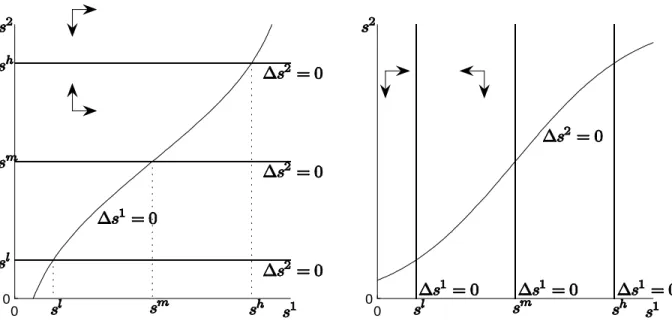
There are exactly three solutions, sl; sm; and sh to the latter equation. Hence there are three horizontal isoclines at which s2 = 0;as shown in the left panel of Figure 3. The former equation generates a single isocline s1 = hb(s2) which is strictly increasing, and satis…es hb(0) 2 (0; sl);
hb(1)2(sh;1);and hb(s) = sfor each s2 fsl; sm; shg;also depicted in the left panel of Figure 3.
As is clear from the …gure, only three steady states exist, all of which are symmetric. Only two of these,(sl; sl) and(sh; sh) are stable. The initial state (sl; sh) is in the basin of attraction of of the high investment steady state(sh; sh). Since the isoclines are all continuous in and at = = 0;
it follows that for su¢ ciently small, integration is equalizing and welfare-improving.
Next consider the limiting isoclines as !1(maintaining the assumption that = 0):In this case hb(s2) is the set of all s1 satisfying
s1= 1 G(~a( ; s1))
and hw(s1)is the set of all s2 satisfying
s2= 1 G(~a( ; s1)):
There are exactly three solutions, sl; sm; and sh to the former equation. Hence there are three vertical isoclines at which s1 = 0;as shown in the right panel of Figure 3. The latter equation generates a single isocline s2 = hw(s1) which is strictly increasing, and satis…es hw(0) 2 (0; sl);
hw(1)2(sh;1);andhw(s) =sfor eachs2 fsl; sm; shg;also depicted in the right panel of Figure 3.
As in the case of = 0;only three steady states exist, all of which are symmetric and two of which,
(sl; sl) and (sh; sh);are stable. The initial state (sl; sh) is in the basin of attraction of of the low investment steady state(sl; sl). Since the isoclines are all continuous in and at = 1 = 0;
0 0
0 0
References
[1] Akerlof, George. 1976. “The Economics of Caste and of the Rat Race and Other Woeful Tales.”
Quarterly Journal of Economics 90, 599–617.
[2] Antonovics, Kate. 2002. "Persistent Racial Wage Inequality." Unpublished Manuscript, Uni-versity of California –San Diego.
[3] Arrow, K.J. 1973. “The Theory of Discrimination.”In Ashenfelter and Rees, editors, Discrim-ination in Labor Markets. Princeton, NJ: Princeton University Press.
[4] Banerjee, Abhijit and Andrew Newman. 1993. "Occupational Choice and the Process of De-velopment."Journal of Political Economy, 101:2, pp. 274-98.
[5] Becker, G.S. 1957.The Economics of Discrimination. Chicago: University of Chicago Press.
[6] Becker, Gary S and Nigel Tomes. 1979. "An Equilibrium Theory of the Distribution of Income and Intergenerational Mobility."Journal of Political Economy, 87:6, pp. 1153-89.
[7] Beggs, Gordon 1995. "Novel Expert Evidence in Federal Civil Rights Litigation." American University Law Review, 45:1, pp. 1-75.
[8] Benabou, R. 1993. “Workings of a City: Location, Education, and Production,”Quarterly Journal of Economics, 108: 619-652.
[9] Bertrand, M. and S. Mullainathan. 2004. "Are Emily and Greg More Employable Than Lak-isha and Jamal? A Field Experiment on Labor Market Discrimination." American Economic Review, 94:4, pp. 991-1013.
[10] Bobo, L. 2001. “Racial Attitudes and Relations at the Close of the Twentieth Century.” In
America Becoming: Racial Trends and Their Consequences, edited by Neil Smelser, William
Julius Wilson, and Faith Mitchell. Washington, D.C.: National Academy Press.
[11] Bobo, L., J.R. Kluegel, and R. Smith. 1997. “Laissez-faire racism: the crystalization of a kinder, gentler, antiblack ideology.” InRacial Attitudes in the 1990s: Continuity and Change, edited by S.A. Tuch and J.K. Martin, pp. 15–42. Westport, CT: Praeger.
[12] Bowles, Samuel. 2004. Microeconomics: Behavior, Institutions, and Evolution. Princeton: Princeton University Press.
[13] Bowles, Samuel and Herbert Gintis. 2002. "The Inheritance of Inequality."Journal of Economic Perspectives 16:3, pp. 3-30.
[14] Chaudhuri, Shubham and Rajiv Sethi. 2008. “Statistical Discrimination with Peer E¤ects: Can Integration Eliminate Negative Stereotypes?”Review of Economic Studies, forthcoming.
[15] Coate, S. and G.C. Loury. 1993. “Will A¢ rmative-Action Policies Eliminate Negative Stereo-types?”American Economic Review 83: 1220–1240.
[16] Cutler, D.M. and Edward Glaeser. 1997. “Are ghettos good or bad?”Quarterly Journal of Economics, 111, pp. 508-48.
[17] Blanch‡ower, David G. and Andrew J. Oswald. 2004. "Well-Being over Time in Britain and the USA."Journal of Public Economics, pp. 1359-86.
[18] Deaton, Angus and Darren Lubotsky. 2003. "Mortality, Inequality, and Race in American Cities and States." Social Science and Medicine 56, 1139-1153.
[19] Durlauf, Stephen N. 1996. "A Theory of Persistent Income Inequality." Journal of Economic Growth 1: 75-93.
[20] Falk, Armin and Andrea Ichino. 2004. “Clean evidence on peer e¤ects.” IZA working paper.
[21] Fryer Roland and Steven D. Levitt. 2006. “The Black-White Test Score Gap Through the Third Grade.”American Law and Economics Review 8:249:281.
[22] Galor, Oded and Joseph Zeira. 1993. "Income Distribution and Macroeconomics." Review of Economic Studies, 60:1, pp. 35-52.
[23] Greenwald A., D. McGhee, and J. Schwartz. 1998. “Measuring individual di¤erences in implicit cognition: the implicit association test.”Journal of Personality and Social Psychology, 74, 1464–80.
[24] Ha, Yong Chool. 2007. “Late Industrialization, the State, and Social Changes: The Emergence of Neofamilism in South Korea.”Comparative Political Studies 40: 363-382.
[25] Hanushek, Eric A., John F. Kain, and Steve G. Rivkin. 2002. “New evidence about Brown v. Board of Education: The Complex E¤ects of School Racial Composition on Achievement.” Working Paper 8741, National Bureau of Economic Research.
[26] Hoxby, Caroline Minter. 2000. "Peer E¤ects in the Classroom: Learning from Gender and Race Variation." National Bureau of Economic Research.
[27] Jackson, Matthew, Sergio Currarini and Paolo Pin (2007). “An Economic Model of Friendship: Homophily, Minorities and Segregation.” Unpublished Manuscript, Stanford University.
[28] Jacob, Brian. 2003. “Public Housing, Housing Vouchers, and Student Achievement: Evidence from Public Housing Demolitions in Chicago.” Kennedy School of Government.
[29] Kremer, Michael and Dan Levy. 2003‘. “Peer E¤ects and Alcohol Use Among College Stu-dents.” National Bureau of Economic Research.
[30] Loury, Glenn C. 1977. “A Dynamic Theory of Racial Income Di¤erences.” In Women,
Mi-norities and Employment Discrimination, edited by Phyllis Wallace and Annette LaMond.
Lexington: Lexington Books.
[31] Loury, Glenn C. 1995. “Economic Discrimination: Getting to the Core of the Problem.” in
One By One From the Inside Out: Essays and Reviews on Race and Responsibility in America.
New York: The Free Press.
[32] Loury, Glenn C. 1981. "Intergenerational Transfers and the Distribution of Earnings," Econo-metrica 49: 843-67.
[33] Loury, Glenn C. 2002. The Anatomy of Racial Inequality. Harvard University Press.
[34] Lucas, Robert. 1988. "On the Mechanics of Economic Development" Journal of Monetary
Economics 22: 3–42.
[35] Lundberg, Shelly and Richard Startz. 1998. "On the Persistence of Racial Inequality."Journal
of Labor Economics 16: 292–323.
[36] McPherson, Miller, Lynn Smith-Lovin, and James Cook. 2001. "Birds of a Feather: Homophily in Social Networks."Annual Review of Sociology, 27, pp. 415-44.
[37] Massey, Douglas and Nancy Denton 1988. “The Dimensions of Residential Segregation.”Social
Forces 67:281–315.
[38] Moro, Andrea and Peter Norman. 2004. “A general equilibrium model of statistical discrimi-nation.”Journal of Economic Theory 114: 1-30.
[39] Mookherjee, Dilip and Debraj Ray. 2003. "Persistent inequality."Review of Economic Studies, 70:2, pp. 369 - 93.
[40] Munshi, Kaivan and Nicholas Wilson. 2007. "Identity, Pparochial Institutions, and Occu-pational Choice: Linking the Past to the Present in teh American Midwest." Unpubliched Manuscript, Brown University.
[41] Neal, Derek. 2005. “Why Has Black-White Skill Convergence Stopped?”NBER Working paper 11090.
[42] Oreopoulos, Philip. 2003. "The Long-Run Consequences of Living in a Poor Neighborhood."
Quarterly Journal of Economics, 118:4, pp. 1533-75.
[43] Phelps, E. 1972. “The Statistical Theory of Racism and Sexism.”American Economic Review
62: 659–661.
[44] President’s Council of Economic Advisors. 1991, 2003. Economic Report of the President. Washington: U.S. Government Printing O¢ ce.
[45] Quillian, Lincoln. 2006. “New Approaches to Understanding Racial Prejudice and Discrimina-tion.”Annual Review of Sociology 32, 299-328.
[46] Sacerdote, Bruce. 2001. "Peer E¤ects with Random Assignment: Results for Dartmouth Room-mates."Quarterly Journal of Economics 116, 681-704.
[47] Schelling, T. 1971. "Dynamic models of segregation." Journal of Mathematical Sociology, 1, pp. 143-86.
[48] Schelling, Thomas. 1978. Micromotives and Macrobehavior. New York: W. W. Norton & Co.
[49] Schuman, H., C. Steeh, L. Bobo, and M. Krysan. 1997. Racial Attitudes in America: Trends and Interpretations, Revised Edition. Cambridge: Harvard University Press.
[50] Sethi, Rajiv and Rohini Somanathan. 2004. "Inequality and Segregation."Journal of Political
Economy, 112: 1296-321.
[51] Shin E.H. and S.K. Chin. 1989. Social A¢ nity among Top Managerial Executives of Large Corporations in Korea.Sociological Forum 4: 3-26.
[52] Tajfel, Henri, M. Billig, R.P. Bundy, and Claude Flament. 1971. "Social Categorization and Intergroup Behavior."European Journal of Social Psychology, 1, pp. 149-77.
[53] U.S. Supreme Court. 1954. "Brown v. Board of Education, 347 U.S. 483."
[54] Weinberg, Bruce, Patricia Reagan, and Je¤rey Yankow. 2004. “Do Neighborhoods A¤ect Hours Worked? Evidence from Longitudinal Data.”Journal of Labor Economics, 22:4, pp. 891-921.
[55] Wol¤, Edward. 1998. "Recent trends in the size distribution of household wealth."Journal of Economic Perspectives, 12:3, pp. 131-50.
[56] Yu, Eui-Young. 1990. "Regionalism in teh South Korean Job Market: An Analysis of Regional-Origin Inequality among Migrants in Seoul."Paci…c A¤ airs, 63, 24-39.
[57] Zimmerman, David J. and Gordon Williams. 2003. "Peer E¤ects in Higher Education." Na-tional Bureau of Economic Research.