ISSN 1470-3297 print/ISSN 1470-3300 online © 2008 Taylor & Francis
DOI: 10.1080/14703290802377240 http://www.informaworld.com
The effect of concept mapping on students’ learning achievements
and interests
Chei-Chang Chiou*
Department of Accounting, National Changhua University of Education, Changhua, Taiwan, ROC
Taylor and Francis RIIE_A_337891.sgm 10.1080/14703290802377240 Innovations in Education and Teaching International 1470-3297 (print)/1470-3300 (online) Original Article 2008 Taylor & Francis 45 4000000November 2008 Chei-ChangChiou [email protected]
The study described in this paper has examined whether concept mapping can be used to help students to improve their learning achievement and interests. The participants were 124 students from two classes enrolled in an advanced accounting course at the School of Management of a university in Taiwan. The experimental data revealed two important results. First, adopting a concept mapping strategy can significantly improve students’ learning achievement compared to using a traditional expository teaching method. Second, most of the students were satisfied with using concept mapping in an advanced accounting course. They indicated that concept mapping can help them to understand, integrate and clarify accounting concepts and also enhance their interests in learning accounting. They also thought that concept mapping could be usefully used in other curriculum areas.
Keywords: concept mapping; concept map; accounting education; advanced accounting
course
Introduction
Accounting, economics, business statistics, and management are all required courses for most schools of management. Professional skills and knowledge in these areas (especially accounting) is a requirement for the future careers of business students. Unfortunately, in some countries (such as Taiwan and the USA), not only do many students struggle with accounting courses but many instructors in accounting have difficulties in relation to the teaching of accounting courses in an effective way.
The Accounting Education Change Commission (AECC) in the USA has stressed the need for changes in accounting education. An early position statement made by AECC provided an objective road map for the future of accounting education (AECC, 1990). This statement emphasised the point that the main objective of accounting courses should be to teach students to learn independently. The AECC stated that this would involve changing the educational focus from the traditional approach of ‘transfer of knowledge’ to one of ‘learning to learn’. As stated by the AECC, learning to learn involves developing skills and strategies that help a person to learn more effectively. It also involves encouraging that person to apply these more effective learning strategies throughout his or her lifetime (AECC, 1990, p. 310). In effect, not only accounting education but business and manage-ment education also needs to teach students the meta-learning technique of learning to learn. In science education in recent years, the increasing awareness of the importance of learner-centredness in the teaching–learning situation has generated a lot of attention in relation to understanding how learners learn and how to help them learn about concepts (Jegede, Alaiymola, & Okebukola, 1990). These efforts in assisting learners to learn more
effectively have led to the development of meta-cognitive strategies to enhance meaningful learning (Biggs, 1988; Cliburn, 1990).
Meta-cognitive strategies, including meta-knowledge and meta-learning, are strategies that empower a learner to take charge of his/her own learning in a highly meaningful fash-ion (Jegede et al., 1990; Novak, 1983). Meta-knowledge refers to knowledge that deals with the very nature of knowledge and knowing, and meta-learning refers to learning that deals with the nature of learning, or learning about meaningful learning (Novak & Gowin, 1984) or, as defined by Biggs (1985), is basically about a process of being aware of, and taking control of, one’s own learning (Biggs, 1985; Meyer & Shanahan, 2004). Meaningful learn-ing means that learners can integrate new knowledge into their existlearn-ing networks of concepts and propositions in their cognitive structures (Malone & Dekkers, 1984). Concept mapping serves as a strategy to help learners organise their cognitive frameworks into more powerful integrated patterns (Kinchin, 2005). In this regard, it serves as a meta-knowledge and a meta-learning strategy (Jegede et al., 1990). Indeed, many researches on concept mapping have proved that it can improve meaningful learning and help learners learn inde-pendently (Cliburn, 1990; Heinze-Fry & Novak, 1990; Kinchin, 2003; Mintzes, Wandersee, & Novak, 2001; Novak, 1990; Novak, Gowin, & Johansen, 1983; Okebukola & Jegede, 1988; Trowbridge & Wandersee, 1996).
A concept map is a graph structure containing nodes that are interlinked by labelled, directed arcs. Concept maps can be used as a knowledge representation tool to reflect rela-tionships that exist between concepts that reside within an individual’s long-term memory (Jacobs-Lawson & Hershey, 2002). When constructing a concept map, the focus is the rela-tionships among concepts. The combination of two concepts connected by a linking line and labelled by a linking word creates a proposition, which is the smallest linguistic unit that carries meaning (Jacobs-Lawson & Hershey, 2002).
Although a concept map is normally regarded as a network structure, in order to aid learning and understanding, sections of a given concept map can be regarded as hierarchical tree-like structures. This is the approach that is adopted in this paper. When a concept map is organised in a hierarchical fashion, the more general and more inclusive concepts should be at the top of the map, with progressively more specific (and less inclusive concepts) arranged below them (Novak & Gowin, 1984). The hierarchical attribute of a concept map also makes meaningful learning proceed more easily as new concepts or concept meanings are subsumed under broader, more inclusive concepts (Novak & Gowin, 1984). This hier-archical attribute also blends nicely with the structure of information contained in the accounting discipline (Leauby & Brazina, 1998).
In addition to concepts and labelled links, a concept map can contain another type of labelled link called a cross link. Cross links connect two distinct segments of a concept hier-archy. The inter-connective nature of cross links serves an important integrative function when constructing a map (Jacobs-Lawson & Hershey, 2002). The cross links knowledge is especially important for learning accounting – since education in accounting stresses the continuity of accounting knowledge (Leauby & Brazina, 1998).
Concept mapping is a meta-learning strategy that can be used to develop students’ capacity to learn independently. It has been used successfully in many disciplines; a search made in the ERIC database in March 2006 identified 834 entries on concept maps or concept mapping during the period 1966–2006. Concept mapping is also regarded as a good technique to encourage students’ learning in a higher education setting in the UK, USA and Taiwan (Budd, 2004; Chang, Sung, & Chiou, 2002; Robley, Whittle, & Murdoch-Eaton, 2005). However, there have been relatively few research studies which have evaluated the usefulness of concept mapping in university-level business education courses. This is
particularly so in accounting education. This study has therefore attempted to evaluate whether concept mapping contributes to learners’ achievement, and their attitudes towards concept mapping. In short, this study sought to:
(1) find out whether concept mapping improved students’ learning achievement in an advanced accounting course within the School of Management; and
(2) identify students’ attitudes towards using concept mapping as a learning tool.
Method Participants
The participants in this study were 124 students from two classes in advanced accounting courses at the School of Management of a university in Taiwan enrolled in the first semester of 2002. One class of 62 students was randomly assigned as the experimental group; the other class of 62 students was used as the control group. The experimental class utilised concept maps in teaching and learning, while the control class maintained normal traditional curriculum activities. The teacher and the textbooks for both classes were the same to avoid confounding effects on the experiment. None of the students reported previous experience in concept mapping.
Instruments
An intermediate accounting score and an intermediate accounting achievement test were used in the pre-tests and an advanced accounting achievement test was administered as a post-test. A questionnaire was used to investigate the students’ attitude towards their learn-ing experiences. Each is briefly explained below.
In this study, an intermediate accounting score was the average score of the participants in intermediate accounting courses in the first and second semesters of 2001. With the same teacher and textbooks in both classes, the intermediate accounting score can be utilised to determine the homogeneity of the participants.
An intermediate accounting achievement pre-test, developed from the National CPA
TEST sponsored by the Ministry of Examination of the Examination Yuan of ROC, was
another way to determine the homogeneity of the participants. An advanced accounting
achievement post-test, also developed from the National CPA TEST, was administered to
measure the experimental effect on achievement. Both instruments consisted of 10 multiple choice questions, four journal entries and accounting reports. The K-R 20 reliability coeffi-cients of the two instruments were 0.92 and 0.89 for the sample used in this study. The students were asked to complete these tests in three hours, under test conditions.
A satisfaction questionnaire was designed to investigate the attitude of participants towards adopting concept mapping to learn advanced accounting. The questionnaire comprised 10 items, and was rated on a four-point Likert scale from ‘strongly disagree’ to ‘strongly agree’. The Cronbach Alpha coefficient of the instrument was 0.85 for the study sample. The instrument had high construct validity (with a part–whole correlation of 0.91) (Kerlinger, 1986).
Experimental design and procedure
The experiment was set up according to a pre-test/post-test control group design. Several stages were implemented to accomplish the purpose of this study. First, before the start of
the course, the teacher and the researcher spent two months (during the summer vacation) to discuss the overall experimental processes. Second, an intermediate accounting score was calculated and an intermediate accounting achievement pre-test was administered to ensure that prior to the experiment, the two groups had achieved the same level of accounting knowledge.
Third, the experimental group participated in the concept mapping programme and the control group participated in normal accounting instruction. In the experimental group, the teacher first explained why concept mapping is a useful tool for learning and how concept mapping can be used to show relationships among concepts, and then spent three hours training students to draw concept maps in accordance with the procedures suggested by Novak and Gowin (1984, pp. 32–34, Table 2.3). The teacher then taught from the textbook using teacher-constructed computer-assisted concept maps as the instructional medium. After finishing a chapter, the students were asked to use concept maps to represent what they had learned from the chapter. The teacher and the researcher then corrected student-constructed concept maps together. During the correcting process, the teacher and the researcher worked together in order to identify any accounting misconceptions and then modified these misconceptions for the class. After going through misconceptions in-class, students were asked to use the former same concepts to reconstruct their individual concept maps again. The students then used these modified concept maps as review tools for their independent studies. The above procedure was repeated until the end of chapter six of the textbook, totalling an implementation period of 12 weeks.
In the control group, the teacher gave an introductory lesson that included the objec-tives of the lesson and how to proceed, and then taught from the textbook using teacher-made computer-assisted abstracts as the instructional medium. After finishing a chapter, the students were asked to work on some questions. The teacher then taught the class correct answers to these questions. The above procedure was also repeated until the end of chapter six of the textbook. The implementation period was the same as the experimental group.
At the end of the experiment, the advanced accounting achievement post-test was administered to the two classes to compare their learning achievement. The final task was asking the students in the experimental group to fill out the satisfaction questionnaires to rate their attitudes towards their experiences of using concept mapping. They were also assured that their responses to the questionnaires had no effect on their scores, and that they were free to respond anonymously.
Results
Examples of concept mapping
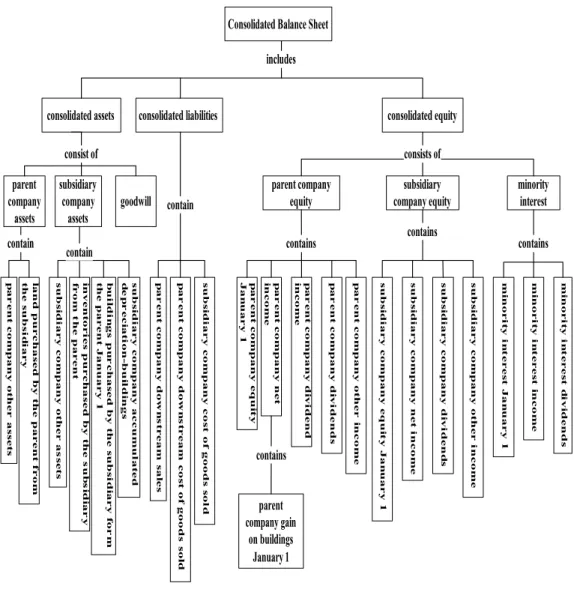
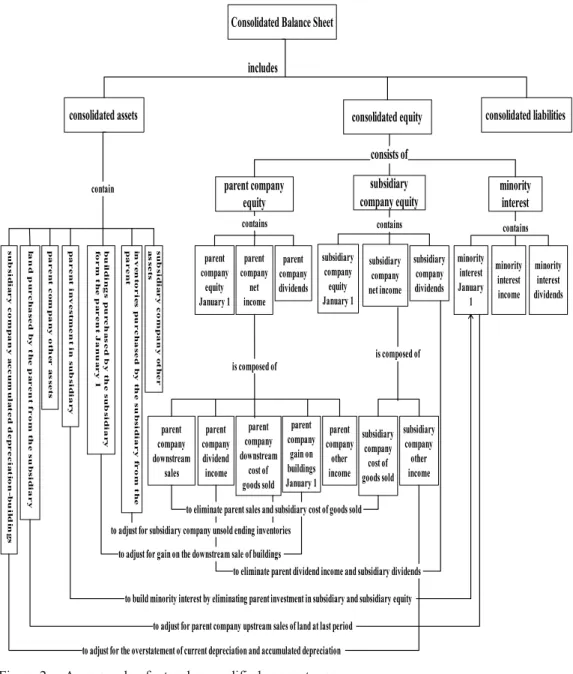
Figures 1 and 2 are examples of concept maps constructed by a student before and after being modified by the teacher and the researcher. Figure 1 shows that before being modi-fied by the teacher in-class, there were many invalid relationships in the map constructed by this student. For example, the subsidiary company’s cost of goods sold should not belong to consolidated liabilities but to the subsidiary company’s net income, and the parent company’s downstream sales should not belong to consolidated liabilities but to the parent company’s net income, etc. There was no cross link included in this map. These deficien-cies revealed this student’s lack of depth and breadth in accounting knowledge. The teacher and the researcher had to modify and correct these invalid relationships to expand his accounting knowledge. In the map, there are 20 valid relationships (propositions) and four
hierarchies, but no cross links. Using Novak and Gowin’s (1984) scoring method, the total score for the concept map of this student was only 40.
Figure 1. An example of a student’s concept map (before modification by the teacher). Figure 2. An example of a teacher-modified concept map.
On the other hand, Figure 2 shows that the concept map reconstructed by this student was more valid and complex after being modified (for misconceptions) by the teacher in-class. There are now no invalid relationships in the map, which has 29 valid relationships. Although there are also four hierarchies, this map tends to branch more frequently and precisely from each concept. This concept map is also more integrated, as revealed by the greater number of cross links between concepts; there are seven cross links compared to none in Figure 1. For example, it displays a cross link between the concepts ‘parent company downstream sales’ and ‘subsidiary company cost of goods sold’, and ‘parent company divi-dend income’ and ‘subsidiary company dividivi-dends’. The cross links require more in-depth thinking and broader analysis in order to identify the interrelationships between accounting concepts. The total score of this map is 119. The progress of this student can be seen by comparing Figures 1 and 2.
Consolidated Balance Sheet
consolidated liabilities su bs id ia ry c om p an y cos t of good s s ol d subsidiary company equity s u b s id iar y c om p a n y o th e r a s s e ts in v e n tor ie s p u r c h as e d b y t h e s u b s id iar y fr om t h e p ar e n t la n d p u r c h as e d b y t h e p ar e n t f r om th e s u b s id ia r y consolidated assets p ar e n t c om p an y ot h e r as s e ts b u il d in gs p u r c h a s e d b y t h e s u b s id iar y f or m th e p a r e n t Ja n u ar y 1 pa re nt com p an y d ow n s tr e am c os t of good s s o ld p ar e n t c om p an y e q u it y Jan u a ry 1 parent company equity minority interest consolidated equity p ar e n t c om p an y d o w n s tr e am s al e s consists of includes s u b s id iar y c om pan y acc u m u lat e d d e p r e c iat ion -b u il d in gs p ar e n t c om p an y n e t in c om e p ar e n t c om p an y d iv id e n d in c om e p ar e n t c om p an y d iv id e n d s p ar e n t c om p an y ot h e r i n com e consist of contains s u b s id iar y c o m p an y e q u it y Jan uary 1 s u b s id iar y c om p an y n e t i n com e s u b s id iar y c om p an y d ivi d e n d s s u b s id iar y c om p a n y o th e r i n c o m e m in or it y in t e r e s t J a n u a r y 1 m in or it y i n t e r e s t i n c om e m in or it y in t e r e s t d iv id e n d s contains parent company gain on buildings January 1 contains contain contains parent company assets subsidiary company assets goodwill contain contain
The results of pre- and post-modified misconceptions by the teacher and the researcher show improved knowledge structure of this student as demonstrated by increased valid accounting propositions and improved branching and cross linking based on the maps. Differences in achievement test scores
Table 1 summarises the results of a t-test done to compare the experimental and control
classes’ scores in intermediate accounting in the first and second semesters of 2001, and their scores in intermediate accounting achievement pre-test. The results of the
heterogene-ity test between the experimental and control classes were not significant (t = −0.65, p >
Consolidated Balance Sheet
consolidated liabilities subsidiary company cost of goods sold subsidiary company equity s u b si d ia r y c o m p a n y o t h e r a s s e ts in v e n to r ie s p u r c h a s e d b y t h e su b s id ia r y f r o m t h e p a r e n t la n d p u r c h a se d b y t h e p a r e n t f r o m t h e su b si d ia r y consolidated assets p a r e n t c o m p a n y o th e r a s s e ts b u il d in g s p u r c h a s e d b y t h e su b s id ia r y fo r m t h e p a r e n t J a n u a r y 1 parent company downstream cost of goods sold parent company equity January 1 parent company
equity minority interest
consolidated equity parent company downstream sales includes consists of s u b si d ia r y c o m p a n y a c c u m u la t e d d e p r e c ia t io n -b u il d in g s parent company net income parent company dividend income parent company dividends parent company other income contain contains subsidiary company equity January 1 subsidiary company net income subsidiary company dividends subsidiary company other income minority interest January 1 minority interest income minority interest dividends contains parent company gain on buildings January 1 contains p a r e n t in v e st m e n t in s u b si d ia r y is composed of is composed of
to build minority interest by eliminating parent investment in subsidiary and subsidiary equity to adjust for parent company upstream sales of land at last period
to adjust for the overstatement of current depreciation and accumulated depreciation
to eliminate parent dividend income and subsidiary dividends to adjust for gain on the downstream sale of buildings
to adjust for subsidiary company unsold ending inventories
to eliminate parent sales and subsidiary cost of goods sold
0.05; t = 0.89, p > 0.05), thus implying that the students of both classes have the same level of accounting knowledge and learning abilities.
Table 2 presents the result of a post-test t-test to examine whether concept mapping
strategy contributes to accounting students’ learning achievement. It shows that there was a
significant difference (t = 2.96, p < 0.01) in the advanced accounting achievement test
scores between the two classes. The mean score for the experimental class (adopting the concept mapping strategy) was 73.24, while the mean score for the control class (using the traditional expository teaching method) was 63.31. In other words, the experimental class outperformed the control class. The result obtained seems to suggest that the concept mapping strategy more effectively improved the students’ learning achievement than the traditional expository teaching method.
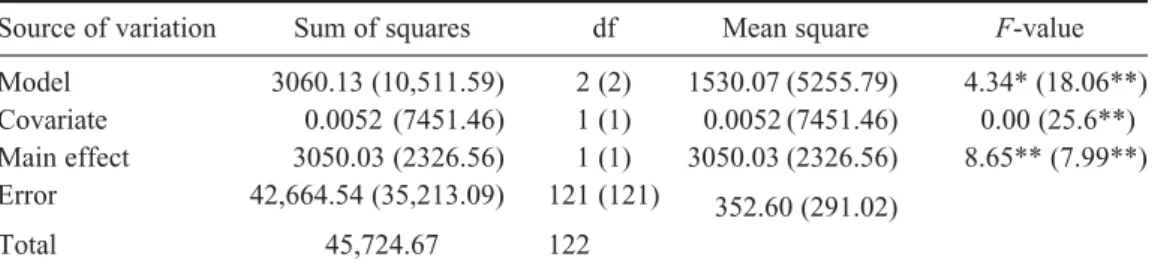
Since the pre-test scores may have influenced the experimental effect, a one-way anal-ysis of covariance was applied. The pre-test scores were the covariates and the post-test scores were the dependent variables. After controlling for the covariates, the main effect for
post-test scores attained significance (F= 8.65, p < 0.01; F = 7.99, p < 0.01) (Table 3). The
result indicated that the experimental class that was exposed to concept mapping has a significantly higher achievement than the control class that received traditional expository teaching.
Students’ perceptions on concept mapping
The students’ responses to the satisfaction questionnaires are shown in Table 4. The responses for each item were converted into ‘agree’ (answers of ‘strongly agree’ or ‘agree’) or ‘disagree’ (answers of ‘strongly disagree’ or ‘disagree’), and were converted into percentages.
Questions 1–4 investigated whether the concept mapping strategy indeed improved learning. The data in Table 4 show that 97% of the students agreed that concept mapping helped them to learn accounting, and also integrate and clarify the inter-relationships among curriculum content. Ninety-five per cent of the students indicated that concept mapping stimulated them to learn and to think independently. The majority of students (89%) expressed the opinion that concept mapping helped them to reduce the barriers to learning and enhance their interests in learning accounting.
Table 1. Pre-test t-value and descriptive statistics for the two classes.
Test Classes n Mean SD df t-value
Accounting score Experimental 62 70.66 17.75 122 −0.65
Control 62 68.05 14.941
Achievement test Experimental 62 67.51 12.106 122 0.89
Control 62 68.87 11.217
Table 2. Post-test t-value and descriptive statistics for the two classes.
Test Classes n Mean SD df t-value
Achievement test Experimental 62 73.24 15.314 122 2.96**
Control 62 63.31 21.561
Questions 5–10 dealt with the degree of the affective acceptance of the concept mapping group. Ninety-five per cent of the students deemed that concept mapping could be regarded as a new accounting teaching and learning method that could easily be applied to other curricula. It also shows that 95% of the students said that they would consider using the concept mapping learning strategy in other curricula. In addition, 84% of the students felt that they liked using concept mapping to assist them in learning accounting. Therefore, most of the students (90%) were satisfied with adopting concept mapping to learn accounting. However, in terms of the ease or learning the principles of concept mapping, only 58% replied in the affirmative. The result indicated that more time is needed for an instructor to give guidance to students in relation to using the concept mapping strategy.
Discussion and conclusion
The main objective of this study was to investigate whether the meta-learning strategy of concept mapping could be used to help students in the School of Management improve their learning achievement in an advanced accounting course. Two classes at the School of Management of a university in Taiwan were chosen to participate in the experiment. The results showed that students in the concept mapping class improved in their learning achievement more than did students in the traditional expository teaching class. This finding
Table 3. Analysis of covariance for the achievement test of the two classes.
Source of variation Sum of squares df Mean square F-value Model 3060.13 (10,511.59) 2 (2) 1530.07 (5255.79) 4.34* (18.06**) Covariate 0.0052 (7451.46) 1 (1) 0.0052 (7451.46) 0.00 (25.6**) Main effect 3050.03 (2326.56) 1 (1) 3050.03 (2326.56) 8.65** (7.99**) Error 42,664.54 (35,213.09) 121 (121) 352.60 (291.02)
Total 45,724.67 122
The numbers in parentheses represent the result of using the intermediate accounting score in the first and second semesters of 2001 as the covariate.
*p < 0.05; **p < 0.01.
Table 4. Perceptions of the experiment class toward concept mapping.
Perceptions %
1. Concept mapping helped me learn accounting 97
2. Concept mapping helped me integrate and clarify the interrelationships among
curriculum contents 97
3. Concept mapping learning strategy stimulated me to learn and think independently 95 4. Concept mapping helped me reduce the barriers and enhance my interest in learning
accounting 89
5. Concept mapping can be a new accounting teaching and learning approach 95 6. I think the concept mapping strategy can be easily used in other curricula 95 7. I will consider using the concept mapping learning strategy in other curricula 95 8. I was satisfied with using concept mapping to learn accounting 90 9. I liked using concept mapping to assist me to learn accounting 84
is in agreement with earlier findings in other disciplines such as Ahlberg, Aanismaa, and Dillon (2005), Arnaudin, Mintzes, Dunn, and Schafter (1984), Bernard and Naidu (1992), Chang, Sung, and Chiou (2002), Chularut and DeBacker (2004), Cliburn (1990), McCagg and Dansereau (1991), Novak et al. (1983), Pankratius (1990), Ritchie and Volkl (2000), and Schmid and Telaro (1990).
The second research question focused on the perceptions of students regarding adopting concept mapping to learn. The whole experimental group was more positive about the usefulness of concept mapping in enhancing learning effectiveness after they took the concept mapping course. Almost all students expressed the view that the concept mapping strategy was really helpful for learning accounting and understanding the structure and inter-relations of the curriculum content. The opinions of students support the merit of concept mapping in the integration of knowledge (Ahlberg et al., 2005; Harpaz, Balik, and Ehrenfeld, 2004; Kinchin, De-Leij, and Hay, 2005; Lavigne, 2005; Novak & Gowin, 1984; Shavelson, Ruiz-Primo, and Wiley, 2005). The original intent of the concept mapping strat-egy (Ahlberg et al., 2005; Harpaz et al., 2004; Novak et al., 1983; Novak & Gowin, 1984) was to facilitate students’ independent learning and thinking. The views of students in this study are in agreement with this idea. Furthermore, most students pointed out that adopting the concept mapping strategy helped them reduce the barriers and promote their interests in learning accounting.
In terms of affective acceptance, the experimental group had a more affirmative attitude for using the concept mapping strategy. The overwhelming majority of the students were of the opinion that concept mapping can be a feasible accounting instructional strategy. Most of the students liked, and felt satisfied with, adopting concept mapping as an assistive learn-ing strategy. The students in the concept mapplearn-ing group also believed that concept mapplearn-ing could be easily applied to other subjects. These opinions are consistent with the successful examples of using concept mapping in other disciplines (Ahlberg et al., 2005; Chang et al., 2002; Freeman & Jessup, 2004; Harpaz et al., 2004; Ritchie & Volkl, 2000).
However, nearly half the students indicated that they could not quickly adapt to the approach of concept mapping. The result points out the importance and difficulty of prepar-ing and trainprepar-ing students for concept mappprepar-ing tasks. As McCagg and Dansereau said, ‘stud-ies of student mapping … have indicated that a lack of familiarity with the technique can be frustrating for novice map makers … training students to use the concept mapping tech-nique can be tedious and time-consuming’ (1991, p. 320). This is also a common problem in other successful examples (Jegede et al., 1990; McCagg & Dansereau, 1991; Ruiz-Primo & Shavelson, 1996). This affective response by students, therefore, perhaps implicated the importance of having an efficient map-training procedure for accounting (or business) instructors interested in using the concept mapping strategy to support teaching and learning activities.
In addition, by comparing Figures 1 and 2, a teacher could easily identify any miscon-ceptions that a student has and also understand the conceptual changes of the student (Vanides, Yin, Tomita, and Ruiz-Primo, 2005). The results of pre- and post-instruction concept map scores also show the improvement of knowledge structure of a student. In this regard, concept mapping, as Wallace and Mintzes (1990) stated, is the only approach to address both what students know and how students organise their knowledge. Furthermore, in the process of developing and modifying concept maps, students were required and were permitted to freely make connections, be creative and find new visual links. The concept mapping strategy thus offers a unique learning opportunity based on empowering students through knowledge of their own learning (Leauby & Brazina, 1998). In this regard, concept mapping is a useful meta-learning strategy in relation to helping students ‘learn how to learn’.
The AECC (1990) in the USA advocated the ‘learning to learn’ concept, which indicated that students should develop the ability to learn on their own. Concept mapping, used successfully in various disciplines, can benefit students not only by developing their capacity
in learning how to learn, but also by integrating new knowledge with what was previously known, i.e. meaningful learning. As such, concept mapping is an effective meta-cognitive strategy, and this study is a pioneering detailed investigation in the usefulness of concept mapping in university-level business accounting courses.
Implications
The findings of this study have several important implications for accounting and business management education. First, business education stresses the continuity of knowledge. For
instance, the elementary financial accounting courses (introductory economics courses) are the foundation of intermediate accounting courses (microeconomics and macroeconomics courses), and the intermediate accounting courses are the foundation of advanced account-ing courses. That is, if a learner wants to be proficient in upper-level courses, then he/she must begin at the foundation of previous courses. Concept mapping can help in making better inter-connections between courses.
Second, the accounting profession requires accountants to possess creative and indepen-dent learning abilities; unfortunately accounting education fails to fulfil this requirement (Albrecht & Sack, 2001). Using concept mapping, which focuses on freely associated connections among accounting concepts, students’ logical thoughts and deductive and self-learning abilities can be enhanced, thus improving their creative and independent self-learning abilities. The capabilities are also a requirement for all business and management students. Third, the meta-learning strategy of concept mapping and the experimental design in this study can be easily extrapolated to other business curriculum areas, such as economics, business and economics statistics, management, etc. Figures 3 and 4 show two separate examples of concept maps relating to a Business and Economics Statistics course and an Economics course, respectively.
Figure 3. An example of a concept map relating to a Business and Economics Statistics course. Figure 4. An example of a concept map relating to an Economics course.
Notes on contributor
Chei-Chang Chiou is an associate professor in the Department of Accounting within the College of Management at the National Changhua University of Education in Taiwan. His research interest includes business education, concept mapping, total quality management, capital market research and operating efficiency.
References
Accounting Education Change Commission (AECC). (1990). Objectives of education for accoun-tants: Position statement number one. Issues in Accounting Education,5, 307–312.
Ahlberg, M., Aanismaa, P., & Dillon, P. (2005). Education for sustainable living: Integrating theory, practice, design, and development. Scandinavian Journal of Educational Research,49(2), 167–185. Albrecht, W.S., & Sack, R.J. (2001). The perilous future of accounting education. The CPA Journal,
71(3), 16–23.
Arnaudin, M.W., Mintzes, J.J., Dunn, C.S., & Schafter, T.H. (1984). Concept mapping in college science teaching. Journal of College Science Teaching,14(2), 117–121.
Bernard, R.M., & Naidu, S. (1992). Post-questioning, concept mapping and feedback: A distance education field experiment. British Journal of Educational Technology,23(1), 37–52.
Biggs, J.B. (1985). The role of metalearning in study process. British Journal of Educational
Psychology,55, 185–212.
Biggs, J.B. (1988). The role of metacognition in enhancing learning. Australian Journal of Education, 32(2), 127–138.
Budd, J.W. (2004). Mind maps as classroom exercises. Journal of Economic Education,35(1), 35–46. Chang, K.E., Sung Y.T., & Chiou S.K. (2002). Use of hierarchical hyper concept map in web-based
courses. Journal of Educational Computing Research,27, 335–353.
Chularut, P., & DeBacker, T.K. (2004). The influence of concept mapping on achievement, self-regulation, and self-efficacy in students of English as a second language. Contemporary
Educational Psychology,29, 248–263.
Cliburn, J.W. (1990). Concept maps to promote meaningful learning. Journal of College Science
Teaching,19, 212–217.
Freeman, L.A., & Jessup, L.M. (2004). The power and benefits of concept mapping: Measuring use, usefulness, ease of use, and satisfaction. International Journal of Science Education, 26(2), 151–169.
Harpaz, I., Balik, C., & Ehrenfeld, M. (2004). Concept mapping: An educational strategy for advancing nursing education. Nursing Forum,39(2), 27–30.
Heinze-Fry, J., & Novak, J.D. (1990). Concept mapping brings long-term movement toward mean-ingful learning. Science Education,74, 461–472.
Jacobs-Lawson, J.M., & Hershey, D.A. (2002). Concept maps as an assessment tool in psychology courses. Methods & Techniques,29(1), 25–29.
Jegede, O.J., Alaiymola, F.F., & Okebukola, P.A. (1990). The effect of concept mapping on students’ anxiety and achievement in biology. Journal of Research in Science Teaching, 27,
951–960.
Kerlinger, F.N. (1986). Foundations of behavioral research. New York: Holt, Rinehart and Winston.
Kinchin, I.M. (2003). Effective teacher–student dialogue: A model from biological education. Journal
of Biological Education,37(3), 110–113.
Kinchin, I.M. (2005). Writing to be published or writing to be read. Journal of Natural History,39,
3229–3233.
Kinchin, I.M., De-Leij, F.A.A.M., & Hay, D.B. (2005). The evolution of a collaborative concept mapping activity for undergraduate microbiology students. Journal of Further & Higher Education, 29(1), 1–14.
Lavigne, N.C. (2005). Mutually informative measures of knowledge: Concept maps plus problem sorts in statistics. Educational Assessment,10(1), 39–71.
Leauby, B.A., & Brazina, P. (1998). Concept mapping: Potential uses in accounting education.
Journal of Accounting Education,16(1), 123–138.
Malone, J., & Dekkers, J. (1984). The concept maps as an aid to instruction in science and mathe-matics. School Science and Mathematics,84(3), 220–231.
McCagg, E.C., & Dansereau, D.F. (1991). A convergent strategy for examining knowledge mapping as a learning strategy. Journal of Educational Research,84, 317–324.
Meyer, J.H.F., & Shanahan, M.P. (2004). Developing metalearning capacity in students: Actionable theory and practical lessons learned in first-year economics. Innovations in Education and
Teaching International,41, 443–455.
Mintzes, J.J., Wandersee, J.H., & Novak, J.D. (2001). Assessing understanding in biology. Journal
of Biological Education,35(3), 118–124.
Novak, J.D. (1983). Metalearning and metaknowledge instruction as strategies to reduce misconcep-tions. In H. Helm & J.D. Novak (Eds.), Proceedings of the International Seminar on
Misconcep-tions in Science and Mathematics (pp. 100–110). Ithaca, NY: Department of Education, Cornell
University.
Novak, J.D. (1990). Concept maps and Vee diagrams: Two metacognitive tools to facilitate mean-ingful learning. Instructional Science,19(1), 29–52.
Novak, J.D., & Gowin, D.B. (1984). Learning how to learn. New York: Cambridge University Press. Novak, J.D., Gowin, D.B., & Johansen, G.T. (1983). The use of concept mapping and knowledge
Vee mapping with junior high school science students. Science Education,67, 625–645. Okebukola, P.A., & Jegede, O.J. (1988). Cognitive preference and learning model as determinants
of meaningful learning through concept mapping. Science Education,72, 489–500.
Pankratius, W.J. (1990). Building an organized knowledge base: Concept mapping and achievement in secondary school physics. Journal of Research in Science Teaching,27, 315–333.
Ritchie, D., & Volkl, C. (2000). Effectiveness two generative learning strategies in the science class-room. School Science and Mathematics,100(2), 83–89.
Robley, W., Whittle, S., & Murdoch-Eaton, D. (2005). Mapping generic skills curricula: Outcomes and discussion. Journal of Further & Higher Education,39, 321–339.
Ruiz-Primo, M.A., & Shavelson, R.J. (1996). Problems and issues in the use of concept maps in science assessment. Journal of Research in Science Teaching,33, 569–600.
Schmid, R.F., & Telaro, G. (1990). Concept mapping as an instructional strategy for high school biology. Journal of Educational Research,84(2), 78–85.
Shavelson, R.J., Ruiz-Primo, M.A., & Wiley, E.W. (2005). Windows into the mind. Higher Education, 49, 413–430.
Trowbridge, J.E., & Wandersee, J.H. (1996). How do graphics presented during college biology lessons affect students’ learning. Journal of College Science Teaching,26(1), 54–57.
Vanides, J., Yin, Y., Tomita, M., & Ruiz-Primo, M.A. (2005). Using concept maps in the science classroom. Science Scope,28(8), 27–31.
Wallace, J.D., & Mintzes, J.J. (1990). The concept map as a research tool: Exploring conceptual change in biology. Journal of Research in Science Teaching,27, 1033–1052.