Open Access Theses Theses and Dissertations
Spring 2015
Application and implications of rule-based pruning
of apple trees
Jacob B. Franzen Purdue University
Follow this and additional works at:https://docs.lib.purdue.edu/open_access_theses Part of theHorticulture Commons
This document has been made available through Purdue e-Pubs, a service of the Purdue University Libraries. Please contact [email protected] for additional information.
Recommended Citation
Franzen, Jacob B., "Application and implications of rule-based pruning of apple trees" (2015).Open Access Theses. 523. https://docs.lib.purdue.edu/open_access_theses/523
PURDUE UNIVERSITY GRADUATE SCHOOL Thesis/Dissertation Acceptance
This is to certify that the thesis/dissertation prepared By
Entitled
For the degree of
Is approved by the final examining committee:
To the best of my knowledge and as understood by the student in the Thesis/Dissertation Agreement, Publication Delay, and Certification Disclaimer (Graduate School Form 32), this thesis/dissertation adheres to the provisions of Purdue University’s “Policy of Integrity in Research” and the use of copyright material.
Approved by Major Professor(s):
Approved by:
Head of the Departmental Graduate Program Date
Jacob B. Franzen
APPLICATION AND IMPLICATIONS OF RULE-BASED PRUNING OF APPLE TREES
Master of Science Peter M. Hirst Chair Bruce P. Bordelon Richard Meilan Peter M. Hirst Hazel Wetzstein 4/20/2015
APPLICATION AND IMPLICATIONS OF RULE-BASED PRUNING OF APPLE TREES
A Thesis
Submitted to the Faculty of
Purdue University by
Jacob B. Franzen
In Partial Fulfillment of the Requirements for the Degree
of
Master of Science
May 2015 Purdue University West Lafayette, Indiana
ACKNOWLEDGEMENTS
I would like to dedicate this thesis to my parents, Jane and Roy. Without them, none of this would be possible. They have loved and supported me throughout my education and given me the strength to continue when all seemed lost. For that, I am eternally grateful.
I thank my advisor, Peter Hirst, for giving me the opportunity, guidance and support I needed to pursue my dream. His knowledge and friendship have been instrumental to my development.
Lastly, I thank my colleagues and the faculty of Purdue University. I have met so many remarkable people and will never forget their kindness and camaraderie.
TABLE OF CONTENTS
Page
LIST OF TABLES ... vi
LIST OF FIGURES ... vii
ABSTRACT ... viii INTRODUCTION ... 1 Early History ... 1 Cultivation ... 1 Orchard Systems ... 3 Tree Training ... 4 Pruning ... 5 Light Interception... 6 Light Distribution ... 8 Growth/Fruiting Habit ... 9 Orchard Management ... 10 Mechanized Pruning ... 11 Harvest ... 11 Rootstock/Scion ... 13 Fruit Quality ... 14 Literature Cited ... 18
APPLICATION AND IMPLICATIONS OF RULE-BASED PRUNING OF APPLE TREES ... 27
Introduction ... 27
Materials and Methods... 28
Light Distribution ... 30 Yield ... 31 Fruit Quality ... 31 Pruning Analysis ... 33 Results ... 33 Light Distribution ... 33 Yield ... 34 Fruit Quality ... 35 Discussion ... 38 Light Distribution ... 38 Yield ... 39 Fruit Quality ... 40 Pruning Analysis ... 41 Summary ... 41
Page Literature Cited ... 46
LIST OF TABLES
Table Page
Table 1.1. Light distribution as percent full sun (%FS), yield components, and fruit quality measurements in ‘Pink Lady’/B.9 and ‘Golden Delicious’/M.26 trees across three
pruning styles in 2013. COM=commercial, RUL=rules, and PHP=Purdue Horticulture pruning. Different letters denote a statistically significant difference at P ≤ 0.05 by Tukey’s honest significant difference (HSD) test between means across rows. ... 37 Table 1.2. Light distribution as percent full sun (%FS), yield components, fruit quality measurements, and pruning analysis in ‘Pink Lady’/B.9, ‘Golden Delicious’/M.26, ‘Fuji’/M.9, ‘Fuji’/B.9 and ‘GoldRush’/B.9 trees across three pruning styles in 2014. COM=commercial, RUL=rules, and PHP=Purdue Horticulture pruning. Different letters denote a statistically significant difference at P ≤ 0.05 by Tukey’s honest significant difference (HSD) test between means across rows. ... 43
LIST OF FIGURES
Figure Page
Figure 1.1 Simplified pruning rules developed by Dr. Jim Schupp, Pennsylvania State University (Pers. Comm) ... 32
ABSTRACT
Franzen, Jacob B., M.S., Purdue University, May 2015. Application and Implications of Rule-Based Pruning of Apple Trees: Major Professor: Peter M. Hirst.
Labor is one of the largest operating costs associated with tree fruit production in the United States. Pruning and harvest can easily eclipse over a quarter of an orchard’s operating budget. Additionally, labor sources are becoming increasingly difficult to find while worker pay keeps going up. As a result, it appears that labor costs will continue to rise for the foreseeable future. Work on developing mechanized alternatives to pruning is seen as one of the key areas to reduce an orchard’s dependence on human labor. The objective of this study was to test a set of simplified pruning rules (RUL), written for possible use by an automated pruner, against pruning done by a commercial orchard crew (COM), and pruning by skilled horticulturists from Purdue University (PHP).
Measurements on orchard productivity, fruit quality, light distribution, and pruning cuts were taken to determine what differences, if any, existed between the three pruning treatments. This experiment was replicated in two different commercial orchards in Indiana, U.S. using two different scion/rootstock combinations in 2013 and expanded to three locations with five different scion/rootstock combinations in 2014. In 2013, minimal differences were seen between pruning treatments. There were no differences
in yield for either scion/rootstock combination. Light distribution was higher in the COM trees of ‘Golden Delicious’/M.26 while soluble solid concentration (SSC) was higher in fruit from the PHP treatment of these trees. ‘Pink Lady’/B.9 PHP fruit were significantly smaller than fruit from the other two treatments. In 2014, a significant difference was seen in only one of the scion/rootstock combinations in terms of light distribution. Yield was highest in the COM for ‘Golden Delicious’/M.26, but individual fruit weight was also the lowest in this treatment. No other differences were seen in terms of yield or fruit quality. Pruning analysis showed that the RUL treatment made fewer cuts than the COM treatment in three of the five cultivars. Looking at the distribution of cuts, the
proportion of cuts made for branches greater than 1” in diameter was highest in the RUL treatment for both ‘Golden Delicious’/M.26 and ‘Fuji’/M.9. The COM treatment for these cultivars had the lowest proportion of large cuts. These results show that only minimal differences existed between pruning treatments and, more importantly, show that pruning using a set of simplified pruning rules will not result in a loss of productivity or fruit quality.
INTRODUCTION Early History
Apples are among the most commonly grown tree fruits worldwide. A member of the family Rosaceae along with pear and quince, apple is in the genus Malus and modern domesticated apples are known by the binomial, Malus x domestica. The modern apple is believed to be an interspecific hybrid whose lineage can be traced to the mountains of Central Asia (Janick and Moore, 1996). Malus sylvestris and M. sieversii
are thought to be the two most important progenitors of the modern apple along with contributions from M. prunifolia, M. orientalis, and M. baccata (Ferree and Warrington, 2003, Ch. 1; Janick et al., 1996). Trade between Europe and China helped bring apples to Europe and there is evidence of apples being cultivated as early as 900 B.C. Homer mentions apples in The Odyssey, while the Greek philosopher Theophrastus discusses apple culture and grafting around the year 370 B.C. (Westwood, 1993). The Roman Empire continued the spread of apples, as did the expansion of Islam and Christianity. Apples were introduced to South Africa by the Dutch in the 17th century and to North
America by European colonists around the same time (Ferree and Warrington, 2003). Cultivation
Early production in North America consisted in two forms: farm gardens and fruit orchards. Fruit orchards were planted by farmers who planted trees by simply sowing
seeds by hand. These trees produced fruit that was rarely eaten raw, but more often used for cider production (Dolan, 2009). Farm gardens, on the other hand, were
prominent features on the grounds of wealthy individuals. Thomas Jefferson had a farm garden of 400 acres that included more than 170 varieties of apple, plum, pear, peach, nectarine, cherry, and quince. Unlike a farm orchard, farm gardens were laid out on geometric grids and divided by fruits (Dolan, 2009). Starting in the mid-19th century,
orchards began to be planted in a more regular pattern similar to fruit gardens. An early horticulturist, Andrew Downing, recommended planting apples in 30-foot grids. The practice of “heading high” was used to create a tree with a tall trunk that grew to 20-30 feet (Dolan, 2009). As the 19th century progressed, professional orchardists took over
the industry and orchards moved from “farm orchards” into modern orchards. These orchards had specialized packing sheds and cold-storage facilities. As the orchard operations modernized, so too did tree pruning. “High-headed” trees gave way to “low-heading” in order to control tree size. These smaller trees increased labor efficiency and induced early bearing by reducing apical dominance (Dolan, 2009). Following World War II, the widespread dissemination of dwarfing rootstocks changed how orchards looked and were managed. New rootstocks allowed orchardists to grow trees about half the size of standard trees. An orchard using early dwarfing rootstocks such as Malling 2 could fit 100-150 trees per acre, as opposed to 80 trees per acre on seedling rootstock (Barritt, 1992). High density planting systems began to appear in the U.S. in the 1970’s that utilized fully dwarfing rootstocks to increase tree densities even more. Modern orchard systems often have planting densities of 600-2,000 trees per acre.
Orchard Systems
An orchard system is any combination of a number of key components. Barritt (1992) describes an orchard system as the successful integration of: rootstock, tree density, tree arrangement, support system, tree quality, training, and pruning. The correct combination of these components will give a grower early yields, sustained high yields, and excellent fruit quality (Ferree and Warrington, 2003). However, a grower must look at limiting factors, such as their market requirements, labor, equipment, and financial viability when deciding what orchard system will suit them best. Careful consideration must be made when selecting an appropriate system as establishment costs vary from around $2,000 -$10,000 per acre, depending on the system (Childers et al., 1995). If a grower mistakenly chooses a system not relevant to their needs, it can be a costly error. Some examples of modern orchard systems are:
Central Leader: Usually planted at medium densities (200 trees per acre) on semi-vigorous rootstocks, such as MM.111 or MM.106. The tree has a main trunk with 3-4 sets of permanent scaffolds with a one meter gap between each set (Ferree and Warrington, 2003).
Vertical-Axis: Developed in Southern France in the late 1970’s. The vertical-axis system utilizes trees planted at a density of around 700 trees per acre commonly on M.9 or M.26. The trees are supported by a wire trellis up to three meters high. There is no permanent scaffolding on the trunk, only small fruiting branches that are renewed every few years (Ferree and Warrington, 2003).
Slender Spindle: Planted at high densities (1,100 trees per acre) on dwarfing rootstocks, such as M.9 or B.9. A support system consisting of a trellis or individual tree stake is needed. Slender spindle trees have permanent scaffolds at the base and temporary fruiting laterals on top (Ferree and Warrington, 2003).
Tall Spindle: This system was developed in New York in the early 1990’s. Trees are planted at a density of 1,280 trees per acre, usually on M.9. There is no permanent scaffolding and only 2-3 limbs whose diameter is larger than 2cm are removed each year (Robinson et al., 2011).
While these systems differ in the rootstock used, planting density, and
management, the goal of each system is the same: to maximize productivity by having high light interception and good light distribution in the canopy while at the same time reducing labor costs. Tree pruning and training form the basic ways of accomplishing this.
Tree Training
Tree training can be defined as the development of a well-structured framework to create conditions favorable to producing large yields of high-quality fruit (Forshey et al., 1992). The key to tree training is to create an open canopy with good light
interception and distribution (Forshey et al., 1992). The bulk of tree training occurs early in the life of a fruit tree when it has not yet reached full production and branches are easily manipulated. The selection and manipulation of scaffolds (the primary branches
forming the framework of the tree) is the main component of tree training. Scaffolds are selected at appropriate heights and direction for the orchard system being used
(Forshey et al., 1992). Scaffold manipulation often involves bending branches to
improve the light environment and induce fruiting by use of weights, branch spreaders, or the tying down of branches. (Ferree et al., 2003). Branch bending has been shown to affect both shoot growth and flowering. Branches trained to a horizontal position have significantly less extension growth and lose apical dominance compared to shoots trained to a vertical position (Wareing and Nasr, 1961). The effects of branch bending on flowering are less clear, with studies showing either an increase in flowering or no difference. Ferree (1994) found that bending limbs increased flower density and increased yield on some rootstocks. Similar results were seen by Hamzakheyl et al. (1976). As lateral shoots were trained to between 30 and 60° from vertical, flowering was significantly increased compared to untrained limbs.
Pruning
Along with tree training, pruning is another key part of fruit production. Ferree et al. (2003) describes pruning as: “the art and science of cutting away a portion of the plant for horticultural purposes”. While tree training directs tree growth and structure formation, pruning is used to remove dead or diseased limbs, improve fruit quality, enhance light penetration, and improve tree form (Ferree et al., 2003; Forshey et al., 1992). There are two main types of pruning cuts: thinning cuts and heading cuts. Thinning cuts are the removal of entire branches from the point of origin and are used
mainly to improve light distribution, whereas heading cuts remove only the apical portion of a branch and induce the formation of lateral branches below the cut (Ferree et al., 2003; Forshey et al., 1992). Pruning is mostly carried out while the trees are dormant, but summer pruning can be performed as well. Dormant pruning, as its name implies, is usually carried out late in the dormant season to reduce any risk of cold injury to the tree after pruning. Work done by Rollins et al. (1962) showed that pruning
decreases a tree’s cold hardiness for about a week after pruning. Summer pruning has been shown to improve the light distribution within the canopy and, as a result, increase percent blush on red blushed cultivars (Porpiglia and Barden, 1981; Morgan et al., 1984; Autio and Greene, 1990). Pruning, as a whole, reduces total tree growth by not only the obvious branch removal, but also by reducing trunk and root growth (Ferree et al., 2003). This suggests a root:shoot ratio that the tree attempts to keep in equilibrium. Geisler and Ferree (1984) noted that root pruning significantly reduced shoot growth immediately after pruning by reducing the water potential and causing a redistribution of photosynthate to the formation of new roots. This redistribution delays shoot growth while the roots are re-grown. More evidence for this ratio is presented by Taylor and Ferree (1984). Their study showed that as a tree is pruned more aggressively, the dry weight of its roots decreases accordingly.
Light Interception
Dry matter production in many crops is dependent on the total amount of light intercepted (Monteith, 1977; Hesketh and Baker, 1967). This has been confirmed a
number of times in apple. Palmer (1988) looked at dry-matter production and
partitioning at four different tree spacings. His results showed that as trees were spaced closer together, their canopies not only developed earlier in the season, but also
intercepted more of the available light than trees spaced further apart. Robinson and Lakso (1991) looked at light interception and its effects on yield by evaluating two cultivars on four different orchard systems. For both cultivars tested, cumulative yield was highest in the system intercepting the most photosynthetically active radiation (PAR) and decreased as PAR interception decreased. Work by Barritt et al. (1991), also looking at the relationship between light interception and yield in ‘Granny Smith’ on various training systems, found similar results. Studies have shown that the light interception necessary to achieve optimal yields in an orchard is 50 to 70% (Robinson, 1997; Wunsche and Lakso, 2000). Light interception above 70% has been seen to decrease yield most likely as a result of poor light distribution (Verheij and Verwer, 1973). However, effects of photo inhibition cannot be discounted. To increase light interception in an orchard, it is recommended to increase canopy density, tree height, or planting density of the orchard (Corelli and Sansavini, 1989). While increasing canopy density gives higher light interception, it will also reduce the light distribution of the canopy and decrease the area with sufficient light levels to produce high-quality fruit (Corelli and Sansavini, 1989). As a result, increasing tree height and/or tree density are the best ways to increase light interception. Increasing tree height will only improve light interception to a certain point. Jackson and Palmer (1972) created a light model for hedgerow orchards and determined that the ideal tree height is twice the width of the
tractor alley. Increasing the tree height:alley width ratio to 3:1 does increase light interception; however, the percentage of inadequately illuminated canopy increases with this increase in tree height. To alleviate this problem, it is recommended to have an angled canopy as opposed to a vertical surface (Jackson and Palmer, 1972).
Light Distribution
It has been well documented that light distribution in the canopy is critical for high-quality apple production (Heinicke, 1966; Jackson, 1970; Robinson et al., 1983). Jackson (1970) found that the main fruiting area of the tree received between 30-95% full sunlight and Heinicke (1966) reported that the optimum fruit producing area of a tree is one that receives 60% or more of full sun. These numbers are critical when looking at how canopy structure affects light transmittance. Heinicke (1963) and Jackson (1970) showed that light penetration in the canopy is reduced by up to 60% only 1m into the canopy. This shows the importance of a narrow canopy for adequate light distribution in modern orchard systems. In a review of canopy modifications on light distribution, Robinson et al. (1991) found that a reduction in tree size also increases light distribution throughout the canopy. Looking at light distribution in central-leader trees on different rootstocks, smaller trees had better light distribution throughout the growing season due to their smaller size and reduced canopy depth. Multiple studies have shown the effects that light exposure in the canopy have on bud formation, fruit set, yield, fruit-quality characteristics, and vegetative growth (Jackson and Palmer, 1977; Robinson et al., 1983; Doud and Ferree, 1980). Work done by Heinicke (1966) showed
the correlation between high light levels and good fruit quality in ‘Red Delicious’ and ‘McIntosh’ as early as 1966. These results have been substantiated numerous times since then in different cultivars and training systems as well as being expanded to show the positive relationship between yield distribution and light environment (Robinson et al., 1983; Warrington et al. 1996). Light distribution in the canopy also affects vegetative growth and bud development. As light levels decrease throughout the canopy so too does leaf weight, leaf thickness, shoot growth, and bud diameter (Doud and Ferree, 1984; Jackson and Palmer, 1977; Warrington et al., 1996). The reduction in leaf weight and thickness when grown in shady environments reduces a leaf’s photosynthetic rate when exposed to more light (Barden, 1974). Following this same pattern, Grappadelli et al. (1994) determined that leaves developing in the shaded portion of a tree had
delayed export of photosynthate to fruit by up to two weeks. It follows that this reduced photosynthetic capability and photosynthate export of shaded leaves probably plays a large role in the reduced fruit weight seen in fruit from shaded areas of the canopy.
Growth/Fruiting Habit
Different apple cultivars grow and bear fruit in different tree forms. The first attempts to classify these systems were by Bernhard in the early 1960’s (Costes et al. 2006). He described trees from Type I to IV, based on how the scaffold branches grew and where fruit was borne on the tree. Cultivars that display a Type I growth habit are tall and slender with most of the scaffolds originating at the base of the tree (basitonic). Good examples of this type are the spur-type strains of ‘Delicious’ and ‘Empire’. It is
necessary to train the limbs of these trees towards the horizontal position to reduce competition with the leader and to using heading cuts to induce the formation of lateral branches (Ferree et al. 2003). Moving from Type I to IV, the angle of the lateral branches decrease and fruit are set on the tip of the branches, as opposed to spurs, and cultivars are described as having a heavy “acrotonic” growth habit. That is, the majority of branches originate in the apical regions. Examples of Type IV cultivars are ‘Granny Smith’, ‘Fuji’, and ‘Rome Beauty’ (Ferree et al., 2003). The growth/fruiting habit of a tree is very important when discussing tree training and pruning. A type I tree will be much more difficult to manage than a Type III tree. More labor inputs will be needed to train the branches down and prune trees appropriately to avoid the trees becoming spur bound.
Orchard Management
Labor is one of the largest costs of apple production. Of this, labor needed for pruning and harvest account for the bulk of the cost. It has been estimated that pruning accounts for up to 25% of an orchard’s labor budget, while harvest can take up to 50% (Crassweller, 2014). As labor becomes increasingly expensive and harder to procure, these costs can be expected to rise. To make up for this, new orchard systems and technologies are being developed to help reduce costs. Mechanization in the orchard will be a key factor in future apple production. Pruning and harvest aids are the two biggest areas that mechanization is seen as helping in the short term.
Mechanized Pruning
While mechanized pruning has been used for over 50 years, it has yet to be perfected. Most mechanized pruning relies on sickle bars and hedgers to quickly prune the trees as the tractor drives through the alleyways. This technique is quick and simple, but the negative aspects of the heading cuts far outweigh any benefits. As shown by Cain (1971), repeated hedging reduces light levels in the canopy to under 30%. This not only hurts fruit quality, but negatively affects the development of fruit buds for the next season. Repeated hedging reduced both the number of flowering spurs and the total yield per tree (Cain, 1971). While hedging is best suited to high-density hedgerow type plantings, where the canopy is planar and is easily accessed by the hedging bar, the practice is not recommended. For orchard systems with a more three-dimensional canopy, a mechanical pruner capable of making discerning cuts is needed.
Harvest
In terms of streamlining harvest, two main types of technologies are being
developed: mechanical harvesters and harvest aides. While a fully mechanized harvester would be ideal, there are numerous problems associated with its development. The two primary ways a mechanical harvester could work is either by harvesting apples in bulk by a “shake and catch” method or individually by way of robotic harvesting arm (Baeten et al., 2008). In the past 40 years, most attempts have focused on shaking the apples from the tree. This method has a couple of inherent problems. The first is that the machines have never been able to harvest 100% of the fruit; second, is “shake and catch” has led to excessive damage to the fruit from impactions on branches and each
other as they fall from the tree. Additionally, there is often an unacceptable amount of stem pull outs with these systems that could lead to long-term storage problems (Peterson and Wolford, 2003; Peterson et al., 1994; Le Flufy, 1982). Historically, these systems have been designed to suit particular orchard systems and canopy structures, such as a Y or T-trellis and, as a result, are specialized systems that could only be used in orchards with those systems (Peterson et al. 1994; Domigan et al. 1988).
More recent attempts have focused on the selective harvesting of individual apples. These systems would have robotic arms with end effectors (the portion of the arm that does the actual task) for harvesting individual fruit. While reducing fruit injury, relative to bulk harvesting, selective harvesting can take up to 10 seconds per fruit and, therefore, is not currently commercially viable (Baeten, 2008). Selective harvesting also is disadvantageous with regard to fruit location in the tree. One of the most difficult aspects of developing an automated harvester is the development of a vision system that can accurately and consistently locate fruit in the canopy. Different systems such as black and white cameras; multi-spectral, color cameras; and infrared sensors have all been used with some systems capable of identifying fruit 90% of the time (Li et al., 2011 and Jimenez et al., 2000). At present, a more practical machine would be a mobile orchard platforms. Mobile orchard platforms have been used on tree fruit since the mid-1950’s (Coppock and Jutras, 1960). These platforms are ideal because they allow crews to reach the upper portions of a canopy without the use of a ladder and can be utilized for all aspects of orchard production, including pruning, thinning, training, and
harvest. Recent studies have shown that working from a mobile platform can help workers reduce the amount of time needed to thin a crop and train trees by up to 67% (Lesser et al., 2008). Platforms are also being modified with new technology to assist workers in harvest by reducing fruit damage and automatically filling bins. Work done by Schupp et al. (2011) has focused on the development of vacuum assist technology that uses vacuum hoses to take an apple from a picker’s hand and transport it to a bin below the platform. Preliminary results with this technology show that it is capable of reducing the amount of time needed to harvest an orchard without a decline in fruit quality. While there has been a lot of progress in terms of mechanized harvesting and mobile orchard platforms, until these systems can perform at least equivalent to a human worker, in terms of cost efficiency, human crews will be the preferred method of fruit harvesting.
Rootstock/Scion
Mechanization of the orchard is not the only way to maximize efficiency and profits. Selecting an ideal rootstock/scion combination and using it in the proper
orchard system can be just as valuable in orchard management. Choice of rootstock is a major decision commercial growers need to make. Rootstocks are the root system and lower trunk of apple trees with an upper, fruiting portion of the tree grafted on to form a complete tree (Ferree et al., 2003). Dwarfing rootstocks can decrease the size of apple trees by up to 80% (Robinson et al., 1991). Compared to large, standard-sized trees, trees on dwarfing rootstocks are more efficient fruit producers and easier to manage. Forshey and McKee (1970) looked at ‘McIntosh’ on a dwarfing rootstock compared to a
seedling rootstock and found that the dwarf put almost 80% of its dry matter
production towards fruiting, while the tree on seedling rootstock devoted less than 50%. Rootstocks can also be used to confer resistance or tolerance to different environmental or pathogenic stresses. Work with different rootstocks subjected to below-freezing temperatures has shown that some rootstocks are heartier than others and, as a result, are more suitable for use in production areas with extreme winter temperatures (Rom and Carlson, 1987). Once a suitable rootstock has been chosen, growers must then decide upon a scion cultivar that works well for their system. Barden (2002) conducted a study looking at pruning time per tree, hectare, and unit of yield across 10 different orchard systems with ‘Delicious’ and ‘Empire’. He found that pruning time per tree is not only dependent upon orchard system, but that it varies with cultivar, as well. The growth habit and vigor of some cultivars require more time to prune or train. This can be seen in work done by Perry et al. (1997), who looked at the effects of rootstock and orchard system on ‘Jonagold’ and ‘Empire’. ‘Empire’ is a weaker growing cultivar than ‘Jonagold’; however, it is more precocious. As a result, ‘Empire’ did not take as much time to prune, but required more time to thin the excess crop. All of these factors must be taken into account when planning an orchard, as a hastily made selection could cost time and profit in the future.
Fruit Quality
Fruit weight, soluble solid concentration (SSC), fruit firmness, starch rating, and fruit color can all be used as a measure of fruit quality in apple. While there are no
minimum fruit weight requirements, it is advantageous for growers to pack lower count sizes (larger apples). Fruit weight and soluble solids have been shown to be affected by myriad factors, including crop load and light distribution within the canopy (Palmer et al., 1997; Warrington et al., 1996). It has been well document that increasing crop load has a negative effect on both fruit weight and soluble solids (Denne, 1960; Link, 2000). Warrington et al. (1996) showed that as light transmission into the canopy increased, there is a corresponding increase in fruit weight and soluble solids. In a trial of six
different orchard systems, fruit weight and soluble solids were consistently higher in the portions of the canopy with the highest light interception. Light environment may also be involved in fruit firmness, but that exact role is not fully understood. Robinson et al. (1983) and Heinicke (1966) found that fruit firmness decreased with increasing light exposure. However, Seeley et al. (1980) found no difference in fruit firmness in
‘Delicious’ apples at different light levels. Robinson et al. (1983) hypothesized that this ambiguity may be due to the fact that fruit firmness is related to fruit size and maturity and not light exposure directly.
Measuring fruit maturity using starch pattern index (SPI) has been used in the apple industry for decades (Smith et al., 1979; Reid et al., 1982). Starch pattern index is a visual assessment of the amount of starch present in an apple by applying a potassium-iodide solution to the flesh and looking at the amount of staining. As apples mature, starch is hydrolyzed to simple sugars, allowing maturity to be assessed by evaluating how much starch remains in the apple. Fruit color is a major contributor towards the
market value and consumer acceptance of red-colored apples. Studies have shown that consumers prefer high-colored fruit and are willing to pay a premium price (Smith and Frye, 1968; Crassweller and Hollender, 1989). Fruit color is a product of the different pigments present in the apple skin. Red coloration is produced by anthocyanins and flavonols, while yellow/green coloration is caused by carotenoids and chlorophyll (Lancaster, 1992). Anthocyanin production is regulated by cultivar and environmental factors, such as temperature and light (Lancaster, 1992; Saure, 1990). Siegleman and Hendricks (1958) showed that the optimum light wavelengths for anthocyanin
production were between 600-750nm with a maximum around 650nm. Light is believed to increase anthocyanin production by upregulating the rate-limiting enzyme of the anthocyanin production pathway called phenylalanine ammonia lyase (PAL) (Faragher and Chalmers, 1977). Temperature also appears to affect anthocyanin synthesis through PAL activity. Work done by Faragher (1983) with ‘Jonathan’ showed that temperature and PAL activity are inversely related and that the ideal temperatures for anthocyanin accumulation are 12 and 20°C for unripe and ripe fruit, respectively. Curry (1997) took this work a step further and determined that different apple cultivars will each have their own optimum temperature for anthocyanin accumulation.
Further research is needed to define optimal pruning for each of the common apple tree training systems. While some “rules” for best pruning practices have been articulated, there often remains a large degree of subjectivity. Removing such
subjectivity is necessary for the development of pruning heuristics for autonomous pruning systems. Such heuristics may also have application for improving the efficiency of human pruning.
Literature Cited
Autio, W. R., & Greene, D. W. (1990) Summer pruning affects yield and improves fruit
quality of ‘McIntosh' apples. Journal of the American Society for Horticultural
Science115(3), 356-359.
Baeten, J., Donné, K., Boedrij, S., Beckers, W., & Claesen, E. (2008) Autonomous fruit
picking machine: A robotic apple harvester. Field and Service Robotics 42, 531-539.
Barden, J. A. (1974). Net photosynthesis, dark respiration, specific leaf weight, and
growth of young apple trees as influenced by light regime. Journal of the American
Society for Horticultural Science,99(6), 547-551.
Barden, J. A. (2002). The influence of cultivar and orchard system on pruning time per
tree, per hectare, and per unit ofyYield. Journal of the American Pomological
Society56, 202-205.
Barritt, B. H. (1992). Intensive orchard management. Yakima, WA: Good Fruit Grower
Barritt, B. H., Rom, C. R., Konishi, B. J., & Dilley, M. A. (1991). Light level influences spur
quality and canopy development and light interception influence fruit production in
apple. HortScience, 26(8), 993-999.
Cain, J. C. (1971). Effects of mechanical pruning of apple hedgerows with a slotting saw
on light penetration and fruiting. Journal of the American Society for Horticultural
Science, 96(5), 664-667.
Childers, N. F., Morris, J. R., & Sibbett, G. S. (1995). Modern fruit science: Orchard and
Coppock, G. E., & Jutras, P. J. (1960). An investigation of the mobile picker's platform
approach to partial mechanization of citrus fruit picking. In Proceedings of the
Florida State Horticultural Society, 73, 258-263.
Corelli, L., & Sansavini, S. (1988). Light interception and photosynthesis related to
planting density and canopy management in apple. In IV International Symposium on
Research and Development on Orchard and Plantation Systems 243 (pp. 159-174).
Costes, E., Lauri, P. E., & Regnard, J. L. (2006). Analyzing fruit tree architecture:
Implications for tree management and fruit production. Horticultural Reviews, 32,
1-61.
Crassweller, R. M. (ed.). 2014. Penn State Tree Fruit Production Guide 2014-15. Penn State University. AGRS-45. 377 pp.
Crassweller, R. M., & Hollender, R. A. (1989). Consumer evaluations of 'Delicious' apple
strains. Fruit Varieties Journal, 43(4), 139-142.
Curry, E. A. (1997). Temperatures for optimum anthocyanin accumulation in apple
tissue. Journal of Horticultural Science, 72(5), 723-729.
Denne, M. P. (1960). The growth of apple fruitlets, and the effect of early thinning on
fruit development. Annals of Botany, 24(95), 397-406.
Dolan, S. (2009). Fruitful Legacy: A Historic Context of Orchards in the United States,
with Technical Information for Registering Orchards in the National Register of
Historic Places. San Fancisco, CA. National Park Service.
Domigan, I. R., & Diehl, R. A. (1988). Picking aid for apples and pears grown on the
Doud, D. S., & Ferree, D. C. (1980). Influence of altered light levels on growth and
fruiting of mature'Delicious' apple trees. Journal of the American Society for
Horticultural Science, 105(3), 325-328.
Geisler, D., & Ferree, D. C. (1984). The influence of root pruning on water relations, net
photosynthesis, and growth of young 'Golden Delicious' apple trees. Journal of the
American Society for Horticultural Science, 115(3), 356-359.
Faragher, J. D. (1983). Temperature regulation of anthocyanin accumulation in apple
skin. Journal of Experimental Botany, 34(10), 1291-1298.
Faragher, J. D., & Chalmers, D. J. (1977). Regulation of anthocyanin synthesis in apple
skin. III. Involvement of phenylalanine ammonia lyase. Functional Plant Biology, 4(1),
133-141.
Ferree, D. C. (1994). Early performance of two apple cultivars in three training
systems. HortScience, 29(9), 1004-1007.
Ferree, D. C., & Warrington, I. J. (2003). Apples: botany, production and uses.
Cambridge, MA. CABI Publishing.
Forshey, C. G., Elfving, D. C., & Stebbins, R. L. (1992). Training and pruning apple and
pear trees. Alexandria, VA. American Society for Horticultural Science.
Forshey, C. G., & McKee, M. W. (1970). Production efficiency of a large and a small
'McIntosh' apple tree. Horticultural Science, 5(3), 164-165.
Grappadelli, L. C., Lakso, A. N., & Flore, J. A. (1994). Early season patterns of
carbohydrate partitioning in exposed and shaded apple branches. Journal of the
Hamzakheyl, N., Ferree, D. C., & Hartman, F. O. (1976). Effect of lateral shoot orientation
on growth and flowering of young apple trees. HortScience, 11(4), 393-395
Heinicke, D. R. (1963). The micro-climate of fruit trees. II. Foliage and light distribution
patterns in apple trees. Proceedings of the American Society of Horticultural Science,
83, 1-11.
Heinicke, D. R. (1966). Characteristics of ‘McIntosh’ and ‘Red Delicious’ apples as
influenced by exposure to sunlight during the growing season. Proceedings of the
American Society for Horticultural Science, 89, 10-13.
Hesketh, J., & Baker, D. (1967). Light and carbon assimilation by plant
communities. Crop Science, 7(4), 285-293.
Jackson, J. E. (1970). Aspects of light climate within apple orchards. Journal of Applied
Ecology, 7(2), 207-216.
Jackson, J. E., & Palmer, J. W. (1972). Interception of light by model hedgerow orchards
in relation to latitude, time of year and hedgerow configuration and
orientation. Journal of Applied Ecology, 9(2), 341-357.
Jackson, J. E., & Palmer, J. W. (1977). Effects of shade on the growth and cropping of
apple trees. I. Experimental details and effects on vegetative growth. Journal of
Horticultural Science, 52, 245-252.
Jackson, J. E., & Palmer, J. W. (1977). Effects of shade on the growth and cropping of
apple trees. II. Effects on components of yield. Journal of Horticultural Science, 52,
Janick, J., & Moore, J. N. (Eds.). (1996). Fruit breeding, tree and tropical fruits(Vol. 1).
New York, NY. John Wiley & Sons.
Jimenez, A. R., Ceres, R., & Pons, J. L. (2000). A survey of computer vision methods for
locating fruit on trees. Transactions of the American Society of Agricultural
Engineers, 43(6), 1911-1920.
Lancaster, J. E., & Dougall, D. K. (1992). Regulation of skin color in apples. Critical
Reviews in Plant Sciences, 10(6), 487-502.
Le Flufy, M. J. (1982). The design of a prototype apple harvester. Journal of Agricultural
Engineering Research, 27(1), 51-60.
Lesser, K., Harsh, R. M., Seavert, C., Lewis, K., Baugher, T., Schupp, J., & Auvil, T. (2008).
Mobile platforms increase orchard management efficiency and profitability.
International Symposium on Application of Precision Agriculture for Fruits and Vegetables, 824, 361-364.
Li, P., Lee, S. H., & Hsu, H. Y. (2011). Review on fruit harvesting method for potential use
of automatic fruit harvesting systems. Procedia Engineering, 23, 351-366.
Link, H. (2000). Significance of flower and fruit thinning on fruit quality. Plant Growth
Regulation, 31(1-2), 17-26.
Monteith, J. L. (1977). Climate and the efficiency of crop production in Britain.
Philosophical Transactions of the Royal Society B: Biological Sciences, 281(980),
Morgan, D. C., Stanley, C. J., Volz, R., & Warrington, I. J. (1984). Summer pruning of
‘Gala’ apple: the relationships between pruning time, radiation penetration, and
fruit quality. Journal of the American Society for Horticultural Science, 109(5),
637-642.
Palmer, J. W. (1988). Annual dry matter production and partitioning over the first 5
years of a bed system of Crispin/M.27 apple trees at four spacings. Journal of
Applied Ecology, 25(2). 569-578.
Palmer, J. W., Giuliani, R., & Adams, H. M. (1997). Effect of crop load on fruiting and leaf
photosynthesis of ‘Braeburn’/M.26 apple trees. Tree Physiology, 17(11), 741-746.
Perry, R., Swinton, S., & Schwallier, P. (1996). Labor requirements for ‘Empire’ and
‘Jonagold’ affected by rootstock and three orchard systems in the Michigan NC-140
Trial. In VI International Symposium on Integrated Canopy, Rootstock, Environmental
Physiology in Orchard Systems 451 (pp. 459-466).
Peterson, D. L., Miller, S. S., & Whitney, J. D. (1994). Harvesting semidwarf freestanding
apple trees with an over-the-row mechanical harvester. Journal of the American
Society for Horticultural Science, 119(6), 1114-1120.
Peterson, D. L., & Wolford, S. D. (2003). Fresh-Market Quality Tree Fruit Harvester Part
II: Apples. Applied Engineering in Agriculture, 19(5), 545-548.
Porpiglia, P. J., & Barden, J. A. (1981). Effects of pruning on penetration of
photosynthetically active radiation and leaf physiology in apples trees. Journal of the
Reid, M. S., Padfield, C. A. S., Watkins, C. B., & Harman, J. E. (1982). Starch iodine
pattern as a maturity index for Granny Smith apples: 1. Comparison with flesh
firmness and soluble solids content. New Zealand Journal of Agricultural
Research, 25(2), 229-237.
Robinson, T. L. (1997). Interaction of tree form and rootstock on light interception, yield
and yield efficiency of ‘Empire’ and ‘Jonagold’ trained to 4 systems. Acta Hort., 415,
427-436.
Robinson, T. L., & Lakso, A. N. (1991). Bases of yield and production efficiency in apple
orchard systems. Journal of the American Society for Horticultural Science, 116(2),
188-194.
Robinson, T. L., Hoying, S. A., & Reginato, G. H. (2008, August). The Tall Spindle planting
system: principles and performance. In IX International Symposium on Integrating
Canopy, Rootstock and Environmental Physiology in Orchard Systems 903 (pp.
571-579).
Robinson, T. L., Lakso, A. N., & Ren, Z. (1991). Modifying apple tree canopies for
improved production efficiency. HortScience, 26(8), 1005-1012.
Robinson, T. L., Seeley, E. J., & Barritt, B. H. (1983). Effect of light environment and spur
age on "Delicious" apple fruit size and quality. Journal of theAmerican Society for
Horticultural Science, 108(5), 855-861.
Rom, R. C., & Carlson, R. F. (1987). Rootstocks for Fruit Crops. New York, NY. John Wiley
Saure, M. C. (1990). External control of anthocyanin formation in apple. Scientia
Horticulturae, 42(3), 181-218.
Seeley, E. J., Micke, W. C., & Kammereck, R. (1980). 'Delicious' apple fruit size and
quality as influenced by radiant flux density in the immediate growing
environment. Journal of the American Society for Horticultural Science, 105(5),
645-647.
Siegelman, H. W., & Hendricks, S. B. (1958). Photocontrol of anthocyanin synthesis in
apple skin. Plant Physiology, 33(3), 185-190.
Smith, H. M., & Frye, R. E. (1964). How color of ‘Red Delicious’ apples affects their sales.
U.S. Department of Agriculture Marketing Research Report 618
Smith, R. B., Lougheed, E. C., Franklin, E. W., & McMillan, I. (1979). The starch iodine test
for determining stage of maturation in apples. Canadian Journal of Plant
Science, 59(3), 725-735.
Taylor, B. H., & Ferree, D. C. (1984). The influence of summer pruning and cropping on
growth and fruiting of apple. Journal of the American Society for Horticultural
Science, 109(1), 19-24.
Verheij, E. W. M., & Verwer, F. L. J. A. W. (1973). Light studies in a spacing trial with
apple on a dwarfing and a semi-dwarfing rootstock. Scientia Horticulturae, 1(1),
25-42.
Wareing, P. F., & Nasr, T. A. A. (1961). Gravimorphism in trees 1. Effects of gravity on
Warrington, I. J., Stanley, C. J., Tustin, D. S., Hirst, P. M., & Cashmore, W. M. (1996). Light
transmission, yield distribution, and fruit quality in six tree canopy forms of 'Granny
Smith' apple. Journal of Tree Fruit Production, 1(1), 27-54.
Westwood, M. N. (1993). Temperate-zone Pomology: Physiology and Culture (3rd ed).
Portland, OR. Timber Press Inc.
Wunsche, J. N., & Lakso, A. N. (2000). The relationship between leaf area and light
interception by spur and extension shoot leaves and apple orchard productivity.
APPLICATION AND IMPLICATIONS OF RULE-BASED PRUNING OF APPLE TREES
Introduction
According to the U.S. Apple Association (2015), apple production in the U.S. is currently valued at nearly $2 billion. Pruning in apple orchards is a key management practice used to control tree size and improve fruit quality. Pruning is done by human crews and requires a significant investment of time and money, with some budgets projecting pruning labor to comprise 25% of the labor budget for an orchard
(Crassweller, 2014). According to the Calvin and Martin (2010), over one half of the labor force in the U.S. fruit and vegetable industries are undocumented workers. As immigration reform continues to be a hotly debated topic within government, there is a distinct possibility that the pool of available workers will shrink in the future. As this prospect of a labor shortage continues to grow, producers are looking towards mechanization in the orchard as a way to save both time and money.
Non-discriminatory mechanical pruning methods have been developed and used in apple orchards for over half a century. While these methods are cheap and quick, they have been shown to create adverse canopy conditions that result in poor fruit quality. In a study evaluating the effectiveness of slotting saws hedgers as pruning strategies in apple, Cain (1971) found that the vegetative growth resulting from the heading cuts
shaded the interior of the canopy and decreased light distribution to below optimum levels. It is obvious that any advances in mechanical pruning require a machine that can be discerning. To do this, a set of simplified pruning rules needs to be written for a machine to follow while not allowing a decrease in productivity or fruit quality. While the development of a fully automated mechanical pruner may be years in the making, in the meantime, pruning rules could be used as a valuable training tool for human
orchard crews. The objective of our study was to determine if trees pruned according to a set of simplified pruning rules could maintain productivity, fruit quality, and light distribution in the canopy compared to trees pruned by a commercial orchard crew or trained horticulturists. Additionally, pruning analysis was conducted to look at the number of cuts made per tree and the proportion of those cuts that were >2.5cm.
Materials and Methods
Experiment 1. In spring 2013, ten 15-tree blocks of ‘Golden Delicious’/M.26 were selected at a commercial orchard in northern Indiana, U.S. The trees were planted in 2009 at a spacing of 5.5m x 2.5m. Within each block, groups of five trees were randomly assigned to be pruned by one of three pruning treatments. Data were only collected from the middle three trees in each group to avoid any influence from an adjacent pruning treatment. The pruning treatments were as follows: 1. Pruning by a commercial orchard crew using their standard practice (COM); 2. Pruning by a set of rules
formulated by Dr. Jim Schupp (RUL) (Figure 1)(J. Schupp, personal communication), and
3. Pruning by a Purdue Horticulture team using their best judgment (PHP). Pruning of the trees in the PHP and RUL treatments was completed by the researchers, while
commercial crews only pruned trees assigned to the COM treatment. All pruning was completed in early spring prior to any visible bud development. Light measurements were taken in early September and harvest was at a commercially acceptable time. Management of the trees was carried out by the commercial crews using standard industrial practices.
In 2014, the trees were used for a second year to look at the effects of repeated treatment. The experimental design was kept the same and trees were subjected to the same pruning treatments for a second season. Light measurements were taken in mid-September and fruit were harvested at a commercially appropriate time.
Experiment 2. Sixty ‘Pink Lady’/B.9 trees were selected for use in a commercial orchard in central Indiana. The trees were planted in 2006 spaced at 4.3m x 3m. Due to tree mortality and variable tree growth the experiment was set up as a randomized, incomplete block design. Groups of five trees were randomly assigned pruning treatments, and pruning and tree management were completed as described in Experiment 1. As with ‘Golden Delicious’, these trees were used to collect a second year’s worth of data in 2014. The experimental design was kept the same and trees were subjected to the same pruning treatment for a second season. Light
measurements were taken in early September and fruit were harvested at a commercially appropriate time.
Experiment 3. Thirty trees of ‘Fuji’/M.9 (NIC.29) (hereafter referred to as M.9) were selected for use in a commercial orchard in southern Indiana. The trees were planted in 2009 and spaced at 5.2m x 2.4m. As no major differences were seen among treatments
in either experiment during 2013, the experiment was set up as a completely
randomized design. Ten trees were randomly designated and pruned according to one of the three pruning treatments (COM, RUL, PHP). Pruning was completed in early spring and trees were managed by a commercial crew in accordance with standard industrial practices. Light measurements were taken in mid-September and fruit were harvested at a commercially appropriate time.
Experiment 4. Thirty-three trees of ‘Fuji’/B.9 were chosen at a commercial orchard located in southern Indiana near the city of Vincennes. The trees were planted in 2005 at a spacing of 4.3m x 1.8m. A completely randomized experimental design was used as in Experiment 3. Eleven trees were randomly selected and pruned using to one of the three pruning treatments (COM, RUL, PHP). Pruning was completed in early spring and trees were managed by the commercial crew in accordance with standard industrial practices. Light measurements were taken in early September and fruit was harvested at a commercially appropriate time.
Experiment 5. Thirty-three trees of ‘GoldRush’/B.9 were selected at the same site as Experiment 4. Trees were planted in 2005 at a spacing of 4.3m x 1.8m. The same experimental design was used as in Experiment 4. Light measurements were taken in early September and fruit was harvested at a commercially appropriate time.
Light Distribution
Measurements to determine light distribution were taken on a clear day in early September +/- 2 hours of solar noon. Photosynthetic photon flux (PPF) was measured within the canopy at a height of 1m following branches most aligned with the four
cardinal directions and twice along both the north-south and east-west axes at 2m, using an Apogee SQ-311 (Apogee Instruments Inc., Logan, Utah) line quantum sensor. Open sky measurements were also taken in the middle of the drive row at a height of 2m before and after canopy measurements to determine the proportion full sun reaching the canopies. Measurements at each height in the canopy were averaged to give a single value for each height. The data were transformed, when necessary, for analysis.
Yield
At the time of commercial harvest, the fruit was harvested and the number of fruit per tree and total yield were recorded. A 20-apple sub-sample was randomly selected from each tree and used for analysis of fruit-quality metrics.
Fruit Quality
Each fruit from the 20-apple sub-sample was assessed after harvest for fresh weight, soluble solid concentration (SSC), and starch pattern index. Fruit SSC was measured using a hand-held Atago Pal-1 refractometer (Tokyo, Japan). Juice was sampled from a single location along the equator of the fruit using a penetrometer to press juice from the apple. Starch pattern index was evaluated by cutting the apple in half and setting the halves flesh down in an iodine-potassium iodide solution for a minimum of 1 minute to stain the starch. The apples were then visually scored on a scale from 1 (stain on entirety of the flesh) to 9 (no stain) (Smith et al., 1979). As ‘Pink Lady’ is a red-blushed cultivar, we used proportion of blush as a fruit quality indicator.
Prioritized Pruning Tasks
1. Once the leader reaches ~ 4.3 meters, it is headed to a short side branch by cutting into 2- to 3-year-old wood to maintain tree height at 3.4-3.7 meters. If desired, a taller tree height can be maintained in plantings with >4.3 meters between rows.
2. Maintain the narrow cone shape by thinning out shoots that are >76.2cm long near the top.
3. Remove any secondary limbs when the limb diameter becomes half as large as the diameter of the leader or >3.8cm in diameter near the base, whichever occurs first.
4. Select and remove the (choose your number) 2 / 3 / 4 largest side branches remaining from leader, leaving a short duckbill stub.
5. Remove all damaged or diseased limbs.
6. Thin out some otherwise good branches, spacing them out, to reduce the number of secondary branches to a total of 30-36 (choose your number, based on yield expectations).
7. Remove all other vertical shoots with an angle of < 40 degrees.
8. Prune each remaining side branch is also pruned to a single axis, either by: o thinning any tertiary branches that are > half the diameter of the
secondary branch, or
o stubbing the drooping limb back to a new axis.
Figure 1.1 Simplified pruning rules developed by Dr. Jim Schupp, Pennsylvania State University (Pers. Comm)
Percent blush was determined by taking a picture of each apple on both sides and using digital image analysis as described by Winzeler and Shupp (2011).
Pruning Analysis
Photos were taken of each tree from four different angles before and after pruning. The before and after photos of similar angles were analyzed side by side to determine the number of pruning cuts made and count how many limbs greater than 2.5cm in diameter were removed.
Results
Light Distribution
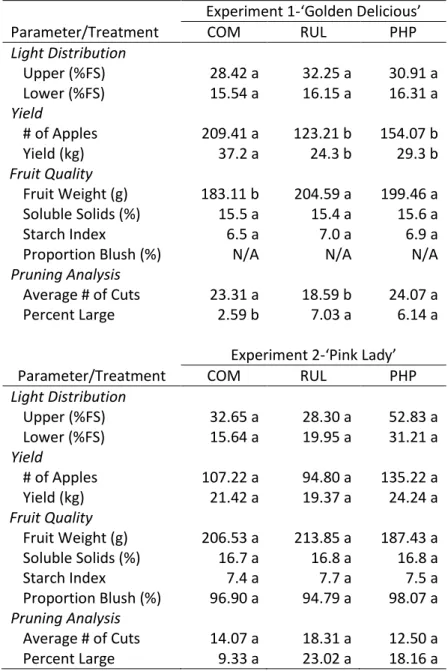
Experiment 1. With ‘Golden Delicious’ trees growing in orchard 1 during 2013 (Experiment 1), the percent full sun reaching the upper canopy of the commercially pruned trees was significantly higher than those of the other two treatments, but showed no differences in 2014 (Tables 1.1 and 1.2). The lower canopies of all three treatments received less than 15% full sun in 2013 with COM trees receiving the highest percent full sun at 13% and trees in the RUL treatment receiving significantly less (10%). Light levels in the lower canopies of the PHP-treated trees were not significantly
different from those in either treatment. There were no significant differences in light levels for any treatment and either level seen in 2014.
Experiment 2. Pruning treatment did not have an effect on light distribution for either year (Tables 1.1 and 1.2). Values of 60, 43, and 31% full sunlight for PHP, COM, and RUL trees, respectively, in 2013 and 52, 32, and 28% in 2014 indicate how much
variation there was in the upper part of the canopy for both years. Light levels in the lower part of the canopy followed a similar trend as the upper canopy, with the PHP trees receiving the highest proportion of full sun (52%).
Experiment 3. Results showed no difference in light levels between treatments in the upper canopy. All three treatments had very similar numbers, with PHP trees
receiving the highest percent full sun (16%) and the COM treatment receiving the lowest (14%). In the lower part of the canopy, the COM-pruned trees received significantly less light than the other two treatments.
Experiment. 4. Pruning treatment did not have any effect on light distribution in either the upper or lower portions of the canopy.
Experiment. 5. Light distribution in the upper portion of the canopy was not different between any of the three treatments. However, differences were seen in the lower canopy. Trees in the RUL treatment received significantly higher light levels than the PHP with 13% and the RUL treatment receiving the lowest amount at about 9% (Table 1.2). Light levels for the COM treatment were not significantly different from either the RUL or PHP treatment.
Yield
Experiment 1. Pruning had no effect on either the total number of apples on the tree or the weight of the fruit in the 2013 season (Table 1.1). However, trees receiving the COM treatment produced significantly more apples in 2014 than trees in the other two treatments. Totals yield followed a similar trend with the COM trees producing 37 kg and RUL and PHP trees producing significantly less at 24 and 29kg, respectively.
Experiment 2. As in Experiment 1, pruning treatment did not affect the number of apples carried by a tree or the cumulative weight of those apples in 2013. This trend was also apparent during the 2014 season where, once again, no differences in yield were seen among treatments.
Experiments 3, 4, and 5. Pruning treatment had no effect on either fruit number or total yield in 2014.
Fruit Quality
Experiment 1. Samples collected in 2013 showed that average fruit weight was similar across all three treatments. Apples from the PHP treatment, however, had a significantly higher soluble solid concentration (16.0%) (Table 1.1). No differences in the starch index indicates that pruning treatment did not affect maturity time. Fruit
collected in 2014 showed a significant difference between apples from the COM treatment and the other two treatments with respect to individual fruit weight. Apples from the COM treatment were significantly smaller with an average weight of 183g (Table 1.2), although no differences between any of the treatments were seen with regard to soluble solid concentration or starch index.
Experiment 2. The fruit from trees receiving RUL and COM treatments had comparable fruit fresh weight in 2013, while apples from the PHP treatment were significantly smaller. No differences were seen in soluble solid concentration, starch index, or percent blush. Results from 2014 showed pruning treatment had no impact on any fruit quality parameter measured. Fresh fruit weight, soluble solid concentration, starch pattern index, and percent blush were constant across all treatments.
Experiment 3. Differences were seen in both fruit weight and starch index for apples in the COM treatment. They were significantly smaller and had a lower starch index than the apples receiving the RUL treatment. No differences were seen between the RUL and PHP treatment.
Experiments 4 and 5. No differences were seen in fruit quality among the three treatments.
Pruning Analysis
Experiment 1. Trees pruned using the set of assumed rules received significantly less cuts than trees pruned by the commercial crew or by the researchers. Using the pruning rules, an average of 19 cuts were made per tree, as opposed to 23 or 24 cuts made by the commercial crew and researcher, respectively. For the proportion of large cuts (>2.5cm), the COM treatment was significantly lower (2%) than the RUL and PHP treatments (7 and 6%), respectively (Table 1.2).
Experiment 2. Different pruning treatments had no effect on the number of cuts made per tree or the distribution of those cuts.
Experiment 3. No differences were seen in the number of cuts per tree, but significant differences were seen in the distribution of cuts made. While only 9% of the cuts made by the commercial crews were larger than 2.5cm, 20% of the cuts made in the PHP treatment were >2.5cm. Trees pruned using the rules had the highest
Table 1.1. Light distribution as percent full sun (%FS), yield components, and fruit quality measurements in ‘Pink Lady’/B.9 and ‘Golden Delicious’/M.26 trees across three
pruning styles in 2013. COM=commercial, RUL=rules, and PHP=Purdue Horticulture pruning. Different letters denote a statistically significant difference at P ≤ 0.05 by Tukey’s honest significant difference (HSD) test between means across rows.
Experiment 1-‘Golden Delicious’
Parameter/Treatment COM RUL PHP
Light Distribution Upper (%FS) 38.79 a 32.63 b 30.23 b Lower (%FS) 13.06 a 10.02 b 10.88 ab Yield # of Apples 146.50 a 170.08 a 179.78 a Yield (kg) 31.1 a 33.58 a 32.84 a Fruit Quality Fruit Weight (g) 212.25 a 218.04 a 217.98 a Soluble Solids (%) 15.5 b 15.4 b 16.0 a Starch Index 3.0 a 3.3 a 3.5 a
Proportion Blush (%) N/A N/A N/A
Experiment 2-‘Pink Lady’
COM RUL PHP Light Distribution Upper (%FS) 43.75 a 31.30 a 60.44 a Lower (%FS) 14.14 a 17.33 a 26.84 a Yield # of Apples 133.22 a 132.70 a 143.57 a Yield (kg) 27.28 a 28.50 a 30.60 a Fruit Quality Fruit Weight (g) 211.29 a 207.56 a 183.09 b Soluble Solids (%) 16.7 a 16.5 a 16.9 a Starch Index 7.6 a 7.6 a 7.6 a Proportion Blush (%) 81.09 a 75.73 a 79.89 a
Experiment 4. Commercially pruned trees received significantly more cuts than the RUL or PHP pruned trees. While those trees had more cuts, the percent of large cuts made in each treatment was all around 7%.
Experiment 5. Trees receiving the COM and PHP treatments did not differ in either the number of cuts made per tree or the percent of cuts larger >2.5cm. The RUL treatment, however, used fewer cuts than both the PHP and COM treatments and had a higher proportion of large cuts than COM treatment. Trees pruned using the rules only received 9 pruning cuts on average, but over 50% of those cuts were large. The trees pruned by the commercial grew had the lowest percent of large cuts at 30%.
Discussion
Light Distribution
In 2013, the trees receiving the COM treatment had the highest percent full sun in the upper canopy at over 38% with the upper canopies of the RUL and PHP pruned trees receiving 32% and 30% full sun, respectively, in Experiment 1. All three of these values meet or exceed the 30% threshold reported by Heinicke (1966) to maintain high fruit quality. The COM pruned trees also had the highest percent full sun in the lower part of the canopy. However, the difference between the COM treatment and the treatment with the lowest value (RUL) was only 3%. A difference this small is unlikely to have any practical significance, and light levels this low are unlikely to produce fruit of high quality, regardless of pruning treatment. The extremely low light measurements recorded in the lower part of the canopy may be a result of the sampling technique.
Because the quantum sensor was only 50 cm long, any light falling in the canopy beyond that distance from the trunk was not recorded. Other studies have recorded equally low light penetration at inner parts of the lower canopy of apple trees (Warrington et al., 1996; Tustin et al., 1988). Results from Experiment 2 yielded no significant differences, but the large range seen indicates how variable the light environment can be in the canopies. These results indicate that while the pruning rules were able to replicate light distribution found in trees pruned by commercial professionals or skilled horticulturists, none of the treatments opened the lower canopy for adequate light penetration +/- 2 hours of solar noon. Unlike 2013, no differences were seen in light distribution in the upper canopy for any experiment conducted in 2014. In general, the upper canopies all received around 30% full sun. The exceptions to this were in Experiments 3 and 5. In both experiments, the amount of full sun reaching the upper canopy was only around 14 to 18%. Light interception is known to negatively affect fruit quality. Light levels lower than 30% exists in the lower canopy across all experiments except for the PHP
treatment in Experiment 2. However, as mentioned above, this could be due to the fact that measurements were all taken within 50 cm of the trunk. Two years of repeated treatment did not seem to affect light distribution in Experiments 1 and 2.
Yield
Yield was not significantly affected by pruning style in either experiment conducted in 2013, indicating that pruning by a set of rules does not adversely affect the crop load carried by a tree. Results for 2014 corroborate these results except for Experiment 1. These results show that pruning by a set of rules is not likely to hurt the productivity of
the orchard, even in the first year of treatment, but a longer study duration may be needed to determine how productivity is affected after repeated treatment.
Fruit Quality
Overall, fruit quality seemed to be minimally affected by the different pruning treatments. The soluble solid concentration in apples from the PHP treatment of Experiment 1 was significantly higher, but only by a nominal amount (about 0.5%). While it is doubtful that a consumer could detect a difference this small, Marini and Barden (1982) found that differences as low as 1% are detectable. The only other fruit quality difference seen in 2013 was the average fruit weight of apples from the PHP treatment in Experiment 2. Apples from this treatment were about 10% smaller than apples in the other two treatments. A similar situation occurred in 2014 with
Experiment 1. The apples from the COM treatment were significantly smaller, but that may be a result of carrying a higher crop load. Studies have shown that fruit dry matter and fruit size are negatively correlated with crop load (Palmer, 1992; Palmer et al., 1997).This size difference probably does not have any effect on orchards that sell directly to consumers. Growers selling their fruit to the wholesale market, however, would most certainly be impacted by these reduced fruit sizes. The reduced fruit size, and as a result high count numbers, would force producers to accept a lower price for their fruit. Maturity, based on the starch index, did not seem to be affected by any of the pruning treatments in either year. Overall, these results show that different pruning styles do not necessarily affect fruit quality at the end of the season. Fruit from trees
pruned using the simplified pruning rules were often equivalent to or better than, the fruit from trees pruned by the commercial crews.
Pruning Analysis
Often, when discussing pruning treatments, studies refer to how much time is needed per tree. It follows then, that pruning styles that make more cuts will take more time and cost the grower more money. The data show that pruning with the simplified rules actually uses equal or fewer cuts, than the other two pruning treatments. This could result in a major cost savings for a grower with large acreages to prune. The big
difference in the pruning analysis was in the how the cuts were distributed within each pruning style. In three of the five experiments, the commercial crews made significantly fewer large cuts (>2.5cm) than the other treatments. The pruning rules relied on fewer cuts, but a greater number of large branches were taken out than in the other
treatments. This could reduce yield in the first couple years after switching to rules-based pruning because the major fruit-bearing scaffolds would be removed, and trees typically respond to this type of treatment with vigorous vegetative growth.
Summary
When combining the 2013 and 2014 data as a whole, pruning style did not show significant differences in most categories. Many of the differences seen were small and may not have any practical significance. The simplified pruning rules were tested across a range of cultivars and locations to show that they are widely applicable for the style of tree they were written for. It can be assumed then, that pruning with a set of simplified