
1877–0428 © 2011 Published by Elsevier Ltd. doi:10.1016/j.sbspro.2011.05.083
Procedia Social and Behavioral Sciences 18 (2011) 565–574
Kongres Pengajaran dan Pembelajaran UKM, 2010
Continual Quality Improvement Process for Undergraduate
Programs
Norbahiah Misran*, Siti Salasiah Mokri, Hafizah Husain, Wan Mimi Diyana Wan Zaki
Faculty of Engineering and Built Environment, Universiti Kebangsaan Malaysia, 43600 UKM Bangi, Selangor, MalaysiaReceived date here; revised date here; accepted date here
Abstract
The Outcome Based Education (OBE) practice requires that the continual quality improvement (CQI) process is implemented in
order to continuously improve the quality of teaching and learning of an education program. In purpose of implementing CQI
processes, the inputs from the program stakeholders consist of external assessors, industry advisory panel (IAP), students as well
as accreditation panel should be considered, weighted and implemented as deemed appropriate by the department. The program
external assessors’ inputs also will determine the quality of the program’s curriculum and contents as benchmarked with other
top international universities. Thus, this paper describes the current CQI processes and self-initiated changes exercised by the
Department of Electrical, Electronic and System Engineering, Faculty of Engineering & Built Environment, Universiti
Kebangsaan Malaysia based on the inputs from accreditation panels, industry advisory panels, external assessors and students
which are gathered periodically by means of visits, meetings and discussions. The stakeholders’ and accreditation panel inputs
are mainly on the aspects of teaching and learning, program objectives, program outcomes, curriculum structure, staff, student
assessment, facilities and the system quality management as a whole. The department scrutinizes each input before appropriate
CQI processes and changes are implemented. Evidently, the CQI and changes made by the JKEES department are not only
implemented based on these inputs but some of them are self-initiated. It is highly affirmed that the continuous improvement
process carried out at this department level has significantly improve students’ learning.
Keywords: Outcome Based Education; CQI; feedback; accreditation; Industry Advisory Panel; stakeholders;
1.
Introduction
The Department of Electrical, Electronic & System Engineering (
Jabatan Kejuruteraan Elektrik, Elektronik &
Sistem
, JKEES), Faculty of Engineering & Built Environment (
Fakulti Kejuruteraan & Alam Bina
, FKAB),
Universiti Kebangsaan Malaysia (UKM), has implemented the Outcome Based Education (OBE) approach since
2004. The department offers three degree programs leading to the Bachelor of Engineering with honors in
Communication & Computer (CC), Electrical and Electronic (EE) and Microelectronic (uE). These three programs
are amongst the various broad-based engineering programs offered by the faculty. The program provides a strong
* Corresponding author. Tel.: +603-8921-6335; fax: +603-8921-6146.
E-mail address: [email protected]
Open access under CC BY-NC-ND license.
© 2011 Published by Elsevier Ltd.
Selection and/or peer-review under responsibility of Kongres Pengajaran & Pembelajaran UKM, 2010
Open access under CC BY-NC-ND license.based in engineering with a good balance between theory and experiments during the four years of study. To
guarantee that the quality of its engineering program is comparable to other prestigious universities, the JKEES has
established Quality Management System (QMS). This system can effectively ensure that the requirements of
professional bodies such as Engineering Accreditation Council (EAC) and Malaysian Qualification Agency (MQA),
(EAC 2007, MQA 2008) are satisfied. The curriculum is constantly in line with the current development of
industrial technologies and the facilities as well services provided by the department match with the customers and
stakeholders’ needs. Conforming to this system, the department has plans and implements several activities in a
systematic manner to improve the quality of the programs, and subsequently to put into practice the continual
assessments to guarantee the effectiveness of the actions taken. In quality management of every program, feedback
from stakeholders and external assessors of the program is important to ensure that the program provide the best and
effective teaching and learning experiences to the students.
In reviewing the program curriculum and syllabus, inputs from engineering accreditation panels, program
external assessor, industry advisory panels (IAP), students, alumni, potential employers and industrial training
employers are considered. This paper discusses the suggestion and recommendations by the JKEES stakeholders,
focusing on four main groups. They are the accreditation panels, students, IAP and external assessors. Apart from
that, this paper also presents the actions taken by department in addressing these inputs in effort to implement the
continuous quality improvement (CQI) process. Generally, the CQI of programs is closely related to the curriculum
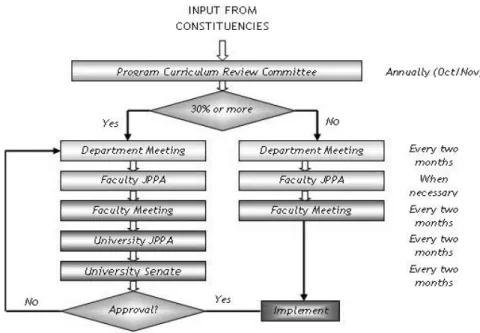
review process. Figure 1 show the flow chart of the curriculum review process in JKEES. From this figure, it can be
observed that the curriculum review process starts by considering the inputs from constituencies. Every
recommendation is discussed and evaluated by the Curriculum Review Committee (CRC), which is headed by a
Program Coordinator, to amend the current curriculum if necessary. Afterwards, the new curriculum draft is
presented in the Department meeting before submission for approval to the Department of Academic Planning and
Development (Jabatan Perancangan dan Perkembangan Akademik, JPPA) at the faculty level. The draft which has
been endorsed by JPPA will be submitted to University Senate meeting for final approval.
The quality assurance of JKEES programs is also strengthened with a systematic program review process. FKAB
has established the Quality Enhancement Plan (QEP), in which, it entails the procedures that need to be adhered to
by every program to assess the effectiveness of their Program Educational Objective (PEO), Program Outcome (PO)
and Course Outcome (CO). This dynamic system implements the quality improvement process based on the
comments and recommendations obtained from program stakeholders. Figure 2 show Quality Enhancement Plan
(QEP) cycle in PEO, PO and CO assessment.
Figure 2 Quality Enhancement Plan (QEP) Cycle at FKAB, UKM
There are three cycles available in program review process; PEO review cycle (between 2-5 years), PO review
cycle (1 year) and CO review cycle (6 months). These cycles are explained below:
a)
6 Month Cycle
:
Course review through Course Teaching Evaluation System, Student Self-
Assessment, Peer Review, Dialogue with the Students Representative
b)
1 Year Cycle
:
Meeting with IAP, Exit Survey, Industrial Training Employer Survey
c)
2-5 Year Cycle
:
Report from external assessor, Alumni Survey, Employer Survey
2.
Feedback Mechanism
Accreditation Panels Visit
In Malaysia, all engineering programs must satisfy the requirement identified by the Engineering Accreditation
Council (EAC). The accreditation panels come to visit and audit the program on regular basis. Based on the
accreditation results, a program may be awarded 1 to 5 years of accreditation. The students graduated from this
program are therefore acknowledged as registered engineers. Upon the due of the accreditation duration, the panels
will again revisit the program to ensure that their concerns and recommendation from previous visit are addressed
and appropriate actions are implemented.
Dialogue with Student Representatives
The department organizes Student-Lecturer Dialogue at the end of every semester just before the final
examination weeks to gather feedback from students. In this meeting, the students’ representatives are given the
opportunity to share their views on the quality of teaching and learning, facilities, syllabus and other relevant
matters. Views from students are very important as they are the main client of the programs (Michael et. al, 2008).
The department is represented by the Head of Department, Program Coordinators, Lab Coordinator, Industrial
Training Coordinator, Chairman of Student Development Committee and Coordinator of the OBE Committee.
Meeting with IAP
Industrial Advisory Panel (IAP) is a panel from industry selected by the Faculty and endorsed by the Senate.
They are responsible to give their comments on the PEO and PO statements, the structure of the program, the
course content, the importance of generic skills, the exit survey and any other related matters such as the quality
of
graduate
programs
that
are currently or used to be employed in
their
company. For this purpose, 2
IAP meeting were held. These meetings were attended by industrial panels and chaired by the Program Coordinator.
Mr. Abd. Rahman Mohd Yusoff who is representing SMK Electronics (Malaysia) Sdn. Bhd. attended the first IAP
meeting on 4
thSeptember 2009 while Mr. David Lee and Mr. Eng Guan Tan, both from Intel Microelectronics (M)
Sdn. Bhd. visited the department on 13
thof August 2009.
Program evaluation by the External Assessor
To ensure that the offered programs are always relevant, program review, benchmarking and evaluation
processes are carried out by the external assessors from foreign universities. Their comments are also considered for
CQI implementation. For this purpose, the program evaluation by external assessor for the CC program was held
from 22
ndof February 2010 until 25
thof February 2010, while the external assessor for the EE Program came to the
department on 10
thJanuary 2010. Lastly, the external assessor for
P
E program came on 15
thNovember 2010.
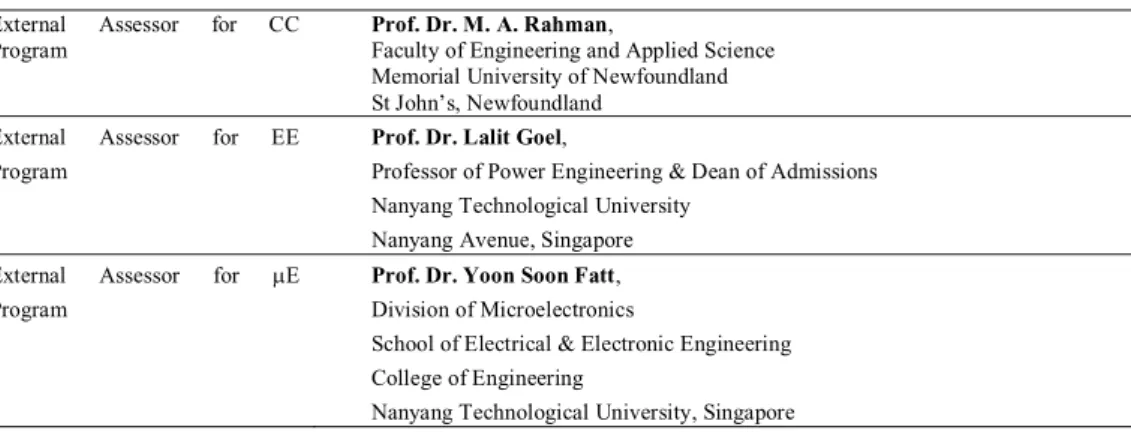
Table 1 lists the names of external assessor for EE, CC and
P
E programs.
Table 1 List of the External Assessor for EE, CC and PE program. External Assessor for CC
Program
Prof. Dr. M. A. Rahman,
Faculty of Engineering and Applied Science Memorial University of Newfoundland St John’s, Newfoundland
External Assessor for EE Program
Prof. Dr. Lalit Goel,
Professor of Power Engineering & Dean of Admissions Nanyang Technological University
Nanyang Avenue, Singapore External Assessor for PE
Program
Prof. Dr. Yoon Soon Fatt, Division of Microelectronics
School of Electrical & Electronic Engineering College of Engineering
Nanyang Technological University, Singapore
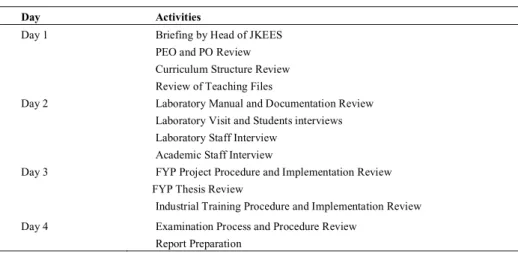
Table 2 shows an example of the external assessor’s general tentative program. At the end of visit, the external
assessor prepared an assessment report to be submitted to the Vice Chancellor before it is forwarded to the Head of
Department. Based on evaluation results and comments, improvement actions were implemented accordingly.
Table 2 General tentative program for external assessors visit
Day Activities
Day 1 Briefing by Head of JKEES PEO and PO Review Curriculum Structure Review Review of Teaching Files
Day 2 Laboratory Manual and Documentation Review Laboratory Visit and Students interviews Laboratory Staff Interview
Academic Staff Interview
Day 3 FYP Project Procedure and Implementation Review FYP Thesis Review
Industrial Training Procedure and Implementation Review Day 4 Examination Process and Procedure Review
Report Preparation
3.
Action Taken from the Stakeholders Feedback
Suggestions and feedback from stakeholders were discussed in JKEES OBE committee meeting before they were
brought forward to the department meeting to discuss the appropriate action plans. If the action plan suggests current
curriculum review, then the involvement of Curriculum Review Committee (CRC) is needed. The proposed action
plans then were tabulated to Quality Assurance Division of the Faculty and Quality Management Meeting to be
finalized and endorsed. Meanwhile, the concerns and recommendations by accreditation panels were listed and
brought to the attention of the academic staff in the department meeting. In implementing CQI specifically based on
the accreditation feedback, the department decided to use the PDCA (Plan,
Do,
Check,
Action) approach (Arthur
1998; Gerald and Julie 1992). The PDCAs are detailed out as in Table 3.
Table 3 Concerns made by the accreditation panels
ITEM 1:
Exam questions of some courses sampled were in a form of straight forward memory recalling and number crunching and have used very much text book approach. Moderation of exam questions already established should include reviewing course assessment and examination questions to address the higher levels of cognitive domains of taxonomy. The panel is of impression that the capabilities of these good quality students are not being challenged.
Plan: The flowchart of the process is designed to ensure the quality of examination questions. The current Bloom’s taxonomy form is used as the guidelines to be adhered to all lecturers when designing exam question. The form will indicate the Bloom’s level addressed by each of exam question set.
Do: Lecturers for all the courses are made compulsory to submit the bloom taxonomy form to ensure the levels of cognitive domains are met. The chairman and the members of Final Exam Moderation committee will verify the quality of the examination questions and to ensure at least one of the questions is open-ended.
Check: Inputs from the stakeholders and EAC panel on the quality of the examination questions. If found unsatisfactory, the lecturers will need to attend enhancement courses.
Action: This procedure is compulsory for JKEES and working procedure manual is to be made available as guidelines for continuous implementation.
ITEM 2:
Although the overall OBE system planning, implementation and assessment is in place, however, the interview with the academic staffs suggest their varied understanding, especially on PO-CO link and overall analysis on PEO/PO attainment.
Plan: A systematic training requirement has been devised by the faculty and PPA (UKM Academic Development Centre). It has been made compulsory for all academic staff to attend in order for them to secure confirmation and/or to apply for promotion.
Do: All academic staffs must attend training on subjects related to OBE organized by PPA. For example, a dedicated session on OBE, MQA and teaching and learning has been allocated in PTK course, where all lecturers must pass this course before he/she can be promoted to senior lecturer post. Lecturers are also encouraged to get involved in education research activities such as Action
Research as well as to present papers on education including the OBE based teaching and learning activities. More comprehension on OBE is indirectly obtained during Department Curriculum Review Session. In addition, the department has organized specific workshops on Bloom Taxonomy and PO/PEO attainment process for academic staff. The latest, JKEES has organized a workshop on PO direct measurement where all lecturers are compulsory to join.
Check: The lecturers understanding on OBE and PEO/PO attainment can be observed from their submission on Assessment Tools Form, direct measurement of PO from marks and Bloom’s Taxonomy Form for Final Examination Question Set. New curriculum based on OBE approach has been developed successfully by each lecturer who is assigned to design the course which also indirectly indicates their understanding on OBE practices. This new curriculum has been approved by the higher authority and implemented in 2010/2011. Moreover, the PO direct measurement workshop has provided the overall understanding on the OBE exercise to all lecturers.
Action: Continuous enforcement on the systematic training and courses on OBE and PO-CO link and analysis.
ITEM 3:
The current analyses on the PO are not clearly linked to the actions plans to enable CQI implementation to be evident.
Plan: Based on analysis of POs using the direct PO measurement method, the course instructor should investigate the roots/factors that contribute to unfulfilled POs and propose remedial action plans to enable CQI implementation.
Do: In the course self assessment report, the course instructor attach the analysis of PO achievement together with description of possible factors that may contribute to unachieved POs and propose changes/action plans for improvement in terms of delivery, designed questions, course contents, references etc.
Check: OBE committees verify every course to ensure that PO analysis is included in the teaching file. Appropriate action plans to improve current teaching and learning processes need to be addressed by the course instructor if the course fails to achieve any PO that is being assessed.
Action: This practice has started since semester 1 session 2010/2011. This will be continually implemented for JKEES to monitor the attainment of PO for each cohort and to enable CQI.
Table 4 lists the recommendation from the accreditation panels. For this category, PDCA approach is not
appropriate because most of the issue is not new and already in place in the CQI system of the department.
Therefore, only brief explanation is required in respond to that.
Table 4 Response to the recommendation from accreditation panels
CATEGORY ISSUE RESPONSE
ACADEMIC CURRICULUM
Industrial visits for students have to be organized. Students could be asked to submit individual reports after each industry visit.
System is already in place. Pre-scheduled industrial visits and talks for students with varied organizations especially industries has been established. Assessment on the effectiveness of activities is done in terms of reports and quizzes. These reports/quizzes will be evaluated in the identified responsible courses which embed the particular industrial visit/talk. Minimum requirements are one visit and one technical talk a year for 3rd and 4th year students. ACADEMIC
CURRICULUM
Final Year Project (FYP) reports should have references to journals, books and papers. Cross referencing between the main text of FYP reports and lists of references and appendices can be further improved. All graphs and figures and photographs should be accompanied by relevant description or explanation.
To ensure the quality of FYP reports, the department has always been practicing the following:
1. FYP report should follow guidelines set university.
2. Students must attend seminar on proposal and thesis writing including on referencing, cross referencing etc.
3. The department has improved the FYP process flow and assessment methods based on rubric for three different assessment aspects: research proposal, progress assessment report and self assessment report. The items assessed include referencing. All supervisors are constantly reminded to thoroughly assessed and recommend corrections on students FYP reports. The FYP committee will conduct double check on all FYP assessments to ensure quality of project and thesis reports. Improved procedure is already in place and is on going for current semester.
STUDENT The students generally can communicate well, but it is noted that students with diploma entry qualifications have difficulties expressing in English.
For the new curriculum, revised English courses with deeper emphasis on engineering practices are offered and these courses are compulsory to pass. The subjects are ZZZE1002 Foundation English (for student with English entry Band 1 and 2), ZZZE3012/3022 Workplace Communication I and Workplace Communication II. JKEES is aware on the diploma entry student performances; hence, the new intake from diploma qualification must also be based on their English performance in secondary high school results.
ACADEMIC AND SUPPORT STAFF
All the qualified academic staff members should be encouraged to register with the Board of Engineer Malaysia (BEM).
The Department always takes up extensive efforts in promoting BEM registration and pursuing Professional Engineer (PE). The Department has made compulsory of BEM registration among newly appointed academic staff. All JKEES academic staff has registered to BEM. The Department also urges staff with more than 3 years registration of BEM to submit application for professional engineering membership. For example, Prof. Ir. Dr. Mohd. Marzuki Mustafa obtained his PE in 2009 while Prof. Dr. Salina is currently doing her industrial attachment to fulfil the requirement for PE. FACILITIES Although main library is well equipped
and well stocked, it is not within walking distance from the Engineering Faculty and students tend to shy away from using the library facilities.
A new library is already being planned to be set up in a new building which is still in the development process. It is located in the walking distance from the faculty.
QUALITY MANAGEMENT SYSTEMS
IAP participation can be improved and be made more active. They need to get feedback from the university on the effectiveness in implementation of their recommendations.
IAP involvement is directly gained through IAP-program coordinators meeting which is scheduled to be held minimum once in a year. From this meeting, IAP gives feedback and suggestions for CQI of the program. Minutes of meeting are emailed to them and they can raise any issue from the minutes. IAP has also been invited to Faculty Dinner each year where discussion and feedback can also be gained from. Moreover, starting from session 2010/2011 onwards, FYP is being evaluated from poster presentations. In this activity, IAP is one of the panels to give feedback and evaluation.
Table 5 lists all the recommendations and comments from the External Assessors, IAP and students followed by
the action plans initiated by the Department to take up these issues.
Table 5 Feedback from the external assessor, IAP and student about the program
CATEGORY ISSUE RAISED BY RESPONSE
PEO/PO • 12 outcomes (POs) are too many. Suggestion to combine some of the POs such that there’s a maximum of 6 to 8 outcomes. • To include in the PEO: students’ capability
to communicate with peers, downward and upward level and technical community. • To include in the PEO: to cultivate intrinsic
value among students to inspire them to take new challenge and become a good risk taker.
External Assessor
IAP
IAP
JKEES has established new reviewed PO (from 12 PO to 9 PO). (Refer to Chapter 3). The new PO has also incorporated these two criteria raised by the IAP through PO7 and PO8.
PO7: Ability to communicate effectively, not only with engineers but also with the community at large.
PO8: Ability to function effectively as an individual and in a group with the capacity to be a leader or manager as well as an effective team member.
CURRICULUM • Most of the courses are outdated. Reference list for all courses including labs need to be revised. Suggestion to have 1 or 2 textbooks and 3 to 4 reference book for each course. • Industrial training should be moved to 3rd
year semester II rather than be sandwiched between semester I and II. • Suggest computer system architecture
become compulsory subject based on External Assessor
External Assessor IAP
All of these recommendations has been discussed and considered for new curriculum review which has started since 2009. For the new program structure and curriculum, based on the stakeholders input, the department has updated the course content including references, revamped some courses, merged or eliminated irrelevant courses and added a few more new courses into the program. The curriculum has also been benchmarked with other university.
market demand.
• Students’ workload per semester is too much, subjects with redundant contents with other subjects should be merged and total credit should be increased
• To have more courses related to Computer (eg. Programming) as this program has inclination towards Communication. • Students to undergo short term training to
acquire computer skills such as LINUX, MICROSOFT, CISCO,6 SIGMA
IAP
Students
IAP and Students
This new program structure has also taken into consideration on the students’ workload per semester by incorporating the MQA notional credit hour formulation. In this calculation, we ensure that the students are not overloaded and still have time for other activities such as sport, visits and recreation.
As for students request about LINUX, MICROSOFT, CISCO and 6 SIGMA training, there is one program under Pestariang Program which gives short course on the abovementioned software.
• Final year project subjects should be merged into one subject with one subject code, in order to reduce the detailed assessment in semester 1 and to allow students to treat the final year project as one entity that runs from the beginning of semester 1 to the end of semester 2.
• FYP proposal available online for the students’ selections.
External Assessor
JKEES restores two FYP subject codes for semester 1 and semester 2. However, in the new introduced curriculum of Semester 1, 2010/2011, the allocation of credits for Semester 1 is reduced from 3 to 2 credits while Semester 2 takes 4 credits rather than 3 credits in the old curriculum. JKEES feels that the two subject codes for respective semester is important so that the students are made aware of early preparation for FYP progress starting from Semester 1. They are able to give full commitment throughout Semester 1 and 2 so that they will achieve the declared FYP process schedule through their Gantt Chart. More credits are allocated for Semester 2 so that utmost FYP assessments are given on their final project and thesis quality.
The Semester 1, 2010/2011 FYP committee has successfully carried out FYP title selection process online. The progress report submission is also done online. ASSESSMENT • Threshold for final examination should be
generally raised to at least 50% of the total marks.
• Answer script of exams are not marked in some of the pages. Not all lecturer use red pen to mark answer scripts. Some exam papers do not show mark distributions.
External Assessor
External Assessor
The Department has remained its own criteria to allocate final examination marks of not less than 40% of the total marks. This is after considering several subjects which have bigger components on projects or embedded lab. Additionally, the total marks for examinations (quizzes, mid-semester exams and final exam) will carry 70% of the total. This is officially restated in Department meeting. Constant reminder has been delivered to all academic staff regarding the marking of exam scripts in the department meeting. The lecturers are informed to give serious attention during marking, avoid mistakes and thoroughly checking the answer script.
• There is a big discrepancy in the grades given by the supervisor and examiner for FYP. Such discrepancies are not desirable and should be minimized.
External Assessor
This issue has been raised in OBE meeting. It is decided that supervisor and examiner must sort out any discrepancy on marks given to a particular student in every assessment session of FYP. The difference must not more than 10%. All lecturers have been informed about this practice.
• Lecturers are proposed to give feedback on marks/comments on quizzes/projects so that students are aware of their defficiency
Students It is a common practice for a lecturer/course coordinator to give feedback to the students on their carry marks before final exams. It is again highlighted during the OBE meeting to emphasis the lecturers to seriously practice this matter.
• Demonstators are not prepared and fully
knowledgeable on the experiments Students As referred to the latest Students Dialog Meeting Semester 1 2010/2011, there is no more complaint on any demonstrators’ competencies. This is due to the stringent selection process of demonstrators by the Lab Coordinator and Science Officer. Priority is given to senior students who are well experienced on the topics and the experiments themselves. Good financial incentive is also
available to boost their motivation. Furthermore, students are advised to be self independent and to make self-discovery while performing experiments, and not heavily rely on the feedback from demonstrators.
TEACHING AND LEARNING
• Students to have professional presentation skills with attractive presentation using Power Point
IAP The department is having the impression that the JKEES students posses good and professional presentation skills including the use of Power Point software. This can be seen from their slide presentations which show their creativity.
• Certain courses have high credit, yet there is no tutorial session embedded in teaching and learning activities. In common, for every 3 hours of lecture/teaching, 1 hour tutorial is required.
External Assessor
Since we practice OBE in our teaching and learning activities, the tutorial session might not be part of it. However, the objective of tutorials is still embedded in the curriculum. This can be achieved through different format of activities such as group discussion, Jigsaw Puzzle, online learning etc.
FACILITIES • Many computers are not functioning in Faculty Mini Lab.
• Desks and chairs are ill equipped at Level 1.
• There are constants failures problems in projector, amplifier and air condioner systems at DK1 and DK2 especially on Mondays.
Students It is a normal exercise of the Faculty to have a regular check on the facilities issues raised by students and staff. The process of upgrading/maintaining the conditions of facilities is under the responsibility of Faculty Infrastructure Development Committee. However, to respond to this matter, the Science Officer who regularly attends meetings with them has raised out the issues. The HoD had also issued formal complaint letter specifically addressing the concerns by the students to the committee.
From the above data, we found that the JKEES has continually seeks feedbacks from accreditation panels,
external assessors and stakeholders including students and industries. Industries input are gained via IAP meetings,
industry-university dialogue and employer surveys to improve the program. In every two years, the JKEES invites
external assessors from foreign universities to evaluate and review the programs. Based on the assessments, the
department has identified the improvements to be made on the curriculum, generic skills, facilities and procedures
involving laboratory sessions and FYP. Even though the PDCA approach is implemented to respond to the
accreditation findings, however, the plan is actually already in the CQI system of the department. Response to the
stakeholders inputs also shows that there is already effort to give the best to the students not only after receiving
their comments, yet it is already in the planning and system beforehand.
4.
Conclusions
In enhancing the standard of an engineering program, inputs and recommendations by the program’s stakeholders
and accreditation panel are important so that the continuous quality improvement (CQI) processes are continuously
implemented. This is necessary in order to produce first class future engineers. In purpose of this, the JKEES has
always view the feedback gathered from students, industrial advisory panel (IAP) and external assessors, covering
the aspects of teaching and learning, program structure, course content, learning facilities and others so that
necessary actions and changes can be devised and carried out. Some of the CQI actions are based on the concerns
and recommendations by the EAC accreditation panel on their last visit in 2008. Their specific and common
concerns are addressed by using PDCA approach, while the responses to other stakeholder’s inputs are clearly
explained in the respective tables. It is evident that the CQI and changes carried out are not only in response of
comments and suggestions by all parties, but more importantly this paper indicates our own self-initiated actions.
We learnt that most of the solutions of the issues raised are already exist in the department current system; yet, there
are certain things that need to be included and complemented. We believe that the CQI processes are progressively
implemented in the JKEES.
Acknowledgement
The authors would like to express sincere gratitude to Pusat Penyelidikan Pendidikan Kejuruteraan UKM for
providing the financial support of this work.
References
Arthur M. S. (1998). Are There Limits To Total Quality Management? Second Quarter Magazine Issue 11: 35-45.
Engineering Accreditation Council (EAC) (2007). Engineering Program Accreditation Manual. Board of Engineers Malaysia (BEM). Gerald, W. M. and Julie, K. S. (1992). Plan-Do-Check-Action - The Management of Institutional Research. 32nd AIR Annual Forum Georgia. Malaysian Qualification Agency (MQA) (2008). Code of Practice for Program Accreditation. MQA.
Michael, K. M., Musa, P., Elizabeth, F.R. G. (2008). Using student feedback in designing student-focused curricula. International Journal of Educational Management. 22(7):611 – 63.


![DEPARTMENT OF ACCOUNTANCY ACCOUNTING A 2016 [REK0A01/ ACC0AA1] FINAL ASSESSMENT OPPORTUNITY: 4 JUNE Ms JD Napo Moderator: Ms Z Patel Marks: 80](data:image/gif;base64,R0lGODlhAQABAIAAAP///wAAACH5BAEAAAAALAAAAAABAAEAAAICRAEAOw==)