Special Issue Article
Saadat Saeed*, Moreno Muffatto, and Shumaila Yousafzai
A Multi-level Study of Entrepreneurship
Education among Pakistani University
Students
Abstract: This study examines how a university’s support impacts students’ entrepreneurial intentions and finds that entrepreneurship education, concept-development support, and business-concept-development support increase such inten-tions. The university role is critical to the growth of entrepreneurial intentions,
and we argue that an individual’s decision in favor of or against becoming an
entrepreneur depends on the multi-level context provided by the university. Our findings suggest that students perceive the education and concept-development support (educational and cognitive) from their universities as highly influential on their entrepreneurial intentions. We conclude that a multi-level perspective offers a meaningful understanding of entrepreneurship and offer suggestions for university management and policy-makers for enhancing entrepreneurship. A sample of 805 undergraduate students in universities in Pakistan took part in the study.
Keywords:entrepreneurial university, entrepreneurship education
*Corresponding author: Saadat Saeed,Department of Industrial Engineering, University of Padua, Via Venezia 1, Padova 35131, Italy; COMSATS Institute of Information Technology, Pakistan, E-mail: [email protected]
Moreno Muffatto,Department of Industrial Engineering, University of Padua, Via Venezia 1, Padova 35131, Italy, E-mail: [email protected]
Shumaila Yousafzai,Cardiff Business School, Cardiff University, Cardiff, UK, E-mail: [email protected]
1 Introduction
As the world becomes increasingly competitive and growth-oriented,
entrepre-neurship has become an efficient strategy with which to enhance a country’s
economic development and achieve sustainable competitiveness (Schaper and Volery 2004; Venkatachalam and Waqif 2005). Through entrepreneurial
activities, several countries have been able to generate wealth, improve the survival rate of firms, enhance the adoption of technological change, and create job opportunities (Gurol and Atsan 2006). In fact, entrepreneurship is the engine
that drives many nations’ economic growth and competitiveness (Kuratko and
Hodgetts 2007). Consequently, entrepreneurship has emerged as one of the most popular topics among scholars, students, and policy-makers and has become an important disciplinary field (Davidsson and Wiklund 2001). The highly compe-titive job environment has increased the interest of both undergraduate and graduate students in studying entrepreneurship (Dickson, Solomon, and Weaver 2008; Solomon 2002) because permanent employment in organizations is no longer guaranteed (Collins, Hannon, and Smith 2004). The supposition that university graduates can acquire a job easily no longer reflects the realities of employment market (Seet and Seet 2006).
In explaining the differences between entrepreneurs and non-entrepreneurs, scholars have primarily focused on individual-level factors (Shane 2004), char-acterizing entrepreneurs as more achievement-orientated (Collins, Hannon, and Smith 2004), more risk-tolerant (Stewart and Roth 2004), more independence-seeking (Douglas and Shepherd 2002), more willing to be introduced to new products and services and to create new firms or new material by destroying the existing economic order (Schumpeter 1934), more able to identify new opportu-nities (Thompson 1999), and more creative (Lee and Wong 2004) than non-entrepreneurs. Although the definitions of an entrepreneur vary, there is con-sensus that an entrepreneur has a unique character, mindset, motivation, and vision, is committed to conceptualizing ideas and implementing them through a business plan, and sees change as an opportunity to innovate (Cheng, Chan, and Mahmood 2009). This consensus implies that entrepreneurs are a function of
their personality traits, so they are “born” rather than “made” as a result of
training and teaching. According to this argument, the entrepreneurial character depends on personal background, previous experience, and environmental influences, which are not teachable (transferable from one person to another).
On the other hand, at the organizational level, scholars have focused on the factors of organizational culture and organizational norms (Louis et al. 1989), university quality (Di Gregoria and Shane 2003), and entrepreneurship educa-tion (Souitaris, Zerbinati, and Allaham 2007), among other factors, as the most
important factors in influencing the development of students’ entrepreneurial
intention. The role of entrepreneurial education and experience has been high-lighted as critical to the ability to recognize entrepreneurial opportunities (Shane 2000; Davidsson and Honig 2003) and to use these opportunities effectively (Robinson and Sexton 1994; Bates 1995). Previous research has recognized the impact of entrepreneurship education, training, and support as critical factors in
developing positive perceptions of competence for start-up firms (Zhao, Seibert, and Hills 2005), favorable attitudes toward entrepreneurship (Krueger and Brazeal 1994), and related entrepreneurship preferences and intentions (Chen, Greene, and Crick 1998). Consequently, the number of entrepreneurship-related subjects at the university level around the world has grown rapidly (Klandt 2004). Still, the question remains concerning how such offerings can motivate and train students for entrepreneurial careers? Previous research is inconclusive about whether entrepreneurship can be taught and learned in universities (Aronsson 2004).
Drawn on a dataset from surveys completed by 805 undergraduate univer-sity students from Pakistan, our findings have important implications for entre-preneurship research and teaching. Our multi-level study extends the literature, as it acknowledges the important but neglected influence of organizational-level factors on entrepreneurial behavior, thus helping to resolve some of the troversies in previous research (Gartner, Bird, and Starr 1992). Our main con-tribution is to extend the entrepreneurship literature by employing a multi-level perspective of individual- and organizational-level factors in order to understand
the roots of university students’ entrepreneurial intentions. Following
Kraaijenbrink, Groen, and Bos (2010), we measure organizational-level factors through entrepreneurship-related educational support, concept-development support, and business-development support. Our focus on the role of universi-ties in promoting entrepreneurship is grounded in resource-based perspective (Penrose 1959; Wernerfelt 1984) which has been increasingly used to examine why some universities enhance the entrepreneurial activities among their stu-dents than the others (Lockett and Wright 2005; Rasmussen and Borch 2010; Walter, Parboteeah, and Walter 2013). An extension of the resource-based view
is the organizational capabilities which refer to“the ability of an organization to
perform a coordinated set of tasks, utilizing organizational resources, for the
purpose of achieving a particular end result”(Helfat and Peteraf 2003, 999). We
thus propose that universities that have the appropriate capabilities (i.e. entre-preneurship-related educational support, concept-development support, and business-development support) to facilitate entrepreneurial intention formation will be more successful in doing so.
At the individual level, we use eight factors that differentiate individuals on the basis of how they discover, evaluate, and exploit entrepreneurial opportu-nities: the need for achievement (Collins, Hannon, and Smith 2004), indepen-dence (Douglas and Shepherd 2002), financial success (Carter et al. 2003), and self-realization (Carter et al. 2003), as well as social norms (Elster 1989), entre-preneurial self-efficacy (Chen, Greene, and Crick 1998), risk-taking propensity (Stewart and Roth 2004), and social network support (Turker and Selcuk 2009).
We selected the relevant variables using five selection criteria in a review of extant studies: (a) heterogeneity in their relationship with entrepreneurial inten-tion, (b) a history of use in the literature, with well-defined structure and theories, (c) consistent use in student-specific populations, (d) high reliability and validity, and (e) independence from one another.
Our second contribution is to extend our understanding of entrepreneurial intention in the context of developing countries. We conducted a review of the literature published between 2000 and 2012 and found that, among the 85 most relevant papers, only a few address the developing part of the world, and none address Pakistan.
In testing our research propositions, we use hierarchical linear modeling (HLM) to avoid the estimation errors that are associated with traditional regres-sion models (Bommer, Dierdorff, and Rubin 2007; Marrone, Tesluk, and Carson 2007; Martin et al. 2007). Our findings will help university managers and national-level policy-makers to understand the effectiveness of initiatives under-taken to stimulate entrepreneurship.
The paper is organized as follows. First, we lay out the theoretical founda-tions and derive the hypotheses for the role of entrepreneurial education and entrepreneurial intention. Next, we describe our methodology and present the results. Finally, we discuss our findings, state the implications of our study, and identify directions for future research.
2 Entrepreneurship education and
entrepreneurial intention
Entrepreneurial universities are valued because of their economic output (such as patents, licenses, and start-up firms) and technology transfer mechanisms (Tijssen 2006). It is important for universities to position themselves as hubs of entrepreneurship by nurturing an entrepreneurial environment and providing substantial contributions to the economy and society (Gnyawali and Fogel 1994). The development of entrepreneurial universities is a widespread phenomenon
that has attracted policy-makers’attention. However, despite the increasing
inter-est in academic entrepreneurship and new-venture creation by students, little empirical research has identified organizational-level factors that can foster entre-preneurial intention among university students (Walter, Auer, and Ritter 2006).
Extant literature has demonstrated significant relationships among educa-tion, training, and entrepreneurship (Henry, Hill, and Leitch 2005), and a sig-nificant amount of scholarship has seen universities as seedbeds for
entrepreneurship-specific human capital (Becker 1964; Ucbasaran, Westhead, and Wright 2008). Entrepreneurial universities can play an important role in
identifying and developing students’entrepreneurial traits and ability to start
their own ventures, thus effectively contributing to economic prosperity and job
creation (Debackere and Veugelers 2005; Mowery et al. 2001; O’Shea et al. 2005;
Binks, Starkey, and Mahon 2006). Research shows that university students who take entrepreneurship courses have more interest in becoming entrepreneurs than do those who did not take such courses (Kolvereid and Moen 1997). Upton, Sexton, and Moore (1995) find that 40% of those who attend entrepreneurship courses start their own businesses.
People tend to avoid careers and environments that do not fit with their
competencies and to select those that match them. An individual’s
entrepre-neurial self-efficacy, which refers to the belief in one’s own abilities to perform
the skills necessary to pursue a new-venture opportunity, plays an important role (Chen, Greene, and Crick 1998), as research has shown that entrepreneurial self-efficacy has a significant impact on entrepreneurial intention and entrepre-neurial behavior (McGee et al. 2009; Townsend, Busenitz, and Arthurs 2010). This finding suggests that entrepreneurial intention can be enacted through
educational infrastructure and university support (Segal, Borgia, and
Schoenfeld 2005). Along the same lines, Wang and Wong (2004, 170) point out that the entrepreneurial dreams of many students are hindered by
inade-quate preparation:“their business knowledge is insufficient, and more
impor-tantly, they are not prepared to take risk to realize their dreams.”Therefore, it is
likely that academic institutions play an important role in fostering entrepre-neurial behavior. However, while research has demonstrated the positive and significant relationship between entrepreneurship education and entrepreneur-ial behavior (Lüthje and Franke 2003; Galloway and Brown 2002) and the number of entrepreneurship courses and curricula has grown, student entrepre-neurship remains low (Kraaijenbrink, Groen, and Bos 2010).
According to Chen, Greene, and Crick (1998), an entrepreneurship education
program should have a support system to increase students’ entrepreneurial
self-efficacy, including engaging students in “real-life” business situations to
encourage risk taking and innovation, as opposed to general management skills or more specific technical skills. Research has proposed that entrepreneurship-related support may give some people the confidence to initiate their own business ventures (Kraaijenbrink, Groen, and Bos 2010) and has attempted to
explain students’entrepreneurial intent as being the result of their education.
For example, Hatten and Ruhland (1995) analyze the effect of an
entrepreneur-ship course on students’attitudes and conclude that entrepreneurship attitudes
can be measured and changed. Similarly, other researchers suggest that the
attitude model of entrepreneurship has implications for entrepreneurship edu-cation programs, as attitudes are open to change and can be influenced by educators and practitioners (Souitaris, Zerbinati, and Allaham 2007; Wang and Wong 2004).
Kraaijenbrink, Groen, and Bos (2010) suggests that, although universities can support entrepreneurship in many objectively measured ways, to under-stand the effect of such measures, it is important to gauge the extent to which
they can influence students by measuring students’perceptions of the university
support they receive. Kraaijenbrink, Groen, and Bos (2010) propose three aspects of university support. First, in their traditional teaching role, universities can provide educational support by teaching students the knowledge and skills that are needed in order to initiate a new venture. Second, in their commercial role, universities can provide students with targeted and specific support for starting their own firms through concept-development support and business-development support. Concept-development support can provide awareness, motivation, and business ideas in the early stages of the entrepreneurial process, in which oppor-tunity recognition and development take place (Shane and Venkataraman 2000), while business-development support is typically given to the start-up firm (rather than to individual students) in the later stages of the entrepreneurial process.
In addition, Krueger and Brazeal (1994) suggest that entrepreneurship
edu-cation should improve students’perceptions of the feasibility of
entrepreneur-ship by increasing their knowledge, building confidence, and promoting self-efficacy. Therefore, we present the following hypotheses:
H1.Students’perceptions of the educational support provided by their universities have a positive influence on their entrepreneurial intention.
H2. Students’ perceptions of the concept-development support provided by their universities have a positive influence on their entrepreneurial intention.
H3.Students’perceptions of the business-development support provided by their universities have a positive influence on their entrepreneurial intention.
3 Method
3.1 Context of the research
The present study’s findings will help university managers and policy-makers to
understand which practices and initiatives are effective in fostering entrepre-neurship, particularly in developing economies like Pakistan. According to
Global Entrepreneurship Monitor (GEM) data, Pakistan has the lowest number of established firms among factor-driven countries like Bangladesh, India, and Egypt. According to a 2007 World Bank Group Entrepreneurship Survey, which measured the entrepreneurial activity in 84 developing and industrial countries
over the period 2003–2005, the average annual entry rate in Pakistan, calculated
as new registrations of companies as a percentage of total lagged registered businesses, was 7% versus 10.2% over the same period in industrialized coun-tries (Chemin 2008). Nevertheless, Pakistan has many firms that remain unre-gistered and that play a significant role in the informal business sector. According to the Small and Medium Enterprise Development Authority (SMEDA), in Pakistan businesses with fewer than 100 employees constitute nearly 90% of the 3.5 million private firms that employ 80% of the non-agricul-tural labor force. These businesses generate 25% of exports and 40% of the annual GDP (Economic Census of Pakistan 2005). Over the last few decades, Pakistani economic policy-makers have undervalued the role of
entrepreneur-ship in the country’s economic development, so they have neglected small firms
(GEM Pakistan Report 2011). However, more recently, these policy-makers have come to understand the potential of entrepreneurial growth and innovation as a
critical contributor to the nation’s economy and have shifted their focus to
entrepreneurship by improving the country’s infrastructure and governance
policies (Framework for Economic Growth Pakistan, Planning Commission Government of Pakistan 2011). Pakistan has taken the initiative to promote entrepreneurial culture in the country by increasing R&D investment by 600%, which stood at 0.7% of GDP (USD 1.176 billion) in the period from 1997 to 2007.
With two-thirds of Pakistan’s population under the age of 30, considerable
potential lies in training of these young people and helping them launch entrepreneurial ventures.
Pakistan provides a favorable environment for our research because its increasing focus on entrepreneurship education will allow us to measure the
impact of the new initiatives on university students’ entrepreneurial
intention. During the last decade Pakistan has worked to build its economic growth through educational policies. The Higher Education Commission (HEC) of Pakistan developed the National Business Education Accreditation Council to encourage universities to invest in infrastructure that supports entrepreneurship, to promote business education, and to focus on stimulating entrepreneurial education and culture. Universities are increasingly considered key institutions for providing important learning and inspirational resources that can nurture entrepreneurship. As a result, the number of technology-licensing offices and entrepreneurship courses in universities has grown significantly.
3.2 Setting and participants
To ensure that the sample of respondents is varied and representative, we selected universities in the largest province of Pakistan, Punjab, where we targeted Lahore, Faisalabad, and Sahiwal, the educational hubs in the region. We selected five universities that provide entrepreneurship education by exam-ining their websites, reviewing their course outlines, and determexam-ining whether they were registered with HEC with approved and relevant programs of study. Then we contacted undergraduate students who had studied or were studying a course of entrepreneurship in the universities that agreed to participate in our study. We obtained written informed consent to participate from students before allowing them to answer the questionnaire. In addition, ethical approval was
obtained from each university’s Ethics Committee. Before completing the
ques-tionnaire, the respondents read a brief explanation of the study and were informed of their rights as participants in accordance with the American
Psychological Association’s Ethical Principles for the treatment of participants.
Data were collected over a period of 8 weeks. One thousand questionnaires were distributed and 850 were returned (response rate of 85%), of which 45 were discarded. The 805 fully completed questionnaires (usable response rate of 80.5%) comprised a sample of 547 males (68%) and 258 females (32%). The
average age was 21 years (SD ¼ 0.54).
3.3 Measurement variables
A questionnaire was developed and pre-tested on a small sample of students for validation purposes. Appendix presents the scales used to measure the study variables.
3.3.1 Dependent variable
Entrepreneurship is the process of venture creation (Gartner, Bird, and Starr 1992) and entrepreneurial intention is crucial in this process as it is the proximal cognitive state that is temporally and causally prior to entrepreneurial action. According to Ajzen (1991) and Fishbein and Ajzen (1975), intention captures the degree to which people show their motivations and willingness to execute the desired behavior. Intention has also been defined as a state of mind that directs
a person’s attention (and therefore experience and actions) toward a specific
entrepreneur) (Bird 1988; Bird and Jelinek 1988; Katz and Gartner 1988). We focused on entrepreneurial intentions because these are measurable without an unpredictable time lag, potential survival bias, ex-post rationalization by the respondents, or the risk of identifying the consequences instead of the determi-nants of self-employment. Thus, entrepreneurial intentions are likely to reflect
entrepreneurship education influences directly. Armitage and Conner’s (2001)
meta-analytic review shows that intentions account for up to 31% of the variance in general, and self-reported behavior accounts for 20% of the variance in observed behavior. Entrepreneurial intention was measured through seven state-ments that assess whether participants intended to start a new business. The
first statement, “Have you ever seriously considered becoming an
entrepre-neur?”was adapted from Veciana, Aponte, and Urbano (2005) and was
mea-sured on a dichotomous scale (1 ¼ Yes, 0 ¼ No). The other six statements were
measured on a five-point Likert scale ranging from 1 (strongly disagree) to 5 (strongly agree) and were adapted from Linan and Chen (2009).
3.3.2 Explanatory variables
Perceived educational supportwas measured using Kraaijenbrink, Groen, and Bos
(2010) six-item scale, which measures students’ perceptions of the universities’
traditional teaching role of universities and includes statements like“my university
offers project work focused on entrepreneurship.”Perceived concept-development
supportwas measured using Kraaijenbrink, Groen, and Bos (2010) four-item scale,
which measures students’perceptions of the support the university provides students
(beyond teaching) at the early stages of the entrepreneurial process to help them with
opportunity recognition. For example, the items included statements like“my
uni-versity provides students with ideas to start a new business.”Perceived
business-development supportwas measured by means of Kraaijenbrink, Groen, and Bos (2010)
three-item scale, which measures students’perceptions of the support the university
provides to start-up firms, rather than individual students, in the later stages of the entrepreneurial process, such as helping a new firm with financial resources. The
items included statements like“my university provides students with the financial
means to start a business.”
3.3.3 Control variables
We controlled for eight individual-level influences: (1)Need for achievementrefers to
an individual’s expectations of doing something better or faster than anyone else or
better than the individual’s own earlier accomplishments (Hansemark 2003).
Individuals who are motivated by a need to achieve are more likely than other people to choose entrepreneurial careers because of the associated challenging activities (Collins, Hannon, and Smith 2004). We employed a formative measure for this
variable that was developed and validated by Cassidy and Lynn (1989). (2)Need for
independence or autonomy is a characteristic of entrepreneurs (Kolvereid 1996). Carter et al. (2003) define independence as freedom, control, and flexibility in the
use of one’s time. We adopted a formative measure of this construct that was
developed and validated by Carter et al. (2003). (3)Risk-taking propensityis
influ-enced by an individual’s personality, the nature of the task, cognitive and situational
factors, and the tendency to avoid or not avoid risk while making decisions (Sitkin and Pablo 1992). Research has shown that an entrepreneur takes more risks than others (Stewart and Roth 2004). The scale is comprised of two items adopted from Zhao, Seibert, and Hills (2005), where scores indicate the extent to which an indivi-dual is willing to participate in events that have uncertain outcomes and for which the
consequences of failure are significant. (4) Self-realization refers to the reasons
involved with pursuing self-directed goals. We measured self-realization through
the three-item scale from Carter et al. (2003). (5)Financial successinvolves the reasons
that describe an individual’s intention to earn money and achieve financial security
(Carter et al. 2003). We measured financial success using the three-item scale from
Carter et al. (2003). (6)Social normsdescribe an individual’s need for status, approval,
and recognition from his or her family, friends, and community (Schienberg and MacMillan 1988; Shane, Kolvereid, and Westhead 1991). We measured this variable
using two items from Carter et al. (2003). (7)Entrepreneurial self-efficacywas
mea-sured using a task-specific scale in which respondents indicated their ability to perform 26 roles and tasks related to five areas of entrepreneurship: marketing, innovation, management, risk taking, and financial control (Chen, Greene, and
Crick 1998). (8)Social network supportrefers to support from one’s family members,
partner, friends, or other connections (Henderson and Robertson 2000). An
indivi-dual’s perception of social network support plays an important role in influencing his
or her career choice, as such support promotes psychological well-being and reduces risk aversion (Dwyer and Cummings 2001). This variable was measured using two items from Turker and Selcuk (2009).
4 Results
4.1 Assessment of measures
Table 1 presents the correlation matrix and summary statistics. The bivariate relationships indicate that all of the independent variables related significantly
Tab le 1: Descript ive statistics and corr elation mat rix Study variab les 1 2 3 4 5 6 7 8 9 10 11 12 1. Perceived educational support − 2. Perceived concept-de velopm ent supp ort 0.6 3** − 3. Perceived business-develo pment support 0.60* 0.58* − 4. Need for achie vement 0.28** 0.15 ** 0 .05* − 5. Need for inde pendenc e 0.38** 0.3 8** 0.3 0** 0.42 ** − 6. Risk-taking prope nsity 0.2 5** 0.20* * 0.10** 0.44** 0.3 4** − 7. Self-realization 0.3 5** 0.30* * 0.25** 0.45 ** 0.44* * 0.5 9** − 8. Financial succe ss 0.00 0.0 1 − 0.01 − 0.10 * 0.0 4 − 0.03 0.0 1 − 9. Social nor ms 0.3 2** 0.27* * 0.10** 0.46 ** 0.48** 0.36** 0.44* * 0.0 5 − 10. Entrepr eneurial self-eff icacy 0.6 3** 0.55 ** 0.43** 0.56** 0.52 ** 0.43 ** 0.49* * 0.0 5 0.58** − 11. Social network support 0.2 5** 0.2 9* 0.12** 0.3 4** 0.2 9** 0.25 ** 0.26* * 0.0 5 0.35** 0.40 ** − 12. Self-employme nt intention 0.43** 0.3 8** 0.35** 0.8 1** 0.37* * 0.41** 0.43 ** − 0.10* 0.46** 0.5 5** 0.3 2** − Mean 3.73 3.6 1 2.37 3.52 3.93 3.57 3.79 3.09 3.86 3.76 3.57 3.54 S tandard deviation 1.28 1.15 1.25 0.99 1.08 1.17 1.09 1.14 0.94 0.7 1 0.7 3 0.96 Chronbach ’ s alpha 0.60 0.65 0.6 0 0.8 4 0.90 0.92 0.7 8 0.75 0.80 0.92 0.84 0.80 Note: * p < 0.05; ** p < 0.01. Q14
to entrepreneurial intention, with the individual-level factors of need for
achievement (r ¼ 0.72;p< 0.01) and entrepreneurial self-efficacy (r ¼ 0.55;p
< 0.01) relating most significantly to entrepreneurial intention. Entrepreneurial intention was also significantly correlated with other control variables, where
the associations ranged between r ¼ –0.10 and r ¼ 0.72. Entrepreneurial
intention was also significantly correlated with perceived education support
(r ¼ 0.43; p < 0.01), perceived concept-development support (r ¼ 0.38; p <
0.01), and perceived business-development support (r ¼ 0.35;p < 0.01). The
eight control or individual-level variables were not highly correlated to each other, as the correlation coefficients among all other variables were all below 0.60 (Kennedy 1992), and none of the variance inflation factors for the variables
was greater than 2, which was below Chatterjee and Price’s (1991) guideline of
10. Therefore, it is unlikely that multi-collinearity among the independent vari-ables affected the findings.
Chandler and Lyon (2001) propose several procedures for validity analy-sis. We considered content validity carefully while choosing and operationa-lizing the constructs of the study and took care to ensure that items were both relevant and representative of the construct being measured (Messick 1988) and that the opinion of expert judges was considered (Rossiter 2002). We also examined substantive validity, which is the extent to which a measure is reflective of or theoretically linked to a construct under study (Holden and Jackson 1979) and which refers to the convergent and discrimi-nant validity. We assessed substantive validity using exploratory and con-firmatory factor analysis, as many researchers have recommended (Klein,
Astrachan, and Smyrnios 2005). Our sample’s Kaiser–Meyer–Olkin test,
which indicate the adequacy of the sample, was notably high (0.92), and
Bartlett’s sphericity test was highly significant (p < 0.001). We analyzed the
nomological (or criterion) validity of a measure, which refers to the expected behavior of a measure with theoretically related constructs (Cadogan, Diamantopoulos, and De Mortanges 1999), by examining the correlations
between the measures (Jarvis, Mackenzie, and Podsakoff 2003).
Entrepreneurial intention can be assumed to depend largely on perceived organizational support (education, conceptual-, and business-development support) and individual-level factors (e.g. need for achievement, need for independence, and risk-taking propensity). This correlation was also signifi-cant, supporting the nomological validity of the proposed organizational-level
factors and entrepreneurial intention. Finally, Chronbach’s alphas for
entre-preneurial intention and the other variables were above the acceptable threshold of 0.70, indicating the reliability of the variables.
4.2 Hierarchical linear modeling
HLM, also known as the random-effects model (Laird and Ware 1982), the mixed linear model (Diggle, Liang, and Zeger 1994), and the random-coefficient model (Strenio, Weisberg, and Bryk 1983), overcomes the shortcomings of traditional methods of analyzing hierarchical data (Hofmann 1997) by helping control for clustering of observations and heteroskedasticity. In addition, given that the assumptions of the HLM are correct, it improves the efficiency of estimated impacts, and even if the assumptions are violated, HLM still produces a best
“HLM”fit, similar to the best linear unbiased estimate property of an OLS model
(Goldberger 1991). Finally, a variation of the HLM model with group mean centering produces unbiased slope estimates under the same conditions that are normally used to justify a fixed-effects model in economics.
Our study adopted a multi-level theoretical lens and methodology to inte-grate existing work on entrepreneurial intention. We considered two levels of analysis based on the hierarchical pattern in our data. Our hypotheses estimate the main effects of variables at both levels of intention, which lead us to use intercepts-as-outcomes models. We preferred intercepts-as-outcomes models over slopes-as-outcome models because individual-level slopes across university departments have less variation (Raudenbush and Bryk 2002).
Our cross-level study, which is inspired by quasi-experimental research, links between-department variances in entrepreneurial intentions to within-department influences. Our cross-level design controls individual-level influ-ences by complementing prior work, so it focuses on only main hypotheses at the organizational level, which helps to establish the external validity of prior findings. We avoided multi-collinearity issues in our analyses by centralizing all individual-level predictors around their group mean in order to make our inter-cepts more interpretable (Hofmann 1997). We also checked to ensure that the six assumptions of HLMs for our two-level model were satisfactory (Raudenbush and Bryk 2002).
4.2.1 The null model
We proposed that a student’s entrepreneurial intention would be associated with
eight individual-level factors and three organizational-level factors. Therefore, a necessary precondition for the support of these propositions is significant
within-group and between-group variance in entrepreneurial intention
(Hofmann 1997). We estimated this significance by computing HLM with no level-1 or level-2 predictors as follows:
Level 1: Entrepreneurial Intention ¼ b0j þeij
Level 2:b0j ¼ g00 þ u0j
As Raudenbush and Bryk (2002) describe, this model essentially forces all of the within-group variance in entrepreneurial intention into the level-1 residual term
(i.e. variance in eij) and all of the between-group variance in entrepreneurial
intention into the level-2 residual term (i.e. the variance inu0j). In other words,
this two-level model partitions the variance in entrepreneurial intention into its within-group (i.e. the level-1 residual variance) and between-group (i.e. the level-2 residual variance) components. Our result shows that the within-group variance component was 0.993 and the between-within-group variance compo-nent was 2.42.
4.2.2 Random-coefficient regression model
Having confirmed that entrepreneurial intention varies both within and between groups, we tested for the individual-level factors. Specifically, we assumed that higher individual-level factors would result in higher entrepreneurial intention. The HLM model used to test this assumption can be written as:
Level 1: Individual level
Entrepreneurial Intention ¼ b0j þ b1j(need for achievement) þ b2j(need
for independence) þ b3j (risk propensity) þ b4j (self-realization) þ b5j
(financial success) þ b6j(social norms) þ b7j(entrepreneurial self-efficacy)
þ b8j(social network support) þ eij
Level 2: Organizational level
b0j ¼ g00 þ g01(perceived educational support) þ g02(perceived
concept-development support)þ g03(perceived business-development support) þu0j
b1j ¼ g10 þ u1j;b2j ¼ g20 þ u2j;b3j ¼ g30 þ u3j;b4j¼ g40 þ u4j;b5j ¼ g50 þ u5j;b6j ¼ g60 þ u6j;b7j ¼ g70 þ u7j; b8j ¼ g80 þ u8j
where gi0 (i ¼ 1…8) provides a direct test of each individual-level variable.
Specifically, the level-2 slope model specifies no predictor. Therefore, the actual regression equation consists of the level-1 slopes regressed onto a unit vector, which is used to module the intercept term so the regression parameter esti-mated is equal to the mean of the outcome variable. The results of this model
reveal the pooled within-group slopes [gi0 (i ¼ 1…8)], which are reported in
Table 2. The residual from the level-1 equation (i.e. the variance in eij) now
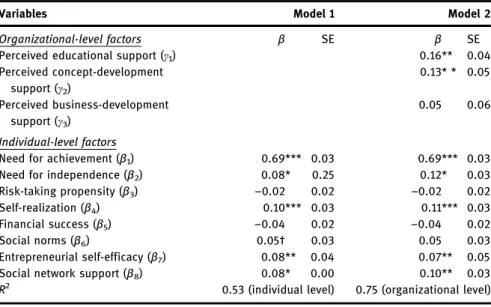
We describe two sets of regression models–one at the individual level and the other at the organizational level. As Raudenbush and Beryk (2002) suggest, we followed all of the assumptions for the two levels of analysis and estimated the variance explained at each level. The organizational-level variables accounted for 75% of the between-department variance (Model 2), while the individual-level variables explained 53% (Model 2) of entrepreneurial intention.
The organizational-level results, adjusted for individual-level factors, par-tially support the hypotheses. H1, that perceived educational support enhances
entrepreneurial intention (β ¼ 0.16;p< 0.01), is fully supported, as is H2, that
perceived concept-development support enhances entrepreneurial intention
(β ¼ 0.13;p< 0.01). However, we did not find support for H3, that perceived
business-development support enhances entrepreneurial intention, as we found a positive but non-significant relationship between perceived
business-develop-ment support and entrepreneurial intention (β ¼ 0.05;p ¼ n.s.).
The results of our individual-level factors are mixed. We found a positive, highly significant relationship between entrepreneurial intention and the need
for achievement (β ¼ 0.69;p< 0.001), the need for independence (β ¼ 0.12;p<
0.05), self-realization (β ¼ 0.11;p< 0.001), entrepreneurial self-efficacy (β ¼
0.07;p< 0.01), and social network support (β ¼ 0.10;p< 0.01). The next section
discusses these results. Table 2:Results for HLM analysis
Variables Model 1 Model 2
Organizational-level factors β SE β SE
Perceived educational support (γ1) 0.16** 0.04
Perceived concept-development support (γ2) 0.13* * 0.05 Perceived business-development support (γ3) 0.05 0.06 Individual-level factors
Need for achievement (β1) 0.69*** 0.03 0.69*** 0.03
Need for independence (β2) 0.08* 0.25 0.12* 0.03
Risk-taking propensity (β3) −0.02 0.02 −0.02 0.02
Self-realization (β4) 0.10*** 0.03 0.11*** 0.03
Financial success (β5) −0.04 0.02 −0.04 0.02
Social norms (β6) 0.05† 0.03 0.05 0.03
Entrepreneurial self-efficacy (β7) 0.08** 0.04 0.07** 0.05
Social network support (β8) 0.08* 0.00 0.10** 0.03
R2 0.53 (individual level) 0.75 (organizational level) Note:†p< 0.10; *p< 0.05; **p< 0.01; ***p< 0.001.
5 Discussion and implications
Our study extends the entrepreneurial intention literature and answers the calls of Hmieleski and Baron (2009) and Phan et al. (2009) for additional multi-level research in the field of entrepreneurship by introducing a multi-level perspective of the factors that contribute to entrepreneurial intention. We supplement prior evidence that neither individual nor organizational factors alone can
sufficiently explain the dynamic nature of entrepreneurial intentions
(Davidsson and Wiklund 2001) but that it is the combination that provides insights into this process. Theoretically, our study offers a new perspective in the entrepreneurial intention literature by demonstrating the combined multi-level perspective.
Organizational-level factors are represented by perceived educational support, perceived concept-development support, and perceived
business-development support. Supporting Peterman and Kennedy’s (2003) findings
that participation in an entrepreneurship program positively affects entrepre-neurial intentions, our results demonstrate the significant role of educational
and concept-development support in influencing students’ entrepreneurial
intentions. Even though previous research has established the link between entrepreneurship education and entrepreneurial behavior (Galloway and Brown 2002; Luthje and Franke 2003), student entrepreneurship figures remain low (Kraaijenbrink, Groen, and Bos 2010). Previous research has suggested that entrepreneurship education could improve entrepreneurship
levels by increasing students’ knowledge, building confidence, and
promot-ing self-efficacy (Krueger and Brazeal 1994). For example, Timmons and Spinelli (1994) suggest that, to be effective, entrepreneurship education must enable students to increase their capacity for imagination, flexibility, and creativity and develop their ability to think conceptually and to perceive change as an opportunity.
More specifically, our findings show that, of the three measures of uni-versity support, perceived educational support was the most important in
developing students’entrepreneurial self-efficacy, followed by perceived
con-ceptual-development and perceived business-development support. Although students perceived that their universities were helpful in providing the gen-eral knowledge and skills required to initiate a new venture (educational support), they needed more targeted support in concept development and business development. These results, which are consistent with those of Kraaijenbrink, Groen, and Bos (2010), help to demonstrate the validity of
Kraaijenbrink, Groen, and Bos (2010) measures to assess perceived university support. These scales should enable universities to measure the impact of their provision of entrepreneurship education and support, thus helping them
to address their students’specific needs.
One explanation for the lack of support for the hypothesis on business-development support is that entrepreneurship education has just been intro-duced in universities in Pakistan, so the faculties at these universities are not
necessarily entrepreneurship-oriented. Therefore, a collective effort is
required in order to promote entrepreneurship among younger faculty mem-bers. Business schools in Pakistan need to develop the activities that support entrepreneurship in order to prepare the business leaders of the future. Universities can also work to develop strong industry networks and initiate new sources for the support of business-development consultancies. The results for individual-level factors show that individuals are motivated toward entrepreneurship by their need for achievement, need for indepen-dence, self-realization, entrepreneurial self-efficacy, and social network sup-port, so strategies at the university level can be designed to strengthen and
enhance these factors that further improve individuals’ attitudes toward
entrepreneurship.
Considering that most researchers agree that entrepreneurial perceptions and intentions can be enhanced by entrepreneurship education (Chen, Greene, and Crick 1998; Kraaijenbrink, Groen, and Bos 2010; Krueger and Brazeal 1994; Peterman and Kennedy 2003; Wang and Wong 2004), it is important to discuss the implications of our results for university managers and policy-makers,
particularly those involved with entrepreneurship-driven programs.
Organizations can support universities’ efforts by introducing entrepreneurial
activities (e.g. business plan competitions and idea development workshops) to cultivate an innovative climate that will motivate individuals and develop their entrepreneurial skills. Policy-makers can target educational and training
pro-grams to raise students’individual-level competencies. Entrepreneurial
educa-tion programs can expose students to the business environment, market opportunities, and real-life entrepreneurship situations to strengthen their con-fidence in pursuing entrepreneurship as a career choice.
Entrepreneurship education is fundamental to student entrepreneurship,
so universities should measure their students’perceptions of the support they
receive in choosing and pursuing entrepreneurial ventures. Our findings show that universities are perceived to be strong in their traditional teaching role but that they fall short in their commercialization role. They can strengthen
this weakness by providing awareness, motivation and business ideas in the early stages of the entrepreneurial process and by offering business-develop-ment support to start-ups. Entrepreneurship education has an important influence on entrepreneurial intention, but it is not the only important
influence, so we propose universities’three-dimensional support (education,
concept support, and business support), together with institutional support,
to increase students’ perceptions of the feasibility of entrepreneurship, as
measured by entrepreneurial self-efficacy. Entrepreneurial self-efficacy and perceived desirability, represented by individual motivations like the need for self-realization and recognition, shape the entrepreneurial intention. Our findings suggest that this holistic approach will provide meaningful support
in the formation of students’ entrepreneurial intention.
6 Limitations and future research
Our study is subject to some limitations. First, our focus is on measuring behavioral intention instead of actual behavior. Although the predictive validity of intention has been established in a general context (Armitage and Conner 2001), it has yet to be established in the entrepreneurial context. As a consequence, our study does not predict how many students will materialize their entrepreneurial intentions. Second, we selected individual and organizational variables that an extensive literature review revealed were most influential in predicting entrepreneurial intention, but other variables could also be important which might include internal events in college and external events. Events occurring inside the school curricula (program con-tents and pedagogies, culture of the school, etc.) and events outside the school (such as meeting with entrepreneurs, getting insightful information about entrepreneurship, and developing experiences implying entrepreneurial behaviors) might affect the results. Obviously, this kind of internal and external events should be taken into account in the design of future research aiming at studying the persistence of entrepreneurial behavior. Third, a long-itudinal study could reveal the degree to which entrepreneurial intention turns into entrepreneurial behavior. Finally, our study examines university students in Pakistani universities, so our findings are mostly generalizable to developing countries. Future research could conduct a comparative analysis between developing and advanced economies in order to reveal relevant variations.
Appendix
–
Measurement items and response
format
Self-employment intention –5-point Likert scale from 1 ¼ “completely disagree”to 5 ¼ “completely agree”: (1) “Have you ever seriously considered becoming an entrepreneur?” (dichotomous scale of“yes/no”); (2)“I will make every effort to start and run my own firm.”; (3)“I’ve got firm intention to start a firm someday.”
Organizational-level factors
Perceived educational support–5-point Likert scale from 1 ¼ “completely disagree”to 5 ¼ “completely agree”: (1)“My university offers elective courses on entrepreneurship.”; (2)“My university offers project work focused on entrepreneurship.”; (3)“My university offers intern-ship focused on entrepreneurintern-ship.”; (4)“My university offers a bachelor or master study on entrepreneurship.”; (5)“My university arranges conferences/workshops on entrepreneurship.”; (6)“My university brings entrepreneurial students in contact with each other.”
Perceived concept-development support–5-point Likert scale from 1¼“completely disagree”to 5¼“completely agree”: (1)“My university creates awareness of entrepreneurship as a possible career choice.”; (2)“My university motivates students to start a new business.”; (3)“My university provides students with ideas to start a new business firm.”; (4)“My university provides students with the knowledge needed to start a new business.”
Perceived business-development support–5-point Likert scale from 1 ¼“completely disagree” to 5¼“completely agree”: (1)“My university provides students with the financial means to start a new business.”; (2)“My university uses its reputation to support students that start a new busi-ness.”; (3)“My university serves as a lead customer of students that start a new business.” Individual-level factors
Need for achievement–5-point Likert scale from 1¼“completely disagree”to 5¼“completely agree”: (1)“Hard work is something I like to avoid.”®; (2)“I believe I would enjoy having authority over other people.”; (3) I would like an important job where people would look up to me.” Need for independence–5-point Likert scale from 1¼“to no extent”to 5¼“to a very great ex-tent”: (1)“Get greater flexibility for personal life is important to me.”; (2)“Free to adapt my app-roach to work is important to me.”
Risk-taking propensity–5-point Likert scale from 1¼“to no extent”to 5¼ “to a very great ex-tent”: (1)“To what extent do you agree or disagree with the following statements?”; (2)“I enjoy the excitement of uncertainty and risk.”; (3)“I am willing to take significant risk if the possible rewards are high enough.”
Self-realization–5-point Likert scale from 1¼“to no extent”to 5¼“to a very great extent”: (1)“It is important for me to challenge myself.”; (2)“It is important for me to fulfil a personal vision.”(3) “It is important for me to grow and learn as a person.”
(continued)
Financial success–5-point Likert scale from 1¼“to no extent”to 5¼“to a very great extent”: (1) “It is important for me to earn a larger personal income.”; (2)“It is important for me to have fin-ancial security.”; (3) It is important for me to build great wealth and high income.”
Social norms–5-point Likert scale from 1¼“to no extent”to 5¼“to a very great extent”: (1)“It is important for me to achieve something and to get recognition.”; (2)“It is important for me to gain a higher position for myself.
Entrepreneurial self-efficacy–5-point Likert scale (1) ¼ None, (2) ¼ Basic, (3)¼ Competent, (4)¼Advanced, (5)¼Expert: What is your skill level for performing each of the following roles and tasks? 26 items were used. Respondents were asked to rate their skill level in marketing, i-nnovation, management, risk-management, and financial control.
Social network support–5-point Likert scale from 1¼“completely disagree”to 5¼“completely agree”: (1)“If I decided to be an entrepreneur, my family members will support me.”; (2)“If I decided to be an entrepreneur, my friends will support me.”
References
Ajzen, I. 1991.“The Theory of Planned Behavior.”Organizational Behavior and Human Decision Processes50(2):179–211.
Armitage, C. J., and M. Conner. 2001.“Efficacy of the Theory of Planned Behavior: A Meta-Analytic Review.”British Journal of Social Psychology40(4):471–99.
Aronsson, M. 2004.“Education Matters–But Does Entrepreneurship Education? An Interview with David Birch.”Academy of Management Learning & Education3(3):289–92. Bates, T. 1995.“Self-Employment Entry Across Industry Groups.”Journal of Business Venturing
10(2):143–56.
Becker, G. 1964.Human Capital: A Theoretical and Empirical Analysis with Special Reference to Education. Chicago: University of Chicago Press.
Binks, M., K. Starkey, and C. L. Mahon. 2006.“Entrepreneurship Education and the Business School.”Technology Analysis & Strategic Management18(1):1–18.
Bird, B. 1988.“Implementing Entrepreneurial Ideas: The Case for Intention.”Academy of Management Review13(3):442–53.
Bird, B., and M. Jelinek. 1988.“The Operation of Entrepreneurial Intentions.”Entrepreneurship Theory and Practice13(2):21–29.
Bommer, W. H., E. C. Dierdorff, and R. S. Rubin. 2007.“Does Prevalence Mitigate Relevance? The Moderating Effect of Group-Level OCB on Employee Performance.”Academy of Management Journal50:1481–94.
Cadogan, J. W., A. Diamantopoulos, and C. P. De Mortanges. 1999.“A Measure of Export Market Orientation: Scale Development and Cross-Cultural Validation.”Journal of International Business Studies30(4):689–707.
Carter, N. M., W. B. Gartner, K. G. Shaver, and E. J. Gatewood. 2003.“The Career Reasons of Nascent Entrepreneurs.”Journal of Business Venturing18:13–39.
Cassidy, T., and R. Lynn. 1989.“A Multifactorial Approach to Achievement Motivation: The Development of a Comprehensive Measure.”Journal of Occupational Psychology 62(4):301–12.
Chandler, G. N., and D. W. Lyon. 2001.“Issues of Research Design and Construct Measurement in Entrepreneur- Ship Research: The Past Decade.”Entrepreneurship Theory and Practice 25(4):101–13.
Chatterjee, S., and B. Price. 1991.Regression Analysis by Example. New York: Wiley. Chemin, M. 2008.“Entrepreneurship in Pakistan: Government Policy on SMEs, Environment for
Entrepreneurship, Internationalisation of Entrepreneurs and SMEs.”Accessed December 2013. http://www.relooney.info/SI_Expeditionary/Entrepreneurship_29.pdf
Chen, C. C., P. G. Greene, and A. Crick. 1998.“Does Entrepreneurial Self-Efficacy Distinguish Entrepreneurs from Managers?”Journal of Business Venturing97:295–316.
Cheng, M. Y., W. S. Chan, and A. Mahmood. 2009.“The Effectiveness of Entrepreneurship Education in Malaysia.”Education þ Training51(7):555–66.
Collins, L., P. D. Hannon, and A. Smith. 2004.“Enacting Entrepreneurial Intent: The Gaps between Student Needs and Higher Education Capability.”Education þ Training46(8/ 9):454–63.
Davidsson, P., and B. Honig. 2003.“The Role of Social and Human Capital among Nascent Entrepreneurs.”Journal of Business Venturing18(3):301–31.
Davidsson, P., and J. Wiklund. 2001.“Level of Analysis in Entrepreneurship Research: Current Research Practices and Suggestions for the Future.”Entrepreneurship Theory & Practice25 (2):81–99.
Debackere, K., and R. Veugelers. 2005.“The Role of Academic Technology Transfer Organizations in Improving Industry Science Links.”Research Policy34:321–42. Di Gregorio, D., and S. Shane. 2003.“Why Do Some Universities Generate More Start-Ups Than
Others?”Research Policy32(2):209–27.
Dickson, P. H., G. T. Solomon, and K. M. Weaver. 2008.“Entrepreneurial Selection and Success: Does Education Matter?”Journal of Small Business and Enterprise Development 15(2):239–58.
Diggle, P., K. Liang, and S. Zeger. 1994.Analysis of Longitudinal Data. New York: Oxford University Press.
Douglas, E., and D. Shepherd. 2002.“Self-Employment as a Career Choice: Attitudes, Entrepreneurial Intentions, and Utility Maximization.”Entrepreneurial Theory and Practice 26(3):81–90.
Dwyer, A. L., and A. L. Cummings. 2001.“Stress, Self-Efficacy, Social Support and Coping Strategies in University Students.”Canadian Journal of Counselling35(3):208–20. Elster, J. 1989.“Social Norms and Economic Theory.”Journal of Economic Perspectives
3(4):99–117.
Fishbein, M., and I. Azjen. 1975.Belief, Attitude, Intention and Behavior: An Introduction to Theory and Research. Reading, MA: Addison-Wesley.
Galloway, L., and W. Brown. 2002.“Entrepreneurship Education at University: A Driver in the Creation of High Growth Firms.”Education þ Training44(8/9):398–405.
Gartner, W. B., B. J. Bird, and J. A. Starr. 1992.“Acting as if: Differentiating Entrepreneurial From Organizational Behavior.”Entrepreneurship Theory and Practice16(3):13–31.
Global Entrepreneurship Monitor. 2011.“Report on Pakistan.”
Gnyawali, R., and D. S. Fogel. 1994.“Environments for Entrepreneurship Development: Key Dimension.”Entrepreneurship Theory and Practice18(4):43.
Goldberger, A. S. 1991.A Course in Econometrics. Cambridge, MA: Harvard University Press. Gürol, Y., and N. Atsan. 2006.“Entrepreneurial Characteristics amongst University Students:
Some Insights for Entrepreneurship Education and Training in Turkey.”Education þ Training48:25–38.
Hansemark, O. 2003.“Need for Achievement, Locus of Control, and the Prediction of Business Start-Ups: A Longitudinal Study.”Journal of Economic Psychology24(3):301–19.
Hatten, T., and S. K. Ruhland. 1995.“Student Attitudes toward Entrepreneurship as Affected by Participation in an SBI Program.”Journal of Education for Business7(4):224–27. Helfat, C. E., and M. A. Peteraf. 2003.“The Dynamic Resource-Based View: Capability
Lifecycles.”Strategic Management Journal24(10):997–1010.
Henderson, R., and M. Robertson. 2000.“Who Wants To Be an Entrepreneur? Young Adult Attitudes to Entrepreneurship as a Career.”Career Development International5(6):279–87. Henry, C., F. Hill, and C. Leitch. 2005.“Entrepreneurship Education and Training–Can
Entrepreneurship Be Taught? Part I.”Education and Training47(2):98–111.
Hmieleski, K., and R. A. Baron. 2009.“Entrepreneurs’Optimism and New Venture Performance: A Social Cognitive Perspective.”Academy of Management Journal52(3):473–88. Hofmann, D. A. 1997.“An Overview of the Logic and Rationale of Hierarchical Linear Models.”
Journal of Management23(6):723–44.
Holden, R. R., and D. N. Jackson. 1979.“Item Subtlety and Face Validity in Personality Assessment.”Journal of Consulting and Clinical Psychology47:459–68.
Jarvis, C. B., S. B. Mackenzie, and P. M. Podsakoff. 2003.“A Critical Review of Construct Indicators and Measurement Model Misspecification in Marketing and Consumer Research.”Journal of Consumer Research30(2):199–218.
Katz, J., and W. B. Gartner. 1988.“Properties of Emerging Organizations.”Academy of Management Review13(3):429–41.
Kennedy, J. J. 1992.Analyzing Qualitative Data: Log-Linear Analysis for Behavioral Research, 2nd ed. New York: Praeger Publishers.
Klandt, H. 2004.“Entrepreneurship Education and Research in German-Speaking Europe.” Academy of Management Learning and Education3(3):293–301.
Klein, S. B., J. H. Astrachan, and K. X. Smyrnios. 2005.“The F-PEC Scale of Family Influence: Construction, Validation, and Further Implication for Theory.”Entrepreneurship Theory and Practice29(3):321–39.
Kolvereid, L. 1996.“Prediction of Employment Status Choice Intentions.”Entrepreneurship Theory and Practice21:47–57.
Kolvereid, L., and O. Moen. 1997.“Entrepreneurship among Business Graduates: Does a Major in Entrepreneurship Make a Difference?”Journal of European Industrial Training21(4):154–60. Kraaijenbrink, J., A. Groen, and G. Bos. 2010.“What Do Students Think of the Entrepreneurial Support Given by Their Universities?”International Journal of Entrepreneurship and Small Business9(1):110–25.
Krueger, N. F., and D. V. Brazeal. 1994.“Entrepreneurial Potential and Potential Entrepreneurs.” Entrepreneurship Theory and Practice18(3):91–104.
Kuratko, D. F., and R. M. Hodgetts. 2007.Entrepreneurship: Theory, Process, Practice, 7th ed. Mason, OH: Thompson South–Western.
Laird, N. M., and H. Ware. 1982.“Random-Effect Models for Longitudinal Data.”Biometric 38:963–74.
Lee, S. H., and P. K. Wong. 2004.“An Exploratory Study of Technopreneurial Intentions: A Career Anchor Perspective.”Journal of Business Venturing19(1):7–28.
Liñán, F., and Y. W. Chen. 2009.“Development and Cross-Cultural Application of a Specific Instrument to Measure Entrepreneurial Intentions.”Entrepreneurship Theory and Practice 33(3):593–617.
Lockett, A., and M. Wright. 2005.“Resources, Capabilities, Risk Capital and the Creation of University Spin-Out Companies.”Research Policy34(7):1043–57.
Louis, K. S., D. Blumenthal, M. E. Gluck, and M. A. Stoto. 1989.“Entrepreneurs in Academe: An Exploration of Behaviors among Life Scientists.”Administrative Science Quarterly34:110–31. Luthje, C., and N. Franke. 2003.“The“Making”of an Entrepreneur: Testing a Model of
Entrepreneurial Intent among Engineering Students at MIT.”R&D Management33(2):35–147. Marrone, J. A., P. E. Tesluk, and J. B. Carson. 2007.“A Multi-Level Investigation of Antecedents
and Consequences of Team Member Boundary Spanning Behavior.”Academy of Management Journal50:1423–39.
Martin, K. D., J. B. Cullen, J. L. Johnson, and K. P. Parboteeah. 2007.“Deciding to Bribe: A Cross-Level Analysis of Firm and Home Country Influence on Bribery Activity.”Academy of Management Journal50:1401–22.
McGee, J. E., M. Peterson, S. L. Mueller, and J. M. Sequeira. 2009.“Entrepreneurial Self-Efficacy: Refining the Measure.”Entrepreneurship Theory & Practice33:965–88. Messick, S. 1988.“Validity.”InEducational Measurement, edited by R. L. Linn, 3rd ed., 13–103.
New York: American Council on Education/Orix Press.
Mowery, D. C., R. R. Nelson, B. N. Sampat, and A. A. Ziedonis. 2001.“The Growth of Patenting and Licensing by the U.S. Universities: An Assessment of the Effects of the Bayh-Dole Act of 1980.”Research Policy30(1):99–119.
O’Shea, R. P., T. J. Allen, A. Chevalier, and F. Roche. 2005.“Entrepreneurial Orientation, Technology Transfer and Spinoff Performance of U.S. Universities.”Research Policy 34(7):994–1009.
Penrose, E. 1959.The Theory of the Growth of the Firm. Oxford: Blackwell.
Peterman, N. E., and J. Kennedy. 2003.“Enterprise Education: Influencing Students’ Perceptions of Entrepreneurship.”Entrepreneurship Theory and Practice28:129–44. Phan, P. H., M. Wright, D. Ucbasaran, and W. L. Tan. 2009.“Corporate Entrepreneurship: Current Research and Future Directions.”Journal of Business Venturing24:197–205. Rasmussen, E., and O. J. Borch. 2010.“University Capabilities in Facilitating Entrepreneurship:
A Longitudinal Study of Spin-Off Ventures at Mid-Range Universities.”Research Policy 39:602–12.
Raudenbush, S. W., and A. S. Bryk. 2002.Hierarchical Linear Models: Applications and Data Analysis Methods, 2nd ed. Newbury Park, CA: Sage.
Robinson, P.B., & Sexton, E.A. 1994.“The effect of education and experience on self-employ-ment success.”Journal of Venturing9(2):141–156.
Rossiter, J. R. 2002.“The C-OAR-SE Procedure for Scale Development in Marketing.” International Journal of Research in Marketing19(4):305–35.
Schaper, M., and T. Volery. 2004.Entrepreneurship and Small Business: A Pacific Rim Perspective. Milton, QLD: John Wiley and Sons Australia Ltd.
Scheinberg, S., and I. C. MacMillan. 1988.“An 11-Country Study of Motivations to Start a Business.”InFrontiers of Entrepreneurship Research, edited by B. A. Kirchoff, W. A. Long, W. E. McMullan, K. H. Vesper, and W. E. Wetzel, 669–87. Wellesley, MA: Babson College.
Schumpeter, J. 1934.The Theory of Economic Development. Cambridge, MA: Harvard University Press.
Seet, P. S., and L. C. Seet. 2006.“Making Singapore University Graduates More
Entrepreneurial: Has Entrepreneurship Education Helped?”51st ICSB World Conference Melbourne, Australia.
Segal, G., D. Borgia, and J. Schoenfeld. 2005.“The Motivation to Become an Entrepreneur.” International Journal of Entrepreneurial Behaviour & Research11(1):42–57.
Shane, S. 2000.“Prior Knowledge and the Discovery of Entrepreneurial Opportunities.” Organization Science11(4):448–69.
Shane, S. 2004.Academic Entrepreneurship: University Spinoffs and Wealth Creation. Aldershot: Edward Elgar.
Shane, S., L. Kolvereid, and P. Westhead. 1991.“An Exploratory Examination of the Reasons Leading to New Firm Formation across Country and Gender.”Journal of Business Venturing 6:431–46.
Shane, S. A., and S. Venkataraman. 2000.“The Promise of Entrepreneurship as a Field of Research.”Academy of Management Review25(1):217–26.
Sitkin, S. B., and A. L. Pablo. 1992.“Reconceptualizing the Determinants of Risk Behavior.” Academy of Management Review17:9–38.
Solomon, G. 2002.“Entrepreneurship Education and Training in the United States: Policy, Strategy or Disjointed Incrementalism.”InThe Dynamics of Entrepreneurship, edited by T. W. Liang, 109–30. Singapore: Prentice-Hall.
Souitaris, V., S. Zerbinati, and A. Allaham. 2007.“Do Entrepreneurship Programmes Raise Entrepreneurial Intention of Science and Engineering Students? The Effect of Learning, Inspiration and Resources.”Journal of Business Venturing22(4):566–91.
Stewart, W. H., and P. L. Roth. 2004.“Data Quality Affects Meta-Analytic Conclusions: A Response to Miner and Raju (2004) Concerning Entrepreneurial Risk Propensity.”Journal of Applied Psychology89:14–21.
Strenio, J. L. F., H. I. Weisberg, and A. S. Bryk. 1983.“Empirical Bayes Estimation of Individual Growth Curve Parameters and Their Relationship to Covariates.”Biometric39:71–86. Thompson, J. L. 1999.“The World of the Entrepreneur–A New Perspective.”Journal of
Workplace Learning: Employee Counseling Today11(6):209–24.
Tijssen, R. J. W. 2006.“Universities and Industrially Relevant Science: Toward Measurement Models and Indicators of Entrepreneurial Orientation.”Research Policy35(10):1569–85. Timmons, J. A., and S. Spinelli. 1994.New Venture Creation: Entrepreneurship for the 21st
Century. New York: McGraw-Hill/Irwin.
Townsend, D. M., L. W. Busenitz, and J. D. Arthurs. 2010.“To Start or Not to Start: Outcome and Ability Expectations in the Decision to Start a New Venture.”Journal of Business Venturing 25:192–202.
Turker, D., and S. S. Selcuk. 2009.“Which Factors Affect Entrepreneurial Intention of University Students?”Journal of European Industrial Training33(2):142–59.
Ucbasaran, D., P. Westhead, and M. Wright. 2008.“Opportunity Identification and Pursuit: Does an Entrepreneur’s Human Capital Matter?”Small Business Economics30(2):153–73. Upton, N., D. Sexton, and C. Moore. 1995.“Have We Made a Difference? An Examination of
Career Activity of Entrepreneurship Major, Since 1981.”Frontiers of Entrepreneurship Research, Proceedings of the 15th Annual Entrepreneurship Research Conference, Babson College, Wellesley, MA.
Veciana, J. M., M. Aponte, and D. Urbano. 2005.“University Students’Attitudes towards Entrepreneurship: A Two Countries Comparison.”International Entrepreneurship and Management Journal1(2):165–82.
Venkatachalam, V. B., and A. A. Waqif. 2005.“Outlook on Integrating Entrepreneurship in Management Education in India.”Decision32:57–71.
Walter, A., M. Auer, and T. Ritter. 2006.“The Impact of Network Capabilities and Entrepreneurial Orientation on University Spin-Off Performance.”Journal of Business Venturing21:541–67.
Walter, S. G., K. P. Parboteeah, and A. Walter. 2013.“University Departments and Self-Employment Intentions of Business Students: A Cross-Level Analysis.”Entrepreneurship Theory & Practice37(2):175–200.
Wang, C. K., and P. K. Wong. 2004.“Entrepreneurial Interest of University Students in Singapore.”Technovation24:163–72.
Wernerfelt, B. 1984.“A Resource-Based View of the Firm.”Strategic Management Journal 5:171–80.
Zhao, H., S. E. Seibert, and G. E. Hills. 2005.“The Mediating Role of Self-Efficacy in the Development of Entrepreneurial Intentions.”The Journal of Applied Psychology90:6.