Green Electricity
Making a Difference
An International Survey of Renewable Electricity Labels
electricity labels and the structure of more than thirty national renewable electricity markets.
The report reveals a diverse landscape of renewable elec-tricity labels and identifies potential for improvement. Key improvement areas, which would be particularly appreciated by multi-national corporations, include a global reach of the labels and improved communication efforts.
In order to be able to take into account the diversity of stake-holders and experts in the renewable electricity market, PwC teamed up with a group consisting of staff from Swiss Re, WWF and the “Verein für umweltgerechte Energie” (associa-tion for environmentally sound energy, VUE). Thus, the report was created in close cooperation with electricity consumers and relevant experts. A board of experts on this subject mat-ter reviewed the report at different stages and gave valuable advice to the authors.
the core competency of our sustainability practice. We help clients improve their social, environmental and economic performance and create long-term shareholder value, through delivering strategy, governance, performance management, reporting and assurance solutions.
By providing this report, we hope to increase transparency in the market for renewable electricity and to stimulate future developments that are beneficial to all stakeholders.
On behalf of PricewaterhouseCoopers and the group involved in producing this report I would like to express my heartfelt thanks to all those who have supported us and contributed in one way or another to this project.
Thomas Scheiwiller
Partner, PricewaterhouseCoopers Ltd, Switzerland Global Sustainability Leader
expected to increase significantly . . . .7
1.2 Key players and complexity of the market . .7
2
Renewable electricity labels . . . 11
2.1 The role of renewable electricity labels as identifiers . . . 11
2.2 Issues to be addressed by renewable electricity labels . . . .12
3
Methodology . . . 14
3.1 Approach . . . .14
3.2 Assessing national renewable electricity markets . . . .14
3.3 Assessing the sustainability and credibility of labels . . . .15
4
Results . . . 18
4.1 Results of the assessment of national renewable electricity markets . . . .18
4.2 Results of the assessment of labels . . . . .21
5
Concluding remarks . . . 26
6.5 Brazil . . . .36 6.6 Canada . . . .38 6.7 Chile . . . .40 6.8 China . . . .42 6.9 Denmark . . . .44 6.10 Finland . . . .46 6.11 France . . . .48 6.12 Germany . . . .50 6.13 Hong Kong . . . .52 6.14 Hungary . . . .54 6.15 India . . . .56 6.16 Indonesia . . . .58 6.17 Ireland . . . .60 6.18 Italy . . . .62 6.19 Japan . . . .64 6.20 Mexico . . . .66 6.21 Netherlands . . . .68 6.22 New Zealand . . . .70 6.23 Philippines . . . .72 6.24 Poland. . . 74 6.25 Portugal . . . .76 6.26 Singapore . . . .78 6.27 South Africa . . . .80 6.28 Spain . . . .82 6.29 Sweden . . . .84 6.30 Switzerland . . . .86 6.31 Turkey . . . .88 6.32 UK . . . .90 6.33 Uruguay . . . .92 6.34 USA . . . .947.11.1 . TÜV SÜD EE01 – Germany . . . 116 7.11.2 . TÜV SÜD EE02 – Germany . . . 117 7.11.3 . TÜV SÜD Generation . . . . .EE+ – Germany . . . 118 7.11.4 . TÜV SÜD Generation . . . . .EE – Germany . . . 119
7.12 100% energia verde – Italy . . . .120
7.13 Green Power Certification System – Japan . . . 121
7.14 Milieukeur Groene Elektriciteit – the Netherlands . . . .123
7.15 Bra Miljöval – Sweden . . . .125
7.16 naturemade – Switzerland . . . .127
7.16.1 . naturemade basic – Switzerland .128 7.16.2 . naturemade star – Switzerland . . .129
7.17 Green-e – USA . . . .130
7.18 Power Scorecard – USA. . . .132
9
Acknowledgements. . . 157
There is an ever increasing interest in renewable or green electricity among private and corporate consumers. They are interested in carbon neutrality and have a growing aware-ness of other ecological problems and sustainability issues. The market for renewable and green electricity has seen con-siderable changes over recent years. Mandatory and volun-tary markets have been established and new market players, products, regulations and instruments (such as Renewable Electricity Certificates) have emerged. These all contribute to the growing complexity of this market. As a consequence of these developments the electricity market has become highly complex, often confusing private and corporate consumers with unclear information, or by not providing information about the electricity they purchase.
Therefore, guidance is needed in the market to help consum-ers find the appropriate product for their divconsum-erse needs. This survey is a first step towards such guidance and aims at creating a basis for decision-making on the procurement of green or renewable electricity. Even though the survey is prin-cipally directed towards the needs of private and corporate consumers, it also addresses the roles and responsibilities of producers and resellers, labelling organisations and regula-tors in the electricity market.
Aim and scope of this report
Three key questions are addressed in this report:
What are the characteristics of today’s national renewable electricity markets?
How sustainable and credible are labels for renewable electricity?
What role do labels play in today’s renewable electricity market and what future additional contribution could they make?
Key findings
Labels are the only available tool for identifying renewable electricity produced in accordance with broad sustaina-bility criteria.
The electricity assessment criteria used by labels across the world are of uneven quality, especially regarding broad sustainability aspects.
Labels need to improve communication and transparency when it comes to procedures and criteria specific to the product.
Most labels are local and do not apply across national borders, making it difficult for multinational firms to imple-ment a global sourcing strategy for renewable electricity. Governmental promotion of renewable electricity must
provide clear definitions and regulations to secure the co-existence of a voluntary market that increases the share of renewable electricity above the regulated minimum.
Renewable electricity is still a niche product even though investments in recent years have increased in absolute numbers.
The survey consists of four main parts:
Chapters 1 to 5: Description of the renewable electric-ity market; discussion of the role of renewable electricelectric-ity labels; the methodology used to assess the labels; the results of the country survey, label survey and concluding remarks.
Chapter 6: Country reports which give an overview of the national electricity production, a description of the legal framework and subsidies and also an overview of the dif-ferent systems available in the country concerning renew-able electricity.
Chapter 7: Label reports that assess the criteria which are applied by the labels and their governance structure. Appendix: contains the definitions of terms (such as
ad-ditionality, green electricity, criteria, label and so on) used in this survey. We want to stress the importance of the definitions as some have slightly different meanings than in other literature.
The outcome of this survey is a comparative analysis of the different labels in the relevant national and international markets as shown in the graph below.
Note on authors and information sources
The survey was created by a multi-stakeholder workgroup, including members of Swiss Re, “Verein für umweltgerech-te Energie” (VUE), WWF and Pricewaumweltgerech-terhouseCoopers (PwC). The report was drawn up by PwC supported by a steering group of external experts.The information presented in this survey is mainly based on publicly available information. As renewable electricity labels operate in a complex environment, various sources were considered. However, due to fragmented data sources and often limited quality of data provided on the Internet, the information presented in this survey might not be complete or accurate in all details. It must therefore be noted that this survey is not a scientific work.
The information presented in this survey is, with some exceptions, as of late Autumn 2008. Whilst considerable care has been taken to ensure the accuracy of the survey, PwC would be pleased to hear of any errors or omissions, together with the source of the information.
Category Criteria Bra M ilj öv al ( S E ) E co Lo g o ( C A ) 10 0% e ne rg ia v er d e ( IT ) E V E - E le ct ri ci té V er te ( FR ) G re en -e ( U S ) G re en P ow er C er tifi ca tio n S ys te m ( JP ) G re en P ow er ( A U ) G rü ne r S tr o m L ab el ( D E ) M ili eu ke ur G ro en e E le kt ri ci te it ( N L) na tu re m ad e b as ic ( C H ) na tu re m ad e s ta r ( C H ) N o rp p ae ne rg ia ( FI ) o k-p ow er ( D E ) P ow er S co re ca rd ( U S ) T Ü V S Ü D E E 01 ( D E ) T Ü V S Ü D E E 02 ( D E ) T Ü V S Ü D G en er at io n E E + ( D E ) T Ü V S Ü D G en er at io n E E ( D E ) U mw el tz ei ch en ( A T ) E co lo gi ca l c rit er ia 1 Hydro-electricity: minimum flow regulations 2 Hydro-electricity: hydro peaking 3 Hydro-electricity:
reservoir management 4 Hydro-electricity:
bed load management
1.1 Renewable electricity production
expected to increase significantly
There has been a surge in expectations that a diverse range of power generation methods – such as wind, solar or geo-thermal energy, combined heat and power and other forms – will have a significant impact on future electricity markets. According to the Renewables 2007 Global Status Report of the Renewable Energy Network for the 21st Century (REN21) the share of renewable energy sources in global electricity generation excluding large hydropower plants was 3.4% in 2006. Furthermore, large hydropower plants accounted for 15% of global electricity production in the same period. This adds up to a total share for renewable electricity production of 18.4% of the global electricity production.The World Energy Outlook 2008 (WEO 2008) of the International Energy Agency (IEA) states that the proportion of non-hydro renewable energy sources for global electricity production – wind, solar, geothermal, wave and tidal energy – is growing the quickest, but the proportion is still small. It is expected that the proportion of non-hydro renewable energy sources in global power generation increases from 1% in 2006 up to 4% in 2030.
Focus on clean power – a key development in
the electricity market
In the Utilities global survey 2008 conducted by PwC, the encouragement of renewable energy topped the list of key developments that respondents expected to see in their power markets in the coming years. The focus on clean power and the associated concerns of emission regulations and energy efficiency top the agenda of utility company survey respond-ents in every major power market. Today’s strong emphasis on environmental issues amongst respondents to the survey manifests a trend that already became evident in the 2004 edition and that has been corroborated in recent years.
Renewable does not always equal sustainable
The shift from non-renewable to renewable energy sources for electricity production is seen as a way to sustainably pre-serve valuable resources for future generations. What remains unclear to many consumers is that electricity generation from renewable energy sources is not free from negative envi-ronmental impacts: hydropower generation can for example have severe negative impacts on regional irrigation, local humidity and cultural and societal structures; or wind energy can impact bird flight paths and is perceived as negatively impacting country landscapes. It is therefore important to be able to distinguish not only between electricity production that uses renewable or non-renewable sources, but also to identify other characteristics of the production process that may impair the environment or society, directly or indirectly. Therefore clear guidance in the form of a transparent and comprehensive multi-criteria approach to electricity genera-tion is a key factor to enable the consumer to assess whether the renewable electricity is sustainable or not.
1.2 Key players and complexity
of the market
Consumers (private and corporate). Consumers are one of the main drivers of the renewable electricity market and have the power to further develop it. However, they require instruments to identify and assess the electricity available on the market to support their buying decision. They are willing to pay a certain price premium for renew-able or green1 electricity, but are price sensitive. Above all
they want to know what they pay the premium for. The lack of transparency and availability of information regarding the quality of green tariffs for electricity waters down the consumer’s choice. Hence the resulting frustration among consumers might lead to a reconsideration of the initial willingness to buy renewable or green energy.
Producers and resellers. These groups offer new prod-ucts to meet consumers’ requirements as the demand for renewable and green electricity grows. However, these products are mostly targeted at only the local or national market. There are still numerous countries on all conti-nents that do not have any green electricity market. This market potential has not yet been exploited. Producers should further develop renewable electricity markets with credible offers that legitimate the price mark-up on their products.
1 To simplify matters, this study uses the terms “renewable” or “green”
elec-tricity as equivalents, even though some sources suggest differentiation should be made between simple electricity generated from renewable sources (“renewable electricity”) and the renewable electricity product that fulfils various criteria and is balanced by a Life Cycle Assessment (“green electric-ity”) (for definitions see appendix 8.3).
Regulators. These have the power to further develop the renewable electricity market by introducing favourable regulations. However, they have to assess the effects of renewable electricity in its local, regional, national or glo-bal context in a critical and unbiased manner. Renewable electricity can have significant adverse impacts on nature, society or the economy and can be subject to conflict of interests. Promotion of renewable electricity should be accompanied by broad sustainability criteria that follow a holistic perspective. Regulators should ensure that mandatory schemes to promote renewable electricity do not constrain any voluntary market but rather increase the share of renewable electricity over and above government mandates.
Complexity of the renewable electricity market
The renewable electricity market varies strongly in different regions of the world. While it is almost non-existent in some regions of the world (such as Africa, Asia or South America), markets are becoming increasingly complex and regulated in others (most notably Europe and the US). On top of this, these markets are changing at a very fast pace. These changes have different drivers, which can be categorised into those driven by regulations (mandatory) or those driven by voluntary consumer initiatives. Regulatory changes are created at re-gional, national and international level and by varying sources such as regional water or landscape protection policies2,
national and international deregulation efforts in electricity markets3 or supranational targets for fighting negative effects
of climate change (cf. excursus below).
Minimal requirements for a functioning
renewable electricity market
When analysing renewable electricity markets that function well for end-consumers, two minimal requirements become apparent: First, there are clear regulations for the respective national renewable electricity markets and the markets that are closely linked to them (such as the market for RECs, see excursus). The regulations and the instruments are carefully defined such that the consumers are aware of the attributes incorporated in the mandatory instruments (such as RECs). Second, the renewable electricity markets feature strong labels which serve as reliable identifiers for consumers in the non-regulated, voluntary electricity market to assess the characteristics of renewable or green electricity and ensure the desired quality and value.
Whilst the importance of clear and coherent regulations for the renewable electricity market is stressed, this report will concentrate on renewable electricity labels. Hence this report analyses the holistic approach of the labels to assess renew-able electricity and discusses the present and future role of the labels in the renewable electricity market.
Excursus: Renewable electricity and
reporting on CO
2emissions – subject
of debate
There is a high interdependence between renewable elec-tricity and the climate change discussion: efforts to fight the negative impacts of climate change have led to a broad range of regulations on both national and international level that mainly aim at tackling the problem of reducing greenhouse gases (GHGs). This has led to the creation of mandatory markets for CO2 reduction certificates. Beside the mandatory markets voluntary markets also exist for consumers that want to reduce negative impacts on the climate.
In the course of the climate change discussion in recent years many companies have started to address the expectations entertained by stakeholders, such as employees or poten-tial new hires, environmental groups or shareholders, with respect to climate change. Many companies have announced voluntary targets to reduce their carbon footprints (for defini-tions see appendix 8.2), often setting targets for direct emis-sions (from own operations) and indirect emisemis-sions (mainly purchased electricity).
2 The water and landscape protection regulations deal with the negative effects
of renewable electricity generation, which are further discussed in chapter 2.2.
3 See, for example the deregulation of the electricity markets by European
Directive 2001/77/EC that allows transnational trade in electricity, bringing along issues about the Guarantee of Origin, which is further described in the appendix 8.1.
A common framework to reduce a company’s CO2 emissions consists of four pillars:
1) Energy efficiency improvement through behaviour, process and infrastructure improvement;
2) On-site renewable energy generation; 3) Purchase of low carbon energy;
4) Compensation via carbon off-set certificates.
The second and third pillars require clear rules for accounting for the reduction in CO2 emissions due to generating elec-tricity from renewable sources. Substitution via purchasing low-carbon energy can be done by buying trading certificates, ‘green-tariffs’ or labelled electricity products. However, only the purchase of a certified product can provide assurance that the reduction4 in CO
2 emissions can be accounted for in
the books of the purchasing company. Failing to secure the CO2 reductions for the purchaser weakens customers’ willing-ness to pay a higher price for green tariffs or to invest in on site generation of renewable electricity.
Voluntary reporting
Companies wishing to set GHG emission targets and moni-tor progress against these targets need to be able to track and report emission levels. As GHG emissions are difficult to measure directly, they are normally calculated using sion factors. Discussion of the accurate choice of conver-sion factors or calculation methods is not in the scope of this report. We would like to concentrate on discussing how to account for the use of renewable electricity in the company’s GHG reporting.
The Greenhouse Gas Protocol (‘Protocol’), a widely accepted guideline on how to report on a company’s GHG emissions, expects the companies to include indirect emissions associ-ated with the consumption of purchased electricity company accounting and reporting under the GHG Protocol Corporate Accounting and Reporting Standard. Furthermore the
Pro-tocol explicitly mentions that one strategy to reduce emis-sions is to purchase renewable electricity to reduce the GHG intensity of the electricity consumed. Companies following this strategy are allowed to report on these GHG emissions by applying conversion factors applicable to the respective renewable energy source (such as solar, wind or hydro) or to apply the conversion factor provided by the producer or supp lier.
Another voluntary reporting standard, the Global Reporting Initiative (GRI), supports and advises companies in reporting on GHG emissions by applying the electricity specific conver-sion factors. It suggests that companies meet GHG emisconver-sion reduction objectives by purchasing renewable energy and applying the associated electricity specific conversion factors to report on the resulting emissions.
The new ISO 14064 standards on GHG accounting and veri-fication do not contradict this method of calculating and re-porting on GHG emissions, as they also refer to the Protocol. Despite this variety of guidelines, in reality there is often a lack of transparency concerning which party (the electricity pro-ducer or the consumer) is allowed to claim the credit for the GHG emission reduction through the generation of electricity from renewable energy sources (see the example of the UK in the box at the end of chapter). Companies often face the problem that they do not know if the RECs they buy authorise them to account for the assumed CO2 reduction. The buyer of RECs provides financial assistance to renewable electricity production in the form of a production subsidy. This does not however guarantee the ownership of the potential CO2 emis-sion reduction as the producer or reseller of the RECs may sell the CO2 emission reduction in another market.
Due to the lack of standardisation and regulation with respect to RECs the buyer of renewable electricity needs to clarify on a case-to-case basis if the acquisition also includes the CO2 emission reduction. Neither certification nor labelling can guarantee this so far.
This lack of transparency gives no incentive to companies to source electricity consumption from renewable sources. This could be avoided if the renewable electricity markets were more clearly definied, a task which is the responsibility of the regulators.
4 The acquisition of renewable electricity reduces a company’s individual
carbon footprint but does not necessarily reduce GHG emissions on a global level. If renewable electricity were to reduce carbon emissions, electricity that is produced from fossil sources would have to be substituted with renewable electricity. In reality, this would for example mean shutting down a coal-fired power plant and replacing it with a wind park. In contrast, if a new hydropower plant is connected to the grid without shutting down a power plant using fossil energy, the country’s carbon emissions stay the same. As long as this cannot be guaranteed the term to use is avoidance rather than reduction of GHG emissions. Nevertheless, this report does not distinguish beteween the two terms to keep the terminology simple.
Who gets the credit for GHG emission
reductions? – The situation in the UK
This section deals with the current situation in the UK, using it as an example to demonstrate how complicated corporate reporting issues concerning renewable electric-ity can be in relation to regulatory targets and voluntary GHG emission reduction efforts.
Electricity suppliers in the UK are legally obliged to pro-duce a certain amount of renewable electricity through Renewable Obligation Certificates (ROC). Currently, green products sold in the market are based on ROCs. As best practice the Department for Environment, Food and Rural Affairs (Defra) recommends using the average electric-ity grid conversion factor to calculate the CO2 emissions resulting from electricity consumption. This is in line with the UK Government’s methodology for calculating its GHG emissions as well as with the requirement of the upcom-ing Carbon Reduction Commitment (CRC). However, if the electricity producers generate more renewable electricity than the legally defined minimum, they should be able to sell this “excess supply” of renewable electricity, including its attributes. Under the current legal framework this is not the case.
In its Guidelines to Defra’s Greenhouse Gas Conversion Factors for Company Reporting as of June 2008, Defra states that the conversion factors it issues are for voluntary estimating and reporting of GHG emissions. As a conse-quence, consumers purchasing green electricity tariffs should no longer be accounting for the reduction in CO2 emissions caused by renewable electricity, meaning that the purchase of renewable electricity has become useless in relation to voluntary GHG emission targets.
Nevertheless, Defra acknowledges that renewable or green electricity might have environmental benefits and lead to additional carbon reductions in the long run. Defra is in a clarification process with different stakeholders on how to account for these benefits in future GHG reporting. It is likely the number of companies in the UK that vol-untarily buy renewable electricity will decrease given the financial pressures arising from applying an average grid mix conversion factor. This would cause a new hurdle on the path to promoting renewable electricity. Discussions on how to deal with the issue are ongoing and no final comment can be given at this point of time. Companies with operations in the UK will need to follow developments closely.
Upcoming regulations on Carbon Disclosure (regulatory mandated), which are currently in consultation under CRC, could further increase the complexity of voluntary activities and voluntary carbon commitment.
A label in this market offering a truly additional (also to the regulatory obligations) GHG emission reduction would provide customers wishing to pursue voluntary GHG aba-tement the required instrument. In this case, only renew-able electricity that is generated over and above the regula-tory amount would be certified as it is the case in other markets, such as Germany or Switzerland.
Given the complex and diverse structures in the different na-tional renewable electricity markets, the questions of sustain-able characteristics, universally applicsustain-able definitions and the origin of energy products are gaining in importance. However, as renewable electricity generation might also have adverse impacts on the environment or on communities, a transparent and comprehensive multi-criteria approach is vital to enable the consumer to assess whether the renewable electricity was generated in a sustainable manner or not. Therefore, clear guidance in the renewable electricity market is crucial – this is the role played by renewable electricity labels, as will be discussed in the first part of this chapter.
The second part of this chapter raises some issues about what a good label should address in its assessment of renew-able electricity like the willingness of consumers to pay a mark-up for renewable electricity. The mark-up depends on transparent information about standards and procedures and on the sustainable attributes (like reduced CO2 emissions) of the labelled renewable electricity they purchase.
2.1 The role of renewable electricity
labels as identifiers
In this report, only labels fulfilling the criteria in the ISO re-quirements for “Environmental labels or eco-labelling” (Type I) have been accepted as labels. Labelling organisations are enablers providing identifiers for assessing the characteristics of renewable electricity in voluntary transactions in renewable electricity markets. Currently, the different quality aspects (such as production quality criteria or ecological standards) are only defined by labels whereas trading systems (for defini-tions see appendix 8.3) only define the (renewable) origin of the electricity per kWh and do not assess its ecological qual-ity.
Additional sustainable quality criteria (for definitions see ap-pendix 8.3) are important market differentiators for a label or an electricity product in contrast to those for normal national electricity production from renewables. Therefore, it is impor-tant that regulations for green electricity market labels are well defined, so that labels can properly define the additional sus-tainable value of the labelled product against a clear national baseline. The baseline is legal compliance with the regulations of the country where the service is provided. Nevertheless, labels are continuously challenged to reflect the strongly changing regulatory frameworks nationally and internationally. Labels will need to adapt procedures and characteristics to ensure that the additional value is maintained.
Labels are therefore an important means of ensuring that the electricity purchased is not only based on renewables but is also measured against additional and credible sustainability criteria. Labels enable electricity generators, distributors and consumers to identify and assess the electrical energy avail-able on the market and thereby facilitate their buying decision. Note, however, that each labelling system has its own range of criteria; thus a label guarantees a specific quality based on self-defined criteria and is not necessarily comparable with other labels. As a consequence, consumers need to have full transparency about the quality of the label. This includes information about the multi-criteria approach applied and the procedures in place.
Future needs – global availability of labelled
renewable electricity
A global label for renewable electricity does not exist today; yet for consumers (especially internationally operating com-panies) it would be preferable to have labels with a world-wide reach, as gaining an overview on each national renewable electricity market and products is a time-consuming task. To-day, consumers are often left frustrated when trying to pursue their intention of implementing a global sourcing strategy for renewable electricity, as the lack of a consistent global cover-age of a label makes reporting on its environmental perform-ance a difficult task.
Despite the legitimate demand from international companies for such a global solution, it is currently impossible to pur-chase labelled electricity that meets consistent evaluation criteria in each country of operation. It is not even possible to find electricity suppliers or labels that can fulfil this de-mand on more than a regional scale, as most of the labelling systems tend to concentrate on a local criteria for production, promotion and markets.
During the research for this survey, no indication was found that such a global system is planned or being developed. A European initiative for the harmonisation of green electricity labels in Europe, called European Green Electricity Network (EUGENE), was stopped early in 2009. The reasons were that established labels had already tailored their products to national electricity markets and the needs and expecta-tions of their consumers, making it very difficult to change the criteria for customers who are already under contract. A new approach to harmonisation, however, similar to The Gold Standard for carbon offset projects, FSC-label for forestry or MSC-label for fishery, could be a possible option.
2.2 Issues to be addressed by
renewable electricity labels
Besides the need for standardisation of the labelling approach to simplify electricity sourcing for corporate consumers, it is crucial that labels assess renewable electricity from a holistic perspective. The main problem for consumers wishing to un-derstand the characteristics of the electricity they purchase is that different labels (not to mention all the electricity products or green tariffs) take different additional sustainability aspects into consideration. For customers to be willing to buy labelled green electricity and pay a surcharge for it, two main require-ments need to be met by labels:
Providing added value via sustainability criteria: The electricity is generated from renewable sources and fulfils additional sustainability criteria.
Ensuring the credibility of the label via appropriate pro-cedures: Such procedures should include appropriate organisation of and professionalism of the label, including independent audits, a disclosed methodology for “balan-cing” the electricity provided under the label and high transparency.
Sustainability criteria
In accordance with the idea of the triple bottom line of sus-tainability, consumers are interested not only in the envi-ronmental but also the social and economic impacts of the electricity produced.
Ecological criteria considered by consumers
The potentially negative impacts of a hydropower plant on other water users. Many ecosystems and economic demands compete for water: drinking water, irrigation of farm land, habitat for fish and other aquatic life, and so on. The potentially negative impacts from hydroelectricity include disrupting river flow, stranding aquatic organisms, trapping sediments, and emitting toxic lubricants.
The life cycle impact (for definitions see appendix 8.2) of renewable power plants (wind, photovoltaics, geothermal energy, tidal energy, and waste), the minimum required efficiency level of the plant, and the flow-on effects from the plants. Example flow-on effects are landscape impacts of wind turbines and ammoniac emissions from biomass plants.
The exclusion of non-renewable energy sources. Support schemes provided by the label to increase
elec-tricity production from renewable energy sources.
Social and economical criteria considered by consumers The idea that arable land used for the production of
bio-mass for a biobio-mass power plant would be better used for food production.
The impacts of the electricity production chain on soil fertility, sustainable land use, use of genetically modified organisms, and biodiversity. An example of high impacts caused by the supply chain for a green electricity power plant is generating electricity from palm oil. Palm oil can be produced in intensive monocultur, in former rain forest areas. This can drastically reduce soil fertility.
The system for tracking the source of biomass. Usu-ally traded biomass passes through numerous hands. A special tracking system should be established to record the whole process from production to consumption. This would help to ensure that the above criterion concerning sustainable biomass farming for electricity production can be met.
The social aspects of dam building projects. Large dam building projects have many societal impacts, such as whether the needs of local people were respected, if they shared the benefits of the dam project, if it was construc-ted in accordance with local laws, and if boundary issues were respected.
The corporate social responsibility efforts of the electricity producer, such as employing local staff at fair wages, hav-ing an environmental management system and contribut-ing positively to the local community.
Creation of economic benefits through the production of renewable electricity.
Process criteria
Organisational and professional criteria considered by consumers
The credibility of the label and its management. Labels which are run by organisations including representatives of the energy industry, consumer organisations and environmental organisations can be considered as highly credible. A balanced voting weight among energy industry, consumer and environmental organisations can be benefi-cial for a label.
Legal compliance on the part of the electricity producer and of the agreement between the producer and the label-ling organisation.
Regular audits of the label by an independent third party. The length of time for which an electricity source is
determined to have met the label’s requirements before requiring recertification.
Balancing criteria considered by consumers
The ability of the label to trace the electricity back to its origin, such as through the existence of “Guarantee of Origin” schemes (for definitions see appendix 8.2). Tracing the source of electricity is important to consumers, as they can then choose the energy source and the region, or even the plant, where the electricity comes from. Trace-ability of each kWh of electricity back to the generating facility should be inherent in a label.
Avoiding double counting of the added value of labelled electricity. The consumer must be sure that the added value paid for via a label is not sold more than once. The label organisation should be able to guarantee that the labelled electricity produced exceeds, or at least is equal to, the labelled electricity sold.
Restrictions of deficits in supply of certified renewable electricity a label imposes on electricity producers. Treatment of green electricity used/lost by the electricity
generator, such as through own electricity consumption and transfer losses.
The label’s use of Life Cycle Assessment (LCA) to assess the global impact of an electricity production plant.
Transparency criteria considered by consumers
Availability of information on the added value of the label and the degree to which consumers can choose the type of electricity they prefer.
Clarity of communication of the label’s criteria. Consum-ers must be helped to identify the added value provided by purchasing labelled electricity. This information needs to be promoted actively, be easily available and easy to understand.
The degree to which the label protects consumers' rights.
3.1 Approach
This survey is based on research conducted between June 2008 and November 2008. 34 countries in Europe, the Ameri-cas, Asia Pacific, Middle East and Africa were included in the survey. Selection criteria for countries were market maturity, geographical coverage and economical power. Some coun-tries (such as Pakistan, Afghanistan, Kenya, the U.A.E or Saudi-Arabia) had to be excluded due to the paucity of the required information. Half of the 34 countries surveyed are in Europe, reflecting the maturity of renewable electricity policies and markets in Europe as well as the availability of informa-tion.
Region Total Country
Africa 1 South Africa
America 7 Argentina, Brazil, Canada, Chile, Mexico, Uruguay, USA
Asia 7 China, Hong Kong, India, Indonesia, Japan, Philippines, Singapore Europe 17 Austria, Belgium, Denmark, Finland,
France, Germany, Hungary, Ireland, Italy, Netherlands, Poland, Portugal, Spain, Sweden, Switzerland, Turkey, UK
Oceania 2 Australia, New Zealand
Table 1: Overview of countries surveyed
While analysing these national renewable electricity markets, those labels that fulfilled the ISO requirements for “Environ-mental labels or eco-labelling (Type I)” were identified and included in this survey.
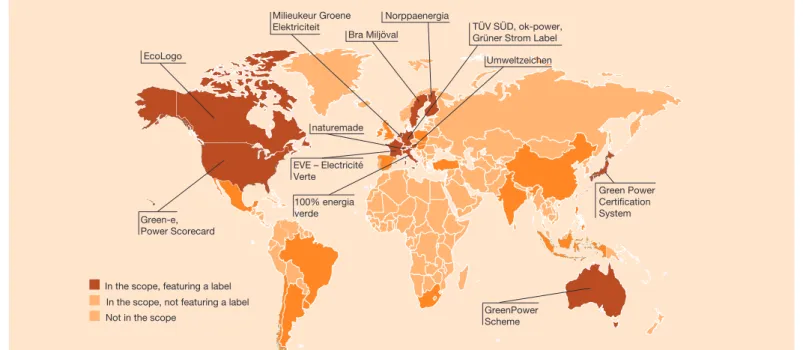
The map below gives a graphical overview of the countries and labels that were part of the study.
3.2 Assessing national renewable
electricity markets
Two sources of information were used to assess the national renewable electricity markets considered in the survey. First, for each country a break-down was made of the total gross electricity production by source (such as coal, gas, or renewa-bles) in 20076. The proportion of renewable electricity was
then further broken down into the types of renewable sources used. In order to ensure data were comparable, official IEA data was used for those countries where information was available. For countries where no IEA7 data was available,
public data was used.
Secondly, a survey approach was used to capture information on the national electricity frameworks and renewable electric-ity systems. A detailed survey was sent to, and filled in, by PwC professionals in the countries where the survey took place, requesting information on the following:
Figure 1: World map indicating countries surveyed and origins of included labels (Source: PwC)
In the scope, featuring a label In the scope, not featuring a label Not in the scope
TÜV SÜD, ok-power, Grüner Strom Label
Umweltzeichen Norppaenergia Bra Miljöval Milieukeur Groene Elektriciteit naturemade EVE – Electricité Verte 100% energia verde EcoLogo Green-e, Power Scorecard GreenPower Scheme Green Power Certification System
National legal framework for renewable electricity; in-cludes sources and references for further information, as well as a brief description of the national electricity market. Overview of all systems available in the country to assess
the characteristics of green electricity for sale. The follow-ing information was requested:
Whether a declaration system existed: A declaration system is a minimum requirement for identifying green electricity products.
Whether a renewables trading system (redeeming system) was in place.
Whether there was a tracking system, or guarantee of origin system, which ensures the traceability of the electricity and the sources.
Whether there were any labels in the electricity market that fulfilled the ISO requirements for “Environmental labels or eco-labelling (Type I)”: this was to identify labels for the second part of the study.
3.3 Assessing the sustainability and
credibility of labels
For those countries where the first survey identified electricity labels that fulfilled the ISO requirements for “Environmental labels or eco-labelling (Type I)”, a second survey was sent to the PwC professionals for completion. This second question-naire concentrated on more detailed information concerning green electricity labels in the countries, such as certification criteria, quality of the labelling procedure and credibility of the label.
In addition to the PwC professionals in the countries involved, a second questionnaire was also sent to the label organisa-tions concerned with the request to fill in the required informa-tion. This double-track approach guaranteed the most objec-tive results possible by increasing the scope of the survey. However, in total only three label organisations returned the completed survey.
The label survey requested information on the labelling system in general and an assessment of the label against
27 defined criteria. As indicated in chapter 2.2, these criteria were divided into two main categories:
Sustainability criteria: Such refer to the impacts electricity generation has on environmental and societal issues. Procedure criteria: These assess the methods and
proc-esses that ensure the content of the label.
Each label was rated against the 27 criteria using four catego-ries: none, low, medium, high. It must however be stressed that even though the graphs give a rough idea of the overall quality of a label, the purpose is not to establish a ranking but rather to provide help to the potential consumer to find the label that matches his preferences best. For example, a potential consumer that finds ecological criteria much more important than process criteria should chose a label that scores high for ecological criteria.
Figure 2: Example for the ranking methodology applied in this survey (source: PwC)
Even though much effort has been put into an objective rat-ing procedure, to a large extent the label assessment is also based on professional judgement. It must be stressed that the assessment of the sustainability criteria evaluated whether the labels provided additional criteria with respect to the national baseline. Therefore, the assessment of the labels has to be seen in the context of the respective countries’ regulations. This again underlines the fact that the label assessment in this survey is not useful for ranking purposes. In this sense, the classification “None” means:
The label does not have the criterion in place; OR There was no publicly available information that would
have served as a basis for a higher evaluation; OR
The country in which the label provides its service already has legal requirements that this criterion needs to fulfil. The analysis framework for photovoltaic electricity is de-scribed as an example of how the assessment worked:
If a label did not have any additional ecological criteria regarding photovoltaic it received the rating, “None”.
6 The overview of the national electricity market is about electricity
produc-tion, as data on consumption was not available at the time the survey was conducted.
7 At the time of the research, only values of the year 2007 were available. The
final numbers of the year 2008 will be published by the IEA in June 2009.
If a label had any additional ecological criteria regarding photovoltaic, such as for example only “protection of the landscape”, it was at least rated as “Low”.
If a label had several additional ecological criteria regard-ing photovoltaic, such as “protection of the landscape” and “consideration of land use aspects”, it was rated as “Medium”.
If a label had a detailed catalogue of additional ecological criteria regarding photovoltaic, such as “protection of the landscape”, “consideration of land use aspects”, “criteria regarding the efficiency of the power plant” and “threshold values for the maximum global impact”, it was rated as “High”.
An example of a label graph can be found below.
Category Criteria None Low Medium High
E co lo gi ca l c rit er ia
1 Hydroelectricity: minimum flow regulations 2 Hydroelectricity: hydro peaking
3 Hydroelectricity: reservoir management 4 Hydroelectricity: bed load management 5 Hydroelectricity: power plant design
6 Hydroelectricity: ecological improvement fund
7 Hydroelectricity: equal treatment of all sizes of power plants 8 Electricity from wind
9 Electricity from photovoltaics 10 Electricity from biomass
11 Electricity from geothermal energy and tidal power plants 12 Electricity from waste
13 Exclusion of non-renewable electricity 14 Quality of renewables support scheme
S o ci al a nd ec on om ic al cri te ria
15 No rivalry between electricity generation and food cultivation 16 Securing soil fertility and land use
17 Biomass tracking
18 Social criteria for dam building projects
19 Corporate social responsibility of electricity producer 20 Market share
Category Criteria None Low Medium High
O rg an is at io n an d p ro fe s-sio na lis
m 12 Representation of industryRepresentation of pressure groups 3 Guarantee of legal compliance 4 Audit by independent third party 5 Periodical revaluation of certification
Ba
la
nc
ing
6 Declaration of origin
7 Avoidance of double counting 8 Regulation for deficit in supply 9 Only net energy permitted 10 LCA verification Tr an s-pa r-en
cy 1211 Availability of information on electricity quality Communication and availability of criteria 13 Protection of consumer rights
Process criteria – label: Example Sustainability criteria – label: Example
Figure 3: Example of the label graph used in the survey to assess the labels, showing the two main categories sustainability and process criteria and the respective subcategories (Source: PwC). For a more detailed description of each criterion please refer to appendix 8.3
Sustainability criteria
Sustainability criteria are divided into two subcategories that reflect the triple bottom line of sustainability, whereby the ecological criteria form one subcategory, social and economi-cal criteria are combined in the second subcategory.
Half the “ecological criteria” (1-14) assess aspects of hydro-electricity as hydropower accounts for the lion’s share (76%) of renewable electricity in the countries included in this report. The basics for the assessment of these categories were taken from the “greenhydro” standard. Two further criteria (6 and 7) cover ecological investment schemes related to hydroelectricity and the rules for producers with respect to size. Criteria 8-12 analyse the ecological standards for other renewable electricity sources. Criterion 13 reflects a binary choice about the exclusion of electricity produced with fossil energy sources. The last ecological criterion (14) evaluates the effectiveness of support for promoting electricity generation from renewable sources.
Criteria 15-20 address the social and economical sustainabil-ity aspects. The first three (15-17) evaluate negative impacts that can result from producing electricity from biomass, such as the recent discussions about bio-fuels triggering rising maize prices and leading to food scarcity in developing coun-tries. Other social aspects are considered by criteria 18-19, which evaluate the working conditions and the protection of cultural assets and – in the case of hydroelectric energy generation – dam building aspects. Finally, criterion 20 looks at the market share of the label which is used as a proxy for economical sustainability.
Procedure criteria
Procedure criteria ensure the label can credibly convince consumers that the stated sustainability criteria, for which the consumer is paying a premium over normal electricity products, are actually being met. Analysis of the procedural criteria was organised into the three subcategories “organisa-tion and professionalism”, “balancing” and “transparency”. The topic “organisation and professionalism” (criteria 1-5) includes information on the independence of the labelling body (separation of powers), the constitution of the labelling organisation and its relationship to pressure groups and the branch.
The subgroup “balancing” (criteria 6-10) concentrates on the equalisation of certified electricity generation and certified electricity sales (avoidance of double counting), reliability of the balancing, turnover and the public awareness of the label.
It also describes the rules for compensation of a deficit in supply as well as the availability and the quality of Life Cycle Assessment (LCA).
“Transparency” is the third subcategory (criteria 11-13). It investigates the availability and the communication of information for the end consumer and the protection of consumers’ rights.
Comments on process of gathering data and
information quality
Note that the country and label surveys were filled in based on publicly available information. No interviews were conducted. As in some cases the information was not accessible or available (such as mix of consumed electricity) there might be some inconsistencies or some information missing. The authors are fully aware of the fact that this study does not provide a complete picture. However, efforts were made to ensure the information provided was reliable.
In order to obtain an additional level of expertise, a steer-ing group9 was set up to support the project team. All the
members of the steering group possess broad experi-ence in the international and national energy market and labelling of green electricity or trading systems and could thus provide valuable input and guidance throughout the project. The steering group was involved at two stages of the project: First, it provided feedback on the evaluation method used for the survey results and second, it as-sessed and reviewed the final report.
This chapter sets out the detailed results of the two surveys conducted. The first survey was directed at assessing na-tional renewable electricity markets, while the second survey concentrated on the labels as a key aspect of the voluntary market and assessed the sustainability and credibility of labels.
Additional general comments on the findings from the surveys as well as on the contribution of electricity labels towards sus-tainable resource management and transparency in renew-able electricity markets are given in chapter 5.
4.1 Results of the assessment of
national renewable electricity
markets
National electricity production
The national electricity production results show that renew-able electricity generally comprises a very small proportion of
total national electricity production. This can be seen in the graph below, which shows the electricity production of the countries in the survey, split into non-renewable electricity sources (fossil, nuclear, other non-renewables) and renewable electricity sources.
Overall electricity production in all countries is still heav-ily based on fossil fuel. Apart from Austria, Canada, New Zealand, Sweden and Switzerland, renewable energy sources for electricity generation still only play a subordinate role. Renewable electricity production, excluding hydropower, remains below 5% in most countries. France’s supportive attitude towards nuclear based energy production is reflected in the graph: It is the country with the highest relative share of nuclear based electricity production.
Figure 4: Sources of electricity production of surveyed countries (Data sources: see respective country reports in chapter 6)
0 100,000 200,000 300,000 400,000 500,000 600,000 700,000 800,000 900,000 1,000,000 1,100,000 1,200,000 Argentina 2 Australia 1 Austria 1 Belgium 1 Brazil 1 Canada 1 Chile 1 Denmark 1 Finland 1 France 1 Germany 1 Hungary 1 India 3 Indonesia 1 Ireland 1 Italy 1 Japan 1 Mexico 1 Netherlands 1 New Zealand 1 Philippines 1 Poland 1 Portugal 1 Singapore 1 South Africa 1 Spain 1 Sweden 1 Switzerland 1 Turkey 1 UK 1 Uruguay 1
1 data from 2007, 2 data from 2006, 3 data from 2004
Electricity production in GWh per annum
0 400,000 800,000 1,200,000 1,600,000 2,000,000 2,400,000 2,800,000 3,200,000 3,600,000 4,000,000 4,400,000 4,800,000 China 2 USA 1 renewables other non- renewables nuclear fossil
National legal framework and financial support
from the government
The survey found that all countries surveyed, except Hong Kong, have a legal framework regulating the electricity market. Financial support from the government for renewable energy, through subsidies, funds, grants or tax exemptions, was pro-vided in nearly two-thirds of the surveyed countries. The table below shows all 22 countries that provide financial incentives:
Region Surveyed countries providing financial support for renewable electricity
Africa South Africa
America Argentina, Brazil, Canada, Mexico, USA Asia Philippines, Singapore
Europe Austria, Belgium, Denmark, France, Germany, Hungary, Ireland, Netherlands, Portugal, Spain, Switzerland, Turkey, UK
Oceania Australia
Table 2: Countries surveyed that provide financial incentives to support renewable electricity. For additional details see coutry reports in chapter 6.
This result shows that policies to promote renewable energy are becoming common, a finding which corresponds to the results of REN21 in the 2007 Global Status Report. REN21 found that 60 countries – 37 developed and transition coun-tries and 23 developing councoun-tries – have some type of policy to promote renewable power generation. The most popular incentive instruments are special feed-in tariffs for renew-able electricity. The number of countries enacting such a policy measure has increased significantly over recent years.
Another common political instrument is setting a target for electricity producers to generate a certain percentage from renewables. Financial market instruments on the other hand, such as capital investments or innovative financing, are not widely used.
Regarding target setting, some countries not only set national but also regional targets. Targets are often specifically al-located to the different renewable technologies (wind power, photovoltaic, solar and so on). Some countries have set ambi-tious goals to significantly increase renewable energy genera-tion capacity within the next twenty to thirty years.
National electricity systems and labels
To increase the market share of renewable electricity, re-newables are promoted by governments through government incentives to motivate a growing number of consumers to switch to renewable electricity. Declaration, trading, track-ing and labelltrack-ing systems are important tools for assisttrack-ing electricity producers and consumers to achieve goals for renewables. These systems provide reliable information on the source of electricity (declaration and tracking), on other characteristics of the electricity (labelling), and allow it to be traded (trading).
Note that even if there is a labelling system in place, a decla-ration or a tracking system is not needed as the label organi-sation could provide these services and information.
An overview of the answers given regarding the systems in place is provided in the table below.
Region Country
Declara-tion system10 Trading system11 (redeeming system) Tracking system12 Guarantee of Origin Labelling system13
Africa South Africa x x
America Argentina x
Brazil x
Canada x EcoLogo
Chile x
10 The declaration system gives the consumer information about the consistence of the delivered electricity mix.
11 Trading systems are database systems, which facilitate merchandising of electricity. In Europe the Renewable Energy Certification System (RECS) is a well known
trading system. See appendix 8.1.
12 The tracking system refers to the production of electricity and declares the origin of the electricity and the corresponding energy source. 13 In this survey a label, i.e. a lable for electricity, is understood to conform to ISO standard Type I.
Region Country Declara-tion system10 Trading system11 (redeeming system) Tracking system12 Guarantee of Origin Labelling system13 America Mexico x Uruguay x
USA x x x Power Scorecard, Green-e
Asia China x Jade Electricity
Hong Kong
India x x
Indonesia
Japan x x Green Power Certification System
Philippines Singapore
Europe Austria x x x Umweltzeichen
Belgium x x x
Denmark x x x
Finland x x x Norppaenergia
France x x x EVE – Electricité Verte
Germany x x x Grüner Strom Label, Öko-Strom, ok-power, TÜV
Nord, TÜV SÜD Generation EE, TÜV SÜD Gen-eration EE+, TÜV SÜD EE01, TÜV SÜD EE02
Hungary x
Ireland x x
Italy x x 100% energia verde
Netherlands x Milieukeur Groene Elektriciteit
Poland x x x
Portugal x
Spain x x x
Sweden x x x Bra Miljöval
Switzerland x x x naturemade basic, naturmade star
Turkey x x x
UK x x
Oceania Australia x GreenPower
New Zealand
Total 34 15 22 22 21
Table 3: Overview of the systems in place in countries surveyed. If there is a labelling system in place, a declaration or a tracking system is not necessarily needed as the label organisation could provide these service and information.
Declaration system
Less than half of the countries surveyed have a declaration system. Of the 15 countries with a declaration system, only two are non-European countries (US and Chile).
Trading system
22 out of the 34 countries surveyed have a trading system for renewable electricity of which 16 are European countries. Hence, nearly all European countries surveyed (Hungary was the only exception) had a trading system, due to Europe’s leading role in setting up RECS. Note that 24 countries were members of RECS as of 2007, and that in addition to the 19 countries included in the survey, Estonia, Luxembourg, Nor-way, Slovenia and Romania are also RECS members. Overall, 81% of the globally existing trading systems are RECS based (18 out of 22).
Trading systems on the American continent exist only in the USA und Canada. This is in contrast to Asia where China, Japan and India have trading systems. Thus, half of the participating Asian countries trade green electricity through a system but none of them is a RECS member. In South Africa, green energy is traded through RECS.
Tracking system
In Europe and America tracking systems are widespread; about three quarters of the participating countries in Europe (13 out of 17 countries) and nearly three quarters in America (5 out of 7 countries) have such a system. In Asia two countries track information; Africa and Oceania each have one country where a tracking system exists.
Labelling system for electricity from renewable energy sources
Overall 13 out of 34 surveyed countries have at least one label.
Out of 19 labels mentioned in the survey 14 are present in Eu-rope, indicating a high interest in labels in European countries. Switzerland and the US have two labels and Germany is way ahead with six labels.
On the Asian continent China and Japan seem to be the pio-neers in a green energy label. A private labelling initiative trig-gered the labelling system in Japan. In Shanghai (China) the World Bank initiated a pilot project for an energy label through its programme “Asia Alternative Energy Program (ASTAE)”.
4.2 Results of the assessment of
labels
The following table shows the results of the assessment of the labels against the sustainability and process criteria. Note that the table is not intended to be used to rank the labels but as a way of assessing labels’ performance against set criteria, which are of interest to electricity consumers. Please refer to chapter 3 for the assessment methodology.
The full details on each criterion can be found in chapter 8.2.
Overall comments
Some of the labels are very broadly defined and are basi-cally applicable to all sorts of renewable electricity. These labels either did not include the sustainability criteria at all or only had vague definitions.
In general, the labels scored better in procedural criteria than with respect to sustainability criteria.
The labels often reflect country specific issues; for example the only two labels that allow electricity from fossil sources (limited to highly efficient gas-fired CHP) are based in Germany, a country with a long history of electricity produced from coal. Likewise, the Swiss labels concentrate on hydropower as Switzerland has abundant water resources; and the Canadian label has criteria for biomass as the country has plenty of forests.
Sustainability criteria
Ecological criteria
All of the 19 labels analysed certify electricity from hy-dropower plants. However, most labels are rather weak with respect to ecological criteria; only about half have further criteria in place to regulate ecological aspects. Only “naturemade star” has very strict and concise rules concerning hydroelectricity. The French label “EVE – Electricité Verte” is in the process of setting up stringent rules for hydroelectricity.
Overall, criteria regarding hydro are not very strict and well developed, a surprising fact considering that hydropower amounts to up to 80% of renewable electricity worldwide.
Category Criteria Bra M ilj öv al ( S E ) E co Lo g o ( C A ) 10 0% e ne rg ia v er d e ( IT E V E - E le ct ri ci té V er te ( G re en -e ( U S ) G re en P ow er C er tifi ca G re en P ow er ( A U ) G rü ne r S tr o m L ab el ( D M ili eu ke ur G ro en e E le kt na tu re m ad e b as ic ( C H na tu re m ad e s ta r ( C H ) N o rp p ae ne rg ia ( FI ) o k-p ow er ( D E ) P ow er S co re ca rd ( U S ) T Ü V S Ü D E E 01 ( D E ) T Ü V S Ü D E E 02 ( D E ) T Ü V S Ü D G en er at io n E T Ü V S Ü D G en er at io n E U mw el tz ei ch en ( A T ) E co lo gi ca l c rit er ia
1 Hydroelectricity: minimum flow regulations 2 Hydroelectricity: hydro peaking 3 Hydroelectricity: reservoir management 4 Hydroelectricity: bed load management 5 Hydroelectricity: power plant design
6 Hydroelectricity: ecological improvement fund 7 Hydroelectricity: equal treatment of all sizes of power plants 8 Electricity from wind
9 Electricity from photovoltaics 10 Electricity from biomass 11 Electricity from geothermal energy and tidal power plants 12 Electricity from waste 13 Exclusion of non-renewable electricity 14 Quality of renewables support scheme
S o ci al a nd ec on om ic al cri te ria
15 No rivalry between electricity generation and food cultivation 16 Securing soil fertility and land use
17 Biomass tracking
18 Social criteria for dam building projects
19 Corporate social responsibility of electricity producer 20 Market share
Category Criteria Bra M ilj öv al ( S E ) E co Lo g o ( C A ) 10 0% e ne rg ia v er d e ( IT E V E - E le ct ri ci té V er te ( G re en -e ( U S ) G re en P ow er C er tifi ca tio G re en P ow er ( A U ) G rü ne r S tr o m L ab el ( D M ili eu ke ur G ro en e E le kt na tu re m ad e b as ic ( C H ) na tu re m ad e s ta r ( C H ) N o rp p ae ne rg ia ( FI ) o k-p ow er ( D E ) P ow er S co re ca rd ( U S ) T Ü V S Ü D E E 01 ( D E ) T Ü V S Ü D E E 02 ( D E ) T Ü V S Ü D G en er at io n E T Ü V S Ü D G en er at io n E U mw el tz ei ch en ( A T ) O rg an is at io n a nd p ro fe ss io n-ali sm 1 Representation of industry
2 Representation of pressure groups 3 Guarantee of legal compliance 4 Audit by independent third party 5 Periodical revaluation of certification
Ba
la
nc
ing
6 Declaration of origin
7 Avoidance of double counting
8 Regulation for deficit in supply
9 Only net energy permitted
10 LCA verification Tr an s-p ar en cy
11 Availability of information on electricity quality 12 Communication and availability of criteria 13 Protection of consumer rights
Figure 5: Overview of the labels evaluated in this survey (Source: PwC).
The labels often had stricter conditions on hydropower than for other renewable electricity sources such as wind, solar or biomass, even though such sources supply a comparatively smaller share of renewable electricity pro-duction than hydro.
All of the 19 labels analysed certify electricity from bio-mass. Around two thirds of the labels do not have very strict criteria in place to regulate ecological aspects of production.
The “naturemade” labels score best regarding criteria for electricity generation from biomass. The French label “EVE” is in the process of setting up stringent rules for electricity from biomass.
Only one of the labels analysed – “ok-power” – allows for electricity from fossil energy sources (limited to high efficient gas-fired CHP). “Grüner Strom Label” also has a label that allows for electricity from fossil fuels. Neverthe-less, this label was not included in the analysis.
The majority of labels do not have support schemes to increase the share of renewable electricity in the electricity market.
Social and economical criteria
Only five labels request strict tracking of electricity pro-duction based on biomass in order to avoid using arable land that would be better used for food production. Strict biomass tracking allows the origin of the biomass used for the electricity generation to be traced. Some further labels have weak rules about the origin of the biomass, but do not have any effective control mechanism in place. A qualified evaluation of a label’s creation of economic
value based on the publicly available information was not directly possible. Instead, the market share15 of the
labelled electricity was used as a proxy for the creation of sustainable economic value.
Procedure criteria
Organisation and professionalism
All labels have pressure groups, such as environmental, consumer or social organisations, in the body responsible for the certification process. However, only ten out of 19 analysed labels also have an independent auditing body to approve the quality of the labels.
Roughly half of the labels put a limit on the temporal validi-ty of the certificates they issue. After a fixed validivalidi-ty period ranging from one up to five years, the electricity producer undergoes re-examination and receives the certification if it still meets the criteria.
Balancing
Half of the labels allow a deficit in supply of certified elec-tricity. Most, however, request that a potential deficit be made up within one year. The tightest rules in this respect are laid down by the four “TÜV SÜD” labels that do not allow any deficit in supply. In contrast, five labels do not have any regulation for a deficit in supply.
Only four of the labels analysed address the topic of double counting actively. Even in these cases though, the information on the control mechanism is not adequate.
Transparency
Most labels provide basic information on the criteria and requirements. The assessment of the communication and availability of the criteria was based on the requirements of an average consumer, which is mainly why most labels score high on this criterion. However, many labels do not fulfil high standards of communication (see textbox on the next page).
The situation with respect to protection of consumer rights is unsatisfactory: on the one hand many labels have a high degree of consumer protection, while on the other there are several labels with no protection of consumer rights what soever.
Need for improved communication
Considering that all labels are applied to the same product (electricity), it was expected that substantial efforts would be undertaken by label owners to explain and justify the price premium the consumer pays for labelled electricity. Easily understandable and publicly available information about the rules and conditions for the labelling process for renewable electricity should be provided to allow potential clients a solid base for the purchase decision and other stakeholders to get the necessary information.
The reality, however, is not so. In general, gathering relevant information to compare labels for renewable electricity today is difficult due to the poor quality and imprecise presentation of published information, low accessibility and language bar-riers. The labels analysed often failed to conform to one or several of the key principles described below:
Accessibility of complete information: A prerequisite for a label to operate should be that the information about the label, its processes and principles, is publicly ac-cessible (i.e. available online). This crucial information, however, was often only partially available and difficult to find.
Updated information:The published information has to be updated on a regular basis. Some of the informa-tion published online was not in line with informainforma-tion received from the labels directly.
Useful form: The information published should be presented in a comprehensive, well-structured man-ner, including all relevant information. The information concerning principles, processes and criteria has to be presented in a manner that excludes the possibility of misinterpretation.
Availability of label responsible for stakeholder ques-tions: The availability of the responsible body for stakeholders questions was more than unsatisfactory. Various negative reactions occurred when questions about the labels’ principles were raised. Moreover, the communication with some labels was very difficult as it took several weeks for answers to inquiries to arrive. Some labels interpreted the attempts to clarify open questions about the label as an insult. Answers pro-vided by the label owners were often inaccurate with respect to data or underlying documentation.
Language:It is desirable that information provided on the label not only is in the language of the home coun-try, but also translated into other languages, notably English. In a globalised world with multinational com-panies, translating information to the most common languages raises transparency and comparability. The principles underlying many labels were not available in English.
The result of the above transparency issues is that the information provided in this survey may not be complete, as the labels might have been assessed on the basis of incomplete information. Even though every effort was made to minimise this risk, it was impossible to succeed in all instances, as missing information requested directly from label organisations was not always received. This fact indicates once more that marketing activities, investor relations, client relationships and stakeholder dialogue are either not a priority or not core competencies of some of the labels.