Procedia - Social and Behavioral Sciences 191 ( 2015 ) 2704 – 2709
1877-0428 © 2015 The Authors. Published by Elsevier Ltd. This is an open access article under the CC BY-NC-ND license (http://creativecommons.org/licenses/by-nc-nd/4.0/).
Selection and peer-review under responsibility of the Organizing Committee of WCES 2014 doi: 10.1016/j.sbspro.2015.04.566
ScienceDirect
WCES 2014
Training Program in Reproduction, Early Development, and the
Impact on Health (REDIH): Four Year Program Evaluation
Dr. Colla J. MacDonald
a*, Dr. Douglas Archibald
b, Dr. Jay Baltz
cDr. Gerald M. Kidder
da Faculty of Education, University of Ottawa, 145 Jean Jacques Lussier, University of Ottawa, Ottawa, Ontario, Canada, K1N6N5. bDepartment of Family Medicine, University of Ottawa ; 43 Bruyère Street (Floor 3JB), Ottawa, Ontario, Canada K1N 5C8. c Ottawa Hospital Research Institute; Ottawa Hospital General Campus, mailbox 411; 501 Smyth Rd, Ottawa, ON K1H 8L6. d Department of Physiology & Pharmacology, Schulich School of Medicine & Dentistry, The University of Western Ontario; 1151 Richmond St.,
London, Ontario N6A 5C1.
Abstract
This paper reports the findings of a comprehensive evaluation of the first four years of a training program in Reproduction, Early Development, and the Impact on Health (REDIH). The objectives of the program are to supplement MA/MS, PhD and Postdoctoral programs, develop the next generation of reproductive scientists, and move the field forward. The data from the analysis of focus group interviews and corroborated by post module survey data revealed that the most appreciated aspect of the REDIH program is that trainees get to meet four days a year with other trainees and mentors from seven universities who are also conducting reproductive science/medicine research. The value of having one-on-one mentor-trainee ratios at meetings, time to network, and visit laboratories and hospitals are features of REDIH that cannot be underestimated. Trainees provided examples of knowledge and skills acquired during REDIH that they are using in their place of work. Moreover, there are several examples of REDIH collaborations extending beyond the meetings. Finally, mentors attributed trainees’ increased confidence and improved presentation skills to their REDIH experience. The REDIH evaluation process provides the ability to troubleshoot problems resulting in a positive learning experience. Mentors listen to trainee’s recommendations and hone the program to meet their expressed needs tempered with training aspects the mentors deem to be important. The value of an emergent design is facilitated by a module format with time between sessions to implement new knowledge and skills. This study demonstrated that evaluation is critical for program design, improvement, and long-term success.
© 2014 The Authors. Published by Elsevier Ltd.
Selection and peer-review under responsibility of the Organizing Committee of WCES 2014.
Keywords: reproductive medicine, graduate training, W(e)Learn framework, emerging design; program evaluation.
_________
* Dr. Colla J. MacDonald. Tel.:+-321-321-321.
E-mail address: [email protected]
© 2015 The Authors. Published by Elsevier Ltd. This is an open access article under the CC BY-NC-ND license (http://creativecommons.org/licenses/by-nc-nd/4.0/).
1. Introduction
A training program in Reproduction, Early Development, and the Impact on Health (REDIH) was initiated in 2009 by researchers specializing in biomedical, clinical, population health and ethics research from collaborating Universities in Quebec, Ontario and Health Canada. The REDIH project received Canadian Institute for Health Research (CIHR) Strategic Training Initiatives in Health Research (STIHR) program funding for six years. The objective of the REDIH program is to provide reproduction and early development training for graduate students, postdoctoral fellows, and clinician-scientists in order to develop the next generation of reproductive biologists in Canada and to move the field forward. This training is meant to be supplementary to the trainees’ graduate or
postdoctoral training programs. Specifically, REDIH exposes trainees to a broader range of methodologies, including basic biomedical, clinical, population health, and ethics research, to place their research in a broader societal and health context, and to promote professional development geared to the various careers in this field. The MA/MS, PhD and Postdoctoral trainees apply and compete for a stipend of approximately $12,000 a year for two
years. In addition, the trainees’ travel expenses and accommodation are covered to attend 2 (two day) meetings for
each of their two years in the program. Semi-annual training sessions for mentors (university faculty and federal government research scientists; experienced researchers) and trainees are the main venues for the presentation of diverse training modules (workshops in presentation skills, peer review and writing skills, knowledge translation, regulatory issues, careers in industry, ethics, visits to hospitals and infertility and research laboratories, to name a few). At the first REDIH meeting in 2009, and with each subsequent bi-annual modular meeting, a comprehensive evaluation of the program has been conducted (MacDonald, Archibald, Baltz, Kidder, & Clarke, 2012; 2013). As the trainees share their opinions in surveys and in focus groups on what would make the program more useful for them, the program is altered to accommodate their preferred learning styles, needs for more practical and specific content, and greater opportunities for application. The result of the evaluation has been an emergent curriculum design continually deleting workshops that are not effective, adding workshops that trainees and mentors feel would enhance trainees’ experience, and adapting the program to improve relevance and applicability. This paper reports the findings of the evaluation of the first four years of the REDIH six year program, concentrating on the findings from the eighth semi-annual meeting.
1.1 W(e)Learn
The W(e)Learn framework was used as a quality standard in this project because this framework has been specifically developed to guide the design, delivery, and evaluation of healthcare education. In addition it has a validated companion evaluation tool to assess programs using the framework. W(e)Learn outlines four critical dimensions of healthcare education —structure, content, media, and service—and is grounded in socioconstructivist theories of adult education. W(e)Learn is intended to elicit four levels of outcomes, the pinnacle of which is transfer of knowledge resulting in organizational change. W(e)Learn offers an emergent design process throughout the design, development, and delivery of the REDIH program so there is on-going evaluation that enables program adaptation and improvement as necessary. (For an interactive version of W(e)Learn visit: http://www.ennovativesolution.com/WeLearn/)
1.2 Aim
The following overall research questions were used as a guide for the evaluation of the REDIH program:
x How did trainees react to the learning experiences?
x Did trainees acquire new knowledge and skills regarding reproductive and early developmental biology and health?
2. Method
A mixed methods approach was used to evaluate the REDIH training program for the reason of combining the strengths of both qualitative and quantitative studies (Pluye, Gagnon, Griffiths & Johnson-Lafleur, 2009). This method offsets the weaknesses and complements the strengths of the quantitative and qualitative research approaches (Bryman, 2007; Creswell & Plano Clark, 2010; Johnson & Onwuegbuzie, 2004).
2.1 Data Collection and Analysis
A total of four focus groups (two with mentors and two with trainees) were held during the June 2013 REDIH meeting at Western University in London, Ontario. There were a total 21 trainees involved in the two
simultaneously run trainee focus group interviews. The trainee focus group participants comprised 1 Postdoctoral Fellow, 18 PhD and 2 MS/MA students from seven universities in Ontario and Quebec. The two mentor focus group interviews comprised fifteen participants (one with eight and one with seven) from the same seven universities as well as Health Canada, industry, and a fertility clinic. Relevant information from the two mentor focus groups was
used to supplement and corroborate the two trainee’s focus groups. Each focus group was audio-taped and then
transcribed verbatim. The transcripts were checked for accuracy by the researcher listening to the audio recording and comparing it to the transcribed text. Open coding of the text was then performed by hand. After a preliminary list of codes was developed, the transcripts were coded a second time. The coding process consisted of grouping the common codes together to form themes based on the W(e)Learn framework.The constructs of the W(e)Learn framework also guided the data analysis of the REDIH Training Module Assessment surveys. The surveys were administered directly after each training module. Descriptive statistics and response frequencies were used to assess
the trainees’ experiences with two learning modules entitled Options, Procedures and Obstacles to Commercialize
Research Results and How to Write and Publish a Scientific Paper, as well as tours of the local in-vitro fertilization
(IVF) clinic with its associated assisted reproductive technology (ART) lab and the neonatal intensive care unit at the Victoria Hospital Campus of the London Health Sciences Centre.
3. Results
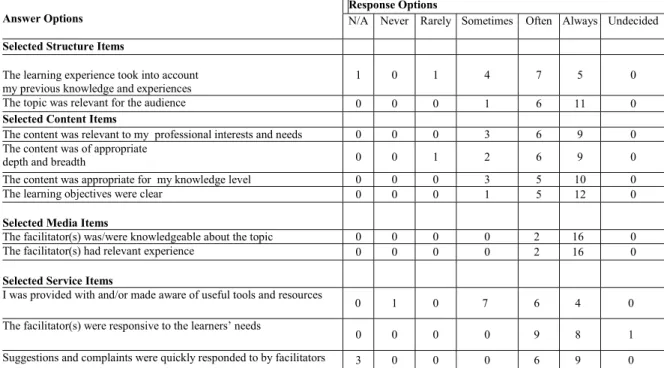
The findings from the four focus groups are chronicled in the ensuing sections and themes are presented in Table 1. Selected results of the Module Assessment Surveys are presented in Figure 1 and Table 2.
Table 1. Themes Based on the W(e) Learn Framework
W(e)Learn Framework Constructs Themes that Emerged from the Focus Groups Content Tour of the IVF clinic and
neonatal intensive care unit
Patent Workshop Job Search Enrichment
Media Poster Presentations Mentor Presentations.
Service Website Emerging Program
Design Networking Structure Termination of the Program Involve More Students Venue Outcomes Knowledge Translation Collaborative Projects
3.1 Content
Trainees unanimously agreed that the visit to the ART lab and IVF clinic, the ART lecture, and the visit to the neonatal intensive care unit, were interesting, informative and a privilege. Trainees also stipulated that touring the hospital and IVF clinic helped them make a connection regarding the impact of their research on practice. Trainees reported the patents workshop presented during REDIH would benefit them in the future. Trainees commented that
they enjoyed hearing how the researcher convinced the investor to ‘put their money down’. Trainees recommended
providing more information on where to look for reproductive medicine jobs at future REDIH meetings. Mentors acknowledged that the positions for reproductive medicine are changing and trainees are not going to be necessarily doing what they thought they would be doing. The mentors discussed many strategies to keep current graduate students motivated and to introduce alternate career options. Mentors voiced concern they were passing on pressure to their graduate students by revealing the stress of getting funded. They expressed it was important that they show their graduate students that they enjoy what they are doing. Trainees reported that REDIH was a wonderful experience and it enhanced their graduate or postdoctoral programs. Trainees were grateful about being exposed to information, techniques and opportunities that they would not be exposed to without the REDIH program. Mentors repeatedly discussed how the REDIH experience provided their graduate students with an advantage over their other graduate students who were not involved in the program. Trainees consistently discussed how REDIH was expanding their thinking, causing them to reflect and preparing them for a career in reproductive medicine. Mentors emphasized that one of the benefits of REDIH was that it is interdisciplinary within the field of reproductive medicine.
3.2 Media
Both trainees and mentors reported that the poster presentation sessions, where trainees present their research and receive feedback, is a wonderful opportunity for trainees. Mentors stated their trainees gained confidence and experience as a result of this opportunity. Trainees stated they would like mentors to present their research and laboratory techniques.
3.3 Service
Trainees recommended making better use of the website by posting previous REDIH sessions and resources such as mentors’ and trainees’ publications. Mentors consistently pointed out that the evaluation of the program has led to an emergent program design with constant honing and improvement of the REDIH program. The trainees concurred and provided several examples of how REDIH has continually improved as a result of the comprehensive evaluation program implemented and the responsiveness of the mentors and administrative to respond to evaluation feedback. Both trainees and mentors reported that one of the biggest benefits of the program is the opportunity that trainees have to network with other reproductive medicine scientists. The trainees were grateful for the small group and close interaction between the trainees and mentors.
3.4 Structure
One of the mentors’ biggest concerns with the program is that the agency is discontinuing the funding. Therefore, in two years when the six year grant runs out, there will not be an opportunity to reapply as with previous grants. Trainees also expressed distress over the fact that the REDIH program will be terminated in two years. Mentors also reported they would like to have the opportunity to extend the REDIH experience to some of their other graduate students. Several trainees commented on the venue of the London REDIH meeting.
3.5 Outcomes
Several trainees testified they used information learned from the REDIH sessions in their workplace situation. Examples repeatedly referred to included information learned from the resume writing and the paper publishing workshops. Several mentors pointed out that the networking from REDIH is extending beyond the meetings. One mentor discussed a collaboration that initiated during REDIH meetings that is taking place between two trainees’
PhD research projects and two mentors’ research laboratories. A second mentor confirmed another collaborative research project taking place between one of his graduate students and another mentor’s graduate student as a result
of REDIH. In this situation the trainees took advantage of the funding provided by the program to visit one another’s
labs to learn new procedures and techniques. Consequently, a collaborative research project was initiated. A third mentor shared that one of his PhD student got a job as a result of REDIH. Trainees also acknowledge that the networking from REDIH is extending beyond the walls of the meetings.
Figure 1. Selected Responses from the Options, Procedures and Obstacles to Commercialize Research Results Module (N=18)
Table 2. Selected Outcomes from the Options, Procedures and Obstacles to Commercialize Research Results Module (N=18) Answer Options
Response Options N/A Strongly
Disagree Disagree Agree Strongly Agree Undecided
I understand new principles 0 0 0 8 9 1
I have gained new knowledge 0 0 0 7 10 1
I will apply new knowledge in the workplace 0 0 1 7 6 4
4. Discussion and Conclusion
This study presents the findings from a training program for graduate students in reproductive science/medicine. The findings from a comprehensive evaluation revealed that the REDIH program has many positive elements that contribute to its success. In response to the research questions, the data from the analysis of the focus groups (corroborated by the survey data) suggested trainees enjoyed the REDIH experience. One of the most appreciated aspects of the REDIH program is that graduate students get to meet four days a year with other graduate students and mentors from seven other universities who are also conducting research in reproductive science and medicine. The value of having approximately one-on-one mentor-trainee ratios at meetings, informal and formal time to network with and learn from other research scientists is a feature of REDIH that cannot be underestimated. Both mentors and trainees feel that REDIH enhances their graduate programs by providing information, training, and learning opportunities that the trainees would not otherwise experience. The trainees reported they enjoyed the venue of this REDIH meeting and the opportunity to visit and compare laboratories and hospitals. Trainees said they enjoyed and appreciated their time with and feedback from the mentors. Trainees provided several examples of new knowledge and skills they acquired from REDIH sessions regarding reproductive and early developmental biology and health. A few trainees provided examples of knowledge and skills acquired during REDIH they are using in their place of work. Moreover, there are several examples of REDIH collaborations taking place and extending beyond the meetings themselves. Trainees and mentors discussed how trainees were using their new knowledge and Answer Options
Response Options
N/A Never Rarely Sometimes Often Always Undecided Selected Structure Items
The learning experience took into account
my previous knowledge and experiences 1 0 1 4 7 5 0
The topic was relevant for the audience 0 0 0 1 6 11 0
Selected Content Items
The content was relevant to my professional interests and needs 0 0 0 3 6 9 0 The content was of appropriate
depth and breadth 0 0 1 2 6 9 0 The content was appropriate for my knowledge level 0 0 0 3 5 10 0
The learning objectives were clear 0 0 0 1 5 12 0
Selected Media Items
The facilitator(s) was/were knowledgeable about the topic 0 0 0 0 2 16 0
The facilitator(s) had relevant experience 0 0 0 0 2 16 0
Selected Service Items
I was provided with and/or made aware of useful tools and resources
0 1 0 7 6 4 0
The facilitator(s) were responsive to the learners’ needs
0 0 0 0 9 8 1
skills to improve their research techniques, enhance their CVs and papers, and initiate collaborative projects and experiments. Finally, mentors attributed trainees’ increased confidence and improved presentation skills to their REDIH experience. This study highlights that all five dimensions of the W(e)Learn are intertwined throughout the design, delivery, and evaluation of a training program. It is the collective impact of these dimensions that leads to a cohesive learning experience. The structure dimension of W(e)Learn emphasizes the importance of understanding participants’ needs and motivations.The REDIH evaluation process provides the ability to troubleshoot problems
resulting in a positive learning experience. Mentors listen to trainee’s recommendations and hone the program to
meet their expressed needs tempered with training aspects the mentors deem to be important. The value of an emergent design is facilitated by a module format with time between sessions to implement new knowledge and skills. This study demonstrated that evaluation is critical for program design, improvement and long-term success.
5. Suggestions
Recommendations identified in the data to further improve the REDIH program include: have mentors present their own research; have past REDIH graduates share how they have benefited from REDIH; have the poster session in two stages so one half can observe while the other half present; include a session on how to get a job; allow more time to collaborate on research grant writing and collaborative projects; and find a way to extend the REDIH program. Both trainees and mentors expressed deep concern that the REDIH program will not be continuing past the current funding period.
References
Bryman, A. (2007). Barriers to integrating quantitative and quantitative research. Journal of Mixed Methods Research, 1(1), 8-22.
Casimiro, L., MacDonald, C. J., L., Thompson, T-L, & Stodel, E. J. (2009). Grounding theories of W(e)Learn: A framework for online interprofessional education, Journal of Interprofessional Care, 23(3), 1-11
Creswell, J. W., & Plano Clark, V. L. (2010). Designing and conducting mixed methods research (2nd ed.). Thousand Oaks, CA: Sage.
Johnson, R. B., & Onwuegbuzie, A. J. (2004). Mixed methods research: A research paradigm whose time has come. Educational Researcher, 33(7), 14-26.
MacDonald, C. J., Stodel, E. J., Thompson, T-L., & Casimiro, L. (2009). W(e)Learn: A framework for interprofessional education. International Journal of Electronic Healthcare. 5(1), 33-47.
MacDonald, C.J, Archibald, D., Baltz, J.M., Kidder, G.M., & Clarke H. (2012). Training Program in Reproduction, Early Development, and the Impact on Health (REDIH): Evaluation of Year 1. Journal of Studies in Education, 2(1), 1-28.
MacDonald, C.J. Archibald, D. Baltz, J. & Kidder, G. (2013). The REDIH Experience: An Emerging Design to Develop an Effective Training Program for Graduate Students in Reproductive Science. Advances in Medical Education and Practice, 4(1-16).
Pluye, P., Gagnon, M-P., Griffiths, F., & Johnson-Lafleur, J. (2009). A scoring system for appraising mixed methods research and concomitantly appraising qualitative, quantitative and mixed methods primary studies in mixed studies reviews. International Josurnal of Nursing Studies, 46(4), 529-546.