Procedia - Social and Behavioral Sciences 31 (2012) 37 – 42 Available online at www.sciencedirect.com
1877-0428 © 2011 Published by Elsevier Ltd. Selection and/or peer-review under responsibility of Prof. Hüseyin Uzunboylu.
Social and
Behavioral
Sciences
Procedia - Social and Behavioral Sciences 00 (2011) 000–000www.elsevier.com/locate/procedia
WCLTA 2011
The effect of teaching collocations on English language proficiency
Mehrak Rahimi
a*, Ghodrat Momeni
aaEnglish Department, Faculty of Humanities, Shahid Rajaee Teacher Training University, Lavizan, Tehran, 1678815811, Iran
Abstract
This study investigated the effect of teaching collocations on English language proficiency. Sixty students participated in a pretest-posttest quasi-experimental design study. For four months, the control group was taught the new words in isolation with traditional techniques such as translation and definition. In the experimental group, vocabulary was taught by providing students with collocations of a particular word through using concordancers and corpus-based activities. After the experiment both groups participated in a language proficiency test. The statistical analyses showed that the experimental group outperformed the control group in the posttest, implying that teaching collocations can improve students‟ language proficiency.
© 2011 Published by Elsevier Ltd.
Keywords: Collocations, language proficiency, English, concordancer;
1.Introduction
Learning a second language involves the manipulation of four main skills including speaking, writing, listening and reading, which leads to effective communication. One crucial factor in this process is the amount of vocabulary one possesses as vocabulary forms the biggest part of the meaning of any language (McCarthy, 1988). As a result of that vocabulary acquisition is currently receiving attention in second language pedagogy and research and how learners acquire vocabulary effectively and efficiently and how it can best be taught are contentious issues in applied linguistics (Lewis, 2006).
There are varieties of techniques to teach and present vocabulary in a course such as physical demonstration, verbal explanation, providing the students with synonyms and antonyms, translation, using visual aids, asking learners to check the meaning in the dictionary, exemplification and presenting a word in the context (Hedge, 2008; Nash & Snowling, 2006). However, it is evident that some of these propounded techniques cannot bring about a great deal of vocabulary retention since learners are not able to make use of presented words in performing academic tasks and communicative activities (Hedge, 2008). Thornbury (2002), for instance, elaborated on the limitation of translation as a technique to presenting words. He added that in spite of being economical, translation cannot warrant a great deal of vocabulary retention since learners over rely on the L1 equivalent and are not actively involved in guessing the meaning from the context.
Among the proposed techniques, research shows that teaching words in chunks can largely enhance the range of the words one can apply in the process of meaning negotiation (Nattinger & DeCarrico, 1992). In line with this, * Mehrak Rahimi. Tel: +982122970035 ; fax: +9821 22970033
E-mail address: [email protected]; [email protected]
© 2011 Published by Elsevier Ltd. Selection and/or peer-review under responsibility of Prof. Hüseyin Uzunboylu.
lexical approach to language teaching places more emphasis on presenting the words in language chunks not in isolation (Willis & Willis, 2006). In this framework, a distinction is made between vocabulary and lexicon, whereas the former concerns words in isolation and the latter is related to words along with their surrounding context or collocations (Lewis, 2006).
Lewis himself insists that the lexical approach is not simply a shift of emphasis from grammar to vocabulary
teaching, as „language consists not of traditional grammar and vocabulary, but often of multi-word prefabricated
chunks‟ (Lewis, 1997). Chunks include collocations, fixed and semi-fixed expressions and idioms, and according to
him, occupy a crucial role in facilitating language production, being the key to fluency. It is suggested that native
speakers‟ fluency is related to the fact that their vocabulary is not stored only as individual words, but also as parts
of phrases and larger chunks, which can be retrieved from memory as a whole and reducing processing difficulties. On the other hand, learners who only learn individual words will need a lot more time and effort to express themselves. (Willis & Willis, 2006)
Consequently, it is essential to make students aware of chunks, giving students opportunities to identify, organise and record these. Hill (1999, cited in Richard & Rodgers, 2003) explains that most learners with „good vocabularies‟
have problems with fluency because their „collocational competence‟ is very limited, and that, especially from
intermediate level, we should aim at increasing their collocational competence with the vocabulary they have already got. This type of vocabulary teaching follows the principles of data-driven learning where learners take the role of analysts and explorers.
Data-driven learning (DDL) highlights learning from a great quantity of linguistic resources or language examples (Schmitt, 2002). This key attribute of a DDL setting gives contextualization for the target language to be acquired, so that learners are encouraged to work as linguistic researchers, hypothesizing and testing lexical or grammatical usage patterns (Johns, 1991a, 1991b). DDL has received much attention over the past few years owing to the prevalence of electronic corpora. Proponents of corpus-driven language pedagogy suggest that a key advantage to this approach is the genuine nature of native speaker corpus data in contrast to “concocted” (Carter & McCarthy, 1988, p. 370) textbook examples.
Sinclair (1997) examined the potential impact of computer-processed language data on language teaching and indicated why language teachers should pay attention to developments in corpus linguistics. A corpus approach supports the use of examples of real language in the classroom (as opposed to the invented ones) and corpus data can provide language teachers and learners with illuminating (and often counter-intuitive) guidance as to frequent collocations and other language patterns. Form-meaning links can be taught in order to minimize the learning load and the language learner can use corpus evidence to help develop individual creativity in language use.
Several studies have lent support to the beneficial effect of concordancing on vocabulary learning. For example
in Todd‟s (1999, cited in Lewis, 2000) study, a class of college students consulted a web-based corpus to help with
their self-corrections of lexical errors. The results showed that these students were able to induce valid patterns from their self-selected concordances and make valid self-corrections of their errors. Mudraya (2008) argues for the integration of the lexical approach with a data-driven corpus-based methodology in English teaching for technical students, particularly students of Engineering because it can enrich the learners‟ language experience and raise their
language awareness while bringing out the researcher in them.
In another study, Varley (2009) found that students generally had a positive response to corpus consultation and were able to identify benefits clearly, particularly in the areas of vocabulary acquisition and increased awareness of syntactic patterns. Most of the participants of his study indicated they are likely to use concordancers in the future and this interest is strongest amongst those students who have clear goals for their language learning. Course assignments produced by these students demonstrated an increased awareness of lexico-grammatical usage, particularly with regard to vocabulary use, phrases and colligational patterns.
Also, Faghih and Sharafi (2006) investigated the role of collocation on Iranian language EFL learners‟
interlanguage. They found that most of errors learners made in their productions were rooted in their lack of proficiency in collocations. They, also, concluded that among the different types of collocations adjective plus noun one poses the largest amount of difficulty to Iranian learners. Their study showed a strong correlation between collocation knowledge and language proficiency. In another study, Jaefarpour and Koosha (2006) found that concordancing materials presented through data -driven learning has a strong effect on learning collocation of preposition. They concluded that if the teacher presents the preposition through the learners‟ consultation of concordances as well as their textbooks the learners will learn them much more easily. They also come to this
conclusion that learners‟ difficulty in spoken and written product is not related to their grammatical or lexical
knowledge but to lack of knowledge of the words accompanies it, that is, the collocation.
However, reviewing the literature of the lexical approach and data-driven learning in EFL context shows that
there is limited study on the effect of teaching collocations and using concordancers on students‟ language
proficiency. Therefore, the current study aims at finding the influence of teaching collocations by concordancers on
EFL learners‟ language proficiency.
2. Method
2.1. Participants
Sixty Iranian pre-university students participated in this study. They were all majoring in the field of mathematical sciences. The groups were chosen according to convenient sampling from six classes in pre-university centres in a small town in the west of Iran. The reason for convenient sampling was the availability of a computer lab for the experimental group. Having used the pre-test-post-test quasi experimental design, the researcher assigned the classes to control and experimental groups arbitrarily.
2.2. Instruments
A language proficiency test was used as a pre-test prior to the study and as a post-test at the end of the experiment. The test had four main parts including reading (35 items), writing (7 items), listening (24 items) and speaking (4 items). The reliability coefficient of the test was estimated using KR20 formula and found to be 0.70 for the pre-test and .78 for the post-test.
2.3. Procedure
The study took place in the academic year 2010-2011. Two pre-university classes (n=60) were sampled and considered as the control (n=30) and the experimental groups (n=30). At the beginning of the study, the proficiency test was administered to both groups. For sixteen weeks, the new words of the reading comprehension passages of the textbook were taught by collocations and using concordancers and corpus-based activities in the experimental group. Meanwhile, the teacher used traditional techniques of teaching vocabulary including explanation, definition, and translation of the words out of the context by referring to the list of words in the form of marginal glosses available in reading passages of the textbook in the control group. At the end of the experiment the language proficiency test was administered again.
3. Results
A mixed between-within subjects analysis of variance was conducted to assess the change in participants‟ language
57) =.252.381, p=.000<.001, partial eta squared=.813) indicating that there was a change in language proficiency scores over two times period. As table 1 illustrates, teaching vocabulary in both groups caused a significant change in their language proficiency scores.
Further, the main effect comparing the two types of teaching vocabulary was also significant, F (1, 58) = 29.125,
p=.000<.001, partial eta squared=.334, suggesting a significant difference in the effectiveness of the two teaching approaches to increase language proficiency.
Table 1. Language proficiency scores for two teaching approaches across two time periods.
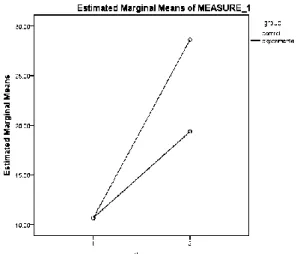
Finally, the interaction effect was also significant (Wilks‟ Lambda=.655, F (1, 58) = 30.556, p=.000<.001, partial eta squared=.345, indicating that the change in language proficiency scores over time was different for the two groups. This means that teaching vocabulary through collocation and concordancing techniques caused a higher level of language proficiency at the end of the language classroom. As figure 1 illustrates, the means of both groups in language proficiency in the first administration were almost the same. However, there is a considerable difference between these two means after the treatment.
Figure 1. The estimated mean scores of two groups in pre-test and post-test.
4. Discussion
The aim of this study was investigating the impact of teaching vocabulary through collocation and concordancing techniques on language proficiency of Iranian pre-university students. The result of the analysis revealed that both groups improved their language proficiency as a result of teaching vocabulary. Therefore, teaching vocabulary has an effect on the improvement of language proficiency and vocabulary teaching, be traditional methods such as translation, explanation and definition or new trend of collocation teaching of the words, can bring about a significant growth in language proficiency (Nunan & Carter, 2002). This supports the fact that it is best not to rely upon incidental learning as the primary source of the learning for new words. Rather, incidental learning seems to be better at enhancing knowledge of words which have already been met (Hill & Laufer, 2003). The finding is a
Time period Group Mean Std. Deviation N
Before treatment control 10.6667 4.01574 30
experimental 10.6364 2.64936 30
Total 10.6515 3.37294 60
After treatment control 19.3606 4.23777 30
experimental 28.6091 6.70249 30
practical and useful guide for syllabus designers and language teachers to place a great deal of emphasis in vocabulary teaching in order to develop language proficiency.
Moreover, it was found that the experimental group who experienced learning vocabulary through collocation teaching and concordance using did better on language proficiency test at the end of the course. Therefore, it can be concluded that although teaching vocabulary affects language proficiency, the level of this effectiveness depends on teaching techniques (here traditional vs. collocations). The better performance from the part of experimental group can be ascribed to the inclusion of collocation teaching and concordances consultation (Mudraya, 2008). This supports the fact suggests that teaching should be based on the idea that language production is the piecing together of ready-made units appropriate for a particular situation. Comprehension of such units is dependent on knowing the patterns to predict in different situations. Instruction, therefore, should centre on these patterns and the ways they can be pieced together, along with the ways they vary and the situations in which they occur (Nattinger, 1980). This idealized situation is interwoven in lexical approach techniques. According to this approach, to attain the collocation pattern of the words learners should consult concordances and collocation dictionaries. Concordancing technology can provide researchers, teachers, and students with a rich tapestry of examples of specific linguistic elements embedded in a variety of rhetorical contexts. Concordancing can also help the user to construct meanings and usage patterns based on sentences or pieces of discourse collected from published or transcribed texts (Kolln, 2007). Moreover, it is found that, concordances make it possible for learner to study syntactic and lexical items in authentic rhetorical contexts and can facilitate what Kolln (2007) calls “the marriage of grammar and rhetoric” (p. xi), which
emphasizes how grammatical choice is influenced by rhetorical context; social constructive views of learning that emphasize the ability of learners to construct meaning for themselves.
One of possibilities of concordances for learners is to learn from being exposed to language through data-driven language learning. The ability to store language data on computer systems and to gain access to them through a software interface has paved the way for the emergence of modern corpus linguistics. The main subject of inquiry of this approach is language data stored in digital format (i.e. language corpora) and its most powerful tool of analysis is the concordancer. Johns (1986, cited in Breyer, 2009) was among the first to suggest putting this research tool into the hands of foreign language learners and named it the „data-driven learning‟ (DDL) is the use of computer-generated concordances in the classroom to get students to explore the regularities of patterning (collocations) in the target language. In DDL, “the learners‟ own discovery of grammar based on evidence from authentic language use
becomes central to the learning process” (Stevens, 1995, p. 3) and makes the learner a language detective. DDL highlights learning from a great quantity of linguistic resources or language examples (Hadley, 2002). This key attribute of a DDL setting gives contextualization for the target language to be acquired, so that learners are encouraged to work as linguistic researchers, hypothesizing and testing lexical or grammatical usage patterns (Johns, 1991a, 1991b).
There is empirical evidence to support the fact that making use of concordances to gain access to the pattern and use of the most frequent words in the language in conjunction with their pattern of uses, can improve their language competence (Belz, 2008) and learners‟ command of collocation can influence their performance on different
language skills and component (Jaefarpour & Koosha, 2006).
Another important factor that should be considered as the reason of increasing learners‟ proficiency by teaching
collocations is decreasing learners‟ language errors. It has been suggested that one of the most common errors in
learners‟ performance is the collocation errors (Faghih &Sharafi, 2006) and there is a high correlation between
learners‟ overall proficiency and their command of collocation.
References
Belz, J. A. (2008). The role of computer mediation in the instruction and development of L2 pragmatic competence. Annual Review of Applied Linguistics, 27, 45-75.
Breyer,Y.(2009). Learning and teaching with corpora: reflections by student teachers. Computer Assisted Language Learning, 22( 2), 153-172. Nunan, D. and Carter, R. (eds) (2002). Teaching English to Speakers of Other Languages .Cambridge: Cambridge University Press.
Faghih, E. and Sharafi, M. (2006).The Impact of Collocation on Iranian EFL learners Interlanguage. Science and Research Quarterly, 16, 58. Hadley, G. (2002). An introduction to data-driven learning. RELC Journal, 33(2), 99-124.
Hedge, T. ( 2008). Teaching and Learning in Language Classroom. Oxford: Oxford University Press.
Hill, M. and Laufer, B. (2003). Type of task, time-on-task and electronic dictionaries in incidental vocabulary acquisition. IRAL, 41(2), 87-106. Jaefarpour,A.A & Koosha, M. (2006). Data-Driven Learning and Teaching Collocation of Preposition. Research on Foreign Language. Journal
of Faculty of Letters and Humanity, 49, 200.
Johns, T. (1991a). Should you be persuaded: Two examples of data- driven. ELR Journal 4, 1-16, University of Birmingham.
Johns, T. (1991b). From printout to handout: Grammar and vocabulary learning in the context of data-driven learning. ELR Journal, 4, 27-45. Kolln, M. (2007). Rhetorical grammar: Grammatical choice, rhetorical effects. New York: Pearson.
McCarthy, M. (1988). Vocabulary. Oxford: Oxford University Press.
Lewis, M.(1997). Implementing the lexical approach: putting theory into practice. Hove: Language Teaching Publications.
Lewis, M (2000). Language in the lexical approach. In M. Lewis, Teaching collocation: Further developments in the lexical approach. (pp. 126-54). Hove: Language Teaching Publications.
Lewis, M ( 2006).Teaching Collocation. Further Development in Lexical Approach. Hove: Language Teaching Publications. Carter, R., and McCarthy, M. (eds). (1988). Vocabulary and language teaching. New York: Longman.
Mudraya , O. (2008). Engineering English: A lexical frequency instructional model. English for Specific Purposes, 25, 235-256.
Nash, H. & Snowling, M. (2006). Teaching new words to children with poor existing vocabulary knowledge: A controlled evaluation of the definition and context methods. International Journal of Language and Communication Disorders, 41(3), 335-354.
Nattinger, J. (1980). A lexical phrase grammar for ESL. TESOL Quarterly, 14, 337-344.
Nattinger, J.R. and J.S. DeCarrico. (1992). Lexical phrases and language teaching. Oxford: Oxford University Press. Richard, J.C & Rodgers. (2003). Approaches and Methods in Language Teaching. Cambridge: Cambridge University Press. Schmitt, N. (2002). Vocabulary in language teaching. Cambridge: Cambridge University Press.
Sinclair, J. (1997). Corpus, concordance, collocation. Oxford. Oxford University Press. Thornbury, S. ( 2002). How to teach vocabulary. London:Longman
Varley, S. (2009). I‟ll just look that up in the concordancer: integrating corpus consultation into the language learning environment. Computer Assisted Language Learning, 22, 2, 133-152.
Willis, D & J. Willis. (2006). Doing Task-based Teaching. Oxford: Oxford University Press.