PLANNING AND DEVELOPMENT OF MINING TOWNS IN GHANA: AN
EXPLORATION OF MINING AND URBAN DEVELOPMENT FRAMEWORKS AND
PRACTICES
by
SARAH GYOGLUU (Student Number: 211158550)
Thesis submitted in fulfillment of the requirements for the degree
Master of Technology: Town and Regional Planning
in the
Faculty of Informatics and Design
at the
Cape Peninsula University Of Technology
Supervisor
: Nigel Tapela
Cape Town Campus
i
DECLARATION
I, SARAH GYOGLUU, declare that the contents of this thesis represent my own unaided work, and that the thesis has not previously been submitted for academic examination towards any qualification. Furthermore, it represents my own opinions and not necessarily those of the Cape Peninsula University of Technology.
ii
ABSTRACT
Ghana has had a long history of mining especially with respect to gold, dating back to the Trans-Saharan Trade where gold precipitated civilisations and was a main commodity of trade among Europeans, merchants and ancient kingdoms. In the 21st century, globalisation coupled with increasing urbanisation has been driving demand for mineral resources and thus the resurging commodity booms. This increases foreign direct investment (FDI) in mining countries like Ghana resulting in not only growth in gross domestic product (GDP) but impacts that transcend macro-level and have direct and indirect impacts on communities in mining regions. The result is often that livelihoods are altered, spin-offs on the local economy emerge and the attendant settlement functions impact on the efficacy of existing mining and development planning and regulatory frameworks. Tarkwa is one of Ghana’s traditional gold mining towns and is the substantive context of the research.
The main objectives of the research were:
To identify the existing key mining and development planning regulations, gaps present and how these have impacted on the efficacy of governments management practices in responding to consequences of mining-led development.
To analyse the urban household’s perceptions of mining impacts on livelihoods, business enterprises and livelihood coping strategies and mechanisms.
To assess the implications of these emerging planning and development frameworks and trends for the effective planning and development of mining towns in Ghana
The highlights of the findings of the research in relation to the above objectives included: The research revealed that urban households’ perception of mining on their
livelihoods was mixed. One of the perceived negative impacts of mining that stuck out from overall responses was scarcity of land for purposes of farming and building. With respect to coping with mining impacts, respondents largely employed a
combination of assets to survive the mining environment. However, respondents’ dependence on human capital-that is, their ability to work and generate income underpinned all livelihoods capitals.
Over 96 percent of business enterprises, perceived purchasing power of people and related available or potential market as the most positive spin-off from mining yet. The informal economy was dominant in terms of business enterprise ownership with informal trading as the most principal form of business enterprise in the informal economy.
iii
The research findings have significant meaning within the broad context of mining-led urban development and with implications for theory, the development and planning for resource-driven settlements (practice) and for further research. For example, with regard to development and planning practice, some glaring challenges include the lack of a proper land management system, “superiority” of some institutions (mine houses)in dealing with the Town and Planning Department and Municipal Assembly, lack of effective collaboration between related institutions, gaps in planning legislations make planning near impossible in Tarkwa.
The effect being that Tarkwa is growing (spatially to accommodate businesses and people coming in) but without an effective and responsive development planning system to effectively channel and coordinate this growth so that long term development is sustained.
The study concludes and recommends that, there is need for a rethink in the way mining towns are planned for and developed in Ghana and should include: a review of the Minerals and Mining law (Act 703) to engender more rights and protection to the communities, a constant review of concession and other agreements to reflect a constantly changing world order, institutional collaboration for planning and development, and long term planning which synchronises spatial and economic planning to capture advantages of agglomeration in and around the Tarkwa mining region.
iv
NOTE ON REFERENCING
The referencing style adopted in this research was based on the Harvard method of Bibliographic citation as recommended by the Cape Peninsula University of Technology. In this regard, dates of publication and page numbers are generally provided in in-text citations, except in cases where general references are made to the text, or where internet materials are cited. In such cases only authors and dates of publication are cited. Following from that, “n.d.” was used in cases where the referred materials had no date and “n.p.” for materials without page numbers. With respect to this study, “n.d.” was largely used in the case of institutional and company websites. However, the date of access of data/information was provided for in the bibliography. “Anon” was used for reports with no author.
Attached to this thesis is an addendum of some interviews used in this research and summaries generated from qualitative data software (Qualitative Content Analyser).
v
ACKNOWLEDGEMENT
God has been good to me and I am continually thankful for His graces and mercies throughout my research journey, especially during my field work.
Nigel, I am more than indebted to you. You have made me a better student at research and a better person. You are among the few people I know who found that balance between being a supervisor, mentor and friend. Thanks for the opportunity to teach in your B Tech class as well. You are the “coolest” supervisor I know.
The environment for my research could not have been achieved without the support of postgraduate staff and students at Town and Regional Planning Department. Colloquiums constantly kept me on my toes helped me understand my work better, share my research experience and learn from others. Thanks to support of my department, I attended my first ever conference which I will forever hold dear. So Belinda, Nigel, Nicholas, Zimkhita, Rayner, Cecil, Taki, Wynton, Eitan, Danai and Chris, I am glad for the opportunity to share and learn from all of you.
To my ever supportive parents, Sylvester Gyogluu and Joyce Yeri; my “battalion” of siblings - Cynthia, Angelica, Betty, Carmel and Benita, thanks for the love, emotional, financial and spiritual support. I couldn’t ask for a better family, you are the best. Need I say more, Birocee Wardjomto you are more than family and the big brother I never had, merci. Not forgetting the best auntie I could ever ask for, Josephine Gyogluu. I haven’t forgotten the love of all the cousins.
Griffith Selorm Klogo, you are the sweetest guy I know. You challenge me to be better every time and always seem to know what to say when I am at my nethermost point. Thanks for always being there. I more than appreciate and love you.
To my Cape Town “family”, Naa Dakora, Reuben Dassah, Ernest Bruttoh, Josephine Dassah, Caroline Bruttoh, Thozama Rululu, Gertrude Dakora, Laban Bagui, Samuel Norvi, Jorge, Nafisa Nabong and Fred Okumu, my experience of Cape Town went beyond my wildest expectations because of all of you. Thanks for the fun, laughs, arguments, food, braais, wine and advice. My thanks also go to Prof Felix Dakora, Prof Nicholas Biekpe and Dr. Maurice Dassah for your constant advice and support.
To Rockson Niminga-Beka and Malcolm Yendaw, you guys really rock! Your dedicated support to my research at different stages was heartening and overwhelming. I am more
vi
than humbled to have you two as friends. Blessings to you too Benedict Mensah Arkhurst for the time and effort. I am thankful. May your cup runneth over.
My deepest gratitude to all the staff of institutions I visited and all who supported my field work in Tarkwa especially Mr. Kizito Ballans, Mr. Frank Sarpong, Mr. Baidoo (AngloGold Ashanti), Mr. Owusu-Koranteng and Mr. Pelpuo (WACAM), Mr. Ali and Mr. Moses (EPA), Mr. Antuokuu, Dr. Yendaw and Prof Suglo (UMAT). To field assistants, Godfred, Collins, Emmanuel, I appreciate the time spent with you guys.
To all my friends who sincerely had me at heart during my research especially to Noela Gbireh, Dery Judith, Dr.Ubeida Koray, Colette Santah, Randy Wanye, Patrick Cobbinah, Rev. father Lazarus Langbiiri, Jude Kyoore and Frank Darcha. You responded to my grumbling and complaints with encouragement, understanding, prayers and laughter.
My sincerest gratitude to all who helped me in diverse ways with this research and for which I could not state their names. God abundantly bless you all.
Lastly, to the Cape Peninsula University of Technology for financial support without which this research output would have been impossible.
vii
DEDICATION
To my late brother, Anthony Kanyiri Gyogluu; though your life was short-lived, the memories still linger and will always be with us ….
viii
Table of Contents
DECLARATION ... i ABSTRACT ...ii NOTE ON REFERENCING ... iv ACKNOWLEDGEMENT ... v DEDICATION ... viiLIST OF FIGURES ... xiii
LIST OF TABLES ... xv
EXPLANATION OF KEY TERMS AND CONCEPTS... xvi
ACRONYMS ... xviii
CHAPTER ONE ... 1
BEYOND GOLD BOOM IN THE PLANNING AND DEVELOPMENT OF MINING REGIONS IN GHANA - BACKGROUND AND KEY ISSUES ... 1
1.1 Introduction ... 1 1.2 Tarkwa Contextualised ... 3 1.3 Background to Problem ... 4 1.4 Statement of Problem ... 7 1.5 Research Questions ... 7 1.6 Research Objectives ... 8 1.7 Research Assumptions ... 8 1.8 Delimitation of Research ... 9 1.9 Significance of Study ... 9 1.10 Limitations of Study ... 10 1.11 Organisaton of Study ... 10 CHAPTER TWO: ... 13
MINING-LED URBAN AND REGIONAL GROWTH AND DEVELOPMENT ... 13
2.1 Introduction ... 13
2.2 Mining-led Growth and Impacts within a Global and African Context: ... 14
2.2.1 Mining-led Growth and Macro-level Impact through Foreign Direct Investment (FDI) ... 14
2.2.2. Mining-led Growth and Spatially Defined Impacts on Settlements and Livelihoods ... 16
2.2.2.1 Socio-Economic Impacts ... 17
2.2.2.2 Environmental Impacts ... 21
ix
2.3.1 Vulnerability Context ... 23
2.3.2 Capabilities/Assets ... 23
2.3.3 Policies and Institutions ... 24
2.4 The Conundrum of Mining and Development: An Exploration of the Theoretical Founding of Mining in Development and Practice. ... 24
2.4.1 Mining is Good for Development: Earlier Mainstream Development Theory ... 26
2.4.2 Mining is bad for Development: Critical Development Economics ... 28
2.4.2.1 Structuralism and Dependency Theories: ... 28
2.4.2.2 Growth Center theory. ... 28
2.4.3 Other Development Theories: Mining is Bad for Development ... 32
2.4.3.1 The Resource Curse and Sustainability: The Paradox of Resource Endowment ... 33
2.4.4 Pendulum Swings in Mining’s Favour- Recent Trends in Development Discourse ... 36
2.5 Chapter Summary ... 40
CHAPTER THREE: ... 41
DEVELOPMENT AND PLANNING FRAMEWORKS FOR MINING TOWNS AND REGIONS ... 41
3.1Introduction: Mining and Development Frameworks for Mining Regions ... 41
3.2 The Case of Chile ... 43
3.2.1 Regulatory Reform for Development ... 43
3.2.2 Mining regulatory framework: Law Reforms ... 44
3.2.3 Complementary Policies and Fiscal Discipline ... 45
3.2.4 Institutional Reform and Strengthening ... 47
3.3 The Case of Botswana ... 48
3.4 The Ghanaian Experience ... 52
3.4.1 Development Planning and Mining Regulatory Frameworks of Ghana’s Mining Towns: An overview ... 52
3.5 Periodising Development Planning and Mining Regulatory Frameworks and Impact in Ghanaian Mining Settlements ... 53
3.5.1 Spatial Footprints of Mining: Pre-colonial Era – Colonialism (before 1957) ... 53
3.5.2 Mining Regulatory frameworks in Post-colonial Period (cf.1957) and Economic Recovery (cf.1984) Periods ... 57
3.5.3 Development Planning Regulatory frameworks in Post-colonial (1957) to Post Economic Recovery (1984) Periods ... 63
3.6 Chapter Summary ... 68
CHAPTER FOUR ... 71
x
4.1 Introduction ... 71
4.2 Research Approach/Strategy ... 71
4.3 Tarkwa in Context: Profile of Study Area ... 72
4.3.1 Physical Characteristics ... 72
4.3.2. Urban Structure of Tarkwa ... 73
4.3.3 Tarkwa and Gold Mining ... 74
4.3.3.1 The Mining Companies - AngloGold Ashanti-Iduapriem ... 75
4.3.4.2 The Mining Companies - Goldfields Ghana-Tarkwa ... 75
4.5 Methodology ... 75
4. 5.1 Overview of Data Collection Methods, Tools and Technique ... 76
4.5.2 Data Collection Tools and Methods ... 77
4.5.3 Sampling Method and Sampling Frame ... 82
4.5.4 Calculation of Sample Size for Households ... 84
4.5.5 Data Analysis and Synthesis ... 84
4.5.5.1Quantitative Data ... 84
4.5.5.2. Qualitative Data Analysis ... 85
4.5.6 Data Validity and Reliability ... 88
4.5.7 Issues of Trustworthiness: Transferability, Credibility and Dependability ... 88
4.5.8 Ethics, Limitations of Research Design and Methodology ... 89
CHAPTER FIVE ... 90
LIVING IN A MINING ENVIRONMENT: HOUSEHOLDS’ SOCIO-ECONOMIC CHARACTERISTICS AND THEIR PERCEPTIONS OF IMPACTS OF MINING ... 90
5.1 Introduction ... 90
5.2 Socio-Economic and Demographic Characteristics of Respondents ... 91
5.2.1 Formal Employment Trends in Mining ... 91
5.2.2 Gender and Employment ... 93
5.2.2 Levels of Education Households ... 96
5.2.3 Previous Place of Stay ... 100
5.2.4 Age, Previous Place of Stay and Length of Stay in Tarkwa ... 101
5.2.5 Length of Stay, Type of Employment and Marital Status ... 102
5.3 Urban Households’ Perceptions of Mining Impacts ... 106
5.3.1 Perception of Positive Impacts of Mining on Individual Households... 106
5.3.1.1 Employment/Job Opportunities ... 106
5.3.2 Perception of Positive Impacts on Larger Community ... 110
5.3.2.1 Provision of Facilities ... 110
xi
5.3.3 Perception of the Negative Impacts of Mining on Individual Households’ ... 115
5.3.3.1 Increased Cost of Living and Scarcity of Land for Building and Farming ... 115
5.3.3.2 Environmental Impacts 1: (Structural Deterioration and Damage of Buildings) ... 117
5.3.3.3 Environmental Impacts 2: Pollution (Air pollution, Dust particulate, water pollution) ... 118
5.3.4 Perception of Negative Impacts on Wider Community ... 118
5.3.4.1 Scarcity of Land to Support Farming and Businesses ... 118
5.3.4.2 Social Vices and Increased School Drop out ... 119
5.3.5 Chapter Summary ... 124
CHAPTER SIX ... 126
PERCEIVED IMPACTS OF MINING SPIN-OFFS ON THE DEVELOPMENT OF BUSINESS ENTERPRISES IN TARKWA ... 126
6.1 Introduction ... 126
6.2 Business Enterprise Characteristics ... 127
6.2.1 Gender, Business Categories and Years in Business Enterprise ... 127
6.2.1.1. Informal Trading ... 129
6.2.2 Age, Specific Business Enterprise Category and Choice of starting Business in Tarkwa ... 132
6.3 Business Enterprise and Perception of Location ... 135
6.4 Perceived Impacts of Mining on Business Enterprises and their Sustainability ... 136
6.5 Chapter Summary ... 141
CHAPTER 7 ... 143
EMERGING LIVELIHOODS AND COPING STRATEGIES OF URBAN LIVELIHOODS IN TARKWA ... 143
7.1 Introduction ... 143
7.2 Coping Strategies and livelihood Capital Adapted ... 144
7.3. Emerging Livelihood Strategies/Mechanisms ... 154
7.4 Chapter Summary ... 155
CHAPTER EIGHT ... 156
DEVELOPMENT PLANNING RESPONSE TO MINING-DRIVEN URBANISATION ... 156
8.1 Introduction and Context ... 156
8.2 Current Planning framework in Tarkwa: Spatial and District Development Planning 157 8.2.1 How Planning legislation and Related Policy Failings is Magnifying Tarkwa’s Urban Problems ... 157
8.3 How is Mining and Mining Related Urbanisation Affecting Planning? ... 160
xii
8.3.2 The Land Question ... 162
8.4 Other Factors Militating Against Planning Effectiveness and Implementation ... 163
8.4.1 Institutions ... 163
8.4.2 Illiteracy ... 164
8.4 Chapter Summary ... 165
CHAPTER NINE ... 166
CONCLUSIONS AND RECOMMENDATIONS ... 166
9.1 Introduction ... 166
9.2 Mining and Development Planning Frameworks ... 166
9.3 Mining Impacts and Emerging Livelihood Strategies in a Mining Region... 167
9.4 Development and Planning Practices and Response to Mining-led Urbanisation ... 170
9.5 Recommendations: Towards a Different a Approach in Overall Planning and Development of Tarkwa and Mining Regions of Ghana ... 171
REFERENCES ... 176
APPENDICES ... 191
Appendix A: Key Mining Legislations/Laws in Ghana ... 191
Appendix B: Some Key Feature of Minerals and Mining Act, 703 ... 191
Appendix C: Procedure for grant of Mineral Rights under Act 703 ... 192
Appendix D: Key Institutions of mining and their functions ... 194
Appendix E: Structure of Local Governance System in Ghana ... 195
Appendix F: DFIDs Livelihoods Framework ... 196
Appendix G :Business Enterprise Category Description ... 197
Appendix H: Research Classification Characteristics for Informal Economic Activities .. 197
Appendix I: Household Questionnaire... 198
Appendix J: Business Enterprise Questionnaire ... 203
Appendix K: Interview schedule for UMAT ... 213
Appendix L: Interview Schedule for TCPD, National Office ... 215
Appendix M: Correlation of age of respondent and Number of years lived in Tarkwa .... 215
Appendix N : Chi square test: Level of Education and Employment Category ... 216
Appendix O: Chi square test: Age of Respondent and Previous Place of Stay ... 216
Appendix P: Chi square test: Length of stay in Tarkwa and Marital status ... 216
xiii
LIST OF FIGURES
Figure 1. 1: Tarkwa in a Locational Context ... 4
Figure 1. 2: Planning and Developmental Problems Associated With Mining Regions ... 6
Figure 1. 3: Key Questions Emerging from Interactions Among Mining Stakeholders ... 7
Figure 1. 4: Overview of Thesis Structure ... 12
Figure 2. 1: Mining and Regional Development: Phases Over Time ... 39
Figure 3. 1: Mineral Productions from 1925-1957 ... 54
Figure 3. 2: Key Notable Mining Towns in Ghana in the Colonial Period ... 56
Figure 3. 3: Gold Production from 1958-1980 ... 57
Figure 3. 4: Gold Production of Ghana from 1980 – 2007 ... 58
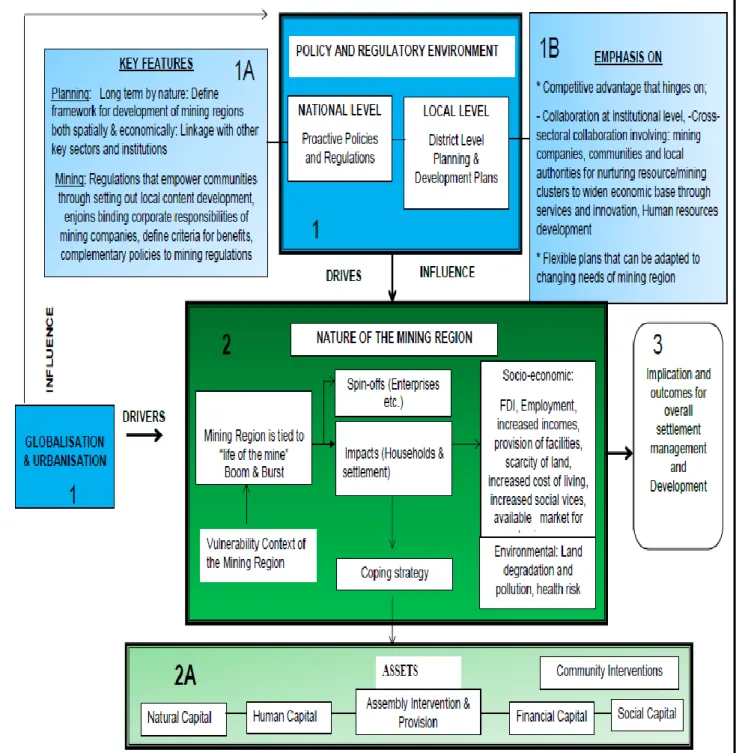
Figure 3. 5: Periodising Mining-Driven Urbanisation and Development Planning in Ghana . 64 Figure 3. 6: A Framework of Interactions and Dynamics in a Mining Region Within a Development and Planning Context ... 70
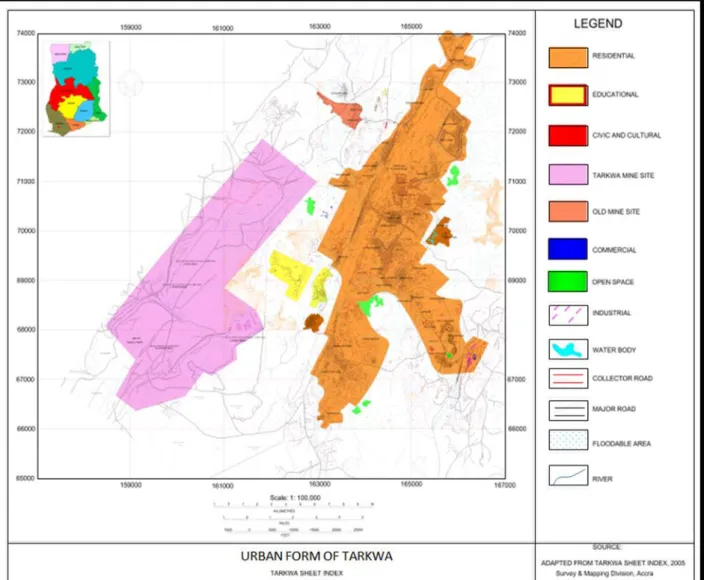
Figure 4. 1: Urban Form/Structure of Tarkwa ... 73
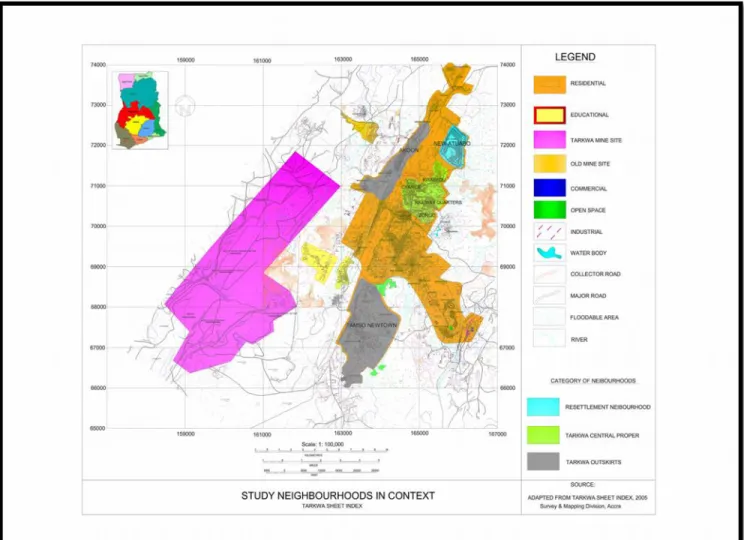
Figure 4. 2: Demarcations Used for Questionnaire Administration ... 83
Figure 4. 3: Qualitative Data Analyser Interface Showing Input of Interviews and Output of a Pairwise Comparison ... 87
Figure 5. 1: Background to Chapter Analysis 90 Figure 5. 2: Employment Trends for AngloGold Ashanti and Goldfields Ghana (Tarkwa) 2008-2011 92 Figure 5. 3: Formal Employment Trends for Mining 1994-2004 92 Figure 5. 4: Employment category and Gender of Respondents 94 Figure 6. 1: Number of Years of Operation of Business Enterprise ... 128
Figure 6. 2: Business Enterprise Categories and Gender Employment ... 129
Figure 6. 3: Informal Sector Trading and Gender Employment ... 130
Figure 6. 4: Major Revenue Items of TNMA from 2009-2011 ... 131
Figure 6. 5: Ages of Respondents and Business Enterprise Employment ... 133
Figure 6. 6: Ages of Respondents and Reasons for Location of Business Enterprise in Tarkwa ... 134
Figure 6. 7: Perceived Challenges to Operating Business Enterprises in Tarkwa ... 139
Figure 6. 8: Perceived Factors for Continued Sustenance of Businesses ... 139
Figure 6. 9 : Rating of Perceived Factors Affecting Growth of Businesses in Tarkwa ... 141
Figure 7. 1: Frequency Count of Livelihood Capitals Available to Urban Households in Tarkwa ... 145
Figure 7. 2: Pairwise Comparison of Human Capital and other Livelihood Capitals ... 147
Figure 7. 3: Pairwise comparison of Financial Capital and other Livelihood Capitals ... 150
Figure 7. 4: Land and Housing as Important Financial Assets ... 152 Figure 7. 5: Pairwise Comparison of Social Capital and other forms of Livelihood Capital 153
xiv
Figure 8. 1: Background Context to Planning in Tarkwa ... 157 Figure 8. 2: Population Increase into Outlying Settlements of Tarkwa ... 161
xv
LIST OF TABLES
Table 2. 1: Reformulation of Components of Local Economic Development ... 38
Table 4. 2: A Précis of Data Collection Methods and Tools ... 81
Table 5. 1: Perception of Mining Impact to Support Farming and Businesses ... 119
Table 5. 2: Annual Crime Report for Tarkwa 2009-2011 ... 120
Table 6. 1: Record of Land Registration for TNMA 2007-2012 ... 132
Table 6. 2: Perception of Location of Present Business Enterprises ... 135
Table 6. 3: Cross Tabulation of Perception of Current Business Location and Preference for a Different Location ... 136
Table 6. 4: Response to Perceived Impacts of Mining on Businesses Enterprises ... 137
Table 6. 5: Employee Numbers per Sector Category of Businesses ... 137
xvi
EXPLANATION OF KEY TERMS AND CONCEPTS
The concepts and terms explained below are used in context of relevance to this research
Mining-Led Urbanisation, Growth and Development
Since this research is focused on mining-initiated growth, the urbanisation that ensues therefrom will be explained as an increase in population and changes in the physical extent of mining regions due to the attractive pull of the extraction of mineral resources and related activities as well the socio-economic changes in lifestyles. Mining-led urbanisation result from the intrinsic character of mineral resources which is associated with “boom and bust” nature of mining economies. This term “boom and bust” originated from business and economics circles and refers to: (a) “pattern of performance over time in an industry or economy that alternates between extremes of rapid growth and extremes of slow growth or decline as opposed to sustained steady growth thus a boom and bust cycle or sequence”. (A boom town is) a town that develops or rapidly expands, as a result of a population influx in response to the discovery of a valuable resource (example oil, gold) in the area (Cleveland & Morris, 2008: 58).
In terms of the focus of this research, the emphasis of mining-led urbanisation is not on the process as it is with the changes that take place in socio-economic and spatial terms, and how this impacts livelihoods, business enterprises and the outlook of mining towns in general.
Within the context of this study, a distinction is made between mining-led growth and development. Mining-led growth will refer to spatial and socio-economic changes (positive or negative) that take place as a result of mining-led urbanisation and injection of investment capital into a mining region. Mining-led development looks at the broader and long term picture of how the transformation of mining regions can make for a self-sustaining region after mining has ceased. Both concepts intrinsically also raise the question of urban development and urban management.
Urban Development
According to Van Dijk (2006) the schools of thought on urban development relate to the spatial with some emphasis on planning and the economic issues and which stress the need for competitiveness of the urban area in its management. This research associate urban development to be influenced by the two main processes of urbanisation and urban growth (Bhatta, 2010 makes a distinction between the two) and essentially the two processes are
xvii
associated with some form of change. In the mining region this change is manifested in either a growth or shrinkage. Within the context of this research, emphasis is placed on development planning aspects of urban development in dealing with this change in the mining region; which was not defined within the strait-jacket blocks of spatial or economic aspects of urban development. Thus issues of urban management are brought to the fore.
Frameworks
Frameworks as used in this research refer to policy and regulatory environment for mining on one hand and development planning on the other hand. This research focused on the key policies and regulations as both mining and planning have numerous policies and legislations.
Galamsey
A term used to refer to illegal mining in Ghana. “Galamseyers” refers to people engaged in the activity of galamsey. Also referred to as “zamazama” in South Africa and “Uchimbaji haramu wa madini” in Swahili in East Africa.
xviii
ACRONYMS
ARC Appalachia Regional CommissionDFID Department for International Development EIR Extractive Industries Review
FDI Foreign Direct Investment
GDP Gross Domestic Product
GES Ghana Education Service GLSS Ghana Living Standards Survey
GoG Government of Ghana
GPRS Ghana Poverty Reduction Strategy
GSGD Ghana Shared Growth and Development Agenda GSS Ghana statistical Service
ILO International Labour Organisation
MoFEP Ministry of Finance and Economic Planning
MoLG&RD Ministry of Local Government and Rural Development MMDAs Metropolitan Municipal & District Assemblies
MNC Multinational Companies
NGO Non-Governmental Organisaton
NVTI National Vocational Technical Institute
OECD Organisation for Economic Co-operation and Development RECA Rural Environment Care Agency
SEED Sustainable Economic Empowerment and Community Development Programme
SPSS Statistical Package for Social Sciences TNMA Tarkwa-Nsuaem Municipal Assembly UMAT University of Mines and Technology
UNCTAD United Nations Commission on Trade and Development UNDP United Nations Development Programme
UNFPA United Nations Population Fund USA United States of America
xix
1
CHAPTER ONE
BEYOND GOLD BOOM IN THE PLANNING AND DEVELOPMENT OF MINING
REGIONS IN GHANA - BACKGROUND AND KEY ISSUES
1.1 Introduction
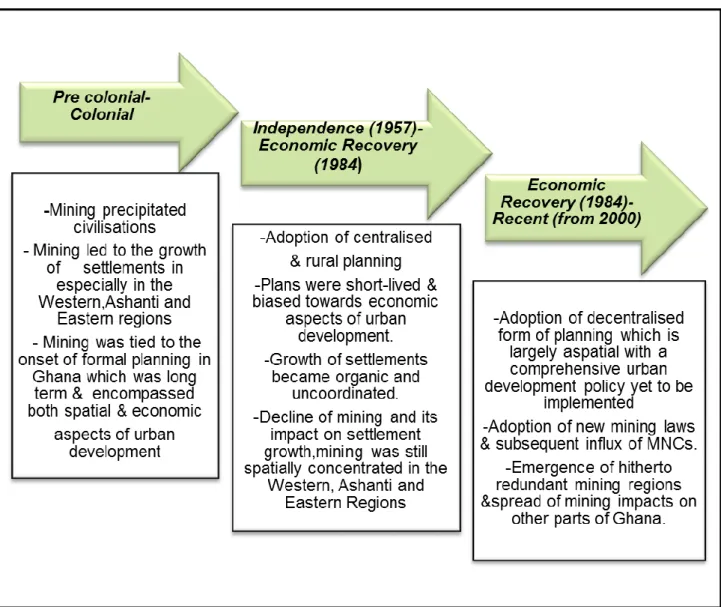
Gold is fundamentally a unique precious metal as is the mining industry it is found. Gold precipitated ancient civilisations and was an important commodity in the Trans-Saharan Trade among ancient kings, kingdoms, Europeans and merchants (Hilson, 2002). In the twenty-first century, gold is craved not only for its industrial and decorative purposes, but more notably as a safe and lucrative form of investment where it is used as a hedge against risks that might cause rapid inflation (Kutschinksky, 2011; Weavind, 2013). The distinctiveness of mining activity is founded on the mine “life” and also on the fact that mining is a footprint industry. The “life” of a mine is tied to the mining region and spans from exploration and development, expansion and maturity, production, decline to exhaustion (Spooner, 1981). Mining activity is also associated with “boom and bust” economic cycles: these being alternating periods of steady growth with periods of slow growth (Cleveland & Morris, 2008:58). The boom is associated with mining-led urbanisation and massive capital and infrastructure investment often during the early stages of the mine cycle. The bust is associated with negative externalities when there is contraction in mining at the later stages. These impacts which could be positive or negative affect livelihoods and alter the socio-economic rhythms of communities and spatial functions of mining settlements and regions. The extent to which benefits or problems from mining will persist depends to some extent on planning and mining legislative frameworks and management, and characteristics of the mining region in question.
Ghana is a country immensely endowed with a diversity of mineral resources. This ranges from gold, bauxite, manganese, diamond, iron ore, and in recent times, the discovery of oil in commercial quantities in 2007 and subsequent exportation in 2011. Ghana’s range of mineral wealth notwithstanding, the most important mineral yet in its development trajectory is gold. Before Ghana’s independence from British colonial rule in 1957, it was called the “Gold Coast” due to the country’s wealth in gold deposits. Gold’s exploitation during the colonial times was vital to the development of infrastructure, contributed largely to the growth of mining towns like Obuasi, Tarkwa, and Prestea (Dickson, 1969) to more recent times where gold mining still influences the growth of settlements. According to the Mining Journal Special Publication Report (2011:9-10), Ghana’s mining sector has contributed an average
2
of 5.5 percent to Gross Domestic Product (GDP) from 2000-2008 and accounts for about 5 percent of formal employment. In terms of commodity exports, minerals alone accounted about 20 percent in the mid-1980s, through to 35 percent in 1991 and heights of 45 percent in 2008. Gold alone accounted for about 95 percent of this total minerals contribution (ibid: 9-10).
These benefits notwithstanding, the mining sector has generally been accused of not making significant contributions to the overall development of the country, and especially in towns and regions that host these mining activities (Akabzaa & Darmani, 2001; Akabzaa, 2009; Ababio & Boon, 2009). This is partly blamed on lax mining regulations and mineral sector reforms which allow for high fiscal incentives and high foreign exchange earnings that mining companies are allowed to keep in their off-shore accounts (Akabzaa & Darmani, 2001). Some authors, for example, Hilson (2004) suggest that reforms of some of Ghana’s mineral policies is one of the ways of addressing the negative impacts of mining sector’s beneficiation of mining communities. Mining companies contend that the general lack of sustainable development of mining towns cannot be exclusively blamed on their operations but is as result of the prevalent nature of poverty in many parts of Ghana (Ababio & Boon, 2009).
Van Dijk (2006:3) laments that urban development and management functions in developing countries is limited to checking of building permits, indication of the location of roads, ensuring minimum standards of buildings and restrictive legal frameworks and local conditions. The aforementioned observation paints a vivid image of urban development in Ghana and thus the planning functions required. The urban development agenda of Ghana’s towns has been bereft of an enabling national urban development policy for the past twenty years. Urban development projects implemented in the past were limited to improving infrastructure and service delivery in urban areas (GoG, 2010a). These limited interventions were taken outside a more comprehensive social-economic development policy, especially for resource-based settlements and regions – thus the benefits were marginal. Key frameworks of urban development are largely inadequate and incongruous with the dynamics of a mining region resulting in ineffective responses to development management. All of the above reasons notwithstanding, mining operations have considerably altered lives and livelihood patterns in mining communities leaving them vulnerable to socio-economic and environmental shocks.
Against a backdrop of these key issues, a two-pronged approach was adopted for this research.
3
Firstly, the challenge of effective settlement growth management for mining-led urbanisation hinges on frameworks for urban development as well as mining. The study argues that mining regions by their nature are unique and therefore they present a different set of challenges in terms of impacts on livelihoods and settlement management. These sets of impacts are explored in detail as well as delving into the development thinking and exemplars around which effective settlement management should be pursued in mining regions. Arising from this is the need for effective frameworks to meet this challenge. By frameworks, the researcher means regulatory and policy mechanisms of mining and urban development that should guide mining-led growth. There was therefore an exploration of theory and concepts through literature around frameworks of mining and urban and regional growth. Attention was focused on key frameworks in the substantive research context of Ghana.
With the literature review creating the foundation of an understanding of mining and urban development with emphasis on development planning in a broader Ghanaian context, the second part of the research explores in detail the impacts of mining on the livelihoods of households and the coping strategies they adopt to deal with these impacts. The research also explores spin-offs on business enterprises development. The later part of the research relates to praxis and explores existing urban development frameworks in terms of development planning in dealing with the impacts that mining-led urbanisation presents. The research concludes and draws implications for effective settlement management in a mining region. The substantive research context for the second part of the research is Tarkwa in the Western Region of Ghana.
.
1.2 Tarkwa Contextualised
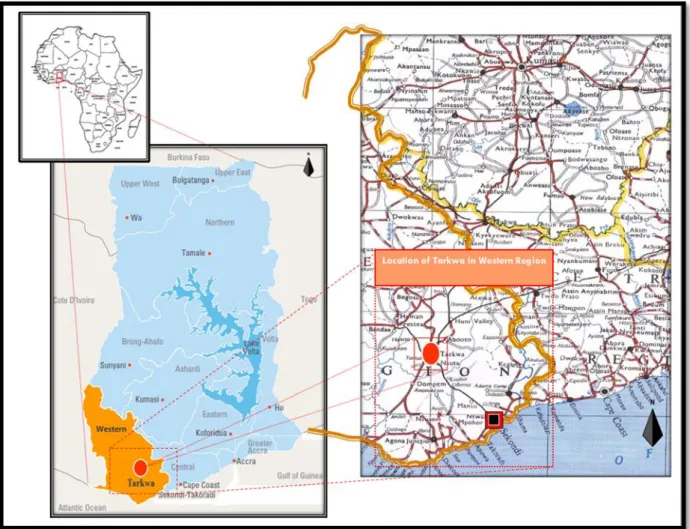
Geographically, the research was undertaken in Tarkwa. Tarkwa is located in the Western Region of Ghana and is the municipal capital of the Tarkwa-Nsuaem Municipal Assembly. The location of Tarkwa in the national and regional Context is shown in Figure 1.1. The 2000 Population and Housing Census put the population of the Tarkwa-Nsuaem Municipality at 107,712 comprising 49 percent female and 51 percent male. The municipality has 20 core settlements with Tarkwa being the most urbanised and spatially dominant in population concentration. For example, Tarkwa had 30,631 people in 2000 made up of 15,233 males and 15,398 females and an average household size of 4.2. It also performs the highest number (32) of functions in the municipality with the next settlement in the hierarchy being Tamso performing 19 functions (TNMA Development Plan, 2012). Even though 68 percent of the population in the Tarkwa-Nsuaem Municipality is engaged in agriculture, about 32
4
percent are engaged in commerce, hospitality industry and the informal sector - all of which are largely dominant in Tarkwa (GoG- MoFEP, 2012:7-12).
Figure 1. 1: Tarkwa in a Locational Context Source: Adapted from Survey and Mapping Division, Accra
1.3 Background to Problem
Ghana’s mineral wealth is not in doubt but the extent of mining’s contribution to national development and its impacts on the sustainability of mining towns and livelihoods that has come into question. The apprehension surrounding the impacts of mining in Ghana which is dominated by multinational companies was succinctly put this way by Akabzaa (2009:53):
Mining companies and governmental agencies are trying hard to convince Ghanaians that the companies are contributing significantly to the development of local communities in their operational areas (Ghana Chamber of Mines 2005). According to them [Ghana chamber of Mines] various mining communities are carrying out community development projects in mining communities that are delivering measurable results. However there is increasing evidence to suggest the contrary. Positive economic impacts on communities affected by mining activities are not particularly visible.
5
The general unsustainable state of development in mining towns in Ghana was summed up by Akabzaa et al. (2007:12) as follows:
The mining towns of Obuasi, Tarkwa, Prestea, Konongo, and Bibiani among others provide a classic picture of the typical mining towns in Ghana. These towns are far from affluent, an aberration of what communities endowed with mineral resources, are or should look like. The towns are very much unlike other gold mining towns such as Johannesburg in South Africa; Noranda City in Ontario, Canada; Reno in the USA or Perth in Australia; where the scars of mining are sealed by the beauty and riches of these cities, built out of mining.
The predisposition to judge these regions by their urban-scapes anchors on the issue of spatial planning as much as it has to do with the economic functions of the town. However, it is a combination of a lot of factors ranging from policy and regulatory instruments, lack of enforcement of regulations bordering on the protection of the environment, financial and other tax benefits offered to multinational companies, land disputes relating to resettlement and artisanal mining (Akabzaa & Darmani, 2001; Hilson & Bachiringah, 2007; Owusu-Koranteng, 2008; Akabzaa, 2009; Temeng & Abew, 2009) and lack of effective planning.
The mining sector is beset with a set of legislations (Appendix A) which are largely silent on measures that might be required to effectively deliver benefits to local communities directly impacted by mining, to protect the physical environment and the rights of vulnerable groups of the population (Akabzaa, 2009:54). There are no clear-cut linkages between the mining sector and mining communities to create long term benefits, during and after mine closures (Akabzaa, 2009). This raises impacts and sustainability concerns of mining regions as the existence of mining companies hinge on the availability of finite mineral resources. According to the Economic Commission for Africa (2005 as cited in Akabzaa, 2009:30), “Ghana like many other mineral-endowed African countries, lacks any set of cogent programmes on a medium to long-term basis for the utilisation and integrated development of mineral resources”. The Ghanaian National Mineral Policy is still in the making and under major revision, and is a necessary framework which should define the role of the sector in the overall national development trajectory. The result is that apart from partially meeting the foreign exchange objective, the contribution of mining to national economic development and more importantly the development of mining towns and sustenance of livelihoods is uncertain (Akabzaa, 2009:30).
Over the past three decades, the pursuance of urban development in Ghana has been under the framework of fragmented and piece-meal development plans (GoG, 2010a:4) and thus the character of development planning that has emerged over the years. Urban development in Ghana, has mainly concentrated on the areas of decentralisation, privatisation and participation (Post, 2001), with interactions between these three interrelated areas directly or
6
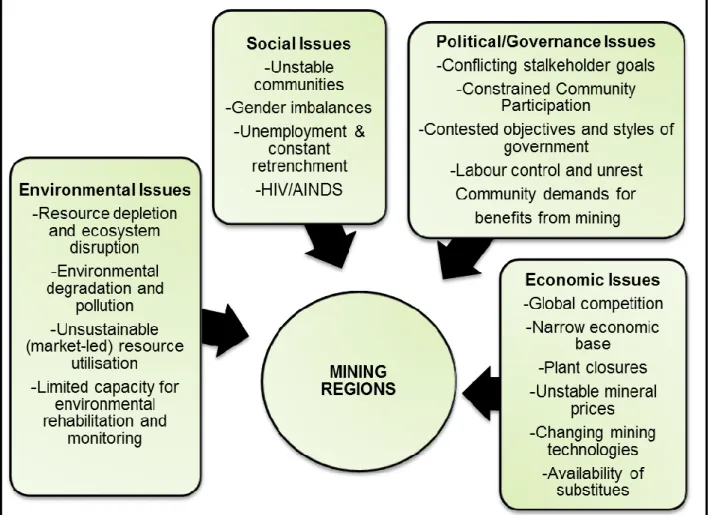
indirectly affecting the quality of lives in cities and towns in Ghana (Post, 2001).Currently, the planning and development elements of Ghanaian settlements fall under the broad framework of decentralisation. Development planning frameworks (relating to policy and regulations) are however generally lacking in spatial focus and inadequate to respond to mining-driven urbanisation and related impacts in mining towns. This is because these frameworks are either existent, outmoded or have gaps which render development planning non-responsive. The impacts and sustainability concerns mining presents are further heightened as the mining sector of Ghana is hardly integrated with development planning frameworks (Akabzaa, 2009:53). Some of the likely planning and development issues and impacts that emerge as a result in mining towns and regions are illustrated in Figure 1.2.
Figure 1. 2: Planning and Developmental Problems Associated With Mining Regions Source: Adapted from Tapela, 2008
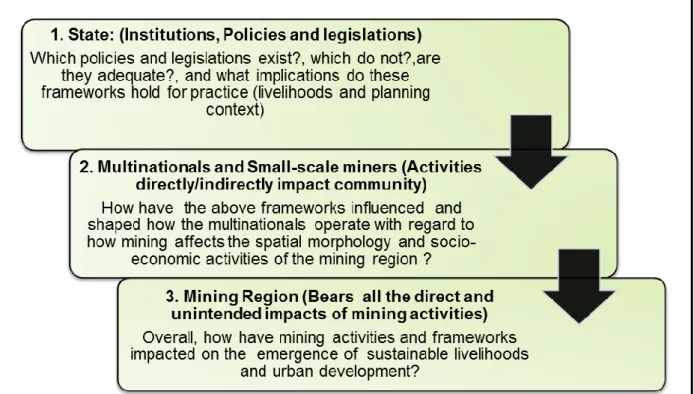
Figure 1.3 gives the interaction between the key stakeholders in the mining industry of Ghana and some of the key questions emerging.
7
Figure 1. 3: Key Questions Emerging from Interactions Among Mining Stakeholders Source: Author Construct, 2013
It is against this background of inadequacy of appropriate legislations, gaps in mining and related urban development policy that this research attempts to explore the extent to which these act as impediments to the sustainable development of mining towns and the associated development dynamics in the mining region of Tarkwa.
1.4 Statement of Problem
The inadequacy of an urban development and planning policy instrument/framework and gaps in mining legislation and practices thereof seem to adversely affect the emergence of sustainable spatial and socio-economic development of Ghanaian mining regions like Tarkwa.
1.5 Research Questions
Broadly, the research answers the question: How have mining impacted on the sustainable development of Tarkwa spatially and socio-economically within the context of current (or lack of) mining, planning frameworks and practices thereof within the Tarkwa mining region? Specifically, the research questions included the following:
8
i. What gaps in mining and development planning regulatory framework exists and how have these impacted on the efficacy of management practices in responding to consequences of mining-led development?
ii. What have been the perceived impacts of mining on urban livelihoods and community business enterprises and how have households responded in terms of coping strategies and mechanisms?
iii. What are the planning and development implications of these emerging planning and development frameworks for sustainable development of mining towns in Ghana?
1.6 Research Objectives
The broad research aim was to understand the extent to which mining and related urban development policies as translated into practice, have impacted on the spatial and socio-economic development on mining towns in Ghana using a case study of the Tarkwa region Specifically, the research aimed:
i. To identify the key mining and planning regulations existing, gaps present and how these have impacted on the efficacy of management practices in responding to consequences of mining-led development.
ii. To analyse the urban household’s perceptions of mining impacts on livelihoods, business enterprises and livelihood coping strategies and mechanisms.
iii. To assess the implications of these emerging planning and development frameworks and trends for the effective planning and development of mining towns in Ghana.
1.7 Research Assumptions
In line with the research, the following assumptions were made:
i. Mining induced urbanisation is a specific type of urbanisation which affects the planning and development outlook of mining towns and regions.
ii. The growth and development or otherwise of mining towns is tied to mining activity. iii. Policy and legislations on mining and urban development has an overarching role in
9 1.8 Delimitation of Research
Contextually, the research was concentrated in these key areas:
i. Key mining legislation and how they relate to community livelihoods, environmentally and socio-economically.
ii. Key planning legislations that border on settlement management and how this relates to development of mining settlements in Ghana.
iii. Key Institutions in the practice of development planning and mining at Tarkwa-Nsuaem Municipal Assembly and at the national level.
iv. Role of Foreign Direct Investment (FDI) and spatial-defined impacts of mining from a global perspective and within the context of urban livelihoods in Tarkwa.
v. Spin-offs of mining and effect on growth of business enterprises in Tarkwa vi. Problems, challenges and prospects in urban development practice
1.9 Significance of Study
A lot of studies have been done on mining in Ghana and in the Western region. However, this study is different in that, it looks at the planning dimension of settlement development in mining regions and the focus was on urban households. The research is thus significant on three broad levels:
i. The identification of key gaps in Ghana’s Minerals and Mining Act of 2006 and praxis of urban development in a mining region are a useful input to the on-going reforms that are taking place around urban development in the Western Region of Ghana as well as mining sector reforms. Furthermore, it contributes to the constant debates in Ghana about how to make mining legislations more responsive and proactive to mining communities and livelihoods.
ii. The study to a large extent addresses the operational dynamics of mining regions. This is significant information to the Tarkwa-Nsuaem Municipal Assembly; planners and development practitioners, in the face of resource booms not only in gold mining but in the burgeoning oil industry in Ghana.
iii. The final research output which is a thesis is a useful source of information to students of not only Town and Regional Planning but students with a leaning towards research as it can be a useful source of knowledge in terms of transferability of research methods for a case study.
10 1.10 Limitations of Study
The challenges of this study were based on data collection in the field from December 2011 to early March 2012. One of the challenges of this study was that illiteracy was rife in many parts of Tarkwa and therefore questionnaire administration took longer than anticipated. Before questionnaire administration, respondents had to be educated on the rationale of the research and that it was for academic purposes and not one that would directly be a response to some of their needs.
Another challenge related to the release of aerial and topo-cadastral mapping which mining companies were unwilling to provide. This largely affected the output of the research as the researcher could not relate spatial changes on the ground to some of the findings in other sources of data. Also, the lack of access to a comprehensive database on business enterprises in Tarkwa made questionnaire administration largely restrictive to business enterprises that could be “seen” in Tarkwa. The author also had to contend with the use of population figures from 2000 due to the fact that results of the 2010 Population and Housing Census were not out as at the time the research was conducted. Furthermore, only preliminary results of the census were subsequently released. This covered the general outlook of population and housing for the regional capitals of Ghana and not details of Municipal/District Assemblies as would have been required by this research.
Lastly, it was challenging to conduct interviews not because respondents were not willing to be part of the interviews but interviewees kept on rescheduling interview days and times. Also some interviewees were located in Accra (national capital) which meant travelling any time an interview was reschedule. That was not only exhausting for the researcher but also expensive in terms of cost and time spent on the field.
1.11 Organisaton of Study
The research is organised into nine chapters:
Chapter 1 gives a snapshot of the whole research by outlining the statement of the core problem, objectives on which the research is premised, the significance of the study and scope of the study.
Chapters 2 and 3 comprise of the literature review. Three types of literature relating to policy, theory and research (Wallace & Wray, 2011:96-97) is reviewed for this study.
11
Chapter 2 examines the unique growth dynamics of mining regions and explores the theoretical, conceptual and definitional issues around development and sustainability in resource regions. Chapter 3 of the literature looks at policy and regulatory frameworks around mining and development planning. The mining regulations of Chile and Botswana are examined as they are regarded by the World Bank as having some of the most effective mining policies and regulations in the developing world. The case of Ghana is also analysed with regard to gaps in key frameworks for mining and development planning. In that regard, the identification of regulatory weaknesses and gaps foregrounded the impact and implications on livelihoods and development of mining settlements. Furthermore, a review of the Minerals and Mining Act of 2006 as part of the literature review is a first step in achieving one of the objectives of this study. Both sets of review however provide a firm grounding for the conceptual framework of the study.
Chapter 4 outlines the research design and delves into the methodology adopted for field work, analysis and synthesis of data from the field.
Chapters 5, 6, 7 and 8 look at the analysis and interpretation of data. Chapter 5 focuses on the urban households of Tarkwa and their perceptions of mining impacts. Chapter 6 centers on the nature of community enterprises and impacts mining spin-offs have had on their growth. Chapter 7 assesses the coping strategies adapted by households to deal with perceived negative mining impacts, while Chapter 8 provides an analysis of the planning and development response to mining-led urbanisation
Finally, Chapter 9 is a synthesis of the study and concludes by casting the meanings of the findings to the broader problem of mining-driven urbanisation and making recommendations in relation to development planning theory, policy, practice and research. The organisaton of the study is summarised in Figure 1. 4.
12
Figure 1. 4: Overview of Thesis Structure Source: Author Construct, 2013
13
CHAPTER TWO:
MINING-LED URBAN AND REGIONAL GROWTH AND DEVELOPMENT
2.1 Introduction
Mining is essentially a triad of people and the mining settlements they live in; MNCs who control and dominate mining; and national governments of mineral-endowed countries that enact and implement mining policies and regulations through institutions. A medley of issues crop up in relation to the aforementioned actors. These include mining impacts; livelihoods and coping mechanisms; mining investments; planning policy regulations and implementing institutions. These fundamental issues largely converge on development and sustainability of mining regions which have implications for urban development management.
Development is a normative concept defined differently by scholars, for example (Escobar, 1996; Todaro, 1997) within economic, social, cultural and technological contexts. Sumner and Tribe (2008:11) advance three different definitions of development namely:
Development as a long term process of structural and societal transformation or change and is historical.
Development viewed as a short to medium term outcome of set targets; and
Development from a post-modernist view based on the “dominant discourse of Western modernity”.
Though development is often viewed in a positive manner, which is in terms of progressive change, the historical perspective of development recognises that development may not necessarily be positive/good change but involve regression, decline, stagnation or other challenging situations within the broad perspective of socio-economic change (Spooner, 1981; Sumner & Tribe, 2008:12).
In mining regions, a primary concern is not only when development shall take place and in what forms should growth be pursued, but also specifically:
i. How mining-led urbanisation and related growth impacts on urban livelihoods and the coping strategies urban households employ.
ii. How spin-offs from mining affect the growth of community based business enterprises.
iii. How existing policy and regulatory, frameworks impact on development trajectories, towns and regions.
14
These questions are fundamental to mining regions because their development path is linked with mining activity which involves the exploitation of an exhaustible mineral resource. Therefore mining-led growth and the attendant settlement functions present spatial and socio-economic impacts which affect not only livelihoods at the community level but also on the overall development trajectory of that particular region. Mining-led growth is therefore a specific kind of growth which in this chapter is explored in theory, research and practice.
2.2 Mining-led Growth and Impacts within a Global and African Context:
2.2.1 Mining-led Growth and Macro-level Impact through Foreign Direct Investment (FDI) Urbanisation and globalisation are the main trends propelling the growth and development of cities and towns in the 21st century. Globalisation has increasingly made possible borderless sharing of ideas through increased connectivity, access to global financial and capital markets (Friedman, 2007). Globalisation is touted as even increasing “the desire and capacity of people to move to other places” (Annan, 2006:963). According to a World Bank Report (2002:1), there were about 3.9 billion people living in about 56 countries mostly in developing and transition economies. The United Nations Population Fund projections (UNPFA, 2007) indicated that an urbanisation milestone would consequently be achieved in 2008 with 3.3 billion people (which is more than half of the world’s people) now living in cities. However, much of the unprecedented rates of urbanisation in the world are taking place in the developing world - Asia and Africa. By 2050, Asia will host 63 percent of the global urban population, or 3.3 billion people; Africa will have an urban population of 1.2 billion, or nearly a quarter of the world’s urban population (UN-HABITAT, 2008/2009).
Much of the growth (about two thirds) that Africa will be experiencing is to be absorbed in its secondary and tertiary cities (settlements with less than 500, 000 inhabitants) rather than in large cities (UN-HABITAT, 2008). Potts (2013: 20-29) emphasize that most of these projections are overhyped and that the real issues should be the driving factors behind these increased populations and where these populations are migrating to. A view supported by McGranahan (2012) who cautions that “the route a country takes to urbanisation will have a big impact on economic growth, social equity and environmental sustainability”. To this end, Potts (2013:29) notes oil is one main driver of urbanisation especially in Africa and mining whose impact on settlements has always been mixed.
Hence globalisation and urbanisation coupled with the increased discovery of mineral resources in many parts of Africa suggests the populations of mining regions can grow.
15
The growth in Asia has consequently sparked a new trend in global and capital markets – where primary commodity prices have hiked, increasing competitive labour, intensive manufacturing and the increased potency of Asia as a direct source of investments (Thurlow & Breisinger, 2008:1).With an increasing shift in the world’s economic center of gravity towards Asia (Mckinsey Global Insitute,2010), China and India have emerged as the key resource dynamos consuming more than 60 percent of global gold according to World Gold Council East-Asia managing director, Albert Cheng (Creamer, 2013). This has thus driven new mining-led growth and increased foreign direct investment in the mining sector in Africa (Thurlow & Breisinger, 2008:1). For the African continent, George Fang, Standard Bank’s Head of Mining and Metals China observes:
The race for Africa’s mineral resources continues to gather momentum. Continued growth in consumption resources is being driven by growth in China and the rest of Asia. Chinese companies are increasingly acquiring assets, as are Indian companies, prompting other global miners into a race to secure mineral assets of their own. This movement for resources can be to the benefit of the African continent (Harding, 2011).
However, the bigger question could be the extent to which the aforementioned statements can be regarded as merely rhetorical given that several MNCs now dominate and dictate mining. Alternatively, what effects thereof does mining-led urbanisation/growth have on mining regions, livelihoods and the development of mining towns? The above rhetorical questions are fundamental to the arguments that have dominated mining literature about the benefits or otherwise of mining through the course of history.
Insofar as mining is concerned, MNCs seem to largely deliver at the macro level in terms of mining benefits through FDI. FDI by several multinational mining companies is by far the biggest contributor to the economies of mining countries through growth in GDP. According to the World Bank (2007), Sub-Sahara Africa grew at 2.4 percent between the periods 1990-2002, this rate however doubled to 4.8 percent from 2002- 2005. Half of the additional growth was attributed to mining and construction, whose annual growth rate increased from 1.8 percent to 8.1 percent. Robbins (2012) observes that even though Africa’s share of FDI is relatively low at 2.8 percent in 2011, GDP has increased significantly across the African continent from rates below the 4 percent average for the 1994–2003 periods through to 5.1 percent in 2011 after a peak of 7.1 percent in 2007. Growth in GDP in African economies through large FDI of MNCs is regarded as one of the ways to deliver development to African economies and through reduction of poverty. For example, Davis (1995), Ding and Field (2005) and the World Bank (2006) support the positive correlation of resource exports to GDP and poverty alleviation. The World Bank Group’s (WBG) continued support for the
16
extractive industry is premised on the belief that poverty can be alleviated and economic growth achieved through the generation and prudent management and allocation of revenues from resources in mineral-rich countries (World Bank, 2003: 12). Some scholars (Collier, 2007; Goldstein et al., 2006) see it as the opportunity for regions such as Africa to bridge the gap in terms of development with the developed world.
Sachs and Warner (1999, 2001) are of the view that a high resource export to GDP ratio is lower for these resource regions. Arguments against mining-led growth result from notions of “resource curse” or “Dutch disease” associated with resource booms. In fact, mining has been central to the evolution of the idea that resources can be a curse with regard to the “lack of development, internal tension, human rights abuses and conflicts at the national level” (Ballard & Banks, 2003:295). This, according to Humphrey et al. (2007), results from the shifting of the economy towards the extractive needs of the mining sector, thus limiting any form of structural diversification, technology accumulation and generates rent seeking and corruption which undermines the effective spending of windfall gains made (Gelb & Associates, 1988; Auty, 1990; Ross, 1999). This “good-bad” paradox of mining is explored subsequently in this chapter.
Potts (2012:21) observes that where GDP is produced is of more significance, not just the amounts and should be the focus of debates around African economies. She thus points out that, when the focus is on specific locations where production is taking place, then there is a shift in debate to where value is added - is it mineral sites and what multiplier effects occur through growth in enterprises, jobs, consumption linkages amongst others?. This leads to question of spatially defined impacts of mining-led growth which is discussed below.
2.2.2. Mining-led Growth and Spatially Defined Impacts on Settlements and Livelihoods Mining-led growth was instrumental in urban development in the past and will influence the path of development in several mining regions for some time in the foreseeable future. The process, patterns, growth and development of settlements continue to be linked very much to the discovery and exploitation of mineral resources. Robbins (2012:159) reckons that there are basically three types of settlements that develop around mining:
Those located around large-scale and artisanal mining sites.
That of large scale regional service towns (cities) that are located in regions of concentrated mining activity, and lastly;
17
The macro-economic level impacts of mining notwithstanding, of more relevance to this research are the spatially defined impacts of mining which have far-reaching implications on settlements and households. These impacts can broadly be categorised into the socio-economic and environmental.
2.2.2.1 Socio-Economic Impacts
The economic impacts of mining on livelihoods largely relates to employment and income from direct or indirect wage employment. In terms of formal mining, the impacts relating to employment has varied from around the nineteenth century where mining employed less technology, lesser degree of specialisation and used more of labour through to the twenty- first century where advances in technology have resulted in use of less labour. For example, mining was central to the evolution of labour markets in Europe in fifteenth and sixteenth century where people who worked in mines were among the first wage earners (Braudel; 1992 as cited by Graulau: 2008). Also, the coalfields exploitation in nineteenth century Britain tremendously increased populations of these British towns, drew huge labour force and also had locational pull on other industries as well as the development of transport infrastructure within and outside the coal field towns (Spooner, 1981:23). Commenting on the role of coal in the development of Britain in the nineteenth century Brown 1972 (as cited by Spooner, 1981:22) argued that coal was not only dominant as a source of energy but
… coal was a big enough activity in itself for its distribution to have significant effect. Its direct effect on regional income, output and employment were considerable, and it drew a huge labour force to the coalfields, while at the same time it exercised a powerful locational pull on industries. Similarly, before the discovery of mineral resources in South Africa in the 1870s, the rate and levels of urbanisation were low (Dewar et al., 1986:179-189). The discovery of gold in 1886 was a crucial factor in the transformation of Johannesburg from a mining camp to a city of about 150,000 people (Warren, 1973 as cited in Spooner 1981:24-25). Potts (2013:22) however observes that Johannesburg’s development was an exception due to the extensive mineral wealth of that region. The discovery of mineral resources in the form of diamonds, gold, copper and coal precipitated urbanisation and transformed the spatial configuration of several Southern African regions namely Kimberly, Witwatersrand, Katanga, the Zambian copper belt and Whangee in Zimbabwe (Tapela, 2002).
Counterpoised to nineteenth century, in the 20th and 21st century however, technology in mining is one of the key determinants shaping formal mine employment by ; helping mining companies cut back on labour/employment cost or resort to use of contracting; and the avoidance of creation of new settlements through fly-in-fly out policies. Carrington et al.
18
(2011:337) in their explorative study of post-industrial mining booms, regimes changes and criminology impacts in Australia observed that:
… organisation of production and employment in the mining industry has been recast over the last two decades…In a short time the mining sector has gone from being one of the most highly unionized and regulated in Australia to one now heavily reliant on sub-contractors, precarious employment practices and industry self-regulation … post-industrial mining regimes maximize resource extraction through continuous production processes organised around block roster shifts relying increasingly on non-resident, contract labour accommodated in work camps. By 1991 more than 40 mining operations employing a total of about 5,000 workers used predominantly non-residential workforces, known as fly-in, fly-outs or drive-in, drive-outs (FIFOs/DIDOs).
Potts (2013:11) also notes that when copper prices fell in the 1980s and 1990s, the copper belt of Zambia largely lost its population and bounced back after 2003 due to increased copper prices. She however points out initial census data for 2010 indicated most towns in the copper belt were still losing their populations as “employment practices and new technologies mean the mines have become more labour efficient”.
Following from the foregoing arguments, it seems reasonable to say that the impact of mining in terms of formal mining employment is increasingly limited by advances in technology. The need for newer technologies that has fostered specialisation in formal mining also implies the increasing need for persons who are highly educated and skilled to operate or use such technologies. Conversely, over 20 million people worldwide depend on mineral extraction in artisanal/ informal sector for their source of livelihood compared to direct formal employment (ILO, 2002). Gold-panning for example does not generally create settlements but is an income-earning opportunity to support livelihoods (Potts, 2013:13). This is aside the general consensus in the mining industry that the artisanal sector mining is poverty driven (Hilson, 2003).
Stokes et al. (2010:75) observe that, in developing economies the migration of labour into extractive sectors like mining, oil and gas often result in an over-supply of labour. This in turn, they note “feeds subsistence entrepreneurship in regional locations as opportunities are created to make a living through self-employment”. These developments and business start-ups are stimulated by incomes earned or opportunities to earn a living or create value that are rather subtle and usually in relation to spillovers or spin-offs relating to skills and businesses resulting from mining (Robbins, 2012; Potts, 2013). Artisanal miners in some of Ghana’s mining towns invest in property, commerce and transport (Ofei-Aboagye, et al.,2004) and some of the economic spin-offs in artisanal mining can have urbanising impacts in small towns as in the case of Tanzania (Potts: 2013). Economic spill-overs can also benefit other settlements that act as large service or commercial centers (Robbins, 2012: Potts, 2013). Examples of such spillovers to other areas arising from concentration