This is an
Accepted Manuscript
, which has been through the
Royal Society of Chemistry peer review process and has been
accepted for publication.
Accepted Manuscripts
are published online shortly after
acceptance, before technical editing, formatting and proof reading.
Using this free service, authors can make their results available
to the community, in citable form, before we publish the edited
article. We will replace this
Accepted Manuscript
with the edited
and formatted
Advance Article
as soon as it is available.
You can find more information about
Accepted Manuscripts
in the
Information for Authors
.
Please note that technical editing may introduce minor changes
to the text and/or graphics, which may alter content. The journal’s
standard
Terms & Conditions
and the
Ethical guidelines
still
apply. In no event shall the Royal Society of Chemistry be held
responsible for any errors or omissions in this
Accepted Manuscript
or any consequences arising from the use of any information it
contains.
Accepted Manuscript
ChemComm
Cite this: DOI: 10.1039/c0xx00000x
www.rsc.org/xxxxxx
COMMUNICATION
This journal is © The Royal Society of Chemistry [year] [journal], [year], [vol], 00–00 | 1
High-yield, regiospecific
bis
-functionalization of C
70using a Diels-Alder reaction in
molten anthracene
Venkata S. Pavan K. Neti,
aMaira R. Cerón,
aA. Duarte-Ruiz,
b* Marilyn M. Olmstead,
c* Alan L. Balch
c*
and Luis Echegoyen*
aReceived (in XXX, XXX) Xth XXXXXXXXX 20XX, Accepted Xth XXXXXXXXX 20XX
5
DOI: 10.1039/b000000x
A regiospecific bis-adduct of C70 with anthracene was
prepared with unusually high yield (68%) by the Diels-Alder reaction in the absence of solvent (melt). The structure of the
bis-adduct was an unexpected 12 o’clock isomer, as 10
determined by single crystal X-ray diffraction, thermal gravimetric analysis (TGA) and spectroscopy.
Regiochemical control of bis-addition reactions on fullerenes has been, and continues to be, an important synthetic challenge. 15
Common fullerene functionalization methods such as addition-elimination of halogenated malonates and 1,3-dipolar cycloadditions of ylides lead to multiple isomeric bis- and tris -adducts which are relatively difficult to separate using conventional column chromatography.1-3 The presence of 30 20
equivalent double bonds on the surface of C60 leads to low bis
-adduct regioselectivity,4 and in the case of C70 the number of
possible isomers increases because there are eight different types of C-C double bonds and five different types of carbon atoms, due to the lower symmetry of this cage.5,6 Diederich et al. and 25
Hirsch et al. developed elegant synthetic strategies, such as the ‘tether directed remote functionalization’ and the ‘reversible template directed activation’ methods, for regioselective bis-,
tris-, and tetrakis-additions to C60 and C70.5 In 1996, Kräutler et
al. reported a topochemically-controlled conversion of the 30
crystalline C60-anthracene monoadduct into the trans-1 bis-adduct
in 96% yield.6a Subsequently, that group showed that heating an anthracene/C60 mixture at 240° C produced the same trans-1 bis
-adduct in 43.7 % yield along with 4.5 % of the mono-adduct and 46.7 % of unreacted C60 asthe only products.6b Such anthracene
35
adducts are useful as protecting groups in guiding multiple additions to fullerenes.5e Surprisingly, similar solvent-free Diels-Alder reactions with C70 or other fullerenes have not been
reported. Here, we report that the solvent-free addition of anthracene to C70 yields only one regioisomer of the bis-adduct in
40
remarkably high yield (68%).
Diederich et al. introduced a simple nomenclature to describe bis-adducts of C70 where the addends are attached to α bonds on
opposite ends of the C70 molecule, which is usually the observed
case.5b These ten α double bonds radiate from the two pentagons 45
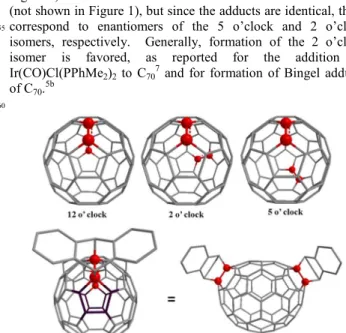
at the poles of the molecule and are typically the most reactive. Assuming from previous observations that anthracenes will add to the more reactive [6,6] α bonds, three possible regioisomers can be formed, two of which exist as enantiomeric pairs, see Figure 1. The three possible bis-isomers are described as 12 50
o’clock, 2 o’clock and 5 o’clock, depending on the relative
orientation of the two adducts around the C5 symmetry axis (see
Figure 1). The 7 o’clock and 11 o’clock bis-adducts can also form (not shown in Figure 1), but since the adducts are identical, these correspond to enantiomers of the 5 o’clock and 2 o’clock 55
isomers, respectively. Generally, formation of the 2 o’clock isomer is favored, as reported for the addition of Ir(CO)Cl(PPhMe2)2 to C70
7
and for formation of Bingel adducts of C70.5b
60
Figure 1. Representation of the possible bis-isomers of C70 (above) and
the structure of the 12 o’clock regioisomer (below).
65
The synthetic procedure followed was essentially the same as that previously reported by Kräutler et al. with C60.
6b
C70 was
reacted with two equivalents of anthracene in the melted state under vacuum at 240°C for 2 hours. Purification of the crude mixture on a silica gel column using CS2:hexane (7:3) as eluent
70
yielded, in order of elution, unreacted C70 and two compounds
denoted as 1 and 2. The major fraction of the reaction was compound 2, which was isolated in 68% yield, followed by C70
and compound 1 in 22% and 10% yield, respectively.
Characterization of the C70-anthracene adducts was performed
75
using field desorption mass spectrometry (FD-MS), MALDI-TOF, electrospray ionization mass spectrometry (ESI), 1H and 13
C-NMR, TGA, UV/Vis, IR, cyclic voltammetry, and single crystal X-ray diffraction.
The 1H-NMR spectrum of compound 1 showed six resonances, 80
and was identical to the spectrum reported for an anthracene C70
-mono-adduct (on an α position) obtained using a flame synthesis procedure (Fig. S1).8 This observation conclusively showed that 1
ChemComm
Accepted
2 | Journal Name, [year], [vol], 00–00 This journal is © The Royal Society of Chemistry [year] is the mono-adduct. The 1H-NMR spectrum of compound 2
exhibited a similar set of signals as observed for compound 1 but with significant chemical shift differences (Fig. S2). Attempts to obtain the parent peaks in the mass spectra for compounds 1 and 2 using a variety of ionization techniques (MALDI-TOF, ESI, 5
and FD) were unsuccessful, indicating that both compounds are very unstable after ionization in the gas phase, readily undergoing retro Diels-Alder reactions. The MALDI-TOF, ESI, and FD mass spectra of the crude mixture and of the isolated compounds exhibited only one strong peak at m/z 840 due to C70.
10
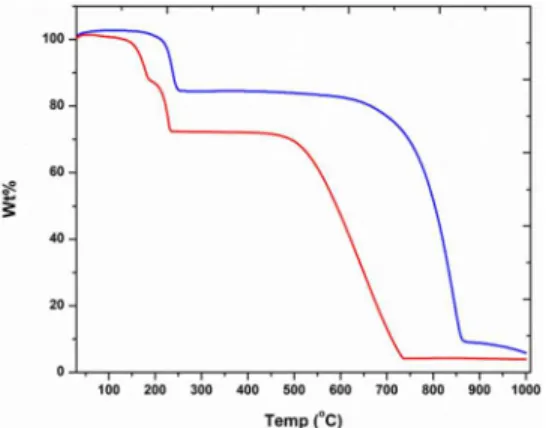
Figure 2. TGA of 1 (blue) and 2 (red) obtained up to 1000° C using a linear 3° C/min ramp method.
15
Thermogravimetric analyses (TGA) of 1 and 2 were performed by increasing the temperature at a rate of 3°C/min under a flow of N2 (Fig. 2). A 17% weight loss (calculated value for the loss
of one anthracene from 1: 17.4%) was observed for 1 (transition onset at 180ᴼ C and midpoint at 220°C). A 31% weight loss was 20
observed to occur in two discrete steps for 2 (calculated value for the loss of two successive anthracene molecules for a bis-adduct is 29.7%, first transition at 160°C and a second transition onset at 180°C and midpoint at 220°C). These results confirm the loss of a single anthracene unit from 1 and of two anthracene units from 25
2. C70 was recovered after thermal treatment of 1 and 2 at 250 °C
under a N2 atmosphere. We selectively removed only one
anthracene from 2 at 190 °C, but the mass balance was not quantitative. The UV-vis spectra of compound 2 is similar to those previously reported for 12 o’clock C70 bis-adducts,5e,9
30
exhibiting weak absorption maxima around 640nm and a strong absorption maximum at 442 nm (Fig. S4). The FT-IR spectra of 1, 2 and C70 showed significant differences in the intensity of the
bridgehead C-H stretching vibration bands (Fig. S5). 35
Table 1. Redox Potentials (V) [a] of 1, 2 and C70
Compound C70 1 2 E0/+1 - 0.97 0.91 E0/-1 -1.05 -1.18 -1.21 E-1/-2 -1.41 -1.54 -1.53 E-2/-3 -1.83 -1.92 -1.99 [a] Values obtained by SWV in V vs Fc/Fc+
The redox properties of 1, 2 and C70 were determined using
cyclic voltammetry (CV) at a scan rate of 100mV/s and by square wave voltammetry (SWV) in o-dichlorobenzene solutions using 40
0.05M of n-Bu4NPF6 as supporting electrolyte, see Figure 3. The
CV results are summarized in Table 1. The electrochemical behavior of 1 showed three reversible reduction waves, which are cathodically shifted compared to those of C70 under the same
experimental conditions. Compound 2 also showed three 45
reversible reduction waves, which were further cathodically shifted compared to those of compound 1. These results agree with previous reports of successive cathodic shifts upon double bond saturation by chemical functionalization.10 Compounds 1 and 2 showed one reversible oxidation wave.
50
Figure 3. Cyclic voltammetry of 0.05mM of C70, C70-mono-anthracene
(1) and C70-bis-anthracene (2) (o-DCB containing 0.05M n-Bu4NPF6 at
100mV/s; using the redox couple Fc/Fc+ as internal reference). 55
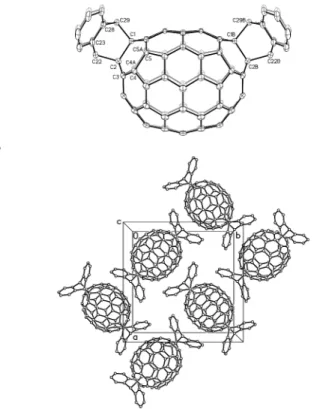
The regiochemistry of bis-adduct 2 was unambiguously established using X-ray crystallography. Black crystals grew as thin rectangular plates from a diffusion of hexane into a carbon disulfide solution of 2. Crystallographic data were collected at the Advanced Light Source, Lawrence Berkeley Laboratory. The 60
structure was solved in the tetragonal crystal system, space group
P42/ncm (no. 138) and revealed one-quarter of the molecule of 2
in the asymmetric unit. The crystallographic site symmetry of 2.mm confirmed that the molecule is the unexpected 12 o’clock
bis-isomer with C2v point symmetry, as shown in Figure 4(a). The
65
2-fold axis is vertical. The two perpendicular mirror planes pass through this axis. The structure contains a disordered interstitial hexane molecule with the same site symmetry. The utility SQUEEZE11 was applied to remove its contribution from the structure. The fullerene [6:6] bond (C1-C2) at the site of the 70
cycloaddition is elongated to 1.601(3) Å. The bonds C1-C29 and C2-C22 are also stretched, at 1.590(3) and 1.586(3) Å, respectively. As shown in Figure 4(b), viewed down the c axis, adjacent molecules efficiently pack in a wavy manner with the concave surface of anthracene well matched to the flattened 75
convex part of C70. This interaction can be viewed in the
Electronic Supplementary Information as a movie in mpg format. These remarkable shape-complementary interactions are less perfect in the reported bis- and tris-adducts of C60 and
anthracene.12 The intermolecular distances are typical for π…π
80
stacking with values in the range 3.18 – 3.45 Å The layers above and below this layer follow the crystallographic 42 operation and
yield the shortest fullerene…fullerene contact of 3.118(3) Å. It is important to note that bis-Diels-Alder additions to C60 and C70
always result in multiple regioisomers (5 or 6 for C60, see
85
references 6c-d, and 8 in the case of C70, see reference 9c), thus it
is remarkable that only one bis-adduct isomer is observed in the present case. -0,6 -0,8 -1,0 -1,2 -1,4 -1,6 -1,8 -2,0 -2,2 C u rr e n t (1 x 1 0 -7 A ) Potential (V) C70-bis-anthracene C70-mono-anthracene C70
Page 2 of 4
ChemComm
ChemComm
Accepted
Manuscript
Conclusions
A remarkably high yield of only one regioisomeric bis-adduct of C70 with anthracene was isolated for the first time from a reaction
in the melt. The two anthracene molecules added to [6,6] double bonds in a 12 o’clock arrangement. Further synthetic evolution of 5
this compound is under investigation in our laboratories, in efforts to prepare tris and higher adducts regioselectively.
10
Figure 4. (a)The molecular structure of the C70bis-anthracene adduct, 2.
Hydrogen atoms are not shown for clarity. Thermal parameters are shown at the 30% probability level. (b) A layer perpendicular to the c axis
15
showing intermolecular interactions between anthracene and C70.
Acknowledgements
This work was generously supported by NSF grants CHE-1305125, and DMR-1205302 (PREM program), and the Robert A. Welch Foundation, grant # AH-0033. A. Duarte-Ruiz wants to 20
express his acknowledgement to the Universidad Nacional de
Colombia for its support. The Advanced Light Source is
supported by the Director, Office of Science, Office of Basic Energy Sciences, of the U.S. Department of Energy under Contract No. DE-AC02-05CH11231.
25
Notes and references
Crystal data for C70-bis-anthracene (C98H20, fw 1197.14): Black plate,
0.240 x 0.240 x 0.014 mm, tetragonal, space group, P42/ncm, a =
16.8655(8), c = 19.6001(10) Å, V = 5575.2(6) Å3, Z = 4, D
calcd = 1.426
Mg m-3, µ = 0.097 mm-1, λ = 0.7749 Å (synchrotron), T = 100(2) K; 30
Bruker Apex II CCD detector; ω scans; 2θmax = 63.27°; 65813 reflections
collected; 3792 independent (Rint = 0.0496) included in the refinement;
direct methods solution, full-matrix least-squares refinement based on F2
(SHELXL-2013);13 conventional R1 = 0.0570 computed for 3386
observed data (I > 2σ(I)), wR2 = 0.1529 for all data; 235 parameters and
35
0 restraints.
a Department of Chemistry, University of Texas at El Paso, El Paso, TX
79968, United States. Fax: +1 915-747-8807; Tel: +1 (915) 747-7573; E-mail: [email protected]
40
b Departamento de Quimica, Universidad Nacional de Colombia, Bogotá,
Colombia.
c
Department of Chemistry, University of California, Davis, California, United States. E-mail: [email protected]; [email protected]; Fax +1 (530) 752 2820; Tel +1 (530) 752 0941.
45
† Electronic Supplementary Information available: Experimental details, Fig. S1-S9. See DOI: 10.1039/b000000x/. CCDC 993667. A view of crystal packing in the ab plane as an mpg file.
References 50
1. (a) M. Maggini, G. Scorrano, M. Prato, J. Am. Chem. Soc., 1993,
115, 9798; (b) R. Schwenninger, T. Müller, and B. Kräutler, J. Am. Chem. Soc., 1997, 119, 9317 (c) M. Izquierdo, M. R. Ceron, N. Alegret, A. J. Metta-Magaña, A. Roderiguez-Fortea, J. M. Poblet, L.
Echegoyen. Angew. Chem. Int. Ed., 2014, 125, 13166; (d) F.
55
Diederich, R. Kessinger, Acc. Chem. Res.,1999, 32, 537.
2. (a) Y. Rubin, S. Khan, D. I. Freedberg, C. Yeretzian, J. Am. Chem.
Soc., 1993, 115, 344; (b) J-F. Eckert, C. Bourgogne and J-F.
Nierengarten, Chem. Commun., 2002, 712; (c) M. Murata, S.
Maeda, Y. Morinaka, Y. Murata and K. Komatsu, J. Am. Chem.
60
Soc., 2008, 130, 15800; (d) P. Peng, F-F. Li, F. Bowles, V. S. P. K. Neti, A. J. M. Magaña, M. Olmstead, A. Balch and L. Echegoyen,
Chem. Commun., 2013, 49, 3209-3211; (e) P. Peng, F-F. Li, V. S. P. K. Neti, A. J. M. Magaña and L. Echegoyen, Angew. Chem., Int. Ed., 2014, 53, 160-163
65
3. (a) G. D. Han, W. R. Collins, T. L. Andrew, V. Bulovic´ and T. M.
Swager, Adv. Funct. Mater., 2013, 23, 3061; (b) K-H. Kim, H. Kang, H. J. Kim, P. S. Kim, S. C. Yoon and B. J. Kim, Chem. Mater., 2012, 24, 2373; (c) Y. He, H-Y. Chen, J. Hou and Y. Li, J. Am. Chem. Soc., 2010, 132, 1377.
70
4. P. W. Fowler, J. Chem. Soc. Faraday Trans., 1995, 91, 2241.
5. (a) A. Hirsch, I. Lamparth, H. R. Karfunkel, Angew. Chem., Int. Ed. Engl., 1994, 33, 437; (b) M. J. van Eis, R. J. Alvarado, L.
Echegoyen, P. Seiler and F. Diederich, Chem. Commun., 2000,
1859; (c) M. J. van Eis, I. P. Nunez, L. A. Muslinkina, R. J.
75
Alvarado, E. Pretsch, L. Echegoyen, and F. Diederich, J. Chem.
Soc., Perkin Trans. 2001, 2, 1890; (d) M. J. van Eis, P. Seiler, L. A. Muslinkina, M. Badertscher, E. Pretsch, F. Diederich, R. J.
Alvarado, L. Echegoyen, I. Pérez Núñez, Helv. Chim. Acta, 2002,
85, 2009; (e) I. Lamparth, C. Maichle-Mössmer, A. Hirsch, Angew.
80
Chem. Int. Ed. Engl. 1995, 34, 1607.
6. (a) B. Kräutler, T. Müller, J. Maynollo, K. Gruber, C. Kratky, P.
Ochsenbein, D. Schwarzenbach, and H-B. Bürgi, Angew. Chem.,
Int.Ed., 1996, 35, 1204; (b) B. Kräutler, T. Müller and A.
Duarte-Ruiz, Chem. Eur. J., 2001, 7, 3223; (c) G.-W. Wang, M. Saunders,
85
R. J. Cross, J. Am. Chem. Soc. 2001, 123, 256.
7. A. L. Balch, J. W. Lee and M. M. Olmstead, Angew. Chem., Int Ed.
1992, 31, 1356.
8. (a) Q-H. Weng, Q. He, D. Sun, H-Y. Huang, S-Y. Xie, X. Lu, R-B.
Huang, and L-S. Zheng, J. Phys. Chem., C, 2011, 115, 11016.
90
9. (a) B. Illescas, N. Martín, C. Seoane, P. de la Cruz, F. Langa, F.
Wudl, Tetrahedron Lett. 1995, 36, 8307. (c) W. W. H. Wong, J. Subbiah, J. M. White, H. Seyler, B. Zhang, D. J. Jones and A. B. Holmes, Chem. Mat. 2014, 26, 1686.
10. (a) A. Herrmann, M. Rüttimann, C. Thilgen, F. Diederich, Helv.
95
Chim. Acta 1995, 78, 1673. (b) A. Herrmann, M. W. Rüttimann, T. Gibtner, C. Thilgen, F. Diederich, T. Mordasini, W. Thiel, Helv. Chim. Acta 1999, 82, 261.
11. A. L. Spek. Acta Cryst. Sect. A, 1990, 46, 194.
ChemComm
Accepted
4 | Journal Name, [year], [vol], 00–00 This journal is © The Royal Society of Chemistry [year]
12. (a) A. Duarte-Ruiz, T. Müller, K. Wurst and B. Kräutler,
Tetrahedron 2001, 57, 3709. (b) A. Duarte-Ruiz, T. Müller, K.
Wurst and B. Kräutler, Helv. Chem. Acta 2008, 91, 1401.
13. G. M. Sheldrick, Acta Crystallogr. 2008, A64, 112.