Age and Ageing2011;40:690–696 doi: 10.1093/ageing/afr050
© The Author 2011. Published by Oxford University Press on behalf of the British Geriatrics Society. All rights reserved. For Permissions, please email: [email protected] Published electronically 19 May 2011
Detection of falls using accelerometers and
mobile phone technology
R
AYMONDY. W. L
EE, A
LISONJ. C
ARLISLERoehampton University—Life Sciences, Whitelands College Holybourne Avenue, London SW15 4JD, UK
Address correspondence to: R.Y.W. Lee. Tel: +44 (0)20 8392 3539. Fax: +44 (0)20 392 3610; Email: [email protected].
Abstract
Objectives:to study the sensitivity and specificity of fall detection using mobile phone technology.
Design:an experimental investigation using motion signals detected by the mobile phone.
Setting and participants: the research was conducted in a laboratory setting, and 18 healthy adults (12 males and 6 females; age = 29 ± 8.7 years) were recruited.
Measurement:each participant was requested to perform three trials of four different types of simulated falls (forwards, backwards, lateral left and lateral right) and eight other everyday activities (sit-to-stand, stand-to-sit, level walking, walking up- and downstairs, answering the phone, picking up an object and getting up from supine). Acceleration was measured using two devices, a mobile phone and an independent accelerometer attached to the waist of the participants.
Results:Bland–Altman analysis shows a higher degree of agreement between the data recorded by the two devices. Using individual upper and lower detection thresholds, the specificity and sensitivity for mobile phone were 0.81 and 0.77, respect-ively, and for external accelerometer they were 0.82 and 0.96, respectively.
Conclusion: fall detection using a mobile phone is a feasible and highly attractive technology for older adults, especially those living alone. It may be best achieved with an accelerometer attached to the waist, which transmits signals wirelessly to a phone.
Keywords:fall detection, telehealth, accelerometer, older people, elderly
Introduction
Older people desire to live at home and have an active independent life. Although physical activity is important in the prevention of disease and improving the quality of life [1,2], falls often happen during physical exercise, walking and various forms of physical activity [3, 4]. A third of fallers have been observed to develop a fear of falling [5,6], which is associated with general anxiety and neuroticism often leading to avoidance of activity [7]. This in itself over the long term may have negative effects on physical abilities with a cyclical pattern of deterioration, social isolation and decreased quality of life [8].
Fall is a major care and cost burden to the health and social services worldwide [9, 10]. Although most falls produce no serious consequence, 5–10% of community-dwelling older adults who fall each year do sustain serious injuries such as fractures, head injuries or serious laceration [11]. Falling among adults ≥65 years of
age has been reported to occur mainly at home, with 65% of women and 44% of men falling inside their usual place of residence and 25% of men and 11% of women falling in their garden [12]. In view of these statistics, there are likely to be occasions where an older adult will be alone when they fall and may require immediate medical assist-ance. Indeed, major concerns for older adults living on their own include the risks associated with falling and whether there will be someone there to help them in case of an emergency.
Previous research has revealed that older people are willing to accept new technologies to support their indepen-dence and safety [13] and coupled with this is a current trend towards wireless healthcare technology. Many new generation ‘smart’ mobile phones currently have exciting features such as built-in motion sensors and global posi-tioning system (GPS) navigation. These features may enable them to be appropriate tools to detect and report fall infor-mation to a remote party over the mobile phone network, allowing quick assistance in the event of serious injury.
There have already been some preliminary reports explor-ing the idea of usexplor-ing mobile phones to detect falls, but the feasibility of this technology has not been fully examined [14–16]. Therefore, one of the fundamental research ques-tions in this study is to compare the motion signals col-lected by the phone with other external measurements so as to determine the accuracy of the data.
Body-mounted sensors (e.g. accelerometers and gyro-scopes) have been used to detect falls in various studies [17–22] and a recent study has shown that a waist-worn accelerometer, using a simple threshold-based algorithm, may be optimal for fall detection [21]. Such a device still suffers from the limitation that it does not record the location and there is no mechanism of reporting the fall. The current mobile phone technology described above will be able to address this limitation. However, it is still unclear if the built-in accelerometer of the phone is capable of accurately recording the motions associated with falls. Since the mobile phone is not originally designed for fall detection, a computer program will need to be developed to acquire signals from the phone and detect falls incorporating a researcher-designed algorithm. Another fundamental research question is whether the phone algorithm has the required sensitivity (the pro-portion of true positives) and specificity (the proportion of true negatives) to detect falls.
Therefore the purpose of this study was: to develop a computer algorithm for fall detection using mobile phone technology; to compare the motion signals acquired by the built-in accelerometer of the phone with those recorded by an independent body-mounted accelerometer; to examine the sensitivity and specificity of fall detection using the computer algorithm.
Methods
Study participants
Eighteen participants, 12 males (height = 1.79 ± 0.07 m; mass = 76.5 ± 9.6 kg) and 6 females (height = 1.64 ± 0.03 m; mass = 62.3 ± 7.1 kg) with age range from 21 to 44 years (age = 29 ± 8.7 years) were recruited for this study. Older people were not recruited because it would be inap-propriate to subject them to simulated falls as there might be serious risk of injury. Participants were excluded if they had any current injury in any parts of the body, any history of musculoskeletal or neurological disorders, fractures, dis-location/subluxation or surgery in the past 12 months, any dizziness or symptoms related to balance disorders, any visual or auditory impairments, and if they were pregnant.
Ethical approval for the study was obtained from the School Ethics Committee of Roehampton University, London. All participants were provided with an information sheet explaining the details of the study and informed written consent was obtained prior to their participation.
Mobile phone technology
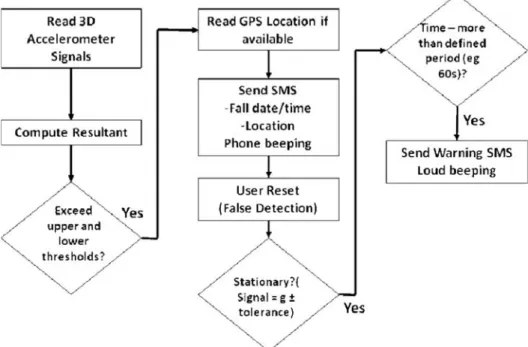
The development of a computer program for acquiring the appropriate accelerometer signals of a mobile phone (Google G1 phone with Android operating system, mass 158 g and overall dimensions 118 × 56 × 17 mm) was the first objective of the study. The block diagram shown in Figure 1illustrates the design of the computer program for detecting falls using a threshold-based algorithm. Three-dimensional (3D) acceleration signals from the built-in sensor of the phone (Bosch Sensortec’s 3-axis BMA150 accelerometer with operating range ±8×g) were
continuously acquired and used to determine the resultant acceleration profile. During a fall, the acceleration decreases sharply to a minimum as the person falls; the impact of landing causes a sharp increase in acceleration to a maximum value. The acceleration profiles of everyday activities would unlikely reach these levels and could there-fore be used as thresholds for detection. If they were exceeded and a fall was suspected, an automatic SMS (short message service) text would be sent to a remote party with information including the date, time and location of the suspected fall. The phone would also make an audible signal to attract the attention of any nearby persons. If the user remained stationary for more than 1 min (as detected by acceleration signals), and if there was no keypad response from the user, this might indicate a serious situ-ation and an emergency text would be sent. If there was no serious problem the user could reset the phone and make a phone call/send a text to the remote party indicating all was well.
Procedures
A large soft fabric elastic band with a width of 8 cm and Velcro fastening was used to attach the phone to the waist. The participants were requested to perform three repeats of several everyday activities: sit-to-stand; stand-to-sit; walking on level ground and up and down stairs; getting out of bed from a supine position; picking up an object from the floor; and answering the phone. The researcher defined thresholds for each individual based on the maximum and minimum acceleration values were obtained from everyday activities.
In order to examine the accuracy of data recorded by the phone, an independent three-dimensional acceler-ometer (MSR145B, CiK Solutions, Germany, sampling frequency 50 Hz, mass 16 g and overall dimensions 20 × 15 × 52 mm) was simultaneously attached to the waist next to the phone for comparison (except the activity of answering the phone when the external accel-erometer was attached to the phone; this allowed the two data sets to be completed for this activity). The acquired accelerometer was low-pass filtered at 10 Hz, and the resultant accelerations were calculated from the output data. Again, the maximum and minimum accel-eration values were used to define thresholds for each individual.
After the thresholds were preset, participants were requested to perform a series of simulated falls. All falls were performed under the close supervision of the researcher, and the participants were instructed to fall onto a large comfortable crash mat. Falls from an upright position in the forward, backward, and lateral left and right directions were tested. Previous research showed that these are the most common types of falls in the elderly people [23]. All the above activities were repeated three times to determine the repeatability of the observations.
Data analysis
The mean maximum and minimum accelerations of various everyday activities and simulated falls were determined. The degree of agreement of the values acquired by the phone and the independent accelerometer was assessed using Bland–Altman plots. The sensitivity and specificity of fall detection were calculated using the following definitions:
Specificity¼ No:of true negatives
No:of true negativesþNo:of false positives
Sensitivity¼ No:of true positives
No:of true positivesþNo:of false negatives where true positive is a fall correctly identified as a fall. False positive is an everyday activity incorrectly identified as a fall. True negative is an everyday activity correctly excluded as not a fall. False negative is a fall incorrectly excluded as not a fall. All statistics were carried out using SPSS (version 17).
Results
Table1shows the minimum and maximum accelerations of various everyday activities and simulated falls as detected by the mobile phone and the independent accelerometer and the numbers of true and false positives and negatives. Repeated-measures analysis of variance showed that the falls were associated with significantly lower minimum and higher maximum values when compared with the various daily activities (P< 0.01). It was noted that answering the phone resulted in maximum accelerations of rather large magnitude, especially for the MSR accelerometer, but these values were still significantly lower than those observed in falling (P< 0.001).
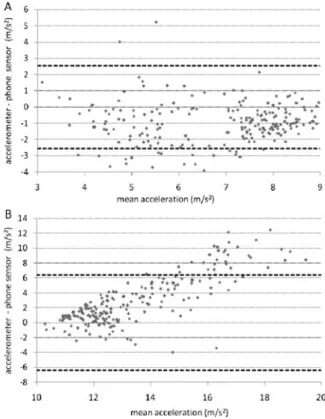
The Bland–Altman analysis (Figure 2) shows the degree of agreement between the data recorded by the phone and the accelerometer, most of the data points are within the 95% limits of agreement. The agreement is particularly good for the minimum acceleration values (Figure 2A), although the data provided by the independent acceleration tended to be smaller than those provided by the phone. The agreement in the maximum acceleration values (Figure 2B) is acceptable but is less satisfactory. The differences between the two devices tend to increase as the magnitude of accel-eration increases, that is, in the simulated fall trials.
Individual upper and lower detection thresholds were defined for each of the participants. In regard to the mobile phone, the mean lower threshold was found to be 6.19 ± 1.27 metres per second squared (ms−2), and the upper threshold 13.54 ± 1.40 ms−2. Mean individual thresholds for the MSR accelerometer were: lower threshold 5.68 ± 0.87 ms−2 and upper threshold 15.82 ± 2.74 ms−2. Both the upper and lower thresholds were then used in fall detection.
. . . .
G1 mobile phone, and numbers of true and false positives and negatives used in the specificity and sensitivity calculation (see the Methods section for further details)Activity Minimum acceleration MSR (ms−2) Minimum acceleration G1 (ms−2) Maximum acceleration MSR (ms−2) Maximum acceleration G1 (ms−2) No. true pos.a(MSR) No. true pos.a(G1) No. false pos.a(MSR) No. false pos.a (G1) No. true neg.b(MSR) No. true neg.b(G1) No. false neg.b(MSR) No. false neg.b(G1) Fall forward 4.47 (±0.74) 5.43 (±1.09) 19.49 (±3.08) 13.19 (±2.35) 54 46 0 8 Fall backward 4.10 (±0.96) 5.41 (±1.47) 18.40 (±3.24) 12.86 (±1.90) 52 42 2 12
Lateral left fall 4.76 (±0.85) 5.78 (±0.95) 16.25 (±2.73) 13.07 (±2.62) 51 41 3 13
Lateral right fall 4.54 (±0.87) 5.97 (±0.92) 17.96 (±2.94) 13.33 (±2.74) 50 38 4 16
Sit-to-stand 7.61 (±0.85) 8.81 (±0.60) 12.0 (±0.86) 10.91 (±0.33) 5 1 49 53 Stand-to-sit 7.81 (±0.79) 8.69 (±0.49) 11.98 (±0.84) 11.13 (±0.63) 2 4 52 50 Level walking 7.90 (±0.45) 8.38 (±0.40) 12.22 (±1.21) 12.16 (±0.54) 4 8 50 46 Walking upstairs 7.55 (±0.40) 7.89 (±1.31) 12.61 (±0.95) 12.43 (±1.20) 4 14 50 40 Walking downstairs 6.86 (±0.65) 7.45 (±1.09) 12.91 (±1.41) 13.14 (±1.56) 10 20 44 34 Picking up an object 7.57 (±1.01) 8.22 (±0.57) 13.77 (±1.61) 11.52 (±1.05) 13 6 41 48 Answering the phone 6.25 (±1.01) 6.22 (±1.29) 15.12 (±3.22) 11.82 (±1.16) 29 26 25 28 Getting up from supine 6.71 (±1.13) 8.12 (±0.70) 12.93 (±1.49) 11.35 (±0.69) 13 2 41 52 a
pos = positives.bneg = negatives.
693
Mobile
phone
fall
When all the activities were analysed, the specificity and sensitivity of phone device were 0.81 and 0.77, respectively, whereas the specificity and sensitivity of MSR accelerometer were 0.82 and 0.96, respectively. Both devices were highly sensitive in detecting falls with a very large number of true positives, and in particular the independent MSR acceler-ometer was more sensitive with very few false negatives (Table 1). Both of them were also generally acceptable in terms of specificity and the number of true negatives. Table 1 shows that the incidence of false positives was lower in activities such as sit-to-stand, stand-to-sit and walking on level ground, which involved smaller magnitude of maximum acceleration, when compared with the other activities tested. There was increased number of false posi-tives in answering the phone, for instance, which involved large acceleration.
Discussion
It is suggested that modern technology has great potential to deliver benefits to older people, although the fast pace of change in technology development and the lack of access, training and support have resulted in older people feeling left behind [24]. Mobile phone is now widely
accepted by the population, including older adults, but the technology has not been fully exploited for healthcare monitoring. To the authors’ knowledge, this was the first experimental study that systematically looked at the accuracy of a mobile phone-embedded accelerometer in fall detec-tion. We compared the specificity and sensitivity of detec-tion between a mobile phone and an independent accelerometer. The data obtained in this study strongly support that the mobile phone is a feasible option for detecting falls as the specificity and sensitivity of detection were sufficiently high. Falls detected by the phone were also in excellent agreement with those detected by the inde-pendent accelerometer. We feel that the current mobile technology can be recommended for older adults with a high risk of falling. The device may be particularly helpful for those who live alone and require a remote party to be contacted when falls occur.
The data obtained in this study show that everyday activities have much less pronounced minimum and maximum acceleration values than falls (Table 1). This allowed the upper and lower thresholds to distinguish these activities from falls. In Table 1, it should be noted that for the same activity or the same fall, there were variations in the minimum and maximum accelerations observed. These values would vary according to the weight of the participant, the manner in which the activi-ties were performed and the nature of the ground surface. It is therefore not ideal to use the same thresholds for all individuals, so individual threshold values were defined for each of the participants using the data collected during everyday activities.
The threshold-based method was found to be highly accurate with very few false negatives and false positives for most activities. It should be emphasised that the maximum accelerations from simulated falls during this study were dampened as the crash mat reduced the impact (highest acceleration). This was obviously necessary for the safety of the participants. In a real fall the impact between the body and the hard ground surface would be higher, with associ-ated improvement in the specificity and sensitivity of the method. This suggestion was in agreement with Klenket al. [25], who observed larger changes in acceleration in real-world falls as compared to fall simulation.
Figure 2A shows a good agreement in the minimum acceleration values recorded by the phone and the accel-erometer, although the phone appeared to underestimate the acceleration. Figure 2B reveals that the maximum acceleration values were in good agreement when the acceleration magnitude was small, and the phone seemed to fail to pick up accelerations beyond 15 ms−2. Differences in the data-processing method, the weight and inertia of the devices, the dynamic operating range of the accelerometers, together with possible cushioning of the phone-embedded accelerometer explain the discre-pancies described above.
Our experimental findings may not be generalised to all real fall situations. Our fall simulation may not represent
Figure 2.Bland–Altman plots for (A) the minimum and (B) maximum acceleration signals. The vertical axis is the differ-ence between the independent accelerometer and mobile phone sensors. The horizontal axis is the collective mean of both the independent accelerometer and mobile phone sensor. The dashed line represents the 95% limits of agreement of the two devices (±1.96 SD).
every fall situation. There are falls that are caused by dizzi-ness, or situations when there is something to grip with during the fall. Another limitation of our current study was that the accuracy and specificity of the current threshold-based method decreases when the activities involve large acceleration. Future research studies should look into the above limitations by incorporating subtle fall events, and falls during more vigorous activities such as jogging. We would also like to develop more sophisticated and robust detection algorithm to deal with these more complex activities.
The current method requires the user to have the phone attached to the waist of the body at all times. The waist was selected as it has been found to be a suitable position for accelerometer-based fall detection [26]. It is a position that can best reflect the movement of the centre of mass of the body. Ergonomically waist placement also causes little con-straint on body movement and minimises discomfort. However, we recognise that this incurs the obvious problem of the user forgetting to keep the phone on the waist. People may also wish to keep the phone in their bag. In addition, false alarms might occur if the phone is dropped compromising specificity and sensitivity. There may also be difficulties in receiving GPS signals inside a home. Therefore, we suggest that an external accelerometer attached to the waist may be a better option as it has been shown to have higher sensitivity than the embedded accel-erometer inside the phone. The accelaccel-erometer profiles could be acquired by the phone via Bluetooth connection and processed with the same algorithm as shown in Figure1. This approach avoids the shortcomings described earlier and does not require the user to have the phone attached to the person, although one will still have to attach the external accelerometer to the waist. This is much easier as the size is much smaller and less intrusive to the user. Moreover, the choice of mobile phone will be much wider as there will be no requirement for 3D accelerometer and the effectiveness of fall detection will not be dependent on the quality of accelerometer embedded in the phone. We recommend that future studies should look into the possi-bility of using an independent accelerometer. There are needs to examine issues such as user acceptability, power consumption associated with Bluetooth connection and whether it is a viable option.
In conclusion, fall detection using mobile phone tech-nology has been shown to be a feasible option. The fi nd-ings of this study show that the specificity and sensitivity of detection are high, but an alternative solution will be to use a small external accelerometer wirelessly connected to a phone via Bluetooth. We recommend defining individual thresholds based on activities of daily living. The present method is capable of notifying a remote party using SMS message and detecting an emergency situation when a subject remains stationary after the fall. It is therefore par-ticularly useful for older people who live alone. It is hoped that the mobile phone would help build up the confidence of older people with fall risk, reduce the fear of falling and
encourage physical activity, which will lead to an improve-ment in the quality of life.
Key points
•Telehealth is an emergingfield and can be usefully applied to detect falls in older adults.
•Individual threshold settings based on activities of daily living result in high sensitivity and specificity of fall detec-tion by accelerometers.
•An accelerometer attached to the waist with signals trans-mitted to the phone may be a feasible method of detect-ing falls.
Acknowledgements
Dr Tina Smith for constructive comments on the manu-script. Thomas Twomey and Peter Nugent for help with data collection and analysis.
Conflicts of interest
None declared.Funding
Funding was provided by Roehampton University (SS09/014).
References
1. Department of Health. The health benefits of physical activity. Available at <http://www.dh.gov.uk/en/Publichealth/ Healthimprovement/Healthyliving/> HealthyLivingCentres/ DH_4133828. DoH 2007 (accessed 15 December 2008).
2. Oakley A, Dawson MF, Holland J et al. Preventing falls and subsequent injury in older people. Qual Health Care 1996; 5: 243–9.
3. Iinattiniemi S, Jokelainen J, Luukinen H. Exercise and risk of injurious fall in home-dwelling elderly. Int J Circumpolar Health 2008; 67: 235–44.
4. Talbot LA, Musiol RJ, Witham EK et al. Falls in young, middle-aged and older community dwelling adults: perceived cause, environmental factors and injury. BMC Public Health 2005; 5: 86.
5. Spice CL, Morotti W, George S et al. The Winchester falls project: a randomised controlled trial of secondary prevention of falls in older people. Age Ageing 2009; 38: 33–40.
6. Vellas BJ, Wayne SJ, Romero LJet al. Fear of falling and mobi-lity restriction in elderly fallers. Age Ageing 1997; 26: 189–93.
7. Mann R, Birks Y, Hall J et al. Exploring the relationship between fear of falling and neuroticism: a cross sectional study in community-dwelling women over 70. Age Ageing 2006; 35: 143–7.
8. Delbaere K, Crombez G, Vanderstraeten Get al. Fear-related avoidance of activities, falls and physical frailty. A prospective community-based cohort study. Age ageing 2004; 33: 368–73.
9. Annekenny R, O’Shea D. Falls and syncope in elderly patients. Clin Geriatric Med 2002; 18: xiii–xiv.
10. Scuffam P, Chaplin S, Legood R. Incidence and costs of unintentional falls in older people in the United Kingdom. J Epidemiol Community Health 2003; 57: 740–4.
11. Tinetti ME, Doucette J, Claus Eet al. Risk factors for serious injury during falls by older persons in the community. J Am Geriatrics Soc 1995; 43: 1214–21.
12. Masud T, Morris RO. Epidemiology of falls. Age Ageing 2001; 30(S4): 3–78.
13. Brownsell SJ, Bradley DA, Bragg R et al. Do community alarm users want telecare? J Telemed Telecare 2000; 6: 199–204.
14. Nguyen T-T, Cho M-C, Lee T-S. Automatic fall detection using biomedical signal measurement terminal. Conf Proc IEEE Eng Med Biol Soc 2009; 20095203-6.
15. Sposaro F, Tyson G. iFall: an Android application for fall monitoring and response. Conf. Proc. IEEE Eng Med Biol Soc 2009; 20096119-22.
16. Campo E, Granereau E. Wireless fall sensor with GPS location for monitoring elderly. Conf. Proc. IEEE Eng Med Biol Soc 2008; vol. 1-8498-501.
17. Kangas M, Vikman I, Wiklander Jet al. Sensitivity and speci-ficity of fall detection in people aged 40 years and over. Gait Posture 2009; 29: 571–4.
18. Kumar A, Rahman F, Lee T. Fall detection unit for elderly. 13th International Conference on Biomedical Engineering 2009; vols. 1–3 23 (1–3): 984–6.
19. Boyle J, Karunanithi M. Simulated fall detection via acceler-ometers. Conf Proc IEEE Eng Med Biol Soc 2008; vol. 1-81274-1277.
20. Bourke AK, O’Brien JV, Lyons GM. Evaluation of a threshold-based tri-axial accelerometer fall detection algor-ithm. Gait Posture 2007; 26: 194–9.
21. Kangas M, Konttila A, Lindgren Pet al. Comparison of low-complexity fall detection algorithms for body attached accel-erometers. Gait Posture 2008; 28: 285–91.
22. Nyan MN, Tay FE, Murugasu E. A wearable system for pre-impact fall detection. J Biomech 2008; 41: 3475–81.
23. O’Neill TW, Varlow J, Silman AJ et al. Age and sex
influ-ences on fall characteristics. Ann Rheum Dis 1994; 53: 773–5.
24. Help the Aged: Learning for Living 2008. Helping to prevent social exclusion amongst older people (on-line). Available at <http://policy.helptheaged.org.uk/NR/ rdonlyres/F67990CC-0555-496B-B4F6-9A9AA9A0F507/ 5554/learningforliving.pdf> (accessed 30 July 2010).
25. Klenk J, Becker C, Lieken Fet al. Comparison of acceleration signals of simulated and real-world backward falls. Med Eng Phys 2011; 33: 368–73.
26. Yang C-C, Hsu Y-L. A review of accelerometry-based wear-bale motion detectors for physical activity monitoring. Sensors 2010; 10: 7772–88.
Received 19 October 2010; accepted in revised form 1 April 2011
Age and Ageing2011;40:696–702 doi: 10.1093/ageing/afr109
© The Author 2011. Published by Oxford University Press on behalf of the British Geriatrics Society. All rights reserved. For Permissions, please email: [email protected] Published electronically 9 September 2011
Two-year morbidity and mortality in elderly
patients with syncope
A
NDREAU
NGAR1,2, G
IANLUIGIG
ALIZIA3, A
LESSANDROM
ORRIONE1,2, C
HIARAM
USSI4, G
ABRIELEN
ORO5,
L
OREDANAG
HIRELLI6, G
IULIOM
ASOTTI1,2, F
RANCOR
ENGO3, N
ICCOLÒM
ARCHIONNI1,2, P
ASQUALEA
BETE3 1Unit of Gerontology and Geriatric Medicine, Department of Critical Care Medicine and Surgery, University of Florence, Via delle Oblate 4, 50141 Florence, Italy
2
Azienda Ospedaliero Universitaria Careggi, Florence, Italy
3
Division of Geriatrics, Department of Clinical Medicine, Cardiovascular and Immunological Sciences, University of Naples
“Federico II”, Naples, Italy
4
Geriatric and Gerontology Institute, University of Modena, Reggio Emilia, Italy
5
Geriatric Unit, Santa Chiara Hospital, Trento, Italy
6
Division of Internal Medicine, Ospedale S Maria Nuova, Reggio Emilia, Italy
Address correspondence to: A. Ungar. Tel: (+39) 055 4271467; Fax: (+39) 055 4271469. Email: [email protected]
Abstract
Background: syncope is a common cause of hospitalisation in the elderly. However, morbidity and mortality in elderly patients with syncope is not well established.