1
Cheshire and Merseyside Palliative and End of Life Care Network Audit Group Manual Production Date: March 2014 Review Date: March 2015Cheshire and Merseyside
Palliative and End of Life Care Network
Audit Group
Audit Manual
March 2014
2
Cheshire and Merseyside Palliative and End of Life Care Network Audit Group Manual Production Date: March 2014 Review Date: March 2015Cheshire and Merseyside Palliative and End of Life Care
Network Audit Group
Audit Manual
CONTENTSAcknowledgements. 4
1. Introduction. 5
1.1 Background. 5
1.2 Aims of the Audit Manual. 6
1.3 Overview of the Network Audit Programme. 6
1.4 Definitions of Clinical Audit. 6
1.5 Roles and Responsibilities for Members of the Guideline Development Group.
8
1.6 The StR Audit Co-ordinator. 9
2. Key Steps in Delivering A Successful Audit. 11
2.1 What Kind of Audit? 11
2.2 Planning the Audit. 12
2.3 Membership of the Guideline Development Group. 12
2.3.1 Defining the Scope of the Guideline and Audit. 12
2.3.2 The Systematic Literature Review. 12
2.3.3 The Invited Expert. 13
2.3.4 Managing the Process and Support. 13
2.4 Survey and Audit Form Design. 14
2.5 Data Collection. 16
2.6 Analysis of Data. 16
2.7 Producing Localised Reports. 17
3. The Audit Presentation. 18
4. Developing the Standards and Guidelines. 19
5. How to Access Support. 20
6. Dissemination. 22
7. The Standards and Guidelines Book. 23
3
Cheshire and Merseyside Palliative and End of Life Care Network Audit Group Manual Production Date: March 2014 Review Date: March 2015CONTENTS (continued)
9. Appendices. 26-38
Appendix 1 NICE Accreditation Process. 26
Appendix 2 Overview of Network Audit Structures. 29
Appendix 3 Example of a Gantt Chart. 30
Appendix 4 One Page Protocol for Marie Curie Palliative Care Institute 31 Appendix 5 The Marie Curie Hospice Liverpool and Marie Curie Palliative
Care Institute Liverpool.
33
Appendix 6 Audit Topics to Date. 34
4
Cheshire and Merseyside Palliative and End of Life Care Network Audit Group Manual Production Date: March 2014 Review Date: March 2015ACKNOWLEDGEMENTS
I hope that readers of this Audit Manual will find it a useful and interesting resource. It would not exist without the input and support of many colleagues and I would like to acknowledge the huge contributions from all of the members of the Audit Group over the past 18 years. They have each helped the audit process to develop and strengthen through their hard work and commitment.
Special thanks go to Dr Andrew Khodabukus, Dr Sarah Fradsham and Dr Aileen Scott for their drive, enthusiasm and hard work in creating this book. Thank you to all the members of the Audit Subgroup, and to Dr Clare Horlick, Dr Laura McGlynn and Professor John Ellershaw for their suggestions and comments on the content and formatting.
Thank you to Dr Helen Bonwick for proof reading the manuscript and removing all of the grammatical errors.
Thank you to Karen Ross, Pamela Bailey and Colette McGinn for their administrative support and never ending patience as we worked our way through many draft versions!
Dr Alison Coackley
Chair of the Audit Subgroup
Cheshire and Merseyside Palliative and End of Life Care Network March 2014
5
Cheshire and Merseyside Palliative and End of Life Care Network Audit Group Manual Production Date: March 2014 Review Date: March 2015Welcome to the Cheshire and Merseyside Palliative and End of Life Care Network Audit Manual.
It has been designed to help you become familiar with the audit process and hopefully answer some of the questions you may have. Further information is available on the Network website (www.mccn.nhs.uk) or alternatively please feel free to contact any member of the Audit Subgroup for further guidance and support. Contact details can be found on the audit page of the Network website.
1.1 BACKGROUND
The Cheshire and Merseyside Palliative and End of Life Care Network Audit Group (CMPCNAG) was formed in 1995*. One of the main objectives of the group is to use
audit projects to develop standards and guidelines, which can then be used to support specialist palliative care professionals and empower those working in other areas of health care.
The group consists of individuals involved in specialist palliative care across the Network in community, hospital and hospice settings. The strength of the group lies in the multidisciplinary representation and the willingness of individual units and services to participate in the audit programme. Over the past fourteen years the group has continued to expand and develop and now holds bimonthly audit meetings throughout the year. In spring the whole group plans the audit programme for the next 12 to 18 months, thus helping to maintain ownership of the audit process and enthusiasm for the projects. In previous years, five audit projects have been chosen, three of which were identified as regional audits and based on a previously audited topic. One of these audits was often expanded to include areas outside the Network as a „supra-regional‟ audit. There were then a further two new audit topics, one of which was designated as non-symptom control. In 2014/2015 only four regional audits will be undertaken to allow everyone to become familiar and confident with the new process which is required for NICE accreditation. (See Appendix 1)
Each audit meeting attracts approximately 60 health care professionals from across the Network. The meetings begin with the presentation of a literature review of the designated topic, followed by results from the individual audit. Proposed standards and guidelines, or suggested amendments to existing guidelines, are then presented. This is followed by an open discussion within the group to further develop and refine the proposed standards and guidelines. An invited expert is also asked to contribute to both the presentation and discussion. The guidelines are developed following the process outlined in the Guideline Development Manual.1 The guidelines are not standard protocols and are by no means prescriptive.
Regional audits complete the audit cycle by assessing the group‟s performance against previously developed standards. Dissemination of results from the audit projects has been achieved by presentations and publications at national and international level. There is then a robust process of external review before the standards and guidelines are published. A full description of this part of the process may be found in the Guideline Development Manual1.
*The name was changed in 2013 from Merseyside and Cheshire Palliative care Network Audit Group following the NHS reconfiguration in the 2012 Health and Social Care Act
6
Cheshire and Merseyside Palliative and End of Life Care Network Audit Group Manual Production Date: March 2014 Review Date: March 2015In 2013, following consultation with group members it was decided to apply for NICE accreditation of the Standards and Guidelines. This process has included a rigorous development of a new Guideline Development Manual to meet all of the 23 criteria specified by NICE. It is hoped to submit the NICE accreditation application at the start of 2015 (See Appendix 1).
1.2 AIMS OF THE AUDIT MANUAL
This audit manual is designed to provide you with information about the audit programme and how to participate in an audit project. It gives details of the different phases of an audit project including planning, survey design, data collection and analysis, presentation of results and dissemination. It is designed to sit alongside the Guideline Development Manual.1
1.3 OVERVIEW OF THE NETWORK AUDIT PROGRAMME
The Audit Subgroup oversees the audit programme for the Network and the production of standards and guidelines. The Subgroup is also responsible for ensuring guidelines are produced according to the agreed process and disseminated in a timely manner to appropriate stakeholders. This group has representatives from each of the localities within the Network. The group has four formal meetings per year. The Chair of The Audit Group provides quarterly reports to the Network Steering Group. Appendix 2 gives an overview of the Network structure. Terms of reference and membership for the Audit Subgroup can be found on the Network website.2
1.4 DEFINITIONS OF CLINICAL AUDIT
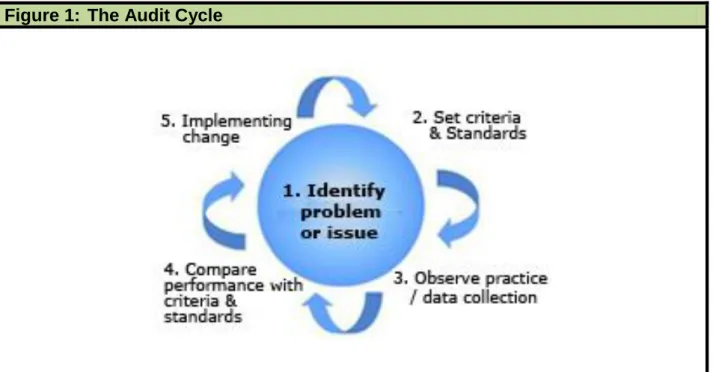
Clinical audit is a quality improvement process that seeks to improve patient care and outcomes through the systematic review of care against explicit criteria and the implementation of change. (See Figure 1) Aspects of the structure, processes and outcomes of care are selected and systematically evaluated against explicit criteria. Where indicated, changes are implemented at an individual team or service level and further monitoring is used to confirm improvement in healthcare delivery. 3
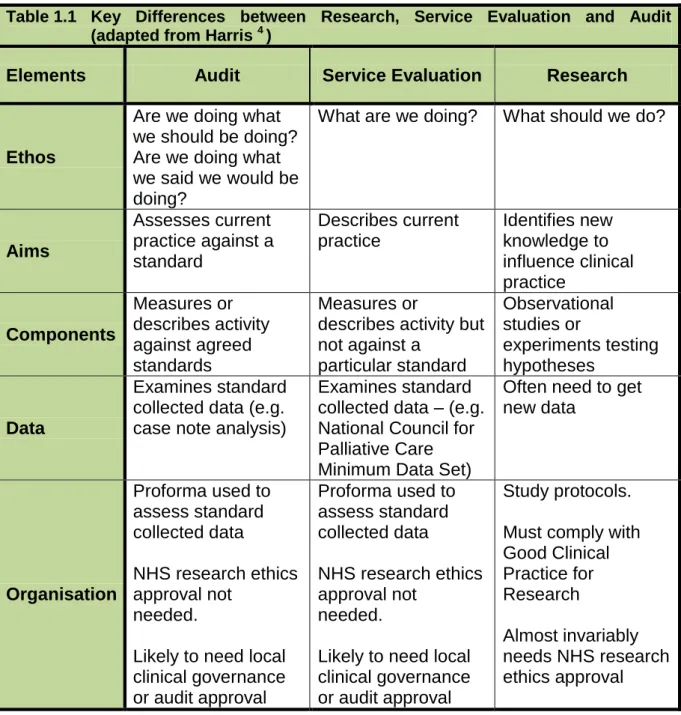
Research, service evaluation and audit can sometime be confused. Table 1.1 highlights the differences in ethos, aims, components, data and organisation.
7
Cheshire and Merseyside Palliative and End of Life Care Network Audit Group Manual Production Date: March 2014 Review Date: March 2015Table 1.1 Key Differences between Research, Service Evaluation and Audit (adapted from Harris 4 )
Elements Audit Service Evaluation Research
Ethos
Are we doing what we should be doing? Are we doing what we said we would be doing?
What are we doing? What should we do?
Aims Assesses current practice against a standard Describes current practice Identifies new knowledge to influence clinical practice Components Measures or describes activity against agreed standards Measures or
describes activity but not against a particular standard Observational studies or experiments testing hypotheses Data Examines standard collected data (e.g. case note analysis)
Examines standard collected data – (e.g. National Council for Palliative Care Minimum Data Set)
Often need to get new data Organisation Proforma used to assess standard collected data NHS research ethics approval not needed.
Likely to need local clinical governance or audit approval Proforma used to assess standard collected data NHS research ethics approval not needed.
Likely to need local clinical governance or audit approval
Study protocols. Must comply with Good Clinical Practice for Research Almost invariably needs NHS research ethics approval .
Section 1
INTRODUCTION
8
Cheshire and Merseyside Palliative and End of Life Care Network Audit Group Manual Production Date: March 2014 Review Date: March 2015Figure 1: The Audit Cycle
1.5 ROLES AND RESPONSIBILITIES FOR MEMBERS OF THE GUIDELINE DEVELOPMENT GROUP
A number of professionals will volunteer to deliver the audit project and develop the standards and guidelines for that topic. They will be known as the Guideline Development Group (GDG).The group will include a range of healthcare professionals from specialist palliative care. Members of a GDG may not necessarily work with other members on a day to day basis. Often being involved in an audit is a good way of getting to know other colleagues from across the Network.
The group will include a Consultant Lead who has the overall responsibility for keeping the audit project on track and ensuring that standards and guidelines are completed according to the NICE process in a timely fashion.
The group will include at least one specialty registrar and two registrars where possible. Specialty registrars (StRs) are undertaking a four year training programme in Palliative Medicine which will equip them to take on a Consultant role in the specialty. All registrars have to complete audits as part of their training. If they are nearing the end of their training they will be tasked with co-ordination of the GDG and will do much of the organisation. If they are a more junior registrar they have a supporting role giving them opportunity to develop skills both in clinical audit and project management. Individual StRs need to consider how they meet the competencies required for audit which are specified in the curriculum.5, 6
9
Cheshire and Merseyside Palliative and End of Life Care Network Audit Group Manual Production Date: March 2014 Review Date: March 2015Membership of each GDG should include professionals with a variety of backgrounds and experience as each benefits from diverse and shared input. Participation within CCMPCNAG can support revalidation for doctors and evidence for Agenda for Change/Knowledge and Skills Framework Appraisal (KSF) for nurses and allied health professionals.
It is important that everyone in the group is prepared to contribute to the work as each audit involves a lot of time and effort. At the first planning meeting it is important to consider the roles and responsibilities for different members. Some aspects of the project may be unfamiliar to some members of the group, depending on previous experience. However, participation should be seen as an opportunity to develop skills, and help and support will be available from other members of the group.
It is important that where possible everyone attends the group meetings in order to keep the project on track. Group members should do their best to arrange release from the workplace. This can be difficult and should be discussed with their Line Manager as soon as possible. It is also helpful if meetings are scheduled at the initial planning discussion so that everyone can have dates, times and locations in their diary. It is helpful if the location can be rotated so that travel is equally shared. The StR often plays a lead role in the organisational aspects of the audit.
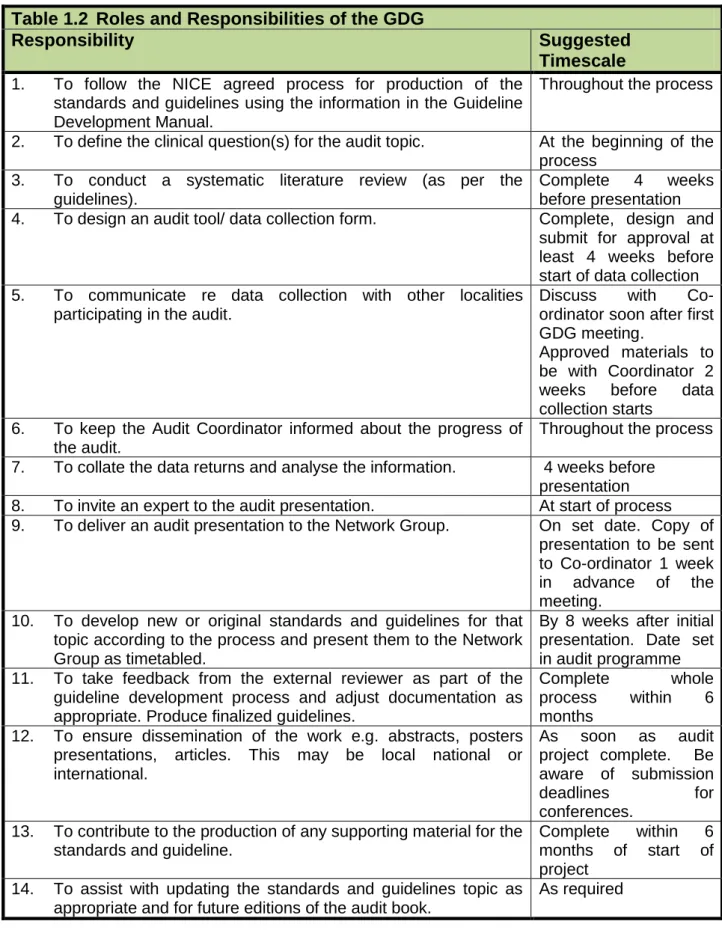
Table 1.2 provides an overview of key responsibilities for the GDG and an optimum timescale.
1.6 THE StR AUDIT CO-ORDINATOR
The Audit Co-ordinator is a senior StR usually based at Marie Curie Hospice Liverpool for 12 months. They are a member of the Audit Subgroup and are responsible for co-ordinating the audit programme. They can be a very useful source of advice and help and details of how to contact them are available on the website.2
You are encouraged to keep the audit coordinator up to date with the progress of your audit to ensure you are meeting appropriate time frames and also to let them know if you are encountering any specific problems with your audit.
10
Cheshire and Merseyside Palliative and End of Life Care Network Audit Group Manual Production Date: March 2014 Review Date: March 2015Table 1.2 Roles and Responsibilities of the GDG
Responsibility Suggested
Timescale
1. To follow the NICE agreed process for production of the standards and guidelines using the information in the Guideline Development Manual.
Throughout the process
2. To define the clinical question(s) for the audit topic. At the beginning of the process
3. To conduct a systematic literature review (as per the guidelines).
Complete 4 weeks
before presentation
4. To design an audit tool/ data collection form. Complete, design and
submit for approval at least 4 weeks before start of data collection 5. To communicate re data collection with other localities
participating in the audit.
Discuss with
Co-ordinator soon after first GDG meeting.
Approved materials to be with Coordinator 2
weeks before data
collection starts 6. To keep the Audit Coordinator informed about the progress of
the audit.
Throughout the process 7. To collate the data returns and analyse the information. 4 weeks before
presentation
8. To invite an expert to the audit presentation. At start of process
9. To deliver an audit presentation to the Network Group. On set date. Copy of presentation to be sent to Co-ordinator 1 week
in advance of the
meeting. 10. To develop new or original standards and guidelines for that
topic according to the process and present them to the Network Group as timetabled.
By 8 weeks after initial presentation. Date set in audit programme 11. To take feedback from the external reviewer as part of the
guideline development process and adjust documentation as appropriate. Produce finalized guidelines.
Complete whole
process within 6
months 12. To ensure dissemination of the work e.g. abstracts, posters
presentations, articles. This may be local national or international. As soon as audit project complete. Be aware of submission deadlines for conferences. 13. To contribute to the production of any supporting material for the
standards and guideline.
Complete within 6
months of start of project
14. To assist with updating the standards and guidelines topic as appropriate and for future editions of the audit book.
As required
11
Cheshire and Merseyside Palliative and End of Life Care Network Audit Group Manual Production Date: March 2014 Review Date: March 2015Tips
Know what type of audit is expected so that you can plan accordingly i.e. Local audits – one/two localities.
Regional – open to all localities in the Network.
Supra-regional – open to all localities in the Network and other invited localities.
2.1 WHAT KIND OF AUDIT?
The audit may be either local or regional.
Regional audits are designed to look at standards and guidelines which have previously been developed. If it is a regional audit it will involve data collection from all areas across the Network. In each locality there are generally three care settings i.e. community, hospice, and hospital making up the Specialist Palliative Care Services Group for that area. All three settings should be included in data collection. The Audit Coordinator will have details for all of the different areas / units in the Cheshire and Merseyside Network.
It may be appropriate to use a previously designed audit tool / proforma or the group may want to develop a new tool. Examples used in previous audits can be found on the website.
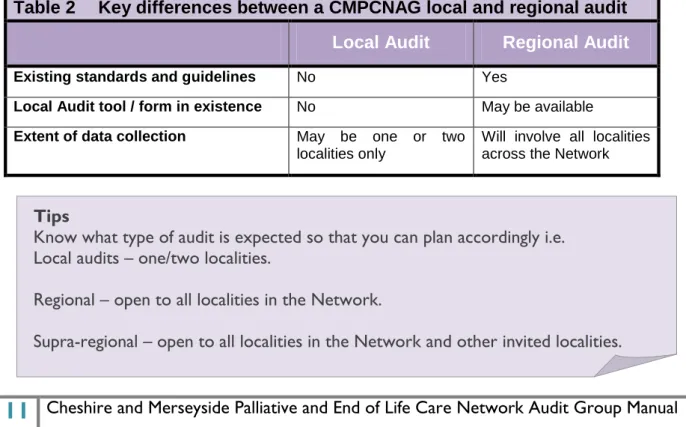
A local audit may look at either one or two localities. It may not necessarily include all care settings although it is usually helpful to try and do so. This will be a new audit so no standards or guidelines will exist and there will be no audit tool / proforma. Table 2 highlights the key differences between a local and regional audit. Note: A junior StR would not be expected to lead a regional audit .This would be the responsibility of a more senior trainee. The less experienced StR would be able to play a supporting role allowing development of the necessary knowledge and skills. The annual review meeting determines the timetable and category of audits for the following year (see Guideline Development Manual 1). Supra-regional audits involve partners from organisations outside the Cheshire and Merseyside Network.
Table 2 Key differences between a CMPCNAG local and regional audit
Local Audit Regional Audit
Existing standards and guidelines No Yes
Local Audit tool / form in existence No May be available
Extent of data collection May be one or two localities only
Will involve all localities across the Network
Section 2
KEY STEPS TO DELIVERING A SUCCESSFUL
AUDIT
12
Cheshire and Merseyside Palliative and End of Life Care Network Audit Group Manual Production Date: March 2014 Review Date: March 20152.2 PLANNING THE AUDIT
This is a crucial stage. Following the annual review meeting and allocation of the Lead consultant and StRs, a Planning Meeting should be organised. This is usually the responsibility of the senior StR. It is strongly advised that everyone in the group attends. The group will then be known as the Guideline Development Group (GDG). The Audit project forms part of the Guideline Development process. Everyone in the group should read both this Audit Manual and the Guideline Development Manual1 thoroughly. These two documents provide important information about how the process should be undertaken and the key steps along the way. In order for the final standards and guidelines to be NICE accredited it is essential that they are produced by the clearly outlined process. There is specific paperwork that needs to be completed and declarations regarding Conflicts of Interests for each member need to be submitted.1
2.3 MEMBERSHIP OF THE GUIDELINE DEVELOPMENT GROUP
Firstly it is important that the group has representation from a range of settings and professionals, and that the members are committed to the project. If there is a problem with membership the Consultant Lead should contact the Chair of the Audit Subgroup as soon as possible. It is very important that patient, carer or public involvement is considered at an early stage. Further guidance is in the Guideline Development Manual.1
. 2.3.1 Defining the Scope of the Guideline and Audit
The group needs to define a clinical question(s) developing the work done in the review meeting. There is more information on how to do this in the Guideline Development Manual.1 If your group has problems with this it is important you contact the Audit Subgroup Chair who may be able to assist. If this is a local (new) audit then you will need to determine your standards prior to developing your data collection proforma. A regional re-audit will have existing standards as a basis for the data collection.
2.3.2 The Systematic Literature Review
A literature search is a key step in the audit process and the Guideline Manual 1 gives extensive information on how to do this. It is important that when planning your project you allow sufficient time to do this. It is likely to involve the majority of the group.
There needs to be a relevant and concise summary of the review presented at the meeting.
Section 2
KEY STEPS TO DELIVERING A SUCCESSFUL
AUDIT
13
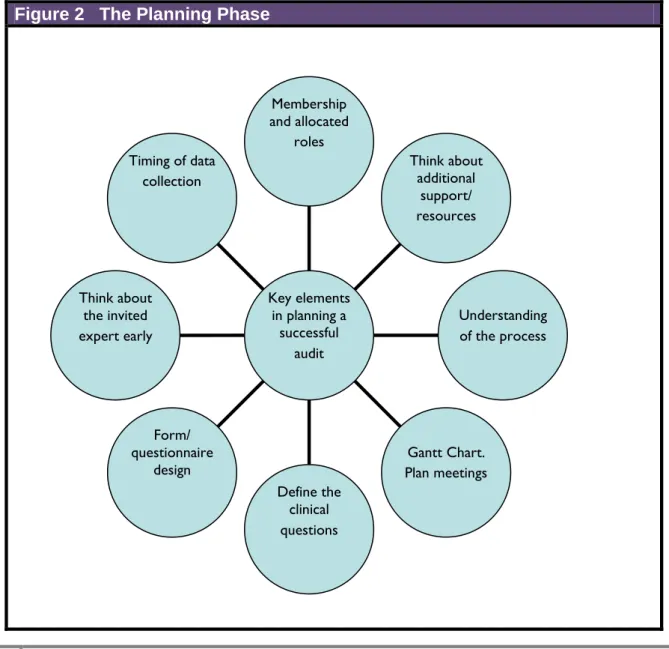
Cheshire and Merseyside Palliative and End of Life Care Network Audit Group Manual Production Date: March 2014 Review Date: March 2015Timing of data collection Think about the invited expert early Form/ questionnaire design Define the clinical questions Gantt Chart. Plan meetings Understanding of the process Think about additional support/ resources Membership and allocated roles Key elements in planning a successful audit
2.3.3 The Invited Expert
Audit projects and the presentation benefit from the input of an invited expert. It is important to think about this at an early stage and approach the professional who would be most appropriate.
2.3.4 Managing the Process and Support
Draw up a Gantt chart6 to plan the audit period. This helps you meet all the required deadlines. Appendix 3 contains an example of an audit Gantt chart.
It may be that you would benefit from additional support to your audit. This may take the form of general advice; help with the literature review or survey design or data analysis. Support and help may be accessed in several ways. Please see section 6 for more details. Figure 2 illustrates the important components of the planning phase.
Figure 2 The Planning Phase
Section 2
KEY STEPS TO DELIVERING A SUCCESSFUL
AUDIT
14
Cheshire and Merseyside Palliative and End of Life Care Network Audit Group Manual Production Date: March 2014 Review Date: March 20152.4 SURVEY AND AUDIT FORM DESIGN
The audit form / survey is key for collecting the data and needs to be designed with great care. If there are existing standards these should be used in the design. The form should include some basic demographic questions. It is important that the locality and the care setting are identified. It may also be important to know the role of the professional responding to the survey.
GDGs may use an electronic method e.g. Survey Monkey or paper. The Audit subgroup has access to an enhanced Survey Monkey account through the Network. This allows you to design a questionnaire with more than 10 questions and use the upgraded facilities. If you wish to use this account you should contact the Audit Subgroup Chair for details of the log in and password.
Questionnaires need to be simple, easy to read and unambiguous as data may be collected by individuals not directly involved in the GDG. Clinical data collection forms must be straightforward. Better response rates are usually obtained from forms no longer than two sides of an A4 sheet of paper.
Examples of forms that have been designed for previous audits will be available on the Network website. As each set of standards and guidelines goes through the NICE process the website will contain each audit form as supporting evidence and as implementation tools for local use.
Decide who you will send the questionnaire out to, which settings and how many responses you would want from each area.
To prevent the overlap of multiple data collection periods for various audits you should inform the audit coordinator of the proposed time scale for data collection at the earliest opportunity and they can then ensure this does not overlap with other projects. On some occasions it may be necessary to alter timings slightly to avoid any clashes.
Once the whole GDG has reviewed the form, it is recommended to pilot the form with someone outside the project group before submitting it for review by the Chair of the Audit Subgroup (see below).
In addition to the form you will need to draft a covering letter to the Leads of all the local Specialist Palliative Care Service Groups if it is a regional audit. The letter will need to be sent to all potential respondents if the audit is local.
Section 2
KEY STEPS TO DELIVERING A SUCCESSFUL
AUDIT
15
Cheshire and Merseyside Palliative and End of Life Care Network Audit Group Manual Production Date: March 2014 Review Date: March 2015Tips
Plan effectively – a Gantt Chart may help with this.
Questions included on the audit form should help answer the overall question “are we doing what we should be doing?” Don’t collect too much data!
Pilot your form – preferably using someone not involved in its creation.
Send your form to the Audit Coordinator 4 weeks before your data collection period to allow review and comments by the Audit Sub Group.
Factor in time to get any local Clinical Audit/Governance approval prior to data collection.
Factor in time to get any local Clinical Audit/Governance approval prior to data collection
This letter should give clear instructions about:- The Audit e.g. title / topic clinical questions
The data collection period with a deadline for returning all forms
How many you are expecting (if there is a maximum number) and who you want to complete the form i.e. which healthcare professionals
If using a paper form where these should be returned to
You should also include a contact for if there are any questions or problems Once you have the final draft of both the form and the covering letter you should send to the Chair of the Audit Subgroup and StR Audit Coordinator along with the completed proposal form and Conflict of Interest statements (see Guideline Development Manual1).
Drafts should be sent at least 4 weeks before the proposed data collection period to give time for review and amendments.
If registering with the Marie Curie Palliative Care Institute Liverpool complete the one page institute protocol (See Appendix 4) and submit to the Research/Development Administrator and the Research/ Development Lead for review. Please see separate guidance on which audits to register with the institute and how to do this (Section 5).
Section 2
KEY STEPS TO DELIVERING A SUCCESSFUL
AUDIT
16
Cheshire and Merseyside Palliative and End of Life Care Network Audit Group Manual Production Date: March 2014 Review Date: March 20152.5 DATA COLLECTION
When approval has been given by the Audit Subgroup Chair, send the approved form or questionnaire and the covering letter to the Audit Coordinator who will then arrange for the documentation to be circulated to the appropriate people.
Individual units participating in an audit will usually need to get agreement from their Trust/ Audit committee before they can go ahead. Different audit departments will have differing stipulations at which point data collection may occur. The lead StR should discuss with the individual Units about how this issue is best managed. It is important that the GDG helps with advice on completing the relevant form(s) so that all the information is included. You need to factor the time allowed for this when planning your project.
It is important to keep track of the number of responses received from each individual unit or Specialist Palliative Care Services group and may be appropriate to send a reminder email(s) throughout the data collection period. This can be organised by the audit coordinator.
2.6 ANALYSIS OF DATA
Data from paper forms will need to be recorded using an appropriate software package e.g. SPSS or Excel. Survey Monkey has its own analysis section, but data may be downloaded and inputted into other software if needed.
The type of analysis to be used should be identified at an early stage as it influences both the type and amount of data collected. Descriptive analysis is the commonest approach.
There may be some useful qualitative information that is collected and this should be analysed thematically. Using comment boxes for free text on the form is one way of collecting this kind of data.
The results should be summarised into the final audit presentation. It is important to think about the key messages that the audience need to be aware of. Not all the graphs produced will need to be included in the final presentation although they may well be of use in future abstracts, articles or presentations.
Section 2
KEY STEPS TO DELIVERING A SUCCESSFUL
AUDIT
17
Cheshire and Merseyside Palliative and End of Life Care Network Audit Group Manual Production Date: March 2014 Review Date: March 2015Tips
When planning the questions for your audit form always think “how am I going to analyse this” to help guide the kind of question you will use.
Results presented at a presentation should support your assessment in whether we are meeting the standards or not.
2.7 PRODUCING LOCALISED REPORTS
Individual units are increasingly being asked to demonstrate their results from a regional audit. The Subgroup is looking at ways a localised report may be produced for all Units that participate in an audit. It is likely that a minimum number of returns will be required before such a report can be generated. Further details of how this will be delivered will be made available on the Network website and at the bimonthly meetings.
Section 2
KEY STEPS TO DELIVERING A SUCCESSFUL
AUDIT
18
Cheshire and Merseyside Palliative and End of Life Care Network Audit Group Manual Production Date: March 2014 Review Date: March 2015Tips
Try and involve everyone in the presentation.
Make sure you send the presentation to the Audit Co-ordinator before the big day! Try and finalise your standards and guidelines as soon after the presentation as you can whilst the memory remains fresh.
The audit presentation is held at the Marie Curie Hospice in Liverpool. Details of the location can be found in Appendix 5.
The date for the presentation of the audit will have been decided at the Review meeting earlier in the year. Ideally all members of the group should contribute to the presentation so it is worth thinking about which areas different members would like to present. An electronic copy of the presentation and any files containing hand-outs for the meeting should be sent to the Coordinator seven days before the audit meeting. The presentation is usually 40-45 minutes and there is then 30 minutes allowed for discussion. The presentation should include:-
Outline of the current standards and guidelines (if they exist)
Summary of the systematic literature review. There needs to be a relevant and concise summary of the review presented to the meeting
Description of the method (s) used Audit results
Proposed new standards and guidelines Comments/ overview from invited expert
Following the presentation all of the group are invited to help with answering any questions from the audience and contribute to the discussion.
At the end of the presentation and discussion the group will be asked to take all of the comments away to produce a final draft of the standards and guidelines to present at the next but one audit meeting i.e. in 4 months. Full details about the development of the standards and guidelines can be found in the Guideline Development Manual.1
19
Cheshire and Merseyside Palliative and End of Life Care Network Audit Group Manual Production Date: March 2014 Review Date: March 2015Tips
Read the Network Guideline Development Manual 1 in conjunction with this guide. It
contains valuable information.
Electronic versions of the various forms are available on the Network website.
A clinical guideline has been defined by NICE as “recommendations on the appropriate treatment and care of people with specific diseases and conditions within the NHS. Clinical guidelines are based on the best available evidence. Guidelines help professionals in their work, but they do not replace their knowledge and skills” 7
. Good clinical guidelines aim to improve the quality of healthcare. They can change the process of healthcare and improve peoples‟ chances of getting as well as possible. Clinical guidelines can:-7
Provide recommendations for the treatment and care of people by health professionals
Be used to develop standards to assess the clinical practice of individual health professionals
Be used in the education and training of health professionals Help patients make informed decisions
Improve communication between patient and health professional
The methodology for the production of clinical guidelines has evolved over the past decade. The Guideline Development Manual 1 details the production and review of the standards and Guidelines in line with current best methodologies and aims to meet the NICE criteria for guideline production.
Information in the manual includes:- Defining the scope of the guidelines Establishing the evidence
Reviewing and grading of evidence
Development and grading of recommendations Consultation and external review
Format and content
Dissemination and Implementation
Comprehensive list of resources and supporting documentation The manual is located on the Network website.2
Section 4
DEVELOPING THE STANDARDS AND
GUIDELINES
20
Cheshire and Merseyside Palliative and End of Life Care Network Audit Group Manual Production Date: March 2014 Review Date: March 2015Tips
If unsure – seek help early, there are many people that can either help or know someone who can.
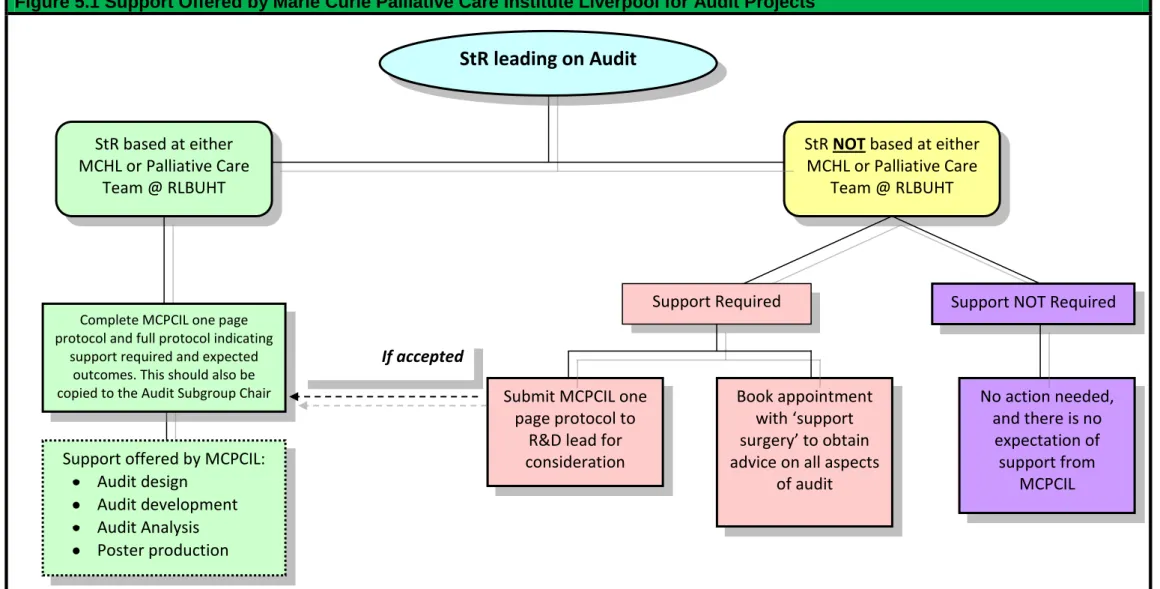
For Specialist Registrars (StRs) leading audits whilst resident at the Marie Curie Hospice and the Royal Liverpool and Broadgreen University Hospital (RLBUHT) Palliative Care Team, the Marie Curie Palliative Care Institute( MCPCIL) will offer support in the design, development and analysis phases of the audit project.
The StR must complete a one page protocol (See Appendix 5) and subsequently a full protocol - indicating the support required and expected outputs (abstracts and publications).
If a StR is leading an audit and would like support but working outside the Marie Curie Hospice and the RLUBHT Palliative Care Team they should submit a one page protocol to the MCPCIL R&D lead for consideration (See Appendix 5). If accepted, a full protocol should be developed, identifying expected outputs (abstracts and publications).
For a StR leading an audit and working in units other than the Marie Curie Hospice / Palliative Care Team and the RLUBHT, and who does not wish to have support, there is no obligation to register the project.
Support, advice and signposting may also be accessed through the Audit Subgroup Chair and Audit Coordinator.
See Figure 5.1 for an overview of the process.
21
Cheshire and Merseyside Palliative and End of Life Care Network Audit Group Manual Production Date: March 2014 Review Date: March 2015Figure 5.1 Support Offered by Marie Curie Palliative Care Institute Liverpool for Audit Projects
Section 5
HOW TO ACCESS SUPPORT
StR leading on Audit
StR based at either MCHL or Palliative Care
Team @ RLBUHT
StR NOT based at either MCHL or Palliative Care
Team @ RLBUHT
Complete MCPCIL one page protocol and full protocol indicating
support required and expected outcomes. This should also be copied to the Audit Subgroup Chair
Support offered by MCPCIL: Audit design
Audit development Audit Analysis Poster production
Support Required Support NOT Required
Submit MCPCIL one page protocol to
R&D lead for consideration
If accepted
Book appointment with ‘support surgery’ to obtain advice on all aspects
of audit No action needed, and there is no expectation of support from MCPCIL
22
Cheshire and Merseyside Palliative and End of Life Care Network Audit Group Manual Production Date: March 2014 Review Date: March 2015Tips
Identify your conference early.
Write the abstract once data analysis is concluded – conference abstracts follow a similar structure.
The Guideline Development Manual has suggestions of other ways to help dissemination and implementation of your work.
After the day of the presentation remember to write and thank your invited expert for his help and attendance. This is usually the responsibility of the lead StR. Copies of the presentation will be made available on the Network website so that other units may use as a teaching aid when disseminating the results from the audit and implementing change.
GDGs are strongly encouraged to disseminate the results of the work as widely as possible. This may include abstracts/ posters for local, national and international conferences. Groups should also consider writing articles for both palliative and non-palliative care journals.
Any posters or publications arising from the audit group should acknowledge the contribution of the Cheshire and Merseyside Palliative and End of Life Care Network Audit Group. For poster format, this is usually by including the Network group logo which can be obtained through the Audit Coordinator.
Details of successful abstracts, presentations or articles should be sent to the Chair of the Audit Subgroup and will be made available on the website.
Every three years all of the current guidelines will be collated into a book. This has been available in hard copy only but it is hoped that it will also be available electronically for the 5th edition, due in 2015.
23
Cheshire and Merseyside Palliative and End of Life Care Network Audit Group Manual Production Date: March 2014 Review Date: March 2015
The book collates the work undertaken by the group. It is designed both for the purposes of education and to facilitate the production of other standards and guidelines. It aims to encourage the setting and monitoring of standards and promote clinical excellence in end of life care. It is intended as an information resource for qualified medical staff and other health professionals caring for patients where palliative care is appropriate. It is applicable to patients with cancer and other forms of advanced disease. The guidelines are not standard protocols and are not intended to be prescriptive.
The fourth edition of the book was produced in 2010. Each chapter had been extensively reviewed by members of the group and experts from across the United Kingdom. Six new chapters were included: drugs at the end of life, interventional pain techniques, major haemorrhage, spiritual care, substance misuse and urinary incontinence. Standards and guidelines which had not been re-audited since the 3rd edition were updated and reviewed. There are levels of evidence throughout the guidelines and grades of recommendation for all of the standards in each of the 43 chapters. Appendix 6 contains a list of all the audit topics.
Copies of the book can be obtained through the Marie Curie Palliative Care Institute Liverpool website (www.mcpcil.org.uk). Details of the annual audit programmes since the last edition of the book can be found in Appendix 7.
24
Cheshire and Merseyside Palliative and End of Life Care Network Audit Group Manual Production Date: March 2014 Review Date: March 2015
1. Cheshire and Merseyside Palliative and End of Life Care Network Audit Group. Guideline Development Manual. March 2014. Available from: www.mccn.nhs.uk. (accessed 20 February 2014).
2. Cheshire and Merseyside Palliative and End of Life Care Network Audit Group. Website. www.mccn.nhs.uk (accessed 20 February 2014).
3. National Institute for Health and Care Excellence. Principles of Best Practice in Clinical Audit. 2002. Radcliffe Medical Press. Oxon. Available from: www.nice.org.uk/media/796/23/BestPracticeClinical Audit.pdf (accessed 20 February 2014).
4. Harris D. Differentiating clinical audit from service evaluation and research.
Eur J Palliat Care 2013: 20(3):133-135.
5. Joint Royal Colleges of Physicians Training Board. Specialty Training Curriculum for Palliative Medicine. August 2010. (Amendments August 2012). Available from: www.jrcptb.org.uk/trainingandcert/ST3
SpR/Documents/2010Palliativemedicinecurriculum(AMENDMENTS2012).pdf (accessed 14 February 2014).
6. Joint Royal Colleges of Physicians Training Board. 2010 Palliative Medicine ARCP Decision Aid. Available from:
www.jrcptb.org.uk/trainingandcert/ST3-SpR/Documents/2010PalliativeMedicineARCPDecisionAid.pdf (accessed 14 February 2014).
7. Department of Health: National Clinical Audit Advisory Group Gantt Charts. Available from:
www.improhealth.org/fileadmin/Documents/Improvement_Tools/Gantt_Chart.p df (accessed 12 February 2014).
8. National Institute for Health and Care Excellence. Clinical guidelines. Available from:www.nice.org.uk/CG Updated 28 October 2011. (accessed 14 February 2014).
25
Cheshire and Merseyside Palliative and End of Life Care Network Audit Group Manual Production Date: March 2014 Review Date: March 2015
ADDITIONAL AUDIT RESOURCES
HQUIP. Potter J, Fuller F, Ferris M. Local clinical audit: handbook for physicians August 2010. Available from: http://www.hqip.org.uk/assets/Guidance/Local-clinical-audit-handbook-for-physicians-August-2010-FINAL.pdf
(accessed 12 February 2014).
HQUIPP Dixon N. Guide to involving Junior doctors in Clinical Audit. Available from:
http://www.hqip.org.uk/assets/5-HQIP-CA-PD-026-Guide-to-Involving-Junior-Doctors-in-Clinical-Audit-19-April-2010.pdf (accessed 12 February 2014).
Online learning resource. Intermediate Clinical Audit Training for Clinicians (April 2012) Available from: http://www.hqip.org.uk/guidance-support/intermediate-level-clinical-audit-training-for-clinicians.html
(accessed 12 February 2014).
HQUIPP Patient and public Involvement. Available from:
http://www.hqip.org.uk/patient-and-public-involvement/ (accessed 12 February 2014).
Clinical Audit teaching Toolkit. Available from:
http://www.hqip.org.uk/downloadable-learning-resources/ (accessed 12 February 2014).
Health Care Quality Improvement Partnership. www.hquip.org.uk. (accessed 12 February 2014).
Clinical Audit Support Centre. www.clinicalauditsupport.com (accessed 12 February 2014).
National Institute for Health and Care Excellence. Clinical Audit www.nice.org.uk (accessed 12 February 2014).
26
Cheshire and Merseyside Palliative and End of Life Care Network Audit Group Manual Production Date: March 2014 Review Date: March 2015
NICE ACCREDITATION PROCESS
Accreditation helps health and social care professionals identify the most robustly produced guidance available, enabling them to deliver high quality care. Since 2009 the National Institute for Health and Care Excellence have accredited 60 guidance development processes.
What is accreditation?
The accreditation programme assesses the processes used to produce guidance and advice. This will, in turn, help raise standards in guidance production.
What are the benefits of accreditation?
To help health and social care professionals identify the most trusted sources of guidance developed using critically evaluated high quality processes
To drive up the quality of information used by health and social care professionals in decision making
To improve patient outcomes through providing robust evidence for NICE quality standards
Why apply for accreditation?
To Increase the visibility of guidance and advice
To attain accreditation for guidance, making it eligible to be considered for the development of NICE quality standards
To promote the guideline development processes as being robust and transparent
To use the NICE Accreditation Mark as an indication of high standard, good quality information
The following table outlines the 6 domains and criteria required for a guideline development process to be NICE accredited. The process must meet all of the criteria. Further information can be found on the NICE website http://www.nice.org.uk/accreditation.
27
Cheshire and Merseyside Palliative and End of Life Care Network Audit Group Manual Production Date: March 2014 Review Date: March 2015ACCREDITATION DOMAINS AND CRITERIA
DOMAIN CRITERIA
1. Scope and purpose is concerned with the overall aim of the guidance, the specific health questions and the target population.
These criteria consider whether the guidance producer has a policy in place and adhered to that requires them to explicitly detail:
1.1 The overall objective of the guidance.
1.2 The clinical, healthcare or social questions covered by the guidance.
1.3 The population and/or target audience to whom the guidance applies.
1.4 That the producer ensures guidance includes clear recommendations in reference to specific clinical, healthcare or social circumstances.
2. Stakeholder involvement focuses on the extent to which the guidance represents the views of its intended users and those affected by the guidance (patients and service users).
These criteria consider whether the guidance producer has a policy in place and adhered to that means it includes:
2.1 Individuals from all relevant stakeholder groups including patients groups in developing guidance.
2.2 Patient and service user representatives and seeks patients views and preferences in developing guidance.
2.3 Representative intended users in developing guidance.
3. Rigour of development relates to the process used to gather and synthesise information and the methods used to formulate recommendations and update them.
These criteria consider whether the guidance producer has a clear policy in place and adhered to that:
3.1 Requires the guidance producer to use systematic methods to search for evidence and provide details of the search strategy.
3.2 Requires the guidance producers to state the criteria and reasons for inclusion or exclusion of evidence identified by the evidence review.
3.3 Describes the strengths and limitations of the body of evidence and acknowledges any areas of uncertainty.
3.4 Describes the method used to arrive at
recommendations (for example, a voting system or formal consensus techniques like Delphi
consensus).
28
Cheshire and Merseyside Palliative and End of Life Care Network Audit Group Manual Production Date: March 2014 Review Date: March 2015
DOMAIN CRITERIA
3.5 Requires the guidance producers to consider the health benefits, side effects and risks in formulating recommendation.
3.6 Describes the processes of external peer review. 3.7 Describes the process of updating guidance and
maintaining and improving guidance quality.
4. Clarity and presentation deals with the language and format of the guidance.
These criteria consider whether the guidance producer ensures that:
4.1 The recommendations are specific, unambiguous and clearly identifiable.
4.2 The different options for management of the condition or options for intervention are clearly presented. 4.3 The date of search, the date of publication or last
update and the proposed date for review are clearly stated.
4.4 The content and style of the guidance is suitable for the specified target audience. If the public, patients or service users are part of this audience, the language should be appropriate.
5. Applicability deals with the likely organisational, behavioural and cost implications of applying the guidance.
These criteria consider whether the guidance producer routinely consider:
5.1 Publishing support tools to aid implementation of guidance.
5.2 Discussion of potential organisational and financial barriers in applying its recommendations.
5.3 Review criteria for monitoring and/or audit purposes within each product.
6. Editorial Independence is concerned with the independence of the
recommendations, acknowledgement of possible conflicts of interest, the credibility of the guidance in general and their recommendations in particular.
These criteria consider whether the guidance producer: 6.1 Ensures editorial independence from the funding body. 6.2 Is transparent about the funding mechanisms for its
guidance.
6.3 Records and states any potential conflicts of interest of individuals involved in developing the recommendations. 6.4 Takes account of any potential for bias in the conclusions
of recommendations of the guidance.
29
Cheshire and Merseyside Palliative and End of Life Care Network Audit Group Manual Production Date: March 2014 Review Date: March 2015
OVERVIEW OF NETWORK AUDIT STRUCTURES
APPENDIX 2
SPC Service Groups AUDIT SPC CLINICAL ADVISORY GROUPPALLIATIVE & END OF LIFE CARE
STEERING GROUP
EDUCATION & TRAINING HOSPITALS TRANSFORM PROGRAMME HOSPICE ADVISORY GROUPSTRATEGIC CLINICAL NETWORK
OVERSIGHT GROUP
EOL CARE
LOCALITY
GROUPS
E.G. QUIPPS /
LIT
PRIMARY AND COMMUNITY SUB GROUP30
Cheshire and Merseyside Palliative and End of Life Care Network Audit Group Manual Production Date: March 2014 Review Date: March 2015
With thanks to Dr Sarah Fradsham.
Exact timings are flexible and will depend on the date and nature of the audit presentation. The timings need to be appropriate for the particular needs of the group.
Month 1 2 3 4 5 6 7 8 9 10 11 12 13 14 15 16 17 18
Regional Review Meeting
Audit & Guideline Development Group meetings - Keep minutes and complete manual forms
Define & Agree Clinical Question(s) Submit Proposal Form to Audit Sub Group
Systematic Literature Review Form Development & pilot Submit agreed audit form Data Collection
Data Analysis
Proposed Standards & Guidelines Prepare for Audit Presentation
Prepare abstract ready for opening of conference submission/publication deadlines
Audit Presentation Consultation
Present Standards & Guidelines External Review Process
Submit final Standards & Guidelines and supporting materials to Audit Sub Group
APPENDIX 3
31
Cheshire and Merseyside Palliative and End of Life Care Network Audit Group Manual Production Date: March 2014 Review Date: March 2015
INSTITUTE PROPOSAL FORM
MCPCIL Management Toolkit
One Page Protocol (1)
Project Title:Project Lead: Project Ref No: Approx dates: Background:
Should include information that helps provide rationale for proposed Project. For research projects/research elements you will need to include a brief summary of previous research literature.
Personnel Involved:
Include names, titles, current location, role in project.
Proposed Start Date / Timeline:
For research projects/research elements of projects you will need to include information about ethical approval, where appropriate (e.g date approval granted / to be sought).
Aims of the Project:
For research projects/research elements of projects this should include the research questions and any main hypotheses.
** Extra section for research projects / research elements**
Need to include information regarding design & methodology including:
Methods of data collection (including any existing instruments to be used) Design (e.g. prospective, retrospective, case study design, longitudinal, cross sectional etc.)
Procedure (brief explanation of how you intend to carry out the proposed investigation)
Sample (including, where appropriate, choice of sample, inclusion & exclusion criteria)
Analysis (how you propose to analyse the data)
32
Cheshire and Merseyside Palliative and End of Life Care Network Audit Group Manual Production Date: March 2014 Review Date: March 2015
MCPCIL Management Toolkit
One Page Protocol (2)
Proposed Finish Date:For research projects/research elements of projects please include when you intend to:
Complete data collection Analyse the results
Write up final MCPCIL report
Disseminate your findings (eg journal articles, conferences etc.)
One Page Protocol approved to proceed
Name Signature Date
Project Lead: Line Manager:
33
Cheshire and Merseyside Palliative and End of Life Care Network Audit Group Manual Production Date: March 2014 Review Date: March 2015
MARIE CURIE HOSPICE LIVERPOOL AND
MARIE CURIE PALLIATIVE CARE INSTITUTE LIVERPOOL
Marie Curie Hospice Liverpool Speke Road
Woolton Liverpool L25 8QA
Tel: 0151 801 1400
Marie Curie Palliative Care Institute Liverpool Cancer Research Centre
University of Liverpool 200 London Road Liverpool L3 9TA
Tel: +44 (0)151 794 8806
Email: [email protected]
“The Institute's mission is to be a centre of excellence and an international leader in care of the dying from bedside to policy through service innovation, research and development and knowledge transfer. It enables clinical excellence that makes a real and sustained difference to dying people and their relatives and carers, in order to influence those who shape and deliver healthcare for the dying”.
34
Cheshire and Merseyside Palliative and End of Life Care Network Audit Group Manual Production Date: March 2014 Review Date: March 2015
AUDIT TOPICS TO DATE (January 2014)
Highlighted audits – >5 years since last audited
ORIGINAL AUDIT REGIONAL (RE)AUDIT
Agitation April 1995 March 2002/ July 2008
Antibiotics October 1998 July 2007/March 2012
Anticoagulation April 2002 March 2010
Anticonvulsants October 2004 November 2012
Ascites June 1995 July 2005 /Nov 2011
Bereavement October 2003
Bisphosphonates /Bone Pain February 2000 November 2008
Blood Transfusion February 1996 June 2000/ Sept 2007
Bowel Obstruction February 1997 April 1998 / Feb 2006
Breakthrough Pain September 2011
Breathlessness February 1998 January 2003/Dec 2010
Constipation October 1996 December 1999/ March 2008
Corticosteroids June 2001 March 2009
CPR December 2002 October 2009
Delirium April 1995 March 2002/ July 2008
Depression June 1996 February 2001/July 2011
Diabetes December 2000 January 2008
Drugs used at the End of Life September 2006
Fatigue April 2001 July 2009
Genograms March 2003
Hydration in the dying patient June 1999 July 2006 /Jan 2010
Hypercalcaemia October 1995 Dec 1998 / Feb 2004
Insomnia September 2002 January 2012
Interventional Pain Techniques October 2008
Itch December 2003
Ketamine September 2012
Major Haemorrhage November 2007
Methadone September 2012
Nausea and Vomiting August 1996 July 2003
Neuropathic Pain June 1997 April 1999 / July 2004/ May 2014
Nutrition July 2012
NSAIDS October 1997 December 2005/January 2013
35
Cheshire and Merseyside Palliative and End of Life Care Network Audit Group Manual Production Date: March 2014 Review Date: March 2015
AUDIT TOPICS TO DATE (January 2014) Contd…..
Highlighted audits – >5 years since last audited
ORIGINAL AUDIT REGIONAL (RE)AUDIT
Opioid Substitution February 1995 Dec 1997/ Update 2000/ July 2007
Opioids in Drug Abuse January 2009
Oral Care May 2000 Feb 2005/ Update Jan 2011
Oxygen September 2013
Pleural Effusions August 1995 March 2007
Pathological Fractures – Prevention April 2005 November 2013
Psychostimulants September 2001
Psychological Support Services December 2004 January 2014
Rehabilitation September 2010
Renal Failure October 1999 September 2005/ March 2013
Sexual Health December 2001 December 2009
Spiritual Care April 2006 March 2011
Spinal Cord Compression March 2004 Update Jan 2011
Syringe Drivers April 1996 July 2002/ Update Jan 2011
Transdermal Opioids July 2010
Urinary Incontinence November 2006
36
Cheshire and Merseyside Palliative and End of Life Care Network Audit Group Manual Production Date: March 2014 Review Date: March 2015APPENDIX 7
Date Topic Supporting
Consultant(s)
Trainee Lead(s) Other Contributors ICN Representation
14 July 2011
Depression
(Regional) Spirituality S&G
Dr Jenny Smith Dr Graham Whyte Dr Andrew Khodabukus
Julie Howarth (Whiston) Dawn Reynolds (Chester)
Stephen Mason Helen Thomas(COCH)
West Cheshire St H&K Liverpool
15 September 2011 Breakthrough Pain
(New) Dr Clare Littlewood
Dr Kate Marley Dr Ami Nwosu Andrew Dickman Dr Esra Sulaivany St H&K Liverpool Warrington 24 November 2011 Ascites (Supra-regional) Depression S&G Dr Laura Chapman Dr Leslie Allsopp Dr Andrea Whitfield
Dr Leslie Johnny Dawn Gray (Women‟s) Ann Griffiths (CCO) Blackpool Nominee Liverpool Blackpool Wirral 12 January 2012 Insomnia/Bereavement (Supra-regional) Breakthrough Pain S&G
Dr Richard Latten Dr Jenny Smith Dr Carolyn Watt
Dr Andrew Khodabukus Dr Caroline Irvine ( Chester) Barbara (Chester) Liverpool West Cheshire Lancaster 22 March 2012 Antibiotics (Regional) Ascites S&G
Dr Clare Finnegan Dr Clare Jeffries
New LAT Marie Curie Link Nurses x2
Southport/ West Lancs Liverpool
3 May 2012 Review Meeting
Insomnia/Bereavement S&G 12 July 2012 Nutrition (New) Antibiotics S&G Dr Paula Powell Dr Cathy Lewis Jones
Dr Emma Taylor New StR
Wirral Dieticians (Via CLJ) Margaret Kendall (Warrington)
Alison Young (RLUH), Elaine Hamill(MCHL) Whiston Wirral Warrington Liverpool 13 September 2012 Ketamine/Methadone
(New/ Regional/Long term) No S+G
Dr Alison Coackley Dr Sarah Fradsham Dr Graham Whyte
Ruth Clark(MCHL Pharmacist) Dr Helen Bonwick(MCHL) Dr Anthony Thompson Andrew Dickman Ann Griffiths(CCO) Liverpool Whiston Blackpool Wirral 8 November 2012 Anticonvulsants (Regional) Nutrition S&G Dr Averil Fountain Dr Melanie Brooks Dr Kate Marley New StR Sue Croft(Wirral) Marie Keenan (Halton
Pharmacist)
Warrington Liverpool
Wirral
37
Cheshire and Merseyside Palliative and End of Life Care Network Audit Group Manual Production Date: March 2014 Review Date: March 2015Date Topic Supporting
Consultant(s)/Senior Medic
Trainee Lead(s) Other Contributors ICN Representation
12 July 2012 Nutrition
(New) Antibiotics S&G
Dr Paula Powell Dr Cathy Lewis Jones
Dr Emma Taylor Dr Clare Horlicks
Wirral Dieticians (Via CLJ) Margaret Kendall
(Warrington) Alison Young (RLUH),
Elaine Hamill(MCHL) Whiston Wirral Warrington Liverpool 13 September 2012 Ketamine/Methadone
(New/ Regional/Long term No S+G Dr Alison Coackley Dr Graham Whyte Dr Sarah Fradsham Dr Aileen Scott Ruth Clark(MCHL Pharmacist) Dr Helen Bonwick(MCHL) Dr Anthony Thompson Andrew Dickman Agnes Noble (CCO)
Liverpool Whiston Blackpool Wirral 8 November 2012 Anticonvulsants (Regional) Nutrition S&G Dr Averil Fountain Dr Melanie Brooks
Dr Kate Marley Sue Croft(Wirral) Marie Keenan (Halton
Pharmacist)
Warrington Liverpool
Wirral
17 January 2013 NSAIDS
Ketamine/ Methadone S&G
Dr Richard Latten Dr Sarah Fradsham/ Dr Seamus Coyle
Ruth Clark Liverpool
14 March 2013 Renal Failure
Anticonvulsants S&G
Dr Julie Raj Dr Clare Horlicks /LAT Aintree Team, Whiston Team Aintree
St Helens and Knowsley
2 May 2013 Review Meeting
NSAIDS S&G
4 July 2013 Path Fracture Dr Jenny Smith Dr Andrew Khodabukus Barbara Humphries, Joanne
Reynolds, CCO team
Western Cheshire Liverpool
Wirral
Oxygen
Renal Failure S&G
Dr Helen Bonwick Dr Aileen Scott Dr Anthony Thompson, Dr Clare Robinson,
Liverpool St Helens and Knowsley
12 September 2013 Psychological Support (Supra-regional)
No S&G
Dr Clare Finnegan Dr Clare Jeffries Dr Emma Taylor), Virginia Williams, Dr Carolyn Watt,
Katie Evans
Southport, Formby and West Lancs
Lancaster St Helens and Knowsley
Aintree
14th November 2013 Neuropathic Pain
Path Fracture/ Oxygen S&G
Dr Esra Sulaivany Dr Kath Gaunt Dr Graham Leng, Margaret Kendall
Warrington Western Cheshire
NETWORK AUDIT PROGAMME 2012/2013
38
Cheshire and Merseyside Palliative and End of Life Care Network Audit Group Manual Production Date: March 2014 Review Date: March 2015APPENDIX 7
Date Topic Supporting
Consultant(s)/ Senior Medic
Trainee Lead(s) Other Contributors ICN Representation
4 July 2013
Systematic Review Pathological fractures
Renal Failure S&G NICE accreditation
N/A DrAndrew Khodabukus
12 September 2013
Oxygen
Nice accreditation
Dr Helen Bonwick Dr Aileen Scott Dr Anthony Thompson, Clare Robinson,
Liverpool St Helens and Knowsley
14 November 2013 Path Fracture
NICE accreditation Dr Jenny Smith Dr Andrew Khodabukus
Barbara Humphries, Joanne Reynolds, CCO team,
Western Cheshire Liverpool Wirral 9 January 2014 Psychological Support (Supra-regional) Oxygen S&G
Dr Clare Finnegan Dr Clare Jeffries
Dr Emma Longford, Virginia Williams, Carolyn Watt, Katie
Evans
Southport, Formby and West Lancs
Lancaster St Helens and Knowsley
Aintree
6 March 2014 Review Meeting
Path Fracture S&G Dr Alison Coackley
Dr Andrew Khodabukus
Dr Aileen Scott Members of Audit Sub-Group N/A
1 May 2014 Neuropathic Pain Dr Esraa Sulaivany Dr Kate Marley Dr Kath Gaunt Dr Seamus Coyle
Dr Graham Leng, Margaret Kendall,
Warrington Western Cheshire
3 July 2014 Update Session
25 September 2014 TBC - Neuropathic Pain
S&G
November 2014 TBC