STATE OF OREGON
DEPARTMENT OF TRANSPORTATION
TRAVEL DEMAND MODEL DEVELOPMENT
AND
APPLICATION GUIDELINES
Prepared for
Oregon Department Of Transportation
Planning Section
Transportation Planning Analysis Unit
Prepared by
Parsons Brinckerhoff Quade & Douglas, Inc.
Portland, Oregon
With Assistance from Kittelson & Assiciates, Inc.
Portland, Oregon
September, 1994 Revised, June, 1995
4ABLE /F #ONTENTS
CONTENTS
1.0 INTRODUCTION
1.1 Background and Objectives 1
1.2 Purpose and Use Of The Guidelines 2
1.3 Report Structure and Outline 2
2.0 LEGISLATIVE REQUIREMENTS AND IMPLICATIONS
2.1 Federal Conformity Rule 3
2.2 State Conformity Rule 5
2.3 Transportation Planning Rule 7
3.0 INPUT DATA ASSEMBLY AND METHODOLOGY
3.1 Land Use and Socio-Economic Data 10
3.2 Travel Survey Data 12
3.3 Transportation Networks 16
3.4 Travel Cost Data 19
3.5 Model Validation Data 21
4.0 MODEL DEVELOPMENT GUIDELINES
4.1 Introduction 24 4.2 Trip Generation 26 4.3 Auto Ownership 35 4.4 Trip Distribution 37 4.5 Mode Choice 44 4.6 Commercial Vehicles 56 4.7 External Travel 58
4.8 Trip Assignment and Time-Of-Day Choice Models 60
4.9 Model Validation Procedures and Standards 63
5.0 NON-MPO MODEL DEVELOPMENT GUIDELINES
5.1 Introduction 66
5.2 Travel Demand Modeling in Non-MPO Areas 66
5.3 Guidelines for Areas Classified as Non-Attaintment 67
5.4 Guidelines for Areas Classified as Attainment 73
6.0 MODEL APPLICATION GUIDELINES
6.1 Introduction 77
6.2 Application Consistency 77
6.3 Reasonableness Evaluations 78
4ABLE /F #ONTENTS
7.0 EVALUATION TECHNIQUES
7.1 Introduction 82
7.2 Evaluation Of Emissions 82
7.3 Evaluation Of Traffic Operations 88
7.4 Concluding Remarks 94
8.0 DIRECTIONS IN THE STATE-OF-THE-ART
8.1 "Best Practice" Model Development 96
4RAVEL $EMAND -ODEL $EVELOPMENT AND !PPLICATION 'UIDELINES
1.0
INTRODUCTION
1.1 - Background and Objectives
With passage of the 1990 Federal Clear Air Act Amendments (CAAA), the 1991 Federal Intermodal Surface Transportation Efficiency Act (ISTEA), and the 1991 Oregon Transportation Planning Rule (TPR), a resurgence in the interest and commitment to improving underlying travel demand model behavioral properties and forecasting techniques has been evidenced throughout the country. The state-of-the-practice has improved measurably in the last few years with the advent of fully nested logit mode choice models, incorporation of the LogSum variable (as the impedance measure) in Trip Distribution, feedback loops occurring throughout the process fostering stronger relationships between individual model components, and advances in trip assignment algorithms (i.e., multi-class assignment, conical volume-delay functions, etc.) to name a few. Substantially new (research) approaches are also being funded by FHWA, FTA, EPA, DOE, and the office of the Transportation Secretary, including the Track "C" redesign of the Travel Forecasting Process and the Los Alamos TRANSIMS project.
Simultaneously and consistent with the advent of relatively inexpensive micro-computer hardware and software resources, including transportation planning software (notably emme/2 in Oregon), the need and opportunity to apply travel demand forecasting techniques and procedures to transportation problems at the regional, corridor, and subarea levels have corresponding increased. There is a new challenge confronting state and regional agencies -- the selection and development of appropriate analysis tools for application to the planning problems at hand. To meet this challenge the transportation planner/analyst must possess both a blueprint for developing and applying these tools and the training necessary to implement that blueprint. The intended purpose of these guidelines is to provide that blueprint.
With notable exceptions, Metropolitan Planning Organizations (MPO’s), counties, and individual cities within Oregon will require technical assistance and guidance in developing and applying travel demand models to the wide spectrum of planning and design study needs in their purview. With this in mind, it will be important for the Oregon Department Of Transportation (ODOT) to be well-positioned to offer technical support. Separate, parallel efforts have been established within ODOT to provide staff training in both the specific use of emme/2 and, more importantly, in the principles of model development and application.
)NTRODUCTION
4RAVEL $EMAND -ODEL $EVELOPMENT AND !PPLICATION 'UIDELINES
1.2 - Purpose and Use Of The Guidelines
Guidelines for the estimation, calibration, validation, and application of travel demand models on a statewide basis, must by their very nature, address the appropriate level-of-complexity of mathematical formulation and level-of-detail required for a range of regional sizes, beginning with a region as diverse in transportation infrastructure as Portland, to the three other MPO’s within the State (all of whom possess populations in excess of 50,000), and finally to those regions with less than 50,000 inhabitants, stratified into those who are in non-attainment (with respect to one or more of the air quality-defined precursors) and those who are currently in attainment. Similarly, the level-of-complexity must consider the full spectrum of model sophistication ranging from typical or common practice (generally found in most MPO’s) to acceptable practice, "best" practice, advanced practice, and finally, to "state-of-the-art", which often borders on academic research. The current travel demand modeling capabilities present within the Portland region generally represent advanced practice, with some of their new initiatives placing the region on the path to "state-of-the-art". These statewide guidelines are intended to support
"best" practice as the yardstick of acceptable practice, while simultaneously supporting, but not
requiring nor limiting, extensions of the methodology to advanced or state-of-the-art practices. The specification of model development and application guidelines have been formulated, therefore, in the context of a two-dimensional framework -- region size and model capability. In a number of instances, where applicable, optional (or advanced practice) guidelines are also included.
1.3 - Report Structure And Outline
The Guidelines begin with an overview of the requirements and implications for travel demand modeling based upon applicable Federal and State of Oregon legislation. The inclusion of Chapter 3 (Input Data Assembly and Methodology) is intended to establish and address the critical importance and role of land use, travel survey, and transportation supply data in the modeling process. The heart of the guidelines is contained in Chapters 4 and 5. These model development guidelines have been structured to detail the mathematics of model formulation, provide examples of fully developed model components, and provide recommendations for market segmentation (where appropriate), and generally describe procedures for model validation and application. Chapter 4 focuses on the needs and requirements of the Metropolitan Planning Organizations (MPO’s) within the state, while Chapter 5 addresses regions and cities which, as a function of population level, are below the MPO threshold (defined for these purposes as 50,000 inhabitants). The often overlooked topic of application guidelines is the subject of Chapter 6. A general description of the use of travel model outputs in a variety post-processing contexts, specifically
environmental analyses and traffic simulation methods, is the subject of Chapter 7. Chapter 7 is not intended to describe the analytical details of data output preparation or translation, but rather, the role of individual model component specifications needed to address the requirements of these analysis
techniques. And finally, Chapter 8 discusses the emerging directions in the state-of-the-art in travel demand model development and forecasting.
4RAVEL $EMAND -ODEL $EVELOPMENT AND !PPLICATION 'UIDELINES
2.0
LEGISLATIVE REQUIREMENTS AND IMPLICATIONS
2.1 - Federal Conformity Rule
Section 51.452 of the December, 1993 Conformity Rule entitled, "Procedures For Determining Regional Transportation-Related Emissions" contains a listing of attributes which the network-based
transportation demand model must possess in regions with serious, severe, or extreme ozone or carbon monoxide non-attainment. As an introduction, Part 5(b)(1) states that the network-based transportation model must relate "travel demand and transportation system performance to land-use patterns, population demographics, employment, transportation infrastructure, and transportation policies". The first section of Chapter 3 provides a fundamental description of the structure and application principles embodied in the current Oregon models and demonstrates the inherent behavioral connections between the regional land use, demographics, and transportation infrastructure and policy input to the quantification of travel demand levels and patterns and the subsequent measurement of transportation system performance. Building upon this basic tenant regarding the inter-relationship between land use, network supply, and travel demand, the rule outlines 10 additional attributes which the models should endeavor to contain.
2.1.1 - Acceptable Practice
The first attribute requires that the functional relationships in the model correspond to acceptable professional practice and are reasonable for emission estimation. The proposed travel demand model guidelines represent the classical "four-step" process -- trip generation, trip distribution, mode choice, and trip assignment. Each of these model elements are consistent with accepted practice by MPO’s, and utilize methodologies which reflect "best" or "advanced" practice. Taken together these model guidelines meet or exceed each of the required attributes outlined in section 51.452.
The most effective tool for judging the adequacy of model estimates for emissions computation, is inherent in the results of model validation for the established base year. Comparisons of observed traffic counts and model estimated link volumes will establish this basis.
2.1.2 - Model Validation
The established base year for model validation will generally be 1990. This base year and the 1994 conformity determination date represents only a 4 year period, as compared to the maximum of 10 years mandated by the rule, between model validation and conformity. The land use and demographic
,EGISLATIVE 2EQUIREMENTS AND )MPLICATIONS
4RAVEL $EMAND -ODEL $EVELOPMENT AND !PPLICATION 'UIDELINES
forecasts, along with the transportation networks should represent the best available information for a base year which could range in the four year period between 1990 and 1994. It should be recognized, however, that the land use and demographic data, utilized by individual transportation analysis zone, will be created based upon a number of data sources, notably with information obtained from the 1990 U.S. Census files.
2.1.3 - Capacity Sensitive Traffic Assignments
The highway assignment methodology employs the principles of equilibrium capacity restraint. Both peak hour and daily traffic volumes along with corresponding travel speeds emanate from this assignment procedure. The specification of link-specific capacity values is determined by considering a wide range of link attributes including, functional roadway type, posted speed limit, link length, number of lanes, parking type, and geographic location.
2.1.4 - Travel Speed Feedback
The trip-interchange level travel times (and speeds) used in both trip distribution and mode choice are based upon the congested speeds computed in the traffic assignment phase. Initial congested values can be obtained from a prior travel demand model run and adjusted through subsequent iterations of the distribution and mode choice models until there is reasonable agreement between assumed (or input) and capacity restrained speeds.
2.1.5 - Empirically Derived Free Flow Speeds
The procedure used to estimate free flow speed and capacity is a detailed methodology that utilizes the maximum amount of information from the network and "connects" this data with information from the Highway Capacity Manual.
2.1.6 - Provision Of Peak and Off-Peak Travel Demand and Travel Times
Both free flow and congested times and speeds are utilized throughout the trip distribution, mode choice, and trip assignment components. The proposed model guidelines explicitly consider the disaggregation of purpose specific travel into individual time period slices (i.e. peak versus off-peak) in both the distribution and mode choice phases.
2.1.7 - Pricing Sensitivity
The nested logit mode choice model contains the full range of pricing (or cost) variables in the individual utility equation expressions for both auto and transit. These cost variables include destination zone parking cost, rail station parking cost, automobile operating cost (cents per mile), and transit fare. A unique attribute of the Trip Distribution models is use of a composite impedance, also known as the LogSum variable, as the measure of accessibility. The LogSum variable, by definition, includes travel time, travel cost, and the socio-economic characteristics of the traveler for all of the available modes.
,EGISLATIVE 2EQUIREMENTS AND )MPLICATIONS
4RAVEL $EMAND -ODEL $EVELOPMENT AND !PPLICATION 'UIDELINES
2.1.8 - Trip Generation Model Accessibility
The trip production trip generation models typically incorporate variables such as auto ownership, the number of household workers, and household size as the key determinants of trip production behavior. Auto ownership provides a direct measure of accessibility in the estimation procedure.
2.1.9 - Economic and Population Growth & Accessibility
Part 5(b)(1)(x) suggests the need for formal mechanisms which relate regional economic and population growth with accessibility measures derived from the transportation system. In this instance, there is substantial disagreement in the research community regarding the validity or relevance of this
relationship. It is coherently argued that overall regional economic and population growth is influenced by factors considerably more global in nature then trip-interchange level accessibility.
2.1.10 - Construction-Related Congestion
As currently structured, the computation of emissions by individual precursor do not explicitly consider potential increases from construction-related congestion. While it can be argued that roadway
construction and/or rehabilitation may increase emissions, these increases would likely be non-recurring and subject to significant daily and seasonal variation. The conformity rule, does not however, require consideration of these potential impacts in the travel demand modeling process.
2.2 Oregon Conformity Rule
The Department of Environmental Quality (DEQ) with the assistance of an advisory committee representing diverse interests, developed a proposed conformity rule, OAR Section 340-20-700.1 This proposed rule as directed under the Clean Air Act as amended in 1990, is specific to the State of Oregon. Oregon’s proposed rule mirrors the federal conformity language except in a few areas where the state rule is more stringent. Section 340-20-1010, “Procedures for Determining Regional Transportation Related Emissions,” is one area that the state rule is more stringent; primarily in the transportation demand modeling area.
In section 340-20-1010(b), for serious, severe, and extreme ozone and serious carbon monoxide areas, the rules are identical. The attributes for the network based models are outlined in the previous section (2.1) of these guidelines.
Section 340-20-1010(c) is found only in the state rule and is for all metropolitan non-attainment areas not covered under subsection (b). Subsection (c) contains a list of modeling attributes and procedures which must be met. Part (c)(1), states that any procedures or practices that satisfy some or all of the
requirements of paragraph (b) that are the current or previous practice of a MPO shall continue to be
1
“Criteria and Procedures for Determining Conformity to State and Federal Implementation Plans of
Transportation Plans, Programs, and Projects Funded or Approved Under Title 23 U.S.C. or the Federal Transit Act.”
,EGISLATIVE 2EQUIREMENTS AND )MPLICATIONS
4RAVEL $EMAND -ODEL $EVELOPMENT AND !PPLICATION 'UIDELINES
used. In other words, this paragraph prevents any area from back sliding on modeling practices that meet or exceed paragraph (c) that are in use by that agency. In addition to this, eight other attributes and procedures are identified.
2.2.1 Network
The first attribute of the state conformity rule requires a network based demand model capture or represent at least 85 percent of the vehicle trips. Transportation networks developed under the “best practice” guidelines, must therefore, include roadway facilities at the collector level. This level of network detail typically captures 90 percent or more of the vehicle trips. Consistency with zone system definition taken together with the need to represent collector level facilities may require the inclusion of selected local streets in the network as well.
2.2.2 Trip Tables
The proposed "best practice" structure of the travel demand models described in these guidelines begin with two key sets of inputs -- land use and demographic data and transportation networks. The creation of trip tables based on current and future land use and demographic forecasts are inherent to this process.
2.2.3 Vehicular Traffic
In general practice, all person trip volumes on an individual link basis are estimated and converted to vehicular equivalencies -- either private automobile, commercial vehicle, or public transit. Use of the multiclass assignment capability of the emme/2 software provides the mechanism to simultaneously consider the contribution of each vehicular mode on the roadway system during equilibrium capacity restraint assignment.
2.2.4 Other Modes
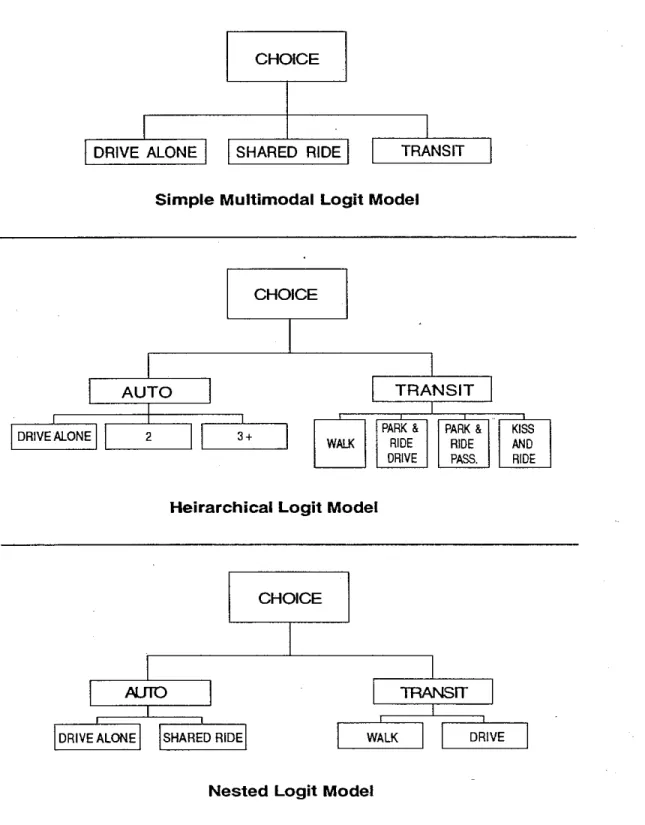
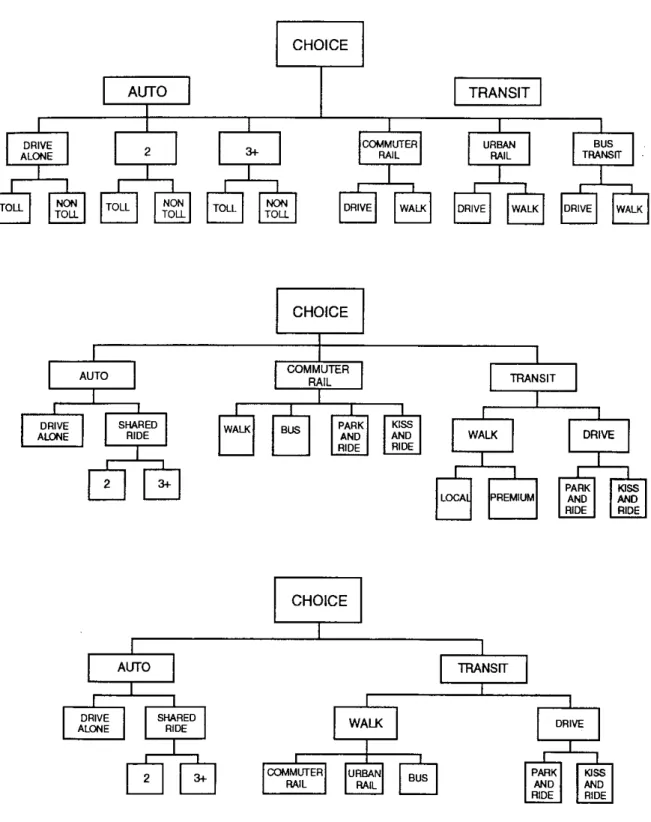
Mode choice models are used to estimate the modal shares of travel given the time and cost of various competing modes and the demographic and socio-economic characteristics of urban residents. The mode choice model structure recommended for use in Oregon’s MPO areas is the nested logit model. The nested logit model is capable of representing motorized as well as non-motorized modes including walk and bicycle travel.
2.2.5 Traffic Assignment Calibration
The comparison of the applied base year model with the field observed data serves as the indicator of how well the model replicates existing travel patterns. At each step in the model development process, the model components are subjected to a series of aggregate and disaggregate validation tests following estimation of model parameters. Model validation is strictly an aggregated set of comparisons, and represent the final test of the model’s ability to accurately simulate existing travel behaviors.
,EGISLATIVE 2EQUIREMENTS AND )MPLICATIONS
4RAVEL $EMAND -ODEL $EVELOPMENT AND !PPLICATION 'UIDELINES
2.2.6 Emission Calculation
The calculations of emissions is covered in detail under Section 7.2 of these guidelines.
2.2.7 "Off-Model" Emissions
Current practice in Oregon for addressing "off-model" or "off-system" emissions is to globally apply a factor to the total Vehicle Miles Traveled (VMT) for the study area. With 90 percent of the vehicle trips typically represented in the network, this factor can be estimated when the total miles of "off- system" roadway facilities are determined.
2.2.8 Estimates of Future Land Use for Projection of Emissions
Section 2.3 briefly describes the necessity of linking land use to transportation planning. Land use, demographic, and economic data is one of two key inputs to the model. Estimation of future year land use and economic activity is mandatory in the application of forecasting models and is generally based on a comprehensive plan for the region. In forecasting applications, the analyst evaluates the results based on hypotheses and expected results. Where results vary from the expected, an evaluation and
determination is made to whether the inconsistency is in the model application data or improper application of the model. Corrections can then be made where applicable. Through this process, reasonable projections of future emissions can be made.
2.3 - Oregon Transportation Planning Rule
The Land Conservation and Development Commission (LCDC) with the support of the Oregon Department of Transportation (ODOT) adopted the Transportation Planning Rule (TPR) OAR 660, Division 12 in April 1991. The TPR is intended to govern transportation planning and project development at local, regional, and statewide levels. Basically, the rule requires ODOT, regional planning bodies, and local governments to link land use and transportation planning efforts. While the TPR does not specifically regulate the structure of travel demand models, it does establish principles that require sensitivity in the development and application of the models.
The TPR requirements vary by urban area as follows:
• The principle requirement of the TPR is for cities, counties, MPOs, and ODOT to prepare and adopt transportation system plans (TSPs). The TSP establishes land use controls and a network of facilities and services to support overall transportation needs. Transportation needs are defined as the
movement of people and goods. From this, the transportation project development process begins.
• Outside of urban areas, the rule indicates what transportation uses are consistent with Goal 3 (Agricultural Lands), Goal 4 (Forest Lands), Goal 11 (Public Facilities and Services), and Goal 14 (Urbanization).
,EGISLATIVE 2EQUIREMENTS AND )MPLICATIONS
4RAVEL $EMAND -ODEL $EVELOPMENT AND !PPLICATION 'UIDELINES
• In cities with a population of less then 2,500 outside of a Metropolitan Planning Organization (MPO) and counties under 25,000 in population, the rule provides for a whole or partial exemption or deferral.
• In urban areas with less than 25,000 population, the rule requires amendments to plans and ordinances requiring residential, commercial, and industrial development patterns to encourage pedestrian and bicycle travel.
• In larger urban areas with a population greater then 25,000, the rule requires development patterns that are transit friendly and carefully considers alternatives to highway expansion. This includes transportation and demand management measures.
• For areas inside Metropolitan Planning Organizations (MPOs) the rule mandates that within 30 years following the adoption of a transportation system plan, total vehicle miles traveled (VMT) must be reduced by 20 percent.
• In the Portland metropolitan area, the rule also requires the evaluation of alternate land use designations, densities, and designs.
2.3.1 - TPR Implications on Transportation Modeling
While the TPR does not regulate transportation modeling, implicit requirements for the travel demand models can be gleamed from the objectives or goals of the rule. The main goals of the rule are to: 1) develop transportation system plans; 2) reduce reliance on single occupancy vehicles; and 3) reduce vehicle miles traveled. Transportation models developed in a manner consistent with these guidelines will posses the level of sophistication necessary to respond to the range of transportation alternatives and policy level strategies.
2.3.2 - Transportation System Plan (TSP)
The TSP is based on the evaluation of potential impacts generated by the proposed system alternatives. It demonstrates or quantifies the impact of land use planning on the transportation system. System alternatives may include improvements to existing facilities, new facilities, and implementation strategies that consider or include alternate modes. These alternatives may also include transportation system management (TSM) and transportation demand management (TDM) measures. The level of analysis that is required for the TSPs is best accomplished using a transportation model developed in a manner consistent with the guidelines outlined in sections 4 and 5.
2.3.3 - Vehicle Miles Traveled (VMT) Reduction
The VMT reduction requirements of the TPR are very aggressive for MPO areas. VMT tracking and testing (estimating) is essential for compliance with the rule. The model can measure the initial baseline conditions, and then be used to track and forecast changes due to transportation system and land use changes.
,EGISLATIVE 2EQUIREMENTS AND )MPLICATIONS
4RAVEL $EMAND -ODEL $EVELOPMENT AND !PPLICATION 'UIDELINES
2.3.4 - Single Occupancy Vehicle (SOV) Reduction
To evaluate system alternatives for SOV reduction, as with VMT reduction, the analysis tool needs to be sensitive to person trip assignment, mode choice, and trip pricing. These guidelines have been developed to assist in developing models sensitive to this type of scenario testing.
2.3.5 - Land Use
The land use, demographic, and economic data is one of the key inputs to the model. Land use scenarios can be examined by modifying the input assumptions and re-running the travel demand models. Land use models can be explicitly incorporated into this loop. The use of land use models would be considered "advanced" practice.
4RAVEL $EMAND -ODEL $EVELOPMENT AND !PPLICATION 'UIDELINES
3.0
INPUT DATA ASSEMBLY AND METHODOLOGY
3.1 Land Use And Demographic Data
State and Federal mandates (OTP, 1993 Oregon Conformity Rule, TPR, ISTEA) are the driving force behind improvements in travel demand modeling. Land use and demographic data are essential inputs to the travel demand modeling process.
The level of detail of land use, economic, and demographic data is determined by the relevant requirements of the model formulations and complexities. While the specifics of development process for these critical model inputs will vary from one area to another due to the variations in analysis needs and resource availability, there are common requirements which would apply to any model system in the state.
3.1.1 Land Use Data
Land use information describes and quantifies zoning and development density respectively. Zoning is a general activity designation for a parcel of land. The level of zoning disaggregation typically includes residential (single and multi family), commercial, industrial, etc. Density is simply the measure of development of a parcel of land.
For modeling purposes, zoning information is necessary only to the extent that such density measures as residential density and/or employment density can be computed from available information. Existing land use data can be obtained from a number of sources including:
• US census data
• Tax assessors (building permits)
• Planning and zoning agencies
• Utility records
• Field surveys
3.1.2 Socio-Economic Data
This section contains a list of candidate variables for inclusion in the land use and demographic dataset, based on anticipated model structures. These variables fall into two categories; those that will be used as inputs to the models, and therefore must be forecast for the future, and those that will be used to check or calibrate the models, for which only current year data must be compiled. Table 3-1 lists the candidate
)NPUT $ATA !SSEMBLY AND -ETHODOLOGY
4RAVEL $EMAND -ODEL $EVELOPMENT AND !PPLICATION 'UIDELINES
variables, as well as whether they need to be forecast or are for calibration purposes. Table 3-1 also shows which variables are anticipated to be used in trip generation for the household submodel, in the production and attraction models, in the Truck model, and in the creation of the mode split model and submodels.
Table 3-1
Proposed Forecast Variables and Their Use
Trip Generation
Variable
Household
Submodel Production Attraction
Truck Model Mode Choice Need to be Forecast? Population (Residents) l l l l Y Employed Residents l l Y Average Income l Y
Household (SDU, MDU, Group) l Y
Household Size l l l N Income Level l l l N Auto Ownership l l l N Total Employment l l l Y Retail Employment l l l Y Service Employment l l Y
Light Industrial Employment l Y
Manufacturing Employment l l Y Other Employment l l Y School Enrollment l Y University Enrollment l Y Zonal Area l l l Y Recreational Space l Y
The household income, number of workers, size, and number of autos are available from the Census Transportation Planning Package (CTPP) and home interview surveys. Sources for employment data include State Employment Department, CTPP (by census tract) and county tax assessors parcel records.
)NPUT $ATA !SSEMBLY AND -ETHODOLOGY
4RAVEL $EMAND -ODEL $EVELOPMENT AND !PPLICATION 'UIDELINES
3.1.3 Land Use and Transportation Model Integration
The need to link travel demand and land use forecasting models has become evident with the passage of recent mandates (OTP, 1993 Oregon Conformity Rule, TPR, ISTEA). This link must relate the influence of land use alternatives on transportation system patterns and vice versa. The mechanism for facilitating this interaction can be a set of land use models.
Though many other models exist, the one most often used is the DRAM/EMPAL model. This system contains a Disaggregated Residential Allocation Model (DRAM) and an Employment Allocation Model (EMPAL). One of the principle design features of the DRAM/EMPAL models is the ability to evaluate land use/transportation alternatives. Both are derived from the original Lowry gravity model (the same gravity model found in most trip distribution models). Other land use models include, CATLAS, POLIS, SAM and METROSIM.
3.2 - Travel Survey Data
Travel surveys provide the underlying strength of any model and serve as the fundamental data upon which it is built. While there are a wide variety of surveys that can be designed for this purpose, the primary objective of this data collection activity should be reflective of the data necessary to estimate and calibrate a set of travel models for a region. A Home Interview survey form the centerpoint of any model development project. An On-board transit survey may also be essential to needs of model estimation, specifically in the construction of a choice-based sample for mode choice model estimation. Park-and-Ride Lot surveys may offer additional information regarding the magnitude and distribution of drive access to transit (as well as carpool/vanpool users). And finally, External-Internal vehicle surveys provide data for estimating the external-internal and external-external trip types.
3.2.1 - Home Interview Survey
A Home Interview Survey is used to collect information about the travel characteristics of households in a region. This type of survey is usually the major source of information for developing a set of travel models to estimate travel behavior in a region. This survey is considered essential when a model development pro-cess is being under taken. Survey sampling techniques usually require a minimum of between 1000 and 1600 households be interviewed. These figures rely on sampling statistics and are generally independent of the size of the region. Larger samples are often necessary to construct models with the full range of explanatory variables. For example, a cross-classification trip generation model may consist of four auto ownership categories cross-classified by five household size and four worker categories. A basic or practical guideline for determining the appropriate number of samples required suggests that a minimum of 30 samples (or households) be present in each cross-classification stratum so that adjacent strata may be compared to gauge statistical significance. In this example, a minimum of 2,400 usable observations would be required. If the available sample size is less than the desired number, compromises with respect to variable inclusion and/or statistical significance of one or more cells will be the result. Zero auto and larger households are typically cells which tend to be missing or under-reported in smaller sample surveys
)NPUT $ATA !SSEMBLY AND -ETHODOLOGY
4RAVEL $EMAND -ODEL $EVELOPMENT AND !PPLICATION 'UIDELINES
An activity-based survey is the preferred method of design for a Home-Interview Survey, as compared with the more traditional trip-based survey method. An activity-based survey collects more detailed and descriptive information about the activities that comprise each end of a trip. Conversely, the information obtained from a trip-based survey is limited to the traveler’s interpretation of trip purpose based upon the purpose response obtained for each recorded trip segment. An activity-based survey also recognizes that activities are the fundamental descriptors of trip making. The information reported about each activity, including the type of activity and the corresponding name of the establishment (or activity), is an important key in describing or defining a set of trip purposes based upon traveler behavior rather than simply relying upon a set of predefined trip purposes.
An example can further demonstrate the primary differences between the two types of survey methods. A traveler proceeds from his/her home to a day care facility to drop off his/her child and then continues on to work. Both surveys would define the purpose sequence of the these three activities as "home", "pick-up/drop-off" (or serve passenger), and "work". Both survey methods would also "link" or remove the intermediate day care stop and create a single home-to-work trip. The difference lies in the trip purpose that would ultimately be defined by each survey. The more classical trip based survey would define this sequence of activities as simply a home-based work trip, in the absence of any knowledge regarding the precise activity performed at the pick-up/drop-off location. The activity based survey, however, has more descriptive information (day care facility) to define this sequence of activities as a Home-Based Work Strategic trip (see section 4.2.1). A second example should help to show exactly how a new trip purpose might be defined as a result of having more detailed information on a travelers activities. In this case, a person works at home takes his/her child to school and then returns home. The trip based survey would "link" or remove the intermediate school purpose and produce a home-to-home trip record which is subse-quently dropped from the analysis. An activity based survey recognizes the intermediate activity as a school trip, and defines both a home-to-school and a school-to-home trip.
The design and implementation of the Home-Interview survey is another important consideration in the survey administration process. Several types of survey methods have been utilized in the past including:
• Mail Out-Telephone Interview Retrieval
• In-Home Interview
• Mail Out/Mail Back (or Self Administered)
The mail out-telephone retrieval has been used with substantial success due to its cost effective nature and the reliability of the data. It entails the mailing of survey packets to households that have agreed to participate followed by a telephone call where the travel information is collected over the phone. The in-home interview calls for surveyors to gather information based on a personal interview completed in the respondent’s home. The quality of the data gathered in this manner is extremely high, however, the method is very costly, and there is intense resistance based upon concerns regarding safety and security of the household and interviewer. The mail out/mail back (or self administered) survey is similar to the mail out-telephone collection survey with the exception that none of the travel survey information is collected over the phone. The completed travel diaries and household questionnaires are completed and then returned via mail to the surveyors. This type of survey is very cost effective, but requires very clear and concise questionnaires. The non-response and incomplete data rates are also very high which can lead to results that severely limit use and applicability.
)NPUT $ATA !SSEMBLY AND -ETHODOLOGY
4RAVEL $EMAND -ODEL $EVELOPMENT AND !PPLICATION 'UIDELINES
Home interview surveys provide the primary source of information on which travel behavior and trip making patterns are measured and translated into a set of travel demand forecasting models. The home interview survey is thus a necessity for MPO level analyses. For smaller urban areas, the home interview survey is optional, but strongly encouraged. If a Home-Interview Survey is not available or within the financial capability of the smaller urban area, then the resulting travel demand model constructs and behavior properties reflected in the area’s model will need to be based upon on experience elsewhere within the state1.
3.2.2 - On-Board Transit Survey
On-board transit surveys are often performed to complement and enhance the data and information obtained in a Home-Interview Survey. The data is considered to be "choice-based", rather than random, given the emphasis placed on a single mode. On-Board Survey data can be useful in a variety of contexts including short-term or operational planning exercises as well as model development, calibration, and validation. The sample of households randomly selected for interviews in a Home-Interview Survey may not be able to provide a sufficient number of transit trip observations to reliably develop mode choice models or assist in the calibration or validation of the models. An on-board survey specifically designed for model development purposes can contribute directly to each step in the model development process.
Designing a sampling plan for an on-board bus survey involves two major considerations. The first consists of determining the total number of bus trips to be sampled. General system characteristics such routes and sub-routes, route direction, and time-of-day should be considered when designing the sample plan. The second consideration consists of selecting the specific bus trips to be sampled balancing surveying efficiency in a consist manner with the overall survey design.
There are two fundamental approaches to the design aspect. One attempts to achieve an equal precision per route, while the second allocates samples as a direct function of individual route ridership, but provides for a minimum precision per route. The former approach is typically followed in instances where the primary use of the data will be for short-range or operational planning. The latter is the method normally employed when model development and application is the primary use of the data.
Transit on-board surveys are highly encouraged in order to get a rich set of transit ridership information. In Oregon, however, the home interview surveys were deliberately structured to elicit information from transit-using households. Given this explicit attempt to capture the behavior of households which make transit trips, an On-Board survey would provide additional insight and understanding as well as an excellent data base for model calibration and validation, but would not be required to establish a "best practice" model set. As such, the on-board transit rider survey should be considered optional.
1Travel Demand Model Development activities within Oregon are expected to consider the blended use of Home-Interview survey data from a number of smaller urban areas in an attempt to identify behavior similarities and differences which can be incorporated in model formulation. The successful result of this approach would more easily extend the use of the resulting models to areas which do not have original data sources, such as a Home-Interview Survey.
)NPUT $ATA !SSEMBLY AND -ETHODOLOGY
4RAVEL $EMAND -ODEL $EVELOPMENT AND !PPLICATION 'UIDELINES
3.2.3 - Establishment Survey
Establishment surveys, also known as employment or destination surveys, are performed to provide specific and detailed information about trip destinations. This information is also used to supplement what is contained in a home interview survey. This information is particularly useful for estimating and calibrating the trip attraction models. The presence of an establishment survey creates an opportunity to estimate the trip attraction models on a disaggregate rather than an aggregate basis. When designing the sampling frame, factors such as geography, establishment type, and establishment size should all be considered.
In addition to enhancing the trip attraction models, data collected from this survey instrument can be used to develop a parking cost model, and/or to provide information about visitors and commercial vehicle traffic. The parking cost model can be created from this data because detailed information can be collected about the exact location where an employee actually parks and the associated cost. Insight regarding the behavioral trade-offs between cost, parking location, and associated walking distance can become an integral part of the parking cost model. Information regarding employer subsidies for parking can be collected and incorporated in the modeling framework. The survey can also provide information of the volume and characteristics of visitors to an establishment. The final data element, volume and characteristics of commercial vehicle traffic can provide the basis and starting point for developing commercial vehicle models. While establishment surveys are certainly considered optional, they are encouraged where resource permit.
3.2.4 - External Survey
External surveys provide information for travelers that have one end of their trip outside the region or sub-sequently for travelers that have both ends of their trip outside the region (external-external), but simply pass through. A survey of this nature allows supplementary models to be developed for two trip purposes related to external trip making:
• Internal-External (and External-Internal)
• External-External
The external survey should include a simultaneous external station count so the surveyed vehicles may be expanded properly to the regional total of external trips. Two methods of performing an external survey are:
• License Plate Survey
• Personal Intercept
The license plate survey is more economical but experiences very low response rates (i.e., 5-20 percent). The personal intercept survey is a more costly since surveyors must stop and interview participating vehicles, but the quality of the data is much higher since a wide variety of questions may be asked about the trip being made and the quality of information can be carefully controlled.
External surveys are also optional, but are highly recommended if external travel comprises a reasonable measure of overall regional travel.
)NPUT $ATA !SSEMBLY AND -ETHODOLOGY
4RAVEL $EMAND -ODEL $EVELOPMENT AND !PPLICATION 'UIDELINES
3.3 - Transportation Networks
The representation of the transportation system is one of the most important aspects of travel demand mod-eling. The most direct method for creating a transportation network for modeling is to develop an abstract representation of the system elements. The elements that should be included range from the basic roadways to a depiction of the transit system. A transportation network is developed for each primary travel mode; in most cases this is the private automobile and transit. The auto system is called a highway network and includes those streets, roads, thoroughfares, and freeways that make up the regional highway system. The network is basically a map of these routes, defined in a manner that can be read, stored, and manipulated by the transportation planning computer program - emme/2.
The transit network is interrelated with the highway network. This is especially true in the emme/2 transportation planning software. The transit lines are defined by which highway links they traverse. Although it is possible to code transit only links, this is not usually done unless the transit service being represented utilizes an exclusive right-of-way such as an grade-separated fixed-guideway system or a bus-only street such as a mall.
3.3.1 - Highway Network
The highway network serves several purposes in transportation system analysis. First, it is an inventory of the existing road system, or a catalog of facilities. It is a record for the present and future years, of the physical status of the highway system. Basic information such as miles of roadway, route configuration, capacity, and counted volumes can be stored in the network. Secondly, the network is used in demand analysis to estimate the highway travel impedance between zones in a region. This impedance, or resistance to travel, is usually described as the time or distance associated with each zone pair (or interchange). This information is used primarily in trip distribution and mode choice. The third major use of the network is in the simulation of auto travel and in the estimation of impacts associated with this travel.
3.3.2 - Highway Network Coding
The process of translating the highway system into a computer usable format is known as network coding. The basic elements of the network file are nodes and links. Links are used to represent individual roadway segments. Nodes represent the intersection of roadway segments and are also used as shape points to main-tain the true topology of the highway system. In addition to regular nodes and links, the network conmain-tains special nodes called centroids. Centroids represent the traffic analysis zones (TAZ) and are located at the center of activity in the zone. They are the point at which trips are loaded on the highway network. Exter-nal stations are centroids which represent the points at which exterExter-nal trips enter or leave the region.
In historical practice, networks used in travel demand models were defined through a process of tracing highway segments off a set of base maps such as USGS maps. The coordinates of the nodes were entered manually or with a digitizer in the network data base. The face of network development is changing with the introduction of the Bureau of Census TIGER files. These files can be used to develop base maps of a region and these base maps can be exported, thus saving the time of digitizing the networks. Even more important is the consistency and accuracy gained by using the TIGER file data.
)NPUT $ATA !SSEMBLY AND -ETHODOLOGY
4RAVEL $EMAND -ODEL $EVELOPMENT AND !PPLICATION 'UIDELINES
3.3.3 - Node Usage and Placement
Nodes indicate specific points in the network. Nodes are identified by a node number, "x", and "y" (Cartesian) coordinates, indicating node location, and multiple user fields which can be used to hold numeric data. Node user fields can be used to hold intersection related data such as intersection controller type, and intersection level of service results. Node types include regular nodes, transit access nodes, dummy nodes, and centroids. Regular nodes, representing street intersections, bus stops, transit stations, and points along highways are the most common node type. Transit stations may be accessed through a transit access node with a walk link representing the movement from the bus stop or parking lot. Transit access nodes serve a dual purpose, because they also act as regular nodes through which auto and bus movements may pass without going to the station.
Centroids are a unique type of node which represent the origin or destination of trips by both auto and tran-sit modes to/from a zone. The coordinates of centroids are defined to facilitate the geographic review of zonal and network data. Travel to/from a zone is not affected by the centroid’s location within a zone, since travel characteristics are based on the attributes of links connecting centroids to the network. Centroids for external zones are located adjacent to the major highway they serve. Once all the centroids have been located, their positions are reviewed to insure that none are overlapped by another node or link. This technique makes network plots more readable.
The fields available for the node records are:
• Node label
• X-coordinate
• Y-coordinate
• User defined data (i.e. type of intersection control, junction type, area type, etc.) 3.3.4 - Roadway Links
The highway and transit systems in a region are represented by a system of links connecting pairs of nodes. Each link contains the following information: the nodes that it connects, the modes that may use it, the link length, the link type, the number of lanes, the volume delay function (VDF) identifier, and user fields. One link is coded for each direction of movement on both the highway and transit networks. Therefore, links are usually coded one-way along roadway segments that only allow one-way movement (including freeways and ramps) and on auxiliary transit links that are used in only one direction during the time period that the model is meant to represent. For example, during the AM peak hour only park-and-ride movements that are traveling towards transit stations are allowed. The link type coded for each link can hold any representation of the type of link desired. Numeric values ranging from 1 to 99 are currently allowed in emme/2.
Link impedances are assigned using volume delay functions, which in emme/2 are flexibly defined in a separate file. The volume delay function code assigned to each link should correspond to the appropriate volume delay equation to be used during an assignment. Volume delay function codes are numeric and can range from 1 to 99.
)NPUT $ATA !SSEMBLY AND -ETHODOLOGY
4RAVEL $EMAND -ODEL $EVELOPMENT AND !PPLICATION 'UIDELINES
The fields typically used for link records are:
• A-node label of link
• B-node label of link
• Link length
• Link modes
• Link type
• Number of lanes
• Volume-delay function number
• User defined data
Link user defined data fields can be used to store a variety of numeric data. These include data to be used for assignment calibration and validation such as roadway counts, observed speeds, and toll fee information. The user fields may also be used to store information vital to the execution of the assignment model. For example, in congested networks with closely spaced intersections, intersection capacity is usually observed to be more of a constraining factor to smooth, uninterrupted vehicle flow than link capacity. The link capacity used in the volume delay functions in a capacity restrained assignment may therefore be defined in a user field and represent the capacity of the downstream intersection (or B-node of the link.)
The values for capacity to be placed in the user field may come from a look-up table of capacities based on characteristics of the intersection including: intersection control type, functional classifications of approach segments at the junction, and area type. Note that area type may be an important intersection attribute as links in rural areas may have their capacities more appropriately represented as mid-block capacities. This is based on the fact that links with lengths greater than a threshold value, determined with local knowledge of traffic queue generation and discharge tendencies, are flow constrained by link attributes of roadway width, presence of parking, rather than intersection flow constrained.
Since the concept of associating capacity restrained traffic assignment with capacity of downstream inter-sections is recognized as proper, this technique should be adopted as "best" practice. Defining link capacities based only on link characteristics is still regarded as acceptable practice.
3.3.5 - Transit Network
In addition to the highway network which allows bus and express bus modes, the networks also include transit links that are not part of the highway network. The two major categories of these transit-only links are bus-only links and rail links. The bus-only links represent portions of the highway system, usually collector streets, that carry bus routes, but are not important enough to include in the highway network. The lengths of such links are determined by the bus routes that utilize them. Impedances on these links are a function of their length and the default speeds of the bus routes.
In addition to the transit network, it is sometimes necessary to build a network of auxiliary transit links which make it possible to move from the origin zone to a transit network (via walk or park-and-ride), trans-fer between routes (via walk), and move from the transit network to the destination zone (via walk). It is important to keep in mind that the basic transit network uses the same nodes and links as the highway net-work as the two are inherently interconnected in emme/2.
)NPUT $ATA !SSEMBLY AND -ETHODOLOGY
4RAVEL $EMAND -ODEL $EVELOPMENT AND !PPLICATION 'UIDELINES
3.3.6 - Centroid Connectors
Centroid connectors are links representing typical access and egress to/from roadways and transit service to/from centroids. Within a network structure, a single link may be used to represent both auto and walk access from a zone to the network, since the network access node is part of the highway network on which transit can be allowed to operate. For most regions, this means that links connecting zone centroids to the highway network allow both vehicle and auxiliary transit modes to use them.
The preferred method for coding centroid links is to connect the zone centroid node to a mid-block node. This method allows greater route choice flexibility by simulating a choice of left versus right turn from a minor approach into a major traffic stream and avoids the difficulty of intersection capacity calculation with large volumes of trips entering an intersection from a zone centroid.
3.3.7 - Park-and-Ride Links
Park-and-Ride links are a special form of centroid connector representing auto access to transit stations. Specifically, the link corresponds to a person driving or getting dropped off at a bus stop or the parking lot of a train station. These links are categorized under auxiliary transit to prevent trips from using the park-and-ride link to access the highway network. Park-park-and-ride links are typically only coded from the zone in an AM network, for example, in order to prohibit transit users from using park-and-ride to egress from a station. Park-and-ride links should only be connected to transit facilities that have parking facilities. A centroid may be connected to more than one park-and-ride lot allowing a choice to be made as to which lot will be used. The number of park-and-ride links from an individual zone as well as the number of parking facilities to be connected from a zone is normally a function of the structure embodied in the mode choice model.
3.4 - Travel Cost Data and Information
Costs associated with travel are often referred to as exogenous variables because they are derived externally from the basic model set. Travel costs are generally broken down into auto operating costs, transit fares, and parking costs. All costs should be expressed in base year dollars. Given this assumption, only the incremental costs expected to exceed the inflation rate should be added to the base year operating costs to establish future year estimates.
3.4.1 - Auto Operating Costs
The cost of owning and operating a vehicle is usually broken down into two components:
• Costs associated with ownership of the vehicle, and
• Costs of operating the vehicle.
Costs associated with ownership of the vehicle include items such as depreciation, insurance, license fees, and finance charges. These costs are considered fixed costs associated with the decision to own one or more vehicles in a household. Costs associated with operating a vehicle are often referred to as out-of-pocket costs since they are paid on a more frequent basis than ownership costs. Vehicle operating costs
)NPUT $ATA !SSEMBLY AND -ETHODOLOGY
4RAVEL $EMAND -ODEL $EVELOPMENT AND !PPLICATION 'UIDELINES
include gasoline, motor oil, tire replacement, maintenance, and repair. The operating costs are variable charges because they vary with the distance traveled.
The use of reports from the Bureau of Labor Statistics (BLS), U.S. Department of Energy, as well as state automobile association surveys can be used to track historical changes in gasoline and non-gasoline costs. The BLS reports are extremely useful for showing national and sub-regional trends in gas prices, changes with respect to consumer price indices, as well as vehicle ownership costs.
3.4.2 - Transit Fares
The cost of riding a transit vehicle is captured in the fare charged by the transit operator. A variety of meth-ods may be applied to calculate transit fares for zonal interchanges. If the complexity of the transit systems warrants, a path based fare should be calculated to properly determine the fare on a zonal interchange. If the data exists, an average fare should be calculated to represent the fact that some passengers pay the adult cash fare, while some pay with discount passes, while youths generally ride for a reduced fare. If this data is not available then the adult cash fare should be used.
3.4.3 - Parking Costs
Parking costs reflect the cost a traveler incurs when parking a vehicle at the destination end of the trip. There are two basic options available in developing parking costs per trip to a destination zone:
• Use the nominal, or posted parking price, or
• Use the partial parking price (accounting for employer subsidies).
The partial parking price is more accurate because the effects of employer subsidies on employee parking can be substantial in certain areas. Data on employer subsidized parking may not be available, requiring that the nominal or posted price be used.
Because drivers do not always park in the zone representing their final destination, the concept of a "floating zone" structure has been developed to help account for this phenomenon. This technique attempts to account for the average parking cost seen by a traveler to a zone as being the average parking cost for the zone and all adjoining zones within a specified walking distance. The network need not actually be coded with walk links for this purpose. The floating zone distance is typically set between 0.25 and 0.50 miles. Each zone is represented by a centroid and the average zonal cost is obtained by averaging the individual costs in each surrounding zone within the specified floating zone distance. These averages are then weighted by the number of spaces in each of the zones.
Weighted average parking prices should be developed by using the number of parking spaces per facility and the corresponding parking prices. An average maximum daily rate per zone is developed for each des-tination zone. The maximum daily rate is the maximum amount a person would have to pay to park in a facility for 8-24 hours at the posted rates. Individual parking facilities are aggregated to the zonal level.
)NPUT $ATA !SSEMBLY AND -ETHODOLOGY
4RAVEL $EMAND -ODEL $EVELOPMENT AND !PPLICATION 'UIDELINES
Models should be developed to relate the daily and two-hour average parking costs to the trip-end zone characteristics. The primary trip-end data variable should be a measure of density; commonly, employment density is used. The average daily rate should be applied to Home-Based Work trips for an 8-24 hour period to reflect the cost of parking for the entire day in a space and a two hour average parking rate is developed to be applied to other trip purposes that will incur a parking charge such as Home-Based Other. In most models of this type, there is a minimum density level in which the parking cost is set to zero for all values below this threshold.
3.5 - Model Validation Data
Model validation represents the final step in the model development process. The comparison of the applied model in the base year with the observed data serves to indicate how well the model is replicating existing travel patterns. At each step in the travel model development process, each model component is subjected to a series of validation tests following estimation of the model parameters (coefficients, constants, etc.). Model validation is strictly an aggregate set of comparisons, and represents the final test of the model’s ability to accurately simulate existing travel behavior. A variety of data sources may be used in the validation of the travel demand models.
3.5.1 - Traffic Count Data
Traffic volume counts are used to compare estimated roadway volumes to observed values. The traffic count data used in the comparison should represent counts taken during the same base year as defined for model development. For example, if the model is being validated based on 1990 socio-economic and land use data, then the traffic counts should be from that same year.
There is often a wide variation in the traffic count data depending on the month and day of week that the individual traffic counts were taken. If a peak hour validation is being performed, it is important to make sure that the traffic count data represents the same hour. Traffic counts taken across multiple days are the best because the data can be summarized and further analyzed to examine any variation that may be present. Traffic counts should also be geared towards the season for which the model is being validated. For example, traffic counts are not often taken in the summer because school is out of normal session and this affects both home-based school trips as well as home-based work trips.
If counts can only be performed at limited locations in the modeled area then screenline locations should be established to strategically cordon the area along major physical barriers. External station counts are always required to ensure the model is properly calibrated at these gateway locations. Traffic count data is a requirement for any area performing travel demand model development.
3.5.2 - Highway Travel Speeds
Link travel speeds are used in the assignment process and fundamentally determine which paths will be used on the network when traveling between zone pairs. There are several reliable methods to collect data on travel speeds. Floating car runs can provide a useful source of information of not only free-flow, but also congested speeds. Pneumatic traffic counters can also be used to collect speed data. The speeds output from a model run can be compared to the observed travel times on a link by link basis to determine if the coded link speeds are accurately reflecting traffic flow conditions. The model estimated link speeds
)NPUT $ATA !SSEMBLY AND -ETHODOLOGY
4RAVEL $EMAND -ODEL $EVELOPMENT AND !PPLICATION 'UIDELINES
should be based upon a set of calibrated travel time functions for the region used in concert with an equilibrium capacity restraint assignment algorithm. The function developed by the Bureau of Public Roads (BPR) is a reasonable starting point, although a larger variety of functions are becoming more prevalent in practice including conical functions. Intersection based volume delay functions represent an additional level of sophistification beyond link-based computation of travel speeds and delays, but require significant additional effort to properly implement.
3.5.3 - Trip Length Information
Information regarding the average length of trips by trip purpose is important in determining how the model is reproducing traffic flows on the network. A home interview survey can serve as a primary source for data on trip lengths. The US Census data for Journey-to-Work information can also be used if it is available. Trip length information is most often used to calibrate a set of trip distribution models for a region. Trip length information can also be used in the calibration of the mode choice model. The observed and estimated average trip lengths for each purpose are compared to make a determination of how well the model is currently calibrated. Several factors can influence the average trip length, including the spatial dis-tribution of productions and attractions as well as the initial highway link speeds used in the calibration process. Each of the appropriate factors influencing the estimated trip length should be reviewed if the comparison of the observed and estimated trip lengths is not favorable.
3.5.4 - Vehicle Occupancy
Observed vehicle occupancy data is important for models that are estimating shared ride modal shares. As more metropolitan areas explore the use of high occupancy vehicle lanes to reduce or curtail roadway con-gestion, the ability of travel demand models to reliably forecast shared ride modes will become increasingly important. A home interview survey can provide a good source of information on vehicle occupancy statistics for a region. When direct observation of vehicle occupancy rates is being made by surveyors the count locations should be selected to provide information for key points in the network. Key points of a network include areas such as external stations, screen line locations, cordons around central business districts, and on freeways. Vehicle occupancy data is optional for developing travel demand models.
3.5.5 - Special Generator Surveys
Special generator surveys or studies can provide area-specific data on trip making characteristics and road-way segment volumes. These type of surveys are usually only done for special generators that might have concentrated development in central business districts. Quite often these special generators are not appro-priately handled in the traditional model stream. This is especially true if the demographic characteristics in an area are significantly different than the average. In these cases it may be worthwhile to perform a local trip generation study. Airports are another example of a special generator since the employment for the airport is usually accounted for in the socioeconomic file but the air passenger traffic is not. Special generator surveys are not required for travel demand model development efforts if there are no significant special generators within the modeling area.
)NPUT $ATA !SSEMBLY AND -ETHODOLOGY
4RAVEL $EMAND -ODEL $EVELOPMENT AND !PPLICATION 'UIDELINES
3.5.6 - Transit Passenger Volumes
A statistical analysis of 24-hour transit assignments on a route-by-route basis provides the basis for ascertaining the accuracy of the transit validation. Actual transit boardings for each route for an entire weekday can be obtained from on-board rider surveys or other available route level information. Similarly, for other non-motorized modes such as bicycle and walking, data from an independent source or count data can be used in the model validation process.
Travel Demand Model Development and Application Guidelines 24
4.0
MODEL DEVELOPMENT GUIDELINES
4.1 - Introduction
The model development guidelines presented in this chapter describe the underlying theory and basis for the structure, formulation, and development of each model component comprising "Best Practice" for each MPO within the state. It also outlines the series of technical steps required to estimate and imple-ment each model, along with the calibration and validation procedures to be followed in verifying the accuracy and acceptability of the complete model set.
The proposed overall structure of the recommended transportation model system is displayed in Figure 4-1. As shown in this schematic representation, application of the model begins with two key sets of input; the demographic, economic, and land use information (at the transportation analysis zone level), and the multimodal transportation network level-of-service data.
The first model in the sequence is the household auto ownership model. The choice between owning 0, 1, 2, or 3 or more vehicles within a household is a fundamental decision effecting travel. The next model is the trip generation model. Estimation of the magnitude of trip making is considered in terms of the range of possible types of trip purposes (i.e., Home-Based Work, Home-Based Shopping, etc.). Following trip generation, an estimate of the proportion of travel (by trip purpose) occurring in the peak and off-peak (or base) hours is determined by a diurnal factoring model. Although the diurnal factoring model is not explicitly discussed in this chapter, the separation of individual trip purpose travel into discrete time period slices can be obtained from original survey data (for the base year) or taken directly from the trip assignment (i.e., Time of Day) model. The linking of trip origins and trip destinations is accomplished by the Trip Distribution model, while the choice among alternative transportation modes is estimated using a Mode Choice model. The final component of the model system is embodied in the assignment of travel to each respective transportation network.
The recommended "best practice" model, as depicted in Figure 4-1, contains a series of “feedback” loops from lower level decision models to a number of upper level components. These “feedback” loops represent both the interrelationship between individual components (i.e., the representation of time, cost, and the socio-economic characteristics of the traveler from Mode Choice in distributing travel in Trip Distribution) and the opportunity to iterate the entire model set to reach of state of equilibrium between the representation of transportation supply and level-of-service and the resulting demand for travel.
Model Development Guidelines
Travel Demand Model Development and Application Guidelines
25
Figure 4-1 - SCHEMATIC REPRESENTATION OF THE REGIONAL TRAVEL
Model Development Guidelines
Travel Demand Model Development and Application Guidelines
26 The chapter concludes with model validation procedures and standards designed to evaluate the ability of the entire modeling system to adequately forecast traffic and transit volumes at an acceptable level of accuracy.
4.2 - Trip Generation
The trip generation model is composed of two basic models -- a production model and an attraction model -- and one or more submodels. The trip generation model estimates the overall magnitude of trip making on a specific geographic basis (i.e., zones). Various submodels are used to support and describe the disaggregation of households (and/or workers) by selected independent variables.
4.2.1 - Market Segmentation Considerations
The trip purposes used in the trip generation model should generally conform to the following
definitions: (1) Home-Based Work; (2) Home-Based Shopping; (3) Home-Based Social/ Recreational; (4) Home-Based Other; (5) Home-Based School; and (6) Non-Home Based. Recent research has suggested that the work trip purpose could be further stratified into subcategories as a function of the potential for intermediate trip stops. This categorization scheme would subdivide work trips into (1) Home direct-to-Work, (2) Strategic Home-Based Work, and (3) Tactical Home-Based Work. An example of a strategic Home-Based Work trip would involve the pickup or dropoff of a school age child. In the case of a tactical work trip, the intermediate stop could be a convenience stop such as stopping for gasoline. Furthermore, it is suggested that the Home-Based School trips be subdivided into Elementa-ry/Secondary and University trips, and also that consideration be given to separating Non-Home Based trips into Non-Home Based Other and Non-Home Based Work, and possibly Non-Home Based Work-to-Work. While all these purposes may not be used in this detailed fashion in all subse quent models (i.e., trip distribution and mode choice), this stratification should allow for the development of a better behavioral model at the trip generation stage and the resulting trip ends can easily be combined for the subsequent models.
Beyond stratification by trip purpose, “time-of-day” (peak versus off-peak) considerations are needed to support segmentation in other model components (i.e., trip distribution and modal choice). In the case of trip generation, the reflection of time-of-day is best implemented following the trip generation model computations. This initial diurnal factoring could be based upon a previous iteration of a time-of-day choice model or historical (survey-based) relationships.
As outlined in Trip Distribution (4.2), stratification of the Home-Based Work trip distribution model by a socio-economic variable could assist in better representing the relationship between worker and work-place. This requires that both the trip production and trip attraction model be stratified in the same manner.
Model Development Guidelines
Travel Demand Model Development and Application Guidelines
27 4.2.2 - Trip Production Model
This section discusses the estimation of the trip production model, but does not include any discussion of a school bus or commercial vehicle generation model. That is, the definition of the production mo