POUR L'OBTENTION DU GRADE DE DOCTEUR ÈS SCIENCES
acceptée sur proposition du jury: 3URI9.XQĀDNSUpVLGHQWGXMXU\ 3URI5*XHUUDRXLGLUHFWHXUGHWKqVH
3URI)7DLDQLUDSSRUWHXU 'U0%LOHQNRUDSSRUWHXU 3URI%)DOWLQJVUDSSRUWHXU
Towards Scalable Personalization
THÈSE N
O8299 (2018)
ÉCOLE POLYTECHNIQUE FÉDÉRALE DE LAUSANNE
PRÉSENTÉE LE 23 FÉVRIER 2018
À LA FACULTÉ INFORMATIQUE ET COMMUNICATIONS LABORATOIRE DE PROGRAMMATION DISTRIBUÉE
PROGRAMME DOCTORAL EN INFORMATIQUE ET COMMUNICATIONS
PAR
Towards Scalable Personalization
Towards Scalable Personalization
Towards Scalable Personalization
Towards Scalable Personalization
Towards Scalable Personalization
Towards Scalable Personalization
Towards Scalable Personalization
Towards Scalable Personalization
Towards Scalable Personalization
Towards Scalable Personalization
Towards Scalable Personalization
Towards Scalable Personalization
Towards Scalable Personalization
Towards Scalable Personalization
Towards Scalable Personalization
Towards Scalable Personalization
Towards Scalable Personalization
The greatest challenge to any thinker is stating the problem in a way that will allow a solution.
Acknowledgements
To begin with, I am deeply thankful to my family, Tapasi Patra (my mother), Kusal Kumar Patra (my father) and Suvam Patra (my brother), for their endless support throughout my career.
Pursuing a PH.D. has been an overwhelming experience for me. Throughout my PH.D., I
had the wonderful opportunity to collaborate with amazing researchers, from both academia and industry, who made my experience even more amazing and these collaborations also subsequently led to this dissertation. To highlight these wonderful collaborations, I would use “we” instead of “I” throughout the main body of this dissertation.
First and foremost, I would like to thank my advisor, Rachid Guerraoui. Starting my PH.D.
right after my Bachelors, I did not have any significant experience in research. In this regard, Rachid was the ideal advisor for me due to his remarkable experience as an accomplished researcher. His constant support and encouragement throughout these years allowed me to grow as a researcher. I would also like to thank Anne-Marie Kermarrec, who co-supervised me on some projects during the initial two years of my PH.D., for her insightful feedback and excellent discussions leading to high-quality research papers in top-tier conferences.
As I mentioned before, I had the wonderful opportunity to work with amazing researchers
from industry throughout my PH.D. duration. More precisely, I spent three summers as
research intern at Technicolor (in 2015), Yandex (in 2016), and Oracle Labs (in 2017). These internships led to fruitful collaborations on diverse topics for which I am extremely thankful to my collaborators, namely, Erwan Le Merrer and Jean-Ronan Vigouroux (at Technicolor), Egor Samosvat, Michael Roizner and Andrei Mishchenko (at Yandex), and lastly Jinha Kim and Sungpack Hong (at Oracle Labs). These collaborations significantly improved my perspective on the practical impact of research in an industrial setting.
I also want to thank my excellent research colleagues from academia for our fruitful col-laborations which led to multiple publications. During my first year, I had a very fruitful collaboration with Antoine Boutet and Davide Frey on scalability aspects of recommenders (Chapter 3), and also with Mahsa Taziki on users’ privacy aspects (Chapter 5). The following years, I collaborated with Jingjing Wang towards another interesting work related to users’ privacy (Chapter 5) as well as with Tao Lin on a project for designing recommenders for multi-application objective (Chapter 6). During the last year, I had another very fruitful collaboration with Georgios Damaskinos leading to interesting research papers on scalable recommenders (Chapter 4) and distributed machine learning.
Acknowledgements
Besides the above-mentioned collaborators, many thanks to my other amazing colleagues from the Distributed Programming Laboratory (LPD) as well as external collaborators for creating a great working environment. Mainly a huge thanks to Karolos Antoniadis, Vasileios Trigonakis, Tudor David, Davide Kozhaya, Georgios Chatzopoulos, Dragos-Adrian Seredinschi, El Mahdi El Mhamdi, Oana Balmau, Matej Pavlovic, Igor Zablotchi, Mahammad Valiyev, and Victor Bushkov. Also, a special thanks to Damien Hilloulin for the French version of the abstract of this thesis.
I would also like to express my special appreciation for the committee members of my PH.D.
defense, namely, Boi Faltings, Viktor Kunˇcak, Misha Bilenko, and Francois Taiani. I want to thank EPFL, Google, and the European Research Council for financially supporting my research.
Being a researcher, I was more focused on the research aspects of academia. However, there are many administrative aspects associated with academics as well. In this regard, I want to thank the two secretaries of our lab, Kristine Verhamme and France Faille. I would also like to thank our system administrator Fabien Salvi for providing assistance during these years concerning any technical issues with LPD’s computing resources.
Last but not the least, I also thank my close friends outside the lab who made the PH.D. years a lot more bearable. First, a big thanks to Monika Parmar for accompanying me throughout the last six years and most importantly for being there for me. Next, I also thank Saeid Sahraei and Hanjie Pan who started in the same year as me and with whom I got to (sometimes) go outside the lab.
EPFL, Lausanne, 18 January 2018 Rhicheek Patra
Preface
This dissertation presents the work that I did during my PH.D. under the supervision of
Professor Rachid Guerraoui at EPFL in Switzerland since September, 2013. This thesis focuses
on three crucial aspects of personalization, namely,Scalability(Chapters 3 and 4),Privacy
(Chapter 5), andHeterogeneity(Chapter 6). Throughout the duration of my PH.D., I was
involved in various research projects leading to high-quality research articles (mentioned
below). The main results of this thesis appeared originally in thehighlightedarticles among
the following. Moreover, the publications are ordered by the corresponding personalization aspects that they address.
S
CAL
ABILIT
Y
• Antoine Boutet, Davide Frey, Rachid Guerraoui, Anne-Marie Kermarrec, and Rhicheek
Patra (alphabetical order).HyRec: leveraging browsers for scalable recommenders.
ACM/I-FIP/USENIX Middleware, 2014.
• Georgios Damaskinos, Rachid Guerraoui, and Rhicheek Patra (alphabetical order).
Captur-ing the Moment: Lightweight Similarity Computations. IEEE International Conference on Data Engineering (ICDE), 2017.
• Rachid Guerraoui, Erwan Le Merrer, Rhicheek Patra, and Jean-Ronan Vigouroux
(alpha-betical order).Sequences, Items And Latent Links: Recommendation With Consumed Item
Packs. (Under submission, arXiv:1711.06100)
• Rachid Guerraoui, Erwan Le Merrer, Rhicheek Patra, and Bao-Duy Tran (alphabetical order).
Frugal Topology Construction for Stream Aggregation in the Cloud. IEEE International Conference on Computer Communications (INFOCOM), 2016.
• Georgios Damaskinos, Rachid Guerraoui, and Rhicheek Patra (alphabetical order).Mobile Learning: Distributed Machine Learning on Mobile Devices. (Under submission)
P
RIV
A
C
Y
• Rachid Guerraoui, Anne-Marie Kermarrec, Rhicheek Patra, and Mahsa Taziki (alphabetical
order).D2P: Distance-Based Differential Privacy in Recommenders. Proceedings of the 41st
International Conference on Very Large Data Bases (PVLDB), 2015.
• Rachid Guerraoui, Anne-Marie Kermarrec, Rhicheek Patra, Mahammad Valiyev, and Jingjing Wang (alphabetical order).I know nothing about you but here is what you might like. 47th IEEE/IFIP International Conference on Dependable Systems and Networks (DSN), 2017.
Preface
H
ETER
OGENEIT
Y• Rachid Guerraoui, Anne-Marie Kermarrec, Tao Lin, and Rhicheek Patra (alphabetical
order). Heterogeneous Recommendations: What You Might Like To Read After Watching
Interstellar. Proceedings of the 43rd International Conference on Very Large Data Bases (PVLDB), 2017.
• Rhicheek Patra, Egor Samosvat, Michael Roizner and Andrei Mishchenko.BoostJet: Towards Combining Statistical Aggregates with Neural Embeddings for Recommendations. (Under submission, arXiv:1711.05828)
EPFL, Lausanne, 18 January 2018 Rhicheek Patra
Abstract
The ever-growing amount of online information calls forPersonalization. Among the various
personalization systems, recommenders have become increasingly popular in recent years.
Recommenders typically usecollaborative filteringto suggest the most relevant items to their
users.
The most prominent challenges underlying personalization are:scalability,privacy, and
het-erogeneity.Scalabilityis challenging given the growing rate of the Internet and its dynamics, both in terms of churn (i.e., users might leave/join at any time) and changes of user interests
over time.Privacyis also a major concern as users might be reluctant to expose their profiles
to unknown parties (e.g., other curious users), unless they have an incentive to significantly
improve their navigation experience and sufficient guarantees about their privacy.
Hetero-geneity poses a major technical difficulty because, to be really meaningful, the profiles of users should be extracted from a number of their navigation activities (heterogeneity ofsource
domains) and represented in a form that is general enough to be leveraged in the context of
other applications (heterogeneity oftargetdomains).
In this dissertation, we address the above-mentioned challenges. For scalability, we introduce
democratizationandincrementality. Ourdemocratizationapproach focuses oniteratively
offloading the computationally expensive tasks to the user devices (via browsers or applica-tions). This approach achieves scalability by employing the devices of the users as additional resources and hence the throughput of the approach (i.e., number of updates per unit time)
scales with the number of users. Ourincrementalityapproach deals with incremental
similar-ity metrics employing either explicit (e.g., ratings) or implicit (e.g., consumption sequences for users) feedback. This approach achieves scalability by reducing the time complexity of each update, and thereby enabling higher throughput.
We tackle the privacy concerns from two perspectives, i.e., anonymity from either other curious users (user-level privacy) or the service provider (system-level privacy). We strengthen the
notion ofdifferential privacyin the context of recommenders by introducingdistance-based
differential privacy (D2P) which prevents curious users from even guessing any category (e.g., genre) in which a user might be interested in. We also briefly introduce a recommender
(X-REC) which employsuniform user samplingtechnique to achieveuser-level privacyand an
Abstract
We also present a heterogeneous recommender (X-MAP) which employs a novel similarity
metric (X-SIM) based on paths across heterogeneous items (i.e., items from different domains). To achieve a general form for any user profile, we generate her AlterEgo profile in a target domain by employing an item-to-item mapping from a source domain (e.g., movies) to a
target domain (e.g., books). Moreover, X-MAPalso enables differentially private AlterEgos.
While X-MAPemploys user-item interactions (e.g., ratings), we also explore the possibility of heterogeneous recommendation by using content-based features of users (e.g., demography, time-varying preferences) or items (e.g., popularity, price).
Keywords:personalization, recommender, machine learning, collaborative filtering, differen-tial privacy, heterogeneity, similarity metric, scalability, energy efficiency, graph, distributed system.
Résumé
La quantité croissante d’informations en ligne appelle à laPersonnalisation. Parmi les
dif-férents systèmes de personnalisation, les systèmes de recommandation sont devenus de plus en plus populaires ces dernières années. Les systèmes de recommandations utilisent
généralement lefiltrage collaboratif pour suggérer les éléments les plus pertinents à leurs
utilisateurs.
Les défis les plus importants sous-jacents à la personnalisation sont :l’évolutivité des systèmes
(« scalability« ),la confidentialitéetl’hétérogénéité.L’évolutivitéest difficile compte tenu du taux croissant d’Internet et de sa dynamique, tant en termes de taux de désabonnement (c’est-à-dire, les utilisateurs peuvent quitter / rejoindre à tout moment) et les changements d’intérêts
des utilisateurs au fil du temps.La confidentialitéest également une préoccupation majeure
car les utilisateurs peuvent être réticents à exposer leurs profils à des parties inconnues (par exemple, d’autres utilisateurs curieux), à moins d’être incités et d’améliorer significativement
leur expérience de navigation et en garantissant leur confidentialité.L’hétérogénéitépose une
difficulté technique majeure car, pour être vraiment significatif, les profils des utilisateurs doivent être extraits d’un certain nombre de leurs activités de navigation (hétérogénéité des
domainessources) et représenté sous une forme suffisamment générale pour être exploitée
dans le contexte d’autres applications (hétérogénéité des domainescibles).
Dans cette thèse, nous abordons les défis mentionnés ci-dessus. Pour l’évolutivité, nous
introduisonsla démocratisationetl’incrémentalité. Notre approche dedémocratisationse
concentre sur le transfert des tâches coûteuses en calcul vers les périphériques utilisateurs (via les navigateurs ou les applications) de manièreitérative. Cette approche permet l’évoluti-vité en utilisant les dispositifs des utilisateurs en tant que ressources supplémentaires et par conséquent le débit de l’approche (c’est-à-dire le nombre de mises à jour par unité de temps)
augmente avec le nombre d’utilisateurs. Notre approcheincrémentaleutilise des métriques
de similarité incrémentale employant des retours explicites (par exemple, évaluations) ou im-plicites (par exemple, des séquences de consommation pour les utilisateurs). Cette approche permet une évolutivité en réduisant la complexité temporelle de chaque mise à jour et en permettant ainsi un débit plus élevé.
Nous abordons les problèmes de confidentialité sous deux angles, à savoir l’anonymat vis-à-vis des autres utilisateurs curieux (confidentialité au niveau de l’utilisateur) ou du fournisseur
confiden-Résumé
tialité différentielle dans le contexte des systèmes de recommandation en introduisant la
confidentialité différentielle basée sur la distance(« distance-based differential privacy« D2P) qui empêche les utilisateurs curieux de deviner ne serait-ce qu’une catégorie (par exemple, genre) dans laquelle un utilisateur pourrait être intéressé. Nous abordons aussi brièvement
un système de recommandation (X-REC) qui utilise la techniqued’échantillonnage
utilisa-teur uniforme pour atteindre laconfidentialité au niveau de l’utilisateuret un schéma de
chiffrement homomorphique efficace (X-HE) pour atteindre laconfidentialité au niveau du
système.
Nous présentons également un système de recommandation hétérogène (X-MAP) qui utilise
une nouvelle métrique de similarité (X-SIM) basée sur les chemins entre des éléments
hétéro-gènes (c’est-à-dire, des éléments de différents domaines). Pour obtenir une forme générale pour n’importe quel profil utilisateur, nous générons son profil AlterEgo dans un domaine cible en utilisant un portage élément à élément d’un domaine source (par exemple des films)
vers un domaine cible (par exemple, des livres). De plus, X-MAPpermet également
d’obte-nir des profils AlterEgos privés au sens différentiel. Bien que X-MAPutilise des interactions
utilisateur (par exemple des évaluations), nous explorons également la possibilité d’une re-commandation hétérogène en utilisant les « caractéristiques de contenu » des utilisateurs (p. Ex., Démographie, préférences variables) ou des éléments (popularité, prix).
Mots-clés :personnalisation, recommandation, apprentissage automatique, filtrage collabo-ratif, confidentialité différentielle, hétérogénéité, métrique de similarité, évolutivité, efficacité énergétique, graphique, système distribué.
Contents
Acknowledgements v
Preface vii
Abstract (English) ix
Résumé (French) xi
List of Figures xvii
List of Tables xxi
1 Introduction 1 1.1 Challenges in Personalization . . . 1 1.1.1 Scalability . . . 1 1.1.2 Privacy . . . 2 1.1.3 Heterogeneity . . . 3 1.2 Contributions . . . 3 1.2.1 Scalability . . . 3 1.2.2 Privacy . . . 5 1.2.3 Heterogeneity . . . 6 1.3 Roadmap . . . 7 I Preliminaries 9 2 Background 11 2.1 Collaborative Filtering . . . 11
2.1.1 User-based collaborative filtering . . . 12
2.1.2 Item-based collaborative filtering . . . 12
2.2 Temporal Relevance . . . 13
Contents
2.4 Heterogeneity . . . 15
2.5 Gradient-descent Algorithm . . . 16
2.6 Trust-distrust Relationship in Online Social Networks . . . 17
2.7 Evaluation Metrics . . . 17
II Scalability 21 3 Democratization 23 3.1 HYREC: Towards a hybrid architecture . . . 23
3.1.1 Overview . . . 23
3.1.2 HYREC . . . 24
3.1.3 Evaluation . . . 27
3.1.4 Related Work . . . 33
3.1.5 Conclusion . . . 33
3.2 Extension to machine learning on mobile devices . . . 34
4 Incrementality 39 4.1 I-SIM: Incremental Similarity . . . 39
4.1.1 Overview . . . 39
4.1.2 I-SIM: A Novel Similarity . . . 42
4.1.3 I-SIMApplications . . . 46
4.1.4 Evaluation . . . 50
4.1.5 Related Work . . . 58
4.1.6 Conclusion . . . 60
4.2 CIP: Consumed Item Packs . . . 60
4.2.1 Overview . . . 60
4.2.2 Consumed Item Packs (CIPS) . . . 62
4.2.3 CIP Algorithms . . . 63 4.2.4 Implementation . . . 68 4.2.5 Evaluation . . . 70 4.2.6 Related Work . . . 74 4.2.7 Conclusion . . . 76 III Privacy 77 5 Privacy 79 5.1 User-level Privacy . . . 79 5.1.1 Overview . . . 79 xiv
Contents
5.1.2 D2P: Privacy for Recommenders . . . 81
5.1.3 D2P-based Recommender . . . 83 5.1.4 Evaluation . . . 88 5.1.5 Related Work . . . 95 5.1.6 Conclusion . . . 97 5.2 System-level Privacy . . . 98 IV Heterogeneity 99 6 Heterogeneous Recommendations 101 6.1 Heterogeneous Recommendations with Alter-Egos . . . 101
6.1.1 Overview . . . 101
6.1.2 Heterogeneous Recommendation Problem . . . 103
6.1.3 X-SIM: Cross-domain similarity . . . 104 6.1.4 X-MAP: Cross-domain recommender . . . 107 6.1.5 Implementation . . . 114 6.1.6 Evaluation . . . 116 6.1.7 Related Work . . . 124 6.1.8 Conclusion . . . 125
6.2 Content-enabled Heterogeneous Recommendations . . . 125
V Thesis Conclusions and Remarks 127 7 Concluding Remarks 129 7.1 Summary and Implications . . . 129
7.2 Future Work . . . 130 VI Appendices 133 8 Appendices 135 8.1 Appendix A: I-SIM . . . 135 8.1.1 Correctness proofs . . . 135 8.2 Appendix B: X-MAP. . . 140 8.2.1 Correctness proofs . . . 140 8.2.2 Additional experiments . . . 142 Bibliography 145 Curriculum Vitae 161
List of Figures
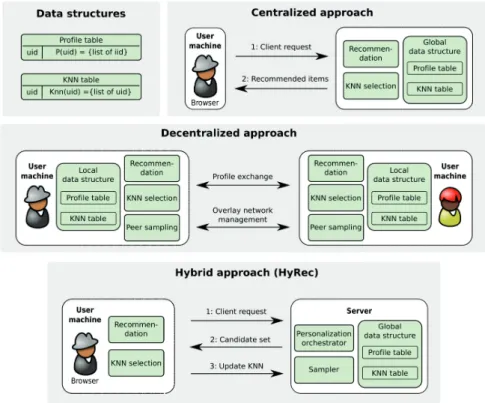
3.1 Centralized, decentralized and hybrid (HYREC) architecture of a recommender. 25
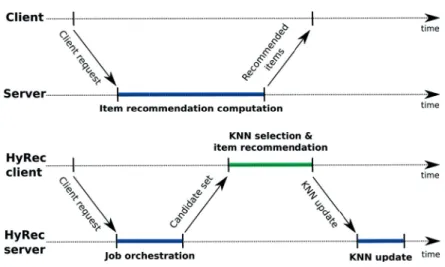
3.2 Timeline: a centralized approach vs. HYREC . . . 26
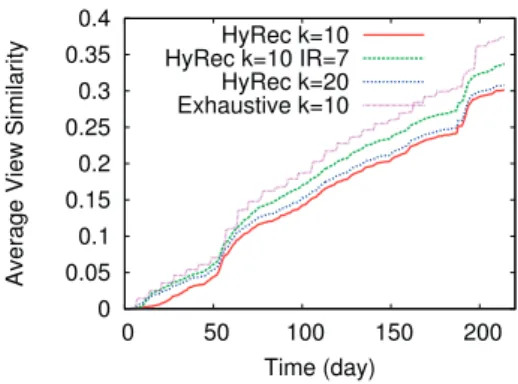
3.3 Average view similarity on ML1 dataset for HYRECand idealKNN. . . 29
3.4 Convergence of the candidate set size (ML1 dataset). . . 30
3.5 Recommendation quality on the ML1 dataset for HYRECas well as offline and online idealKNN (k=10). . . 31
3.6 Time to compute theknearest neighbors on ML and Digg workloads. . . 32
3.7 The architecture overview of HYML. . . 35
3.8 Throughput comparison among single nodes (mobile, CPU, GPU) and a cluster. 37 4.1 Temporal effects in ML-1M dataset. . . 40
4.2 Limitations of state-of-the-art similarity metrics with respect to temporal rele-vance and incremental updates. The gray areas in the right subfigure indicate the similarities (Si j) that need to be updated within a time interval [t−δ,t]. . . 41
4.3 Comparison between incremental (I-SIM) and non-incremental similarity com-putations [157, 5] for ML-1M dataset. The time interval for the active users is 5 days. . . 44
4.4 The architecture overview of SWIFT. . . 46
4.5 The biased sampling technique of SWIFT. . . 48
4.6 Voters’ trust in an administrator during a Wiki-Election . . . 50
4.7 Impact of model size (K) and recommendations-per-click (N) on accuracy. . . 53
4.8 Impact of flexibility mode on accuracy for ML-1M. . . 54
4.9 Impact of temporal relevance (α) on accuracy. Settingαto 0 deactivates SWIFT’s temporal feature. . . 55
4.10 Impact of model size (K) on latency (stream processing). . . 56
4.11 Impact of batch processing on latency for ML-1M. . . 56
4.12 Scalability comparison for ML-20M. . . 57
List of Figures
4.14 Existence of temporal consumption habits of users in MovieLens dataset. . . . 61
4.15 Topology and data structures for CIP-Uand CIP-I(arrows denote the RDD dependencies). . . 69
4.16 Topology and data structures for DEEPCIP. . . 70
4.17 Recommendation quality of CIP-based algorithms versus competitors. . . 72
4.18 Partition effects. . . 74
4.19 Cluster size effects. . . 75
5.1 D2P Illustration. . . 80
5.2 D2P-based Recommender. . . 84
5.3 D2P Modification Phase. . . 85
5.4 ML1 Dataset Partitions based on rating density. . . 89
5.5 Recall@N with varying Dataset Characteristics. . . 90
5.6 Effect of Profiler Probability (p∗) on Quality for the ML Dataset (User-based CF). 91 5.7 Effect of Profiler Probability (p∗) on Quality for the Jester Dataset (User-based CF). 91 5.8 Effect of Selector Probability (p) on Quality for the ML Dataset (User-based CF). 92 5.9 Effect of Selector Probability (p) on Quality for the Jester Dataset (User-based CF). 92 5.10 Effect of Distance Metric (λ) on Quality for the ML Dataset (User-based CF). . . 92
5.11 Distance for Personal Choice. . . 93
5.12 Distance for Average. . . 93
5.13 Privacy Parameters Comparison. . . 94
5.14 Catalog Coverage Comparison. . . 95
5.15 Effect of Selector Probability (p) on Quality for the ML Dataset (Item-based CF). 96 5.16 Effect of Profiler Probability (p∗) on Quality for the ML Dataset (Item-based CF). 96 6.1 Heterogeneous recommendation using meta-paths. . . 101
6.2 Layer-based pruning in X-MAP. . . 105
6.3 Alice’s AlterEgo profile (in target domain) mapped from her original profile (in source domain). . . 108
6.4 The components of X-MAP:Baseliner, Extender, Generator, Recommender. . . . 114
6.5 Temporal relevance (X-MAP, NX-MAP). . . 119
6.6 Privacy-quality trade-off in X-MAP-IB. . . 119
6.7 Privacy-quality trade-off in X-MAP-UB. . . 120
6.8 MAE comparison with varyingk. . . 120
6.9 MAE comparison (Overlap size).1 . . . 121
6.10 MAE comparison based on profile size. . . 121
6.11 Scalability of X-MAP. . . 123
List of Figures
List of Tables
2.1 Confusion Matrix for true/false positive/negative recommendations. . . 18
3.1 Datasets statistics . . . 28
3.2 Impact on the cost of a centralized back-end server according to theKNN
selec-tion period. . . 33 4.1 Model comparison (MAE) between incremental and non-incremental alternatives. 55
4.2 Runtime and accuracy comparisons for I-TRUSTand C-TRUST. . . 58
4.3 Details of the datasets used in our experiments. . . 71 5.1 Datasets characteristics. . . 90 5.2 Overhead of Privacy. . . 95
6.1 Sub-domains (D1andD2) based on genres in Movielens 20M dataset. . . 122
6.2 MAE comparison (homogeneous setting on ML-20M dataset). . . 122 8.1 Comparison between user-based (UB) and item-based (IB) recommenders
in different deployment scenarios with Amazon datasets. Bold denotes faster computation time relative to the alternative. . . 143
8.2 MAE comparison between NX-MAP, X-MAPand MLLIB-ALS on Amazon datasets.143
1
Introduction
In the modern generation of web-based services, the number of users is increasing continu-ously. This number bumped up from 16 million users in 1995 to 3.6 billion users in 2017. Such an immense growth in the number of users evidently led to an exponential increase in the amount of data available online (about 2.5 billion GB of data are created everyday). As a result, the web has become a big storehouse of information, making it impossible for any individual to explore the whole web contents to extract relevant data. Subsequently, personalization [25] has become an essential tool to navigate this wealth of information available on the Internet. Particularly popular now are recommender systems [107] which provide users with personal-ized content, based on their past online behavior (e.g., browsing history, clicks) and that of other similar users. These systems have been successfully employed by major online retailers such as Amazon to propose new items to their customers. Social networking sites, such as Facebook or Twitter, exploit these systems to suggest friends/followers to their users and to filter the content displayed on their feeds. Google or Yahoo! use these systems to provide personalized news to registered users. Personalization has now become ubiquitous in social media platforms and employed by almost all big players (e.g., Google, Facebook, Amazon) as well as relatively smaller ones (e.g., startups).
1.1 Challenges in Personalization
While appealing, building such personalization systems raises several technical challenges. We discuss about these technical challenges in the following.
1.1.1 Scalability
As we mentioned earlier that the growth in the number of online users led to the emergence
of personalization. However, the personalization schemes also need to bescalablein order
to process the ever-growing amount of information created by the users. Personalization
Chapter 1. Introduction
resources to process this huge volume of information and provide relevant personalized content. Moreover, any such recommender system continuously needs to be updated due to an ever-increasing amount of data, collected from online platforms, with ever-changing patterns due to various factors e.g., popularity of items or behavioral trends of users [45, 193]. Billion-dollar companies such as Google or Facebook leverage their personal huge data centers to distribute the computations for updating the recommender system using the incoming data
either in anonlinemanner (e.g.., stream processing [92]) or in anofflinemanner (e.g., batch
processing [163] at predetermined periodic intervals). For relatively smaller service providers, the most practical option is to employ cloud-based computing resources such as Amazon EC2 or Microsoft Azure but only in an offline manner. As a result, there are significant investments (i.e., Total Cost of Ownership) involved in employing such cloud-based resources. Dimension reduction and algorithmic optimizations [74, 66], or sample-based approaches [54, 61, 51], partially tackle the problem by reducing the time complexity of each update at the cost of performing more updates in a parallelized fashion. Yet there exists the need of significant investments in computational resources with growing number of users and items [143, 46, 28]. Even with massive parallelization (map-reduce [49]) on multicore architectures [151, 130] or elastic cloud architectures [46], personalization remains expensive in terms of both hardware and energy consumption [38, 133]. In this thesis, the main technical challenge concerning scalability is to design novel solutions that significantly reduce the number of computations (i.e., time complexity) for updating the recommender system and thereby also reduce the investment in computing resources.
1.1.2 Privacy
The growing tendency towards personalization has raised several privacy concerns [150] as more and more personal data is being collected and used by various personalization services. It is often observed that when an Internet user accesses some service, the provider of this service typically claims the ownership of any personal information provided by the user. The service provider sometimes even distributes the collected information to third parties like advertising and promotional partners [168]. Even the sharing of anonymized user information like the Netflix Prize dataset might end up not being secure. For instance, Narayanan et. al presented a de-anonymization attack that linked the records in the Netflix Prize dataset with the IMDb profiles available publicly [139].
Personalization systems like recommenders are particularly fragile with respect to privacy due
to their ability to provideserendipitousrecommendations (i.e.,unexpectedbutdesired
recom-mendations) [150]. Recommender systems typically make predictions about the preferences of any user by analyzing the preferences of other users. Hence, recommenders are particularly vulnerable to privacy attacks as they directly rely on information about users to provide
rele-vant recommendations. Recommenders aggregateuser preferences[152] in ways analogous
to database queries, which can be exploited by adversaries to extract personal identifiable information about a specific user [150]. In this thesis, the primary challenge concerning
1.2. Contributions
privacy is to provide novel privacy-preserving solutions (with some formal guarantees) which do not affect the recommendation quality significantly, and also do not require a significant computation overhead for the privacy preservation.
1.1.3 Heterogeneity
Although widely used today, recommender systems are mainly applied in ahomogeneous
sense: movie recommenders like IMDb or Netflix, news recommenders like Google News or Yahoo News, as well as music recommenders like Last.fm or Spotify, each focuses on a single specific application domain. In short, you will be recommended books only if you rated books, and you will be recommended movies only if you rated movies. Given the growing multiplicity of web applications, homogeneity is a major limitation. For example, with most state-of-the-art recommenders, Alice who just joined a book-oriented web application, and never rated any book before, cannot be recommended any relevant book, even if she has been rating many movies. This example is a classical illustration of thecold-startproblem [159] in recommender systems.
Heterogeneous preferences on the web, i.e., preferences from multiple application domains, could be leveraged to improve personalization furthermore, not only for users who are new to a domain (i.e., cold-start situation), but also when the data issparse[2] (e.g., a very few ratings per user). The scalability and privacy challenges become even more crucial in heterogeneous recommenders due to increasing connections across users and items from multiple domains or applications. In this thesis, the technical challenge is to design a private and scalable heterogeneous recommender which provides relevant recommendations across multiple domains or applications.
1.2 Contributions
In this thesis, we address the above-mentioned technical challenges concerning personaliza-tion. We present the main contributions of this thesis in the following which are ordered by the topics.
1.2.1 Scalability
In this thesis, we focus on two primary directions that improves the scalability of current
state-of-the-art personalization systems. We improve scalability by designingiterativeor
incrementalsolutions that significantly reduce the number of computations for updating the recommender system.
Chapter 1. Introduction
A. Democratization
In our first step, we focus on the democratization of computationally expensive jobs for
updating the recommender. We use the notion ofdemocratizationsince our solution can be
easily deployed by any service provider irrespective of the available computational resources.
The objective here is to offloadcustomizedcomputation jobs to computational devices which
could be high-end devices like laptops as well as lightweight devices like smartphones or tablets. Typically, these are the devices of the end-users who are using the personalization service for getting relevant suggestions. The computation jobs are customized based on the computational capacity of the corresponding computing device. In Chapter 3.1 of this thesis,
we introduce HYREC[27] which offloads computational jobs of constant time complexity
to the devices. The motivation of this work is to explore solutions that can democratize
personalizationby making it accessible to any content-provider company, without requiring
huge investments. HYRECemploys aniterativetechnique to update the nearest-neighbor
graph [174] of users. Such an iterative solution also scales out with an increasing number of users as the throughput, in terms of the number of updates, increases with more devices
from the users. HYRECemploys ahybridarchitecture capable of providing a cost-effective
personalization platform to web-content services. Instead of scaling through either larger and larger recommendation back-end servers, or through fully decentralizing the recommendation
process by relying solely on the front-end clients, HYRECdelegates expensive computation
tasks to the clients while, at the same time, retaining on the server side the recommender’s coordination tasks and the maintenance of the user-user graph (i.e., nearest-neighbor graph) which reflects the relationship between different users.
We also give a brief overview regarding how we can extend this idea of iteratively offloading computational jobs to Machine Learning (ML) applications. In Chapter 3.2 of this thesis, we
present HYML, an extension of HYREC, which offloads computational jobs proportional to
the device features (e.g., available memory, cpu cores). Unlike collaborative filtering employed in HYREC, performance variability, due to varying device features, poses a significant
chal-lenge [196] to train anycentralizedML algorithm (i.e., a global ML model stored and updated
on a central server) by employing users’ devices. Due to the asynchronous nature [120] of the training procedure (i.e., model updates) combined with the heterogeneity of the mobile de-vices, there exists significant performance difference between the slow and fast mobile devices.
HYML currently employs classical heterogeneity-aware model update algorithms [97, 196] in
such a heterogeneous environment of mobile computing devices.
B. Incrementality
We next focus on theincrementalityof the updates for the recommender system. At the heart
of many practical collaborative filtering techniques [92] lies the computation ofsimilarities
between users, also known aslike-mindedness. Even for trust-distrust prediction in Online
Social Networks (OSNs), nearest neighbor graphs employ similarities between the nodes [197]. We observe that existing similarity metrics [157, 187] were not designed to handle a very 4
1.2. Contributions
large number of users with rapidly changing behavior. Moreover, recommenders typically
collect userpreferencesusingexplicit feedback such asnumericalratings (star ratings in
IMDb, Netflix, Amazon),binarypreferences (likes/dislikes in Youtube), orunarypreferences
(retweets in Twitter). However, in systems where the item catalog is large, users tend to give explicit feedback on a trace amount of those items leading the classicalsparsityissue [2]. This led to the usage of recommenders employing implicit feedback (e.g., time corresponding to purchase events [115] or purchase sequences [39]). We provide incremental solutions for recommender systems employing either explicit feedback (in Chapter 4.1) or implicit feedback (in Chapter 4.2).
In Chapter 4.1 of this thesis, we introduce a novel similarity metric, we call I-SIM[45], which enables lightweight similarity computations incorporating the rapidly changing temporal
behavior of users. I-SIMcan be considered as a “temporalization” of the adjusted cosine
similarity [157] and hence of the cosine similarity which is a specific instance of adjusted cosine similarity. Therefore, I-SIMcan be easily integrated with other time-aware applications
in Online Social Networks (OSNs) e.g., trust-distrust predictions. I-SIMis lightweightin
the sense that it can be updatedincrementallyto achieve low latency and limited energy
consumption. Lastly, we highlight the fact that I-SIMemploys explicit feedback from users
(e.g. ratings) for the incremental updates.
As we mentioned above, relying on explicit feedback raises issues regarding feedbacksparsity
(thereby impacting the quality of recommendations [2]), and limited efficiency for recom-mending fresh items in reaction to recent user actions [122]. We investigate the existence of a higher level abstraction for sequences of consumed items, and algorithms for dealing with them. In Chapter 4.2 of this thesis, we introduce the notion ofconsumed item packs(CIPS[78]) to extract relevant implicit information from consumption history logs of users. We propose novel algorithms using CIPS. To address scalability, the CIP-based algorithms areincremental: they enable to incorporate fresh items consumed recently by users, in order to update the recommendations in an efficient manner.
1.2.2 Privacy
In this thesis, we investigate how we can protect the privacy of users while providing per-sonalized recommendations. We consider two levels of privacy. The first level is to protect the privacy of any user from other curious users (who can perform attacks [31]) which we denote asuser-level privacy. The second level is to protect the privacy of users from the service provider itself which we denote assystem-level privacy.
In Chapter 5.1 of this thesis, we present D2P, a novel protocol that uses a probabilistic substi-tution technique to create the AlterEgo profile of an original user profile. D2P ensures a strong form ofdifferential privacy[55, 57], which we callDistance-basedDifferentialPrivacy[76]. Differential privacy [55, 57] is a celebrated property, originally introduced in the context of databases. Intuitively, it ensures that the removal of a record from a database does not change
Chapter 1. Introduction
the result of a query to that database - modulo some arbitrarily small value (). In this sense, the presence in the database of every single record - possibly revealing some information about some user - is anonymous as no query can reveal the very existence of that record to
any other user (modulo). Applying this notion in the context of recommenders would mean
that - modulo- no uservwould be able to guess - based on the recommendations she gets
- whether some other useruhas some itemiin her profile, e.g., whetheruhas seen some
moviei. Such a guarantee, however, might be considered weak as nothing would preventv
from guessing thatuhas in her profile some item that is very similar toi, e.g., thatuhas seen
some movie similar toi. We strengthen the notion of differential privacy in the context of
CF recommenders to guarantee that any uservis not only prevented from guessing whether
the profile ofucontains some itemi, but also whether the profile ofucontains any itemi
within somedistanceλfromi (say any movie of the same category ofi): hence the name
Distance-basedDifferentialPrivacy(D2P). Our D2P protocol ensures this property.
In Chapter 5.2 of this thesis, we provide a brief overview of how we design X-REC[77], a
novel recommender which ensures the privacy of users against the service provider (
system-level privacy) or other curious users (user-level privacy) with negligible increase of latency in providing recommendations to end-users (due to the privacy overhead), while preserving
recommendation quality. X-RECemploys auniform user samplingtechnique to achieve
user-level privacyand an efficient homomorphic encryption scheme (X-HE) to achievesystem-level privacy.
1.2.3 Heterogeneity
In Chapter 6 of this thesis, we present a heterogeneous recommender which we call X-MAP:
Cross-domain personalization system[75]. X-MAPemploys a novel similarity metric, X-SIM,
which computes a meta-path-based1transitive closure of inter-item similarities across
sev-eral domains. X-SIMinvolves adaptations, to the heterogeneous case, of classical
signifi-cance weighting[84] (to account for the number of users involved in a meta-path) andpath length[150] (to capture the effect of meta-path lengths) schemes. X-MAPalso employs the notion ofAlterEgos, namely artificial profiles (created using X-SIM), of users even in domains
where they havenoorvery littleactivity yet. We generate an AlterEgo profile (of Alice) in a
target domain leveraging an item-to-item mapping from a source domain (e.g., movies) to the target domain (e.g., books). AlterEgos enable to integrate any standard recommendation fea-ture in the target domain and preserve, for example, the temporal behavior of users [53] across
the domains. X-MAPalso provides differential privacy by using an obfuscation mechanism,
based on the meta-path-based similarities, to guarantee differentially private AlterEgos. We also briefly explore the possibility to perform content-enabled heterogeneous recommenda-tions [144] by employing statistical aggregates of user features (e.g., demography, time-varying preferences) or item features (e.g., popularity, price).
1A meta-path in a heterogeneous graphGcan be defined as a sequence of adjacent heterogeneous vertices (e.g., movies or books) connected by edges inG.
1.3. Roadmap
1.3 Roadmap
The rest of this thesis is organized as follows.
P
AR
T
I
Chapter 2 presents some preliminary concepts in recommender systems, namely,
collabo-rative filtering, differential privacy, and temporal relevance, along with the standard quality metrics used to evaluate the recommenders.
P
AR
T
II
Chapter 3 presents the democratization approach for recommender systems (HYREC) and
then provides a brief overview regarding how the idea can be extended to classical machine
learning applications (HYML).
Chapter 4 presents two incrementality approaches for scalability depending on the type of
the feedback which could be eitherexplicit(I-SIM) orimplicit(CIP).
P
AR
T
III Chapter 5 presents our notion of distance-based differential privacy (D2P) which strength-ens the notion of classical differential privacy used for providing user-level privacy in recommenders. We also provide a brief overview regarding how we can achieve
system-level privacy besides user-system-level privacy by employing X-REC.
P
AR
T
IV Chapter 6 presents a heterogeneous recommender system (X-MAP) which enables
recom-mendations across multiple domains based on user-item interactions (e.g., ratings). We also briefly explore content-enabled heterogeneous recommendations.
P
AR
T
V Chapter 7 summarizes the contributions of this thesis along with its implications at a high
level. We also highlight some interesting research directions as potential future work that the contributions of this thesis enable.
P
AR
T
VI
Chapter 8 provides some supplementary materials (e.g., correctness proofs, additional
P
ART
I
Preliminaries
In this part of the thesis, we present the primary background concepts required for understand-ing the various personalization-related approaches covered in this thesis. These concepts are
2
Background
We recall here the classical notions of collaborative filtering, temporal relevance, heterogeneity, and privacy. Other than these standard concepts, we also provide a brief overview of trust-distrust predictions in online social networks, the classical gradient-descent algorithm, and the standard metrics for evaluating recommenders.
2.1 Collaborative Filtering
Collaborative Filtering(CF) algorithms fall mainly in two categories:memory-based[154, 170] andmodel-based[89, 134, 180]. Memory-based algorithms typically compute thetop-k
like-minded users for any given user (say Alice), denoted as the neighbors of Alice, from the
training database, and then make recommendations to Alice based on the rating history of her neighbors. In contrast to memory-based algorithms, model-based ones first extract some
information (also known asfeatures) about users (including Alice) from the database to train
amodeland then use this model to make recommendations for the users (including Alice). Memory-based algorithms are more flexible in practice compared to model-based ones [92]. It is relatively more time-consuming to add new incoming data to model-based systems because training a model takes significant amount of time depending on the complexity of the model along with the hyper-parameter tuning.
Neighbor-based CF, based onk nearest neighbor(KNN) algorithms, are very popular and
widely used in practice [157, 83]. The goal is to find similar objects (users or items) by explor-ing the relationships between them. The primary techniques employed by recommenders
to explore these relationships can be divided into two categories:user-basedanditem-based.
A user-based technique predicts a target user’s preference for an item by leveraging the rat-ing information aggregated from similar users. An item-based technique applies the same approach, but utilizes similarities between items instead of users.
We now provide a detailed explanation of the user-based and item-based collaborative filtering. We start with presenting the recommendation setting. We consider a database consisting of
Chapter 2. Background
N rating events on a set ofmitemsI={i1,i2, ..,im} by a set ofnusersU={u1,u2, ...,un} over
time. The ratings are sorted based on the time of the event. Each rating event is in the form of a tuple:〈u,i,rui,τui〉which reflects the fact that useruprovided a ratingruifor an itemiat a
timestampτui. Furthermore,Uitdenotes the set of users who have ratediuntil timestept.
2.1.1 User-based collaborative filtering
A user-based CF scheme typically consists of three phases as shown in Algorithm 1. We describe each of these phases in the following.
Similarity computation phase.This phase concerns with the similarity computations based on the observed ratings. We use the pearson correlation or cosine similarity [60] as the similarity metric for this phase.
Neighborhood computation phase.This phase deals with computing the most similar users corresponding to a given user, based on the computed similarities from the previous phase,
and then creating the user-user network. For each useru, the top-K users, i.e., with theK
highest similarities, are selected as the neighbors. The parameterKdenotes themodel size.
Prediction phase. In this phase, there are eitherprediction-based approach which predict the scores for every item (or a filtered set of items) typically according to Equation 2.2 or
popularity-based approach where the recommendations are the most popular items from a given user’s neighborhood.
2.1.2 Item-based collaborative filtering
A standard item-based CF scheme typically consists of three phases as shown in Algorithm 2. We briefly describe each of these phases in the following.
Similarity computation phase.This phase concerns with the similarity computations based on the observed ratings. We mostly use the adjusted cosine similarity as it was empirically demonstrated to be superior to other metrics for item-based CF [157]. The deviation from the average rating effectively captures the user’s rating behavior. Moreover, the ratings provided by users that generally give low (strict) or high (generous) ratings, have a uniform effect on the similarities.
Neighborhood computation phase.This phase deals with computing the most similar items corresponding to any given item, based on the computed similarities, and creating the item-item network. For each item-itemi, the top-Kitems, i.e., with theKhighest similarities, are selected
as the neighbors. The parameterK denotes themodel size.
Prediction phase.In this phase, the prediction scores are computed for each item according to Equation 2.4. Note that subtracting a user’s average rating ¯rucompensates for differences in
her rating scale thus making predictions even more accurate. 12
2.2. Temporal Relevance
Algorithm 1Standard User-based CF
Require: I: Item set;U: User set;Iu: Set of Items rated by a user with user-idu. Ensure: Ra: Top-N recommendations for a user Alice (a)
Phase 1 - Similarity computation: GETSIMIL ARS(a,U)
Ensure: sa: Dictionary for userawith user-ids as keys and similarities as values. 1: foruinU do 2: sa[u]= i∈Iu∩Ia (rui−r¯u)(rai−r¯a) i∈Iu (rui−r¯u)2 i∈Ia (rai−r¯a)2 (2.1) 3: end for 4: return:sa
Phase 2 - Neighborhood computation:KNN (a,U) Ensure: Na:K most similar users to usera.
5: Na=NLARGEST(K, GETSIMILARS(a,U)) 6: return:Na
Phase 3 - Prediction: TOPN(U)
Require: Sav: similarity between two usersa,v. Ensure: Ra: Top-N recommendations for Alice.
7: var PRED Dictionary with predictions for Alice
8: foriinIdo 9: PRED[i]=r¯a+ v∈KNN(a,U)∩Ui (rvi−r¯v)Sav v∈KNN(a,U)∩Ui |Suv| (2.2) 10: end for 11: Ra=NLARGEST(N, PRED) 12: return:Ra
2.2 Temporal Relevance
Temporal relevance[110, 122] is a popular notion in data mining, commonly known asconcept drift, a dynamic learning problem over time. A typical example is the change in user’s interests when following an online news stream. In such domains (e.g. news, deals), the target concept (user’s interests) depends on some temporal context (e.g., mood, financial state). This con-stantly changing context can induce changes in the target concepts, producing a concept drift. We now provide the definition of temporal relevance at any given timestep as follows where
Chapter 2. Background
Algorithm 2Standard Item-based CF
Require: I: Item set;U: User set;Uj: Set of users who rated an item with item-idj; ¯ru: Average
rating for useru.
Ensure: Ra: Top-N recommendations for a user Alice (a) Phase 1 - Similarity computation: GETSIMILARS(j,I)
Ensure: sj: Dictionary for itemjwith item-ids as keys and similarities as values. 1: foriinIdo 2: sj[i]= u∈Ui∩Uj (rui−r¯u)(ru j−r¯u) u∈Ui (rui−r¯u)2 u∈Uj (ru j−r¯u)2 (2.3) 3: end for 4: return:sj
Phase 2 - Neighborhood computation:KNN (j,I) Ensure: Nj:K most similar items to itemj.
5: Nj=NLARGEST(K, GETSIMILARS(j,I)) 6: return:Nj
Phase 3 - Prediction: TOPN(I)
Require: Si j: similarity between two itemsi,j. Ensure: Ra: Top-N recommendations for Alice.
7: var PRED Dictionary with predictions for Alice
8: foriinIdo 9: PRED[i]=r¯a+ j∈KNN(i,I)∩Ia (ra j−r¯a)Si j j∈KNN(i,I)∩Ia |Si j| (2.4) 10: end for 11: Ra=NLARGEST(N, PRED) 12: return:Ra
timestepis a logical time corresponding to the current number of incremental updates.
Definition 1(TEMPORALRELEVANCE). Temporal relevance measures the relevance of a feedback sui for making predictions at a timestep t based on a time-decaying parameterα. In the following, we denote the temporal relevance of sui at a timestep t by fuiα(t)and assign a weight
2.3. Privacy
to sui depending on the interval since the timestep (tui) when the actual feedback was provided.
fuiα(t)=e−α(t−tui) (2.5)
Temporal relevance can be incrementally updated as follows: fuiα(t+1)=e−αfuiα(t). We consider one decay factor (Equation 2.5). However, multiple weighting factors like temporal regression [29] based ones might also be considered.
2.3 Privacy
Privacy is another crucial aspect in recommender systems and preserving privacy in CF rec-ommenders is challenging. It was shown using the Netflix Prize dataset that even anonymizing individual data before releasing it publicly is not enough to preserve privacy [139]. Even cryp-tographic approaches do not preclude the possibility of the output leaking information about the personal input of individuals [181]. The need for stronger and robust privacy guarantees motivated the emergence of the notion ofDifferential Privacy[55, 57, 64]. First introduced in
the context of databases, differential privacy providesquantifiableprivacy guarantees.
Differential Privacy
Differential privacy [58] was initially devised in a context where statistical information about a database is released without revealing information about its individual entries. Differential privacy provides formal privacy guarantees that do not depend on an adversary’s background knowledge (including access to other databases) or computational power. More specifically, differential privacy is defined as follows.
Definition 2(DIFFERENTIALPRIVACY[58]). A randomized functionRensures-differential privacy if for all datasets D1and D2, differing on at most one user profile, and all t∈Rang e(R),
the following inequality always holds:
P r[R(D1)=t]
P r[R(D2)=t]≤
exp() (2.6)
Remark 1(COMPOSITION INDIFFERENTIALPRIVACY[59]). LetR1be an1-differentially private
algorithm, andR2 be an2-differentially private algorithm. Then, their composition, i.e., R1,2(x)=(R1(x),R2(x)), is1+2-differentially private.
2.4 Heterogeneity
The multiplicity of web domains (movies, books, songs) is calling forheterogeneous
recom-menders that could utilize ratings for one domain (i.e.,source) to provide recommendations in another one (i.e.,target). Without loss of generality, we formulate the heterogeneity problem
Chapter 2. Background
using two domains, referred to as the source domain (DS) and the target domain (DT). We
note that the problem of heterogeneous recommendations trivially extends to multiple source
and multiple target domains. We use superscript notationsSandT to differentiate the source
and the target domains. We assume that users inUSandUT overlap1, butISandIT have no common items. This captures the most common heterogeneous personalization scenario in e-commerce companies such as Amazon or eBay nowadays. The heterogeneous
recommen-dation objective is to recommend items inIT to users inUSbased on the preferences ofUS
forIS(ratings in the source domain),UT forIT (ratings in the target domain) andUS∩UT for
IS∪IT (overlapping ratings across the domains). In other words, we aim to recommend items
inIT to a user who rated a few items (sparsity) or no items (cold-start) inIT. For instance, we
intend to recommend new relevant books (i.e., items inDT) either to Alice who never rated
any book (cold-start) or to Bob who rated only a single book (sparsity). Both the users (Alice and Bob) rated a few movies (i.e., items inDS).
2.5 Gradient-descent Algorithm
Machine learning approaches typically focus on solving the following optimization prob-lem [120].
min
θ∈Rdf(θ) :=Eξ[F(θ;ξ)]
whereξ∈Ξis a random variable andf(θ) is a smooth (but not necessarily convex) function. The most common specification is thatΞis an index set of all training samplesΞ={1, 2, . . . ,N} andF(θ;ξ) is the cost function with respect to the training sample indexed byξ.
Gradient-descent(GD) is a standard algorithm, employed by many classical machine learning models to minimize the above-mentioned optimization problem. GD minimizes the cost functionF(θ) by executing the following two stepsiteratively.
• Gradient step. This step is responsible for computing the gradient (Equation 2.7) corre-sponding to the cost functionF(θ;ξi), based onit hsampled example from the training
database, with respect to the model parameters (θ).
G(θ;ξi)= ∇F(θ;ξi) (2.7)
• Descent step. This step then updates the current model parameters (θ) in a direction opposite to the compute gradient as shown in Equation 2.8. More precisely, given a training database withN training examples and a learning rateγk, the model is updated at
any given stepkusingnexamples (such that 1≤n≤N) as follows.
θ(k+1)=θ(k)−γ k· n i=1 G(θ;ξi) (2.8)
1This overlap is often derived from profiles maintained by users across various web applications along with interconnection mechanisms for cross-system interoperability [36] and cross-system user identification [35].
2.6. Trust-distrust Relationship in Online Social Networks
We note that the above update rule is known asstochasticGD update whenn=1, then
mini-batchGD update when 1<n<N, and lastlybatchGD update whenn=N. Depending on the size of the mini-batch (n), there exists a trade-off between the robustness of a given update (noise in the computed gradient) and the time required to compute this update. Lastly, the initial model parametersθ(0)typically have a specified value or follow a predefined probability distribution (e.g., Gaussian).
2.6 Trust-distrust Relationship in Online Social Networks
Online Social Networks (OSNs) are becoming increasingly popular nowadays as online places where users gather and exchange information. However, this information exchange also raises severe trust-distrust issues. Trust-distrust relations between users play a vital role in making decisions in OSNs like voting for administrators. In practice, the available explicit trust relations are often extremely sparse, therefore making the prediction task even more challenging. Weighted nearest neighbor algorithms are widely used for predicting trust
rela-tions [197, 126]. Algorithm 3 demonstrates one such algorithm leveragingK-nearest neighbors
(KNN) to predict trust relations.
We denote the trust level of userwfor a uservasRw v. Givennclasses with labelsC0,C1,...,
Cnwhich reflect the different levels of trust or distrust [67] between two users, we define a
mapping functionφsuch thatφ(Rw v)=Ci and 0≤i≤n. We then define SCORE(w,v,Ci) as
follows. SCORE(w,v,Ci)= ⎧ ⎨ ⎩ 1 φ(Rw v)=Ci 0 φ(Rw v)=Ci (2.9)
Since trust relation between users is asymmetric, it is possible to have SCORE(w,v,Ci)=
SCORE(v,w,Ci) whenRw v=Rv w.
These three phases resemble the ones in Algorithm 1. The first phase (similarity computation) employs the standard cosine similarity between users. The second phase is similar to the one
in Algorithm 1 and derives theKNN set for a given user. Finally, the last phase predicts the
trust relation between two users based on theKNN graph constructed in the previous two
phases.
2.7 Evaluation Metrics
We recall here some standard metrics used to evaluate the quality of recommender systems. Based on the literature of recommender systems [43, 160], we usePrecision,Recall, andF1
-scoreas our metrics to assess the quality of recommenders. Table 2.1 presents the terms needed for defining these metrics:true positives(tp),true negatives(tn),false positives(fp),
Chapter 2. Background
Algorithm 3Trust Prediction
Require: U: User set;Uw: Set of users who trusted/distrusted another user with user-idw. Ensure: Rw v: Trust level of userwfor a userv.
Phase 1 - Similarity computation: GETSIMILARS(v,U)
Ensure: sv: Dictionary for uservwith user-ids as keys and similarities as values. 1: forwinUdo 2: sv[w]= u∈Uw∩Uv Rw uRvu u∈Uw R2w u u∈Uv R2vu (2.10) 3: end for 4: return:sv
Phase 2 - Neighborhood computation:KNN (v,U) Ensure: Nv:K most similar users to userv.
5: Nv=NLARGEST(K, GETSIMILARS(v,U)) 6: return:Nv
Phase 3 - Prediction: PREDICTTRUST(w,v) Ensure: Trust prediction of userwfor a userv.
7: return: argmax
C∈{C0,...,Cn} l∈KNN(w,U)
SCORE(l,v,C)
Relevant Irrelevant Total
Recommended t p f p t p+f p
Not Recommended f n t n f n+t n
Total t p+f n f p+t n N
Table 2.1 –Confusion Matrix for true/false positive/negative recommendations. PrecisionorTrue Positive Accuracy (TPA)is the ratio of the number of relevant recommended items to the total number of recommended items.
Precision=TPA=t pt p+f p
RecallorTrue Positive Rate (TPR)is the ratio of the number of relevant recommended items to the total number of relevant items.
Recall=TPR=t pt p+f n
2.7. Evaluation Metrics
F1-scoreis used to evaluate precision and recall simultaneously. Mathematically, it is the
harmonic mean of Precision and Recall.
F1−score=2.PrecisionPrecision+.RecallRecall
We use these standard evaluation metrics throughout the rest of the thesis. In some sections of this thesis, we introduce some additional evaluation metrics like Mean Absolute Error (MAE) which are more specific to that section only.
Based on these background concepts, we explore and address the technical challenges for designing a personalization system (i.e.,scalability,privacy, andheterogeneity) in the next three parts of this thesis. At the beginning of each part, we summarize the major contributions of that specific part of the thesis.
P
ART
II
Scalability
As the amount of web data increases, the need for highly scalable personalization solutions grows proportionally. In this part of the thesis, we focus on two primary directions that improve the scalability of recommender systems.
• The first one isdemocratizationwherecustomizedcomputation jobs areiteratively
of-floaded to devices of the end-users which could be either high-end devices like laptops or lightweight mobile devices like smartphones or tablets. The computation jobs are typically lightweight and customized to the computational capacity of the device. We provide de-mocratized solutions for classical collaborative filtering (in §3.1) and demonstrate how it could be extended to classical machine learning (in §3.2).
• The second one isincrementalitywhere the personalization model is updated in an
in-crementalmanner to incorporate freshly arriving data without significant computational
overhead. Recommenders typically collect userpreferencesusingexplicitfeedback such as
numericalratings (star ratings in IMDb, Netflix, Amazon),binarypreferences (likes/dislikes
in Youtube), orunarypreferences (retweets in Twitter). We provide incremental solutions
3
Democratization
3.1
H
YR
EC: Towards a hybrid architecture
3.1.1 Overview
The motivation of this work is to explore solutions that candemocratizepersonalization by
making it accessible to any service provider, without requiring huge investments. We introduce HYREC, ahybridarchitecture capable of providing a cost-effective1scalable personalization platform to any service provider. Instead of scaling through either larger and larger recom-mendation back-end servers, or through fully decentralizing the recomrecom-mendation process
by relying solely on the front-end clients, HYRECdelegates expensive computation tasks to
clients while, at the same time, retaining on the server side the system’s coordination tasks and the maintenance of the nearest-neighbor graph (for users) which reflects the relationship between different users. In a later section of this chapter, we also demonstrate how to extend this democratization idea to enable service providers to offload various machine learning tasks (e.g., classification, ranking) on mobile devices like smartphones, tablets.
HYRECemploysuser-based collaborative filtering (§2.1.1), namely predicting the interests
of a user by collecting preferences or taste information from many other users [60]. CF is content agnostic and represents a natural opportunity for decentralizing recommendation
tasks on user devices. More specifically, HYRECadopts aknearest neighbor (KNN) approach
(Algorithm 1), which consists of computing thek nearest neighbors according to a given
similarity metric, and identifying the items to recommend from the preferences of these neighboring users [175]. The challenge here is to cope with a large number of users and items. Traditional centralized recommendation architectures achieve this by computing neighbor-hood information offline and exploiting elastic cloud platforms to massively parallelize the recommendation jobs on a large number of nodes [46, 49]. Yet, offline computation is less effective when new content is being added continuously as well as the dynamic change in user preferences. Forcing periodic re-computations, induces significant costs [46, 121, 133].
Chapter 3. Democratization
HYREC’s architecture avoids the need to process the entire sets of users and items by means of
aniterativesampling-based approach inspired by epidemic (gossip-based) computing [183,
22], and successfully used in state-of-the-artk-nearest-neighbor graph construction [54] as
well as query processing [3].
The computation for the personalization operations of a user are performed at the browser
of that user’s machine (which we sometimes simply callthe userorthe client). The HYREC
server provides each user with a sample set of profiles of other users (candidate set). Every
user then computes herknearest neighbors followed by the most popular items preferred by
her nearest neighbors. The server uses, in tu
![Figure 4.3 – Comparison between incremental ( I-S IM ) and non-incremental similarity compu- compu-tations [157, 5] for ML-1M dataset](https://thumb-us.123doks.com/thumbv2/123dok_us/420814.2548279/68.892.183.657.209.395/figure-comparison-incremental-incremental-similarity-compu-tations-dataset.webp)