Alma Mater Studiorum
Alma Mater Studiorum –– Università di Bologna
Università di Bologna
DOTTORATO DI RICERCA IN
ASTROFISICA
Ciclo XXX
Settore Concorsuale:
02/C1
Settore Scientifico Disciplinare:
FIS/05
“The Exotic Zoo of Millisecond Pulsars in Globular Clusters:
a multi-wavelength study”
Presentata da:
Mario Cadelano
Coordinatore Dottorato
Supervisore
Chiar.mo Prof. F. R. Ferraro Chiar.mo Prof. F. R. Ferraro
Co-Relatrici
Chiar.ma Prof.ssa B. Lanzoni
Dr.ssa C. Pallanca
Abstract
This thesis work is focused on the study of millisecond pulsars in globular cluster by using multi-‐wavelength observations obtained with radio and optical telescopes. Radio
observations have been used to search for and timing the pulsars. While classical search routines are based on the analysis of single and long time sequence of data, we present here an alternative method. This method exploits the large amount of available archival radio data to search for very faint pulsars by stacking all the daily power spectra. This method led to the discovery of three new pulsars in the stellar system Terzan 5.
The update of the timing solutions of 9 (out of 12) pulsars in the globular cluster M28 is then presented. The timing solutions now cover a data span of about 10 years and provide precise spin, astrometric and orbital properties for all the analyzed systems. For the case of the eccentric and relativistic binaries M28C and M28D, post-‐Keplerian corrections to the orbit have been measured in order to derive the masses of both the binary components. The measurement of the pulsar proper motions allowed to constrain the cluster motion as a whole, which has been used to infer its orbit in the Galaxy gravitational field. Finally, the pulsar spin and orbital period derivatives have been used to measure their accelerations induced by the cluster potential field. It turned out that a classical King model is able to reproduce all the measured accelerations. However, two systems show anomalous “jerk’’ values that suggest perturbations by nearby orbiting stars.
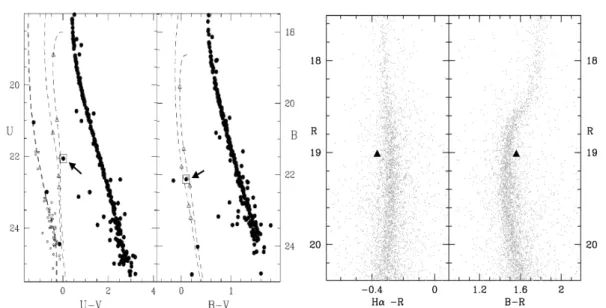
Optical observations have been exploited to search for millisecond pulsar optical counterparts, whose emission is totally dominated by the companion stars. Six new companion stars have been discovered, thus increasing by ~40% the total number of companions identified in globular clusters. In particular, four companions turned out to be He white dwarfs, as expected from the canonical formation scenario. One companion turned out to be a very faint and non-‐degenerate object, showing a strong variability which is likely the result of a strong heating of the stellar side exposed to the pulsar injected flux. Its position in the color-‐magnitude diagram, not compatible with that of any evolutionary sequence of the cluster, also confirms that this system underwent a non-‐canonical evolution. Finally, one companion is a main-‐sequence star which shows a strong Hα emission likely due to a low-‐level accretion probably from a residual disk. This system can be located in an early evolutive stage, immediately preceding the reactivation of an already re-‐accelerated pulsar. Furthermore, we identified the companion star to a transient low-‐ mass X-‐ray binary. This companion turned out to be a sub-‐giant branch star and therefore this system is likely in a very early phase of the mass accretion stage, when an expanding secondary star is filling its Roche-‐Lobe and transferring material that eventually spins-‐up the NS.
Conclusion are drawn in the final chapter, where the evolution of millisecond pulsars is discussed and possible future developments are suggested.
When we become the enfolders of those orbs, and the pleasure and knowledge of every thing in them, shall we be fill’d and satisfied then? No, we but level that lift to pass and continue beyond.
-T
ABLE OFC
ONTENTSPage
List of Tables xvii
List of Figures xix
Introduction 1
1 From Neutron Stars to Millisecond Pulsars 5
1.1 Neutron Stars . . . 6
1.1.1 The Internal Structure of a Neutron Star . . . 8
1.2 Phenomenology of Pulsars . . . 9
1.2.1 Pulse Properties . . . 9
1.2.2 Derivation of the Pulsar Physical Parameters . . . 10
1.3 Pulsar Magnetosphere and Emission Mechanism . . . 12
1.4 Pulsar Evolution . . . 15
1.5 Millisecond Pulsars . . . 17
1.5.1 Canonical Formation Scenarios . . . 18
1.5.2 The Spiders: Black-Widows and Redbacks . . . 21
1.5.3 Accreting and Transitional Millisecond Pulsars . . . 22
1.6 Globular Clusters: the Ideal Millisecond Pulsar Factories . . . 24
1.6.1 Dynamical Interactions . . . 25
1.7 Millisecond Pulsars in Globular Clusters: State of the Art . . . 28
2 Searching, Timing and Optical Identification of Millisecond Pulsars in Globu-lar Clusters 33 2.1 Searching for Pulsars . . . 34
2.1.1 Dispersion and Dedispersion of the Signal . . . 34
2.1.2 Standard Search Procedures . . . 36
2.1.3 Flux Density Estimates . . . 39
2.2 Pulsar Timing . . . 40
TABLE OF CONTENTS
2.2.2 Binary Pulsars . . . 41
2.3 Identification of Optical Counterparts in Globular Clusters . . . 43
2.3.1 Photometry of the Companion Stars . . . 43
2.3.2 Spectroscopy of the Companion Stars . . . 47
3 Discovery of Three New Millisecond Pulsars in Terzan 5 51 3.1 Introduction . . . 52
3.2 Observations and Data Analysis . . . 53
3.2.1 Dataset and initial data reduction . . . 53
3.2.2 Stacking search procedures . . . 53
3.3 Results . . . 56
3.3.1 Ter5aj . . . 56
3.3.2 Ter5ak . . . 57
3.3.3 Ter5al . . . 60
3.4 Accelerations and physical parameters . . . 60
4 Long-Term Timing of the Millisecond Pulsars in the Globular Cluster M28 63 4.1 Introduction . . . 64
4.2 Observations and Data Analysis . . . 64
4.3 Isolated Millisecond Pulsars . . . 66
4.4 Binary Millisecond Pulsars . . . 69
4.4.1 The eccentric binaries M28C and M28D . . . 69
4.4.2 M28G, J, K and L . . . 71
4.5 Proper Motions . . . 72
4.6 Spin and Orbital Period Derivatives . . . 74
5 The Black-Widow PSR J1953+1846A in the Globular Cluster M71 83 5.1 Introduction . . . 84
5.2 Radio Timing . . . 84
5.3 Optical Photometry of the Companion Star . . . 87
5.3.1 Observations and data analysis . . . 87
5.3.2 The companion to M71A . . . 88
5.4 Discussion . . . 90
5.4.1 Reprocessing efficiency and Roche Lobe filling factor . . . 94
5.4.2 A comparison between M71A and M5C . . . 95
5.4.3 Comparing X-ray and optical light curves . . . 97
6 The He White Dwarfs Orbiting the Millisecond Pulsars in the Globular Clus-ter 47 Tucanae 99 6.1 Introduction . . . 100
TABLE OF CONTENTS
6.2 Optical Photometry of the Star Cluster . . . 100
6.2.1 Observations and data analysis . . . 100
6.2.2 Astrometry . . . 101
6.2.3 Identification of the MSP companions . . . 102
6.3 Discussion . . . 105
6.3.1 The physical properties of the He WD companions . . . 105
6.3.2 Possible candidate companion stars . . . 110
6.3.3 Non detections . . . 111
6.3.4 The companion to the RB 47TucW . . . 111
7 The Optical Counterpart to the Accreting Millisecond X-ray Pulsar SAX J1748.9-2021 in the Globular Cluster NGC 6440 115 7.1 Introduction . . . 116
7.2 Observations and Data Reduction . . . 117
7.3 Results . . . 118
7.4 Discussion . . . 122
8 The Optical Identification of the X-ray Burster EXO 1745-248 in Terzan 5 127 8.1 Introduction . . . 128
8.2 Observations and Data Reduction . . . 129
8.3 Results . . . 130
Summary and Conclusions 135 A Proper Motions and Structural Parameters of the Galactic Globular Cluster M71 145 A.1 Introduction . . . 146
A.2 Observations and Data Reduction . . . 147
A.3 Relative Proper Motions . . . 150
A.4 Absolute Proper Motions . . . 152
A.4.1 The cluster orbit . . . 156
A.5 Gravitational Center, Structural Parameters and Initial Mass . . . 157
A.5.1 Gravitational center . . . 158
A.5.2 Stellar density profile . . . 158
A.5.3 Cluster initial mass . . . 162
A.6 Summary . . . 163
Bibliography 165
L
IST OFT
ABLESTABLE Page
3.1 Timing parameters for the new Terzan 5 MSPs. . . 58
4.1 Timing solutions for the three isolated MSPs in M28 analyzed in this work. . . 79
4.2 Timing solution for M28C. . . 80
4.3 Timing solutions for four binary MSPs analyzed in this work. . . 81
4.4 Timing solutions for M28G. . . 82
5.1 Timing parameters for PSR J1953+1847 (M71A)a. . . 85
5.2 Optical observations of COM-M71A . . . 91
5.3 Optical properties of COM-M71A . . . 93
6.1 Radio timing ephemeris of the analyzed MSPs . . . 101
6.2 Optical properties of the companion stars . . . 105
L
IST OFF
IGURESFIGURE Page
1.1 Schematic representation of the NS internal structure. . . 9
1.2 Integrated pulse profiles for a sample of PSRs. . . 10
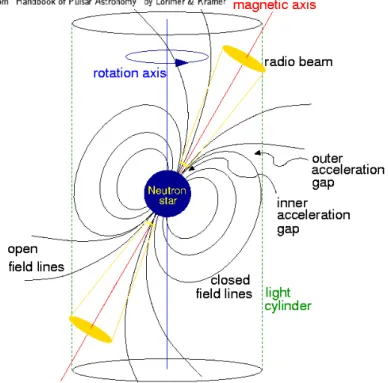
1.3 Schematic representation of a NS and its magnetosphere . . . 13
1.4 PSR magnetosphere in the Goldreich-Julian model. . . 13
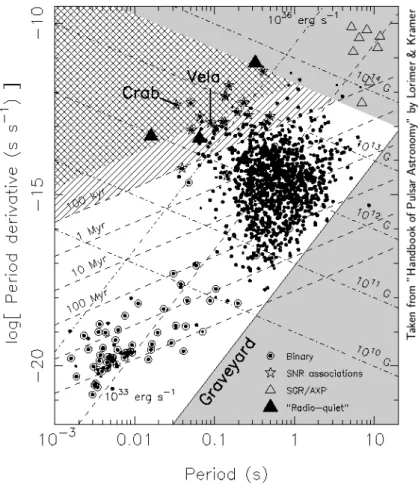
1.5 TheP−P˙ for a large sample of radio PSRs. . . 16
1.6 Surfaces of equal gravitational potential in a binary system. . . 18
1.7 MSPs formation scenarios. . . 19
1.8 An artistic representation of a spider MSP system. Credits: Ferraro F. R., ESO. . . 21
1.9 Orbital period as a function of the companion mass for a sample of MSPs. . . 23
1.10 Number of MSPs identified in each GCs. . . 25
1.11 Distribution of MSP spin periods, orbital periods and eccentricities. . . 26
1.12 Schematic representation of dynamical interactions in GCs. . . 27
1.13 Number of MSPs in GCs as a function of the stellar encounter rate. . . 28
1.14 Position of the MSP optical counterparts in an absolute CMD. . . 31
2.1 The effect of the dispersion of the PSR signal. . . 35
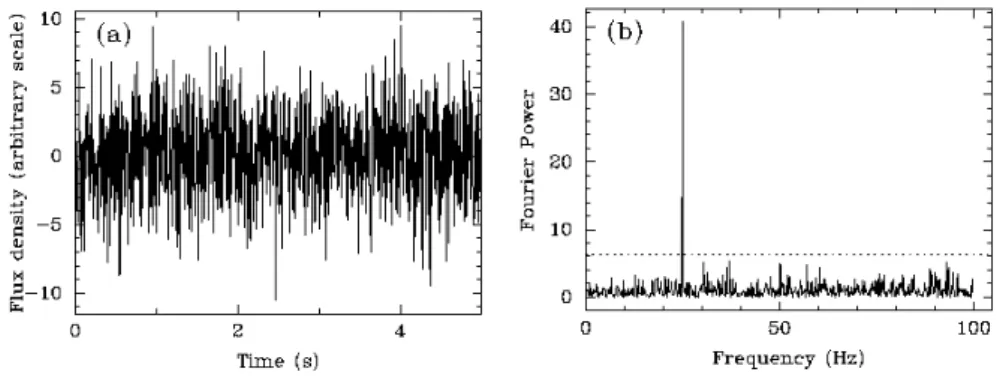
2.2 Sinusoidal signal as view in the time and Fourier space. . . 37
2.3 Pulse profiles with and without correction for the orbital motion. . . 39
2.4 CMD position of two MSP companion stars. . . 46
2.5 Light curves of the companion stars to PSR B1957+20 and PSR J1701-3006B . . . 47
2.6 Representation of the tidal distortion of a companion star. . . 47
2.7 Radial velocity curve and optical spectra of the companion to PSR J1740-5340A . . . 48
3.1 Power spectrum around the region of the newly discovered Ter5ak. . . 54
3.2 Spectral powers as a function of DM for Ter5C and Ter5aj. . . 55
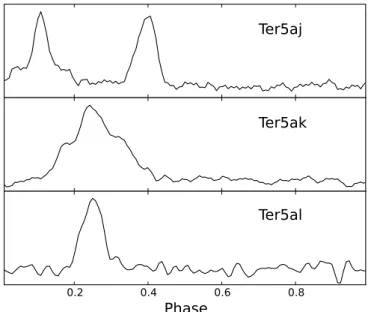
3.3 Averaged pulse profiles of the best detections of Ter5aj, Ter5ak and Ter5al. . . 57
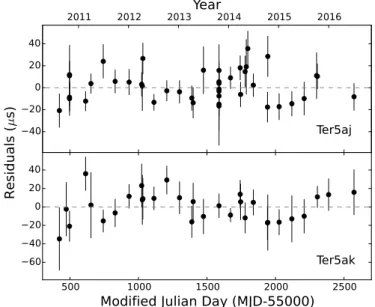
3.4 Timing residuals for Ter5aj and Ter5ak. . . 59
3.5 Positions of Ter5aj and Ter5ak with respect to the cluster gravitational center and to the other MSPs in the cluster. . . 59
LIST OFFIGURES
4.1 Pulse templates used to extract the TOAs. . . 66
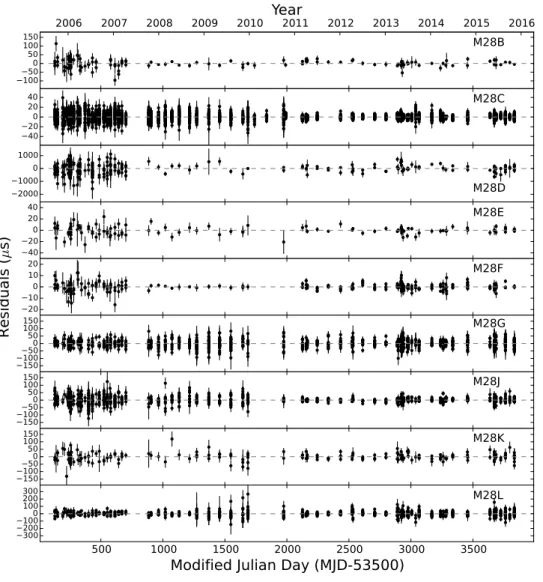
4.2 Timing residuals for all the analyzed MSPs. . . 67
4.3 Positions of all the MSPs in M28. . . 68
4.4 DMX values as a function of time for M28E and M28F. . . 68
4.5 Companion mass as a function of the PSR mass for M28C and M28D. . . 70
4.6 Post-fit residuals of M28G as a function of the orbital phase. . . 72
4.7 Proper motions of the PSR analyzed in this work. . . 73
4.9 Line of sight accelerations of the PSRs in M28. . . 77
4.10 Line of sight “jerks” of the PSRs in M28. . . 78
5.1 Postfit timing residuals and pulse profile of M71A . . . 86
5.2 Variation of the time of passage through ascending node . . . 86
5.3 Primary dataset HST images of the 5"×5" region around the nominal position of M71A 89 5.4 Light curves of COM-71A in the F606W and F814W filters . . . 90
5.5 Light curves of the candidate companion proposed by Huang et al. (2010) . . . 92
5.6 CMD of M71 with highlighted in blue the region occupied by COM-M71A . . . 93
5.7 Reprocessing efficiency of the PSR emitted energy as a function of the inclination angle 96 5.8 Light curves and CMD positions of COM-M71A and COM-M5C . . . 97
6.1 HST images of the 2"×2" region around the position of the seven analyzed MSPs . . 103
6.2 UV CMD of the GC 47 Tucanae . . . 104
6.3 Same as in Figure 6.2, but zoomed into the WD region . . . 106
6.4 Physical properties of 47TucQ, 47TucS, 47TucT, 47TucU and 47TucY . . . 107
6.5 MSP orbital periods as a function of the best-fit companion masses . . . 108
6.6 Light curves of COM-47TucW . . . 112
7.1 Finding charts of the counterpart to COM-SAX J1748.9-2021 . . . 118
7.2 CMD and color-color diagrams of NGC 6440 . . . 119
7.3 Magnitude of COM-SAX J1748.9-2021 in the three different filters and epochs . . . . 120
7.4 Roche Lobe radius as function of the COM-SAX J1748.9-2021 mass . . . 121
7.5 Color-color diagram of NGC 6440 used to determine theHαEW . . . 124
7.6 Light curve of COM-SAX J1748.9-2021 obtained by folding the optical measurements 126 8.1 Images of the region around EXO 1745-248. . . 130
8.2 F814W-band drz combined image of the region around EXO 1745-248. . . 131
8.3 CMD of Terzan 5 corrected for differential reddening. . . 132
8.4 CMD of Terzan 5 obtained from HST/ACS and ESO/MAD observations. . . 133
8.5 Position of the MSP optical counterparts in an absolute CMD after this thesis work. . 141
LIST OFFIGURES
A.2 Optical CMD of M71 . . . 149
A.3 Optical and near-infrared CMDs of M71 . . . 149
A.4 Estimated uncertainties of the derived proper motions . . . 151
A.5 VPD of the relative PMs . . . 152
A.6 Optical CMD decontaminated using the derived proper motions . . . 153
A.7 Finding charts of six selected extra-Galactic objects . . . 154
A.8 VPD of absolute PMs . . . 155
A.9 Simulation of M71 orbit in the Galaxy . . . 157
A.10 Observed density profile of M71 obtained near-infrared dataset . . . 159
A.11 Reddening map of the 1500"×1500" region centered on M71 . . . 160
A.12 Density profile of M71 obtained from the optical dataset . . . 161
I
NTRODUCTIONP
ulsars (PSRs) are rapidly spinning and highly magnetized neutron stars (NSs), mostly known as emitters of pulsating radiation in the radio bands. Their characteristic pulsated emission is the result of a collimated beam of radiation located in correspondence of the magnetic poles, misaligned with respect to the spinning axis. Therefore, the observer receives a pulsed signal every time the emission beams sweep past the line of sight, once per rotation. This is the so-called “lighthouse effect”.The first PSR was discovered about 50 years ago by Jocelyn Bell Burnell, who observed an intense source of pulsation in the sky with a stable period of 1.33 s (Hewish et al., 1968), later confirmed to be a rapidly spinning NS by Franco Pacini and Thomas Gold (Gold, 1968). Both of them independently proposed that such a rotating and magnetized star, made mostly of neutrons and formed after the supernova explosion of a high-mass star, could emit a radiation similar to that observed by Jocelyn Bell Burnell.
To date, ∼2600 PSRs have been discovered throughout he Galaxy1. The vast majority of them are isolated systems spinning at periods of about 1 s. However, a second important class, populated by∼400 objects, shows very short spin periods (around 5 ms) and are usually called “millisecond pulsars” (MSPs). They are old NSs, reaccelerated by mass and angular momentum accretion from an evolving companion star and therefore they are commonly observed in binary systems with an exhausted and deeply peeled secondary star, usually a white dwarf (WD) with a He core (e.g., Stairs, 2004).
Being highly collisional systems, globular clusters (GCs) are the ideal habitat for the forma-tion of MSPs (Verbunt, Hut, 1987; Hut et al., 1991; Ransom et al., 2005; Hessels et al., 2007). Indeed, about 40% of MSPs are found in these systems, despite the Galaxy is∼103times more massive than the entire GC system. This can be explained taking into account that MSPs in GCs are the outcome not only of the standard evolution of primordial binary systems, but also of non primordial binaries created through stellar dynamical encounters in the dense internal region of GCs. Before this thesis work, 146 MSPs were known in 28 GCs2. However, population synthesis models suggest that the next generation of radio telescopes will unveil few hundreds or even few thousands of new MSPs within the 150 Galactic GCs. Such a large population will
1http://www.atnf.csiro.au/people/pulsar/psrcat/ 2http://www.naic.edu/~pfreire/GCpsr.html
INTRODUCTION
hopefully include holy grails of PSR astronomy such as MSP-MSP binaries or even MSP-black hole binaries, expected to be formed exclusively in the extreme environments of GC cores through dynamical interactions (Freire et al., 2004; Verbunt, Freire, 2014).
MSPs in GCs can provide a wealth of science spacing in many different fields, from stellar evolution to accretion physics, from dynamics to general relativity tests. In the following we briefly introduce some of the science that can be performed by studying these objects. Some of this aspects will be discussed with more details throughout the thesis:
• Thanks to the stability of their signal over time, MSPs are extremely precise clocks. De-viations from their precision can be caused by their acceleration induced by the host GC potential field. Thus such deviations can be exploited to study the structure of the cluster itself, its physical characteristics, dynamical status, possibly probing or excluding the pres-ence of an intermediate-mass black hole in the center (e.g., Prager et al., 2017). Moreover, the measurements of MSP proper motions allow to constrain the orbit of the host cluster within the Galaxy, shedding light on the formation and evolution of these stellar systems and the Milky Way itself across their∼12 Gyr lifetime.
• The study of MSPs in GCs can be used to improve out understanding of the dynamical evolution of these dense stellar systems. For instance, the identification of a large population of MSPs is crucial to constrain the rate of ejection and the NS retention fraction in the early stage of GC evolution. Furthermore, different GCs show differences in the properties of their MSP population. For example, the numerous population of MSPs in 47 Tucanae shows properties basically identical to those of the Galactic field population, while M15 shows a population composed exclusively of exotic systems, such as isolated MSPs and double NS systems. This is tightly related to the cluster dynamical status which can therefore be constrained identifying as many MSPs as possible in many different GCs (Verbunt, Freire, 2014).
• Since MSPs are mostly located in binary systems, their companion stars, identifiable through optical observations, provide a complementary view on the properties of these systems. Indeed, according to the canonical formation scenario, MSP companions are expected to be WDs with a He core. However, several deviations from this scenario can occur. These deviations are usually imprinted on the characteristics of the companion stars and thus the identification of the optical counterparts can help shedding light on the MSP evolutionary paths (Ferraro et al., 2001b, 2003a; Pallanca et al., 2010, 2014; Mucciarelli et al., 2013). The identification and characterization of MSP optical counterparts is also a powerful tool to study stellar evolution under extreme conditions (due to the MSP energetic emission), as well as the accretion mechanism and the physical processes occurring in the intra-binary space, where the interplay between the PSR wind of relativistic particles
INTRODUCTION
and material lost from the outer envelope of the companion star becomes dominant (e.g., Bogdanov et al., 2005).
• MSPs can be used to test general relativity on small scales thanks to independent mea-surements (through PSR timing) of different relativistic orbital properties of the binaries, so-called “post-Keplerian parameters” (e.g., Burgay et al., 2003; Kramer et al., 2006; Breton et al., 2008). The number of systems clearly showing such effects is enhanced in GCs thanks to perturbations of the binaries due to close encounters with other stars. Binary MSPs also provided in the past the first indirect evidence of gravitational waves emission through the measurement of the orbital period decay of a double NS system (Hulse, Taylor, 1975). Finally, mass measurements through PSR timing and spectroscopy of the companion star could in principle be used to measure NS masses with high precision, thus possibly setting constraints on the equation of state of ultra-dense matter, which is a still open question in fundamental physics (Freire et al., 2008b; Demorest et al., 2010).
This thesis presents a multi-wavelength study of MSPs in GCs performed through radio and optical observations. These observations have been exploited through different approaches aimed to discovering new and extremely faint objects, obtain long-term highly precise timing solution and identify the optical counterparts to systems experiencing different evolutionary stages. The thesis is organized as follows:
• In Chapter 1 we provide a theoretical background on PSR properties, emission physics and evolution to the stage of MSPs. The properties of the different families of MSPs are then presented. Finally, we show why GCs are the ideal habitat for the formation of these systems and what kind of science has been (and can be) done by studying their population of MSPs.
• In Chapter 2 we present the main radio and optical methodologies used to study MSPs in GCs, from the techniques used to search for them and timing their signals in the radio bands, to the identification and characterization of their optical counterparts through optical observations.
• In Chapter 3 we report on the discovery of three new MSPs in the stellar system Terzan 5. These have been identified not though classical search routines, but using a different approach which exploits the large archival observations of this cluster, which has been routinely monitored in the past years.
• In Chapter 4 we analyze the long-term timing solutions of the MSPs in the GC M28. The timing solutions have been updated by using observations performed in the past 6 years and used to constrain the properties of each systems, evaluate the cluster proper motion and measure the acceleration induced by the GC potential field.
INTRODUCTION
• In Chapter 5 we present the optical identification and characterization of the companion star to the black-widow system M71A. Black-widows are a sub-class of MSPs showing eclipses of the radio signal. They largely deviate from the canonical formation scenario and the companion star is expected to be very different from the “typical” He WD.
• In Chapter 6 we report on the identification and characterization of the optical counterparts to four MSPs in the GC 47 Tucanae. All the discovered companion stars are He WD, as expected from the standard formation scenario. Their properties are analyzed and discussed.
• In Chapter 7 we focus our attention on the optical counterpart to an accreting MSP system in the GC NGC 6440. Accreting MSPs are a sub-class of transient low-mass X-ray binaries showing pulsations from an already recycled NS, which is however still inactive as a radio MSP. The optical counterpart gives us the chance to probe the properties of the companion star in a system experiencing an evolutionary stage immediately preceding that of radio MSPs.
• In Chapter 8 we report on the identification of the optical counterpart to EXO 1745-248, a low-mass X-ray binary in the stellar system Terzan 5. This binary is characterized by recurrent outburst episodes triggered by active mass accretion from an evolving secondary star to the NS. The characterization of such a system allows to get insights on the very early stages of NS binary evolution, where the re-acceleration of a slow and inactive pulsar is still on-going.
• Finally, in the Conclusion chapter, we summarize the results obtained in this work, we draw our final conclusions and future prospects on the study of PSRs in GCs.
C
H A P T E R1
F
ROMN
EUTRONS
TARS TOM
ILLISECONDP
ULSARST
his chapter is aimed at providing a general theoretical background for a proper study of the population of millisecond pulsars in globular clusters. We will present a general view on the neutron star properties and on the pulsar phenomenology, focusing on the physical processes that characterize their peculiar signals. Then, we will show what is and how forms a millisecond pulsar, presenting the number of different evolutionary scenarios that create the exotic zoo of these objects. We will conclude showing why globular clusters are the ideal site for the formation of millisecond pulsars and what kind of science can be performed with a multi-wavelength approach.CHAPTER 1. FROM NEUTRON STARS TO MILLISECOND PULSARS
1.1
Neutron Stars
Neutron stars (NSs) are rapidly spinning and magnetized compact stars composed mostly of neutrons. They are the core remnant of the gravitational collapse of massive stars (M>11 M¯) which eject their envelopes through supernova explosions.
The primary energy source of a star is given by thermonuclear fusion reactions, which can sustain the stellar structure until the exhaustion of the thermonuclear fuel (i.e. H, He and heavier elements till, at most, the iron group elements like Fe and Ni). Once this is exhausted, the only stellar energy source left is the gravitational one. This phenomenon has different outcomes depending on the original mass of the star:
• Stars with masses smaller than∼11 M¯ end their life as white dwarfs (WDs): compact (∼R⊕) and hot (∼104−5K) stars sustained by the pressure of degenerate electrons and mostly made of C and O or, possibly, of O, Ne and Mg.
• Stars with masses between∼11 M¯and∼25 M¯become NSs: extremely compact objects (∼10 km), sustained by the pressure of degenerate neutrons.
• For stars with masses larger than∼25 M¯, the gravitational collapse leads directly to the formation of a black hole.
While the processes leading to the formation of a WD are relatively steady and smooth events, the formation of a NS is preceded by the violent emission of most of the star gravitational energy through an explosion known as “core-collapse supernova”. During this process, the outer envelopes of the star are blown away, while only a small inner core is left, formed from the collapse of the previous star nucleus, mostly composed of iron group elements and degenerate electrons (vaguely resembling a WD composed of Fe nuclei). This nucleus is subject to free fall collapse since its mass is expected to exceed the Chandrasekhar limit1of∼1.4 M¯and a remnant composed mostly of neutrons is formed. In fact, during this phase, the density in the stellar core is large enough that neutronization of matter is favored throughβ−decay reactions:
(1.1) p++e−→n+νe
This process results in the formation of a tremendous amount of neutrons. As a rough estimate, the ratio between the stellar nucleus mass (close to the Chandrasekhar limit of∼1.4 M¯) and the neutron mass (∼1.7×10⁻²⁴g) is of the order of 1057, thus easily explaining why these remnants are called “neutron stars".
NSs are extremely compact stars. Assuming that in a NS the speed of sound is smaller than the speed of light, it has been demonstrated (Lattimer et al., 1990) that the minimum radius is 1It is the mass limit below which a system supported by the pressure of degenerate electrons (such as a WD) is
1.1. NEUTRON STARS
about 1.5 times its Schwarzschild radius (RS):
(1.2) Rmin'1.5RS= 3G M c2 =6.2 km µ M 1.4 M¯ 
whereGis the gravitational constant,cthe speed of light andMthe NS mass. On the other hand, a maximum radius can be obtained assuming that the rotating star is stable against centrifugal forces. For a NS with rotational periodP, we find:
(1.3) Rmax' µG MP2 4π2 ¶1/3 =16.8 km µ M 1.4 M¯ ¶1/3µ P ms ¶2/3
The fastest known rotating NS (PSR J1748−2446ad; Hessels et al., 2006) spins with a period of∼1.39 ms, implying a maximum radius of∼21 km for a typical mass of 1.4 M¯. Assuming that the NS is born from the collapse of a WD-like structure with a radius∼R⊕, it follows that its final radius can be up to∼500 times smaller than that of the progenitor one. Indeed, most models predict NSs to have a radius of 10 km−20 km (Lattimer, Prakash, 2001). Although such measurements are observationally challenging, high-energy data are confirming this range of values (e.g., Guillot et al., 2013; Güver, Özel, 2013). This can also explain why NSs are observed as rapidly rotating stars: under the (weak) assumption that during the gravitational collapse there is no mass and/or angular momentum loss in the stellar core and that the NS is a sphere of uniform density, applying the conservation of angular momentum law before and after the collapse we find:
(1.4) IiΩi=IfΩf =⇒ Ωf =ΩiR
2
i
R2f
whereI=25MR2andΩ=2π/Pare the moment of inertia and angular velocity of the NS (or of the stellar nucleus, before the collapse), respectively. SettingRi=500Rf, we find thatPf =10−6P
i. Considering a typicalPi≈103s, it results thatPf≈10−3s.
Shortly after their formation, NSs are extremely hot objects with temperature as high as 1011K. However, very efficient cooling mechanisms allow the star to reach, in a time-scale of 105 years, a typical temperature of about 106K (see Potekhin et al., 2015, and reference therein). Therefore the black-body emission of these objects is peaked at soft X-ray wavelengths, even though, as explained in the following, most of the NS radiation is emitted through non-thermal mechanisms.
A possible alternative NS formation mechanism is the so-called “Accretion Induced Collapse": if a massive WD in a binary system is accreting material from a standard evolving star, its mass can eventually exceed the Chandrasekhar limit. It follows a gravitational collapse that likely creates a NS (e.g. Freire, Tauris, 2014).
CHAPTER 1. FROM NEUTRON STARS TO MILLISECOND PULSARS
1.1.1 The Internal Structure of a Neutron Star
The NS structure is able to contrast the gravitational collapse thanks to the pressure granted by degenerate neutrons. As for any degenerate system, the stellar structure can be described by an equation of state, that provides a link between the density and the pressure of the star at different stellar radii.
Given the extreme physical properties of NSs, testing the equation of state in Earth laborato-ries is prohibitive. Indeed, for a typical NS with a mass of 1.4 M¯and a radius of about 10 km, the average density is∼6.7×10¹⁴g cm−3, about the same order of magnitude of the density of an atomic nucleus. While the equation state of matter with density large as the nuclear density is known, beyond this value relativistic field theories have not been able, so far, to constrain this equation, due to our lack of knowledge of the properties of the strong force in such an extreme regime. Observational constraints can be obtained through the simultaneous measurement of NS radii and masses, which is, however, quite challenging (see, e.g., Lattimer, Prakash, 2001; Guillot, Rutledge, 2014).
A description of the different kinds of equation of state proposed so far by theoretical physicists is beyond the goals of this thesis. Briefly, in most of them a NS with a very short interval of radii (10.5 km−12 km) is expected to be found in the mass range from 0.5 M¯to 2.5 M¯(Lyne, Graham-Smith, 2012). The bulk of the NS population is known to have a mass around 1.35 M¯ (Stairs, 2004), corresponding to radii in the interval of 10.5 km and 11.2 km.
The maximum mass allowed to a system supported by the pressure of degenerate electrons is well known as the Chandrasekhar limit. The same value for a system supported by the pressure of degenerate neutrons is however unknown, as a consequence of our ignorance about the equation of state. A possible value, the so-called "Tolman-Oppenheimer-Volkov" limit, is of about 2.5 M¯ (Lattimer, Prakash, 2001). However, none of the NSs with a precise mass measurement reach such a value, although few candidates are known (Freire et al., 2008b; Demorest et al., 2010), especially among the class of recycled NSs (see Section 1.5).
A schematic representation of the NS structure is reported in Figure 1.1, where it can be seen that the star density varies by about 9 orders of magnitude between the surface (ρ∼109 g cm−3)
and the central regions (ρ∼1018g cm−3). The most external regions of the crust are composed of a thin atmosphere of atomic nuclei and free electrons, whose typical thickness is of few meters. Below that, the matter already reach the typical density of a WD and it is composed of a solid lattice, mostly of Fe nuclei. Descending into the star interiors, the energetic of the system favors the neutronization of matter: the production of isotopes with a large number of neutrons (e.g. Ni62, Ni64, Ni66), throughβ-decay reactions like in 1.1. Although such isotopes would be unstable in normal condition and neutrons would decade into protons, this cannot happen in a complete degenerate structure. Below the crust, where densities are very close to the nuclear ones, the matter is expected to be in an superfluid state, where heavy atomic nuclei are embedded in a
1.2. PHENOMENOLOGY OF PULSARS
Figure 1.1: Schematic representation of the NS internal structure. Credits: A. Patruno.
sea of neutrons, with some protons and electrons. Finally, in the very central regions, where the composition of the matter is still extremely unclear, and the density overcomes the nuclear one, elementary particles can behave in unpredictable ways. Some models predict that the matter can be in exotic states, where the extreme densities force the disruption of neutrons into mesons and kaons, possibly also creating a solid inner core. Other models predict an interior composed of free quarks or a Bose-Einstein condensate. In any case, the real structure of NS interiors is still to be defined (see, e.g., Shapiro, Teukolsky, 1983).
1.2
Phenomenology of Pulsars
NSs are commonly observed as radio pulsars (PSRs), which are highly magnetized and rotating objects characterized by a peculiar emission of pulsated and stable radiation at radio wavelengths. As we will see, most of the PSR properties can be naturally explained in a scenario where charged particles, located in the NS surface, are accelerated in a highly magnetized and rotating structure.
1.2.1 Pulse Properties
The typical pulsed emission is the result of the so-calledlighthouse effect, where an emission beam (or possibly two), located at the magnetic pole (or poles), sweep past our line of sight once per NS rotation. PSR spin periods cover a broad range of values: the slowest one is PSR J18414−0456 s with a spin period of 11.79 s (Dib, Kaspi, 2014), while the fastest one is PSR J1748−2446ad (Hessels et al., 2006), spinning at about 1.39 ms. Each PSR is characterized by a distinct pulse profile, which is usually very stable at the same observing frequency and therefore can be thought as a fingerprint of the PSR itself. Being very weak radio sources (typical flux densities are of the order of 10−5−1 Jy), the pulse profile is obtained by summing together hundreds or thousands of
CHAPTER 1. FROM NEUTRON STARS TO MILLISECOND PULSARS
Figure 1.2: Integrated pulse profiles for a sample of PSRs.
pulses (this process is called “folding”) creating an “integrated pulse profile” like those reported in Figure 1.2. The shape of each pulse profile is due to the size and geometry of the emission beam, as well as the angle between the line of sight and the beam. The main pulse profile is sometimes followed by a secondary pulse called “interpulse”, separated by 180◦from the main pulse and likely due to a secondary emission beam originate from the opposite magnetic pole.
The radio PSR emission is characterized by a strong dependence of the emitted flux density on the observing frequency. This dependence can be described by a simple power-law (Sν∝να) with a steep spectral index 0&α&−4 (Maron et al., 2000).
1.2.2 Derivation of the Pulsar Physical Parameters
The emission of a PSR does not come for free, but at the expenses of a large reservoir of kinetic rotational energy. This is the reason why PSR periods are observed to increase with time. The spin-down rate ( ˙P=dP/dt) is related to the rotational kinetic energy as follows (see Lorimer, Kramer, 2004, for more details):
(1.5) E˙≡ −dErot dt = − d(IΩ2/2) dt = −IΩ ˙ Ω=4π2IP P˙ −3
where ˙Eis the “spin-down luminosity” and represents the kinetic energy output emitted by the NS. Assuming a typical moment of inertia I=1045g cm2, we find:
(1.6) E˙'3.95×1031erg s−1 µ P˙ 10−15 ¶ µP s ¶−3
Only a very small fraction of this spin-down luminosity is actually converted into radio emission. Most of it is converted into high energy radiation and relativistic wind of particles that heavily
1.2. PHENOMENOLOGY OF PULSARS
interact with the interstellar medium (the so-called “PSR wind nebulae”) or, if present, with a companion star (Kirk et al., 2009).
As we will see in the following, PSRs have strong dipole magnetic fields. A rotating magnetic dipole with a moment |m| emits electromagnetic waves at its rotation frequency. The radiation power is:
(1.7) E˙d i pol e=
2 3c3|m|
2Ω4sin2α
whereαis the angle between the magnetic and the spin axis. Equating equation (1.5) to equa-tion (1.7), we find: (1.8) Ω˙ = − µ2 |m|2sin2α 3I c3 ¶ Ω3
which shows the expected spin period evolution. By expressing this equation using a simple power-law and in terms of the rotational frequencyν, this relation becomes:
(1.9) ν˙= −Kνn
wherenis called “breaking index” andK is assumed to be a constant. For a pure magnetic dipole breaking, the index is n=3. However, other dissipation mechanisms, such as the PSR wind, may carry away part of the rotational kinetic energy. The measured values ofnvaries from 1.4 to 2.9 (Kaspi, Helfand, 2002), confirming that the pure magnetic dipole breaking is just a poor assumption.
Rearranging equation (1.9) in terms of the spin period derivative, a first order differential equation is obtained. Integrating this equation, assuming a constant K and n6=1, a simple relation for the PSR age can be obtained:
(1.10) T= P (n−1) ˙P · 1− µP 0 P ¶n−1¸
whereP0is the PSR birth spin period. AssumingP0<<Pandn=3, this equation simplifies in
the so-called “characteristic age”:
(1.11) τc≡ P 2 ˙P '15.8 Myr µP s ¶ µ P˙ 10−15 ¶−1
Such an age is easily measurable through observations. However, given the assumptions, its value is not a very reliable measurement of the true PSR age. Thus it should be treated carefully and only as a rough estimate. Rearranging the two latter equations, we find an equation for the spin period at birth:
(1.12) P0=P · 1− µn −1 2 ¶T τc ¸(n1 −1)
CHAPTER 1. FROM NEUTRON STARS TO MILLISECOND PULSARS
Therefore, if the breaking index is measured and the true age of the PSR is independently determined (e.g. by measuring the age of an associated supernova remnant), the PSR spin period at birth can be inferred. The range of possible PSR birth periods is still unclear. Some estimates suggest a broad range of values from tens to hundreds of milliseconds (e.g. Migliazzo et al., 2002; Kramer et al., 2003).
PSRs are highly magnetized systems. Although direct measurements of the magnetic field strength are not possible, an estimate of its intensity can be obtained from equation (1.8), since the magnetic field strength is related to the magnetic moment by the relation B≈ |m|/r3. It follows that the magnetic field strength at the NS surface (BS) is:
(1.13) BS=
s
3I c3
8π2R6sin2αPP˙
Using the same typicalIas before, a typical radiusR=10 km and assumingα=90◦, we find:
(1.14) BS=3.2×10¹⁹GpPP˙ '1012G µ P˙ 10−15 ¶1/2µP s ¶1/2
As in the case of the characteristic age, given all the assumptions, this equation does not provide a precise measure of the true surface magnetic field, but only a rough estimate. As we shall see in Section 1.4, this characteristic surface magnetic field can cover a broad range of values from ∼108G to∼1015G.
1.3
Pulsar Magnetosphere and Emission Mechanism
In Section 1.1.1 we saw that the NS surface and atmosphere are composed of charged particles. These are subject to Lorentz forces much stronger than the gravitational ones. In a rotating and magnetized system such as a NS, this leads to the formation of a strong electric field able to extract plasma from the surface, which surrounds the NS following the magnetic field lines and creating the “PSR magnetosphere”. A simple, yet very educative model of this phenomenon has been presented by Goldreich, Julian (1969) shortly after the discovery of the first PSR. This model assumes that the spin and magnetic axes of the PSR are aligned and shows that in any point of the sphere, the magnetic fieldBinduces an electric fieldE=(Ω×r)×B. In a perfectly conductive sphere this will be balanced by a distribution of charges that create an electric field able to grant, at any pointr, a force-free state. This can be mathematically expressed as follows:
(1.15) E+1
c(Ω×r)×B=0
Under the assumption that there is vacuum outside the sphere, the surface charges induce a quadrupole moment that corresponds to a surface electric field:
(1.16) E||= E·B B ¯ ¯ ¯ ¯r =R = −ΩBSR c cos 3θ
1.3. PULSAR MAGNETOSPHERE AND EMISSION MECHANISM
Figure 1.3: Schematic representation of a rotating NS and its surrounding magnetosphere
CHAPTER 1. FROM NEUTRON STARS TO MILLISECOND PULSARS
This field induces an electric force on charged particles that is stronger than the gravitational pull. As a consequence, charges are easily extracted from the surface to create a surrounding dense plasma. The charge distribution around the NS is arranged in such a way that the electric fieldE||is shielded and thus the force-free state (see equation 1.15) is maintained also outside the star. This plasma outside the NS is subjected to the same electromagnetic field as the NS interior and thus the charged particles are forced to rigidly co-rotate with the star. Co-rotation can however occur up to a distance where the plasma is rotating at a speed equal to the speed of light. This co-rotation limit defines a radius known as “light cylinder radius” and is given by:
(1.17) RLC= c Ω= cP 2π'4.77×10 4kmµP s 
The existence of such a limiting radius divides the magnetosphere into two distinct regions as shown in Figures 1.3 and 1.4: the “closed field lines region” where the magnetic field lines close within the light cylinder and the “open field lines region” where the magnetic field lines cannot close.
The presence of the open field line region provides the physical ground for the NS to emit the pulsated radiation. Indeed, the radio beam, responsible of the pulsed signal, is confined within this region. The exact physical mechanism that produce the PSR emission is still poorly understood. However, the generally accepted model identifies the emitting region as a cone-shaped beam centered on the magnetic poles, within a so-called “inner acceleration gap” (see Figures 1.3 and 1.4). Here, the plasma extracted from the surface by a residual electric field, is accelerated along the open field lines, thus emitting photons in a direction tangential to that of the open field line at the point of emission. This mechanism is usually called “curvature emission” (Komesaroff, 1970) and the very high brightness temperatures measured imply that this mechanism is a coherent process, at least at radio wavelengths. Briefly, the charges extracted from the NS surface are accelerated, reaching relativistic energies (γ.107), along the magnetic field lines where they emitγ-ray photons by curvature emission or inverse Compton scattering with lower-energy photons. These photons, due to the presence of the strong magnetic field, can split into an electron-positron pair if the initial energy is larger than twice the electron rest mass. In such a way, a new generation of particle is created and it will emit high energy photons and create pairs again. The net result is the creation of an avalanche of secondary pair plasma. This phenomenon results in the multiplication by a factor up to 104of the initial plasma density and it is believed that the acceleration of this secondary plasma produces the commonly observed radio emission (see Lorimer, Kramer, 2004, and reference therein, for more details). As a consequence, the opening angle of the radio beam is a function of both the width of the open field line region and the height where the emission occurs. However, it is worth reminding that the observed pulse shape is also a function of the structure of the emitting regions within the cone and of the portion of the emission cone crossed by the observer line of sight.
For the sake of completeness, we specify that the PSR pulsated emission has been observed also at higher energies, such as optical, X-ray andγ-ray wavelengths. The emission mechanism
1.4. PULSAR EVOLUTION
in these bands is quite different from the radio one and likely located, as well as in the inner acceleration gap, also in an outer acceleration gap: a region in the outer magnetosphere close to the light cylinder (see Figure 1.3). High energy photons from these outer gaps are probably created through synchrotron and curvature emission (in a lowerBregime, with respect to the radio emission case), while high energy photons from the inner gap are likely due to inverse Compton scattering.
1.4
Pulsar Evolution
The evolution of a PSR can be described through a spin period vs spin period derivative (P−P˙) diagram, reported in Figure 1.5 (Lorimer, Kramer, 2004). From the analysis of the plot, at least two distinct families of PSRs can be distinguished. The bulk of the PSR population is located at “long” spin periods, centered around 0.5 s, and spin-down rates of about 10−15: these are classical
isolated NSs, spinning down after being formed in a supernova event. They are characterized by typical magnetic field of 1011−13G and ages of about 106−7yr. A second family can be identified in those objects with extremely short spin periods, around 5 ms, and low spin-down rates around 10−20. Given their typical spin periods, these objects are called “millisecond pulsars" (MSPs). From equation (1.11) is it clear that this population is composed of PSR older than the bulk of the population, being older than 108 yr and, on the basis of equation (1.14), having low magnetic field strength of about 108−9G. Furthermore, the vast majority of them is located in binary systems. Indeed, as we will see in the following, their formation requires the presence of a companion star.
According to the most plausible evolutionary scenarios (Lorimer, Kramer, 2004), PSRs are born with small spin periods around tens of milliseconds and large spin-down rates (.10−15),
thus located in the upper left section of theP−P˙diagram. While they slow down, losing rotational kinetic energy, they move toward the bulk population with period around 0.5 s. This evolution is likely accompanied by a decay of the magnetic field strength and thus a decrease of the spin-down rate. The slow down process keeps moving the PSR toward the rightest regions of the diagram where they eventually cross the so-called “death line" and enter the “PSR graveyard". This is a region where the combination of spin periods and spin-down rates is not suitable to provide an efficient emission mechanism and therefore the NS is no more able to emit as a PSR.
The bulk of the PSR population is located close to the death line. This is because the evolu-tionary time scales from the birth region to this region of the diagram is quite fast, the typical timescale being of about 105−6 yr. Indeed, young PSRs have short spin periods and strong mag-netic fields that allow an efficient energy emission, and thus a rapid slow down. When they reach spin periods larger than∼0.5 s, this is not true anymore and the evolution in theP−P˙ diagram is slowed down. After 107 yr the emission eventually becomes too weak to be detectable and the PSR moves toward and beyond the death line.
CHAPTER 1. FROM NEUTRON STARS TO MILLISECOND PULSARS
Figure 1.5: TheP−P˙for a large sample of radio PSRs. Binary systems are highlighted with circles. PSRs associated to supernova remnants are plotted as empty stars, magnetars as empty triangles and radio quiet PSRs as filled triangles. Lines at constant magnetic field, characteristic age and spin-down luminosity are also plotted. The gray shaded area is the region called “graveyard” where the PSR is expected to be no more observable.
Across the death line, we should be no more able to see the PSR emission. However, if the dead NS is located in a binary system, accretion phenomena can transfer mass and angular momentum from the companion to the NS. This can spin-up the NS till periods of the order of milliseconds, where the emission mechanism can be reactivated and the NS can be visible again in the radio band as a MSP. The same mechanisms are also thought to be responsible of the burying of the magnetic field (Bisnovatyi-Kogan, Komberg, 1974): this is why MSPs are observed in the lower left region of the diagram, where objects with very low spin-down rates (and thus weak magnetic field) are located.
In the P−P˙ diagram it can be also distinguised a third family of objects, composed by PSRs with long spin periods but very high spin-down rates (of∼10−11) corresponding to strong
1.5. MILLISECOND PULSARS
magnetic field strengths (around 1014−15 G). These objects are called “magnetars" or in some
cases “Anomalous X-ray Pulsars” or “Soft Gamma-ray Repeaters” and they are characterized by high energy emission (Kaspi, Beloborodov, 2017). A description of this family of PSRs is beyond the goals of this thesis.
1.5
Millisecond Pulsars
As we saw in the previous section, MSPs represent an old and evolved population of NSs, resulting from mass accretion from a companion star onto a dead NS.
The first MSP, 4C21.53, was discovered in 1982 by Backer et al. (1982) and Alpar et al. (1982). It was long thought that this source could host a NS as primary star. However, no pulsations were discovered till the search was moved to very short spin periods, in a region where no PSR was known. In this way, it was discovered a 1.6 ms pulsation from this source, confirm-ing its PSR nature, but with an unprecedented short spin period. To date,∼400 MSPs are known2.
The formation of a MSP begins in a binary system where the massive star explodes as a supernova, creating a NS. This phenomenon can release an amount of energy large enough to unbound the binary. However, it can be shown, starting from the virial theorem and assuming spherical symmetry, that the binary system survives the explosion if the total amount of mass ejected during the supernova event is less than half the total mass of the binary system. After the explosion, if the binary system survives, it likely is on an eccentric orbit and the NS is visible as a classical PSR for about 106−7yr. The accretion phenomenon usually starts when the companion star evolves from the main sequence stage and becomes a red giant star. If in this stage the companion fills its Roche Lobe3 (Figure 1.6), transfer of material from the surface of the companion toward the NS can occur through the stellar wind or, more commonly, through the Lagrange pointL1 (see Figure 1.6). The mass transfer onto the NS implies also the transfer of angular momentum, thus resulting in the acceleration of the compact object. A limiting spin period is reached thanks to the equilibrium between the magnetic pressure of the accreting NS and the ram pressure of the in-falling matter (Bhattacharya, van den Heuvel, 1991). Its value is usually of few milliseconds and hence a MSP is formed. This phenomenon allows us to observe old NSs, whose emission should not be observable, having passed the death line. This is why MSPs are also known as "recycled PSRs" and the accretion/reacceleration stages as "recycling scenario”.
Aside from the dominant radio pulsed emission, MSPs are also strong high energy emitters, both in the X-ray and in theγ-ray regimes (Rutledge et al., 2004; Bogdanov et al., 2011; Xing,
2Seehttps://apatruno.wordpress.com/about/millisecond-pulsar-catalogue/
3The Roche Lobe is defined as the region, around a star in a binary system, within which orbiting material is
CHAPTER 1. FROM NEUTRON STARS TO MILLISECOND PULSARS
Figure 1.6: Surfaces of equal gravitational potential in a binary system, as seen from the equato-rial plane. The two drop-like structures intersecting at the Lagrange pointL1 are called Roche Lobes of the stars with masses M1 andM2, rotating around the center of gravity with angular
velocityΩ.
Wang, 2016). The high energy emission can be due both to thermal and non thermal processes, like the emission of photons in the surroundings of the MSP magnetosphere or to intra-binary shocks between the relativistic wind of particles emitted by the MSP and the material lost by the companion star. On the other hand, the optical emission of MSPs is dominated by the companion stars (e.g. Ferraro et al., 2001b, 2003a; Stappers et al., 2001; Breton et al., 2013) and thus optical observations are the only window to characterize the binary system properties from the secondary star point of view and to study the physics and the evolution of stars under the extreme conditions due to the presence of a NS.
1.5.1 Canonical Formation Scenarios
Canonical formation scenarios are quite branched and include many kind of MSPs. A simple but illustrative classification can be done on the basis of the companion mass. This quantity is not always easily measurable. In some cases its value can be constrained by the identification of the companion star in the optical bands while in the case of relativistic binary systems, PSR timing can provide precise mass measurements of both the primary and the secondary stars.
A schematic representation of the different possible evolutionary scenarios is presented in Figure 1.7 (see Stairs 2004). As can be seen, following the formation of the primary PSR and the subsequent accretion stages, the secondary object becomes an inactive system from the thermonuclear reactions point of view, usually a WD. We can distinguish three main MSP families on the basis of the companion mass:
1.5. MILLISECOND PULSARS
Figure 1.7: Schematic representation of MSP canonical formation scenarios, taken from Stairs (2004). Panel A shows the evolutions of MSPs with low-mass companion stars, panel B and C the evolution of MSPs with intermediate-mass companions and finally panel D the evolution of MSPs with high-mass companion stars.
stars are usually WD with a He core and mass<0.5 M¯.
• MSPs with intermediate-mass companion stars. They usually have massive C-O WD companions with masses∼1 M¯.
• MSPs with high-mass companion stars, where the latter has a mass larger than 1 M¯, typically another NS.
MSPs with low-mass companion stars
The vast majority of binary MSPs belongs to this class. They are formed from binary systems with a low-mass (∼1 M¯) secondary star. This scenario is depicted in section A of Figure 1.7.
CHAPTER 1. FROM NEUTRON STARS TO MILLISECOND PULSARS
Once the NS is formed and the secondary is evolved to the red giant phase, mass accretion can occur via Roche-Lobe overflow, through the formation of an accretion disk.
The accretion stages are commonly observed in systems called “Low-Mass X-ray Binaries” (LMXBs)4, whose intense X-ray radiation is due to the accretion disk (Tauris, van den Heuvel, 2006). These systems have been long thought to be the progenitor of MSPs and this connection has been recently confirmed by the discovery of a new class of binary systems, the so-called “transitional MSP” (tMSPs), which we will describe in Section 1.5.3. The “low-mass" prefix is used to distinguish them from the class of “High-Mass X-ray Binaries", with more massive companion stars, that are thought to be the progenitors of double PSR systems (Stairs 2004, scenario D of Figure 1.7).
This phase can last as long as∼1 Gyr and thus the final result is a rapidly spinning MSP with spin periods usually shorter than 10 ms, and a companion star whose envelope has been completely stripped out, thus a low-mass WD (∼0.1 M¯−0.2 M¯) with a He core or, more rarely, with a C-O core and an outer envelope of H and He.
MSPs with intermediate-mass companion stars
They are the outcome of the evolution of binary systems where the secondary star has a mass in the range 3 M¯−6 M¯. The evolutionary scheme is reported in sections B and C of Figure 1.7. In the former case, the primary star creates a NS and when the secondary evolves to be a red giant, a common envelope phase allows the NS to accrete material from the secondary and thus to spin the NS up. At the end, we find a mildly recycled MSP (spin periods of tens of ms) with a massive WD with a C-O core (see, e.g., Lorimer et al., 2006; Pallanca et al., 2013b). In the latter scenario, both the stars have masses lower than∼8 M¯. The more massive one firstly becomes a red giant and starts to transfer mass to the secondary star via Roche-Lobe overflow. The primary becomes a massive WD with a C-O or O-Mg core. When the secondary evolves, a common envelope phase allows mass transfer from the secondary to the primary. Finally the secondary star, which has accreted matter in the early stages and lost its envelope in the later ones, explodes as a supernova and a young PSR is formed (see, e.g., Kaspi et al., 2000).
MSPs with high-mass companion stars
It is the scenario depicted in section D of Figure 1.7. Briefly, two main sequence stars, both with masses larger than 8 M¯, evolve. When the first NS is formed and the second one reaches the red giant phase, mass transfer onto the NS can occur via the stellar wind lost by the secondary star. After a common envelope phase, where the accretion can still occur, the secondary star explodes as a supernova and a second NS is formed. These systems are usually characterized by large spin periods (≥20 ms) and eccentric orbits (0.1.e.0.9). Double NS systems are known, like PSR 4For the sake of completeness, it is worth mentioning that it also exist a sub-class of LMXB with a stellar mass
1.5. MILLISECOND PULSARS
B1913+16 or B2127+11C (Jacoby et al., 2006; Weisberg et al., 2010), but only in one case the pulsations have been detected from both the NSs (Burgay et al., 2003). All of them are highly relativistic systems and thus suitable to be used as probes of general relativity (e.g. Hulse, Taylor, 1975).
1.5.2 The Spiders: Black-Widows and Redbacks
There is another class of MSPs with low-mass companion star, whose properties are not predicted by the canonical evolutionary scenario described before. These systems are named “spiders” and classified in two species: Black-Widows (BW) and Redbacks (RB, see, e.g., Fruchter et al., 1988; Ruderman et al., 1989; Ray et al., 2012; Roberts, 2013). They are also called “eclipsing MSPs” since they are characterized by periodical eclipses of the radio signal lasting for a significant fraction of the orbit, usually during the PSR superior conjunction. This phenomenon cannot be due to the occultation of the MSP by the companion star, but to absorption or scattering between the radio photons and ionized material located between the emitter and the observer. This material is likely produced from the ablation of the companion star surface by the relativistic wind of particles and high energy radiation emitted by the re-activated PSR (and so the name of the two murderous spiders). An artistic representation is reported in Figure 1.8.
Among a population of 402 MSPs, 22 RBs and 40 BWs are known so far5. The distinction between the BW and the RB classes is made on the basis of the companion star mass: while
5seehttps://apatruno.wordpress.com/about/millisecond-pulsar-catalogue/
CHAPTER 1. FROM NEUTRON STARS TO MILLISECOND PULSARS
RB companions can have masses in the range 0.1 M¯−0.5 M¯, BWs have extremely low-mass companion stars, of the order of≤0.05 M¯ (see Figure 1.9). Both the kinds of companions are expected to be non-degenerate or, at least, semi-degenerate stars, as observationally confirmed by their optical identification (e.g. Stappers et al., 2001; Pallanca et al., 2010; Breton et al., 2013). Indeed, in the case of a WD companion, the surface gravity would be too strong and the projected radius too small to produce such a mass loss from its atmosphere. The typical orbital periods of spider MSPs can cover a range from few hours to a day (Figure 1.9) and so they always present very compact orbits with no measurable eccentricities, as a result of the strong tidal interaction between the two components of binary system. A strong tidal locking also forces the companion star to rotate around his rotational axis with the same period of the orbit and thus, as in the Earth-Moon case, the same region of the star is constantly exposed to the MSP. Interestingly, spider MSPs are X-ray andγ-ray emitters (e.g. Bogdanov et al., 2005; Ray et al., 2012). The bulk of the high energy radiation is due to non thermal emission from an intra-binary shock formed between the PSR wind and the material outflowing from the companion star (Roberts et al., 2014).
There are few cases of MSPs with an expected extremely low-mass companion that show no radio eclipses. The typical mass function of their companion star is around 10−5M¯, while that of BW is usually≥3·10−4M¯. Since the mass function depends on the orbital inclination angle as sin3(i), it is reasonable that these systems are BWs seen at low inclination angle (Freire, 2005). Indeed, the eclipsing material is expected to be able to intercept the radio beam and our line of sight only at high inclination angles.
The physical mechanisms leading to the formation of these systems are still debated. Simu-lations by Chen et al. (2013) show that RBs and BWs are the outcome of different evolutionary paths, where the PSR irradiation efficiency is the discriminant factor. At odds with these results, the simulations by Benvenuto et al. (2014) show that the evolution of RBs is bifurcated, with some of them evolving into BWs and the others producing canonical MSPs with a He WD companion. Possibly, the progressive evaporation of BW companions could lead to their total disruption and thus to the formation of isolated MSPs.
1.5.3 Accreting and Transitional Millisecond Pulsars
The bridge between LMXBs and MSPs is found in a class of peculiar binaries called “Accreting Millisecond X-ray Pulsars” (AMXPs). These are a subgroup of transient LMXBs that show, during outbursts, X-ray pulsations from a rapidly rotating NS. During these outbursts, the matter lost from the non-degenerate companion star via Roche-Lobe overflow is channeled down from a truncated accretion disk onto the NS magnetic poles, producing X-ray pulsations at the rotational frequencies (ν≥100 Hz) of a weakly magnetized (B∼108−9 G) NS (see Patruno, Watts, 2012, and
1.5. MILLISECOND PULSARS
Figure 1.9: Orbital period as a function of the companion mass for a sample of MSPs. Blue points mark the position of a small sample of canonical MSPs with He WD companion stars. Black triangles, red and orange squares mark the positions of BWs, RBs and AMXPs, respectively. Finally, the three open circles around the red squares identify the three tMSPs.
AMXPs emission is powered by the accretion itself, at odds with that of classical MSPs, powered by the NS rotation. Indeed, the presence of active accretion halts the radio emission mechanism (and indeed pulsations have never been detected in these systems, despite deep radio searches; Patruno et al. 2009) and the pulsations are visible thanks to the heating of the inner acceleration gap due to the presence of accretion flow. Such a flow is however a non steady phenomenon and indeed, during quiescence, X-ray pulsations have never been observed. All AMXPs are transient systems, running through cycles of outburst and quiescence with recurrence times different among systems and with durations from few days to several years. The spin frequencies of these systems confirm that the re-acceleration of the dead NS already took place during previous stages.
The total number of AMXPs systems currently known is 20 (Patruno, Watts, 2012; Sanna et al., 2017b,a; Strohmayer, Keek, 2017). All of them are compact or even ultracompact binaries with orbital periods usually much shorter than 1 day and companion stars with masses usually smaller than 1 M¯, in a similar fashion to that of spider MSPs (see Figure 1.9). Given the range covered by the orbital periods, these systems are unlikely to be the progenitors of canonical MSPs,
CHAPTER 1. FROM NEUTRON STARS TO MILLISECOND PULSARS
while a tight connection with the spiders is obvious given their orbits and the properties of their companion stars.
The discovery of AMXPs has been an important validation for the MSP recycling scenario, probing that accretion of matter during the LMXB phase can indeed spin-up a slowly rotating NS. The final confirmation of this scenario arrived in 2013, almost 50 years after the discovery of the first binary PSR. Papitto et al. (2013) found that the transient X-ray source IGR J18245−2452 in the globular cluster (GC) M28 had an accretion outburst during March 2013, when it reached a luminosity larger than 1036erg s−1. They discovered that during this outburst the NS was emitting X-ray pulsations with a period of 3.9 ms. These have been used to obtain a timing solution that showed that the spin and orbital properties of this object were identical to that of PSR J1824−2452I, a RB system already known in the cluster. No radio pulsations have been detected during the outburst phase, while they reappeared less than two weeks after the end of the outburst, thus probing that this system was swinging between a pure accretion powered state, where it behaves like an AMXP, and a pure rotational powered state, where it behaves like an eclipsing radio MSP. These systems have been named “transitional MSPs” (tMSPs) and to date, only two more are known (Archibald et al., 2009; De Martino et al., 2015). All of them during the rotation powered state are classified as RBs (see Figure 1.9). The possibility that also BWs can swing to an accretion powered state is still open.
1.6
Globular Clusters: the Ideal Millisecond Pulsar Factories
GCs are gravitationally bound systems composed of up to 106stars and orbiting the Galaxy halo and bulge. The gravitational forces due to the ensemble of stars results in systems with spherical symmetry and high central densities. They are very old systems with typical ages of∼12 Gyr and metallicities−2.0.[Fe/H].−1.0, but up to solar values for the systems in the Galactic bulge (e.g. Terzan 5).
The central high densities are high enough that GC are the only place in the universe where dynamical interactions between stars occur in a timescale much shorter than the stellar ages. Therefore, the stars within the cluster, during their lifetime, are subjected to a large number of dynamical interactions such as exchange interactions, fly-byes, collisions, creation and disruption of binary systems. This results in the production of a large number of exotic objects such as MSPs, LMXBs, blue straggler stars and cataclysmic variables.
Although the absolute number of MSPs in the Galactic field is larger than that in GCs (252 vs 149), their number per unit mass is larger in the latter. In other words,∼40% of MSPs are found in GCs, despite the Galaxy is&103 times more massive than the entire GC system. This is easily explainable in a scenario in which MSPs in the field are the outcome of the evolution of primordial
1.6. GLOBULAR CLUSTERS: THE IDEAL MILLISECOND PULSAR FACTORIES
Figure 1.10: Number of MSPs identified in each GCs. The results shown in Chapter 3 are already included here. Courtesy of A. Ridolfi.
binary systems, while those in GCs can be the result of the evolution of both primordial systems and new binary systems formed later through dynamical interactions.
Figure 1.10 shows the number of MSPs in each cluster. As