Student-Generated Animations: Supporting Middle School Students’
Visualization, Interpretation and Reasoning of Chemical Phenomena
Hsin-Yi Chang & Chris Quintana
University of Michigan, 610 E. University, 4039SEB, Ann Arbor, MI 48109 Email: [email protected], [email protected]
Abstract: The study explores the roles of instructional animation to support middle school
students’ learning of chemistry concepts. We discuss two roles of animations: a constructivist tool to support visualization and interpretation of chemical processes, and a problem-solving tool to support reasoning about chemical phenomena. We developed Chemation, a handheld-based chemistry animation tool, to address the roles. We conducted an initial evaluation study to assess the impact of Chemation for supporting students’ visualization, interpretation, and reasoning of chemical phenomena. Two teachers and 73 seventh grade students participated in the study. The results of pre- and posttests indicated a positive gross effect of the learning environment including all aspects such as teacher and tool supports. Close examination through classroom observations, student interviews, and student artifacts revealed the relationships between student learning and tool supports. The results inform the design of interactive learning environments that incorporate animation as a learning support.
Introduction
Animation can serve as an instructional aid to support visualization of dynamic processes or abstract relationships that might otherwise be difficult to depict. Weiss, Knowlton, & Morrison (2002) discussed five functions of instructional animation, including (1) cosmetic functions that make instruction attractive to learners, (2) attention gaining functions that signal salient points of a topic, (3) motivation functions that provide feedback to reinforce correct responses, (4) presentation functions that provide concrete reference and a visual context for ideas, and (5) clarification functions that clarify relationships through visual means. However, researchers have difficulty to establish the instructional value of animation. Empirical studies have shown mixed results for the effect of instructional animation on student learning (e.g., Tversky & Morrison, 2002).
The role of instructional animation has mostly been studied in the context of tools that provide external dynamic representations to help learners build mental models of a given concept or phenomenon. Here learning may occur by learners transforming external representations into internal ones, but the role of the instructional animation remains passive. While the “viewing” approach has its value, we are exploring additional roles of instructional animation in supporting student learning: (1) animation as a constructivist tool that supports students’ visualization and interpretation of abstract processes, and (2) animation as a problem-solving tool that supports students’ reasoning processes. A new computer-based program, Chemation, was developed to address the two roles for instructional animation. It allows students to build 2-D molecular models and flipbook style animations to represent chemical phenomena at the molecular level. Chemation provides features to enable and deliver student-generated animations. The purpose of the study is to discuss the rationale for the design of Chemation, analyze its supports in light of how it serves as a constructivist and problem-solving tool, and assess its impact on promoting three aspects of learning: visualization, interpretation and reasoning. Our contribution in this paper is an example of incorporating constructivist perspectives to the development of instructional animation tools for young students. Furthermore, our evaluation of its impact in real-world classrooms illustrates the active roles that animation tools may serve.
Empirical and Theoretical Background
Few studies focus on the role of instructional animation other than serving a presentation role (e.g, Williamson & Abraham, 1995). A study found that the positive effect of animation is more apparent in open, interactive learning situations than in situations less open-ended (Kehoe, Stasko, & Taylor, 2001). The result is consistent with constructivist perspectives, suggesting that cognitive growth requires learners to actively participate in the process of knowledge construction (Piaget, 1977), and understanding occurs when individuals connect between external symbolic forms and internal cognitive structures (Olson, 2003). Moreover, several studies indicate
2003). Researchers have started to address different methods to use animation to promote understanding (e.g., Mayer & Moreno, 2002; Vermaat, Kramers-Pals, & Schank, 2003).
We discuss two constructivist perspectives as rationale for the development of Chemation in the present study: (1) learners as active knowledge constructors and (2) prior knowledge as an important role in learning and understanding. First of all, children are active constructors of knowledge rather than passive recipients of other’s knowledge (Piaget, 1977). Building on the constructivist perspective, our animation tool allows students to construct their own artifact (i.e., animations). Constructing animations encourages active learning, requiring students to employ a variety of strategies, such as selecting and organizing information, and making connections between prior experience and new knowledge. Specifically, when students use Chemation to construct animations about a chemical phenomenon at the molecular level, they are engaged in visualizing chemical processes, and thinking about important characteristics in the process. Moreover, the task of constructing may help students interpret the representation, since through constructing students connect to the context of the representation (Kress & van Leeuwen, 1996). Second, constructivists assume that all knowledge is constructed from previous knowledge (Bransford, Brown, & Cocking, 2000), and students’ experiences and prior knowledge are building blocks for their later learning (Linn, 2000). For example, research indicates that many middle school students have little or fragmented knowledge of the particulate nature of matter (e.g., Nakhleh, Samarapungavan, & Saglam, 2005). A gap may exist between middle school students’ prior knowledge about chemistry and the knowledge often embedded in an advanced modeling tool in chemistry. The complex chemistry concept may impede young students to conduct reasoning or other higher-order thinking, because successfully engaging in such tasks is built on a foundation of learned content knowledge. Several studies argue for the necessity to transform scientific knowledge or representation to make it accessible to students (e.g., Lee & Butler, 2003). The design of Chemation considers students’ prior knowledge as addressed in the literature by reducing the complexity of molecular model representations, to make chemistry representations accessible for young students for visualization, interpretation, and reasoning of chemical phenomena.
Chemation: Animation to Support Visualization, Interpretation and Reasoning
Features of Chemation
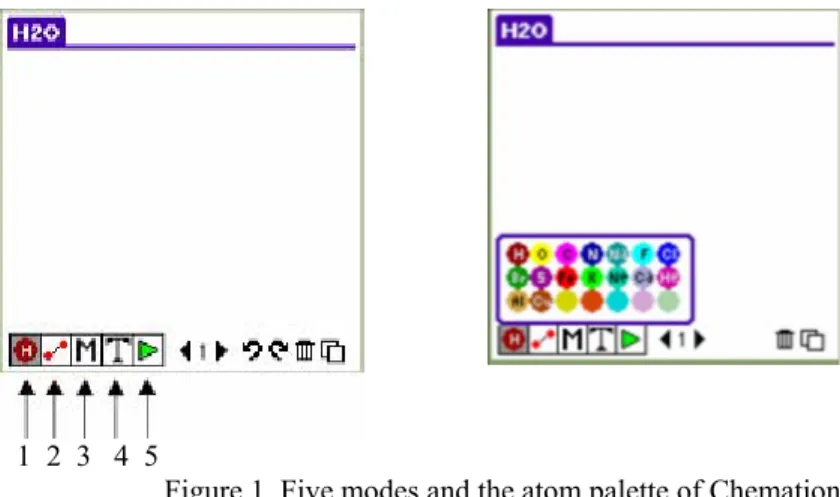
Chemation is a program for Palm devices that allows students to build 2-D molecular models and flipbook style animations. It runs on handheld computers for portability and pervasive access of student artifacts. Chemation contains five modes (Figure 1): (1) Atom mode: Chemation provides an atom palette that contains 21 different atoms, each a different color from which students can choose and drag to the main screen. Sixteen of these atoms include element symbols such as “H” or “O”. The other five are blank circles and can be used to represent other elements. (2) Link mode: The link mode is used to connect two atoms. Instead of showing different types of bonds, Chemation provides only single lines to represent the concept of connections between atoms. (3) Molecule mode: The molecule mode is used to manipulate the atoms as a group. Once atoms are drawn and connected, they are viewed as a group of atoms in a molecule. Students can use the molecule mode to copy, paste, rotate, and flip the whole molecule. (4) Label mode: Labels are free form text boxes that allow students to document their model. (5) Animation mode: After building molecular models, students can develop a series of frames to animate the models to articulate the details of a chemical or physical process.
Learning Activities and Supports From Chemation
The design of Chemation follows the learner-centered design approach (Quintana, Krajcik, & Soloway, 2003), emphasizing learning goals and contexts to help develop supportive features in software. We discuss three kinds of learning activities regarding student use of animation in a seventh-grade inquiry-based chemistry curriculum: (1) visualization of a chemical process: students construct animations that include atom rearrangement or molecule movement to show the molecular view of a given process, (2) interpretation of a chemical process: students explain the meaning of the animation, and relate it to the macroscopic chemical process the animation represents, and (3) reasoning about a chemical phenomenon: students use animations to explain the observable changes in a chemical reaction, decide whether a given process is a chemical reaction, and predict the products of a chemical reaction.
The goal of Chemation is to provide supports for each of the learning activities. We discuss six aspects of support from Chemation (see Table 1): (1) content-specific supports to help learners build appropriate animations,
1 2 3 4 5
Figure 1. Five modes and the atom palette of Chemation
such as the simplified atom palette, element symbols, and real-time messages for invalid atom connections, (2) construction supports to help learners build animations efficiently, such as copy tool for information transfer and undo/redo tool for revision, (3) multiple representations to support multi-modal articulation, such as graphic interface for building visual (non-textual) representations and label tool for inserting textual description, (4) multiple paths of navigation to support different spatial and temporal needs as students interpret, such as frame-by-frame navigation and navigation to a particular frame, (5) manipulation tools to support atom/molecule rearrangement and movement, such as functions of deleting and dragging, and (6) sustained artifacts to support ongoing reasoning, such as real-time save function for preserving students’ working processes.
Table 1. Supports from Chemation
Student activity related to the use of animation 1. Visualization of a chemical
process 2. Interpretation of a chemical process 3. Reasoning about a chemical phenomenon Supports
provided by Chemation
(1) Content-specific supports to help learners build appropriate animations: • Simplified atom palette • Element symbols • Real-time messages for
invalid atom connections • Simplified link tool (2) Construction supports to
help learners build animations efficiently: • Copy tool for information
transfer
• Undo/redo tool for revision
• Non-linear tool bar for multiple paths of revising
(3) Multiple representations to support multi-modal articulation:
• Graphic interface for building visual (non-textual) representations • Label tool for inserting
textual description (4) Multiple paths of
navigation to support different spatial and temporal needs of viewing: • Frame-by-frame navigation • Continuous playing • Navigation to a particular frame (5) Manipulation tools to support atom/molecule rearrangement and movement: • Deletion function to remove connections between atoms for atom rearrangement
• Dragging function to move atoms or molecules (6) Sustained artifacts to
support ongoing reasoning: • Real-time save function
for preserving students’ working processes
Classroom Study to Assess Student Learning With Animation
The present study is situated in cycles of design experiments (e.g., Brown, 1992): development and research take place through iterative phases of design, implementation, assessment, and redesign; researchers engineer innovative learning environments and simultaneously conduct studies of those innovations. In the following sections we discuss the methods of the study and report on initial results from the first round of design, implementation and assessment.
Participants
We assessed Chemation in light of promoting students’ visualizing, interpreting and reasoning. We have completed an evaluation study with 73 seventh grade students distributed in four classes taught by two teachers at urban middle schools in the Midwest. The majority of the students are African American or Hispanic students. One teacher used Chemation with two classes (n=40) and the other teacher at a different school used Chemation with two classes (n=33). The former had two years of experience teaching the chemistry curriculum, and the latter taught this curriculum for the first time. The students and teachers had used different programs on handheld computers in a previous learning unit. Therefore, they were Palm-literate when they started the chemistry unit. In addition, pretests showed no statistically significant differences between the students at the two schools, indicating low diversity of the participants’ prior content knowledge.
Data Collection
Each student in the study was provided with one handheld computer to build animations in four lessons during the eight-week curriculum. For each lesson, we videotaped the entire class along with group activities involving student use of Chemation. In addition, we collected pre- and post-test data. Items in the pre- and posttests are identical, including 12 multiple-choice and three open-ended questions assessing chemistry concepts targeted in the four lessons. Students’ scores on the tests revealed some but not all aspects of student understanding. The data source did not indicate how thorough students’ responses were, and how students used animations to conduct reasoning tasks. Therefore we also interviewed 15 students selected from the 73 students at the teacher’s suggestion. The teacher indicated that four of them were students with low academic achievement in science, five were medium, and six were high. We developed four to seven interview questions for each lesson (24 questions in total). The questions require students to use the animation they built during class to either interpret or reason about a given chemical phenomenon. We also interviewed the teachers to obtain feedback about Chemation. Additional data collected include artifacts that students produced during class (i.e., student-generated animations).
Data Analysis
We conducted two-tailed paired t-tests and effect size (calculated by using the difference between posttest and pretest mean scores divided by the pretest standard deviation) to analyze the pre- and posttest data for all students, and developed coding schemes to analyze interview transcripts, student artifacts, and observation notes for the 15 select students. We developed detailed, content-specific criteria for the three aspects of student learning: visualization, interpretation and reasoning. In general, student visualization is measured by student construction of animations at three levels: (1) proficient: students construct animations that include two parts- correct types of atoms and molecules, and accurate atom rearrange or molecule movement, (2) basic: students’ animation includes one part or two parts with minor errors, and (3) unsatisfactory: students’ animation includes none of the parts or major errors. Student interpretation is also coded at three levels: (1) proficient: students discuss the meaning of the animation appropriately, and discuss atom arrangement or molecule movement in detail, (2) basic: students’ interpretation is appropriate but not in detail, or thorough interpretation with minor errors, and (3) unsatisfactory: students’ interpretation is not appropriate or in detail. The three levels for students’ reasoning include: (1) proficient: students’ reasoning includes two parts- accurate evidence and explicit connection to scientific principles, (2) basic: students demonstrate either part, or both parts with prompting or minor errors, and (3) unsatisfactory: students demonstrate none of the parts. Teacher interview data were transcribed but not coded and analyzed in detail. This data source was used to triangulate our assertion regarding the role of the animation tool. For example, the analysis of student interview data may indicate areas in which students showed strong or weak performance. Teachers’ feedback on the tool helps confirm or disconfirm the relationships between student performance and the tool supports.
Results and Discussions
The pre- and posttest result shows significant gains of students’ content knowledge during the eight-week period [t(72) =15.62, p<.001]. Moreover, the effect size indicates that the mean score on the posttest was 4.17 standard deviations greater than the mean score on the pretest (effect size = 4.17). Both results suggest a positive gross effect of the learning environment including all aspects such as the supports from the teacher, the technology tool and other material used, and the roles they play. In-depth analysis of data from the select students helps establish the relationship between student use of the animation tool and student learning. We particularly examine
the quality of student visualization, interpretation and reasoning with animations. We discuss the findings in the following sections.
Visualization and Interpretation of Chemical Reaction
Students’ visualization of chemical reactions contained three major parts: the reactants, atom rearrangement, and the products. All select students built proficient animations except two had minor errors. Students demonstrated the capability to represent chemical phenomena at the molecular level. As most students were able to build appropriate animations, their verbal interpretations were mediated by their animation. The majority of student interview responses (87%) demonstrated proficient or basic interpretation of a chemical process. The following example illustrates how George used his animation to explain what happened to his experiment in which two substances, penny (copper) and vinegar (acetic acid), were put together.
Interviewer: Look at your animation and tell me what you did.
George: This is what we called a chemical reaction. There are two substances. They have to break bonds and make new substances. First frame just shows copper and two other molecules [acetic acid]. The second one hasn't broken any bond yet. Frame 4 the bonds are all broken and they make new bonds because the copper...the bonds broke off the two hydrogen and went on to the copper to make copper acetate.
George did not simply describe how he made his animation (such as “I connect two atoms”). Rather, he focused on using the animation to interpret a conceptual process and generalize the process as an example of chemical reaction, which reconfirms his definition of chemical reaction (i.e., bond breaking and generation of new substances). He demonstrated successful visualization and interpretation of a chemical process. We argue that the animation tool impacts student learning at two levels. First, the task of constructing a series of molecular models prompts students to think about not only spatial but also temporal changes in a chemical process. Second, the made animation serves as a backdrop for students to point at or refer to, mediating their interpretation. As a result, more than half of student interpretations were thorough, and focused on the process in detail. However, some students also held common alternative conceptions during their visualization or interpretation. For example, they showed confusion between atoms and molecules (Schollum & Osborne, 1985), neglect of the gaseous product in a chemical reaction (Hesse & Anderson, 1992), or use of ill-defined language such as “mix” or “combine” to describe the action between two reactants in a chemical reaction. More content-specific supports are needed to address these alternative conceptions.
Reasoning About Chemical Phenomena
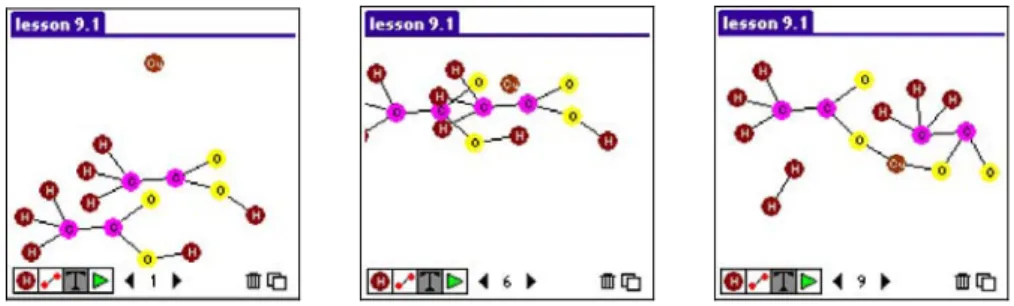
More than half (78%) of the student responses demonstrated basic or proficient reasoning of a chemical phenomenon. The following segment shows one example of basic reasoning. Cheryl, a low science achievement student, was asked to use her animation (Figure 2) to decide the products of the chemical reaction of copper penny (copper) and vinegar (acetic acid). At first she only mentioned copper acetate, neglecting the gaseous product (hydrogen gas) that she had not noticed in her experiment. As the interviewer reminded her that the reaction also generates hydrogen gas, Cheryl was able to examine the numbers and types of atoms in her animation and reasoned that there should be two leftover hydrogen atoms, although she also showed some minor error (she called carbon as carbon dioxide).
Interviewer: Did you see them [hydrogen gas] in your experiment?
Cheryl: No. All I see was there was penny and vinegar. I kind of do think there is a bit hydrogen.
Interviewer: Tell me more about it.
Cheryl: There had to be hydrogen there because in acetic acid, there are 8 hydrogen, 4 oxygen, and 4...um...carbon dioxide. Still there has two hydrogen because when the copper mixed with acetic acid it took two out to make a new bond so all together there were 6 in copper acetate.
Interviewer: So you are saying you have two leftover? Cheryl: Yah.
Figure 2. Three major screens of Cheryl’s animation
We argue that the animation tool contributes to student reasoning by providing objects for students to concretize the abstract concepts of atoms and molecules. The students were able to use the objects to count and manipulate to assist their reasoning process. Although it is arguable that other tools, such as physical manipulations, may have similar effects on supporting reasoning, the animation tool preserves students’ work in a real-time and permanent manner so that the artifacts are available for ongoing thinking, reasoning and reflection. Moreover, compared to physical objects that may lack emphasis on processes, the animation tool supports students to compare different processes. Although research indicates that students often confuse physical processes with chemical processes (Ahtee & Varjola, 1998), only one student in the present study showed this problem.
On the other hand, our result shows that all unsatisfactory reasoning was from medium or low science achievement students, indicating that reasoning is difficult for this group of students. For future work we are exploring incorporation of scaffolding such as content-specific or reasoning skill related supports. In addition, our classroom observations show that the one-to-one nature of handheld computers encourages students’ continual, but individual work. Student sharing expertise rarely occurred in the learning environment we observed. Given peer collaboration as an importance resource to promote mastery of knowledge or skills, future Chemation work will consider promoting diverse students’ interactions for sharing experience such as peer evaluation of animations.
Concluding Remarks
Although using student-generated artifacts to promote learning is not a brand new idea, as informed by the “learning by design” literature (e.g., Barab, Hay, Barnett, & Keating, 2000; Schank & Kozma, 2002), there is less research focusing on using animations as constructivist and problem-solving tools to support student understanding. In the present study we argue for the use of instructional animation to go beyond the typical cosmetic or presentation roles that animation plays. The results provide information for multimedia designers to consider enabling animations to play a more active role in educational settings. With appropriate supports, students as young as seventh graders may build appropriate animations and use them to conduct higher-order thinking such as reasoning and interpretation. One limitation of the paper is the role of the teacher not discussed. Our future work will focus on the interaction among teacher, technology and student to advance understanding of how teachers may facilitate student learning with a constructivist, problem-solving animation tool. Other future work includes revision of the animation tool to address the remaining challenges that we identified in the study, and development of animation-related activities to promote social interactions among students, for which we will conduct another evaluation study with a large number of participants.
References
Ahtee, M., & Varjola, I. (1998). Students' understanding of chemical reaction. International Journal of Science Education, 20(3), 305-316.
Barab, S. A., Hay, K. E., Barnett, M., & Keating, T. (2000). Virtual solar system project: Building understanding through model building. Journal of Research in Science Teaching, 37(7), 719-756.
Bransford, J., Brown, A. L., & Cocking, R. (2000). How people learn: brain, mind, experience and school. Washington, D.C.: National Academy Press.
Brown, A. (1992). Design experiments: Theoretical and methodological challenges in creating complex interventions in classroom settings. The Journal of Learning Sciences, 2(2), 141-178.
Hesse, J. J., & Anderson, C. W. (1992). Students' conceptions of chemical change. Journal of Research in Science Teaching, 29(3), 277-299.
Hubscher-Younger, T., & Narayanan, N. H. (2003). Dancing hamsters and marble statues: characterizing student visualizations of algorithms. Paper presented at the 2003 ACM symposium on Software visualization., San Diego, CA.
Kehoe, C., Stasko, J., & Taylor, A. (2001). Rethinking the evaluation of algorithm animations as learning aids: an observational study. International Journal of Human-Computer Studies, 54, 265-284.
Kress, G., & van Leeuwen, T. (1996). Reading images: The grammar of visual design. New York: Routledge. Lee, H.-S., & Butler, N. (2003). Making authentic science accessible to students. International Journal of Science
Education, 25(8), 923-948.
Linn, M. C. (2000). Designing the knowledge integration environment. International Journal of Science Education, 22(8), 781-796.
Mayer, R. E., & Moreno, R. (2002). Animation as an aid to multimedia learning. Educational Psychology Review, 14(1), 87-99.
Nakhleh, M. B., Samarapungavan, A., & Saglam, Y. (2005). Middle school students' beliefs about matter. Journal of Research in Science Teaching, 42, 581-612.
Olson, D. R. (2003). Psychological theory and educational reform. Cambridge; New York: Cambridge University Press.
Piaget, J. (1977). Introduction and the growth of logical thinking from childhood to adolescence. In H. Gruber & J. J. Voneche (Eds.), The essential Piaget (pp. xvii-xL, 405-444). New York: Basic Books.
Quintana, C., Krajcik, J., & Soloway, E. (2003). Issues and approaches for developing learner-centered technology. Advances in Computers, 57, 271-321.
Schank, P., & Kozma, R. B. (2002). Learning chemistry though the use of a representation-based knowledge building environment. Journal of Computers in Mathematics and Science Teaching, 21(3), 253-279. Schollum, B., & Osborne, R. (1985). Relating the new to the familiar. In R. Osborne & P. Freyberg (Eds.), Learning
in science: The implications of children's science (pp. 51-65). Portsmouth, New Hampshire: Heinemann Publishers.
Tversky, B., & Morrison, J. B. (2002). Animation: Can it facilitate? International Journal of Human-Computer Studies, 57, 247-262.
Vermaat, H., Kramers-Pals, H., & Schank, P. (2003). The use of animations in chemical education. In Proceedings of the International Convention of the Association for Educational Communications and Technology (pp. 430-441). Anaheim, CA.
Weiss, R. E., Knowlton, D. S., & Morrison, G. R. (2002). Principles for using animation in computer-based instruction: theoretical heuristics for effective design. Computers in Human Behavior, 18, 465-477.
Williamson, V. M., & Abraham, M. R. (1995). The effects of computer animation on the particulate mental models of college chemistry students. Journal of Research in Science Teaching, 32(5), 521-534.
Acknowledgments
This material is based on work supported by the National Science Foundation under Grant No. IIS-0328797. Any opinions and findings expressed in this material are those of the authors and do not necessarily reflect those of the National Science Foundation. We especially would like to thank Professor Joseph Krajcik and Dr. Lisa Scott Holt for their insight on the development of the present study, and our teachers, Kerry Girardin, and Alycia Meriweather, for their consistent classroom supports.