* Corresponding author. ORCID ID: https://orcid.org/0000-0001-9636-7306 Peer review under responsibility of Bussecon International Academy.
© 2019 Bussecon International. Hosting by SSBFNET- Center for Strategic Studies in Business & Finance. All rights reserved.
Effect of customer loyalty program on customer satisfaction and its
impact on customer loyalty
Salihah Khairawati
aaBusiness and Psychology Faculty, Yogyakarta Technology University, Indonesia
A R T I C L E I N F O
Article history: Received 07 July 19
Received in revised form 22 July 19 Accepted 08 August 19 Keywords: Loyalty program Customer satisfaction Customer loyalty Jel Classification M30,M20 A B S T R A C T
The aim of this research is to examine the effect of the customer loyalty program on customer satisfaction and its impact on customer loyalty. This program is developed by the company in order to increase customer satisfaction. Optimal customer satisfaction will be able to create customer loyalty. For a company, customer loyalty will guarantee the company’s income to be constantly optimal. The research is conducted using the survey method involving 110 customers and 100 feasible data used. The sampling technique used is judgment sampling and data collected through the questionnaire. It uses SEM in examining hypotheses assisted by software AMOS version 20.0. Member card significantly affects customer satisfaction, while discount promo has no significant effect on customer satisfaction and it also doesn’t affect customer loyalty. Member cards and discount promo have a direct effect on customer loyalty. In general, it can be understood that the customer loyalty program applied by Alfamart either member card or discount promo affects customer satisfaction and has an impact on customer loyalty. This research gives input to retail business managers in managing customer satisfaction through the proper development of customer loyalty programs.
© 2019 Bussecon International Academy. Hosting by SSBFNET. All rights reserved. Peer review under responsibility of Bussecon International Academy & SSBFNET.
Introduction
Customer satisfaction has important role for business sustainability, especially the retail business. Customer satisfaction is able to support the customers to have positive impression on the product and service offered by a business organization. Positive attitude has important role in rebuying the product or service in the future (Dizfani, Mantralla, Yuzta and Ruiz, 2017). The satisfied customers will be formed to rebuy in the same shop despite the interesting offer from other shops. In general, a positive relationship between the customer satisfaction and the customer loyalty possibly becomes the main factor or the moderation. In some previous marketing study, it is confirmed that the customer satisfaction on their needs is one antecedent of loyalty either on the brand or the shop Dizfani et.al (2017).
Customer satisfaction is determined by the development of product and quality conducted by the company, also the service and improvement in order to meet the customer expectation. The customer satisfaction can be measured through various methods. One of them is by measuring the customer expectation compared with the benefit and cost (Mouri, 2005). According to Spath & Fahnirch (2007) another way to measure the customer satisfaction is by measuring the customer life cycle relationship.
Customer loyalty is one strength owned by a company. Many companies do not realize that the customer loyalty is started from several stages, from searching potential customers to the forming of advocate customer that will bring benefit for the company (Hurriyati, 2005). Various efforts are conducted by the company in order to build the customer loyalty, to maintain the customer loyalty to make the company’s finance performance increase and to make the company be able to maintain its life sustainability. Magatef & Tomaleh (2015) in a study conducted to a grocery prove that the loyalty program performed in a good way will be able to build and manage or maintain the customers. According to Singh & Khan (2012), customer loyalty is the customer will or wish to
Research in Business & Social Science
IJRBS VOL 9 NO 1 ISSN: 2147-4478
Available online at www.ssbfnet.com Journal homepage: https://www.ssbfnet.com/ojs/index.php/ijrbs
buy the company’s product or service compared with the competitor’s product or service in the market. The programs of reward gift are offered by the company that always conduct purchase, or it can also be in the form of more easiness to the customers to get new product, discount card, or free gift. These programs support the level of rebuying and improve and maintain the level of sales by providing incentive for the customers who often buy in a big amount (Lewis, 2004). Some types of customer loyalty programs are Fee-Based Loyalty System, Rebates System, Non-Monetary/Community Program, Coalition, Organic Loyalty (Alazzam, Fahad & Bach, 2014). The customer loyalty programs are the special offer gift for those having member card, the discount price promo for the customers, and many others.
An effort to build the customer loyalty is also conducted by applying harmonic relationship with the customers. Loyalty program gives effect on the customer satisfaction and loyalty (Singh & Khan, 2012). Juramello & Spector (2015) conduct a research on how the customers react on member card and its impact on the value creating and goal in marketing. Li (2018) in the research conducted on the customer behavior also examines the relationship among membership card, mobile application, and loyalty in Starbuck. The result of research confirms that member card and mobile application programs are one way to build a relationship with the customers and a part of the customer loyalty program. Other effort to build the customer loyalty is by holding a program of discount price promo. A research conducted by Dewi & Kusumawati (2018) on the effectiveness of price promo in affecting the customer satisfaction of online business reaches a conclusion that the program of discount price promo affects the customer decision on buying and the customer satisfaction.
Alfamart is a modern retail shop and has a networking that recently is facing a competitive business condition. Alfamart effort to maintain its customers is conducted by applying the loyalty program for its loyal customers by offering various incentives such as discount for product purchase and special facilities for the member card holders, the purchase point that can be exchanged to pay the transaction. It aims at making the customers satisfied and finally loyal to the shop. The reseach question statement are loyalty program applied by Alfamart affects the customer satisfaction and gives impact on the customer loyalty?
The aim of this research is to find out the effect of the customer loyalty program on the customer satisfaction and how it gives impact on the customer loyalty. This research is hopefully able to give benefit to the retail business actors in performing the development of their promo program, the development of values or benefit to their loyal customers, and in giving inputs on the effectiveness of marketing programs in creating the customer satisfaction and loyalty.
The previous research has much examined the relationship of loyalty program on the customer satisfaction. In this research the writer is trying to examine the relationship between the loyalty program and the customer loyalty and then adding the variables of mediation. The author is trying to examine the relationship and effect of the loyalty program on the customer satisfaction and how it gives impact on the customer loyalty.
This study is divided into five parts. The first part is introduction that discusses the background of research, the object of research, and the scope of research. The second part discusses the theory and study of literature and the development of hypothesis. The third part contains the methodology of research as follows: sample selection, method used, and method of data analysis. The fourth part contains discussion and result of research. The fifth part discusses conclusion, limitation of research, and suggestion for further research.
Literature of Review
Loyalty Program
According to Wijaya (2008), customer loyalty program is a program offered to the customers to build an emotional bond to the company or the brand of company. This program is a technique of growing and maintaining the existing customers and supporting the rebuying through the incentive scheme (Doyle, 2013). Loyalty programs encourage buyers to return to shops where they make purchases (Isoraite, 2019).
Membership Card
Kottler & Keller (2009) state that the customer loyalty program much applied in companies is the frequency program and the marketing program (club or member card). The club marketing program through member cards gives opportunity to the company to build a data base or to catch the customers from the competitors. In retail world, the customer loyalty program has various names as follows: program bonus, customer card, customer club, membership card, fly buys, and many others. It is clearly proved that the loyalty programs are able to build and maintain the customers (Li, 2018).
Loyalty program is not only a tool to increase the customer loyalty but also is an opportunity to get information about shopping habit and customer preference. Such information help the company to adapt its service to the customers. Customer loyalty program is an incentive plan that allows the retail business to get information about its customers. The customers get offers in the form of product discount, coupon, point, and merchandise or other rewards. Another aim of loyalty program is to rebuild the business by offering the customer participation that is not offered to the non-participated customers. (Magtef & Tomalieh, 2015).
According to Sutjipto & Santoso (2013), member card is used for a necessary related to membership of an organization. Lupiyoadi (2013:197) states that the customers who become the members of program tend to have stronger emotional bond than those who are
not the members. According to Matita (2013), member card ownership gives significant effect on the customer satisfaction, trust, and commitment. In general, based on the study conducted (Jaramillo & Spector, 2015; Li, 2018) in a research on the customer behavior on membership card program, it is positive, which means that the customer respond on membership card program is positive. Sutjipto & Santoso (2013) in their research state that member card gift and facilities belonging to it affect the customer loyalty. Hypothesis 1 : Customer member card program gives positive effect on the customer satisfaction.
Hypothesis 4 : Customer member card program gives indirect impact on the customer loyalty. Discount Price Program
According to Tjiptono (2011: 166), a discount is a reduce fare given by the seller to the buyer as a reward on certain activity from the buyer that makes the seller happy. Dewi & Kusumawati (2018) in a research on the customers of Traveloka in Surabaya who buy the tickets via online by utilizing the discount price state that the variable of discount price gives significant effect on the customer satisfaction. The customers tend to search for those who give discounts. It indicates that the variable of discount price is something favored by the customers. Zhang & Prasongsukarn (2017) in a research conducted in Starbuck in Thailand by examining the relationship between promo price and the customer evaluation on the quality, the customer satisfaction and the intensity of rebuying that promo price affects the customer satisfaction.
An effort to prevent the moving of customers to other companies is conducted by giving incentives in the form of discount price to the customers. As proved by Kim (2019); Gabler, Landers & Raynolds (2017) in the research on the impact of promo price on losing the customers and the strategy of discount price on the decision of buying, which show that giving discount price to the customers is able to prevent losing the customers and affect the decision of buying of the customers.
Therefore, price becomes the important thing as the predictor of satisfaction either directly or indirectly, that may affect the customer loyalty. This is confirmed by Raji, M. N. A., & Zainal, A. (2017) in a research, which proves that the customer satisfaction is affected by the values received in which monetary price is seen as the best predictor for the customer satisfaction.
Hypothesis 2: Discount program gives positive effect on the customer satisfaction. Hypothesis 5: Discount program gives indirect effect on the customer loyalty. Customer Satisfaction
Customer satisfaction is the most important thing that is used to measure the success of a product or service. Satisfaction and assessment given by the customers can be used to find out the level of customer satisfaction on the product or service. The customers will feel satisfied when the product they get and feel meet their expectation.
Bloemer & De Ruyter (1998) define satisfaction as a result of subjective evaluation process in selecting the alternative or exceeding the expectation. While Swan & Oliver (1985) describe satisfaction as an orientation of post purchase that is affective or cognitive focusing on the evaluation of product performance. The customer satisfaction is positively caused by the product and service offered by the retailer. This habit has important role in the customer purchase in the future.
Customer satisfaction is affected by physical environment and perception on prices (Dube, Johnson & Renaghan, 1999; Knutson & Patton, 1995). According to (Tjiptono, 2011: 453), there are three important aspects required to be examined in the frame of measurement of customer satisfaction as follows:
1). General satisfaction or overall satisfaction
2). Confirmation of expectation that is suitability level between performance and expectation, and
3). Comparison to ideal situation that is the product performance compared to the ideal product according to customer perception. Kim et.al (2015) prove in a research conducted to a hotel industry that has impact of customer satisfaction on the loyalty to the hotel industry. While Bricci et.al (2016) examine the impact of customer trust, commitment, and satisfaction on their loyalty. It is proved that customer loyalty is affected by the above three factors.
Hypothesis 3: Customer satisfaction gives positive effect on customer loyalty. Customer Loyalty
Loyalty can be described as a condition in which someone is doing a buying routinely based on the unit of decision making. According to Griffin (2005) loyalty has four characteristics as follows: doing rebuying regularly, buying product or service at the same place, referring or recommending to others, and not being able to be influenced by the competitor to move.
A research on loyalty has been much conducted by the previous researches. Ali & Reza (2015) on a research in the influence of service quality on customer satisfaction in Islamic Banks in Pakistan conclude that the customer satisfaction is influenced by other quality of service. The research on the effectiveness of loyalty program in building customer loyalty has been conducted by Kamran et.al (2017); Breugelmans (2015); Key & Alejandro (2015); Liu & Mattila (2016). While Kadimpully et.al (2015) in a literature study
of secondary data states that it needs to build a frame to understand the customer loyalty and its impact on the improvement of the customer involvement role.
H4 Membership Card H1
Customer Satisfaction H3 Customer Loyalty Discount Promo H2
H5
Figure 1: Frame of Research; Source: Author
Research and Methodology
A research is conducted by survey method to the customers of Alfamart. The sample is taken using judgement sampling method, in which the criteria for the respondents is the customer who has shopped at least three times to Alfamart and has Alfamart member card. According to Sugiyono (2018: 96-97), the independent variable in the research is free variable which value does not depend on other variables. In this research independent variable is: member card and discount price. While mediation variable is a variable that influences or strengthens or weakens the relationship between independent variable and dependent variable. In this research mediation variable is the customer satisfaction. While dependent variable is attached variable which value depends on other variables, in this research dependent variable is the customer loyalty.
The population in this research is the customers who buy or shop in Alfamart Bangunjiwo, Indonesia. Sample is the part of amount and the characteristic owned that should be really representative for the sample selected as the participant; it is a technique that does not give the same opportunity to each element or member of population to be selected as the sample. The research determines 110 samples of respondents, but of 110 only 100 questionnaires that are complete and feasible to be processed.
It can use likert scale to measure the attitude, opinion, and perception of someone or a group of people about the social phenomena (Sugiyono, 2013:168). The indicator of measurement is based on 5 points of Likert Scale (1 = strongly disagree, 2= disagree, 3=not agree, 4= agree, dan 5 = strongly agree). The data feasibility is measured through the reliability and validity analysis test. Specifically the reliability analysis uses alpha Cronbach and the validity analysis uses discriminant and convergent analysis with Pearson correlation. The Structural Equation Modelling (SEM) data analysis is used to examine the hypothesis. Path analysis is conducted with AMOS program version 20.0.
Result and Discussion
Validity Analysis and Data Reliability
Examining the validity and reliability of the question items for each variable is conducted by validity and reliability test. The result of validity test of all indicators of member card variable amounted seven items of questions is stated to be valid because the loading factor value is > 0.5. While of the discount promo variable amounted seven items of questions, there are two that are not valid because the loading factor value is < 0.5 so it cannot be used in the questionnaire of research. The validity test for the variable indicator of customer satisfaction amounted six items of questions and the variable indicator of customer loyalty amounted eight items of questions in which the whole questions have the loading factor value > 0.5 so all is stated to be valid and can be used in the questionnaire of research. Reliability test is conducted by comparing the alpha Cronbach value of the result with the standard. The variable of research is said to be reliable if having the result value > 0.70 (Ghozali, 2018: 46)
Table 1. Reliability of Instrument
Variables Cronbach’s Alpha Description
X1 0.934 Reliable
X2 0.793 Reliable
Y1 0.860 Reliable
Y2 0.913 Reliable
Based on the above table, all variables of research have the Alpha Cronbach value that is bigger than 0.70 so that this instrument of research meets the criteria of valid and reliable because it is stated to be feasible to use.
Model of Research Testing
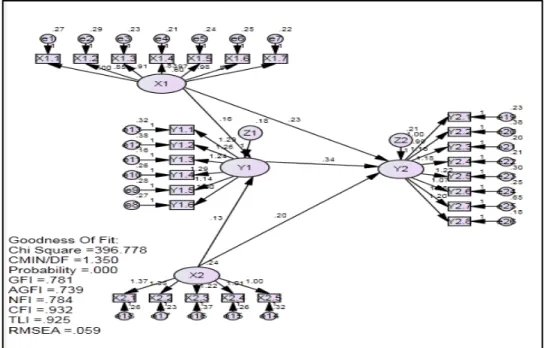
Based on the hypothesis model improved, the customer loyalty program is indirectly assumed as having causal relationship with the customer loyalty through the dimension of customer loyalty forming, by making the starting point having no estimation value. Afterwards it should be making the structural model having owned estimation value based on the starting point. The testing on the goodness of fit of model should be conducted to ensure that the structural model arranged can explain the direction of relationship and the direction of effect exactly without causing estimation bias. Figure 2 describes how the relationship between variables and model is.
Figure 2. Goodness of Fit of model: relationship between variables and model
Theoretical model on the conceptual frame of research is determined to be fit if being supported by the empirical data. The result of goodness of fit of overall modeltesting is used to find out whether the hypothetic model is supported by the empirical data. The computing result with AMOS program for SEM model result the index of goodness of fit as shown in the following table:
Table 2: Goodness of Fit Index ofModel
Source: Primary processed data
The result of Goodness of Fit gets the Chi-Square value amounted 396.778 with probability 0.000. Other fit criteria are GFI, TLI, CFI, NFI, and RMSEA to conclude the goodness of fit of overall model, the value of CMIN/DF amounted 1.350 indicates fit model because it is ≤ 2. The values of GFI amounted 0.781, NFI amounted 0.784, TLI amounted 0.932 and CFI amounted 0.925 indicate fit model because they are more than the recommended values. The result of goodnees of fittesting as a whole may conclude that the hypothetic model is supported by the empirical data, or the model is said to be fit.
Based on Table 2., it can be seen that the evaluation result of model for full model structural indicates good criteria in which each measurement of goodness of fit value has been appropriate except for the measurement of Chi-Square, GFI, AFGI and NFI which values have not met the determined criteria. However, as a whole it can be concluded that the structural model being modified has resulted in the expected estimation level. Based on Ghozali’s opinion (2015), if two or more than the whole Goodness of Fitused
Goodness of Fit Analysis Result Cut-off Value Description
c2 (Chi-Square) 396.778 Expected to be little Less
Probability 0.000 ³ 0.05 Less CMIND/DF 1.350 ≤ 2 Good GFI 0.781 ³ 0.90 Less AGFI 0.739 ³ 0.90 Less NFI 0.784 ³ 0.95 Less CFI 0.932 ³ 0.90 Good TLI 0.925 ³ 0.95 Marginal RMSEA 0.065 ≤ 0.08 Good
have indicated good fit of model, so the model is considered to be good and fit. Basically the customer satisfaction is an intermediary that can bridge the customer loyalty program, in which the good customer satisfaction will affect the customer loyalty. A hypothesis testing is conducted to test the presumption.
Hypothesis Testing
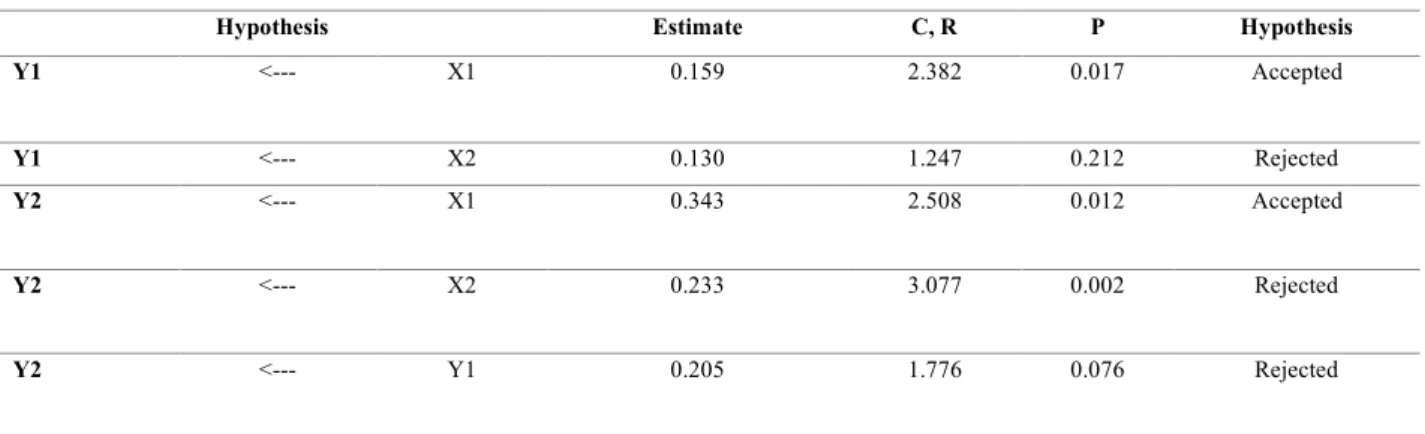
To answer the hypothesis of research, a hypothesis testing is conducted to find out the direct or indirect effect among the variables. The result of hypothesis test is as follows:
Table 3 Direct Effect of Hypothesis Testing
Hypothesis Estimate C, R P Hypothesis
Y1 <--- X1 0.159 2.382 0.017 Accepted
Y1 <--- X2 0.130 1.247 0.212 Rejected
Y2 <--- X1 0.343 2.508 0.012 Accepted
Y2 <--- X2 0.233 3.077 0.002 Rejected
Y2 <--- Y1 0.205 1.776 0.076 Rejected
Source: Primary processed data
Hypothesis 1: Customer Member Card Program gives positive effect on Customer Satisfaction
The result of hypothesis testing for the direct effect on table 3 indicates that the result of the first hypothesis with AMOS approach is that the coefficient value of customer member card has effect on the customer satisfaction with the value 2.382 (p value 0.017 < 0.05). The coefficient value is positive, so it can be concluded that the relationship between both is in the same directon, which means that the better the customer member card is, the better the customer satisfaction will be. Based on the result of t-statistic test amounted 2.382, because the t-statistic value is bigger that the t-table 2.00, so the first hypothesis that states ”customer member card program gives positive effect on customer satisfaction“ is accepted. As confirmed by Matita (2013) that the ownership of membership card has significant effect on customer satisfaction, which means that so far the customers feel satisfied with the offer and facilities provided by Alfamart to the member card holders.
Hypothesis 2: Discount Program has positive effect on customer satisfaction
Based on the t-statistic test on table 3, the result of the second hypothesis testing with AMOS approach is that the coefficient value of discount program has effect amounted 1.274 (p value 0.212 > 0.05), because the t-statistic is less than the t-table 2.00, so the second hypothesis that states ”discount program has effect on customer satisfaction“ is rejected. Thus, it can be concluded that the discount program conducted by Alfamart has not been able to give positive and significant effect on the customer satisfaction. It is possibly because the Alfamart customers do not pay much attention on discount program so that this program does not give any effect on the customer satisfaction. This hypothesis is different from the result of study conducted by the previous researchers such as Dewi & Kusumawati (2018); Zhang & Prasongsukarn (2017) who state that price promo affects the customer satisfaction.
Hypothesis 3: Customer satisfaction gives positive effect on customer loyalty
Based on the result of t-statistic test as shown in table 3, the result of the third hypothesis testing is that the coefficient value of the customer satisfaction has effect on the customer loyalty amounted 1.205 (p value 0.076 > 0.05) because the t-statistic value is less than t-tabel 2.00, so the third hypothesis that states ”Customer satisfaction has positive effect on customer loyalty“ is rejected. So far the customer satisfaction has not been able to have strong effect on the customer loyalty. According to Oliver (1999), customer loyalty is a very important thing for all industries either product or service. When the customer has been loyal by always using the product or service of a certain company, it can be said that the company has succeeded in giving satisfaction to its customers because basically customer satisfaction is one important factor that can make them loyal.
The testing of indirect influence is also conducted and the result is as shown in table 4. The relation existing between the customer loyalty program and the customer loyalty is indirect effect, which means that the effect is given indirectly and through the dimension of customer loyalty forming as the intermediary variable. The calculation result of indirect effectusing AMOS program can be seen in table 4.
Table 4 Indirect Effect Testing
Interaction Value Description Hypothesis
Y2 <--- X1 0.343 Direct Effect Direct effect > indirect effect, so hypothesis stating “X1 gives indirect effect on Y2” is rejected
Y2 <--- X1 0.055 Indirect Effect
Y2 <--- X2 0.233 Direct Effect Direct effect > indirect effect, so hypothesis stating “X2 gives indirect effect on Y2” is rejected Y2 <--- X2 0.044 Indirect Effect
Source : Primary processed data
Hypothesis 4: Customer Member Card Program has direct or indirect effect on customer loyalty Direct Effect
From table 3 it can be seen that the result of the fourth hypothesis testing with AMOS approach is that the coefficient value of customer member card has effect on loyalty with the value 2.508 (p value 0.012 < 0.05). The result of coefficient value is positive, so it can be concluded that the relationship between both is in the same direction, which means the better the customer member car is, the better the customer loyalty will be. Based on the result of t-statistic test amounted 2.508, because the value of t-statistic is bigger than t-table 2.00, so the fourth hypothesis that states ”customer member card program has direct effect on customer loyalty“ is accepted. It is similar to Sutjipto & Santoso (2013) who state in their research the member card with its facilities and benefit offers in it can affect the customer loyalty.
Indirect Effect
While the indirect effect in table 4 indicates that direct effect is bigger than indirect effect, so the hypothesis that states “member card has indirect effect on customer loyalty” is rejected. Thus, it can be concluded that member card having indirect effect on customer loyalty is rejected and is not proved.
Hypothesis 5: Discount program has direct and indirect effect on customer loyalty
Direct Effect
From table 3 the result of the fifth hypothesis testing using AMOS is that the coefficient value of discount program effect on loyalty is 3.077 (p value 0.002 < 0.05). The result of coefficient value is positive, so it can be concluded that the relationship between both is in the same direction, which means that the better the discount program is, the better the customer loyalty will be. Based on the result of t-statistic test amounted 3.077, because the t-statistic value is bigger that t-table 2.00, so the fifth hypothesis that states ”Discount promo program has direct effect on customer loyalty“ is accepted.
Indirect Effect
Table 4 indicates that direct effect is bigger than indirect effect, so the hypothesis stating that discount promo has indirect effect on customer loyalty is rejected and not proved. Thus, the discount promo program having indirect effect on customer loyalty is rejected and not accepted.
Implication of Research
This research gives description about customer loyalty. The result of research is also considered to be an evaluation of the policy of customer loyalty program that all this time is being conducted by the company using variables of member card and discount promo, and how the success of loyalty program on customer satisfaction is so it can give positive effect on the customer loyalty.
The company needs to improve the features and benefit of the customer loyalty program in accordance with the times, because the values of benefit or utilization are moving as the times run, so that it will be able to increase the customer satisfaction and strengthen the customer loyalty.
Conclusions
The results of the study in showed that the customer loyalty programmes offered by Alfamart to consumers have an effect on customer satisfaction. The results of the first hypotheses evaluation proves that customer loyalty program through Member card program significantly affects customer satisfaction. This is due to the provision of benefits, facilities and attractive offers to the member card holders. The promo price discount as a form of loyalty program does not affect customer satisfaction. This is possible, prices are not a major factor for consumers. This study shows that the role of customer satisfaction as a moderator variable is not significant in influencing customer loyalty. This research proves that customer loyalty programmes through member cards and discount promo prices directly impact customer loyalty.
This research has limitation in the form of the amount of respondents that is relatively little or limited. It is expected that further research can use more respondents. Besides, this research is also conducted only in one booth of Alfamart so it cannot be generalized.
Further research is suggested to be conducted to respondents from some booths of retail store in different regions. Further research is suggested to be able to improve either from variable of endogen latent used, variable of exogent latent, and the method and tools used.
References
Alazzam, Fahad & Christian, B. (2014). Loyalty Program Factors and How do they Affect Customer Behavior, International Journal of Business and Social Science Vol. 5, No. 6, 276-282.
Ali, M., & Raza, S. A. (2015). Service quality perception and customer satisfaction in Islamic banks of Pakistan: the modified SERVQUAL model. Total Quality Management & Business Excellence, 28(5-6),559-577,
https://doi.org/10.1080/14783363.2015.1100517.
Bowen, J. T., & Chen, S. L. (2015). Transitioning loyalty programs: a commentary on “the relationships between customer loyalty and customer satisfaction”. International Journal of Contemporary Hospitality Management, 27(3), 415-430,
https://doi.org/10.1108/IJCHM-072014- 0368.
Breugelmans, E., Bijmolt, T. H., Zhang, J., Basso, L. J., Dorotic, M., Kopalle, P& Wünderlich, N. V. (2015). Advancing research on loyalty programs: a future research agenda. Marketing Letters, 26(2), 127-139, https://doi.org/10.1007/s11002-014-9311-4.
Bricci, L., Fragata, A., & Antunes, J. (2016). The Effects of Trust, Commitment and Satisfaction on Customer Loyalty in the distribution sector. Journal of Economics, Business and Management, 4(2), 173-177,
https://doi.org/10.7763/JOEBM.2016.V4.386.
Dewi, I. K., & Kusumawati, A. (2018). Pengaruh Diskon Terhadap Keputusan Pembelian Dan Kepuasan Pelanggan Bisnis Online (Survei pada Mahasiswa Fakultas Ilmu Administrasi Universitas Brawijaya Angkatan 2013/2014 Konsumen
Traveloka). Jurnal Administrasi Bisnis, 56 (1).
Dubé L, Michael DJ, Leo MR. (1999). Adapting the QFD Approach to Extended Service Transactions. Production and Operations Management.
Gabler, C. B., Landers, V. M., & Reynolds, K. E. (2017). Purchase Decision Regret: Negative Consequences of the Steadily Increasing Discount strategy. Journal of Business Research, 76, 201-208, https://doi.org/10.106/j.jbusnes.2017/01.002.
Ghazali, I. (2018). Aplikasi Analisis Mutivariat dengan Program IBM SPSS 29, Badan Penerbit Universitas Diponogoro.
Griffin, Jill. (2005). Customer Loyalty: Growing and Sustaining Customer Loyalty. Jakarta: Erland. Hurriyati, R. (2005). Bauran Pemasaran dan Loyalitas Konsumen, Bandung: CV. Alfabeta.
Išoraitė, M. (2019). Consumen Loyality Programs In Retail Companys In Lithuania. Ecoforum Journal, 8(1).
Jaramillo, F., & Spector, P. E. (2015). Sunk Cost Effect, Escalation of Commitment and the Principle of Fungibility: Consumers’ Reactions to Membership Cards. In Creating and Delivering Value in Marketing (pp. 148-154). Springer, Cham, https://doi.org/10.1007/9783319-11848248.
Kamran-Disfani, O., Mantrala, M. K., Izquierdo-Yusta, A., & Martínez-Ruiz, M. P. (2017). The impact of retail store format on the satisfaction-loyalty link: An empirical investigation. Journal of Business Research, 77,14-22.,
https://doi.org/10.1016/j.jbusres.2017.04.004.
Kandampully, J., Zhang, T., & Bilgihan, A. (2015). Customer loyalty: a review and future directions with a special focus on the hospitality industry. International Journal of Contemporary Hospitality Management, 27(3),379-414,
https://doi.org/10.1108/IJCHM-03-2014-0151.
Kang, J., Alejandro, T. B., & Groza, M. D. (2015). Customer–company identification and the effectiveness of loyalty programs. Journal of Business Research, 68(2), 464-471, https://dx.doi.org/10.1016/j.jbssres.2014.06.002.
Kim, J. (2019). The impact of different price promotions on customer retention. Journal of Retailing and Consumer Services, 46, 95-102, https://doi.org/10.1016/j.jretconser.2017.10.007.
Kim, M., Vogt, C. A., & Knutson, B. J. (2015). Relationships among customer satisfaction, delight, and loyalty in the hospitality industry. Journal of Hospitality & Tourism Research, 39(2),170-197,
https://doi.org/10.1177/1096348012471376.
Knutson B, Patton M. (1995). Dineserv: A tool for Measuring Service quality in Restaurant. The Cornell Hotel and Restaurant Administration Quartely.
Kottler Philiph & Keller K.Lane. (2009), Dasar-Dasar Pemasaran, Jilid 2. PT Indeks.
Lewis, M. (2004). The influence of loyalty programs and short-term promotions on customer retention. Journal of Marketing Research, 281-292, https://10.1509/jmkr.41.3.281.35986.
Li, C. Y. (2018). Consumer behavior in switching between membership cards and mobile applications: The case of Starbucks. Computers in Human Behavior, 84, 171-184, https://doi.org/10.106/j.chb.2017.12.042.
Liu, S. Q., & Matila, A. S. (2016). The influence of a “green” loyalty program on service encounter satisfaction. Journal of Services Marketing, 30(6), 576-585 https://doi.org/10.1108/JSM.09.2015-0298.
Lupiyoadi, R. (2013), Manajemen Pemasran Jasa, Edisi 3. Salemba Empat.
Magatef, S. G., & Tomalieh, E. F. (2015). The impact of customer loyalty programs on customer retention. International Journal of Business and Social Science, 6(8), 78-93.
Matita, Glenn,. R. (2013). Analisis Efektifitas Program membership Card dalam Menciptakan Loyalitas Afektif Konsumen Matahari Departemen Store di surabaya, Kajian Ilmiah Mahasiswa Manajemen, vol 2, No 4.
Mouri, N. (2005). An Examination of Consumer Value, Satisfaction and Post-purchase Behavior. University of Central Florida, 156.
Oliver, R. L. (1999). Cognitive, affective, and attribute bases of the satisfaction response. Journal of Consumer Research, 20,418– 430, https://doi.org/10.1086/209358.
Raji, M. N. A., & Zainal, A. (2017). The effect of customer perceived value on customer satisfaction: A case study of Malay upscale restaurants. Geografia-Malaysian Journal of Society and Space, 12(3).
Roopa, S., & Khan. I., A. (2012). An Approach to Increase Customer Retention and Loyalty in B2C World, International Journal of Scientific and Research Publications, 2(6), 1-5.
Santoso, Johan, Alamjaya, Nugroho dan Sutjipto. (2013). Persepsi Konsumen Terhadap Membership Card dan pengaruhnya Terhadap Loyalitas Kosumen Di Narita Hotel Surabaya, Jurnal Hospitality dan Manajemen Jasa, 1(1). Spath, D., & Fähnrich, K. -P. (2007). Advances in Services Innovations. Springer, Berlin, and ISBN.
Stathopoulou, A., & Balabanis, G. (2016). The effects of loyalty programs on customer satisfaction, trust, and loyalty toward high-and low-end fashion retailers. Journal of Business Research, 69(12), 5801-5808,
https://doi.org/10.1016.j.jbusres.2016.04.177.
Sugiyono. (2018). Metode Penenelitian Manajemen, Alvabeta.
Tjiptono, F. (2011). Pemasaran Jasa, Banyumedia Publishing, Malang.
Zhang, Q., Prasongsukarn, K.S. (2017). A Relationship Study of Price Promotion, Customer Quality Evaluation, Customer Satisfaction, And Repurchase Intention : A Case Study of Starbucks in Thailanda, Proceedings of 6 2nd IASTEM International Conference, Bangkok, Thailand, 5th-6th.