OpenBU http://open.bu.edu
Theses & Dissertations Boston University Theses & Dissertations
2019
Program synthesis and
vulnerability injection using a
Grammar VAE
https://hdl.handle.net/2144/37102
GRADUATE SCHOOL OF ARTS & SCIENCES
Thesis
PROGRAM SYNTHESIS AND VULNERABILITY
INJECTION USING A GRAMMAR VAE
by
LEONARD R. KOSTA JR.
B.S., United States Military Academy, 2017
Submitted in partial fulfillment of the
requirements for the degree of
Master of Science
2019
First Reader
Hongwei Xi, PhD
Associate Professor of Computer Science
Second Reader
Sang Chin, PhD
Research Professor of Computer Science
Third Reader
Laura Seaman, PhD
[Yield not to misfortunes, but advance all the more boldly against them, Wherever Fortune clears the way.]
This project was sponsored by the Air Force Research Laboratory (AFRL) as part of the DARPA MUSE program. It was also supported by the Draper Fellows Program. I would like to express my thanks to Dr. Sheila Hemami and Martha Porter for their hard work and supervision. My experience as a fellow has been nothing but positive, and I am grateful for the opportunity to work with people of such high caliber.
For their hard work to make this project a success, I would like to thank Dr. Laura Seaman, Dr. Tomo Lazovich, and Prof. Hongwei Xi. Their guidance was invaluable as I went through the research process. Special thanks to Laura for reading an early draft of this paper, and for helping me with my presentations.
I hope that this work honors my professors, for whose instruction I am forever grateful. I would especially like to thank Dr. Suzanne Matthews, LTC(R) Timothy Nix, LTC Alexander Mentis, and Dr. Christopher Okasaki for their trust and confidence in me. Dr. Matthews in particular has been an advocate for me practically since I began my undergraduate education, and she is one of the most thoughtful people I know. I would also like to recognize MAJ Benjamin Klimkowski for setting the standard in toughness, critical thinking, and patience. CPT(P) Michael Kranch, MAJ Michael Petullo, LTC Joshua Bundt, and LTC Clay Moody deserve mention for teaching me some of my most valuable technical skills. All are outstanding officers. Additionally, I am indebted to COL Christa Chewar, who runs a peerless computer science program. Lastly, I am grateful for the mentorship of MAJ Lauren Koban.
To my best friends–Dhruv Bansal, Clara Guo, 2LT Crystel Calder´on, and 2LT Ryan Grimm–thanks for looking out for me. Thanks also to 2LT Sean Deaton for helping me prepare for life after graduate school. I’ll see you in Ranger School, Sean! Finally, I would like to thank my family for their support.
Second Lieutenant U.S. Army
INJECTION USING A GRAMMAR VAE
LEONARD R. KOSTA JR.
ABSTRACT
The ability to automatically detect and repair vulnerabilities in code before deployment has become the subject of increasing attention. Some approaches to this problem rely on machine learning techniques, however the lack of datasets–code samples labeled as containing a vulnerability or not–presents a barrier to performance. We design and implement a deep neural network based on the recently developed Grammar Variational Autoencoder (VAE) architecture to generate an arbitrary number of unique C functions labeled in the aforementioned manner. We make several improvements on the original Grammar VAE: we guarantee that every vector in the neural network’s latent space decodes to a syntactically valid C function; we extend the Grammar VAE into a context-sensitive environment; and we implement a semantic repair algorithm that transforms syntactically valid C functions into fully semantically valid C functions that compile and execute. Users can control the semantic qualities of output functions with our constraint system. Our constraints allow users to modify the return type, change control flow structures, inject vulnerabilities into generated code, and more. We demonstrate the advantages of our model over other program synthesis models targeting similar applications. We also explore alternative applications for our model, including code plagiarism detection and compiler fuzzing, testing, and optimization.
1 Introduction 1
2 Background 7
2.1 Program Synthesis . . . 7
2.2 Neural Networks . . . 10
2.2.1 Variational Autoencoders (VAE) . . . 10
2.2.2 Convolutional Neural Networks (CNN) . . . 12
2.2.3 Recurrent Neural Networks (RNN) and Gated Recurrent Units (GRU) . . . 14
2.3 Grammars . . . 15
2.4 Abstract Syntax Trees (AST) . . . 20
3 Related Work 24 4 Methods 32 4.1 MUSE Dataset . . . 32
4.2 Constructing the Grammar . . . 32
4.3 AST Reconstruction . . . 45 4.4 Generated Dataset . . . 58 4.5 Strict Model . . . 67 4.5.1 Grammar VAE . . . 67 4.5.2 Training . . . 76 4.6 Latent Space . . . 84 viii
4.7.1 Disallow Constraints . . . 94
4.7.2 Include Constraints . . . 97
4.7.3 Repair Constraints . . . 100
4.7.4 Latent Space Considerations . . . 120
4.8 Relaxed Model . . . 122
4.9 Character Model . . . 133
5 Experiments and Results 144 5.1 Strict Model . . . 144
5.1.1 Experiment 1: Test Dataset Performance . . . 144
5.1.2 Experiment 2: Example Generation . . . 150
5.1.3 Experiment 3: Example Generation with Constraints . . . 158
5.1.4 Experiment 4: Traversal of the Latent Space . . . 169
5.2 Relaxed Model . . . 174
5.2.1 Experiment 1: Test Dataset Performance . . . 178
5.2.2 Experiment 2: Example Generation . . . 179
5.3 Character Model . . . 181
5.3.1 Experiment 1: Test Dataset Performance . . . 181
5.3.2 Experiment 2: Example Generation . . . 184
5.3.3 Experiment 3: Example Generation with Constraints . . . 187
5.3.4 Experiment 4: Traversal of the Latent Space . . . 187
6 Conclusions 190 6.1 Results . . . 190
6.2 Contributions . . . 193
6.3 Applications . . . 197
6.5 Future Work . . . 202
7 Appendix 205
7.1 Sample functions in the C source dataset . . . 205 7.2 Sample functions in the generated dataset . . . 207 7.3 Selected algorithms . . . 208
Bibliography 214
Curriculum Vitae 220
4.1 Production rules in the MUSE dataset. . . 35
4.2 Function retention by sequence length in the MUSE dataset. . . 63
4.3 Strict Model architecture. . . 70
4.4 Strict Model instantiation hyperparameters. . . 77
4.5 Strict Model training hyperparameters. . . 77
4.6 Strict Model training results. . . 83
4.7 Strict model supplementary training metrics. . . 83
4.8 Selected constraints. . . 94
4.9 Relaxed Model architecture. . . 125
4.10 Relaxed Model instantiation hyperparameters. . . 127
4.11 Relaxed Model training hyperparameters. . . 127
4.12 Relaxed Model training results. . . 129
4.13 Relaxed Model supplementary training metrics. . . 133
4.14 Character Model architecture. . . 137
4.15 Character Model instantiation hyperparameters. . . 138
4.16 Character Model training hyperparameters. . . 138
4.17 Character Model training results. . . 140
4.18 Character Model supplementary training metrics. . . 140
5.1 Strict Model supplementary test metrics. . . 146
5.2 Strict Model generative performance metrics. . . 153
5.4 Strict Model generative performance metrics: constraints 2. . . 162
5.5 Strict Model generative performance metrics: constraints 3. . . 163
5.6 Strict Model generative performance metrics: constraints 4. . . 166
5.7 Strict Model generative performance metrics: constraints 5. . . 168
5.8 Relaxed Model supplementary test metrics. . . 179
5.9 Relaxed Model generative performance metrics. . . 180
5.10 Character Model supplementary test metrics. . . 183
5.11 Character Model generative performance metrics. . . 185
1·1 System overview. . . 6
2·1 Sample VAE architecture. . . 11
2·2 Sample CNN architecture. . . 13
2·3 Sample RNN architecture. . . 15
2·4 AST for Algorithm ListMax. . . 23
4·1 Optimized AST for Algorithm ListMax. . . 57
4·2 Sequence lengths in the MUSE dataset. . . 62
4·3 Sequence lengths in the MUSE dataset on a log scale. . . 63
4·4 Strict Model training performace. . . 85
4·5 Strict Model validation performance. . . 86
4·6 Strict Model learning rate. . . 87
4·7 Idealized latent space. . . 89
4·8 Disallow constraints. . . 96
4·9 Include constraints. . . 101
4·10 Repair constraints. . . 114
4·11 Relaxed Model training performace. . . 130
4·12 Relaxed Model validation performance. . . 131
4·13 Relaxed Model learning rate. . . 132
4·14 Character Model training performance. . . 141
4·15 Character Model validation performance. . . 142
5·1 Strict Model test return type frequencies. . . 147
5·2 Strict Model test argument number frequencies. . . 148
5·3 Strict Model generative return type frequencies. . . 153
5·4 Strict Model generative argument number frequencies. . . 154
5·5 Strict Model generated functions. . . 157
5·6 Strict Model generated functions: constraints 1-3. . . 161
5·7 Strict Model generated functions: constraints 4-5. . . 165
5·8 Strict Model latent space. . . 172
5·9 Strict Model latent space distance. . . 175
5·10 Relaxed Model generated functions. . . 182
5·11 Character Model generated functions. . . 186
5·12 Character Model latent space. . . 189
API . . . Application Programming Interface AST . . . Abstract Syntax Tree
BNF . . . Backus-Naur Form CFG . . . Context-Free Grammar
CNN . . . Convolutional Neural Network GCD . . . Greatest Common Divisor CSG . . . Context-Sensitive Grammar ELBO . . . Evidence Lower Bound GRU . . . Gated Recurrent Unit KL . . . Kullback-Leibler
LSTM . . . Long Short-Term Memory RNN . . . Recurrent Neural Network VAE . . . Variational Autoencoder
Chapter 1
Introduction
Software analysis has become an important part of the code development pipeline. Developers use software analysis tools to help identify potential vulnerabilities in code so that they can be repaired before launch. Such tools operate either statically on source code or dynamically on instruction traces. The former are generally preferable since they cost less time and do not require that source code be compiled. It is also very difficult to cover the entire code base using dynamic analysis, whereas with static analysis such a feat can be accomplished with much more ease. Therefore, there has been an increase in demand for static analysis tools that can identify vulnerabilities with high accuracy. In order to increase this accuracy, some new static analysis tools have incorporated machine learning techniques into their approaches. This is the goal of the MUSE project at Draper, a mid-sized engineering solutions company located in Cambridge. One of the main difficulties of the project was identifying or creating labeled datasets on which to train the neural networks. Each example in the dataset would need to be a C function labeled as containing a vulnerability or not. Identification of vulnerabilities in the wild is a difficult problem; compiling a corpus of labeled functions from existing code bases at the scale required to train machine learning models is simply not feasible. The ultimate goal of our research is to create a system that allows us to generate an arbitrary number of C functions that we know for certain contain or do not contain vulnerabilities. The model will support MUSE
by enabling the synthesis of large datasets of realistic-looking C functions labeled as good or bad with respect to vulnerabilities. It can also be useful in other applications that require a large number of valid C programs that obey certain constraints. We design and implement a system that meets these requirements and opens the way for future research in this space.
We address 2 questions in this work: first, can we use a Grammar Variational Autoencoder (VAE) to improve and/or expand upon previous methods of program synthesis in support of the MUSE project? Second, can we enforce constraints on code synthesized by our network? We answer both questions in the affirmative. To accomplish our first goal, we investigated previous methods of program synthesis, identified their strengths and shortcomings, and devised and implemented methods by which to overcome some of those shortcomings. Many of the previous attempts at program synthesis have either relied on a detailed program specification from the user or a set of input/output pairs in order to synthesize a single function. In order to synthesize a large number of functions, a significant amount of user involvement is required. We circumvent this obstacle by taking a different approach to the program synthesis task: rather than generate one program at a time where each accomplishes a specific task or computes a specific function, we generate many programs that are similar to a set of input functions and that obey certain user-specified constraints. Output functions are not required to solve any particular problem. To generate each output function, we chose to implement a Grammar VAE. A Grammar VAE is a generative neural network model in which each raw input example is decomposed into a sequence of production rules according to some grammar. During the training procedure, the Grammar VAE encodes each function into the latent space, then decodes each latent vector back into a sequence of production rules corresponding to a valid C function. The input and output sequences are intended to match as closely
as possible. After training has been completed, new sequences can be discovered by decoding arbitrary vectors from the latent space. Some logic in the decoder ensure that each output sequence produced by the Grammar VAE is syntactically (but not necessarily semantically) valid. Thus, we can use the Grammar VAE to generate an arbitrary number of syntactically valid C programs that are similar to the functions on which the network was trained. To the best of our knowledge, we are the first researchers to apply a Grammar VAE to the problem of program synthesis. To accomplish our second goal, we add several additional layers of logic to the Grammar VAE in the decode phase. This logic forces the output sequences to behave according to user-specified constraints. The constraints allow control over the kinds of design decisions that programmers would normally make: function return type, arguments, variable types, control flow, and semantic validity. In summary, we meet the goals of using a Grammar VAE for program synthesis and forcing constraints on the synthesized code. We construct an appropriate grammar and handle issues of context-sensitivity during sequence generation; we generate a dataset on which to train our model; we apply the Grammar VAE to the problem of program synthesis; we train and tune the model extensively; we analyze the latent space; and we impose constraints on generated functions.
Figure 1·1 gives an overview of the system that we produced. For the sake of brevity, we will not fully explain the concepts introduced here–they will be covered in depth as they become relevant throughout the paper. We encourage the reader to revisit this figure as concepts are explained and the system can be understood with greater clarity. There are two primary points of entry into the system. The first is with a C function as shown in the top left of the figure. This particular function is taken from our training dataset. Functions in the training dataset have several peculiar qualities, chief among which is the replacement of all identifier names with generic
names. We will describe this and all other transformations applied in full detail later. In general, it is not necessary for the input function to be so modified; any C function will be a valid input to the system as long as it is in the language defined by the system’s grammar. The system takes the function and, using the grammar, parses it into an abstract syntax tree. The Grammar Variational Autoencoder subsystem uses one-hot vectors to represent production rules in the grammar. We wish to reduce the number of unique production rules required to represent all of the functions in our dataset because a smaller vocabulary produces smaller one-hot vectors, and smaller one-hot vectors improves the neural network’s performance. Thus, to reduce the number of unique production rules required to represent any set of input functions, the system optimizes the abstract syntax tree by making it near-binary. In the next step, the system outputs the sequence of production rules that correspond with a preorder traversal of the abstract syntax tree and converts each rule into a one-hot vector using the grammar. The boxed subsystem represents the Grammar VAE. The neural network attempts to reproduce the input from the limited information in the latent vector with as high a degree of accuracy as possible. The sequence of one-hot vectors representing the input function is passed to the neural network as input. The neural network encodes the input by passing it through several layers. The first layers in the network are convolutional layers, which learn position-invariant relationships within the input. After the convolutions are applied, the network passes the input through several fully connected layers until it becomes a compressed latent vector. The latent vector is the second point of entry for the system. In order to generate new functions not seen in the training dataset, one can choose a random latent vector and pass it through the neural network decoder and the remainder of the system. This point of entry makes the system useful as a generative, program synthesis model. Regardless of the point of entry chosen, the latent vector is decoded
through several layers in an attempt to reproduce the input. The last of the decode layers are recurrent layers, which specialize in learning sequential relationships in data. The output of the final recurrent layer is a sequence of logit (probability) vectors, each of which gives the neural network’s prediction for the production rule at that index in the sequence. The system then enforces the first two sets of optional user-provided constraints. The first class of constraints enforced is the disallow constraints, which are applied as the sequence of logit vectors are first decoded. The second class is the include constraints, which are applied both during and after the decoding of the initial sequence. The result of these transformations is the sequence of final logit vectors that correspond to the neural network’s best guess of the original input sequence given the optional user-provided constraints. The system then completes the decode phase by translating the logit sequence into production rules in the grammar. The Grammar VAE architecture ensures that the decoded production rule sequence corresponds to a syntactically valid function according to the grammar. Depending on user-provided repair constraints, the last class of constraints, the production rule sequence may undergo semantic repair, which transforms the syntactically valid function (one that will parse) into a fully semantically valid function (one that will parse, compile, and execute). The system will then use the grammar to reconstruct the optimized abstract syntax tree from the production rules. From the optimized abstract syntax tree, the system derives the corresponding deoptimized abstract syntax tree, which is turned into C source code using the grammar. If the user has specified that the function should contain a vulnerability, one is injected at this point. Vulnerability injection is another optional repair constraint. The system now returns the function produced as output.
Figure 1 · 1: System o v erview.
Chapter 2
Background
2.1
Program Synthesis
Automatic program synthesis has long been the subject of research, the goal of which is to generate full or partial programs from a specification (Gulwani et al., 2017). Specifications vary based on application. Often, they involve a set of rules or statements in a formal logic, but some recent works use input/output pairs as formal specifications (Allamanis et al., 2017). In the case of the former, the specification is complete; in the latter, it is only partial. Code synthesis can be thought of as an attempt to generate or model some function based on limited user specification. Early attempts at code synthesis leveraged theorem provers to construct a proof of the specifications, and then build a program to satisfy the proof (Green, 1969; Waldinger and Lee, 1969; Manna and Waldinger, 1971). The next popular approach was transformation-based synthesis, which iteratively transformed the formal specification into the desired output program (Manna and Waldinger, 1975). One shortcoming of these deductive approaches is that it is left to the user to provide the specifications that precisely define the behavior of the desired function. Specifications of this kind can be even more difficult to compose than the desired code would be (Gulwani et al., 2017). Users must have a deep understanding of the underlying logic of the program to be generated, and this is not always achievable.
exam-ples, program sketches, and other forms of incomplete specification. The advantage of this methodology is that it does not require users to have much or any understanding of the underlying logic of the desired program. However, the limited information about the algorithm and/or its behavior presents its own unique set of challenges. It is difficult to make models of this kind synthesize programs that generalize across inputs, rather than memorize specific input-output pairs. Yet, there has been some success. Machine learning has been applied to the inductive synthesis problem with impressive results. Modern machine learning algorithms require relatively few exam-ples to produce functions that meet user intent. Gulwani et al. (2017) also categorize genetic programming as a method of inductive synthesis. Genetic programming models evolve by a sort of natural selection according to some fitness function (analogous to a loss function). This is an open area of research. Inductive synthesis does not usually work directly with source code. The synthesized programs are often latent (hidden in the weights of a neural network or the DNA of a genetic algorithm, for instance) or written in a domain-specific language in which syntax is not a concern. A common example of the latter case is when the synthesizer must determine how to string together calls from a programmer-defined pool of possible commands, which can be executed successfully in arbitrary order.
When working in environments where syntax does matter, researchers often rely on methods of syntax-guided synthesis. Alur et al. (2013) identify the problem of syntax-guided synthesis as finding a program expression such that the program meets the specifications of both the user and the theory. This form of synthesis makes use of syntactic templates to help ensure the correctness of generated programs. Still, these models need not work with source code either directly or indirectly. Syntax-guided synthesis can be paired with inductive techniques to generate syntactically valid programs that meet user intent. However, the combination of these two techniques
can be problematic because programs are usually checked for syntactic validity after, not during, generation. When combined with machine learning methods, the models may learn the syntax and begin to produce syntactically valid programs on their own, but there is nothing to prevent them from generating code that is not syntactically valid. If the resulting code is not syntactically valid, then the network must be queried again for a new function. We use a new neural network architecture, the Grammar VAE of Kusner et al. (2017), to guarantee that all output sequences are syntactically valid from the outset. Without needing to learn the syntax of the grammar, the model also does a better job learning the semantics of the algorithm that it intends to model.
Some machine learning techniques fall outside of what is traditionally understood as inductive synthesis. Cummins et al. (2017b), for instance, attempt to write code one character at a time using a neural network. One limitation with this and similar models is that, in general, there is no guarantee that the generated code will be either syntactically or semantically correct. Thus, these models may be useful in the domain of text generation for natural languages, but they often fail when it comes to the much more syntactically rigorous domain of programming languages; generated functions may appear meaningful, correct, and even well-written at first glance, but they must be discarded or repaired if they are not syntactically valid. Repair, of course, is nontrivial. On the other hand, the advantage of this and other machine learning approaches is that they alleviate the responsibility previously placed on users to provide a complete program specification.
We seek to learn from the aforementioned work so that our model succeeds in writing its own meaningful, correct code. Specifically, we combine inductive, syntax-guided, and machine learning approaches to program synthesis. Our neural network not only learns how to generate its own code, but also guarantees the syntactic validity of any output. We also take steps to produce semantically valid code and impose
other constraints on generated functions. Furthermore, we take program synthesis in a slightly different direction than those explored by most of the previous work. Synthesized programs are usually very specific–they are intended to produce a certain output, solve a particular problem, or model some function. We attempt to generate many programs that, in fact, do not necessarily solve any particular problem. As explained earlier, this methodology is better suited to the applications that we target.
2.2
Neural Networks
2.2.1 Variational Autoencoders (VAE)
Recent advances in computing have allowed neural networks to emerge as a powerful technology in recent years. Neural networks attempt to learn some function by finding weights to minimize the corresponding loss function, which measures how far a network’s output is from the desired output. A Variational Autoencorder (VAE) is a type of neural network that learns a latent representation of the input data by repeatedly encoding and decoding each example. The latent representation of a given example is a vector far smaller than the original input vector so that only the most important information is kept. Figure 2·1 shows an example of VAE architecture. In each encoding layer, information is discarded as the number of neurons is decreased; in each decoding layer, the network reconstructs the information by increasing the number of neurons. The latent vector corresponding to each example is the sequence of activation values of the neurons in the middle layer. The input and output layers have the same size. The goal of the VAE is to perfectly reconstruct each example using only the information contained in the latent vector. In general, this is not possible, although such networks can achieve a remarkably high degree of accuracy. VAEs are typically used for dimensionality reduction and, more recently, generative models.
Figure 2·1: Sample VAE architecture.
The former is achieved organically through the structure of the neural network: every input sequence is compressed into a much smaller latent vector. The latter results from an exploitation of the learned latent space. New sequences can be generated by sampling vectors from the latent space and passing them through the decoder.
By virtue of VAE architecture, the latent space contains only the most important information used to represent the input sequence. The VAE’s bottleneck structure forces the network to discard irrelevant or useless information about the input. The remaining information forms the basis for the latent space. The VAE decoder can only use the information captured in the latent space to reconstruct the input sequence. For the VAE to minimize the loss function, it must by necessity learn a way to compress into a latent space vector all of the information needed to reconstruct the input. This process makes the latent space information-rich both in terms of which features are present and where they reside in the latent space; the learning process will create a latent space in which features cluster together. That is, there will tend to be distinct, more or less contiguous regions in the latent space in which certain
features are prevalent. Sometimes, these features have an intuitive meaning, but often they do not. Kingma et al. (2014) demonstrate how a VAE can learn a latent space for handwritten digits using the popular MNIST dataset. In their learned latent space, they find that one particular dimension controls digit curvature. So, one can manipulate how curvy a digit will be by incrementing or decrementing the value for that dimension in the corresponding latent vector before it is decoded. The meaningfulness and interpretability of the latent space are definite strengths of the VAE model. It is chiefly for these reasons that VAEs are often used for dimensionality reduction. However, one should note that the degree to which the latent space is well-organized is dependent on the effectiveness of training. We use a VAE to learn a latent representation of C functions approximately 2 to 10 lines in length. The specifics of our model architecture and other important characteristics will be discussed in a later section.
2.2.2 Convolutional Neural Networks (CNN)
Convolutional Neural Networks (CNNs) are a class of neural networks that specialize in identifying higher order features in input data. They are usually applied to image classification problems, although they are also prominent in the domain of natural language processing. The key innovation of the CNN is the convolution or filter, which applies some function or operation to a subset of the input. The CNN learns its filters during the training process. CNN performance often improves from chaining convolutional layers in a deep neural network structure; the result is usually some variation of alternating convolutional and pooling layers up to a certain depth. Convolutional layers deeper in the network learn higher order features, since the input to those layers are themselves the output of previous convolutions. After the convolutional and pooling layers usually follow 1 or more dense (fully connected)
Figure 2·2: Sample CNN architecture.
layers, and finally the output layer. Figure 2·2 shows an example of CNN architecture. Note that in the convolutional layers, each feature map is constructed by applying a filter across subsets of the input in sliding window fashion. Because they are applied over subsets of the data, the learned filters are also position invariant. In other words, the feature identified by the filter will be found regardless of its position within the input data. Filters are most easily understood in the example of image processing. The first convolutional layers are essentially edge detectors across various axes. Subsequent layers learn combinations of edges–maybe an eye, nose, or mouth in facial recognition. Deeper layers learn yet more complex features, such as distinct portions of a face. The final dense layers will use these high level features as input, which will make classification easier. The above case is idealized; filters are not always so easily interpretable in practice. Regardless, the CNN has proved a valuable tool in the machine learning arsenal. Depending on the shape of the input, filters may be 1-dimensional, 2-1-dimensional, etc. In image processing, filters are usually 2-dimensional. Our filters are all 1-dimensional. We use CNNs as subcomponents of the encoder in our Grammar VAE for the purpose of learning higher-order, position-invariant features in the data. The first layers in our Grammar VAE architecture are convolutional.
2.2.3 Recurrent Neural Networks (RNN) and Gated Recurrent Units (GRU)
Recurrent Neural Networks (RNNs) are another family of neural networks designed specifically to learn features in sequential or temporal data. The assumption in traditional Multi-Layer Perceptron neural network architectures is that input data are independent of each other. RNNs capture sequential relationships by making the output of one neuron dependent not only on the input, but also on the hidden state of the previous neuron. Thus, the hidden state acts as a sort of memory for the network. Figure 2·3 shows an example of RNN architecture. We show the network being unfolded over several timesteps. Here, xt is the input at time t, st is the hidden state at time t, ot is the output at time t, and U, V, and W are learned weights that determine how the values relate to each other. The hidden state st is defined as:
st=f(U xt+W st−1)
where f is a nonlinear activation function such astanh or ReLU, both of which are common even in basic Multi-Layer Perceptron implementations of neural networks. Finally, to compute the output ot, we pass st into another activation function. The choice of activation function will vary based on application, but for classification a common one is softmax:
ot=sof tmax(V st)
Softmax is used to create a probability distribution over a set of possible output classes. Thus, we can select the final output at timet to be the most probable class based on the distribution. Depending on the application, we may care only about outputs at specific timesteps.
Figure 2·3: Sample RNN architecture.
The Gated Recurrent Unit (GRU), first introduced by Cho et al. (2014), is an extension to the traditional RNN architecture. Like the Long Short-Term Memory (LSTM) units designed by Hochreiter and Schmidhuber (1997), GRUs were built to solve the vanishing gradient problem–that RNNs have difficulty ”remembering” information from more than a few timesteps in the past. GRUs use update and reset gates to decide which information is sent to the output. A full explanation of GRUs is beyond the scope of this paper. Suffice it to say that GRUs expand on the traditional RNN model by allowing the network to remember features across significantly longer sequences. We use GRU layers in the decoder portion of our Grammar VAE to learn sequential relationships in the input.
2.3
Grammars
Grammars are formal constructs that describe the set of all valid strings in a given language. In this work, we consider three types of grammars: free, context-sensitive, and unrestricted. A Context-Free Grammar (CFG) G is formally defined as a 4-tuple:
G= (V,Σ, R, S)
where V is the set of non-terminal symbols, Σ is the set (disjoint from V) of terminal symbols, R is the set of production rules (also called the vocabulary), and S is the start symbol. The rules inR describe how to transition from non-terminal symbols to strings in the language. Each rule is of the form:
A→α
where A V and α (V ∪Σ)∗. In other words, a non-terminal symbol A can be replaced with zero or more non-terminal or terminal symbols in any combination. The string is complete when it has been fully expanded so that it contains only terminal symbols.
For convenience, CFGs are often expressed in Backus-Naur Form (BNF). Below is an example of a CFG written in BNF. This particular CFG describes the language of balanced parentheses. When written in BNF, the set of non-terminals V can be constructed from all of the symbols on the left hand side of the arrows; Σ is composed of all symbols on the right hand side of the arrows that do not appear on the left hand side; R is the set of lines in the BNF; and S is given explicitly (here, it is A). The production rules in our grammar are also kept in BNF, which allows us to easily perform transformations on them when necessary. We will describe these transformations and their necessity in depth later on.
A→AA
A→()
A Context-Sensitive Grammar (CSG) is defined by the same 4-tuple as a CFG, but with the additional requirement that every rule be of the form:
αAβ →γ
where A V; α, β, γ (V ∪Σ)∗; and |αAβ| ≤ |γ|. In other words, a CSG allows for each application of a rule to take into account its position in the string. The difference between CFGs and CSGs is that the latter have more expressive power. As shown by the Chomsky Hierarchy of grammars, every language that can be expressed by a CFG can also be expressed by a CSG. The converse is not true. Namely, there are many languages that can be described by a CSG, but not a CFG. We will show later on that the C language cannot be described by a CFG; we must handle issues of context-sensitivity.
Unrestricted grammars are the most expressive grammars in the Chomsky Hierarchy. They describe any language that can be parsed by a Turing Machine. An unrestricted grammar is defined by the same 4-tuple as before, except that each rule is of the form:
αAβ →γ
where A V and α, β, γ (V ∪Σ)∗. Unrestricted grammars, like CSGs, make use of context information when applying production rules. The former, though, is far more powerful in terms of the kinds of languages that it can describe. There are many examples of languages that can be described by an unrestricted grammar, but not a context-sensitive grammar; however, it is beyond the scope of our work to discuss these languages in detail.
programs and the language of all semantically valid C programs. Throughout this work, we say that a C program is “syntactically valid” if it parses into an abstract syntax tree without errors. We say that a program is “semantically valid” if it both parses and compiles without errors. In other words, a program is in the language of syntactically valid C programs if it parses correctly, and a program is in the language of semantically valid C programs if it compiles correctly. We recognize that these definitions are imprecise and depend largely on which parser and compiler one uses. We use the pycparser for parsing and gcc for compilation. Our model is largely dependent upon the underlying grammar that we use, so we must first consider which kind of grammar can express each of these languages. We would prefer if these languages were both context-free, because that would greatly simplify our model logic. Unfortunately, this is not the case. We determine that the language of merely syntactically and not necessarily semantically valid C programs (i.e. the programs parse successfully, but do not necessarily compile successfully) is not a context-free language. In fact, whether or not this language is context-sensitive or unrestricted is a matter of little importance for our purposes; in both cases, we must design a model that can incorporate context information. We will leave it to future work to find the answer to the problem of where in the Chomsky hierarchy these languages fall. Some examples of context-sensitivity in our particular parser include the handling of case and break statements. Our production rules allow both such statements to be used wherever a general statement is required. However, the parser will not accept all of the strings in the language just described. Specifically, the parser does not allow the final case statement in a switch block to be empty (forward-looking context-sensitivity), nor does it allow a break statement to be placed outside of the scope of a loop (backward-looking context-sensitivity). In other words, some production rules are only valid based on the context in which they are used. Thus, the language accepted by our parser is
not context-free. A final example is the well known typedef-name problem: the C grammar requires typedef names to obey scoping rules, which forces parsers to handle context.
The language of all semantically valid C programs is also not context-free. First, this language achieves the requirement of context-sensitivity because it contains the language of syntactically valid C programs. It also has its own context requirements. One of the most obvious examples is that variable use before declaration is invalid. Another is that no two labels defined in a given program can have the same name. Most parsers do not enforce these requirements, so it is left to the compiler to check. Since our model must generate semantically valid functions, we must also handle this context information before we output any code. As with the language of syntactically valid C programs, it may be the case that the language of semantically valid C programs is either context-sensitive or unrestricted. While this question is thought-provoking, it is only tangentially related to the work that we do here. With that being said, we could certainly see it being an issue of importance as more research is done in this field. The neural network architecture on which this work is based can guarantee the syntactic validity of output sequences when working in a context-free environment, but makes no such guarantee when handling context-sensitive grammars. If a new architecture is designed to handle context-sensitive grammars, but not unrestricted grammars, it may be important to know whether the language of semantically valid C functions is context-sensitive or unrestricted. Because more context information is necessary to produce semantically valid functions, we will produce syntactically valid functions and then transform them into semantically valid functions.
As previously stated, our C parser enforces a certain degree of context-sensitivity, and this greatly increases the complexity of our model. We could design a model based on a purely context-free interpretation of C, but this would present its own problems;
programs generated by such a model would likely be invalid either syntactically or semantically. Considering that the goal of code synthesis is to give programs the power to generate meaningful, correct code, and that only semantically valid code can be either meaningful or correct, using a context-free interpretation of C would not be particularly sensible. We will describe in a later section exactly to what extent we dealt with issues of context-sensitivity, and how this impacted our work. We will also discuss our attempts to transform syntactically valid programs into semantically valid programs.
2.4
Abstract Syntax Trees (AST)
An abstract syntax tree (AST) is a tree representation of a string in a formal or programming language. Usually, ASTs are employed in the context of parsing source code, although they can be created for other structures that can be expressed as formal languages. Because we are working on the problem of program synthesis, we will explain ASTs as they relate to the former case. An AST is a tree that represents a program, and in which each node is a construct in the programming language. The tree implicitly shows some syntax, like the order of operations, by nature of its structure–hence, it is “abstract.” One can create an AST from source code by passing it through a parser. As the parser processes the source code, it builds and fills in the AST. The AST is then used in the compilation process. One useful property of the AST is that it depicts graphically the applications of production rules in a grammar. A preorder traversal of an AST will give the sequence of production rule applications that result in the original function. We take advantage of this fact when we build our vocabulary. Consider Algorithm ListMax below.
int listMax(int array[], int N) {
if (N == 0)
return -1;
int result = array[0];
for (int i = 1; i < N; i++) { if (array[i] > result) result = array[i]; } return result; }
We produce the AST by executing a parse operation on the source code. Figure 2·4 shows the AST for Algorithm ListMax. For clarity, attributes and child names are omitted. The associated production rule sequence, acquired from a preorder traversal of the AST, is shown below. Attributes and child names can be seen clearly here. start=FileAST -> ext[0]=FuncDef
ext[0]=FuncDef -> decl=Decl:name=largest,quals=[],storage=[], funcspec=[] body=Compound
decl=Decl -> type=FuncDecl
type=FuncDecl -> args=ParamList type=TypeDecl:declname= largest,quals=[] args=ParamList -> params[0]=Decl:name=array,quals=[], storage=[],funcspec=[] params[1]=Decl:name=N,quals=[], storage=[],funcspec=[] params[0]=Decl -> type=ArrayDecl:dim_quals=[] type=ArrayDecl -> type=TypeDecl:declname=array,quals=[] type=TypeDecl -> type=IdentifierType:names=[’int’] params[1]=Decl -> type=TypeDecl:declname=N,quals=[] type=TypeDecl -> type=IdentifierType:names=[’int’] type=TypeDecl -> type=IdentifierType:names=[’int’]
body=Compound -> block_items[0]=If block_items[1]=Decl:name= result,quals=[],storage=[],funcspec=[] block_items[2]=For block_items[3]=Return
block_items[0]=If -> cond=BinaryOp:op=== iftrue=Return cond=BinaryOp -> left=ID:name=N right=Constant:type=int,
value=0
iftrue=Return ->
expr=UnaryOp:op=-expr=UnaryOp -> expr=Constant:type=int,value=1
block_items[1]=Decl -> type=TypeDecl:declname=result,quals=[] init=ArrayRef
type=TypeDecl -> type=IdentifierType:names=[’int’]
init=ArrayRef -> name=ID:name=array subscript=Constant:type=
int,value=0
block_items[2]=For -> init=DeclList cond=BinaryOp:op=< next= UnaryOp:op=p++ stmt=Compound
init=DeclList -> decls[0]=Decl:name=i,quals=[],storage=[], funcspec=[]
decls[0]=Decl -> type=TypeDecl:declname=i,quals=[] init= Constant:type=int,value=1
type=TypeDecl -> type=IdentifierType:names=[’int’] cond=BinaryOp -> left=ID:name=i right=ID:name=N next=UnaryOp -> expr=ID:name=i
stmt=Compound -> block_items[0]=If
block_items[0]=If -> cond=BinaryOp:op=> iftrue=Assignment: op==
cond=BinaryOp -> left=ArrayRef right=ID:name=result left=ArrayRef -> name=ID:name=array subscript=ID:name=i iftrue=Assignment -> lvalue=ID:name=result rvalue=ArrayRef rvalue=ArrayRef -> name=ID:name=array subscript=ID:name=i block_items[3]=Return -> expr=ID:name=result
We use ASTs both when we decompose a function into its production rules and when we reconstruct a function from its production rules. While the former operation is straightforward, the latter is not. Because of the context-sensitivity of the grammar, the process can actually be quite difficult. We discuss how we handle these issues in a later section.
Figure 2·4: AST for Algorithm ListMax, which finds the largest element in an unsorted array. Nonterminal symbols are shown in teal, while terminal symbols are shown in blue. We used the pycparser to generate this AST.
Chapter 3
Related Work
Allamanis et al. (2017) survey the current state of machine learning technologies and methodologies as they relate to probabilistic models of source code. They compare and contrast programming languages and natural languages, finding that the two share many similarities that are exploitable in machine learning models; this property they put forth in the Naturalness Hypothesis. They also identify application areas that can benefit from machine learning models in the near future. They specifically list program synthesis as one of these areas, and discuss previous work in this domain. These findings validate many of our methods, and suggest possible approaches to the problem of program synthesis.
Gulwani et al. (2017) give an account of state-of-the-art approaches to program synthesis. They identify the most common approaches to program synthesis, compare and contrast them, and give their respective shortcomings. In our work, we explore constraint solving and inductive programming in depth. The authors also note many of the challenges still faced in the domain. These challenges include the intractability of the program space and diversity in user intent. We face both challenges in our work. Because the size of the program space varies with the number of production rules in the vocabulary when the maximum AST size is held constant, we do much work to reduce the vocabulary size. We also attempt to capture the wide variation in user intent with the VAE, which learns a latent space to represent functions.
Green (1969), Manna and Waldinger (1971), and Waldinger and Lee (1969) pioneer early methods of program synthesis. These works rely heavily on a user-defined specification, which is then translated into a proof in a formal logic using SAT/SMT solvers. The proof is used to build the final program. Another approach that relies on user-defined specifications is transformation-based synthesis (Manna and Waldinger, 1974). In this case, the given specification is transformed repeatedly until the desired program is constructed. Collectively, these approaches constitute deductive program synthesis. As previously noted, one major shortcoming of deductive synthesis is that it can often be exceedingly difficult to provide a full specification of the desired program; at that point, one may as well just write the program oneself.
To combat this problem, researchers began to experiment with inductive program synthesis techniques. Jha and Seshia (2017) define formal inductive program syn-thesizer as one that “generalize[s] from examples by searching a restricted space of programs.” In contrast with deductive synthesis, inductive synthesis does not rely on a user-defined specification of the desired program. Instead, the user gives the model a set of input-output examples or some equivalent demonstration of the program’s functionality, and the model must create a program to match these. Shaw et al. (1975) design a system that produces recursive LISP programs from single input-output pairs. Summers (1986) and Biermann (1978) create more robust LISP programs from multiple input-output examples. Related to programming-by-example in the inductive synthesis domain is programming-by-demonstration. Smith (1975) builds one such model. Their contribution to the domain was a program that recreates recursive programs after some number of executions of those programs. More recently, Lau (2001) combine programming-by-demonstration with machine learning. They use version space algebra to observe changes in application state as a result of a user’s actions, then learn the sequence of instructions that map between these states. Genetic
programming, which attempts to learn a program by simulating natural selection, is sometimes also classified as inductive program synthesis (Koza, 1994).
Common to both aforementioned approaches is the need to reduce or more quickly process the search space of potential programs. Albarghouthi et al. (2013) use a generic programming-by-example algorithm, but provide a novel search strategy using special data structures to efficiently synthesize programs. Their work outperformed the previous state-of-the-art SAT based synthesis tool. Perelman et al. (2014) improve search efficiency by supplying input/output examples to the model one at a time, and refining the synthesized program at every step. Polikarpova et al. (2016) use polymorphic refinement types to discover complex programs faster than previous methods. We limited our search space by reducing our vocabulary size as much as possible.
Modern approaches to inductive synthesis often employ machine learning. Jha and Seshia (2017) note that inductive synthesis and machine learning, while similar, are not identical; inductive synthesis generally focuses on finding an exact solution to a problem, whereas machine learning traditionally is used to find anapproximate
solution to a problem. Nevertheless, machine learning techniques have proven useful in expanding upon previous work in inductive synthesis. Liang et al. (2010) use a Bayesian prior to learn inter-program substructures between related programs using only a few input-output examples. Menon et al. (2013) learn weights in a probabilistic model using textual features in input-output examples. Both of the aforementioned works rely on a probabilistic context-free grammar that corresponds to a set of function applications. These functions were created by the authors to conduct certain predefined string transformations in a domain-specific syntax. In contrast, our grammar is that of the C programming language, and we allow our model to build functions directly into source code. Balog et al. (2016) use deep learning to augment traditional inductive
programming techniques. Their model, like some of those previously discussed, predicts a series of applications of specific predefined functions (+1, −1, map, reduce, filter, sort, etc.). Parisotto et al. (2016) use a Recursive-Reverse-Recursive Neural Network to construct new programs based on input/output examples. Their network architecture allows the model to generalize with some success to programs that were not seen during training. The programs considered were string transformation procedures. Graves et al. (2014) give neural networks memory resources, making them analogous to Turing Machines. They demonstrate the ability of their model to learn several functions, including copy, sort, and associative recall. Kurach et al. (2015), Joulin and Mikolov (2015), Grefenstette et al. (2015), Sukhbaatar et al. (2015), Neelakantan et al. (2015), Kaiser and Sutskever (2015), Reed and De Freitas (2015), Zaremba et al. (2016), and Graves et al. (2016) continue work with memory- and logic-augmented
neural networks. Bunel et al. (2016) learn and optimize assembly-like programs using a neural compiler. While these Neural Turing Machine models have shown much promise, none of them truly write programs in the sense that they do not output human-readable source code; their programs are entirely latent. So, while their models may be capable of solving complex problems with relatively high accuracy, they are not useful for the applications we consider.
Some machine learning research has focused on writing source code directly in non domain-specific languages. Lin et al. (2017) use an RNN and program templates to create single-line bash scripts to solve problems given by a natural language specification. Ling et al. (2016) use a neural network and a mix of structural and natural language specifications to generate code for various trading card games. Raychev et al. (2014) synthesize code completions for programs with holes. They mainly consider Java programs that rely heavily on API calls. Cummins et al. (2017b) discuss the need for generative models that can produce a large quantity of semantically
valid source code for the purpose of training compilers. They note the lack of datasets for such problems, and the need for generated programs to be similar to hand-written programs. They use an RNN to produce code at the character level. Generated code is then fed into a discard filter, which rejects functions that do not compile. They have a discard rate of approximately 32%. We remove the need for a discard filter by employing a Grammar VAE.
Modern inductive approaches to program synthesis have expanded on source code composition by including a grammar to assist in the derivation of generated programs. Alur et al. (2013) define the problem of syntax-guided synthesis as follows:
Given a background theory T, a typed function symbol f, a formula φ over the vocabulary of T along with f, and a set Lof expressions over the vocabulary of T and of the same type as f, find an expression e L such that the formula φ[f /e] is valid moduloT.
Formally, this is the problem that our model solves. They also suggest a selective learning approach to solve this problem. That is, for every candidate program generated by the model, learning only succeeds if the program is in the language of valid programs. The syntactic validity of candidate programs is checked by an oracle function. This contrasts with our approach because every example produced by our model is syntactically valid. Our model therefore wastes no time producing syntactically invalid (and meaningless) functions, nor is it burdened by having to learn the syntax of the language in question; our VAE’s latent space consists entirely of semantic information, not syntactic information. Thus, we build especially on this work and the work of Kusner et al. (2017) to produce a Grammar VAE for program synthesis. Patra and Pradel (2016) create a generative model for fuzzing similar to Cummins et al. (2017b), except that theirs is based on probabilistic decision trees and a CFG. However, because they do not rely on any context information, only
96.3% of generated JavaScript programs are syntactically valid and 14.4% of the subset of syntactically valid programs execute without causing an error. Our approach guarantees that all generated programs are syntactically valid, and we improve upon these semantic validity numbers.
Other examples of inductive synthesis allow users to define a partial program that is filled by the model. Gaunt et al. (2016) introduce a domain-specific language in which users can define a program representation using random variables and input/output examples. The language then infers the underlying program. Similarly, Devlin et al. (2017) implements a neural network using rules in a domain-specific language, and compares their methodology to traditional neural induction strategies using input/output examples and the aforementioned Neural Turing Machine approach. They find that their network exhibits very good performance in cases where input/output examples are noisy. Solar-Lezama (2008) produce the language SKETCH, which allows users to specify program sketches (programs with holes) rather than logical specifications. Building on previous work with program sketches, Murali et al. (2017) use a Bayesian encoder-decoder to train a posterior distribution over candidate sketches. They then use the posterior distribution to assign higher probability to sketches that are more likely to match the incomplete specification supplied to the model. Gulwani (2011) and Gulwani et al. (2012) describe Excel’s FlashFill, which synthesizes string transformation programs from input-output examples. Singh and Gulwani (2015) expand upon FlashFill by incorporating a version-space algebra to improve rankings of synthesized code options. Finally, Polozov and Gulwani (2015) design an extension to FlashFill and a framework that can be applied to any domain-specific language. Riedel et al. (2016) use neural networks to complete user-defined program sketches in the language Forth. Unlike previous models, these can indeed write source code, but fulfill a fundamentally different purpose when compared to our research. We give the
user significantly less control over the kinds of programs produced because the intent of our model is not to produce a single program that solves a specific problem. Rather, we want to allow users to generate arbitrarily many functions that are similar to a corpus of input functions and about which we can make certain guarantees. These guarantees will be discussed in a later section.
One final set of sources inspired this work. Most important and relevant to our work is that of Kusner et al. (2017), who introduce the Grammar VAE neural network architecture and demonstrate its effectiveness on generative modeling of discrete data. They recognize that many generative models across all domains (including program synthesis) often produce invalid outputs. The Grammar VAE guarantees syntactic validity of output sequences when the data can be represented as production rules from a context-free grammar. They find that the Grammar VAE learns a more meaningful latent space when compared to the traditional VAE architecture, and they apply their model to both symbolic regression and molecular synthesis. Finally, they suggest program synthesis as a potential application for the Grammar VAE. We build on their work. We also review Lipton et al. (2015), who note that improvements in RNN architecture (like the LSTM and GRU) have made them viable for learning large sequences. They contrast RNNs with Markov Models, and find that RNNs have outpaced Markov Models in expressive power, memory requirements, and accuracy. This work gave us confidence that the Grammar VAE, which uses an RNN in the decode phase, would be sufficient for our purposes. Dolan-Gavitt et al. (2016) design a system to inject vulnerabilities into C source code. They successfully add vulnerabilities to common Unix utilities like bash and tshark. Depending on the application, they are able to inject vulnerabilities successfully between 9.6% and 53.2% of the time. We improve upon these numbers, although we work in source code rather than compiled binaries. Additionally, their vulnerability injection process is quite
expensive, taking up to several minutes on average. This latency is unsatisfactory for making a dataset of hundreds of thousands or millions of functions, which is the size of the corpus required by MUSE. These sources in particular motivated our design decisions, and gave us an idea of potential pitfalls.
Chapter 4
Methods
4.1
MUSE Dataset
Our work relies on a large corpus of C functions. These functions, in plain text, form the basis for the input to our neural network. In subsequent sections, we describe how we transformed the C source dataset into the final input dataset. Our initial dataset is comprised of a diverse range of functions across several languages from various open-source GitHub projects. Some curating and maintenance work was done by the MUSE team to produce the MUSE corpus, which contains a total of 11,114,224 C functions. Functions range from the application level to the kernel level, employing various data structures, algorithms, and styles. The dataset is shuffled so that functions from the different projects are intermixed. We ultimately use only a fraction of the input functions in our training dataset. Some functions from this dataset can be found in the appendix.
4.2
Constructing the Grammar
Before we could build the final dataset, we need to find an appropriate C grammar for our purposes. Our parser provides us with a large starting grammar. We initially considered using this full grammar, but found that it was too complex for our purposes. To test the kinds of output functions that we were likely to see, we randomly chose production rules one step at a time until we had only terminal symbols or
hit some maximum AST size. The search space of functions when using the full grammar was vast, so it took quite a long time to assemble each output sequence. Moreover, we felt that the randomly constructed functions were not representative of the sorts of functions that we would like to model. Namely, the sample functions frequently contained obscure C constructs that, while syntactically valid, nonetheless left something to be desired stylistically. Because we plan to use the output of our model to provide training examples for the MUSE classifiers (many of which take as input the raw source code rather than compiled and optimized binaries or intermediate representations like LLVM), we would like our output functions to be representative of code samples that might be found in the wild. Furthermore, to the best of our knowledge we are the first researchers to apply a Grammar VAE to the domain of code synthesis. Therefore, we thought it best to consider only a subset of the grammar and aim for generating simpler functions. This choice helped us to reduce the search space of functions when deciding on an output.
It became even more apparent that we made the correct choice in considering only a subset of the C grammar when we found that we needed to incorporate some form of backward-looking context in our rules; the addition of context results in an increase in vocabulary size exponential with the number of rules that we look back. We could have decided instead to use the full grammar without context information, but the result would have been a network that is not guaranteed to produce syntactically valid code. We felt that our main contribution to the field of program synthesis was a robust neural network that always generates syntactically valid code, thus combining the advantages of many current machine learning approaches to program synthesis with those of deductive and syntax based approaches. Thus, our network takes as input a subset of the grammar, and only accepts and produces functions that use rules found in the given grammar.
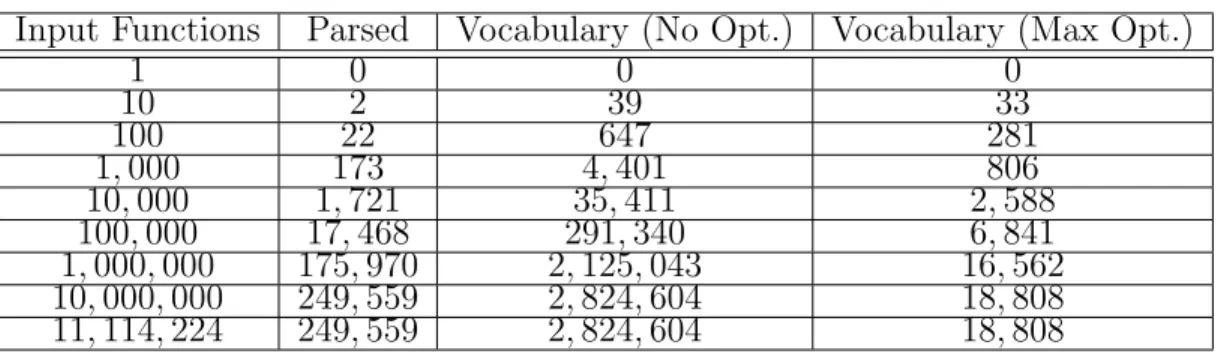
In order to determine the subset of the C grammar in which we are interested, we decided to enumerate the production rules in a set of randomly selected functions. Table 4.1 shows the result of this enumeration. In each trial, we choose a certain number of functions to read from the C source dataset. We vary the number of functions read by an order of magnitude in each trial. We then attempt to parse each of the functions. While all code samples in the source dataset are valid C functions, the parser nonetheless fails to parse many of the input samples. We found that our parser would only accept those user-defined types that were previously declared in a corresponding typedef statement (another example of context sensitivity in our parser). We find that there are a large number of user-defined types in our dataset. We also discarded any function in which the number of production rules used exceeded 50. We did this because our neural network architecture only allowed for output sequences of some maximum sequence length, which we arbitrarily set to 50. This corresponds with functions of 2 to 10 lines in length. While we could have included the production rules found in long functions in the rules dataset, we decided that keeping only the rules found in short functions corresponded more with the goal of our work. As a result, the number of functions successfully parsed is only a fraction of the number of functions chosen from the source dataset. This does not pose a problem in our work because we find that we enumerate more than enough production rules even after filtering out functions that fail to parse. We experimented with various vocabulary sizes in our model, but ultimately settled on a small vocabulary of 234 rules (where 1 rule is for padding sequences that do not reach the maximum length of 50). While this only corresponds with the production rules found in 100 input functions, we note that in this work we are attempting to model small functions that exhibit very generic behaviors; we are not interested in capturing many of the niche or obscure features of C that are found in the longer and more complicated functions.
Input Functions Parsed Vocabulary (No Opt.) Vocabulary (Max Opt.) 1 0 0 0 10 2 39 33 100 22 647 281 1,000 173 4,401 806 10,000 1,721 35,411 2,588 100,000 17,468 291,340 6,841 1,000,000 175,970 2,125,043 16,562 10,000,000 249,559 2,824,604 18,808 11,114,224 249,559 2,824,604 18,808
Table 4.1: Production rules enumerated in the MUSE C source dataset.
For functions that successfully parsed into an AST, we extracted the production rules by a preorder traversal of the tree. However, we found that the rules extracted in this manner were not in the desired format. Specifically, they captured no context information. Based on the work of Kusner et al. (2017), we knew that our model would use a GRU during the decode phase to build the output function one production rule at a time. The original Grammar VAE described in the aforementioned work uses a masking function to disallow invalid transitions when choosing the next rule in the sequence. This strategy works well for context-free languages, in which there is no need to preserve context information when applying a production; however, as previously mentioned, our parser accepts a context-sensitive language. We therefore needed to do a series of transformations on the vocabulary in order to ensure that all output functions were syntactically valid. Specifically, during the rule extraction phase we prepend the name of the non-terminal symbol to which the rule belongs as a child (this information is stored in the AST data structure). This greatly increases the size of the vocabulary because there are many combinations of rules and their children. To offset this explosion in vocabulary size, we also take steps to reduce the size of the vocabulary. First, we replace all identifier names with a generic name that uses the variable occurrence as a suffix (i.e. generic 0, generic 1, generic 2, etc.). We
were initially reluctant to do this, because the hope was that the model would be able to learn some sort of semantic relationship between variable name uses on its own. Without unique variable names, the model cannot learn these relationships. Second, we replace all string literal values with a generic string literal (“string literal”). Third, we replace all other literal values with generic values corresponding to their respective types (0 for int, ’x’ for char, etc.). Again, at the outset of the project we wanted to preserve this information because we wanted to allow the model to find semantic connections between the uses of different literal values (e.g. loop counter variables are usually initialized to 0, and usually count up to some nonzero value). Fourth, we modify the structure of the AST to make it as similar as possible to a binary tree. This was, by far, the most involved transformation we made. For any AST node that can have potentially unlimited direct children (such as an expression list for the arguments to a function), we replace the node with a series of custom nodes that did not previously exist in the grammar. Each of these custom nodes has 1 or 2 children: a value (e.g. an expression or argument) and, if there are any more values in the original sequence, a child node of the same type. Later, when we reconstruct the AST from the sequence of production rules used in the function, we replace these custom nodes with the original nodes found in the grammar. The advantage of the near-binarized AST is that the context information becomes much more manageable. In the original vocabulary after our addition of context, rules would have information on their position in the sequence (i.e. arg0, arg1, arg2, etc.). This information is actually not useful for the model because it pollutes the vocabulary with expressions that can only be used in very specific positions. This is especially true if there is a function in the dataset that has a huge number of arguments. After near-binarization, rules are much more general. In fact, this process allows the model to output functions that were previously unreachable. For example, if there were no functions of 5 arguments in
the input dataset, then the model would not be able to produce functions with 5 arguments without our transformations. Plus, by virtue of the way GRUs work, the model can learn information about the position of arguments and expressions in a list on its own, so explicit labels denoting the argument number are unnecessary. Fifth, and finally, we replace all numbered generic identifiers with a single generic identifier name. This supersedes our first transformation. We were reluctant to be so aggressive with our renaming, but we found that without doing so the vocabulary became too unwieldy for the model; the neural network could not learn much from such a large vocabulary. Below is an example of a simple function, the production rules enumerated before our transformations are applied, and the production rules enumerated after our transformations are applied. We also show the C code that corresponds with each sequence of production rules for the sake of completeness and clarity. We will explain in the subsequent sections how we reconstruct the AST from the production rules; after this reconstruction, we can use the pycparser API to generate C code for the AST. We begin with an implementation of the Euclidean GCD algorithm.
int gcd(int a, int b) { if ((a == 0) || (b == 0)) return 0; if (a == b) return a; if (a > b) return gcd(a - b, b);
return gcd(a, b - a); }
reproduces the function without loss of any information. start=FileAST -> ext[0]=FuncDef
ext[0]=FuncDef -> decl=Decl:name=gcd,quals=[],storage=[], funcspec=[] body=Compound
decl=Decl -> type=FuncDecl