POLICY RESEARCH WORKING
PAPER
2707
Financial Intermediary
Panel data for 63 countries in1 960-97 reveal no robust
Development and Growth
relationship between theVolatility
development of financialintermediaries and the volatility of growth.
Do Intermediaries Dampen
or Magnify Shocks?
Thorsten Beck
Mattias Lunidberg
Giovanni Ma/nioniThe World Bank
H
Public Disclosure Authorized
Public Disclosure Authorized
Public Disclosure Authorized
| POLICY RESEARCH WORKING PAPER 2707
Summary findings
Beck, Lundberg, and Majnoni extend the recent The authors test these predictions in a pane I data set literature on the link between financial development and covering 63 countries over the period 1960-97, using economic volatility by focusing on the channels through the volatility of terms of trade to proxy for real volatility, which the development of financial intermediaries affects and the volatility of inflation to proxy for motetary economic volatility. Their theoretical model predicts that volatility. They find no robust relationship between the well-developed financial intermediaries dampen the development of financial intermediaries and growth effect of real sector shocks on the volatility of growth volatility, weak evidence that financial intermediaries while magnifying the effect of monetary shocks- dampen the effect of terms of trade volatility, and suggesting that, overall, financial intermediaries have no evidence that financial intermediaries magnify the impact unambiguous effect on growth volatility. of inflation volatility in low- and middle-incom]e
countries.
This paper-a product of Finance, Development Research Group-is part of a larger effort in the group to un,derstand the links between the financial system and economic growth. Copies of the paper are available free from the World Bank, 18 18 H Street NW, Washington, DC 20433. Please contactAgnesYaptenco, room MC3-446, telephone 473-852 6, fax 202-522-1155, email address ayaptencoCaworldbank.org. Policy Research Working Papers are also posted on the Web at http://econ.worldbank.org. The authors may be contacted at [email protected], [email protected], or gmajnoniCoworldbank.org. November 2001. (48 pages)
The Policy Research Working Paper Series disseminates the findings of work in progress to encourage the exchange of ideas about development issues. An objective of the series is to get the findings out quickly, even if the presentations are less than fully polishel. The papers carry the names of the authors and should be cited accordingly. The findings, interpretations, and conclusions expressed r this
Financial Intermediary Development and Growth
Volatility: Do Intermediaries Dampen or Magnify Shocks?
Thorsten Beck, Mattias Lundberg, and Giovanni Majnoni*
* The World Bank. We would like to thank Hosook Hwang for outstanding research assistance and George Clarke, Robert Cull, Gregorio Impavido, Ross Levine, Rick Mishkin, and seminar participants at the World Bank and the Conference of the Latin American and Caribbean Economic Association for useful comments and suggestions.
1. Introduction
Do economies with higher levels of financial intermediary development
experience more or less volatility in economic growth rates? Do intermediaries dampen
the impact of external shocks on the economy or do they amplify them through the credit
channel? While the recent empirical and theoretical literature has established a positive
impact of financial sector development on economic growth, the potential links between
financial development and the volatility of economic growth have not been studied
thoroughly yet.' Still, the high growth volatility that many developing countries
experience has brought to the forefront the question whether and to what extent output
fluctuations can be related to the development of the financial sector. Explaining the
determinants of growth volatility is important for policy makers who want to secure a
high and stable growth rate for their economies.
This paper tries to shed light on the links between financial intermediary
development and growth volatility both theoretically and empirically. Previous papers
have found that financial development reduces macroeconomic volatility (Easterly,
Islam, and Stiglitz, 2000; Denizer, lygun, and Owen, 2000; Gavin and Hausmann, 1995).
These results, however, have not been proved to be robust across different measures of
financial development. Further, none of these papers has tried to identify the channels
through which financial development potentially affects growth volatility. This paper
explores the interaction of financial intermediary development and real and monetary
volatility in their effect on growth volatility. Specifically, we examine whether financial
intermediaries serve as shock absorbers mitigating the effect of real and monetary
volatility on growth volatility, or whether they magnify their impact.
Our work builds on three different strands of literature. First, we build on a large
empirical literature on the relation between financial development and economic growth.
2Financial intermediaries and markets emerge to lower the costs of researching potential
investments and projects, exerting corporate control, managing risks, and mobilizing
savings. Economies with better-developed financial intermediaries and markets therefol-e
enjoy higher growth rates. This literature, however, does not explore the impact of
financial development on the volatility of economic growth rates. We use an indicator of
financial intermediary development developed by the literature on finance and growth to
explore the relation between financial intermediary development and growth volatility.
A second relevant strand of literature has emphasized the magnifying effect that
capital market imperfections have on the propagation of real sector shocks. In particular,
Bemanke and Gertler (1990) show that shocks to the net worth of borrowers amplify
economic up- and downtums, through an accelerator effect on investment. Acemoglu
and Zilibotti (1997) show that the interaction of investment indivisibility and the resulting
inability to diversify risk not only impedes economic development, but also results in
high economic volatility. Finally, Kiyotaki and Moore (1997) show that capital market
imperfections can amplify the effects of temporary productivity shocks and make them
more persistent, through their effect on the net wealth of credit-constrained borrowers.
A third related line of work is the literature on the credit channel of monetary
policy (Bemanke and Blinder, 1988 and Bemanke and Gertler, 1995).3 According to the
credit channel view, monetary policy impacts the real economy not only through its
effects on the bond market, but also through its effects on the credit market. Through
their impact on borrowers' profitability, asset value and thus collateral, interest rate
changes directly affect borrowers' ability to borrow (balance sheet effect).4 The supply
of loanable funds is affected if banks cannot easily replace deposit liabilities and if banks'
assets are not perfectly substitutable (bank lending channel).
5While this literature
focuses on the U.S. and the impact of monetary policy on firms and banks of different
sizes, it also suggests that the banking sector can magnify monetary shocks into the real
economy.6
This paper makes several contributions. Building on a model by Bacchetta and
Caminal (2000), we show that depending on their nature, shocks to the economy are
dampened or magnified by well-developed financial intermediaries.
7While real sector
shocks, i.e. shocks that affect only nonfinancial firms in the first round, are dampened in
their effect on output volatility by financial intermediaries, monetary shocks, i.e. shocks
to the banks' balance sheets, are magnified. While the results for real sector shocks
match findings by the theoretical literature on capital market imperfections and shock
propagation, the results for monetary shocks can be explained with the credit channel
view of monetary policy. Firms depend more on external resources in financially
developed economies and are therefore more exposed to monetary shocks that are
transmitted through the financial sector. Overall, our model does not predict an
unambiguous relation between financial development and growth volatility, but different
interactions of intermediaries with different sources of volatility.
Second, we test the hypotheses derived in the theoretical model in a panel data set
of 63 countries and 38 years. We explore whether financial intermediary development,
defined as outstanding credits to the private sector relative to GDP, affects the impact of
terms of trade and inflation volatility on economic growth volatility. Specifically, we
regress the volatility of real per capita GDP growth on our measure of financial intermediary development, the volatility of terms of trade changes and inflation, and interaction terms of financial development and both volatility measures, controlling for other potential determinants of growth volatility. To test the robustness of our results, we split the sample period in different ways and use different econometric methods.
Furthermore, we conduct a variety of specification tests.
Overall, the results give qualified support for the hypotheses derived in our model. We do not find a robust relation between financial intermediary development and growth volatility. We find a negative, but generally insignificant coefficient on the interaction of financial intermediary development and terms of trade volatility,
suggesting weak evidence for a dampening effect of financial intermediary development on the impact of terms of trade volatility. We find a positive and often significant coefficient on the interaction of financial intermediary development and inflation volatility. Controlling for a separate interaction in high-income countries, however, we find a positive interaction term of financial intermediary development with inflation volatility only for low- and middle-income countries, while we find no effect of monetary volatility among income economies. We explain the differences between high-income and low- and middle-high-income countries with different institutional environments that are not captured by our model.
The evidence provided in this paper contradicts previous results that financial intermediary development has an unambiguously negative effect on growth volatility. The ambiguous effect can be explained by interactions of opposing signs between fnancial intermediary development and different sources of volatility. While
intermediaries might help dampen real volatility, they help magnify monetary volatility in
low- and middle-income countries.
The remainder of the paper is organized as follows. Section 2 presents a simple
theoretical model and sets out the main testable hypotheses. Section 3 describes the data
and the testing strategy. Section 4 discusses the main findings of the econometric
analysis, while Section 5 concludes.
2. A Simple Model of Financial Development and Output Volatility
In this section, we describe a simple two-period model that builds on a model
developed by Bacchetta and Caminal (2000). Entrepreneurs differ in their level of wealth
and therefore access to the capital markets. Financial intermediaries arise due to
informational asymmetries between lenders and borrowers. Unlike in Bacchetta and
Caminal, however, we will model the financial intermediaries explicitly and will
introduce a channel for monetary policy in the form of reserve requirements. Further, we
will introduce two classes of shocks, real shocks that affect only nonfinancial firms in the
first round, and monetary shocks that affect only banks' balance sheets in the first round.
Since entrepreneurs produce at different productivity levels, depending on their level of
intemal resources, real and monetary shocks will have distributional effects that will
result in a dampened or magnified effect on output depending on the nature of the shock.
2.1. The Real Sector
All individuals in our model are at the same time consumers and entrepreneurs.
Although all entrepreneurs have access to the same production technologyf(k), they are
endowed with different levels of wealth b. Specifically, we distinguish between two classes of entrepreneurs, High and Low, with high and low levels of wealth. The fraction
P
of agents are High entrepreneurs and the share (1-j3) are Low entrepreneurs. Entrepreneurs can use their wealth to invest in the production technology or they can deposit their wealth with banks, earning a riskless rate rD. While High entrepreneurs can fully finance their investment and have excess funds, which they deposit with banks, Low entrepreneurs cannot fully finance their investment with their own funds and will borrow funds at the lending rate rL. This might be due to investment indivisibility or required minimum investment. Due to asymmetric information about the type of investment entrepreneurs choose, and the resulting potential moral hazard problems, Low entrepreneurs face agency costs (p .Assuming decreasing returns to scale in production, we can write the profit
8
maximization problem for the High entrepreneurs as follows:
f'(kH) = r
,(1)
where the superscript H denotes High entrepreneurs. Since Low entrepreneurs (subscript L) face agency costs (p, their profit maximization problem implies
f'(kL)
= (prL, Ž
2 1 (2)Combining eqs. (1) and (2) we obtain
f'(k) rL
The higher the agency costs or the wedge between lending and deposit rates, the higher the ratio kH/kL and the larger the wedge between the marginal productivity of Low and High entrepreneurs. If we take the agency costs as a negative indicator of financial
development, this also implies that the productivity wedge between Low and High entrepreneurs is larger in financially less developed economies.
Given the different levels of productivity, a reallocation of funds between the two entrepreneurial classes affects aggregate productivity and therefore output and growth in the economy. The larger agency costs and therefore the lower the level of financial development, the larger the effect of a reallocation.
2.2. The Financial Sector
Agents face market frictions when trying to reallocate resources between the surplus and the deficit sector of the economy. Specifically, entrepreneurs can choose between different investment projects that imply different degrees of efforts and thus different probabilities of success. However, other agents cannot observe the investment
decision without costs. The asymmetric infornation in our economy gives rise to financial intermediaries that can internalize the agency costs. High entrepreneurs deposit their excess funds with financial intermediaries whereas Low entrepreneurs borrow from
intermediaries, to complement their own funds. Intermediaries operate in a perfectly competitive environment, face no costs and can only hold loans as assets. However, deposits are subject to reserve requirements imposed by the monetary authority, so that loans supplied to Low entrepreneurs equal (I-r) times the deposits of High entrepreneurs, where r is the reserve requirement. There are no other liabilities and thus no other sources of funding for banks. We assume these reserve requirements are not remunerated and are not used for productive purposes.9 An increase in c, i.e. a monetary tightening, implies a decrease in resources available for lending to Low entrepreneurs, whereas a
decrease in
t,i.e. a monetary easing, implies an increase in loanable funds. Financial
intermediaries have thus two functions in our model: They arise out of market frictions
and channel flows from High to Low entrepreneurs, i.e. from the surplus to the deficit
sector, and they serve as conduit for monetary policy. Aggregate loan supply of the
financial intermediary sector can thus be written as:
(I -r),8(bH- -kH )= (kL
-b
L)(I- _ )(4)
Since, as we show below, in equilibrium there is no uncertainty concerning
repayment by borrowers, the ratio of the lending and deposit rate depends only the
reserve requirement .
rL (I -
r)
(5)The asymmetric information and resulting agency costs lead to sub-optimal
investment of Low entrepreneurs. While High entrepreneurs always choose the highest
level of effort and the optimal scale for their investment project, Low entrepreneurs may
choose an inefficient project, given that they share the downward risk with lenders. As
described in the appendix, assuming certain functional forms for the production function,
the nature of agency costs and for the level of equity of Low entrepreneurs, we get the
following result.
Result 1: Agency costs q> are described by the following equation. v = (i -kL
where w is a function of exogenously given technological parameters. Low entrepreneurs are offered credit at the interest rate rL, but are credit-constrained, in the sense that their investment level is sub-optimal.
The agency costs faced by Low entrepreneurs therefore increase in co and in the leverage ratio kL/bL. Combining eq. (2) and Result 1, we get
f!(kL) = rLW(l
--- F)
(6)
The demand for loanable funds by Low entrepreneurs therefore decreases in rL, co and
kL/bL. The supply of loanable funds by High entrepreneurs, on the other hand, is only a
function of the interest rate rD and reserve requirement x.
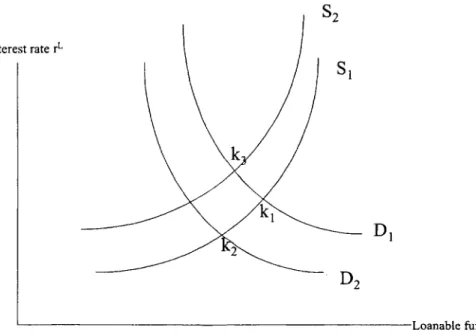
Figure 1 depicts the market for loanable funds. Higher interest rates decrease the optimal investment level for High entrepreneurs and therefore increase the excess funds that High entrepreneurs will deposit with banks. Higher interest rates, however, will also decrease the optimal level of investment of Low entrepreneurs, so that the demand for loanable funds decreases. A higher level of agency costs (p and thus lower level of financial interrnediary development will shift the demand for loanable funds to the left (from DI to D2), which results in a lower level of loans k2and a lower interest rate. If due
to monetary tightening, banks can channel less deposits to Low entrepreneurs, the supply schedule shifts to the left (SI to S2), resulting in a lower level of loanable funds k3and a
higher loan interest rate. Note that due to the decreasing returns to scale of the production technology, the sensitivity of the supply of loanable funds to interest rate changes
increases with higher levels of agency costs.
Our model thus combines the characteristics of a model with endogenous financial interrnediation with conditions for the existence of a bank lending channel of monetary policy: (i) firms cannot substitute bank lending with alternative sources of finance, and (ii) the monetary authority is able to affect the supply of loans.
S2 Interest rate rL SI Di D2 Loanable funds k
Figure 1: Supply and Demand for Loanable Funds
2.3. General Equilibrium
We embed the previously described partial equilibrium model of entrepreneurs
and banks into a simple two-period overlapping generations model. Agents are born with
endowments b',, i=H,L
(bH>bL),and invest and produce in the first period. In the second
period they consume a fixed share of their income and leave a bequest. '
0In the next
subsection we explore how shocks affect the change in output from the first to the second
period, and how these changes differ under different levels of agency costs (p and
therefore financial development.
The solution to the optimization problem of High entrepreneurs is given by
f'(kH) = rD (1)
and
where y is the savings rate.
11Similarly, the optimization problem for the Low
entrepreneur yields:
f '(k) = rl
(6) kLand
b,L, = yL [f (kL)+
r, (b,L - kL) (8)We can combine eqs. (1) and (6) as above:
f ?(k L)
b
Lb If ) ( k
=(-)( ) (9)
f'(kH) k r kL _
-Finally, the market clearance condition for financial markets yields:
,bH + (I -)bL =,
+ (1 8)kL+
r(bHk)(10)
Eqs. (7) - (10) describe the model. It can be shown that a unique equilibrium exists,
given certain assumptions about y and
L~.We can now derive the following result:'
2Result 2: The relative investment of Low entrepreneurs kL/kFI increases in the ratio of internal to total resources bL/kL and in their relative wealth share bLbF, and decreases in agency costs co and reserve requirements 'z The positive effect of a higher bL/kL and bLebH on kL/kH increases in the agency costs C 13
Higher internal resources and a decreased wealth inequality decrease the
financing constraint and thereby increase the investment share of Low entrepreneurs.
They shift the loan demand curve outwards resulting in a higher level of loans and a
higher interest rates. Higher agency costs, on the other hand, increase the financing
constraint. The loan demand curve shifts inwards, resulting in a lower level of loans and
lower interest rates. Note that changes in the wealth distribution and leverage result in
larger movements in loanable funds at high levels of agency costs, due to the higher sensitivity of the supply of loanable funds to changes in interest rates. 14
2.4. Shocks
We can now explore the effects that different shocks have on the relative
composition of investment and output, and therefore output volatility. We will distinguish between shocks that affect only the real sector, i.e. the internal funds available to
entrepreneurs of both classes and shocks that affect the financial sector and therefore the external funds available to Low entrepreneurs. We are especially interested in the effect that the agency costs, our measure of financial development, have on the scale of these output changes.
2.4.1 Real Shocks
Consider an unanticipated shock to the production function, that hits the economy during the first period, after all investment decisions have been made, i.e. y,= lg(k,). This productivity shock can be caused by either improved technology or by lower input prices. As can be seen from eqs. (7) and (8), the profits of the leveraged, i.e. the Low
entrepreneurs, increase more than proportionally. This increases the relative wealth of Low entrepreneurs b,L1lb,+H and therefore relative investment by Low entrepreneurs in
the following period (Result 2). Since Low entrepreneurs produce at a higher marginal productivity than High entrepreneurs, this shift in relative investment towards Low
entrepreneurs magnifies the effect of the productivity shock under imperfect capital markets. The higher agency costs and thus the higher the difference in marginal productivity are, the more magnified is the shock.15
Result 3: The relative output effect of a shock that leads to a change in bL/bH
islarger under asymmetric information than under perfect capital markets. The size of the
output change increases in agency costs ac
Better-developed financial intermediaries alleviate the cash-flow constraint for
Low entrepreneurs and thus dampen the impact of shocks to the production function.
Note that these shocks only affect the demand for loanable funds, but do not shift the
supply curve. Further, they affect banks' balance sheets only in the second round, through
shifts in the loan demand curve.
2.4.2. Monetary Shocks
We now consider shocks that directly affect the supply of loanable funds by
banks. A tightening of monetary policy through the increase of reserve requirement
tdecreases the supply of loanable funds and increases the interest rate rL. However, it also
lowers the leverage and thus the agency cost constraint for the Low entrepreneur. This
partly offsets the negative impact of higher reserve requirements.
16This dampening
effect, however, decreases as agency costs decrease. Lower agency costs co, i.e. more
financial development, therefore, increase the output effect of monetary shocks.
Result 4: The relative effect of a shock that changes the supply of loanable funds
to Low entrepreneurs is smaller under asymmetric information than under perfect capital
markets. The effect of the output change decreases in agency costs co
The financial sector thus has a magnifying effect on monetary shocks. In
financially more developed economies, Low entrepreneurs depend more on external
finance and therefore suffer more if banks' balance sheets are affected by changes in
monetary policies. Shocks that affect the financial sector in the first round therefore are
transmitted into the real sector, and this effect is stronger for financially more developed economies.
This effect is comparable to the credit channel of monetary policy. However, We concentrate on only one of the possible channels, the bank lending channel, as opposed z.o the balance sheet channel, the effect of monetary policy on borrowers' balance sheet, their financial position and thus capacity to borrow. Unlike the theoretical literature of the banking lending channel that focuses on the imperfect substitutability of money, bonds and loans, we focus only on loans and on reserve requirements as monetary policy tool. As in this literature, we focus on the distributional rather than the aggregate effects of monetary policy. Unlike this literature, however, we do not focus on the difference between the cost of internal and external finance, but rather on credit rationing. While the empirical and theoretical literature on the bank-lending channel implies that monetaly shocks have larger implications for small firms with less access to finance, our model predicts that countries with higher levels of financial intermediary development will see their monetary shocks be amplified more. The reason for the difference is that we assume that firms in all countries depend on bank finance and cannot substitute it for other sources of finance. More financial intermediary development therefore translates
--unlike in the credit channel literature - into more bank-dependence. In the empirical part, however, we will qualify this simplistic statement.
2.5. Testable Hypotheses
The theoretical model has shown that there is no unambiguous relation between financial intermediary development and growth volatility.17 Financial intermediaries can
dampen or magnify the effect of shocks on growth volatility, depending on the nature of the shocks. Shocks that only affect the real sector in the first round are dampened, whereas shocks that affect the financial sector directly are magnified. While the theoretical model only considers two periods, we could easily extend this to a multi-period model. In our empirical analysis, we should therefore find (i) no unambiguous relation between a measure of financial intermediary development and growth volatility, and (ii) no independent effect of financial intermediaries on growth volatility beyond their effect on dampening real and magnifying monetary shocks. The second hypothesis, however, builds on the restrictions of our model to the specific channel on which we focus in our model. In the following sections we will test these hypotheses in a panel of 63 countries and 38 years. We will use the standard deviation of terms of trade changes to proxy for the extent to which an economy is exposed to real sector shocks and the standard deviation of the inflation rate to proxy for the extent to which an economy is exposed to monetary shocks. Further, we will test for a separate impact of financial intermediary development on the effect of the volatility of terms of trade and inflation in high-income countries. We motivate this by the observation that the institutional
environment might be sufficiently different in high-income countries to observe a different impact of financial intermediaries, especially in the channels of monetary policy. Further, as we will discuss below, an initial casual look at the data reveals different relations between volatility and financial intermediary development across different income groups.
A word of caution is due concerning the choice of terms of trade shocks to proxy for real shocks and inflation shocks to represent monetary shocks. Terms of trade shocks
hit only the tradable sector of an economy directly, whereas the non-tradable sector might be affected only indirectly. Countries with large non-tradable sectors will therefore be
relatively less affected by fluctuations in terms of trade. We partly control for this by including the ratio of trade to GDP in our estimation below. The interaction between
financial intermediary development and inflation volatility can be interpreted as coming from either variable, since both are subject to policy decisions, at least to a certain extenm.. Further, inflation volatility might reflect not only monetary policy volatility, but other factors as well, such as demand shocks and business cycle effects.
3. Data and Econometrics
3.1. The Data
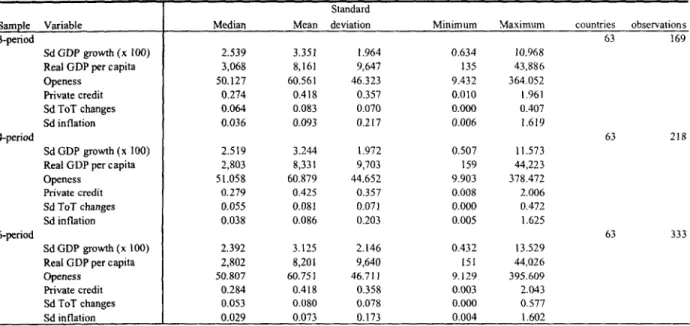
The data come primarily from published World Bank and IMF sources.'8 We create three panel data sets by aggregating over different time periods on data from 1960 to 1997. This serves partly as a robustness check on the results, and partly to avoid the problems caused by aggregating on unusual initial- or end-years. Our constructed data sets are a three-period panel (aggregated over the periods 1960-72, 1973-85, and 1986-97), a four-period panel (1960-69, 1970-78, 1979-87, 1988-1986-97), and a six-period panel
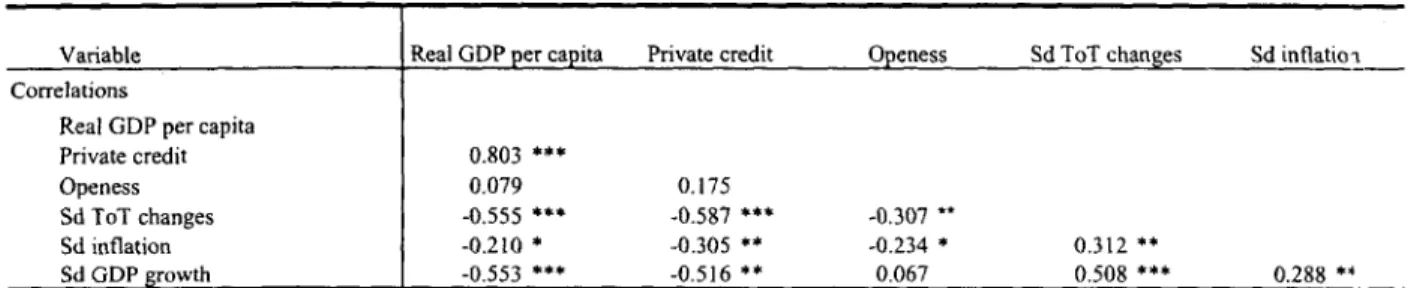
(1960-66, 1967-72, 1973-78, 1979-84, 1985-90, 1991-97). We maintain a consistent sample of 63 countries across all data sets, but the number of observations differs by aggregation.'9 We will focus the discussion here and in the empirical results on the three-period panel, since it provides the most efficient estimates of standard deviations (i.e. based on the largest number of observations). Table I describes the data and Table 2 presents correlations.
The dependent variable is the standard deviation of growth in real GDP per capita
within each time period. For the three-period sample, this ranges from a minimum of less
than 1% (France and the Philippines in the first period, Sri Lanka in the middle period,
and Ghana in the most recent period) to about 11% (Lesotho in the middle period),
around a median of 2.5% (which is larger than the median growth rate for the sample of
2. 1% per year).
Our measure of financial intermediary development is Private Credit, the claims on
the private sector by financial intermediaries as share of GDP. Unlike other measures of
financial intermediary development that have been used in the empirical growth
literature, such as the share of M2 in GDP, this measure is more than a simple measure of
size or financial depth. Private Credit measures the most important activity of the
financial intermediary sector, channeling funds from savers to investors, and more
specifically, to investors in the private sector. It therefore relates directly to our
theoretical model. Levine, Loayza and Beck (2000) and Beck, Levine, and Loayza (2000)
show that Private Credit has a significantly positive and economically large impact on
economic growth. Private Credit also varies significantly across countries, from less than
1%
of GDP (Haiti and Congo (Zaire)) to nearly twice the level of GDP (Switzerland and
Japan).2 0
We use the standard deviations of terms of trade changes and inflation over the
corresponding periods to proxy for the degree to which an economy is subject to real and
monetary shocks and thus volatility. As indicated in Table 1, there is a large variation
across countries in terms of trade and monetary volatility.
In the multivariate analysis below, we include the log of real GDP per capita and a measure of trade openness, specifically the log of the sum of exports and imports relative to GDP. There is considerable evidence that wealthy countries are more stable. Easterly, Islam and Stiglitz (2000), for example, show that the standard deviation of growth in nonx-OECD countries is more than twice that in nonx-OECD countries. Greater openness, on the other hand, increases a country's exposure to changes in the terms of trade.
Table 2 presents correlations. We note that more developed countries, as measured by a higher real GDP per capita, experience less variability in growth, terms of trade and inflation. Similarly, financially more developed economies experience less volatility in growth, terms of trade changes and inflation. Growth volatility is positively correlated with volatility in inflation and terms of trade changes.
Table 3 summarizes the data across income classes as defined by the World Bank's
World Development Report. This table shows that high-income countries are
significantly different from other countries in almost all respects. They have more stable growth rates, and the level of Private Credit is more than double that in low- and middle-income countries. In general, they also experience lower standard deviations of terms of trade changes and inflation. Also, while high-income countries are more open than on average, the share of trade in GDP is on a par with lower-middle-income countries.2' It is likely that these structural differences between income classes affect both the direction and the magnitude of the impact of real and monetary volatility. In the multivariate work below, we therefore test whether the intuitive interpretation of the data can be confirmed by more rigorous analysis.
3.2. Econometric Methodology
To test our hypotheses we will run the following reduced-form regression:
SD(Growth)s, = a,SD(ATOT),, + x2SD(Inflation),, +,/FD,, (
+ yMInterl j, + y2Inter2,, + gCVjH + j + Ei,
where SD(Growth) is the standard deviation of real per capita GDP, SD(4TOT) and
SD(Inflation) are the standard deviations of terms of trade changes and inflation,
respectively, FD is our measure of financial intermediary development, Private Credit,
Inter] and Inter2 are the interaction terms of FD with SD(A TOT) and SD(Inflation),
respectively, CV is a vector of control variables, p is a country-specific effect,
£is the
error term and i and t denote country and time period, respectively.
To explore the impact of financial intermediary development on the propagation
of real and monetary volatility, we have to consider (i) the sign and significance of the
interaction terms y' and y2,
and (ii) the significance of terms of trade and inflation
volatility at different levels of Private Credit. A negative sign on
r,
would indicate a
dampening role of financial intermediaries in the propagation of real volatility and would
thus be consistent with our theoretical model. A positive sign on
72would indicate a
magnifying role of financial intermediaries in the propagation of monetary volatility, as
predicted by our theoretical model. However, if variance in financial intermediary
development is to explain cross-country differences in the propagation of real and
monetary volatility, the overall impact of real and monetary volatility has to vary across
different levels of financial intermediary development. We are therefore interested in
a,+ yrFD and a
2+2*FD, where FD denotes a specific level of Private Credit, at
effect of financial intermediary development on growth volatility beyond its dampening and magnifying effect on the propagation of real and monetary volatility, respectively.
We also run regressions controlling for a separate interaction term of financial intermediary development with both terms of trade and inflation volatility for high-income countries.
SD(Growth),, = a,SD(ATOT),, +a,2SD(Inflation),, + /3FD1,
+ ylInterl,, +
y
2Inter2,, +y
3Interl,, *High, , (12)+
y
4Inter2,, *High, +WCVJ, +,a, +where High is a dummy variable taking the value one for countries that are classified by the World Development Report as high-income, and zero otherwise. The overall impact of the interaction of financial intermediary development and real or monetary volatility in high-income countries would then be r/+7 and r2+r4, respectively.
The interaction terms in these regressions are by definition correlated with their components. This gives rise to the problem of multicollinearity. While this does not necessarily bias the estimates, it does increase the size of the estimated variance, and, given the relatively small sample sizes, may cause instability in the parameter estimates. Examination of variance inflation factors2 2reveals that volatility in terms of trade changes is the largest sources of collinearity. In our empirical work, this might lead to the case where the parameter estimates on Private Credit and its interaction with the respective volatility measure are individually insignificant, but jointly significant. We therefore report the joint significance of the individual volatility measures and the interaction terms.
To control for biases introduced by the estimation of panel data, we use two different estimation strategies. The data combine cross-country and time-series, which
enables estimation by conventional panel-data techniques, random- or fixed-effects
regressions. These panel-data estimators are asymptotically normal as T
-+ oo,but in
small samples, and especially when the number of groups exceeds the number of time
periods, these estimators yield overly optimistic standard errors, and lead to
overconfidence in the results. Our base regression is instead a pooled OLS using
panel-corrected standard errors, as suggested by Beck and Katz (1995). This allows us to
correct for errors that are both heteroskedastic (that is, they differ systematically across
countries) and correlated over time within countries. While the parameter estimates are
found by the conventional method ,B = (X'
X)'
X' Y, the estimated variance matrix is
given by
(X'X)-'XQX(X'X) ',
where Q=EE
x, Ei;Exi
.This is similar to the
i j
Huber-White cluster (sandwich) error correction (Q2
=(I}x,j-EX,)),
but while that
method controls for differences in errors across groups, it does not allow for correlation
within groups.
Note that the variance correction (weighting) matrix Q does not assume a specific
time-series error structure. We conduct an ad-hoc test for serial correlation, by
estimating a common serial correlation coefficient r
=wr, ,where r, is the estimate of
the within-country serial correlation, and wi is a weight derived from the reciprocals of
the variances, which increases the efficiency of the estimates (Greene, 1993, p.457). The
ad-hoc nature of the test is that we consider the test significant if the serial correlation
coefficient is close to or above 0.3, the rule-of-thumb for correction suggested by Grubb
and Magee (1988). We find significant serial correlation only in the 6-period sample, for
which we present both the OLS and corrected estimates using the Prais-Winsten transformation.
We present two additional tests. First, we present a likelihood ratio test of group-specific heteroskedasticity, following Greene (1993, p.397). Rejection of this test indicates that the errors differ significantly across countries, requiring the use of some panel-correction estimation method. Second, we test for the endogeneity of Private Credit and its interactions. Specifically, we use the Davidson-Mackinnon test of
exogeneity for Private Credit and its interactions (Davidson and Mackinnon, 1993). This is similar to the Wu-Hausman test, with the null hypothesis that the ordinary least squares (OLS3 estimator is consistent with the instrumental variables estimator. A rejection of the null indicates that the endogeneity of the regressors has a significant influence on the estimates, and that the equation should be properly estimated using instrumental
variables. We use as instruments dummy variables indicating the source of legal tradition, a dummy variable indicating commodity exporters, and the urban population
share in the total population. In no case can we reject exogeneity.
4. The Results
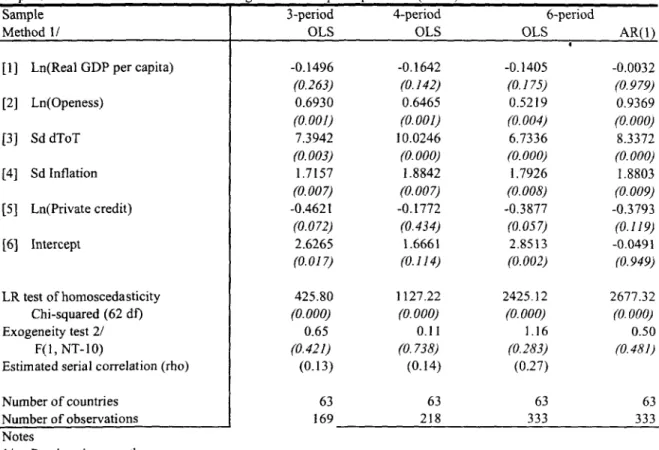
This section presents the regression results from a 63-country panel, with data averaged over three, four or six sub-periods over 1960-97. We present three sets of results. First, we discuss results from a regression without interaction terms (Table 4). While this does not link directly to the theoretical model, it helps us relate our paper to previous studies on the impact of financial development on growth volatility. We then present the regression results with one interaction term (Tables 5A and B), and
subsequently on regressions with two interaction terms, specifically one overall
interaction term and one for high-income countries only (Tables 6A and B). We focus
on the regressions with three periods and use the regressions with four and six periods as
robustness tests.
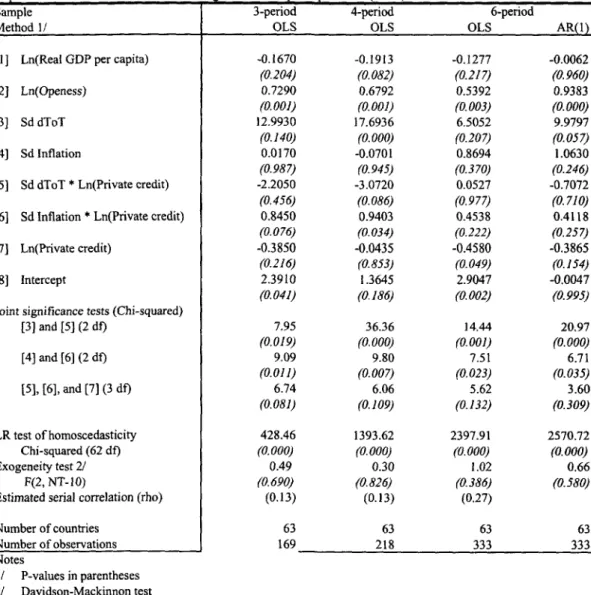
Table 4 suggests a large and statistically significant impact of both terms of trade
and inflation volatility on growth volatility, while no robust impact of financial
internediary development. The standard deviations of terms of trade changes and
inflation enter positively and significantly at the 1% level in all regressions, while Private
Credit enters at the 10% level in two of the regressions (3-period and 6-period OLS) and
insignificantly in the other two. These results are consistent with our theoretical model as
that there is no unambiguous relation between financial intermediary development and
growth volatility. We also note that more open economies suffer larger swings in their
growth rates, while there is no independent relation between per capita income and
growth volatility.
Tables 5A and B show only weak evidence for a dampening effect of financial
intermediary development on the propagation of terms of trade volatility, stronger
evidence for a magnifying effect on the propagation of monetary volatility, and again no
unambiguous overall relation of intermediaries with growth volatility. We first turn to the
interaction between terms of trade volatility and Private Credit. While the standard
deviation of terms of trade changes enters significantly only in the 4-period and the
6-period AR(l) (at the 10%-level) regressions and its interaction with Private Credit only
enters significantly (at the 10%-level) in the 4-period regressions, both terms enter jointly
significant in all regressions. As discussed above, finding individual insignificance and
joint significance can be explained by the high multicollinearity of the individual variables.
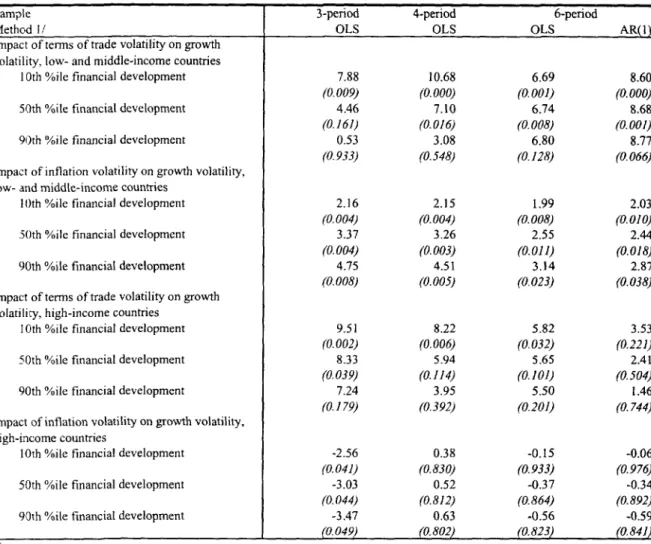
Table 5B presents the total effects of a change in the measures of real and monetary volatility on growth volatility, at different levels of Private Credit. We find a significant impact of terms of trade volatility on growth volatility at the I oth and 5 0th
percentile of Private Credit, while there is no significant impact at the 9 0th percentile. The
point estimates seem to indicate that countries with low levels of Private Credit experience a high impact of terms of trade volatility on growth volatility, whereas we cannot reject the hypothesis that among countries with well-developed financial intermediaries, growth is completely insulated from the effects of terms of trade volatility. However, although the evidence shows that countries with poorly developed financial intermediation suffer more from the effects of real volatility, these results do not prove that for a given country, the impact of terms of trade volatility is reduced as it develops better financial intermediaries.
Table 5A also shows that the impact of inflation volatility on growth volatility is larger in countries with higher levels of financial intermnediary development, thus providing evidence for a magnifying role of financial intermediaries in the transmission
of monetary shocks to the real economy. In all estimations, the interaction term of Private Credit and the standard deviation of inflation enters positively, and it enters
significantly at the 10% level in the three- and four-period estimations. The standard deviation of inflation and its interaction with Private Credit enter jointly significant in all regressions and the effect of inflation volatility on growth volatility is significant at all levels of Private Credit. Further, Table 5B shows that the overall impact of inflation
volatility is higher with higher levels of Private Credit. These results suggest a
magnifying role for financial intermediaries in the propagation of monetary volatility and
are consistent with our theoretical model.
The results in Table 5A also confirm that overall there is no significant relation
between Private Credit and growth volatility. Private Credit does not enter significantly
in most regressions - except for the 6-period OLS results - and together with the two
interaction terms it is insignificant at the 5% level in all regressions. Statistically, this can
be explained by the offsetting signs on the two interaction terms. Economically, this
result confirms the Table 4 results, where we do not find any robust relation between
Private Credit and growth volatility, even when not controlling for interaction terms.
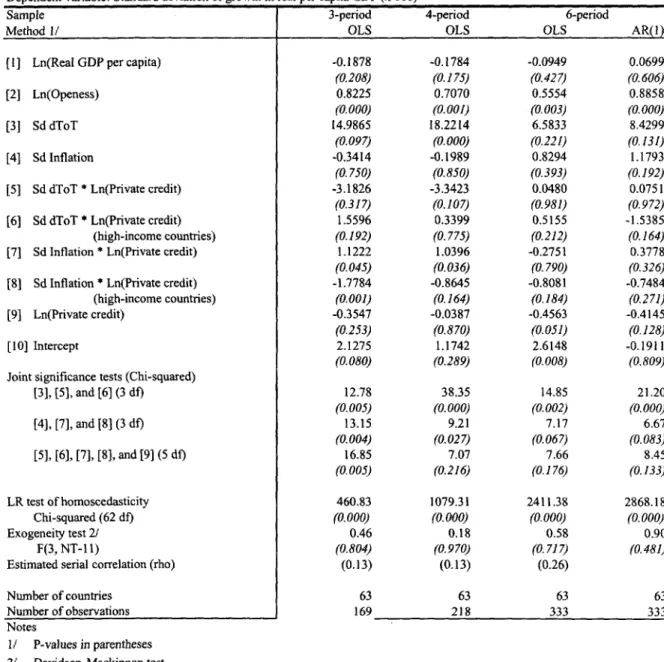
The results in Table 6A and B confirm the weak evidence for a dampening effect
of financial intermediary development on the propagation of terms of trade volatility,
while providing evidence for a magnifying role of financial intermediaries in the
propagation of monetary shocks in low- and middle-income, but not in high-income
economies. Here we control for a separate interaction of financial intermediary
development with real and monetary volatility in high-income countries. As before,
terms of trade volatility and its interaction terms with Private Credit are individually
mostly insignificant, but jointly significant (Table 6A). The analysis of the marginal
impact of terms of trade volatility at different levels of Private Credit shows that both
high-income and low- and middle-income economies at the 1 orh percentile of Private
Credit experience propagation of terms of trade volatility, while economies at the
90'h
The results in Table 6A also indicate that Private Credit increases the impact of
inflation volatility among low- and middle-income countries, while there is no robust
evidence for high-income countries. In low- and middle-income countries, a deeper
financial system exacerbates the impact of inflation volatility on growth volatility. The
interaction term of inflation volatility and Private Credit enters significantly positive in
the 3-period and the 4-period regressions, and the standard deviation of inflation and its
interactions with Private Credit are jointly significant in all regressions. Further, the
effect of inflation volatility is significant at all levels of Private Credit in low- and
middle-income countries and increases with higher levels of financial intermediary
development. In high-income economies, financial intermediary development seems to
have a dampening impact on inflation volatility, based on the 3-period estimations. The
sum of the interaction terms of Private Credit with inflation volatility is negative and
significant. However, this result is not confirmed by the 4- and 6-period estimations.
Further, Table 6B shows that for the 3-period results, inflation volatility seems to have a
significantly negative impact on growth volatility at all levels of Private Credit, a result
not confirmed by the 4-period and 6-period regressions.
Table 6A confirns our previous findings of no robust relation between Private
Credit and growth volatility. Private Credit does not enter any of the regressions
significantly at the 5% level. Further, it is jointly insignificant with the four interaction
terms in all except the 3-period sample.
Summarizing, we find only weak evidence that financial intermediary
development might dampen the impact of terms of trade volatility on growth volatility.
Our results suggest a magnifying role of the financial sector in the propagation of
monetary volatility on growth volatility in low- and middle-income countries, while there is no robust evidence for an impact of monetary volatility on growth volatility in high-income economies. There is no robust relation between Private Credit and growth volatility beyond the different interactions with real and monetary volatility.
The results for low- and middle-income countries are consistent with the
predictions of our theoretical model, while the results for the high-income economies do not completely match the theoretical predictions. This might be explained both by the
limitations of our model, as well as by institutional differences between low- and middle-income and high-middle-income economies that are not captured by the variables in our
empirical explorations. In low- and middle-income countries, the capacity of financial intermediaries to serve as conduit for monetary policy increases as the financial sector develops and the real sector becomes more dependent on external financing. In most of these economies, our assumptions that banks cannot easily substitute deposits for other sources of funding and that firms do not have easy access to alternative source of external financing, might be appropriate. In high-income countries, on the other hand, there are two opposing effects. While firms depend more on external finance in financially more developed economies, financial intermediaries also have easier access to non-deposit sources of funding, which reduces the effectiveness of monetary policy (Ceccetti, 2001 and Kashyap and Stein, 1995). Further, firmns have also easier access to alternative sources of external financing, such as capital markets.
While we have interpreted the positive interaction term between inflation volatility and Private Credit as evidence for a magnifying role of the financial sector in the propagation of monetary volatility in low- and middle-income countries, one could
also interpret this interaction in the view of recent research that has shown the negative impact of inflation on financial sector development (Boyd, Levine, and Smith, 2001). This interpretation would characterize inflation volatility as decreasing the ability of financial intermediaries to serve as shock absorber and thus its capacity to reduce growth volatility. However, the insignificance of Private Credit in the regression without interaction terms and the joint insignificance of Private Credit and its interaction terms in Tables 5 and 6 are counter to this interpretation.
5. Concluding Remarks
This paper (i) assessed the impact of financial intermediary development on growth volatility and (ii) explored potential channels through which these two variables might be linked. In our theoretical model financial intermediaries arise to alleviate agency costs and cash flow constraints on entrepreneurs and thus dampen the impact of real shocks. At the same time, financial intermediaries serve as conduit for monetary policy propagation into the real economy. Our theoretical model thus predicts a dampening effect of financial intermediaries on the propagation of real shocks and a magnifying effect on the propagation of monetary shocks. Depending on the shocks an economy is exposed to and the relative size of these shocks, financial intermediaries might therefore have an overall dampening or amplifying impact on growth volatility. Our empirical analysis of 63 countries over the period 1960-97 confirms this prediction and does not show any significant impact of financial intermediaries on growth volatility. Further, we find only weak evidence for a dampening role of financial intermediaries in the propagation of terms of trade shocks. However, we find a magnifying role of
intermediaries in the propagation of monetary shocks in low- and middle-income
countries, while no role is apparent in high-income economies.
Our results shed doubts on previous studies that have found a negative relation
between indicators of financial development and growth volatility. However, the
different effects that financial intermediaries have in the propagation of real and
monetary shocks can explain this insignificance. If, on average, an economy is hit by
both real and monetary shocks, the dampening and magnifying effects of financial
intermediaries cancel each other out.
Our results suggest some general conclusions. First, while well-developed
financial intermediaries foster economic growth, they do not, on average, affect its
volatility. Second, instability in macroeconomic policies, namely in the conduct of
monetary policy, may increase growth volatility, an effect that is magnified by financial
intermediaries. Finally, our results do not imply that financial sector policies are
irrelevant to the volatility that economies suffer. The ownership structure of the banking
system, for example, might be important, especially the presence of foreign banks.
23Further, the regulatory and supervisory framework might have an impact on the extent to
which financial intermediaries serve as absorbers or as propagators of exogenous shocks
References
Acemoglu, Daron and Zilibotti, Fabrizio (1997): Was Prometheus Unbound by Chance? Risk, Diversification, and Growth, Journal of Political Economy 105, 709-51. Bacchetta, Philippe and Caminal, Ramon (1996): Do Capital Market Imperfections
Exacerbate Output Fluctuations?, CEPR Discussion Paper No.1422. Bacchetta, Philippe and Caminal, Ramon (2000): Do Capital Market Imperfections
Exacerbate Output Fluctuations?, European Economic Review 44, 449-468. Beck, N. and J. Katz (1995): What to Do (and Not to Do) with Time-series Cross-section
Data, American Political Science Review 89, 634-647.
Beck, Thorsten and Levine, Ross (2001): Stock Markets, Banks, and Economic Growth: Correlation or Causality, World Bank Policy Research Working Paper 2670. Beck, Thorsten, Demirgiiu -Kunt, Asli, and Levine, Ross (2000): A New Database on
Financial Development and Structure, World Bank Economic Review 14, 597-605.
Beck, Thorsten, Levine, Ross and Loayza, Norman,(2000): Finance and the Sources of Growth, Journal of Financial Economics 58, 261-300.
Bernanke, B. S. and Blinder, A.S. (1992): The Federal Funds Rate and the Channels of Monetary Transmission, American Economic Review 82, 901-921.
Bernanke, Ben S. and Gertler, Mark (1989): Agency Costs, Net Worth, and Business Fluctuations, American Economic Review 79, 14-31.
Bernanke, Ben S. and Gertler, Mark (1995): Inside the Black Box: The Credit Channel of Monetary Policy Transmission, Journal of Economic Perspectives 9, 27-48. Bernanke, Ben S. and Gertler, Mark (1990): Financial Fragility and Economic
Performance, Quarterly Journal of Economics 105, 87-114.
Bernanke, Ben S., Gertler, Mark, and Gilchrist, Simon (1996): The Financial Accelerator and the Flight of Quality, Review of Economics and Statistics 78, 1-15.
Boyd, John H., Levine, Ross, and Smith, Bruce D.(2001): The Impact of Inflation on Financial Sector Performance, Journal of Monetary Economics 47, 221-48. Capnro, Gerard and Honohan, Patrick (2001): Banking Policy and Macroeconomic
Cecchetti, Stephen G. (2001): Legal Structure, Financial Structure and the Monetary Policy Transmission Mechanism, in: Deutsche Bundesbank (ed): The Monetary Transmission Process. Recent Developments and Lessons for Europe, New York: Palgrave.
Crystal, Jennifer, Dages, Gerard, and Goldberg, Linda (2001): Does Foreign Ownership Contribute to Sounder Banks in Emerging Markets? The Latin American Experience, mimeo, Federal Reserve Bank of New York.
Davidson, R. and MacKinnon, J. (1993): Estimation and Inference in Econometrics. New York: Oxford University Press.
Denizer, Cevdet, lyigun, Murat F., and Owen, Ann L. (2000): Finance and
Macroeconomic Volatility, World Bank Policy Research Working Paper 2487. Easterly, William, Islam, Roumeen, and Stiglitz, Joseph (2000): Shaken and Stirred.
Explaining Growth Volatility, presented at the ABCDE Conference, World Bank. Goodfriend, Marvin (1995): The Impact of Monetary Policy on Bank Balance Sheets. A
Comment, Carnegie-Rochester Conference Series on Public Policy 42, 197-202. Gertler, Mark and Gilchrist, S. (1994): Monetary Policy, Business Cycles, and the
Behavior of Small Manufacturing Firms, Quarterly Journal of Economics 109, 309-340.
Gertler, Mark and Hubbard, M.G. (1989): Financial Factors in Business Fluctuations, in: Federal Reserve Bank of Kansas City: Financial Market Volatility. Causes, Consequences and Policy Recommendations, Kansas City, MO.
Greene, William H. (1993): Econometric Analysis, Englewood Cliffs, NJ: Prentice Hall Inc.
Grubb, D and L. Magee (1988): A Variance Composition of OLS and Feasible GLS Estimators, Econometric Theory 4, 329-35.
Hausmann, Ricardo and Gavin, Michael (1996): Securing Stability and Growth in a Shock Prone Region: The Policy Challenge for Latin America, Inter-American Development Bank, Office of the Chief Economist, Working Paper 315. Jayaratne, Jith and Morgan, Donald P. (2000): Capital Market Frictions and Deposit
Constraints at Banks, Journal of Money, Credit, and Banking 32, 74-92.
Kashyap, Anil K. and Stein, Jeremy C. (1 994): Monetary Policy and Bank Lending, in:. Mankiw, N.G.(ed.): Monetary Policy, Chicago: University of Chicago Press for NBER.
Kashyap, Anil K. and Stein, Jeremy C. (1995): The Impact of Monetary Policy on Bank Balance Sheets, CarnegieRochester Conference Series on Public Policy 42, 151
-195.
Kashyap, Anil K., Lamont, O., and Stein, Jeremy C. (1994): Credit Conditions and the Cyclical Behavior of Inventories, Quarterly Journal of Economics 109, 565-92. King, Robert G. and Levine, Ross (1993a): Finance and Growth: Schumpeter Might Be
Right, Quarterly Journal of Economics 108(3), 717-38.
King, Robert G. and Levine, Ross (1993b): Finance, Entrepreneurship, and Growth: Theory and Evidence, Journal of Monetary Economics 32, 513-42.
Kishan, Ruby P. and Opiela, Timothy P (2000): Bank Size, Bank Capital, and the Bank Lending Channel, Journal of Money. Credit, and Banking 32, 121-141.
Kiyotaki, N. and Moore, J. (1997): Credit Cycles, Journal of Political Economy 105, 211 -48.
La Porta, Rafael, Lopez-de-Silanes, Florencio, Shleifer, Andrei, and Vishny, Robert (1999): The Quality of Government, Journal of Law, Economics, and Organization 15, 222-279.
Levine, Ross (1997): Financial Development and Economic Growth: Views and Agenda, Journal of Economic Literature 35, 688-726.
Levine, Ross, Loayza, Norman, and Beck, Thorsten (2000): Financial Intermediation and Growth: Causality and Causes, Journal of Monetary Economics 46, 31-77.
Levine, Ross and Zervos, Sara (1998): Stock Markets, Banks, and Economic Growth, American Economic Review 88, 537-558.
Morgan, Donald P. (1998): The Credit Effects of Monetary Policy: Evidence Using Loan Commitments, Journal of Money, Credit, and Banking 30, 102-118.
Neusser, Klaus and Kugler, Maurice (1998): Manufacturing Growth and Financial Development: Evidence from OECD Countries, Review of Economics and Statistics 80, 636-46.
Oliner, S. and Rudebusch, G. (1996): Is There a Broad Credit Channel for Monetary Policy?, Economic Review, Federal Reserve Bank of San Francisco, 3-13. Peek, Joe and Rosengren, Eric (2000): Collateral Damage: Effects of the Japanese Bank
Crisis on Real Activity in the United States, American Economic Review 90, 30-45.
Rajan, Raghuram G. and Zingales, Luigi (1998): Financial Dependence and Growth,
American Economic Review 88, 559-86.
Rousseau, Peter L. and Wachtel, Paul (2000): Equity Markets and Growth:
Cross-Country Evidence on Timing and Outcomes, 1980-1995, Journal of Business and
Finance 24, 1933-57.
Appendix
This appendix discusses the derivation of result 1. It follows closely the discussion in Bachetta and Caminal (1996, 2000).
We assume that all entrepreneurs have access to the same production technology f(k). There is a continuum of investment projects, indexed by a, which can be operated
at different scales. Specifically, if an entrepreneur selects project a and invests k units of her resources, she obtains the following level of outputy:
u(a)f(k) with probability a
0 with probability 1-a (A.)
wheref(k) is twice continuously differentiable, with positive first and negative second derivative. Furthermore, we assume limk-Qf'(k) = oo and limk4'(k) =1. The parameter a
lies in the interval [a, I], with 0<_< 1. Further, the function 4((a) is such that [L(1 )= 1 and
0<•ax(a)<I for any aE [a,1). The profit maximizing project is a=1, since expected output
equalsf(k). Lower levels of a, on the other hand, imply lower average level and higher dispersion of expected output. While
k
is public information, a can only be observed by the entrepreneur. This informational asymmetry gives rise to potential moral hazard, since no contract can be written on the choice of a specific project a that maximizes output. Depending on the financial structure, entrepreneurs might be induced to adopt a sub-optimal project, i.e. a<l.We can now derive the profit maximization for both High and Low entrepreneurs. High entrepreneurs will maximize profits
[I = q(a)f(kH) + r D (bH _kH) (A.2)
subject to a E [a, 1). They will choose a=
1
and the efficient scale of investment so that the marginal product equals the opportunity costs of depositing resources at the bankf' (kH) = rD. No agency problems arise since High entrepreneurs exclusively work with
internal resources.
Low entrepreneurs, on the other hand, have to borrow resources beyond their own wealth to produce. Due to asymmetric information, ex-post output can only be verified by an outsider by incurring verification costs r1. Financial intermediaries will offer a debt contract that defines an interest rate and loan amount and maximizes the Low
entrepreneur's profit:
11 = a[p(a)f (kL) rL (kL- b )] (A.3)
subject to oX E [a,1). The use of external resources and the asymmetric information concerning ax might induce Low entrepreneurs to adopt a<l1. While a<<l might imply lower output, it might actually increase the entrepreneur's profits. Only if intemal resources b are high enough, will the Low entrepreneurs choose (x= and the incentive problem is thus non-binding. In the following we will concentrate on the case where the
incentive problem is binding, so that the Low entrepreneur chooses aX< 1, if she is offered the first-best contract, as defined below. In the following we will therefore have to
restrict the functional forms off(k) and 1L(a). While asymmetric information and the resulting incentive problems might be reflected by either higher interest rates (to compensate that the entrepreneur chooses a<1) or credit rationing (if the entrepreneur chooses a=1) in optimal financial contracts, in the following we will focus on credit rationing.
First, we assume the following functional form for agency costs u:.
,I(a) I + (I - Z) In az
1+(l-z)lna
~
~
~
a,(a-where z is a constant, O<z<1. Notice that ,u()=l and daa() ,implying that expected output increases in cx. In order to avoid negative levels of output we assume that the lower limit uc=exp(-1/(1-z)}, so that .(ax)=O. A higher z implies a higher level of moral hazard since it reduces the incentives to choose the efficient project. It can thus be interpreted as proxying for the institutional deficiencies in an economy that result in less efficient financial intermnediation.
Second, we assume the following functional form for the production functionf(k):
f(k) =k
where 1-z<A<V. With this specific functional form we rule out that variation of output depends on its level and can therefore focus on the role of financial market imperfections. We can now rewrite eq. (A.3) as follows:
The optimal contract is a pair (rl,kL) that solves eq. (A.3') subject to the budget constraint of the financial intermediary and the incentive compatibility constraint.
[0OL - rD /(I - -)](kL bL)
-
(1- a)7
>0
(A.4)
a(r L
k
L )= arg max{[I + (I - Z) In a]k" _ o(k L L- bL) (A.5)If c(qrL,k') is an interior solution, then it will be characterized by the following first-order condition:
(I - z)k
rL(kL -bL )
Thus the lender's expected return per unit lent ocrL is independent of rL. The higher rL the lower a and the higher the probability for the intermediary of incurring verification costs. We can now rewrite eq. (A.3') and (A.4) as follows:
H = {1 + (I - z)[lna -
l]}k'
(A.3")(I - z)k
i- r
D[(k
'- bLt)
/(I
_r)]
_(I
_ ar)r72 0
(A.4 s)
Note that both the entrepreneur's and the intermediary's profits increase in ox. The optimal debt contract (rL, kL) thus induces the entrepreneur to choose a=1 in which case expected verification costs are zero. This implies the following interior or corner solution for the entrepreneur:
(I - z)k i >_ rL(kL - bt L (A.6)
However, we assume that Low entrepreneurs have such a low level of wealth that if they were offered the first best contract
f
(kL) L rL, then the incentive constraint would beviolated.
(I -z)k - < rD(kL - bL)
Replacing f (k) = Aki-'
=
rL, and solving for bL we get Condition A:Condition A: b < ( A )I'(1-A)(1 -
c1)-rL
where orX/(l-z). In order to fulfill eq. (A.6) at equality (a=1), Low entrepreneurs therefore receive a loan that results in suboptimal investment, i.e. f (kL) > r L
X See King and Levine (1993a,b) and Levine and Zervos (1998) for correlation between financial
intermediary and stock market development and economic growth. Levine, Loayza and Beck (2000), Beck, Levine and Loayza (2000), Beck and Levine (2001), Neusser and Kugler (1998) and Rousseau and Wachtel (2000) provide evidence for a causal impact of financial development on economic growth. Also,
Demirgui-Kunt and Maksimovic (1998) show that firms in countries with an active stock market and large banking sector grow faster than predicted by individual firm characteristics. Rajan and Zingales (1998) show that industries that rely more heavily on external finance grow faster in countries with better-developed financial systems.
2 For an overview of the theoretical literature, see Levine (1997). For the empirical literature, see the
previous footnote.
3See also the literature cited in Kashyap and Stein (1995).
4 A number of papers show that liquidity constraints become binding for small firms in the U.S., which
depend more on bank loans than large firms, after the Fed tightens its monetary policy. See among others, Gertler and Hubbard (1989), Gertler and Gilchrist (1994), Bernanke, Gertler, and Gilchrist (1996),
Kashyap, Lamont, and Stein (1994), Oliner and Rudebusch (1996), and Morgan (1998). See also the survey in Kashyap and Stein (1994).
5 Kashyap and Stein (1995) and Kishan and Opiela (2000) present evidence for the U.S. that smaller banks' lending volume is more affected by changes in monetary policy than large banks' lending volume. Jayaratne and Morgan (2000) show that there is a positive correlation between loan growth and insured deposit growth in the U.S. and that this correlation increases in a bank's leverage. They interpret this as evidence for a bank lending channel of monetary policy.
6 In a recent paper Cecchetti (2001) uses a sample of OECD countries to show that the output effect of
monetary policy is la