Working Paper No. 407
Changes in Household Wealth in the
1980s and 1990s in the U.S.
by
Edward N. Wolff
The Levy Economics Institute and New York University May 2004
The Levy Economics Institute Working Paper Collection presents research in progress by Levy Institute scholars and conference participants. The purpose of the series is to
disseminate ideas to and elicit comments from academics and professionals. The Levy Economics Institute of Bard College, founded in 1986, is a nonprofit, nonpartisan, independently funded research organization devoted to public service. Through scholarship and economic research it generates viable, effective public policy responses to important economic problems that profoundly affect the quality of life in the United States and abroad.
The Levy Economics Institute P.O. Box 5000
Annandale-on-Hudson, NY 12504-5000
http://www.levy.org
The 1990s witnessed some remarkable events. The stock market boomed. On the basis of the Standard & Poor 500 index, stock prices surged 171 percent between 1989 and 2001. Stock ownership spread and by 2001 (as we shall see below) over half of U.S. households owned stock either directly or indirectly. Real wages, after stagnating for many years, finally grew in the late 1990s. According to BLS figures, real mean hourly earnings gained 8.3 percent between 1995 and 2001.1
Most studies have looked at the distribution of well-being or its change over time in terms of income. However, family wealth is also an indicator of well-being, independent of the direct financial income it provides. There are four reasons. First, owner-occupied housing provides services directly to their owner. Second, wealth is a source of consumption, independent of the direct money income it provides, because assets can be converted directly into cash and thus provide for immediate consumption needs. Third, the availability of financial assets can provide liquidity to a family in times of economic stress, such as occasioned by unemployment, sickness, or family break-up. Fourth, in a representative democracy, the distribution of power is often related to the distribution of wealth.
Previous work of mine (see Wolff, 1994, 1996, 1998, 2001, and 2002a), using the 1983, 1989, 1992, 1995, and 1998 Surveys of Consumer Finances, presented evidence of sharply increasing household wealth inequality between 1983 and 1989 followed by a modest rise
between 1989 and 1998. Both mean and median wealth holdings climbed briskly during the 1983-1989 period. From 1983-1989 to 1998, mean wealth continued to surge while median net worth rose at a rather anemic pace. Indeed, the only segment of the population that experienced large gains in wealth since 1983 is the richest 20 percent of households. Moreover, despite the buoyant
economy over the 1990s, overall indebtedness continued to rise among American families. Stocks and pensions accounts also rose as a share of total household wealth, with offsetting declines in bank deposits, investment real estate, and financial securities.
The ratio of mean wealth between African-American and white families was very low in 1983, at 0.19, and barely budged during the 1990s, though median wealth among
1 These figures are based on the Bureau of Labor Statistics (BLS) hourly wage series. The source is: U.S. Council of
Economic Advisers (2004). The BLS wage figures are converted to constant dollars on the basis of the Consumer Price Index (CPI-U).
American families did advance relative to white families. In 1983, the richest households were those headed by persons between 45 and 69 years of age, though between 1983 and 1989, wealth shifted away from this age group toward both younger and older age groups. However, the relative wealth holdings of both younger and older families fell between 1989 and 1998.
Though wealth and income are positively correlated among households, the correlation is far from perfect and there exists a large variation of wealth holdings within income class. One issue that generated some controversy over the last few years is that the largest wealth gains from 1983 to 1989 were being received by middle income families. From 1989 to 1998, the situation reversed and non-elderly middle income families actually experienced the largest losses in wealth.
With the release of the Federal Reserve Board's 2001 Survey of Consumer Finances, I can now extend some of my earlier analysis on the ownership of household wealth to 2001. Section 1 discusses the measurement of household wealth and describes the data sources used for this study. Section 2 presents results on time trends in average wealth holdings, Section 3 on changes in the concentration of household wealth, and Section 4 on the composition of household wealth. Section 5 investigates changes in wealth holdings by race; Section 6 reports on changes in the age-wealth profile, as well as on age-wealth by marital status; and Section 7 examines age-wealth differences by income class. Section 8 provides details on stock ownership for different demographic groups. A summary of results and concluding remarks are provided in Section 9.
1. DATA SOURCES AND METHODS
The data sources used for this study are the 1983, 1989, 1992, 1995, 1998, and 2001 Survey of Consumer Finances (SCF) conducted by the Federal Reserve Board. Each survey consists of a core representative sample combined with a high-income supplement. The supplement is drawn from the Internal Revenue Service's Statistics of Income data file. For the 1983 SCF, for example, an income cut-off of $100,000 of adjusted gross income is used as the criterion for inclusion in the supplemental sample. Individuals were randomly selected for the sample within pre-designated income strata. The advantage of the high-income supplement is that it provides a much “richer” sample of high income and therefore potentially very wealthy families. However, the presence of a high-income supplement creates some complications, because weights must be
constructed to meld the high-income supplement with the core sample.2
The SCF also supplies alternative sets of weights. For the 1983 SCF, I have used the so-called “Full Sample 1983 Composite Weights” because this set of weights provides the closest correspondence between the national balance sheet totals derived from the sample and the those in the Federal Reserve Board Flow of Funds. For the same reason, results for the 1989 SCF are based on the average of SRC-Design-S1 series (X40131 in the database itself) and the SRC Designed Based weights (X40125); and results for the 1992, 1995, 1998, and 2001 SCF rely on the Designed-Base Weights (X42000)—a partially design-based weight constructed on the basis of original selection probabilities and frame information and adjusted for nonresponse.3 In the case of the 1992 SCF, this set of weights produced major anomalies in the size distribution of income for 1991. As a result, I have modified the weights somewhat to conform to the size distribution of income as reported in the Internal Revenue Service's Statistics of Income (see Wolff, 1996, for details on the adjustments).
The Federal Reserve Board imputes information for missing items in the SCF. However, despite this procedure, there still remain discrepancies for several assets between the total balance sheet value computed from the survey sample and the Flow of Funds data. As a result, the results presented below are based on my adjustments to the original asset and liability values in the surveys. This takes the form of the alignment of asset and liability totals from the survey data to the corresponding national balance sheet totals. In most cases, this entails a proportional adjustment of reported values of balance sheet items in the survey data (see Wolff, 1987, 1994,
2
Three studies conducted by the Federal Reserve Board — Kennickell and Woodburn (1992) for the 1989 SCF; Kennickell, McManus, and Woodburn (1996) for the 1992 SCF; and Kennickell and Woodburn (1999) for the 1995 SCF — discuss some of the issues involved in developing these weights.
3 The 1998 and 2001 weights are actually partially Designed-Based weights (X42001), which account for the systematic deviation from the CPS estimates of homeownership rates by racial and ethnic groups.
1996, and 1998 for details).4 It should be noted that the alignment has very little effect on the measurement of wealth inequality — both the Gini coefficient and the quantile shares. However, it is important to make these adjustments when comparing changes in mean wealth both overall and by asset type.
The principal wealth concept used here is marketable wealth (or net worth), which is defined as the current value of all marketable or fungible assets less the current value of debts. Net worth is thus the difference in value between total assets and total liabilities or debt. Total assets are defined as the sum of: (1) the gross value of owner-occupied housing; (2) other real estate owned by the household; (3) cash and demand deposits; (4) time and savings deposits, certificates of deposit, and money market accounts; (5) government bonds, corporate bonds, foreign bonds, and other financial securities; (6) the cash surrender value of life insurance plans; (7) the cash
surrender value of pension plans, including IRAs, Keogh, and 401(k) plans; (8) corporate stock and mutual funds; (9) net equity in unincorporated businesses; and (10) equity in trust funds. Total liabilities are the sum of: (1) mortgage debt, (2) consumer debt, including auto loans, and (3) other debt.
This measure reflects wealth as a store of value and therefore a source of potential
consumption. I believe that this is the concept that best reflects the level of well-being associated with a family's holdings. Thus, only assets that can be readily converted to cash (that is,
“fungible” ones) are included. As a result, consumer durables such as automobiles, televisions, furniture, household appliances, and the like, are excluded here, since these items are not easily
4
The adjustment factors by asset type and year are as follows:
1983 SCF 1989 SCF 1992 SCF 1995 SCF ——————————————————— Checking Accounts 1.68
Savings and Time Deposits 1.50
All Deposits 1.37 1.32 Financial Securities 1.20 Stocks and Mutual Funds 1.06
Trusts 1.66 1.41 1.45 Stocks and bonds 1.23 Non-Mortgage Debt 1.16
marketed or their resale value typically far understates the value of their consumption services to the household. Also excluded is the value of future social security benefits the family may receive upon retirement (usually referred to as “social security wealth”), as well as the value of
retirement benefits from private pension plans (“pension wealth”). Even though these funds are a source of future income to families, they are not in their direct control and cannot be marketed.5 I also use a more restricted concept of wealth, which I call “financial wealth.” This is defined as net worth minus net equity in owner-occupied housing. Financial wealth is a more “liquid” concept than marketable wealth, since one's home is difficult to convert into cash in the short term. It thus reflects the resources that may be immediately available for consumption or various forms of investments.
2. WEALTH GREW RAPIDLY DURING THE 1990S
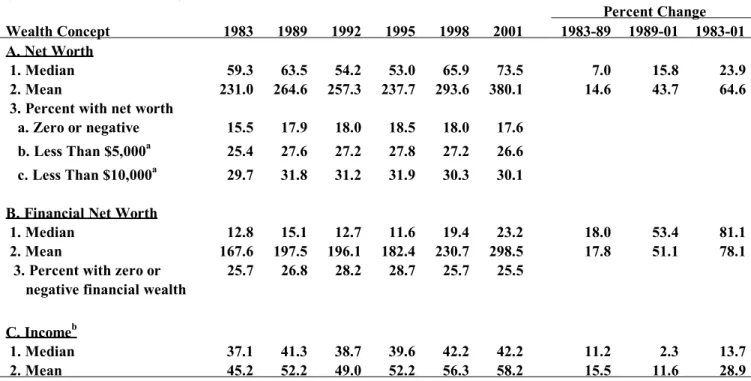
Table 1 documents a robust growth in wealth during the 1990s. Median wealth (the wealth of the household in the middle of the distribution) was 16 percent greater in 2001 than in 1989. After rising by 7 percent between 1983 and 1989, median wealth fell by 17 percent from 1989 to 1995 and then rose by 39 percent from 1995 to 2001. As a result, median wealth grew slightly faster between 1989 and 2001, 1.32 percent per year, than between 1983 and 1989, at 1.13 percent per year. Moreover, as shown in the third row of Panel A, the percentage of households with zero or negative net worth increased from 15.5 percent in 1983 to 17.9 percent in 1989 but fell off a bit to 17.6 percent in 2001. The share of household with net worth less than $5,000 and less than $10,000 (both in 1995 dollars) also declined somewhat between 1989 and 2001.
Mean net worth also showed a sharp increase from 1983 to 1989 followed by a rather precipitous decline from 1989 to 1995 and then, buoyed largely by rising stock prices, another surge in 2001. Overall, it was 65 percent higher in 2001 than in 1983 and 44 percent larger than in 1989.6 In fact mean wealth grew quite a bit faster between 1989 and 2001, at 3.02 percent per year, than from 1983 to 1989, at 2.27 percent per year. Moreover, mean wealth grew almost
5 See Wolff (2002b) for recent estimates of social security and pension wealth.
6 The time trend is very similar when the unadjusted asset values are used instead of my adjusted values and when the value of vehicles is included in net worth. Similar results can also be derived from the estimates provided by Kennickell and Woodburn (1999) for 1989 and 1995.
three times as fast as the median, suggesting widening inequality of wealth over these years. Financial wealth grew even faster than net worth during the 1990s. Median financial wealth rose by 18 percent between 1983 and 1989, then plummeted by 24 percent from 1989 to 1995, and then surged over the next six years, for a net increase of 53 percent between 1989 and 2001 and of 81 percent from 1983 to 2001. Between 1983 and 1995, the fraction of households with zero or negative financial wealth expanded from 25.7 to 28.7 percent but then fell back to 25.5 percent in 2001. Mean financial wealth, after increasing by 18 percent from 1983 to 1989, declined by 8 percent between 1989 and 1995, and then jumped after that, for a net gain of 51 percent between 1989 and 2001 and 78 percent from 1983 to 2001. These increases were almost identical to those for median financial wealth. The bull market was largely responsible for the sharp growth in financial wealth between 1995 and 2001.
Median household income (based on Current Population Survey data), after gaining 11 percent between 1983 and 1989, grew by only 2.3 percent from 1989 to 2001, for a net change of 14 percent. In contrast, mean income rose by 16 percent from 1983 to 1989 and by another 12 percent from 1989 to 2001, for a total change of 30 percent.
In sum, while household income virtually stagnated for the average American household over the 1990s, median net worth and especially median financial wealth grew strongly over this period.
3. WEALTH INEQUALITY SHOWS LITTLE CHANGE OVER THE 1990s
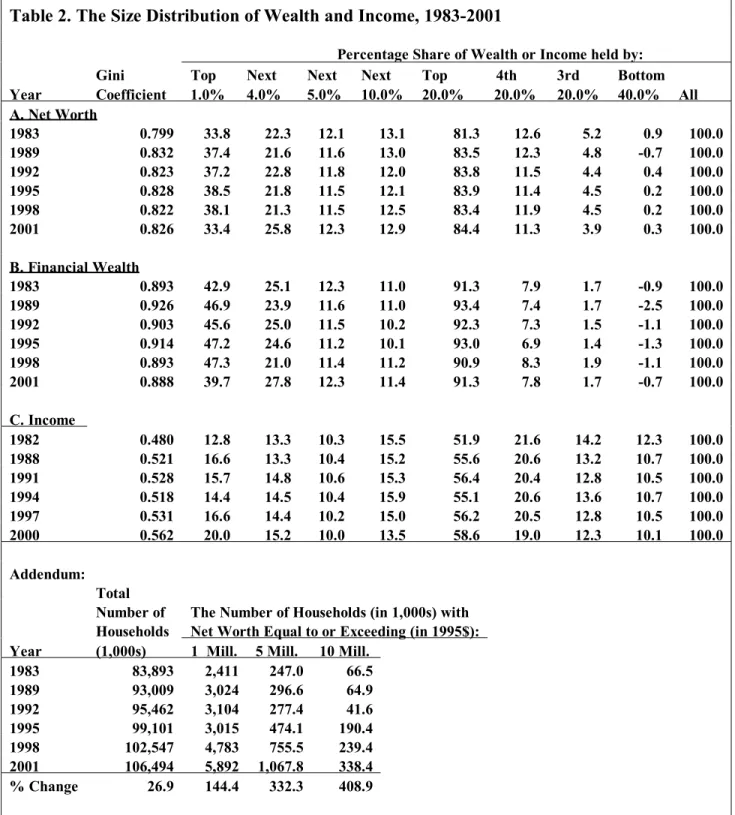
The figures in Table 2 also show that wealth inequality, after rising steeply between 1983 and 1989, remained virtually unchanged from 1989 to 2001. The share of wealth held by the top 1 percent rose by 3.6 percentage points from 1983 to 1989 and the Gini coefficient (a measure of overall inequality) increased from 0.80 to 0.83. Between 1989 and 2001, the share of the top percentile actually declined sharply, from 37.4 to 33.4 percent, though this was almost exactly compensated for by an increase in the share of the next four percentiles. As a result, the share of the top five percent actually increased slightly, from 58.9 to 59.2 percent, as did the share of the top quintile, from 83.5 to 84.4 percent. The share of the fourth and middle quintiles also declined slightly, while that of the bottom 40 percent increased somewhat, so that overall, the Gini
coefficient fell very slightly, from 0.832 to 0.826.
Financial wealth is even more concentrated than net worth, with the richest 1 percent (as ranked by financial wealth) owning 40 percent of total household financial wealth in 2001 (compared to 33 percent for net worth) and the top 20 percent owning 91 percent (compared to 84 percent for net worth). However, the inequality of financial wealth shows a different time trend than net worth. The share of the top one percent gained 4.0 percentage points and the Gini coefficient increased from 0.89 to 0.93 between 1983 and 1989 – trends mirroring those of net worth. However, in the ensuing twelve years, the share of the richest one percent plummeted by seven percentage points, the share of the top five percent fell by three percentage points, and that of the top quintile by two percentage points. The share of the fourth quintile increased by 0.4 percentage points, the share of the middle quintile held its own, and that of the bottom two quintiles rose. As a result, the Gini coefficient fell from 0.93 in 1989 to 0.89 in 2001 and was actually slightly lower in 2001 than in 1983.
The top 1 percent of families (as ranked by income and based on the SCF data) earned 20 percent of total household income in 2000 and the top 20 percent accounted for 59 percent — large figures but lower than the corresponding wealth shares. The time trend for income inequality also contrasts with those for net worth and financial wealth inequality. Income
inequality increased sharply between 1982 and 1988, with the Gini coefficient rising from 0.48 to 0.52 and the share of the top one percent from 12.8 to 16.6 percent. There was then very little change between 1988 and 1997. While the share of the top one percent remained at 16.6 percent of total income, the share of the next 19 percent increased by 0.6 percentage points and the share of the other quintiles lost, so that the Gini coefficient grew slightly, from 0.52 to 0.53. However, between 1997 and 2000, income inequality again surged, with the share of the top percentile rising by 3.4 percentage points, the shares of the other quintiles falling again, and the Gini index advancing from 0.53 to 0.56. As a result, the years from 1989 to 2001 saw almost the same degree of increase in income inequality as the 1983-1989 period.7
7
It should be noted that the SCF data show a much higher level of income inequality than the CPS data. In the year 2000, for example, the CPS data show a share of the top five percent of 22.1 percent and a Gini coefficient of 0.462. The difference is primarily due to two factors. First, the SCF oversamples the rich (as noted above), while the CPS is a representative sample. Second, the income concepts differ between the two samples. In particular, the SCF income definition includes capital gains whereas the CPS definition does not. However, the CPS data also show a large increase of inequality between 1989 and 2000, with the share of the top five percent rising from 18.9
Despite the stability in overall wealth inequality during the 1990s, the decade witnessed a near explosion in the number of very rich households (see the Addendum to Table 2). The
number of millionaires almost doubled between 1989 and 2001, the number of “penta-millionaires” ($5,000,000 or more) increased three and a half times, and the number of “deca-millionaires” ($10,000,000 or more) grew more than five-fold. Much of the growth occurred between 1995 and 2001 and was directly related to the surge in stock prices.
Table 3 shows the absolute changes in wealth and income between 1983 and 1998. The results are even more striking. Over this period, the largest gains in relative terms were made by the wealthiest households. The top one percent saw their average wealth (in 2001 dollars) rise by almost 5 million dollars or by 63 percent. The remaining part of the top quintile experienced increases from 62 to 90 percent and the fourth quintile by 48 percent. While the middle quintile gained 24 percent, the poorest 40 percent lost 44 percent! By 2001, their average wealth had fallen to $2,900.
Another way of viewing this phenomenon is afforded by calculating the proportion of the total increase in real household wealth between 1983 and 2001 accruing to different wealth
groups. This is computed by dividing the increase in total wealth of each percentile group by the total increase in household wealth, while holding constant the number of households in that group. If a group's wealth share remains constant over time, then the percentage of the total wealth growth received by that group will equal its share of total wealth. If a group's share of total wealth increases (decreases) over time, then it will receive a percentage of the total wealth gain greater (less) than its share in either year. However, it should be noted that in these calculations, the households found in each group (say the top quintile) may be different in the two years.
The results indicate that the richest one percent received about one third of the total gain in marketable wealth over the period from 1983 to 2001. The next 4 percent also received close to one third of the total gain and the next 15 percent received another quarter, so that the top
quintile together accounted for 89 percent of the total growth in wealth, while the bottom 80 percent accounted for 11 percent.
to 22.1 percent and the Gini coefficient from 0.431 to 0.462. Further analysis of the difference in income figures between the two surveys is beyond the scope of the present paper.
The pattern of results are similar for financial wealth. The average financial wealth of the richest one percent more than doubled, that of the next richest four percent grew by 86 percent, and that of the next richest 15 percent by about three-quarters. Altogether, the financial wealth of the top quintile gained 94 percent. However, in the case of financial wealth, the fourth and third quintiles also showed substantial gains, of 66 and 61 percent, respectively, and the bottom quintiles also showed positive growth. Of the total growth in financial wealth between 1983 and 2001, 52 percent accrued to the top one percent and 95 percent to the top quintile, while the bottom 80 percent collectively accounted for only 5 percent.
A similar calculation using income data reveals that the greatest gains in real income over the period from 1982 to 2000 were households in the top one percent of the income distribution, who saw their incomes grow by 71 percent. Mean incomes increased by about a third for the next highest nine percent and by 30 percent for the next highest ten percent. Groups in the bottom 80 percent of the income distribution all experienced 25 percent or less real growth in income. Of the total growth in real income between 1982 and 2000, 28 percent was received by the top one percent and 67 percent by the top quintile, with remaining 33 percent distributed among the bottom 80 percent.
These results indicate rather dramatically that despite the stability of inequality of net worth and the decrease of financial wealth inequality during the 1990s, the growth in the economy during the period from 1983 to 2001 was concentrated in a surprisingly small part of the population — the top 20 percent and particularly the top one percent.
4. STOCKS REMAIN HIGHLY CONCENTRATED IN THE HANDS OF THE RICH
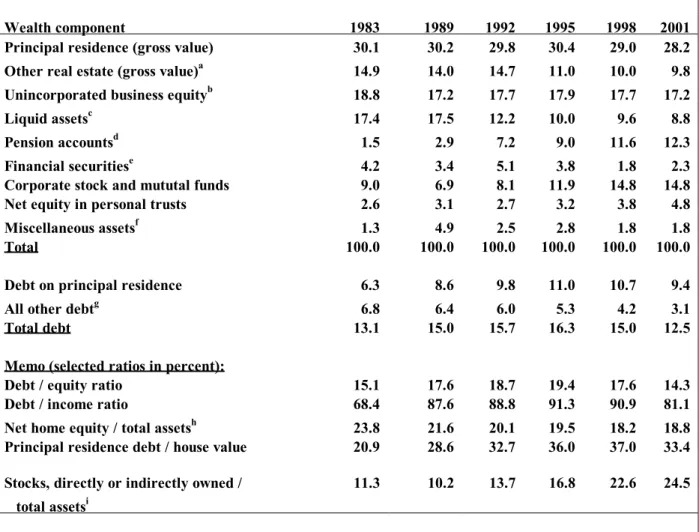
The portfolio composition of household wealth shows the forms in which households save. In 2001, owner-occupied housing was the most important household asset in the breakdown shown in Table 4, accounting for 28 percent of total assets. However, net home equity — the value of the house minus any outstanding mortgage — amounted to only 19 percent of total assets. Real estate, other than owner-occupied housing, comprised 10 percent, and business equity another 17 percent.
of life insurance made up 9 percent and pension accounts 12 percent. Bonds and other financial securities amounted to 2 percent; corporate stock, including mutual funds, to 15 percent; and trust equity to a little less than 5 percent. Debt as a proportion of gross assets was 13 percent, and the debt-equity ratio (the ratio of total household debt to net worth) was 0.14.
There have been some notable trends in the composition of household wealth over the period between 1983 and 2001. The first is that pension accounts rose from 1.5 to 12.3 percent of total assets. This increase largely offset the decline in total liquid assets, from 15.3 to 8.8 percent, so that it is reasonable to conclude that households have substituted tax-free pension accounts for taxable savings deposits.
The second is that gross housing wealth remained almost constant as a share of total assets over this period. Moreover, according to the SCF data, the homeownership rate (the percent of households owning their own home, including mobile homes), after falling from 63.4 percent in 1983 to 62.8 percent in 1989, picked up to 67.7 percent in 2001. However, net equity in owner-occupied housing has fallen almost continuously, from 23.8 percent in 1983 to 18.2 percent in 1998, though it did pick up to 18.8 percent in 2001.
The difference between the two series is attributable to the changing magnitude of
mortgage debt on homeowner's property, which increased from 21 percent in 1983 to 37 percent in 1998 but then fell back to 33 percent in 2001. Overall indebtedness first increased, with the debt-equity ratio leaping from 15.1 percent in 1983 to 19.4 percent in 1995, before falling off to 17.6 percent in 1998 and 14.3 percent in 2001. Likewise, the ratio of debt to total income first surged from 68 percent in 1983 to 91 percent in 1995, leveled off in 1998, and then declined to 81 percent in 2001. Moreover, as we saw above, the fraction of households recording zero or
negative net worth jumped from 15.5 percent in 1983 to 18.0 percent in 1998 and then fell slightly to 17.6 percent in 2001. However, if mortgage debt on principal residence is excluded, then the ratio of other debt to total assets fell off even more, from 6.8 percent in 1983 to 3.1 percent in 2001. One implication is that over the 1990s families have been using tax-sheltered mortgages and home equity loans to finance normal consumption rather than consumer loans and other forms of consumer debt.
The proportion of total assets in the form of other (non-home) real estate fell off sharply, from 15 percent in 1983 to 10 percent in 2001, as did financial securities, from 4.2 to 2.3 percent.
Unincorporated business equity fell slightly as a share of gross wealth over this period. These declines were largely offset by a rise in the share of corporate stock in total assets, from 9.0 in 1983 to 14.8 percent in 2001, reflecting the bull market in corporate equities. However, still in 2001, direct stock ownership ranked only third in total value in this breakdown, behind housing and business equity. However, if we include the value of stocks indirectly owned through mutual funds, trusts, IRAs, 401(k) plans, and other retirement accounts, then the share of total stocks owned shoots up to 25 percent of total assets in 2001 – more than double the share in 1983. This tabulation provides a picture of the average holdings of all families in the economy, but there are marked class differences in how middle-class families and the rich invest their wealth. As shown in Table 5, the richest one percent of households (as ranked by wealth)
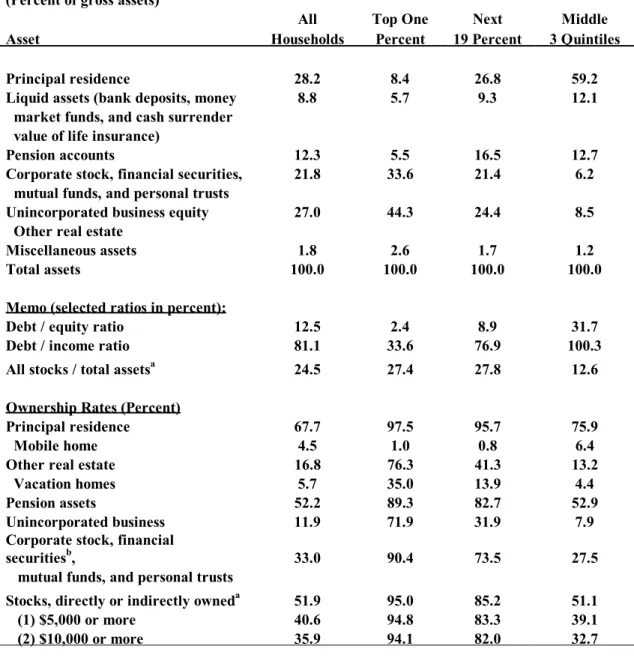
invested almost 80 percent of their savings in investment real estate, businesses, corporate stock, and financial securities in 2001. Corporate stocks, either directly owned by the households or indirectly owned through mutual funds, trust accounts, or various pension accounts, comprised 27 percent by themselves. Housing accounted for only 8 percent of their wealth, liquid assets another 6 percent, and pension accounts another 6 percent. Their ratio of debt to net worth was 2 percent and their ratio of debt to income was 34 percent.
Among the next richest 19 percent of U.S. households, housing comprised 27 percent of their total assets, liquid assets another 9 percent, and pension assets 16 percent. Forty-six percent of their assets took the form of investment assets — real estate, business equity, stocks, and bonds—and 28 percent was in the form of stocks directly or indirectly owned. Debt
amounted to 9 percent of their net worth and 77 percent of their income.
In contrast, almost 60 percent of the wealth of the middle three quintiles (60 percent) of households was invested in their own home in 2001. Another 25 percent went into monetary savings of one form or another and pension accounts. Together housing, liquid assets, and pension assets accounted for 84 percent of the total assets of the middle class. The remainder was about evenly split among non-home real estate, business equity, and various financial securities and corporate stock. Stocks directly or indirectly owned amounted to only 13 percent of their total assets. The ratio of debt to net worth was 32 percent, much higher than for the richest 20 percent, and their ratio of debt to income was 100 percent, also higher than the top quintile.
Almost all households among the top 20 percent of wealth holders owned their own home, in comparison to 76 percent of households in the middle three quintiles. Though this homeownership rate looks large, 6 percent of households in the middle three quintiles reported having a mobile home as their primary residence. Three-quarters of very rich households (in the top percentile) owned some other form of real estate (35 percent owned a vacation home), compared to 41 percent of rich households (those in the next 19 percent of the distribution) and 13 percent of households in the middle 60 percent. Almost 90 percent of the very rich owned some form of pension asset, compared to 83 percent of the rich and 53 percent of the middle. A somewhat startling 72 percent of the very rich reported owning their own business. The
comparable figures are 32 percent among the rich and only 8 percent of the middle class. Among the very rich, 90 percent held corporate stock, mutual funds, financial securities or a trust fund, in comparison to 74 percent of the rich and 28 percent of the middle. Ninety-five percent of the very rich reported owning stock either directly or indirectly, compared to 85 percent of the rich and 51 percent of the middle. If we exclude small holdings of stock, then the ownership rates drop off sharply among the middle three quintiles, from 51 percent to 39 percent for stocks worth $5,000 or more and to 33 percent for stocks worth $10,000 or more.
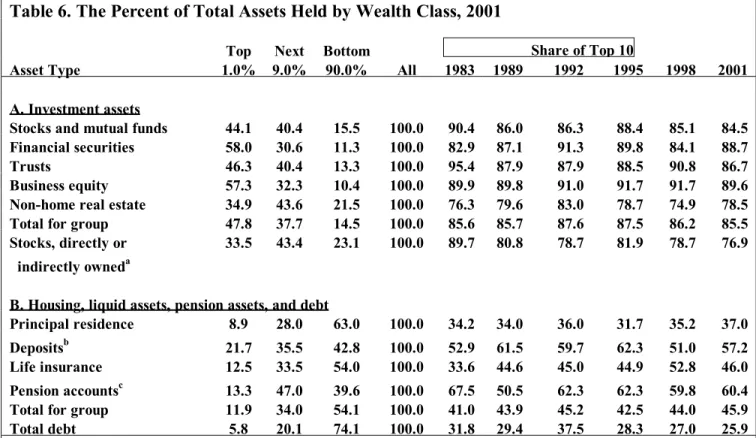
Another way to portray differences between middle class households and the rich is to compute the share of total assets of different types held by each group (see Table 6). In 2001 the richest one percent of households held half of all outstanding stock, financial securities, trust equity, and business equity, and 35 percent of non-home real estate. The top 10 percent of families as a group accounted for about 90 percent of stock shares, bonds, trusts, and business equity, and about 80 percent of non-home real estate. Moreover, despite the fact that 52 percent of households owned stock shares either directly or indirectly through mutual funds, trusts, or various pension accounts, the richest 10 percent of households accounted for 77 percent of the total value of these stocks, only slightly less than its 85 percent share of directly owned stocks and mutual funds.
In contrast, owner-occupied housing, deposits, life insurance, and pension accounts were more evenly distributed among households. The bottom 90 percent of households accounted for 63 percent of the value of owner-occupied housing, about half of deposits and life insurance cash value, and 40 percent of the value of pension accounts. Debt was the most evenly distributed
component of household wealth, with the bottom 90 percent of households responsible for 74 percent of total indebtedness.
There was relatively little change between 1983 and 2001 in the concentration of asset ownership, with three exceptions. First, the share of total stocks and mutual funds held by the richest 10 percent of households declined from 90 to 85 percent over this period, and their share of stocks directly or indirectly owned from 90 to 77 percent. Second, the proportion of total pension accounts held by the top 10 percent fell from 68 percent in 1983 to 51 percent in 1989, reflecting the growing use of IRAs by middle income families, and then rebounded to 60 percent in 2001 from the expansion of 401(k) plans and their adoption by high income earners. Third, the share of total debt held by the top 10 percent also fell from 32 to 26 percent.
5. THE RACIAL DIVIDE GROWS IN THE LATE 1990s
Striking differences are found in the wealth holdings of different racial and ethnic groups. In Tables 7 and 8, households are divided into three groups: (i) Hispanic whites, (ii) non-Hispanic African-Americans, and (iii) non-Hispanics.8 In 2001, while the ratio of mean incomes between non-Hispanic white and non-Hispanic black households was a very low 0.48 and the ratio of median incomes was 0.57, the ratios of mean and median wealth holdings were even lower, at 0.14 and 0.10, respectively, and those of financial wealth still lower, at 0.12 and 0.03, respectively.9 The homeownership rate for black households was 47 percent in 2001, less than two thirds the rate among whites, and the percentage of black households with zero or negative net worth stood at 30.9, more than double the corresponding percentage among whites.
Between 1982 and 2000, while the average real income of non-Hispanic white households increased by 37 percent and the median by 13 percent, the former rose by only 23 percent for non-Hispanic black households and the latter by 15 percent. As a result, the ratio of mean income slipped from 0.54 in 1982 to 0.48 in 2000, while the ratio of median income rose slightly, from 0.56 to 0.57. Between 1983 and 2001, average net worth (in 2001 dollars) rose by a whopping 73
8 The residual group, American Indians and Asians, is excluded here.
9 It should be stressed that the unit of observation is the household, which includes both families (two or more related individuals living together), as well as single adults.
percent for whites but only by 31 percent for black households, so that the net worth ratio fell from 0.19 to 0.14. Most of the slippage occurred between 1998 and 2001, when white net worth surged by a spectacular 34 percent and black net worth advanced by only a respectable 5 percent. Indeed, mean net worth growth among black households was slightly higher in the 1998-2001 years, at 1.55 percent per year, than in the preceding 15 years, at 1.47 percent per year. The difference in the 1998-2001 period was the huge increase in household wealth among white households. In the case of median wealth, the black-white ratio first increased from 7 to 12 percent between 1983 and 1998 and then diminished to 10 percent in 2001. In this case, median wealth for white households grew by 20 percent between 1998 and 2001 but declined in absolute terms by 2 percent among black households.
Average financial wealth also increased somewhat more for black than white households between 1983 and 1998, so that the ratio rose from 13 to 15 percent. However, between 1998 and 2001, mean financial wealth among white households also surged by 34 percent but inched up only 6 percent among black households, so that the ratio dwindled back to 0.12—even lower than in 1983. The median financial wealth of non-Hispanic black households also increased, from virtually zero in 1983 to a positive $1,100 in 2001, and the corresponding ratio also grew, from zero to 3 percent.
The homeownership rate of black households grew from 44.3 to 47.4 percent between 1983 and 2001 but relative to white households, the homeownership rate first increased from a ratio of 0.65 in 1983 to 0.67 in 1998 and then slipped to 0.64 in 2001. The change over the last three years primarily reflects a big jump in the white homeownership rate, of 2.3 percentage points. In contrast, the percentage of black households reporting zero or negative net worth fell from 34.1 percent in 1983 to 27.4 percent in 1998 (and likewise declined relative to white households) but then retreated to 30.9 percent in 2001 (and also rose relative to the corresponding rate for white households).10
The picture is quite similar for Hispanics (see Table 8). The ratios of mean and median income between Hispanics and non-Hispanic whites in 2001 were 0.50 and 0.55,
10
There is a large amount of variation in the income and wealth figures for both blacks and Hispanics on a year by year basis. This is probably a reflection of the small sample sizes for these two groups and the associated sampling variability, as well as some changes in the wording of questions on race and ethnicity over the five surveys.
respectively—about the same as those between African-American and white households. The ratio of mean net worth was 0.17 and the ratio of mean financial wealth 0.14, both slightly higher than the corresponding ratios between black and white households. However, the ratios of medians were 0.03 and 0.01, respectively, lower than those between blacks and whites. The Hispanic homeownership rate was 44 percent, less than that of non-Hispanic black households, and 35 percent of Hispanic households reported zero or negative wealth, compared to 31 percent of African-Americans.
Progress among Hispanic households over the period from 1983 to 2001 is also a mixed story. Mean household income for Hispanics advanced a bit between 1983 and 2001 while median income actually declined slightly, so that the ratio of mean income dropped from 60 to 50 percent and that of median income from 66 to 55 percent. Between 1983 and 1998, mean wealth almost doubled for Hispanic households and mean financial wealth grew more than four-fold but between 1989 and 2001 both declined in absolute terms. As a result, the ratio of mean net worth climbed from 16 percent in 1983 to 25 percent in 1998 and then tumbled to 17 percent in 2001, and the ratio of mean financial wealth jumped from 7 to 20 percent between 1983 and 1998 then fell off to 14 percent in 2001. Median wealth among Hispanics remained largely unchanged, as did median financial wealth (at virtually zero!), so that the ratio of both median wealth and median financial wealth between Hispanics and non-Hispanic whites stayed pretty much the same. On the other hand, the homeownership rate among Hispanic households surged from 33 to 44 percent between 1983 and 2001, and the percentage with zero or negative net worth fell from 40 to 35 percent.
What is also disturbing is that even in 2001, the respective wealth gaps between African-Americans and Hispanics on the one hand and non-Hispanic whites on the other were still much greater than the corresponding income gap. While the income ratios were of the order of 50–55 percent, the wealth ratios were of the order of 12-17 percent. Median financial wealth among non-Hispanic black and Hispanic households was still virtually zero in 2001 and the percent with zero or negative net worth was around a third, in contrast to 13 percent among non-Hispanic white households (a difference that appears to mirror the gap in poverty rates). Moreover, we may speculate that blacks and Hispanics were left out of the wealth surge of the years 1998 to
2001 because of relatively low stock ownership (see Section 8 below for more details).11
6. THE YOUNG ARE GETTING POORER
As shown in Table 9, the cross-sectional age-wealth profiles of 1983, 1989, 1992, 1995, 1998, and 2001 generally follow the predicted hump-shaped pattern of the life-cycle model (see, for example, Modigliani and Brumberg, 1954). Mean wealth increases with age up through age 65 or so and then falls off. Financial wealth has an almost identical profile, though the peak is generally somewhat higher than for net worth. Homeownership rates also have a similar profile, though the fall-off after the peak age is much more attenuated than for the wealth numbers. In 2001, the wealth of elderly households (age 65 and over) averaged 67 percent higher than the non-elderly and their homeownership rate was 15 percentage points higher.
Despite the apparent similarity in the profiles, there have been notable shifts in the relative wealth holdings of age groups between 1983 and 2001. The relative wealth of the
youngest age group, under 35 years of age, expanded from 21 percent of the overall mean in 1983 to 29 percent in 1989, plummeted to 16 percent in 1995 but rebounded to 19 percent in 2001; and that of households between 35 and 44 of age, after rising slightly from 71 percent in 1983 to 72 percent in 1989, dropped to 65 percent in 1995 and then to 64 percent in 2001. In contrast, the wealth of the oldest age group, age 75 and over, gained substantially, from only 5 percent above the mean in 1983 to 32 percent in 1995 but then fell back to 20 percent in 2001. Results for financial wealth are very similar, with the financial wealth of the youngest age group, after climbing from 17 to 28 percent of the overall mean from 1983 to 1989, declining to 19 percent in 2001, while that of the oldest age group rising from 10 percent above the mean in 1983 to 26 percent above the mean in 1995 and then falling back to 11 percent above the mean in 2001.
11
One important reason for the wealth gap is differences in inheritances. According to my calculations from the SCF data, 24.1 percent of white households in 1998 reported receiving an inheritance over their life time, compared to 11.0 percent of black households, and the average bequest among white inheritors was 115 thousand dollars (present value in 1998) and only 32 thousand dollars among black inheritors. Thus, inheritances appear to play a vital role in explaining the large wealth gap, particularly in light of the fact that black families appear to save more than white families at similar income levels (see Blau and Graham, 1990, and Oliver and Shapiro, 1997, for example).
Changes in homeownership rates tend to mirror these trends. While the overall ownership rate increased from 63.4 to 67.7 percent between 1983 and 2001, the share of households in the youngest age group owning their own home increased by only 1.5 percentage points. It fell from 68.4 to 67.6 percent for those between 35 and 44 of age, and from 78.2 to 76.1 percent for those between 45 and 54 of age. The three oldest age groups showed increases, particularly households 75 and over, whose homeownership rate grew by almost seven percentage points. The statistics point to a clear shifting of asset ownership away from younger towards older households between 1983 and 2001 — particularly from 1989 to 1995.
Another dimension is afforded in Table 10 by considering the relative wealth positions of families defined by both age and parental status. It is first of note that childless families were much wealthier than families with children. In 1983, among married couples under the age of 65, the mean net worth of the former group was twice that of the latter, the former's financial wealth was about two and half times greater, and their debt-equity ratio was half as great, though their homeownership rate was about the same. Among female-headed households, the relative
statistics are very similar: mean wealth twice as high, mean financial wealth three times as high, a debt-equity ratio two-thirds as great, and a homeownership rate slightly higher. Moreover, in comparison to married couples age 65 and over, the relative wealth position of families with children was even lower in relative terms. Part of these differences is due to the fact that childless households are, on average, older than those with children and therefore tend to have higher incomes and have had more time to accumulate assets. Another likely reason is that raising children absorbs financial resources and thus reduces household savings.
However, according to the calculations shown in Table 10, the relative position of married couples with children has improved in terms of wealth since the early 1980s. From 1983 to 2001, average net worth (in real terms) climbed by 93 percent among married couples with children but rose by only 46 percent among nonelderly married couples without children and by 47 percent among elderly families. Among female heads under the age of 65, average wealth also grew, by 41 percent for those without children but by only 17 percent among those with children. The results are quite similar for financial wealth, with its average value rising much more among married couples with children than among married couples without children (both elderly and non-elderly). In this case, average financial wealth rose somewhat more among female headed families
with children than among female heads without children. Still, by 2001, both average net worth and financial wealth was still considerably lower among married couples with children than among both elderly and non-elderly married couples without children, and less among female headed families with children than those without children.
Indebtedness (relative to net worth) declined somewhat more for married couples under age 65 with children than couples under age 65 without children, while indebtedness increased somewhat for married couples age 65 and over. The debt-equity ratio actually fell among female-headed families without children, while it grew sharply among female heads with children. Still, by 2001, the debt-equity ratio was about twice as great for non-elderly married couples with children as those without children and much higher among female heads with children than those who were childless. Indebtedness was by far the lowest among the elderly.
Between 1983 and 2001, the homeownership rate rose by 3.1 percentage points among non-elderly married couples with children and by only 0.8 percentage points among non-elderly married couples without children, and by 2001 it was actually slightly greater for the former than the latter. On the other hand, the homeownership rate fell among female-headed families under age 65 with children but rose substantially among female-headed families under age 65 without children, so that the gap widened from 2 percentage points in 1983 to 13 percentage points in 2001. The homeownership rate was by far the highest among elderly married couples in 2001. One may speculate why families with children have done better (in both relative and absolute terms) with regard to their wealth holdings over the period from 1983 to 2001. One reason is that in 2001 families with children tended to be older, on average, than in 1983 and to have fewer children. Another possible reason is that such families have received financial help from their parents. Elderly families, as is evident, have considerably greater financial resources than the non-elderly and it is quite likely that they have transferred wealth to their (grown) children, particularly those with children of their own, in the form of gifts and through bequests. 7. THE RELATION BETWEEN HOUSEHOLD INCOME AND WEALTH GAINS IS A MIXED BAG
shown in Table 11, I divide households into those under age 65 and those 65 and over because the elderly tend to accumulate a large amount of wealth (see Table 10) but after retirement tend to have lower incomes than younger families. Lumping the two groups together might induce a spurious correlation between income and wealth gains due to age.
Wealth and income are strongly correlated, with mean wealth rising monotonically with income for each age group and in each of the five years. It is also of note that among the non-elderly only the top income class reported mean net worth exceeding the national average, while the top three income classes among the elderly did.
Among the non-elderly, there is a very clear relation between income level and wealth gains over the 1983-2001 period, with wealth gains greater the higher the income class. Among those in the lowest income class (under $15,000), net worth actually declined in real terms. Middle income families ($15,000-$49,999) enjoyed only a very modest gain in net worth; the upper middle class ($50,000-$74,999) saw their net worth rise by 27 percent; and those in the top income class saw gains of 33 percent.
The correspondence is less clear among elderly households. By far the largest wealth gains were found among the middle class ($25,000-$49,999), followed in turn by the lowest two
income classes, upper middle income households ($50,000-$74,999), and lastly by the top income class.
8. TRENDS IN STOCK OWNERSHIP, 1983-2001
Tables 12a and 12b report on overall stock ownership trends from 1983 to 2001. The proportion of households who owned corporate stock shares directly declined a bit between 1983 and 1989, from 13.7 to 13.1 percent, while the share that owned any stocks or mutual funds plunged over these years, from 24.4 to 19.9 percent.12 In contrast, the share of households owning stocks and mutual funds worth $5,000 or more (in 1995 dollars) was stable over this period; and, indeed, the proportion with holdings of $10,000 or more and with $25,000 or more actually rose over this
12
The 1983 data do no permit an estimation of indirect stock ownership, so that we present the results for 1983 and 1989 separately from the other years.
period. These changes over the 1983-1989 period might reflect the steep drop in the stock market in 1987 and the consequent exit of small fund holders during and after 1987. Yet, despite a 62 percent real increase in stock prices (as measured by the Standard and Poor 500 index), stocks plus mutual funds as a share of total household asset actually declined form 9.0 percent in 1983 to 6.9 percent in 1989.
In contrast, the years 1989 to 2001 saw a substantial increase in stock ownership (see Table 12b). The share of households with direct ownership of stock climbed from 13.1 percent in 1989 to 21.3 percent in 2001, while the share with some stock owned either outright or indirectly through mutual funds, trusts, or various pension accounts surged from 31.7 to 51.9 percent. Much of the increase was fueled by the growth in pension accounts like IRAs, Keogh plans, and 401(k) plans. Between 1989 and 2001, the share of households owning stock through a pension account more than doubled, accounting for the bulk of the overall increase in stock ownership. Indirect ownership of stocks through mutual funds also greatly expanded over the 1989-2001 period, from 5.9 to 16.7 percent, as did indirect ownership through trust funds, from 1.6 to 5.1 percent. All told, the share of households with indirect ownership of stocks more than doubled, from 23.5 percent in 1989 to 47.7 percent in 2001.
Despite the overall gains in stock ownership, only slightly more than half of all
households had any stake in the stock market by 2001. Moreover, many of these families had only a minor stake. In 2001, while 52 percent of households owned some stock, only 40 percent had total stock holdings worth $5,000 or more (in 1995 dollars), only 35 percent owned $10,000 or more of stock, and only 27 percent owned $25,000 or more of stocks.
However, direct plus indirect ownership of stocks as a percent of total household assets did more than double over these years, from 10.2 in 1989 to 24.5 in 2001. This increase may reflect in large measure the 171 percent surge in stock prices over these years.
Stock ownership is also highly skewed by wealth and income class. As shown in Table 13a, 95 percent of the very rich (the top one percent) reported owning stock either directly or indirectly in 2001, compared to 49 percent of the middle quintile and 21 percent of the poorest 20 percent. While 94 percent of the very rich also reported stocks worth $10,000 or more, only 31 percent of the middle quintile and less than 3 percent of the bottom quintile did so. The top one percent of households owned 34 percent of all stocks, the top five percent over 60 percent,
the top 10 percent over three-quarters, and the top quintile almost 90 percent.
Stock ownership also tails off by income class (see Table 13b). Whereas 94 percent of households in the top 2.7 percent of income recipients (those who earned $250,000 or more) owned stock in 2001, 49 percent of the middle class (incomes between 25 and 50 thousand), 26 percent of the lower middle class (incomes between 15 and 25 thousand), and only 11 percent of poor households (income under $15,000) reported stock ownership. The comparable ownership figures for stock holdings of $10,000 or more are 91 percent for the top one percent, 27 percent for the middle class, 11 percent for the lower middle class, and 5 percent for the poor. Moreover, over three-quarters of all stocks were owned by households earning $75,000 or more (the top 23 percent) and 89 percent by the top forty percent of households in terms of income.
Thus, in terms of wealth or income, substantial stock holdings have still not penetrated much beyond the reach of the rich and the upper middle class. The big winners from the stock market boom of the late 1990s have been these groups, while the middle class and the poor have not seen sizable benefits from the bull market. It is also apparent which groups benefit from the preferential tax treatment of capital gains.
Table 14 provides details on stock ownership among whites and African-Americans in 2001. It is first of note that while the overall ratio of net worth between blacks and whites was 0.14, the wealth ratio was somewhat higher when households are divided by income class. Interestingly, the ratio of net worth was highest among poor households (under $15,000 of income), at 0.39 and second highest among the upper middle class, at 0.35. The ratio declined to 0.28 among lower-middle income households, to 0.24 among middle-income households ($25,000 to $50,000), and then fell off to 0.20 among the rich ($75,000 or more of income).
While 58 percent of white households owned stock, either directly or indirectly, the figure was 34 percent for African-American households. Disparities in the stock ownership rate persist even when households are classified into income class, though the difference attenuates among higher income households. On average, white households who hold stock owned more than five times as much stock as African-American stock holders. Here, again, when households are separated into income class, the ratios are higher but still relatively low, except for the lowest income class where there is virtual parity in average stockholdings. Indeed, in the top income class of $75,000 or more, the ratio of average stock holdings between black and white owners is
only 19 percent, just slightly above the overall ratio. As a result, while 25 percent of the total assets of white households were invested in stocks in 2001, the corresponding figure for black households is only 15 percent. These differences remain by income class though they are generally less marked than the overall discrepancy.
All in all, the greater stock ownership by white households than black households, both in terms of ownership rate and value of stocks, might help to explain the rather precipitous decline in the black-white net worth ratio between 1998 and 2001.
Table 15 shows stock ownership by age and income class. The percent of households owning stock generally rises slowly or remains about constant with age until age group 55-64 and then falls off rapidly with age. The major exceptions are the lowest income class and the middle income class, with stock ownership showing very little relation with age. In contrast, the share of stocks in total assets tends to rise with age across all age classes. However, the patterns are much more erratic by age group among households in bottom two income classes.
Table 16 provides another cut at stock ownership patterns — in this case, with respect to years of education. In this case, the pattern is much stronger. Conditioning on income, stock ownership rates rise directly with years of schooling. Among the middle income class, for
example, the rate grows from 39 percent to 64 percent between those households with less than a high school education to households with 16 or more years of schooling. The same pattern
generally emerges with respect to the share of stocks in total assets, which tends to rise with educational attainment. The effect is strongest in the highest income class, with the share
increasing from 9 percent among households with less than a high school education to 28 percent among those with four years of college or more.
Table 17 cuts stock ownership by marital status and presence of children. Married couples under 65 (both with and without children) have the highest incidence of stock ownership overall, while single mothers with children have the lowest overall. Conditional on income, these patterns generally hold, except for the highest income class, for which stock ownership rates tend to be invariant across marital class. However, no clear pattern emerges between the share of stocks in total assets and marital and parental status.
A summary table on trends in stock ownership by demographic characteristics over the years 1989 to 2001 is given in Table 18. The stock ownership rate rises steeply with income
class in all three years. However, the largest gains in stock ownership over the years from 1989 to 2001 occurred in the three income classes ranging between $25,000 and $99,999. Non-Hispanic whites had the highest rate of stock ownership in all three years, followed closely by Asians, African-Americans (except for 1989), and lastly Hispanics. However, the greatest gain in stock ownership occurred among Asian households, followed by blacks, whites, and lastly Hispanics.
The biggest gain in stock ownership occurred among households under the age of 35, followed by middle-aged households, and then the elderly. As a result, the pattern of stock ownership with respect to age class switched from a U-shaped profile in 1989, with a peak in the 45-54 age group, to one where ownership rates were fairly flat with respect to age up to age 65 and then dropped off sharply. There is a strong correlation between stock ownership rates and education in all three years, as well as between gains in stock ownership and education. The largest gain in stock ownership occurred among college graduates, followed by those with 1-3 years of college, high school graduates, and lastly those with less than 12 years of schooling. 9. SUMMARY AND CONCLUDING COMMENTS
There is mostly good news provided in this report. I find that despite slow growth in income over the 1990s, there have been marked improvements in the wealth position of average families. Both mean and median net worth and financial wealth grew briskly in the late 1990s. The
inequality of net worth leveled off while that of financial wealth showed a marked decline despite the fact that income inequality continued to rise over this period.
However, the number of households worth $1,000,000 or more, $5,000,000 or more, and especially $10,000,000 or more surged during the 1990s. Moreover, the average wealth of the poorest 40 percent declined by 44 percent between 1983 and 2001, and by 2001 had fallen to only $2,900. All in all, the greatest gains in wealth and income were enjoyed by the upper 20 percent, particularly the top one percent, of the respective distributions. Between 1983 and 2001, the top one percent received 33 percent of the total growth in net worth, 52 percent of the total growth in financial wealth, and 28 percent of the total increase in income. The figures for the top 20 percent are 89 percent, 95 percent, and 67 percent, respectively.
Indebtedness also fell substantially during the late 1990s and by 2001 the overall debt-equity ratio was lower than in 1983. The proportion of households reporting zero or negative net worth, after increasing from 15.5 percent in 1983 to 18.0 percent in 1998, fell to 17.6 percent in 2001. Net equity in owner-occupied housing as a share of total assets fell sharply from 23.8 percent in 1983 to 18.2 percent in 1998 and then rebounded somewhat to 18.8 percent in 2001, reflecting rising mortgage debt on homeowner's property between 1983 and 1998, which grew from 21 to 37 percent, before retreating to 33 percent in 2001. The debt-equity ratio was also much higher among the middle 60 percent of households in 2001, at 0.32, than among the top one percent (0.024) or the next 19 percent (0.089).
The concentration of investment type assets generally remained as high in 2001 as during the previous two decades. About 90 percent of the total value of stock shares, bonds, trusts, and business equity, and about 80 percent of non-home real estate were held by the top 10 percent of households. Moreover, despite the widening ownership of stock (52 percent of households owned stock shares either directly or indirectly through mutual funds, trust funds, or pension plans in 2001), the richest 10 percent still accounted for 77 percent of the total value of these stocks.
The racial disparity in wealth holdings, after stabilizing during most of the 1990s,
widened in the years between 1998 and 2001, as the ratio of average net worth holdings dropped sharply from 0.18 to 0.14 and the ratio of median net worth from 0.12 to 0.10. With regard to mean net worth, the reason is that white net worth gained a spectacular 34 percent between 1998 and 2001, black net worth advanced by only 5 percent (a rate that was slightly greater than in previous years). In the case of median net worth, wealth for white households grew by 20 percent between 1998 and 2001 but declined in absolute terms by 2 percent among black
households. Between 1998 and 2001, mean financial wealth among white households also surged by 34 percent but went up by only 6 percent among black households, so that the ratio dwindled from 0.15 to 0.12— even lower than in 1983. The black homeownership rate grew from 44.3 to 47.4 percent between 1983 and 2001 but the homeownership rate relative to white households, after increasing from a ratio of 0.65 in 1983 to 0.67 in 1998, slipped back to 0.64 in 2001. The change over the last three years primarily reflected a big jump in the white homeownership rate.
white households between 1998 and 2001. Between 1998 and 2001, both mean and median net worth and mean financial declined in absolute terms (median financial wealth increased from zero to $200). The ratio of mean net worth, after climbing from 16 percent in 1983 to 25 percent in 1998, collapsed to 17 percent in 2001, and the ratio of mean financial wealth, after jumping from 7 to 20 percent between 1983 and 1998, plummeted to 14 percent in 2001. The homeownership rate among Hispanic households, after advancing from 33 percent in 1983 to 44 percent in 1995, leveled off in the ensuing six years, and the ratio of homeownership rates advanced from 48 percent in 1983 to 64 percent in 1995 and then dropped to 60 percent in 2001.
Still, in 2001, the respective wealth gaps between African-Americans and Hispanics on the one hand and non-Hispanic whites on the other were still much greater than the
corresponding income gap. Racial (and ethnic) differences in net worth remain large even by income class, as do patterns of stock investment. A large part of the reason that both black and Hispanic households lost ground relative to non-Hispanic white households between 1998 and 2001 is traceable to the much lower rate of stock ownership among black and Hispanic families than among (non-Hispanic) whites, even conditional on household income.
At least since 1989, wealth shifted in relative terms away from young households (under age 55) toward households in age group 55 to 74. A similar pattern is found for financial wealth. The average net worth and financial wealth of households in age group 75 and over also fell relative to the overall mean between 1989 and 2001. Moreover, childless couples (both non-elderly and non-elderly) were much wealthier than families with children. However, the relative position of both married couples with children has improved substantially in terms of wealth since the early 1980s.
While the years 1983 to 1989 saw some diminution in stock holdings, the years 1989 to 2001 saw a substantial increase in stock ownership. The share of households with direct
ownership of stock climbed from 13.1 to 21.3, while the share with some stock owned either outright or indirectly through mutual funds, trusts, or various pension accounts surged from 31.7 to 51.9 percent. However, in 2001, while 52 percent of households owned some stock, only 40 percent had total stock holdings worth $5,000 or more (in 1995 dollars), only 35 percent owned $10,000 or more of stock, and only 27 percent owned $25,000 or more of stocks.
households classified by wealth owned 34 percent of all stocks, the top 10 percent over three-quarters, and the top quintile almost 90 percent. Moreover, over three-quarters of all stocks were owned by households earning $75,000 or more and 89 percent by households with incomes of $50,000 or more.
I also find that stock ownership rates in 2001 were higher for non-elderly households (under age 65) than those 65 and over. However, the value of stocks as a share of total assets rose almost directly with age. Between 1989 and 2001, the gain in the stock ownership was strongest among young households (under age 35) and weakest among elderly households. In 2001, both the stock ownership rate and stocks as a share of total assets varied directly with educational attainment, even conditional on the income level of the household. Gains in the stock ownership rate between 1989 and 2001 was also directly correlated with educational attainment.
Though the “wealth” news generally seems very good for the years 1998 to 2001, these results must be interpreted cautiously. A large part of the story of this period is the erosion of traditional Defined Benefit (DB) pension plans and the substitution of Defined Contribution (DC) plans such as 401(k)s for traditional DB pensions. According to standard wealth accounting methods, DC pensions are included in (standard) net worth while DB pension wealth is not. Though this topic is somewhat beyond the scope of the present paper, in related work (Wolff, forthcoming) I show that if we include DB pension wealth as well in our wealth measure, then we find virtually no growth in median wealth and an increase in wealth inequality between 1989 and 2001.
REFERENCES
Avery, Robert B., Gregory E. Elliehausen, and Arthur B. Kennickell. 1988. “Measuring Wealth with Survey Data: An Evaluation of the 1983 Survey of Consumer Finances.” Review of Income and Wealth 34 (5): 339-369.
Blau, Francine D., and John W. Graham. 1990. “Black-White Differences in Wealth and Asset Composition.” Quarterly Journal of Economics 105 (May): 321-339.
Board of Governors of the Federal Reserve System. 1998. “Flow of Funds Accounts of the United States: Flows and Outstanding Second Quarter 1998.” (September 11). Kennickell, Arthur B., Douglas A. McManus, and R. Louise Woodburn. 1996. “Weighting
Design for the 1992 Survey of Consumer Finances.” Federal Reserve Board of Washington (March). Unpublished paper.
Kennickell, Arthur B., and R. Louise Woodburn. 1992. “Estimation of Household Net Worth Using Model-Based and Design-Based Weights: Evidence from the 1989 Survey of Consumer Finances. Federal Reserve Board of Washington (April). Unpublished paper. Kennickell, Arthur B., and R. Louise Woodburn. 1999. “Consistent Weight Design for the 1989,
1992, and 1995 SCFs, and the Distribution of Wealth.” Review of Income and Wealth 45 (2): 193-216.
Modigliani, Franco, and Richard Brumberg. 1954. “Utility Analysis and the Consumption Function: An Interpretation of Cross-Section Data.” In Post-Keynesian Economics, edited by K. Kurihara. New Brunswick, N.J.: Rutgers University Press.
Oliver, Melvin L., and Thomas M. Shapiro. 1997. Black Wealth, White Wealth. New York: Routledge.
U.S. Council of Economic Advisers. 2004. Economic Report of the President, 1994. Washington, D.C.: United States Government Printing Office.
Wolff, Edward N. 1987. “Estimates of Household Wealth Inequality in the United States, 1962-83.” Review of Income and Wealth 33 (3): 231-256.
———. 1994. “Trends in Household Wealth in the United States, 1962-1983 and 1983-1989.” Review of Income and Wealth 40 (2): 143-174.
———. 1996. TOP HEAVY: A Study of Increasing Inequality of Wealth in America. New York: New Press.
———. 1998. “Recent Trends in the Size Distribution of Household Wealth.” Journal of Economic Perspectives 12 (3): 131-150.
———. 2001. “Recent Trends in Wealth Ownership, from 1983 to 1998.” In Thomas M. Shapiro and Edward N. Wolff eds., Assets for the Poor: The Benefits of Spreading Asset Ownership, New York: Russell Sage Press, pp. 34-73.
———. 2002a. TOP HEAVY: A Study of Increasing Inequality of Wealth in America. Newly updated and expanded edition, New York: the New Press.
———. 2002b. Retirement Insecurity: The Income Shortfalls Awaiting the Soon-to-Retire, Washington, D.C.: Economic Policy Institute.
———. Forthcoming. “The Unraveling of the American Pension System, 1983-2001.” In Nelly Ganesan and Teresa Ghilarducci eds., In Search of Retirement Security: The Changing Mix of Social Insurance, Employee Benefits and Personal Responsibility, NASI.
Table 1: Mean and Median Wealth and Income, 1983-2001
(In thousands, 2001 dollars)
Percent Change
Wealth Concept 1983 1989 1992 1995 1998 2001 1983-89 1989-01 1983-01
A. Net Worth
1. Median 59.3 63.5 54.2 53.0 65.9 73.5 7.0 15.8 23.9
2. Mean 231.0 264.6 257.3 237.7 293.6 380.1 14.6 43.7 64.6
3. Percent with net worth
a. Zero or negative 15.5 17.9 18.0 18.5 18.0 17.6
b. Less Than $5,000a 25.4 27.6 27.2 27.8 27.2 26.6
c. Less Than $10,000a 29.7 31.8 31.2 31.9 30.3 30.1
B. Financial Net Worth
1. Median 12.8 15.1 12.7 11.6 19.4 23.2 18.0 53.4 81.1
2. Mean 167.6 197.5 196.1 182.4 230.7 298.5 17.8 51.1 78.1
3. Percent with zero or 25.7 26.8 28.2 28.7 25.7 25.5
negative financial wealth
C. Incomeb
1. Median 37.1 41.3 38.7 39.6 42.2 42.2 11.2 2.3 13.7
2. Mean 45.2 52.2 49.0 52.2 56.3 58.2 15.5 11.6 28.9
Source: own computations from the 1983, 1989, 1992, 1995, 1998, and 2001 Surveys of Consumer Finances. The 1983 weights are the Full Sample 1983 Composite Weights; and the 1989 weights are the average of the SRC-Design-S1 series (X40131) and the SRC designed based weights (X40125). The 1992 calculations are based on the Designed-Base Weights (X42000), with my adjustments (see Wolff, 1996). The 1995 weights are the Designed-Base Weights (X42000). The 1998 and 2001 weights are partially Designed-Based weights (X42001), which account for the systematic deviations from CPS estimates of homeownership by racial/ethnic groups. The 1983, 1989, 1992, and 1995 asset and liability entries are aligned to national balance sheet totals (see Footnote 2). The 1998 and 2001 asset and liability entries are based on original, unadjusted survey data.
a. Constant 1995 Dollars.
b. Source for household income data: U.S. Census of the Bureau, Current Populations Surveys, available on the internet.